

Role of Autophagy on Heavy Metal-Induced Renal Damage and the Protective Effects of Curcumin in Autophagy and Kidney Preservation



Abstract
1. Introduction
2. Curcumin’s Antioxidant Effects and Mitochondrial Protection in Kidney Damage Models
3. Autophagy and Its Evaluation
4. The Autophagy in Heavy Metals Kidney Damage
5. Protective Effects of Curcumin Related to Autophagy Regulation
Summary of Heavy Metals-Induced Autophagy Flux Impairment in Renal Damage
6. Conclusions
Author Contributions
Funding
Acknowledgments
Conflicts of Interest
References
- Moghaddam, N.S.A.; Oskouie, M.N.; Butler, A.E.; Petit, P.X.; Barreto, G.E.; Sahebkar, A. Hormetic effects of curcumin: What is the evidence? J. Cell. Physiol. 2019, 234, 10060–10071. [Google Scholar] [CrossRef] [PubMed]
- Kocaadam, B.; Şanlier, N. Curcumin, an active component of turmeric (Curcuma longa), and its effects on health, Crit. Rev. Food Sci. Nutr. 2017, 57, 2889–2895. [Google Scholar] [CrossRef] [PubMed]
- de Oliveira, M.R.; Jardim, F.R.; Setzer, W.N.; Nabavi, S.M.; Nabavi, S.F. Curcumin, mitochondrial biogenesis, and mitophagy: Exploring recent data and indicating future needs. Biotechnol. Adv. 2016, 34, 813–826. [Google Scholar] [CrossRef] [PubMed]
- Rainey, N.; Motte, L.; Aggarwal, B.B.; Petit, P.X. Curcumin hormesis mediates a cross-talk between autophagy and cell death. Cell Death Dis. 2015, 6, e2003. [Google Scholar] [CrossRef] [PubMed]
- García-Niño, W.R.; Pedraza-Chaverrí, J. Protective effect of curcumin against heavy metals-induced liver damage. Food Chem. Toxicol. 2014, 69, 182–201. [Google Scholar] [CrossRef]
- Liu, F.; Gao, S.; Yang, Y.; Zhao, X.; Fan, Y.; Ma, W.; Yang, D.; Yang, A.; Yu, Y. Antitumor activity of curcumin by modulation of apoptosis and autophagy in human lung cancer A549 cells through inhibiting PI3K/Akt/mTOR pathway. Oncol. Rep. 2018, 39, 1523–1531. [Google Scholar] [CrossRef]
- Mounce, B.C.; Cesaro, T.; Carrau, L.; Vallet, T.; Vignuzzi, M. Curcumin inhibits Zika and chikungunya virus infection by inhibiting cell binding. Antivir. Res. 2017, 142, 148–157. [Google Scholar] [CrossRef]
- Zhang, J.; Tang, L.; Li, G.S.; Wang, J. The anti-inflammatory effects of curcumin on renal ischemia-reperfusion injury in rats. Ren. Fail. 2018, 40, 680–686. [Google Scholar] [CrossRef]
- Huang, L.; Chen, C.; Zhang, X.; Li, X.; Chen, Z.; Yang, C.; Liang, X.; Zhu, G.; Xu, Z. Neuroprotective Effect of Curcumin Against Cerebral Ischemia-Reperfusion Via Mediating Autophagy and Inflammation. J. Mol. Neurosci. 2018, 64, 129–139. [Google Scholar] [CrossRef]
- Jin, T.; Song, Z.; Weng, J.; Fantus, I.G. Curcumin and other dietary polyphenols: Potential mechanisms of metabolic actions and therapy for diabetes and obesity. Am. J. Physiol. Metab. 2018, 314, E201–E205. [Google Scholar] [CrossRef]
- Patel, S.S.; Acharya, A.; Ray, R.S.; Agrawal, R.; Raghuwanshi, R.; Jain, P. Cellular and molecular mechanisms of curcumin in prevention and treatment of disease. Crit. Rev. Food Sci. Nutr. 2019, 1–53. [Google Scholar] [CrossRef] [PubMed]
- Avila-Rojas, S.H.; Tapia, E.; Briones-Herrera, A.; Aparicio-Trejo, O.E.; León-Contreras, J.C.; Hernández-Pando, R.; Pedraza-Chaverri, J. Curcumin prevents potassium dichromate (K2Cr2O7)-induced renal hypoxia. Food Chem. Toxicol. 2018, 121, 472–482. [Google Scholar] [CrossRef] [PubMed]
- Lao, C.D.; Ruffin, M.T.; Normolle, D.; Heath, D.D.; Murray, S.I.; Bailey, J.M.; Boggs, M.E.; Crowell, J.; Rock, C.L.; Brenner, D.E. Dose escalation of a curcuminoid formulation. BMC Complement. Altern. Med. 2006, 6, 10. [Google Scholar] [CrossRef] [PubMed]
- Kim, K.S.; Lim, H.J.; Lim, J.S.; Son, J.Y.; Lee, J.; Lee, B.M.; Chang, S.C.; Kim, H.S. Curcumin ameliorates cadmium-induced nephrotoxicity in Sprague-Dawley rats. Food Chem. Toxicol. 2018, 114, 34–40. [Google Scholar] [CrossRef] [PubMed]
- Soliman, M.M.; Baiomy, A.A.; Yassin, M.H. Molecular and Histopathological Study on the Ameliorative Effects of Curcumin Against Lead Acetate-Induced Hepatotoxicity and Nephrototoxicity in Wistar Rats. Biol. Trace Elem. Res. 2015, 167, 91–102. [Google Scholar] [CrossRef]
- Aparicio-Trejo, O.E.; Tapia, E.; Molina-Jijón, E.; Medina-Campos, O.N.; Macías-Ruvalcaba, N.A.; León-Contreras, J.C.; Hernández-Pando, R.; García-Arroyo, F.E.; Cristóbal, M.; Sánchez-Lozada, L.G.; et al. Curcumin prevents mitochondrial dynamics disturbances in early 5/6 nephrectomy: Relation to oxidative stress and mitochondrial bioenergetics. Biofactors 2017, 43, 293–310. [Google Scholar] [CrossRef] [PubMed]
- Buyuklu, M.; Kandemir, F.M.; Ozkaraca, M.; Set, T.; Bakirci, E.M.; Topal, E. Protective effect of curcumin against contrast induced nephropathy in rat kidney: What is happening to oxidative stress, inflammation, autophagy and apoptosis? Eur. Rev. Med. Pharmacol. Sci. 2014, 18, 461–470. Available online: http://www.ncbi.nlm.nih.gov/pubmed/24610611 (accessed on 28 April 2019).
- Rana, M.N.; Tangpong, J.; Rahman, M.M. Toxicodynamics of Lead, Cadmium, Mercury and Arsenic- induced kidney toxicity and treatment strategy: A mini review. Toxicol. Rep. 2018, 5, 704–713. [Google Scholar] [CrossRef]
- Lentini, P.; Zanoli, L.; Granata, A.; Signorelli, S.S.; Castellino, P.; Dellaquila, R. Kidney and heavy metals - The role of environmental exposure. Mol. Med. Rep. 2017, 15, 3413–3419. [Google Scholar] [CrossRef]
- Wu, W.; Zhang, K.; Jiang, S.; Liu, D.; Zhou, H.; Zhong, R.; Zeng, Q.; Cheng, L.; Miao, X.; Tong, Y.; et al. Association of co-exposure to heavy metals with renal function in a hypertensive population. Environ. Int. 2018, 112, 198–206. [Google Scholar] [CrossRef]
- Abdel-Moneim, A.M.; El-Toweissy, M.Y.; Ali, A.M.; Allah, A.A.M.A.; Darwish, H.S.; Sadek, I.A. Curcumin Ameliorates Lead (Pb2+)-Induced Hemato-Biochemical Alterations and Renal Oxidative Damage in a Rat Model. Biol. Trace Elem. Res. 2015, 168, 206–220. [Google Scholar] [CrossRef] [PubMed]
- Song, X.B.; Liu, G.; Liu, F.; Yan, Z.G.; Wang, Z.Y.; Liu, Z.P.; Wang, L. Autophagy blockade and lysosomal membrane permeabilization contribute to lead-induced nephrotoxicity in primary rat proximal tubular cells. Cell Death Dis. 2017, 8, e2863. [Google Scholar] [CrossRef] [PubMed]
- Liu, F.; Wang, X.Y.; Zhou, X.P.; Liu, Z.P.; Song, X.B.; Wang, Z.Y.; Wang, L. Cadmium disrupts autophagic flux by inhibiting cytosolic Ca 2+ -dependent autophagosome-lysosome fusion in primary rat proximal tubular cells. Toxicology 2017, 383, 13–23. [Google Scholar] [CrossRef] [PubMed]
- Kimura, A.; Ishida, Y.; Nosaka, M.; Kuninaka, Y.; Hama, M.; Kawaguchi, T.; Sakamoto, S.; Shinozaki, K.; Iwahashi, Y.; Takayasu, T.; et al. Exaggerated arsenic nephrotoxicity in female mice through estrogen-dependent impairments in the autophagic flux. Toxicology 2016, 339, 9–18. [Google Scholar] [CrossRef] [PubMed]
- Yan, P.; Sun, X.; Chen, X.; Chen, Y.; Wang, X.; Su, D.; Zhou, H.; Gao, L.; Lu, L.; Wang, J.; et al. The Polyphenolic Compound Curcumin Conjugation with an Alkyne Moiety in the Process of Autophagy. Am. J. Chin. Med. 2018, 46, 673–687. [Google Scholar] [CrossRef]
- Tan, J.; Wang, M.; Song, S.; Miao, Y.; Zhang, Q. Autophagy activation promotes removal of damaged mitochondria and protects against renal tubular injury induced by albumin overload. Histol. Histopathol. 2018, 33, 681–690. [Google Scholar] [CrossRef]
- Yang, X.; Yan, X.; Yang, D.; Zhou, J.; Song, J.; Yang, D. Rapamycin attenuates mitochondrial injury and renal tubular cell apoptosis in experimental contrast-induced acute kidney injury in rats. Biosci. Rep. 2018, 38, BSR20180876. [Google Scholar] [CrossRef]
- Zhu, F.; Chen, M.; Zhu, M.; Zhao, R.; Qiu, W.; Xu, X.; Liu, H.; Zhao, H.; Yu, R.; Wu, X.; et al. Curcumin Suppresses Epithelial—Mesenchymal Transition of Renal Tubular Epithelial Cells through the Inhibition of Akt/mTOR Pathway. Biol. Pharm. Bull. 2017, 40, 17–24. [Google Scholar] [CrossRef]
- Molina-Jijón, E.; Tapia, E.; Zazueta, C.; el Hafidi, M.; Zatarain-Barrón, Z.L.; Hernández-Pando, R.; Medina-Campos, O.N.; Zarco-Márquez, G.; Torres, I.; Pedraza-Chaverri, J. Curcumin prevents Cr(VI)-induced renal oxidant damage by a mitochondrial pathway, Free Radic. Biol. Med. 2011, 51, 1543–1557. [Google Scholar] [CrossRef]
- Li, Y.; Zhang, J.; Liu, H.; Yuan, J.; Yin, Y.; Wang, T.; Cheng, B.; Sun, S.; Guo, Z. Curcumin ameliorates glyoxylate-induced calcium oxalate deposition and renal injuries in mice. Phytomedicine 2019, 61, 152861. [Google Scholar] [CrossRef]
- Molina-Jijón, E.; Aparicio-Trejo, O.E.; Rodríguez-Muñoz, R.; León-Contreras, J.C.; Cárdenas-Aguayo, M.d.; Medina-Campos, O.N.; Tapia, E.; Sánchez-Lozada, L.G.; Hernández-Pando, R.; Reyes, J.L.; et al. The nephroprotection exerted by curcumin in maleate-induced renal damage is associated with decreased mitochondrial fission and autophagy. BioFactors 2016, 42, 686–702. [Google Scholar] [CrossRef] [PubMed]
- Shakeri, A.; Cicero, A.F.G.; Panahi, Y.; Mohajeri, M.; Sahebkar, A. Curcumin: A naturally occurring autophagy modulator. J. Cell. Physiol. 2019, 234, 5643–5654. [Google Scholar] [CrossRef] [PubMed]
- Trujillo, J.; Granados-Castro, L.F.; Zazueta, C.; Andérica-Romero, A.C.; Chirino, Y.I.; Pedraza-Chaverrí, J. Mitochondria as a Target in the Therapeutic Properties of Curcumin. Arch. Pharm. 2014, 347, 873–884. [Google Scholar] [CrossRef] [PubMed]
- Zenkov, N.K.; Chechushkov, A.V.; Kozhin, P.M.; Kandalintseva, N.V.; Martinovich, G.G.; Menshchikova, E.B. Plant phenols and autophagy. Biochemistry 2016, 81, 297–314. [Google Scholar] [CrossRef] [PubMed]
- Ortega-Domínguez, B.; Aparicio-Trejo, O.E.; García-Arroyo, F.E.; León-Contreras, J.C.; Tapia, E.; Molina-Jijón, E.; Hernández-Pando, R.; Sánchez-Lozada, L.G.; Barrera-Oviedo, D.; Pedraza-Chaverri, J. Curcumin prevents cisplatin-induced renal alterations in mitochondrial bioenergetics and dynamic. Food Chem. Toxicol. 2017, 107, 373–385. [Google Scholar] [CrossRef] [PubMed]
- Gaedeke, J.; Noble, N.A.; Border, W.A. Curcumin blocks fibrosis in anti-Thy 1 glomerulonephritis through up-regulation of heme oxygenase 1. Kidney Int. 2005, 68, 2042–2049. [Google Scholar] [CrossRef]
- Ghosh, S.S.; Massey, H.D.; Krieg, R.; Fazelbhoy, Z.A.; Ghosh, S.; Sica, D.A.; Fakhry, I.; Gehr, T.W.B. Curcumin ameliorates renal failure in 5/6 nephrectomized rats: Role of inflammation. Am. J. Physiol. 2009, 296, F1146–F1157. [Google Scholar] [CrossRef]
- Liu, F.H.; Ni, W.J.; Wang, G.K.; Zhang, J.J. Protective role of curcumin on renal ischemia reperfusion injury via attenuating the inflammatory mediators and Caspase-3. Cell. Mol. Biol. 2016, 62, 95–99. Available online: http://www.ncbi.nlm.nih.gov/pubmed/27755959 (accessed on 20 June 2019).
- Guerrero-Hue, M.; García-Caballero, C.; Palomino-Antolín, A.; Rubio-Navarro, A.; Vázquez-Carballo, C.; Herencia, C.; Martín-Sanchez, D.; Farré-Alins, V.; Egea, J.; Cannata, P.; et al. Curcumin reduces renal damage associated with rhabdomyolysis by decreasing ferroptosis-mediated cell death. FASEB J. 2019. [Google Scholar] [CrossRef]
- Pickles, S.; Vigié, P.; Youle, R.J. Mitophagy and Quality Control Mechanisms in Mitochondrial Maintenance. Curr. Biol. 2018, 28, R170–R185. [Google Scholar] [CrossRef]
- Sureshbabu, A.; Ryter, S.W.; Choi, M.E. Oxidative stress and autophagy: Crucial modulators of kidney injury. Redox Biol. 2015, 4, 208–214. [Google Scholar] [CrossRef] [PubMed]
- Hashemzaei, M.; Heravi, R.E.; Rezaee, R.; Roohbakhsh, A.; Karimi, G. Regulation of autophagy by some natural products as a potential therapeutic strategy for cardiovascular disorders. Eur. J. Pharmacol. 2017, 802, 44–51. [Google Scholar] [CrossRef] [PubMed]
- Kaushal, G.P.; Shah, S.V. Autophagy in acute kidney injury. Kidney Int. 2016, 89, 779–791. [Google Scholar] [CrossRef] [PubMed]
- Dikic, I.; Elazar, Z. Mechanism and medical implications of mammalian autophagy. Nat. Rev. Mol. Cell Biol. 2018, 19, 349–364. [Google Scholar] [CrossRef] [PubMed]
- Navarro-Yepes, J.; Burns, M.; Anandhan, A.; Khalimonchuk, O.; del Razo, L.M.; Quintanilla-Vega, B.; Pappa, A.; Panayiotidis, M.I.; Franco, R. Oxidative stress, redox signaling, and autophagy: Cell death versus survival. Antioxid. Redox Signal. 2014, 21, 66–85. [Google Scholar] [CrossRef]
- Wang, Z.; Choi, M.E. Autophagy in Kidney Health and Disease. Antioxid. Redox Signal. 2014, 20, 519–537. [Google Scholar] [CrossRef]
- Lin, F. Autophagy in renal tubular injury and repair. Acta Physiol. 2017, 220, 229–237. [Google Scholar] [CrossRef]
- Luo, B.; Lin, Y.; Jiang, S.; Huang, L.; Yao, H.; Zhuang, Q.; Zhao, R.; Liu, H.; He, C.; Lin, Z. Endoplasmic reticulum stress eIF2α–ATF4 pathway-mediated cyclooxygenase-2 induction regulates cadmium-induced autophagy in kidney. Cell Death Dis. 2016, 7, e2251. [Google Scholar] [CrossRef]
- Yuan, Y.; Ma, S.; Qi, Y.; Wei, X.; Cai, H.; Dong, L.; Lu, Y.; Zhang, Y.; Guo, Q. Quercetin inhibited cadmium-induced autophagy in the mouse kidney via inhibition of oxidative stress. J. Toxicol. Pathol. 2016, 29, 247–252. [Google Scholar] [CrossRef]
- Shi, Q.; Jin, X.; Fan, R.; Xing, M.; Guo, J.; Zhang, Z.; Zhang, J.; Xu, S. Cadmium-mediated miR-30a-GRP78 leads to JNK-dependent autophagy in chicken kidney. Chemosphere 2019, 215, 710–715. [Google Scholar] [CrossRef]
- Liu, G.; Yuan, Y.; Long, M.; Luo, T.; Bian, J.; Liu, X.; Gu, J.; Zou, H.; Song, R.; Wang, Y.; et al. Beclin-1-mediated Autophagy Protects Against Cadmium-activated Apoptosis via the Fas/FasL Pathway in Primary Rat Proximal Tubular Cell Culture. Sci. Rep. 2017, 7, 977. [Google Scholar] [CrossRef] [PubMed]
- Jiang, P.; Mizushima, N. LC3- and p62-based biochemical methods for the analysis of autophagy progression in mammalian cells. Methods 2015, 75, 13–18. [Google Scholar] [CrossRef] [PubMed]
- Ni, H.M.; Bockus, A.; Wozniak, A.L.; Jones, K.; Weinman, S.; Yin, X.M.; Ding, W.X. Dissecting the dynamic turnover of GFP-LC3 in the autolysosome. Autophagy 2011, 7, 188–204. Available online: http://www.ncbi.nlm.nih.gov/pubmed/21107021 (accessed on 21 April 2019). [CrossRef] [PubMed]
- Chargui, A.; Zekri, S.; Jacquillet, G.; Rubera, I.; Ilie, M.; Belaid, A.; Duranton, C.; Tauc, M.; Hofman, P.; Poujeol, P.; et al. Cadmium-induced autophagy in rat kidney: An early biomarker of subtoxic exposure. Toxicol. Sci. 2011, 121, 31–42. [Google Scholar] [CrossRef] [PubMed]
- Chu, B.X.; Fan, R.F.; Lin, S.Q.; Yang, D.B.; Wang, Z.Y.; Wang, L. Interplay between autophagy and apoptosis in lead(II)-induced cytotoxicity of primary rat proximal tubular cells. J. Inorg. Biochem. 2018, 182, 184–193. [Google Scholar] [CrossRef] [PubMed]
- Song, X.; Li, Z.; Liu, F.; Wang, Z.; Wang, L. Restoration of autophagy by puerarin in lead-exposed primary rat proximal tubular cells via regulating AMPK-mTOR signaling. J. Biochem. Mol. Toxicol. 2017, 31, e21869. [Google Scholar] [CrossRef] [PubMed]
- Luo, T.; Zhang, H.; Yu, Q.; Liu, G.; Long, M.; Zhang, K.; Liu, W.; Song, R.; Bian, J.; Gu, J.; et al. ERK1/2 MAPK promotes autophagy to suppress ER stress-mediated apoptosis induced by cadmium in rat proximal tubular cells. Toxicol. Vitr. 2018, 52, 60–69. [Google Scholar] [CrossRef] [PubMed]
- Song, M.F.; Yang, Y.; Yi, Z.W.; Zhang, Z.Q.; Shen, X.D.; Hu, G.H.; Zhu, Y.F. Sema 3A as a biomarker of the activated mTOR pathway during hexavalent chromium-induced acute kidney injury. Toxicol. Lett. 2018, 299, 226–235. [Google Scholar] [CrossRef]
- Chen, P.; Huang, H.P.; Wang, Y.; Jin, J.; Long, W.G.; Chen, K.; Zhao, X.H.; Chen, C.G.; Li, J. Curcumin overcome primary gefitinib resistance in non-small-cell lung cancer cells through inducing autophagy-related cell death. J. Exp. Clin. Cancer Res. 2019, 38, 254. [Google Scholar] [CrossRef]
- Hsiao, Y.T.; Kuo, C.L.; Chueh, F.S.; Liu, K.C.; Bau, D.T.; Chung, J.G. Curcuminoids Induce Reactive Oxygen Species and Autophagy to Enhance Apoptosis in Human Oral Cancer Cells. Am. J. Chin. Med. 2018, 46, 1145–1168. [Google Scholar] [CrossRef] [PubMed]
- Aoki, H.; Takada, Y.; Kondo, S.; Sawaya, R.; Aggarwal, B.B.; Kondo, Y. Evidence That Curcumin Suppresses the Growth of Malignant Gliomas in Vitro and in Vivo through Induction of Autophagy: Role of Akt and Extracellular Signal-Regulated Kinase Signaling Pathways. Mol. Pharmacol. 2007, 72, 29–39. [Google Scholar] [CrossRef] [PubMed]
- Gao, Y.; Li, J.; Wu, L.; Zhou, C.; Wang, Q.; Li, X.; Zhou, M.; Wang, H. Tetrahydrocurcumin provides neuroprotection in rats after traumatic brain injury: Autophagy and the PI3K/AKT pathways as a potential mechanism. J. Surg. Res. 2016, 206, 67–76. [Google Scholar] [CrossRef] [PubMed]
- Maiti, P.; Scott, J.; Sengupta, D.; Al-Gharaibeh, A.; Dunbar, G. Curcumin and Solid Lipid Curcumin Particles Induce Autophagy, but Inhibit Mitophagy and the PI3K-Akt/mTOR Pathway in Cultured Glioblastoma Cells. Int. J. Mol. Sci. 2019, 20, 399. [Google Scholar] [CrossRef]
- Zhu, J.; Zhao, B.; Xiong, P.; Wang, C.; Zhang, J.; Tian, X.; Huang, Y. Curcumin Induces Autophagy via Inhibition of Yes-Associated Protein (YAP) in Human Colon Cancer Cells. Med. Sci. Monit. 2018, 24, 7035–7042. [Google Scholar] [CrossRef] [PubMed]
- Liu, R.; Zhang, H.B.; Yang, J.; Wang, J.R.; Liu, J.X.; Li, C.L. Curcumin alleviates isoproterenol-induced cardiac hypertrophy and fibrosis through inhibition of autophagy and activation of mTOR. Eur. Rev. Med. Pharmacol. Sci. 2018, 22, 7500–7508. [Google Scholar] [CrossRef] [PubMed]
- Hu, J.B.; Li, S.J.; Kang, X.Q.; Qi, J.; Wu, J.H.; Wang, X.J.; Xu, X.L.; Ying, X.Y.; Jiang, S.P.; You, J.; et al. CD44-targeted hyaluronic acid-curcumin prodrug protects renal tubular epithelial cell survival from oxidative stress damage. Carbohydr. Polym. 2018, 193, 268–280. [Google Scholar] [CrossRef] [PubMed]
- Wei, Y.; Gao, J.; Qin, L.; Xu, Y.; Shi, H.; Qu, L.; Liu, Y.; Xu, T.; Liu, T. Curcumin suppresses AGEs induced apoptosis in tubular epithelial cells via protective autophagy. Exp. Ther. Med. 2017, 14, 6052–6058. [Google Scholar] [CrossRef]
- Yao, Q.; Ke, Z.Q.; Guo, S.; Yang, X.S.; Zhang, F.X.; Liu, X.F.; Chen, X.; Chen, H.G.; Ke, H.Y.; Liu, C. Curcumin protects against diabetic cardiomyopathy by promoting autophagy and alleviating apoptosis. J. Mol. Cell. Cardiol. 2018, 124, 26–34. [Google Scholar] [CrossRef]
- Mukhopadhyay, S.; Panda, P.K.; Sinha, N.; Das, D.N.; Bhutia, S.K. Autophagy and apoptosis: Where do they meet? Apoptosis 2014, 19, 555–566. [Google Scholar] [CrossRef]
- Li, G.; Chen, L.; Chen, K. Curcumin Promotes Femoral Fracture Healing in a Rat Model by Activation of Autophagy. Med. Sci. Monit. 2018, 24, 4064–4072. [Google Scholar] [CrossRef]
- Zhang, J.; Wang, J.; Xu, J.; Lu, Y.; Jiang, J.; Wang, L.; Shen, H.M.; Xia, D. Curcumin targets the TFEB-lysosome pathway for induction of autophagy. Oncotarget 2016, 7, 75659–75671. [Google Scholar] [CrossRef] [PubMed]
- Song, J.X.; Sun, Y.R.; Peluso, I.; Zeng, Y.; Yu, X.; Lu, J.H.; Xu, Z.; Wang, M.Z.; Liu, L.F.; Huang, Y.Y.; et al. A novel curcumin analog binds to and activates TFEB in vitro and in vivo independent of MTOR inhibition. Autophagy 2016, 12, 1372–1389. [Google Scholar] [CrossRef] [PubMed]
- He, Y.; Lang, X.; Cheng, D.; Yang, Z. Curcumin ameliorates chronic renal failure in 5/6 nephrectomized rats by regulation of the mTOR/HIF-1α/VEGF signaling pathway. Biol. Pharm. Bull. 2019. [Google Scholar] [CrossRef] [PubMed]
- Vergadi, E.; Ieronymaki, E.; Lyroni, K.; Vaporidi, K.; Tsatsanis, C. Akt Signaling Pathway in Macrophage Activation and M1/M2 Polarization. J. Immunol. 2017, 198, 1006–1014. [Google Scholar] [CrossRef] [PubMed]
- Heras-Sandoval, D.; Pérez-Rojas, J.M.; Hernández-Damián, J.; Pedraza-Chaverri, J. The role of PI3K/AKT/mTOR pathway in the modulation of autophagy and the clearance of protein aggregates in neurodegeneration. Cell Signal. 2014, 26, 2694–2701. [Google Scholar] [CrossRef] [PubMed]
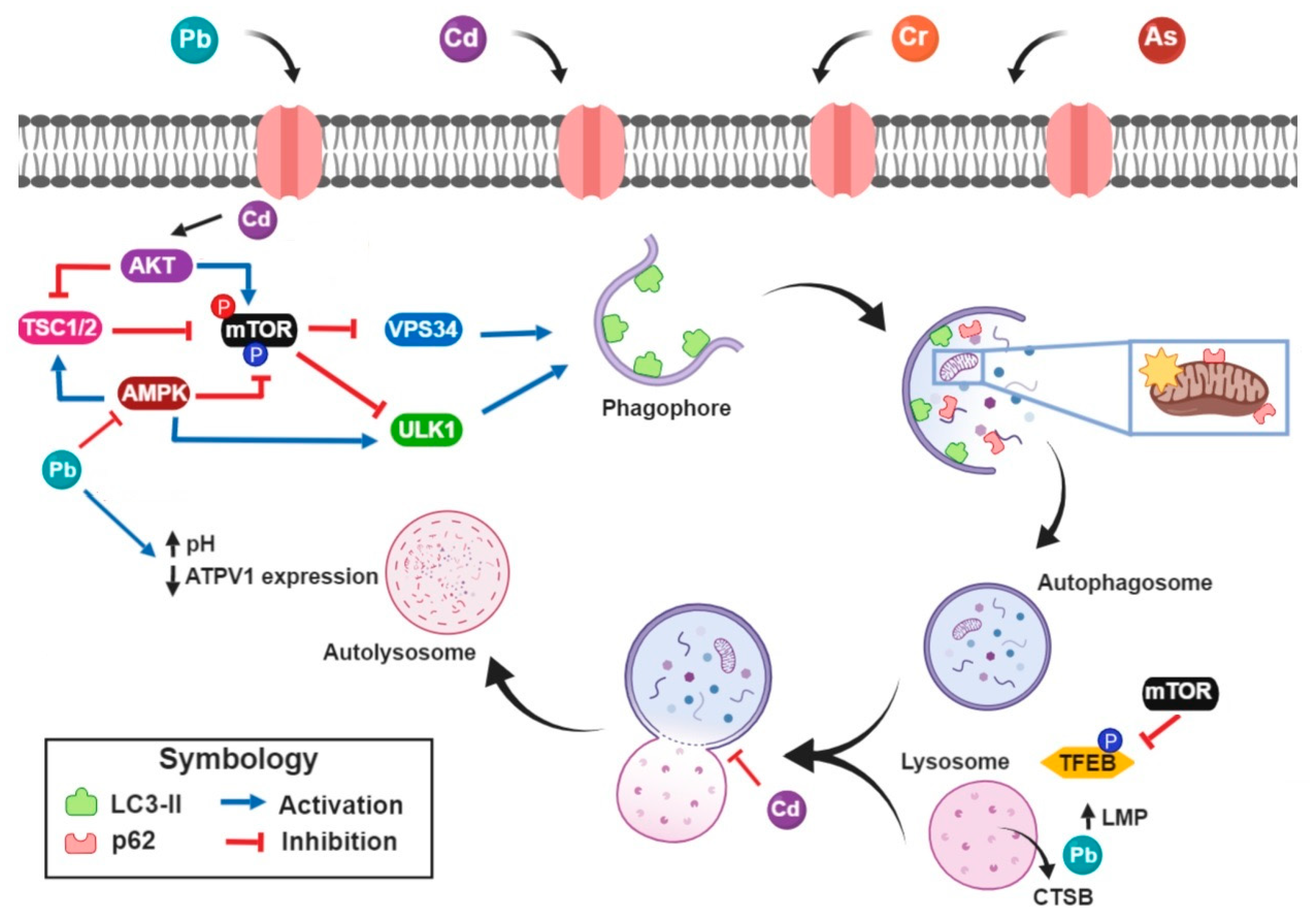

| In Vitro | |||
| Cell Line and Treatment | Effect | Cause/Mechanism | References |
| rPT cells CdCl2 (1.25–5 μM) for 12 h | ↑ LC3-II and p62 protein ↓ Autophagosome-lysosome fusion ↑ Ca2+ cytosolic levels - Chelation (BAPTA-AM and 2-APB): ↑ Autophagosome-lysosome fusion ↑ Fusion machinery (Rab7 expression) | Ca2+ cytosolic overload impairment autophagic flux by autophagosome-lysosome fusion inhibition | [23] |
| HEK cells CdCl2 (0–80 μM) for 3, 6, and 12 h | ↑ LC3-II, p-Akt and COX-2 protein ↓ p62 protein - COX-2 siRNA prevented: Changes in LC3-II, p-Akt, p62 and p-mTOR protein | COX-2 activated autophagy by Akt/mTOR inhibition | [48] |
| PCT cells CdCl2 (5 µM) for 1, 3, and 5 h | ↑ LC3-II expression ↑ Ubiquitinated proteins - CdCl2 + inhibitors 3-MA: LC3-II non expression Baf: ↑↑LC3-II accumulation | Ubiquitinated proteins induced ER stress and autophagy activation as mechanisms to remove and detoxify the cell against CdCl2 toxicity | [54] |
| rPT cells CdCl2 (2.5–5 μM) for 6 and 12 h | ↑ LC3-II and Beclin-1 protein - Interaction between beclin-1 and cleaved caspase-8 - Autophagy activation (rapamycin): ↓ Fas, FasL, FADD and cleaved caspase-8 protein, as well as apoptosis rate | Beclin-1 expression prevented Fas/FasL pathway-mediated apoptosis | [51] |
| rPT cells Pb(NO3)2 (0.5 µM) for 12 h | ↑ LC3-II, p62, Beclin-1 and Atg5 proteins ↑ Autophagosome accumulation ↑ Apoptosis-related proteins (cleaved caspase-3 and cleaved PARP) | Autophagy inhibition is directly involved in Pb(NO3)2-induced apoptosis | [55] |
| rPT cells PbNO3 (0.5 μM) for 12 h | ↑ LC3-II, p62, p-mTOR, p-p70S6K and p-4E-BP1 protein ↑ Autophagosome accumulation ↓ p-AMPK protein | Autophagic flux impairment by deregulation of AMPK/mTOR pathway | [56] |
| rPT cells PbAc2 (0.5 μM) for 12 h | ↑ LC3-II and p62 protein ↑ Autophagosome accumulation ↓ Lysosomal alkalinization ↓ ATP6V1A and ATP6V1B1+ ATPV6VB2 protein subunits ↑ LMP and cathepsins release | Autophagic flux impairment by lysosomal alkalinization and LMP | [22] |
| rTP and NRK-52E cells CdAc2 (2.5–5 μM) for 12 h | ↑ LC3-II, Beclin-1 and Atg5 proteins ↑ Autophagosome accumulation ↓ p62 protein ↑ p-ERK1/2 stimulated autophagy ↑ p-JNK1/2 and p-38 promoted apoptosis - ERK inhibition (U0126): ↑ ER stress-induced apoptosis ↓ Autophagy activation | p-ERK1/2-induced autophagy activation can suppress ER stress-mediated apoptosis | [57] |
| In Vivo | |||
| Male kunming mice CdCl2 (0.4 mg/kg/day, i.p.) for 3 days | ↑ LC3-II/LC3-I ratio ↑ Autophagosome formation | ROS-mediated autophagy | [49] |
| Male ICR mice CdCl2 (0.2 mg to 5 mg/kg/day, i.p.) for 1 week | ↑ LC3-II and COX-2 protein ↓ p62 protein - COX-2 inhibition (celecoxib) prevented: Changes in LC3-II and p62 protein | COX-2 regulates CdCl2-induced autophagy | [48] |
| Female BALB/c mice NaAsO2 (12.5 mg/kg, s.c.) | ↑ LC3-II/LC3-I, p62, SOCS3 and p-ERK/ERK protein ↑ SOCS3 mRNA, but IL-6 was unchanged ↓ p-STAT3/STAT3 protein | Impairment of autophagy flux resulted from ERK activation, by SOCS3 dependent-attenuation of IL-6/STAT3 activation | [24] |
| Female Wistar rats CdCl2 (0.3 mg/kg, i.p.) for 5 days | Glomerular and tubular functions not affected CdCl2 accumulation on renal cortex Structural changes in PCT cells associated to proliferation and autophagy | CdCl2 accumulation generated ubiquitinated proteins, in order to remove them, autophagy was activated | [54] |
| Hyline Brown laying chicken treated with CdCl2 (150 mg/kg in diet supplemented) for 90 days | ↑ Autophagic vesicles ↑ JNK, Beclin-1, Atg5, LC3-I and LC3-II protein and mRNA levels | CdCl2 promotes JNK-dependent autophagy | [50] |
| Experimental Model | Conditions | Curcumin Effect | References |
|---|---|---|---|
| HKC cells | Cells were treated with TGF-β1 (5 ng/mL) alone or combination with curcumin (3.125–25 μM) for 72 h | ↓ Vimentin and α-SMA mRNA and protein levels ↓ p-mTOR, p-Akt, p-p70S6K, and p-4E-BP1 protein ↓ Epithelial-to-mesenchymal transition | [28] |
| MEF cells | 20 μM curcumin for 12 h | ↑ LC3-II and ↓ p62 protein ↑ Lysosomal acidification, enzyme activity of lysosomal cathepsin B and autophagosome-lysosome fusion ↑ Atp6v1a, Atp6voc, and Atp6voe mRNA levels ↓ p-Akt, p-mTOR and p70S6K protein | [25] |
| MEF and HTC116 cells | 20 μM curcumin for 12 h | ↑ LC3-II protein ↓ p62, p-Akt, p-mTOR, p70S6K, and p-TFEB protein ↑ Lysosomal acidification and enzyme activities of lysosomal cathepsin B ↑ Tfeb, Lamp1, and Atp6v1a mRNA levels ↑ TFEB translocation and transcriptional activity In Tsc2-/- MEFs: Curcumin was unable to increase the lysosomal function | [71] |
| Wistar-albino rats | Curcumin for 10 days (200 mg/kg/day, oral). On the 5th day contrast agent was administered | ↓ Kidney damage markers (Scr, BUN) ↓ Lipid peroxidation ↑ Antioxidant activity (SOD, CAT) ↓ LC3-II expression in tubular epithelial cells, podocytes and mesangial cells in the glomeruli and the macula dense ↓ Caspase-3 activation | [17] |
| NRK-52E cells | Co-incubation of AGE (700 μg/mL) with curcumin (10 μM) for 48 h | ↓ Apoptosis-related proteins (Bax, AIF and caspase-3) ↑ LC3-II and Beclin-1 and p-Akt levels 3-MA pretreatment: - Suppression of curcumin-induced apoptosis inhibition LY294002 (PI3K/AKT inhibitor) pretreatment: - Avoided the curcumin-induced autophagy activation | [67] |
| Male C57BL/6 mice and H9c2 cells | STZ-induced diabetic mice were treated with curcumin (200 mg/kg/day in drinking water) for 3 months Cells were co-incubated at high concentrations of D-glucose (30 mM) plus palmitate (0.1 mM) with curcumin for 24 to 36 h. | In both: ↓ Apoptosis-related proteins (cytochrome c and caspase-3 cleaved) ↑ Autophagic-like vesicle formation ↑ p-AMPK, p-JNK, p-Bcl-2, and Bim protein levels ↓ p-mTOR, p-p70S6K, and p-4E-BP1 protein levels In vitro: ↓ Interaction of Beclin1 with Bcl-2 and Bim 3-MA pretreatment: - Suppressed autophagic flux and increase apoptosis rate Inhibition of JNK- and AMPK-activation: - Abolished ability of curcumin to enhance LC3-II formation and to suppress apoptosis | [68] |
| Tubular epithelial (HK-2) cells and ICR male mice | Cells pretreated with H2O2 (200 μM) for 4 h followed by curcumin (20 μg/mL) incubation for 12 h Curcumin (10 mg/kg, i.v.) was administered to animals in an ischemia (30 min)/reperfusion (24 h) model | In vitro: ↓ Apoptosis (caspase-3 and -9) ↑ Autophagic-like vesicle formation and LC3-II protein ↓ p62, p-Akt and p-mTOR protein In vivo: ↓ Kidney damage markers (Scr, BUN) ↓ Tubular necrosis, luminal congestion, and pro-inflammatory cytokine (TNF-α and IL-6) | [66] |
| Male Sprague-Dawley rats | Rats that underwent 5/6 nephrectomy were administered with curcumin (75 mg/day, oral) for 6 weeks. | ↓ Kidney damage markers (Scr, BUN and proteinuria) ↓ Glomerular hypertrophy, tubular dilation, and fibrosis ↓ mTOR, p-mTOR, p-p70S6K, and p-4E-BP1 | [73] |
© 2019 by the authors. Licensee MDPI, Basel, Switzerland. This article is an open access article distributed under the terms and conditions of the Creative Commons Attribution (CC BY) license (http://creativecommons.org/licenses/by/4.0/).
Share and Cite
Avila-Rojas, S.H.; Lira-León, A.; Aparicio-Trejo, O.E.; Reyes-Fermín, L.M.; Pedraza-Chaverri, J. Role of Autophagy on Heavy Metal-Induced Renal Damage and the Protective Effects of Curcumin in Autophagy and Kidney Preservation. Medicina 2019, 55, 360. https://doi.org/10.3390/medicina55070360
Avila-Rojas SH, Lira-León A, Aparicio-Trejo OE, Reyes-Fermín LM, Pedraza-Chaverri J. Role of Autophagy on Heavy Metal-Induced Renal Damage and the Protective Effects of Curcumin in Autophagy and Kidney Preservation. Medicina. 2019; 55(7):360. https://doi.org/10.3390/medicina55070360
Chicago/Turabian StyleAvila-Rojas, Sabino Hazael, Alejandra Lira-León, Omar Emiliano Aparicio-Trejo, Laura María Reyes-Fermín, and José Pedraza-Chaverri. 2019. "Role of Autophagy on Heavy Metal-Induced Renal Damage and the Protective Effects of Curcumin in Autophagy and Kidney Preservation" Medicina 55, no. 7: 360. https://doi.org/10.3390/medicina55070360
APA StyleAvila-Rojas, S. H., Lira-León, A., Aparicio-Trejo, O. E., Reyes-Fermín, L. M., & Pedraza-Chaverri, J. (2019). Role of Autophagy on Heavy Metal-Induced Renal Damage and the Protective Effects of Curcumin in Autophagy and Kidney Preservation. Medicina, 55(7), 360. https://doi.org/10.3390/medicina55070360

