1. Introduction
Skatole (3-methylindole) is the most representative indolic odorant in livestock manure, generated through the anaerobic metabolism of tryptophan by gut microbiota. Owing to its extremely low olfactory threshold and persistent malodor, skatole has become a core target pollutant for odor control in animal farming [
1]. Conventional deodorization methods, such as physical adsorption and chemical oxidation, often suffer from high operational costs and the risk of secondary pollution. By contrast, microbial degradation has emerged as the dominant technological pathway for livestock manure odor mitigation due to its environmental friendliness, low cost, and capacity for in situ remediation. The isolation of functional microbial strains with efficient skatole-degrading capabilities is therefore a critical prerequisite for the practical implementation of this biotechnology [
2,
3].
A growing body of literature has documented the diversity of skatole-degrading microorganisms isolated from various environmental matrices, including livestock manure, rumen fluid, activated sludge, and contaminated soils. A recent comprehensive review by Xu et al. [
4] summarized the current advances in microbial skatole degradation, covering bacterial genera such as
Pseudomonas,
Acinetobacter,
Sphingobacterium,
Lactobacillus, and
Bacillus, as well as the proposed degradation pathways involving hydroxylation, ring cleavage, and subsequent mineralization. Among these, strains of the genus
Bacillus have attracted particular attention due to their ability to form endospores, which confers exceptional tolerance to heat, desiccation, and environmental stress—properties highly advantageous for the formulation and storage of bio-inoculants for field application. However, compared with other genera, the number of
Bacillus strains explicitly characterized for skatole degradation remains limited. For instance, Wang et al. [
5] isolated skatole-degrading bacteria from bovine rumen and reported a
Bacillus strain that achieved 23.03% degradation of 100 mg/L skatole within 48 h. Xu et al. [
6] screened deodorizing strains from chicken manure and identified a
Bacillus isolate capable of removing 44.5% of 10 mg/L skatole within 24 h. In addition, dietary supplementation with
Bacillus subtilis has been shown to modulate intestinal microbiota and reduce odorant emissions in weaned piglets [
7], further supporting the potential of
Bacillus-based approaches for manure deodorization. Nevertheless, the skatole degradation efficiencies reported for
Bacillus strains to date remain relatively modest, and the genomic basis underlying their degradation capacity and environmental adaptability remains poorly characterized.
Members of the genus
Bacillus are characterized by strong environmental adaptability, the ability to form endospores that confer tolerance to high temperatures, heavy metals, disinfectants, and other stresses, and the genetic potential to secrete various oxidases and hydrolases, making them widely applicable in the biodegradation of organic pollutants [
8]. As a typical species of this genus,
Bacillus pumilus has been extensively studied for plant growth promotion and disease antagonism, but its potential for environmental bioremediation—particularly the degradation of indolic malodorants—remains underexplored. Systematic investigations into its skatole-degrading function and underlying molecular mechanisms are still lacking, and comprehensive genomic evidence for its biotechnological application is limited [
9]. Moreover, residual heavy metals, various veterinary antibiotics, and disinfectants in livestock manure can severely inhibit the survival and functionality of degrading bacteria; therefore, the isolation of indigenous strains that combine high degradation efficiency with broad stress resistance is crucial for practical applications in manure environments [
10].
Polyphasic taxonomy represents the standard system for accurate prokaryotic species delineation, integrating colony and cell morphology, chemotaxonomy (whole-cell fatty acid profiling), physiological and biochemical characteristics, and single- or multi-locus housekeeping gene phylogeny, thereby effectively avoiding the identification bias inherent in any single method [
11]. While 16S rRNA gene sequencing remains the cornerstone of bacterial identification, closely related
Bacillus species often exhibit >99% 16S rRNA sequence similarity, necessitating the use of additional housekeeping genes (e.g.,
gyrB,
rpoB,
recA) and, ideally, whole-genome-based methods such as average nucleotide identity (ANI) for definitive species assignment [
12]. High-throughput whole-genome sequencing and bioinformatic annotation can further elucidate the functional repertoire of a strain at the genetic level, including carbon metabolism, aromatic pollutant degradation, environmental stress resistance, and biosafety, thereby revealing the molecular basis of skatole degradation and the mechanisms of environmental adaptation [
13]. These genomic approaches are essential for evaluating the biotechnological potential of newly isolated strains.
In this study, we aimed to (i) isolate and identify a skatole-degrading B. pumilus strain from cattle manure using polyphasic taxonomy, supplemented by genome-based taxonomic comparisons; (ii) evaluate its skatole degradation efficiency under controlled laboratory conditions; (iii) characterize its genome through high-throughput sequencing and comprehensive bioinformatic annotation; and (iv) annotate genes putatively involved in xenobiotic degradation, stress resistance, and biosafety to assess its biotechnological potential for manure deodorization. The results provide a microbial resource and genomic framework for the development of bio-based deodorization technologies in livestock production, while also identifying key knowledge gaps requiring future functional validation.
2. Materials and Methods
2.1. Chemicals and Reagents
Bacillus Medium (HB8786, Hopebio, Qingdao, China), sterile Petri dishes, absolute ethanol, a LiChrospher® RP-18 HPLC column (5 μm particle size, 25 cm × 4.6 mm i.d., Sigma-Aldrich, St. Louis, MO, USA), acetonitrile (HPLC grade), methanol (HPLC grade), 2-methylindole (2-MI, Macklin, Shanghai, China), Tris buffer, 0.22 μm organic membrane filters, syringes, 3-methylindole (3-MI, skatole, Macklin, Shanghai, China), 2 mL autosampler vials, and sterile physiological saline were used.
2.2. Isolation and Screening of Skatole-Degrading Bacteria
Fresh cattle manure (100 g) was collected from Changji (China) and suspended in 900 mL sterile physiological saline. The suspension was shaken at 37 °C and 100 rpm for 1 h to release endogenous microorganisms. The suspension was serially diluted (10−1 to 10−6), and 100 μL aliquots of each dilution were spread onto Bacillus selective agar plates containing 100 mg/L skatole. After incubation at 37 °C for 24 h, ten morphologically distinct single colonies were picked and individually enriched in 5 mL Bacillus liquid medium at 37 °C, 180 rpm for 24 h. The isolates were further purified by streak plating on Bacillus agar.
For degradation capacity screening, each purified isolate was inoculated into 100 mL
Bacillus liquid medium supplemented with 100 mg/L skatole in 250 mL Erlenmeyer flasks, at an initial optical density at 600 nm (OD
600) of 0.1. The cultures were incubated at 37 °C with shaking at 180 rpm for 96 h. Uninoculated
Bacillus liquid medium containing 100 mg/L skatole was included as an abiotic control to account for volatilization and adsorption losses. All experiments were performed in 3 independent biological replicates. After 96 h, residual skatole concentrations were determined by HPLC as described in
Section 2.3. The strain exhibiting the highest skatole removal was designated hhy901 and selected for subsequent polyphasic taxonomic identification at the Agricultural Culture Collection of China (ACCC) and whole-genome sequencing performed by Shanghai Majorbio Bio-pharm Technology Co., Ltd.
2.3. Skatole Quantification
For detailed degradation kinetics, strain hhy901 was cultured in
Bacillus liquid medium containing 100 mg/L skatole under the same conditions described in
Section 2.2. Samples (2 mL) were collected at 0, 12, 24, 48, 72, and 96 h. Each sample was centrifuged at 12,000×
g for 10 min at 4 °C, and the supernatant was filtered through a 0.22 μm organic membrane filter into 2 mL autosampler vials for HPLC analysis.
Skatole concentration was determined by high-performance liquid chromatography (HPLC) using an Agilent 1260 Infinity II system equipped with a LiChrospher
® RP-18 column (5 μm, 25 cm × 4.6 mm i.d., Sigma-Aldrich, St. Louis, MO, USA) and a fluorescence detector (FLD). The fluorescence detection conditions were set at an excitation wavelength of 270 nm and an emission wavelength of 352 nm. The mobile phase consisted of water, acetonitrile, and methanol at a ratio of 50:40:10 (
v/
v/
v). The column temperature was maintained at 35 °C, the flow rate was set at 1.0 mL/min, and the injection volume was 10 μL. The total run time for each sample was 15 min. For accurate quantification, 2-methylindole (2-MI) was used as an internal standard to minimize operational errors introduced during sample processing and improve the reliability of the results. The internal standard solution was prepared as 0.05 M Tris buffer containing 10 μg/mL 2-MI. Skatole was quantified using an internal standard calibration curve prepared from authentic skatole standards at concentrations of 1, 5, 10, 20, 50, 100, and 200 μg/mL [
14].
Sample pretreatment prior to HPLC analysis was performed as follows: (1) 100 μL of the culture supernatant was mixed with 400 μL of HPLC-grade acetonitrile; (2) 500 μL of 0.05 M Tris buffer containing 10 μg/mL 2-MI (internal standard) was added; (3) the mixture was thoroughly vortexed and filtered through a 0.22 μm organic membrane filter to obtain the sample for injection. The degradation percentage was calculated as:
where C
0 is the initial skatole concentration and C
t is the residual skatole concentration at time t. Values were corrected for abiotic losses measured in the uninoculated control. The degradation rate (mg/L/h) was calculated as the total mass of skatole degraded divided by the incubation time. All data are presented as mean ± standard deviation (SD) of 3 biological replicates. Statistical significance was assessed by one-way ANOVA followed by Tukey’s post hoc test using SPSS 26.0, with
p < 0.05 considered statistically significant (
Supplementary Table S1).
2.4. 16S rRNA and gyrB Gene Amplification and Sequencing
The 16S rRNA and gyrB gene amplification and sequencing were performed by the Agricultural Culture Collection of China (ACCC). The 16S rRNA gene was amplified using the universal bacterial primers 27F (5′-GTTTGATCMTGGCTCAG-3′) and 1492R (5′-TACGGYTACCTTGTTACGACTT-3′). The gyrB gene fragment was amplified with the degenerate primers UP-1 (5′-GAAGTCATCATGACCGTTCTGCAYGCNGGNGGNAARTTYGA-3′) and UP-2r (5′-AGCAGGATACGGATGTGCGAGCCRTCNACRTCNGCRTCNGTCAT-3′). PCR products were purified and sequenced bidirectionally. PCR products were purified and sequenced bidirectionally by the ACCC.
2.5. Morphological and Staining Characteristics
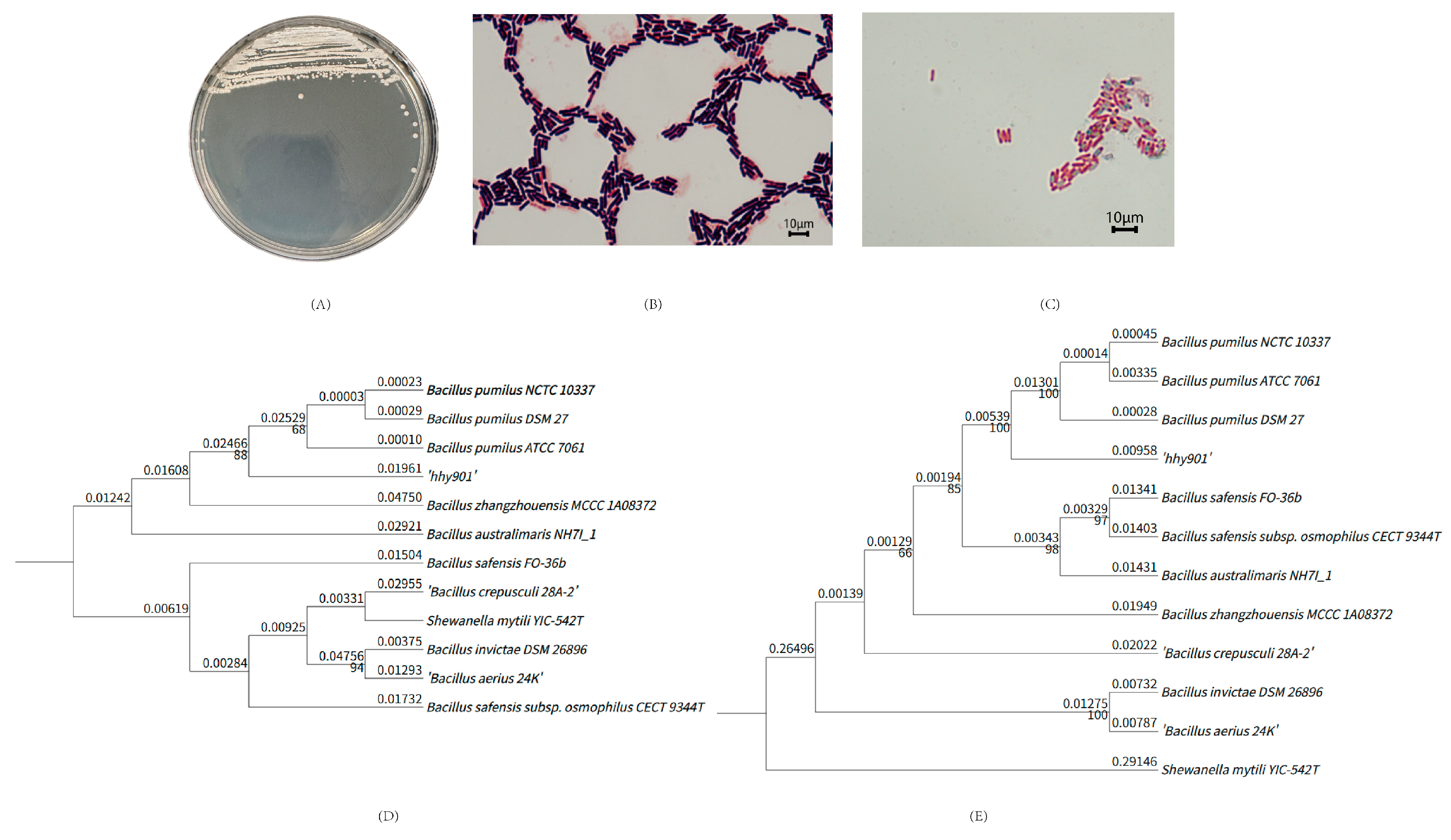
Morphological and staining characterization was performed by the ACCC. Strain hhy901 was streaked onto Trypticase Soy Agar (TSA) and incubated at 30 °C for 24 h. Colony morphology (shape, elevation, margin, surface wrinkling, and color) was observed and photographed. Gram staining and endospore staining were performed, and cell morphology, Gram reaction, and spore formation were examined under a light microscope.
2.6. Physiological and Biochemical Characterization
Physiological and biochemical characterization, including API 50CH carbon source utilization and whole-cell fatty acid analysis, was performed by the ACCC. Carbon source utilization was tested using the API 50CH system (bioMérieux, Marcy-l’Étoile, France) following the manufacturer’s instructions. Results were recorded as positive (+), weakly positive (w), or negative (−). For whole-cell fatty acid analysis, strain hhy901 was grown in Tryptic Soy Broth to the stationary phase, and fatty acids were extracted, saponified, methylated, and identified by gas chromatography using the MIDI Sherlock Microbial Identification System. Relative percentages of fatty acids were compared with the typical profile of the genus Bacillus for chemotaxonomic assignment.
2.7. Whole-Genome Sequencing and Bioinformatics
Whole-genome sequencing was performed by Shanghai Majorbio Bio-pharm Technology Co., Ltd. (Shanghai, China) using a combined PacBio and Illumina sequencing strategy. For PacBio single-molecule real-time (SMRT) sequencing, genomic DNA was sheared to 8–10 kb fragments using G-tubes. Sequencing was performed on a PacBio Sequel II platform. For Illumina sequencing sequenced on an Illumina NovaSeq 6000 platform with 2 × 150 bp paired-end reads (data were deposited in NCBI under accession number SAMC8439660).
Raw PacBio reads were filtered and assembled de novo using Flye v2.9.2 (
https://github.com/mikolmogorov/Flye (accessed on 31 August 2026)). The resulting assembly was polished using Pilon v with Illumina short reads to correct base-level errors. Illumina raw reads were quality-filtered using fastp v0.20.0 (
https://github.com/OpenGene/fastp (accessed on 31 August 2026)) with the following criteria: removal of adapter sequences, trimming of bases with quality score < 20, and discarding reads with length < 50 bp.
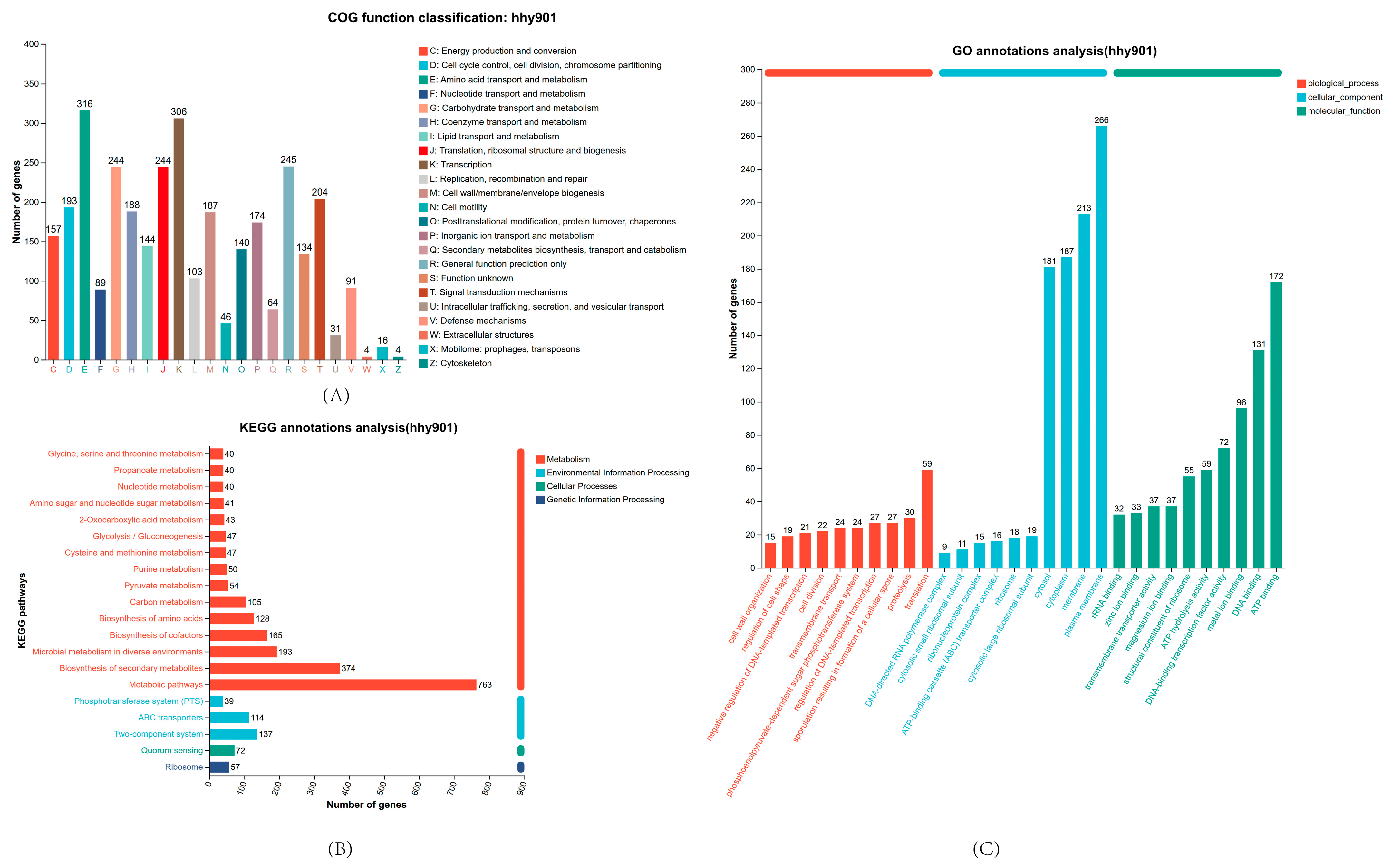
Gene prediction was carried out with Prodigal v for the chromosome, identifying a total of 3564 protein-coding sequences. Transfer RNAs were predicted using tRNAscan-SE, and ribosomal RNAs were predicted using Barrnap. Functional annotation was conducted by BLASTP searches (e-value threshold: 1 × 10⁻⁵) against the NCBI Non-Redundant (NR) database, Swiss-Prot, Pfam, Clusters of Orthologous Groups (COG), Kyoto Encyclopedia of Genes and Genomes (KEGG), and Gene Ontology (GO) databases.
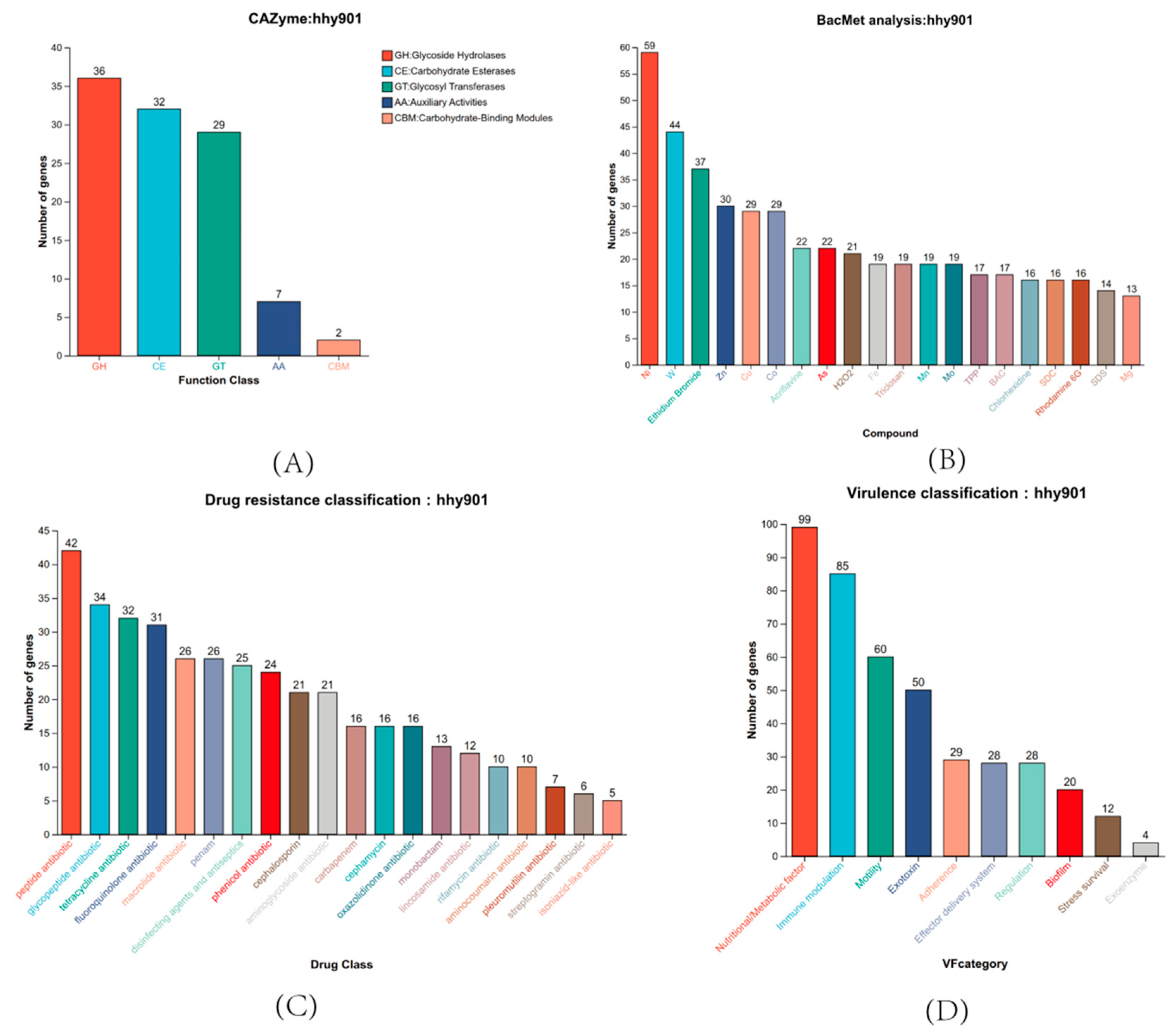
Antibiotic resistance genes were identified using the Comprehensive Antibiotic Resistance Database (CARD, Version 1.1.3) and ResFinder (
https://cge.cbs.dtu.dk/services/ResFinder/ (accessed on 31 August 2026)). Heavy metal and disinfectant resistance genes were annotated using the BacMet database. Virulence factors were identified by BLAST (version 2.17.0) searches against the Virulence Factor Database (VFDB). Mobile genetic elements, including genomic islands (GIs), prophages, insertion sequences (IS), integrons, and CRISPR-Cas systems, were predicted using the Majorbio cloud platform. For genome-based taxonomic confirmation, average nucleotide identity (ANI) was calculated between strain hhy901 and closely related
Bacillus species using the Majorbio cloud platform based on Mash distance and whole-genome comparison.
2.8. Data Analysis
Homology searches for 16S rRNA and gyrB gene sequences were performed against the EzBioCloud (
https://www.ezbiocloud.net/; accessed on 15 July 2026) and NCBI (
https://www.ncbi.nlm.nih.gov/; accessed on 15 July 2026) databases [
15]. Phylogenetic trees were reconstructed using the neighbor-joining method in MEGA 11 (jointly developed by Temple University, USA, and Tokyo Metropolitan University, Japan) with 1000 bootstrap replicates. For genome-based taxonomic analysis, the Type (Strain) Genome Server (TYGS,
https://tygs.dsmz.de/ (accessed on 31 August 2026)) was employed to calculate pairwise digital DNA–DNA hybridization (dDDH) values using the GGDC 3.0 formula and to infer a whole-genome blast distance phylogeny (GBDP) tree with 100 pseudo-bootstrap replicates [
16,
17]. The average nucleotide identity (ANI) was calculated using the OrthoANIu algorithm. The taxonomic position of strain hhy901 was determined according to standard polyphasic criteria based on morphological, biochemical, chemotaxonomic, and molecular phylogenetic data, supplemented by genome-based ANI and dDDH comparisons. All figures were generated using GraphPad Prism 9 (GraphPad Software, San Diego, CA, USA) and finalized in Adobe Illustrator (Adobe Systems, San Jose, CA, USA, version 30.7).
4. Discussion
This study isolated and characterized a skatole-degrading bacterium, B. pumilus hhy901, from bovine manure, and integrated polyphasic taxonomy, degradation assays, and whole-genome sequencing to evaluate its biotechnological potential for livestock manure deodorization. The strain achieved 87.12% removal of 100 mg/L skatole within 96 h, and its genome encodes a broad repertoire of genes potentially associated with aromatic compound degradation, environmental stress resistance, and survival in complex microbial communities. Below, we discuss the significance of these findings in the context of current knowledge, while explicitly distinguishing between experimentally demonstrated phenotypes and genomically inferred potential.
4.1. Taxonomic Identification
The polyphasic taxonomic approach—combining 16S rRNA and gyrB gene phylogeny, morphological characterization, biochemical profiling, and whole-cell fatty acid analysis—initially assigned strain hhy901 to
B. pumilus. However, as noted in the Results, the 16S rRNA gene sequence shared equally high similarity (99.93%) with both
B. pumilus ATCC 7061T and
B. zhangzhouensis DW5–4T [
21], reflecting the well-documented limitation of 16S rRNA sequencing for species delineation within the
B. pumilus clade [
12]. To resolve the taxonomic position definitively, we employed whole-genome-based approaches including ANI and TYGS dDDH analyses. The ANI value of 95.73% with
B. pumilus ATCC 7061T exceeded the 95% species delimitation threshold, and the TYGS phylogenomic tree placed hhy901 within the
B. pumilus clade. Notably, the dDDH d4 value (64.3%) was below the conventional 70% threshold, which likely reflects the substantial accessory genome divergence between hhy901 and the type strain (genome alignment coverage of ~66%). This pattern—ANI above threshold but dDDH below—is occasionally observed in bacterial species with large pan-genomes and high rates of horizontal gene transfer. Nevertheless, the combined weight of evidence from 16S rRNA, gyrB, morphology, biochemistry, fatty acid profiling, ANI, and phylogenomic clustering supports the assignment of hhy901 to
B. pumilus, while acknowledging its relatively divergent genomic position within the species. This multi-evidence approach ensures taxonomic accuracy and is consistent with current standards for prokaryotic species description [
12].
4.2. Skatole Degradation Performance and Comparison with Known Bacillus Degraders
The skatole degradation efficiency of strain hhy901 (87.12% removal of 100 mg/L within 96 h) compares favorably with previously reported
Bacillus strains. A comprehensive review by Xu et al. [
4] summarized the current state of microbial skatole degradation, noting that while diverse bacterial genera have been identified,
Bacillus strains remain relatively underexplored despite their advantageous sporulation and stress resistance properties.
Table 4 compares the degradation performance of strain hhy901 with two previously reported
Bacillus skatole degraders.
As shown in
Table 4, strain hhy901 exhibits a substantially higher degradation rate than previously reported
Bacillus strains, even when accounting for differences in experimental conditions. The higher initial skatole concentration (100 mg/L vs. 10 mg/L) and longer incubation time (96 h vs. 24–48 h) in the present study may partly explain the improved performance, as longer incubation allows for more complete degradation. Nevertheless, the nearly 2-fold higher degradation rate compared with the rumen
Bacillus isolate (0.908 vs. 0.479 mg/L/h) at the same initial concentration suggests that hhy901 possesses a genuinely stronger skatole-degrading capacity. This may reflect the strain’s adaptation to the high skatole concentrations present in fresh cattle manure, where prolonged environmental selection has favored efficient degraders.
It is important to note that the degradation assays in this study were conducted in nutrient-rich Bacillus liquid medium rather than a minimal medium with skatole as the sole carbon source. Therefore, the observed degradation may involve co-metabolic processes, and further experiments in minimal medium are needed to determine whether hhy901 can utilize skatole as a sole carbon and energy source.
4.3. Putative Skatole Degradation Pathway
Based on the genomic annotation and known aromatic compound degradation pathways [
4,
14,
22], we propose a putative skatole degradation pathway for
B. pumilus hhy901 (
Figure 4). The pathway is inferred from the presence of relevant genes and has not been experimentally validated; steps supported by genomic evidence are indicated by dashed arrows, while the overall conversion of skatole to biomass and CO
2 is supported by the degradation assay.
Figure 4. Putative skatole degradation pathway in
B. pumilus hhy901. Dashed arrows indicate genomically inferred steps that require experimental validation. Key enzymes: CYP, cytochrome P450 monooxygenase; C23O, catechol 2,3-dioxygenase (meta-cleavage); ALDH, aldehyde dehydrogenase; MAO, monoamine oxidase; DmpD, 2-hydroxymuconic semialdehyde hydrolase; PcaC, 4-carboxymuconolactone decarboxylase; PraC, 4-oxalocrotonate tautomerase. TCA, tricarboxylic acid cycle.
In the proposed pathway, skatole (3-methylindole) may first undergo hydroxylation of the pyrrole ring or the benzene ring, catalyzed by cytochrome P450 monooxygenase (cypD_E) or other oxidoreductases, yielding hydroxy-skatole intermediates. The monoamine oxidase gene (aofH) may participate in the oxidative deamination of the indole nitrogen, facilitating ring opening. Subsequent cleavage of the aromatic ring may be catalyzed by catechol 2,3-dioxygenase (catE), which performs meta-cleavage of catechol-like intermediates—a key step in the aerobic degradation of many aromatic pollutants [
22,
23]. The resulting ring-cleavage products (e.g., 2-hydroxymuconic semialdehyde) may then be processed by enzymes such as DmpD (2-hydroxymuconic semialdehyde hydrolase), PcaC (4-carboxymuconolactone decarboxylase), and PraC (4-oxalocrotonate tautomerase), ultimately channeling carbon into the tricarboxylic acid (TCA) cycle via the phenylacetic acid degradation pathway (paaH, atoB, atoD, atoA) and β-oxidation (fadA, fadB, fadN). Aldehyde dehydrogenase (ALDH) may play a critical role in detoxifying reactive aldehyde intermediates generated during ring cleavage.
This proposed pathway is consistent with the general model of indolic compound degradation described in recent reviews [
4] and with the genomic inventory of hhy901. However, several key steps remain speculative. In particular, the initial hydroxylation of skatole and the identity of the first ring-cleavage substrate have not been determined. Future studies should employ transcriptomic analysis (e.g., RNA-seq or RT-qPCR comparing skatole-induced vs. uninduced cells) to identify differentially expressed genes, and metabolomic analysis (e.g., LC-MS/MS or GC-MS) to detect degradation intermediates [
14]. Enzyme activity assays for C23O and ALDH in cell-free extracts would further validate the pathway.
4.4. Environmental Stress Adaptation
The livestock manure environment presents a complex stress landscape comprising heavy metals, residual veterinary antibiotics, disinfectants, and oxidative stress, all of which can constrain the survival and functionality of inoculated degrading strains [
10]. The genome of hhy901 encodes a broad repertoire of genes potentially associated with resistance to these stressors, including 59 nickel resistance-associated genes, 44 tungsten resistance-associated genes, and numerous genes for copper, zinc, cobalt, and arsenic resistance. The abundance of these genes is consistent with the strain’s isolation from manure, where feed-derived trace metals (particularly copper and zinc, commonly used as growth promoters in livestock feed) exert continuous selection pressure [
10].
The genome also encodes genes potentially associated with resistance to disinfectants widely used in livestock operations, including quaternary ammonium compounds (QACs), chlorhexidine, and SDS. This is a practically relevant trait, as manure storage facilities and animal housing are routinely disinfected, and a deodorizing inoculant must survive these treatments to function effectively. Similarly, the 21 genes potentially associated with hydrogen peroxide resistance may support survival under oxidative stress conditions in manure.
However, it is critical to emphasize that all of these resistance predictions are based on sequence homology and have not been phenotypically validated. The high copy numbers for certain metals (e.g., 59 nickel genes) likely include multiple paralogous transporter systems with broad substrate specificity rather than dedicated resistance mechanisms. Phenotypic assays—such as minimum inhibitory concentration (MIC) tests for relevant heavy metals and disinfectants—are needed to confirm whether the genomic potential translates into actual tolerance. Until such data are available, claims regarding the strain’s environmental resilience should be regarded as hypotheses rather than conclusions.
4.5. Biosafety Assessment
Biosafety is a critical consideration for any microbial strain proposed for environmental release. The genomic analysis of hhy901 identified a relatively low number of invasion-associated virulence genes (only one), and the majority of virulence-factor annotations corresponded to conserved cellular functions such as nutrient acquisition, motility, and biofilm formation—traits that are common in environmental Bacillus species and not necessarily indicative of pathogenicity. The 50 genes categorized as “exotoxin” in VFDB likely include hemolysin-like proteins, siderophores, and other nutrient-acquisition factors that are widespread in non-pathogenic bacteria, rather than bona fide toxins. These observations suggest that hhy901 has a relatively low potential for invasive pathogenicity.
That said, several biosafety concerns warrant cautious interpretation. First, the genome encodes a large number of antimicrobial resistance-associated genes across multiple drug classes. While many of these annotations may correspond to conserved housekeeping genes or broad-specificity efflux pumps rather than clinically relevant resistance mechanisms, the presence of even a few transferable resistance genes poses a potential risk of horizontal gene transfer (HGT) to indigenous environmental microbiota or, indirectly, to pathogens. Second, biosafety cannot be determined from genomic data alone; standardized phenotypic assays—including antimicrobial susceptibility testing (e.g., CLSI broth microdilution or disk diffusion), cytotoxicity assays (e.g., against mammalian cell lines), and, if warranted, in vivo virulence testing in appropriate animal models—are required to establish a definitive safety profile.
Therefore, we conclude that while genomic analysis suggests a relatively low invasive pathogenic potential, the strain should be regarded as a candidate for further development rather than a confirmed safe product. We recommend that any future field application be preceded by a comprehensive biosafety assessment following relevant national and international guidelines (e.g., EFSA guidelines for environmental risk assessment of microbial plant protection products, or OECD consensus documents for microbial biosafety).
4.6. Practical Implications for Manure Deodorization
The practical application of hhy901 for manure deodorization would require formulation as a stable bio-inoculant. Several properties of B. pumilus are advantageous in this regard: (i) the ability to form endospores enables production of shelf-stable spore-based formulations that can withstand high temperatures during storage and transport; (ii) the broad carbohydrate-active enzyme repertoire (108 CAZy genes) may support rapid proliferation on manure polysaccharides, providing the biomass necessary for sustained degradation; (iii) the predicted stress resistance profile may enhance survival in the competitive manure environment.
Potential application strategies include direct inoculation of manure storage pits or lagoons, incorporation into composting systems, or use in biofilters for treating exhaust air from animal housing. For liquid manure systems, a spore-based inoculant could be applied periodically at a defined dosage, while for composting, the strain could be mixed into the compost matrix during the thermophilic phase, leveraging its heat-resistant spores. However, several challenges remain: (i) the strain’s ability to colonize and persist in complex manure microbial communities has not been evaluated; (ii) competition with indigenous microbiota may reduce degradation efficiency in situ; (iii) the optimal dosage, application frequency, and environmental conditions (temperature, pH, moisture) for field performance need to be determined; and (iv) the cost-effectiveness of large-scale production and application must be assessed. Future studies should address these knowledge gaps through pilot-scale trials in real manure management systems.
4.7. Study Limitations
This study has several limitations that should be acknowledged:
(1) Lack of functional validation of degradation genes. The proposed skatole degradation pathway is inferred from genomic annotation and has not been experimentally verified. Transcriptomic (e.g., RNA-seq or RT-qPCR), proteomic, or metabolomic (e.g., LC-MS/MS) analyses are needed to confirm which genes are actually expressed and active during skatole degradation, and to identify degradation intermediates.
(2) Degradation assays under nutrient-rich conditions. The skatole degradation experiments were conducted in Bacillus liquid medium containing other carbon sources, not in a minimal medium with skatole as the sole carbon source. Therefore, it remains unclear whether hhy901 can utilize skatole as a sole carbon and energy source, or whether degradation occurs via co-metabolism.
(3) No phenotypic validation of stress resistance. All resistance predictions (heavy metals, disinfectants, antibiotics) are based on genomic annotation. Phenotypic susceptibility assays are needed to confirm actual tolerance levels.
(4) Biosafety assessment based solely on genomics. The biosafety evaluation is limited to in silico analysis. Phenotypic safety testing (antimicrobial susceptibility, cytotoxicity, and potentially animal model studies) is required before environmental application.
(5) Laboratory-scale only. All experiments were conducted under controlled laboratory conditions. The strain’s performance in real manure systems, where it must compete with indigenous microbiota and tolerate fluctuating environmental conditions, remains to be evaluated.
(6) No field trials. Pilot-scale or field-scale trials are needed to assess the practical efficacy, persistence, and ecological impact of hhy901 in real livestock production settings.
Future work will focus on (i) transcriptomic and metabolomic validation of the skatole degradation pathway; (ii) phenotypic characterization of stress resistance and biosafety; (iii) optimization of fermentation and formulation processes for spore-based inoculant production; and (iv) pilot-scale field trials in livestock manure management systems.
5. Conclusions
In this study, a skatole-degrading bacterium was isolated from bovine manure and identified as Bacillus pumilus hhy901 through polyphasic taxonomy, supplemented by genome-based ANI analyses. The strain removed 87.12% of 100 mg/L skatole within 96 h under laboratory conditions, representing a higher degradation rate than previously reported Bacillus skatole degraders. Whole-genome sequencing revealed a genome of approximately 3.6 Mb encoding 3564 protein-coding genes, including 39 genes potentially associated with xenobiotic biodegradation, a broad repertoire of stress resistance determinants, and a relatively low number of invasion-associated virulence factors. These genomic features suggest that hhy901 possesses the genetic potential for aromatic compound degradation and environmental adaptation, consistent with its observed skatole-removal phenotype.
However, it is important to emphasize that the functional annotations, degradation pathway model, stress resistance predictions, and biosafety assessment presented in this study are based primarily on genomic inference and require experimental validation. The strain should be regarded as a promising candidate for further development rather than a confirmed bio-deodorization product. Future studies should focus on functional validation of the degradation pathway, phenotypic characterization of stress resistance and biosafety, and pilot-scale field trials to assess practical efficacy. With these validations, B. pumilus hhy901 could contribute to the development of sustainable bio-based odor control technologies for intensive livestock production.




 ,
,