


Enzymatic Degradation Behavior and Molecular Weight Regulation of Dextran: Empirical Modeling and Multi-Scale Structural Characterization
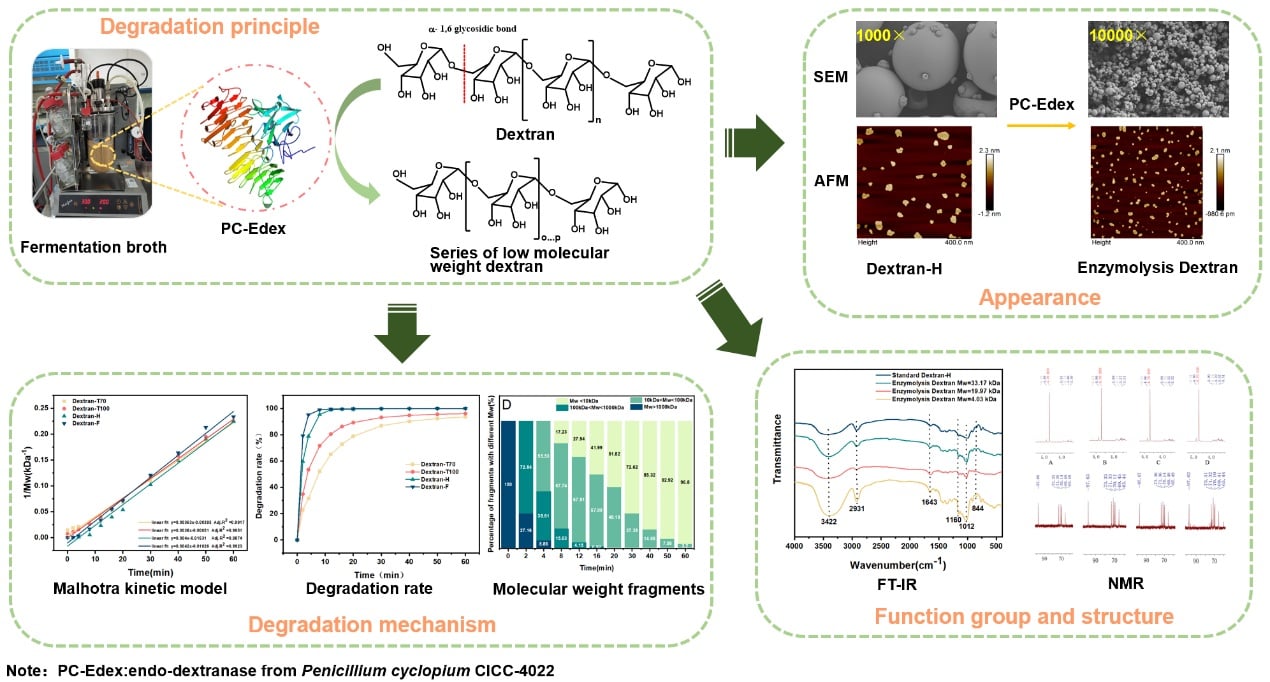
Abstract
Share and Cite
Li, M.; Fan, P.; Zhang, Y.; Li, R.; Chen, L.; Zhang, D.; Zhong, L. Enzymatic Degradation Behavior and Molecular Weight Regulation of Dextran: Empirical Modeling and Multi-Scale Structural Characterization. Curr. Issues Mol. Biol. 2026, 48, 749. https://doi.org/10.3390/cimb48070749
Li M, Fan P, Zhang Y, Li R, Chen L, Zhang D, Zhong L. Enzymatic Degradation Behavior and Molecular Weight Regulation of Dextran: Empirical Modeling and Multi-Scale Structural Characterization. Current Issues in Molecular Biology. 2026; 48(7):749. https://doi.org/10.3390/cimb48070749
Chicago/Turabian StyleLi, Mei, Piaoran Fan, Yirui Zhang, Ranran Li, Lemin Chen, Donghui Zhang, and Lei Zhong. 2026. "Enzymatic Degradation Behavior and Molecular Weight Regulation of Dextran: Empirical Modeling and Multi-Scale Structural Characterization" Current Issues in Molecular Biology 48, no. 7: 749. https://doi.org/10.3390/cimb48070749
APA StyleLi, M., Fan, P., Zhang, Y., Li, R., Chen, L., Zhang, D., & Zhong, L. (2026). Enzymatic Degradation Behavior and Molecular Weight Regulation of Dextran: Empirical Modeling and Multi-Scale Structural Characterization. Current Issues in Molecular Biology, 48(7), 749. https://doi.org/10.3390/cimb48070749
