

Integration of Machine Learning-Based Pathogenicity Prediction and Phenotype Matching Improves Variant Prioritization in Rare Clinical Testing
 , , ,
, , ,
Abstract
1. Introduction
2. Materials and Methods
2.1. Study Design
2.2. Exome Sequencing
2.3. Universal Pathogenicity Predictor (UP2)
2.4. UP2 Interpretability Features
2.5. DiagAI Prioritization Algorithm
2.6. DiagAI Shortlist
2.7. Evaluation of Performance
3. Results
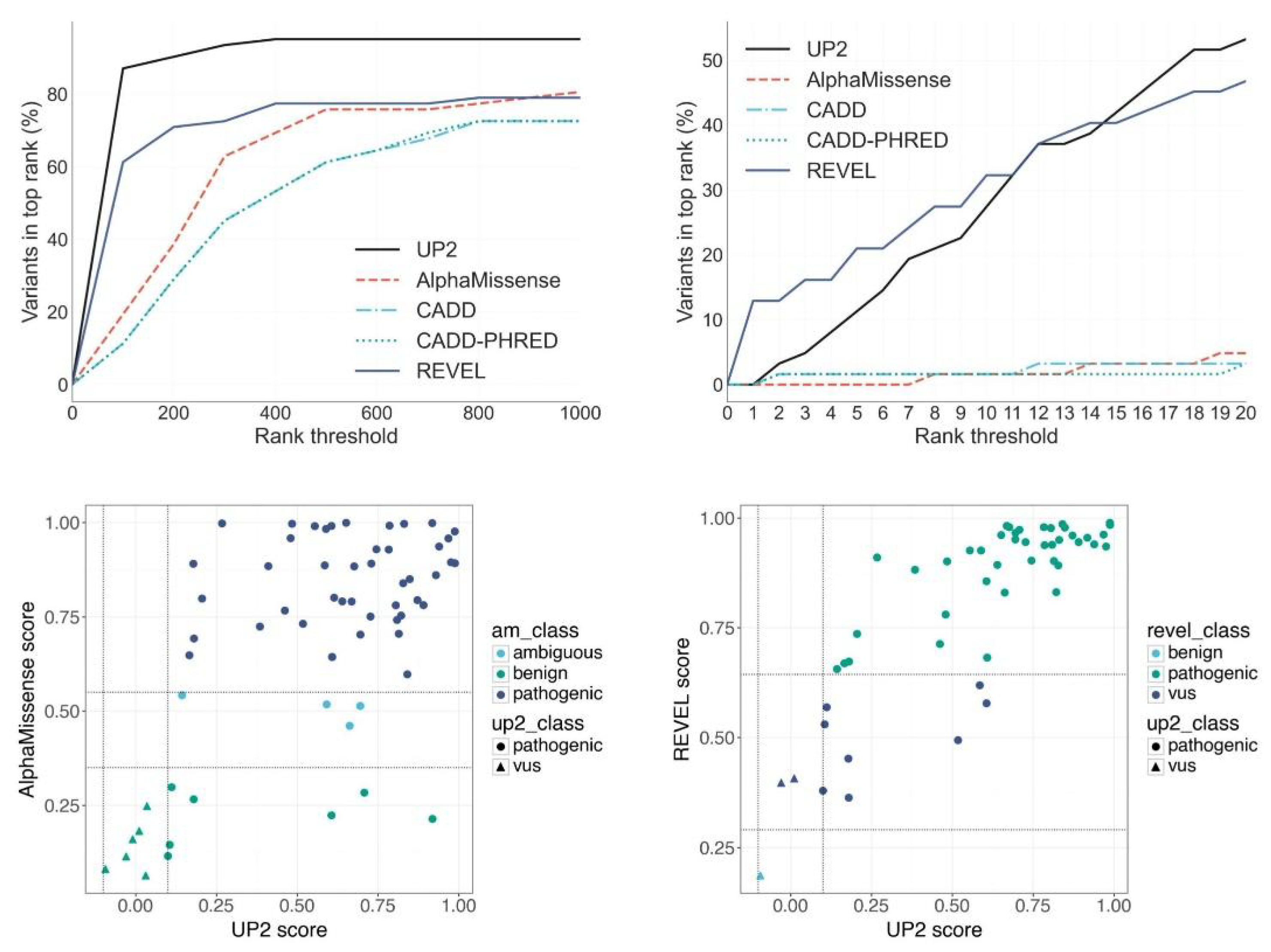
3.1. Comparison Between UP2, CADD, REVEL and AlphaMissense
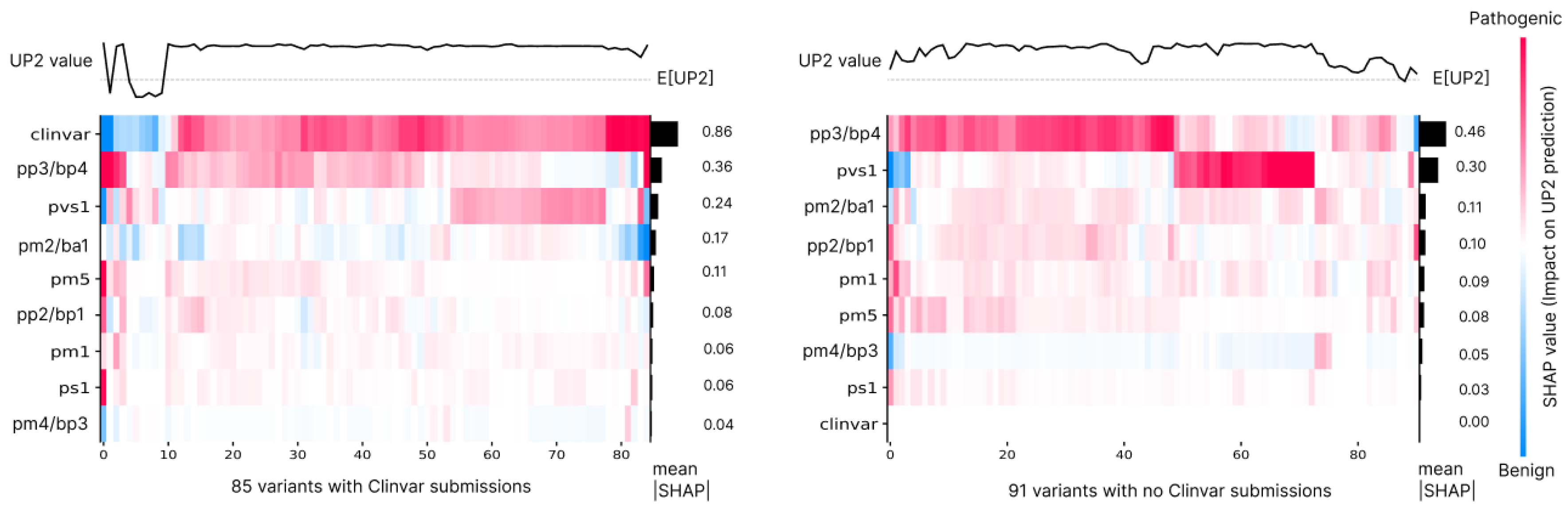
3.2. Interpretability of the Classifier
3.3. Proportion of Causal Variants Identified in Shortlists
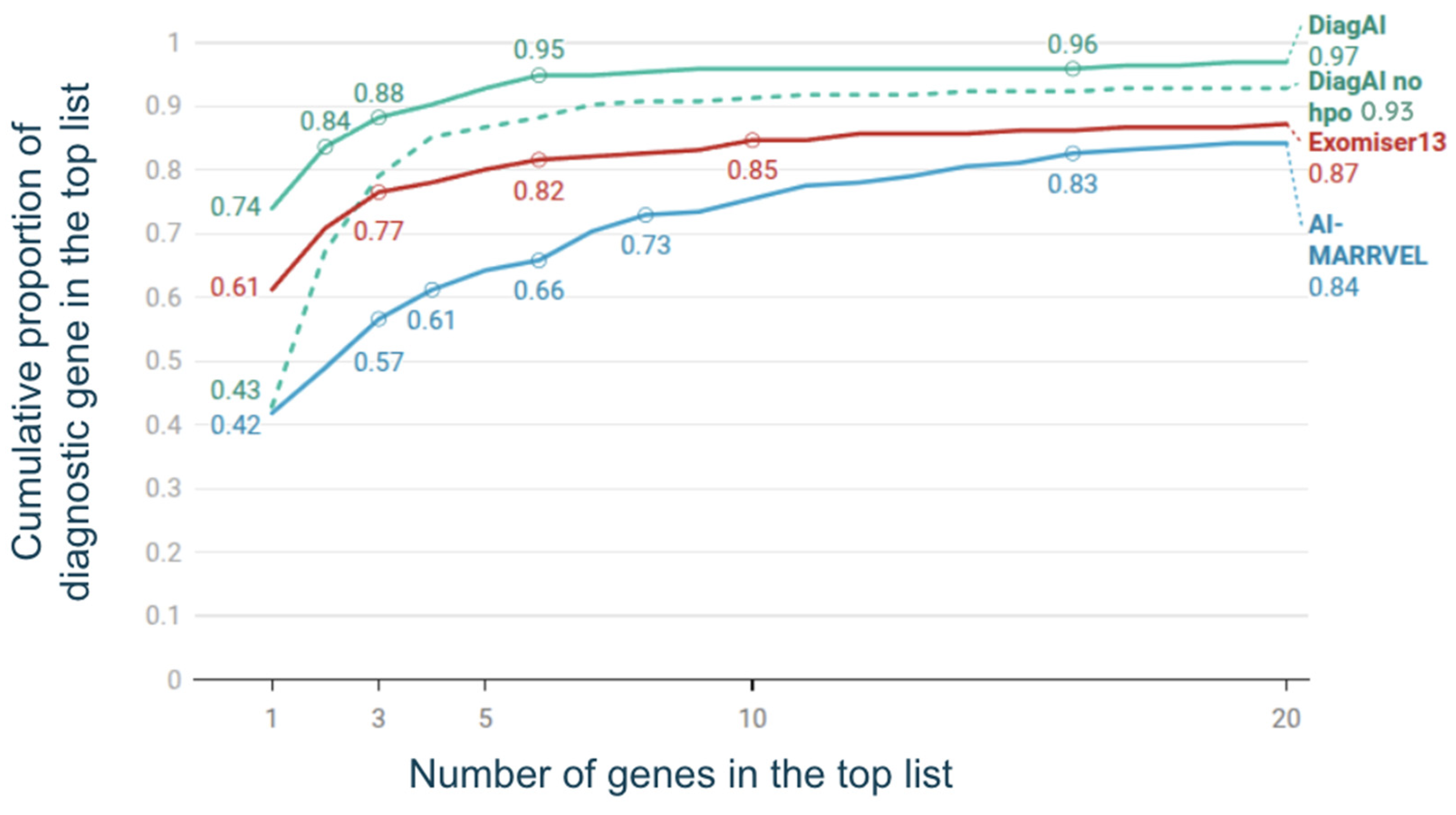
3.4. Variant Ranking
3.5. Causal Variants Absent from the Shortlists
4. Discussion
Supplementary Materials
Author Contributions
Funding
Institutional Review Board Statement
Informed Consent Statement
Data Availability Statement
Acknowledgments
Conflicts of Interest
Abbreviations
| ACMG | American College of Medical Genetics and Genomics |
| AI | Artificial intelligence |
| ES | Exome sequencing |
| HPO | Human Phenotype Ontology |
| SNV | Single-nucleotide variant |
| UP2 | Universal Pathogenicity Predictor |
| VUS | Variant of uncertain significance |
| WGS | Whole-genome sequencing |
References
- 100,000 Genomes Project Pilot Investigators. 100,000 Genomes Pilot on Rare-Disease Diagnosis in Health Care—Preliminary Report. N. Engl. J. Med. 2021, 385, 1868–1880. [CrossRef] [PubMed]
- Doreille, A.; Lombardi, Y.; Dancer, M.; Lamri, R.; Testard, Q.; Vanhoye, X.; Lebre, A.-S.; Garcia, H.; Rafat, C.; Ouali, N.; et al. Exome-First Strategy in Adult Patients with CKD: A Cohort Study. Kidney Int. Rep. 2023, 8, 596–605. [Google Scholar] [CrossRef] [PubMed]
- Austin-Tse, C.A.; Jobanputra, V.; Perry, D.L.; Bick, D.; Taft, R.J.; Venner, E.; Gibbs, R.A.; Young, T.; Barnett, S.; Belmont, J.W.; et al. Best practices for the interpretation and reporting of clinical whole genome sequencing. npj Genom. Med. 2022, 7, 27. [Google Scholar] [CrossRef] [PubMed]
- Amendola, L.M.; Muenzen, K.; Biesecker, L.G.; Bowling, K.M.; Cooper, G.M.; Dorschner, M.O.; Driscoll, C.; Foreman, A.K.M.; Golden-Grant, K.; Greally, J.M.; et al. Variant Classification Concordance using the ACMG-AMP Variant Interpretation Guidelines across Nine Genomic Implementation Research Studies. Am. J. Hum. Genet. 2020, 107, 932–941. [Google Scholar] [CrossRef] [PubMed]
- Pejaver, V.; Byrne, A.B.; Feng, B.J.; Pagel, K.A.; Mooney, S.D.; Karchin, R.; O’donnell-Luria, A.; Harrison, S.M.; Tavtigian, S.V.; Greenblatt, M.S.; et al. Calibration of computational tools for missense variant pathogenicity classification and ClinGen recommendations for PP3/BP4 criteria. Am. J. Hum. Genet. 2022, 109, 2163–2177. [Google Scholar] [CrossRef] [PubMed]
- Mao, D.; Liu, C.; Wang, L.; Ai-Ouran, R.; Deisseroth, C.; Pasupuleti, S.; Kim, S.Y.; Li, L.; Rosenfeld, J.A.; Meng, L.; et al. AI-MARRVEL—A Knowledge-Driven AI System for Diagnosing Mendelian Disorders. NEJM AI 2024, 1, AIoa2300009. [Google Scholar] [CrossRef] [PubMed]
- Owen, M.J.; Lefebvre, S.; Hansen, C.; Kunard, C.M.; Dimmock, D.P.; Smith, L.D.; Scharer, G.; Mardach, R.; Willis, M.J.; Feigenbaum, A.; et al. An automated 13.5 hour system for scalable diagnosis and acute management guidance for genetic diseases. Nat. Commun. 2022, 13, 4057. [Google Scholar] [CrossRef] [PubMed]
- De La Vega, F.M.; Chowdhury, S.; Moore, B.; Frise, E.; McCarthy, J.; Hernandez, E.J.; Wong, T.; James, K.; Guidugli, L.; Agrawal, P.B.; et al. Artificial intelligence enables comprehensive genome interpretation and nomination of candidate diagnoses for rare genetic diseases. Genome Med. 2021, 13, 153. [Google Scholar] [CrossRef] [PubMed]
- Meng, L.; Attali, R.; Talmy, T.; Regev, Y.; Mizrahi, N.; Smirin-Yosef, P.; Vossaert, L.; Taborda, C.; Santana, M.; Machol, I.; et al. Evaluation of an automated genome interpretation model for rare disease routinely used in a clinical genetic laboratory. Genet. Med. 2023, 25, 100830. [Google Scholar] [CrossRef] [PubMed]
- Köhler, S.; Doelken, S.C.; Mungall, C.J.; Bauer, S.; Firth, H.V.; Bailleul-Forestier, I.; Black, G.C.M.; Brown, D.L.; Brudno, M.; Campbell, J.; et al. The Human Phenotype Ontology project: Linking molecular biology and disease through phenotype data. Nucleic Acids Res. 2014, 42, D966–D974. [Google Scholar] [CrossRef] [PubMed]
- Li, H. Aligning sequence reads, clone sequences and assembly contigs with BWA-MEM. arXiv 2013. [Google Scholar] [CrossRef]
- Garrison, E.; Marth, G. Haplotype-based variant detection from short-read sequencing. arXiv 2012. [Google Scholar] [CrossRef]
- Van der Auwera, G.A.; O’Connor, B.D. Genomics in the Cloud: Using Docker, GATK, and WDL in Terra, 1st ed.; O’Reilly Media: Santa Rosa, CA, USA, 2020. [Google Scholar]
- Cameron, D.L.; Schröder, J.; Penington, J.S.; Do, H.; Molania, R.; Dobrovic, A.; Speed, T.P.; Papenfuss, A.T. GRIDSS: Sensitive and specific genomic rearrangement detection using positional de Bruijn graph assembly. Genome Res. 2017, 27, 2050–2060. [Google Scholar] [CrossRef] [PubMed]
- Uguen, K.; Redon, S.; Rouault, K.; Pensec, M.; Benech, C.; Schutz, S.; Zanlonghi, X.; Nadjar, Y.; Le Maréchal, C.; Férec, C.; et al. An unusual diagnosis of alpha-mannosidosis with ocular anomalies: Behind the scenes of a hidden copy number variation. Am. J. Med. Genet. Part A 2024, 194, e63532. [Google Scholar] [CrossRef] [PubMed]
- McKenna, A.; Hanna, M.; Banks, E.; Sivachenko, A.; Cibulskis, K.; Kernytsky, A.; Garimella, K.; Altshuler, D.; Gabriel, S.; Daly, M.; et al. The Genome Analysis Toolkit: A MapReduce framework for analyzing next-generation DNA sequencing data. Genome Res. 2010, 20, 1297–1303. [Google Scholar] [CrossRef] [PubMed]
- Chen, T.; Guestrin, C. XGBoost: A Scalable Tree Boosting System. In Proceedings of the 22nd ACM SIGKDD International Conference on Knowledge Discovery and Data Mining; ACM: New York, NY, USA, 2016; pp. 785–794. [Google Scholar] [CrossRef]
- Richards, S.; Aziz, N.; Bale, S.; Bick, D.; Das, S.; Gastier-Foster, J.; Grody, W.W.; Hegde, M.; Lyon, E.; Spector, E.; et al. Standards and guidelines for the interpretation of sequence variants: A joint consensus recommendation of the American College of Medical Genetics and Genomics and the Association for Molecular Pathology. Genet. Med. 2015, 17, 405–423. [Google Scholar] [CrossRef] [PubMed]
- Landrum, M.J.; Chitipiralla, S.; Brown, G.R.; Chen, C.; Gu, B.; Hart, J.; Hoffman, D.; Jang, W.; Kaur, K.; Liu, C.; et al. ClinVar: Improvements to accessing data. Nucleic Acids Res. 2020, 48, D835–D844. [Google Scholar] [CrossRef] [PubMed]
- Yauy, K.; Lecoquierre, F.; Baert-Desurmont, S.; Trost, D.; Boughalem, A.; Luscan, A.; Costa, J.-M.; Geromel, V.; Raymond, L.; Richard, P.; et al. Genome Alert!: A standardized procedure for genomic variant reinterpretation and automated gene-phenotype reassessment in clinical routine. Genet. Med. Off. J. Am. Coll. Med. Genet. 2022, 24, 1316–1327. [Google Scholar] [CrossRef] [PubMed]
- Karczewski, K.J.; Francioli, L.C.; Tiao, G.; Cummings, B.B.; Alfoldi, J.; Wang, Q.; Collins, R.L.; Laricchia, K.M.; Ganna, A.; Birnbaum, D.P.; et al. The mutational constraint spectrum quantified from variation in 141,456 humans. Nature 2020, 581, 434–443, Correction in Nature 2021, 590, E53. [Google Scholar] [CrossRef] [PubMed]
- McLaren, W.; Gil, L.; Hunt, S.E.; Riat, H.S.; Ritchie, G.R.S.; Thormann, A.; Flicek, P.; Cunningham, F. The Ensembl Variant Effect Predictor. Genome Biol. 2016, 17, 122. [Google Scholar] [CrossRef] [PubMed]
- Liu, X.; Li, C.; Mou, C.; Dong, Y.; Tu, Y. dbNSFP v4: A comprehensive database of transcript-specific functional predictions and annotations for human nonsynonymous and splice-site SNVs. Genome Med. 2020, 12, 103. [Google Scholar] [CrossRef] [PubMed]
- Jian, X.; Boerwinkle, E.; Liu, X. In silico prediction of splice-altering single nucleotide variants in the human genome. Nucleic Acids Res. 2014, 42, 13534–13544. [Google Scholar] [CrossRef] [PubMed]
- Strauch, Y.; Lord, J.; Niranjan, M.; Baralle, D. CI-SpliceAI—Improving machine learning predictions of disease causing splicing variants using curated alternative splice sites. PLoS ONE 2022, 17, e0269159. [Google Scholar] [CrossRef] [PubMed]
- Jurka, J. Repbase update: A database and an electronic journal of repetitive elements. Trends Genet. 2000, 16, 418–420. [Google Scholar] [CrossRef] [PubMed]
- Yauy, K.; Duforet-Frebourg, N.; Testard, Q.; Beaumeunier, S.; Audoux, J.; Simard, B.; Larue, D.; Blum, M.G.; Bernard, V.; Genevieve, D.; et al. Learning phenotypic patterns in genetic diseases by symptom interaction modeling. medRxiv 2022. [Google Scholar] [CrossRef]
- Martin, A.R.; Williams, E.; Foulger, R.E.; Leigh, S.; Daugherty, L.C.; Niblock, O.; Leong, I.U.S.; Smith, K.R.; Gerasimenko, O.; Haraldsdottir, E.; et al. PanelApp crowdsources expert knowledge to establish consensus diagnostic gene panels. Nat. Genet. 2019, 51, 1560–1565. [Google Scholar] [CrossRef] [PubMed]
- Amberger, J.; Bocchini, C.A.; Scott, A.F.; Hamosh, A. McKusick’s Online Mendelian Inheritance in Man (OMIM®). Nucleic Acids Res. 2009, 37, D793–D796. [Google Scholar] [CrossRef] [PubMed]
- Sayers, E.W.; Beck, J.; Bolton, E.E.; Brister, J.R.; Chan, J.; Connor, R.; Feldgarden, M.; Fine, A.M.; Funk, K.; Hoffman, J.; et al. Database resources of the National Center for Biotechnology Information in 2025. Nucleic Acids Res. 2025, 53, D20–D29. [Google Scholar] [CrossRef] [PubMed]
- Rentzsch, P.; Witten, D.; Cooper, G.M.; Shendure, J.; Kircher, M. CADD: Predicting the deleteriousness of variants throughout the human genome. Nucleic Acids Res. 2019, 47, D886–D894. [Google Scholar] [CrossRef] [PubMed]
- Ioannidis, N.M.; Rothstein, J.H.; Pejaver, V.; Middha, S.; McDonnell, S.K.; Baheti, S.; Musolf, A.; Li, Q.; Holzinger, E.; Karyadi, D.; et al. REVEL: An Ensemble Method for Predicting the Pathogenicity of Rare Missense Variants. Am. J. Hum. Genet. 2016, 99, 877–885. [Google Scholar] [CrossRef] [PubMed]
- Cheng, J.; Novati, G.; Pan, J.; Bycroft, C.; Žemgulytė, A.; Applebaum, T.; Pritzel, A.; Wong, L.H.; Zielinski, M.; Sargeant, T.; et al. Accurate proteome-wide missense variant effect prediction with AlphaMissense. Science 2023, 381, eadg7492. [Google Scholar] [CrossRef] [PubMed]
- Hopkins, J.J.; Wakeling, M.N.; Johnson, M.B.; Flanagan, S.E.; Laver, T.W. REVEL Is Better at Predicting Pathogenicity of Loss-of-Function than Gain-of-Function Variants. Hum. Mutat. 2023, 2023, 1–6. [Google Scholar] [CrossRef] [PubMed]
- Cipriani, V.; Pontikos, N.; Arno, G.; Sergouniotis, P.I.; Lenassi, E.; Thawong, P.; Danis, D.; Michaelides, M.; Webster, A.R.; Moore, A.T.; et al. An Improved Phenotype-Driven Tool for Rare Mendelian Variant Prioritization: Benchmarking Exomiser on Real Patient Whole-Exome Data. Genes 2020, 11, 460. [Google Scholar] [CrossRef] [PubMed]
- Blasco, M.; Quiroga, B.; García-Aznar, J.M.; Castro-Alonso, C.; Fernández-Granados, S.J.; Luna, E.; Fresnedo, G.F.; Ossorio, M.; Izquierdo, M.J.; Sanchez-Ospina, D.; et al. Genetic Characterization of Kidney Failure of Unknown Etiology in Spain: Findings From the GENSEN Study. Am. J. Kidney Dis. Off. J. Natl. Kidney Found. 2024, 84, 719–730.e1. [Google Scholar] [CrossRef] [PubMed]
- Schwotzer, N.; Fakhouri, F.; Martins, P.V.; Delmas, Y.; Caillard, S.; Zuber, J.; Moranne, O.; Mesnard, L.; Frémeaux-Bacchi, V.; El-Sissy, C. Hot Spot of Complement Factor I Rare Variant p.Ile357Met in Patients with Hemolytic Uremic Syndrome. Am. J. Kidney Dis. 2024, 84, 244–249. [Google Scholar] [CrossRef] [PubMed]
- Timmermans, S.A.; van Doorn, D.P.; van Paassen, P. Rare Variants in Complement Genes May Not Be That Rare After All. Kidney Int. Rep. 2023, 8, 1911–1913. [Google Scholar] [CrossRef] [PubMed]
- Molinari, E.; Decker, E.; Mabillard, H.; Tellez, J.; Srivastava, S.; Raman, S.; Wood, K.; Kempf, C.; Alkanderi, S.; Ramsbottom, S.A.; et al. Human urine-derived renal epithelial cells provide insights into kidney-specific alternate splicing variants. Eur. J. Hum. Genet. 2018, 26, 1791–1796. [Google Scholar] [CrossRef] [PubMed]
- O’Brien, T.D.; Campbell, N.E.; Potter, A.B.; Letaw, J.H.; Kulkarni, A.; Richards, C.S. Artificial intelligence (AI)-assisted exome reanalysis greatly aids in the identification of new positive cases and reduces analysis time in a clinical diagnostic laboratory. Genet. Med. 2022, 24, 192–200. [Google Scholar] [CrossRef] [PubMed]


Disclaimer/Publisher’s Note: The statements, opinions and data contained in all publications are solely those of the individual author(s) and contributor(s) and not of MDPI and/or the editor(s). MDPI and/or the editor(s) disclaim responsibility for any injury to people or property resulting from any ideas, methods, instructions or products referred to in the content. |
© 2026 by the authors. Licensee MDPI, Basel, Switzerland. This article is an open access article distributed under the terms and conditions of the Creative Commons Attribution (CC BY) license.
Share and Cite
Ruzicka, J.; Ravel, J.-M.; Audoux, J.; Boulat, A.; Thévenon, J.; Yauy, K.; Dancer, M.; Raymond, L.; Lombardi, Y.; Philippe, N.; et al. Integration of Machine Learning-Based Pathogenicity Prediction and Phenotype Matching Improves Variant Prioritization in Rare Clinical Testing. Curr. Issues Mol. Biol. 2026, 48, 706. https://doi.org/10.3390/cimb48070706
Ruzicka J, Ravel J-M, Audoux J, Boulat A, Thévenon J, Yauy K, Dancer M, Raymond L, Lombardi Y, Philippe N, et al. Integration of Machine Learning-Based Pathogenicity Prediction and Phenotype Matching Improves Variant Prioritization in Rare Clinical Testing. Current Issues in Molecular Biology. 2026; 48(7):706. https://doi.org/10.3390/cimb48070706
Chicago/Turabian StyleRuzicka, Jiri, Jean-Marie Ravel, Jérôme Audoux, Alexandre Boulat, Julien Thévenon, Kévin Yauy, Marine Dancer, Laure Raymond, Yannis Lombardi, Nicolas Philippe, and et al. 2026. "Integration of Machine Learning-Based Pathogenicity Prediction and Phenotype Matching Improves Variant Prioritization in Rare Clinical Testing" Current Issues in Molecular Biology 48, no. 7: 706. https://doi.org/10.3390/cimb48070706
APA StyleRuzicka, J., Ravel, J.-M., Audoux, J., Boulat, A., Thévenon, J., Yauy, K., Dancer, M., Raymond, L., Lombardi, Y., Philippe, N., Blum, M. G., Duforet-Frebourg, N., & Mesnard, L. (2026). Integration of Machine Learning-Based Pathogenicity Prediction and Phenotype Matching Improves Variant Prioritization in Rare Clinical Testing. Current Issues in Molecular Biology, 48(7), 706. https://doi.org/10.3390/cimb48070706