Article

Exploring the Relationship Between Protein-Level Ratios (rQLTs) and Duodenal Ulcer

Faculty of Medicine, Macau University of Science and Technology, Taipa, Macao 999078, China
*
Author to whom correspondence should be addressed.
These authors contributed equally to this work.
Curr. Issues Mol. Biol. 2026, 48(6), 643; https://doi.org/10.3390/cimb48060643
Submission received: 14 May 2026 / Revised: 16 June 2026 / Accepted: 20 June 2026 / Published: 22 June 2026
(This article belongs to the Section Bioinformatics and Systems Biology)

Abstract

To explore the associations between protein-level ratios (rQLTs) and duodenal ulcer (DU) risk using Mendelian randomization (MR), colocalization, and pathway analysis approaches. A bidirectional MR approach was used to identify molecular targets linking rQLTs with DU, employing the inverse variance weighted (IVW) method for causal estimation. Colocalization analysis ensured the reliability of inferred causal relationships. Gene interaction networks were constructed via STRING, and key regulatory hub-genes were identified through Cytoscape analysis. Significant inverse associations were found between rQLT-ACE2/GGT1 (Angiotensin-converting enzyme 2/γ-glutamyl transpeptidase 1) (IVW, OR (95% CI) = 0.754 (0.674–0.843), adjusted PIVW = 0.0005), and DU risk in the East Asian (Japanese) population. No statistically significant associations were observed in the European population. The findings indicate a genetic inverse association between rQLT-ACE2/GGT1 and DU risk in the East Asian (Japanese) population, while no corresponding association was observed in Europeans. These results provide genetic evidence consistent with a potential association rather than causal inference or biomarker validation. This study does not support conclusions regarding diagnostic or therapeutic utility at this stage.

1. Introduction

Duodenal ulcer (DU) is a chronic peptic ulcer predominantly affecting the duodenal bulb. In Western populations, DU represents the most prevalent form of peptic ulcer disease, with population-based studies reporting a lifetime prevalence of 5–15%. In contrast, epidemiological surveys in China estimate a prevalence of around 10% [1].
The pathogenesis of DU is not only associated with inflammatory responses [2] but also closely linked to dysbiosis of the intestinal microbiota [3]. These pathogenic factors are accompanied by coordinated alterations in circulating protein expression profiles involved in immune and metabolic processes.
In this study, the exposure consists of protein-level ratio traits (rQLTs), defined as quantitative traits representing the ratio of circulating plasma levels between two proteins (protein A/protein B). A total of 2821 rQLTs were included as exposures in the analysis. These ratio traits capture relative protein abundance rather than absolute protein levels and reflect the biological balance between functionally related proteins within systemic pathways [4].
Accordingly, rQLTs can be interpreted as continuous quantitative variables, where higher or lower values indicate a shift in the relative abundance between two proteins. This framework enables the investigation of genetically influenced variation in protein homeostasis and its relationship with disease risk.
Therefore, this study systematically investigates the associations between 2821 genetically predicted rQLTs and DU risk using Mendelian randomization (MR), colocalization, and pathway analysis approaches. The objective is to evaluate genetic evidence for potential associations between circulating protein ratio traits and DU risk, rather than to identify biomarkers or infer clinical utility.

2. Materials and Methods

Statistical analyses were performed using R software (version 4.0.2, Posit Software, PBC, Boston, MA, USA). Network visualization and analysis were conducted using Cytoscape software (version 3.10.3, Institute for Systems Biology, Seattle, WA, USA).

2.1. Data

We obtained the genotype data from the genome-wide association studies (GWAS).

2.1.1. Exposure Data

Genetic variants for rQLTs were obtained from publicly available GWAS summary statistics (https://www.ebi.ac.uk/gwas/, accessed on 30 December 2025), accession numbers GCST90313126–GCST90315946. The original study was based on Olink proteomics data from more than 54,000 UK Biobank participants with circulating protein measurements for 1463 proteins.
After quality control and restriction to European ancestry individuals, a total of 43,509 participants were included in the final analysis, from which 2821 rQLTs were derived, representing 4248 significant protein–protein ratio associations.

2.1.2. Outcome Data

Genetic variants for DU in East Asian (Japanese) populations were obtained from the IEU OpenGWAS database (https://www.ebi.ac.uk/gwas/, accessed on 30 December 2025), accession number GCST90270928. This dataset includes 252,639 individuals, comprising 11,964 cases and 240,675 controls. The DU phenotype was defined based on clinically diagnosed duodenal ulcer cases derived from electronic health records, primarily using ICD-10 codes (K25 and K26 series), with additional harmonized phenotype mappings including PheCode 531.3. These definitions were constructed from hospital records and integrated clinical coding systems to identify DU-related cases in large-scale biobank data.
Genetic variants for duodenal ulcer in European (UK) populations were obtained from the IEU OpenGWAS database (https://www.ebi.ac.uk/gwas/, accessed on 30 December 2025), accession number GCST90044132. This dataset includes 456,348 individuals, comprising 1484 cases and 454,864 controls. The reported trait was defined using PheCode 531.3, which corresponds to duodenal ulcer phenotypes derived from electronic health record-based ICD coding (ICD-10 K26 series) within the UK Biobank system.
All summary statistics were accessed from the IEU OpenGWAS database on 30 December 2025. The original GWAS publications did not report overlapping samples between the exposure and outcome datasets used in this Mendelian randomization analysis; therefore, potential overlap is considered unlikely.

2.2. Methods

2.2.1. Mendelian Randomization (MR) Analysis

Forward MR Analysis
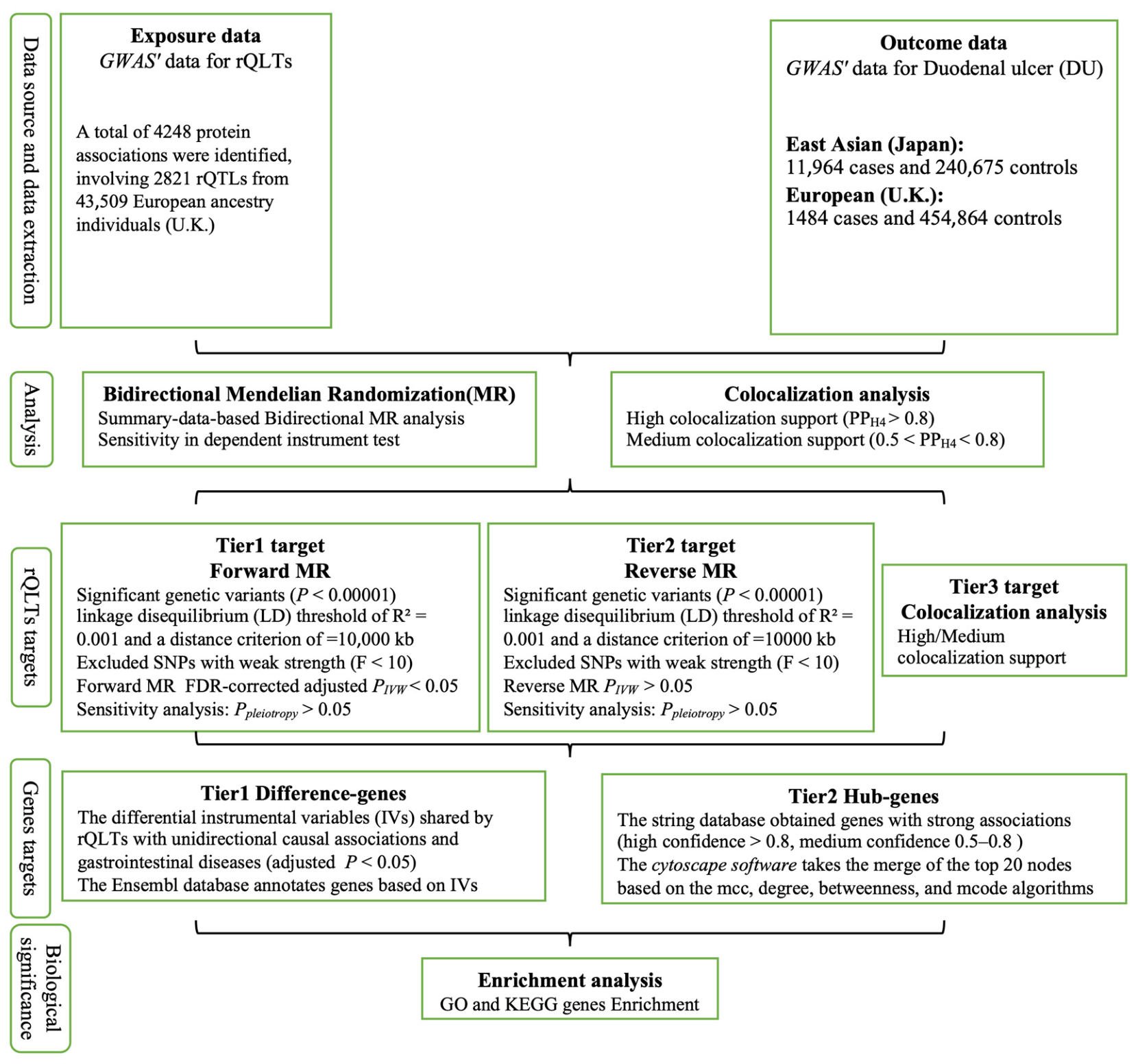
Forward MR analysis was conducted based on the three assumptions (Figure 1). To ensure the validity and reliability of instrumental variables (IVs), a multi-step selection procedure was applied. First, genetic variants associated with rQLTs were selected using a significance threshold of p < 1 × 10⁻⁵. This threshold was adopted instead of the conventional genome-wide significance level (p < 5 × 10⁻⁸) because protein ratio quantitative traits typically yield fewer genome-wide significant loci due to their derived nature and reduced statistical power compared with single-protein traits. Therefore, a relaxed but commonly used threshold in proteomic and protein-ratio MR studies was applied to ensure sufficient instrumental variables for downstream causal inference. Second, linkage disequilibrium (LD) pruning was performed using an r2 threshold of 0.001 within a 10,000 kb window to ensure independence among single nucleotide polymorphisms (SNPs). Third, instrumental strength was evaluated using the F-statistic (F = β2/SE2), and SNPs with F < 10 were excluded to minimize weak instrument bias; summary F-statistics of the retained instruments were calculated for quality control. Fourth, allele harmonization was performed to ensure consistency of effect alleles between exposure and outcome datasets, with palindromic SNPs resolved using allele frequency information when available or otherwise excluded. The number of SNPs removed at each stage, including LD pruning and harmonization, was systematically recorded and reported in the corresponding results tables.
Assessment of horizontal pleiotropy and heterogeneity was conducted using multiple complementary approaches. Directional pleiotropy was evaluated using the MR-Egger regression intercept test, while heterogeneity among SNP-specific estimates was assessed using Cochran’s Q statistic. In addition, the MR-PRESSO framework was applied, including global test for horizontal pleiotropy, outlier detection, and correction analysis after removal of identified outlier SNPs. When outliers were detected, causal estimates were recalculated after outlier exclusion, and both original and corrected results were compared. The inverse variance weighted (IVW) method was used as the primary MR estimator under the assumption of no horizontal pleiotropy. Multiple testing correction was performed using the Benjamini–Hochberg false discovery rate (FDR), with statistical significance defined as adjusted p < 0.05. All analyses were conducted using R software (version 4.4.0) [5] (Figure 2).
Reverse MR Analysis
Reverse MR analysis was performed to assess the potential causal effect of DU on rQLTs. In this analysis, DU was treated as the exposure and rQLTs as outcomes. Genetic instruments for DU were obtained from published GWAS summary statistics.
Instrument selection, LD clumping, instrumental strength assessment, and allele harmonization were conducted using the same procedures and parameters as described in Section Forward MR Analysis.

2.2.2. Colocalization Analysis

A Bayesian colocalization analysis was conducted using the coloc R package to evaluate whether rQLTs and gastrointestinal disease traits share a common causal variant within the same genomic region [5]. For each locus, a predefined genomic window of ±250 kb around the lead SNP was used to extract summary statistics from both exposure and outcome datasets. Only SNPs present in both datasets were included, and the number of overlapping SNPs at each locus was recorded to ensure transparency of the colocalization input data.
The analysis was performed under the standard coloc framework assuming a single causal variant per trait within each locus. No conditional analysis was performed prior to colocalization. Default prior probabilities were applied, with p1 = 1 × 10⁻⁴ (probability that an SNP is associated with trait 1), p2 = 1 × 10⁻⁴ (probability that an SNP is associated with trait 2), and p12 = 1 × 10⁻⁵ (probability that an SNP is associated with both traits). The posterior probability of hypothesis 4 (PPH4) was used as the primary metric to assess evidence for colocalization. A PPH4 value > 0.8 was considered strong evidence supporting a shared causal variant, while values between 0.5 and 0.8 were interpreted as suggestive evidence.

2.2.3. Identification and Functional Enrichment Analysis of Hub-Genes

Identification and Screening of Hub-Genes Targets
(a)
The identification of hub genes was performed through a multi-step integrative workflow to ensure reproducibility. First, single nucleotide polymorphisms (SNPs) showing significant discrepancies between exposure and outcome associations (adjusted p < 0.05) were selected. Duplicate SNPs were removed by retaining the variant with the lowest p-value. These SNPs were then mapped to genes using the Ensembl database based on genomic location (positional mapping within ±10 kb of gene boundaries), and SNP-level signals were aggregated at the gene level to generate an initial candidate gene list.
(b)
Protein–protein interaction (PPI) analysis was conducted using the STRING database (https://cn.string-db.org accessed on 30 December 2025) with a high-confidence interaction threshold (combined score > 0.7). The resulting interaction network was imported into Cytoscape software for downstream network analysis. Hub gene identification was performed using the CytoHubba plugin based on three centrality algorithms: maximal clique centrality (MCC), degree, and betweenness centrality. In parallel, module detection was performed using the MCODE plugin with the following parameters: node score cutoff = 0.2, k-core = 2, degree cutoff = 2, and haircut option enabled.
(c)
For hub gene selection, genes ranked within the top 20 nodes in each centrality algorithm (MCC, degree, and betweenness) were first identified. The final hub genes were defined as those genes that (i) consistently ranked within the top 20 across all three centrality measures and (ii) were also included in the highest-scoring MCODE module. The overlap between these selection criteria hub genes.
Enrichment Analysis of Hub-Genes
GO and KEGG enrichment analyses were conducted on the hub-genes to determine the top 10 significantly enriched pathways within each category—biological process (BP), cellular component (CC), molecular function (MF), and Kyoto Encyclopedia of Genes and Genomes (KEGG) pathways—using an adjusted p < 0.05. The results demonstrated that at least one biologically relevant functional pathway was significantly enriched.

3. Results

3.1. The Causal Association Between the rQLTs and DU

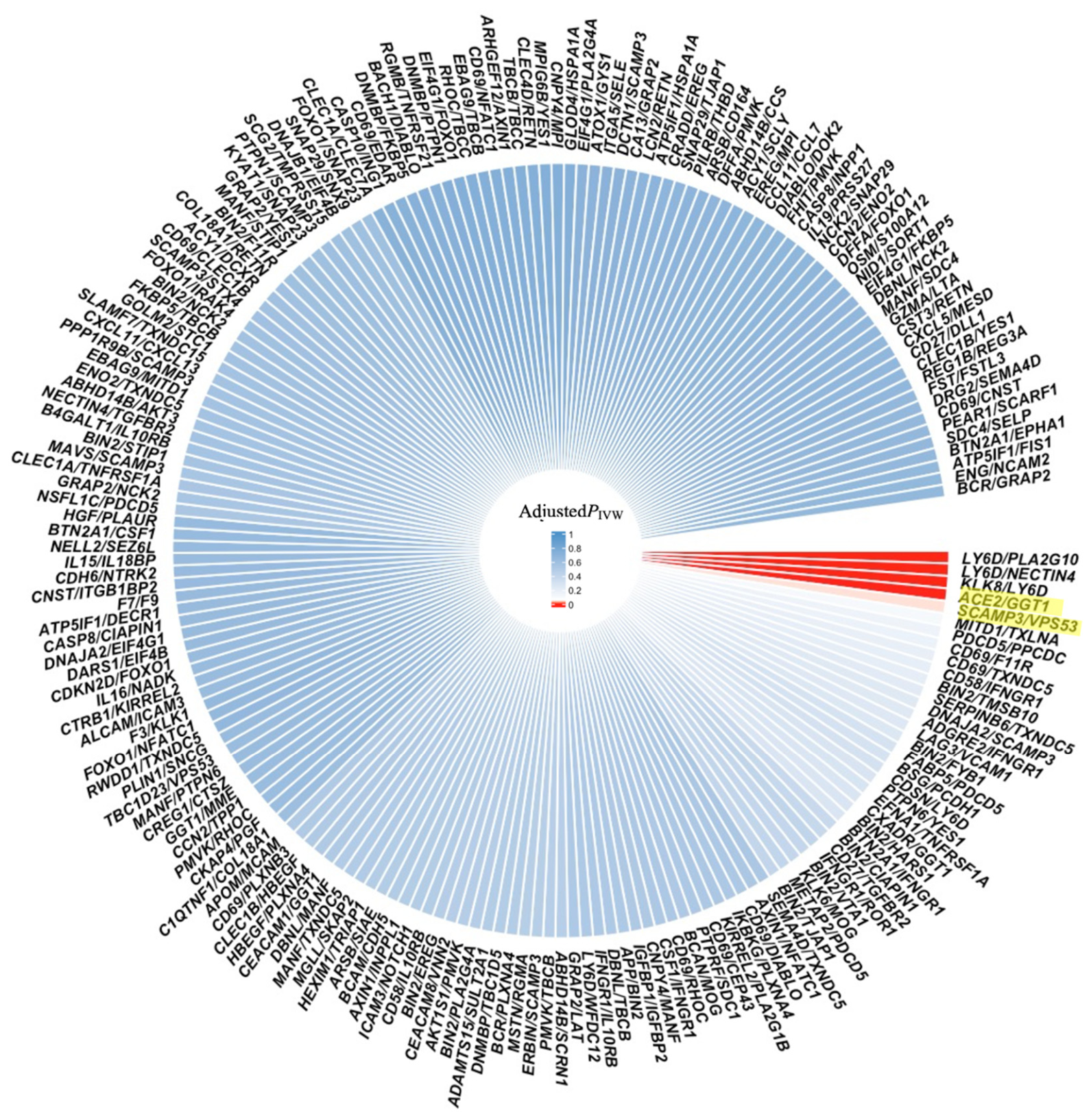
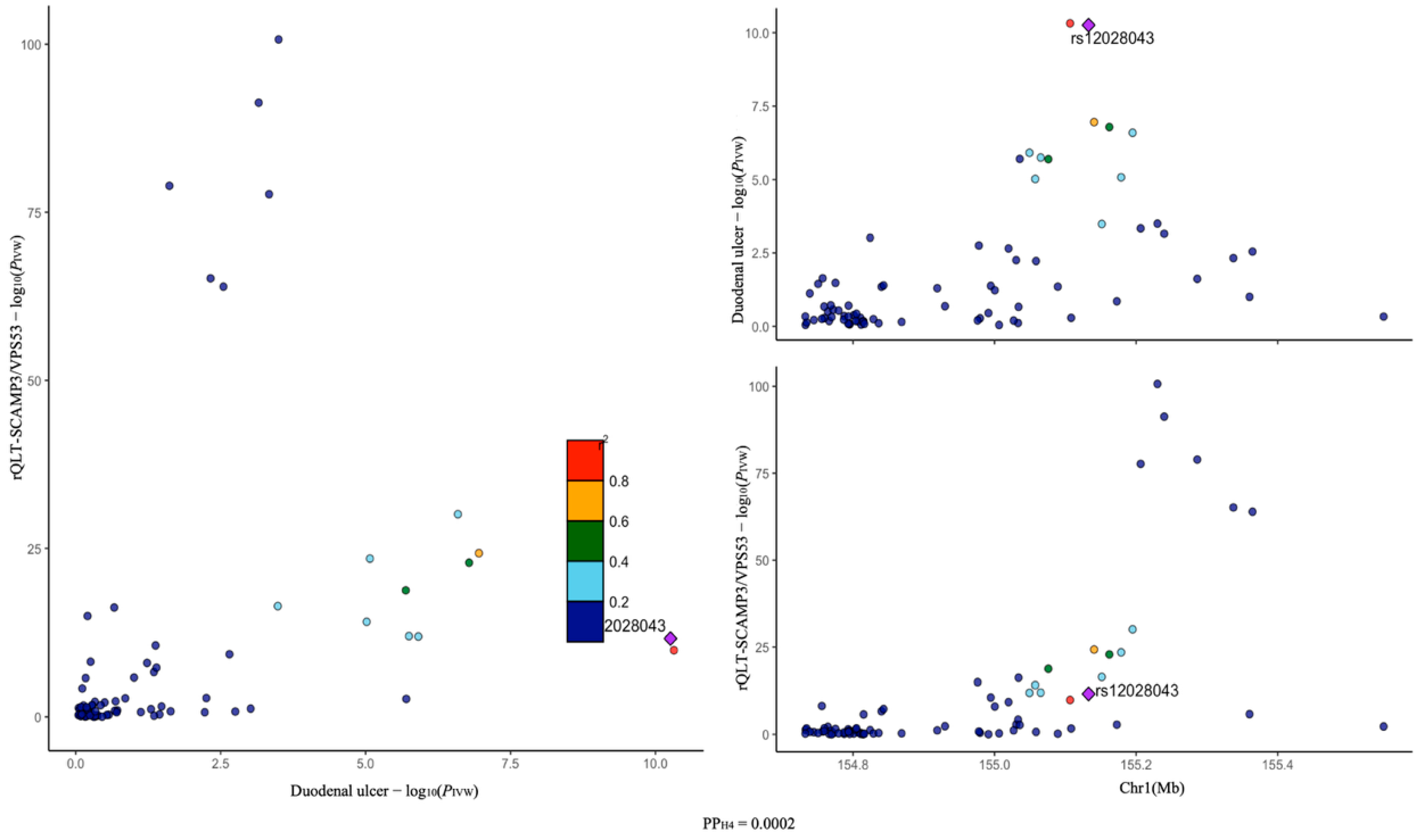
East Asian (Japanese): Forward MR analysis identified 5 rQLTs (rQLT-ACE2/GGT1, rQLT-KLK8/LY6D (Kallikrein-8/Lymphocyte antigen 6 family member D), rQLT-LY6D/NECTIN4 (Lymphocyte antigen 6 family member D/Nectin cell adhesion molecule 4), rQLT-LY6D/PLA2G10 (Lymphocyte antigen 6 family member D/Group 10 secretory phospholipase A2), rQLT-SCAMP3/VPS53 (Secretory carrier-associated membrane protein 3/Vacuolar protein sorting-associated protein 53)) as significantly associated with DU among East Asian (FDR-adjusted PIVW < 0.05). Reverse MR analysis revealed evidence of reverse causality for 3 rQLTs (rQLT-KLK8/LY6D, rQLT-LY6D/NECTIN4, rQLT-LY6D/PLA2G10). As a result, only 2 rQLTs (rQLT-SCAMP3/VPS53 and rQLT-ACE2/GGT1) were retained as potentially exerting causal effects on DU in East Asian (Figure 3). Importantly, colocalization analysis of rQLT-SCAMP3/VPS53 and DU (Japanese) showed no shared causal variant, suggesting limited stability of the inferred causal relationship (PPH4 = 0.0002) (Figure 4). Therefore, the findings provide robust evidence that changes in the rQLT-ACE2/GGT1 exert a causal influence on DU risk among East Asian (Japanese) (Table 1).
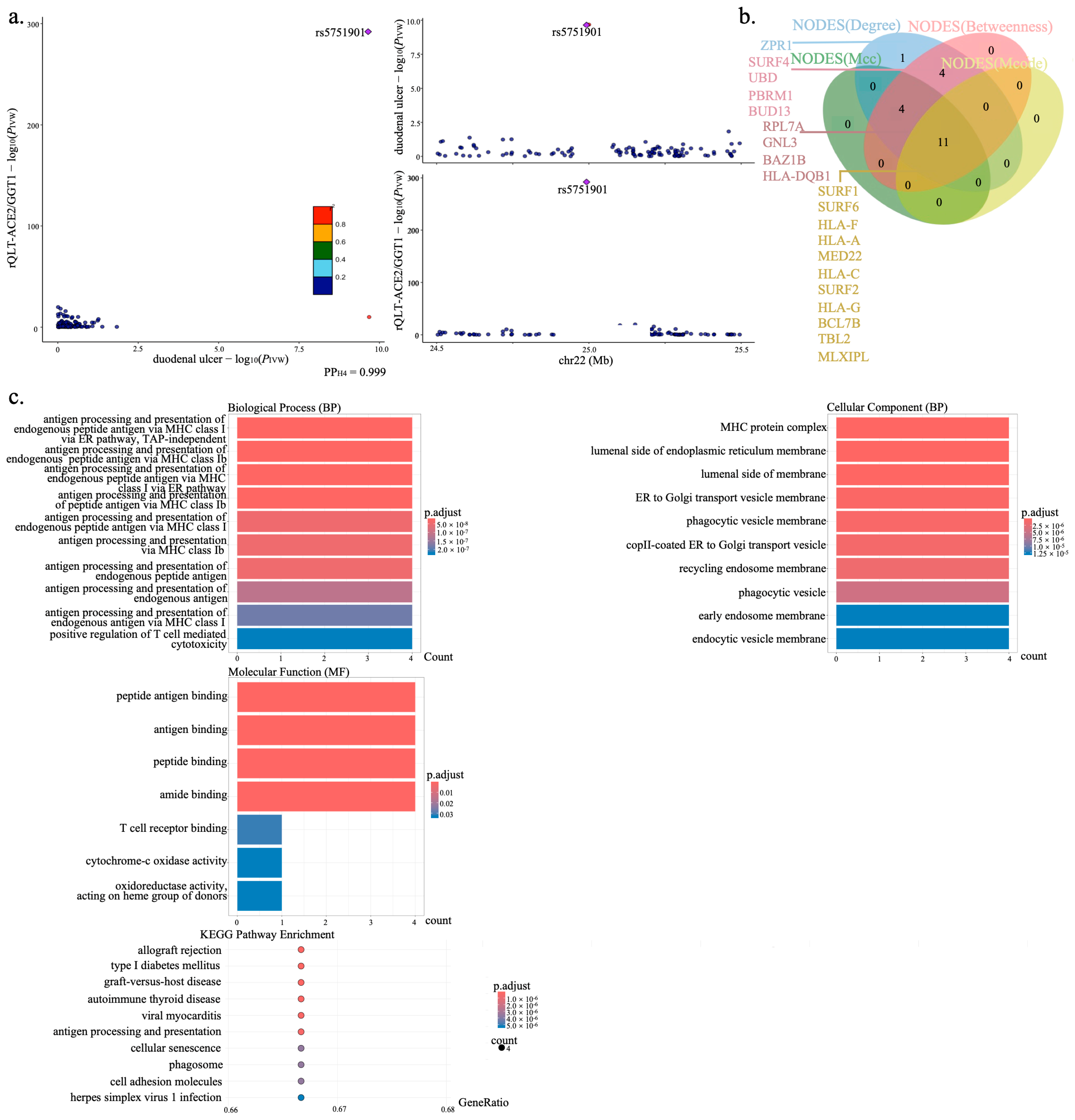
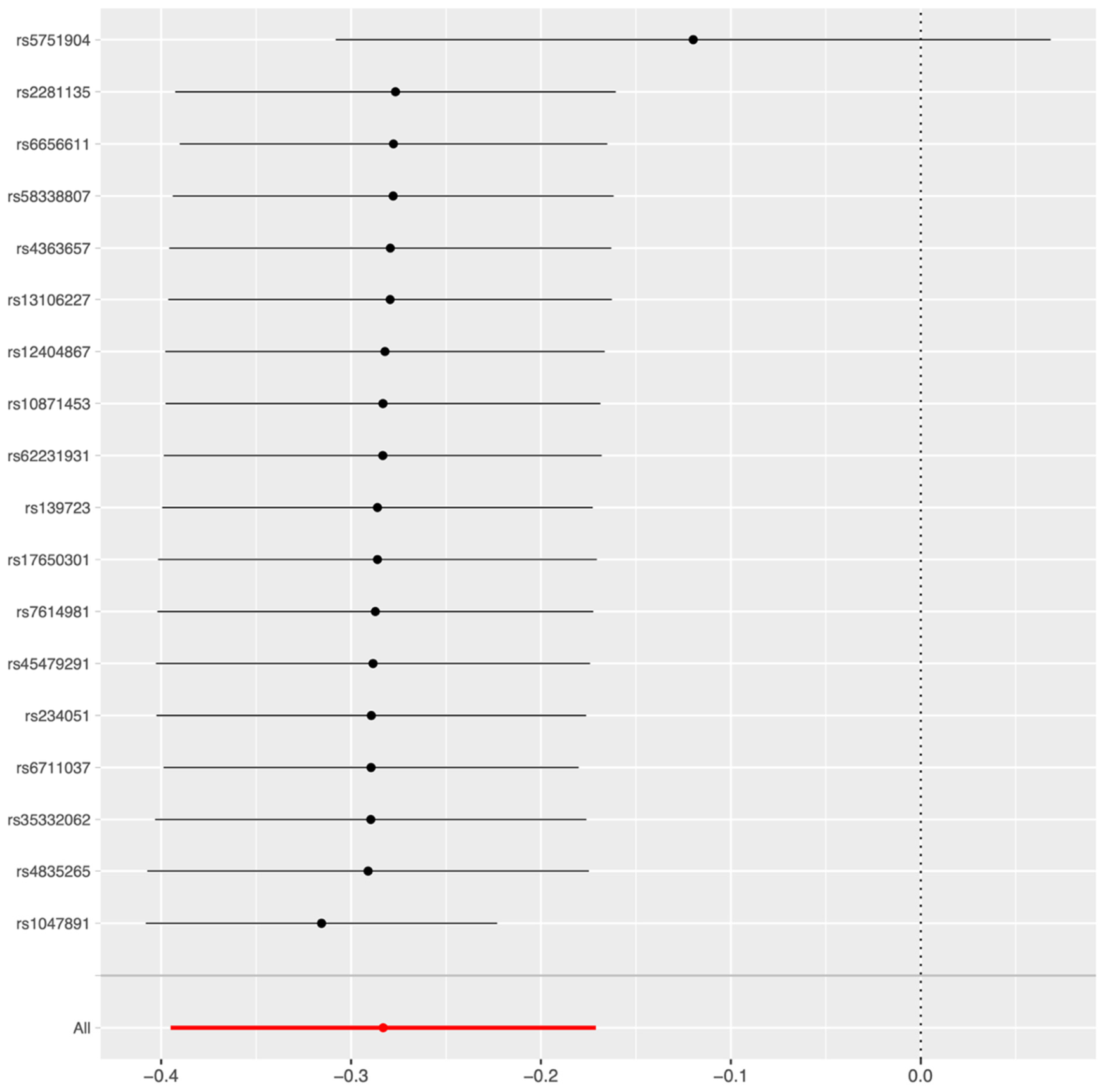
rQLT-ACE2/GGT1 demonstrates protective effects against DU in Japan (IVW, OR (95% CI) = 0.754 (0.674–0.843), Adjusted PIVW = 0.0005). The association shows no evidence of heterogeneity or horizontal pleiotropy (PHeterogeneity = 0.077, PPleiotropy = 0.216), and reverse causality was not detected in bidirectional MR analysis (PIVW = 0.592). Colocalization analysis provides support for the presence of a shared causal variant (rs5751901) and indicates a highly robust causal relationship (PPH4 = 0.999) (Table 1, Figure 5a). Moreover, leave-one-out sensitivity analysis confirms the stability and robustness of the observed association (Figure 6).
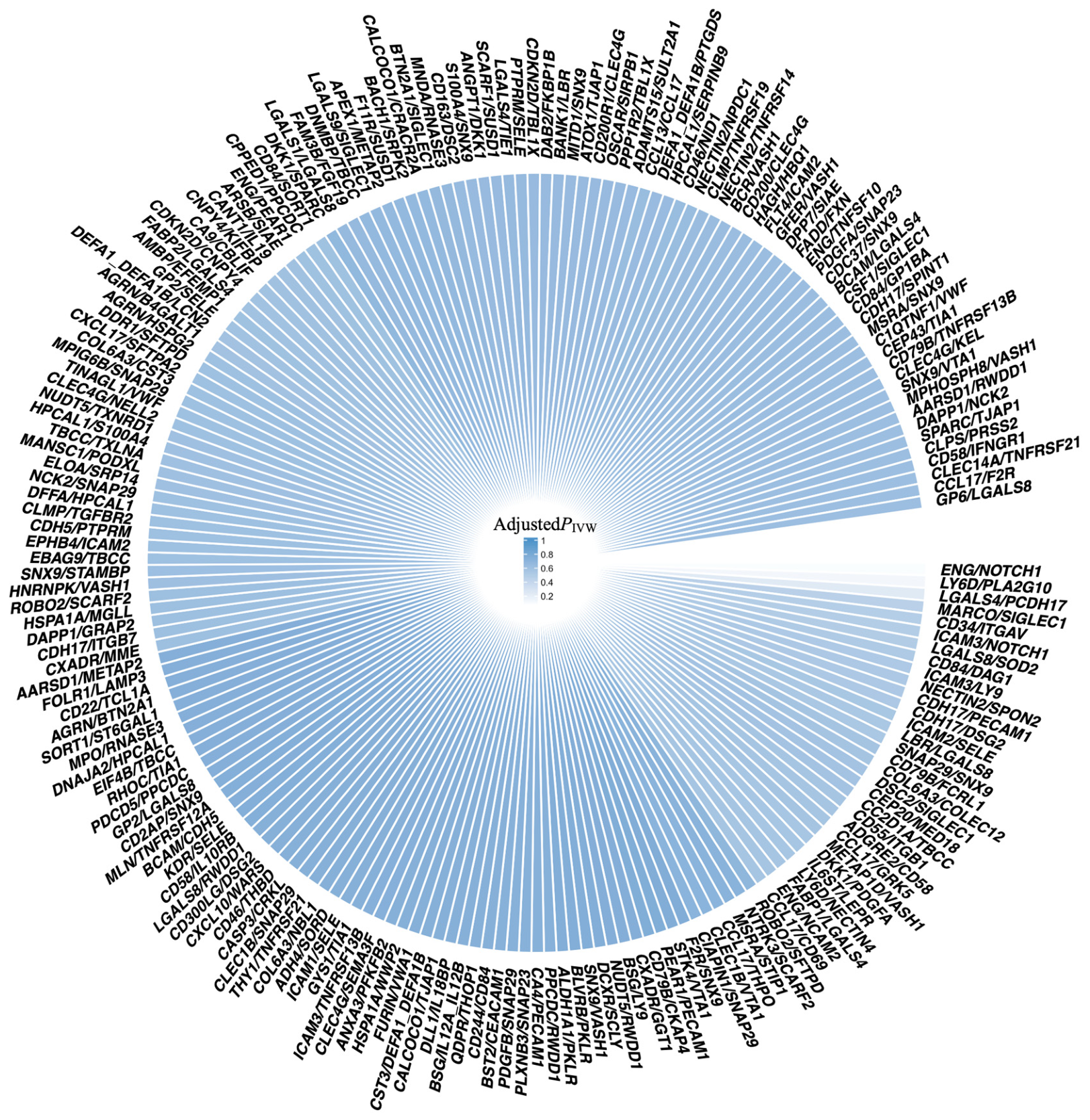
European (UK): MR analysis revealed no statistically significant associations between any of the 2821 rQLTs and DU risk in European (FDR-adjusted PIVW > 0.05) (Figure 7).

3.2. Functional Enrichment of Hub Genes in the rQLT-ACE2/GGT1–DU (Japanese) Network

The rQLT-ACE2/GGT1-associated DU (Japanese) network comprised 11 hub genes (SURF1, SURF6, HLA-F, HLA-A, MED22, HLA-C, SURF2, HLA-G, BCL7B, TBL2, and MLXIPL) (Table 2, Figure 5b). GO and KEGG pathway enrichment analysis of this gene set identified the top 10 significantly enriched biological processes (Figure 5c). The enriched pathways were predominantly immune-related and included antigen processing and presentation, allograft rejection, and viral myocarditis-related pathways.

4. Discussion

This study investigated the association between rQLTs levels and DU in both Japan and U.K. We systematically analyzed the molecular mechanisms of disease-related target genes within the biological pathways implicated in these conditions. The integration of GO and KEGG enrichment analyses revealed that the rQLT-ACE2/GGT1–associated gene set is primarily enriched in immune-related biological pathways rather than indicating specific disease mechanisms.

The Protective Effect of rQLT-ACE2/GGT1 Levels in DU (Japanese)

ACE2 is a membrane-bound enzyme that is highly expressed in the intestine, where it serves as a key marker for brush border proteins and differentiated intestinal epithelial cells. It plays an essential role in maintaining both the structural and functional integrity of the intestinal barrier [6,7]. With its well-documented anti-inflammatory, antioxidant, and anti-fibrotic properties [8], ACE2 reduces tissue damage, regulates cell proliferation and migration, and promotes the regeneration of intestinal epithelial cells [7]. However, the current study does not directly test these functional effects, and such interpretations are based on prior literature rather than enrichment output.
In contrast to ACE2, GGT1 predominantly participates in glutathione metabolism and the regulation of cellular antioxidant defenses. Glutathione is a key endogenous antioxidant, and fluctuations in its levels significantly affect cellular susceptibility to oxidative stress. Excessive oxidative stress can lead to cell injury and apoptosis, which in turn compromise tissue function [9]. GGT1 has been implicated in the regulation of redox balance; however, the present study does not directly assess oxidative stress pathways, and such interpretations are based on prior biological knowledge rather than enrichment results. Furthermore, accumulating evidence suggests that GGT1 activity may be associated with inflammatory signaling pathways, including NF-κB activation [10]. Nevertheless, this association should be interpreted cautiously, as it is not directly supported by the enrichment analysis performed in this study. While oxidative stress–related and inflammatory processes are biologically plausible in gastrointestinal injury, they were not specifically identified among the top enriched pathways in the current dataset. Collectively, ACE2 and GGT1 may reflect distinct biological roles in intestinal physiology, but the current analysis does not provide evidence for functional antagonism, directional effects, or causal relationships in DU pathogenesis. Their potential involvement should therefore be considered exploratory and hypothesis-generating.
This study identifies a genetic association between rQLT-ACE2/GGT1 and DU risk in Japanese, based on MR and colocalization analyses, without implying therapeutic effects. GO and KEGG enrichment analyses of hub-genes suggest that the associated gene set is enriched in immune-related biological pathways. First, all nucleated cells are capable of expressing MHC-I molecules. rQLT-ACE2/GGT1 regulates antigen processing and presentation pathways by enhancing both classical MHC-I and non-classical MHC-Ib signaling, thereby modulating immune responses [11]. MHC-I-mediated antigen presentation is indispensable for CD8+ T cell activation. Upregulated MHC-I expression enhances the capacity of CD8+ T cells to recognize and eliminate invading pathogens, thereby reinforcing immune surveillance, counteracting immune evasion, and playing a central role in adaptive immunity [12,13]. These pathway annotations suggest potential involvement in immune regulation; however, no functional effects in DU are directly demonstrated in this study. Second, Helicobacter pylori (HP) is a primary etiological agent in DU pathogenesis and is prone to aggregated colonization in specific populations [14]. The enrichment of immune-related pathways, including those associated with graft-versus-host disease, reflects general immune system involvement rather than disease-specific mechanisms. In East Asian, HP-induced immune hyperactivation may drive excessive stimulation of both innate and adaptive immune responses [15], thereby increasing the risk of collateral damage to host tissues. However, the present study does not ensure conclusions regarding immune modulation or disease modification. Third, rQLT-ACE2/GGT1 exhibits functional involvement in oxidoreductase activity and plays a pivotal role in attenuating oxidative stress. For example, HP-derived lipopolysaccharide (LPS) induces reactive oxygen species that compromise gastrointestinal mucosal integrity. While oxidative stress is biologically relevant to gastrointestinal injury, the current enrichment analysis does not directly demonstrate involvement of oxidative stress pathways [16]. Finally, rQLT-ACE2/GGT1 contributes to the preservation of gastrointestinal structural and functional integrity by promoting cellular repair and tissue remodeling. During the ulcer healing process, cell survival and extracellular matrix reorganization are critical for the restoration of mucosal architecture and physiological function [17]. However, claims related to extracellular matrix remodeling or collagen deposition are not supported by the enrichment results and are therefore not inferred in this study.
Collectively, rQLT-ACE2/GGT1 shows a genetic association with DU risk in East Asian populations, with enrichment results suggesting immune-related biological context. However, the current evidence supports only a potential association and does not establish causal effects, therapeutic relevance, or mechanistic conclusions.

5. Limitations

This study employed GWAS summary statistics of rQLTs derived from individuals of European ancestry as the exposure dataset, while DU was used as the outcome based on independent GWAS datasets from both European (UK) and East Asian (Japanese) populations. This cross-ancestry design was adopted to evaluate the robustness and generalizability of genetically predicted associations across different ancestral backgrounds.
The European DU outcome dataset (GCST90044132) was derived from UK Biobank–based GWAS data; however, it does not overlap with the proteomic GWAS used for the exposure, as the rQLT summary statistics were generated from independent protein quantitative trait analyses and not from the same GWAS participants used for disease outcome estimation. Therefore, sample overlap between exposure and outcome datasets is considered minimal.
In contrast, the East Asian (Japanese) DU dataset (GCST90270928) was obtained from a separate biobank-based population with distinct ancestry and recruitment sources, further reducing the likelihood of sample overlap with the European UK Biobank exposure dataset.
Given the cross-ancestry nature of the analysis, differences in linkage disequilibrium structure, allele frequencies, and environmental background may contribute to heterogeneity in effect estimates between UK and Japanese. Therefore, the East Asian results should be interpreted as external validation and exploratory evidence of biological consistency rather than direct replication.
Overall, this cross-ancestry MR framework acknowledges the potential heterogeneity among different populations.

Author Contributions

S.T. and Y.L.: Writing—Original draft, visualization, conceptualization, methodology, investigation, data curation. X.Y.: Writing—review and editing. Y.X.: Writing—reviewing and editing, conceptualization. T.Z.: Writing—reviewing and editing, conceptualization, project administration, supervision. All authors have read and agreed to the published version of the manuscript.

Funding

This research was funded by the Macau Science and Technology Development Fund (0005/2024/AGJ and 0009/2023/AFJ).

Institutional Review Board Statement

This study utilized publicly available summary data from genome-wide association studies (GWAS). According to Article 32 of the “Measures for the Ethical Review of Life Science and Medical Research Involving Humans” (China, 2023), the research was exempted from ethics committee review as it involved publicly available and non-identifiable human data.

Informed Consent Statement

Patient consent was waived as the study used only publicly available and de-identified datasets from Genome-Wide Association Studies (GWAS) databases. All participants had provided informed consent for the use of their genetic information in research, and all participant data were fully anonymized to protect confidentiality.

Data Availability Statement

The GWAS summary data used in this study were openly available in the GWAS Catalog, a publicly available, manually curated resource of all published GWAS and association results. The GWAS Catalog is collaboratively produced and maintained by the National Human Genome Research Institute (NHGRI) and the European Bioinformatics Institute (EMBL-EBI). The catalog is accessible at https://www.ebi.ac.uk/gwas/ (accessed on 30 December 2025). The raw data supporting the conclusions of this article will be made available by the corresponding authors on request.

Conflicts of Interest

The authors declare no conflicts of interest.

References

  1. Chen, X.; Chang, H.; Gao, C.; Zhu, X. Genetic insights into the gut microbiota-duodenal diseases interplay: A Mendelian randomization and Bayesian weighting study. Microb. Pathog. 2025, 199, 107181. [Google Scholar] [CrossRef] [PubMed]
  2. Park, S.; Liu, M.; Huang, S. Association of Polygenic Variants Involved in Immunity and Inflammation with Duodenal Ulcer Risk and Their Interaction with Irregular Eating Habits. Nutrients 2023, 15, 296. [Google Scholar] [CrossRef] [PubMed]
  3. Dong, Z.; Yu, K.; Xin, Y.; Gao, X.; Bu, F.; Zhao, D.; Ren, D.; Lu, J.; Wang, D. Association between gut microbiota and peptic ulcer disease, particularly gastric ulcer and duodenal ulcer: A two-sample Mendelian randomization study. Front. Microbiol. 2024, 14, 277300. [Google Scholar] [CrossRef] [PubMed]
  4. Suhre, K. Genetic associations with ratios between protein levels detect new pQTLs and reveal protein-protein interactions. Cell Genom. 2024, 4, 100506. [Google Scholar] [CrossRef] [PubMed]
  5. Li, Y.; Liao, X.; Yu, X.; Xiao, Y.; Tao, X.; Zhong, T. Mediating Role of the ANGPTL3/TFPI Protein Ratio in Regulating T-Cell Surface Glycoprotein CD5 Levels on Knee Osteoarthritis (KOA): A Mendelian Randomization Study. Int. J. Mol. Sci. 2025, 26, 4471. [Google Scholar] [PubMed]
  6. Camargo, S.M.R.; Vuille-dit-Bille, R.N.; Meier, C.F.; Verrey, F. ACE2 and gut amino acid transport. Clin. Sci. 2020, 134, 2823–2833. [Google Scholar] [CrossRef] [PubMed]
  7. Ohara, T.E.; Colonna, M.; Stappenbeck, T.S. Adaptive differentiation promotes intestinal villus recovery. Dev. Cell 2022, 57, 166–179. [Google Scholar] [CrossRef] [PubMed]
  8. Liao, Y.J.; Wu, X.; Luo, W.W.; Chen, J.; Huang, Y.J.; Ma, K.J.; Zhang, C.; Wang, J.Y.; Yang, Y.; Deng, M.Z.; et al. Azelaic Acid Regulates the Renin-Angiotensin System and Improves Colitis Based on Network Pharmacology and Experimentation. ACS Omega 2023, 8, 15217–15228. [Google Scholar] [CrossRef] [PubMed]
  9. Averill-Bates, D.A. Chapter Five—The antioxidant glutathione. In Vitamins and Hormones; Litwack, G., Ed.; Academic Press: Cambridge, MA, USA, 2023; Volume 121, pp. 109–141. [Google Scholar]
  10. Sanguinetti, C.; Scalise, V.; Neri, T.; Celi, A.; Pedrinelli, R. Binding of gamma-glutamyl transferase to TLR-4 allows the activation of tissue factor expression in human monocytes. Eur. Heart J. 2021, 42, ehab724.3425. [Google Scholar] [CrossRef]
  11. Pishesha, N.; Harmand, T.J.; Ploegh, H.L. A guide to antigen processing and presentation. Nat. Rev. Immunol. 2022, 22, 751–764. [Google Scholar] [CrossRef] [PubMed]
  12. Taylor, B.C.; Balko, J.M. Mechanisms of MHC-I Downregulation and Role in Immunotherapy Response. Front. Immunol. 2022, 13, 844866. [Google Scholar] [CrossRef] [PubMed]
  13. Yamamoto, K.; Venida, A.; Perera, R.M.; Kimmelman, A.C. Selective autophagy of MHC-I promotes immune evasion of pancreatic cancer. Autophagy 2020, 16, 1524–1525. [Google Scholar] [CrossRef] [PubMed]
  14. Tanikawa, C.; Urabe, Y.; Matsuo, K.; Kubo, M.; Takahashi, A.; Ito, H.; Tajima, K.; Kamatani, N.; Nakamura, Y.; Matsuda, K. A genome-wide association study identifies two susceptibility loci for duodenal ulcer in the Japanese population. Nat. Genet. 2012, 44, 430–434. [Google Scholar] [CrossRef] [PubMed]
  15. Marzhoseyni, Z.; Mousavi, M.J.; Ghotloo, S. Helicobacter pylori antigens as immunomodulators of immune system. Helicobacter 2024, 29, e13058. [Google Scholar] [CrossRef] [PubMed]
  16. Gonciarz, W.; Piatczak, E.; Ploszaj, P.; Gosciniak, G.; Chmiela, M. Salvia cadmica extracts rich in polyphenols neutralize a deleterious effects of oxidative stress driven by Helicobacter pylori lipopolysaccharide in cell cultures of gastric epithelial cells or fibroblasts. Ind. Crops Prod. 2022, 178, 114633. [Google Scholar] [CrossRef]
  17. Bueno, G.; Rico, S.L.C.; Périco, L.L.; Ohara, R.; Rodrigues, V.P.; Emilío-Silva, M.T.; Assunçao, R.; da Rocha, L.R.M.; Nunes, D.S.; Besten, M.A.; et al. The essential oil from Baccharis trimera (Less.) DC improves gastric ulcer healing in rats through modulation of VEGF and MMP-2 activity. J. Ethnopharmacol. 2021, 271, 113832. [Google Scholar] [CrossRef] [PubMed]
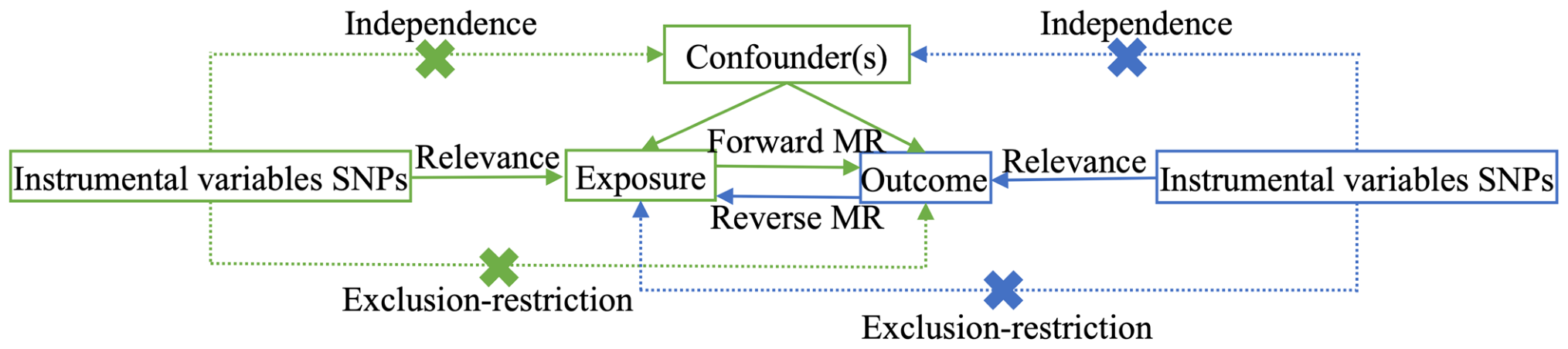
Figure 1. Flowchart of the MR design.
Cimb 48 00643 g001
Figure 2. Flowchart of the study design.
Cimb 48 00643 g002
Figure 3. Causal relationships among rQTLs associated with DU in East Asian were examined. Of the 2821 rQTLs analyzed, only 2 showed a unidirectional causal association with DU in this population (Reverse MR, PIVW < 0.05). In the network visualization, red edges indicate statistically significant causal relationships, whereas blue edges represent non-significant associations in the forward MR analysis, the yellow-highlighted rQTLs was identified as having a reliable unidirectional causal association after validation through bidirectional MR analysis.
Cimb 48 00643 g003
Figure 4. rQLT-SCAMP3/VPS53 demonstrates colocalization with DU in East Asian.
Cimb 48 00643 g004
Figure 5. (a) rQLT-ACE2/GGT1 demonstrates colocalization with DU in East Asian. (b) The Venn diagram illustrates the overlap between rQLT-ACE2/GGT1-associated genes and confirmed genetic loci for DU in East Asian, with the merged region representing hub-genes. (c) Functional enrichment analyses, including GO and KEGG pathway analysis, were conducted on the hub-genes.
Cimb 48 00643 g005
Figure 6. MR leave-one-out sensitivity analysis for ‘rQLT-ACE2/GGT1’ on ‘DU (Japanese)’. Each point represents the causal effect estimate after omitting a single individual SNP. All confidence intervals lie on the same side of the null dashed line, indicating that the causal estimate is statistically stable and not driven by any single genetic variant.
Cimb 48 00643 g006
Figure 7. Causal relationships among rQTLs associated with DU in European were examined. Of the 2821 rQTLs analyzed, 0 showed a unidirectional causal association with DU in this population (Reverse MR, PIVW > 0.05).
Cimb 48 00643 g007
Table 1. Causal analysis of rQLTs associated with DU.
Forward MRFDR-CorrectedReverse
MR
Colocalization
ExposureOutcomeSNPsOR
(95% CI)
PIVWPHeterogeneityPPleiotropyAdjusted
PIVW
PIVWPPH4
rQLT-ACE2/GGT1DU
(Japanese)
180.754
(0.674–0.843)
<0.000010.0770.2160.00050.5920.999
rQLT-KLK8/LY6D190.408
(0.311–0.536)
<0.000010.1570.543<0.00001<0.00001
rQLT-LY6D/NECTIN4232.491
(1.971–3.150)
<0.00001<0.0000<0.00001<0.00001<0.00001
rQLT-LY6D/PLA2G10282.275
(1.908–2.713)
<0.00001<0.00001<0.00001<0.00001<0.00001
rQLT-SCAMP3/VPS53120.7683
(0.674–0.875)
<0.000010.4630.5260.0420.9340.0002
Table 2. Identification of target genes.
Trait/Gene SetHub-Genes
rQLT-ACE2/GGT1 affects DU
(Japanese)
SURF1
SURF6
HLA-F
HLA-A
MED22
HLA-C
SURF2
HLA-G
BCL7B
TBL2
MLXIPL
Disclaimer/Publisher’s Note: The statements, opinions and data contained in all publications are solely those of the individual author(s) and contributor(s) and not of MDPI and/or the editor(s). MDPI and/or the editor(s) disclaim responsibility for any injury to people or property resulting from any ideas, methods, instructions or products referred to in the content.