Article

Genome-Wide Identification and Expression Analysis of the GDPD Gene Family in Cucumber (Cucumis sativus L.)


College of Life Science, Shenyang Normal University, Shenyang 110034, China
*
Authors to whom correspondence should be addressed.
These authors contributed equally to this work.
Curr. Issues Mol. Biol. 2026, 48(6), 602; https://doi.org/10.3390/cimb48060602 (registering DOI)
Submission received: 8 May 2026 / Revised: 29 May 2026 / Accepted: 3 June 2026 / Published: 5 June 2026
(This article belongs to the Section Molecular Plant Sciences)

Abstract

Glycerophosphate diester phosphodiesterase (GDPD) catalyzes the decomposition of glycerophosphate diester into sn-glycerol-3-phosphate and corresponding alcohols. In this study, six GDPD genes were identified in the cucumber genome, named CsGDPD1 to CsGDPD6, and distributed on chromosomes 1, 3, 4, 5, 6, and 7. All six proteins exhibited similar predicted three dimensional structures, suggesting conserved biochemical functions. Phylogenetic and dN/dS selection pressure analyses revealed that CsGDPD genes are evolutionarily close to their Arabidopsis homologs and have evolved under purifying selection, indicating functional conservation. Synteny analysis identified five collinear gene pairs between cucumber and Arabidopsis, but no synteny with rice. Promoter cis-acting element analysis showed the presence of multiple stress- and hormone-responsive elements. Tissue-specific expression profiling demonstrated that CsGDPD1, CsGDPD2, and CsGDPD6 are broadly expressed across tissues, whereas CsGDPD4 and CsGDPD5 show preferential expression in reproductive organs. qRT-PCR under drought and salt stress, with or without the plant growth promoting rhizobacterium GD17, revealed that drought alone upregulates all CsGDPD genes; PGPR-GD17 alone (+PGPR) suppresses their expression; and combined PGPR + Drought leads to synergistic suppression. Under salt stress, CsGDPD5 was dramatically upregulated (20-fold), and PGPR-GD17 partially reversed salt induced changes. These results provide a comprehensive foundation for understanding the evolutionary and functional roles of the GDPD gene family in cucumber stress responses.

1. Introduction

Lipids are major membrane components. Recent studies on lipid signaling and metabolism have revealed their essential roles in plant stress tolerance, including drought, heat, cold, salinity, and pathogen attack [1]. Lipid remodeling is also crucial for alleviating nutrient deprivation, particularly phosphate (Pi) deficiency. Phosphorus (P) is an essential macronutrient for plant growth, participating in multiple critical physiological processes such as cell structure construction, energy generation, metabolic regulation, and signal transduction [2,3,4]. Plants employ various strategies to cope with Pi shortage, among which membrane phospholipid remodeling and phosphate recycling are key [5,6]. In this context, glycerophosphodiester phosphodiesterase (GDPD, also known as GPX-PDE) catalyzes the breakdown of glycerophosphodiesters into sn-glycerol-3-phosphate (G-3-P) and corresponding alcohols. GDPD genes have been identified in multiple species, including 13 in Arabidopsis [7], 13 in rice (Oryza sativa L.) [8], and 14 in maize (Zea mays L.) [9].
Beyond their established role in phosphorus homeostasis, GDPD genes have also been implicated in plant responses to abiotic stresses. In Arabidopsis, several AtGDPD genes are transcriptionally regulated by salt and osmotic stress [7], suggesting a broader function beyond phosphate deficiency. Abiotic stresses such as drought, salinity, and extreme temperatures severely impair crop growth and productivity. Plants counteract these adverse conditions through complex networks involving membrane lipid remodeling, signal transduction, and regulation of reactive oxygen species (ROS) [1,10]. Because GDPD enzymes hydrolyze glycerophosphodiesters derived from membrane phospholipids, they are strategically positioned to influence membrane integrity and potentially release signaling molecules under stress. However, the functional relevance of GDPD genes in cucumber under abiotic stress remains unknown. Moreover, recent evidence indicates that plant growth-promoting rhizobacteria (PGPR) can modulate host gene expression to enhance stress tolerance [11,12], but whether PGPR influence GDPD expression has never been investigated. Therefore, clarifying the expression patterns of cucumber GDPD genes under drought and salt stress, as well as their possible regulation by PGPR, is a critical step toward understanding their broader physiological roles.
Cucumber (Cucumis sativus L.) belongs to the Cucurbitaceae family and is an important economic crop that is widely cultivated around the world [13]. Although GDPD genes have been studied in various species, systematic investigation in cucumber is still lacking. In this study, we performed the first genome-wide identification of the GDPD gene family in cucumber, and comprehensively analyzed their phylogenetic relationships, gene structures, conserved motifs, synteny, promoter cis-elements, and selection pressure. We further investigated the expression patterns of CsGDPD genes under drought and salt stress, as well as their modulation by the plant growth promoting rhizobacterium GD17 (Paraburkholderia sp. GD17)—an aspect that has never been explored in any species. Through qRT-PCR validation, we identified CsGDPD5 as a key stress-responsive gene dramatically induced by salt stress and partially attenuated by PGPR-GD17. These results provide evolutionary and functional insights into the cucumber GDPD family, and highlight a novel role of GDPD genes in PGPR-mediated abiotic stress tolerance.

2. Materials and Methods

2.1. Plant Culture and Treatment

Cucumber seeds (Cucumis sativus L. cv. Zhongnong 26) were obtained from the Institute of Vegetable and Flower Research, Chinese Academy of Agricultural Sciences. After sterilization with 75% ethanol, seeds were germinated in darkness at 25 °C for 48 h, then transplanted into seedling pots. Growth conditions: 26/18 °C (day/night), 14/10 h photoperiod, 12,000 lx light intensity, and a soil mixture of soil:vermiculite:perlite = 3:2:1.
Seven days after transplanting, uniform seedlings were divided into two groups: control (CT) and +PGPR. When the first true leaves emerged, a bacterial suspension of PGPR-GD17 (108 cells/mL) was prepared by centrifuging a 48 h shaker culture and resuspending the pellet in pure water, then applied to the +PGPR group. A second identical inoculation was performed seven days later, followed by normal cultivation.
After the second inoculation, seedlings of similar size were assigned to six groups: CT, Drought, NaCl, +PGPR, PGPR + Drought, and PGPR + NaCl. Treatments began at the four-true-leaf stage. Drought stress was imposed by water withdrawal for 9 days. Salt stress was applied by irrigation with 100 mmol/L NaCl every 3 days for a total of two treatments. The third true leaf was sampled from each group for analysis.

2.2. Identification of Cucumber GDPD Genes

The HMM file (PF02704) of the GDPD gene family was downloaded from the InterPro database (https://www.ebi.ac.uk/interpro/ (accessed on 15 November 2025)) [14,15] and used to search for GDPD genes in the cucumber genome [16]. The protein sequences of the candidate GDPD genes were extracted from the Cucurbit Genomics Database (http://www.cucurbitgenomics.org/ (accessed on 15 November 2025)). All retrieved protein sequences were subsequently verified using the InterPro database and the NCBI database (https://www.ncbi.nlm.nih.gov/ (accessed on 15 November 2025)). Ultimately, six GDPD genes were identified in the cucumber genome [17].

2.3. Chromosomal Localization, Physicochemical Properties, and 3D Structure Prediction of GDPD Proteins

For chromosome distribution analysis, the GFF3 file of ChineseLong_V3 was downloaded from the Cucurbit Genomics Database, and the chromosomal localization map was generated using TBtools (v2.467) software [17]. For physicochemical characterization, the protein sequences of the six CsGDPD genes were submitted to the ProtParam online tool (https://web.expasy.org/protparam/ (accessed on 29 November 2025)) to determine protein length, instability index, and isoelectric point (pI) [18]. Subcellular localization was predicted using the CELLO v2.5 platform (http://cello.life.nctu.edu.tw/ (accessed on 1 December 2025)) [19]. For three-dimensional structure prediction, the protein sequences were submitted to the SWISS-MODEL server (https://swissmodel.expasy.org/ (accessed on 1 December 2025)), and models were generated based on the best matching templates [20]. Model quality was assessed using GMQE scores and Ramachandran plots.

2.4. Phylogenetic Tree of CsGDPD Genes

The evolutionary relationships among the GDPD gene family members in cucumber, Arabidopsis, and rice were analyzed through phylogenetic reconstruction. Using MEGA 12 software with the MUSCLE algorithm for multiple-sequence alignment, a maximum likelihood (ML) phylogenetic tree was generated under the best-fit substitution model (determined by ModelFinder) to represent their genetic divergence [21]. The resultant phylogenetic tree was subsequently visualized and optimized using the iTOL online platform (https://itol.embl.de/ (accessed on 5 December 2025)) [22].

2.5. Conserved Motif and Gene Structure Analysis

Conserved motifs of the cucumber GDPD proteins were identified using the MEME online tool (http://meme-suite.org/tools/meme (accessed on 12 December 2025)) with default parameters except for setting the maximum number of motifs to 10 and the motif length between 6 and 200 amino acids [23]. Gene structures were visualized based on the ChineseLong_V3 GFF3 file using the Gene Structure View tool in TBtools. All resulting visualizations were integrated and displayed using TBtools.

2.6. Synteny and Selection Pressure Analysis

Synteny analysis was performed to investigate collinear relationships of GDPD genes between cucumber and two reference species, Arabidopsis and rice. Using TBtools software, the genomic sequences and annotation files (GFF3) of cucumber (ChineseLong_V3), Arabidopsis, and rice were loaded. One-step synteny analysis was conducted with default parameters to identify collinear blocks containing GDPD genes. Syntenic gene pairs were visualized using the Dual Synteny Plotter tool in TBtools. To further evaluate the selective constraints acting on the orthologous gene pairs, selection pressure analysis was performed using MEGA11. The non-synonymous (dN) to synonymous (dS) substitution rate ratio (dN/dS) was calculated for each orthologous pair between cucumber and Arabidopsis GDPD genes. A dN/dS value less than 1, equal to 1, or greater than 1 indicates purifying selection, neutral evolution, or positive selection, respectively.

2.7. Cis-Acting Elements Analysis of Cucumber GDPD Genes

The 2.0 kb upstream promoter sequences of the cucumber GDPD genes were extracted from the transcription start site using TBtools software. Cis-acting elements in the promoter regions were identified using the PlantCare online database (https://bioinformatics.psb.ugent.be/webtools/plantcare/html/ (accessed on 8 January 2025)) [24]. The results were visualized and displayed using TBtools.

2.8. Tissue-Specific Expression Analysis

The transcriptome data of cucumber tissues (PRJNA80169) were obtained from the Cucurbit Genomics Database and combined with the cucumber ChineseLong_V3 genome for RNA-seq reanalysis. The expression heatmap of CsGDPD genes across tissues was visualized using ChiPlot (https://www.chiplot.online/ (accessed on 28 January 2025)).

2.9. RNA Isolation, cDNA Synthesis, and Quantitative Real-Time PCR Analysis

Total RNA was extracted from cucumber samples using a universal plant total RNA extraction kit (Promega, Madison, WI, USA). First-strand cDNA was synthesized from 1 μg of total RNA using the PrimeScript RT reagent kit (TaKaRa, Kusatsu, Japan) according to the manufacturer’s instructions. Quantitative real-time PCR (qRT-PCR) was performed on a LightCycler 96 system (Roche, Basel, Switzerland) using TB Green Premix Ex Taq (Takara). The reaction mixture (20 μL) contained 10 μL of 2× TB Green Premix, 0.4 μM of each gene-specific primer, and 2 μL of diluted cDNA (equivalent to 50 ng of input RNA). The thermal cycling conditions were: 95 °C for 30 s, followed by 40 cycles of 95 °C for 5 s and 60 °C for 30 s. Melting curve analysis was conducted to verify amplification specificity, and primer amplification efficiency was determined by standard curve analysis using a dilution series of cDNA. The cucumber Actin gene (CsActin) was used as an internal reference. Relative expression levels of each target gene were calculated using the 2−ΔΔCT method. The expression level of the control group (CT) was set to 1, and the expression levels of all treatment groups were normalized relative to CT. Three biological replicates were performed for each treatment, and each reaction was run in technical triplicates. The sequences of gene-specific primers are listed in Supplementary Table S2.

3. Results

3.1. Identification and Characterization of GDPD Genes

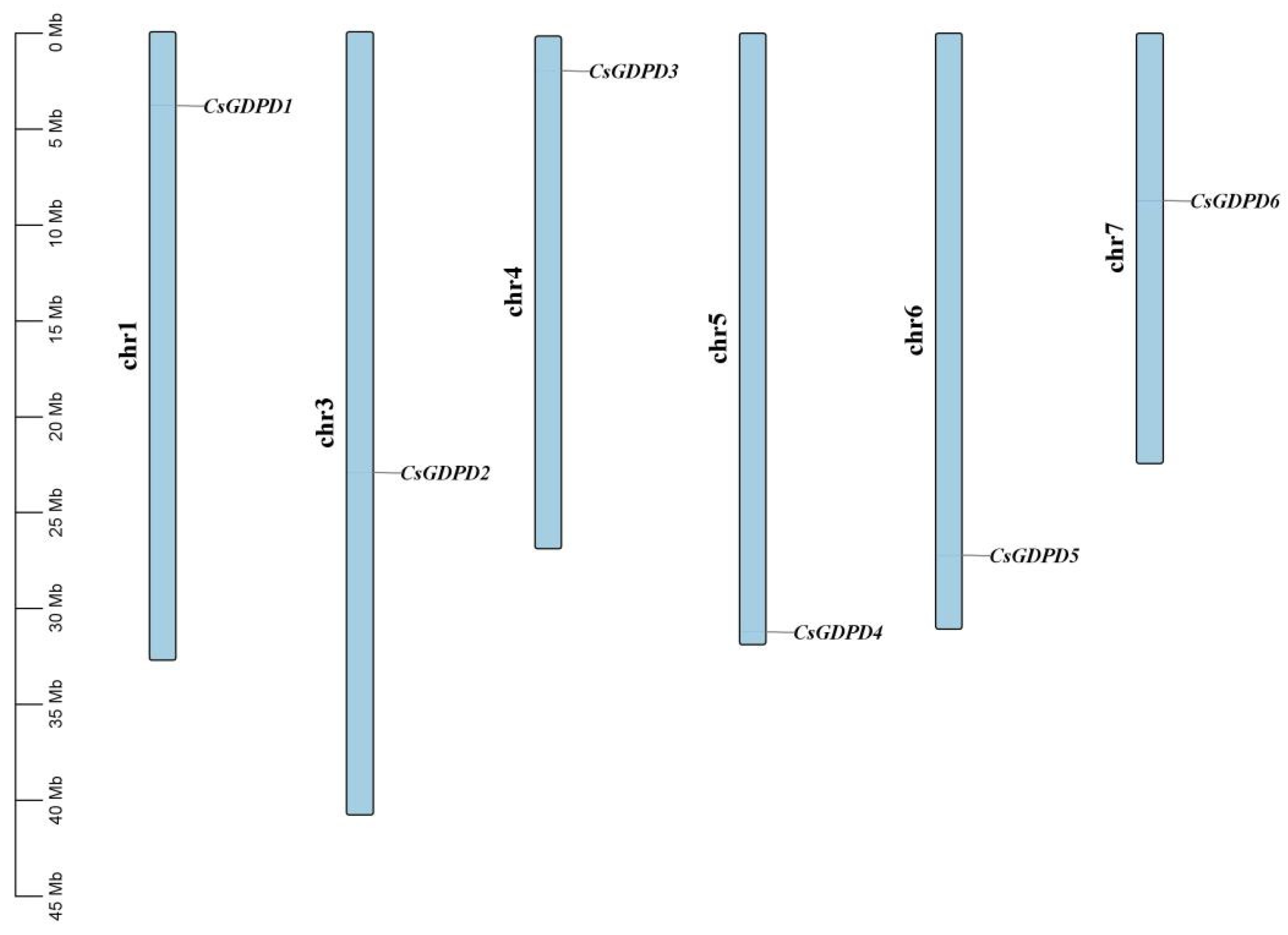
A total of six GDPD genes were identified in the cucumber genome (ChineseLong_V3). These genes, named CsGDPD1 to CsGDPD6, were located on chromosomes 1, 3, 4, 5, 6, and 7, respectively (Figure 1).
The protein length ranged from 330 (CsGDPD4) to 764 (CsGDPD6) amino acids, and the molecular weight ranged from 37.30 kDa (CsGDPD4) to 83.50 kDa (CsGDPD6). The theoretical isoelectric points (pI) ranged from 4.99 (CsGDPD2) to 9.74 (CsGDPD4). Instability index analysis indicated that CsGDPD1 and CsGDPD5 were unstable (instability index > 40), whereas the other four GDPD proteins were stable. The grand average hydropathicity (GRAVY) values of CsGDPD1, CsGDPD2, CsGDPD3, and CsGDPD4 were less than zero, indicating that they are hydrophilic, while the remaining two were hydrophobic. Subcellular localization prediction showed that two GDPD genes were located in the cytoplasm, two in the plasma membrane, and the remaining two in the extracellular space and mitochondria, respectively (Table 1).
To gain insight into the structural conservation of the CsGDPD proteins, their three-dimensional structures were predicted using SWISS-MODEL (Figure S1). For all six proteins, reliable models were obtained with template sequence identity ranging from 73.3% to 100% and GMQE scores between 0.82 and 0.89, indicating high modeling quality. Ramachandran plot analysis showed that over 92% of the residues were in favored regions, further validating the structural reliability. The predicted structures of all six CsGDPD proteins were spatially similar, suggesting conserved biochemical functions.

3.2. Gene Structure and Analysis of Conserved Motifs

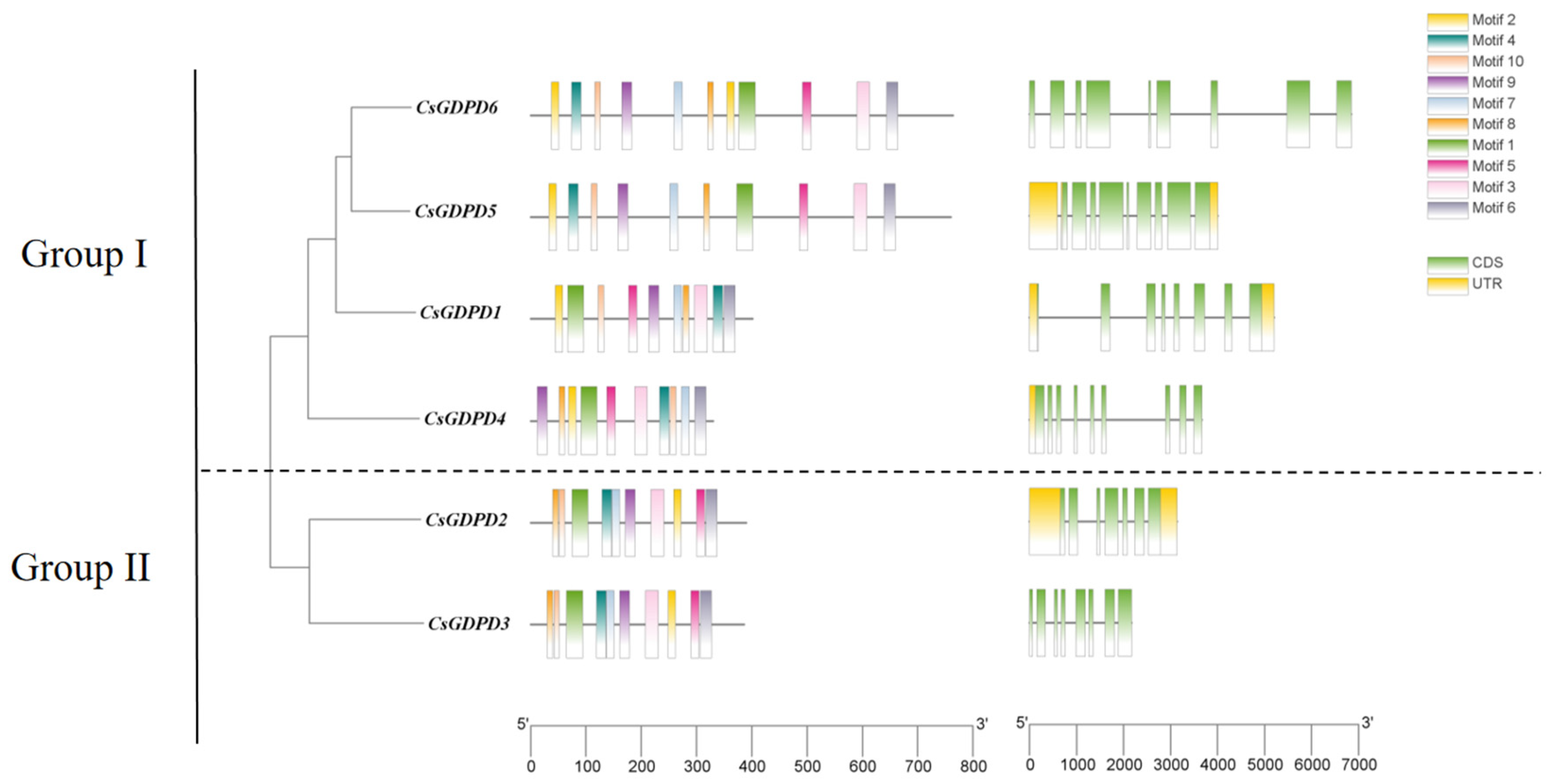
Based on the conserved motif composition of the six cucumber GDPD proteins, they were divided into two groups (Group I and Group II). Group I included CsGDPD1, CsGDPD4, CsGDPD5, and CsGDPD6, while Group II included CsGDPD2 and CsGDPD3.
Motif analysis using MEME revealed that CsGDPD6 contained 11 conserved motifs, whereas the other five members each contained 10 motifs (Figure 2). In Group II, the two genes shared identical motif types and order, suggesting they may perform similar biological functions. In contrast, Group I members exhibited variable motif patterns, and their motif composition differed significantly from that of Group II, which may account for the functional diversification within this family. In addition, gene structure analysis showed that the number of exons ranged from 7 to 9, and the number of introns ranged from 6 to 8. Specifically, CsGDPD4 and CsGDPD6 both contained 9 exons and 8 introns (Figure 2).

3.3. Phylogenetic Analysis

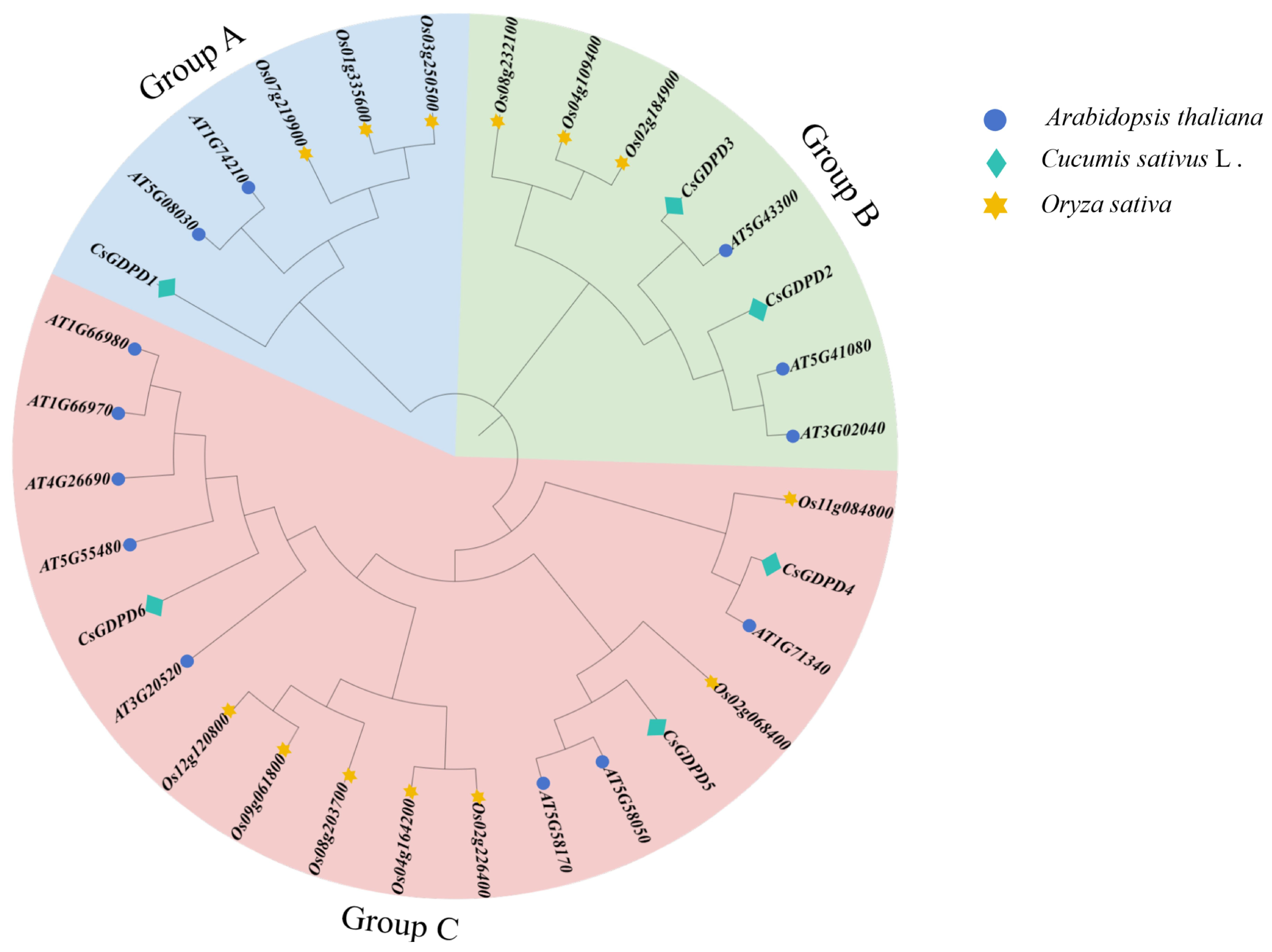
A phylogenetic tree was constructed using the GDPD protein sequences of cucumber (6), Arabidopsis (13), and rice (13) (Figure 3). The tree was divided into three groups (Groups A, B, and C), containing 6, 8, and 18 GDPD genes, respectively. Two pairs of putative orthologous genes were identified between cucumber and Arabidopsis, CsGDPD3 with AT5G43300, and CsGDPD4 with AT1G71340. No direct orthologous relationship between cucumber and rice GDPDs was observed in the phylogenetic tree. CsGDPD1 clusters tightly with AT1G74210 and AT5G08030 in Group A, whereas CsGDPD2 is placed into Group B, clustering closely with AT3G02040 and AT5G41080. This suggests that CsGDPD1 and CsGDPD2 may have retained conserved functions. Although CsGDPD5 and CsGDPD6 both belonged to Group C, they clustered with different Arabidopsis genes, indicating possible species-specific functional divergence in cucumber. Based on the close evolutionary relationships, the potential biological functions of cucumber GDPD genes may be inferred from their well-characterized counterparts in Arabidopsis.

3.4. Synteny Analysis of GDPD Genes Among Arabidopsis, Rice and Cucumber and Selection Pressure Analysis

To further investigate the evolutionary conservation of the CsGDPD gene family, synteny analysis was performed between cucumber and two reference species, Arabidopsis and rice (Figure 4). In total, five syntenic GDPD gene pairs were identified between cucumber and Arabidopsis, CsGDPD1 exhibited synteny with AT1G74210 and AT5G08030; CsGDPD2 with AT3G02040; CsGDPD4 with AT1G71340; and CsGDPD6 with AT5G55480. No syntenic relationships were detected between cucumber and rice GDPD genes. The synteny results are largely consistent with the phylogenetic relationships described. The absence of syntenic counterparts for CsGDPD3 and CsGDPD5 in both Arabidopsis and rice may reflect species-specific evolution or rapid divergence, consistent with their distinct phylogenetic positions (e.g., CsGDPD3 as a putative ortholog of AT5G43300 but without collinearity). Overall, the combination of phylogenetic and syntenic analyses provides complementary evidence for the evolutionary trajectories of the cucumber GDPD gene family.
To further assess the evolutionary conservation between cucumber and Arabidopsis GDPD genes, the dN/dS ratio was calculated for orthologous pairs (Table S1). All dN/dS values were below 1, indicating that these genes have evolved under purifying selection and have retained similar functions across species. Notably, the low dN/dS values for CsGDPD1 with its Arabidopsis counterparts (AT1G74210 and AT5G08030) suggest that these genes have been highly conserved during evolution and may share essential, irreplaceable roles. Similarly, CsGDPD4 and its ortholog AT1G71340 also showed strong purifying selection, supporting their functional similarity. In contrast, CsGDPD3 and CsGDPD4 with AT5G43300 exhibited relatively higher dN/dS values, implying slightly relaxed but still conserved functions. Overall, the dN/dS analysis reinforces the conclusion from the phylogenetic tree that cucumber GDPD genes and their Arabidopsis homologs are likely to perform similar biological functions, providing a molecular basis for functional prediction in cucumber.

3.5. Analysis of the Cis-Acting Elements in Cucumber GDPD Genes

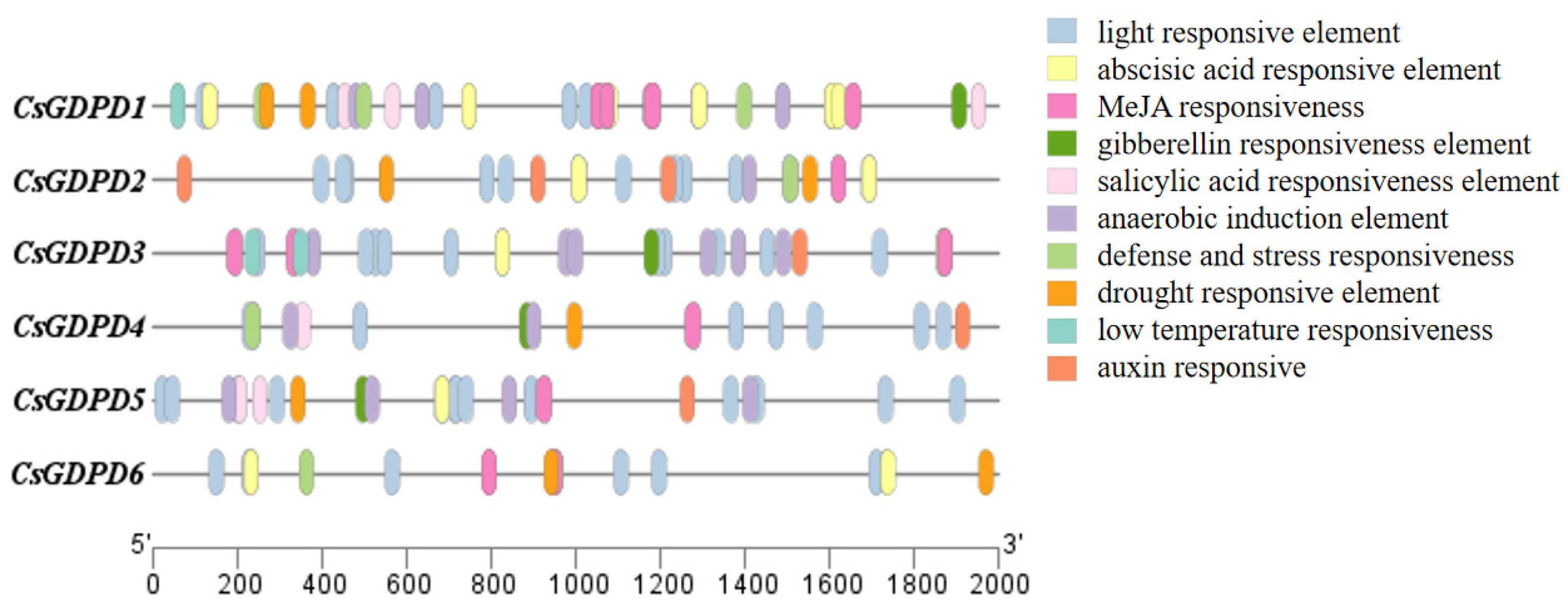
To predict the potential regulatory mechanisms of the CsGDPD genes, the 2000 bp upstream promoter sequences of all six CsGDPD genes were analyzed using PlantCare (Figure 5). A total of 10 types of cis-acting elements were identified, including light-responsive elements, MeJA-responsive elements, anaerobic induction elements, hormone-responsive elements (auxin, abscisic acid, MeJA, and gibberellin), and stress-responsive elements (low temperature, drought, defense, and salt). All six genes contained light-responsive, MeJA-responsive, and anaerobic induction elements. The number and distribution of cis-elements varied among family members. CsGDPD1 contained the highest number of elements, while CsGDPD2 contained the fewest. Genes such as CsGDPD1, CsGDPD3, and CsGDPD5 exhibited a higher density of stress and hormone-related elements, suggesting their potential involvement in multiple signaling pathways. Notably, drought-responsive elements are present in all CsGDPD, leading us to speculate that CsGDPDs may play important roles in plant stress resistance. Overall, the promoter analysis indicates that the CsGDPD gene family may participate in various biological processes, including hormone signal transduction, stress adaptation, and light response.

3.6. Tissue-Specific Expression Analysis of GDPD Genes

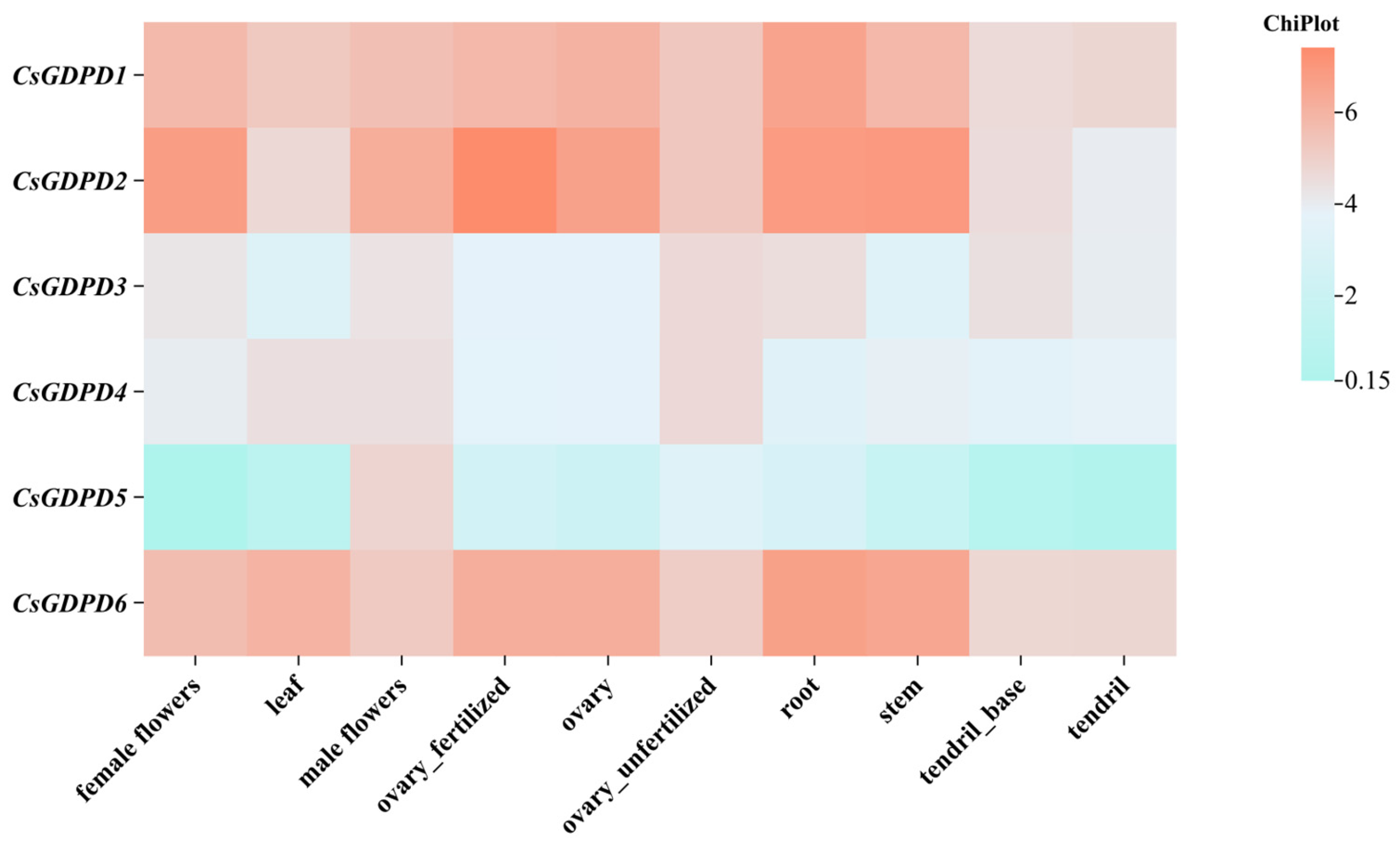
The expression profiles of the six CsGDPD genes across ten different cucumber tissues were analyzed using publicly available transcriptome data (Figure 6). CsGDPD1, CsGDPD2, and CsGDPD6 showed generally high expression levels in all tissues, whereas CsGDPD3, CsGDPD4, and CsGDPD5 exhibited low expression across most tissues. Notably, CsGDPD5 was predominantly expressed in male tissues, and CsGDPD4 showed relatively higher expression in leaf, male, and unfertilized ovary tissues. CsGDPD2 was highly expressed in all tissues except tendril. Interestingly, the expression levels of CsGDPD1 and CsGDPD2 were significantly higher in female flowers than in male flowers, suggesting a potential role in female reproductive organ development and fruit setting. The presence of hormone-responsive elements in the promoters of these genes (Figure 5) may partly explain their differential expression in floral tissues. These tissue-specific patterns provide clues for further functional studies of the CsGDPD family.

3.7. qRT-PCR Expression Analysis of CsGDPD Genes Under Drought, Salt, and PGPR-GD17 Treatments

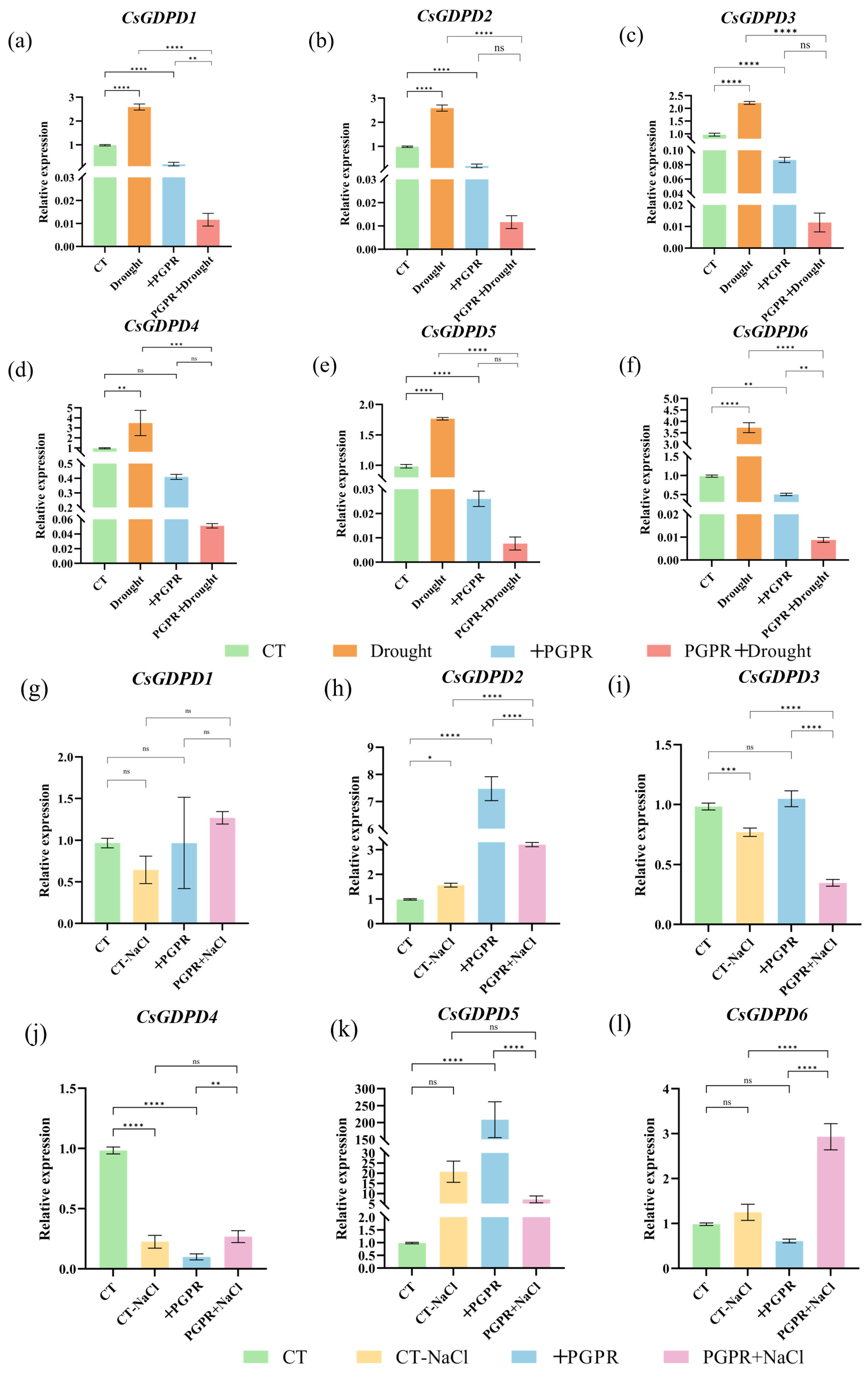
To investigate the effects of the PGPR-GD17 on CsGDPD expression under abiotic stresses, qRT-PCR was performed under drought and salt stress, with or without PGRP-GD17 inoculation (Figure 7). Under drought stress alone (D), all six CsGDPD genes were upregulated compared with the control (CT), with expression levels ranging from 1.77 (CsGDPD5) to 3.73 (CsGDPD6), indicating a general positive response of the family to drought. Inoculation with +PGPR strongly suppressed the expression of all six genes, with values ranging from 0.026 (CsGDPD5) to 0.50 (CsGDPD6), suggesting that PGPR-GD17 negatively regulates CsGDPD transcription under normal conditions. In the PGPR + Drought group, the expression levels of all genes were further reduced to extremely low levels (0.007–0.051), even lower than with +PGPR, indicating a synergistic suppressive effect between PGPR-GD17 and drought. Under salt stress alone (+NaCl), the responses were gene-specific, CsGDPD1, CsGDPD3, CsGDPD4, and CsGDPD6 showed moderate changes (0.22–1.56), while CsGDPD5 was dramatically upregulated (20.39), and CsGDPD2 also increased (1.56). PGPR-GD17 under salt conditions (PGPR + NaCl) partially reversed the salt-induced changes, CsGDPD1, CsGDPD2, CsGDPD3, and CsGDPD6 were further induced (1.27–3.20), whereas CsGDPD4 and CsGDPD5 were reduced compared with salt alone but remained higher than control for CsGDPD5 (7.06). The salt-responsive expression of CsGDPD5 and its altered expression under PGPR-GD17 treatment identify it as a candidate for stress tolerance, but further functional studies (e.g., gene editing or overexpression) are necessary to establish its actual role.

4. Discussion

In this study, we performed the first genome-wide identification and systematic characterization of the GDPD gene family in cucumber. A total of six GDPD genes were identified in the cucumber genome, which is fewer than in Arabidopsis (13), rice (13) and maize (14) [7,8,9]. The smaller size of the cucumber GDPD family may reflect species-specific gene loss or differential expansion during evolution, as has been observed for other gene families in Cucurbitaceae [25,26].
Phylogenetic analysis showed that the six CsGDPD genes were distributed among three groups (A, B and C). Consistent with the evolutionary distance between dicots and monocots, cucumber GDPD proteins clustered more closely with those of Arabidopsis (dicot) than with those of rice (monocot). Two pairs of putative orthologs were identified between cucumber and Arabidopsis (CsGDPD3/AT5G43300 and CsGDPD4/AT1G71340). Synteny analysis further revealed five collinear gene pairs between cucumber and Arabidopsis, but no syntenic relationship with rice. These results indicate that the cucumber GDPD family shares a closer evolutionary history with the model dicot. The absence of syntenic relationships between cucumber and rice GDPD genes is consistent with the deep evolutionary divergence between dicots and monocots, which are estimated to have separated approximately 140–150 million years ago [27]. During this long period, extensive genome rearrangements, including chromosomal fusions, inversions, translocations, and differential gene loss, may have disrupted ancestral collinearity [28]. Lineage-specific expansion or contraction of gene families could also have led to the loss of syntenic signals while maintaining functional orthology at the sequence level [29]. Similar phenomena have been observed for other gene families in Cucurbitaceae when compared with monocot genomes [30]. The absence of syntenic counterparts for CsGDPD3 and CsGDPD5 in both Arabidopsis and rice suggests that these two genes might have originated from species-specific duplication or rapid divergence, potentially leading to neo-functionalization [31].
Selection pressure analysis (dN/dS) revealed that all orthologous pairs between cucumber and Arabidopsis have dN/dS values below 1, indicating strong purifying selection [32,33]. This supports the notion that the GDPD family has maintained conserved enzymatic functions during evolution. Notably, CsGDPD1, with its Arabidopsis counterparts (AT1G74210 and AT5G08030), exhibited extremely low dN/dS values, implying essential, non-redundant roles. The higher dN/dS values for CsGDPD3 and CsGDPD4 with AT5G43300 suggest slightly relaxed constraints, which may allow for functional divergence [7]. Beyond evolutionary conservation, our expression data provide insights into how CsGDPD proteins may contribute to drought and salt tolerance at the physiological and molecular levels. Under drought stress, all six CsGDPD genes were upregulated (1.5- to 3.5-fold), and under salt stress, CsGDPD5 was dramatically induced (20-fold), as shown by qRT-PCR. These expression patterns are consistent with the presence of drought-responsive elements (DRE) and abscisic acid-responsive elements (ABRE) in their promoters (Figure 5). The GDPD enzyme hydrolyzes membrane-derived glycerophosphodiesters to produce sn-glycerol-3-phosphate (G-3-P) and free alcohols such as choline. G-3-P can serve as a precursor for the synthesis of glycerol, a compatible osmolyte that stabilizes membranes and proteins under osmotic stress [34]. Additionally, choline released from glycerophosphocholine can be converted into glycine betaine, a well-known osmoprotectant that maintains cellular water balance and protects macromolecular structures during drought and salinity [35]. Therefore, the stress-induced upregulation of CsGDPD genes may enhance the production of these osmoprotectants, thereby contributing to cellular adaptation. Furthermore, G-3-P has been implicated in stress signaling pathways, potentially linking GDPD activity to broader regulatory networks. While direct biochemical evidence is still lacking in cucumber, our transcriptional and promoter analyses strongly suggest that CsGDPD proteins participate in abiotic stress tolerance through the generation of osmoprotective metabolites and maintenance of membrane integrity.
The promoter cis-acting element analysis revealed that all CsGDPD genes contain multiple stress-responsive elements, including drought-responsive elements (DRE) and abscisic acid-responsive elements (ABRE), as well as hormone-responsive elements (MeJA, auxin, gibberellin). This is consistent with our qRT-PCR results: under drought stress, all six CsGDPD genes were significantly upregulated (1.5- to 3.5-fold), and under salt stress, CsGDPD5 was dramatically induced (20-fold). Notably, CsGDPD1, CsGDPD3, and CsGDPD5 exhibited a higher density of stress- and hormone-related elements in their promoters, which correlates with their relatively higher expression levels under stress conditions. For instance, CsGDPD5, the most strongly salt induced gene, possesses multiple ABRE and DRE motifs, suggesting that these elements may directly contribute to its transcriptional activation. These observations are in line with previous reports that DRE and ABRE are key regulators of stress-inducible gene expression [36,37]. Collectively, our promoter and expression data strongly indicate that the CsGDPD genes are transcriptionally regulated by drought and salt stress, likely through the action of these cis-elements. The presence of light-responsive and anaerobic induction elements further suggests additional roles in photosynthesis and hypoxia adaptation, which warrants future investigation.
Tissue-specific expression analysis revealed that CsGDPD1, CsGDPD2 and CsGDPD6 are broadly expressed, whereas CsGDPD4 and CsGDPD5 show preferential expression in reproductive tissues (male flowers, unfertilized ovaries). This pattern is similar to that observed for CaGDPD1 in pepper and several AtGDPD genes in Arabidopsis, which are highly expressed in floral organs and are implicated in reproductive development [7,8]. The elevated expression of CsGDPD1 and CsGDPD2 in female flowers compared with male flowers suggests a potential role in fruit setting and female reproductive organ development, which deserves further functional investigation. However, whether cucumber CsGDPD4 and CsGDPD5 actually play similar roles remains unknown and requires experimental validation.
PGPR-GD17 is a PGPR that has been experimentally validated to play an important regulatory role in drought tolerance of cucumber [38]. Therefore, we investigated the effect of PGPR-GD17 on the expression of CsGDPD genes under drought and salt stress. qRT-PCR under drought and salt stress, with or without the PGPR-GD17, provided novel insights into the regulation of CsGDPD genes. Drought alone upregulated all six CsGDPD genes, indicating a positive response to dehydration. This is in line with the presence of drought-responsive elements in their promoters. Interestingly, +PGPR strongly suppressed CsGDPD expression under normal conditions, and combined PGPR + Drought led to synergistic suppression at extremely low levels. In contrast, under salt stress, PGPR-GD17 partially reversed salt-induced changes: CsGDPD5 was dramatically induced (20-fold) by salt alone, and PGPR-GD17 reduced this induction but still maintained higher expression than the control. These differential responses suggest a possible regulatory effect of PGPR-GD17. The strong and specific upregulation of CsGDPD5 under salt stress highlights it as a prime candidate for salt tolerance breeding. The suppressive effect of PGPR-GD17 under drought might reflect a trade-off between growth promotion and stress signaling, or it could indicate that PGPR-GD17 helps the plant avoid over-activation of phospholipid remodeling pathways under combined stress [5].
Overall, this study provides a foundation for understanding the evolution and regulation of the cucumber GDPD family. The salt-responsive expression of CsGDPD5 and its correlation with PGPR-GD17 treatment suggest a possible role for this gene in stress tolerance; however, direct functional validation (e.g., via gene editing or overexpression) is required to confirm its involvement.

5. Conclusions

In this study, six GDPD family genes were systematically identified in the cucumber genome. They are distributed on chromosomes 1, 3, 4, 5, 6, and 7, and encode proteins with conserved three-dimensional structures. Phylogenetic and dN/dS selection pressure analyses demonstrated that cucumber GDPD genes are evolutionarily close to their Arabidopsis homologs and have evolved under purifying selection, supporting functional conservation. Synteny analysis identified five collinear gene pairs between cucumber and Arabidopsis, but no synteny with rice. Promoter cis-acting element analysis revealed abundant stress and hormone-responsive elements, suggesting involvement in multiple signaling pathways. Tissue-specific expression profiling showed that CsGDPD1, CsGDPD2, and CsGDPD6 are broadly expressed, while CsGDPD4 and CsGDPD5 exhibit preferential expression in reproductive tissues, implying specialized roles in growth and development. qRT-PCR under drought and salt stress, with or without PGPR-GD17, uncovered that drought alone upregulates all CsGDPD genes; +PGPR suppresses them; and combined GD17 + Drought causes synergistic suppression. Under salt stress, CsGDPD5 is massively induced (20-fold), and PGPR-GD17 partially modulates this response. These results suggest that CsGDPD5 could be a candidate for further investigation in salt tolerance breeding, but this remains to be validated by functional studies. The data also indicate that PGPR-GD17 may exert gene-specific and stress-dependent regulation. Overall, this study provides essential gene resources and a theoretical basis for further functional analysis of GDPD genes in cucumber resistance breeding.

Supplementary Materials

The following supporting information can be downloaded at https://www.mdpi.com/article/10.3390/cimb48060602/s1.

Author Contributions

Writing—original draft, S.L., X.Z. and W.F.; methodology, X.Z., S.L., L.C. and W.F.; investigation, S.L., R.Z. and W.F.; formal analysis, X.Z., Y.Z. and L.J.; data curation, S.L.; writing—review and editing, W.F.; supervision, L.J.; funding acquisition, W.F.; project administration, L.J. and W.F. All authors have read and agreed to the published version of the manuscript.

Funding

This research was supported by Liaoning Provincial universities Basic Research funds. special fund (LJ202410166039), Liaoning Provincial Science and Technology Plan Joint Project (2025-MSLH-618), Liaoning Provincial University Students’ Innovation Training Program Project (S202510166050).

Institutional Review Board Statement

Not applicable.

Informed Consent Statement

Not applicable.

Data Availability Statement

The original data presented in the study are openly available in Cucurbit Genomics Database [accession number PRJNA80169].

Conflicts of Interest

The authors declare no conflicts of interest.

References

  1. Okazaki, Y.; Saito, K. Roles of lipids as signaling molecules and mitigators during stress response in plants. Plant J. 2014, 4, 584–596. [Google Scholar] [CrossRef] [PubMed]
  2. Bieleski, R.L. Phosphate pools, phosphate transport and phosphate availability. Annu. Rev. Plant Biol. 1973, 24, 225–252. [Google Scholar] [CrossRef]
  3. Raghothama, K.G. Phosphate Acquisition. Annu. Rev. Plant Physiol. Plant Mol. Biol. 1999, 50, 665–693. [Google Scholar] [CrossRef] [PubMed]
  4. Chen, J.; Quan, C.; Zhao, Y.; Kalumith, I.L.D.S.; Fei, Z.; Kochian, L.V.; Lucas, W.J.; Ham, B. PPSR1 Protein Functions as an Important Regulator to Enhance Plant Growth Performance Under N, P, and K Deficient Stress Conditions. Plant Biotechnol. J. 2026, 4, 2385–2404. [Google Scholar] [CrossRef]
  5. Mehra, P.; Pandey, B.K.; Verma, L.; Giri, J. A Novel Glycerophosphodiester Phosphodiesterase Improves Phosphate Deficiency Tolerance in Rice. Plant Cell Environ. 2019, 4, 1167–1179. [Google Scholar]
  6. Li, L.; Xu, Z.; He, Y. OsPHR2 and OsMYC2 Coordinate Phosphate Starvation-Induced Sakuranetin Biosynthesis for Enhanced Rice Blast Resistance. Plant Physiol. 2026, kiag199, Advance online publication. [Google Scholar] [CrossRef]
  7. Cheng, Y.; Zhou, W.E.; Sherry, N.I.; Peters, C.; Li, M.; Wang, X.; Huang, J. Characterization of the Arabidopsis glycerophosphodiester phosphodiesterase (GDPD) family reveals a role of the plastid-localized AtGDPD1 in maintaining cellular phosphate homeostasis under phosphate starvation. Plant J. 2011, 5, 781–795, Erratum in Plant J. 2011, 67, 746. [Google Scholar] [CrossRef]
  8. Mehra, P.; Giri, J. Rice and chickpea GDPDs are preferentially influenced by low phosphate and CaGDPD1 encodes an active glycerophosphodiester phosphodiesterase enzyme. Plant Cell Rep. 2016, 8, 1699–1717. [Google Scholar] [CrossRef]
  9. Wang, J.; Pan, W.; Nikiforov, A.; King, W.; Hong, W.; Li, W.; Han, Y.; Patton-Vogt, J.; Shen, J.; Cheng, L. Identification of two glycerophosphodiester phosphodiesterase genes in maize leaf phosphorus remobilization. Crop J. 2021, 1, 95–108. [Google Scholar] [CrossRef]
  10. You, J.; Chan, Z. ROS regulation during abiotic stress responses in plants. Int. J. Mol. Sci. 2015, 16, 14286–14307. [Google Scholar] [CrossRef]
  11. Zhu, R.; Cao, Y.; Li, G.; Guo, Y.; Ma, L.; Bu, N.; Hao, L. Paraburkholderia sp. GD17 improves rice seedling tolerance to salinity. Plant Soil 2021, 467, 373–389. [Google Scholar] [CrossRef]
  12. Fu, W.; Zhao, D.; Liu, H.; Wu, L.; Hao, L. Inoculation of Paraburkholderia sp. GD17 improves seedling growth and tolerance to cadmium in Chinese cabbage. Environ. Exp. Bot. 2024, 227, 105955. [Google Scholar] [CrossRef]
  13. Luo, H.; Zhang, H.; Wang, H. Advance in sex differentiation in cucumber. Front. Plant Sci. 2023, 14, 1186904. [Google Scholar] [CrossRef]
  14. Oelkers, K.; Goffard, N.; Weiller, G.F.; Gresshoff, P.M.; Mathesius, U.; Frickey, T. Bioinformatic analysis of the CLE signaling peptide family. BMC Plant Biol. 2008, 8, 1, Erratum in BMC Plant Biol. 2009, 9, 17. [Google Scholar] [CrossRef] [PubMed]
  15. Finn, R.D.; Clements, J.; Eddy, S.R. HMMER web server: Interactive sequence similarity searching. Nucleic Acids Res. 2011, 39, W29–W37. [Google Scholar] [CrossRef] [PubMed]
  16. Paysan-Lafosse, T.; Blum, M.; Chuguransky, S.; Grego, T.; Pinto, B.L.; A Salazar, G.; Bileschi, M.L.; Bork, P.; Bridge, A.; Colwell, L.; et al. InterPro in 2022. Nucleic Acids Res. 2023, D1, D418–D427. [Google Scholar] [CrossRef] [PubMed]
  17. Chen, C.; Chen, H.; Zhang, Y.; Thomas, H.R.; Frank, M.H.; He, Y.H.; Xia, R. TBtools: An integrative toolkit developed for interactive analyses of big biological data. Mol. Plant 2020, 8, 1194–1202. [Google Scholar] [CrossRef]
  18. Gasteiger, E.; Hoogland, C.; Gattiker, A.; Duvaud, S.E.; Wilkins, M.R.; Appel, R.D.; Bairoch, A. Protein identification and analysis tools on the ExPASy server. In The Proteomics Protocols Handbook; Walker, J.M., Ed.; Humana Press: Totowa, NJ, USA, 2005; pp. 571–607. [Google Scholar]
  19. Yu, C.S.; Chen, Y.C.; Lu, C.H.; Hwang, J.K. Prediction of protein subcellular localization. Proteins-Struct. Funct. Bioinform. 2006, 3, 643–651. [Google Scholar] [CrossRef]
  20. Waterhouse, A.; Bertoni, M.; Bienert, S.; Studer, G.; Tauriello, G.; Gumienny, R.; Heer, F.T.; de Beer, T.A.P.; Rempfer, C.; Bordoli, L.; et al. SWISS-MODEL: Homology modelling of protein structures and complexes. Nucleic Acids Res. 2018, W1, W296–W303. [Google Scholar] [CrossRef]
  21. Tamura, K.; Stecher, G.; Kumar, S. MEGA11: Molecular Evolutionary Genetics Analysis Version 11. Mol. Biol. Evol. 2021, 7, 3022–3027. [Google Scholar] [CrossRef]
  22. Letunic, I.; Bork, P. Interactive Tree Of Life (iTOL) v5: An online tool for phylogenetic tree display and annotation. Nucleic Acids Res. 2021, W1, W293–W296. [Google Scholar] [CrossRef]
  23. Bailey, T.L.; Boden, M.; Buske, F.A.; Frith, M.; Grant, C.E.; Clementi, L.; Ren, J.; Li, W.W.; Noble, W.S. MEME SUITE: Tools for motif discovery and searching. Nucleic Acids Res. 2009, 37, W202–W208. [Google Scholar] [CrossRef]
  24. Higo, K.; Ugawa, Y.; Iwamoto, M.; Korenaga, T. Plant cis-acting regulatory DNA elements (PLACE) database: 1999. Nucleic Acids Res. 1999, 1, 297–300. [Google Scholar] [CrossRef] [PubMed]
  25. Jain, M.; Tyagi, A.K.; Khurana, J.P. Genome-wide analysis, evolutionary expansion, and expression of early auxin-responsive SAUR gene family in rice (Oryza sativa). Genomics 2006, 3, 360–371. [Google Scholar] [CrossRef]
  26. Yang, D.; Li, Y.; Zhu, M.; Cui, R.; Gao, J.; Shu, Y.; Lu, X.; Zhang, H.; Zhang, K. Genome-Wide Identification and Expression Analysis of the Cucumber FKBP Gene Family in Response to Abiotic and Biotic Stresses. Genes 2023, 11, 2006. [Google Scholar] [CrossRef] [PubMed]
  27. Chaw, S.M.; Chang, C.C.; Chen, H.L.; Li, W.H. Dating the monocot-dicot divergence and the origin of core eudicots using whole chloroplast genomes. J. Mol. Evol. 2004, 4, 424–441. [Google Scholar]
  28. Murat, F.; Armero, A.; Pont, C.; Klopp, C.; Salse, J. Reconstructing the genome of the most recent common ancestor of flowering plants. Nat. Genet. 2017, 4, 490–496. [Google Scholar] [CrossRef]
  29. Panchy, N.; Lehti-Shiu, M.; Shiu, S.H. Evolution of Gene Duplication in Plants. Plant Physiol. 2016, 4, 2294–2316. [Google Scholar] [CrossRef]
  30. Zhang, X.; Li, S.; Zhou, Y.; Chen, M.; Jiang, L.; Fu, W. Characterization and Expression Analysis of the SABATH Gene Family Under Abiotic Stresses in Cucumber (Cucumis sativus L.). Plants 2025, 12, 1748. [Google Scholar] [CrossRef]
  31. Paixão, V.D.S.; Suárez, P.; Oliveira da Silva, W.; Geise, L.; Ferguson-Smith, M.A.; O’bRien, P.C.M.; Mendes-Oliveira, A.C.; Rossi, R.V.; Pieczarka, J.C.; Nagamachi, C.Y. Comparative genomic mapping reveals mechanisms of chromosome diversification in Rhipidomys species (Rodentia, Thomasomyini) and syntenic relationship between species of Sigmodontinae. PLoS ONE 2021, 10, e0258474. [Google Scholar] [CrossRef]
  32. Hurst, L.D. The Ka/Ks Ratio: Diagnosing the Form of Sequence Evolution. Trends Genet. 2002, 9, 486. [Google Scholar] [CrossRef]
  33. Pan, J.; Zhang, A.; Xiao, K.; Anwar, T.; Ma, K.; Wu, X. Genome-Wide Characterization of the Expansin Gene Family in Eggplant (Solanum melongena L.) Reveals Its Roles in Fruit Development and Heat Stress Response. Plants 2026, 7, 995. [Google Scholar] [CrossRef]
  34. Hoekstra, F.A.; Golovina, E.A.; Buitink, J. Mechanisms of plant desiccation tolerance. Trends Plant Sci. 2001, 9, 431–438. [Google Scholar] [CrossRef]
  35. Chen, T.H.; Murata, N. Glycinebetaine protects plants against abiotic stress: Mechanisms and biotechnological applications. Plant Cell Environ. 2011, 1, 1–20. [Google Scholar] [CrossRef]
  36. Yamaguchi-Shinozaki, K.; Shinozaki, K. A novel cis-acting element in an Arabidopsis gene is involved in responsiveness to drought, low-temperature, or high-salt stress. Plant Cell 1994, 2, 251–264. [Google Scholar]
  37. Nakashima, K.; Yamaguchi-Shinozaki, K.; Shinozaki, K. The transcriptional regulatory network in the drought response and its crosstalk in abiotic stress responses including drought, cold, and heat. Front. Plant Sci. 2014, 5, 170. [Google Scholar] [CrossRef]
  38. Zhang, X.; Zhou, Y.; Shamsi, I.H.; Jiang, L.; Wang, S.; Zhao, Y.; Hao, L.; Fu, W. Paraburkholderia sp. GD17 alleviates damage under drought stress by inducing abscisic acid to regulate the branched-chain amino acid pathway. Plant Physiol. Biochem. 2026, 233, 111260. [Google Scholar] [CrossRef] [PubMed]
Figure 1. The distribution and localization of CsGDPDs on chromosomes are shown, with chromosome names and the scale in megabases (Mb) displayed to the left of each chromosome.
Cimb 48 00602 g001
Figure 2. Schematic diagram of the exon–intron structures of GDPD genes and conserved motifs of GDPD proteins in cucumber.
Cimb 48 00602 g002
Figure 3. Phylogenetic tree of GDPD proteins from cucumber, Arabidopsis, and rice. Green diamonds, blue circles, and yellow five-pointed stars represent GDPD members from cucumber, Arabidopsis, and rice, respectively.
Cimb 48 00602 g003
Figure 4. Chromosomal collinearity relationships between Cucumber and Arabidopsis. Gray lines in the background indicate collinear blocks in Cucumber and Arabidopsis genomes, while the red lines represent the CsGDPD.
Cimb 48 00602 g004
Figure 5. The cis-acting elements analysis of the promoters of cucumber GDPD genes.
Cimb 48 00602 g005
Figure 6. The expression profiling of cucumber GDPD genes in different tissues.
Cimb 48 00602 g006
Figure 7. Expression profiles of CsGDPD genes in response to various stress. (af) Relative expression levels of six CsGDPD genes in cucumber leaves under control (CT), drought (Drought), +PGPR, and combined drought + GD17 (PGPR + Drought) conditions. (gl) Relative expression levels of six CsGDPD genes under control (CT), salt stress (NaCl), and combined salt + GD17 (PGPR + NaCl) conditions. Data are presented as mean ± SE of three biological replicates. Significant differences from CT are indicated by asterisks (one-way ANOVA, “ns” indicates insignificant, * p < 0.05, ** p < 0.01, *** p < 0.001, **** p < 0.0001,).
Cimb 48 00602 g007
Table 1. List of six CsGDPD genes and basic characterizations.
Gene ID (v3)Gene ID (v4)Gene
Name
LocationProtein
Length
(aa)
MW
(Da)
PIInstability
Index
GRAVY ValueSC
Localization
CsaV3_1G006010CsaV4_1G000648CsGDPD1Chr 140246,177.465.7235.53−0.272Extracellular
CsaV3_3G026730CsaV4_3G002610CsGDPD2Chr 339043,958.374.9940.71−0.206Cytoplasmic
CsaV3_4G002900CsaV4_4G000298CsGDPD3Chr 438643,380.865.1351.01−0.165Cytoplasmic
CsaV3_5G039470CsaV4_5G003422CsGDPD4Chr 533037,304.199.7444.27−0.202Mitochondrial
CsaV3_6G046000CsaV4_6G003441CsGDPD5Chr 676083,290.675.2337.570.067Plasma Membrane
CsaV3_7G018770CsaV4_7G001093CsGDPD6Chr 776483,495.995.1043.910.027Plasma Membrane
Note: The databases used in the experiment were all Chinese long_v3 gene databases, and “Chr” is the abbreviation of “Chromosome”.
Disclaimer/Publisher’s Note: The statements, opinions and data contained in all publications are solely those of the individual author(s) and contributor(s) and not of MDPI and/or the editor(s). MDPI and/or the editor(s) disclaim responsibility for any injury to people or property resulting from any ideas, methods, instructions or products referred to in the content.