
AWmeta Empowers Adaptively Weighted Transcriptomic Meta-Analysis



Abstract
1. Introduction
2. Materials and Methods
2.1. Framework of AWmeta
2.1.1. AW-Fisher Module (Adaptive p-Value Integration)
2.1.2. AW-REM Module (Adaptive Effect-Size Integration)
2.2. Transcriptomic Datasets
2.3. Transcriptomic Data Preprocessing
2.3.1. Microarray Data Processing
2.3.2. RNA-Seq Data Processing
2.4. Transcriptomic Meta-Analysis Evaluation Metrics
2.4.1. DEG Detection Capability Evaluation
2.4.2. DEG Discrimination Evaluation Using Semi-Synthetic Simulation Strategy
- 1.
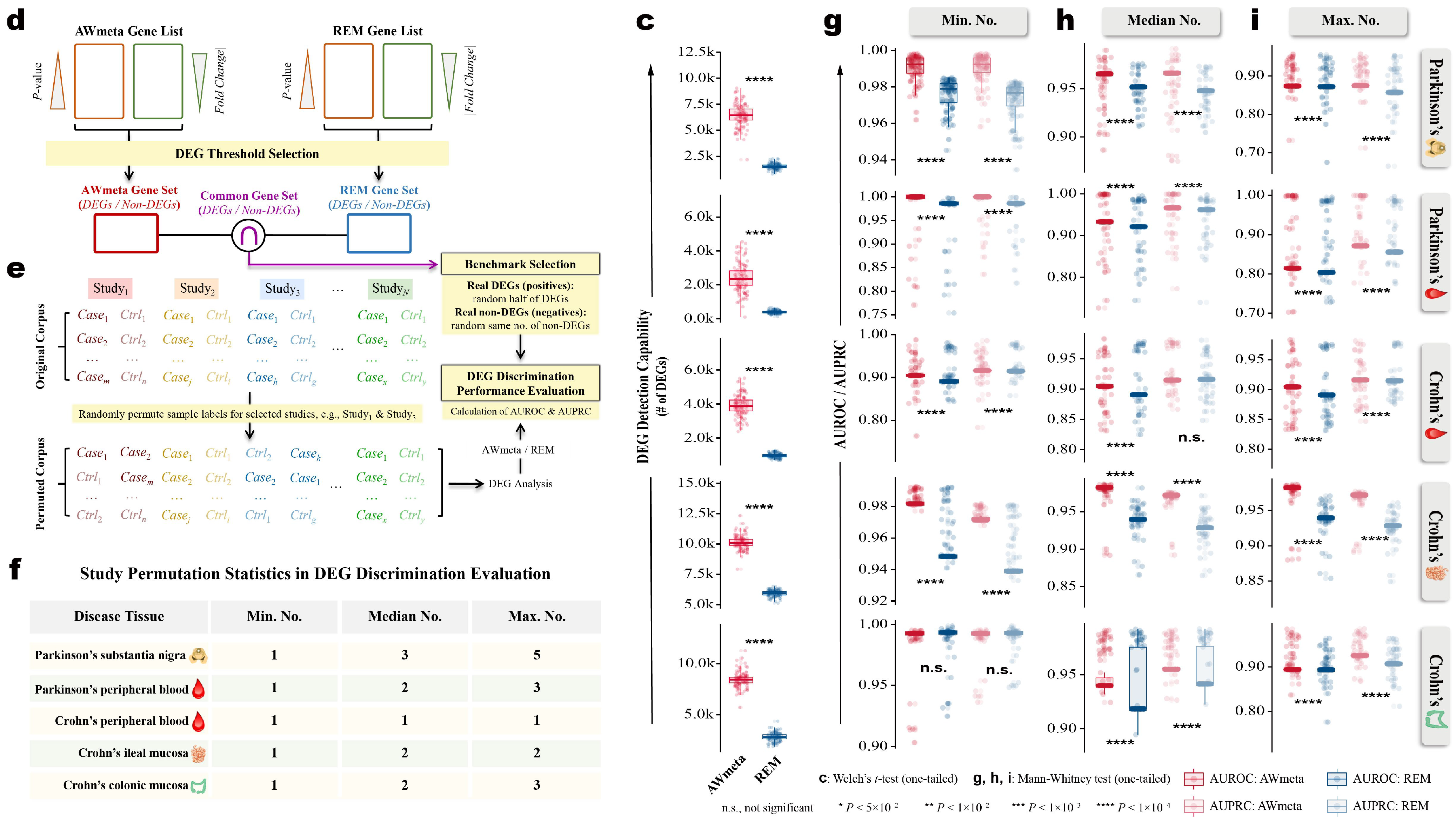
- Identify the intersection of DEGs and non-DEGs called by both AWmeta and REM under predefined screening thresholds (Figure 1d).
- 2.
- Randomly sample half of the intersected DEGs to form an unbiased positive benchmark; sample an equal-sized negative benchmark from the intersected non-DEGs (Figure 1d).
- 3.
- Construct semi-synthetic datasets by permuting case/control labels within a subset of original studies (e.g., Study1 and Study3; Figure 1e). Label permutation removes the true signal from those studies.
- 4.
- Apply AWmeta and REM to the combined set of original and label-permuted studies; compute the area under the receiver operating characteristic curve (AUROC) and the area under the precision–recall curve (AUPRC) over the previously defined positive and negative benchmark genes (Figure 1e).
- 5.
- Repeat Steps 3 and 4 100 times to obtain distributions of AUROC and AUPRC, summarizing performance under minimum-, median-, and maximum-permuted scenarios (Figure 1f), which ensures the stability and reliability of our assessment. Statistical significance between AWmeta and REM was tested via a one-tailed Mann–Whitney test.
2.4.3. Gene-Wise Convergence Assessment for Gene Differential Expression Meta-Analysis
2.4.4. Study-Wise Convergence Assessment for Gene Differential Expression Meta-Analysis
- 1.
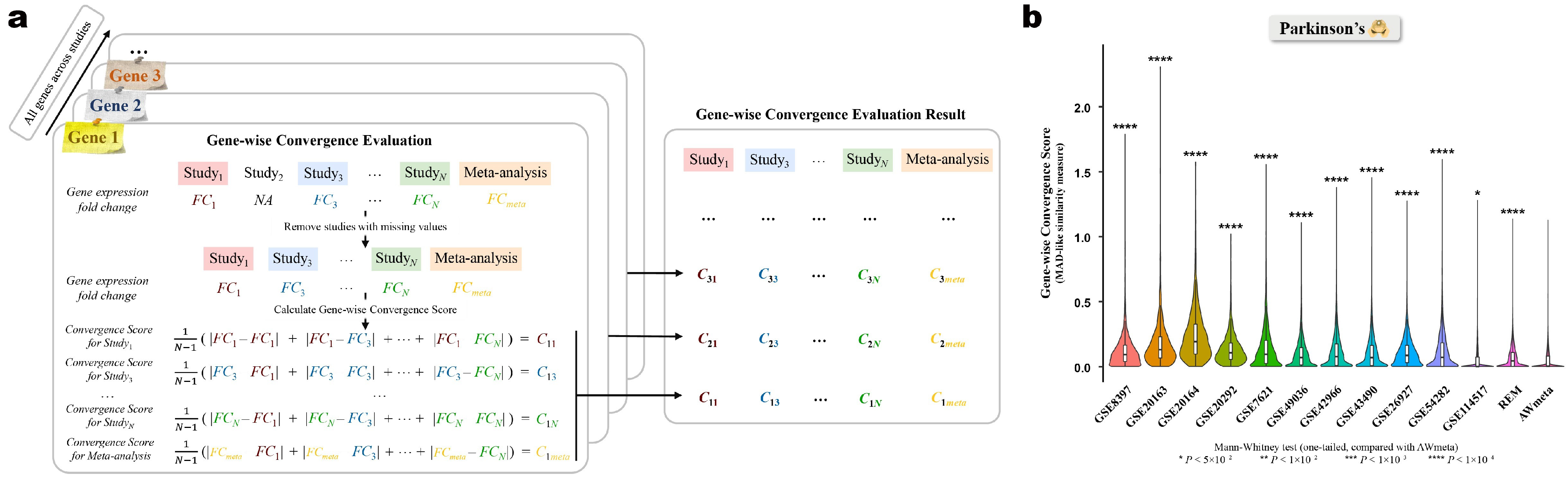
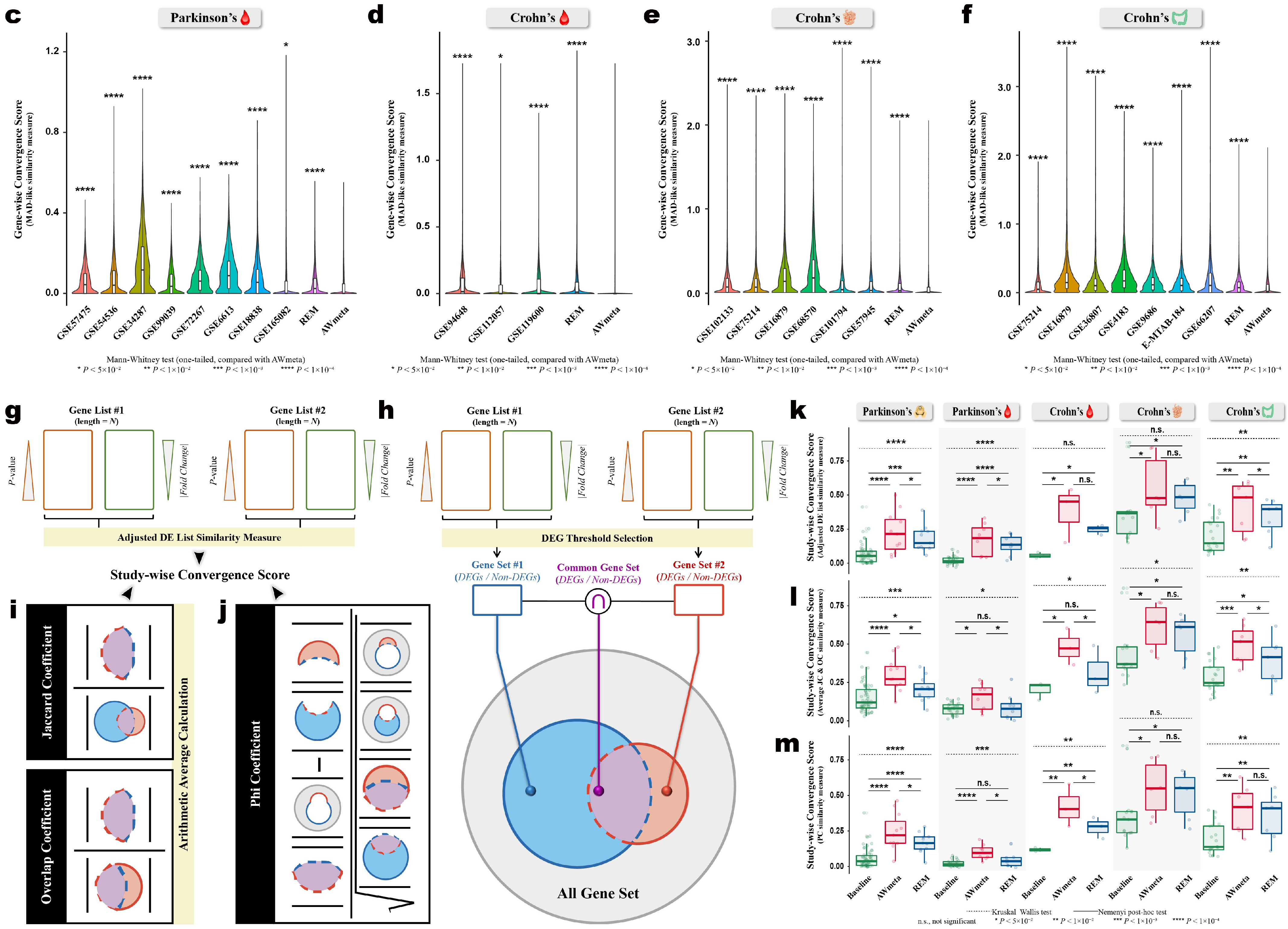
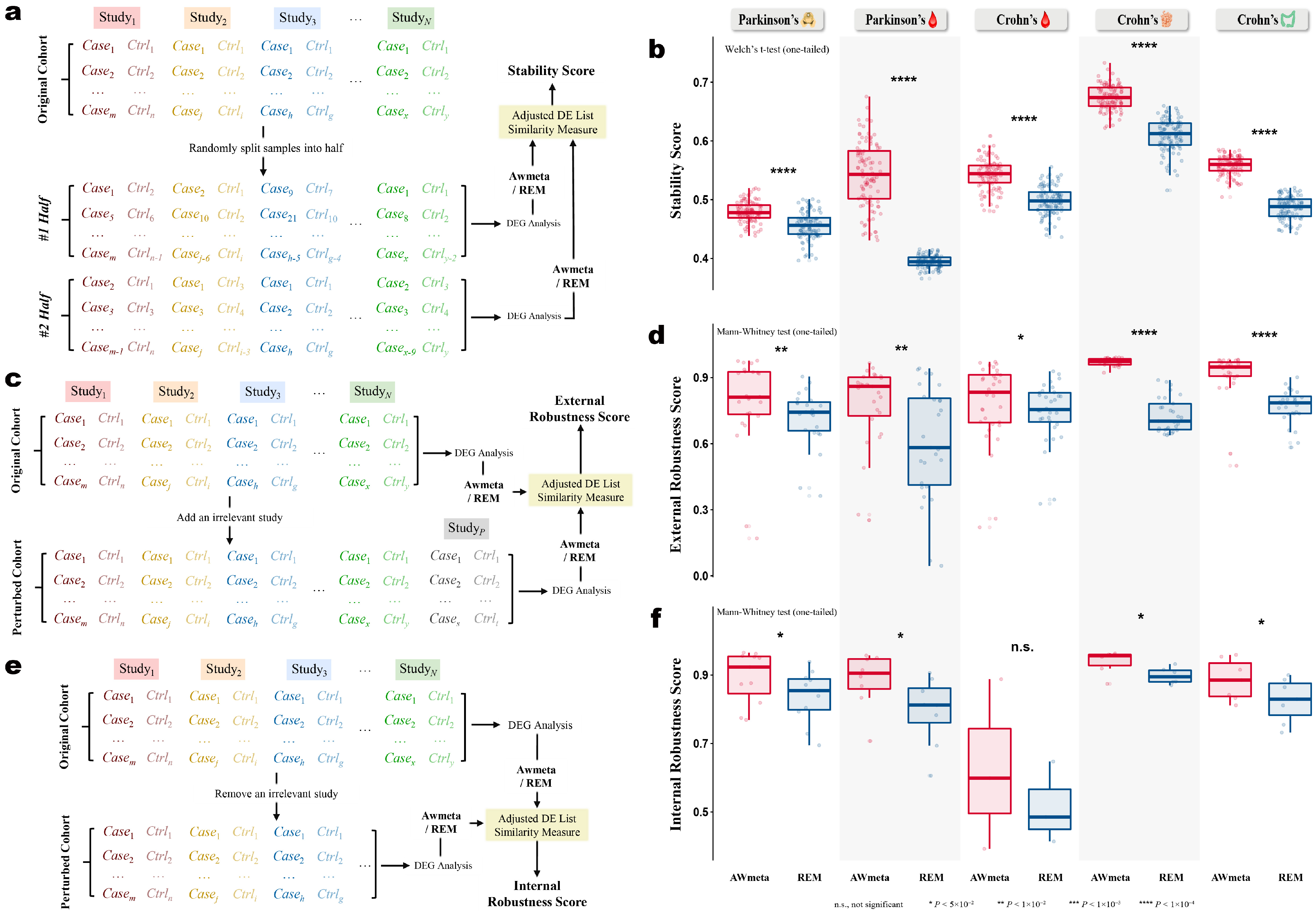
- Adjusted rankeD genE (DE) list similarity: Our first approach quantifies concordance using a rank-sensitive similarity metric that is critically weighted towards top-ranked genes (Figure 2g). The schematic diagram of this approach can be found in Supplementary Figure S7. To construct robustly ordered gene lists ( for the meta-analysis; for Studyi), we first devised a composite rank for each gene by multiplying its p-value rank (ascending) with its |log2FC| rank (descending), thereby integrating statistical significance and effect size. The weighted similarity between the meta-analysis and each original study gene lists (containing N genes) was computed using a non-linear weighting scheme [36], which emphasizes the top-ranked gene concordance:where is the number of common genes in the top n positions, and is a weighting exponent (0.001). This score was then normalized to the interval [] [34] yielding the adjusted similarity:where and are the expected and maximum scores under a null hypothesis of random gene lists.
- 2.
- Set-based overlap similarity: To circumvent the limitations of the above rank-dependent approach, which is sensitive to gene ranking variations while potentially overlooking consistent differential expression patterns, study-wise convergence was assessed using a set-based overlap metric that exclusively evaluates binary DEG classification concordance (Figure 2h,i). Here, DEG sets were determined for both the meta-analysis () and individual studies () using predefined statistical thresholds, thereby focusing analytical power on reproducible differential expression status irrespective of positional gene rankings. Two metrics were calculated: Jaccard coefficient (JC) () and overlap coefficients (OC) (). The convergence metric for the meta-analysis relative to Studyi was the arithmetic mean .
- 3.
- Phi coefficient (PC) similarity: Finally, PC [37] was utilized to measure the association between DEG classifications (Figure 2h,j). This approach considers the extreme case where shared DEGs or non-DEGs between two gene sets might be randomly generated.For each comparison between the meta-analysis and an original Studyi, a 2 × 2 contingency table was constructed to categorize all genes as DEG or non-DEG in both datasets, and the corresponding PC () was then calculated aswhere represents DEGs, non-DEGs in both datasets, and and represent exclusively-classified DEGs for the binary datasets. The row and column sums are denoted by , , , and .
2.4.5. Stability and Robustness Assessment of Transcriptomic Meta-Analysis
- 1.
- Within-study subsampling stability: For each disease tissue, case and control samples of every constituent study were randomly partitioned into two equal sub-cohorts, yielding paired “half-study” datasets. Each half-study set underwent independent DEG analysis and subsequent meta-analysis. The similarity between the resulting ordered gene lists was computed over 100 bootstrap replicates, quantifying stability under within-study sampling (Figure 3a). AWmeta and REM stability distributions were compared via one-tailed Welch’s t-test.
- 2.
- External robustness: For each disease tissue, resilience to new data was assessed by sequentially incorporating one external study into the original meta-analysis (Figure 3c). This independent external study cohort consists of all non-target disease tissue studies derived from our full panel of 35 transcriptomic datasets. For each addition, the meta-analysis procedure was implemented before and after study inclusion, and then adjusted DE list similarity between resulting ordered gene lists was computed to measure the impact of disparate external data (AWmeta versus REM, by the one-tailed Mann–Whitney test). This design mimics a real-world scenario where a thematically misaligned study is inadvertently included in a meta-analysis.
- 3.
- Internal robustness: Sensitivity to study omission was evaluated by performing leave-one-study-out analyses (Figure 3e): each original study was removed in turn, and meta-analyses were rerun on the reduced datasets. The similarity between each leave-one-study-out and the full-cohort ranked gene lists, across all iterations, quantified internal robustness (AWmeta versus REM, by the one-tailed Mann–Whitney test).
2.4.6. Biological Relevance Assessment of Gene Differential Expression Meta-Analysis
2.4.7. Gene Ontology (GO) Enrichment Analysis of Gene Differential Expression Meta-Analysis
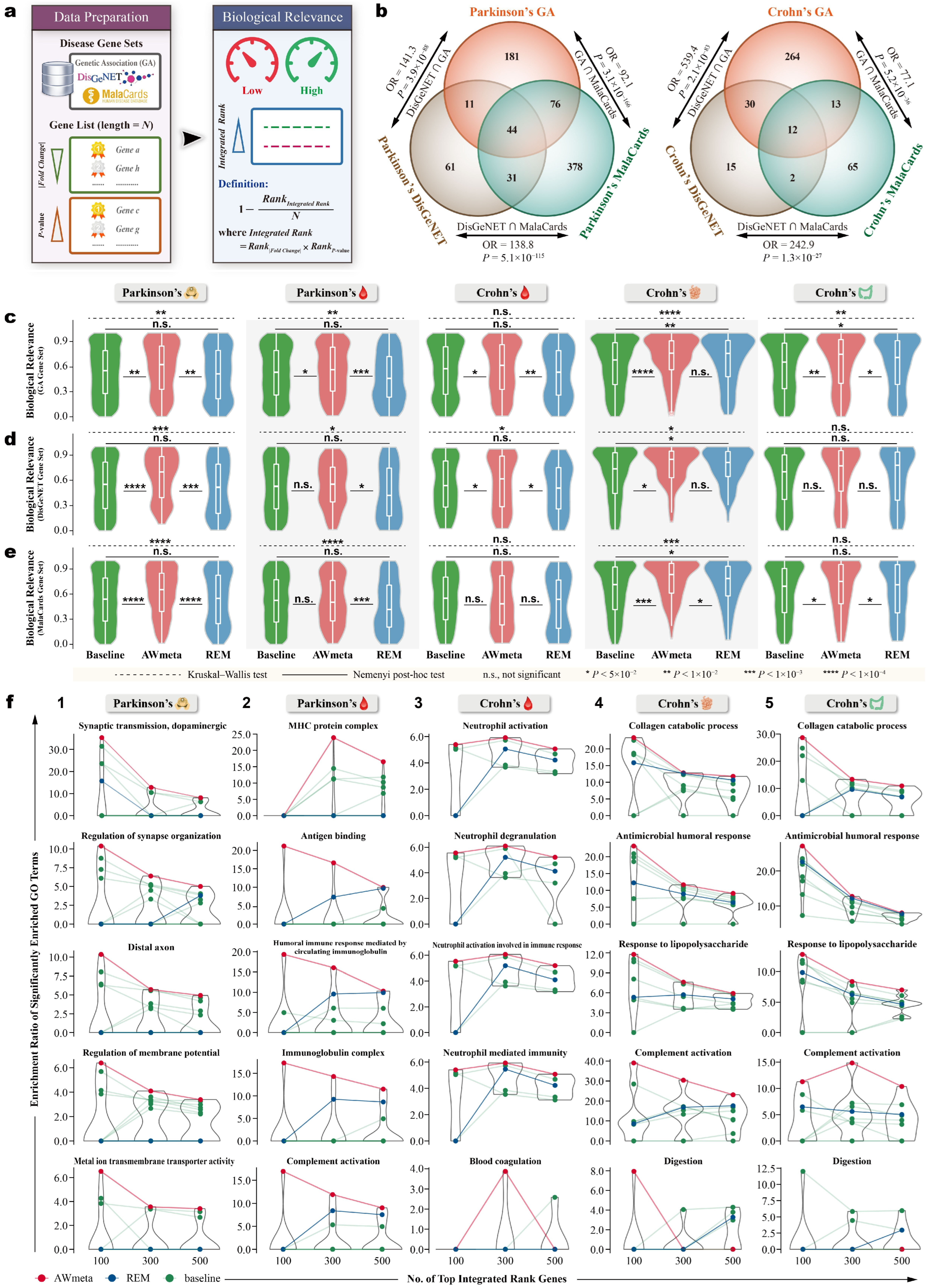
- To explore tissue-wise Parkinson’s and Crohn’s disease mechanisms hidden behind meta-analysis prioritized genes, GO enrichment was further implemented by over-representation analysis with clusterProfiler [43]. To avoid arbitrariness, three thresholds (100, 300, and 500) were used to select the number of top integrated rank genes (Section 2.4.6 and Figure 4a). The enrichment ratio quantifies the degree to which GO terms are significantly enriched in relevant disease tissues:
3. Results
3.1. AWmeta Secures Consistent Higher-Fidelity DEG Identification Across Transcriptomic Contexts of Parkinson’s and Crohn’s Disease
3.2. AWmeta Establishes Superior Gene- and Study-Wise Convergence in Gene Differential Expression of Parkinson’s and Crohn’s Disease
3.3. AWmeta Delivers Remarkable Stability and Robustness in Transcriptomic Meta-Analysis of Parkinson’s and Crohn’s Disease
3.4. AWmeta Facilitates Prioritization of Parkinson’s and Crohn’s Disease Genes
3.5. AWmeta Enhances Tissue-Contextual Mechanism Interpretation from Prioritized Parkinson’s and Crohn’s Disease Genes
4. Discussion
5. Conclusions
Supplementary Materials
Author Contributions
Funding
Institutional Review Board Statement
Informed Consent Statement
Data Availability Statement
Acknowledgments
Conflicts of Interest
Abbreviations
| REM | random-effects model |
| DEG | differentially expressed gene |
| RNA-seq | RNA-sequencing |
| FC | fold change |
| AUROC | area under the receiver operating characteristic curve |
| AUPRC | area under the precision–recall curve |
| MAD | mean absolute deviation |
| IQR | interquartile ranges |
| JC | Jaccard coefficient |
| OC | overlap coefficient |
| PC | phi coefficient |
| OR | odds ratio |
| GO | Gene Ontology |
| GA | genetic association |
References
- Stark, R.; Grzelak, M.; Hadfield, J. RNA sequencing: The teenage years. Nat. Rev. Genet. 2019, 20, 631–656. [Google Scholar] [CrossRef] [Scilit] [PubMed]
- Shorten, A.; Shorten, B. What is meta-analysis? Evid. Based Nurs. 2013, 16, 3–4. [Google Scholar] [CrossRef] [Scilit]
- Piras, I.S.; Manchia, M.; Huentelman, M.J.; Pinna, F.; Zai, C.C.; Kennedy, J.L.; Carpiniello, B. Peripheral biomarkers in Schizophrenia: A meta-analysis of microarray gene expression datasets. Int. J. Neuropsychopharmacol. 2019, 22, 186–193. [Google Scholar] [CrossRef] [Scilit]
- Zhong, G.; Bolitho, S.; Grunstein, R.; Naismith, S.L.; Lewis, S.J.G. The relationship between thermoregulation and REM sleep behaviour disorder in Parkinson’s disease. PLoS ONE 2013, 8, e72661. [Google Scholar] [CrossRef] [Scilit] [PubMed]
- Cho, H.; Kim, H.; Na, D.; Kim, S.Y.; Jo, D.; Lee, D. Meta-analysis method for discovering reliable biomarkers by integrating statistical and biological approaches: An application to liver toxicity. Biochem. Biophys. Res. Commun. 2016, 471, 274–281. [Google Scholar] [CrossRef] [Scilit]
- Tseng, G.C.; Ghosh, D.; Feingold, E. Comprehensive literature review and statistical considerations for microarray meta-analysis. Nucleic Acids Res. 2012, 40, 3785–3799. [Google Scholar] [CrossRef] [Scilit]
- Aguzzoli Heberle, B.; Fox, K.L.; Lobraico Libermann, L.; Ronchetti Martins Xavier, S.; Tarnowski Dallarosa, G.; Carolina Santos, R.; Fardo, D.W.; Wendt Viola, T.; Ebbert, M.T. Systematic review and meta-analysis of bulk RNAseq studies in human Alzheimer’s disease brain tissue. Alzheimer’s Dement. 2025, 21, e70025. [Google Scholar] [CrossRef] [Scilit]
- Fisher, R.A. Statistical methods for research workers. In Breakthroughs in Statistics: Methodology and Distribution; Springer: New York, NY, USA, 1970; pp. 66–70. [Google Scholar]
- Stouffer, S.A. A study of attitudes. Sci. Am. 1949, 180, 11–15. [Google Scholar] [CrossRef] [Scilit]
- Li, J.; Tseng, G.C. An adaptively weighted statistic for detecting differential gene expression when combining multiple transcriptomic studies. Ann. Appl. Stat. 2011, 5, 994–1019. [Google Scholar] [CrossRef] [Scilit]
- Wang, X.; Chua, H.X.; Chen, P.; Ong, R.T.H.; Sim, X.; Zhang, W.; Takeuchi, F.; Liu, X.; Khor, C.C.; Tay, W.T.; et al. Comparing methods for performing trans-ethnic meta-analysis of genome-wide association studies. Hum. Mol. Genet. 2013, 22, 2303–2311. [Google Scholar] [CrossRef] [Scilit] [PubMed]
- Stogiannis, D.; Siannis, F.; Androulakis, E. Heterogeneity in meta-analysis: A comprehensive overview. Int. J. Biostat. 2024, 20, 169–199. [Google Scholar] [CrossRef] [Scilit] [PubMed]
- Breitling, R.; Armengaud, P.; Amtmann, A.; Herzyk, P. Rank products: A simple, yet powerful, new method to detect differentially regulated genes in replicated microarray experiments. FEBS Lett. 2004, 573, 83–92. [Google Scholar] [CrossRef] [Scilit]
- Del Carratore, F.; Jankevics, A.; Eisinga, R.; Heskes, T.; Hong, F.; Breitling, R. RankProd 2.0: A refactored bioconductor package for detecting differentially expressed features in molecular profiling datasets. Bioinformatics 2017, 33, 2774–2775. [Google Scholar] [CrossRef] [Scilit]
- Kruschke, J.K. Bayesian analysis reporting guidelines. Nat. Hum. Behav. 2021, 5, 1282–1291. [Google Scholar] [CrossRef] [Scilit] [PubMed]
- Reis, D.J.; Kaizer, A.M.; Kinney, A.R.; Bahraini, N.H.; Holliday, R.; Forster, J.E.; Brenner, L.A. A practical guide to random-effects Bayesian meta-analyses with application to the psychological trauma and suicide literature. Psychol. Trauma Theory Res. Pract. Policy 2023, 15, 121. [Google Scholar] [CrossRef] [Scilit]
- Katz, K.; Shutov, O.; Lapoint, R.; Kimelman, M.; Brister, J.R.; O’Sullivan, C. The Sequence Read Archive: A decade more of explosive growth. Nucleic Acids Res. 2022, 50, D387–D390. [Google Scholar] [CrossRef] [Scilit]
- Cohen, J. Statistical Power Analysis for the Behavioral Sciences; Routledge: New York, NY, USA, 1988. [Google Scholar]
- Hedges, L.V. Distribution theory for Glass’s estimator of effect size and related estimators. J. Educ. Stat. 1981, 6, 107–128. [Google Scholar] [CrossRef] [Scilit]
- Love, M.I.; Huber, W.; Anders, S. Moderated estimation of fold change and dispersion for RNA-seq data with DESeq2. Genome Biol. 2014, 15, 1–21. [Google Scholar] [CrossRef] [Scilit]
- Burankova, Y.; Abele, M.; Bakhtiari, M.; von Toerne, C.; Barth, T.K.; Schweizer, L.; Giesbertz, P.; Schmidt, J.R.; Kalkhof, S.; Müller-Deile, J.; et al. Privacy-preserving multicenter differential protein abundance analysis with FedProt. Nat. Comput. Sci. 2025, 5, 675–688. [Google Scholar] [CrossRef] [Scilit] [PubMed]
- Xue, D.; Narisu, N.; Taylor, D.L.; Zhang, M.; Grenko, C.; Taylor, H.J.; Yan, T.; Tang, X.; Sinha, N.; Zhu, J.; et al. Functional interrogation of twenty type 2 diabetes-associated genes using isogenic human embryonic stem cell-derived β-like cells. Cell Metab. 2023, 35, 1897–1914. [Google Scholar] [CrossRef] [Scilit]
- Brown, M.R.; Holmes, H.; Rakshit, K.; Javeed, N.; Her, T.K.; Stiller, A.A.; Sen, S.; Shull, G.E.; Prakash, Y.; Romero, M.F.; et al. Electrogenic sodium bicarbonate cotransporter NBCe1 regulates pancreatic β cell function in type 2 diabetes. J. Clin. Investig. 2021, 131, e142365. [Google Scholar] [CrossRef] [Scilit] [PubMed]
- Kenward, M.G.; Roger, J.H. Small sample inference for fixed effects from restricted maximum likelihood. Biometrics 1997, 53, 983–997. [Google Scholar] [CrossRef] [Scilit] [PubMed]
- Ma, T.; Huo, Z.; Kuo, A.; Zhu, L.; Fang, Z.; Zeng, X.; Lin, C.W.; Liu, S.; Wang, L.; Liu, P.; et al. MetaOmics: Analysis pipeline and browser-based software suite for transcriptomic meta-analysis. Bioinformatics 2019, 35, 1597–1599. [Google Scholar] [CrossRef] [Scilit]
- Gentleman, R.; Carey, V.; Huber, W.; Irizarry, R.; Dudoit, S. Bioinformatics and Computational Biology Solutions Using R and Bioconductor; Springer Science & Business Media: New York, NY, USA, 2005. [Google Scholar]
- Ritchie, M.E.; Phipson, B.; Wu, D.; Hu, Y.; Law, C.W.; Shi, W.; Smyth, G.K. limma powers differential expression analyses for RNA-sequencing and microarray studies. Nucleic Acids Res. 2015, 43, e47. [Google Scholar] [CrossRef] [Scilit]
- Köster, J.; Rahmann, S. Snakemake—A scalable bioinformatics workflow engine. Bioinformatics 2012, 28, 2520–2522. [Google Scholar] [CrossRef] [Scilit]
- Bolger, A.M.; Lohse, M.; Usadel, B. Trimmomatic: A flexible trimmer for Illumina sequence data. Bioinformatics 2014, 30, 2114–2120. [Google Scholar] [CrossRef] [Scilit]
- Sahraeian, S.M.E.; Mohiyuddin, M.; Sebra, R.; Tilgner, H.; Afshar, P.T.; Au, K.F.; Bani Asadi, N.; Gerstein, M.B.; Wong, W.H.; Snyder, M.P.; et al. Gaining comprehensive biological insight into the transcriptome by performing a broad-spectrum RNA-seq analysis. Nat. Commun. 2017, 8, 59. [Google Scholar] [CrossRef] [Scilit]
- Kim, D.; Paggi, J.M.; Park, C.; Bennett, C.; Salzberg, S.L. Graph-based genome alignment and genotyping with HISAT2 and HISAT-genotype. Nat. Biotechnol. 2019, 37, 907–915. [Google Scholar] [CrossRef] [Scilit] [PubMed]
- Liao, Y.; Smyth, G.K.; Shi, W. featureCounts: An efficient general purpose program for assigning sequence reads to genomic features. Bioinformatics 2014, 30, 923–930. [Google Scholar] [CrossRef] [Scilit]
- Makinde, F.L.; Tchamga, M.S.S.; Jafali, J.; Fatumo, S.; Chimusa, E.R.; Mulder, N.; Mazandu, G.K. Reviewing and assessing existing meta-analysis models and tools. Brief. Bioinform. 2021, 22, bbab324. [Google Scholar] [CrossRef] [Scilit]
- Chang, L.C.; Lin, H.M.; Sibille, E.; Tseng, G.C. Meta-analysis methods for combining multiple expression profiles: Comparisons, statistical characterization and an application guideline. BMC Bioinform. 2013, 14, 368. [Google Scholar] [CrossRef] [Scilit]
- Li, Y.; Ge, X.; Peng, F.; Li, W.; Li, J.J. Exaggerated false positives by popular differential expression methods when analyzing human population samples. Genome Biol. 2022, 23, 79. [Google Scholar] [CrossRef] [Scilit]
- Yang, X.; Bentink, S.; Scheid, S.; Spang, R. Similarities of Ordered Gene Lists. J. Bioinform. Comput. Biol. 2011, 4, 693–708. [Google Scholar] [CrossRef] [Scilit]
- Akoglu, H. User’s guide to correlation coefficients. Turk. J. Emerg. Med. 2018, 18, 91–93. [Google Scholar] [CrossRef] [Scilit] [PubMed]
- Piñero, J.; Ramírez-Anguita, J.M.; Saüch-Pitarch, J.; Ronzano, F.; Centeno, E.; Sanz, F.; Furlong, L.I. The DisGeNET knowledge platform for disease genomics: 2019 update. Nucleic Acids Res. 2020, 48, D845–D855. [Google Scholar] [CrossRef] [Scilit] [PubMed]
- Yuan, X.; Wang, H.; Zhang, F.; Zhang, M.; Wang, Q.; Wang, J. The common genes involved in the pathogenesis of Alzheimer’s disease and type 2 diabetes and their implication for drug repositioning. Neuropharmacology 2023, 223, 109327. [Google Scholar] [CrossRef] [Scilit] [PubMed]
- Ferreira, J.C.; Alshamali, F.; Pereira, L.; Fernandes, V. Characterization of Arabian Peninsula whole exomes: Contributing to the catalogue of human diversity. iScience 2022, 25, 105336. [Google Scholar] [CrossRef] [Scilit]
- Rappaport, N.; Twik, M.; Plaschkes, I.; Nudel, R.; Iny Stein, T.; Levitt, J.; Gershoni, M.; Morrey, C.P.; Safran, M.; Lancet, D. MalaCards: An amalgamated human disease compendium with diverse clinical and genetic annotation and structured search. Nucleic Acids Res. 2017, 45, D877–D887. [Google Scholar] [CrossRef] [Scilit]
- Hu, Y.; She, B.; Yin, Z.; Yu, X.; Wu, W.; Chen, M. Mapping the comorbid landscape of Parkinson’s disease and Crohn’s disease along the gut-blood-brain axis. medRxiv 2025. [Google Scholar] [CrossRef] [Scilit]
- Xu, S.; Hu, E.; Cai, Y.; Xie, Z.; Luo, X.; Zhan, L.; Tang, W.; Wang, Q.; Liu, B.; Wang, R.; et al. Using clusterProfiler to characterize multiomics data. Nat. Protoc. 2024, 19, 3292–3320. [Google Scholar] [CrossRef] [Scilit]
- Hu, Y.; Pan, Z.; Hu, Y.; Zhang, L.; Wang, J. Network and pathway-based analyses of genes associated with Parkinson’s disease. Mol. Neurobiol. 2017, 54, 4452–4465. [Google Scholar] [CrossRef] [Scilit] [PubMed]
- Burke, R.E.; O’Malley, K. Axon degeneration in Parkinson’s disease. Exp. Neurol. 2013, 246, 72–83. [Google Scholar] [CrossRef] [Scilit]
- Chen, L.; Shen, Q.; Liu, Y.; Zhang, Y.; Sun, L.; Ma, X.; Song, N.; Xie, J. Homeostasis and metabolism of iron and other metal ions in neurodegenerative diseases. Signal Transduct. Target. Ther. 2025, 10, 31. [Google Scholar] [CrossRef] [Scilit]
- Bjorklund, G.; Stejskal, V.; Urbina, M.A.; Dadar, M.; Chirumbolo, S.; Mutter, J. Metals and Parkinson’s disease: Mechanisms and biochemical processes. Curr. Med. Chem. 2018, 25, 2198–2214. [Google Scholar] [CrossRef] [Scilit]
- Ma, K.Y.; Fokkens, M.R.; Reggiori, F.; Mari, M.; Verbeek, D.S. Parkinson’s disease–associated VPS35 mutant reduces mitochondrial membrane potential and impairs PINK1/Parkin-mediated mitophagy. Transl. Neurodegener. 2021, 10, 19. [Google Scholar] [CrossRef] [Scilit]
- Poewe, W.; Seppi, K.; Tanner, C.M.; Halliday, G.M.; Brundin, P.; Volkmann, J.; Schrag, A.E.; Lang, A.E. Parkinson disease. Nat. Rev. Dis. Prim. 2017, 3, 17013. [Google Scholar] [CrossRef] [Scilit]
- Roda, G.; Chien Ng, S.; Kotze, P.G.; Argollo, M.; Panaccione, R.; Spinelli, A.; Kaser, A.; Peyrin-Biroulet, L.; Danese, S. Crohn’s disease. Nat. Rev. Dis. Prim. 2020, 6, 22. [Google Scholar] [CrossRef] [Scilit]
- Gu, R.; Pan, J.; Awan, M.U.N.; Sun, X.; Yan, F.; Bai, L.; Bai, J. The major histocompatibility complex participates in Parkinson’s disease. Pharmacol. Res. 2024, 203, 107168. [Google Scholar] [CrossRef] [Scilit] [PubMed]
- Tan, E.K.; Chao, Y.X.; West, A.; Chan, L.L.; Poewe, W.; Jankovic, J. Parkinson disease and the immune system—Associations, mechanisms and therapeutics. Nat. Rev. Neurol. 2020, 16, 303–318. [Google Scholar] [CrossRef] [Scilit]
- Danne, C.; Skerniskyte, J.; Marteyn, B.; Sokol, H. Neutrophils: From IBD to the gut microbiota. Nat. Rev. Gastroenterol. Hepatol. 2024, 21, 184–197. [Google Scholar] [CrossRef] [Scilit] [PubMed]
- Khosousi, S.; Hye, A.; Velayudhan, L.; Bloth, B.; Tsitsi, P.; Markaki, I.; Svenningsson, P. Complement system changes in blood in Parkinson’s disease and progressive Supranuclear Palsy/Corticobasal Syndrome. Park. Relat. Disord. 2023, 108, 105313. [Google Scholar]
- Rogler, G.; Singh, A.; Kavanaugh, A.; Rubin, D.T. Extraintestinal manifestations of inflammatory bowel disease: Current concepts, treatment, and implications for disease management. Gastroenterology 2021, 161, 1118–1132. [Google Scholar] [CrossRef] [Scilit]
- Stadnicki, A.; Stadnicka, I. Venous and arterial thromboembolism in patients with inflammatory bowel diseases. World J. Gastroenterol. 2021, 27, 6757. [Google Scholar] [CrossRef] [Scilit] [PubMed]
- Mortensen, J.; Lindholm, M.; Langholm, L.; Kjeldsen, J.; Bay-Jensen, A.; Karsdal, M.; Manon-Jensen, T. The intestinal tissue homeostasis—The role of extracellular matrix remodeling in inflammatory bowel disease. Expert Rev. Gastroenterol. Hepatol. 2019, 13, 977–993. [Google Scholar] [CrossRef] [Scilit]
- Caruso, R.; Lo, B.C.; Núñez, G. Host–microbiota interactions in inflammatory bowel disease. Nat. Rev. Immunol. 2020, 20, 411–426. [Google Scholar] [CrossRef] [Scilit] [PubMed]
- Candelli, M.; Franza, L.; Pignataro, G.; Ojetti, V.; Covino, M.; Piccioni, A.; Gasbarrini, A.; Franceschi, F. Interaction between lipopolysaccharide and gut microbiota in inflammatory bowel diseases. Int. J. Mol. Sci. 2021, 22, 6242. [Google Scholar] [CrossRef] [Scilit]
- Halstensen, T.; Mollnes, T.; Garred, P.; Fausa, O.; Brandtzaeg, P. Surface epithelium related activation of complement differs in Crohn’s disease and ulcerative colitis. Gut 1992, 33, 902–908, Correction in Gut 1992, 33, 1440. https://doi.org/10.1136/gut.33.10.1440-a.. [Google Scholar] [CrossRef] [Scilit]
- Kong, L.; Pokatayev, V.; Lefkovith, A.; Carter, G.T.; Creasey, E.A.; Krishna, C.; Subramanian, S.; Kochar, B.; Ashenberg, O.; Lau, H.; et al. The landscape of immune dysregulation in Crohn’s disease revealed through single-cell transcriptomic profiling in the ileum and colon. Immunity 2023, 56, 444–458. [Google Scholar] [CrossRef] [Scilit] [PubMed]
- Feldman, M.; Friedman, L.S.; Brandt, L.J. Sleisenger and Fordtran’s Gastrointestinal and Liver Disease e-Book: Pathophysiology, Diagnosis, Management; Elsevier Health Sciences: Philadelphia, PA, USA, 2020. [Google Scholar]
- Borenstein, M.; Hedges, L.V.; Higgins, J.P.; Rothstein, H.R. A basic introduction to fixed-effect and random-effects models for meta-analysis. Res. Synth. Methods 2010, 1, 97–111. [Google Scholar] [CrossRef] [Scilit]
- Huo, Z.; Tang, S.; Park, Y.; Tseng, G. P-value evaluation, variability index and biomarker categorization for adaptively weighted Fisher’s meta-analysis method in omics applications. Bioinformatics 2020, 36, 524–532. [Google Scholar] [CrossRef] [Scilit]
 —substantia nigra;
  —peripheral blood;
  —ileal mucosa; and
  —colonic mucosa. n.s., not significant. *, . **, . ***, . ****, .
—substantia nigra; —peripheral blood; —ileal mucosa; and —colonic mucosa. n.s., not significant. *, . **, . ***, . ****, .
—colonic mucosa. n.s., not significant. *, . **, . ***, . ****, .
—substantia nigra; —peripheral blood; —ileal mucosa; and —colonic mucosa. n.s., not significant. *, . **, . ***, . ****, .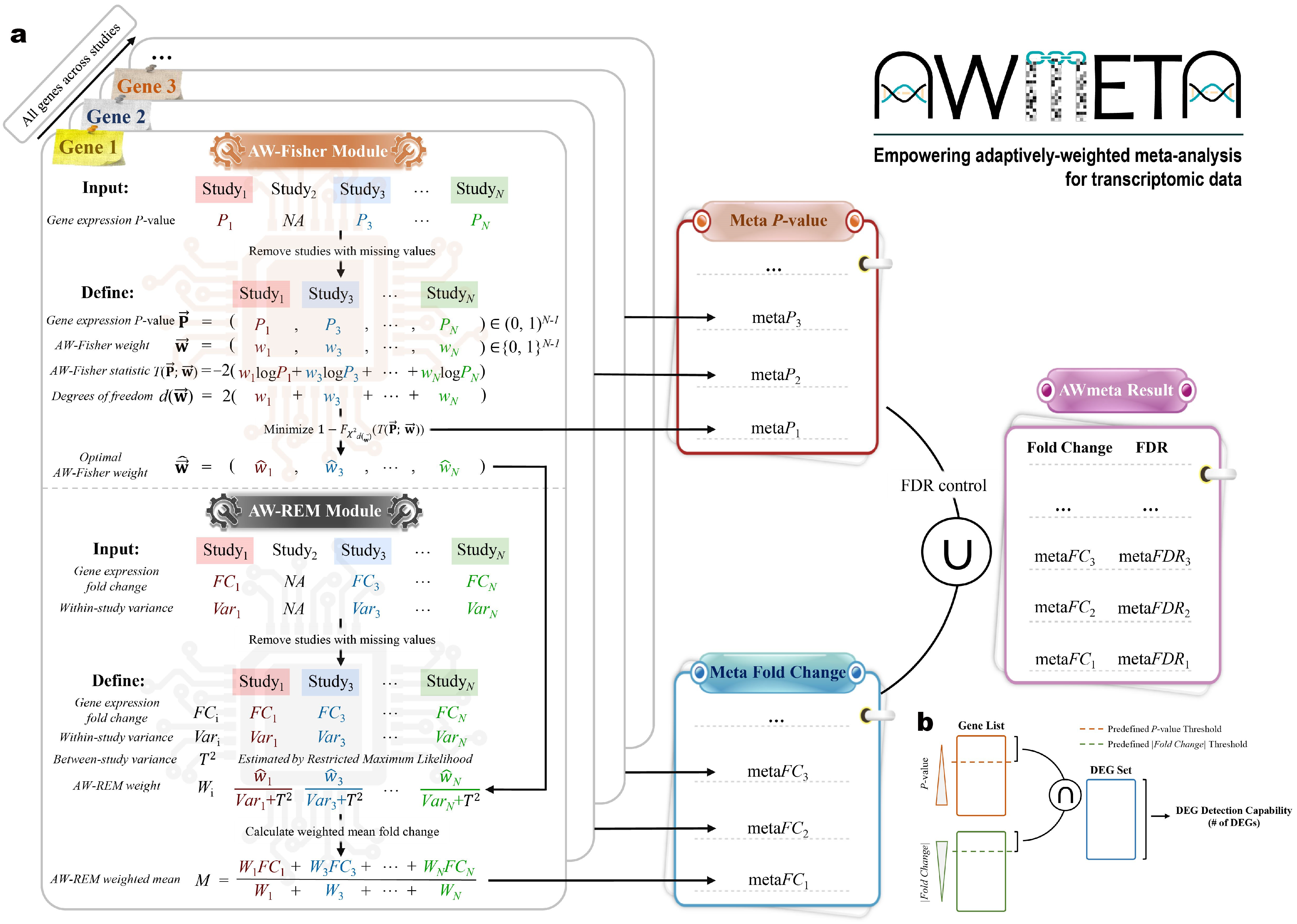
 —substantia nigra; —peripheral blood; —ileal mucosa; —colonic mucosa. n.s., not significant. *, . **, . ***, . ****, .
—substantia nigra; —peripheral blood; —ileal mucosa; —colonic mucosa. n.s., not significant. *, . **, . ***, . ****, .
—substantia nigra; —peripheral blood; —ileal mucosa; —colonic mucosa. n.s., not significant. *, . **, . ***, . ****, .
 —substantia nigra; —peripheral blood; —ileal mucosa; and —colonic mucosa. n.s., not significant. *, . **, . ***, . ****, .
—substantia nigra; —peripheral blood; —ileal mucosa; and —colonic mucosa. n.s., not significant. *, . **, . ***, . ****, .
—substantia nigra; —peripheral blood; —ileal mucosa; and —colonic mucosa. n.s., not significant. *, . **, . ***, . ****, . —substantia nigra; —peripheral blood; —ileal mucosa; —colonic mucosa. n.s., not significant. *, . **, . ***, . ****, .
—substantia nigra; —peripheral blood; —ileal mucosa; —colonic mucosa. n.s., not significant. *, . **, . ***, . ****, .
—substantia nigra; —peripheral blood; —ileal mucosa; —colonic mucosa. n.s., not significant. *, . **, . ***, . ****, .
Disclaimer/Publisher’s Note: The statements, opinions and data contained in all publications are solely those of the individual author(s) and contributor(s) and not of MDPI and/or the editor(s). MDPI and/or the editor(s) disclaim responsibility for any injury to people or property resulting from any ideas, methods, instructions or products referred to in the content. |
© 2026 by the authors. Licensee MDPI, Basel, Switzerland. This article is an open access article distributed under the terms and conditions of the Creative Commons Attribution (CC BY) license.
Share and Cite
Hu, Y.; Wang, Z.; Hu, Y.; Feng, C.; Fang, Q.; Chen, M. AWmeta Empowers Adaptively Weighted Transcriptomic Meta-Analysis. Curr. Issues Mol. Biol. 2026, 48, 530. https://doi.org/10.3390/cimb48050530
Hu Y, Wang Z, Hu Y, Feng C, Fang Q, Chen M. AWmeta Empowers Adaptively Weighted Transcriptomic Meta-Analysis. Current Issues in Molecular Biology. 2026; 48(5):530. https://doi.org/10.3390/cimb48050530
Chicago/Turabian StyleHu, Yanshi, Zixuan Wang, Yueming Hu, Cong Feng, Qiuyu Fang, and Ming Chen. 2026. "AWmeta Empowers Adaptively Weighted Transcriptomic Meta-Analysis" Current Issues in Molecular Biology 48, no. 5: 530. https://doi.org/10.3390/cimb48050530
APA StyleHu, Y., Wang, Z., Hu, Y., Feng, C., Fang, Q., & Chen, M. (2026). AWmeta Empowers Adaptively Weighted Transcriptomic Meta-Analysis. Current Issues in Molecular Biology, 48(5), 530. https://doi.org/10.3390/cimb48050530