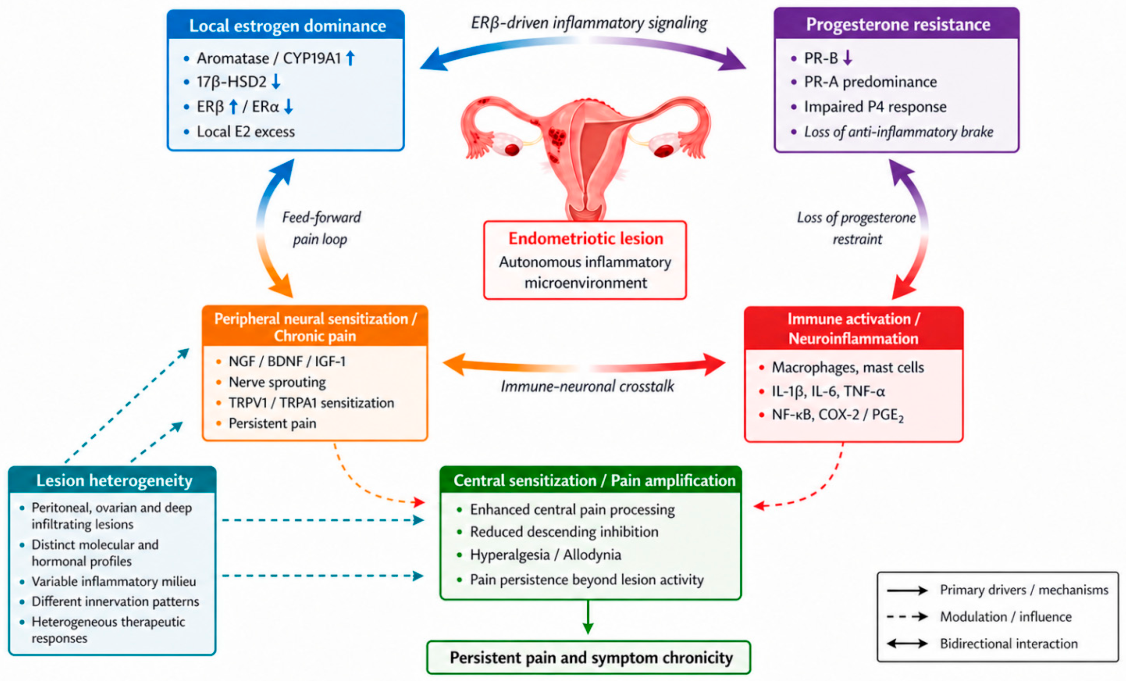

Hormonal Dysregulation and Neuroinflammation in Endometriosis: Convergent Druggable Pathways

Abstract
1. Introduction
2. Physiological Steroid Hormone Signaling in the Endometrium
3. Hormonal Dysregulation in Endometriosis
3.1. Dysregulated Estrogen Signaling and Estrogen Dominance
3.2. Progesterone
3.3. Androgen
4. Neuroinflammation and Pain in Endometriosis: Mechanisms and Phenotypic Variation
4.1. Ectopic Neurogenesis and Lesion Innervation
4.2. The Immune–Neuronal Interface
4.3. Central Sensitization and Pain Chronification
5. Hormone-Dependent Neuroinflammation in Endometriosis: Evidence for Bidirectional Interactions
5.1. Hormonal Dysregulation as a Driver of Neuroinflammation
5.2. Neuroinflammation as an Inducer or Amplifier of Hormonal Resistance
6. Molecular Convergent Nodes at the Hormonal–Neuroinflammatory Interface in Endometriosis

| Target | Dominant Hormonal Input | Neuroinflammatory/Neurosensitizing Output | Human Evidence (Selected Effect Sizes; Lesion Specificity) | Therapeutic Maturity | Pros | Cons |
|---|---|---|---|---|---|---|
| PGE2–EP2/EP4 ↔ aromatase (CYP19A1) ↔ estradiol | Estradiol-dominant milieu reinforced by PGE2 signaling; inflammatory cytokines act upstream of PGE2 | Sustained inflammatory mediator production; permissive microenvironment for innervation and sensitization | Human stromal cells: PGE2 induces aromatase activity ~19–44× in endometriosis-derived stromal cells [177]. Primary human ESC: EP2/EP4 antagonists reduce IL-1β-induced IL-6/IL-8 and suppress aromatase expression; macrophage EP2 expression higher in patients [177]. Letrozole + norethindrone reduces pelvic-pain VAS in adolescent and adult cohorts refractory to first-line progestins [181,182]. Lesion specificity: ovarian, peritoneal; reduced expression in fibrotic deep lesions [177,180]. | AIs: Off-label (Phase II evidence). EP2/EP4 antagonists: Preclinical. | AIs address local intracrine estrogen production directly and are the most relevant option for adolescents and fertility-preserving patients in whom GnRH agonists are contraindicated. EP2/EP4 antagonism preserves systemic estrogen and may avoid menopausal sequelae [183]. | AIs cause vasomotor symptoms, accelerated bone loss, and dyslipidemia; require add-back progestin [184]. Efficacy diminishes in fibrotic deep lesions where EP2/EP4 expression declines [180]. |
| ERβ → NF-κB → CCL2 | ERβ overexpression (up to 100-fold ectopic vs. eutopic); estradiol signaling bias | Macrophage recruitment; inflammatory amplification; stromal proliferation through macrophage–stromal feedback | Human cohort + cells (22 cases/14 controls): ERβ high → CCL2 via NF-κB; macrophages recruited; co-culture promotes ESC proliferation/clonogenicity [164] ERβ hypomethylation drives 34-fold stromal upregulation [179]. Lesion specificity: ovarian endometriomas predominant; also peritoneal [179]. | Preclinical (PHTPP, ERB-041); SERMs (raloxifene): Phase II terminated for early pain recurrence [185,186]. | Relative specificity for ectopic lesions; integrates hormonal and inflammatory signaling; nanoparticle co-delivery (PHTPP + disulfiram) shows lesion-selective effect in murine models without affecting normal endometrium [185]. | Context-dependent signaling: agonists and antagonists can produce similar effects in different systems [70]. CCL2 redundancy in chemokine networks. Clinical translation of SERMs has so far failed [186]. |
| IL-6/sIL-6R → STAT3 ↔ NF-κB (non-resolving inflammation → fibrosis) | Hormone–immune coupling via estradiol effects on cytokine environment in human ESCs) | Pro-fibrotic phenotype (collagen I, αSMA stress fibers), migration, persistent NF-κB activation | Human tissue + primary stromal cells (60 DIE cases vs. 32 controls): IL-6 transsignaling induces profibrotic phenotype in patient-derived ESCs but not in controls; impaired SOCS supports persistence; STAT3 inhibition reverses phenotype [178] DUSP2 downregulation in hypoxia amplifies IL-6/STAT3 [187]. Lesion specificity: DIE | Tocilizumab (anti-IL-6R): Approved (other indications); Endometriosis: preclinical [188,189]. STAT3 inhibitors: Discovery/Preclinical. | Disease-selective effect: trans-signaling preferentially active in endometriotic stromal cells. Anti-IL-6R agents already approved for rheumatologic indications, allowing repurposing trials. | STAT3 is essential for decidualization/implantation—systemic inhibition incompatible with fertility preservation. Pathway redundancy and feedback loops require combination strategies [190]. |
| TRPV1/TRPA1 (neuronal + non-neuronal) | Inflammatory mediators (PGE2, TNF-α) shaped by estrogenic loops. E2 induces TRPV1 in human sensory neurons [191]. | Nociceptor sensitization; cytokine and NO release from lesion cells; correlation with dysmenorrhea, dyspareunia, dyschezia | Human lesions + ESCs: TRPV1+ nerve-fiber density higher in ovarian endometrioma implants, correlates with dysmenorrhea VAS; PGE2 and TNF-α upregulate TRPV1 in EESCs; TRPV1 activation induces NO and IL-1β release [192]. In rectosigmoid DIE, TRPA1/TRPV1 upregulated and correlates with dysmenorrhea, dyspareunia, dyschezia [158]. Lesion specificity: ovarian, rectosigmoid DIE. | Phase II terminated (AMG517, ABT-102, LY3526318, GDC-0334) for off-target effects in non-endometriosis indications [193]. | Strong mechanistic and clinical-correlational rationale for chronic pelvic pain. Peripherally restricted antagonists or topical/intralesional delivery would bypass the main systemic toxicity. | On-target hyperthermia and impaired heat perception (TRPV1 antagonists); insufficient efficacy or PK liabilities (TRPA1 antagonists). No endometriosis-specific trial to date [193]. |
| NGF–TrkA/p75 axis | Estrogen-responsive tissue context; hormonal therapy reduces NGF in DIE [194]. | Neurogenesis/nerve sprouting; peripheral sensitization; correlation with deep dyspareunia | Human pathology: DIE lesions show strong NGF, TrkA, p75 expression with high nerve density [195,196]. Stromal NGF correlates with dyspareunia severity and local nerve-bundle density. NGF stimulation in patient-derived ESCs increases COX-2 and PGE2 via Trk-dependent signaling [133]. Hormonal treatment reduces nerve fiber density and NGF/p75 expression in eutopic tissues and in DIE lesions [196]. Lesion specificity: DIE > peritoneal; bowel, rectovaginal. | Phase II terminated (tanezumab, anti-NGF)—unsuccessful in endometriosis pain (NCT00784693). | Mechanistically robust as a driver of neurogenic pain in DIE specifically. Strong dose–response correlation between NGF, nerve-fiber density, and dyspareunia (NCT00784693). | Tanezumab failed primary endpoint despite acceptable safety. Joint-related adverse events from anti-NGF program in osteoarthritis raise broader concerns [197]. Endometriosis pain is multimodal: single-pathway blockade unlikely to suffice. |
| BDNF–TrkB | Estradiol and IL-1β induce BDNF in human ESCs via ERK1/2 | Central/peripheral pain maintenance signaling; correlation with dysmenorrhea VAS | Human cohort: serum and peritoneal-fluid BDNF higher in pain than in no-pain subgroups; ectopic lesion BDNF mRNA higher than eutopic/control; ESC BDNF inducible by estradiol or IL-1β and blocked by ERK inhibitor [130,198] BDNF/TrkB upregulated in ovarian endometrioma, with stage-dependent expression. Lesion specificity: ovarian; eutopic-tissue BDNF/TrkB correlates with dysmenorrhea | Discovery (no clinical agent in endometriosis). | Convergent estrogenic and inflammatory regulation positions BDNF as an integrative node. Eutopic-tissue expression suggests a non-invasive biomarker rationale. | Pan-Trk inhibitors (oncology) cause CNS adverse effects (cognitive impairment, mood disturbance, sleep disorders) reflecting BDNF/TrkB roles in synaptic plasticity [199]. Anti-BDNF antibodies failed to reduce endometriosis pain in murine models [134]. |
| TNF-α → NK1R (TACR1) ↔ substance P signaling | Inflammatory TNF-α exposure; cytokine-driven receptor induction. | Neurogenic inflammation; lesion maintenance via neuropeptide signaling | Human matched samples + primary cells: TACR1/2 higher in ectopic vs. eutopic tissue; TACR1/NK1R correlates with peritoneal fluid TNF-α; TNF-α induces NK1R in stromal cells; substance P increases stromal cell viability, reversed by NK1R antagonist [200] | Approved (other indications): aprepitant for chemotherapy-induced nausea. Endometriosis: Discovery. | Aprepitant has an established safety profile, enabling rapid repurposing trials. Mechanistic link to lesion persistence beyond pain modulation. | Broad NK1R distribution in CNS and peripheral nervous system raises off-target concerns. No validated biomarker to identify neurogenic-inflammation-dominant patients. Tachykinin-receptor redundancy. |
| Mast cell activation (tryptase+) ↔ SCF (KITLG) in estrogenic contexts | Estrogen and progesterone modulate lesion–mast cell cross-talk; SCF in lesions promotes mast cell recruitment | Local cytokines (e.g., IL-6, IL-8); neuroimmune amplification near nerve fibers [7,135,136,165]. | Human tissue (paired): endometriotic lesions show significantly higher tryptase+ mast cell density and SCF than eutopic [165]. Mast-cell conditioned media under hormonal conditions increases pro-inflammatory chemokines/cytokines in endometriotic epithelial/stromal cells [165]. Mast-cell density correlates with pain severity [7,135,136,165]. Lesion specificity: ovarian endometrioma (estrogen-driven mast-cell activation), peritoneal. | Cromolyn/ketotifen: Approved (other indications); endometriosis: Discovery. | Non-hormonal alternative preserving HPO-axis function—relevant for fertility-seeking patients. Disrupts the feed-forward E2–inflammation loop without systemic estrogen depletion [135]. | Systemic MC stabilization may compromise innate immunity and wound healing [201]. Fibrotic shields in advanced lesions limit drug penetration [202,203] Functional redundancy with macrophages—likely insufficient as monotherapy |
6.1. The PGE2–EP2/EP4–Aromatase Axis
6.2. The ERβ–NF-κB–CCL2 Axis
6.3. The IL-6/sIL-6R–STAT3–NF-κB Axis
6.4. TRPV1 and TRPA1 Channels
6.5. The NGF–TrkA/p75 Axis
6.6. The BDNF–TrkB Axis
6.7. TNF-α-Driven NK1R (TACR1) and Substance P Signaling
6.8. Mast-Cell Activation and the SCF–KIT Axis
7. Discussion
8. Conclusions
Author Contributions
Funding
Data Availability Statement
Conflicts of Interest
References
- As-Sanie, S.; Mackenzie, S.C.; Morrison, L.; Schrepf, A.; Zondervan, K.T.; Horne, A.W.; Missmer, S.A. Endometriosis. JAMA 2025, 334, 64. [Google Scholar] [CrossRef]
- Saunders, P.T.K.; Horne, A.W. Endometriosis: Etiology, pathobiology, and therapeutic prospects. Cell 2021, 184, 2807–2824. [Google Scholar] [CrossRef]
- Taylor, H.S.; Kotlyar, A.M.; Flores, V.A. Endometriosis is a chronic systemic disease: Clinical challenges and novel innovations. Lancet 2021, 397, 839–852. [Google Scholar] [CrossRef] [PubMed]
- Malvezzi, H.; Marengo, E.B.; Podgaec, S.; Piccinato, C.d.A. Endometriosis: Current challenges in modeling a multifactorial disease of unknown etiology. J. Transl. Med. 2020, 18, 311. [Google Scholar] [CrossRef]
- Reis, F.M.; Coutinho, L.M.; Vannuccini, S.; Batteux, F.; Chapron, C.; Petraglia, F. Progesterone receptor ligands for the treatment of endometriosis: The mechanisms behind therapeutic success and failure. Hum. Reprod. Update 2020, 26, 565–585. [Google Scholar] [CrossRef] [PubMed]
- Zhang, P.; Wang, G. Progesterone Resistance in Endometriosis: Current Evidence and Putative Mechanisms. Int. J. Mol. Sci. 2023, 24, 6992. [Google Scholar] [CrossRef]
- Anaf, V.; Chapron, C.; El Nakadi, I.; De Moor, V.; Simonart, T.; Noël, J.-C. Pain, mast cells, and nerves in peritoneal, ovarian, and deep infiltrating endometriosis. Fertil. Steril. 2006, 86, 1336–1343. [Google Scholar] [CrossRef] [PubMed]
- Forster, R.; Sarginson, A.; Velichkova, A.; Hogg, C.; Dorning, A.; Horne, A.W.; Saunders, P.T.K.; Greaves, E. Macrophage-derived insulin-like growth factor-1 is a key neurotrophic and nerve-sensitizing factor in pain associated with endometriosis. FASEB J. 2019, 33, 11210–11222. [Google Scholar] [CrossRef]
- Wu, J.; Xie, H.; Yao, S.; Liang, Y. Macrophage and nerve interaction in endometriosis. J. Neuroinflamm. 2017, 14, 53. [Google Scholar] [CrossRef]
- Zelenko, Z.; Aghajanova, L.; Irwin, J.C.; Giudice, L.C. Nuclear Receptor, Coregulator Signaling, and Chromatin Remodeling Pathways Suggest Involvement of the Epigenome in the Steroid Hormone Response of Endometrium and Abnormalities in Endometriosis. Reprod. Sci. 2012, 19, 152–162. [Google Scholar] [CrossRef]
- Snijders, M.P.M.L.; de Goeij, A.F.P.M.; Baerts, M.J.C.D.-T.; Rousch, M.J.M.; Koudstaal, J.; Bosman, F.T. Immunocytochemical analysis of oestrogen receptors and progesterone receptors in the human uterus throughout the menstrual cycle and after the menopause. Reproduction 1992, 94, 363–371. [Google Scholar] [CrossRef] [PubMed]
- Mertens, H.J.M.M.; Heineman, M.J.; Theunissen, P.H.M.H.; de Jong, F.H.; Evers, J.L.H. Androgen, estrogen and progesterone receptor expression in the human uterus during the menstrual cycle. Eur. J. Obstet. Gynecol. Reprod. Biol. 2001, 98, 58–65. [Google Scholar] [CrossRef]
- Mahajan, V.; Farquhar, C.; Ponnampalam, A.P. Could DNA hydroxymethylation be crucial in influencing steroid hormone signaling in endometrial biology and endometriosis? Mol. Reprod. Dev. 2019, 87, 7–16. [Google Scholar] [CrossRef]
- Plaza-Parrochia, F.; Romero, C.; Valladares, L.; Vega, M. Endometrium and steroids, a pathologic overview. Steroids 2017, 126, 85–91. [Google Scholar] [CrossRef]
- Heldring, N.; Pike, A.; Andersson, S.; Matthews, J.; Cheng, G.; Hartman, J.; Tujague, M.; Ström, A.; Treuter, E.; Warner, M.; et al. Estrogen Receptors: How Do They Signal and What Are Their Targets. Physiol. Rev. 2007, 87, 905–931. [Google Scholar] [CrossRef]
- Yu, K.; Huang, Z.-Y.; Xu, X.-L.; Li, J.; Fu, X.-W.; Deng, S.-L. Estrogen Receptor Function: Impact on the Human Endometrium. Front. Endocrinol. 2022, 13, 827724. [Google Scholar] [CrossRef]
- Silva, R.d.C.P.d.C.e.; Moura, K.K.V.d.O.; Ribeiro Júnior, C.L.; Guillo, L.A. Estrogen signaling in the proliferative endometrium: Implications in endometriosis. Rev. Assoc. Med. Bras. 2016, 62, 72–77. [Google Scholar] [CrossRef]
- Tabibzadeh, S.; Kong, Q.F.; Satyaswaroop, P.G.; Babaknia, A. Heat shock proteins in human endometrium throughout the menstrual cycle. Hum. Reprod. 1996, 11, 633–640. [Google Scholar] [CrossRef] [PubMed]
- Zuo, R.-J.; Zhao, Y.-C.; Lei, W.; Wang, T.-S.; Wang, B.-C.; Yang, Z.-M. Crystallin αB acts as a molecular guard in mouse decidualization: Regulation and function during early pregnancy. FEBS Lett. 2014, 588, 2944–2951. [Google Scholar] [CrossRef] [PubMed]
- Fan, M.; Park, A.; Nephew, K.P. CHIP (Carboxyl Terminus of Hsc70-Interacting Protein) Promotes Basal and Geldanamycin-Induced Degradation of Estrogen Receptor-α. Mol. Endocrinol. 2005, 19, 2901–2914. [Google Scholar] [CrossRef]
- Smith, D.F.; Toft, D.O. Minireview: The Intersection of Steroid Receptors with Molecular Chaperones: Observations and Questions. Mol. Endocrinol. 2008, 22, 2229–2240. [Google Scholar] [CrossRef] [PubMed]
- Dhamad, A.E.; Zhou, Z.; Zhou, J.; Du, Y. Systematic Proteomic Identification of the Heat Shock Proteins (Hsp) that Interact with Estrogen Receptor Alpha (ERα) and Biochemical Characterization of the ERα-Hsp70 Interaction. PLoS ONE 2016, 11, e0160312. [Google Scholar] [CrossRef]
- Björnström, L.; Sjöberg, M. Mechanisms of Estrogen Receptor Signaling: Convergence of Genomic and Nongenomic Actions on Target Genes. Mol. Endocrinol. 2005, 19, 833–842. [Google Scholar] [CrossRef]
- Dias Da Silva, I.; Wuidar, V.; Zielonka, M.; Pequeux, C. Unraveling the Dynamics of Estrogen and Progesterone Signaling in the Endometrium: An Overview. Cells 2024, 13, 1236. [Google Scholar] [CrossRef]
- Hewitt, S.C.; Winuthayanon, W.; Lierz, S.L.; Hamilton, K.J.; Donoghue, L.J.; Ramsey, J.T.; Grimm, S.A.; Arao, Y.; Korach, K.S. Role of ERα in Mediating Female Uterine Transcriptional Responses to IGF1. Endocrinology 2017, 158, 2427–2435. [Google Scholar] [CrossRef]
- Plante, B.J.; Kannan, A.; Bagchi, M.K.; Yuan, L.; Young, S.L. Cyclic regulation of transcription factor C/EBP beta in human endometrium. Reprod. Biol. Endocrinol. 2009, 7, 15. [Google Scholar] [CrossRef]
- Klotz, D.M.; Hewitt, S.C.; Ciana, P.; Raviscioni, M.; Lindzey, J.K.; Foley, J.; Maggi, A.; DiAugustine, R.P.; Korach, K.S. Requirement of Estrogen Receptor-α in Insulin-like Growth Factor-1 (IGF-1)-induced Uterine Responses and in Vivo Evidence for IGF-1/Estrogen Receptor Cross-talk. J. Biol. Chem. 2002, 277, 8531–8537. [Google Scholar] [CrossRef] [PubMed]
- Eswarakumar, V.P.; Lax, I.; Schlessinger, J. Cellular signaling by fibroblast growth factor receptors. Cytokine Growth Factor Rev. 2005, 16, 139–149. [Google Scholar] [CrossRef] [PubMed]
- Pawar, S.; Laws, M.J.; Bagchi, I.C.; Bagchi, M.K. Uterine Epithelial Estrogen Receptor-α Controls Decidualization via a Paracrine Mechanism. Mol. Endocrinol. 2015, 29, 1362–1374. [Google Scholar] [CrossRef]
- Surveyor, G.A. Expression and steroid hormonal control of Muc-1 in the mouse uterus. Endocrinology 1995, 136, 3639–3647. [Google Scholar] [CrossRef]
- Cheng, J.-G.; Chen, J.R.; Hernandez, L.; Alvord, W.G.; Stewart, C.L. Dual control of LIF expression and LIF receptor function regulate Stat3 activation at the onset of uterine receptivity and embryo implantation. Proc. Natl. Acad. Sci. USA 2001, 98, 8680–8685. [Google Scholar] [CrossRef]
- Marquardt, R.M.; Kim, T.H.; Shin, J.-H.; Jeong, J.-W. Progesterone and Estrogen Signaling in the Endometrium: What Goes Wrong in Endometriosis? Int. J. Mol. Sci. 2019, 20, 3822. [Google Scholar] [CrossRef]
- Yang, S.; Thiel, K.W.; Leslie, K.K. Progesterone: The ultimate endometrial tumor suppressor. Trends Endocrinol. Metab. 2011, 22, 145–152. [Google Scholar] [CrossRef] [PubMed]
- Patel, B.; Elguero, S.; Thakore, S.; Dahoud, W.; Bedaiwy, M.; Mesiano, S. Role of nuclear progesterone receptor isoforms in uterine pathophysiology. Hum. Reprod. Update 2014, 21, 155–173. [Google Scholar] [CrossRef]
- Szwarc, M.M.; Kommagani, R.; Lessey, B.A.; Lydon, J.P. The p160/Steroid Receptor Coactivator Family: Potent Arbiters of Uterine Physiology and Dysfunction1. Biol. Reprod. 2014, 91, 122. [Google Scholar] [CrossRef]
- Jacobsen, B.M.; Horwitz, K.B. Progesterone receptors, their isoforms and progesterone regulated transcription. Mol. Cell. Endocrinol. 2012, 357, 18–29. [Google Scholar] [CrossRef] [PubMed]
- Grimm, S.L.; Hartig, S.M.; Edwards, D.P. Progesterone Receptor Signaling Mechanisms. J. Mol. Biol. 2016, 428, 3831–3849. [Google Scholar] [CrossRef]
- Takamoto, N.; Zhao, B.; Tsai, S.Y.; DeMayo, F.J. Identification of Indian Hedgehog as a Progesterone-Responsive Gene in the Murine Uterus. Mol. Endocrinol. 2002, 16, 2338–2348. [Google Scholar] [CrossRef]
- Kurihara, I.; Lee, D.-K.; Petit, F.G.; Jeong, J.; Lee, K.; Lydon, J.P.; DeMayo, F.J.; Tsai, M.-J.; Tsai, S.Y. COUP-TFII Mediates Progesterone Regulation of Uterine Implantation by Controlling ER Activity. PLoS Genet. 2007, 3, e102. [Google Scholar] [CrossRef] [PubMed]
- Angers, S.; Moon, R.T. Proximal events in Wnt signal transduction. Nat. Rev. Mol. Cell Biol. 2009, 10, 468–477. [Google Scholar] [CrossRef]
- Yang, Z.; Wolf, I.M.; Chen, H.; Periyasamy, S.; Chen, Z.; Yong, W.; Shi, S.; Zhao, W.; Xu, J.; Srivastava, A.; et al. FK506-Binding Protein 52 Is Essential to Uterine Reproductive Physiology Controlled by the Progesterone Receptor A Isoform. Mol. Endocrinol. 2006, 20, 2682–2694. [Google Scholar] [CrossRef]
- Vasquez, Y.M.; Mazur, E.C.; Li, X.; Kommagani, R.; Jiang, L.; Chen, R.; Lanz, R.B.; Kovanci, E.; Gibbons, W.E.; DeMayo, F.J. FOXO1 is Required for Binding of PR on IRF4, Novel Transcriptional Regulator of Endometrial Stromal Decidualization. Mol. Endocrinol. 2015, 29, 421–433. [Google Scholar] [CrossRef]
- Huyen, D.V.; Bany, B.M. Evidence for a conserved function of heart and neural crest derivatives expressed transcript 2 in mouse and human decidualization. Reproduction 2011, 142, 353–368. [Google Scholar] [CrossRef]
- Sarno, J.L.; Kliman, H.J.; Taylor, H.S. HOXA10, Pbx2, and Meis1 Protein Expression in the Human Endometrium: Formation of Multimeric Complexes on HOXA10 Target Genes. J. Clin. Endocrinol. Metab. 2005, 90, 522–528. [Google Scholar] [CrossRef]
- Simitsidellis, I.; Saunders, P.T.K.; Gibson, D.A. Androgens and endometrium: New insights and new targets. Mol. Cell. Endocrinol. 2018, 465, 48–60. [Google Scholar] [CrossRef]
- Gibson, D.A.; Simitsidellis, I.; Cousins, F.L.; Critchley, H.O.D.; Saunders, P.T.K. Intracrine Androgens Enhance Decidualization and Modulate Expression of Human Endometrial Receptivity Genes. Sci. Rep. 2016, 6, 19970. [Google Scholar] [CrossRef]
- Simitsidellis, I.; Gibson, D.A.; Cousins, F.L.; Esnal-Zufiaurre, A.; Saunders, P.T.K. A Role for Androgens in Epithelial Proliferation and Formation of Glands in the Mouse Uterus. Endocrinology 2016, 157, 2116–2128. [Google Scholar] [CrossRef]
- Vienonen, A.; Miettinen, S.; Bläuer, M.; Martikainen, P.M.; Tomás, E.; Heinonen, P.K.; Ylikomi, T. Expression of Nuclear Receptors and Cofacotrs in Human Endometrium and Myometrium. J. Soc. Gynecol. Investig. 2004, 11, 104–112. [Google Scholar] [CrossRef]
- Lissaman, A.C.; Girling, J.E.; Cree, L.M.; Campbell, R.E.; Ponnampalam, A.P. Androgen signalling in the ovaries and endometrium. Mol. Hum. Reprod. 2023, 29, gaad017. [Google Scholar] [CrossRef]
- Stefkovich, M.L.; Arao, Y.; Hamilton, K.J.; Korach, K.S. Experimental models for evaluating non-genomic estrogen signaling. Steroids 2018, 133, 34–37. [Google Scholar] [CrossRef]
- Pietras, R.J.; Szego, C.M. Endometrial cell calcium and oestrogen action. Nature 1975, 253, 357–359. [Google Scholar] [CrossRef]
- Aronica, S.M.; Kraus, W.L.; Katzenellenbogen, B.S. Estrogen action via the cAMP signaling pathway: Stimulation of adenylate cyclase and cAMP-regulated gene transcription. Proc. Natl. Acad. Sci. USA 1994, 91, 8517–8521. [Google Scholar] [CrossRef]
- Simoncini, T.; Genazzani, A. Non-genomic actions of sex steroid hormones. Eur. J. Endocrinol. 2003, 148, 281–292. [Google Scholar] [CrossRef]
- Prossnitz, E.R.; Hathaway, H.J. What have we learned about GPER function in physiology and disease from knockout mice? J. Steroid Biochem. Mol. Biol. 2015, 153, 114–126. [Google Scholar] [CrossRef]
- Delvoux, B.; Groothuis, P.; D’Hooghe, T.; Kyama, C.; Dunselman, G.; Romano, A. Increased Production of 17β-Estradiol in Endometriosis Lesions Is the Result of Impaired Metabolism. J. Clin. Endocrinol. Metab. 2009, 94, 876–883. [Google Scholar] [CrossRef]
- Noble, L.S.; Simpson, E.R.; Johns, A.; Bulun, S.E. Aromatase expression in endometriosis. J. Clin. Endocrinol. Metab. 1996, 81, 174–179. [Google Scholar] [CrossRef]
- Zeitoun, K.; Takayama, K.; Sasano, H.; Suzuki, T.; Moghrabi, N.; Andersson, S.; Johns, A.; Meng, L.; Putman, M.; Carr, B.; et al. Deficient 17β-Hydroxysteroid Dehydrogenase Type 2 Expression in Endometriosis: Failure to Metabolize 17β-Estradiol. J. Clin. Endocrinol. Metab. 1998, 83, 4474–4480. [Google Scholar] [CrossRef]
- Ishikawa, H.; Shozu, M. Aromatase Expression in Endometriosis and Its Significance. In Endometriosis; Springer: Tokyo, Japan, 2014; pp. 155–178. [Google Scholar] [CrossRef]
- Osiński, M.; Wirstlein, P.; Wender-Ożegowska, E.; Mikołajczyk, M.; Jagodziński, P.P.; Szczepańska, M. HSD3B2, HSD17B1, HSD17B2, ESR1, ESR2 and AR expression in infertile women with endometriosis. Ginekol. Pol. 2018, 89, 125–134. [Google Scholar] [CrossRef]
- Biyik, I.; Kalkan, U.; Simsek, S. The deep infiltrating endometriosis tissue has lower T-cadherin, E-cadherin, progesterone receptor and oestrogen receptor than endometrioma tissue. Taiwan. J. Obstet. Gynecol. 2021, 60, 1059–1065. [Google Scholar] [CrossRef]
- Akingbemi, B.T.; Braden, T.D.; Kemppainen, B.W.; Hancock, K.D.; Sherrill, J.D.; Cook, S.J.; He, X.; Supko, J.G. Exposure to Phytoestrogens in the Perinatal Period Affects Androgen Secretion by Testicular Leydig Cells in the Adult Rat. Endocrinology 2007, 148, 4475–4488. [Google Scholar] [CrossRef]
- Colón-Caraballo, M.; García Mendoza, A.; Flores, I. Human Endometriosis Tissue Microarray Reveals Site-Specific Expression of Estrogen Receptors, Progesterone Receptor, and Ki67. Appl. Immunohistochem. Mol. Morphol. 2019, 27, 491–500. [Google Scholar] [CrossRef]
- Vannuccini, S.; Clemenza, S.; Rossi, M.; Petraglia, F. Hormonal treatments for endometriosis: The endocrine background. Rev. Endocr. Metab. Disord. 2022, 23, 333–355. [Google Scholar] [CrossRef] [PubMed]
- Attia, G.R.; Zeitoun, K.; Edwards, D.; Johns, A.; Carr, B.R.; Bulun, S.E. Progesterone Receptor Isoform A But Not B Is Expressed in Endometriosis1. J. Clin. Endocrinol. Metab. 2000, 85, 2897–2902. [Google Scholar] [CrossRef]
- Bedaiwy, M.A.; Dahoud, W.; Skomorovska-Prokvolit, Y.; Yi, L.; Liu, J.H.; Falcone, T.; Hurd, W.W.; Mesiano, S. Abundance and Localization of Progesterone Receptor Isoforms in Endometrium in Women with and Without Endometriosis and in Peritoneal and Ovarian Endometriotic Implants. Reprod. Sci. 2015, 22, 1153–1161. [Google Scholar] [CrossRef]
- Wu, Y.; Strawn, E.; Basir, Z.; Halverson, G.; Guo, S.-W. Promoter Hypermethylation of Progesterone Receptor Isoform B (PR-B) in Endometriosis. Epigenetics 2006, 1, 106–111. [Google Scholar] [CrossRef] [PubMed]
- Kamergorodsky, G.; Invitti, A.L.; D’AMora, P.; Parreira, R.M.; Kopelman, A.; Bonetti, T.C.; Girão, M.J.; Schor, E. Progesterone’s role in deep infiltrating endometriosis: Progesterone receptor and estrogen metabolism enzymes expression and physiological changes in primary endometrial stromal cell culture. Mol. Cell. Endocrinol. 2020, 505, 110743. [Google Scholar] [CrossRef]
- Bulun, S.E.; Yilmaz, B.D.; Sison, C.; Miyazaki, K.; Bernardi, L.; Liu, S.; Kohlmeier, A.; Yin, P.; Milad, M.; Wei, J. Endometriosis. Endocr. Rev. 2019, 40, 1048–1079. [Google Scholar] [CrossRef]
- Patel, B.G.; Rudnicki, M.; Yu, J.; Shu, Y.; Taylor, R.N. Progesterone resistance in endometriosis: Origins, consequences and interventions. Acta Obstet. Gynecol. Scand. 2017, 96, 623–632. [Google Scholar] [CrossRef]
- Han, S.J.; Jung, S.Y.; Wu, S.-P.; Hawkins, S.M.; Park, M.J.; Kyo, S.; Qin, J.; Lydon, J.P.; Tsai, S.Y.; Tsai, M.-J.; et al. Estrogen Receptor β Modulates Apoptosis Complexes and the Inflammasome to Drive the Pathogenesis of Endometriosis. Cell 2015, 163, 960–974. [Google Scholar] [CrossRef]
- Burney, R.O.; Giudice, L.C. Pathogenesis and pathophysiology of endometriosis. Fertil. Steril. 2012, 98, 511–519. [Google Scholar] [CrossRef] [PubMed]
- Wu, Y.; Strawn, E.; Basir, Z.; Halverson, G.; Guo, S.-W. Aberrant expression of deoxyribonucleic acid methyltransferases DNMT1, DNMT3A, and DNMT3B in women with endometriosis. Fertil. Steril. 2007, 87, 24–32. [Google Scholar] [CrossRef]
- Szczepańska, M.; Wirstlein, P.; Skrzypczak, J.; Jagodziński, P.P. Expression of HOXA11 in the mid-luteal endometrium from women with endometriosis-associated infertility. Reprod. Biol. Endocrinol. 2012, 10, 1. [Google Scholar] [CrossRef] [PubMed]
- Dyson, M.T.; Kakinuma, T.; Pavone, M.E.; Monsivais, D.; Navarro, A.; Malpani, S.S.; Ono, M.; Bulun, S.E. Aberrant expression and localization of deoxyribonucleic acid methyltransferase 3B in endometriotic stromal cells. Fertil. Steril. 2015, 104, 953–963.e2. [Google Scholar] [CrossRef] [PubMed][Green Version]
- van Kaam, K.J.A.F.; Delvoux, B.; Romano, A.; D’Hooghe, T.; Dunselman, G.A.J.; Groothuis, P.G. Deoxyribonucleic acid methyltransferases and methyl-CpG-binding domain proteins in human endometrium and endometriosis. Fertil. Steril. 2011, 95, 1421–1427. [Google Scholar] [CrossRef]
- Wang, L.; Zhao, J.; Li, Y.; Wang, Z.; Kang, S. Genome-wide analysis of DNA methylation in endometriosis using Illumina Human Methylation 450 K BeadChips. Mol. Reprod. Dev. 2019, 86, 491–501. [Google Scholar] [CrossRef]
- Thong, L.Y.; McRae, A.F.; Sirota, M.; Giudice, L.; Montgomery, G.W.; Mortlock, S. Methylation Risk Score Modelling in Endometriosis: Evidence for Non-Genetic DNA Methylation Effects in a Case–Control Study. Int. J. Mol. Sci. 2025, 26, 3760. [Google Scholar] [CrossRef]
- Kyei-Barffour, I.; Montgomery, G.W.; McKinnon, B.D. Variation in endometriosis aetiology, potential impact on lesion heterogeneity and the consequences for research and treatment. J. Endometr. Uterine Disord. 2026, 14, 100152. [Google Scholar] [CrossRef]
- Ducreux, B.; Patrat, C.; Firmin, J.; Ferreux, L.; Chapron, C.; Marcellin, L.; Parpex, G.; Bourdon, M.; Vaiman, D.; Santulli, P.; et al. Systematic review on the DNA methylation role in endometriosis: Current evidence and perspectives. Clin. Epigenet. 2025, 17, 32. [Google Scholar] [CrossRef]
- Yang, X.; Tao, Y.; Jin, O.; Lai, J.; Yang, X. MiR-17-5p promoter methylation regulated by DNA methyltransferase 3 beta (DNMT3B) expedites endometriosis via the Krüppel-like factor 12 (KLF12)/Wnt/β-catenin axis. J. Reprod. Immunol. 2023, 158, 103974. [Google Scholar] [CrossRef]
- Park, Y.; Sung, N.; Kim, E.; Jeong, J.; Sim, J.; Park, M.J.; Lydon, J.P.; Guan, X.; Han, S.J. Polychlorinated Biphenyls Alter Estrogen Receptor β-mediated Epigenetic Regulation, Promoting Endometriosis. Endocrinology 2025, 166, bqaf146. [Google Scholar] [CrossRef]
- Liao, Z.; Liu, W.; Wang, L.; Xie, W.; Yao, C.; Huang, Q.; Jiang, X.; Ren, C. The role of non-coding RNA regulates stem cell programmed death in disease therapy. Noncoding RNA Res. 2025, 13, 57–70. [Google Scholar] [CrossRef]
- Xu, H.; Zhou, M.; Cao, Y.; Zhang, D.; Han, M.; Gao, X.; Xu, B.; Zhang, A. Genome-wide analysis of long noncoding RNAs, microRNAs, and mRNAs forming a competing endogenous RNA network in repeated implantation failure. Gene 2019, 720, 144056. [Google Scholar] [CrossRef]
- Takamura, M.; Zhou, W.; Rombauts, L.; Dimitriadis, E. The long noncoding RNA PTENP1 regulates human endometrial epithelial adhesive capacity in vitro: Implications in infertility. Biol. Reprod. 2020, 102, 53–62. [Google Scholar] [CrossRef]
- Zhang, M.; Li, J.; Duan, S.; Fang, Z.; Tian, J.; Yin, H.; Zhai, Q.; Wang, X.; Zhang, L. Comprehensive characterization of endometrial competing endogenous RNA network in infertile women of childbearing age. Aging 2020, 12, 4204–4221. [Google Scholar] [CrossRef]
- Wang, P.; Zeng, Z.; Shen, X.; Tian, X.; Ye, Q. Identification of a Multi-RNA-Type-Based Signature for Recurrence-Free Survival Prediction in Patients with Uterine Corpus Endometrial Carcinoma. DNA Cell Biol. 2020, 39, 615–630. [Google Scholar] [CrossRef]
- Zhou, M.; Fu, J.; Xiao, L.; Yang, S.; Song, Y.; Zhang, X.; Feng, X.; Sun, H.; Xu, W.; Huang, W. miR-196a overexpression activates the MEK/ERK signal and represses the progesterone receptor and decidualization in eutopic endometrium from women with endometriosis. Hum. Reprod. 2016, 31, 2598–2608. [Google Scholar] [CrossRef]
- Pei, T.; Liu, C.; Liu, T.; Xiao, L.; Luo, B.; Tan, J.; Li, X.; Zhou, G.; Duan, C.; Huang, W. miR-194-3p Represses the Progesterone Receptor and Decidualization in Eutopic Endometrium from Women with Endometriosis. Endocrinology 2018, 159, 2554–2562. [Google Scholar] [CrossRef]
- Lin, S.-C.; Li, W.-N.; Hou, H.-T.; Tsai, Y.-C.; Lin, T.-C.; Wu, M.-H.; Tsai, S.-J. Targeting YAP1 ameliorates progesterone resistance in endometriosis. Hum. Reprod. 2023, 38, 1124–1134. [Google Scholar] [CrossRef]
- Joshi, N.R.; Miyadahira, E.H.; Afshar, Y.; Jeong, J.-W.; Young, S.L.; Lessey, B.A.; Serafini, P.C.; Fazleabas, A.T. Progesterone resistance in endometriosis is modulated by the altered expression of microRNA-29c and FKBP4. J. Clin. Endocrinol. Metab. 2016, 102, 141–149. [Google Scholar] [CrossRef]
- Petracco, R.; Grechukhina, O.; Popkhadze, S.; Massasa, E.; Zhou, Y.; Taylor, H.S. MicroRNA 135 Regulates HOXA10 Expression in Endometriosis. J. Clin. Endocrinol. Metab. 2011, 96, E1925–E1933. [Google Scholar] [CrossRef]
- Long, M.; Wan, X.; La, X.; Gong, X.; Cai, X. miR-29c is downregulated in the ectopic endometrium and exerts its effects on endometrial cell proliferation, apoptosis and invasion by targeting c-Jun. Int. J. Mol. Med. 2015, 35, 1119–1125. [Google Scholar] [CrossRef]
- Li, N.; Yi, K.; Li, X.; Wang, Y.; Jing, J.; Hu, J.; Wang, Z. MiR-143-3p facilitates motility and invasiveness of endometriotic stromal cells by targeting VASH1/TGF-β signaling. Reprod. Biol. 2022, 22, 100592. [Google Scholar] [CrossRef] [PubMed]
- Moustafa, S.; Burn, M.; Mamillapalli, R.; Nematian, S.; Flores, V.; Taylor, H.S. Accurate diagnosis of endometriosis using serum microRNAs. Am. J. Obstet. Gynecol. 2020, 223, 557.e1–557.e11. [Google Scholar] [CrossRef]
- Bendifallah, S.; Dabi, Y.; Suisse, S.; Jornea, L.; Bouteiller, D.; Touboul, C.; Puchar, A.; Daraï, E. MicroRNome analysis generates a blood-based signature for endometriosis. Sci. Rep. 2022, 12, 4051. [Google Scholar] [CrossRef] [PubMed]
- Zeng, H.; Fan, X.; Liu, N. Expression of H19 imprinted gene in patients with repeated implantation failure during the window of implantation. Arch. Gynecol. Obstet. 2017, 296, 835–839. [Google Scholar] [CrossRef]
- He, D.; Zeng, H.; Chen, J.; Xiao, L.; Zhao, Y.; Liu, N. H19 regulates trophoblastic spheroid adhesion by competitively binding to let-7. Reproduction 2019, 157, 423–430. [Google Scholar] [CrossRef]
- Liu, C.; Chen, P.; Yang, Z.; Zhang, K.; Chen, F.; Zhu, Y.; Liu, J.; Liu, L.; Wang, D.; Wang, D. New insights into molecular mechanisms underlying malignant transformation of endometriosis: BANCR promotes miR-612/CPNE3 pathway activity. Reprod. Biomed. Online 2024, 49, 104326. [Google Scholar] [CrossRef] [PubMed]
- Liu, H.; Liang, J.; Dai, X.; Peng, Y.; Xiong, W.; Zhang, L.; Li, X.; Li, W.; Liu, K.; Bi, S.; et al. Transcriptome-wide N6-methyladenosine (m6A) methylation profiling of long non-coding RNAs in ovarian endometriosis. Genomics 2024, 116, 110803. [Google Scholar] [CrossRef] [PubMed]
- Aghajanova, L.; Velarde, M.C.; Giudice, L.C. The progesterone receptor coactivator Hic-5 is involved in the pathophysiology of endometriosis. Endocrinology 2009, 150, 3863–3870. [Google Scholar] [CrossRef]
- Pabona, J.M.P.; Zhang, D.; Ginsburg, D.S.; Simmen, F.A.; Simmen, R.C.M. Prolonged pregnancy in women is associated with attenuated myometrial expression of progesterone receptor co-regulator Krüppel-like Factor 9. J. Clin. Endocrinol. Metab. 2015, 100, 166–174. [Google Scholar] [CrossRef][Green Version]
- Hirota, Y.; Tranguch, S.; Daikoku, T.; Hasegawa, A.; Osuga, Y.; Taketani, Y.; Dey, S.K. Deficiency of immunophilin FKBP52 promotes endometriosis. Am. J. Pathol. 2008, 173, 1747–1757. [Google Scholar] [CrossRef]
- Yoo, J.-Y.; Kim, T.H.; Fazleabas, A.T.; Palomino, W.A.; Ahn, S.H.; Tayade, C.; Schammel, D.P.; Young, S.L.; Jeong, J.-W.; Lessey, B.A. KRAS Activation and over-expression of SIRT1/BCL6 Contributes to the Pathogenesis of Endometriosis and Progesterone Resistance. Sci. Rep. 2017, 7, 6765. [Google Scholar] [CrossRef]
- Velarde, M.C.; Aghajanova, L.; Nezhat, C.R.; Giudice, L.C. Increased mitogen-activated protein kinase kinase/extracellularly regulated kinase activity in human endometrial stromal fibroblasts of women with endometriosis reduces 3’,5’-cyclic adenosine 5’-monophosphate inhibition of cyclin D1. Endocrinology 2009, 150, 4701–4712. [Google Scholar] [CrossRef]
- Eaton, J.L.; Unno, K.; Caraveo, M.; Lu, Z.; Kim, J.J. Increased AKT or MEK1/2 activity influences progesterone receptor levels and localization in endometriosis. J. Clin. Endocrinol. Metab. 2013, 98, E1871–E1879. [Google Scholar] [CrossRef]
- Yin, X.; Pavone, M.E.; Lu, Z.; Wei, J.; Kim, J.J. Increased activation of the PI3K/AKT pathway compromises decidualization of stromal cells from endometriosis. J. Clin. Endocrinol. Metab. 2012, 97, E35–E43. [Google Scholar] [CrossRef]
- González-Ramos, R.; Rocco, J.; Rojas, C.; Sovino, H.; Poch, A.; Kohen, P.; Alvarado-Díaz, C.; Devoto, L. Physiologic activation of nuclear factor kappa-B in the endometrium during the menstrual cycle is altered in endometriosis patients. Fertil. Steril. 2012, 97, 645–651. [Google Scholar] [CrossRef]
- Jackson, K.S.; Brudney, A.; Hastings, J.M.; Mavrogianis, P.A.; Kim, J.J.; Fazleabas, A.T. The Altered Distribution of the Steroid Hormone Receptors and the Chaperone Immunophilin FKBP52 in a Baboon Model of Endometriosis Is Associated with Progesterone Resistance During the Window of Uterine Receptivity. Reprod. Sci. 2007, 14, 137–150. [Google Scholar] [CrossRef]
- Huang, J.-Y.; Yang, S.-F.; Wu, P.-J.; Wang, C.-H.; Tang, C.-H.; Wang, P.-H. Different Influences of Endometriosis and Pelvic Inflammatory Disease on the Occurrence of Ovarian Cancer. Int. J. Environ. Res. Public Health 2021, 18, 8754. [Google Scholar] [CrossRef]
- Keske, A.; Polaki, U.S.; Matson, D.R. Immunohistochemical Analysis of GATA2 Expression in Endometrium and its Relationship with Hormone Receptor Expression in Benign and Premalignant Endometrial Disorders. Reprod. Sci. 2024, 31, 3880–3891. [Google Scholar] [CrossRef]
- Kim, H.I.; Kim, T.H.; Yoo, J.-Y.; Young, S.L.; Lessey, B.A.; Ku, B.J.; Jeong, J.-W. ARID1A and PGR proteins interact in the endometrium and reveal a positive correlation in endometriosis. Biochem. Biophys. Res. Commun. 2021, 550, 151–157. [Google Scholar] [CrossRef]
- Flores, V.A.; Vanhie, A.; Dang, T.; Taylor, H.S. Progesterone Receptor Status Predicts Response to Progestin Therapy in Endometriosis. J. Clin. Endocrinol. Metab. 2018, 103, 4561–4568. [Google Scholar] [CrossRef] [PubMed]
- Massarotti, C.; Badenier, I.M.; Paudice, M.; Scaglione, G.; Remorgida, V.; Vellone, V.G. Steroids receptors immunohistochemical expression in different sites of endometriosis. J. Gynecol. Obstet. Hum. Reprod. 2021, 50, 101861. [Google Scholar] [CrossRef]
- Carneiro, M.M.; Morsch, D.M.; Camargos, A.F.; Reis, F.M.; Spritzer, P.M. Androgen receptor and 5α-reductase are expressed in pelvic endometriosis. BJOG Int. J. Obstet. Gynaecol. 2007, 115, 113–117. [Google Scholar] [CrossRef] [PubMed]
- Sarsenova, M.; Lawarde, A.; Pathare, A.D.S.; Saare, M.; Modhukur, V.; Soplepmann, P.; Terasmaa, A.; Käämbre, T.; Gemzell-Danielsson, K.; Lalitkumar, P.G.L.; et al. Endometriotic lesions exhibit distinct metabolic signature compared to paired eutopic endometrium at the single-cell level. Commun. Biol. 2024, 7, 1026. [Google Scholar] [CrossRef] [PubMed]
- Huhtinen, K.; Saloniemi-Heinonen, T.; Keski-Rahkonen, P.; Desai, R.; Laajala, D.; Ståhle, M.; Häkkinen, M.R.; Awosanya, M.; Suvitie, P.; Kujari, H.; et al. Intra-Tissue Steroid Profiling Indicates Differential Progesterone and Testosterone Metabolism in the Endometrium and Endometriosis Lesions. J. Clin. Endocrinol. Metab. 2014, 99, E2188–E2197. [Google Scholar] [CrossRef]
- Ono, Y.J.; Tanabe, A.; Nakamura, Y.; Yamamoto, H.; Hayashi, A.; Tanaka, T.; Sasaki, H.; Hayashi, M.; Terai, Y.; Ohmichi, M. A low-testosterone state associated with endometrioma leads to the apoptosis of granulosa cells. PLoS ONE 2014, 9, e115618. [Google Scholar] [CrossRef]
- McGrath, I.M.; Montgomery, G.W.; Mortlock, S. Insights from Mendelian randomization and genetic correlation analyses into the relationship between endometriosis and its comorbidities. Hum. Reprod. Update 2023, 29, 655–674. [Google Scholar] [CrossRef]
- Hayashi, M.; Yamashita, Y.; Hayashi, A.; Yoshida, Y.; Kawabe, S.; Hayashi, M.; Terai, Y.; Kamegai, H.; Ohmichi, M. Expression and Epigenetic Change of the AR and FSHR Genes in the Granulosa Cells of Endometriosis Patients. Genet. Epigenet. 2012, 4, GEG-S9877. [Google Scholar] [CrossRef]
- Han, S.J.; Hawkins, S.M.; Begum, K.; Jung, S.Y.; Kovanci, E.; Qin, J.; Lydon, J.P.; DeMayo, F.J.; O’Malley, B.W. A new isoform of steroid receptor coactivator-1 is crucial for pathogenic progression of endometriosis. Nat. Med. 2012, 18, 1102–1111. [Google Scholar] [CrossRef]
- York, B.; O’Malley, B.W. Steroid receptor coactivator (SRC) family: Masters of systems biology. J. Biol. Chem. 2010, 285, 38743–38750. [Google Scholar] [CrossRef]
- Traish, A.; Bolanos, J.; Nair, S.; Saad, F.; Morgentaler, A. Do Androgens Modulate the Pathophysiological Pathways of Inflammation? Appraising the Contemporary Evidence. J. Clin. Med. 2018, 7, 549. [Google Scholar] [CrossRef]
- Pluchino, N.; Mamillapalli, R.; Wenger, J.-M.; Ramyead, L.; Drakopoulos, P.; Tille, J.-C.; Taylor, H.S. Estrogen receptor-α immunoreactivity predicts symptom severity and pain recurrence in deep endometriosis. Fertil. Steril. 2020, 113, 1224–1231.e1. [Google Scholar] [CrossRef]
- Tokushige, N.; Markham, R.; Russell, P.; Fraser, I.S. Nerve fibres in peritoneal endometriosis. Hum. Reprod. 2006, 21, 3001–3007. [Google Scholar] [CrossRef] [PubMed]
- Tokushige, N.; Markham, R.; Russell, P.; Fraser, I.S. Different types of small nerve fibers in eutopic endometrium and myometrium in women with endometriosis. Fertil. Steril. 2007, 88, 795–803. [Google Scholar] [CrossRef] [PubMed]
- Van Steirteghem, A. Editor’s Choice. Hum. Reprod. 2009, 24, 2971. [Google Scholar] [CrossRef]
- Maharajaa, S.P.K.; Black, K.I.; Manconi, F.; Ng, C.H.; Hey-Cunningham, A.; Fraser, I.S.; Berbic, M. An Investigation of the Relationship between Pelvic Pain and Density of Nerve Fibers in Peritoneal Lesions of Endometriosis. J. Endometr. Pelvic Pain Disord. 2014, 6, 84–91. [Google Scholar] [CrossRef]
- Zhang, X.; Lu, B.; Huang, X.; Xu, H.; Zhou, C.; Lin, J. Endometrial nerve fibers in women with endometriosis, adenomyosis, and uterine fibroids. Fertil. Steril. 2009, 92, 1799–1801. [Google Scholar] [CrossRef]
- Wang, G.; Tokushige, N.; Russell, P.; Dubinovsky, S.; Markham, R.; Fraser, I.S. Hyperinnervation in Intestinal Deep Infiltrating Endometriosis. J. Minim. Invasive Gynecol. 2009, 16, 713–719. [Google Scholar] [CrossRef]
- Ding, S.; Zhu, T.; Tian, Y.; Xu, P.; Chen, Z.; Huang, X.; Zhang, X. Role of Brain-Derived Neurotrophic Factor in Endometriosis Pain. Reprod. Sci. 2018, 25, 1045–1057. [Google Scholar] [CrossRef]
- Perricos, A.; Ashjaei, K.; Husslein, H.; Proestling, K.; Kuessel, L.; Obwegeser, R.; Wenzl, R.; Yotova, I. Increased serum levels of mBDNF in women with minimal and mild endometriosis have no predictive power for the disease. Exp. Biol. Med. 2018, 243, 50–56. [Google Scholar] [CrossRef]
- Szubert, M.; Rogut, M.; Ziętara, M.; Wierzbowski, T.; Wilczyński, J.; Czyż, M. Expression of nerve growth factor (NGF) in endometrium as a potential biomarker for endometriosis—Single tertiary care centre study. J. Gynecol. Obstet. Hum. Reprod. 2021, 50, 101895. [Google Scholar] [CrossRef] [PubMed]
- Peng, B.; Zhan, H.; Alotaibi, F.; Alkusayer, G.M.; Bedaiwy, M.A.; Yong, P.J. Nerve Growth Factor Is Associated with Sexual Pain in Women with Endometriosis. Reprod. Sci. 2018, 25, 540–549. [Google Scholar] [CrossRef]
- Zaninelli, T.H.; Fattori, V.; Heintz, O.K.; Wright, K.R.; Bennallack, P.R.; Sim, D.; Bukhari, H.; Terry, K.L.; Vitonis, A.F.; Missmer, S.A.; et al. Targeting NGF but not VEGFR1 or BDNF signaling reduces endometriosis-associated pain in mice. J. Adv. Res. 2025, 73, 593–605. [Google Scholar] [CrossRef]
- Zhu, T.-H.; Ding, S.-J.; Li, T.-T.; Zhu, L.-B.; Huang, X.-F.; Zhang, X.-M. Estrogen is an important mediator of mast cell activation in ovarian endometriomas. Reproduction 2018, 155, 73–83. [Google Scholar] [CrossRef] [PubMed]
- Scheerer, C.; Bauer, P.; Chiantera, V.; Sehouli, J.; Kaufmann, A.; Mechsner, S. Characterization of endometriosis-associated immune cell infiltrates (EMaICI). Arch. Gynecol. Obstet. 2016, 294, 657–664. [Google Scholar] [CrossRef]
- Krasnyi, A.M.; Sadekova, A.A.; Sefihanov, T.G.; Vtorushina, V.V.; Krechetova, L.V.; Khilkevich, E.G.; Arakelyan, A.S.; Pavlovich, S.V. The Content of Cytokines IL-6, IL-8, TNF-α, IL-4 and the Level of CD86 and CD163 Expression in Peritoneal Fluid Macrophages Has a Reverse Correlation with the Degree of Severity of External Genital Endometriosis. Biochem. (Moscow) Suppl. Ser. B Biomed. Chem. 2020, 14, 52–56. [Google Scholar] [CrossRef]
- Capobianco, A.; Rovere-Querini, P. Endometriosis, a disease of the macrophage. Front. Immunol. 2013, 4, 9. [Google Scholar] [CrossRef]
- Wei, Y.; Liang, Y.; Lin, H.; Dai, Y.; Yao, S. Autonomic nervous system and inflammation interaction in endometriosis-associated pain. J. Neuroinflamm. 2020, 17, 80. [Google Scholar] [CrossRef]
- Tran, L.V.P.; Tokushige, N.; Berbic, M.; Markham, R.; Fraser, I.S. Macrophages and nerve fibres in peritoneal endometriosis. Hum. Reprod. 2008, 24, 835–841. [Google Scholar] [CrossRef] [PubMed]
- Reis, F.M.; Petraglia, F.; Taylor, R.N. Endometriosis: Hormone regulation and clinical consequences of chemotaxis and apoptosis. Hum. Reprod. Update 2013, 19, 406–418. [Google Scholar] [CrossRef]
- Montagna, P.; Capellino, S.; Villaggio, B.; Remorgida, V.; Ragni, N.; Cutolo, M.; Ferrero, S. Peritoneal fluid macrophages in endometriosis: Correlation between the expression of estrogen receptors and inflammation. Fertil. Steril. 2008, 90, 156–164. [Google Scholar] [CrossRef]
- Mao, X.; Wang, J.; Ding, S.; Guo, X.; Xu, X.; Xu, P.; Zhang, X. MRGPRX2 Mediates Mast Cell-Induced Endometriosis Pain Through the Sensitization of Sensory Neurons via Histamine/ HRH1/TRPV1 Signaling Pathway. FASEB J. 2025, 39, e70778. [Google Scholar] [CrossRef]
- Makoui, M.H.; Fekri, S.; Makoui, R.H.; Ansari, N.; Esmaeilzadeh, A. The Role of Mast Cells in the Development and Advancement of Endometriosis. Am. J. Reprod. Immunol. 2025, 93, e70019. [Google Scholar] [CrossRef]
- Thoburn, K.K.; Hough, L.B.; Nalwalk, J.W.; Mischler, S.A. Histamine-induced modulation of nociceptive responses. Pain 1994, 58, 29–37. [Google Scholar] [CrossRef]
- Oliveira, S.M.; Silva, C.R.; Ferreira, J. Critical Role of Protease-activated Receptor 2 Activation by Mast Cell Tryptase in the Development of Postoperative Pain. Anesthesiology 2013, 118, 679–690. [Google Scholar] [CrossRef]
- Sachs, D.; Cunha, F.Q.; Poole, S.; Ferreira, S.H. Tumour necrosis factor-α, interleukin-1β and interleukin-8 induce persistent mechanical nociceptor hypersensitivity. Pain 2002, 96, 89–97. [Google Scholar] [CrossRef]
- Huang, F.; Cao, J.; Liu, Q.; Zou, Y.; Li, H.; Yin, T. MAPK/ERK signal pathway involved expression of COX-2 and VEGF by IL-1β induced in human endometriosis stromal cells in vitro. Int. J. Clin. Exp. Pathol. 2013, 6, 2129–2136. [Google Scholar]
- Attar, E.; Tokunaga, H.; Imir, G.; Yilmaz, M.B.; Redwine, D.; Putman, M.; Gurates, B.; Attar, R.; Yaegashi, N.; Hales, D.B.; et al. Prostaglandin E2 Via Steroidogenic Factor-1 Coordinately Regulates Transcription of Steroidogenic Genes Necessary for Estrogen Synthesis in Endometriosis. J. Clin. Endocrinol. Metab. 2009, 94, 623–631. [Google Scholar] [CrossRef]
- García-Gómez, E.; Vázquez-Martínez, E.R.; Reyes-Mayoral, C.; Cruz-Orozco, O.P.; Camacho-Arroyo, I.; Cerbón, M. Regulation of Inflammation Pathways and Inflammasome by Sex Steroid Hormones in Endometriosis. Front. Endocrinol. 2020, 10, 935. [Google Scholar] [CrossRef]
- Rasheed, H.A.M.; Hamid, P. Inflammation to Infertility: Panoramic View on Endometriosis. Cureus 2020, 12, e11516. [Google Scholar] [CrossRef]
- Pellicer, A.; Albert, C.; Garrido, N.; Navarro, J.; Remohí, J.; Simón, C. The pathophysiology of endometriosis-associated infertility: Follicular environment and embryo quality. J. Reprod. Fertil. Suppl. 2000, 55, 109–119. [Google Scholar]
- Vercellini, P.; Fedele, L.; Aimi, G.; Pietropaolo, G.; Consonni, D.; Crosignani, P. Association between endometriosis stage, lesion type, patient characteristics and severity of pelvic pain symptoms: A multivariate analysis of over 1000 patients. Hum. Reprod. 2007, 22, 266–271. [Google Scholar] [CrossRef]
- Alzamora-Schmatz, M.C.; Gubbels, A. More than the Lesion: Unraveling the Complexities of Endometriosis-Associated Pain. Semin. Reprod. Med. 2025, 43, 202–213. [Google Scholar] [CrossRef]
- Maulitz, L.; Nehls, S.; Stickeler, E.; Ignatov, A.; Kupec, T.; Henn, A.T.; Chechko, N.; Tchaikovski, S.N. Psychological characteristics and structural brain changes in women with endometriosis and endometriosis-independent chronic pelvic pain. Hum. Reprod. 2024, 39, 2473–2484. [Google Scholar] [CrossRef]
- Orr, N.L.; Huang, A.J.; Liu, Y.D.; Noga, H.; Bedaiwy, M.A.; Williams, C.; Allaire, C.; Yong, P.J. Association of Central Sensitization Inventory Scores with Pain Outcomes After Endometriosis Surgery. JAMA Netw. Open 2023, 6, e230780. [Google Scholar] [CrossRef]
- Rocha, M.G.; e Silva, J.C.R.; da Silva, A.R.; Dos Reis, F.J.C.; Nogueira, A.A.; Poli-Neto, O.B. TRPV1 Expression on Peritoneal Endometriosis Foci is Associated with Chronic Pelvic Pain. Reprod. Sci. 2011, 18, 511–515. [Google Scholar] [CrossRef]
- Bohonyi, N.; Pohóczky, K.; Szalontai, B.; Perkecz, A.; Kovács, K.; Kajtár, B.; Orbán, L.; Varga, T.; Szegedi, S.; Bódis, J.; et al. Local upregulation of transient receptor potential ankyrin 1 and transient receptor potential vanilloid 1 ion channels in rectosigmoid deep infiltrating endometriosis. Mol. Pain 2017, 13, 1744806917705564. [Google Scholar] [CrossRef]
- Castro, J.; Maddern, J.; Chow, C.Y.; Tran, P.; Vetter, I.; King, G.F.; Brierley, S.M. The voltage-gated sodium channel NaV1.7 underlies endometriosis-associated chronic pelvic pain. J. Neurochem. 2023, 168, 3760–3776. [Google Scholar] [CrossRef]
- Interdonato, L.; Marino, Y.; D’amico, R.; Cordaro, M.; Siracusa, R.; Impellizzeri, D.; Macrì, F.; Fusco, R.; Cuzzocrea, S.; Di Paola, R. Modulation of the Proliferative Pathway, Neuroinflammation and Pain in Endometriosis. Int. J. Mol. Sci. 2023, 24, 11741. [Google Scholar] [CrossRef] [PubMed]
- Zhu, J.; Mayr, D.; Kuhn, C.; Mahner, S.; Jeschke, U.; von Schönfeldt, V. Prostaglandin E2 receptor EP1 in healthy and diseased human endometrium. Histochem. Cell Biol. 2018, 149, 153–160. [Google Scholar] [CrossRef]
- Lai, Z.-Z.; Yang, H.-L.; Ha, S.-Y.; Chang, K.-K.; Mei, J.; Zhou, W.-J.; Qiu, X.-M.; Wang, X.-Q.; Zhu, R.; Li, D.-J.; et al. Cyclooxygenase-2 in Endometriosis. Int. J. Biol. Sci. 2019, 15, 2783–2797. [Google Scholar] [CrossRef] [PubMed]
- Qi, Q.; Liu, X.; Zhang, Q.; Guo, S.-W. Platelets induce increased estrogen production through NF-κB and TGF-β1 signaling pathways in endometriotic stromal cells. Sci. Rep. 2020, 10, 1281. [Google Scholar] [CrossRef] [PubMed]
- Gou, Y.; Li, X.; Li, P.; Zhang, H.; Xu, T.; Wang, H.; Wang, B.; Ma, X.; Jiang, X.; Zhang, Z. Estrogen receptor β upregulates CCL2 via NF-κB signaling in endometriotic stromal cells and recruits macrophages to promote the pathogenesis of endometriosis. Hum. Reprod. 2019, 34, 646–658. [Google Scholar] [CrossRef]
- McCallion, A.; Nasirzadeh, Y.; Lingegowda, H.; Miller, J.E.; Khalaj, K.; Ahn, S.; Monsanto, S.P.; Bidarimath, M.; Sisnett, D.J.; Craig, A.W.; et al. Estrogen mediates inflammatory role of mast cells in endometriosis pathophysiology. Front. Immunol. 2022, 13, 961599. [Google Scholar] [CrossRef]
- Feng, R.; Qin, X.; Li, Q.; Adeniran, S.O.; Huang, F.; Li, Y.; Zhao, Q.; Zheng, P. Progesterone regulates inflammation and receptivity of cells via the NF-κB and LIF/STAT3 pathways. Theriogenology 2022, 186, 50–59. [Google Scholar] [CrossRef]
- Choi, J.; Jo, M.; Lee, E.; Kim, S.E.; Lee, D.-Y.; Choi, D. Inhibition of the NLRP3 inflammasome by progesterone is attenuated by abnormal autophagy induction in endometriotic cyst stromal cells: Implications for endometriosis. Mol. Hum. Reprod. 2022, 28, gaac007. [Google Scholar] [CrossRef]
- Ichioka, M.; Mita, S.; Shimizu, Y.; Imada, K.; Kiyono, T.; Bono, Y.; Kyo, S. Dienogest, a synthetic progestin, down-regulates expression of CYP19A1 and inflammatory and neuroangiogenesis factors through progesterone receptor isoforms A and B in endometriotic cells. J. Steroid Biochem. Mol. Biol. 2015, 147, 103–110. [Google Scholar] [CrossRef]
- Hayashi, A.; Tanabe, A.; Kawabe, S.; Hayashi, M.; Yuguchi, H.; Yamashita, Y.; Okuda, K.; Ohmichi, M. Dienogest increases the progesterone receptor isoform B/A ratio in patients with ovarian endometriosis. J. Ovarian Res. 2012, 5, 31. [Google Scholar] [CrossRef]
- Grandi, G.; Mueller, M.D.; Papadia, A.; Kocbek, V.; Bersinger, N.A.; Petraglia, F.; Cagnacci, A.; McKinnon, B. Inflammation influences steroid hormone receptors targeted by progestins in endometrial stromal cells from women with endometriosis. J. Reprod. Immunol. 2016, 117, 30–38. [Google Scholar] [CrossRef]
- Chae, U.; Min, J.Y.; Kim, S.H.; Ihm, H.J.; Oh, Y.S.; Park, S.Y.; Chae, H.D.; Kim, C.-H.; Kang, B.M. Decreased progesterone receptor B/A ratio in endometrial cells by tumor necrosis factor-alpha and peritoneal fluid from patients with endometriosis. Yonsei Med. J. 2016, 57, 1468–1474. [Google Scholar] [CrossRef]
- Wu, Y.; Starzinski-Powitz, A.; Guo, S.-W. Prolonged stimulation with tumor necrosis factor-α induced partial methylation at PR-B promoter in immortalized epithelial-like endometriotic cells. Fertil. Steril. 2008, 90, 234–237. [Google Scholar] [CrossRef]
- King, A.E.; Critchley, H.O.; Kelly, R.W. The NF-kappaB pathway in human endometrium and first trimester decidua. Mol. Hum. Reprod. 2001, 7, 175–183. [Google Scholar] [CrossRef]
- Choi, J.; Jo, M.; Lee, E.; Lee, D.-Y.; Choi, D. Nuclear factor-kappa B signaling in endometriotic stromal cells is not inhibited by progesterone owing to an aberrant endoplasmic reticulum stress response: A possible role for an altered inflammatory process in endometriosis. Mol. Hum. Reprod. 2021, 27, gaab002. [Google Scholar] [CrossRef]
- Monsivais, D.; Dyson, M.T.; Yin, P.; Coon, J.S.; Navarro, A.; Feng, G.; Malpani, S.S.; Ono, M.; Ercan, C.M.; Wei, J.J.; et al. ERβ- and Prostaglandin E2-Regulated Pathways Integrate Cell Proliferation via Ras-like and Estrogen-Regulated Growth Inhibitor in Endometriosis. Mol. Endocrinol. 2014, 28, 1304–1315. [Google Scholar] [CrossRef]
- Bukulmez, O.; Hardy, D.B.; Carr, B.R.; Word, R.A.; Mendelson, C.R. Inflammatory Status Influences Aromatase and Steroid Receptor Expression in Endometriosis. Endocrinology 2008, 149, 1190–1204. [Google Scholar] [CrossRef]
- Makabe, T.; Koga, K.; Nagabukuro, H.; Asada, M.; Satake, E.; Taguchi, A.; Takeuchi, A.; Miyashita, M.; Harada, M.; Hirata, T.; et al. Use of selective PGE2 receptor antagonists on human endometriotic stromal cells and peritoneal macrophages. Mol. Hum. Reprod. 2021, 27, gaaa077. [Google Scholar] [CrossRef] [PubMed]
- Matsuzaki, S.; Pouly, J.-L.; Canis, M. Persistent activation of signal transducer and activator of transcription 3 via interleukin-6 trans-signaling is involved in fibrosis of endometriosis. Hum. Reprod. 2022, 37, 1489–1504. [Google Scholar] [CrossRef] [PubMed]
- Xue, Q.; Lin, Z.; Cheng, Y.-H.; Huang, C.-C.; Marsh, E.; Yin, P.; Milad, M.P.; Confino, E.; Reierstad, S.; Innes, J.; et al. Promoter Methylation Regulates Estrogen Receptor 2 in Human Endometrium and Endometriosis1. Biol. Reprod. 2007, 77, 681–687. [Google Scholar] [CrossRef] [PubMed]
- Huang, Q.; Liu, X.; Guo, S. Higher fibrotic content of endometriotic lesions is associated with diminished prostaglandin E2 signaling. Reprod. Med. Biol. 2022, 21, e12423. [Google Scholar] [CrossRef]
- Ailawadi, R.K.; Jobanputra, S.; Kataria, M.; Gurates, B.; Bulun, S.E. Treatment of endometriosis and chronic pelvic pain with letrozole and norethindrone acetate: A pilot study. Fertil. Steril. 2004, 81, 290–296. [Google Scholar] [CrossRef]
- Ferrero, S.; Camerini, G.; Seracchioli, R.; Ragni, N.; Venturini, P.; Remorgida, V. Letrozole combined with norethisterone acetate compared with norethisterone acetate alone in the treatment of pain symptoms caused by endometriosis. Hum. Reprod. 2009, 24, 3033–3041. [Google Scholar] [CrossRef]
- Arosh, J.A.; Lee, J.; Balasubbramanian, D.; Stanley, J.A.; Long, C.R.; Meagher, M.W.; Osteen, K.G.; Bruner-Tran, K.L.; Burghardt, R.C.; Starzinski-Powitz, A.; et al. Molecular and preclinical basis to inhibit PGE2 receptors EP2 and EP4 as a novel nonsteroidal therapy for endometriosis. Proc. Natl. Acad. Sci. USA 2015, 112, 9716–9721. [Google Scholar] [CrossRef]
- Amsterdam, L.L.; Gentry, W.; Jobanputra, S.; Wolf, M.; Rubin, S.D.; Bulun, S.E. Anastrazole and oral contraceptives: A novel treatment for endometriosis. Fertil. Steril. 2005, 84, 300–304. [Google Scholar] [CrossRef]
- Liao, Z.; Li, J.; Xian, S.; Huang, J.; Tian, W.; Zhong, Q.; Shi, W.; Li, X.; Shuai, X.; Chen, S. A dual-targeted liposomal nanosystem for co-delivery of estrogen receptor β antagonist and disulfiram for the non-hormonal treatment of endometriosis. Acta Biomater. 2025, 208, 456–471. [Google Scholar] [CrossRef]
- Stratton, P.; Sinaii, N.; Segars, J.; Koziol, D.; Wesley, R.; Zimmer, C.; Winkel, C.; Nieman, L.K. Return of Chronic Pelvic Pain from Endometriosis After Raloxifene Treatment. Obstet. Gynecol. 2008, 111, 88–96. [Google Scholar] [CrossRef] [PubMed]
- Hsiao, K.; Chang, N.; Tsai, J.; Lin, S.; Tsai, S.; Wu, M. Hypoxia-inhibited DUSP2 expression promotes IL-6/STAT3 signaling in endometriosis. Am. J. Reprod. Immunol. 2017, 78, e12690. [Google Scholar] [CrossRef]
- Scott, L.J. Tocilizumab: A Review in Rheumatoid Arthritis. Drugs 2017, 77, 1865–1879. [Google Scholar] [CrossRef]
- Kotlyar, A.M.; Mamillapalli, R.; Flores, V.A.; Taylor, H.S. Tofacitinib alters STAT3 signaling and leads to endometriosis lesion regression. Mol. Hum. Reprod. 2021, 27, gaab016. [Google Scholar] [CrossRef]
- Catalano, R.D.; Johnson, M.H.; Campbell, E.A.; Charnock-Jones, D.S.; Smith, S.K.; Sharkey, A.M. Inhibition of Stat3 activation in the endometrium prevents implantation: A nonsteroidal approach to contraception. Proc. Natl. Acad. Sci. USA 2005, 102, 8585–8590. [Google Scholar] [CrossRef]
- Payrits, M.; Sághy, É.; Csekő, K.; Pohóczky, K.; Bölcskei, K.; Ernszt, D.; Barabás, K.; Szolcsányi, J.; Ábrahám, I.M.; Helyes, Z.; et al. Estradiol Sensitizes the Transient Receptor Potential Vanilloid 1 Receptor in Pain Responses. Endocrinology 2017, 158, 3249–3258. [Google Scholar] [CrossRef]
- Liu, J.; Liu, X.; Duan, K.; Zhang, Y.; Guo, S.-W. The Expression and Functionality of Transient Receptor Potential Vanilloid 1 in Ovarian Endometriomas. Reprod. Sci. 2012, 19, 1110–1124. [Google Scholar] [CrossRef]
- Koivisto, A.-P.; Belvisi, M.G.; Gaudet, R.; Szallasi, A. Advances in TRP channel drug discovery: From target validation to clinical studies. Nat. Rev. Drug Discov. 2022, 21, 41–59. [Google Scholar] [CrossRef]
- Tarjanne, S.; Ng, C.H.; Manconi, F.; Arola, J.; Mentula, M.; Maneck, B.; Fraser, I.S.; Heikinheimo, O. Use of hormonal therapy is associated with reduced nerve fiber density in deep infiltrating, rectovaginal endometriosis. Acta Obstet. Gynecol. Scand. 2015, 94, 693–700. [Google Scholar] [CrossRef]
- Wang, G.; Tokushige, N.; Markham, R.; Fraser, I.S. Rich innervation of deep infiltrating endometriosis. Hum. Reprod. 2008, 24, 827–834. [Google Scholar] [CrossRef]
- Dewanto, A.; Dudas, J.; Glueckert, R.; Mechsner, S.; Schrott-Fischer, A.; Wildt, L.; Seeber, B. Localization of TrkB and p75 receptors in peritoneal and deep infiltrating endometriosis: An immunohistochemical study. Reprod. Biol. Endocrinol. 2016, 14, 43. [Google Scholar] [CrossRef]
- Abouelella, A.; Najah, Q.; Day, R.O.; Arendt-Nielsen, L.; Lopez-Olivo, M.A.; Bagg, M.K.; Seah, K.T.M.; Alhasan, M.; Hamoudah, A.; Abuzied, O.; et al. Efficacy and Safety of Anti-nerve Growth Factor Monoclonal Antibodies in Managing Chronic Musculoskeletal Pain: A Systematic Review with Network Meta-analysis. Drugs 2026, 86, 719–736. [Google Scholar] [CrossRef]
- Wang, S.; Duan, H.; Li, B.; Hong, W.; Li, X.; Wang, Y.; Guo, Z.C. BDNF and TrKB expression levels in patients with endometriosis and their associations with dysmenorrhoea. J. Ovarian Res. 2022, 15, 35. [Google Scholar] [CrossRef]
- Yang, A.T.; Laetsch, T.W. Safety of current treatment options for NTRK fusion-positive cancers. Expert Opin. Drug Saf. 2023, 22, 1073–1089. [Google Scholar] [CrossRef]
- McKinnon, B.D.; Evers, J.; Bersinger, N.A.; Mueller, M.D. Induction of the Neurokinin 1 Receptor by TNFα in Endometriotic Tissue Provides the Potential for Neurogenic Control Over Endometriotic Lesion Growth. J. Clin. Endocrinol. Metab. 2013, 98, 2469–2477. [Google Scholar] [CrossRef]
- Wernersson, S.; Pejler, G. Mast cell secretory granules: Armed for battle. Nat. Rev. Immunol. 2014, 14, 478–494. [Google Scholar] [CrossRef]
- Finn, D.F.; Walsh, J.J. Twenty-first century mast cell stabilizers. Br. J. Pharmacol. 2013, 170, 23–37. [Google Scholar] [CrossRef]
- Konno, R.; Yamada-Okabe, H.; Fujiwara, H.; Uchiide, I.; Shibahara, H.; Ohwada, M.; Ihara, T.; Sugamata, M.; Suzuki, M. Role of immunoreactions and mast cells in pathogenesis of human endometriosis -morphologic study and gene expression analysis-. Hum. Cell 2003, 16, 141–149. [Google Scholar] [CrossRef]
- Pavone, M.E.; Bulun, S.E. Aromatase inhibitors for the treatment of endometriosis. Fertil. Steril. 2012, 98, 1370–1379. [Google Scholar] [CrossRef]
- Polyzos, N.P.; Fatemi, H.M.; Zavos, A.; Grimbizis, G.; Kyrou, D.; Velasco, J.-G.; Devroey, P.; Tarlatzis, B.; Papanikolaou, E.G. Aromatase inhibitors in post-menopausal endometriosis. Reprod. Biol. Endocrinol. 2011, 9, 90. [Google Scholar] [CrossRef]
- Wang, W.; Pan, K.; Yang, J.; Li, Z. Prostaglandin E2 (PGE2) in tissue regeneration: Its role and therapeutic strategies. EXCLI J. 2025, 24, 1634–1656. [Google Scholar] [CrossRef]
- Zhu, H.; Wang, Y.; He, Y.; Yu, W. Inflammation-mediated macrophage polarization induces TRPV1/TRPA1 heteromers in endometriosis. Am. J. Transl. Res. 2022, 14, 3066–3078. [Google Scholar]
- Young, R.E.; Huh, D.D. Organ-on-a-chip technology for the study of the female reproductive system. Adv. Drug Deliv. Rev. 2021, 173, 461–478. [Google Scholar] [CrossRef]
- Gnecco, J.S.; Pensabene, V.; Li, D.J.; Ding, T.; Hui, E.E.; Bruner-Tran, K.L.; Osteen, K.G. Compartmentalized Culture of Perivascular Stroma and Endothelial Cells in a Microfluidic Model of the Human Endometrium. Ann. Biomed. Eng. 2017, 45, 1758–1769. [Google Scholar] [CrossRef]
- Pan, M.; Chen, H.; Deng, K.; Xiao, K. Organ-on-a-Chip Models of the Female Reproductive System: Current Progress and Future Perspectives. Micromachines 2025, 16, 1125. [Google Scholar] [CrossRef]
- Deng, Z.-M.; Dai, F.-F.; Wang, R.-Q.; Deng, H.-B.; Yin, T.-L.; Cheng, Y.-X.; Chen, G.-T. Organ-on-a-chip: Future of female reproductive pathophysiological models. J. Nanobiotechnol. 2024, 22, 455. [Google Scholar] [CrossRef]
- Sekulovski, N.; Whorton, A.E.; Shi, M.; MacLean, J.A.; Hayashi, K. Endometriotic inflammatory microenvironment induced by macrophages can be targeted by niclosamide. Biol. Reprod. 2019, 100, 398–408. [Google Scholar] [CrossRef]
- Woo, J.-H.; Yang, Y.-I.; Ahn, J.-H.; Choi, Y.S.; Choi, J.-H. Interleukin 6 secretion from alternatively activated macrophages promotes the migration of endometriotic epithelial cells. Biol. Reprod. 2017, 97, 660–670. [Google Scholar] [CrossRef][Green Version]

Disclaimer/Publisher’s Note: The statements, opinions and data contained in all publications are solely those of the individual author(s) and contributor(s) and not of MDPI and/or the editor(s). MDPI and/or the editor(s) disclaim responsibility for any injury to people or property resulting from any ideas, methods, instructions or products referred to in the content. |
© 2026 by the authors. Licensee MDPI, Basel, Switzerland. This article is an open access article distributed under the terms and conditions of the Creative Commons Attribution (CC BY) license.
Share and Cite
Olteanu, I.-L.; Pușcașu, C.; Andrei, C.; Zanfirescu, A. Hormonal Dysregulation and Neuroinflammation in Endometriosis: Convergent Druggable Pathways. Curr. Issues Mol. Biol. 2026, 48, 528. https://doi.org/10.3390/cimb48050528
Olteanu I-L, Pușcașu C, Andrei C, Zanfirescu A. Hormonal Dysregulation and Neuroinflammation in Endometriosis: Convergent Druggable Pathways. Current Issues in Molecular Biology. 2026; 48(5):528. https://doi.org/10.3390/cimb48050528
Chicago/Turabian StyleOlteanu, Ioana-Laura, Ciprian Pușcașu, Corina Andrei, and Anca Zanfirescu. 2026. "Hormonal Dysregulation and Neuroinflammation in Endometriosis: Convergent Druggable Pathways" Current Issues in Molecular Biology 48, no. 5: 528. https://doi.org/10.3390/cimb48050528
APA StyleOlteanu, I.-L., Pușcașu, C., Andrei, C., & Zanfirescu, A. (2026). Hormonal Dysregulation and Neuroinflammation in Endometriosis: Convergent Druggable Pathways. Current Issues in Molecular Biology, 48(5), 528. https://doi.org/10.3390/cimb48050528