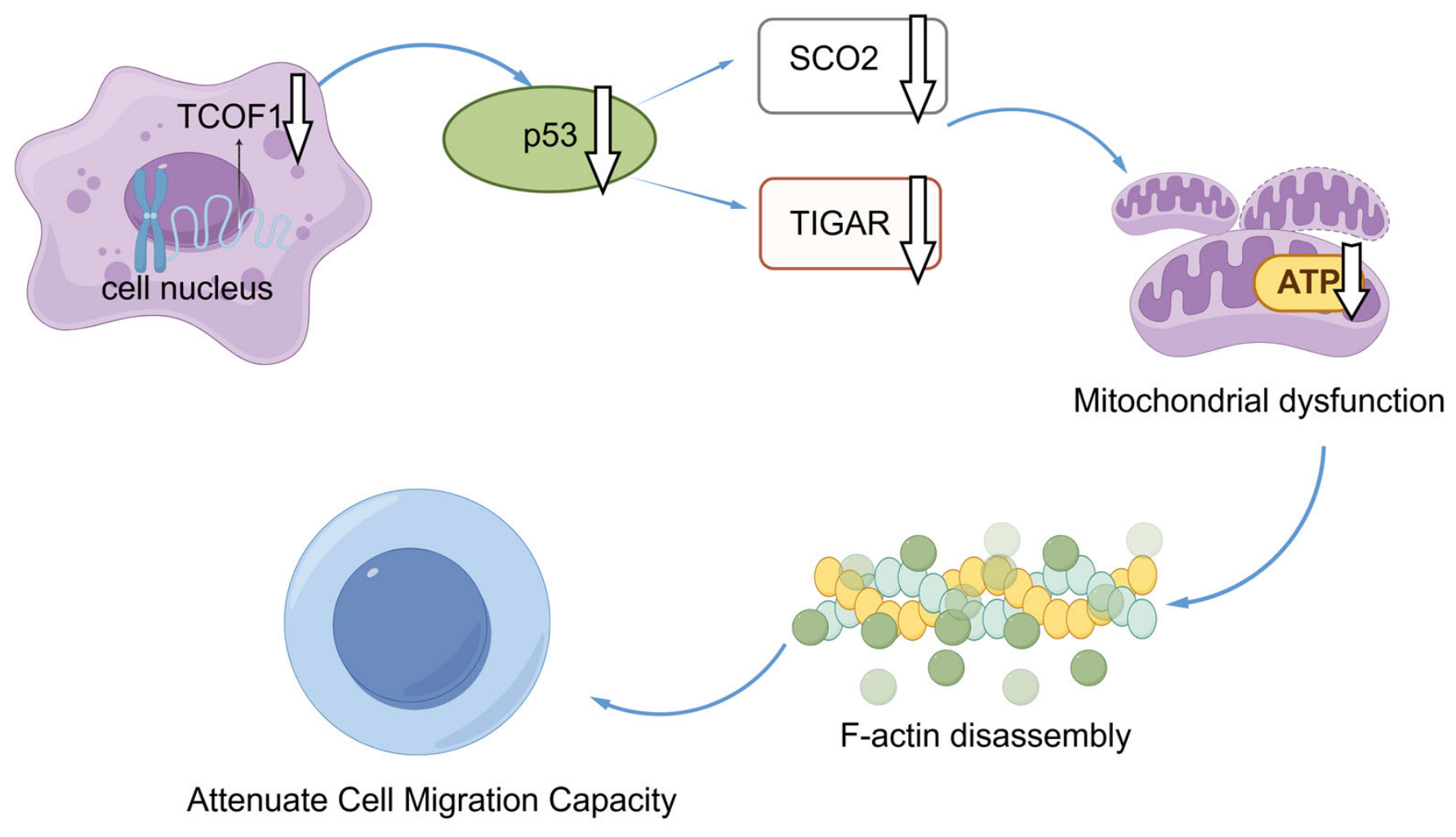

TCOF1 Regulates Tumor Cell Migration Through p53-Dependent Mitochondrial Homeostasis and F-Actin Dynamics

Abstract
1. Introduction
2. Materials and Methods
2.1. Cell Culture and Gene Silencing
2.2. Immunofluorescence (IF) Analysis
2.3. Stochastic Optical Reconstruction Microscopy (STORM) Analysis
2.4. RT-qPCR
2.5. Western Blotting
2.6. Wound Healing Assay
2.7. Phalloidin Staining Assay
2.8. Cell Treatment
2.9. RNA Sequencing
2.10. Transwell Cell Migration Assay
2.11. Statistical Analysis
3. Results
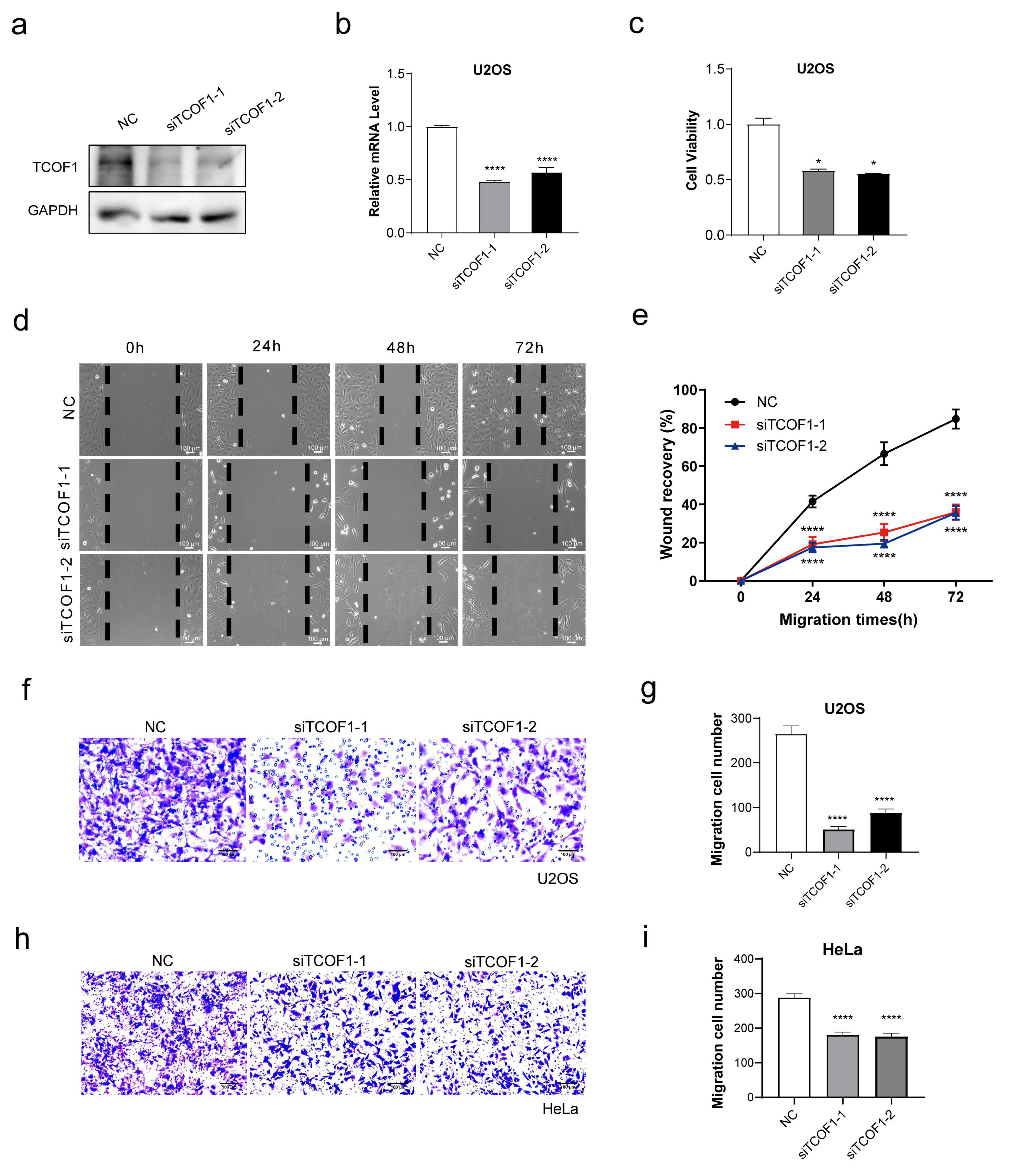
3.1. TCOF1 Deficiency Inhibits Tumor Cell Migration
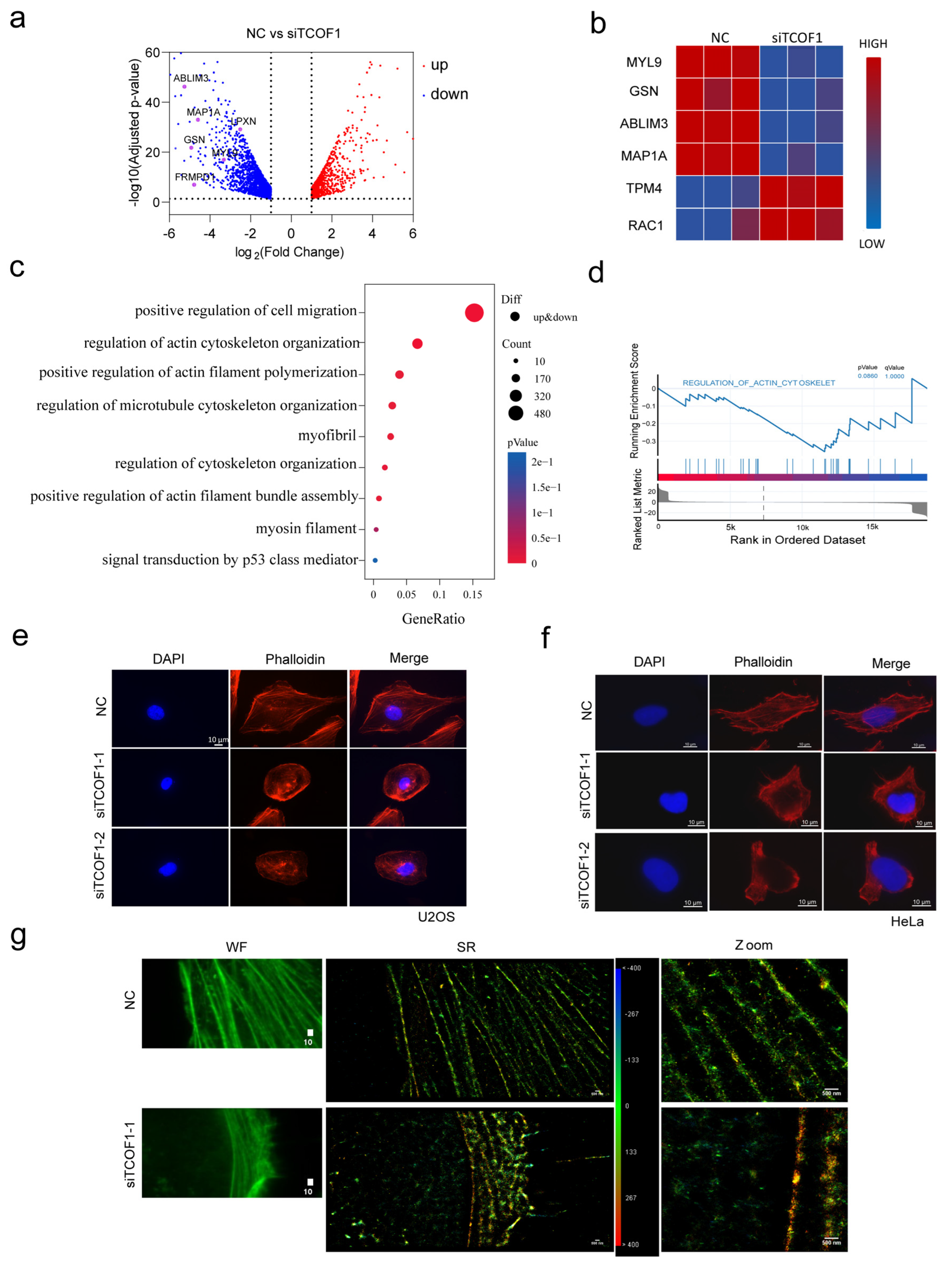
3.2. TCOF1 Deficiency Affects F-Actin Assembly
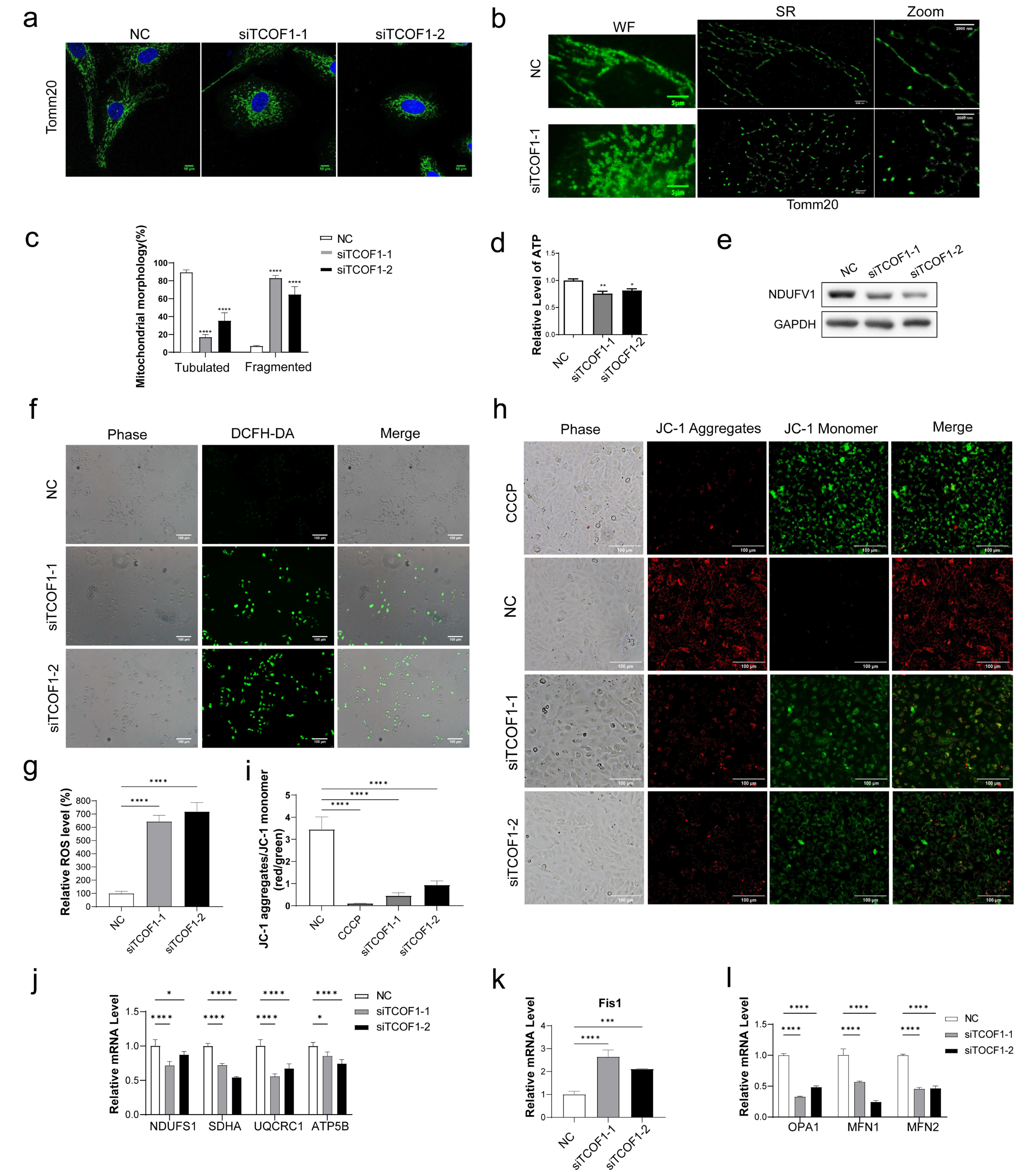
3.3. TCOF1 Deficiency Impairs Mitochondrial Function
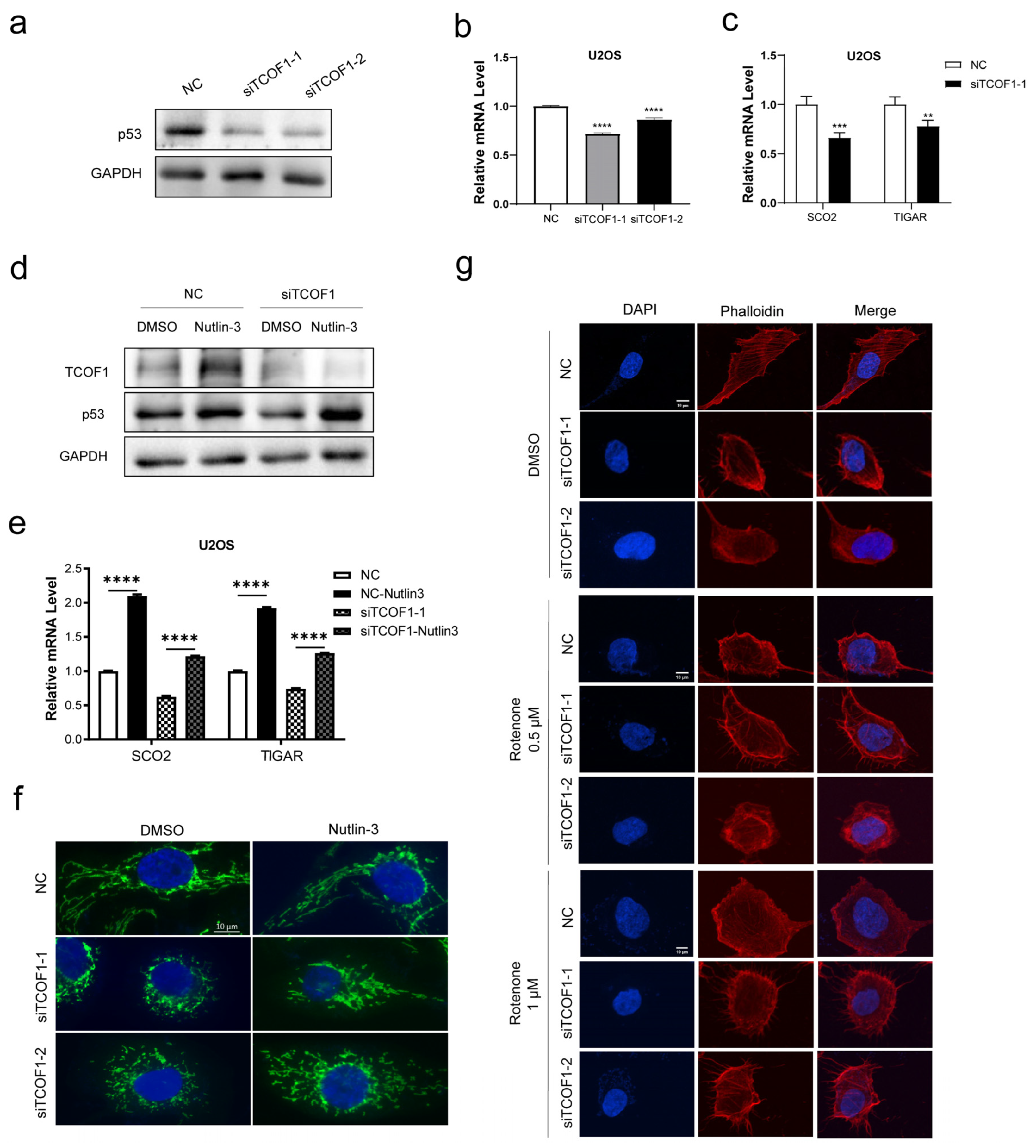
3.4. TCOF1 Maintains Mitochondrial Stability by Regulating p53
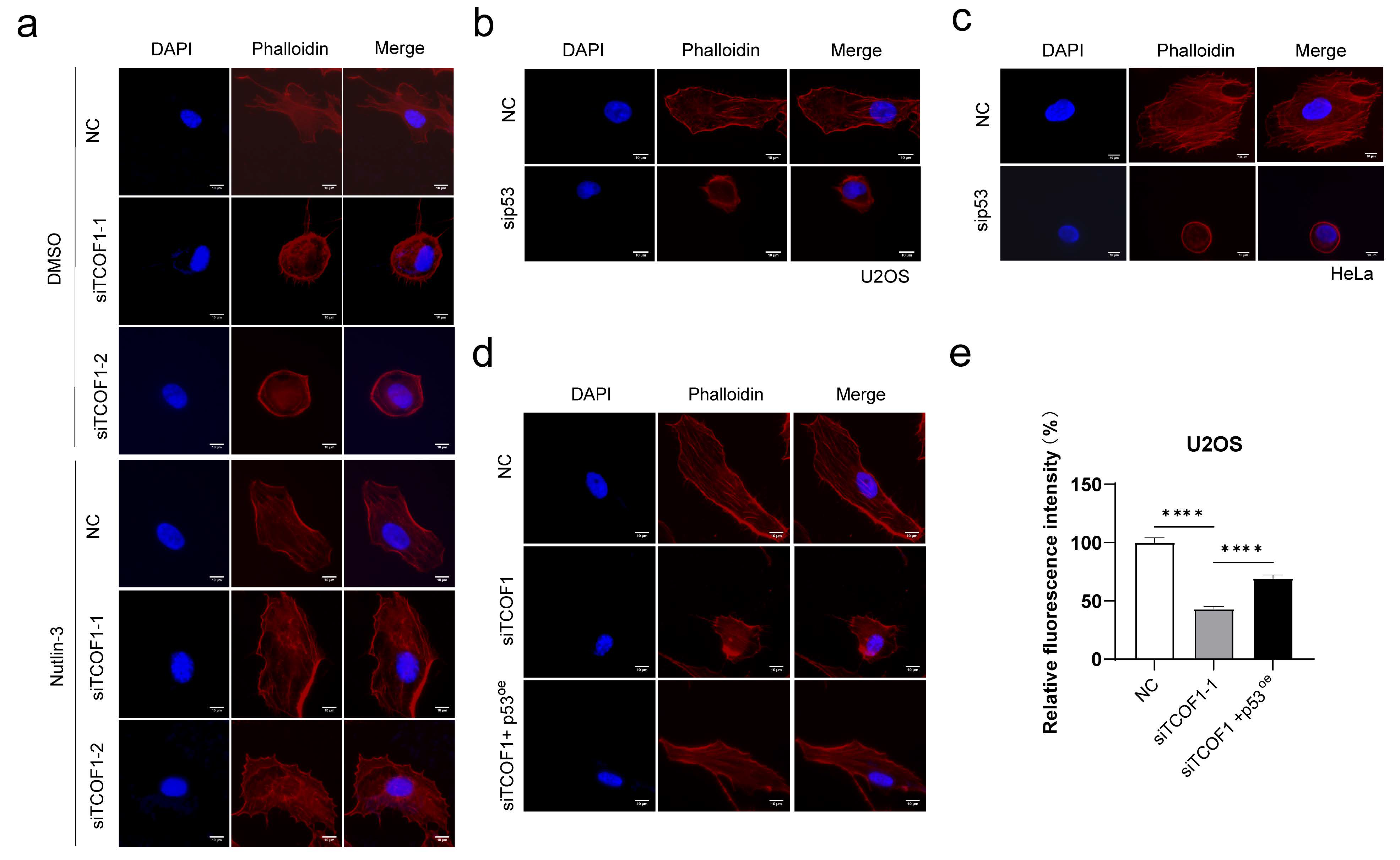
3.5. TCOF1 Maintains F-Actin Stability by Regulating p53
4. Discussion
Supplementary Materials
Author Contributions
Funding
Institutional Review Board Statement
Informed Consent Statement
Data Availability Statement
Acknowledgments
Conflicts of Interest
References
- Valdez, B.C.; Henning, D.; So, R.B.; Dixon, J.; Dixon, M.J. The Treacher Collins syndrome (TCOF1) gene product is involved in ribosomal DNA gene transcription by interacting with upstream binding factor. Proc. Natl. Acad. Sci. USA 2004, 101, 10709–10714. [Google Scholar] [CrossRef]
- Winokur, S.T.; Shiang, R. The Treacher Collins syndrome (TCOF1) gene product, treacle, is targeted to the nucleolus by signals in its C-terminus. Hum. Mol. Genet. 1998, 7, 1947–1952. [Google Scholar] [CrossRef] [PubMed]
- Oxe, K.C.; Larsen, D.H. Treacle is Upregulated in Cancer and Correlates With Poor Prognosis. Front. Cell Dev. Biol. 2022, 10, 918544. [Google Scholar] [CrossRef] [PubMed]
- Grzanka, M.; Piekiełko-Witkowska, A. The Role of TCOF1 Gene in Health and Disease: Beyond Treacher Collins Syndrome. Int. J. Mol. Sci. 2021, 22, 2482. [Google Scholar] [CrossRef] [PubMed]
- Falcon, K.T.; Watt, K.E.N.; Dash, S.; Zhao, R.; Sakai, D.; Moore, E.L.; Fitriasari, S.; Childers, M.; Sardiu, M.E.; Swanson, S.; et al. Dynamic regulation and requirement for ribosomal RNA transcription during mammalian development. Proc. Natl. Acad. Sci. USA 2022, 119, e2116974119. [Google Scholar] [CrossRef]
- Sakai, D.; Dixon, J.; Achilleos, A.; Dixon, M.; Trainor, P.A. Prevention of Treacher Collins syndrome craniofacial anomalies in mouse models via maternal antioxidant supplementation. Nat. Commun. 2016, 7, 10328. [Google Scholar] [CrossRef]
- Ciccia, A.; Huang, J.W.; Izhar, L.; Sowa, M.E.; Harper, J.W.; Elledge, S.J. Treacher Collins syndrome TCOF1 protein cooperates with NBS1 in the DNA damage response. Proc. Natl. Acad. Sci. USA 2014, 111, 18631–18636. [Google Scholar] [CrossRef]
- Larsen, D.H.; Hari, F.; Clapperton, J.A.; Gwerder, M.; Gutsche, K.; Altmeyer, M.; Jungmichel, S.; Toledo, L.I.; Fink, D.; Rask, M.B.; et al. The NBS1-Treacle complex controls ribosomal RNA transcription in response to DNA damage. Nat. Cell Biol. 2014, 16, 792–803. [Google Scholar] [CrossRef]
- Wise, C.A.; Chiang, L.C.; Paznekas, W.A.; Sharma, M.; Musy, M.M.; Ashley, J.A.; Lovett, M.; Jabs, E.W. TCOF1 gene encodes a putative nucleolar phosphoprotein that exhibits mutations in Treacher Collins Syndrome throughout its coding region. Proc. Natl. Acad. Sci. USA 1997, 94, 3110–3115. [Google Scholar] [CrossRef]
- Sakai, D.; Trainor, P.A. Face off against ROS: Tcof1/Treacle safeguards neuroepithelial cells and progenitor neural crest cells from oxidative stress during craniofacial development. Dev. Growth Differ. 2016, 58, 577–585. [Google Scholar] [CrossRef]
- Qu, Y.; Meng, B.; Cai, S.; Yang, B.; He, Y.; Fu, C.; Li, X.; Li, P.; Cao, Z.; Mao, X.; et al. Apoptotic metabolites ameliorate bone aging phenotypes via TCOF1/FLVCR1-mediated mitochondrial homeostasis. J. Nanobiotechnol. 2024, 22, 549. [Google Scholar] [CrossRef]
- Srinivasan, S.; Guha, M.; Kashina, A.; Avadhani, N.G. Mitochondrial dysfunction and mitochondrial dynamics-The cancer connection. Biochim. Biophys. Acta Bioenerg. 2017, 1858, 602–614. [Google Scholar] [CrossRef] [PubMed]
- Mitchell, P. Coupling of phosphorylation to electron and hydrogen transfer by a chemi-osmotic type of mechanism. Nature 1961, 191, 144–148. [Google Scholar] [CrossRef] [PubMed]
- Jiang, H.; Ye, J. The Warburg effect: The hacked mitochondrial-nuclear communication in cancer. Semin. Cancer Biol. 2025, 112, 93–111. [Google Scholar] [CrossRef] [PubMed]
- Adebayo, M.; Singh, S.; Singh, A.P.; Dasgupta, S. Mitochondrial fusion and fission: The fine-tune balance for cellular homeostasis. FASEB J. 2021, 35, e21620. [Google Scholar] [CrossRef]
- Ma, Y.; Wang, L.; Jia, R. The role of mitochondrial dynamics in human cancers. Am. J. Cancer Res. 2020, 10, 1278–1293. [Google Scholar]
- Chen, Y.; Liu, Y.; Dorn, G.W., 2nd. Mitochondrial fusion is essential for organelle function and cardiac homeostasis. Circ. Res. 2011, 109, 1327–1331. [Google Scholar] [CrossRef]
- Mallik, B.; Frank, C.A. Roles for Mitochondrial Complex I Subunits in Regulating Synaptic Transmission and Growth. Front. Neurosci. 2022, 16, 846425. [Google Scholar] [CrossRef]
- Mallik, B.; Bhat, S.A.; Wang, X.; Frank, C.A. Mitochondrial Complex I and ROS control neuromuscular function through opposing pre- and postsynaptic mechanisms. PLoS Biol. 2025, 23, e3003388. [Google Scholar] [CrossRef]
- Kidwell, C.U.; Casalini, J.R.; Pradeep, S.; Scherer, S.D.; Greiner, D.; Bayik, D.; Watson, D.C.; Olson, G.S.; Lathia, J.D.; Johnson, J.S.; et al. Transferred mitochondria accumulate reactive oxygen species, promoting proliferation. eLife 2023, 12, e85494. [Google Scholar] [CrossRef]
- Harlow, E.; Williamson, N.M.; Ralston, R.; Helfman, D.M.; Adams, T.E. Molecular cloning and in vitro expression of a cDNA clone for human cellular tumor antigen p53. Mol. Cell. Biol. 1985, 5, 1601–1610. [Google Scholar] [CrossRef] [PubMed]
- Soussi, T.; May, P. Structural aspects of the p53 protein in relation to gene evolution: A second look. J. Mol. Biol. 1996, 260, 623–637. [Google Scholar] [CrossRef] [PubMed]
- Liu, J.; Zhang, C.; Hu, W.; Feng, Z. Tumor suppressor p53 and its mutants in cancer metabolism. Cancer Lett. 2015, 356, 197–203. [Google Scholar] [CrossRef] [PubMed]
- Ma, W.; Sung, H.J.; Park, J.Y.; Matoba, S.; Hwang, P.M. A pivotal role for p53: Balancing aerobic respiration and glycolysis. J. Bioenerg. Biomembr. 2007, 39, 243–246. [Google Scholar] [CrossRef]
- Tsipis, A.; Athanassiadou, A.M.; Athanassiadou, P.; Kavantzas, N.; Agrogiannis, G.; Patsouris, E. Apoptosis-related factors p53, bcl-2 and the defects of force transmission in dilated cardiomyopathy. Pathol. Res. Pract. 2010, 206, 625–630. [Google Scholar] [CrossRef]
- Matoba, S.; Kang, J.G.; Patino, W.D.; Wragg, A.; Boehm, M.; Gavrilova, O.; Hurley, P.J.; Bunz, F.; Hwang, P.M. p53 regulates mitochondrial respiration. Science 2006, 312, 1650–1653. [Google Scholar] [CrossRef]
- Sung, Y.J.; Kao, T.Y.; Kuo, C.L.; Fan, C.C.; Cheng, A.N.; Fang, W.C.; Chou, H.Y.; Lo, Y.K.; Chen, C.H.; Jiang, S.S.; et al. Mitochondrial Lon sequesters and stabilizes p53 in the matrix to restrain apoptosis under oxidative stress via its chaperone activity. Cell Death Dis. 2018, 9, 697. [Google Scholar] [CrossRef]
- Shin, J.; Hong, S.G.; Choi, S.Y.; Rath, M.E.; Saredy, J.; Jovin, D.G.; Sayoc, J.; Park, H.S.; Eguchi, S.; Rizzo, V.; et al. Flow-induced endothelial mitochondrial remodeling mitigates mitochondrial reactive oxygen species production and promotes mitochondrial DNA integrity in a p53-dependent manner. Redox Biol. 2022, 50, 102252. [Google Scholar] [CrossRef]
- Hao, Q.; Chen, J.; Lu, H.; Zhou, X. The ARTS of p53-dependent mitochondrial apoptosis. J. Mol. Cell Biol. 2023, 14, mjac074. [Google Scholar] [CrossRef]
- Moujaber, O.; Stochaj, U. The Cytoskeleton as Regulator of Cell Signaling Pathways. Trends Biochem. Sci. 2020, 45, 96–107. [Google Scholar] [CrossRef]
- Hinshaw, D.B.; Armstrong, B.C.; Burger, J.M.; Beals, T.F.; Hyslop, P.A. ATP and microfilaments in cellular oxidant injury. Am. J. Pathol. 1988, 132, 479–488. [Google Scholar]
- Cárdenas, L.; Lovy-Wheeler, A.; Wilsen, K.L.; Hepler, P.K. Actin polymerization promotes the reversal of streaming in the apex of pollen tubes. Cell Motil. Cytoskelet. 2005, 61, 112–127. [Google Scholar] [CrossRef] [PubMed]
- Dogterom, M.; Koenderink, G.H. Actin-microtubule crosstalk in cell biology. Nat. Rev. Mol. Cell Biol. 2019, 20, 38–54. [Google Scholar] [CrossRef]
- Pimm, M.L.; Henty-Ridilla, J.L. New twists in actin-microtubule interactions. Mol. Biol. Cell 2021, 32, 211–217. [Google Scholar] [CrossRef] [PubMed]
- Zheng, T.; Zhou, H.; Li, X.; Peng, D.; Yang, Y.; Zeng, Y.; Liu, H.; Ren, J.; Zhao, Y. RBMX is required for activation of ATR on repetitive DNAs to maintain genome stability. Cell Death Differ. 2020, 27, 3162–3176. [Google Scholar] [CrossRef]
- Das, S.; Ge, P.; Oztug Durer, Z.A.; Grintsevich, E.E.; Zhou, Z.H.; Reisler, E. D-loop Dynamics and Near-Atomic-Resolution Cryo-EM Structure of Phalloidin-Bound F-Actin. Structure 2020, 28, 586–593.e583. [Google Scholar] [CrossRef] [PubMed]
- Rappaport, L.; Oliviero, P.; Samuel, J.L. Cytoskeleton and mitochondrial morphology and function. Mol. Cell. Biochem. 1998, 184, 101–105. [Google Scholar] [CrossRef]
- De Vos, K.J.; Allan, V.J.; Grierson, A.J.; Sheetz, M.P. Mitochondrial function and actin regulate dynamin-related protein 1-dependent mitochondrial fission. Curr. Biol. 2005, 15, 678–683. [Google Scholar] [CrossRef]
- Lebedeva, M.A.; Eaton, J.S.; Shadel, G.S. Loss of p53 causes mitochondrial DNA depletion and altered mitochondrial reactive oxygen species homeostasis. Biochim. Biophys. Acta 2009, 1787, 328–334. [Google Scholar] [CrossRef]
- Bergeaud, M.; Mathieu, L.; Guillaume, A.; Moll, U.M.; Mignotte, B.; Le Floch, N.; Vayssière, J.L.; Rincheval, V. Mitochondrial p53 mediates a transcription-independent regulation of cell respiration and interacts with the mitochondrial F1F0-ATP synthase. Cell Cycle 2013, 12, 2781–2793. [Google Scholar] [CrossRef]
- Dai, C.Q.; Luo, T.T.; Luo, S.C.; Wang, J.Q.; Wang, S.M.; Bai, Y.H.; Yang, Y.L.; Wang, Y.Y. p53 and mitochondrial dysfunction: Novel insight of neurodegenerative diseases. J. Bioenerg. Biomembr. 2016, 48, 337–347. [Google Scholar] [CrossRef] [PubMed]
- Fields, J.; Hanisch, J.J.; Choi, J.W.; Hwang, P.M. How does p53 regulate mitochondrial respiration? IUBMB Life 2007, 59, 682–684. [Google Scholar] [CrossRef] [PubMed]
- Bensaad, K.; Tsuruta, A.; Selak, M.A.; Vidal, M.N.; Nakano, K.; Bartrons, R.; Gottlieb, E.; Vousden, K.H. TIGAR, a p53-inducible regulator of glycolysis and apoptosis. Cell 2006, 126, 107–120. [Google Scholar] [CrossRef] [PubMed]
- Li, H.; Jogl, G. Structural and biochemical studies of TIGAR (TP53-induced glycolysis and apoptosis regulator). J. Biol. Chem. 2009, 284, 1748–1754. [Google Scholar] [CrossRef]
- Momand, J.; Zambetti, G.P.; Olson, D.C.; George, D.; Levine, A.J. The mdm-2 oncogene product forms a complex with the p53 protein and inhibits p53-mediated transactivation. Cell 1992, 69, 1237–1245. [Google Scholar] [CrossRef]
- Yee-Lin, V.; Pooi-Fong, W.; Soo-Beng, A.K. Nutlin-3, A p53-Mdm2 Antagonist for Nasopharyngeal Carcinoma Treatment. Mini Rev. Med. Chem. 2018, 18, 173–183. [Google Scholar] [CrossRef]
- Vassilev, L.T.; Vu, B.T.; Graves, B.; Carvajal, D.; Podlaski, F.; Filipovic, Z.; Kong, N.; Kammlott, U.; Lukacs, C.; Klein, C.; et al. In vivo activation of the p53 pathway by small-molecule antagonists of MDM2. Science 2004, 303, 844–848. [Google Scholar] [CrossRef]
- Li, N.; Ragheb, K.; Lawler, G.; Sturgis, J.; Rajwa, B.; Melendez, J.A.; Robinson, J.P. Mitochondrial complex I inhibitor rotenone induces apoptosis through enhancing mitochondrial reactive oxygen species production. J. Biol. Chem. 2003, 278, 8516–8525. [Google Scholar] [CrossRef]
- Leite, G.O.; Ecker, A.; Seeger, R.L.; Krum, B.N.; Lugokenski, T.H.; Fachinetto, R.; Sudati, J.H.; Barbosa, N.V.; Wagner, C. Protective effect of (-)-α-bisabolol on rotenone-induced toxicity in Drosophila melanogaster. Can. J. Physiol. Pharmacol. 2018, 96, 359–365. [Google Scholar] [CrossRef]
- Sakai, D.; Trainor, P.A. Treacher Collins syndrome: Unmasking the role of Tcof1/treacle. Int. J. Biochem. Cell Biol. 2009, 41, 1229–1232. [Google Scholar] [CrossRef]
- Passos-Bueno, M.R.; Ornelas, C.C.; Fanganiello, R.D. Syndromes of the first and second pharyngeal arches: A review. Am. J. Med. Genet. A 2009, 149a, 1853–1859. [Google Scholar] [CrossRef] [PubMed]
- Calo, E.; Gu, B.; Bowen, M.E.; Aryan, F.; Zalc, A.; Liang, J.; Flynn, R.A.; Swigut, T.; Chang, H.Y.; Attardi, L.D.; et al. Tissue-selective effects of nucleolar stress and rDNA damage in developmental disorders. Nature 2018, 554, 112–117. [Google Scholar] [CrossRef] [PubMed]
- Werner, A.; Iwasaki, S.; McGourty, C.A.; Medina-Ruiz, S.; Teerikorpi, N.; Fedrigo, I.; Ingolia, N.T.; Rape, M. Cell-fate determination by ubiquitin-dependent regulation of translation. Nature 2015, 525, 523–527. [Google Scholar] [CrossRef] [PubMed]
- Kong, X.; Zhong, Z.; Fang, C. F-actin dynamics regulates collective cell migration by modulating cell shape and stress correlation. Biophys. J. 2025, 124, 1995–2004. [Google Scholar] [CrossRef]
- Suwannalert, P.; Panpinyaporn, P.; Wantanachaisaeng, P.; Teeppaibul, T.; Khumsri, W.; Koomsang, T.; Payuhakrit, W.; Naktubtim, C. A Potential Combination of Targeting HSP90 and mTOR in Breast Cancer Cell Growth, Migration, and Invasion Through Inhibiting AKT Phosphorylation and F-actin Organization. Anticancer. Res. 2024, 44, 2555–2565. [Google Scholar] [CrossRef]
- Wang, Y.T.; Liao, Q.Y.; Dong, Y.Z.; Shu, Y.; Li, X.Y.; Li, J.; Sun, R.F.; Su, X.S. Compound kushen injection inhibits breast cancer lung metastasis through regulating MTSS1/ARPC3/F-actin. J. Ethnopharmacol. 2025, 350, 120054. [Google Scholar] [CrossRef]
- Wu, C.; Xia, D.; Wang, D.; Wang, S.; Sun, Z.; Xu, B.; Zhang, D. TCOF1 coordinates oncogenic activation and rRNA production and promotes tumorigenesis in HCC. Cancer Sci. 2022, 113, 553–564. [Google Scholar] [CrossRef]
- Yadav, T.; Gau, D.; Roy, P. Mitochondria-actin cytoskeleton crosstalk in cell migration. J. Cell Physiol. 2022, 237, 2387–2403. [Google Scholar] [CrossRef]
- Zhang, Z.; Zhang, H.; Antonic-Baker, A.; Kwan, P.; Yan, Y.; Ma, Y. CXCR5 Regulates Neuronal Polarity Development and Migration in the Embryonic Stage via F-Actin Homeostasis and Results in Epilepsy-Related Behavior. Neurosci. Bull. 2023, 39, 1605–1622. [Google Scholar] [CrossRef]
- Basu, H.; Pekkurnaz, G.; Falk, J.; Wei, W.; Chin, M.; Steen, J.; Schwarz, T.L. FHL2 anchors mitochondria to actin and adapts mitochondrial dynamics to glucose supply. J. Cell Biol. 2021, 220, e201912077. [Google Scholar] [CrossRef]
- Romani, P.; Nirchio, N.; Arboit, M.; Barbieri, V.; Tosi, A.; Michielin, F.; Shibuya, S.; Benoist, T.; Wu, D.; Hindmarch, C.C.T.; et al. Mitochondrial fission links ECM mechanotransduction to metabolic redox homeostasis and metastatic chemotherapy resistance. Nat. Cell Biol. 2022, 24, 168–180. [Google Scholar] [CrossRef]
- Kim, Y.Y.; Um, J.H.; Yoon, J.H.; Lee, D.Y.; Lee, Y.J.; Kim, D.H.; Park, J.I.; Yun, J. p53 regulates mitochondrial dynamics by inhibiting Drp1 translocation into mitochondria during cellular senescence. FASEB J. 2020, 34, 2451–2464. [Google Scholar] [CrossRef]
- Li, J.; Donath, S.; Li, Y.; Qin, D.; Prabhakar, B.S.; Li, P. miR-30 regulates mitochondrial fission through targeting p53 and the dynamin-related protein-1 pathway. PLoS Genet. 2010, 6, e1000795, Correction in PLoS Genet. 2010, 6. https://doi.org/10.1371/annotation/4050116d-8daa-4b5a-99e9-34cdd13f6a26. [Google Scholar] [CrossRef]
- Villeneuve, C.; Guilbeau-Frugier, C.; Sicard, P.; Lairez, O.; Ordener, C.; Duparc, T.; De Paulis, D.; Couderc, B.; Spreux-Varoquaux, O.; Tortosa, F.; et al. p53-PGC-1α pathway mediates oxidative mitochondrial damage and cardiomyocyte necrosis induced by monoamine oxidase-A upregulation: Role in chronic left ventricular dysfunction in mice. Antioxid. Redox Signal. 2013, 18, 5–18. [Google Scholar] [CrossRef]





| siRNA | Sequence (5′→3′) |
|---|---|
| NC (negative control) | 5′-UUCUCCGAACGUGUCACGUdTdT-3′ |
| siTCOF1-1 | 5′-GGAAUCAGAUAGUGAGGAAdTdT-3′ |
| siTCOF1-2 | 5′-GAGGAUUCUUCAAGCAGUGAGGAAUdTdT-3′ |
| Primers | Sequences |
|---|---|
| TCOF1-forward primer | 5′-CCCCAGAACAGTACCGTCTT-3′ |
| TCOF1-reverse primer | 5′-GCTCTGATCTGGTGGGTCTT-3′ |
| GAPDH-forward primer | 5′-AGCCACATCGCTCAGACAC-3′ |
| GAPDH-reverse primer | 5′-GCCCAATACGACCAAATCC-3′ |
| β-actin-forward primer | 5′-TCCCTGGAGAAGAGCTACGA-3′ |
| β-actin-reverse primer | 5′-AGCACTGTGTTGGCGTACAG-3′ |
| MFN1-forward primer | 5′-GAGGTGCTATCTCGGAGACAC-3′ |
| MFN1-reverse primer | 5′-GCCAATCCCACTAGGGAGAAC-3′ |
| MFN2-forward primer | 5′-CACATGGAGCGTTGTACCAG-3′ |
| MFN2-reverse primer | 5′-TTGAGCACCTCCTTAGCAGAC-3′ |
| OPA1-forward primer | 5′-AGTAGAGGTTGCTTGGGAGAC-3′ |
| OPA1-reverse primer | 5′-TGTCATCATGCTCTTTCCCT-3′ |
| Fis1-forward primer | 5′-CATCGTGCTGCTGGAGAGC-3′ |
| Fis1-reverse primer | 5′-GCAGAGAGCAGGTGAGGCTG-3′ |
| NDUFS1-forward primer | 5′-TTAGCAAATCACCCATTGGACTG-3′ |
| NDUFS1-reverse primer | 5′-CCCCTCTAAAAATCGGCTCCTA-3′ |
| SDHA-forward primer | 5′-CAGCATGTGTTACCAAGCTGT-3′ |
| SDHA-reverse primer | 5′-GGTGTCGTAGAAATGCCACCT-3′ |
| UQCRC1-forward primer | 5′-GGGAGTGTGGATTGATGTTGG-3′ |
| UQCRC1-reverse primer | 5′-TGTTCCCTTGAAAGCCAGATG-3′ |
| ATP5B-forward primer | 5′-GGTGAGAGGACCCGTGAAG-3′ |
| ATP5B-reverse primer | 5′-CGCTACCTTAGAGGTGGCAT-3′ |
Disclaimer/Publisher’s Note: The statements, opinions and data contained in all publications are solely those of the individual author(s) and contributor(s) and not of MDPI and/or the editor(s). MDPI and/or the editor(s) disclaim responsibility for any injury to people or property resulting from any ideas, methods, instructions or products referred to in the content. |
© 2026 by the authors. Licensee MDPI, Basel, Switzerland. This article is an open access article distributed under the terms and conditions of the Creative Commons Attribution (CC BY) license.
Share and Cite
Jiang, Y.; Wei, Y.; Yang, D.; Yao, J.; Hu, Q.; Li, X. TCOF1 Regulates Tumor Cell Migration Through p53-Dependent Mitochondrial Homeostasis and F-Actin Dynamics. Curr. Issues Mol. Biol. 2026, 48, 447. https://doi.org/10.3390/cimb48050447
Jiang Y, Wei Y, Yang D, Yao J, Hu Q, Li X. TCOF1 Regulates Tumor Cell Migration Through p53-Dependent Mitochondrial Homeostasis and F-Actin Dynamics. Current Issues in Molecular Biology. 2026; 48(5):447. https://doi.org/10.3390/cimb48050447
Chicago/Turabian StyleJiang, Yuanyuan, Yao Wei, Daikang Yang, Jiali Yao, Qiping Hu, and Xiaocui Li. 2026. "TCOF1 Regulates Tumor Cell Migration Through p53-Dependent Mitochondrial Homeostasis and F-Actin Dynamics" Current Issues in Molecular Biology 48, no. 5: 447. https://doi.org/10.3390/cimb48050447
APA StyleJiang, Y., Wei, Y., Yang, D., Yao, J., Hu, Q., & Li, X. (2026). TCOF1 Regulates Tumor Cell Migration Through p53-Dependent Mitochondrial Homeostasis and F-Actin Dynamics. Current Issues in Molecular Biology, 48(5), 447. https://doi.org/10.3390/cimb48050447