

Exploring Early Neurodegeneration Through Fasting-Induced Metabolic Signatures and High-Sensitivity Biomarkers
 ,
, 
 ,
, 
Abstract
1. Introduction
2. Metabolic Foundations of Intermittent Fasting
3. Metabolic Signatures of Fasting as Modulators of Early Neurodegenerative Biomarkers
4. Metabolic and Neuroinflammatory Pathways in Early Neurodegeneration
5. Plasma and CSF Biomarkers for Early Neurodegeneration
6. Do Fasting-Induced Metabolic Mediators Measurably Modify Plasma/CSF Biomarkers?
7. Metabolic, Molecular, and Clinical Effects of IF
8. Future Directions in IF: Biomarkers and Precision Neuro-Nutrition
9. IF Clinical Considerations: Safety and Contraindications
10. Limitations and Evidence Gaps
11. Conclusions
Author Contributions
Funding
Institutional Review Board Statement
Informed Consent Statement
Data Availability Statement
Conflicts of Interest
Abbreviations
| AD | Alzheimer’s disease |
| ADF | Alternate-Day Fasting |
| AI | Artificial Intelligence |
| Aβ | Amyloid-beta |
| Aβ42/Aβ40 | Amyloid-beta 42/amyloid-beta 40 ratio |
| AMPK | AMP-activated protein kinase |
| AT(N) | Amyloid/tau/neurodegeneration framework |
| BDNF | Brain-derived Neurotrophic Factor |
| BHB | β-hydroxybutyrate |
| CSF | Cerebrospinal Fluid |
| DALYs | Disability-adjusted life years |
| GABA | Gamma-aminobutyric acid |
| GAP-43 | Growth-associated protein 43 |
| GFAP | Glial Fibrillary Acidic Protein |
| GH | Growth hormone |
| hFABP | Heart-type fatty acid-binding protein |
| IF | Intermittent Fasting |
| IGF-1 | Insulin-like Growth Factor 1 |
| IL-6 | Interleukin-6 |
| MAPK | Mitogen-activated protein kinase |
| MCP-1 | Monocyte chemoattractant protein-1 |
| MCI | Mild Cognitive Impairment |
| mTOR | Mechanistic Target of Rapamycin |
| NDs | Neurodegenerative diseases |
| NF-κB | Nuclear factor kappa-light-chain-enhancer of activated B cells |
| NfL | Neurofilament light chain |
| PD | Parkinson’s disease |
| PI3K/Akt | Phosphoinositide 3-kinase/protein kinase B |
| p-Tau | Phosphorylated tau |
| p-Tau181 | Phosphorylated tau at threonine 181 |
| p-Tau217 | Phosphorylated tau at threonine 217 |
| p-Tau231 | Phosphorylated tau at threonine 231 |
| RCTs | Randomised controlled trials |
| ROS | Reactive oxygen species |
| SCFAs | Short-Chain Fatty Acids |
| S100B | S100 calcium-binding protein B |
| SIRT1 | Sirtuin 1 |
| SIRT3 | Sirtuin 3 |
| SNAP-25 | Synaptosomal-Associated Protein 25 |
| sTREM2 | Soluble triggering receptor expressed on myeloid cells 2 |
| TDP-43 | TAR DNA-binding protein 43 |
| t-Tau | Total tau |
| TREM2 | Triggering receptor expressed on myeloid cells 2 |
| TRF | Time-restricted Feeding |
| UCH-L1 | Ubiquitin C-terminal hydrolase L1 |
| VRF | Visceral fat ratio |
| VILIP-1 | Visinin-like protein 1 |
| YKL-40 | Chitinase-3-like protein 1 |
References
- The GBD 2021 Nervous System Disorders Collaborators. Global, regional, and national burden of disorders affecting the nervous system, 1990–2021: A systematic analysis for the Global Burden of Disease Study 2021. Lancet Neurol. 2024, 23, 344–381. [Google Scholar] [CrossRef]
- Ding, C.; Wu, Y.; Chen, X.; Chen, X.; Wu, C.; Lin, Z.; Kang, D.; Fang, W.; Chen, F. Global burden of neurological disorders: The Global Burden of Disease Study 1990–2019. Front. Public Health 2022, 10, 952161. [Google Scholar] [CrossRef]
- Yang, H. Mitochondrial dysfunction in neurodegenerative diseases. Cells 2025, 14, 276. [Google Scholar] [CrossRef] [PubMed]
- Hein, Z.M.; Arbain, M.F.F.; Kumar, S.; Mehat, M.Z.; Hamid, H.; Che Ramli, M.D.; Che Mohd Nassir, C.M.N. Intermittent Fasting as a Neuroprotective Strategy: Gut-Brain Axis Modulation and Metabolic Reprogramming in Neurodegenerative Disorders. Nutrients 2025, 17, 2226. [Google Scholar] [CrossRef] [PubMed]
- Hadi, F.; Mortaja, M.; Hadi, Z. Calcium (Ca2+) hemostasis, mitochondria, autophagy, and mitophagy contribute to Alzheimer’s disease as early moderators. Cell Biochem. Funct. 2024, 42, e4085. [Google Scholar] [CrossRef] [PubMed]
- Nakamura, Y.; Nakano, M.; Hisaoka-Nakashima, K.; Morioka, N. Aging-related dysregulation of energy metabolism and mitochondrial dynamics in microglia. J. Clin. Biochem. Nutr. 2025, 76, 239–244. [Google Scholar] [CrossRef]
- Mian, M.; Tahiri, J.; Eldin, R.; Altabaa, M.; Sehar, U.; Reddy, P.H. Overlooked cases of mild cognitive impairment: Implications to early Alzheimer’s disease. Ageing Res. Rev. 2024, 93, 102335. [Google Scholar] [CrossRef]
- Tu, R.; Han, Z.; Zhang, H.; Jia, X.; Sun, T.; Liu, H.; Li, J.; Tang, M.; Wang, S. From pathogenesis to treatment: The emerging role of ferroptosis in Parkinson’s disease. Front. Immunol. 2025, 16, 1709561. [Google Scholar] [CrossRef]
- Kaur, J.; Sharma, V.; Khan, H.; Singh, S.; Singh, T.G. Intersecting molecular pathways in Synucleinopathies and Amyloidogenesis: Exploring shared mechanisms and therapeutic potential. Brain Res. 2025, 1855, 149568. [Google Scholar] [CrossRef]
- Yang, F. Molecular Mechanisms and Clinical Translation of Intermittent Fasting on Adipose Tissue Heterogeneity. Theor. Nat. Sci. 2025, 122, 26–32. [Google Scholar] [CrossRef]
- Vergara-Nieto, Á.A.; Halabi-Diaz, A. A narrative review about metabolic pathways, molecular mechanisms and clinical implications of intermittent fasting as an autophagy promoter. Curr. Nutr. Rep. 2025, 14, 78. [Google Scholar] [CrossRef] [PubMed]
- Ciastek, B.; Kapłon, K.; Domaszewski, P. A comprehensive perspective on the biological effects of intermittent fasting and periodic short-term fasting in metabolic health. Nutrients 2025, 17, 2061. [Google Scholar] [CrossRef]
- Rius-Bonet, J.; Macip, S.; Closa, D.; Massip-Salcedo, M. Intermittent fasting as a dietary intervention with potential sexually dimorphic health benefits. Nutr. Rev. 2025, 83, e635–e648. [Google Scholar] [CrossRef]
- Parnetti, L.; Chipi, E.; Salvadori, N.; D’Andrea, K.; Eusebi, P. Prevalence and risk of progression of preclinical Alzheimer’s disease stages: A systematic review and meta-analysis. Alzheimer’s Res. Ther. 2019, 11, 7. [Google Scholar] [CrossRef]
- Ismail, R.; Parbo, P.; Madsen, L.S.; Hansen, A.K.; Hansen, K.V.; Schaldemose, J.L.; Kjeldsen, P.L.; Stokholm, M.G.; Gottrup, H.; Eskildsen, S.F.; et al. The relationships between neuroinflammation, beta-amyloid and tau deposition in Alzheimer’s disease: A longitudinal PET study. J. Neuroinflamm. 2020, 17, 151. [Google Scholar] [CrossRef]
- Agnello, L.; Gambino, C.M.; Cacciabaudo, F.; Ciaccio, A.M.; Massa, D.; Masucci, A.; Tamburello, M.; Vassallo, R.; Midiri, M.; Scazzone, C.; et al. From amyloid to synaptic dysfunction: Biomarker-driven insights into Alzheimer’s disease. Curr. Issues Mol. Biol. 2025, 47, 580. [Google Scholar] [CrossRef]
- Chatterjee, P.; Pedrini, S.; Ashton, N.J.; Tegg, M.; Goozee, K. Diagnostic and prognostic plasma biomarkers for preclinical Alzheimer’s disease. Alzheimer’s Dement. 2022, 6, 1141–1154. [Google Scholar] [CrossRef]
- Zhao, Y.; Jaber, V.; Alexandrov, P.N.; Vergallo, A.; Lista, S.; Hampel, H.; Lukiw, W.J. MicroRNA-Based Biomarkers in Alzheimer’s Disease (AD). Front. Neurosci. 2020, 14, 585432. [Google Scholar] [CrossRef]
- Doecke, J.D.; Bellomo, G.; Vermunt, L.; Alcolea, D.; Halbgebauer, S.; In ’t Veld, S.; Mattsson-Carlgren, N.; Veverova, K.; Fowler, C.J.; Boonkamp, L.; et al. Diagnostic performance of plasma pTau217/Aβ42 ratio and a three-zone threshold model for Alzheimer’s disease. Alzheimer’s Dement. 2025, 159, 60–68. [Google Scholar]
- Ibanez, L.; Liu, M.; Beric, A.; Timsina, J.; Kohlfeld, P.; Bergmann, K.; Lowery, J.; Sykora, N.; Sanchez-Montejo, B.; Brock, W.; et al. Benchmarking of a multi-biomarker low-volume panel for Alzheimer’s disease research. Alzheimer’s Dement. 2025, 21, e14413. [Google Scholar] [CrossRef] [PubMed]
- Khandelwal, D.; Bhattacharya, A.; Kumari, V.; Gupta, S.S.; Ranjan, K.R.; Mishra, V. Leveraging nanomaterials for ultrasensitive biosensors in early cancer detection: A review. J. Mater. Chem. B 2025, 13, 802–820. [Google Scholar] [CrossRef]
- Mattson, M.P.; Longo, V.D.; Harvie, M. Impact of intermittent fasting on health and disease processes. Ageing Res. Rev. 2017, 39, 46–58. [Google Scholar] [CrossRef] [PubMed]
- Stockman, M.C.; Thomas, D.; Burke, J.; Apovian, C.M. Intermittent fasting: Is the wait worth the weight? Curr. Obes. Rep. 2018, 7, 172–185. [Google Scholar] [CrossRef] [PubMed]
- Rynders, C.A.; Thomas, E.A.; Zaman, A.; Pan, Z.; Catenacci, V.A. Effectiveness of Intermittent Fasting and Time-Restricted Feeding Compared to Continuous Energy Restriction for Weight Loss. Nutrients 2019, 11, 2442. [Google Scholar] [CrossRef]
- Gabel, K.; Cienfuegos, S.; Kalam, F.; Ezpeleta, M.; Varady, K.A. Time-Restricted Eating to Improve Cardiovascular Health. Curr. Atheroscler. Rep. 2021, 23, 22. [Google Scholar] [CrossRef]
- Lee, S.A.; Sypniewski, C.; Bensadon, B.A.; McLaren, C.; Donahoo, W.T.; Sibille, K.T.; Anton, S. Determinants of adherence in time-restricted feeding interventions in older adults: Lesson from a pilot study. Nutrients 2020, 12, 874. [Google Scholar] [CrossRef]
- Liu, D.; Huang, Y.; Huang, C.; Yang, S.; Wei, X.; Zhang, P.; Guo, D.; Lin, J.; Xu, B.; Li, C.; et al. Calorie restriction with or without time-restricted eating in weight loss. N. Engl. J. Med. 2022, 386, 1495–1504. [Google Scholar] [CrossRef] [PubMed]
- Ezzati, A.; Rosenkranz, S.K.; Phelan, J.; Logan, C. The Effects of Isocaloric Intermittent Fasting vs Daily Caloric Restriction on Weight Loss and Metabolic Risk Factors for Noncommunicable Chronic Diseases: A Systematic Review of Randomized Controlled or Comparative Trials. J. Acad. Nutr. Diet. 2023, 123, 318–329. [Google Scholar] [CrossRef]
- Wei, M.; Cooper, B.; Lee, J.; Cernoch, M.; Huntoon, K.; Hodek, J.; Christian, H.; Chao, A.M. Intermittent Energy Restriction for Weight Loss: A Systematic Review of Cardiometabolic, Inflammatory and Appetite Outcomes. Biol. Res. Nurs. 2022, 24, 410–428. [Google Scholar] [CrossRef]
- Vasim, I.; Majeed, C.N.; DeBoer, M.D. Intermittent fasting and metabolic health. Nutrients 2022, 14, 631. [Google Scholar] [CrossRef]
- Carvajal, V.; Marín, A.; Gihardo, D.; Maluenda, F.; Carrasco, F. Intermittent fasting and metabolic health in humans. Rev. Med. Chile 2023, 151, 81–100. [Google Scholar] [CrossRef]
- Giuliani, G.; Longo, V.D. Ketone bodies in cell physiology and cancer. Am. J. Physiol. Cell Physiol. 2024, 326, C948–C963. [Google Scholar] [CrossRef]
- Brocchi, A.; Rebelos, E.; Dardano, A.; Mantuano, M.; Daniele, G. Effect of Intermittent fasting and brain metabolism. Nutrients 2022, 14, 1275. [Google Scholar] [CrossRef]
- Brandhorst, S.; Choi, I.Y.; Wei, M.; Cheng, C.W.; Sedrakyan, S.; Navarrete, G.; Dubeau, L.; Yap, L.P.; Park, R.; Vinciguerra, M.; et al. A periodic diet that mimics fasting promotes multi-system regeneration, enhanced cognitive performance and healthspan. Cell Metab. 2015, 22, 86–99. [Google Scholar] [CrossRef]
- Joaquim, L.; Faria, A.; Loureiro, H.; Matafome, P. Benefits, mechanisms and risks of intermittent fasting in metabolic syndrome and type 2 diabetes. J. Physiol. Biochem. 2022, 78, 295–305. [Google Scholar] [CrossRef] [PubMed]
- Silva, A.I.; Direito, M.; Pinto-Ribeiro, F.; Ludovico, P.; Sampaio-Marques, B. Effects of Intermittent Fasting on Regulation of Metabolic Homeostasis: A Systematic Review and Meta-Analysis in Health and Metabolic-Related Disorders. J. Clin. Med. 2023, 12, 3699. [Google Scholar] [CrossRef] [PubMed]
- Hein, N.; Karikalan, M.; Gopalakrishna, G.; Dhevi, K.; Alkatiri, A.; Hussan, F.; Moklas, M.A.M.; Jagadeesan, S.; Che Ramli, M.D.; Nassir, C.M.N.C.M.; et al. Toward a Unified Framework in Molecular Neurobiology of Alzheimer’s Disease: Revisiting the Pathophysiological Hypotheses. Mol. Neurobiol. 2025, 63, 282. [Google Scholar] [CrossRef]
- Peixoto, C.A.; De Oliveira, W.H.; Araújo, S.M.; Nunes, A.K.S. AMPK activation: Role in the signaling pathways of neuroinflammation and neurodegeneration. Exp. Neurol. 2017, 298, 31–41. [Google Scholar] [CrossRef] [PubMed]
- Ramezani, M.; Fernando, M.; Eslick, S.; Asih, P.R.; Shadfar, S. Ketone bodies mediate alterations in brain energy metabolism and biomarkers of Alzheimer’s disease. Front. Neurosci. 2023, 17, 1297984. [Google Scholar] [CrossRef]
- Moscoso, A.; Grothe, M.; Ashton, N.; Karikari, T.; Lantero-Rodríguez, J. Longitudinal Associations of Blood Phosphorylated Tau181 and Neurofilament Light Chain with Neurodegeneration in Alzheimer Disease. JAMA Neurol. 2021, 78, 396–406. [Google Scholar] [CrossRef]
- Senarath, R.M.U.S.; Burton, M.; Fernando, W.B.; Jayasena, V.; Brennan, C. Role of short chain fatty acids on astrocytes and microglia in Alzheimer’s disease brain. Int. J. Food Sci. Technol. 2024, 59, 5902–5911. [Google Scholar] [CrossRef]
- Zhang, A.; Wang, J.; Zhao, Y.; He, Y.; Sun, N. Intermittent fasting, fatty acid metabolism reprogramming, and neuroimmuno microenvironment: Mechanisms and application prospects diseases. Front. Nutr. 2024, 11, 1485632. [Google Scholar] [CrossRef] [PubMed]
- Ye, Y.; Chai, S.F.; Li, X.R.; Wu, M.N.; Cai, H. Intermittent fasting and Alzheimer’s disease-Targeting ketone bodies as a potential strategy for brain energy rescue. Metab. Brain Dis. 2023, 39, 129–146. [Google Scholar] [CrossRef] [PubMed]
- Nasaruddin, M.L.; Syed Abd Halim, S.A.; Kamaruzzaman, M.A. Studying the Relationship of Intermittent Fasting and β-Amyloid in Animal Model of Alzheimer’s Disease: A Scoping Review. Nutrients 2020, 12, 3215. [Google Scholar] [CrossRef] [PubMed]
- Zhao, Y.; Jia, M.; Chen, W.; Liu, Z. The neuroprotective effects of intermittent fasting on brain aging and neurodegenerative diseases via regulating mitochondrial function. Free Radic. Biol. Med. 2022, 182, 206–218. [Google Scholar] [CrossRef]
- Alkurd, R.; Mahrous, L.; Zeb, F.; Khan, M.A.; Alhaj, H.; Khraiwesh, H.M.; Faris, M.E. Effect of Calorie Restriction and Intermittent Fasting Regimens on Brain-Derived Neurotrophic Factor Levels and Cognitive Function in Humans: A Systematic Review. Medicine 2024, 60, 191. [Google Scholar] [CrossRef]
- Elias, A.; Padinjakara, N.; Lautenschlager, N. Effects of intermittent fasting on cognitive health and Alzheimer’s disease. Nutr. Rev. 2023, 81, 1225–1233. [Google Scholar] [CrossRef]
- Stencel, N.; Szczot, J.; Krala-Szkaradowska, M.; Skrzypczak, K.O.; Stuczyński, S.K. Impact of Intermittent Fasting on Alzheimer’s Disease Risk: A Literature Review. Qual. Sport 2024, 23, 55272. [Google Scholar] [CrossRef]
- Zhao, Z.; Geng, W.; Gao, Y.; Liu, Y.; Nie, S. Effects of intermittent fasting on brain health via the gut-brain axis. Front. Nutr. 2025, 12, 1696733. [Google Scholar] [CrossRef]
- Rakshe, P.S.; Dutta, B.J.; Chib, S.; Maurya, N.; Singh, S. Unveiling the interplay of AMPK/SIRT1/PGC-1α axis in brain health: Promising targets against aging and NDDs. Ageing Res. Rev. 2024, 96, 102255. [Google Scholar] [CrossRef]
- Lauro, C.; Limatola, C. Metabolic Reprograming of Microglia in the Regulation of the Innate Inflammatory Response. Front. Immunol. 2020, 11, 493. [Google Scholar] [CrossRef]
- Sadeghdoust, M.; Das, A.; Kaushik, D.K. Fueling neurodegeneration: Metabolic insights into microglia functions. J. Neuroinflamm. 2024, 21, 300. [Google Scholar] [CrossRef]
- Henderson, S.T. Editorial: The role and mechanism of metabolic dysfunction in the development of neurodegenerative disease. Front. Mol. Neurosci. 2024, 17, 1373532. [Google Scholar] [CrossRef]
- Alecu, I.; Bennett, S.A.L. Dysregulated Lipid Metabolism and Its Role in α-Synucleinopathy in Parkinson’s Disease. Front. Neurosci. 2019, 13, 328. [Google Scholar] [CrossRef]
- Tong, B.; Ba, Y.; Li, Z.; Yang, C.; Su, K.; Liu, X.; Qi, H.; Zhang, D.; Wu, Y.; Chen, Y.; et al. Targeting dysregulated lipid metabolism for the treatment of Alzheimer’s disease and Parkinson’s disease: Current advancements and future prospects. Neurobiol. Dis. 2024, 196, 106505. [Google Scholar] [CrossRef]
- Sharma, A.; Singh, A.K. Molecular mechanism of caloric restriction mimetics-mediated neuroprotection of age-related neurodegenerative diseases: An emerging therapeutic approach. Biogerontology 2023, 24, 679–708. [Google Scholar] [CrossRef]
- Corona-Velazquez, A.F.C.; Jackson, W.T. So Many Roads: The Multifaceted Regulation of Autophagy Induction. Mol. Cell. Biol. 2018, 38, e00303-18. [Google Scholar] [CrossRef] [PubMed]
- Bustamante, H.A.; González, A.E.; Cerda-Troncoso, C.C.; Shaughnessy, R.; Otth, C.; Soza, A.; Burgos, P.V. Interplay Between the Autophagy-Lysosomal Pathway and the Ubiquitin-Proteasome System: A Target for Therapeutic Development in Alzheimer’s Disease. Front. Cell. Neurosci. 2018, 12, 126. [Google Scholar] [CrossRef] [PubMed]
- Khodadadi, H.; Łuczyńska, K.; Winiarczyk, D.; Leszczyński, P.; Taniguchi, H. NFE2L1 as a central regulator of proteostasis in neurodegenerative diseases: Interplay with autophagy, ferroptosis, and the proteasome. Front. Mol. Neurosci. 2025, 18, 1551571. [Google Scholar] [CrossRef] [PubMed]
- Abukuri, D.N. Novel Biomarkers for Alzheimer’s Disease: Plasma Neurofilament Light and Cerebrospinal Fluid. Int. J. Alzheimer’s Dis. 2024, 2024, 6668159. [Google Scholar] [CrossRef]
- Ebrahimi, R.; Salehi Amniyeh Khozani, A.A.; Masouri, M.M.; Seifi, M.; Hashempoor, A.; Mohammad Soltani, S.; Noori, S. Neurodegeneration and glial activation related blood biomarkers in Alzheimer’s disease: A systematic review and an updated meta-analysis. Exp. Gerontol. 2025, 212, 112960. [Google Scholar] [CrossRef]
- Jin, Z.; Lu, Y.; Tang, H.; Cui, H. Integrating neuroinflammation biomarkers into the ATN(X) framework: Advances in Alzheimer’s pathogenesis, diagnosis, and insights from non-human primate models. Alzheimer’s Dement. 2025, 21, e70472. [Google Scholar] [CrossRef] [PubMed]
- Varma, V.R.; An, Y.; Kac, P.R.; Bilgel, M.; Moghekar, A.; Loeffler, T.; Amschl, D.; Daurer, M.; Prokesch, M.; Troncoso, J.; et al. Longitudinal Progression of Blood Biomarkers Reveals a Key Role of Reactive Astrocytosis in Preclinical Alzheimer’s Disease. Cell Rep. Med. 2025, 6, 100724. [Google Scholar] [CrossRef] [PubMed]
- Cao, Y.; Xu, Y.; Cao, M.; Chen, N.; Zeng, Q. Fluid-based biomarkers for neurodegenerative diseases. Ageing Res. Rev. 2025, 108, 102739. [Google Scholar] [CrossRef]
- Daponte, A.; Koros, C.; Skarlis, C.; Siozios, D.; Rentzos, M. Neurofilament Biomarkers in Neurology: From Neuroinflammation to Neurodegeneration, Bridging Established and Novel Analytical Advances with Clinical Practice. Int. J. Mol. Sci. 2025, 26, 9739. [Google Scholar] [CrossRef]
- Benedet, A.L.; Milà-Alomà, M.; Vrillon, A.; Ashton, N.J.; Pascoal, T.A.; Lussier, F.; Karikari, T.K.; Houurregue, C.; Cognat, E.; Dumurgier, J.; et al. Differences Between Plasma and Cerebrospinal Fluid Glial Fibrillary Acidic Protein Levels Across the Alzheimer Disease Continuum. JAMA Neurol. 2021, 78, 1471–1483. [Google Scholar] [CrossRef]
- Shen, X.; Huang, Y.; Cui, M.; Zhao, Q.H.; Guo, Y.; Huang, Y.Y.; Zhang, W.; Ma, Y.H.; Chen, S.D.; Zhang, Y.R.; et al. Plasma Glial Fibrillary Acidic Protein in the Alzheimer Disease Continuum: Relationship to Other Biomarkers, Differential Diagnosis, and Prediction of Clinical Progression. Clin. Chem. 2023, 69, 411–421. [Google Scholar] [CrossRef] [PubMed]
- Bandara, M.S.; Asih, P.R.; Pedrini, S.; Hone, E.; Fernando, W.M.A.D.B.; Martins, R.N. The Role of Glial Fibrillary Acidic Protein in the Neuropathology of Alzheimer’s Disease and Its Potential as a Blood Biomarker for Early Diagnosis and Progression. Mol. Neurobiol. 2025, 62, 15576–15608. [Google Scholar] [CrossRef]
- Schindler, S.E.; Li, Y.; Todd, K.T.; Herries, E.M.; Henson, R.L.; Gray, J.D.; Wang, G.; Graham, D.L.; Shaw, L.M.; Trojanowski, J.Q.; et al. Emerging cerebrospinal fluid biomarkers in autosomal dominant Alzheimer’s disease. Alzheimer’s Dement. 2019, 15, 655–665. [Google Scholar] [CrossRef]
- Salvadó, G.; Shekari, M.; Falcon, C.; Operto, G.; Milà-Alomà, M. Brain alterations in the early Alzheimer’s continuum with amyloid-β, tau, glial and neurodegeneration CSF markers. Brain Commun. 2022, 4, fcac134. [Google Scholar] [CrossRef]
- Milos, T.; Vuic, B.; Balic, N.; Farkas, V.; Nedic Erjavec, G.; Svob Strac, D.; Nikolac Perkovic, M.; Pivac, N. Cerebrospinal fluid in the differential diagnosis of Alzheimer’s disease: An update of the literature. Expert Rev. Neurother. 2024, 24, 1063–1079. [Google Scholar] [CrossRef]
- Chen, Y.; Wang, Y.; Tao, Q.; Lu, P.; Meng, F.; Zhuang, L.; Qiao, S.; Zhang, Y.; Luo, B.; Liu, Y.; et al. Diagnostic value of isolated plasma biomarkers and its combination in neurodegenerative dementias: A multicenter cohort study. Clin. Chim. Acta 2024, 558, 118784. [Google Scholar] [CrossRef]
- Lin, X.; Wang, S.; Gao, Y. The effects of intermittent fasting for patients with multiple sclerosis (MS): A systematic review. Front. Nutr. 2024, 10, 1328426. [Google Scholar] [CrossRef]
- Norwitz, N.G.; Saif, N.; Estrada-Ariza, I.; Isaacson, R.S. Precision Nutrition for Alzheimer’s Prevention in ApoE4 Carriers. Nutrients 2021, 13, 1362. [Google Scholar] [CrossRef] [PubMed]
- Cao, Q.; Shen, M.; Li, R.; Liu, Y.; Zeng, Z.; Zhou, J.; Niu, D.; Zhang, Q.; Wang, R.; Yao, J.; et al. Elucidating the specific mechanisms of the gut-brain axis: The short-chain fatty acids–microglia pathway. J. Neuroinflamm. 2025, 22, 133. [Google Scholar] [CrossRef] [PubMed]
- Martin, B.; Mattson, M.P.; Maudsley, S. Caloric Restriction and Intermittent Fasting: Two Potential Diets for Successful Brain Aging. Ageing Res. Rev. 2006, 5, 332–353. [Google Scholar] [CrossRef] [PubMed]
- Punyatoya, T.; Bhavana, S. Intermittent Fasting and Type 2 Diabetes: Impacts on Glycemic Control and Metabolic Health. Int. J. Multidiscip. Res. 2025, 7, 4. [Google Scholar] [CrossRef]
- Mattson, M.P.; Moehl, K.; Ghena, N.; Schmaedick, M.; Cheng, A. Intermittent metabolic switching, neuroplasticity and brain health. Nat. Rev. Neurosci. 2018, 19, 81–94, Correction in Nat. Rev. Neurosci. 2020, 21, 445.. [Google Scholar] [CrossRef]
- Strilbytska, O.; Klishch, S.; Storey, K.B.; Koliada, A.; Lushchak, O. Intermittent fasting and longevity: From animal models to implication for humans. Ageing Res. Rev. 2024, 96, 102274. [Google Scholar] [CrossRef]
- Jamerlan, A.M.; An, S.S.A.; Hulme, J.P. Microbial diversity and fitness in the gut–brain axis: Influences on developmental risk for Alzheimer’s disease. Gut Microbes 2025, 17, 2486518. [Google Scholar] [CrossRef]
- Miquel, S.; Champ, C.; Day, J.; Aarts, E.; Bahr, B.A. Poor cognitive ageing: Vulnerabilities, mechanisms and the impact of nutritional interventions. Ageing Res. Rev. 2018, 42, 40–55. [Google Scholar] [CrossRef]
- Brasse, P.; Żerdka, J.; Staszkiewicz, K.; Piszka, M. Intermittent Fasting: Efficacy, Safety, and Its Impact on Body Weight, Glucose Metabolism, and Gut Microbiota. Cureus 2025, 17, e97773. [Google Scholar] [CrossRef]
- Brogi, S.; Tabanelli, R.; Puca, S.; Calderone, V. Intermittent Fasting: Myths, Fakes and Truth on This Dietary Regimen Approach. Foods 2024, 13, 1960. [Google Scholar] [CrossRef]
- Bhuiyan, M.N.I.; Saha, B.K.; Satter, M.A. Harnessing artificial intelligence and precision diets for brain health and cognitive resilience. J. Nutr. 2025, 155, 3179–3190. [Google Scholar] [CrossRef] [PubMed]
- Beveridge, J.; Montgomery, A.; Grossberg, G. Intermittent fasting and neurocognitive disorders: What the evidence shows. J. Nutr. Health Aging 2025, 29, 100480. [Google Scholar] [CrossRef] [PubMed]
- Vasquez, E.L.; Kautz, T.F.; Kivisäkk, P.; Satizabal, C.; Bernal, R. The effect of fasting status on Alzheimer’s disease plasma biomarkers AB40, AB42, GFAP, NfL, CD-14, and YKL-40. Alzheimer’s Dement. 2023, 19, e077508. [Google Scholar] [CrossRef]
- Lee, E. Wearable technology in circadian rhythm research: From monitoring to clinical insights. Chronobiol. Med. 2025, 7, 3–8. [Google Scholar] [CrossRef]
- Delgado-Peraza, F.; Mustapic, M.; Nogueras-Ortiz, C.J. Brain effects of 5:2 intermittent fasting and the healthy living diet in a randomized controlled trial. Alzheimer’s Dement. 2025, 20, e084536. [Google Scholar]
- Wang, B.; Wang, C.; Li, H. The impact of intermittent fasting on body composition and cardiometabolic outcomes in overweight and obese adults: A systematic review and meta-analysis of randomized controlled trials. Nutr. J. 2025, 24, 120. [Google Scholar] [CrossRef]
- Aoun, A.; Ghanem, C.; Hamod, N.; Sawaya, S. The Safety and Efficacy of Intermittent Fasting for Weight Loss. Nutr. Today 2020, 55, 270–277. [Google Scholar] [CrossRef]



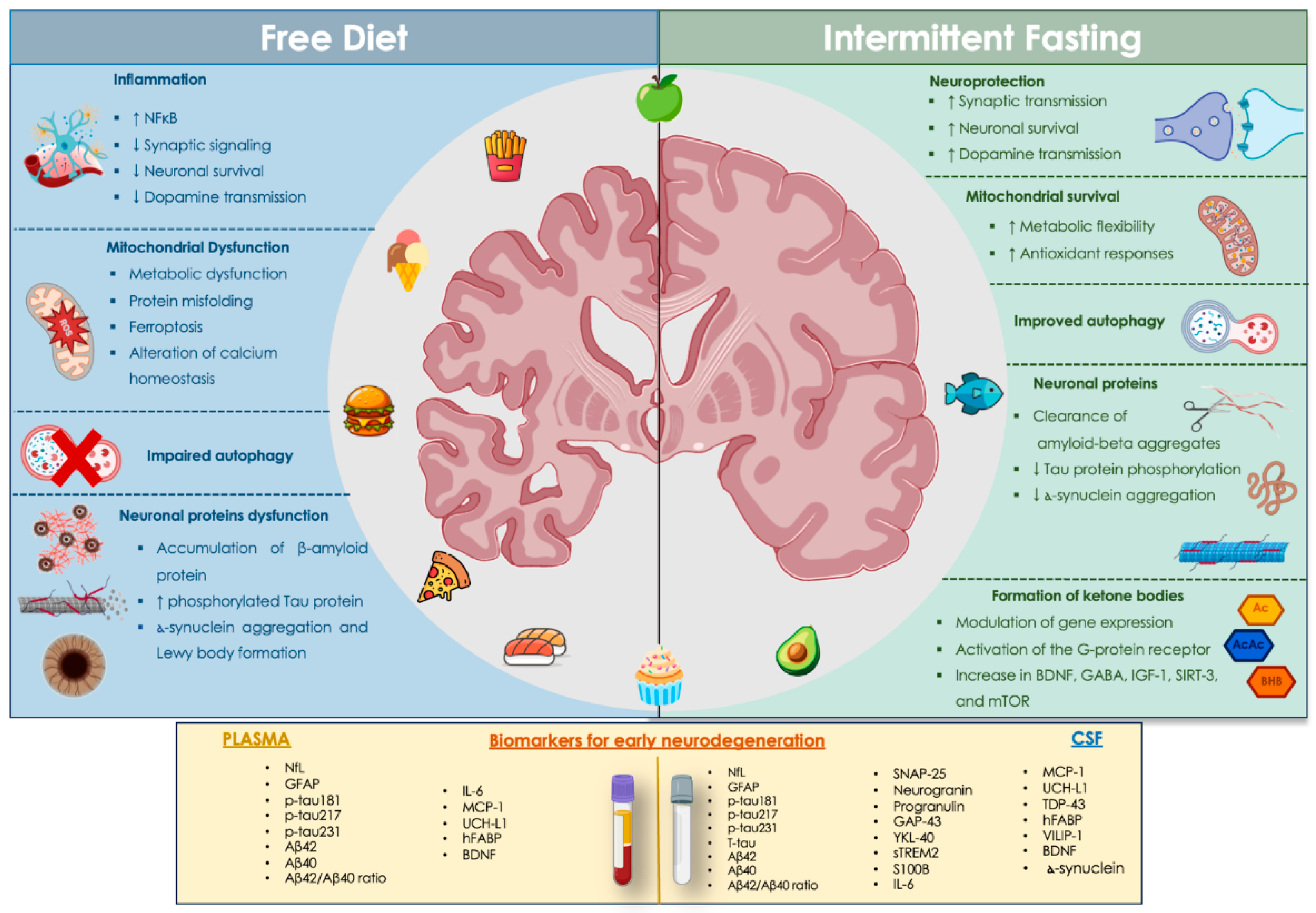
| Pathological Domain | Biomarker(s) | Biofluid(s) | Main Pathological Process Captured | Clinical/Research Use in Early Disease |
|---|---|---|---|---|
| Amyloid pathology | Aβ42 Aβ42/Aβ40 ratio | CSF, plasma | Amyloid-β production/clearance imbalance | Identification of amyloidosis; inclusion in multimarker panels for early AD diagnosis |
| Tau pathology | p-Tau181 p-Tau217 p-Tau231 | CSF, plasma | Tau phosphorylation, tangle formation, neuronal injury | Discrimination of AD vs. controls and non-AD dementias; staging along AT(N) framework |
| t-Tau | CSF | Neurodegeneration | Marker of neuronal injury and disease severity | |
| Neurodegeneration | NfL hFABP | CSF, plasma | Axonal injury and neurodegeneration | Sensitive markers of neuronal damage; prognosis and disease monitoring across AD and non-AD dementias |
| VILIP-1 | CSF | Neuronal calcium-mediated injury | Marker associated with neuronal damage and disease progression | |
| Astroglial activation | GFAP | CSF, plasma | Astrocyte reactivity and astrogliosis | Early marker of amyloid-driven astroglial response; prediction of progression in preclinical and prodromal AD |
| Synaptic dysfunction | SNAP-25 Neurogranin Progranulin GAP-43 | CSF | Synaptic loss and dysfunction | Early indication of synaptic damage; improved discrimination between controls and preclinical AD when combined with tau markers |
| BDNF | CSF, plasma | Neurotrophic signalling and synaptic plasticity | Exploratory marker of synaptic plasticity and neurotrophic support; currently less established than SNAP-25 and neurogranin | |
| Neuroinflammation | YKL-40 sTREM2 S100B | CSF | Microglial and astroglial activation, inflammatory signalling | Association with imaging measures of neurodegeneration; under evaluation for routine diagnostic use |
| IL-6 MCP-1 | CSF, plasma | Cytokine-mediated inflammatory signalling | Investigational markers of neuroinflammatory activation | |
| Proteinopathy (non-AT(N) axis) | TDP-43 | CSF (experimental) | TDP-43 protein aggregation | Emerging biomarker of TDP-43 proteinopathy; CSF detection remains experimental and assays are not yet standardised |
| Reference | Intermittent Fasting Protocol | Main Outcomes | Molecular/Biological Mechanisms |
|---|---|---|---|
| Brocchi et al., 2022 [33] | Various IF regimens (TRF, ADF) | Improved insulin sensitivity, lipid metabolism and body composition | Improved insulin signalling and mitochondrial efficiency, associated with brain energy metabolism and neuroprotection |
| Brandhorst et al., 2015 [34] | Periodic fasting-mimicking cycles | Reduced IGF-1 levels, improved metabolic markers | Enhanced cellular stress resistance, regeneration and improved cognitive performance |
| Joaquim et al., 2022 [35] | IF strategies | Improved glycaemic control and metabolic flexibility | Reduced inflammatory markers and improved metabolic regulation |
| Silva et al., 2023 [36] | Different IF regimens | Body weight reduction and improved metabolic homeostasis | Regulation of metabolic pathways associated with glucose metabolism and insulin signalling |
| Punyatoya et al., 2025 [77] | Various IF regimens | Improved glycaemic control, reduced HbA1c, weight loss and improved insulin sensitivity | Enhanced insulin signalling, reduced oxidative stress, circadian rhythm regulation and improved metabolic flexibility |
Disclaimer/Publisher’s Note: The statements, opinions and data contained in all publications are solely those of the individual author(s) and contributor(s) and not of MDPI and/or the editor(s). MDPI and/or the editor(s) disclaim responsibility for any injury to people or property resulting from any ideas, methods, instructions or products referred to in the content. |
© 2026 by the authors. Licensee MDPI, Basel, Switzerland. This article is an open access article distributed under the terms and conditions of the Creative Commons Attribution (CC BY) license.
Share and Cite
Cacciabaudo, F.; Agnello, L.; Gambino, C.M.; Accardi, G.; Masucci, A.; Tamburello, M.; Vassallo, R.; Ciaccio, M. Exploring Early Neurodegeneration Through Fasting-Induced Metabolic Signatures and High-Sensitivity Biomarkers. Curr. Issues Mol. Biol. 2026, 48, 358. https://doi.org/10.3390/cimb48040358
Cacciabaudo F, Agnello L, Gambino CM, Accardi G, Masucci A, Tamburello M, Vassallo R, Ciaccio M. Exploring Early Neurodegeneration Through Fasting-Induced Metabolic Signatures and High-Sensitivity Biomarkers. Current Issues in Molecular Biology. 2026; 48(4):358. https://doi.org/10.3390/cimb48040358
Chicago/Turabian StyleCacciabaudo, Francesco, Luisa Agnello, Caterina Maria Gambino, Giulia Accardi, Anna Masucci, Martina Tamburello, Roberta Vassallo, and Marcello Ciaccio. 2026. "Exploring Early Neurodegeneration Through Fasting-Induced Metabolic Signatures and High-Sensitivity Biomarkers" Current Issues in Molecular Biology 48, no. 4: 358. https://doi.org/10.3390/cimb48040358
APA StyleCacciabaudo, F., Agnello, L., Gambino, C. M., Accardi, G., Masucci, A., Tamburello, M., Vassallo, R., & Ciaccio, M. (2026). Exploring Early Neurodegeneration Through Fasting-Induced Metabolic Signatures and High-Sensitivity Biomarkers. Current Issues in Molecular Biology, 48(4), 358. https://doi.org/10.3390/cimb48040358