Fluoroquinolones represent the strongest and most consistent inducers of the SOS response in
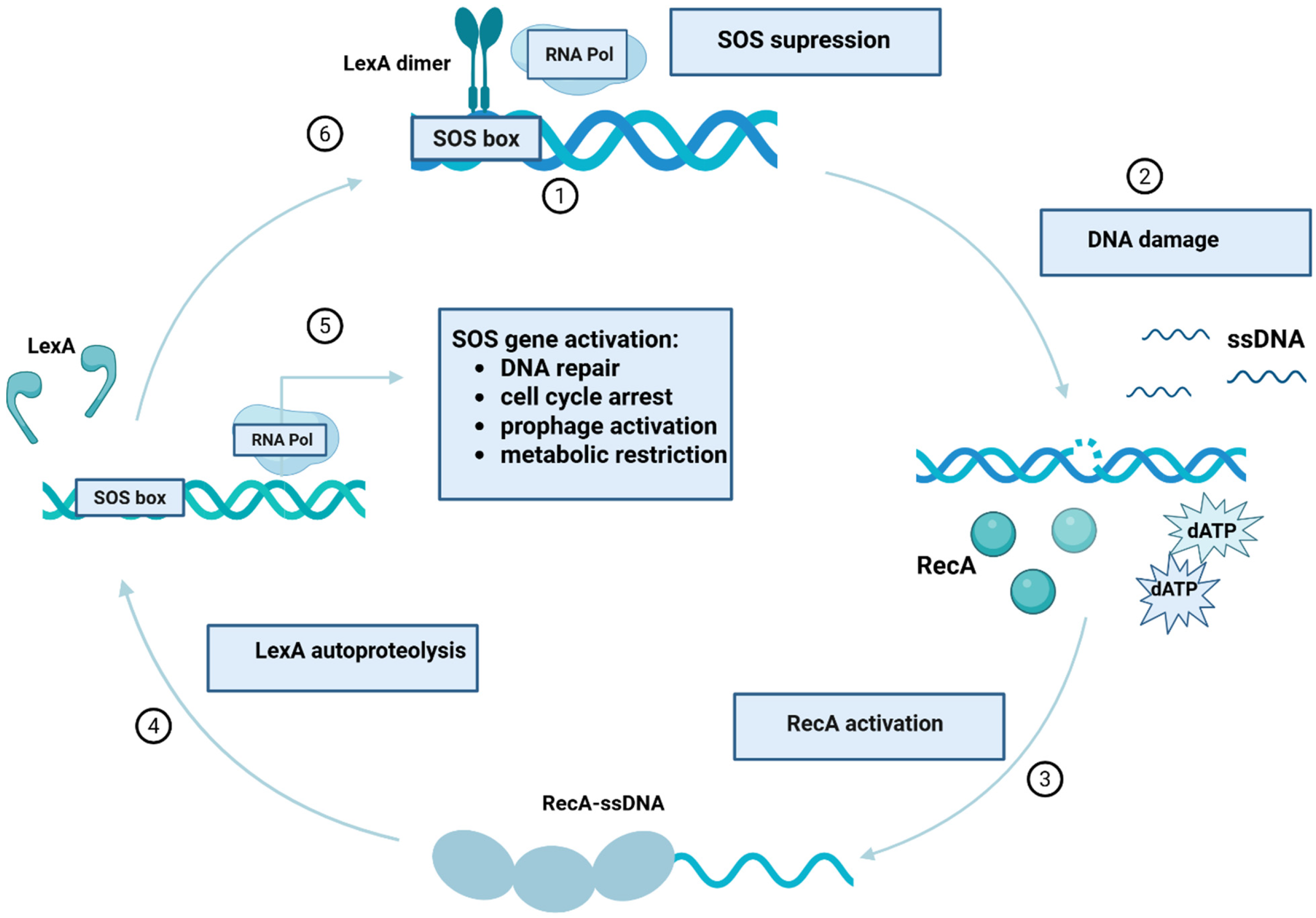
P. aeruginosa. These chemotherapeutic agents exert bactericidal activity by targeting DNA gyrase and topoisomerase IV, leading to the accumulation of enzyme-associated DNA strand breaks through the inhibition of the DNA re-ligation step of the topoisomerase reaction cycle. The resulting DNA damage constitutes a strong intracellular signal that activates RecA and initiates the SOS regulatory cascade.
Table 1 summarizes the major published studies investigating the SOS response and antibiotic-induced mutagenesis in
P. aeruginosa, including experimental models, inducing agents, and proposed molecular mechanisms. Early foundational studies provided direct evidence that the
recA gene in
P. aeruginosa is inducible by genotoxic stress, including ultraviolet irradiation and quinolone exposure, thereby establishing the existence of a functional SOS-like regulatory system in this species. The induction of
recA expression was shown to be time dependent, reaching maximal levels three hours after UV and at a norfloxacin concentration of 1 µg/mL (two-fold higher than MIC) [
23]. Notably, this induction was strictly dependent on the presence of a functional RecA protein, consistent with an autoregulatory mechanism characteristic of SOS responses.
Transcriptomic studies performed using ciprofloxacin at clinically relevant concentrations have demonstrated that the SOS response in
P. aeruginosa comprises a narrow and well-defined regulon that is markedly smaller than that described in
E. coli [
11]. Among the several thousand analyzed genes, only 15 exhibited unequivocal LexA-dependent regulation. These genes were predominantly associated with DNA repair functions, including
recA,
recN, and
recX, as well as with inducible DNA polymerases genes such as
imuB and
dnaE2. In contrast, the vast majority of transcriptional changes observed following ciprofloxacin exposure were independent of the SOS response and reflected a global suppression of core cellular processes. Notably, decreased expression was detected for genes involved in cellular respiration (
atpC,
atpD), cell division (
ftsZ,
ftsA), lipopolysaccharide biosynthesis (
wbp), DNA replication (
dnaA,
dnaN,
gyrB), and motility (
pilA). Collectively, these changes are consistent with a broad metabolic and proliferative slowdown rather than a canonical SOS-driven transcriptional program. A particularly striking feature of the ciprofloxacin-induced transcriptome was the pronounced upregulation of the transcriptional regulator PtrR and genes under its direct control. Among these,
ptrB, which encodes a negative regulator of the type III secretion system (T3SS), exhibited a robust induction, increasing by up to 166-fold. This early finding suggests that ciprofloxacin-triggered DNA damage not only affects genome maintenance pathways but also profoundly reshapes regulatory circuits linked to virulence [
11].
The impact of ciprofloxacin on the expression of
dinB, encoding a translesion synthesis (TLS) DNA polymerase potentially involved in stress-induced mutagenesis, remains less clear. While Cirz et al. reported induction of
dinB expression in response to ciprofloxacin [
11], a subsequent study by Blázquez and coworkers did not observe such induction [
24]. Importantly, these discrepancies can be largely attributed to differences in antibiotic dosage, as the dinB induction observed by Cirz et al. was detected at ciprofloxacin concentrations approximately 25 times higher than those used by Blázquez et al. in the latter study. Moreover, transcriptional analyses by Cirz et al. demonstrated that dinB is not a member of the canonical SOS regulon in
P. aeruginosa and suggested that the lack of direct LexA-dependent regulation of this gene may be common among bacterial species. This observation remains controversial, as other studies have functionally linked dinB to the SOS response [
25]. A plausible explanation is that
dinB expression is activated through indirect mechanisms that operate under conditions of severe or prolonged DNA damage, rather than through direct LexA-mediated derepression. Studies indicate that an important role in this process is played by the stress factor RpoS (σS) [
26]. These findings suggest that SOS regulation in
P. aeruginosa involves multiple regulatory layers and is considerably more complex than the well-established LexA-centered SOS mechanism described in
E. coli. Nevertheless, in addition to
dinB, ciprofloxacin exposure led to the increased expression of three genes encoding inducible DNA polymerases: PA0923 (3.7-fold induction), PA0670 (
imuB; 6.3-fold induction), and PA0669 (
dnaE2; 1.9-fold induction). PA0923 encodes a Y-family DNA polymerase homologous to DinB, whereas
imuB and
dnaE2 encode components of a polymerase complex implicated in error-prone, damage-tolerant DNA synthesis [
11]. Taken together, these transcriptomic data indicate that ciprofloxacin exposure promotes a reprogramming of DNA metabolism, shifting the cell away from canonical high-fidelity replication toward a state that permits the engagement of inducible, error-tolerant polymerases.
A subset of the analyzed studies enabled a direct comparison of cellular responses in
P. aeruginosa to β-lactam antibiotics targeting penicillin-binding proteins and to fluoroquinolones that induce DNA damage. These studies revealed pronounced qualitative and quantitative differences in SOS activation, downstream transcriptional programs, and phenotypic outcomes depending on the antibiotic class. Ceftazidime primarily inhibits PBP3, leading to defective septation, filamentation, and cell wall stress without directly damaging DNA. Importantly, the removal of ceftazidime resulted in the rapid resumption of growth, indicating that PBP3 inhibition induces a reversible adaptive state rather than irreversible cellular damage [
24]. Despite these distinct primary targets, ceftazidime was shown to activate components of the SOS response even at subinhibitory concentrations, albeit through mechanistically distinct pathways compared with fluoroquinolones. Interestingly, in this particular study, ciprofloxacin did not induce
dinB expression. However, this observation may be attributable to the relatively low antibiotic concentration used, which may have been insufficient to elicit full induction of the SOS regulon. In contrast, ceftazidime at subinhibitory concentrations leads to a more than 3-fold increase in
dinB expression after five hours [
24]. A common feature is a reduction in the expression of genes involved in global energy metabolism after exposure to both antibiotics, consistent with a broader metabolic slowdown associated with antibiotic stress. At the same time, several key differences in the global cellular response to these two antibiotics were observed. Most notably, ceftazidime attenuated the toxicity of ciprofloxacin by suppressing the expression of pyocin genes, thereby limiting a major SOS-associated cytotoxic output. Collectively, these findings underscore that the SOS response does not represent a uniform transcriptional program but rather a flexible signaling network that is integrated with other stress responses, such as cell wall damage. Accordingly, SOS activation triggered by PBP3 inhibition exhibits a fundamentally different character from that induced by fluoroquinolones. Another important distinction concerns the regulation of mobile genetic elements. Ciprofloxacin exposure led to a marked increase in the expression of prophage-related genes, transposases, and plasmid-associated functions, indicative of activation of mobile genetic elements. In contrast, ceftazidime elicited the opposite effect, repressing the expression of these genetic modules.
3.1. Role of RecA and LexA in SOS Activation and Antibiotic Susceptibility
Across all the analyzed studies, RecA emerged as an essential determinant of SOS response activation. RecA mutants consistently failed to induce SOS genes following their exposure to fluoroquinolones or other genotoxic agents, a finding confirmed at both the transcriptomic and protein levels [
20,
23]. The genetic complementation of
recA fully restored SOS inducibility, thereby demonstrating a direct and causal role of RecA in both homologous recombination (HR) and initiating the SOS regulatory cascade. Beyond its regulatory function, RecA plays a critical role in survival under fluoroquinolone stress, as recA mutant strains show both larger inhibition zones and lower ciprofloxacin MIC values [
27]. Specifically, the deletion of
recA resulted in an approximately four-fold increase in susceptibility to ciprofloxacin and ofloxacin compared with the wild-type strain [
20]. The restoration of a functional
recA allele reverted the MIC values to those observed in the parental strain, further underscoring the contribution of RecA to antibiotic tolerance. Importantly, additional studies corroborated the pivotal role of RecA in ciprofloxacin tolerance and further implicated this protein in the emergence of resistant mutants, linking SOS activation not only to short-term survival but also to the evolutionary trajectories of antibiotic resistance [
27]. It appears that
recA plays a protective role during the early phases of antibiotic exposure. In contrast, the absence of functional RecA in bacterial populations in the stationary phase does not result in detectable differences in long-term survival. Nevertheless, recA-deficient cells exhibit pronounced morphological alterations, indicating that RecA influences cellular physiology beyond its role in survival per se [
28]. These observations suggest that sustained activation of the SOS response is not a decisive determinant of long-term survival in
P. aeruginosa under antibiotic stress. Instead, the susceptibility of stationary-phase cells is likely driven by metabolic activity and the associated generation of reactive oxygen species. Consistent with this interpretation, supplementation with antioxidants has been shown to enhance bacterial survival during exposure to levofloxacin, implicating oxidative stress as a major contributor to antibiotic-mediated lethality in non-growing populations [
28].
The use of LexA variants defective in autocatalytic cleavage, such as LexA(S125A), enabled the functional separation of the SOS response from other cellular stress response pathways. These non-cleavable LexA mutants failed to induce SOS genes upon exposure to ciprofloxacin; however, their susceptibility to fluoroquinolones, as assessed by MICs, remained largely unchanged. This observation indicates that RecA plays a central role in determining cellular sensitivity to fluoroquinolones, whereas LexA, the second principal regulator of the SOS network, appears to be less critical in this context. Collectively, these findings demonstrate that canonical SOS activation is dispensable for baseline fluoroquinolone susceptibility and instead primarily contributes to stress adaptation, regulatory reprogramming, and longer-term cellular responses rather than directly mediating antibiotic lethality [
11].The lack of an effect of functional LexA on direct susceptibility to ciprofloxacin is further supported by additional studies. The absence of functional LexA was associated with a reduction in short-term cellular fitness, as wild-type strains were shown to slightly outcompete isolates carrying mutations in the
lexA gene [
29]. These findings indicate that LexA contributes to the maintenance of cellular viability on a short-term timescale, while simultaneously underscoring the complexity and multiplicity of mechanisms that collectively determine bacterial survival in the presence of antibiotics. Taken together, these observations suggest that, although the SOS response influences fitness and stress adaptation, it does not directly dictate the immediate survival of individual
P. aeruginosa cells during antibiotic exposure.
An additional level of SOS response regulation was described by Breidenstein et al., who demonstrated a critical role for the ATP-dependent Lon protease in modulating SOS activation, ciprofloxacin susceptibility, and mutagenesis in
P. aeruginosa. Mutants lacking
Lon exhibited a markedly reduced induction of the SOS regulon following exposure to ciprofloxacin. Notably,
RecA expression was approximately 2.5-fold lower in the
Lon mutant compared to the wild-type PAO1 strain [
30]. SulA, a canonical SOS-regulated cell division inhibitor controlled by the LexA repressor, represents one of the putative molecular targets of Lon, although direct evidence for this interaction in
P. aeruginosa remains limited. In addition, Lon has been proposed to indirectly influence RecA activity by modulating the stability of negative regulators such as RecX or components of the RecFOR pathway, thereby enabling full SOS activation. Consequently, the absence of Lon results in a dysregulated and functionally impaired SOS response. Taken together, these findings suggest that Lon fine-tunes the magnitude and duration of the SOS response.
3.2. Antibiotic-Induced Mutagenesis and Its Dependence on the SOS Response
Both in vitro and in vivo studies have demonstrated that exposure to fluoroquinolones results in a significant increase in mutation frequency, typically quantified by the emergence of mutants resistant to unrelated antibiotics such as rifampicin. This mutagenic effect is strongly dependent on RecA and an intact SOS response, as mutation rates are markedly reduced or completely abolished in recA-deficient strains or in strains carrying non-inducible lexA alleles [
18,
31]. In the case of
P. aeruginosa, the data are more inconsistent. Hocquet et al. demonstrated that metronidazole, at concentrations corresponding to approximately 1/80 of the MIC, increased the frequency of
P. aeruginosa mutants resistant to ciprofloxacin and amikacin through the induction of the SOS response [
32]. Although metronidazole is not clinically effective against
P. aeruginosa, its widespread use, most notably in the treatment of
Helicobacter pylori associated gastritis, results in substantial environmental exposure, particularly in hospital settings. Although these observations raise important concerns, the clinical relevance of metronidazole-induced SOS activation likely depends on local drug concentrations, microbiome composition, and treatment duration, and has not yet been fully quantified in patient populations. Transcriptomic analyses revealed the increased expression of
recA and
lexA following metronidazole exposure. Concomitantly, a significant increase in the number of ciprofloxacin-resistant (2.8-fold) and amikacin-resistant (15.4-fold) isolates was observed. In contrast, recA deletion mutants did not exhibit a comparable increase in resistance to either antibiotic [
32]. Sanders et al. indicate that relief of LexA-mediated repression does not directly translate into increased mutagenesis; instead, elevated expression of translesion synthesis (TLS) polymerases is the critical determinant of this effect [
25]. However, bacteria harboring non-functional LexA variants exhibited a significantly reduced mutation frequency following antibiotic exposure, underscoring the contribution of LexA-dependent SOS regulation to antibiotic-induced mutagenesis [
29].
The
dinB gene encodes DNA polymerase IV (Pol IV), a member of the Y-family of DNA polymerases whose expression is induced in response to DNA damage. Owing to its ability to tolerate lesions in the DNA template, Pol IV plays an important role in maintaining replication continuity under genotoxic stress conditions. The overexpression of
dinB resulted in an approximately 2.6-fold increase in the frequency of rifampicin-resistant mutants [
25]. DinB is thought to participate in relatively accurate, low-mutagenic translesion DNA synthesis across DNA adducts. Nevertheless, dinB preferentially catalyzes erroneous transversions and frameshift mutations, particularly within homopolymeric sequences [
25]. This phenomenon is clinically relevant, as similar mutations have been identified in the
mucA gene among
P. aeruginosa isolates obtained from cystic fibrosis patients [
33]. Consequently, frameshift mutations may promote bacterial adaptation, increased virulence, and the transition of infection to a chronic state. The activity of dinB likely contributes to cell survival, as mutants lacking dinB exhibit an increased sensitivity to nitrofurazone and 4-nitroquinoline-1-oxide [
25]. DinB appears to participate in relatively accurate, low-mutagenic TLS, and thus protects cells from death following exposure to genotoxic agents, without leading to a significant increase in mutation frequency. Nevertheless, Fahey et al. demonstrated that the number of ciprofloxacin-resistant mutants was significantly reduced in strains carrying a mutation in the
dinB gene, whereas the restoration of a functional copy of this gene resulted in an increased mutation frequency. Mutations conferring resistance to ciprofloxacin appear to arise through a complex pathway involving both the activation of the SOS response and engagement of global stress response mechanisms. Moreover, dinB and another inducible translesion DNA polymerase, ImuC, seem to function in a coordinated manner. The decrease in mutagenesis observed in
dinB deletion strains was not compensated by overexpression of the imuBC operon. Similarly, the reduced mutation frequency in
imuC mutant strains was not restored by
dinB overexpression. In contrast, in
imuB deletion strains, the overexpression of
dinB led only to a partial restoration of mutagenic activity [
26].
At the same time, detailed mechanistic studies have demonstrated that fluoroquinolone-induced mutagenesis does not always require the involvement of classical error-prone DNA polymerases. In one pivotal study, deletion of
dinB,
polB, and
imuC, either individually or in combination, did not abolish ciprofloxacin-induced mutagenesis. Furthermore, the mutation of
recA also failed to affect the frequency of antibiotic-induced mutations [
20]. Nonetheless, important methodological differences between the studies may have influenced the observed outcomes. In particular, the concentration of the antibiotic used was a critical factor. The subinhibitory concentration applied in the study by Mercolino et al. [
20] may have been insufficient to generate resistant mutants, whereas higher concentrations, such as those used by Fahey et al. [
26], revealed a significant dependence of mutagenesis on SOS system activation and the induction of TLS polymerases. The type of antibiotic used for mutagenesis induction is also of key importance. Metronidazole, whose active metabolites bind directly to DNA, markedly increased the frequency of resistant colonies [
32]. In contrast, exposure to fluoroquinolones, which disrupt the replication machinery, may additionally activate alternative alarm response pathways [
26]. Nevertheless, the study by Mercolino et al. provides evidence that, in
P. aeruginosa, mutagenesis may proceed via an alternative mechanism independent of RecA and classical SOS induction. The involvement of additional mechanisms in the response to genotoxic stress is further supported by the findings of Fahey et al. A crucial role has been attributed to the general stress response sigma factor RpoS, as the number of mutants was significantly reduced in strains deficient in this regulator. Notably, this reduction was compensated by
dinB overexpression, suggesting that the regulation of DinB is complex and depends on both SOS activation and the global stress response [
26]. Other antibiotics, such as ceftazidime, have also been shown to contribute to SOS response activation and increased mutation frequency. A five-hour exposure to ceftazidime at a concentration corresponding to two-fold MIC resulted in nearly a five-fold increase in the number of resistant mutants [
24]. Nevertheless, the profile of SOS activation varies depending on the nature of the stress-inducing agent. The available literature data challenge the direct extrapolation of the classical SOS response model established in
E. coli to
P. aeruginosa and instead point to the existence of alternative, species-specific mechanisms of genetic variability generation. Moreover, evolutionary studies indicate that SOS-induced mutagenesis is more likely a by-product than the primary adaptive function of this system. In this context, SOS activation does not appear to accelerate the evolution of antibiotic resistance, as long-term analyses spanning approximately 200 successive bacterial generations revealed no correlation between SOS-induced mutagenesis and the degree of adaptation to ciprofloxacin [
29]. Studies also indicate the presence of key genetic differences that may underlie the distinct ciprofloxacin susceptibility profiles of clinical isolates compared with reference strains, as well as differences in mutation frequency. Clinical isolates were shown to exhibit a lower mutagenic potential despite ciprofloxacin exposure when compared with the reference strain PA14. Notably, the highest number of functional alterations was identified in the
imuB and
recX genes, both of which are regulated by RecA [
21]. Moreover, the Lon protease appears to regulate antibiotic-induced mutagenesis. A strain carrying a mutation in the
lon gene almost completely lost the ability to undergo ciprofloxacin-induced mutagenesis, whereas the complementation of the gene restored the observed phenotype [
30].
3.3. Antibiotics as Indirect Modulators of Mutagenesis
A key conclusion drawn from the reviewed studies is that antibiotics lacking direct activity against
P. aeruginosa may nevertheless indirectly induce the SOS response and promote the emergence of antibiotic resistance. Metronidazole, despite its lack of bactericidal activity against this species, was shown to induce
recA and
lexA expression, resulting in a significant increase in the frequency of mutants resistant to ciprofloxacin and amikacin. This effect was entirely dependent on RecA and was absent in
recA deletion mutants [
32]. Similarly, a clinical study provided evidence that antibiotic therapy administered in vivo can activate the SOS response and drive class 1 integron rearrangements, leading to the expression of previously silent resistance genes [
34]. The removal of the integron cassette repressing blaOXA28 expression occurred exclusively under conditions of an active SOS response, with effects observed in vivo and confirmed by in vitro analyses. SOS-dependent integron activation resulted in expression of the gene encoding the OXA-28 β-lactamase, ultimately leading to the development of resistance to ceftazidime.
It was also demonstrated that amikacin applied at subinhibitory concentrations significantly attenuated SOS activation. Its administration resulted in more than a two-fold reduction in
recA expression and almost complete suppression of ciprofloxacin-induced mutagenesis [
27]. These findings indicate that combination therapy may substantially limit the evolutionary trajectory toward resistance. This conclusion is supported by studies examining the combined use of ciprofloxacin and meropenem, a β-lactam antibiotic, in the context of MDR strains. Concurrent exposure to both agents at concentrations corresponding to 0.5 × MIC led to decreased
lexA expression. Importantly, from a clinical resistance perspective, this combination also reduced the expression of
ampC and
oprD, genes directly associated with antibiotic resistance [
35]. Thus, combination therapy may weaken bacterial protective systems.
Clinically relevant observations were also obtained from studies employing
P. aeruginosa isolates derived from cystic fibrosis patients. Prolonged incubation in the presence of subinhibitory antibiotic concentrations resulted in a significant reduction in susceptibility in approximately 22% of clinical isolates. This phenotypic shift was accompanied by genetic alterations, including mutations in genes encoding efflux pump regulators (
mexR,
mexZ,
mexS, and
nalC) as well as in
fusA1, a gene associated with aminoglycoside resistance [
36].
Collectively, these findings provide important insights into the determinants of antibiotic treatment efficacy and underscore the critical importance of achieving sufficiently high drug concentrations at the site of infection. Subinhibitory antibiotic exposure selects for a non-classical spectrum of resistance-associated mutations, and the selective mechanisms operating under these conditions differ fundamentally from those observed at higher antibiotic doses.
3.4. The SOS Response and Biofilm Formation, Tolerance, and Virulence
Several studies have demonstrated that the activation of the SOS response affects not only mutagenesis but also the phenotypic traits of bacterial populations, including biofilm formation and virulence. Subinhibitory concentrations of ciprofloxacin were shown to stimulate biofilm development in an LexA-dependent manner and were associated with increased cellular motility [
37]. LexA functions as a negative regulator of motility; therefore, its autocatalytic cleavage, a hallmark event during SOS regulon activation, is essential for flagellar activity and surface colonization. In strains with an impaired SOS response, antibiotic-induced biofilm formation was not observed, and the synthesis of flagella-associated proteins was significantly reduced [
37]. This study indicates that the SOS response acts as a key regulator of DNA damage–induced biofilm formation, and that maintenance of proper cellular motility, which is dependent on an intact SOS system, is critical during the early stages of biofilm development.
The activation of the SOS response also resulted in the increased production of outer membrane vesicles (OMVs). Importantly, OMV-producing bacteria exhibit significantly enhanced cytotoxicity toward host cells. This effect was partially LexA dependent, indicating a direct link between the genotoxic stress response and the modulation of bacterial pathogenicity [
38]. The dependence of OMV production on SOS activation was further supported indirectly by studies examining the combined use of subinhibitory concentrations of ciprofloxacin and meropenem. This combination attenuated alarm response activation and concomitantly reduced OMV production [
35].
Importantly, the relationship between SOS activation and virulence in
P. aeruginosa appears to be antibiotic specific. A key divergence between β-lactams and fluoroquinolones has been observed in the regulation of pyocin synthesis. Pyocins are bacteriocins produced by
Pseudomonas species that function as narrow-spectrum protein toxins targeting closely related bacterial strains. They are typically released in an SOS-dependent manner and often cause producer cell lysis, making their production a potent yet self-destructive competitive strategy. Through the selective killing of competing bacteria, pyocins contribute to niche dominance, population structuring, and virulence in polymicrobial environments. The exposure to fluoroquinolones results in the strong induction of pyocin operons, leading to increased cell lysis and enhanced bactericidal activity at the population level. In contrast, treatment with ceftazidime causes pronounced repression of pyocin genes despite the partial activation of the SOS response [
24]. Functional assays demonstrated that such repression, related to PBP3 inhibition, reduced pyocin-mediated killing and antagonized ciprofloxacin-induced toxicity during combination therapy. This effect was dependent on intact pyocin loci and was absent in pyocin-deficient mutants, confirming that the antibiotic-specific modulation of SOS outputs directly influences cell death pathways [
24]. In the context of
P. aeruginosa virulence, the regulation of pyocin production represents a classical “double-edged sword” strategy—effective in eliminating competing bacteria but ultimately leading to lysis of the producer cell. Such lysis is accompanied by the release of additional toxins, metabolites, and extracellular DNA, which may exacerbate host inflammation and contribute to tissue damage. Pyocin production in
P. aeruginosa is tightly controlled by the PrtR–PrtN regulatory system, which is functionally linked to the SOS response. Under genotoxic stress, the activation of RecA triggers proteolytic cleavage of the PrtR repressor, resulting in the derepression of the prtN gene. PrtN, acting as a transcriptional activator, initiates expression of pyocin biosynthesis genes, ultimately leading to lysis of the producer cell and release of the toxins.
However, exposure to ciprofloxacin reveals an additional, parallel layer of regulation. In addition to inducing the SOS response and promoting PrtR degradation, ciprofloxacin increases PrtR expression. Elevated PrtR levels enable the partial re-establishment of prtN repression even under conditions of active SOS signaling. As a result, a dynamic balance emerges between derepression and the secondary inhibition of the pyocin pathway. Consequently, the bacterial population retains the ability to eliminate competitors through localized pyocin production while minimizing the biological cost associated with loss of toxin-producing cells. The analysis of clinical strains revealed increased pyocin production compared with the reference strain PA14, which may partially account for the greater susceptibility of these isolates to ciprofloxacin [
21]. Moreover, the ATP-dependent protease Lon has emerged as another crucial regulator of pyocin synthesis. Strains lacking the
lon gene exhibit deregulation of the RecA/PrtR/PrtN regulatory axis, which results in a marked reduction in pyocin production [
30]. Importantly, Lon is not required for SOS induction per se, but rather for the proper execution and coordination of SOS-dependent pathways. Although the downregulation of RecA-controlled pyocin genes in a lon mutant would theoretically be expected to decrease susceptibility to ciprofloxacin, the observed hypersensitivity of these strains indicates that Lon is essential for effective SOS-mediated stress adaptation beyond pyocin regulation alone.
Concurrently, PrtR plays a second yet equally important role in virulence regulation, as it is required for expression of the type III secretion system (T3SS). PrtR acts indirectly by repressing
ptrB, a gene encoding a T3SS inhibitor. Consequently, the degradation of PrtR under conditions of strong SOS activation also leads to the deregulation of T3SS, a critical effector of acute virulence and bacterial-mediated neutrophil killing. The functional consequence of this autoregulatory circuit is the maintenance of a balance between virulence and cell survival. Stable PrtR levels allow for sustained T3SS activity within the host environment, facilitating colonization and immune cell elimination, while simultaneously limiting excessive pyocin production and associated cell lysis. Under ciprofloxacin exposure, this mechanism additionally promotes increased bacterial tolerance, particularly within biofilms, by suppressing the suicidal pyocin response [
39]. In this framework, PrtR emerges not as a simple component of the SOS cascade but as a central regulator of stress homeostasis, integrating genotoxic signals, host immune responses, and virulence regulation. This mechanism enables
P. aeruginosa to maintain pathogenic potential under conditions of oxidative stress and fluoroquinolone exposure while minimizing the biological costs associated with uncontrolled SOS activation and excessive bacteriocin production. Moreover, PrtR enhances biofilms’ tolerance to ciprofloxacin, as both prtR overexpression and prtN deletion significantly increased cell survival within biofilms. These data demonstrate that ciprofloxacin-induced biofilm loss is not a direct consequence of antibiotic exposure but rather results from pyocin-dependent cell lysis, which can be attenuated by the PrtR-mediated, SOS-dependent repression of the pyocin pathway [
39]. Studies have demonstrated that the SOS response is not overexpressed in biofilms. Instead, the increased tolerance of biofilms to ciprofloxacin appears to be driven by enhanced expression of the hypoxia-associated anr regulon, genes involved in osmotic stress responses, and components of quorum-sensing pathways. In addition, bacteria growing in the biofilm state exhibit significantly elevated expression of the global stress response regulator rpoS [
40]. These findings indicate that antibiotic tolerance of
P. aeruginosa biofilms, particularly to ciprofloxacin, results from overlapping stress responses associated with hypoxia and starvation rather than from classical resistance mechanisms.
3.6. Antibiotic- and Stress-Induced Modulation of the SOS Response
Although fluoroquinolones represent the most extensively studied inducers of the SOS response in
P. aeruginosa, the studies summarized in
Table 1 demonstrate that SOS signaling can be influenced by a broader range of antibiotics and environmental stressors. These include agents with distinct primary targets, such as β-lactams (e.g., ceftazidime), aminoglycosides (e.g., amikacin), carbapenems (e.g., meropenem), and even antibiotics that do not exhibit direct antibacterial activity against
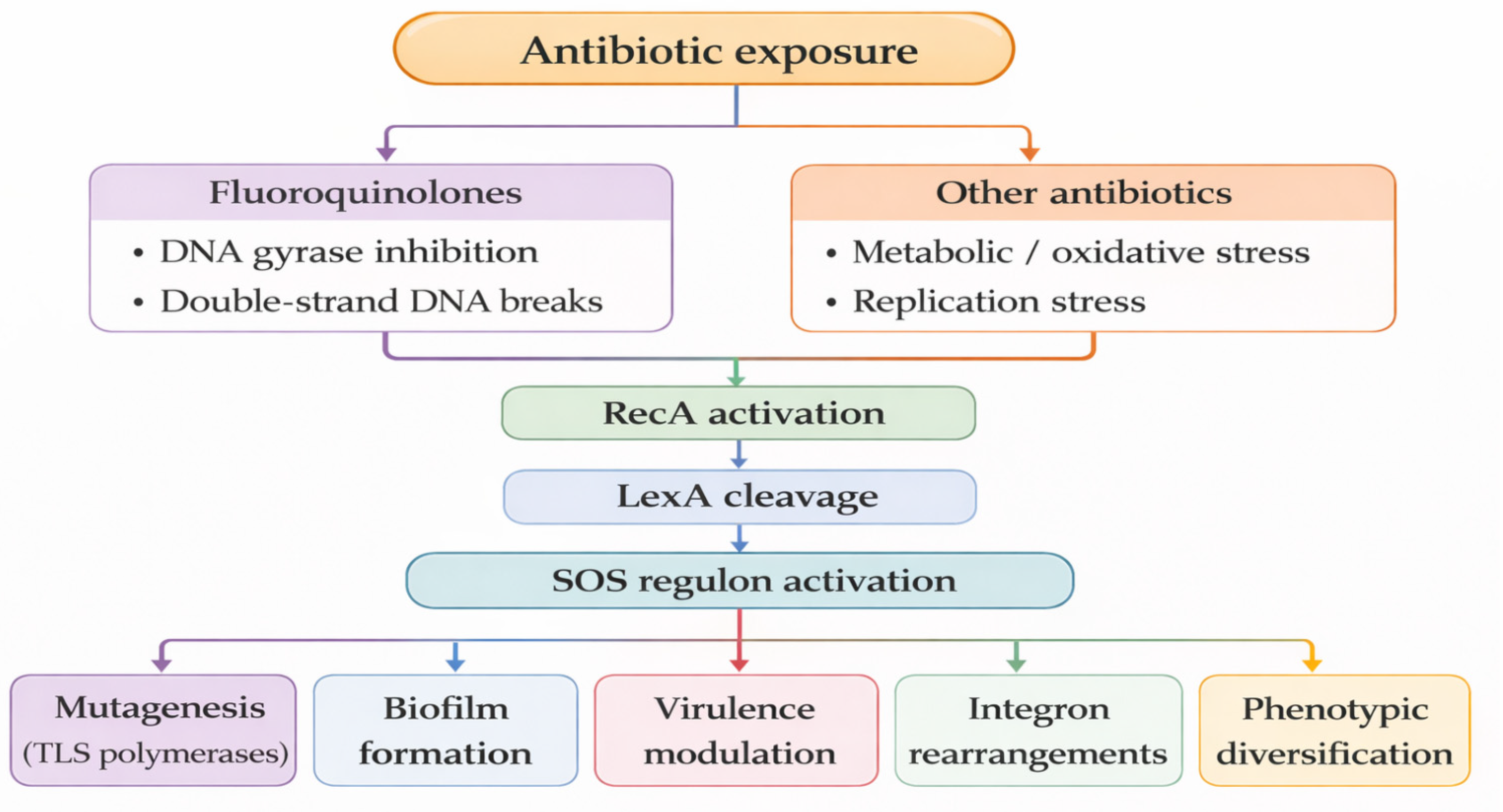
P. aeruginosa, such as metronidazole. Despite their different mechanisms of action, these agents may modulate the SOS network through indirect stress pathways, including oxidative stress, metabolic perturbation, or disruption of DNA replication processes [
24,
27,
32,
35].
Importantly, the studies collected in
Table 1 indicate that the interaction between antibiotic exposure and SOS signaling is not uniform but may produce several distinct outcomes. In some cases, antibiotic exposure directly induces SOS activation and increases mutation frequency, as observed for fluoroquinolones or metronidazole [
20,
32]. In other situations, antibiotics primarily modulate the magnitude or consequences of SOS activation without necessarily increasing mutagenesis. For example, combination therapies involving aminoglycosides or carbapenems may suppress SOS-associated mutagenesis or alter the transcription of key regulatory genes such as
recA or
lexA [
27,
35]. These findings highlight that antibiotic interactions with the SOS network may either promote or attenuate stress-induced genetic variability.
The data summarized in
Table 1 also illustrate that SOS signaling in
P. aeruginosa is closely integrated with other stress response pathways and physiological processes. The activation of the SOS system may influence diverse phenotypes, including virulence regulation, biofilm formation, membrane vesiculation, and stress adaptation mechanisms mediated by regulators such as RpoS or Lon [
26,
30,
37,
38]. In addition, SOS activation may occur in response to non-antibiotic stressors, such as ultraviolet radiation or chemical DNA-damaging agents, further emphasizing the role of this regulatory network as a general genomic stress response.
Taken together, the available evidence demonstrates that the SOS response in P. aeruginosa should not be viewed solely as a reaction to fluoroquinolone-induced DNA damage. Instead, it represents a broader and highly context-dependent regulatory system that integrates signals from diverse antibiotic classes and environmental stressors, ultimately shaping bacterial adaptation, mutagenesis, and phenotypic plasticity.
Table 1.
Antibiotic- and stress-induced SOS responses in Pseudomonas aeruginosa.
Table 1.
Antibiotic- and stress-induced SOS responses in Pseudomonas aeruginosa.
| Antibiotic/Stress | Experimental Model | SOS Activation | Mutagenesis | Key Mechanistic Insight | Ref. |
|---|
| NOR/UV | PAO (RecA+/RecA−) | Yes | ND | RecA autoregulation; first evidence of inducible SOS stress response | [23] |
| CIP (8× MIC) | PAO1, lexA(S125A) | Yes | ND | Narrow LexA regulon (~15 genes); LexA does not determine MIC but contributes to adaptive potential | [11] |
| CIP (sub-MIC) | PAO1 vs. lexA(S125A) | Yes | ND | SOS increases fitness but does not accelerate resistance evolution | [29] |
| CIP | PAO1 ΔdinB ΔimuBC ΔrpoS | Yes | Yes | Cooperation between SOS and RpoS; polygenic mutagenesis | [26] |
| FQs | PAO1 ΔrecA ΔTLS | Yes | Yes | SOS-independent mutagenesis challenges canonical E. coli model | [20] |
UV, NFZ,
4-NQO | PAO1 ΔdinB | Yes | Yes | DinB mediates frameshifts and transversions; dual protective and mutagenic role | [25] |
| MET (1/80 MIC) | PA14 ΔrecA | Yes | Yes | RecA-dependent mutagenesis; indirect induction of resistance to CIP and AMI | [32] |
| CIP (sub-MIC) | PA14 vs. CF isolates | Yes | Yes | Clinical isolates show distinct mutation patterns (imuB, recX, and pyocin genes) | [21] |
| MET/CAZ | MDR clinical isolates | Yes | Yes | Integron activation (intI1); clinically relevant resistance emergence | [34] |
| CIP + AMI | PAO1, RecA mutant | Yes | Yes | AMI suppresses recA expression and reduces mutagenesis | [27] |
| CIP + MER (sub-MIC) | MDR isolates | Yes | ND | Repression of lexA expression and reduced OMV production | [35] |
| CIP | PAK ΔprtR, ΔprtN, ΔprtR | Yes | ND | PrtR-dependent regulation balances virulence and survival | [39] |
| CIP/TOB | PAO1 | Yes (not essential) | ND | Tolerance linked to hypoxia stress, RpoS and stationary phase physiology | [40] |
| sub-MIC CIP | PAO1 vs. LexAN | Yes | ND | LexA regulates motility; promotes biofilm initiation | [37] |
| CIP | PAO1 vs. LexAN | Yes | ND | Increased OMV production; SOS modulates virulence | [38] |
| CIP | PAO1 Δlon | Yes | Yes | Lon protease regulates SOS activation and mutagenesis | [30] |
| LVX | PAO1 ΔrecA | ND | ND | Survival determined by oxidative stress rather than SOS activation | [28] |
| LVX | PAO1, PA14 | No | ND | Persister survival depends on avoidance of DNA double-strand breaks | [41] |
| CIP vs. CAZ | PAO1 | Yes | ND | β-lactams modulate fluoroquinolone toxicity via stress-dependent SOS branches | [24] |
| CIP, TOB, CAZ, MER (sub-MIC) | PAO1, PA14, CF isolates | ND | Yes | Sub-MIC exposure promotes resistance-associated mutations | [36] |