Article

Expression of Endonuclease RsaI Induces Chromosomal Rearrangement in the Yeast Kluyveromyces marxianus

by
Babiker M. A. Abdel-Banat
1,*,
Muhammad Munir
1,
Hisashi Hoshida
2,3 and
Rinji Akada
2,3
1
Date Palm Research Center of Excellence, King Faisal University, Al-Ahsa 31982, Saudi Arabia
2
Division of Applied Chemistry, Graduate School of Science and Technology for Innovation, Yamaguchi University, 2-16-1 Tokiwadai, Ube 755-8611, Japan
3
Research Center for Thermotolerant Microbial Resources, Yamaguchi University, 1677-1 Yoshida, Yamaguchi 753-8315, Japan
*
Author to whom correspondence should be addressed.
Curr. Issues Mol. Biol. 2026, 48(3), 252; https://doi.org/10.3390/cimb48030252
Submission received: 1 February 2026 / Revised: 22 February 2026 / Accepted: 24 February 2026 / Published: 26 February 2026
(This article belongs to the Collection Feature Papers Collection in Molecular Microbiology)

Abstract

DNA double-strand breaks (DSBs) are primarily repaired in eukaryotic cells through two pathways: homologous recombination (HR) and non-homologous end joining (NHEJ). The thermotolerant yeast Kluyveromyces marxianus is recognized for its highly active NHEJ pathway, making it a suitable model organism for studying the role of NHEJ in DSB repair. To induce DSBs in K. marxianus DMKU3-1042, an expression cassette containing the gene encoding the endonuclease RsaI was integrated into the LYS1 locus of both the wild-type and NHEJ-deficient KU70 mutant strains. This cassette is regulated by the galactose-inducible promoter GAL10. Cells expressing RsaI and grown in galactose medium exhibited an elongated, rod-shaped morphology under a microscope. Following RsaI expression, the viability of transformed KU70 cells decreased during the first three hours of culture in liquid medium and then partially recovered after six hours of incubation. In contrast, the KU70 mutant cells failed to produce viable survivors. Pulsed-field gel electrophoresis analysis revealed distinct chromosomal separation patterns among various RsaI-transformed KU70 cells. These findings demonstrate that the repair of RsaI-induced DSBs in K. marxianus DMKU3-1042 results in new strains with several forms of rearranged chromosomes.

1. Introduction

Genomic alterations in yeast cells can occur spontaneously or be induced by external factors [1]. Such alterations include point mutations, chromosomal rearrangements (such as large deletions, duplications, inversions, and translocations), and whole-chromosome aneuploidy. Structural chromosomal rearrangements are alterations in chromosome structure that involve the exchange of large segments of DNA. These rearrangements can have significant effects on gene function and genome stability. The primary mechanisms underlying structural chromosomal rearrangements include DNA double-strand breaks (DSBs), defective DNA repair mechanisms, aberrant recombination events, and chromothripsis [2,3], a mutational pattern in which a large number of rearrangements are confined to local regions, often accompanied by copy-number losses [4]. These chromosomal fragments are then incorrectly reassembled simultaneously, rather than accumulating chromosomal rearrangements gradually over many generations [3]. This process is driven by errors during mitosis, which generate abnormal nuclear structures that lead to extensive but localized fragmentation of mis-segregated chromosomes [5]. These structural chromosomal rearrangements are often associated with specific genomic architectural features that can lead to genetic instability [6]. DSBs are among the most detrimental types of DNA damage, leading to genome instability, apoptosis, or cell senescence if not correctly repaired [7,8,9,10,11,12]. Nevertheless, in some instances, these genomic rearrangements can yield mutant strains capable of growing under highly acidic conditions (pH 1.8) in the non-conventional yeast Candida utilis, via direct nuclease transfection [13].
In eukaryotes, DNA repair primarily occurs through non-homologous end joining (NHEJ) or homologous recombination (HR) to maintain genome integrity [14]. The process proceeds through a cascade of events in which DNA damage sensors, transducers, and effectors detect and rejoin the broken ends of chromosomes [14,15]. HR depends on a considerable homology between the damaged DNA and an undamaged partner on a sister chromatid or a homologous chromosome [16,17]. HR requires proteins of the modifier gene group RAD52 (RAD52, RAD51, RAD54, and RAD55/57), in addition to several nucleases and helicases [18,19,20]. Moreover, the NHEJ repair pathway requires little or no homology between the joining DNA [14] and the proteins Ku70, Ku80, and Lig4 [21].
Defects in the repair of conserved DNA pathways may lead to cell death or chromosomal rearrangements such as translocations, duplications, deletions, inversions, and the formation of rearranged chromosomes [22,23,24]. Extrachromosomal circular DNA (eccDNA) is one form of chromosomal rearrangement found in cancer genomes and multiple genetic diseases [23,25,26]. Chromosomal rearrangements also play a role in phenotypic divergence and environmental adaptation, as evidenced in some organisms such as Plasmodium falciparum [27], Candida albicans [28], Drosophila S2 cells [29], and Saccharomyces cerevisiae [30].
The consequences of DSB repair have been extensively studied in model organisms such as S. cerevisiae [31]; however, limited information is available on how these processes impact the chromosomal integrity of Kluyveromyces marxianus (Km). The main advantage of K. marxianus is its robust NHEJ activity compared to the yeast S. cerevisiae [32,33]. Using this characteristic, K. marxianus randomly integrates linear DNA into its chromosomes. This feature enabled the identification of auxotrophic mutant genes, obviating plasmid construction in Escherichia coli [32,33]. In addition, this yeast can generate circular plasmid DNA when the heterologous DNA contains the innate autonomously replicating sequence (KmARS), which aided in constructing plasmids harboring various selection markers and recombinant DNAs [34,35]. A study on KmARS point mutations, deletions, and nucleotide substitutions was also performed using this robust NHEJ activity in K. marxianus, which resulted in the identification of the smallest sequence that functions as an ARS in K. marxianus. The sequences from different KmARSs were found to be interchangeable, enabling robust autonomous replication [36]. Using CRISPR-Cas9-induced chromosome breaks, a multigene integration tool was developed in K. marxianus via its highly active NHEJ pathway, resulting in enhanced 2-phenylethanol biosynthesis [37]. These characteristics of K. marxianus suggest that this yeast is a suitable model organism for investigating the role of the NHEJ pathway in the repair outcomes of DSBs.
In this study, we aim to explore the effect of induction of the blunt-end restriction enzyme RsaI that recognizes the GT/AC sequence and whether the induced widespread DSBs could be repaired by the highly active NHEJ pathway in K. marxianus to generate diverse and viable chromosomal rearrangements, in addition to determining whether this process will be impaired in a ku70Δ background.

2. Materials and Methods

2.1. Strains and Culture Media

The yeast strains used in this study are listed in Table 1. YPD medium (1% yeast extract, 2% peptone, and 2% glucose) and minimal medium (MM; 0.17% yeast nitrogen base without amino acids and ammonium sulfate, 0.5% ammonium sulfate, and 2% glucose) were prepared following a previously described method [38]. YPGal medium contains 1% yeast extract, 2% polypeptone, and 4% galactose. The dropout MM-U contains [adenine sulfate, L-tryptophan, L-histidine HCl, L-methionine, L-leucine, and L-lysine HCl] and lacks uracil [39]. MM-Leu and MM-Lys are dropout MM-U media that lack L-leucine and L-lysine, respectively. To prepare a 5-fluoroorotic acid (FOA) medium, 50 mg/L of uracil and 2% agar were added to the MM-U (MM-U + uracil) medium, autoclaved, and subsequently maintained at 65 °C in a water bath. FOA was dissolved in dimethyl sulfoxide (DMSO) at 100 mg/mL and then added to autoclaved MM-U + uracil medium to achieve a final FOA concentration of 1 mg/mL [40]. For the preparation of solid plates, 2% agar was added.

2.2. Construction of Yeast Strains Expressing RsaI

A construct containing the gene for the restriction enzyme RsaI was designed for expression in K. marxianus under the control of the GAL10 promoter (PGAL10). The activity of this promoter is tightly regulated by the induction of galactose in K. marxianus. The yeast S. cerevisiae strain RAK3940 (Table 1) was used as a transformation host to replace the construct PGAL10-yEGFP-15C-PpHIS3. S. cerevisiae strain RAK5331 with a fusion construct of PGAL10-RsaI-URA3 was obtained. The fusion construct PGAL10-RsaI-URA3 was amplified from the S. cerevisiae strain RAK5331 using the previously described fusion PCR method [42,44]. KmLYS1 homologous sequences (1 kb) were attached to both ends of the fusion construct [KmLYS1-PGAL10-RsaI-URA3-KmLYS1] and amplified using the primers KmLYS1URA3-1000: (5′-AATGGCTCCCACATTGCTGTTGGGTTATTG-3′) and KmLYS1URA3-1000c: (5′-AGATTGATATATCTAGTACTACCGAAA-3′). Thereafter, the fusion construct was targeted at the LYS1 locus of the Km Ku70+ and Km Ku70 strains using the Km-targeted gene integration method [33,45], as explained below in the section “2.3 Km transformation”. The resulting transformant strains were RAK5551, which retained the intact KmKU70 gene, and RAK5332, which lacked the KmKU70 gene (Table 1). The K. marxianus ACT1 gene was amplified as a reference gene for PCR amplification using primers KmACT1 + 16 (5′-GCAGAGGTCGCTGCTTTAGTTATTG-3′) and KmACT + 1111c (5′-ATGGACCAGATTCGTCGTATTCTTG-3′). The sequence of the fusion construct [KmLYS1-PGAL10-RsaI-URA3-KmLYS1] is shown in Supplementary Figure S1.

2.3. Km Transformation

The transformation mixture (TM) consists of the following components in final concentrations in sterilized distilled water: 40% w/v polyethylene glycol 3350 (PEG), 200 mM lithium acetate (LiAc), and 100 mM dithiothreitol (DTT). Single-stranded carrier DNA was added to the transformation reaction at a final concentration of 1 mg/mL in TM [33]. K. marxianus cells were grown overnight in YPD, diluted 1:10 in 18 mL of fresh YPD, and allowed to grow for 5 h at 28 °C with vigorous shaking. The cells at the log phase were centrifuged, washed once with 500 μL of TM, and immediately suspended in 180 μL of TM. The cell suspension (85 μL) was transferred into a new 1.5 mL tube and mixed with 10 μL of 10 mg/mL denatured carrier DNA and 5 μL of purified PCR-fusion DNA (KmLYS1-PGAL10-RsaI-URA3-KmLYS1). The URA3 gene from S. cerevisiae (ScURA3) with flanking 1 kb KmLYS1 homologous sequences (KmLYS1-URA3-KmLYS1) was also transformed as a control. The mixture was vortexed for 30 seconds, incubated at 42 °C for 40 min, and then spread onto the required selection/dropout plates. The plates were incubated at 28 °C for 2–3 days.

2.4. Measurement of Yeast Viability Under RsaI Restriction Enzyme Expression

The wild-type strain DMKU3-1042 of K. marxianus and the strains expressing the restriction enzyme RsaI (RAK5551 and RAK5332) were cultured in deep-bottomed Petri dishes containing 5 mL of YPD and incubated for 18 h at 28 °C with vigorous shaking at 150 rpm. All strains exhibit normal growth under the non-inductive medium (YPD). The yeast cultures were transferred to 15 mL Falcon tubes and centrifuged at 6400 RCF for 3 min, and the supernatant was discarded. The cell pellets were washed twice with 5 mL of sterile deionized water (SDW) and resuspended in 5 mL of SDW. The suspended cells’ optical density (OD600) was measured using a WPA CO 8000 cell density meter (Biochrom Ltd., Cambridge, UK). The samples were prepared in a 15 mL tube by diluting them with sterilized deionized water to achieve an optical density (OD600) of 2. Five milliliters from each of the three strains was added to Erlenmeyer flasks containing 2× YPD medium, resulting in a total volume of 10 mL. Similarly, 5 mL from each of the three strains was added to flasks containing 5 mL of 2× YPGal medium, resulting in a total volume of 10 mL. The flasks were incubated in a rotary shaker at 37 °C with vigorous shaking. Samples were taken at 3 h intervals. On each occasion, 100 μL of the sample was transferred into a chilled 1.5 mL tube containing 900 μL of sterile deionized water. DMKU3-1042, RAK5551, and RAK5332 strains cultured in YPGal medium were diluted to the same concentrations. An aliquot of 300 μL from each sample was plated onto YPD solid medium. The YPD plates were subsequently incubated for two days at 28 °C.
The colonies that had grown on the YPD solid medium were counted. The percentages of viable RAK5551 and RAK5332 strains over time were calculated as units per milliliter for each time point, after culturing the strains in YPGal medium with vigorous shaking. Three biological replicates were conducted for each test.

2.5. Microscopic Observation of Cells

The strain RAK5551 was cultured in YPGal with vigorous shaking for 6 h. An aliquot of 300 μL of the culture was plated on FOA-Gal to select for the loss of the URA3-RsaI cassette. Recovered colonies were examined to assess the potential yeast chromosomal rearrangements. DMKU3-1042 and the recovered RAK5551 colonies were cultured in YPGal medium, grown at 30 °C for 24 h, and examined under a Nikon Eclipse TE2000-S inverted fluorescence microscope (Nikon Corporation, Tokyo, Japan) to observe cell morphology. Three independent microscopic observations were conducted for each strain.

2.6. Preparation of Yeast Chromosomal DNA in Agarose Inserts

Yeast cells were grown overnight in YPD, and final cell densities were estimated using a spectrophotometer. Yeast cultures were spun at 6400 RCF for 2 min. Cell pellets were washed twice in 50 mM EDTA (pH 7.5). Each time, the pellets were spun at 6400 RCF for 2 min, and the supernatant was discarded. The cell pellets were re-suspended in 50 mM EDTA buffer (pH 7.5) at 2× the cell concentration used for each insert. Three hundred microliters of the suspension was mixed with 6 μL of 2 mg/mL Zymolyase 100 T and 305 μL of 1.8% liquefied agarose (Low Melt Preparative Grade, Bio-Rad, Tokyo, Japan) prepared in 50 mM EDTA (pH 7.5) and equilibrated to 45~50 °C. The mixture was poured into plastic molds to enable the gel to cool and solidify. The gel inserts were removed from the mold and transferred to a 0.5 M EDTA (pH 7.5) solution containing 7.5% 2-mercaptoethanol (5 mL per 20 inserts). Inserts were incubated overnight at 37 °C without shaking. This treatment process removes cell wall material, leading to the formation of spheroplasts [46,47,48]. Thereafter, the inserts were incubated for 2 days in a solution containing 1% sodium lauroyl sarcosine as a detergent, 0.5 M EDTA (pH 9~9.5), and 1 mg/mL of proteinase K (this solution is referred to as ESP). A total volume of 5 mL of ESP was used per 20 inserts. The inserts were then stored at 4 °C indefinitely. Before performing pulsed-field gel electrophoresis (PFGE), the inserts were rinsed three times with TE50 buffer (10 mM Tris-HCl, pH 7.5, 50 mM EDTA, pH 7.5) to dilute the N-lauryl sarcosine [47,49].

2.7. PFGE for Chromosome Analysis

Electrophoretic separation of K. marxianus chromosomes in agarose inserts was performed according to standard protocols [48,50,51,52] with minor modification. Briefly, yeast chromosomes were separated using a chromosomal DNA electrophoretic apparatus, the BS-80, manufactured by Bio Craft (EverSeiko Corporation, Tokyo, Japan). The electrophoretic system consists of a Bio Craft model BE-900 electrophoresis tank (Cooling electrophoresis bath), connected to a Bio Craft pulse timer BC-950 and a Bio Craft real power model BP-4 power supply. The following conditions were used to separate K. marxianus chromosomes: the final agarose concentration was 0.9%, and the agarose was CertifiedTM Molecular Biology Agarose (Bio-Rad, Tokyo, Japan). The pulse time was set at 150 s at a constant voltage of 140 V. The electrophoresis-running buffer was 0.5× TBE (89 mM Tris base, 89 mM boric acid, and 2 mM EDTA, pH 8.0). Electrophoresis was run for 35 hours at 14 °C. The PFGE experiment was repeated four times.

2.8. Statistical Analyses

Viability data for the strains were subjected to ANOVA (p < 0.05) using Statistix 8.1 software [53]. Comparison of means was performed using Tukey’s test at the 0.05 level of significance [54].

3. Results

3.1. Construction of K. marxianus Strains Expressing RsaI and Viability Measurement

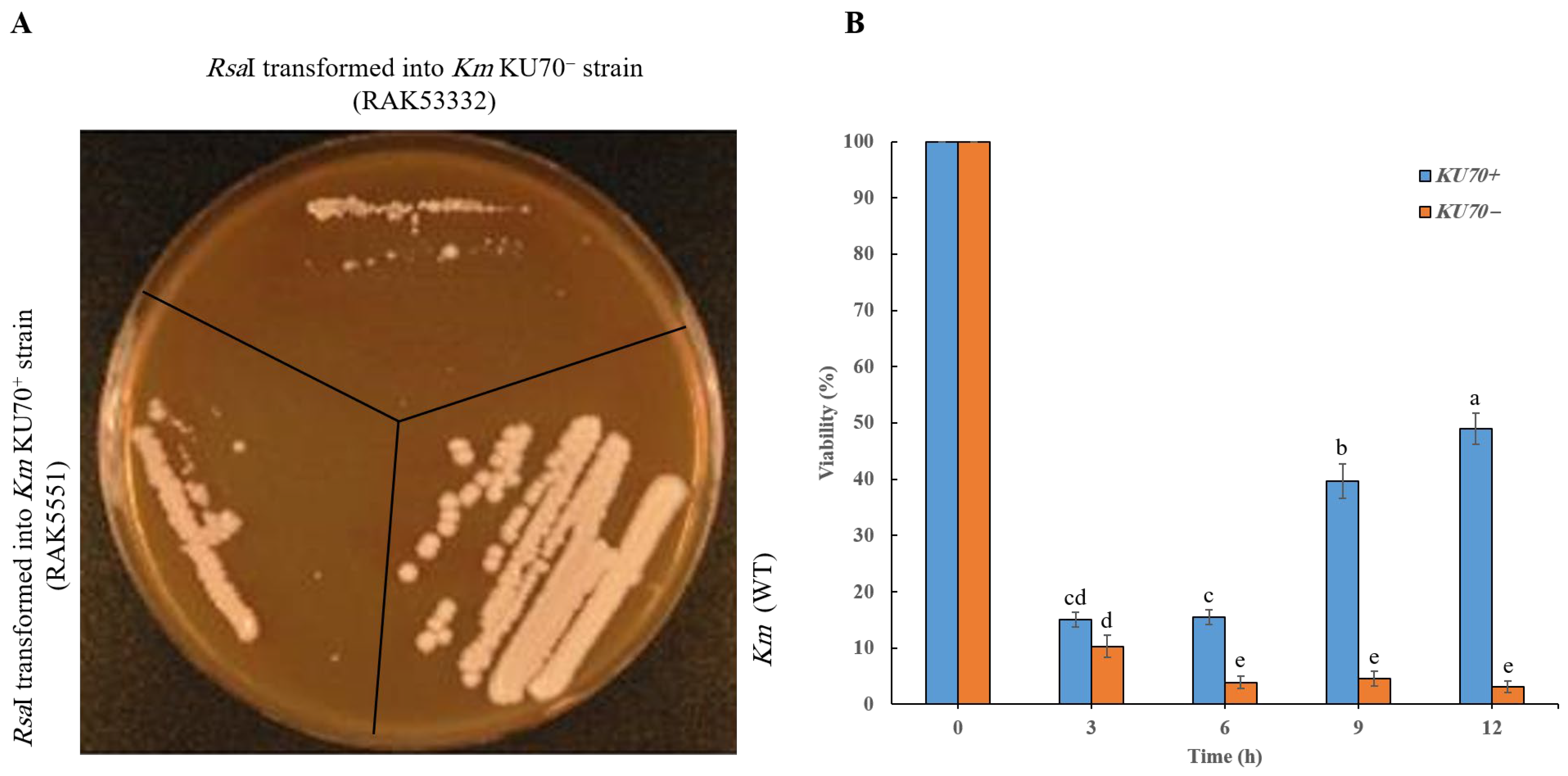
The yeast K. marxianus exhibits efficient non-homologous end-joining (NHEJ) activity to repair DNA double-strand breaks [33,34,35]. To gain further insight into changes in chromosomal integrity during DNA break repair in this yeast, we constructed strains expressing the RsaI gene under the control of the galactose-inducible promoter PGAL10. In a static culture, the KmKU70+ (RsaI-transformant) strain showed growth defects on inducible YPGal medium (Figure 1A). After an initial drop at 3 h of culture in liquid YPGal, the KmKU70+ strain expressing the RsaI gene stabilized and began to show a trend of recovery. In comparison, the KmKU70 strain continued to decline with longer incubation time (Figure 1B). The difference between the KmKU70+ and KmKU70 strains is statistically significant (p < 0.05; n = 3) at 9 and 12 h, indicating that the KmKU70+ strain expressing the RsaI endonuclease could recover its growth after rearranging the chromosomes into properly functioning structures.

3.2. Effects of Induction of RsaI in KU70+ and KU70 Cells

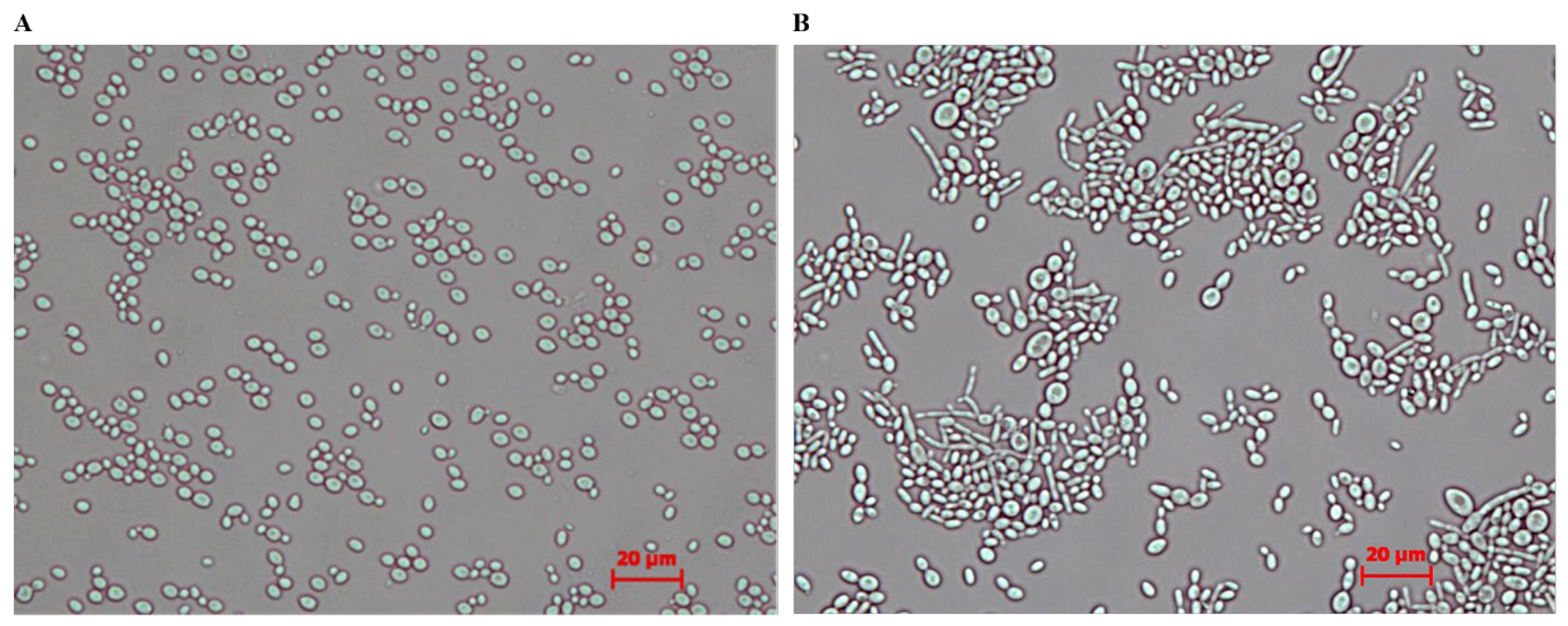
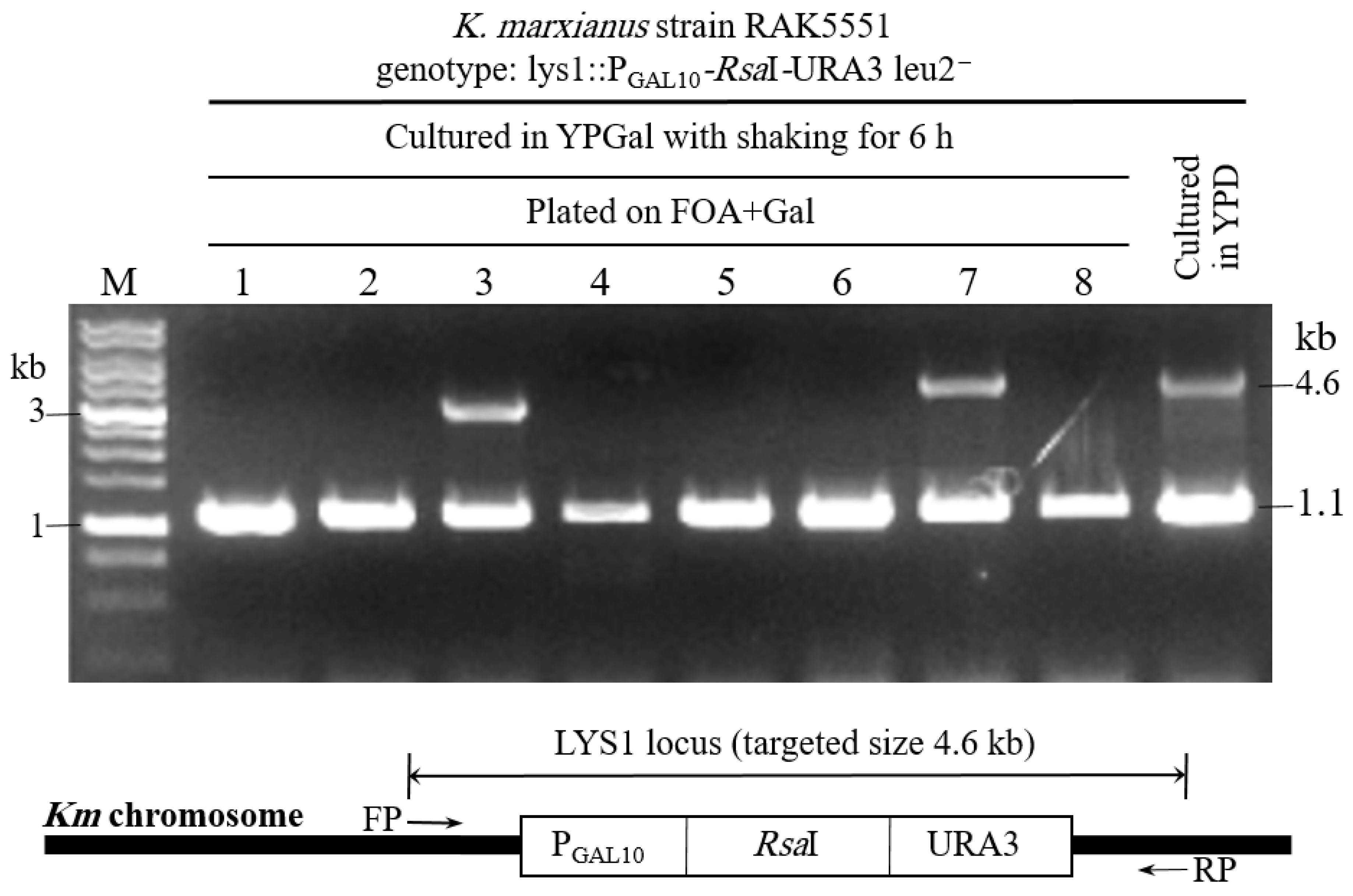
The Km LYS1 locus is located on chromosome 4 (NCBI reference sequence: NC_036028.1) according to the genome sequence of the strain DMKU3-1042, and its sequence coordinates range from nucleotides 856,079 to 857,197, encoding 372 amino acids [55]. The strain KmKU70+ expressing RsaI (RAK5551) was incubated in a YPGal liquid medium for 6 h with vigorous shaking. The induced cells were plated on FOA-containing galactose (FOA+Gal medium). The colonies that lost the RsaI were expected to grow on the FOA+Gal medium. Colonies that show similar growth to the KU70+ cells in the FOA+Gal solid medium may have undergone mutation in RsaI, partial deletion in the transformed construct, or the entire construct may have been deleted through the action of the restriction enzyme RsaI. Eight colonies (Table 1) were tested by means of PCR for the presence or absence of the inserted fusion construct (PGAL10-RsaI-URA3). Only two colonies (RAK6482 and RAK6486) retained the RsaI expression cassette at the Km LYS1 locus; the remaining six colonies had lost the cassette from the LYS1 locus (Figure 2), suggesting a structural change in the chromosomes. The KmKU70+ yeast cells expressing RsaI (RAK5551) grown in YPGal exhibited morphological alterations under a microscope (Figure 3). Some cells displayed rod-shaped structures, whereas others exhibited elongated structures compared to the wild-type Km cells. Our results suggest that some of the elongated cells were attached, forming long threads with distinct invaginations.

3.3. Pulsed-Field Gel Electrophoresis (PFGE) of K. marxianus Expressing RsaI Recovered on FOA-Gal

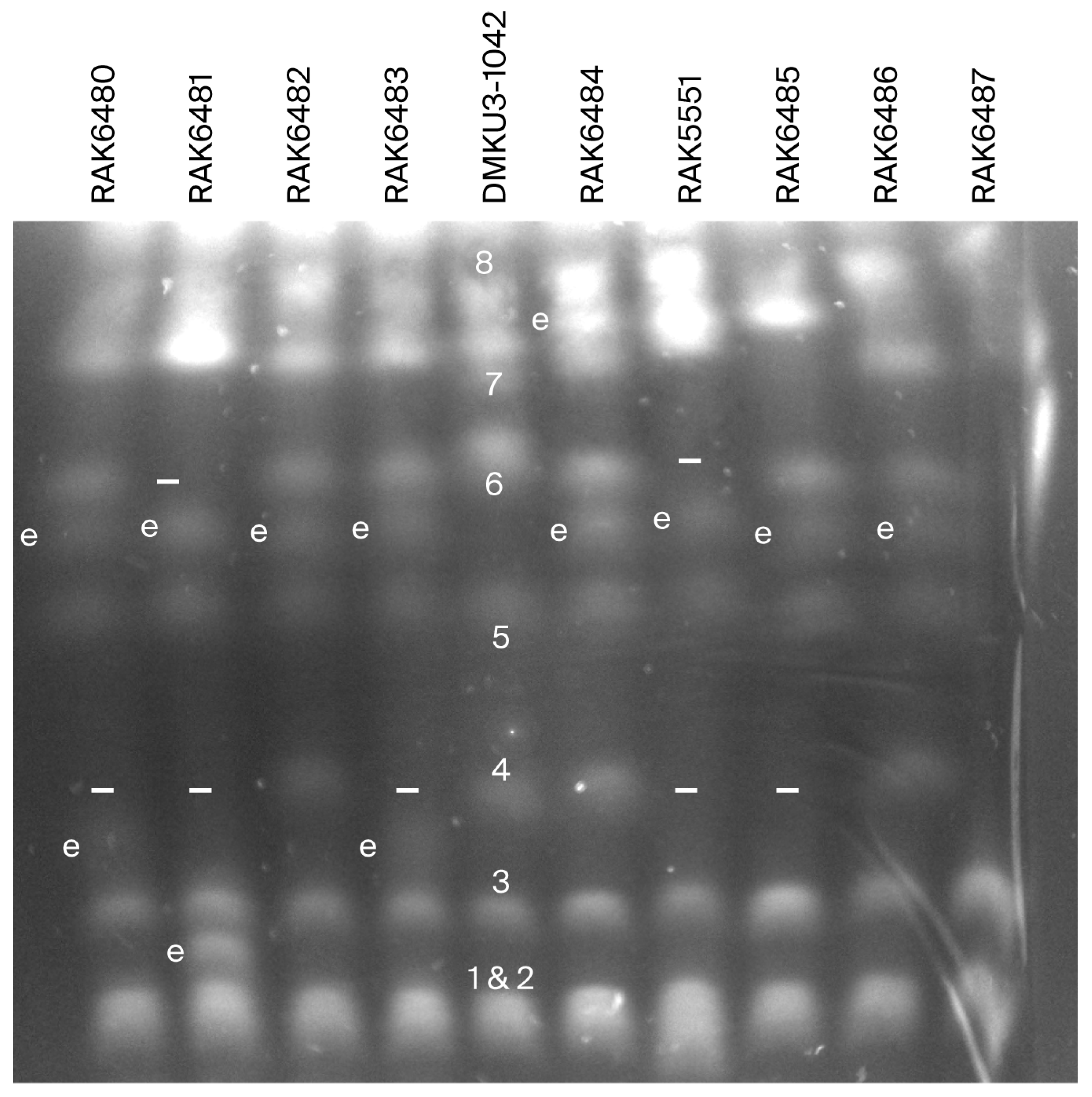
Chromosomes from the KmKU70+ colonies expressing RsaI depicted in Figure 2 were separated by means of PFGE (Figure 4). PFGE-separated chromosomes of the strain DMKU3-1042 (lane 5) were indicated by numeric labels on the gel. Chromosomes 1 and 2 migrated together as a dense band at the bottom of the gel, and therefore, they are referred to as chr1 and 2. An apparent variation was discovered in the chromosomal size of some RsaI-expressing strains, as evidenced by their separation on the gel. We detected an extra band (highlighted as e on the gel panel) from the strains RAK6480 (lane 1), RAK6481 (lane 2), RAK6482 (lane 3), RAK6483 (lane 4), RAK6484 (lane 6), RAK5551 (lane 7), RAK6485 (lane 8), and RAK6486 (lane 9). Its position lies between chr5 and chr6 in DMKU3-1042 (lane 5). The strain RAK6481 possesses an additional band between chr1 and 2 and chromosome 3 compared to DMKU3-1042. The strains RAK6480 and RAK6483 each contain an extra band above chr3 of DMKU3-1042, which is undetectable in the other strains. Moreover, the strain RAK6484 contains an additional band located between chromosomes 7 and 8 of DMKU3-1042. Chromosome 4, which includes the targeted LYS1 locus, disappeared from the strains RAK6480, RAK6481, RAK6483, RAK5551, and RAK6485 (its position is highlighted by a − sign on the gel panel). Chromosome 6 of DMKU3-1042 appears denser and relatively higher on the gel than the relative bands from the strains RAK6480, RAK6482, RAK6483, RAK6484, RAK6485, and RAK6486. Larger chromosomes of the strain RAK5551 densely migrated to the top of the gel and exhibited incomplete separation. Chromosomes 1 and 2, in addition to chromosome 3 of DMKU3-1042, appeared in all tested strains. A noticeable difference was detected in the larger chromosomes at the top of the gel between the strains RAK6481, RAK6482, RAK6483, RAK6484, RAK5551, RAK6485, and RAK6486 compared to DMKU3-1042. Most bands of the strain RAK6487 (lane 10), except for two at the bottom, were distorted during migration on the gel, rendering them indistinguishable. A consistent chromosomal change was the introduction of an extra chromosome between chromosomes 5 and 6 of the wild-type strain, in addition to the loss of chromosome 4 in the majority of tested strains (Table 2; Figure 4). The PFGE result is consistent with the PCR data, as the PFGE procedure confirmed the presence of chromosome 4, and PCR results showed retention of the transformed construct at the LYS1 locus in strains RAK6482 and RAK6486. As all tested strains are viable on FOA-Gal and exhibit discrete chromosomal migration on the gel, the yeast strains underwent significant karyotype engineering, resulting in rearranged or aberrant chromosomes.

4. Discussion

An in vivo genetic assay was developed to study non-conservative (i.e., leading to some changes in the DNA sequence) intra-chromosomal deletions at regions of non-tandem direct repeats in Schizosaccharomyces pombe [20]. This chromosomal rearrangement may lead to local species adaptations and diversification [56] if it is not lethal. Researchers have demonstrated that yeast chromosomal structural rearrangements have successfully enhanced industrially important phenotypes, including the production of novel medicines, nutritional supplements, anti-tumor molecules, and tolerance to environmental stress and drug resistance [24,57].
In this study, we aimed to determine whether inducing DNA DSBs affected the chromosomal integrity of K. marxianus. The restriction endonuclease RsaI recognizes the sequence GTAC, cleaves it between T and A, and produces blunt ends. Draft genome sequences of K. marxianus strains KCTC 17555 [58], DMB1 [59], and CCT 7735 [60], in addition to complete genome sequences of the strains DMKU3-1042 [55] and NBRC 1777 [61], have been identified. The strains DMKU3-1042 and NBRC 1777 each possess eight chromosomes in their genomes [55,61]. The sequences of the smallest chromosomes, 7 and 8, are 963,718 and 939,718 bp, respectively (Supplementary Table S1). Analysis of the genome of strain DMKU3-1042 using the software SnapGene© version 8.2 revealed 5009, 5139, 4633, 4236, 3986, 3599, 2870, and 3995 RsaI recognition sites on chromosomes 1, 2, 3, 4, 5, 6, 7, and 8, respectively, in addition to 42 recognition sites in the mitochondrial DNA (Supplementary Table S1). In total, roughly 33,499 recognition sites for the restriction enzyme RsaI were found in the genome of K. marxianus. It has been reported that K. marxianus strain 4G5 can switch its mating types [62]. Haploid cells may become diploids and produce spores in response to harsh environmental conditions [62]. Nevertheless, the strain DMKU3-1042 employed in this study is haploid [32]. The expression of the restriction enzyme RsaI caused a growth defect in the KmKu70+ strain grown on solid medium (Figure 1A). The lethality of RsaI in the KmKU70 strain is likely due to the loss of the NHEJ machinery that repairs broken DNA. This finding is consistent with reports demonstrating that cells employ various strategies to escape selective pressure [63]. To escape CRISPR/Cas-mediated knockouts, cells undergo target-site mutations, such as nucleotide substitutions or insertions/deletions. These mutations prevent guide RNA binding or Cas9 cleavage, in addition to alternative splicing or exon skipping, leading to truncated proteins that retain partial function [63]. Multiplex genome editing in yeast using CRISPR/Cas9 [64] enabled simultaneous targeting of multiple genes, facilitating the reconstruction of complex biosynthetic pathways. By employing multiple guide RNAs, the platform can induce various mutations across different loci, enabling comprehensive genetic modifications and the study of gene interactions in metabolic engineering applications [64]. Adaptive evolution of K. marxianus toward tolerance of high ethanol concentrations was demonstrated during adaptive laboratory evolution [65].
A notable observation was made regarding the morphology of induced RsaI-expressing Km strains. Microscopic examination revealed that some cells appeared rod-shaped, whereas others were elongated compared to wild-type Km cells (Figure 3). Some elongated cells were attached, forming long threads with distinct invaginations. It has been reported that when cell damage occurs, the cell cycle checkpoints halt or delay the cycle to enable the cell to ameliorate the damage before division. Elongated or large-budded yeast cells with undivided nuclei are mostly indicative of the G2/M checkpoint, which monitors DNA damage before mitosis [66,67]. The morphological appearance of RsaI-expressing Km survivors is primarily due to a cell cycle delay in DNA repair or due to oxidative stress [68]. However, the RsaI-transformed KmKu70+ strain recovered its growth when evaluated in liquid culture with vigorous shaking (Figure 1B), which likely enhanced the selective pressure for cells to escape RsaI expression by mutations in the expression cassette or loss of the entire LYS1 locus. The difference in growth between KmKU70+ and KmKU70 RsaI-transformed strains suggests that NHEJ function is necessary for recovery after DSB. The authors of a study involving a rad52 mutant S. cerevisiae strain, which is deficient in DSB repair, expressing the EcoRI endonuclease that produces four-base-pair cohesive ends, found that the restriction enzyme’s lethality was exacerbated under induction conditions [69].
FOA selection is enriched for cells that have lost the selection marker URA3 through mutation or deletion of the RsaI expression cassette. Growth of RsaI-expressing Km strains on FOA-Gal suggested that the viable cells may have undergone mutation, partial deletion, and/or deletion of the entire targeted region. The latter was confirmed by means of colony PCR (Figure 2). Six viable colonies revealed the loss of the LYS1 gene from its original locus. For further evaluation, the chromosomes of these strains were visualized by means of PFGE, a widely used technique for karyotyping yeast and human genomes [24,70,71,72]. In a previous study on chromosome polymorphisms in Italian K. marxianus cheese strains, the results revealed seven PFGE patterns, differing in chromosome size and number [73], and showed that the number of visualized chromosomal bands ranged from four to seven, with sizes of roughly 1.0 to 2.7 Mb [73]. In our study, six to seven bands of chromosomes from the wild-type Km strain DMKU3-1042 were resolved via PFGE. Conversely, the sequence data of the same strain revealed eight chromosomes in its genome [55]. This discrepancy may be due to the joint migration of closely sized chromosomes on the gel. PFGE of the chromosomes from the induced RsaI-expressing Km strains showed distinct variations (Figure 4). While RsaI sites are abundant in the genome of Km DMKU3-1042, selection pressure at the targeted LYS1 locus and survival bias likely dominate observed karyotypes, rather than random genome-wide cleavage. The strains RAK6482 and RAK6486, which retained the expression cassette at the LYS1 locus (Figure 2), showed a similar pattern of chromosomal migration on the PFGE. They also retained chr4, similar to the DMKU3-1042 strain. However, the band corresponding to chromosome 4 was not detected in the strains RAK6481, RAK6485, RAK6487, and RAK5551. In contrast, new bands of different sizes appeared in the other induced strains. Taken together, these data confirm the structural rearrangement in the chromosomes of induced RsaI-expressing K. marxianus, resulting in new strains with chromosomal migration on the gel that differs from that of their ancestor strain, DMKU3-1042. Strains harboring the active NHEJ pathway utilize this machinery to restore the integrity of their chromosomes. Further investigation is needed to characterize the molecular nature of karyotype rearrangements inferred from PFGE and the role of HR as a potential backup repair pathway in the KmKU70+ strain.

5. Conclusions

Our study’s findings demonstrate that the ku70 mutant strain of K. marxianus expressing the endonuclease RsaI generates multiple chromosomal fragments. Despite the presence of approximately 33,599 RsaI recognition sites in the yeast genome, some strains with newly rearranged chromosomes can survive. These strains evade the endonuclease’s lethality by rearranging their chromosomes in various patterns, suggesting a powerful random genome-shuffling technique for engineering K. marxianus strains. Our results highlight the potency of the NHEJ repair pathway in maintaining genome stability through chromosomal rearrangements and aid in directing future studies toward genome engineering and adaptive evolution strategies in the thermotolerant yeast K. marxianus DMKU3-1042.

Supplementary Materials

The following supporting information can be downloaded at https://www.mdpi.com/article/10.3390/cimb48030252/s1, Figure S1: Complete sequence of the fusion construct with annotations; Figure S2: Full-length electrophoresis gel image for Figure 2; Figure S3: Full-length electrophoresis gel image for Figure 4; Table S1: Recognition sites for the restriction enzyme RsaI in the genome of Kluyveromyces marxianus strain DMKU3-1042.

Author Contributions

Conceptualization, B.M.A.A.-B. and R.A.; methodology, B.M.A.A.-B., R.A. and H.H.; validation, B.M.A.A.-B., R.A. and M.M.; formal analysis, B.M.A.A.-B. and M.M.; investigation, B.M.A.A.-B.; resources, B.M.A.A.-B. and R.A.; data curation, B.M.A.A.-B.; writing—original draft preparation, B.M.A.A.-B.; writing—review and editing, B.M.A.A.-B., M.M., H.H. and R.A.; visualization, B.M.A.A.-B.; supervision, R.A.; project administration, B.M.A.A.-B.; funding acquisition, B.M.A.A.-B. All authors have read and agreed to the published version of the manuscript.

Funding

This work was supported by the Deanship of Scientific Research, Vice Presidency for Graduate Studies and Scientific Research, King Faisal University, Saudi Arabia [Grant No. KFU260972].

Institutional Review Board Statement

Not applicable.

Informed Consent Statement

Not applicable.

Data Availability Statement

The datasets generated and/or analyzed during the current study are available from the corresponding author upon reasonable request.

Acknowledgments

The authors thank Ryota Kuroki for his technical assistance. This work was partly supported by the Program for Promotion of Basic Research Activities for Innovative Biosciences (PROBRAIN), Japan. The technical support provided by the Date Palm Center of Research Excellence at King Faisal University is also acknowledged.

Conflicts of Interest

The authors declare no conflicts of interest.

References

  1. Li, K.-J.; Qi, L.; Zhu, Y.-X.; Min, H.; Xiang, Q.; Zheng, D.-Q. Spontaneous and environment induced genomic alterations in yeast model. Cell Insight 2025, 4, 100209. [Google Scholar] [CrossRef]
  2. Zhang, C.-Z.; Leibowitz, M.L.; Pellman, D. Chromothripsis and beyond: Rapid genome evolution from complex chromosomal rearrangements. Genes Dev. 2013, 27, 2513–2530. [Google Scholar] [CrossRef]
  3. Brierley, C.K.; Yip, B.H.; Orlando, G.; Wen, J.; Wen, S.; Goyal, H.; Levine, M.; Jakobsdottir, G.M.; Tapinos, A.; Cornish, A.J.; et al. Chromothripsis-associated chromosome 21 amplification orchestrates transformation to blast-phase MPN through targetable overexpression of DYRK1A. Nat. Genet. 2025, 57, 1478–1492. [Google Scholar] [CrossRef]
  4. Leibowitz, M.L.; Zhang, C.Z.; Pellman, D. Chromothripsis: A new mechanism for rapid karyotype evolution. Annu. Rev. Genet. 2015, 49, 183–211. [Google Scholar] [CrossRef]
  5. Mazzagatti, A.; Engel, J.L.; Ly, P. Boveri and beyond: Chromothripsis and genomic instability from mitotic errors. Mol. Cell 2024, 84, 55–69. [Google Scholar] [CrossRef]
  6. Burssed, B.; Zamariolli, M.; Bellucco, F.T.; Melaragno, M.I. Mechanisms of structural chromosomal rearrangement formation. Mol. Cytogenet. 2022, 15, 23. [Google Scholar] [CrossRef]
  7. Featherstone, C.; Jackson, S.P. DNA double-strand break repair. Curr. Biol. 1999, 9, R759–R761. [Google Scholar] [CrossRef]
  8. Shrivastav, M.; De Haro, L.; Nickoloff, J. Regulation of DNA double-strand break repair pathway choice. Cell Res. 2008, 18, 134–147. [Google Scholar] [CrossRef] [PubMed]
  9. Davis, A.J.; Chen, D.J. DNA double strand break repair via non-homologous end-joining. Transl. Cancer Res. 2013, 2, 130–143. [Google Scholar] [CrossRef] [PubMed]
  10. Frigerio, C.; Di Nisio, E.; Galli, M.; Colombo, C.V.; Negri, R.; Clerici, M. The chromatin landscape around DNA double-strand breaks in yeast and its influence on DNA repair pathway choice. Int. J. Mol. Sci. 2023, 24, 3248. [Google Scholar] [CrossRef] [PubMed]
  11. Qi, L.; Sui, Y.; Tang, X.-X.; McGinty, R.J.; Liang, X.-Z.; Dominska, M.; Zhang, K.; Mirkin, S.M.; Zheng, D.-Q.; Petes, T.D. Shuffling the yeast genome using CRISPR/Cas9-generated DSBs that target the transposable Ty1 elements. PLoS Genet. 2023, 19, e1010590. [Google Scholar] [CrossRef]
  12. Jeon, Y.; Lu, Y.; Ferrari, M.M.; Channagiri, T.; Xu, P.; Meers, C.; Zhang, Y.; Balachander, S.; Park, V.S.; Marsili, S.; et al. RNA-mediated double-strand break repair by end-joining mechanisms. Nat. Commun. 2024, 15, 7935. [Google Scholar] [CrossRef]
  13. Oda, A.H.; Yasukawa, T.; Tamura, M.; Sano, A.; Masuo, N.; Ohta, K. Advantages of mutant generation by genome rearrangements of non-conventional yeast via direct nuclease transfection. Genes Cells 2025, 30, e70010. [Google Scholar] [CrossRef]
  14. Vítor, A.C.; Huertas, P.; Legube, G.; de Almeida, S.F. Studying DNA double-strand break repair: An ever-growing toolbox. Front. Mol. Biosci. 2020, 7, 24. [Google Scholar] [CrossRef]
  15. Harper, J.W.; Elledge, S.J. The DNA damage response: Ten years after. Mol. Cell 2007, 28, 739–745. [Google Scholar] [CrossRef] [PubMed]
  16. Paques, F.; Haber, J.E. Multiple pathways of recombination induced by double-strand breaks in Saccharomyces cerevisiae. Microbiol. Mol. Biol. Rev. 1999, 63, 349–404. [Google Scholar] [CrossRef] [PubMed]
  17. Jazayeri, A.; McAinsh, A.D.; Jackson, S.P. Saccharomyces cerevisiae Sin3p facilitates DNA double-strand break repair. Proc. Natl. Acad. Sci. USA 2004, 101, 1644–1649. [Google Scholar] [CrossRef] [PubMed]
  18. Symington, L.S. Role of RAD52 epistasis group genes in homologous recombination and double-strand break repair. Microbiol. Mol. Biol. Rev. 2002, 66, 630–670. [Google Scholar] [CrossRef]
  19. Mortensen, U.H.; Lisby, M.; Rothstein, R. Rad52. Curr. Biol. 2009, 19, R676–R677. [Google Scholar] [CrossRef]
  20. Lucas, B.E.; McPherson, M.T.; Hawk, T.M.; Wilson, L.N.; Kroh, J.M.; Hickman, K.G.; Fitzgerald, S.R.; Disbennett, W.M.; Rollins, P.D.; Hylton, H.M.; et al. An assay to study intra-chromosomal deletions in yeast. Methods Protoc. 2019, 2, 74. [Google Scholar] [CrossRef]
  21. Chang, H.H.Y.; Pannunzio, N.R.; Adachi, N.; Lieber, M.R. Non-homologous DNA end joining and alternative pathways to double-strand break repair. Nat. Rev. Mol. Cell Biol. 2017, 18, 495–506. [Google Scholar] [CrossRef]
  22. Ding, L.; Macdonald, H.D.; Smith, H.O.; Hutchison, C.A., III; Merryman, C.; Michael, T.P.; Abramson, B.W.; Kannan, K.; Liang, J.; Gill, J.; et al. Gross chromosomal rearrangements in Kluyveromyces marxianus revealed by Illumina and Oxford nanopore sequencing. Int. J. Mol. Sci. 2020, 21, 7112. [Google Scholar] [CrossRef] [PubMed]
  23. Tang, X.-X.; Wen, X.-P.; Qi, L.; Sui, Y.; Zhu, Y.-X.; Zheng, D.-Q. Origin, regulation, and fitness effect of chromosomal rearrangements in the yeast Saccharomyces cerevisiae. Int. J. Mol. Sci. 2021, 22, 786. [Google Scholar] [CrossRef]
  24. Cheng, L.; Zhao, S.; Li, T.; Hou, S.; Luo, Z.; Xu, J.; Yu, W.; Jiang, S.; Monti, M.; Schindler, D.; et al. Large-scale genomic rearrangements boost SCRaMbLE in Saccharomyces cerevisiae. Nat. Commun. 2024, 15, 770. [Google Scholar] [CrossRef]
  25. Turner, K.M.; Deshpande, V.; Beyter, D.; Koga, T.; Rusert, J.; Lee, C.; Li, B.; Arden, K.; Re, B.; Nathanson, D.A.; et al. Extrachromosomal oncogene amplification drives tumour evolution and genetic heterogeneity. Nature 2017, 543, 122–125. [Google Scholar] [CrossRef]
  26. Paulsen, T.; Kumar, P.; Koseoglu, M.M.; Dutta, A. Discoveries of extrachromosomal circles of DNA in normal and tumor cells. Trends Genet. 2018, 34, 270–278. [Google Scholar] [CrossRef] [PubMed]
  27. Pologe, L.G.; Ravetch, J.V. A chromosomal rearrangement in a P. falciparum histidine-rich protein gene is associated with the knobless phenotype. Nature 1986, 322, 474–477. [Google Scholar] [CrossRef]
  28. Selmecki, A.; Forche, A.; Berman, J. Aneuploidy and isochromosome formation in drug-resistant Candida albicans. Science 2006, 313, 367–370. [Google Scholar] [CrossRef] [PubMed]
  29. Zhang, Y.; Malone, J.H.; Powell, S.K.; Periwal, V.; Spana, E.; Macalpine, D.M.; Oliver, B. Expression in aneuploid Drosophila S2 cells. PLoS Biol. 2010, 8, e1000320. [Google Scholar] [CrossRef]
  30. Zhang, K.; Zhang, L.-J.; Fang, Y.-H.; Jin, X.-N.; Qi, L.; Wu, X.-C.; Zheng, D.-Q. Genomic structural variation contributes to phenotypic change of industrial bioethanol yeast Saccharomyces cerevisiae. FEMS Yeast Res. 2016, 16, fov118. [Google Scholar] [CrossRef]
  31. Gnügge, R.; Symington, L.S. Efficient DNA double-strand break formation at single or multiple defined sites in the Saccharomyces cerevisiae genome. Nucleic Acids Res. 2020, 48, e115. [Google Scholar] [CrossRef]
  32. Nonklang, S.; Abdel-Banat, B.M.A.; Cha-aim, K.; Moonjai, N.; Hoshida, H.; Limtong, S.; Yamada, M.; Akada, R. High-temperature ethanol fermentation and transformation with linear DNA in the thermotolerant yeast Kluyveromyces marxianus DMKU3–1042. Appl. Environ. Microbiol. 2008, 74, 7514–7521. [Google Scholar] [CrossRef]
  33. Abdel-Banat, B.M.A.; Nonklang, S.; Hoshida, H.; Akada, R. Random and targeted gene integrations through the control of non-homologous end joining in the yeast Kluyveromyces marxianus. Yeast 2010, 27, 29–39. [Google Scholar] [CrossRef] [PubMed]
  34. Hoshida, H.; Murakami, N.; Suzuki, A.; Tamura, R.; Asakawa, J.; Abdel-Banat, B.M.A.; Nonklang, S.; Nakamura, M.; Akada, R. Non-homologous end joining-mediated functional marker selection for DNA cloning in the yeast Kluyveromyces marxianus. Yeast 2014, 31, 29–46. [Google Scholar] [CrossRef] [PubMed]
  35. Suzuki, A.; Fujii, H.; Hoshida, H.; Akada, R. Gene expression analysis using strains constructed by NHEJ-mediated one-step promoter cloning in the yeast Kluyveromyces marxianus. FEMS Yeast Res. 2015, 15, fov059. [Google Scholar] [CrossRef][Green Version]
  36. Abdel-Banat, B.M.A.; Hoshida, H.; Akada, R. Various short autonomously replicating sequences from the yeast Kluyveromyces marxianus seemingly without canonical consensus. Curr. Res. Microb. Sci. 2021, 2, 100053. [Google Scholar] [CrossRef]
  37. Li, M.; Lang, X.; Cabrera, M.M.; De Keyser, S.; Sun, X.; Da Silva, N.; Wheeldon, I. CRISPR-mediated multigene integration enables Shikimate pathway refactoring for enhanced 2-phenylethanol biosynthesis in Kluyveromyces marxianus. Biotechnol. Biofuels 2021, 14, 3. [Google Scholar] [CrossRef]
  38. Kaiser, C.; Michaelis, S.; Mitchell, A. Methods in Yeast Genetics; Cold Spring Harbor Laboratory Press: Huntington, NY, USA, 1994; 234p. [Google Scholar]
  39. Akada, R.; Shimizu, Y.; Matsushita, Y.; Kawahata, M.; Hoshida, H.; Nishizawa, Y. Use of a YAP1 overexpression cassette conferring specific resistance to cerulenin and cycloheximide as an efficient selectable marker in the yeast Saccharomyces cerevisiae. Yeast 2002, 19, 17–28. [Google Scholar] [CrossRef]
  40. Akada, R.; Kitagawa, T.; Kaneko, S.; Toyonaga, D.; Ito, S.; Kakihara, Y.; Hoshida, H.; Morimura, S.; Kondo, A.; Kida, K. PCR-mediated seamless gene deletion and marker recycling in Saccharomyces cerevisiae. Yeast 2006, 23, 399–405. [Google Scholar] [CrossRef]
  41. Limtong, S.; Sringiew, C.; Yongmanitchai, W. Production of fuel ethanol at high temperature from sugar cane juice by a newly isolated Kluyveromyces marxianus. Bioresour. Technol. 2007, 98, 3367–3374. [Google Scholar] [CrossRef] [PubMed]
  42. Cha-aim, K.; Fukunaga, T.; Hoshida, H.; Akada, A. Reliable fusion PCR mediated by GC-rich overlap sequences. Gene 2009, 434, 43–49. [Google Scholar] [CrossRef]
  43. Brachmann, C.B.; Davies, A.; Cost, G.J.; Caputo, E.; Li, J.; Hieter, P.; Boeke, J.D. Designer deletion strains derived from Saccharomyces cerevisiae S288C: A Useful set of strains and plasmids for PCR-mediated gene disruption and other applications. Yeast 1998, 14, 115–132. [Google Scholar] [CrossRef]
  44. Cha-aim, K.; Hoshida, H.; Fukunaga, T.; Akada, R. Fusion PCR via novel overlap sequences. In Gene Synthesis; Peccoud, J., Ed.; Methods in Molecular Biology; Springer: Berlin/Heidelberg, Germany, 2012; Volume 852, pp. 97–109. [Google Scholar] [CrossRef]
  45. Choo, J.H.; Han, C.; Kim, J.Y.; Kang, H.A. Deletion of a KU80 homolog enhances homologous recombination in the thermotolerant yeast Kluyveromyces marxianus. Biotechnol. Lett. 2014, 36, 2059–2067. [Google Scholar] [CrossRef]
  46. Kwan, H.; Li, C.; Chiu, S.; Cheng, S. A simple method to prepare intact yeast chromosomal DNA for pulsed field gel electrophoresis. Nucleic Acids Res. 1991, 19, 1347. [Google Scholar] [CrossRef][Green Version]
  47. Kaufmann, M.E. Pulsed-Field Gel Electrophoresis. In Molecular Bacteriology; Woodford, N., Johnson, A.P., Eds.; Methods in Molecular Medicine™; Humana Press: Totowa, NJ, USA, 1998; Volume 15, pp. 33–50. [Google Scholar] [CrossRef]
  48. Herschleb, J.; Ananiev, G.; Schwartz, D.C. Pulsed-field gel electrophoresis. Nat. Protoc. 2007, 2, 677–684. [Google Scholar] [CrossRef]
  49. Cantor, C.R.; Smith, C.L.; Mathew, M.K. Pulsed-field gel electrophoresis of very large DNA molecules. Annu. Rev. Biophys. Biophys. Chem. 1988, 17, 287–304. [Google Scholar] [CrossRef]
  50. Doi, M.; Homma, M.; Chindamporn, A.; Tanak, K. Estimation of chromosome number and size by pulsed-field gel electrophoresis (PFGE) in medically important Candida species. J. Gen. Microbiol. 1992, 138, 2243–2251. [Google Scholar] [CrossRef]
  51. Hage, A.E.; Houseley, J. Resolution of budding yeast chromosomes using pulsed-field gel electrophoresis. In DNA Electrophoresis; Makovets, S., Ed.; Methods in Molecular Biology; Humana Press: Totowa, NJ, USA, 2013; Volume 1054, pp. 195–207. [Google Scholar] [CrossRef]
  52. Yamada, T.; Murakami, H.; Ohta, K. Pulsed-field gel electrophoresis for detecting chromosomal DNA breakage in fission yeast. In DNA Electrophoresis; Hanada, K., Ed.; Methods in Molecular Biology; Humana Press: New York, NY, USA, 2020; Volume 2119, pp. 135–143. [Google Scholar] [CrossRef]
  53. Wagner, W.E., III. Using IBM® SPSS® Statistics for Research Methods and Social Science Statistics; Sage Publications: Singapore, 2019. [Google Scholar]
  54. Steel, R.G.D.; Torrie, J.H.; Dicky, D.A. Principles and Procedures of Statistics, A Biometrical Approach, 3rd ed.; McGraw Hill, Inc. Book Co.: New York, NY, USA, 1997; pp. 352–358. [Google Scholar]
  55. Lertwattanasakul, N.; Kosaka, T.; Hosoyama, A.; Suzuki, Y.; Rodrussamee, N.; Matsutani, M.; Murata, M.; Fujimoto, N.; Suprayogi; Tsuchikane, K.; et al. Genetic basis of the highly efficient yeast Kluyveromyces marxianus: Complete genome sequence and transcriptome analyses. Biotechnol. Biofuels 2015, 8, 47. [Google Scholar] [CrossRef] [PubMed]
  56. Augustijnen, H.; Arias-Sardá, C.; Farré, M.; Lucek, K. A genomic update on the evolutionary impact of chromosomal rearrangements. Mol. Ecol. 2024, 33, e17602. [Google Scholar] [CrossRef] [PubMed]
  57. Jin, J.; Jia, B.; Yuan, Y.-J. Yeast chromosomal engineering to improve industrially-relevant phenotypes. Curr. Opin. Biotechnol. 2020, 66, 165–170. [Google Scholar] [CrossRef]
  58. Jeong, H.; Lee, D.-H.; Kim, S.H.; Kim, H.-J.; Lee, K.; Song, J.Y.; Kim, B.K.; Sung, B.H.; Park, J.C.; Sohn, J.H.; et al. Genome sequence of the thermotolerant yeast Kluyveromyces marxianus var. marxianus KCTC 17555. Eukaryot. Cell 2012, 11, 1584–1585. [Google Scholar] [CrossRef]
  59. Suzuki, T.; Hoshino, T.; Matsushika, A. Draft genome sequence of Kluyveromyces marxianus strain DMB1, isolated from sugarcane bagasse hydrolysate. Genome Announc. 2014, 2, e00733-14. [Google Scholar] [CrossRef]
  60. Silveira, W.B.; Diniz, R.H.S.; Cerdán, M.E.; González-Siso, M.I.; Souza, R.D.A.; Vidigal, P.M.P.; Brustolini, O.J.B.; de Almeida Prata, E.R.B.; Medeiros, A.C.; Paiva, L.C.; et al. Genomic sequence of the yeast Kluyveromyces marxianus CCT 7735 (UFV-3), a highly lactose-fermenting yeast isolated from the Brazilian dairy industry. Genome Announc. 2014, 2, e01136-14. [Google Scholar] [CrossRef] [PubMed]
  61. Inokuma, K.; Ishii, J.; Hara, K.Y.; Mochizuki, M.; Hasunuma, T.; Kondo, A. Complete genome sequence of Kluyveromyces marxianus NBRC1777, a non-conventional thermotolerant yeast. Genome Announc. 2015, 3, e00389-15, Erratum in: Genome Announc. 2017, 5, e00058-17. [Google Scholar] [CrossRef]
  62. Lee, M.-H.; Lin, J.-J.; Lin, Y.-J.; Chang, J.-J.; Ke, H.-M.; Fan, W.-L.; Wang, T.-Y.; Li, W.-H. Genome-wide prediction of CRISPR/Cas9 targets in Kluyveromyces marxianus and its application to obtain a stable haploid strain. Sci. Rep. 2018, 8, 7305. [Google Scholar] [CrossRef]
  63. Wang, Y.; Zhai, Y.; Zhang, M.; Song, C.; Zhang, Y.; Zhang, G. Escaping from CRISPR–Cas-mediated knockout: The facts, mechanisms, and applications. Cell. Mol. Biol. Lett. 2024, 29, 48. [Google Scholar] [CrossRef]
  64. Utomo, J.C.; Hodgins, C.L.; Ro, D.-K. Multiplex genome editing in yeast by CRISPR/Cas9—A potent and agile tool to reconstruct complex metabolic pathways. Front. Plant Sci. 2021, 12, 719148. [Google Scholar] [CrossRef] [PubMed]
  65. Mo, W.; Wang, M.; Zhan, R.; Yu, Y.; He, Y.; Lu, H. Kluyveromyces marxianus developing ethanol tolerance during adaptive evolution with significant improvements of multiple pathways. Biotechnol. Biofuels 2019, 12, 63. [Google Scholar] [CrossRef]
  66. Siede, W.; Friedberg, A.S.; Friedberg, E.C. RAD9-dependent G1 arrest defines a second checkpoint for damaged DNA in the cell cycle of Saccharomyces cerevisiae. Proc. Natl. Acad. Sci. USA 1993, 90, 7985–7989. [Google Scholar] [CrossRef] [PubMed]
  67. McMillan, J.N.; Sia, R.A.L.; Lew, D.J. Morphogenesis checkpoint monitors the actin cytoskeleton in yeast. J. Cell Biol. 1998, 142, 1487–1499. [Google Scholar] [CrossRef]
  68. Jamieson, D.J. Oxidative stress responses of the yeast Saccharomyces cerevisiae. Yeast 1998, 14, 1511–1527. [Google Scholar] [CrossRef]
  69. Barnes, G.; Rine, J. Regulated expression of endonuclease EcoRI in Saccharomyces cerevisiae: Nuclear entry and biological consequences. Proc. Natl. Acad. Sci. USA 1985, 82, 1354–1358. [Google Scholar] [CrossRef]
  70. Lasker, B.A.; Carle, G.F.; Kobayashi, G.S.; Medoff, G. Comparison of the separation of Candida albicans chromosome-sized DNA by pulsed-field gel electrophoresis techniques. Nucleic Acids Res. 1989, 17, 3783–3793. [Google Scholar] [CrossRef] [PubMed]
  71. McCulley, J.L.; Petes, T.D. Chromosome rearrangements and aneuploidy in yeast strains lacking both Tel1p and Mec1p reflect deficiencies in two different mechanisms. Proc. Natl. Acad. Sci. USA 2010, 107, 11465–11470. [Google Scholar] [CrossRef] [PubMed]
  72. Sharma, V.; Mohan, V. Detection of DNA double-strand breaks using pulsed-field gel electrophoresis. In Genotoxicity Assessment; Dhawan, A., Bajpayee, M., Eds.; Methods in Molecular Biology; Humana Press: New York, NY, USA, 2019; Volume 2031, pp. 301–311. [Google Scholar] [CrossRef]
  73. Fasoli, G.; Tofalo, R.; Lanciotti, R.; Schirone, M.; Patrignani, F.; Perpetuini, G.; Grazia, L.; Corsetti, A.; Suzzi, G. Chromosome arrangement, differentiation of growth kinetics and volatile molecule profiles in Kluyveromyces marxianus strains from Italian cheeses. Int. J. Food Microbiol. 2015, 214, 151–158. [Google Scholar] [CrossRef] [PubMed]
Figure 1. Growth properties of RsaI-expressing K. marxianus transformants. (A) Growth of KmKU70+ and KmKU70 strains expressing RsaI on a static culture (YPGal plate) compared to the Km wild-type. (B) Viability of KmKU70+ and KmKU70 strains expressing RsaI cultured in liquid YPGal with vigorous shaking. Ku70 is required to restore viability after DSB induction in Km. Results from three biological replicates are plotted on the graph, with the error bars representing the standard deviation of the means. Bars with different lowercase letters are significantly different at a 0.05 level of significance (p < 0.05).
Cimb 48 00252 g001
Figure 2. Fate of the targeted disruption of the LYS1 locus upon the induction of the restriction enzyme RsaI. The KmKU70+ viable strain (RAK5551) was cultured in YPGal for 6 h with vigorous shaking and plated on FOA+Gal. Eight colonies were tested by means of PCR for the targeted construct (4.6 kb). PCR results showed that six of the eight strains had lost the construct at the LYS1 locus, namely, RAK6480 (lane 1), RAK6481 (lane 2), RAK6483 (lane 4), RAK6484 (lane 5), RAK6485 (lane 6), and RAK6487 (lane 8). Two strains, RAK6482 (lane 3) and RAK6486 (lane 7), retained the transformed construct in the LYS1 locus. The DNA band at 1.1 kb corresponds to the Km ACT1 gene and was used as a reference for DNA loading (see Section 2 for details). A schematic depiction of the gene construct targeted at the LYS1 locus is shown at the bottom of the agarose gel. M, DNA molecular weight marker (1 kb DNA Ladder, Sib enzyme); FP, forward primer; RP, reverse primer.
Cimb 48 00252 g002
Figure 3. Morphological alteration of KmKU70+ cells expressing RsaI. (A) K. marxianus DMKU3-1042 and (B) RsaI-transformed K. marxianus strains were cultured in YPGal, grown at 30 °C for 24 h, and examined under a microscope. K. marxianus DMKU3-1042 cells exhibited normal growth, whereas the RsaI-transformed cells showed deformed morphological cell structures. Scale bar = 20 μm.
Cimb 48 00252 g003
Figure 4. Chromosomal DNA separation on pulsed-field gel electrophoresis (PFGE). PFGE of K. marxianus chromosomes extracted from nine viable RsaI transformants, which had undergone chromosome rearrangement in addition to the chromosomes from the strain DMKU3-1042. The electrophoresis gel contains chromosomes from the strains RAK6480 (lane 1), RAK6481 (lane 2), RAK6482 (lane 3), RAK6483 (lane 4), DMKU3-1042 (the wild type) (lane 5), RAK6484 (lane 6), RAK5551 (lane 7), RAK6485 (lane 8). Numbers on the gel indicate the chromosomes from DMKU3-1042, whereas the distinct extra bands from the RsaI-expressing strains are marked by the letter (e), and the chromosomes that have disappeared are indicated by the (−) sign. A summary of new bands or missing chromosomes from each strain relative to DMKU3-1042 is presented in Table 2.
Cimb 48 00252 g004
Table 1. Strains used in this study.
Strain *GenotypeSource
K. marxianus
DMKU3-1042Wild-type (WT)[41]
RAK3605ura3[32]
RAK3627ura3 lys1::ScURA3[32,34]
RAK4174ura3 leu2[42]
RAK4736ura3 ku70Δ::ScLEU2[32]
RAK5332ku70Δ::ScLEU2 lys1::PGAL10-RsaI-URA3RAK4736 transformant (This study)
RAK5551lys1::PGAL10-RsaI-URA3 leu2RAK4174 transformant (This study)
RAK6480lys1::PGAL10-RsaI-URA3 leu2YPGal-induced RAK5551
RAK6481lys1::PGAL10-RsaI-URA3 leu2YPGal-induced RAK5551
RAK6482lys1::PGAL10-RsaI-URA3 leu2YPGal-induced RAK5551
RAK6483lys1::PGAL10-RsaI-URA3 leu2YPGal-induced RAK5551
RAK6484lys1::PGAL10-RsaI-URA3 leu2YPGal-induced RAK5551
RAK6485lys1::PGAL10-RsaI-URA3 leu2YPGal-induced RAK5551
RAK6486lys1::PGAL10-RsaI-URA3 leu2YPGal-induced RAK5551
RAK6487lys1::PGAL10-RsaI-URA3 leu2YPGal-induced RAK5551
S. cerevisiae
BY4704MATa ade2Δ::hisG his3Δ200 leu2Δ0 lys2Δ0 met15Δ0 trp1Δ63[43]
BY4743MATa/alpha his3Δ1/his3Δ1 leu2Δ0/leu2Δ0 met15Δ0/MET15 LYS2/lys2Δ0 ura3Δ0/ura3Δ0[40,43]
RAK3940MATa his3Δ200 leu2Δ0 met15Δ0 trp1Δ63 ura3Δ0::PGAL10-yEGFP-15C-PpHIS3[40,44]
RAK5331MATa his3Δ200 leu2Δ0 met15Δ0 trp1Δ63 ura3Δ0::PGAL10-RsaⅠ-15C-URA3This study
* The strains from RAK6480 to RAK6487 were recovered after the galactose induction of the strain RAK5551. Only the strains RAK6482 and RAK6486 retained the entire transformed construct. The other six strains lost the targeted construct into the LYS1 locus.
Table 2. Major karyotype engineering observed in RsaI-transformed strains relative to the wild-type K. marxianus DMKU3-1042 using PFGE.
DMKU3-1042
Chromosomes
RAK6480
Band *
RAK6481 BandRAK6482 BandRAK6483 BandRAK6484 BandRAK5551 BandRAK6485 BandRAK6486 BandRAK6487 Band
1 & 21 & 21 & 21 & 21 & 21 & 21 & 21 & 21 & 21 & 2
New
3333333333
New New
4MissingMissing4Missing4MissingMissing4Missing
555555555Distorted
NewNewNewNewNewNewNewNew
6 Missing Missing Distorted
7777777777
NewNew
8888888888
* Chromosomal bands are tabulated from Figure 4.
Disclaimer/Publisher’s Note: The statements, opinions and data contained in all publications are solely those of the individual author(s) and contributor(s) and not of MDPI and/or the editor(s). MDPI and/or the editor(s) disclaim responsibility for any injury to people or property resulting from any ideas, methods, instructions or products referred to in the content.