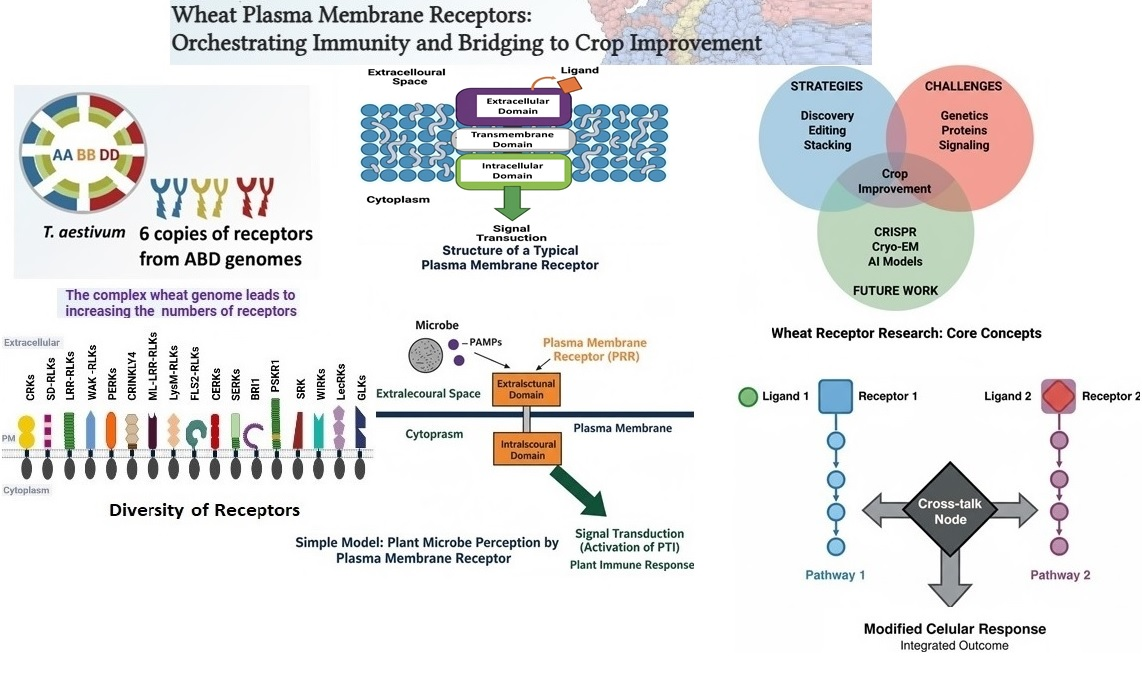
Wheat Plasma Membrane Receptors: Orchestrating Immunity and Bridging to Crop Improvement

 ,
,  , , ,
, , ,
Abstract
1. Introduction
2. Methods for Studying the PMRs
2.1. Genomic and Molecular Techniques
2.2. Transcriptomic Approaches
2.3. Proteomic and PPI Approaches
3. Structural and Functional Diversity of Wheat PMRs
3.1. G Protein-Coupled Receptors (GPCRs)
3.2. Ion Channel Receptors
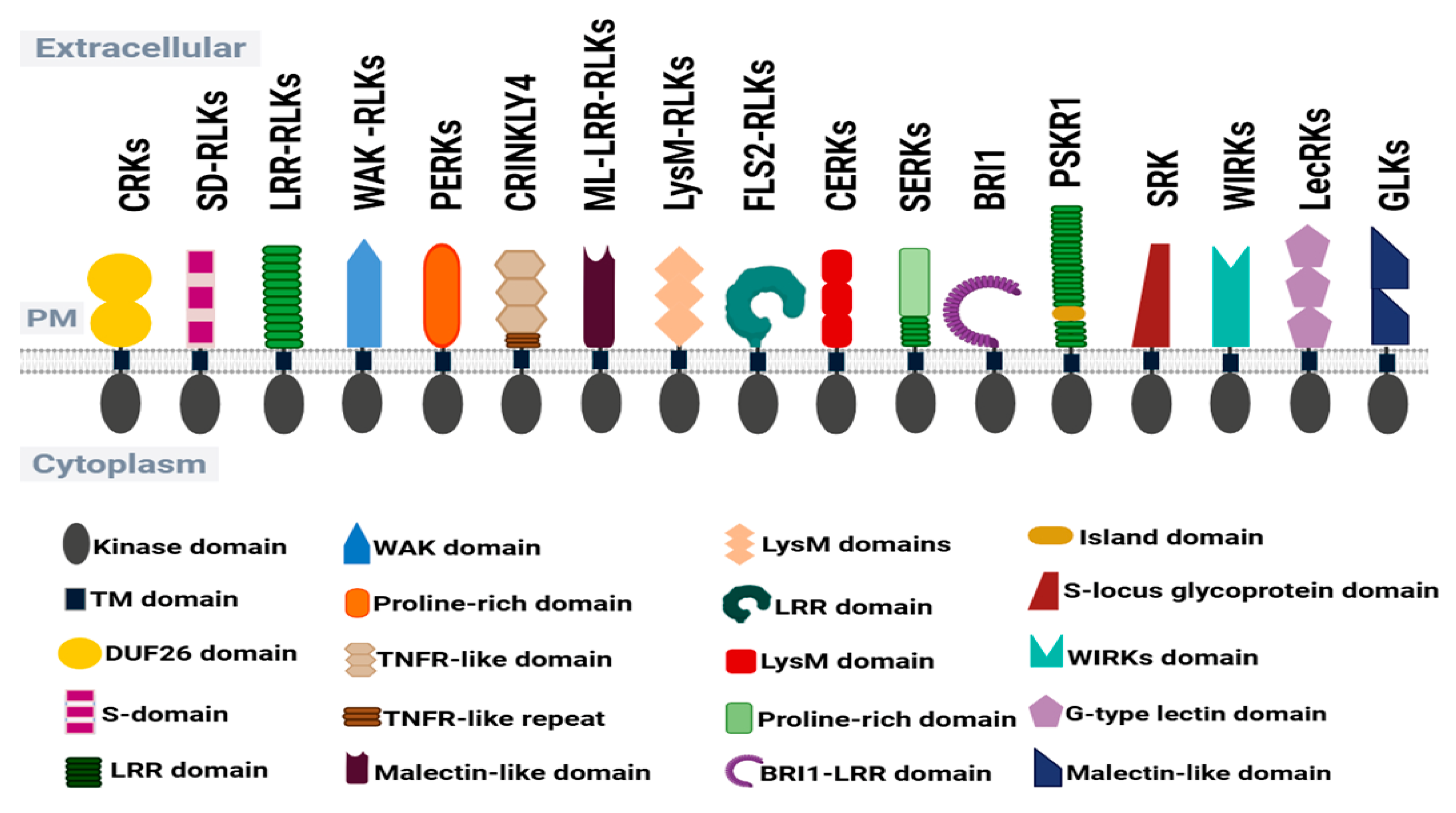
3.3. Receptor-like Protein Kinases
3.3.1. RLKs as Core Pattern Recognition Receptors
3.3.2. RLKs as Sensors of Cell Wall Integrity and Damage
3.3.3. RLKs as Specialized Recognizers of Microbial Signatures
3.3.4. RLKs as Regulators of Growth and Defense
3.3.5. Non-Canonical RLKs
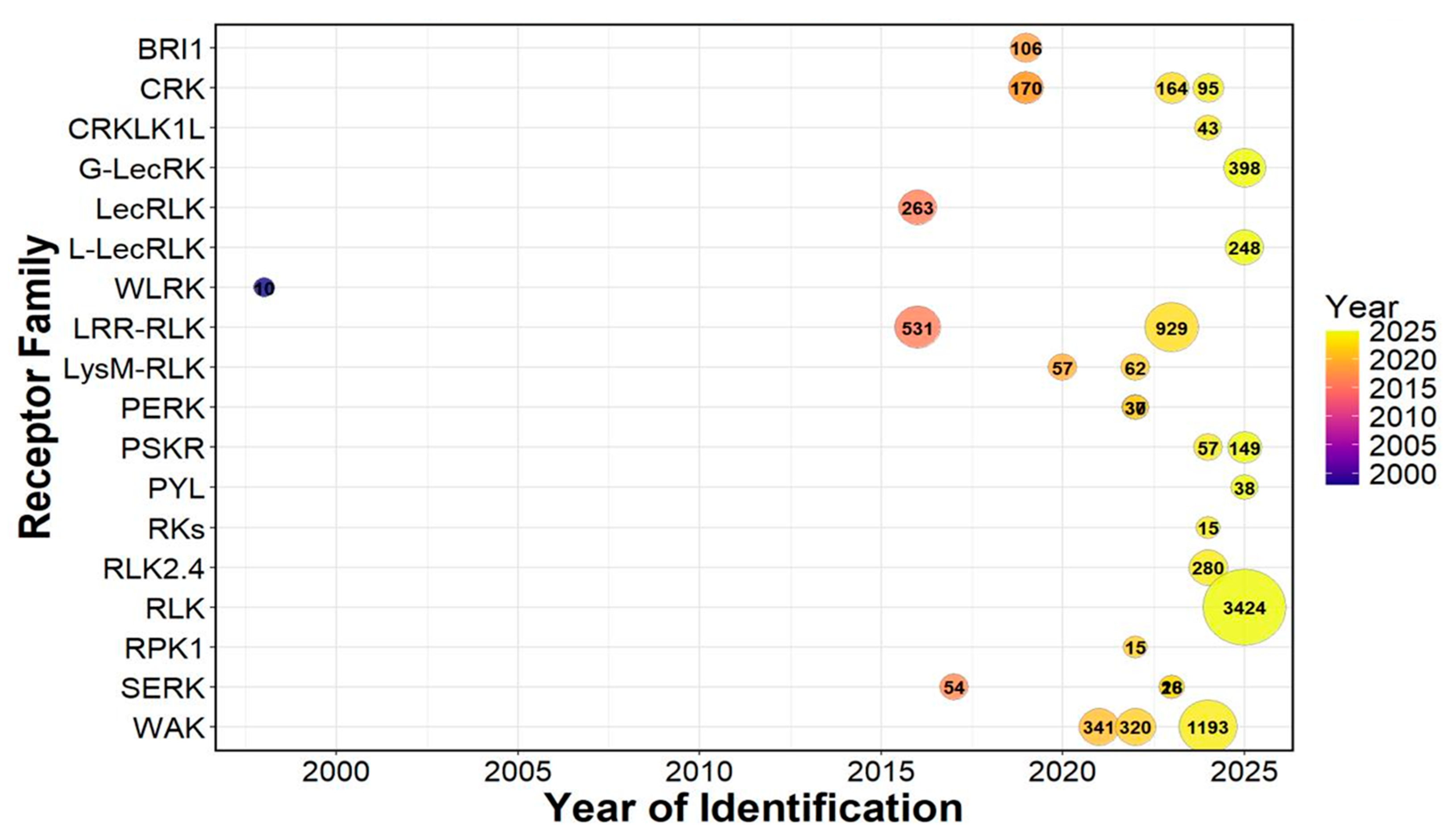
4. Expansion of Wheat PMR Families
5. Wheat PMRs’ in Response to Biotic Challenge
5.1. Wheat Defense Against Pathogens
5.1.1. Involvement of Wheat PMRs in Pattern-Triggered Immunity (PTI)
5.1.2. Involvement of Wheat PMRs in Effector-Triggered Immunity (ETI)
5.2. Wheat PMRs as Guardians of Insect Resistance
5.3. Wheat PMRs in Symbiotic Microbial Interactions
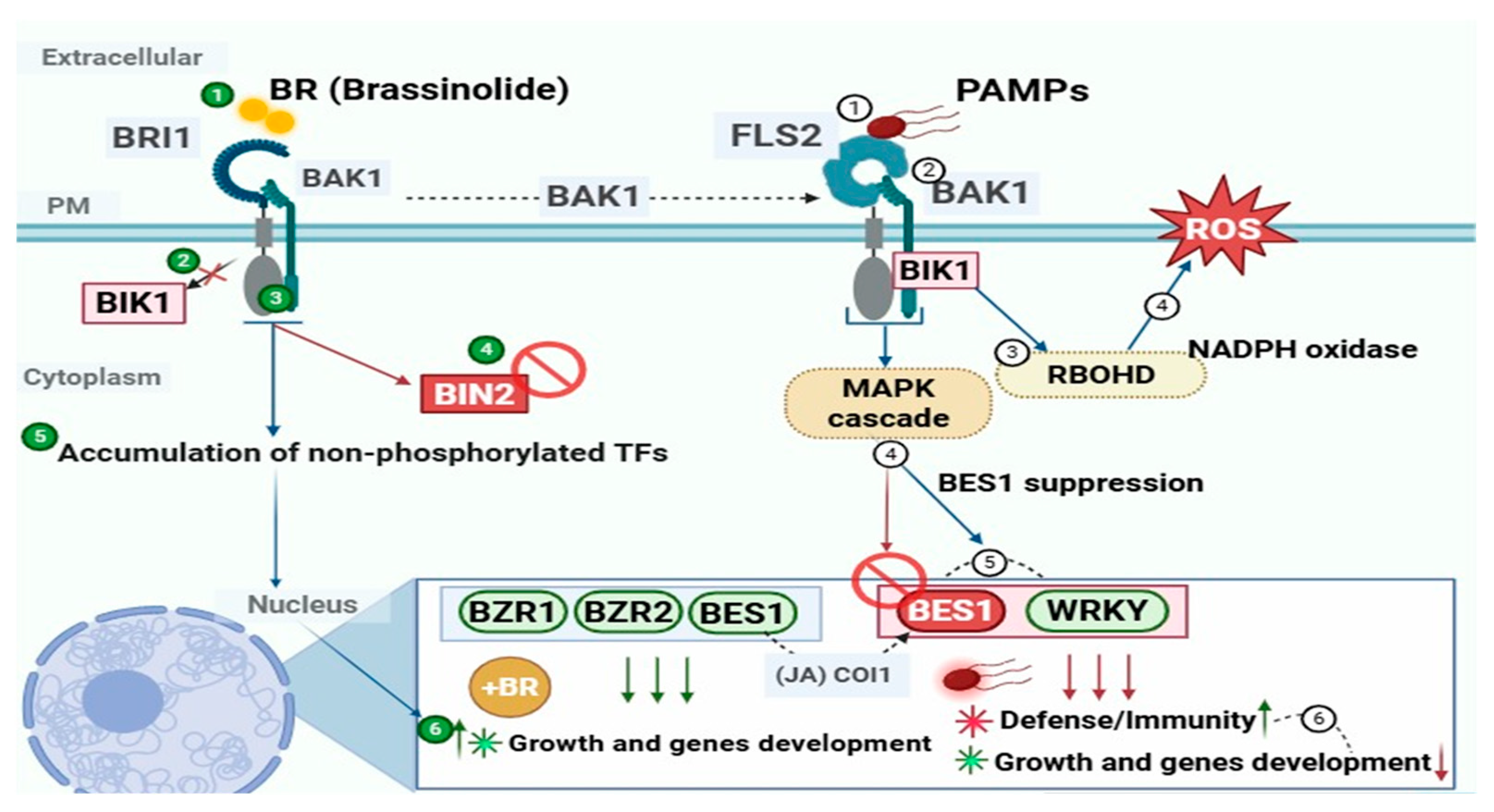
6. Receptor Cross-Talk Across Various Signaling Pathways
7. Exploiting the Wheat Receptors for Crop Improvement
8. Challenges and Limitations in Studying the Wheat PMRs
9. Future Directions
10. Conclusions
Author Contributions
Funding
Data Availability Statement
Acknowledgments
Conflicts of Interest
Abbreviations
| PMRs | Plasma Membrane Receptors |
| PPI | Protein–Protein Interaction |
| PTMs | Post-Translational Modifications |
| PRRs | Pattern Recognition Receptors |
| LysM | Lysin Motif |
| LysM-RLKs | LysM Receptor-Like Kinases |
| LRR | Leucine-Rich Repeat |
| RLKs | Receptor-Like Kinases |
| CRKs | Cysteine-rich Receptor-Like Protein Kinases |
| RACE | Rapid Amplification of cDNA Ends |
| TILLING | Targeting Induced Local Lesions in Genomes |
| RNA-seq | RNA Sequencing |
| qRT-PCR | Quantitative Real-Time PCR |
| scRNA-seq | Single-Cell RNA Sequencing |
| MS | Mass Spectrometry |
| LC-MS/MS | Liquid Chromatography–Tandem MS |
| WAK1 | Wall-Associated Kinase 1 |
| Y2H | Yeast Two-Hybrid |
| Co-IP/MS | Co-Immunoprecipitation Coupled with Mass Spectrometry |
| LecRLKs | Lectin Receptor-Like Protein Kinases |
| BiFC | Bimolecular Fluorescence Complementation |
| PAMPs | Pathogen-Associated Molecular Patterns |
| DAMPs | Damage-Associated Molecular Patterns |
| SD-RLKs | S-Domain Receptor-Like Kinases |
| LRK10L-RLK | L-Lectin Receptor-Like Kinase 10L |
| LRR-RLKs | Leucine-Rich Receptor-Like Protein Kinases |
| FHB | Fusarium Head Blight |
| ETI | Effector-Triggered Immunity |
| HR | Hypersensitive Response |
| WAKs | Wall-Associated Kinases |
| PERKs | Proline-rich/Extensin-Like Receptor Kinases |
| ML-LRR-RLKs | Malectin-Like Leucine-Rich Repeat Receptor-Like Kinases |
| ROS | Reactive Oxygen Species |
| MAPK | Mitogen-Activated Protein Kinase |
| PR | Pathogenesis-Related |
| FLS2-RLKs | Flagellin-Sensing 2 Receptor Kinases |
| CERKs | Chitin Elicitor Receptor Kinases |
| SERKs | Somatic Embryogenesis Receptor Kinases |
| ABA | Abscisic Acid |
| BRI1 | Brassinosteroid-Insensitive 1 |
| BR | Brassinosteroid |
| PSKRs | Phytosulfokine Receptors |
| PSK | Phytosulfokine hormone |
| GC | Guanylate Cyclase |
| cGMP | Cyclic Guanosine Monophosphate |
| CDPKs | Calcium-Dependent Protein Kinases |
| SRKs | S-locus Receptor Kinases |
| NLR | Nucleotide-binding Leucine-rich Repeat |
| WIRKs | Wound-Induced Receptor Kinases |
| GLKs | GHR1-Like Kinases |
| GHR1 | Guard Cell Hydrogen Peroxidase-Resistant 1 |
| GPCRs | G Protein-Coupled Receptors |
| WLRK | Wheat Leaf Rust Kinase |
| HAMPs | Herbivore-Associated Molecular Patterns |
| PTI | Pattern-Triggered Immunity |
| RLCKs | Receptor-Like Cytoplasmic Kinases |
| TaFLS2-like | Wheat Flagellin Sensing 2 |
| BAK1 | BRI1-Associated Kinase 1 |
| TIR | Toll/Interleukin-1 Receptor |
| NB | Nucleotide-Binding |
| R | Resistance Genes |
| VOCs | Volatile Organic Compounds |
| AM | Arbuscular Mycorrhizal |
| RLPs | Receptor-Like Proteins |
| LBDs | Ligand-Binding Domains |
| BIN2 | Brassinosteroid-insensitive 2 |
| JA | Jasmonic Acid |
| EFR | EF-Tu Receptor |
| MAS | Marker-Assisted Selection |
| KASP | Kompetitive Allele Specific PCR |
| GWAS | Genome-Wide Association Study |
| QTL | Quantitative Trait Loci |
| CrRLK1L | Catharanthus roseus RLK1-like |
| PYL | Pyrabactin resistance 1-like |
| RPK1 | Receptor-Like Protein Kinase 1 |
| CRs | Cytoplasmic Receptors |
| ORs | Organelle Receptors |
| PKs | Protein Kinases |
| SAR | Systemic Acquired Resistance |
References
- He, Y.; Zhou, J.; Shan, L.; Meng, X. Plant cell surface receptor-mediated signaling—A common theme amid diversity. J. Cell Sci. 2018, 131, jcs209353. [Google Scholar] [CrossRef] [PubMed]
- Duckney, P.; Li, C.; Hussey, P.J.; Wang, P. TraB, a novel plant ER-mitochondrial contact site protein functions as a mitophagy receptor in plants. Autophagy 2023, 19, 2148–2150. [Google Scholar] [CrossRef]
- Boisson-Dernier, A.; Franck, C.M.; Lituiev, D.S.; Grossniklaus, U. Receptor-like cytoplasmic kinase MARIS functions downstream of CrRLK1L-dependent signaling during tip growth. Proc. Natl. Acad. Sci. USA 2015, 112, 12211–12216. [Google Scholar]
- Novikova, G.V.; Stepanchenko, N.S.; Zorina, A.A.; Nosov, A.V.; Rakitin, V.Y.; Moshkov, I.E.; Los, D.A. Coupling of cell division and differentiation in Arabidopsis thaliana cultured cells with interaction of ethylene and ABA signaling pathways. Life 2020, 10, 15. [Google Scholar] [CrossRef] [PubMed]
- Tuteja, N.; Sopory, S.K. Plant signaling in stress: G-protein coupled receptors, heterotrimeric G-proteins and signal coupling via phospholipases. Plant Signal. Behav. 2008, 3, 79–86. [Google Scholar] [CrossRef]
- Zhang, S.; Li, C.; Si, J.; Han, Z.; Chen, D. Action mechanisms of effectors in plant-pathogen interaction. Int. J. Mol. Sci. 2022, 23, 6758. [Google Scholar] [CrossRef]
- Chow, B.; McCourt, P. Plant hormone receptors: Perception is everything. Genes Dev. 2006, 20, 1998–2008. [Google Scholar] [CrossRef]
- Gyula, P.; Schäfer, E.; Nagy, F. Light perception and signalling in higher plants. Curr. Opin. Plant Biol. 2003, 6, 446–452. [Google Scholar] [CrossRef] [PubMed]
- Jung, J.H.; Seo, P.J.; Oh, E.; Kim, J. Temperature perception by plants. Trends Plant Sci. 2023, 28, 924–940. [Google Scholar] [CrossRef]
- Zhu, J.K. Abiotic stress signaling and responses in plants. Cell 2016, 167, 313–324. [Google Scholar] [CrossRef]
- Molina, A.; Jordá, L.; Torres, M.Á.; Martín-Dacal, M.; Berlanga, D.J.; Fernández-Calvo, P.; Gómez-Rubio, E.; Martín-Santamaría, S. Plant cell wall-mediated disease resistance: Current understanding and future perspectives. Mol. Plant 2024, 17, 699–724. [Google Scholar] [CrossRef] [PubMed]
- Tor, M.; Lotze, M.T.; Holton, N. Receptor-mediated signalling in plants: Molecular patterns and programmes. J. Exp. Bot. 2009, 60, 3645–3654. [Google Scholar] [CrossRef] [PubMed]
- Claus, L.A.N.; Savatin, D.V.; Russinova, E. The crossroads of receptor-mediated signaling and endocytosis in plants. J. Integr. Plant Biol. 2018, 60, 827–840. [Google Scholar] [CrossRef]
- Yeagle, P.L. The Membranes of Cells; Academic Press: Cambridge, MA, USA, 2016. [Google Scholar]
- Muller, M.P.; Jiang, T.; Sun, C.; Lihan, M.; Pant, S.; Mahinthichaichan, P.; Trifan, A.; Tajkhorshid, E. Characterization of lipid–protein interactions and lipid-mediated modulation of membrane protein function through molecular simulation. Chem. Rev. 2019, 119, 6086–6161. [Google Scholar] [CrossRef]
- Nakao, H.; Sugimoto, Y.; Ikeda, K.; Saito, H.; Nakano, M. Structural feature of lipid scrambling model transmembrane peptides: Same-side positioning of hydrophilic residues and their deeper position. J. Phys. Chem. Lett. 2020, 11, 1662–1667. [Google Scholar] [CrossRef]
- Nawrocki, G.; Im, W.; Sugita, Y.; Feig, M. Clustering and dynamics of crowded proteins near membranes and their influence on membrane bending. Proc. Natl. Acad. Sci. USA 2019, 116, 24562–24567. [Google Scholar] [CrossRef]
- Rich, P.R.; Maréchal, A. Functions of the hydrophilic channels in protonmotive cytochrome c oxidase. J. R. Soc. Interface 2013, 10, 20130183. [Google Scholar] [CrossRef]
- Bordag, N.; Keller, S. α-Helical transmembrane peptides: A “divide and conquer” approach to membrane proteins. Chem. Phys. Lipids 2010, 163, 1–26. [Google Scholar] [CrossRef]
- Harrison, R.S.; Shepherd, N.E.; Hoang, H.N.; Ruiz-Gómez, G.; Hill, T.A.; Driver, R.W.; Desai, V.S.; Young, P.R.; Abbenante, G.; Fairlie, D.P. Downsizing human, bacterial, and viral proteins to short water-stable alpha helices that maintain biological potency. Proc. Natl. Acad. Sci. USA 2010, 107, 11686–11691. [Google Scholar] [CrossRef]
- Zhou, Y.; Wang, B.; Yuan, F. The role of transmembrane proteins in plant growth, development, and stress responses. Int. J. Mol. Sci. 2022, 23, 13627. [Google Scholar] [CrossRef] [PubMed]
- Lundbæk, J.A.; Collingwood, S.A.; Ingólfsson, H.I.; Kapoor, R.; Andersen, O.S. Lipid bilayer regulation of membrane protein function: Gramicidin channels as molecular force probes. J. R. Soc. Interface 2010, 7, 373–395. [Google Scholar] [CrossRef]
- Levy, A.A.; Feldman, M. Evolution and origin of bread wheat. Plant Cell 2022, 34, 2549–2567. [Google Scholar] [CrossRef]
- Brenchley, R.; Spannagl, M.; Pfeifer, M.; Barker, G.L.; D’Amore, R.; Allen, A.M.; McKenzie, N.; Kramer, M.; Kerhornou, A.; Bolser, D.; et al. Analysis of the bread wheat genome using whole-genome shotgun sequencing. Nature 2012, 491, 705–710. [Google Scholar] [CrossRef]
- Chauhan, H.; Khurana, N.; Tyagi, A.K.; Khurana, J.P.; Khurana, P. Identification and characterization of high temperature stress responsive genes in bread wheat (Triticum aestivum L.) and their regulation at various stages of development. Plant Mol. Biol. 2011, 75, 35–51. [Google Scholar] [CrossRef] [PubMed]
- Abhinandan, K.; Skori, L.; Stanic, M.; Hickerson, N.M.N.; Jamshed, M.; Samuel, M.A. Abiotic stress signaling in wheat—An inclusive overview of hormonal interactions during abiotic stress responses in wheat. Front. Plant Sci. 2018, 9, 734. [Google Scholar] [CrossRef]
- Thapa, G.; Gunupuru, L.R.; Hehir, J.G.; Kahla, A.; Mullins, E.; Doohan, F.M. A pathogen-responsive leucine rich receptor like kinase contributes to fusarium resistance in cereals. Front. Plant Sci. 2018, 9, 867. [Google Scholar] [CrossRef]
- Qi, H.; Guo, F.; Lv, L.; Zhu, X.; Zhang, L.; Yu, J.; Wei, X.; Zhang, Z. The wheat wall-associated receptor-like kinase TaWAK-6D mediates broad resistance to two fungal pathogens Fusarium pseudograminearum and Rhizoctonia cerealis. Front. Plant Sci. 2021, 12, 758196. [Google Scholar] [CrossRef]
- Forderer, A.; Li, E.; Lawson, A.W.; Deng, Y.N.; Sun, Y.; Logemann, E.; Zhang, X.; Wen, J.; Han, Z.; Chang, J.; et al. A wheat resistosome defines common principles of immune receptor channels. Nature 2022, 610, 532–539. [Google Scholar] [CrossRef] [PubMed]
- Pearce, S.; Kippes, N.; Chen, A.; Debernardi, J.M.; Dubcovsky, J. RNA-seq studies using wheat PHYTOCHROME B and PHYTOCHROME C mutants reveal shared and specific functions in the regulation of flowering and shade-avoidance pathways. BMC Plant Biol. 2016, 16, 141. [Google Scholar] [CrossRef] [PubMed]
- Chen, A.; Li, C.; Hu, W.; Lau, M.Y.; Lin, H.; Rockwell, N.C.; Martin, S.S.; Jernstedt, J.A.; Lagarias, J.C.; Dubcovsky, J. Phytochrome C plays a major role in the acceleration of wheat flowering under long-day photoperiod. Proc. Natl. Acad. Sci. USA 2014, 111, 10037–10044. [Google Scholar] [CrossRef]
- Sun, H.; Zhang, W.; Wu, Y.; Gao, L.; Cui, F.; Zhao, C.; Guo, Z.; Jia, J. The circadian clock gene, TaPRR1, is associated with yield-related traits in wheat (Triticum aestivum L.). Front. Plant Sci. 2020, 11, 285. [Google Scholar] [CrossRef]
- Alves, M.S.; Dadalto, S.P.; Gonçalves, A.B.; de Souza, G.B.; Barros, V.A.; Fietto, L.G. Transcription factor functional protein-protein interactions in plant defense responses. Proteomes 2014, 2, 85–106. [Google Scholar] [CrossRef]
- Gough, C.; Sadanandom, A. Understanding and exploiting post-translational modifications for plant disease resistance. Biomolecules 2021, 11, 1122. [Google Scholar] [CrossRef] [PubMed]
- Julkowska, M.M.; Testerink, C. Tuning plant signaling and growth to survive salt. Trends Plant Sci. 2015, 20, 586–594. [Google Scholar] [CrossRef] [PubMed]
- Zipfel, C. Plant pattern-recognition receptors. Trends Immunol. 2014, 35, 345–351. [Google Scholar] [CrossRef] [PubMed]
- Hao, G.; Tiley, H.; McCormick, S. Chitin triggers tissue-specific immunity in wheat associated with fusarium head blight. Front. Plant Sci. 2022, 13, 832502. [Google Scholar] [CrossRef]
- Zhao, S.; Li, M.; Ren, X.; Wang, C.; Sun, X.; Sun, M.; Yu, X.; Wang, X. Enhancement of broad-spectrum disease resistance in wheat through key genes involved in systemic acquired resistance. Front. Plant Sci. 2024, 15, 1355178. [Google Scholar] [CrossRef]
- Sharma, M.; Wagh, P.; Shinde, T.; Trimbake, D.; Tripathy, A.S. Exploring the role of pattern recognition receptors as immunostimulatory molecules. Immun. Inflamm. Dis. 2025, 13, e70150. [Google Scholar] [CrossRef]
- Hu, S.P.; Li, J.J.; Dhar, N.; Li, J.P.; Chen, J.Y.; Jian, W.; Dai, X.F.; Yang, X.Y. Lysin motif (LysM) proteins: Interlinking manipulation of plant immunity and fungi. Int. J. Mol. Sci. 2021, 22, 3114. [Google Scholar] [CrossRef]
- Liu, S.; Xiao, M.; Fang, A.; Tian, B.; Yu, Y.; Bi, C.; Ma, D.; Yang, Y. LysM Proteins TaCEBiP and TaLYK5 Are Involved in Immune Responses Mediated by Chitin Coreceptor TaCERK1 in Wheat. J. Agric. Food Chem. 2023, 71, 13535–13545. [Google Scholar] [CrossRef]
- Liu, S.; Lei, J.; Zhang, J.; Liu, H.; Ye, Z.; Yang, J.; Feng, H.; Yang, J. Genome-wide identification and analysis of wheat LRR-RLK family genes following Chinese wheat mosaic virus infection. Front. Plant Sci. 2023, 13, 1109845. [Google Scholar] [CrossRef]
- Liu, H.; Li, X.; Yin, Z.; Hu, J.; Xie, L.; Wu, H.; Han, S.; Li, B.; Zhang, H.; Li, C.; et al. Identification and characterization of the CRK gene family in the wheat genome and analysis of their expression profile in response to high temperature-induced male sterility. PeerJ 2024, 12, e17370. [Google Scholar] [CrossRef] [PubMed]
- Kamel, A.M.; Metwally, K.; Sabry, M.; Albalawi, D.A.; Abbas, Z.K.; Darwish, D.B.E.; Al-Qahtani, S.M.; Al-Harbi, N.A.; Alzuaibr, F.M.; Khalil, H.B. The expression of Triticum aestivum cysteine-rich receptor-like protein kinase genes during leaf rust fungal infection. Plants 2023, 12, 2932. [Google Scholar] [CrossRef] [PubMed]
- Rahim, A.A.; Uzair, M.; Rehman, N.; Rehman, O.U.; Zahra, N.; Khan, M.R. Genome-wide identification and characterization of receptor-like protein kinase 1 (RPK1) gene family in Triticum aestivum under drought stress. Front. Genet. 2022, 13, 912251. [Google Scholar] [CrossRef]
- Yang, K.; Rong, W.; Qi, L.; Li, J.; Wei, X.; Zhang, Z. Isolation and characterization of a novel wheat cysteine-rich receptor-like kinase gene induced by Rhizoctonia cerealis. Sci. Rep. 2013, 3, 3021. [Google Scholar] [CrossRef] [PubMed]
- Saintenac, C.; Lee, W.S.; Cambon, F.; Rudd, J.J.; King, R.C.; Marande, W.; Powers, S.J.; Bergès, H.; Phillips, A.L.; Uauy, C.; et al. Wheat receptor-kinase-like protein Stb6 controls gene-for-gene resistance to fungal pathogen Zymoseptoria tritici. Nat. Genet. 2018, 50, 368–374. [Google Scholar] [CrossRef]
- Rahim, A.A.; Uzair, M.; Rehman, N.; Fiaz, S.; Attia, K.A.; Abushady, A.M.; Yang, S.H.; Khan, M.R. CRISPR/Cas9 mediated TaRPK1 root architecture gene mutagenesis confers enhanced wheat yield. J. King Saud Univ. Sci. 2024, 36, 103063. [Google Scholar] [CrossRef]
- Erayman, M.; Turktas, M.; Akdogan, G.; Gurkok, T.; Inal, B.; Ishakoglu, E.; Ilhan, E.; Unver, T. Transcriptome analysis of wheat inoculated with Fusarium graminearum. Front. Plant Sci. 2015, 6, 867. [Google Scholar] [CrossRef]
- Wang, Y.; Li, P.; Zhu, Y.; Shang, Y.; Wu, Z.; Tao, Y.; Wang, H.; Li, D.; Zhang, C. Transcriptome profiling reveals the gene network responding to low nitrogen stress in wheat. Plants 2024, 13, 371. [Google Scholar] [CrossRef]
- Garcia-Seco, D.; Chiapello, M.; Bracale, M.; Zhang, Y.; Chiusano, M.L.; Ruiz, E.; Nocito, F.F.; Vannini, C. Transcriptome and proteome analysis reveal new insight into proximal and distal responses of wheat to foliar infection by Xanthomonas translucens. Sci. Rep. 2017, 7, 10157. [Google Scholar] [CrossRef]
- Wu, Z.; Zhang, G.; Zhao, R.; Gao, Q.; Zhao, J.; Zhu, X.; Wang, F.; Kang, Z.; Wang, X. Transcriptomic analysis of wheat reveals possible resistance mechanism mediated by Yr10 to stripe rust. Stress Biol. 2023, 3, 28. [Google Scholar] [CrossRef] [PubMed]
- Qiao, L.; Luo, J.; Wang, H.; Kong, Y.; Du, T.; Qin, P.; Yang, B. Integrated genome-wide association and transcriptomic analysis to identify receptor kinase genes to stripe rust resistance in wheat germplasm from southwestern China. BMC Plant Biol. 2024, 24, 362. [Google Scholar] [CrossRef] [PubMed]
- Mao, H.; Jian, C.; Cheng, X.; Chen, B.; Mei, F.; Li, F.; Zhang, Y.; Li, S.; Du, L.; Li, T.; et al. The wheat ABA receptor gene TaPYL1-1B contributes to drought tolerance and grain yield by increasing water-use efficiency. Plant Biotechnol. J. 2022, 20, 846–861. [Google Scholar] [CrossRef]
- Yao, P.; Zhang, C.; Sun, C.; Liu, Y.; Liu, Z.; Wei, J.; Su, X.; Bai, J.; Cui, J.; Bi, Z. The abscisic acid receptor gene StPYL8-like from Solanum tuberosum confers tolerance to drought stress in transgenic plants. Antioxidants 2024, 13, 1088. [Google Scholar] [CrossRef]
- Ke, Y.; Pujol, V.; Staut, J.; Pollaris, L.; Seurinck, R.; Eekhout, T.; Grones, C.; Saura-Sanchez, M.; Van Bel, M.; Vuylsteke, M.; et al. A single-cell and spatial wheat root atlas with cross-species annotations delineates conserved tissue-specific marker genes and regulators. Cell Rep. 2025, 44, 115240. [Google Scholar] [CrossRef]
- Zhang, L.; He, C.; Lai, Y.; Wang, Y.; Kang, L.; Liu, A.; Lan, C.; Su, H.; Gao, Y.; Li, Z.; et al. Asymmetric gene expression and cell-type-specific regulatory networks in the root of bread wheat revealed by single-cell multiomics analysis. Genome Biol. 2023, 24, 65. [Google Scholar] [CrossRef] [PubMed]
- Wei, W.Q.; Li, S.; Zhang, D.; Tang, W.H. Single-cell transcriptomic analysis highlights specific cell types manipulated by Fusarium head blight fungus leading to wheat susceptibility. Dev. Cell 2025, 60, 3496–3513.E6. [Google Scholar] [CrossRef]
- Fabre, F.; Urbach, S.; Roche, S.; Langin, T.; Bonhomme, L. Proteomics-based data integration of wheat cultivars facing Fusarium graminearum strains revealed a core-responsive pattern controlling Fusarium head blight. Front. Plant Sci. 2021, 12, 644810. [Google Scholar] [CrossRef]
- Gan, P.; Tang, C.; Lu, Y.; Ren, C.; Nasab, H.R.; Kun, X.; Wang, X.; Li, L.; Kang, Z.; Wang, X.; et al. Quantitative phosphoproteomics reveals molecular pathway network in wheat resistance to stripe rust. Stress Biol. 2024, 4, 32. [Google Scholar] [CrossRef]
- Alves, T.O.; D’Almeida, C.T.S.; Scherf, K.A.; Ferreira, M.S.L. Modern approaches in the identification and quantification of immunogenic peptides in cereals by LC-MS/MS. Front. Plant Sci. 2019, 10, 1470. [Google Scholar] [CrossRef]
- Yang, B.; Ruan, R.; Cantu, D.; Wang, X.; Ji, W.; Ronald, P.C.; Dubcovsky, J. A comparative approach expands the protein-protein interaction node of the immune receptor XA21 in wheat and rice. Genome 2013, 56, 315–326. [Google Scholar] [CrossRef][Green Version]
- Niu, E.; Zhang, Y.; Xu, H.; Xu, B.; Liang, Q.; Li, H.; Wang, J. A G-type lectin receptor-like kinase TaSRLK confers wheat resistance to stripe rust by regulating the reactive oxygen species signaling pathway. Stress Biol. 2025, 5, 37. [Google Scholar] [CrossRef]
- Lu, C.; Du, J.; Chen, H.; Gong, S.; Jin, Y.; Meng, X.; Zhang, T.; Fu, B.; Molnár, I.; Holušová, K.; et al. Wheat Pm55 alleles exhibit distinct interactions with an inhibitor to cause different powdery mildew resistance. Nat. Commun. 2024, 15, 503. [Google Scholar] [CrossRef]
- Bozsoki, Z.; Gysel, K.; Hansen, S.B.; Lironi, D.; Krönauer, C.; Feng, F.; de Jong, N.; Vinther, M.; Kamble, M.; Thygesen, M.B.; et al. Ligand-recognizing motifs in plant LysM receptors are major determinants of specificity. Science 2020, 369, 663–670. [Google Scholar] [CrossRef] [PubMed]
- Tuteja, N. Signaling through G protein coupled receptors. Plant Signal. Behav. 2009, 4, 942–947. [Google Scholar] [CrossRef] [PubMed]
- Urano, D.; Chen, J.-G.; Botella, J.R.; Jones, A.M. Heterotrimeric G protein signaling in the plant kingdom. Open Biol. 2013, 3, 120186. [Google Scholar] [CrossRef]
- Jiang, C.; Cao, S.; Wang, Z.; Xu, H.; Liang, J.; Liu, H.; Wang, G.; Ding, M.; Wang, Q.; Gong, C.; et al. An expanded subfamily of G-protein-coupled receptor genes in Fusarium graminearum required for wheat infection. Nat. Microbiol. 2019, 4, 1582–1591. [Google Scholar] [CrossRef]
- Wang, Y.J.; Yu, J.N.; Chen, T.; Zhang, Z.G.; Hao, Y.J.; Zhang, J.S.; Chen, S.Y. Functional analysis of a putative Ca2+ channel gene TaTPC1 from wheat. J. Exp. Bot. 2005, 56, 3051–3060. [Google Scholar] [CrossRef] [PubMed]
- Lindberg, S.; Premkumar, A. Ion changes and signaling under salt stress in wheat and other important crops. Plants 2023, 13, 46. [Google Scholar] [CrossRef]
- Shi, G.; Zhang, Z.; Friesen, T.L.; Raats, D.; Fahima, T.; Brueggeman, R.S.; Lu, S.; Trick, H.N.; Liu, Z.; Chao, W.; et al. The hijacking of a receptor kinase-driven pathway by a wheat fungal pathogen leads to disease. Sci. Adv. 2016, 2, e1600822. [Google Scholar] [CrossRef]
- Yan, J.; Su, P.; Meng, X.; Liu, P. Phylogeny of the plant receptor-like kinase (RLK) gene family and expression analysis of wheat RLK genes in response to biotic and abiotic stresses. BMC Genom. 2023, 24, 224. [Google Scholar] [CrossRef]
- Feuillet, C.; Reuzeau, C.; Kjellbom, P.; Keller, B. Molecular characterization of a new type of receptor-like kinase (wlrk) gene family in wheat. Plant Mol. Biol. 1998, 37, 943–953. [Google Scholar] [CrossRef]
- Saintenac, C.; Cambon, F.; Aouini, L.; Verstappen, E.; Ghaffary, S.M.T.; Poucet, T.; Marande, W.; Berges, H.; Xu, S.; Jaouannet, M.; et al. A wheat cysteine-rich receptor-like kinase confers broad-spectrum resistance against Septoria tritici blotch. Nat. Commun. 2021, 12, 433. [Google Scholar] [CrossRef] [PubMed]
- Zhu, Q.; Feng, Y.; Xue, J.; Chen, P.; Zhang, A.; Yu, Y. Advances in receptor-like protein kinases in balancing plant growth and stress responses. Plants 2023, 12, 427. [Google Scholar] [CrossRef] [PubMed]
- Liu, Y.; Liu, D.; Zhang, H.; Gao, H.; Guo, X.; Fu, X.; Zhang, A. Isolation and characterisation of six putative wheat cell wall-associated kinases. Funct. Plant Biol. 2006, 33, 811–821. [Google Scholar] [CrossRef]
- Yang, F.; Melo-Braga, M.N.; Larsen, M.R.; Jørgensen, H.J.L.; Palmisano, G. Battle through signaling between wheat and the fungal pathogen Septoria tritici revealed by proteomics and phosphoproteomics. Mol. Cell. Proteom. 2013, 12, 2497–2508. [Google Scholar] [CrossRef]
- Sun, Y.; Wang, X.; Liu, F.; Guo, H.; Wang, J.; Wei, Z.; Kang, Z.; Tang, C. A Leucine-rich repeat receptor-like kinase TaBIR1 contributes to wheat resistance against Puccinia striiformis f. sp. tritici. Int. J. Mol. Sci. 2023, 24, 6438. [Google Scholar] [CrossRef]
- Idänheimo, N.; Gauthier, A.; Salojärvi, J.; Siligato, R.; Brosché, M.; Kollist, H.; Mähönen, A.P.; Kangasjärvi, J.; Wrzaczek, M. The Arabidopsis thaliana cysteine-rich receptor-like kinases CRK6 and CRK7 protect against apoplastic oxidative stress. Biochem. Biophys. Res. Commun. 2014, 445, 457–462. [Google Scholar] [CrossRef] [PubMed]
- Lee, D.S.; Kim, Y.C.; Kwon, S.J.; Ryu, C.M.; Park, O.K. The Arabidopsis cysteine-rich receptor-like kinase CRK36 regulates immunity through interaction with the cytoplasmic kinase BIK1. Front. Plant Sci. 2017, 8, 1856. [Google Scholar] [CrossRef]
- Jose, J.; Ghantasala, S.; Roy Choudhury, S. Arabidopsis transmembrane receptor-like kinases (RLKs): A bridge between extracellular signal and intracellular regulatory machinery. Int. J. Mol. Sci. 2020, 21, 4000. [Google Scholar] [CrossRef]
- Burdiak, P.; Rusaczonek, A.; Witoń, D.; Głów, D.; Karpiński, S. Cysteine-rich receptor-like kinase CRK5 as a regulator of growth, development, and ultraviolet radiation responses in Arabidopsis thaliana. J. Exp. Bot. 2015, 66, 3325–3337. [Google Scholar] [CrossRef] [PubMed]
- Zeiner, A.; Colina, F.J.; Citterico, M.; Wrzaczek, M. Cysteine-Rich Receptor-Like Protein Kinases—Their evolution, structure and roles in stress response and development. J. Exp. Bot. 2023, 74, 4904–4917. [Google Scholar] [CrossRef] [PubMed]
- Gu, J.; Sun, J.; Liu, N.; Sun, X.; Liu, C.; Wu, L.; Liu, G.; Zeng, F.; Hou, C.; Han, S.; et al. A novel cysteine-rich receptor-like kinase gene, TaCRK2, contributes to leaf rust resistance in wheat. Mol. Plant Pathol. 2020, 21, 732–746. [Google Scholar] [CrossRef]
- Guo, F.; Shan, Z.; Yu, J.; Xu, G.; Zhang, Z. The Cysteine-rich repeat protein TaCRR1 participates in defense against both Rhizoctonia cerealis and Bipolaris sorokiniana in Wheat. Int. J. Mol. Sci. 2020, 21, 5698. [Google Scholar] [CrossRef]
- Wu, T.; Guo, F.; Xu, G.; Yu, J.; Zhang, L.; Wei, X.; Zhu, X.; Zhang, Z. The receptor-like kinase TaCRK-7A inhibits Fusarium pseudograminearum growth and mediates resistance to Fusarium crown rot in wheat. Biology 2021, 10, 1122. [Google Scholar] [CrossRef]
- Guo, F.; Wu, T.; Shen, F.; Xu, G.; Qi, H.; Zhang, Z. The cysteine-rich receptor-like kinase TaCRK3 contributes to defense against Rhizoctonia cerealis in wheat. J. Exp. Bot. 2021, 72, 6904–6919. [Google Scholar] [CrossRef]
- Shumayla; Sharma, S.; Pandey, A.K.; Singh, K.; Upadhyay, S.K. Molecular characterization and global expression analysis of lectin receptor kinases in bread wheat (Triticum aestivum). PLoS ONE 2016, 11, e0153925. [Google Scholar] [CrossRef]
- Xia, T.; Yang, Y.; Zheng, H.; Han, X.; Jin, H.; Xiong, Z.; Zhang, K. Efficient expression and function of a receptor-like kinase in wheat powdery mildew defence require an intron-located MYB binding site. Plant Biotechnol. J. 2021, 19, 897–909. [Google Scholar] [CrossRef]
- Lagudah, E.S.; Krattinger, S.G.; Herrera-Foessel, S.; Singh, R.P.; Huerta-Espino, J.; Spielmeyer, W.; Brown-Guedira, G.; Selter, L.L.; Keller, B. Gene-specific markers for the wheat gene Lr34/Yr18/Pm38 which confers resistance to multiple fungal pathogens. Theor. Appl. Genet. 2009, 119, 889–898. [Google Scholar] [CrossRef]
- Zhang, P.; McIntosh, R.A.; Hoxha, S.; Dong, C. Wheat stripe rust resistance genes Yr5 and Yr7 are allelic. Theor. Appl. Genet. 2009, 120, 25–29. [Google Scholar] [CrossRef] [PubMed]
- Navarro, C.; Moore, J.; Ott, A.; Baumert, E.; Mohan, A.; Gill, K.S.; Sandhu, D. Evolutionary, comparative and functional analyses of the brassinosteroid receptor gene, BRI1, in wheat and its relation to other plant genomes. PLoS ONE 2015, 10, e0127544. [Google Scholar] [CrossRef]
- Singh, A.; Breja, P.; Khurana, J.P.; Khurana, P. Wheat brassinosteroid-insensitive1 (TaBRI1) interacts with mMembers of TaSERK gene family and cause early flowering and seed yield enhancement in Arabidopsis. PLoS ONE 2016, 11, e0153273. [Google Scholar] [CrossRef]
- Wang, J.; Jiang, J.; Wang, J.; Chen, L.; Fan, S.L.; Wu, J.W.; Wang, X.; Wang, Z.X. Structural insights into the negative regulation of BRI1 signaling by BRI1-interacting protein BKI1. Cell Res. 2014, 24, 1328–1341. [Google Scholar] [CrossRef]
- Qi, H.; Zhu, X.; Shen, W.; Zhang, Z. A Novel wall-associated kinase TaWAK-5D600 positively participates in defense against sharp eyespot and Fusarium crown rot in wheat. Int. J. Mol. Sci. 2023, 24, 5060. [Google Scholar] [CrossRef] [PubMed]
- Dmochowska-Boguta, M.; Kloc, Y.; Zielezinski, A.; Werecki, P.; Nadolska-Orczyk, A.; Karlowski, W.M.; Orczyk, W. TaWAK6 encoding wall-associated kinase is involved in wheat resistance to leaf rust similar to adult plant resistance. PLoS ONE 2020, 15, e0227713. [Google Scholar] [CrossRef]
- Yang, K.; Qi, L.; Zhang, Z. Isolation and characterization of a novel wall-associated kinase gene TaWAK5 in wheat (Triticum aestivum). Crop J. 2014, 2, 255–266. [Google Scholar] [CrossRef]
- Qi, H.; Zhu, X.; Guo, F.; Lv, L.; Zhang, Z. The Wall-associated receptor-like kinase TaWAK7D is required for defense responses to Rhizoctonia cerealis in Wheat. Int. J. Mol. Sci. 2021, 22, 5629. [Google Scholar] [CrossRef]
- Amsbury, S. Sensing Attack: The Role of Wall-Associated Kinases in Plant Pathogen Responses. Plant Physiol. 2020, 183, 1420–1421. [Google Scholar] [CrossRef] [PubMed]
- Shumayla; Mendu, V.; Singh, K.; Upadhyay, S.K. Insight into the roles of proline-Rich extensin-like receptor protein kinases of bread wheat (Triticum aestivum L.). Life 2022, 12, 941. [Google Scholar] [CrossRef] [PubMed]
- Kesawat, M.S.; Kherawat, B.S.; Singh, A.; Dey, P.; Routray, S.; Mohapatra, C.; Saha, D.; Ram, C.; Siddique, K.H.M.; Kumar, A.; et al. Genome-wide analysis and characterization of the proline-rich extensin-like receptor kinases (PERKs) gene family reveals their role in different developmental stages and stress conditions in wheat (Triticum aestivum L.). Plants 2022, 11, 496. [Google Scholar] [CrossRef]
- Buendia, L.; Girardin, A.; Wang, T.; Cottret, L.; Lefebvre, B. LysM receptor-like kinase and LysM receptor-like protein families: An update on phylogeny and functional characterization. Front. Plant Sci. 2018, 9, 1531. [Google Scholar] [CrossRef]
- Kettles, G.J.; Kanyuka, K. Dissecting the molecular interactions between wheat and the fungal pathogen Zymoseptoria tritici. Front. Plant Sci. 2016, 7, 508. [Google Scholar] [CrossRef]
- Fan, A.; Wei, L.; Zhang, X.; Liu, J.; Sun, L.; Xiao, J.; Wang, Z.; Wang, X. Heterologous expression of the Haynaldia villosa pattern-recognition receptor CERK1-V in wheat increases resistance to three fungal diseases. Crop J. 2022, 10, 1733–1745. [Google Scholar] [CrossRef]
- Wang, Z.; Cheng, J.; Fan, A.; Zhao, J.; Yu, Z.; Li, Y.; Zhang, H.; Xiao, J.; Muhammad, F.; Wang, H.; et al. LecRK-V, an L-type lectin receptor kinase in Haynaldia villosa, plays positive role in resistance to wheat powdery mildew. Plant Biotechnol. J. 2018, 16, 50–62. [Google Scholar] [CrossRef]
- Sun, W.; Cao, Y.; Jansen Labby, K.; Bittel, P.; Boller, T.; Bent, A.F. Probing the Arabidopsis flagellin receptor: FLS2-FLS2 association and the contributions of specific domains to signaling function. Plant Cell 2012, 24, 1096–1113. [Google Scholar] [CrossRef] [PubMed]
- Blanco-Touriñán, N.; Rana, S.; Nolan, T.M.; Li, K.; Vukašinović, N.; Hsu, C.W.; Russinova, E.; Hardtke, C.S. The brassinosteroid receptor gene BRI1 safeguards cell-autonomous brassinosteroid signaling across tissues. Sci. Adv. 2024, 10, eadq3352. [Google Scholar] [CrossRef] [PubMed]
- Sharma, A.; Ramakrishnan, M.; Khanna, K.; Landi, M.; Prasad, R.; Bhardwaj, R.; Zheng, B. Brassinosteroids and metalloids: Regulation of plant biology. J. Hazard. Mater. 2022, 424, 127518. [Google Scholar] [CrossRef]
- Shi, H.; Li, X.; Lv, M.; Li, J. BES1/BZR1 Family Transcription Factors Regulate Plant Development via Brassinosteroid-Dependent and Independent Pathways. Int. J. Mol. Sci. 2022, 23, 10149. [Google Scholar] [CrossRef]
- Li, Y.; Di, Q.; Luo, L.; Yu, L. Phytosulfokine peptides, their receptors, and functions. Front. Plant Sci. 2024, 14, 1326964. [Google Scholar] [CrossRef]
- Khalil, H.B. Genome-Wide Characterization and expression profiling of phytosulfokine receptor genes (PSKRs) in Triticum aestivum with docking simulations of their interactions with phytosulfokine (PSK)-α: A bioinformatic study. Genes 2024, 15, 1306. [Google Scholar] [CrossRef]
- Ding, S.; Lv, J.; Hu, Z.; Wang, J.; Wang, P.; Yu, J.; Foyer, C.H.; Shi, K. Phytosulfokine peptide optimizes plant growth and defense via glutamine synthetase GS2 phosphorylation in tomato. EMBO J. 2023, 42, e111858. [Google Scholar] [CrossRef]
- Singla, B.; Khurana, J.P.; Khurana, P. Characterization of three somatic embryogenesis receptor kinase genes from wheat, Triticum aestivum. Plant Cell Rep. 2008, 27, 833–843. [Google Scholar] [CrossRef]
- Singh, A.; Khurana, P. Ectopic expression of Triticum aestivum SERK genes (TaSERKs) control plant growth and development in Arabidopsis. Sci. Rep. 2017, 7, 12368. [Google Scholar] [CrossRef] [PubMed]
- Qi, H.; Yu, J.; Yuan, X.; Shen, W.; Zhang, Z. The somatic embryogenesis receptor kinase TaSERK1 participates in the immune response to Rhizoctonia cerealis infection by interacting and phosphorylating the receptor-like cytoplasmic kinase TaRLCK1B in wheat. Int. J. Biol. Macromol. 2023, 228, 604–614. [Google Scholar] [CrossRef]
- Gifford, M.L.; Robertson, F.C.; Soares, D.C.; Ingram, G.C. Arabidopsis CRINKLY4 function, internalization, and turnover are dependent on the extracellular crinkly repeat domain. Plant Cell 2005, 17, 1154–1166. [Google Scholar] [CrossRef]
- Qian, Q.; Hu, W.; Yu, Y.; Zhang, Y.; Liu, Y.; Li, Y.; Li, R.; Zhang, J.; Ge, C.; Yuan, Z.; et al. Overexpression of TaCR4-A positively regulates grain size in Triticum aestivum. BMC Plant Biol. 2025, 25, 1273. [Google Scholar] [CrossRef]
- Chun, Y.; Fang, J.; Zafar, S.A.; Shang, J.; Zhao, J.; Yuan, S.; Li, X. MINI SEED 2 (MIS2) Encodes a receptor-like kinase that controls Grain Size and Shape in Rice. Rice 2020, 13, 7. [Google Scholar] [CrossRef] [PubMed]
- Hu, P.; Liu, J.; Xu, J.; Zhou, C.; Cao, S.; Zhou, W.; Huang, Z.; Yuan, S.; Wang, X.; Xiao, J.; et al. A malectin-like/leucine-rich repeat receptor protein kinase gene, RLK-V, regulates powdery mildew resistance in wheat. Mol. Plant Pathol. 2018, 19, 2561–2574. [Google Scholar] [CrossRef]
- Chen, R.; Chen, J.; Powell, O.R.; Outram, M.A.; Arndell, T.; Gajendiran, K.; Wang, Y.L.; Lubega, J.; Xu, Y.; Ayliffe, M.A.; et al. A wheat tandem kinase activates an NLR to trigger immunity. Science 2025, 387, 1402–1408. [Google Scholar] [CrossRef] [PubMed]
- Liu, J.; Li, W.; Wu, G.; Ali, K. An update on evolutionary, structural, and functional studies of receptor-like kinases in plants. Front. Plant Sci. 2024, 15, 1305599. [Google Scholar] [CrossRef]
- Sierla, M.; Hõrak, H.; Overmyer, K.; Waszczak, C.; Yarmolinsky, D.; Maierhofer, T.; Vainonen, J.P.; Salojärvi, J.; Denessiouk, K.; Laanemets, K.; et al. The Receptor-like pseudokinase GHR1 Is required for stomatal closure. Plant Cell 2018, 30, 2813–2837. [Google Scholar] [CrossRef]
- Peng, Y.; Van Wersch, R.; Zhang, Y. Convergent and divergent signaling in PAMP-triggered immunity and effector-triggered immunity. Mol. Plant-Microbe Interact. 2018, 31, 403–409. [Google Scholar] [CrossRef] [PubMed]
- Dodds, P.N.; Chen, J.; Outram, M.A. Pathogen perception and signaling in plant immunity. Plant Cell 2024, 36, 1465–1481. [Google Scholar] [CrossRef] [PubMed]
- Liu, D.; Jiao, S.; Cheng, G.; Li, X.; Pei, Z.; Pei, Y.; Yin, H.; Du, Y. Identification of chitosan oligosaccharides binding proteins from the plasma membrane of wheat leaf cell. Int. J. Biol. Macromol. 2018, 111, 1083–1090. [Google Scholar] [CrossRef]
- Zhao, G.; Qin, S.; Wei, Z.; Li, X.; Wu, J.; Liu, S. Evolutionary characteristics, expression patterns of wheat receptor-like kinases and functional analysis of TaCrRLK1L16. Stress Biol. 2025, 5, 24. [Google Scholar] [CrossRef]
- Shumayla; Sharma, S.; Kumar, R.; Mendu, V.; Singh, K.; Upadhyay, S.K. Genomic dissection and expression profiling revealed functional divergence in Triticum aestivum leucine rich repeat receptor like kinases (TaLRRKs). Front. Plant Sci. 2016, 7, 1374. [Google Scholar] [CrossRef] [PubMed]
- Sharma, N.; Khurana, P. Genome-wide identification, characterization and expression analysis of the BRI1 gene family in Triticum aestivum L. Plant Biotechnol. Rep. 2022, 16, 777–791. [Google Scholar] [CrossRef]
- Tyagi, S.; Sharma, A.; Singh, K.; Upadhyay, S.K. Genomic dissection and transcriptional profiling of Cysteine-rich receptor-like kinases in five cereals and functional characterization of TaCRK68-A. Int. J. Biol. Macromol. 2019, 134, 316–329. [Google Scholar]
- Gawande, N.D.; Sankaranarayanan, S. Genome wide characterization and expression analysis of CrRLK1L gene family in wheat unravels their roles in development and stress-specific responses. Front. Plant Sci. 2024, 15, 1345774. [Google Scholar] [CrossRef]
- Kuruppu, M.; Siddiqui, Y.; Khalil, H.B. Comprehensive analysis of causal pathogens and determinants influencing black rot disease development in MD2 pineapples. Front. Microbiol. 2025, 15, 1514235. [Google Scholar] [CrossRef]
- Chen, Z.; Shen, Z.; Zhao, D.; Xu, L.; Zhang, L.; Zou, Q. Genome-wide analysis of LysM-containing gene Family in Wheat: Structural and Phylogenetic Analysis during Development and Defense. Genes 2020, 12, 31. [Google Scholar]
- Liu, M.; Gao, N.; Zhao, Y.; Wu, Y.; Yuan, Z. Wheat lysin-motif-containing proteins characterization and gene expression patterns under abiotic and biotic stress. Phyton-Int. J. Exp. Bot. 2022, 91, 2367–2382. [Google Scholar]
- Ma, Z.; Wei, J.; Zheng, J.; Su, J.; Zhao, D. Genome-wide identification of PSKR genes in wheat and differential expression under abiotic stress conditions. Front. Plant Sci. 2025, 16, 1582433. [Google Scholar] [CrossRef]
- Wang, Y.; Wang, L.; Wang, Y.; Xia, L.; Li, S.; Dai, K.; Guo, J. Genome-wide characterization of the Pyrabactin Resistance 1-like (PYL) gene family in wheat and functional identification of TaPYL2D. Plant Sci. 2025, 359, 112681. [Google Scholar] [CrossRef]
- Sharma, N.; Khurana, P. Genome-wide identification and analysis of the TaSERK gene family in bread wheat Triticum aestivum L. and TaSERK 8 overexpression study in rice. J. Plant Growth Regul. 2023, 42, 4131–4149. [Google Scholar] [CrossRef]
- Khalil, H.B.; Wang, Z.; Wright, J.A.; Ralevski, A.; Donayo, A.O.; Gulick, P.J. Heterotrimeric Gα subunit from wheat (Triticum aestivum), GA3, interacts with the calcium-binding protein, Clo3, and the phosphoinositide-specific phospholipase C, PI-PLC1. Plant Mol. Biol. 2011, 77, 145–158. [Google Scholar]
- Liu, X.; Yang, C.; Dong, H.; Wu, S.; Wang, G.; Han, X.; Fan, B.; Shang, Y.; Dang, C.; Xie, C.; et al. TaRLK2.4, a transgressive expression receptor like kinase, improves powdery mildew resistance in wheat. Int. J. Biol. Macromol. 2024, 277, 134387. [Google Scholar] [CrossRef]
- Ramadan, K.; Alshoaibi, A.; Sattar, M.N.; Albalawi, K.S.; Alzuaibr, F.; Darwish, D.; Bendary, E.S.; Badr Khalil, H.; Ghazzawy, H.S.; Ali, M.A.; et al. Exogenous α-lipoic acid mitigates lead (Pb) toxicity in tomato seedlings by regulating metabolites, nutrient uptake, antioxidant defense and redox balance maintenance. Front. Plant Sci. 2025, 16, 1611383. [Google Scholar] [CrossRef] [PubMed]
- Xia, X.; Zhang, X.; Zhang, Y.; Wang, L.; An, Q.; Tu, Q.; Wu, L.; Jiang, P.; Zhang, P.; Yu, L.; et al. Characterization of the WAK gene family reveals genes for FHB resistance in bread wheat (Triticum aestivum L.). Int. J. Mol. Sci. 2022, 23, 7157. [Google Scholar] [CrossRef] [PubMed]
- Ni, J.; Dong, Z.; Qiao, F.; Zhou, W.; Cao, A.; Xing, L. Phylogenetic analysis of wall-associated kinase genes in Triticum species and characterization of TaWAK7 involved in wheat powdery mildew resistance. Plant Dis. 2024, 108, 1223–1235. [Google Scholar]
- Kanyuka, K.; Rudd, J.J. Cell surface immune receptors: The guardians of the plant’s extracellular spaces. Curr. Opin. Plant Biol. 2019, 50, 1–8. [Google Scholar] [CrossRef] [PubMed]
- Jones, J.D.G.; Dangl, J.L. The plant immune system. Nature 2006, 444, 323–329. [Google Scholar] [CrossRef]
- Basu, S.; Varsani, S.; Louis, J. Altering Plant Defenses: Herbivore-associated molecular patterns and effector arsenal of chewing herbivores. Mol. Plant-Microbe Interact. 2018, 31, 13–21. [Google Scholar] [CrossRef]
- Ngou, B.P.M.; Jones, J.D.G.; Ding, P. Plant immune networks. Trends Plant Sci. 2022, 27, 255–273. [Google Scholar] [CrossRef]
- Wang, L.; He, Y.; Guo, G.; Xia, X.; Dong, Y.; Zhang, Y.; Wang, Y.; Fan, X.; Wu, L.; Zhou, X.; et al. Overexpression of plant chitin receptors in wheat confers broad-spectrum resistance to fungal diseases. Plant J. 2024, 120, 1047–1063. [Google Scholar] [CrossRef]
- Tena, G.; Boudsocq, M.; Sheen, J. Protein kinase signaling networks in plant innate immunity. Curr. Opin. Plant Biol. 2011, 14, 519–529. [Google Scholar] [CrossRef]
- Ding, L.N.; Li, Y.T.; Wu, Y.Z.; Li, T.; Geng, R.; Cao, J.; Zhang, W.; Tan, X.L. Plant disease resistance-related signaling pathways: Recent progress and future prospects. Int. J. Mol. Sci. 2022, 23, 16200. [Google Scholar] [CrossRef] [PubMed]
- Thoms, D.; Liang, Y.; Haney, C.H. Maintaining symbiotic homeostasis: How do plants engage with beneficial microorganisms while at the same time restricting pathogens? Mol. Plant-Microbe Interact. 2021, 34, 462–469. [Google Scholar] [CrossRef] [PubMed]
- Duba, A.; Goriewa-Duba, K.; Wachowska, U. A review of the interactions between wheat and wheat pathogens: Zymoseptoria tritici, Fusarium spp. and Parastagonospora nodorum. Int. J. Mol. Sci. 2018, 19, 1138. [Google Scholar] [CrossRef]
- Velho, A.C.; Dall’Asta, P.; de Borba, M.C.; Magnin-Robert, M.; Reignault, P.; Siah, A.; Stadnik, M.J.; Randoux, B. Defense responses induced by ulvan in wheat against powdery mildew caused by Blumeria graminis f. sp. tritici. Plant Physiol. Biochem. 2022, 184, 14–25. [Google Scholar] [CrossRef]
- Guo, F.; Wu, T.; Xu, G.; Qi, H.; Zhu, X.; Zhang, Z. TaWAK2A-800, a Wall-associated kinase, participates positively in resistance to Fusarium head blight and sharp eyespot in wheat. Int. J. Mol. Sci. 2021, 22, 11493. [Google Scholar] [CrossRef]
- Wang, J.; Wang, J.; Li, J.; Shang, H.; Chen, X.; Hu, X. The RLK protein TaCRK10 activates wheat high-temperature seedling-plant resistance to stripe rust through interacting with TaH2A.1. Plant J. 2021, 108, 1241–1255. [Google Scholar] [CrossRef]
- Andersen, E.J.; Ali, S.; Byamukama, E.; Yen, Y.; Nepal, M.P. Disease resistance mechanisms in plants. Genes 2018, 9, 339. [Google Scholar] [CrossRef]
- Ochoa-Meza, L.C.; Quintana-Obregón, E.A.; Vargas-Arispuro, I.; Falcón-Rodríguez, A.B.; Aispuro-Hernández, E.; Virgen-Ortiz, J.J.; Martínez-Téllez, M.Á. Oligosaccharins as elicitors of defense desponses in wheat. Polymers 2021, 13, 3105. [Google Scholar] [CrossRef]
- Dmochowska-Boguta, M.; Alaba, S.; Yanushevska, Y.; Piechota, U.; Lasota, E.; Nadolska-Orczyk, A.; Karlowski, W.M.; Orczyk, W. Pathogen-regulated genes in wheat isogenic lines differing in resistance to brown rust Puccinia triticina. BMC Genom. 2015, 16, 742. [Google Scholar] [CrossRef]
- Tang, D.; Wang, G.; Zhou, J.M. Receptor kinases in plant-pathogen interactions: More than pattern recognition. Plant Cell 2017, 29, 618–637. [Google Scholar] [CrossRef] [PubMed]
- Wu, T.; Zhu, X.; Lv, L.; Chen, X.; Xu, G.; Zhang, Z. The wheat receptor-like cytoplasmic kinase TaRLCK1B is required for host immune response to the necrotrophic pathogen Rhizoctonia cerealis. J. Integr. Agric. 2020, 19, 2616–2627. [Google Scholar] [CrossRef]
- Sun, J.; Huang, G.; Fan, F.; Wang, S.; Zhang, Y.; Han, Y.; Zou, Y.; Lu, D. Comparative study of Arabidopsis PBS1 and a wheat PBS1 homolog helps understand the mechanism of PBS1 functioning in innate immunity. Sci. Rep. 2017, 7, 5487. [Google Scholar] [CrossRef]
- Sarowar, S.; Alam, S.T.; Makandar, R.; Lee, H.; Trick, H.N.; Dong, Y.; Shah, J. Targeting the pattern-triggered immunity pathway to enhance resistance to Fusarium graminearum. Mol. Plant Pathol. 2019, 20, 626–640. [Google Scholar] [CrossRef] [PubMed]
- Krasova, Y.V.; Tkachenko, O.V.; Sigida, E.N.; Lobachev, Y.V.; Burygin, G.L. Lipopolysaccharide and flagellin of Azospirillum brasilense Sp7 influence callus morphogenesis and plant regeneration in wheat. World J. Microbiol. Biotechnol. 2022, 38, 62. [Google Scholar] [CrossRef] [PubMed]
- Schoonbeek, H.J.; Wang, H.H.; Stefanato, F.L.; Craze, M.; Bowden, S.; Wallington, E.; Zipfel, C.; Ridout, C.J. Arabidopsis EF-Tu receptor enhances bacterial disease resistance in transgenic wheat. New Phytol. 2015, 206, 606–613. [Google Scholar] [CrossRef]
- Guo, F.; Pan, L.; Liu, H.; Lv, L.; Chen, X.; Liu, Y.; Li, H.; Ye, W.; Zhang, Z. Whole-genome metalloproteases in the wheat sharp eyespot pathogen Rhizoctonia cerealis and a role in Fungal Virulence. Int. J. Mol. Sci. 2022, 23, 10691. [Google Scholar] [CrossRef] [PubMed]
- Khalil, H.B.; Kamel, A.M.; Mohamed, A.Y.; Hesham, D.; Mahmoud, Y.; Ibrahim, R.; Salama, N.; Elsayed, M.H. Emerging roles of melatonin in mitigating pathogen stress. In Melatonin: Role in Plant Signaling, Growth and Stress Tolerance: Phytomelatonin in Normal and Challenging Environments; Springer International Publishing: Cham, Switzerland, 2023; pp. 237–248. [Google Scholar]
- Erbs, G.; Newman, M.A. The role of lipopolysaccharide and peptidoglycan, two glycosylated bacterial microbe-associated molecular patterns (MAMPs), in plant innate immunity. Mol. Plant Pathol. 2012, 13, 95–104. [Google Scholar] [CrossRef]
- Wang, L.; Zhao, J.; Yin, C.; Li, H.; Xiao, Y.; Du, C.; Lu, Z.; Zhang, Y.; Jia, F.; Hao, J.; et al. Recognition of a phytocytokine by the DEPR1–SERK2 receptor complex confers multi-pathogen resistance in wheat. Mol. Plant 2025, 18, 1999–2017. [Google Scholar] [CrossRef]
- Xu, M.; Wang, Q.; Wang, G.; Zhang, X.; Liu, H.; Jiang, C. Combatting Fusarium head blight: Advances in molecular interactions between Fusarium graminearum and wheat. Phytopathol. Res. 2022, 4, 37. [Google Scholar] [CrossRef]
- Zou, S.; Wang, H.; Li, Y.; Kong, Z.; Tang, D. The NB-LRR gene Pm60 confers powdery mildew resistance in wheat. New Phytol. 2018, 218, 298–309. [Google Scholar] [CrossRef]
- Zhu, X.; Lu, C.; Du, L.; Ye, X.; Liu, X.; Coules, A.; Zhang, Z. The wheat NB-LRR gene TaRCR1 is required for host defence response to the necrotrophic fungal pathogen Rhizoctonia cerealis. Plant Biotechnol. J. 2017, 15, 674–687. [Google Scholar] [CrossRef] [PubMed]
- Sattar, A.; Sher, A.; Ijaz, M.; Ul-Allah, S.; Abbas, T.; Hussain, S.; Hussain, J.; Khalil, H.B.; Alharbi, B.M.; El-Yazied, A.A.; et al. Silicon and Strigolecton Application Alleviates the Adversities of Cadmium Toxicity in Maize by Modulating Morpho-Physiological and Antioxidants Defense Mechanisms. Agronomy 2023, 13, 2352. [Google Scholar] [CrossRef]
- Saur, I.M.L.; Hückelhoven, R. Recognition and defence of plant-infecting fungal pathogens. J. Plant Physiol. 2021, 256, 153324. [Google Scholar] [CrossRef]
- Islam, F.; Khan, M.S.S.; Chen, H.; Chen, J. Utilizing effector-triggered immunity (ETI) as a robust priming agent to protect plants from pathogens. Stress Biol. 2024, 4, 51. [Google Scholar] [CrossRef] [PubMed]
- Brunner, S.; Hurni, S.; Streckeisen, P.; Mayr, G.; Albrecht, M.; Yahiaoui, N.; Keller, B. Intragenic allele pyramiding combines different specificities of wheat Pm3 resistance alleles. Plant J. 2010, 64, 433–445. [Google Scholar] [CrossRef]
- Bourras, S.; Kunz, L.; Xue, M.; Praz, C.R.; Müller, M.C.; Kälin, C.; Schläfli, M.; Ackermann, P.; Flückiger, S.; Parlange, F.; et al. The AvrPm3-Pm3 effector-NLR interactions control both race-specific resistance and host-specificity of cereal mildews on wheat. Nat. Commun. 2019, 10, 2292. [Google Scholar] [CrossRef]
- Khalil, H.B.; Salama, N.M. Comparative genomic analysis of effector repertoires in rust fungi: Insights into pathogenesis and host interactions in wheat. Curr. Res. Environ. Appl. Mycol. 2025, 15, 35–55. [Google Scholar] [CrossRef]
- Isaksson, J.; Heuberger, M.; Amhof, M.; Kunz, L.; Bourras, S.; Keller, B. Interactions of wheat powdery mildew effectors involved in recognition by the wheat NLR PM3. Mol. Plant-Microbe Interact. 2025, MPMI05250050SC. [Google Scholar] [CrossRef]
- Ortiz, D.; Chen, J.; Outram, M.A.; Saur, I.M.L.; Upadhyaya, N.M.; Mago, R.; Ericsson, D.J.; Cesari, S.; Chen, C.; Williams, S.J.; et al. The stem rust effector protein AvrSr50 escapes Sr50 recognition by a substitution in a single surface-exposed residue. New Phytol. 2022, 234, 592–606. [Google Scholar] [CrossRef]
- Loutre, C.; Wicker, T.; Travella, S.; Galli, P.; Scofield, S.; Fahima, T.; Feuillet, C.; Keller, B. Two different CC-NBS-LRR genes are required for Lr10-mediated leaf rust resistance in tetraploid and hexaploid wheat. Plant J. 2009, 60, 1043–1054. [Google Scholar] [CrossRef]
- Yang, R.C.; Peng, F.Y.; Hu, Z. Inferring defense-related gene families in Arabidopsis and wheat. BMC Genom. 2017, 18, 980. [Google Scholar] [CrossRef]
- Khalil, H.B.; Lutfi, A.M.; Sayed, A.R.; Mahmoud, M.T.; Mostafa, S.A.; Ibrahim, Z.A.; Thabet, M. Gamma-aminobutyric acid (GABA) as a defense booster for wheat against leaf rust pathogen (Puccinia triticina). Plants 2024, 13, 2792. [Google Scholar] [CrossRef] [PubMed]
- Nirmala, J.; Drader, T.; Chen, X.; Steffenson, B.; Kleinhofs, A. Stem rust spores elicit rapid RPG1 phosphorylation. Mol. Plant-Microbe Interact. 2010, 23, 1635–1642. [Google Scholar] [CrossRef] [PubMed]
- Liu, W.; Frick, M.; Huel, R.; Nykiforuk, C.L.; Wang, X.; Gaudet, D.A.; Eudes, F.; Conner, R.L.; Kuzyk, A.; Chen, Q.; et al. The stripe rust resistance gene Yr10 encodes an evolutionary-conserved and unique CC-NBS-LRR sequence in wheat. Mol. Plant 2014, 7, 1740–1755. [Google Scholar] [CrossRef] [PubMed]
- Thynne, E.; Ali, H.; Seong, K.; Abukhalaf, M.; Guerreiro, M.A.; Flores-Nunez, V.M.; Hansen, R.; Bergues, A.; Salman, M.J.; Rudd, J.J.; et al. An array of Zymoseptoria tritici effectors suppress plant immune responses. Mol. Plant Pathol. 2024, 25, e13500. [Google Scholar] [CrossRef] [PubMed]
- Snoeck, S.; Abramson, B.W.; Garcia, A.G.K.; Egan, A.N.; Michael, T.P.; Steinbrenner, A.D. Evolutionary gain and loss of a plant pattern-recognition receptor for HAMP recognition. eLife 2022, 11, e81050. [Google Scholar] [CrossRef]
- Arif, M.A.R.; Waheed, M.Q.; Lohwasser, U.; Shokat, S.; Alqudah, A.M.; Volkmar, C.; Börner, A. Genetic insight into the insect resistance in bread wheat exploiting the untapped natural diversity. Front. Genet. 2022, 13, 828905. [Google Scholar] [CrossRef]
- Wani, S.H.; Choudhary, M.; Barmukh, R.; Bagaria, P.K.; Samantara, K.; Razzaq, A.; Jaba, J.; Ba, M.N.; Varshney, R.K. Molecular mechanisms, genetic mapping, and genome editing for insect pest resistance in field crops. Theor. Appl. Genet. 2022, 135, 3875–3895. [Google Scholar] [CrossRef] [PubMed]
- Subramanyam, S.; Nemacheck, J.A.; Hargarten, A.M.; Sardesai, N.; Schemerhorn, B.J.; Williams, C.E. Multiple molecular defense strategies in Brachypodium distachyon surmount Hessian fly (Mayetiola destructor) larvae-induced susceptibility for plant survival. Sci. Rep. 2019, 9, 2596. [Google Scholar] [CrossRef]
- Steinbrenner, A.D.; Muñoz-Amatriaín, M.; Chaparro, A.F.; Aguilar-Venegas, J.M.; Lo, S.; Okuda, S.; Glauser, G.; Dongiovanni, J.; Shi, D.; Hall, M.; et al. A receptor-like protein mediates plant immune responses to herbivore-associated molecular patterns. Proc. Natl. Acad. Sci. USA 2020, 117, 31510–31518. [Google Scholar] [PubMed]
- Cai, L.; Macfadyen, S.; Hua, B.; Zhang, H.; Xu, W.; Ren, Y. Identification of biomarker volatile organic compounds released by three stored-grain insect pests in wheat. Molecules 2022, 27, 1963. [Google Scholar] [CrossRef]
- Ficke, A.; Asalf, B.; Norli, H.R. Volatile organic compound profiles from wheat diseases are pathogen-specific and can be exploited for disease classification. Front. Microbiol. 2022, 12, 803352. [Google Scholar] [CrossRef]
- Lehnert, H.; Serfling, A.; Enders, M.; Friedt, W.; Ordon, F. Genetics of mycorrhizal symbiosis in winter wheat (Triticum aestivum). New Phytol. 2017, 215, 779–791. [Google Scholar] [CrossRef]
- Ding, Y.; Lesterps, Z.; Gasciolli, V.; Fuchs, A.L.; Gaston, M.; Medioni, L.; de-Regibus, A.; Remblière, C.; Vicédo, C.; Bensmihen, S.; et al. Several groups of LysM-RLKs are involved in symbiotic signal perception and arbuscular mycorrhiza establishment. Nat. Commun. 2025, 16, 5999. [Google Scholar]
- Huisman, R.; Hontelez, J.; Bisseling, T.; Limpens, E. SNARE complexity in arbuscular mycorrhizal symbiosis. Front. Plant Sci. 2020, 11, 354. [Google Scholar] [CrossRef]
- Li, Q.F.; Gao, Q.; Yu, J.W.; Liu, Q.Q. Brassinosteroid, a prime contributor to the next green revolution. Seed Biol. 2023, 2, 7. [Google Scholar] [CrossRef]
- Wang, X.; Chory, J. Brassinosteroids regulate dissociation of BKI1, a negative regulator of BRI1 signaling, from the plasma membrane. Science 2006, 313, 1118–1122. [Google Scholar] [CrossRef]
- Bradai, M.; Amorim-Silva, V.; Belgaroui, N.; Esteban del Valle, A.; Chabouté, M.-E.; Schmit, A.-C.; Lozano-Duran, R.; Botella, M.A.; Hanin, M.; Ebel, C. Wheat type one protein phosphatase participates in the Brassinosteroid control of root growth via activation of BES1. Int. J. Mol. Sci. 2021, 22, 10424. [Google Scholar] [CrossRef]
- Yang, J.; Duan, G.; Li, C.; Liu, L.; Han, G.; Zhang, Y.; Wang, C. The crosstalks between jasmonic acid and other plant hormone signaling highlight the involvement of jasmonic acid as a core component in plant response to biotic and abiotic stresses. Front. Plant Sci. 2019, 10, 1349. [Google Scholar] [CrossRef] [PubMed]
- Schwessinger, B.; Roux, M.; Kadota, Y.; Ntoukakis, V.; Sklenar, J.; Jones, A.; Zipfel, C. Phosphorylation-dependent differential regulation of plant growth, cell death, and innate immunity by the regulatory receptor-like kinase BAK1. PLoS Genet. 2011, 7, e1002046. [Google Scholar] [CrossRef] [PubMed]
- Khalifa, W.; Khalil, H.B.; Thabet, M. Unraveling Quinoa (Chenopodium quinoa Willd.) Defense against downy mildew (Peronospora variabilis): Comparative molecular analysis of resistant “Hualhuas” and susceptible “Real” cultivars. Plants 2024, 13, 3344. [Google Scholar] [CrossRef]
- Liao, K.; Peng, Y.J.; Yuan, L.B.; Dai, Y.S.; Chen, Q.F.; Yu, L.J.; Xiao, S. Brassinosteroids antagonize jasmonate-activated plant defense responses through BRI1-EMS-SUPPRESSOR1 (BES1). Plant Physiol. 2020, 182, 1066–1082. [Google Scholar] [CrossRef] [PubMed]
- Qiao, H.; Liu, Y.; Cheng, L.; Gu, X.; Yin, P.; Li, K.; Zhou, C. TaWRKY13-A serves as a mediator of jasmonic acid-related leaf senescence by modulating jasmonic acid biosynthesis. Front. Plant Sci. 2021, 12, 717233. [Google Scholar] [CrossRef]
- Ahmad, S.; Aftab, M.N.; Aslam, M.S.; Rehman, A.U.; Haq, I.U.; Ali, S.; Usman, M. Trehalose–abscisic acid pathway feedback loops in wheat–Piriformospora indica symbiosis: Mechanisms and drought resilience. Microbe 2025, 9, 100561. [Google Scholar] [CrossRef]
- Zhang, Y.; Zhao, Y.; Hou, X.; Zhang, C.; Wang, Z.; Zhang, J.; Liu, X.; Shi, X.; Duan, W.; Xiao, K. Wheat TaPYL9-involved signalling pathway impacts plant drought response through regulating distinct osmotic stress-associated physiological indices. Plant Biotechnol. J. 2024, 23, 352–373. [Google Scholar] [CrossRef] [PubMed]
- Huang, S.; Wang, C.; Ding, Z.; Zhao, Y.; Dai, J.; Li, J.; Huang, H.; Wang, T.; Zhu, M.; Feng, M.; et al. A plant NLR receptor employs ABA central regulator PP2C–SnRK2 to activate antiviral immunity. Nat. Commun. 2024, 15, 3205. [Google Scholar] [CrossRef] [PubMed]
- Shang, Y.; Yang, D.; Ha, Y.; Shin, H.-Y.; Nam, K.H. Receptor-like protein kinases RPK1 and BAK1 sequentially form complexes with the cytoplasmic kinase OST1 to regulate ABA-induced stomatal closure. J. Exp. Bot. 2020, 71, 1491–1502. [Google Scholar]
- Ren, Z.; Liu, J.; Din, G.M.U.; Zhang, H.; Du, Z.; Chen, W.; Liu, T.; Zhang, J.; Zhao, S.; Gao, L. Transcriptome analysis of wheat spikes in response to Tilletia controversa Kühn which cause wheat dwarf bunt. Sci. Rep. 2020, 10, 21567. [Google Scholar] [CrossRef]
- Tian, X.; Wang, Z.; Liu, W.; Zhao, Y. Harness the wild: Progress and perspectives in wheat genetic improvement. J. Genet. Genom. 2025, in press. [Google Scholar] [CrossRef]
- Li, S.; Lin, D.; Zhang, Y.; Deng, M.; Chen, Y.; Lv, B.; Li, B.; Lei, Y.; Wang, Y.; Zhao, L.; et al. Genome-edited powdery mildew resistance in wheat without growth penalties. Nature 2022, 602, 455–460. [Google Scholar] [CrossRef]
- Periyannan, S.; Bansal, U.; Bariana, H.; Deal, K.; Luo, M.-C.; Dvorak, J.; Lagudah, E.S. Identification of a robust molecular marker for the detection of the stem rust resistance gene Sr45 in common wheat. Theor. Appl. Genet. 2014, 127, 947–955. [Google Scholar] [CrossRef]
- Yao, Y.; Guo, W.; Gou, J.; Hu, Z.; Liu, J.; Ma, J.; Zong, Y.; Xin, M.; Chen, W.; Li, Q.; et al. Wheat2035: Integrating pan-omics and advanced biotechnology for future wheat design. Mol. Plant 2025, 18, 272–297. [Google Scholar] [CrossRef] [PubMed]
- He, M.; Jahan, M.S.; Khalil, H.B.; Wang, Y.; Sun, J.; Shu, S.; Guo, S. BAG2 and MAPK2 regulate differently on different periods of heat-induced programmed cell death in tomato. Sci. Hortic. 2024, 327, 112815. [Google Scholar] [CrossRef]
- Wang, Y.; Wang, X.; Zhang, L.; Li, J.; Lang, T.; Liu, H.; Zhang, H.; An, D. An optimized disease resistance gene cloning workflow for wheat. Nat. Commun. 2025, 16, 4567. [Google Scholar] [CrossRef]
- Gupta, P.K. Drought-tolerant transgenic wheat HB4®: A hope for the future. Trends Biotechnol. 2024, 42, 807–809. [Google Scholar] [CrossRef] [PubMed]





| Method | Principle | Example | |
|---|---|---|---|
| Genomic and molecular techniques | Genome Sequencing | Sequencing the wheat genome to identify receptor-like protein genes via conserved domains. | LysM-RLKs LRR-RLKs CR-RLKs |
| PCR-Based Cloning | Selective PCR amplification of receptor genes from genomic DNA or cDNA using gene-specific primers. | CRK | |
| RACE | A PCR-based technique designed to obtain the cDNA sequence by amplifying the 5′ and/or 3′ ends of the transcript. | CRK | |
| TILLING | Reverse genetics screening of mutagenized DNA to detect point mutations in target receptor genes. | Stb6 | |
| CRISPR-Cas9 | CRISPR-Cas9 system using gRNA to induce targeted knockout mutations in receptor genes. | CERK1 RPK1 | |
| Transcriptomic approaches | Microarray Analysis | cDNA microarray hybridization to measure relative abundance of predefined transcripts. | RLK |
| RNA-seq | High-throughput cDNA sequencing to profile the transcriptome and analyze gene expression. | CRK | |
| qRT-PCR | Fluorescence-based qPCR to quantify expression of specific genes and validate transcriptomic data. | CERK1 Pm3 | |
| scRNA-seq | Sequences the transcriptome of individual cells, revealing cell-type-specific expression patterns. | RLK | |
| Proteomic and protein interaction approaches | Y2H | Screens for binary protein interactions by reconstituting a transcription factor in yeast. | TaXa21 |
| Co-IP | Uses an antibody to purify a target protein and its bound partners from a cell lysate. | LecRLKs RLK | |
| MS Proteomics | Identifies and quantify proteins from digested peptides based on mass-to-charge ratio, often coupled with LC for separation. | CERK1 RLK WAK1 | |
| BiFC | Two non-fluorescent fragments of a fluorescent protein are fused to putative interacting partners; interaction reconstitutes fluorescence | Pm55 |
| RLKs | Primary Ligand | Key Wheat Examples & Function |
|---|---|---|
| CRKs | ROS, unknown PAMPs/DAMPs | TaCRKs; stress-responsive signaling. |
| SD-RLKs | Carbohydrates (e.g., chitin), unknown ligands | LRK10L; confers powdery mildew (Bgt) resistance. |
| LRR-RLKs | Diverse: PAMPs, effectors, hormones (e.g., BR) | Lr34 (broad-spectrum), TaTLRK-6D (FHB), Yr5/Yr7 (stripe rust). |
| WAKs | Pectin, cell wall damage | TaWAK6 responds to leaf rust; cell wall integrity sensors. |
| PERKs | Cell wall integrity/perturbation | Large family (~30–37 genes); highly stress-responsive. |
| CR4 | Unknown peptide | Putative regulator of grain and epidermal development. |
| ML-LRR-RLKs | Possibly glycans | RLK-V from wild wheat; confers powdery mildew resistance. |
| LysM-RLKs/CERKs | Fungal chitin oligosaccharides | TaCEBiP & TaCERK1; cooperate for FHB and other fungal defenses. |
| LecRLKs | Fungal carbohydrates (chitin, β-glucans) | LecRK-V (powdery mildew), TaSRLK (stripe rust). |
| FLS2 | Bacterial flagellin | Conserved bacterial PPR; basal immunity. |
| SERKs | Co-receptor for multiple RLKs | TaSERK1; mediates defense and development pathways. |
| BRI1 | Brassinosteroids | Central growth regulator; target for dwarfing alleles. |
| PSKRs | Phytosulfokine peptide | Promotes cell proliferation; integrates growth & stress. |
| SRKs | Pathogen effectors? (neofunctionalized) | Tandem kinases partnering with NLRs for rust resistance. |
| WIRKs | Damage signals, PAMPs | TtdLRK10L-1; rapid defense activation post-wounding. |
| GLKs | Scaffold for ABA/ROS signals | Pseudokinase; regulating stomatal closure; drought tolerance. |
Disclaimer/Publisher’s Note: The statements, opinions and data contained in all publications are solely those of the individual author(s) and contributor(s) and not of MDPI and/or the editor(s). MDPI and/or the editor(s) disclaim responsibility for any injury to people or property resulting from any ideas, methods, instructions or products referred to in the content. |
© 2025 by the authors. Licensee MDPI, Basel, Switzerland. This article is an open access article distributed under the terms and conditions of the Creative Commons Attribution (CC BY) license.
Share and Cite
Khalil, H.B.; Zakherah, H.A.; Alhassan, F.A.; Salah, M.M.; Kamel, A.M.; Mohamed, A.Y.; Alsahoud, H.A.; Metwaly, F.H.; Mostafa, S.A. Wheat Plasma Membrane Receptors: Orchestrating Immunity and Bridging to Crop Improvement. Curr. Issues Mol. Biol. 2026, 48, 2. https://doi.org/10.3390/cimb48010002
Khalil HB, Zakherah HA, Alhassan FA, Salah MM, Kamel AM, Mohamed AY, Alsahoud HA, Metwaly FH, Mostafa SA. Wheat Plasma Membrane Receptors: Orchestrating Immunity and Bridging to Crop Improvement. Current Issues in Molecular Biology. 2026; 48(1):2. https://doi.org/10.3390/cimb48010002
Chicago/Turabian StyleKhalil, Hala B., Hoda A. Zakherah, Fatimah A. Alhassan, Mai M. Salah, Ahmed M. Kamel, Ammar Y. Mohamed, Haidar A. Alsahoud, Fatma Hamdi Metwaly, and Salah A. Mostafa. 2026. "Wheat Plasma Membrane Receptors: Orchestrating Immunity and Bridging to Crop Improvement" Current Issues in Molecular Biology 48, no. 1: 2. https://doi.org/10.3390/cimb48010002
APA StyleKhalil, H. B., Zakherah, H. A., Alhassan, F. A., Salah, M. M., Kamel, A. M., Mohamed, A. Y., Alsahoud, H. A., Metwaly, F. H., & Mostafa, S. A. (2026). Wheat Plasma Membrane Receptors: Orchestrating Immunity and Bridging to Crop Improvement. Current Issues in Molecular Biology, 48(1), 2. https://doi.org/10.3390/cimb48010002