Genetic Associations with Pectus Excavatum: A Systematic Review

 ,
,
Abstract
1. Introduction
2. Methods
2.1. Search Strategy and Information Sources
2.2. Search Terms and Boolean Operators
2.3. Study Selection Criteria
2.4. Screening and Data Extraction
2.5. Quality Assessment
2.6. Assessment of Mendelian Randomization Suitability
3. Results
- 1.
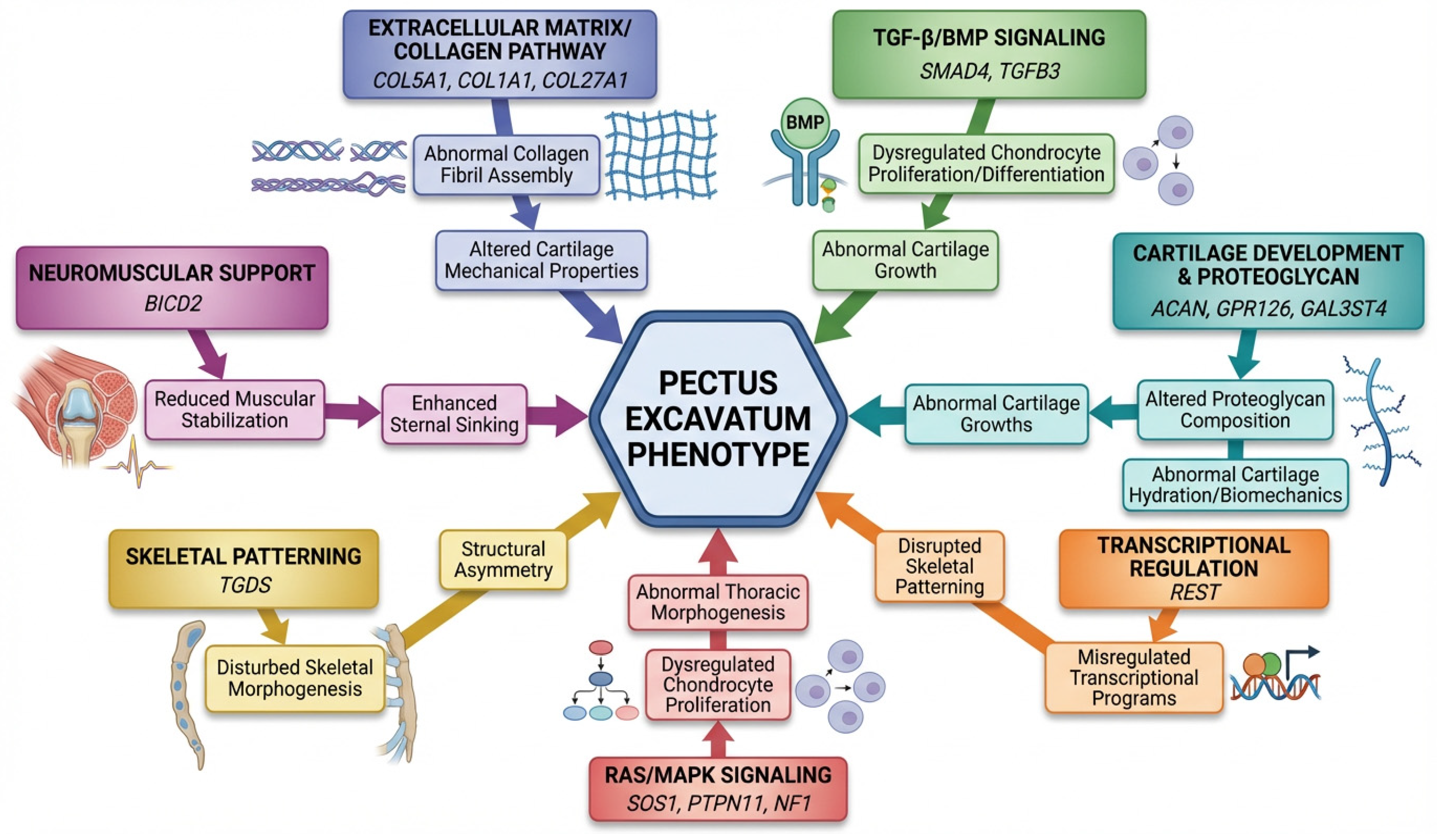
- Extracellular Matrix and Collagen Metabolism (COL5A1, COL1A1, COL27A1): COL5A1 regulates fibril diameter, which is critical for cartilage ultrastructure [28]. COL1A1 encodes the primary structural collagen in bone and costal cartilage [29]. COL27A1 is specific to cartilage and is essential for its structural integrity [30]. Abnormalities in collagen may alter mechanical properties, resulting in abnormal growth and chest wall deformity.
- 2.
- TGF-β/BMP Signaling (SMAD4, TGFB3): SMAD4 serves as the central mediator in TGF-β and BMP signaling cascades [31], while TGFB3 functions as a key upstream ligand [23]. These pathways regulate chondrocyte proliferation, differentiation, and hypertrophy during endochondral ossification [32]. Dysregulation of these processes has been implicated in skeletal abnormalities [33].
- 3.
- 4.
- 5.
- 6.
- 7.
- Neuromuscular Support (BICD2): Decreased anterior chest wall support may exacerbate existing structural vulnerabilities [23].
4. Discussion
4.1. Interpretation of Genetic Findings
4.2. Implications for Mendelian Randomization Studies
4.3. The Critical Need for Genome-Wide Association Studies
4.4. Biological Insights and Therapeutic Implications
4.5. Syndromic Versus Isolated PE
4.6. Limitations of Current Evidence
4.7. Recommendations for Future Research
5. Conclusions
Supplementary Materials
Author Contributions
Funding
Institutional Review Board Statement
Informed Consent Statement
Data Availability Statement
Conflicts of Interest
References
- Fokin, A.A.; Steuerwald, N.M.; Ahrens, W.A.; Allen, K.E. Anatomical, histologic, and genetic characteristics of congenital chest wall deformities. Semin. Thorac. Cardiovasc. Surg. 2009, 21, 44–57. [Google Scholar] [CrossRef] [PubMed]
- Jaroszewski, D.E.; Notrica, D.M.; McMahon, L.E.; Stout, M.J.; Cheng, G.; Sulkowski, J.P. Current management of pectus excavatum: A review and update of therapy and treatment recommendations. J. Am. Board. Fam. Med. 2016, 29, 230–242. [Google Scholar] [CrossRef] [PubMed]
- Brochhausen, C.; Turial, S.; Müller, F.K.; Schmitt, V.H.; Coerdt, W.; Wihlm, J.M.; Schier, F.; Kirkpatrick, C.J. Pectus excavatum: History, hypotheses and treatment options. Interact. Cardiovasc. Thorac. Surg. 2012, 14, 801–806. [Google Scholar] [CrossRef] [PubMed]
- Nuss, D.; Kelly, R.E., Jr. Indications and technique of Nuss procedure for pectus excavatum. Thorac. Surg. Clin. 2010, 20, 583–597. [Google Scholar] [CrossRef]
- Creswick, H.A.; Stacey, M.W.; Kelly, R.E., Jr.; Gustin, T.; Nuss, D.; Harvey, H.; Goretsky, M.J.; Vasser, E.; Welch, J.C.; Mitchell, K.; et al. Family study of the inheritance of pectus excavatum. J. Pediatr. Surg. 2006, 41, 1699–1703. [Google Scholar] [CrossRef]
- Janssen, N.; Coorens, N.A.; Franssen, A.J.P.M.; Daemen, J.H.T.; Michels, I.L.; Hulsewé, K.W.E.; Vissers, Y.L.J.; de Loos, E.R. Pectus excavatum and carinatum: A narrative review of epidemiology, etiopathogenesis, clinical features, and classification. J. Thorac. Dis. 2024, 16, 1687–1701. [Google Scholar] [CrossRef]
- Kotzot, D.; Schwabegger, A.H. Etiology of chest wall deformities—A genetic review for the treating physician. J. Pediatr. Surg. 2009, 44, 2004–2011. [Google Scholar] [CrossRef]
- Loeys, B.L.; Dietz, H.C.; Braverman, A.C.; Callewaert, B.L.; De Backer, J.; Devereux, R.B.; Hilhorst-Hofstee, Y.; Jondeau, G.; Faivre, L.; Milewicz, D.M.; et al. The revised Ghent nosology for the Marfan syndrome. J. Med. Genet. 2010, 47, 476–485. [Google Scholar]
- Malfait, F.; Francomano, C.; Byers, P.; Belmont, J.; Berglund, B.; Black, J.; Bloom, L.; Bowen, J.M.; Brady, A.F.; Burrows, N.P.; et al. The 2017 international classification of the Ehlers-Danlos syndromes. Am. J. Med. Genet. C Semin. Med. Genet. 2017, 175, 8–26. [Google Scholar] [CrossRef]
- Visscher, P.M.; Wray, N.R.; Zhang, Q.; Sklar, P.; McCarthy, M.I.; Brown, M.A.; Yang, J. 10 years of GWAS discovery: Biology, function, and translation. Am. J. Hum. Genet. 2017, 101, 5–22. [Google Scholar] [CrossRef]
- Burgess, S.; Small, D.S.; Thompson, S.G. A review of instrumental variable estimators for Mendelian randomization. Stat. Methods Med. Res. 2017, 26, 2333–2355. [Google Scholar] [CrossRef]
- Torkamani, A.; Wineinger, N.E.; Topol, E.J. The personal and clinical utility of polygenic risk scores. Nat. Rev. Genet. 2018, 19, 581–590. [Google Scholar] [CrossRef] [PubMed]
- Bamshad, M.J.; Ng, S.B.; Bigham, A.W.; Tabor, H.K.; Emond, M.J.; Nickerson, D.A.; Shendure, J. Exome sequencing as a tool for Mendelian disease gene discovery. Nat. Rev. Genet. 2011, 12, 745–755. [Google Scholar] [CrossRef] [PubMed]
- Ackert-Bicknell, C.L.; Anderson, L.C.; Sheehan, S.; Hill, W.G.; Chang, B.; Churchill, G.A.; Chesler, E.J.; Korstanje, R.; Peters, L.L. Mouse BMD quantitative trait loci show improved concordance with human genome-wide association loci when recalculated on a new, common mouse genetic map. J. Bone Min. Res. 2015, 30, 1434–1441. [Google Scholar] [CrossRef] [PubMed]
- Page, M.J.; McKenzie, J.E.; Bossuyt, P.M.; Boutron, I.; Hoffmann, T.C.; Mulrow, C.D.; Shamseer, L.; Tetzlaff, J.M.; Akl, E.A.; Brennan, S.E.; et al. The PRISMA 2020 statement: An updated guideline for reporting systematic reviews. BMJ 2021, 372, n71. [Google Scholar] [CrossRef]
- Wells, G.; Shea, S.; O’Connell, D.; Peterson, J.; Welch, V.; Losos, M.; Tugwell, P. The Newcastle-Ottawa Scale (NOS) for Assessing the Quality of Nonrandomised Studies in Meta-Analyses. 2000. Available online: http://www.ohri.ca/programs/clinical_epidemiology/oxford.asp (accessed on 1 November 2025).
- Gene Ontology Consortium. The Gene Ontology resource: Enriching a GOld mine. Nucleic Acids Res. 2021, 49, D325–D334. [Google Scholar] [CrossRef]
- Davey Smith, G.; Hemani, G. Mendelian randomization: Genetic anchors for causal inference in epidemiological studies. Hum. Mol. Genet. 2014, 23, R89–R98. [Google Scholar] [CrossRef]
- Farina, J.M.; Olson, R.J.; Dhamija, R.; Bofferding, A.; Sekulić, A. The complexity of familial inheritance in pectus excavatum: A ten-family exome sequencing analysis. Genes 2024, 15, 1429. [Google Scholar] [CrossRef]
- Cruz-Centeno, N.; Saenz-Maisonet, J.; López-Dones, P.; Santiago-Cornier, A.; Ortiz-Justiniano, V. Mutations in COL1A1 and COL27A1 associated with a pectus excavatum phenotype in 2 siblings with Osteogenesis imperfecta. Am. J. Case Rep. 2022, 23, e935526. [Google Scholar] [CrossRef]
- Bryant, G.; Moore, P.; Sathyamoorthy, M. The association of a single nucleotide variant in COL5A1 to early onset keratoconus and pectus excavatum. Medicina 2024, 60, 974. [Google Scholar] [CrossRef]
- Chelleri, C.; Scala, M.; De Marco, P.; Guerriero, V.; Ognibene, M.; Madia, F.; Guerrisi, S.; Di Duca, M.; Torre, M.; Tamburro, S.; et al. Somatic double inactivation of NF1 associated with NF1-related pectus excavatum deformity. Hum. Mutat. 2023, 2023, 3160653. [Google Scholar] [CrossRef] [PubMed]
- Billar, R.; Heyman, S.; Kant, S.; Wijnen, R.; Sleutels, F.; Demirdas, S.; Schnater, J.M. Early-onset pectus excavatum is more likely to be part of a genetic variation. Eur. J. Pediatr. Surg. 2024, 34, 325–332. [Google Scholar] [CrossRef] [PubMed]
- Yılmaz, M.; Güler, A.; Ayduk Gövdeli, E.; Karacan, M.; Babur Guler, G. A Noonan syndrome mimicking acute coronary syndrome. Turk Kardiyol. Dern. Ars. 2025, 53, 48–51. [Google Scholar]
- Stacey, M.W.; Neumann, S.A.; Dooley, A.; Segna, K. Variable number of tandem repeat polymorphisms (VNTRs) in the ACAN gene associated with pectus excavatum. Clin. Genet. 2010, 78, 502–504. [Google Scholar] [CrossRef]
- Karner, C.M.; Long, F.; Solnica-Krezel, L.; Monk, K.R.; Gray, R.S. Gpr126/Adgrg6 deletion in cartilage models idiopathic scoliosis and pectus excavatum in mice. Hum. Mol. Genet. 2015, 24, 4365–4373. [Google Scholar] [CrossRef]
- Gurnett, C.A.; Alaee, F.; Bowcock, A.; Kruse, L.; Lenke, L.G.; Bridwell, K.H.; Kuklo, T.; Luhmann, S.J.; Dobbs, M.B. Genetic linkage localizes an adolescent idiopathic scoliosis and pectus excavatum gene to chromosome 18q. Spine 2009, 34, E94–E100. [Google Scholar] [CrossRef]
- Shoulders, M.D.; Raines, R.T. Collagen structure and stability. Annu. Rev. Biochem. 2009, 78, 929–958. [Google Scholar] [CrossRef]
- Hjorten, R.; Hansen, U.; Underwood, R.A.; Telfer, H.E.; Fernandes, R.J.; Krakow, D.; Sebald, E.; Wachsmann-Hogiu, S.; Bruckner, P.; Jacquet, R.; et al. Type XXVII collagen at the transition of cartilage to bone during skeletogenesis. Bone 2007, 41, 535–542. [Google Scholar] [CrossRef]
- Massagué, J. TGFβ signalling in context. Nat. Rev. Mol. Cell Biol. 2012, 13, 616–630. [Google Scholar] [CrossRef]
- Wu, M.; Chen, G.; Li, Y.P. TGF-β and BMP signaling in osteoblast, skeletal development, bone formation, homeostasis and disease. Bone Res. 2016, 4, 16009. [Google Scholar] [CrossRef]
- Salazar, V.S.; Gamer, L.W.; Rosen, V. BMP signaling in skeletal development, disease and repair. Nat. Rev. Endocrinol. 2016, 12, 203–221. [Google Scholar] [CrossRef] [PubMed]
- Kiani, C.; Chen, L.; Wu, Y.J.; Yee, A.J.; Yang, B.B. Structure and function of aggrecan. Cell Res. 2002, 12, 19–32. [Google Scholar] [CrossRef] [PubMed]
- Hossain, M.Z.; Ao, P.; Boynton, A.L. Rapid disruption of gap junctional communication and phosphorylation of connexin43 by platelet-derived growth factor in T51B rat liver epithelial cells expressing platelet-derived growth factor receptor. J. Cell. Physiol. 1998, 174, 66–77. [Google Scholar] [CrossRef]
- Schoenherr, C.J.; Anderson, D.J. The neuron-restrictive silencer factor (NRSF): A coordinate repressor of multiple neuron-specific genes. Science 1995, 267, 1360–1363. [Google Scholar] [CrossRef]
- Centonze, E.; Marte, A.; Albini, M.; Rocchi, A.; Cesca, F.; Chiacchiaretta, M.; Floss, T.; Baldelli, P.; Ferroni, S.; Benfenati, F.; et al. Neuron-restrictive silencer factor/repressor element 1-silencing transcription factor (NRSF/REST) controls spatial K+ buffering in primary cortical astrocytes. J. Neurochem. 2023, 165, 701–721. [Google Scholar] [CrossRef]
- Feng, J.; Hu, T.; Liu, W.; Zhang, S.; Tang, Y.; Chen, R.; Jiang, X.; Wei, F. The biomechanical, morphologic, and histochemical properties of the costal cartilages in children with pectus excavatum. J. Pediatr. Surg. 2001, 36, 1770–1776. [Google Scholar] [CrossRef]
- Groth, K.A.; Hove, H.; Kyhl, K.; Folkestad, L.; Gaustadnes, M.; Vejlstrup, N.; Stochholm, K.; Østergaard, J.R.; Andersen, N.H.; Gravholt, C.H. Prevalence, incidence, and age at diagnosis in Marfan syndrome. Orphanet J. Rare Dis. 2015, 10, 153. [Google Scholar] [CrossRef]
- Judge, D.P.; Dietz, H.C. Marfan’s syndrome. Lancet 2005, 366, 1965–1976. [Google Scholar] [CrossRef]
- Malfait, F.; Wenstrup, R.J.; De Paepe, A. Clinical and genetic aspects of Ehlers-Danlos syndrome, classic type. Genet. Med. 2010, 12, 597–605. [Google Scholar] [CrossRef]
- Kou, I.; Takahashi, Y.; Johnson, T.A.; Takahashi, A.; Guo, L.; Dai, J.; Qiu, X.; Sharma, S.; Takimoto, A.; Ogura, Y.; et al. Genetic variants in GPR126 are associated with adolescent idiopathic scoliosis. Nat. Genet. 2013, 45, 676–679. [Google Scholar] [CrossRef]
- Romano, A.A.; Allanson, J.E.; Dahlgren, J.; Gelb, B.D.; Hall, B.; Pierpont, M.E.; Roberts, A.E.; Robinson, W.; Takemoto, C.M.; Noonan, J.A. Noonan syndrome: Clinical features, diagnosis, and management guidelines. Pediatrics 2010, 126, 746–759. [Google Scholar] [CrossRef]
- Fragale, A.; Tartaglia, M.; Wu, J.; Gelb, B.D. Noonan syndrome-associated SHP2/PTPN11 mutants cause EGF-dependent prolonged GAB1 binding and sustained ERK2/MAPK1 activation. Hum. Mutat. 2004, 23, 267–277. [Google Scholar] [CrossRef] [PubMed]
- Marini, J.C.; Forlino, A.; Bächinger, H.P.; Bishop, N.J.; Byers, P.H.; Paepe, A.; Fassier, F.; Fratzl-Zelman, N.; Kozloff, K.M.; Krakow, D.; et al. Osteogenesis imperfecta. Nat. Rev. Dis. Primers 2017, 3, 17052. [Google Scholar] [CrossRef] [PubMed]
- Gleghorn, L.; Ramesar, R.; Beighton, P.; Wallis, G. A mutation in the variable repeat region of the aggrecan gene (AGC1) causes a form of spondyloepiphyseal dysplasia associated with severe, premature osteoarthritis. Am. J. Hum. Genet. 2005, 77, 484–490. [Google Scholar] [CrossRef] [PubMed]
- Doege, K.J.; Coulter, S.N.; Meek, L.M.; Maslen, K.; Wood, J.G. A human-specific polymorphism in the coding region of the aggrecan gene. Variable number of tandem repeats produce a range of core protein sizes in the general population. J. Biol. Chem. 1997, 272, 13974–13979. [Google Scholar] [CrossRef]
- Birk, D.E.; Fitch, J.M.; Babiarz, J.P.; Doane, K.J.; Linsenmayer, T.F. Collagen fibrillogenesis in vitro: Interaction of types I and V collagen regulates fibril diameter. J. Cell Sci. 1990, 95, 649–657. [Google Scholar] [CrossRef]
- Loeys, B.L.; Chen, J.; Neptune, E.R.; Judge, D.P.; Podowski, M.; Holm, T.; Meyers, J.; Leitch, C.C.; Katsanis, N.; Sharifi, N.; et al. A syndrome of altered cardiovascular, craniofacial, neurocognitive and skeletal development caused by mutations in TGFBR1 or TGFBR2. Nat. Genet. 2005, 37, 275–281. [Google Scholar] [CrossRef]
- Emdin, C.A.; Khera, A.V.; Kathiresan, S. Mendelian randomization. JAMA 2017, 318, 1925–1926. [Google Scholar] [CrossRef]
- Haller, J.A., Jr.; Kramer, S.S.; Lietman, S.A. Use of CT scans in selection of patients for pectus excavatum surgery: A preliminary report. J. Pediatr. Surg. 1987, 22, 904–906. [Google Scholar]
- Buniello, A.; MacArthur, J.A.L.; Cerezo, M.; Harris, L.W.; Hayhurst, J.; Malangone, C.; McMahon, A.; Morales, J.; Mountjoy, E.; Sollis, E.; et al. The NHGRI-EBI GWAS Catalog of published genome-wide association studies, targeted arrays and summary statistics 2019. Nucleic Acids Res. 2019, 47, D1005–D1012. [Google Scholar] [CrossRef]
- Sudlow, C.; Gallacher, J.; Allen, N.; Beral, V.; Burton, P.; Danesh, J.; Downey, P.; Elliott, P.; Green, J.; Landray, M.; et al. UK Biobank: An open access resource for identifying the causes of a wide range of complex diseases of middle and old age. PLoS Med. 2015, 12, e1001779. [Google Scholar] [CrossRef]
- Spencer, C.C.A.; Su, Z.; Donnelly, P.; Marchini, J. Designing genome-wide association studies: Sample size, power, imputation, and the choice of genotyping chip. PLoS Genet. 2009, 5, e1000477. [Google Scholar] [CrossRef] [PubMed]
- Boyera, N.; Galey, I.; Bernard, B.A. Effect of vitamin C and its derivatives on collagen synthesis and cross-linking by normal human fibroblasts. Int. J. Cosmet. Sci. 1998, 20, 151–158. [Google Scholar] [CrossRef] [PubMed]
- Grafe, I.; Alexander, S.; Peterson, J.R.; Snider, T.N.; Levi, B.; Lee, B.; Mishina, Y. TGF-β family signaling in mesenchymal differentiation. Cold Spring Harb. Perspect. Biol. 2018, 10, a022202. [Google Scholar] [CrossRef] [PubMed]
- Knudson, A.G., Jr. Mutation cancer: Statistical study of retinoblastoma. Proc. Natl. Acad. Sci. USA 1971, 68, 820–823. [Google Scholar] [CrossRef]
- Takahashi, Y.; Kou, I.; Takahashi, A.; Johnson, T.A.; Kono, K.; Kawakami, N.; Uno, K.; Ito, M.; Minami, S.; Yanagida, H.; et al. A genome-wide association study identifies common variants near LBX1 associated with adolescent idiopathic scoliosis. Nat. Genet. 2011, 43, 1237–1240. [Google Scholar] [CrossRef]
- Fokin, A.A.; Robicsek, F. Poland’s syndrome revisited. Ann. Thorac. Surg. 2002, 74, 2218–2225. [Google Scholar] [CrossRef]
- Andreescu, N.; Sharma, A.; Mihailescu, A.; Zimbru, C.G.; David, V.L.; Horhat, R.; Kundnani, N.R.; Puiu, M.; Farcas, S. Chest wall deformities and their possible associations with different genetic syndromes. Eur. Rev. Med. Pharmacol. Sci. 2022, 26, 5107–5114. [Google Scholar]
- Cobben, J.M.; Oostra, R.J.; van Dijk, F.S. Pectus excavatum and carinatum. Eur. J. Med. Genet. 2014, 57, 414–417. [Google Scholar] [CrossRef]
- Tocchioni, F.; Ghionzoli, M.; Messineo, A.; Romagnoli, P. Pectus excavatum and heritable disorders of the connective tissue. Pediatr. Rep. 2013, 5, e15. [Google Scholar] [CrossRef]
- Kloth, K.; Klohs, S.; Bhullar, J.; Boettcher, M.; Hempel, M.; Trah, J.; Reinshagen, K. The Epidemiology behind Pectus Excavatum: Clinical Study and Review of the Literature. Eur. J. Pediatr. Surg. 2022, 32, 316–320. [Google Scholar]
- David, V.L. Current Concepts in the Etiology and Pathogenesis of Pectus Excavatum in Humans—A Systematic Review. J. Clin. Med. 2022, 11, 1241. [Google Scholar] [CrossRef]
- Małek, Ł.; Lemańska, A.; Śpiewak, M. Pectus Excavatum-A Frequent but Often Neglected Entity in Sports Cardiology. Diagnostics 2025, 15, 2956. [Google Scholar]
- Lauffer, P.; van Weelden, W.; van Haelst, M.M.; Jansen, P.R. Polygenic risk scores in routine genetic diagnostics: What lies ahead? J. Community Genet. 2025, 17, 8. [Google Scholar] [CrossRef]
- van Polen, E.J.; Janssen, N.; Daemen, J.H.T.; Franssen, A.J.P.M.; de Groot, E.P.; van Roozendaal, L.M.; Hulsewé, K.W.E.; Vissers, Y.L.J.; de Loos, E.R. To screen or not to screen: The importance of early detection of pectus excavatum. Transl. Pediatr. 2025, 14, 529–532. [Google Scholar] [CrossRef]
- Nagib, N.; Avila, D.; Denham, A.L.; Montanez, P. Developmental and Genetic Considerations in a Neonate with Pectus Excavatum, Bilateral Hydroceles, Indirect Inguinal Hernia, and Type 2 Ileal Atresia. Cureus 2025, 17, e78350. [Google Scholar] [CrossRef]
- Turturro, F.; Calderaro, C.; Montanaro, A.; Labianca, L.; Argento, G.; Ferretti, A. Isolated asymptomatic short sternum in a healthy young girl. Case Rep. Radiol. 2014, 2014, 761582. [Google Scholar] [CrossRef]



| Gene | Chromosome | Study Type | Sample Size | Variant Type | Biological Function |
|---|---|---|---|---|---|
| REST [19] | 4q12 | Family exome sequencing | 10 families, 10 cases | Missense variant (c.70A>G; p.Met24Val) | Transcriptional repression |
| SMAD4 [19] | 18q21.2 | Family exome sequencing | 10 families, 10 cases | Promoter-region variant (c.-69G>A) | TGF-β/BMP signaling |
| COL5A1 [19,21] | 9q34.2-q34.3 | Family exome sequencing; Case report | 10 families; 10 patients | 5′UTR regulatory variant; intronic splice-altering variant | Type V collagen, extracellular matrix |
| COL1A1 [20] | 17q21.33 | Case report | 2 siblings | Copy number gain | Type I collagen, extracellular matrix |
| COL27A1 [20] | 9q32 | Case report | 2 siblings | Missense variant (p.Gly697Arg) | Type XXVII collagen, cartilage ECM organization and cartilage-to-bone transition |
| NF1 [22] | 17q11.2 | Case report | 1 case | Germline and somatic frameshift variants | Tumor suppressor; RAS/MAPK pathway |
| BICD2 [23] | 9q22.31 | Cohort study | 11 cases | Pathogenic variant (neuromuscular disorder) | Intracellular transport; motor neuron function |
| TGDS [23] | 13q32.1 | Cohort study | 11 cases | Pathogenic variant (Catel–Manzke syndrome) | Skeletal development |
| SOS1 [23] | 2p22.1 | Cohort study | 11 cases | Pathogenic variant (Noonan syndrome) | RAS/MAPK signaling |
| TGFB3 [23] | 14q24.3 | Cohort study | 11 cases | Pathogenic variant (Loeys–Dietz syndrome) | TGF-β signaling; connective-tissue regulation |
| PTPN11 [23,24] | 12q24.13 | Case report | 1 patient | Missense and Pathogenic variant | Protein tyrosine phosphatase; RAS/MAPK signaling |
| ACAN [25] | 15q26.1 | Case–control | 158 cases | VNTR polymorphism (27-repeat allele) | Cartilage proteoglycan |
| GPR126 [26] | 6q24.1 | Mouse model | Mouse | Deletion | Chondrocyte differentiation |
| GAL3ST4 [26] | 1q42.3 | Mouse model | Mouse | Upregulation | Proteoglycan sulfation |
| Unknown locus [27] | 18q | Linkage analysis | 1 large family (23 family members) | Linkage peak (LOD score 3.86); no mutation identified | Unknown |
| Required Data Element | Available for PE? | Notes |
|---|---|---|
| SNP rsID | No | All variants are rare or private to families; no common SNPs reported |
| Effect allele/Other allele | No | Allelic effects not specified in any study |
| Beta coefficient or Odds ratio | No | No quantitative effect sizes reported from population studies |
| Standard error or 95% CI | No | Precision estimates not provided |
| p-value (genome-wide significant) | No | No GWAS conducted; no p < 5 × 10⁻⁸ associations |
| Effect allele frequency | No | Population-level allele frequencies not reported |
| Sample size (cases/controls) | No | No population-based case–control studies with genetic data |
| Independent replication | No | No findings replicated in independent cohorts |
| MR Feasibility | Not possible | No genetic instruments available |
Disclaimer/Publisher’s Note: The statements, opinions and data contained in all publications are solely those of the individual author(s) and contributor(s) and not of MDPI and/or the editor(s). MDPI and/or the editor(s) disclaim responsibility for any injury to people or property resulting from any ideas, methods, instructions or products referred to in the content. |
© 2026 by the authors. Licensee MDPI, Basel, Switzerland. This article is an open access article distributed under the terms and conditions of the Creative Commons Attribution (CC BY) license.
Share and Cite
Ranjan, R.; Imtiaz, N.; Waterhouse, B.; Paul, I.; Brunswicker, A.; Dunning, J. Genetic Associations with Pectus Excavatum: A Systematic Review. Curr. Issues Mol. Biol. 2026, 48, 122. https://doi.org/10.3390/cimb48010122
Ranjan R, Imtiaz N, Waterhouse B, Paul I, Brunswicker A, Dunning J. Genetic Associations with Pectus Excavatum: A Systematic Review. Current Issues in Molecular Biology. 2026; 48(1):122. https://doi.org/10.3390/cimb48010122
Chicago/Turabian StyleRanjan, Redoy, Nafiz Imtiaz, Benjamin Waterhouse, Ian Paul, Annemarie Brunswicker, and Joel Dunning. 2026. "Genetic Associations with Pectus Excavatum: A Systematic Review" Current Issues in Molecular Biology 48, no. 1: 122. https://doi.org/10.3390/cimb48010122
APA StyleRanjan, R., Imtiaz, N., Waterhouse, B., Paul, I., Brunswicker, A., & Dunning, J. (2026). Genetic Associations with Pectus Excavatum: A Systematic Review. Current Issues in Molecular Biology, 48(1), 122. https://doi.org/10.3390/cimb48010122