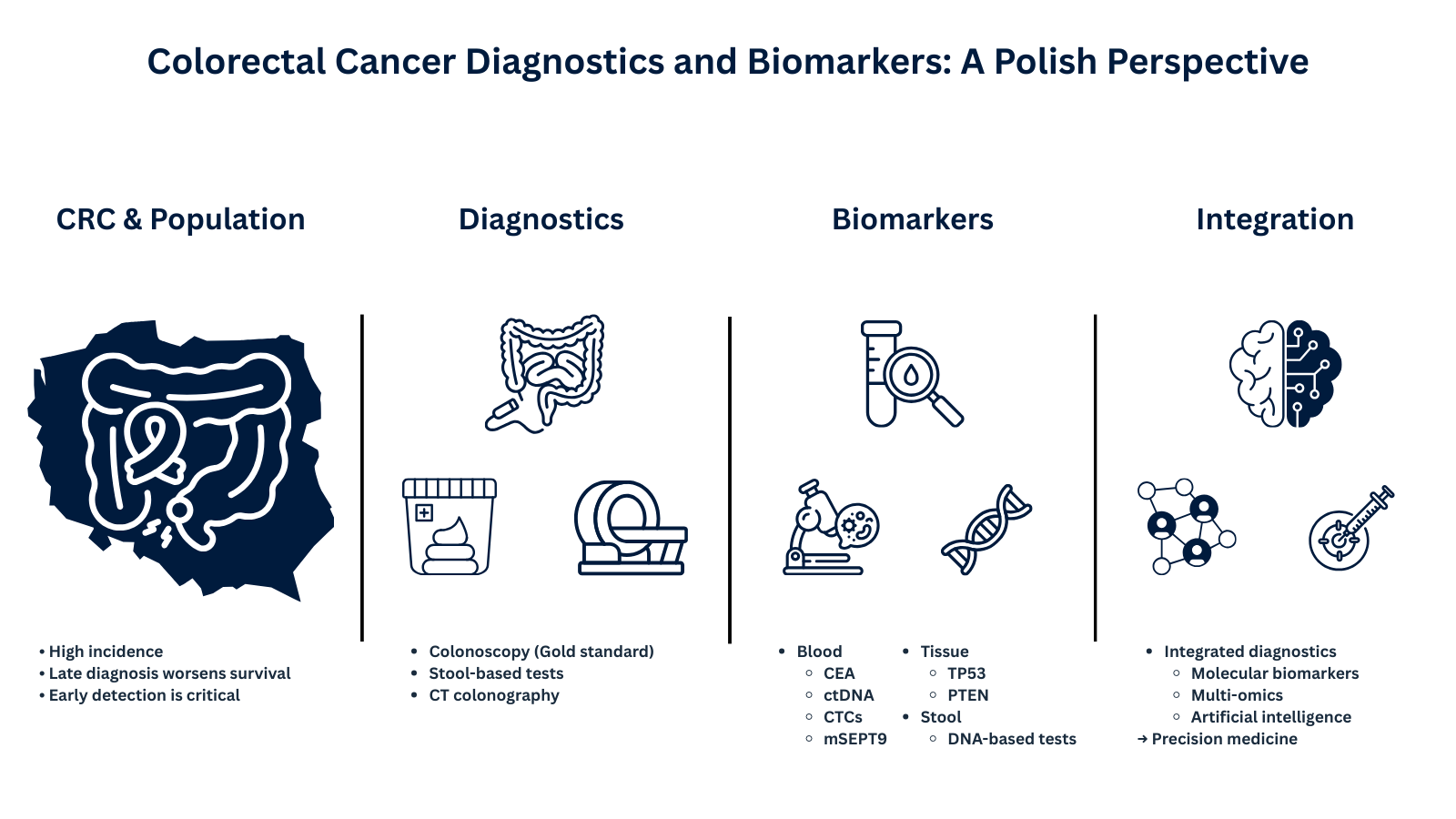
Diagnostic Pathways and Molecular Biomarkers in Colorectal Cancer: Current Evidence and Perspectives in Poland


Abstract
1. Introduction
2. Literature Search
2.1. Methodological Framework
2.2. Screening for Colorectal Cancer

| Method | Mechanism of Action | Sensitivity | Specificity | Remarks |
|---|---|---|---|---|
| gFOBT | Detects heme peroxidase activity | 19.3–44.1% | 65.0–99.0% | Results may be false positives due to diet or medications. |
| FIT | Detects antibodies specific to human hemoglobin | 79–80.4% | 93.5–94% | No need for dietary restrictions, better patient acceptability, preferred method in many countries. |
| Mt-sDNA | Detects occult blood and genetic markers | 74–86% | 85–94% | High sensitivity and specificity, effective tool in CRC diagnostics. |
2.3. CRC Early Detection Recommendations in Poland
- Genetic markers—mutations in specific genes, e.g., KRAS, NRAS, BRAF.
- Epigenetic markers—DNA methylation changes, e.g., SEPT9.
- Protein markers—proteins secreted by tumor cells or their microenvironment, e.g., CEA.
- MicroRNA (miRNA) markers—short RNA molecules regulating gene expression, e.g., miR-21.
- By clinical application, markers are classified as:
- Diagnostic markers—allow detection of an ongoing neoplastic process, e.g., methylated SEPT9 (mSEPT9), a test based on detection of methylated SEPT9 DNA in patient plasma; TAG-72; circulating miRNAs (c-miRNA); p53.
- Prognostic markers—help determine patient prognosis, e.g., BRAF mutation in CRC, associated with worse outcomes; TAG-72; circulating tumor cells (CTCs); circulating tumor DNA (ctDNA); c-miRNA; p53; PTEN.
- Predictive markers—indicate response to specific therapies, e.g., KRAS and NRAS mutations in CRC predict resistance to anti-EGFR therapy; ctDNA; PTEN.
- Monitoring markers—used to assess treatment effectiveness and detect recurrence, e.g., CEA, CA 19-9, TPS, TAG-72, CTCs, ctDNA, c-miRNA.
- By biological material analyzed, markers include:
- Serum markers—present in patient blood, e.g., carbohydrate antigen CEA.
- Tissue markers—present in surgical material, e.g., TP53 and PTEN mutations detected in paraffin-embedded tumor samples.
- Stool markers—present in fecal material, e.g., sDNA-FIT screening tests.
- Urinary markers, e.g., c-miRNA, are detectable in the early stages of CRC.
2.4. Selected Markers of Colorectal Cancer
3. Emerging Multi-Omics and AI-Driven Approaches in CRC Biomarker Discovery
4. Challenges in Clinical Translation and Access to Molecular Diagnostics
5. Conclusions
Funding
Data Availability Statement
Acknowledgments
Conflicts of Interest
Abbreviations
| CRC | Colorectal cancer |
| FAP | Familial adenomatous polyposis; |
| HMPS | Hereditary mixed polyposis syndrome |
| HNPCC | Hereditary non-polyposis colorectal cancer, Lynch syndrome; associated polyposis |
| MAP | MUTYH-associated polyposis |
| MUTYH | base excision repair gene; biallelic mutations predispose to colorectal cancer. |
| 5-FU | 5-fluorouracil |
| CEA | carcinoembryonic antigen |
| CT | computed tomography |
| MRI | magnetic resonance imaging |
| FOBT | fecal occult blood testing |
| FIT | fecal immunochemical testing |
| sDNA-FIT | stool DNA testing |
| miRNA | MicroRNA |
| mSEPT9 | methylated SEPT9 |
| CTCs | circulating tumor cells |
| ctDNA | circulating tumor DNA |
| CA 19-9 | Carbohydrate antigen 19-9 |
| TPS | Tissue polypeptide-specific antigen |
| TAG-72 | Tumor-associated glycoprotein 72 |
| CA 72-4 | Carbohydrate antigen 72-4 |
| CIN | chromosomal instability |
| MSI | microsatellite instability |
| PTEN | Phosphatase and tensin homolog |
| CIMP | CpG island methylator phenotype |
References
- Sawicki, T.; Ruszkowska, M.; Danielewicz, A.; Niedźwiedzka, E.; Arłukowicz, T.; Przybyłowicz, K.E. Review of Colorectal Cancer in Terms of Epidemiology, Risk Factors, Development, Symptoms, and Diagnosis. Cancers 2021, 13, 2025. [Google Scholar] [CrossRef] [PubMed] [PubMed Central]
- Johnson, C.M.; Wei, C.; Ensor, J.E.; Smolenski, D.J.; Amos, C.I.; Levin, B.; Berry, D.A. Meta-analyses of colorectal cancer risk factors. Cancer Causes Control 2013, 24, 1207–1222. [Google Scholar] [CrossRef] [PubMed] [PubMed Central]
- Shah, S.C.; Itzkowitz, S.H. Colorectal Cancer in Inflammatory Bowel Disease: Mechanisms and Management. Gastroenterology 2022, 162, 715–730.e3. [Google Scholar] [CrossRef] [PubMed] [PubMed Central]
- Saraiva, M.R.; Rosa, I.; Claro, I. Early-onset colorectal cancer: A review of current knowledge. World J. Gastroenterol. 2023, 29, 1289–1303. [Google Scholar] [CrossRef] [PubMed] [PubMed Central]
- Syngal, S.; Brand, R.E.; Church, J.M.; Giardiello, F.M.; Hampel, H.L.; Burt, R.W.; Konrad, T.; Morgan, D.R.; Petersen, G.M.; Lindor, N.M.; et al. ACG clinical guideline: Genetic testing and management of hereditary gastrointestinal cancer syndromes. Am. J. Gastroenterol. 2015, 110, 223–262; quiz 263. [Google Scholar] [CrossRef] [PubMed] [PubMed Central]
- Janus-Szymańska, G.; Doraczyńska-Kowalik, A.; Bębenek, M.; Cisarz, E.; Gil, J. Fundamentals of personalized medicine in colorectal cancer. Nowotw. J. Oncol. 2021, 71, 52–61. [Google Scholar] [CrossRef]
- Hegde, M.; Ferber, M.; Mao, R.; Samowitz, W.; Ganguly, A. Working Group of the American College of Medical Genetics and Genomics (ACMG) Laboratory Quality Assurance Committee. ACMG technical standards and guidelines for genetic testing for inherited colorectal cancer (Lynch syndrome, familial adenomatous polyposis, and MYH-associated polyposis). Genet. Med. 2014, 16, 101–116. [Google Scholar] [CrossRef] [PubMed]
- Xie, Y.H.; Chen, Y.X.; Fang, J.Y. Comprehensive review of targeted therapy for colorectal cancer. Signal Transduct. Target. Ther. 2020, 5, 22. [Google Scholar] [CrossRef] [PubMed] [PubMed Central]
- Hong, Y.; Kim, J.; Choi, Y.J.; Lee, S.H.; Park, J.H.; Jeong, H.; Kim, H.; Cho, M.J.; Lim, S.B. Clinical study of colorectal cancer operation: Survival analysis. Korean J. Clin. Oncol. 2020, 16, 3–8. [Google Scholar] [CrossRef] [PubMed] [PubMed Central]
- O’Connell, J.B.; Maggard, M.A.; Ko, C.Y. Colon cancer survival rates with the new American Joint Committee on Cancer sixth edition staging. J. Natl. Cancer. Inst. 2004, 96, 1420–1425. [Google Scholar] [CrossRef] [PubMed]
- Ilyas, M.I.M. Epidemiology of Stage IV Colorectal Cancer: Trends in the Incidence, Prevalence, Age Distribution, and Impact on Life Span. Clin. Colon. Rectal. Surg. 2023, 37, 57–61. [Google Scholar] [CrossRef] [PubMed] [PubMed Central]
- Botrel, T.E.A.; Clark, L.G.O.; Paladini, L.; Yi, J.; Moreira, L.M.; Mattei, J.; Ferreira, C.R.O.; Falcao, C.B.; Mello, M.F.; da Silva, G.B.; et al. Efficacy and safety of bevacizumab plus chemotherapy compared to chemotherapy alone in previously untreated advanced or metastatic colorectal cancer: A systematic review and meta-analysis. BMC Cancer 2016, 16, 677. [Google Scholar] [CrossRef] [PubMed] [PubMed Central]
- Yaffee, P.; Osipov, A.; Tan, C.; Tomeh, C.A.; Cai, L.; Neugut, A.I.; Bhutani, M.S. Review of systemic therapies for locally advanced and metastatic rectal cancer. J. Gastrointest. Oncol. 2015, 6, 185–200. [Google Scholar] [CrossRef] [PubMed] [PubMed Central]
- Didkowska, J.; Wojciechowska, U. Nowotwory Złośliwe w Polsce w 2021 Roku; Centrum Onkologii—Instytut im. Marii Skłodowskiej-Curie: Warszawa, Poland, 2023; Available online: https://onkologia.org.pl/sites/default/files/publications/2024-01/0_krn-2023-book-2024-01-22.pdf (accessed on 20 October 2025).
- Anand, S.; Liang, P.S. A Practical Overview of the Stool DNA Test for Colorectal Cancer Screening. Clin. Transl. Gastroenterol. 2022, 13, e00464. [Google Scholar] [CrossRef] [PubMed] [PubMed Central]
- Wang, X.; Cao, L.; Song, X.; Zhang, Y.; Li, H.; Chen, Y.; Liu, J.; Huang, Q.; Zhao, R.; Xu, T.; et al. Is flexible sigmoidoscopy screening associated with reducing colorectal cancer incidence and mortality? A meta-analysis and systematic review. Front. Oncol. 2023, 13, 1288086. [Google Scholar] [CrossRef] [PubMed] [PubMed Central]
- Kindt, I.S.; Martiny, F.H.J.; Gram, E.G.; Jørgensen, J.C.; Larsen, M.L.B.; Nielsen, K.R.; Andersen, B.R.; Pedersen, D.M.; Sørensen, H.T.; Thomsen, R.W.; et al. The risk of bleeding and perforation from sigmoidoscopy or colonoscopy in colorectal cancer screening: A systematic review and meta-analyses. PLoS ONE 2023, 18, e0292797. [Google Scholar] [CrossRef] [PubMed] [PubMed Central]
- Gupta, S. Screening for Colorectal Cancer. Hematol. Oncol. Clin. N. Am. 2022, 36, 393–414. [Google Scholar] [CrossRef] [PubMed] [PubMed Central]
- Jain, S.; Maque, J.; Galoosian, A.; Greenwald, E.; Wu, X.; O’Connell, T.B.; Banerjee, S. Optimal strategies for colorectal cancer screening. Curr. Treat. Options Oncol. 2022, 23, 474–493. [Google Scholar] [CrossRef] [PubMed] [PubMed Central]
- Bagheri, R.; Ghorbian, M.; Ghorbian, S. Tumor circulating biomarkers in colorectal cancer. Cancer Treat. Res. Commun. 2024, 38, 100787. [Google Scholar] [CrossRef] [PubMed]
- Lin, J.S.; Perdue, L.A.; Henrikson, N.B.; Bean, S.; Blasi, P.R.; Curry, S.J.; Doroshenk, M.; Hovden, A.O.; Humphrey, L.L.; Krist, A.H.; et al. Screening for Colorectal Cancer: An Evidence Update for the U.S. Preventive Services Task Force; Report No.: 20-05271-EF-1; Agency for Healthcare Research and Quality: Rockville, MD, USA, 2021. [Google Scholar] [PubMed]
- Gini, A.; Jansen, E.E.L.; Zielonke, N.; Meester, R.G.S.; Gupta, S.; Senore, C.; Segnan, N.; Atkin, W.S.; Lauby-Secretan, B.; Løberg, M.; et al. Impact of colorectal cancer screening on cancer-specific mortality in Europe: A systematic review. Eur. J. Cancer 2020, 127, 224–235. [Google Scholar] [CrossRef] [PubMed]
- Brenner, H.; Chang-Claude, J.; Jansen, L.; Knebel, P.; Stock, C.; Hoffmeister, M.; Brenner, G.; Schöttker, B.; Segnan, N.; Senore, C.; et al. Reduced risk of colorectal cancer up to 10 years after screening, surveillance, or diagnostic colonoscopy. Gastroenterology 2014, 146, 709–717. [Google Scholar] [CrossRef] [PubMed]
- Wu, Z.; Li, Y.; Zhang, Y.; Liang, L.; Wang, L.; Wang, N.; Liu, Q.; Chen, X.; Zhao, Y.; Yang, S.; et al. Colorectal cancer screening methods and molecular markers for early detection. Technol. Cancer Res. Treat. 2020, 19, 1533033820980426. [Google Scholar] [CrossRef] [PubMed] [PubMed Central]
- US Preventive Services Task Force; Davidson, K.W.; Barry, M.J.; Mangione, C.M.; Cabana, M.; Caughey, A.B.; Davis, E.M.; Donahue, K.E.; Doubeni, C.A.; Krist, A.H.; et al. Screening for colorectal cancer: U.S. Preventive Services Task Force recommendation statement. JAMA 2021, 325, 1965–1977, Erratum in JAMA 2021, 326, 773. https://doi.org/10.1001/jama.2021.12404. [Google Scholar] [CrossRef] [PubMed]
- Wolf, A.M.D.; Fontham, E.T.H.; Church, T.R.; Flowers, C.R.; Guerra, C.E.; LaMonte, S.J.; Etzioni, R.; McKenna, M.T.; Oeffinger, K.C.; Shih, Y.T.; et al. Colorectal cancer screening for average-risk adults: 2018 guideline update from the American Cancer Society. CA Cancer J. Clin. 2018, 68, 250–281. [Google Scholar] [CrossRef] [PubMed]
- Shaukat, A.; Kahi, C.J.; Burke, C.A.; Rabeneck, L.; Sauer, B.G.; Rex, D.K.; Ladabaum, U.; Farraye, F.A.; Heitman, S.J.; Lieberman, D.A.; et al. ACG clinical guidelines: Colorectal cancer screening 2021. Am. J. Gastroenterol. 2021, 116, 458–479. [Google Scholar] [CrossRef] [PubMed]
- Canadian Task Force on Preventive Health Care. Recommendations on screening for colorectal cancer in primary care. CMAJ 2016, 188, 340–348. [Google Scholar] [CrossRef] [PubMed] [PubMed Central]
- Burch, J.A.; Soares-Weiser, K.; St John, D.J.; Hyde, C.J.; Ryan, M.; Keeling, N.J.; Thorpe, S. Diagnostic accuracy of faecal occult blood tests used in screening for colorectal cancer: A systematic review. J. Med. Screen. 2007, 14, 132–137. [Google Scholar] [CrossRef] [PubMed]
- Imperiale, T.F.; Gruber, R.N.; Stump, T.E.; Emmett, T.W.; Monahan, P.O.; Krist, A.H. Performance characteristics of fecal immunochemical tests for colorectal cancer and advanced adenomatous polyps: A systematic review and meta-analysis. Ann. Intern. Med. 2019, 170, 319–329. [Google Scholar] [CrossRef] [PubMed]
- Lee, J.K.; Liles, E.G.; Bent, S.; Levin, T.R.; Corley, D.A. Accuracy of fecal immunochemical tests for colorectal cancer: Systematic review and meta-analysis. Ann. Intern. Med. 2014, 160, 171. [Google Scholar] [CrossRef] [PubMed] [PubMed Central]
- Meklin, J.; SyrjÄnen, K.; Eskelinen, M. Fecal Occult Blood Tests in Colorectal Cancer Screening: Systematic Review and Meta-analysis of Traditional and New-generation Fecal Immunochemical Tests. Anticancer Res. 2020, 40, 3591–3604. [Google Scholar] [CrossRef] [PubMed]
- Colorectal Cancer Screening Program. Available online: https://www.nfz.gov.pl/dla-pacjenta/programy-profilaktyczne/program-badan-przesiewowych-raka-jelita-grubego/ (accessed on 20 October 2025).
- Available online: https://bip.aotm.gov.pl/assets/files/ppz/2024/RPT/22.02.23_RAPORT_zalec_techn_art_48aa_RJG.pdf (accessed on 20 October 2025).
- Kankanala, V.L.; Zubair, M.; Mukkamalla, S.K.R. Carcinoembryonic Antigen. In StatPearls [Internet]; StatPearls Publishing: Treasure Island, FL, USA, 2025. [Google Scholar] [PubMed]
- Nicholson, B.D.; Shinkins, B.; Pathiraja, I.; Roberts, N.W.; James, T.; Mallett, S.; Perera, R.; Primrose, J.N.; Mant, D. Blood CEA levels for detecting recurrent colorectal cancer. Cochrane Database Syst. Rev. 2015, 2015, CD011134. [Google Scholar] [CrossRef] [PubMed] [PubMed Central]
- Meira-Júnior, J.D.; Costa, T.N.; Montagnini, A.L.; Nahas, S.C.; Jukemura, J. Elevated CA 19-9 in an asymptomatic patient: What does it mean? Arq. Bras. Cir. Dig. 2022, 35, e1687. [Google Scholar] [CrossRef] [PubMed] [PubMed Central]
- Song, L.; Jia, J.; Peng, X.; Xiao, W.; Li, Y.; Wang, X.; Li, H.; Li, J.; Liu, J.; Zhang, Y.; et al. The performance of the SEPT9 gene methylation assay and a comparison with other CRC screening tests: A meta-analysis. Sci. Rep. 2017, 7, 3032. [Google Scholar] [CrossRef] [PubMed] [PubMed Central]
- Church, T.R.; Wandell, M.; Lofton-Day, C.; Mongin, S.J.; Burger, M.; Payne, S.R.; Castaños-Vélez, E.; Blumenstein, B.A.; Rösch, T.; Osborn, N.; et al. Prospective evaluation of methylated SEPT9 in plasma for detection of asymptomatic colorectal cancer. Gut 2014, 63, 317–325. [Google Scholar] [CrossRef] [PubMed] [PubMed Central]
- Nian, J.; Sun, X.; Ming, S.; Yan, C.; Ma, Y.; Feng, Y.; Yang, L.; Wang, X.; Yang, J.; Li, H.; et al. Diagnostic accuracy of methylated SEPT9 for blood-based colorectal cancer detection: A systematic review and meta-analysis. Clin. Transl. Gastroenterol. 2017, 8, e216. [Google Scholar] [CrossRef] [PubMed] [PubMed Central]
- Li, R.; Chen, J.; Shen, X.; Zhang, Y.; Liu, Z.; Wang, L.; Zhao, Q.; Huang, J.; Li, Y.; Zhou, H.; et al. A study of the clinical significance of mSEPT9 in monitoring recurrence and prognosis in patients with surgically treated colorectal cancer. PLoS ONE 2024, 19, e0312676. [Google Scholar] [CrossRef] [PubMed] [PubMed Central]
- Lu, D.C.; Zhang, Q.F.; Li, L.; Zhang, Y.; Wang, X.; Liu, J.; Zhao, R.; Chen, Y.; Huang, Q.; Xu, T.; et al. Methylated Septin9 has moderate diagnostic value in colorectal cancer detection in Chinese population: A multicenter study. BMC Gastroenterol. 2022, 22, 232. [Google Scholar] [CrossRef] [PubMed] [PubMed Central]
- Jelski, W.; Mroczko, B. Biochemical Markers of Colorectal Cancer—Present and Future. Cancer Manag. Res. 2020, 12, 4789–4797. [Google Scholar] [CrossRef] [PubMed] [PubMed Central]
- Borgmästars, E.; Lundberg, E.; Öhlund, D.; Rosendahl, A.; Nilsson, B.; Falkmer, U.; Ingvar, C.; Nordgren, S.; Andersson, R.; Björck, S.; et al. Circulating tissue polypeptide-specific antigen in pre-diagnostic pancreatic cancer samples. Cancers 2021, 13, 5321. [Google Scholar] [CrossRef] [PubMed] [PubMed Central]
- Duffy, M.J.; McDermott, E.W.; Crown, J. Blood-based biomarkers in breast cancer: From proteins to circulating tumor cells to circulating tumor DNA. Tumour Biol. 2018, 40, 1010428318776169. [Google Scholar] [CrossRef] [PubMed]
- Rupert, K.; Holubec, L.; Nosek, J.; Kucera, E.; Krska, Z.; Skalický, T. Význam cytokeratinového markeru TPS v pooperačním sledování nemocných s kolorektálním karcinomem [Significance of the TPS cytokeratin marker in the postoperative follow-up of colorectal carcinoma patients]. Rozhl. Chir. 2009, 88, 428–433. (In Czech) [Google Scholar] [PubMed]
- Mishaeli, M.; Klein, B.; Sadikov, E.; Ayalon, A.; Klein, M. Initial TPS serum level as an indicator of relapse and survival in colorectal cancer. Anticancer Res. 1998, 18, 2101–2105. [Google Scholar] [PubMed]
- Guadagni, F.; Roselli, M.; Cosimelli, M.; Spila, A.; Cavaliere, R.; Greiner, J.W.; Schlom, J. TAG-72 (CA 72-4 assay) as a complementary serum tumor antigen to carcinoembryonic antigen in monitoring patients with colorectal cancer. Cancer 1993, 72, 2098–2106. [Google Scholar] [CrossRef] [PubMed]
- Lopez, J.B.; Royan, G.P.; Lakhwani, M.N.; Goh, K.L. CA 72-4 compared with CEA and CA 19-9 as a marker of some gastrointestinal malignancies. Int. J. Biol. Markers 1999, 14, 172–177. [Google Scholar] [CrossRef] [PubMed]
- Ning, S.; Wei, W.; Li, J.; Hou, B.; Zhong, J.; Xie, Y.; Chen, Z.; Wang, C.; Zhang, X.; Liu, H.; et al. Clinical significance and diagnostic capacity of serum TK1, CEA, CA 19-9 and CA 72-4 levels in gastric and colorectal cancer patients. J. Cancer 2018, 9, 494–501. [Google Scholar] [CrossRef] [PubMed] [PubMed Central]
- Ding, Y.; Li, W.; Wang, K.; Xu, C.; Hao, Z.; Zhang, Y.; Li, L.; Wang, Y.; Sun, X.; Liu, J.; et al. Perspectives of the application of liquid biopsy in colorectal cancer. Biomed. Res. Int. 2020, 2020, 6843180. [Google Scholar] [CrossRef] [PubMed] [PubMed Central]
- Li, Y.; Wu, S.; Bai, F. Molecular characterization of circulating tumor cells-from bench to bedside. Semin. Cell Dev. Biol. 2018, 75, 88–97. [Google Scholar] [CrossRef] [PubMed]
- Malla, M.; Loree, J.M.; Kasi, P.M.; Parikh, A.R.; Van Cutsem, E.; Lieu, C.H.; Kopetz, S.; Overman, M.J.; Vilar, E.; Strickler, J.H.; et al. Using circulating tumor DNA in colorectal cancer: Current and evolving practices. J. Clin. Oncol. 2022, 40, 2846–2857. [Google Scholar] [CrossRef] [PubMed] [PubMed Central]
- Reinert, T.; Henriksen, T.V.; Christensen, E.; Sharma, S.; Salari, R.; Sethi, H.; Knudsen, M.; Nordentoft, I.; Wu, H.T.; Tin, A.; et al. Analysis of plasma cell-free DNA by ultradeep sequencing in patients with stages I to III colorectal cancer. JAMA Oncol. 2019, 5, 1124–1131, Erratum in JAMA Oncol. 2019, 5, 1232. https://doi.org/10.1001/jamaoncol.2019.2162. [Google Scholar] [CrossRef] [PubMed] [PubMed Central]
- Coleman, D.; Kuwada, S. miRNA as a Biomarker for the Early Detection of Colorectal Cancer. Genes 2024, 15, 338. [Google Scholar] [CrossRef] [PubMed] [PubMed Central]
- Pino, M.S.; Chung, D.C. The chromosomal instability pathway in colon cancer. Gastroenterology 2010, 138, 2059–2072. [Google Scholar] [CrossRef] [PubMed] [PubMed Central]
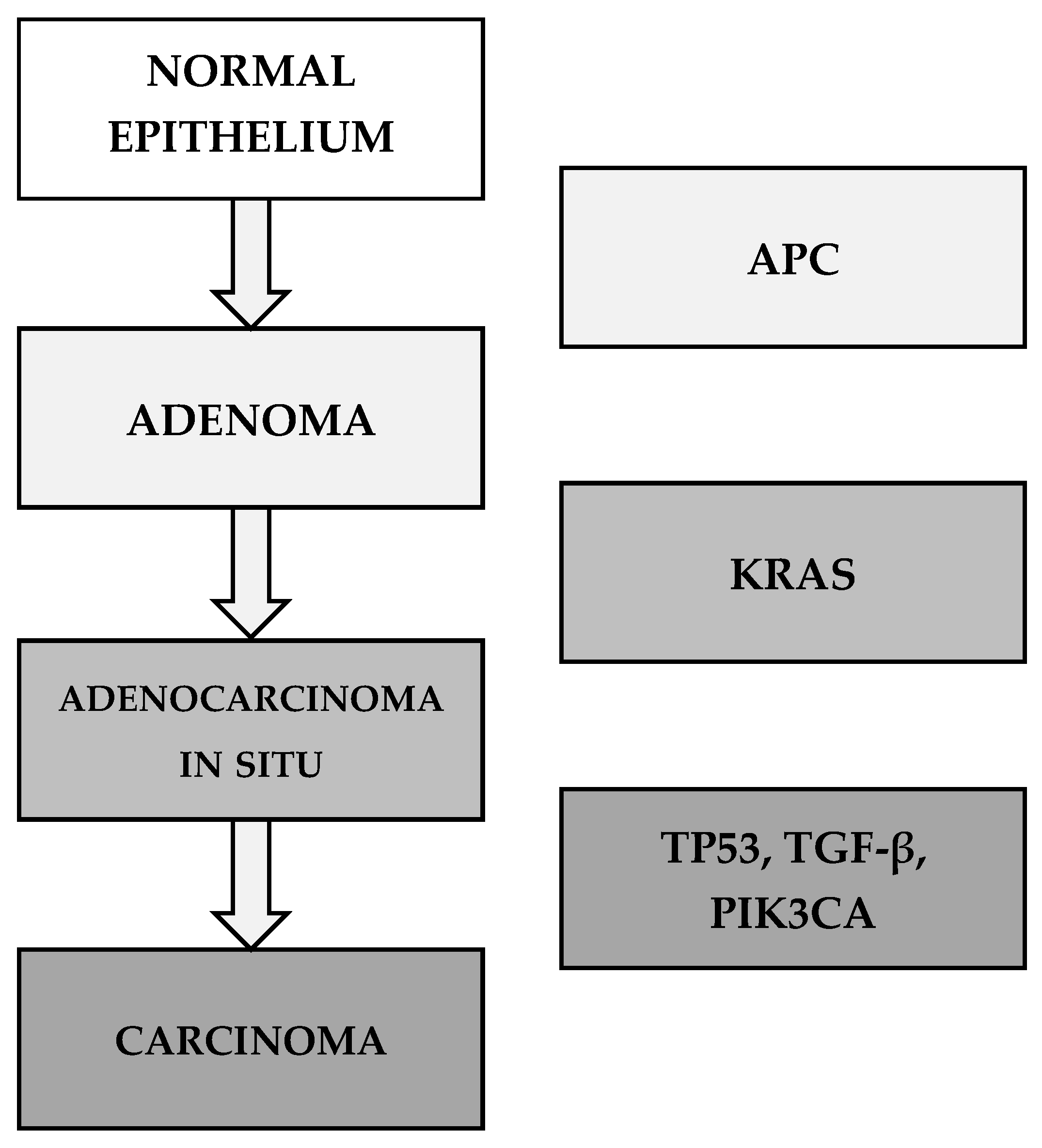
- Fearon, E.R.; Vogelstein, B. A genetic model for colorectal tumorigenesis. Cell 1990, 61, 759–767. [Google Scholar] [CrossRef] [PubMed]
- Lech, G.; Słotwiński, R.; Słodkowski, M.; Krasnodębski, I.W. Colorectal cancer tumour markers and biomarkers: Recent therapeutic advances. World J. Gastroenterol. 2016, 22, 1745–1755. [Google Scholar] [CrossRef] [PubMed] [PubMed Central]
- Liebl, M.C.; Hofmann, T.G. The Role of p53 Signaling in Colorectal Cancer. Cancers 2021, 13, 2125. [Google Scholar] [CrossRef] [PubMed] [PubMed Central]
- Hientz, K.; Mohr, A.; Bhakta-Guha, D.; Efferth, T.; Ansari, M.A.; Roy, R.; Jha, A.; Chakraborty, S.; Paul, S.; Choudhury, Y.; et al. The role of p53 in cancer drug resistance and targeted chemotherapy. Oncotarget 2017, 8, 8921–8946. [Google Scholar] [CrossRef] [PubMed] [PubMed Central]
- Salvatore, L.; Calegari, M.A.; Loupakis, F.; Cremolini, C.; Marmorino, F.; Antoniotti, C.; Moretto, R.; Fontanini, G.; Falcone, A.; Brandi, G.; et al. PTEN in colorectal cancer: Shedding light on its role as predictor and target. Cancers 2019, 11, 1765. [Google Scholar] [CrossRef] [PubMed] [PubMed Central]
- Molinari, F.; Frattini, M. Functions and Regulation of the PTEN Gene in Colorectal Cancer. Front. Oncol. 2014, 3, 326. [Google Scholar] [CrossRef] [PubMed] [PubMed Central]
- Li, X.H.; Zheng, H.C.; Takahashi, H.; Masuda, S.; Yang, X.H.; Takano, Y. PTEN expression and mutation in colorectal carcinomas. Oncol. Rep. 2009, 22, 757–764. [Google Scholar] [CrossRef] [PubMed][Green Version]
- Atreya, C.E.; Sangale, Z.; Xu, N.; Matli, M.R.; Tikishvili, E.; Welbourn, W.; Hopkins, S.; Wu, C.; Kral, J.; Smith, J.J.; et al. PTEN expression is consistent in colorectal cancer primaries and metastases and associates with patient survival. Cancer Med. 2013, 2, 496–506. [Google Scholar] [CrossRef] [PubMed] [PubMed Central]
- Lakemeyer, L.; Sander, S.; Wittau, M.; Henne-Bruns, D.; Kornmann, M.; Lemke, J. Diagnostic and Prognostic Value of CEA and CA19-9 in Colorectal Cancer. Diseases 2021, 9, 21. [Google Scholar] [CrossRef] [PubMed] [PubMed Central]
- Wang, J.; Cong, Y.; Tang, B.; Liu, J.; Pu, K. Integrative analysis of multi-omics data and gut microbiota composition reveals prognostic subtypes and predicts immunotherapy response in colorectal cancer using machine learning. Sci. Rep. 2025, 15, 25268. [Google Scholar] [CrossRef] [PubMed] [PubMed Central]
- Zheng, Z.; Xu, X. Integrative multi-omics identification and functional validation of potential targets linking metabolism-immune-colorectal cancer causal pathway. Front. Immunol. 2025, 16, 1649788. [Google Scholar] [CrossRef] [PubMed] [PubMed Central]
- Gao, Y.; Cao, D.; Li, M.; Zhao, F.; Wang, P.; Mei, S.; Song, Q.; Wang, P.; Nie, Y.; Zhao, W.; et al. Integration of multiomics features for blood-based early detection of colorectal cancer. Mol. Cancer 2024, 23, 173. [Google Scholar] [CrossRef] [PubMed] [PubMed Central]
- Song, W.; Wang, Y.; Zhou, M.; Guo, F.; Liu, Y. Spatial transcriptomics and scRNA-seq: Decoding tumor complexity and constructing prognostic models in colorectal cancer. Hum. Genom. 2025, 19, 92. [Google Scholar] [CrossRef] [PubMed] [PubMed Central]
- Peng, T.; Zhan, Q. Single-cell integration analysis reveals molecular signatures of the tumor microenvironment in early-onset colorectal cancer. npj Precis. Oncol. 2025, 9, 360. [Google Scholar] [CrossRef] [PubMed] [PubMed Central]
- Abuzuhri, M.A.; Najjar, S.; Awad, M.; Cruz-Correia, R.; Falna, H.; Aktas, E.; Abu Al Rob, B.M.; Oliveira, M.; Mughnamin, I.; Esteves, S.N.; et al. Machine learning in colorectal cancer prediction and diagnosis: A systematic review of models’ performance. Int. J. Med. Inform. 2025, 206, 106170. [Google Scholar] [CrossRef] [PubMed]
- Shaikhah, A.; Elkhwsky, F.; Aljeesh, Y.; Abu-Naser, S.S.; Al-Taher, A.; Alhaddad, M.; Zaqout, I.; Alser, M.; Sweidan, A.; Barakat, O.; et al. Application of machine learning algorithms for predicting the outcome of therapeutic intervention of colorectal cancer patients in Palestine with a global comparison. BMC Artif. Intell. 2025, 1, 6. [Google Scholar] [CrossRef]
- Lal, D.; Pandey, H. Integrated Multi-Omics Analysis Identifies Novel Prognostic and Diagnostic Hub Genes in Colorectal Cancer. Onco 2025, 5, 50. [Google Scholar] [CrossRef]
- Manzano, A.; Svedman, C.; Hofmarcher, T.; Wilking, N. Comparator Report on Cancer in Europe 2025—Disease Burden, Costs and Access to Medicines and Molecular Diagnostics. IHE Report 2025:2; IHE—The Swedish Institute for Health Economics: Lund, Sweden, 2025; Available online: https://www.efpia.eu/media/nbbbsbhp/ihe-comparator-report-on-cancer-in-europe-2025.pdf?utm_source=chatgpt.com (accessed on 20 October 2025).
- Škerl, P.; Vogrič, V.; Stegel, V.; Šetrajčič Dragoš, V.; Blatnik, O.; Klančar, G.; Novaković, S. Real-World Evaluation of Microsatellite Instability Detection via Targeted NGS Panels in Routine Molecular Diagnostics. Int. J. Mol. Sci. 2025, 26, 7138. [Google Scholar] [CrossRef] [PubMed] [PubMed Central]
- Joshi, P.; Gogte, P.; Pawar, P.; Gurav, M.; Iyer, R.; Singh, S.; Hatkar, S.; Shetty, U.; Nair, A.; Mulay, M.; et al. Implementation of circulating tumor DNA (ctDNA) testing in precision oncology: A four-year experience from a tertiary cancer center in India. J. Liq. Biopsy 2025, 9, 100319. [Google Scholar] [CrossRef] [PubMed] [PubMed Central]
- Battistuzzi, L.; Blondeaux, E.; Puccini, A.; Boni, L.; Grillo, F.; Trevisan, L.; Varesco, L.; Sciallero, M.S. Barriers and Facilitators in Diagnostic Pathways that Align Universal Tumor Screening and Mainstream Genetic Testing for Lynch Syndrome in Colorectal Cancer: Protocol for a Scoping Review with a Narrative Synthesis. JMIR Res. Protoc. 2025, 14, e70831. [Google Scholar] [CrossRef] [PubMed] [PubMed Central]
- Fischer, L.E.; Stintzing, S.; Heinemann, V.; Keilholz, U.; Keune, D.; Vollbrecht, C.; Burmeister, T.; Kind, A.; Weiss, L.; Horst, D.; et al. Liquid Biopsy in Colorectal Cancer: Quo Vadis? Implementation of Liquid Biopsies in Routine Clinical Patient Care in Two German Comprehensive Cancer Centers. Front. Oncol. 2022, 12, 870411. [Google Scholar] [CrossRef] [PubMed] [PubMed Central]

| Hereditary Syndrome | Gene(s) Involved | Inheritance Pattern |
|---|---|---|
| FAP | APC | Autosomal dominant |
| MAP | MUTYH | Autosomal recessive |
| Peutz–Jeghers syndrome | STK11 | Autosomal dominant |
| Cowden syndrome | PTEN | Autosomal dominant |
| HMPS | CRAC1 | Autosomal dominant |
| Juvenile polyposis of the colon | BMPR1A, SMAD4 | Autosomal dominant |
| HNPCC | MLH1, MSH2, MSH6, PMS2, EPCAM | Autosomal dominant |
| Method | Sensitivity | Specificity | CRC Risk/Mortality Reduction | Recommended Interval | Advantages/ Disadvantages | Refs. |
|---|---|---|---|---|---|---|
| Sigmoidoscopy | 95% (adenomas) | 87% | CRC risk ↓ 26%/mortality ↓ 30% | Every 5–10 years (with annual FIT) | Lower complication rate compared with colonoscopy, less invasive Evaluates only the distal colon | [16,17,18,19,20,21,22,23,24] |
| Colonography | Adenomas ≥ 10 mm: 89%; Adenomas ≥ 6 mm: 86% | Adenomas ≥ 10 mm: 94%; Adenomas ≥ 6 mm: 89% | No data on CRC mortality reduction | Every 5 years | Minimally invasive, no anesthesia, safe for patients with comorbidities, detects extracolonic abnormalities Abnormal results require colonoscopy, no evidence of mortality reduction | [16,17,18,19,20,21,22,23,24] |
| Colonoscopy | Gold standard; complete visualization of the colon | CRC incidence ↓ 69% | mortality ↓ up to 88% | Every 10 years (starting age: 45) | Both diagnostic and therapeutic (polyp removal), highest effectiveness More invasive, requires bowel prep and diet/medication adjustments, higher cost, complications < 1% (bleeding 0.146%, perforation 0.031%), low patient adherence | [16,17,18,19,20,21,22,23,24] |
| Target Group | Recommended Test | Remarks | Refs. |
|---|---|---|---|
| Individuals aged 50–65 years without symptoms or with symptoms (GI bleeding, diarrhea, constipation, anemia). | Colonoscopy | First-time examination, repeated every 10 years | [33,34] |
| Individuals aged 40–49 years with a first-degree relative diagnosed with CRC | Colonoscopy | First-time examination, repeated every 10 years | [33,34] |
| Individuals aged 25–49 years with a family history of familial adenomatous polyposis (FAP) | Colonoscopy | Confirmation required in a genetic counseling clinic | [33,34] |
| Individuals who underwent colonoscopy within the last 10 years | Not eligible for repeat colonoscopy | Screening colonoscopy not provided under the program | [33,34] |
| Individuals for whom colonoscopy is not feasible | FOBT | Annual testing | [33,34] |
| Individuals included in the Program 40 Plus | FOBT | Free of charge under the program | [33,34] |
| Biomarker | Clinical Implication | Therapeutic Consequence | Prognostic Significance | Refs. |
|---|---|---|---|---|
| Carcinoembryonic antigen (CEA) | Widely used marker for recurrence surveillance; elevated in ~70% of CRC. | Does not guide therapy; used for monitoring when elevated pre-treatment. | Rising postoperative CEA predicts recurrence; low sensitivity limits standalone use. | [35,36] |
| Carbohydrate antigen 19-9 (CA 19-9) | Low sensitivity in CRC; adjunctive marker when combined with CEA; falsely elevated in benign conditions. | Not recommended for monitoring systemic therapy or guiding treatment. | Higher levels may indicate worse outcomes; non-producers limit use. | [65] |
| Methylated SEPT9 (mSEPT9) | Non-invasive screening test; helpful in recurrence prediction when combined with CEA. | No direct therapeutic implications; supportive diagnostic tool. | Preoperative positivity associated with higher recurrence risk; lower sensitivity vs. colonoscopy. | [37,38,39,40,41] |
| Tissue polypeptide-specific antigen (TPS) | Marker of cell proliferation; useful in monitoring chemotherapy response. | Indicates treatment effect during systemic therapy. | Elevated TPS correlates with aggressive disease. | [42,43,44,45,46] |
| Tumor-associated glycoprotein 72 (TAG-72/CA 72-4) | Complementary diagnostic marker; increases sensitivity when combined with CEA and CA19-9. | Not used for therapy selection; adjunct for long-term follow-up. | Elevated levels associate with tumor burden; sensitivity varies by tumor site. | [47,48,49] |
| Circulating tumor cells (CTCs) | Reflect metastatic potential | Useful for dynamic therapy monitoring | Higher counts link to aggressive disease | [50,51] |
| ctDNA positivity (MRD) | Detects minimal residual disease | Guides adjuvant therapy intensity; early relapse detection | Early rise predicts recurrence months before imaging | [52,53] |
| Circulating microRNAs (c-miRNAs) | Early detection of CRC; stool and plasma assays complement screening; material-dependent sensitivity. | No direct therapeutic impact yet; emerging predictive potential in multi-omics models. | Altered miRNA signatures correlate with tumor stage, invasiveness, and recurrence risk. | [54] |
| TP53 mutation | Associated with impaired DNA damage response | Reduced sensitivity to 5-FU, cisplatin, oxaliplatin | Worse overall survival | [57,58,59] |
| PTEN loss | Activates PI3K/AKT pathway; induces treatment resistance | Reduced efficacy of EGFR inhibitors; potential candidate for PI3K pathway-targeted trials | Associated with deeper invasion, nodal metastases, and poor survival | [60,61,62,63] |
| Approach | What It Measures | Clinical Use | Advantages | Limitations | Refs. |
|---|---|---|---|---|---|
| Genomics (NGS) | Mutations, CNVs, MSI/MMR | Therapy selection | Actionable targets | Cost; limited early detection | [64,66,67,68,69,70,71,72,73] |
| Epigenomics | DNA methylation | Screening; recurrence | Liquid biopsy-friendly | Lower sensitivity; variability | [64,66,67,68,69,70,71,72,73] |
| Transcriptomics | Gene-expression | Prognosis; immunotherapy prediction | Immune contexture captured | Needs high-quality tissue | [64,66,67,68,69,70,71,72,73] |
| Proteomics | Protein pathways | Target discovery | Functional insight | Low standardization | [64,66,67,68,69,70,71,72,73] |
| Metabolomics | Metabolic markers | Early detection | Non-invasive | High variability | [64,66,67,68,69,70,71,72,73] |
| Microbiome | Gut bacteria, metabolites | Risk; immune modulation | Non-invasive | Inter-individual variation | [64,66,67,68,69,70,71,72,73] |
| Multi-Omics Liquid Biopsy | cfDNA mutations + methylation + fragmentomics | Early detection; MRD | High accuracy | Complex analytics; cost | [64,66,67,68,69,70,71,72,73] |
| scRNA-seq | Single-cell TME mapping | Resistant clones; immune profiling | Highest resolution | Only research use | [64,66,67,68,69,70,71,72,73] |
| Spatial Transcriptomics | Spatial gene maps | TME architecture | Preserves tissue context | Very high cost | [64,66,67,68,69,70,71,72,73] |
| AI/ML | Integrated clinical + omics | Predicting risk/outcomes | High accuracy | Needs large datasets | [64,66,67,68,69,70,71,72,73] |
| Deep Learning Multi-Omics | Multi-layer biomarker fusion | Early detection | Outperforms single tests | Limited validation | [64,66,67,68,69,70,71,72,73] |
| Barrier | Core Problem | Clinical Impact | Essential Solution | Refs. |
|---|---|---|---|---|
| Cost and Reimbursement | High cost; limited coverage | Unequal access; restricted testing | Reimbursement reform; cost-effectiveness data | [68,74,75,76,77] |
| Standardization Issues | Variable NGS/ctDNA workflows | Inconsistent results | Harmonized protocols; QC programs | [68,74,75,76,77] |
| Infrastructure Limits | Lack of sequencing/bioinformatics capacity | Limited implementation outside major centers | Investment in labs; centralized testing | [68,74,75,76,77] |
| Clinical Workflow Gaps | Complex reports; lack of clear pathways | Misinterpretation; underuse | Decision-support tools; MDT involvement | [68,74,75,76,77] |
| Evidence Gaps | Few prospective trials for new biomarkers | Conservative guidelines; low reimbursement | Large-scale validation studies | [68,74,75,76,77] |
Disclaimer/Publisher’s Note: The statements, opinions and data contained in all publications are solely those of the individual author(s) and contributor(s) and not of MDPI and/or the editor(s). MDPI and/or the editor(s) disclaim responsibility for any injury to people or property resulting from any ideas, methods, instructions or products referred to in the content. |
© 2025 by the authors. Licensee MDPI, Basel, Switzerland. This article is an open access article distributed under the terms and conditions of the Creative Commons Attribution (CC BY) license (https://creativecommons.org/licenses/by/4.0/).
Share and Cite
Bichalski, B.; Bichalska-Lach, M.; Waniczek, D. Diagnostic Pathways and Molecular Biomarkers in Colorectal Cancer: Current Evidence and Perspectives in Poland. Curr. Issues Mol. Biol. 2025, 47, 1047. https://doi.org/10.3390/cimb47121047
Bichalski B, Bichalska-Lach M, Waniczek D. Diagnostic Pathways and Molecular Biomarkers in Colorectal Cancer: Current Evidence and Perspectives in Poland. Current Issues in Molecular Biology. 2025; 47(12):1047. https://doi.org/10.3390/cimb47121047
Chicago/Turabian StyleBichalski, Bartosz, Magda Bichalska-Lach, and Dariusz Waniczek. 2025. "Diagnostic Pathways and Molecular Biomarkers in Colorectal Cancer: Current Evidence and Perspectives in Poland" Current Issues in Molecular Biology 47, no. 12: 1047. https://doi.org/10.3390/cimb47121047
APA StyleBichalski, B., Bichalska-Lach, M., & Waniczek, D. (2025). Diagnostic Pathways and Molecular Biomarkers in Colorectal Cancer: Current Evidence and Perspectives in Poland. Current Issues in Molecular Biology, 47(12), 1047. https://doi.org/10.3390/cimb47121047