


Descriptive Genomic Analysis of Ampullary Carcinoma Utilizing the AACR Project GENIE Dataset

 , ,
, ,
Abstract
1. Introduction
2. Materials and Methods
2.1. Genomic Database and Design
2.2. Data Collection and Processing
2.3. Statistical Analysis
3. Results
3.1. Patient Demographics of Ampullary Carcinoma
3.2. Most Frequent Somatic Mutations and Copy Number Alterations of Ampullary Cancer
3.3. Mutational Differences by Sex (777 Genes Tested in Total)
3.4. Mutation Differences by Race (765 Genes Tested in Total)
3.5. Co-Occurrence and Mutual Exclusivity Mutations (78 Gene Pairs Tested in Total)
3.6. Primary vs. Metastatic Mutation Differences (776 Genes Tested in Total)
3.7. Mutations Differences by Histological Sub-Category
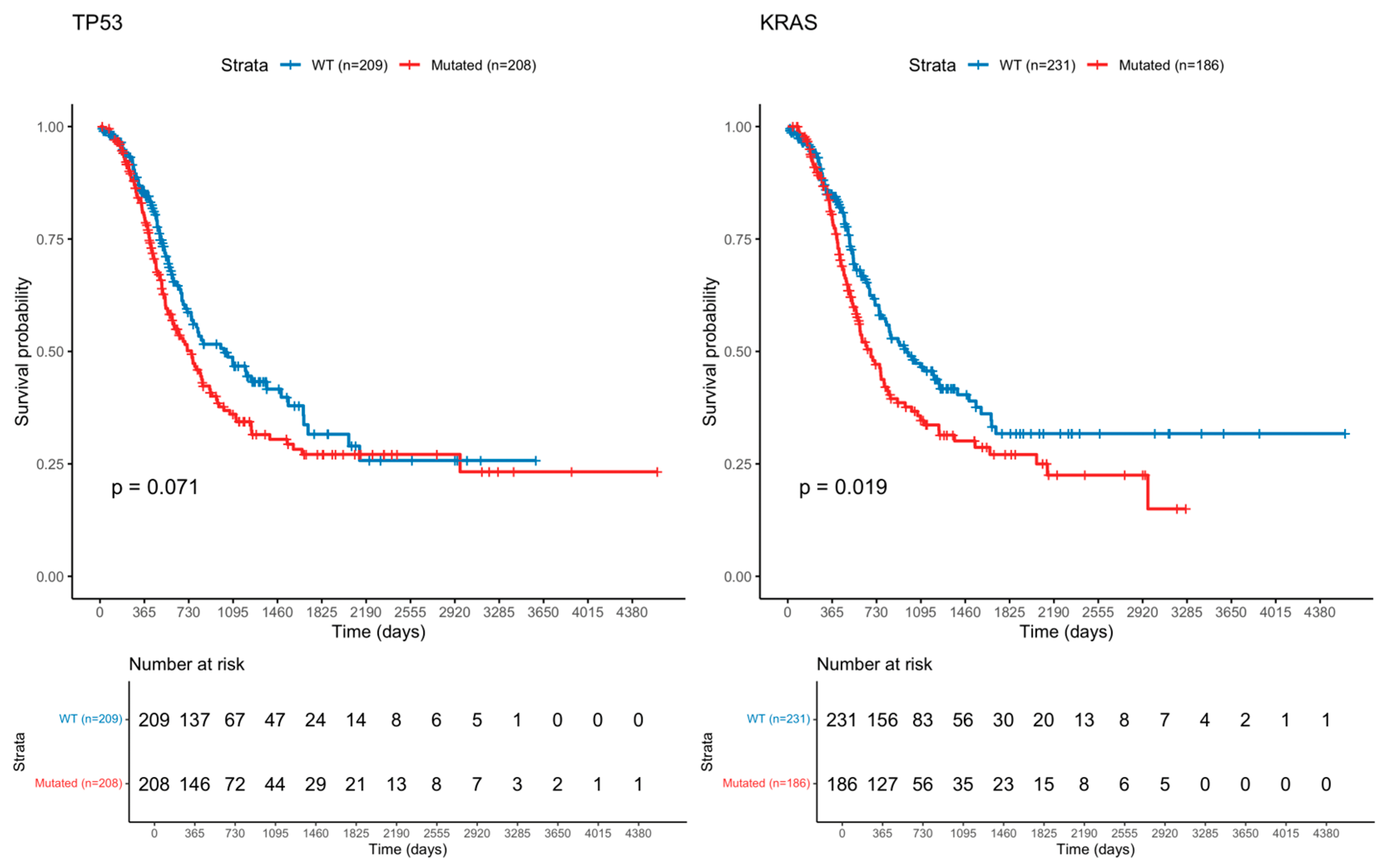
3.8. Mutations Associated with Reduced Survival
3.9. Survival Analysis with Mutually Exlcusive and Co-Occurring Genes
3.10. Comparison of Pancreatobiliary Ampullary Carcinoma vs. Pancreatic Adenocarcinoma
4. Discussion
5. Conclusions
Supplementary Materials
Author Contributions
Funding
Institutional Review Board Statement
Informed Consent Statement
Data Availability Statement
Conflicts of Interest
References
- Walter, D.; Schnitzbauer, A.A.; Schulze, F.; Trojan, J. The Diagnosis and Treatment of Ampullary Carcinoma. Dtsch. Ärzteblatt Int. 2023, 120, 729. [Google Scholar] [CrossRef] [PubMed]
- Kimura, W.; Futakawa, N.; Yamagata, S.; Wada, Y.; Kuroda, A.; Muto, T.; Esaki, Y. Different Clinicopathologic Findings in Two Histologic Types of Carcinoma of Papilla of Vater. Jpn. J. Cancer Res. 1994, 85, 161–166. [Google Scholar] [CrossRef]
- Nappo, G.; Funel, N.; Laurenti, V.; Stenner, E.; Carrara, S.; Bozzarelli, S.; Spaggiari, P.; Zerbi, A. Ampullary Cancer: Histological Subtypes, Markers, and Clinical Behaviour—State of the Art and Perspectives. Curr. Oncol. 2023, 30, 6996–7006. [Google Scholar] [CrossRef]
- Zimmermann, C.; Wolk, S.; Aust, D.E.; Meier, F.; Saeger, H.-D.; Ehehalt, F.; Weitz, J.; Welsch, T.; Distler, M. The pathohistological subtype strongly predicts survival in patients with ampullary carcinoma. Sci. Rep. 2019, 9, 12676. [Google Scholar] [CrossRef] [PubMed]
- Ellington, T.D.; Momin, B.; Wilson, R.J.; Henley, S.J.; Wu, M.; Ryerson, A.B. Incidence and Mortality of Cancers of the Biliary Tract, Gallbladder, and Liver by Sex, Age, Race/Ethnicity, and Stage at Diagnosis: United States, 2013 to 2017. Cancer Epidemiol. Biomark. Prev. 2021, 30, 1607–1614. [Google Scholar] [CrossRef]
- Goodman, M.T.; Yamamoto, J. Descriptive study of gallbladder, extrahepatic bile duct, and ampullary cancers in the United States, 1997–2002. Cancer Causes Control 2007, 18, 415–422. [Google Scholar] [CrossRef]
- de Jong, E.J.M.; Geurts, S.M.E.; van der Geest, L.G.; Besselink, M.G.; Bouwense, S.A.W.; Buijsen, J.; Dejong, C.H.C.; Heij, L.R.; Koerkamp, B.G.; de Hingh, I.H.J.T.; et al. A population-based study on incidence, treatment, and survival in ampullary cancer in the Netherlands. Eur. J. Surg. Oncol. 2021, 47, 1742–1749. [Google Scholar] [CrossRef]
- Nassour, I.; Mokdad, A.A.; Minter, R.M.; Polanco, P.M.; Augustine, M.M.; Mansour, J.C.; Porembka, M.R.; Wang, S.C. Racial and Ethnic Disparities in a National Cohort of Ampullary Cancer Patients. J. Surg. Oncol. 2018, 117, 220–227. [Google Scholar] [CrossRef]
- Zaccari, P.; Archibugi, L.; Belfiori, G.; Nista, E.; Dell’Anna, G.; Crippa, S.; Schepis, T.; Tacelli, M.; Aleotti, F.; Petrone, M.C.; et al. Risk factors for the occurrence of ampullary tumors: A case-control study. United Eur. Gastroenterol. J. 2022, 10, 730–735. [Google Scholar] [CrossRef] [PubMed]
- Chiorean, E.G.; Chiaro, M.D.; Tempero, M.A.; Malafa, M.P.; Benson, A.B.; Cardin, D.B.; Christensen, J.A.; Chung, V.; Czito, B.; Dillhoff, M.; et al. Ampullary Adenocarcinoma, Version 1.2023, NCCN Clinical Practice Guidelines in Oncology. J. Natl. Compr. Cancer Netw. 2023, 21, 753–782. [Google Scholar] [CrossRef]
- Sattar, R.S.A.; Ali, A.; Sharma, A.K.; Kumar, A.; Santoshi, S.; Saluja, S.S. Molecular pathways in periampullary cancer: An overview. Cell. Signal. 2022, 100, 110461. [Google Scholar] [CrossRef] [PubMed]
- Pea, A.; Riva, G.; Bernasconi, R.; Sereni, E.; Lawlor, R.T.; Scarpa, A.; Luchini, C. Ampulla of Vater carcinoma: Molecular landscape and clinical implications. World J. Gastrointest. Oncol. 2018, 10, 370–380. [Google Scholar] [CrossRef]
- Kawata, J.; Koga, Y.; Noguchi, S.; Shimada, Y.; Yamada, Y.; Yamamoto, T.; Shindo, K.; Nakamura, M.; Oda, Y. Clinicopathologic Features and Genetic Alterations in Mixed-Type Ampullary Carcinoma. Mod. Pathol. 2023, 36, 100181. [Google Scholar] [CrossRef]
- Luchini, C.; Scarpa, A. Microsatellite instability in pancreatic and ampullary carcinomas: Histology, molecular pathology, and clinical implications. Hum. Pathol. 2023, 132, 176–182. [Google Scholar] [CrossRef]
- Xue, Y.; Balci, S.; Mericoz, C.A.; Taskin, O.C.; Jiang, H.; Pehlivanoglu, B.; Muraki, T.; Memis, B.; Saka, B.; Kim, G.E.; et al. Frequency and clinicopathologic associations of DNA mismatch repair protein deficiency in ampullary carcinoma: Routine testing is indicated. Cancer 2020, 126, 4788–4799. [Google Scholar] [CrossRef] [PubMed]
- Reid, M.D.; Balci, S.; Ohike, N.; Xue, Y.; Kim, G.E.; Tajiri, T.; Memis, B.; Coban, I.; Dolgun, A.; Krasinskas, A.M.; et al. Ampullary carcinoma is often of mixed or hybrid histologic type: An analysis of reproducibility and clinical relevance of classification as pancreatobiliary versus intestinal in 232 cases. Mod. Pathol. 2016, 29, 1575–1585. [Google Scholar] [CrossRef]
- Koea, J.; Phillips, A.; Lawes, C.; Rodgers, M.; Windsor, J.; McCall, J. Gall bladder cancer, extrahepatic bile duct cancer and ampullary carcinoma in New Zealand: Demographics, pathology and survival. ANZ J. Surg. 2002, 72, 857–861. [Google Scholar] [CrossRef]
- Albores-Saavedra, J.; Schwartz, A.M.; Ba, K.B.; Henson, D.E. Cancers of the ampulla of vater: Demographics, morphology, and survival based on 5,625 cases from the SEER program. J. Surg. Oncol. 2009, 100, 598–605. [Google Scholar] [CrossRef]
- Waseem, M.; Gujrati, H.; Wang, B.-D. Tumor suppressive miR-99b-5p as an epigenomic regulator mediating mTOR/AR/SMARCD1 signaling axis in aggressive prostate cancer. Front. Oncol. 2023, 13, 1184186. [Google Scholar] [CrossRef]
- Liu, T.X.; Becker, M.; Hsu, K.; Jelinek, J.; Deng, M.; Bloomfield, C.; Issa, J.-P.; Clarke, M.F.; Look, A.T. Epigenetic Suppression of the CTNNA1 Gene, Encoding the α-Catenin Protein, which Is Located in the 5q31 Critical Deleted Region in Malignant Myeloid Disorders with del(5q). Blood 2004, 104, 203. [Google Scholar] [CrossRef]
- Wang, C.; Sun, H.; Zou, R.; Zhou, T.; Wang, S.; Sun, S.; Tong, C.; Luo, H.; Li, Y.; Li, Z.; et al. MDC1 functionally identified as an androgen receptor co-activator participates in suppression of prostate cancer. Nucleic Acids Res. 2015, 43, 4893–4908. [Google Scholar] [CrossRef]
- Huang, J.; Wang, H.; Xu, Y.; Li, C.; Lv, X.; Han, X.; Chen, X.; Chen, Y.; Yu, Z. The Role of CTNNA1 in Malignancies: An Updated Review. J. Cancer 2023, 14, 219–230. [Google Scholar] [CrossRef]
- Fleming, J.L.; Huang, T.H.-M.; Toland, A.E. The role of parental and grandparental epigenetic alterations in familial cancer risk. Cancer Res. 2008, 68, 9116–9121. [Google Scholar] [CrossRef][Green Version]
- Lesch, B.J.; Tothova, Z.; Morgan, E.A.; Liao, Z.; Bronson, R.T.; Ebert, B.L.; Page, D.C. Intergenerational epigenetic inheritance of cancer susceptibility in mammals. eLife 2019, 8, e39380. [Google Scholar] [CrossRef] [PubMed]
- Joshi, S.; Garlapati, C.; Aneja, R. Epigenetic Determinants of Racial Disparity in Breast Cancer: Looking beyond Genetic Alterations. Cancers 2022, 14, 1903. [Google Scholar] [CrossRef] [PubMed]
- Lerner, L.; Winn, R.; Hulbert, A. Lung cancer early detection and health disparities: The intersection of epigenetics and ethnicity. J. Thorac. Dis. 2018, 10, 2498–2507. [Google Scholar] [CrossRef] [PubMed]
- Lin, Y.; Huang, Y.; Yang, B.; Zhang, Y.; Ji, N.; Li, J.; Zhou, Y.; Shen, Y.-Q.; Chen, Q. Precision therapy targeting CAMK2 to overcome resistance to EGFR inhibitors in FAT1 -mutated oral squamous cell carcinoma. Chin. Med. J. 2025, 138, 1853–1865. [Google Scholar] [CrossRef]
- Stefanoudakis, D.; Frountzas, M.; Schizas, D.; Michalopoulos, N.V.; Drakaki, A.; Toutouzas, K.G. Significance of TP53, CDKN2A, SMAD4 and KRAS in Pancreatic Cancer. Curr. Issues Mol. Biol. 2024, 46, 2827–2844. [Google Scholar] [CrossRef]
- Buglioni, S.; Melucci, E.; Sperati, F.; Pallocca, M.; Terrenato, I.; De Nicola, F.; Goeman, F.; Casini, B.; Amoreo, C.A.; Gallo, E.; et al. The clinical significance of PD-L1 in advanced gastric cancer is dependent on ARID1A mutations and ATM expression. Oncoimmunology 2018, 7, e1457602. [Google Scholar] [CrossRef]
- Karagiannis, T.C.; El-Osta, A. DNA damage repair and transcription. Cell. Mol. Life Sci. CMLS 2004, 61, 2137–2147. [Google Scholar] [CrossRef]
- Baskar, R.; Lee, K.A.; Yeo, R.; Yeoh, K.-W. Cancer and Radiation Therapy: Current Advances and Future Directions. Int. J. Med. Sci. 2012, 9, 193. [Google Scholar] [CrossRef] [PubMed]
- Huang, R.-X.; Zhou, P.-K. DNA damage response signaling pathways and targets for radiotherapy sensitization in cancer. Signal Transduct. Target. Ther. 2020, 5, 60. [Google Scholar] [CrossRef]
- Jayaramayya, K.; Balachandar, V.; Santhy, K.S. Ampullary carcinoma—A genetic perspective. Mutat. Res. Rev. Mutat. Res. 2018, 776, 10–22. [Google Scholar] [CrossRef]
- Huang, D.; Sun, W.; Zhou, Y.; Li, P.; Chen, F.; Chen, H.; Xia, D.; Xu, E.; Lai, M.; Wu, Y.; et al. Mutations of key driver genes in colorectal cancer progression and metastasis. Cancer Metastasis Rev. 2018, 37, 173–187. [Google Scholar] [CrossRef]
- Tsagkalidis, V.; Langan, R.C.; Ecker, B.L. Ampullary Adenocarcinoma: A Review of the Mutational Landscape and Implications for Treatment. Cancers 2023, 15, 5772. [Google Scholar] [CrossRef]
- Dhar, S.S.; Lee, M.G. Cancer-epigenetic function of the histone methyltransferase KMT2D and therapeutic opportunities for the treatment of KMT2D-deficient tumors. Oncotarget 2021, 12, 1296–1308. [Google Scholar] [CrossRef]
- Angelico, G.; Attanasio, G.; Colarossi, L.; Colarossi, C.; Montalbano, M.; Aiello, E.; Di Vendra, F.; Mare, M.; Orsi, N.; Memeo, L. ARID1A Mutations in Gastric Cancer: A Review with Focus on Clinicopathological Features, Molecular Background and Diagnostic Interpretation. Cancers 2024, 16, 2062. [Google Scholar] [CrossRef]
- Mandal, J.; Mandal, P.; Wang, T.-L.; Shih, I.-M. Treating ARID1A mutated cancers by harnessing synthetic lethality and DNA damage response. J. Biomed. Sci. 2022, 29, 71. [Google Scholar] [CrossRef] [PubMed]
- Hein, K.Z.; Stephen, B.; Fu, S. Therapeutic Role of Synthetic Lethality in ARID1A-Deficient Malignancies. J. Immunother. Precis. Oncol. 2024, 7, 41–52. [Google Scholar] [CrossRef] [PubMed]
- Dong, Z.; Chong, W.; Chen, C.; Qi, L.; Mengke, L.; Minghui, D.; Jiawei, Y.; Longxi, Q.; Hengchao, L.; Liu, J.; et al. Assessing the genomic feature of Chinese patients with ampullary adenocarcinoma: Potential therapeutic targets. BMC Cancer 2024, 24, 286. [Google Scholar] [CrossRef]

| Demographics | Category | n (%) |
|---|---|---|
| Sex | Male | 260 (53.4) |
| Unknown | 10 (2.1) | |
| Female | 217 (44.6) | |
| Age category at which sequencing was reported | Adult | 500 (100) |
| Unknown | 0 (0) | |
| Pediatric | 0 (0) | |
| Ethnicity | Non-Hispanic | 320 (65.7) |
| Unknown/Not Collected | 106 (21.8) | |
| Hispanic | 61 (12.5) | |
| Race | Asian | 40 (8.2) |
| White | 319 (65.5) | |
| Black | 32 (6.6) | |
| Other | 61 (12.5) | |
| Unknown | 27 (5.5) | |
| Sample Type | Primary | 303 (60.6) |
| Metastasis | 147 (29.1) | |
| Unspecified/NA | 50 (10.0) |
| Gene | Total Mutations (%) | Samples with ≥1 Mutation (%) |
|---|---|---|
| TP53 | 266 (53.2) | 247 (49.4) |
| KRAS | 233 (46.6) | 228 (45.6) |
| SMAD4 | 83 (16.6) | 78 (15.6) |
| APC | 108 (21.6) | 83 (16.6) |
| PIK3CA | 52 (10.4) | 50 (10.0) |
| ARID1A | 60 (12.0) | 45 (9.0) |
| CDKN2A | 46 (9.2) | 44 (8.8) |
| KMT2D | 56 (11.2) | 40 (8.0) |
| CTNNB1 | 43 (8.6) | 42 (8.4) |
| ERBB2 | 44 (8.8) | 34 (6.8) |
| ATM | 36 (7.2) | 34 (6.8) |
| RNF43 | 34 (6.8) | 29 (5.8) |
| ERBB3 | 33 (6.6) | 27 (5.4) |
| Gene | Male, n (%) | Female, n (%) | p Value | q Value |
|---|---|---|---|---|
| FANCA | 1 (0.43) | 10 (5.35) | 3.86 × 10⁻⁴ | 0.116 |
| SF3B1 | 3 (1.25) | 10 (5.13) | 2.29 × 10⁻² | 0.444 |
| ATRX | 3 (1.29) | 10 (5.35) | 2.21 × 10⁻² | 0.440 |
| PREX2 | 11 (7.69) | 2 (1.82) | 4.41 × 10⁻² | 0.748 |
| CTNNB1 | 31 (11.61) | 12 (5.41) | 1.64 × 10⁻² | 0.440 |
| RARA | 5 (2.18) | 0 (0.0) | 6.92 × 10⁻² | 1.00 |
| White, n (%) | Non-White, n (%) | p Value | q Value | |
| TP53 | 183 (55.5) | 50 (37.0) | 3.43 × 10⁻⁴ | 0.180 |
| KRAS | 170 (51.5) | 45 (33.3) | 4.71 × 10⁻⁴ | 0.180 |
| LRP1B | 10 (22.7) | 1 (1.82) | 2.09 × 10⁻³ | 0.216 |
| SOX9 | 22 (8.18) | 2 (1.60) | 1.13 × 10⁻² | 0.319 |
| IRS2 | 15 (6.61) | 1 (0.86) | 1.47 × 10⁻² | 0.389 |
| SMAD4 | 67 (20.36) | 15 (11.11) | 2.22 × 10⁻² | 0.471 |
| Mutation | Differential Survival | Number of Patients with Wild Type | Number of Patients with Mutation | p Value | Gene Function (GeneCards) |
|---|---|---|---|---|---|
| TP53 | Reduces Survival | 209 | 208 | 0.071 | Tumor suppressor |
| KRAS | Reduces Survival | 231 | 186 | 0.019 | Ras family oncogene |
| Gene (Chi-Squared) | Pancreatobiliary Ampullary Carcinoma | Pancreatic Adenocarcinoma | p Value | q Value | Enriched In |
|---|---|---|---|---|---|
| KRAS | 80 (50.63%) | 7215 (77.81%) | <10 × 10−10 | <10 × 10−10 | Pancreatic Adenocarcinoma |
| PIK3CA | 14 (8.81%) | 263 (2.84%) | 2.370 × 10⁻⁴ | 4.577 × 10⁻³ | Pancreatobiliary Ampullary Carcinoma |
| ERBB2 | 14 (8.86%) | 221 (2.38%) | 3.874 × 10⁻⁵ | 8.290 × 10⁻⁴ | Pancreatobiliary Ampullary Carcinoma |
| BAP1 | 7 (4.86%) | 82 (0.97%) | 7.086 × 10⁻⁵ | 1.28 × 10⁻² | Pancreatobiliary Ampullary Carcinoma |
| ATM | 16 (10.46%) | 392 (4.34%) | 1.239 × 10⁻³ | 0.0212 | Pancreatobiliary Ampullary Carcinoma |
Disclaimer/Publisher’s Note: The statements, opinions and data contained in all publications are solely those of the individual author(s) and contributor(s) and not of MDPI and/or the editor(s). MDPI and/or the editor(s) disclaim responsibility for any injury to people or property resulting from any ideas, methods, instructions or products referred to in the content. |
© 2025 by the authors. Licensee MDPI, Basel, Switzerland. This article is an open access article distributed under the terms and conditions of the Creative Commons Attribution (CC BY) license (https://creativecommons.org/licenses/by/4.0/).
Share and Cite
Martin, S.; Recupido, B.; Torbenson, E.; Hsia, B.; Braaten, M.; Tauseef, A. Descriptive Genomic Analysis of Ampullary Carcinoma Utilizing the AACR Project GENIE Dataset. Curr. Issues Mol. Biol. 2025, 47, 932. https://doi.org/10.3390/cimb47110932
Martin S, Recupido B, Torbenson E, Hsia B, Braaten M, Tauseef A. Descriptive Genomic Analysis of Ampullary Carcinoma Utilizing the AACR Project GENIE Dataset. Current Issues in Molecular Biology. 2025; 47(11):932. https://doi.org/10.3390/cimb47110932
Chicago/Turabian StyleMartin, Samantha, Blake Recupido, Elijah Torbenson, Beau Hsia, Marco Braaten, and Abubakar Tauseef. 2025. "Descriptive Genomic Analysis of Ampullary Carcinoma Utilizing the AACR Project GENIE Dataset" Current Issues in Molecular Biology 47, no. 11: 932. https://doi.org/10.3390/cimb47110932
APA StyleMartin, S., Recupido, B., Torbenson, E., Hsia, B., Braaten, M., & Tauseef, A. (2025). Descriptive Genomic Analysis of Ampullary Carcinoma Utilizing the AACR Project GENIE Dataset. Current Issues in Molecular Biology, 47(11), 932. https://doi.org/10.3390/cimb47110932

