Review

Circular RNAs Variously Participate in Coronary Atherogenesis

by
Liudmila V. Dergunova
1,*,
Margarita A. Vinogradina
1,
Ivan B. Filippenkov
1,
Svetlana A. Limborska
1 and
Alexander D. Dergunov
2
1
Laboratory of Human Molecular Genetics, National Research Center “Kurchatov Institute”, Kurchatov Sq. 2, Moscow 123182, Russia
2
Laboratory of Structural Fundamentals of Lipoprotein Metabolism, National Medical Research Center for Therapy and Preventive Medicine, Petroverigsky Street 10, Moscow 101990, Russia
*
Author to whom correspondence should be addressed.
Curr. Issues Mol. Biol. 2023, 45(8), 6682-6700; https://doi.org/10.3390/cimb45080422
Submission received: 29 June 2023 / Revised: 3 August 2023 / Accepted: 11 August 2023 / Published: 13 August 2023

Abstract

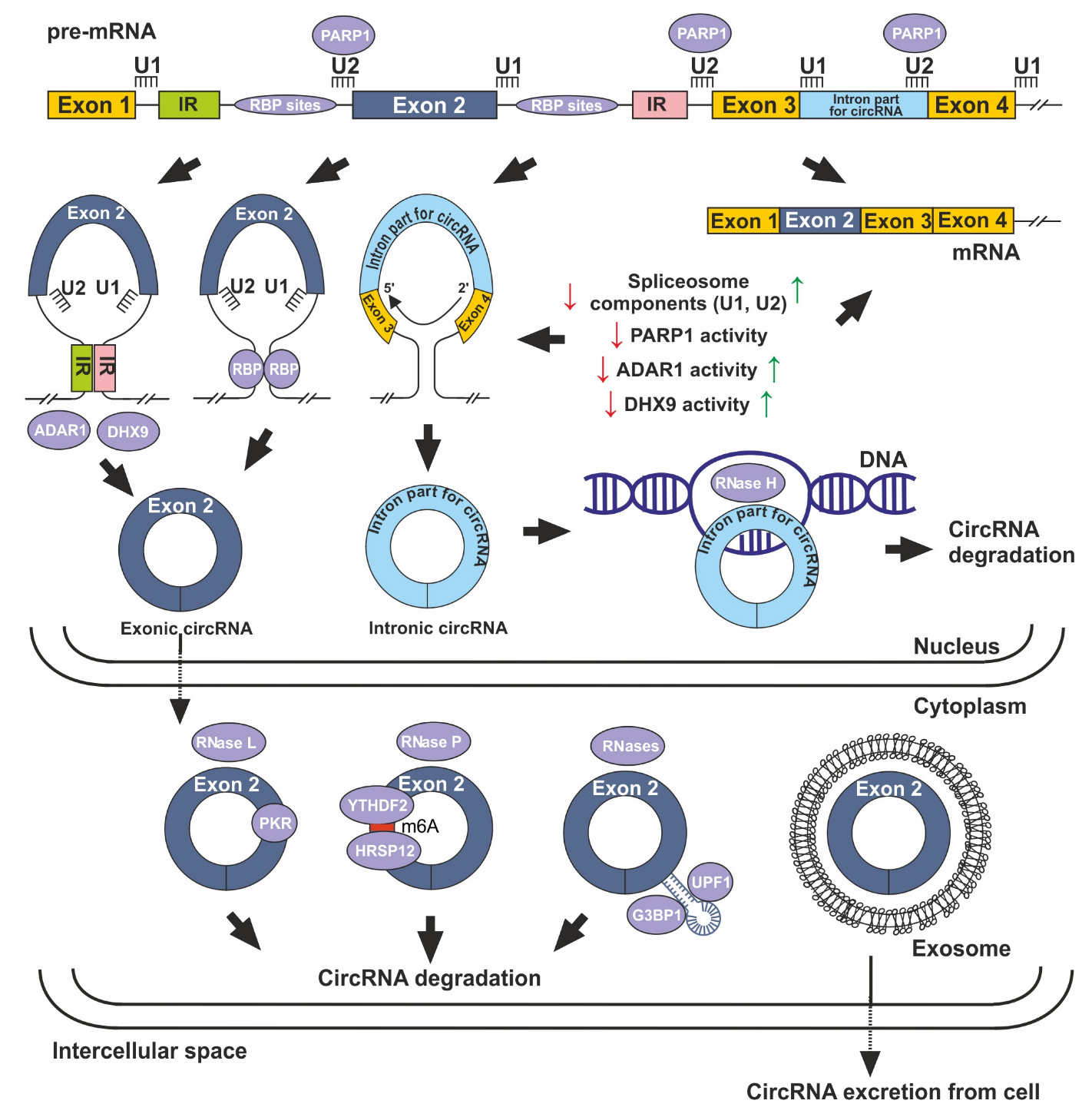
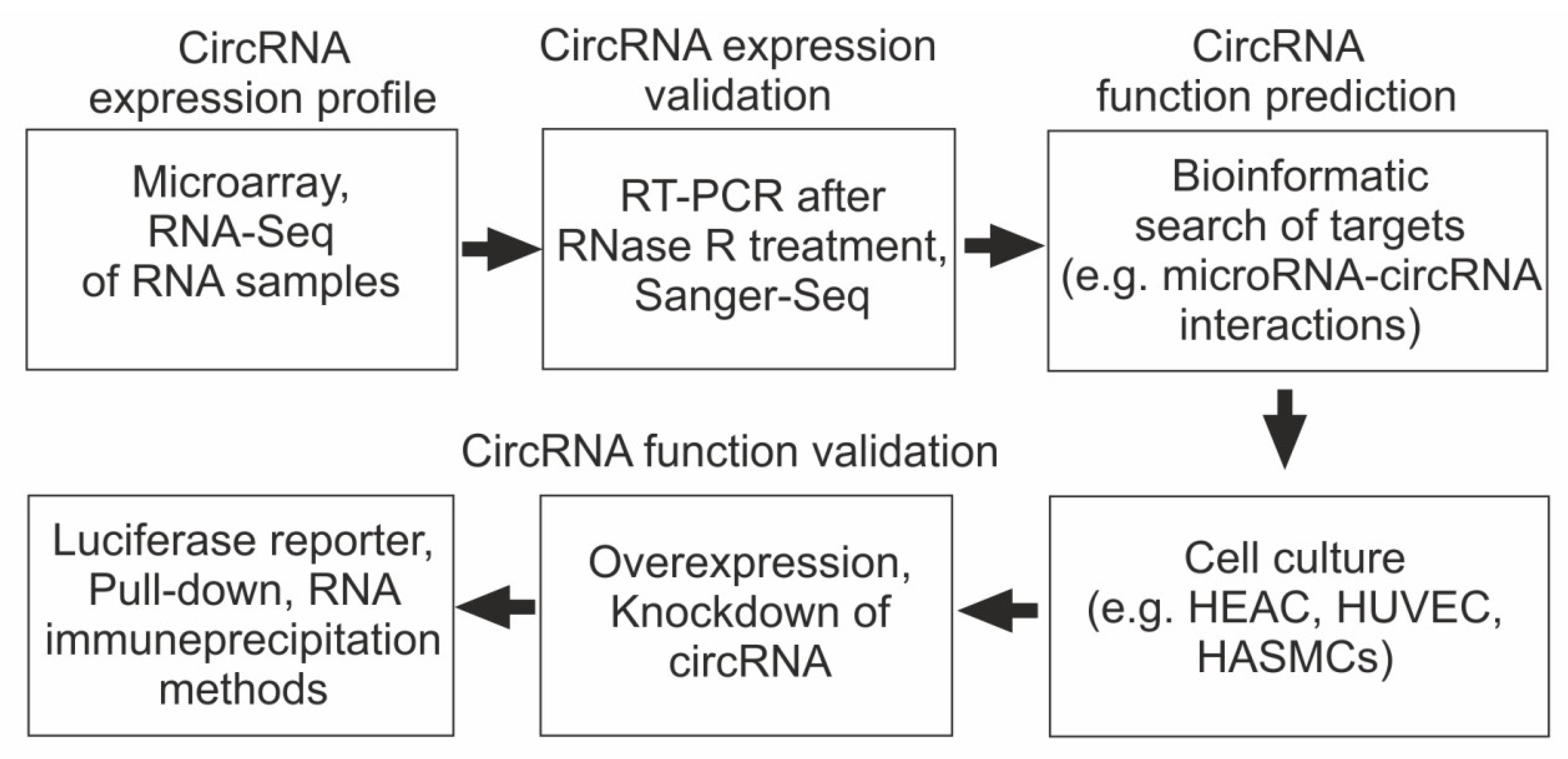
Over the past decade, numerous studies have shown that circular RNAs (circRNAs) play a significant role in coronary artery atherogenesis and other cardiovascular diseases. They belong to the class of non-coding RNAs and arise as a result of non-canonical splicing of premature RNA, which results in the formation of closed single-stranded circRNA molecules that lack 5′-end caps and 3′-end poly(A) tails. circRNAs have broad post-transcriptional regulatory activity. Acting as a sponge for miRNAs, circRNAs compete with mRNAs for binding to miRNAs, acting as competing endogenous RNAs. Numerous circRNAs are involved in the circRNA–miRNA–mRNA regulatory axes associated with the pathogenesis of cardiomyopathy, chronic heart failure, hypertension, atherosclerosis, and coronary artery disease. Recent studies have shown that сirc_0001445, circ_0000345, circ_0093887, сircSmoc1-2, and circ_0003423 are involved in the pathogenesis of coronary artery disease (CAD) with an atheroprotective effect, while circ_0002984, circ_0029589, circ_0124644, circ_0091822, and circ_0050486 possess a proatherogenic effect. With their high resistance to endonucleases, circRNAs are promising diagnostic biomarkers and therapeutic targets. This review aims to provide updated information on the involvement of atherogenesis-related circRNAs in the pathogenesis of CAD. We also discuss the main modern approaches to detecting and studying circRNA–miRNA–mRNA interactions, as well as the prospects for using circRNAs as biomarkers and therapeutic targets for the treatment of cardiovascular diseases.
Keywords: circular RNA; microRNA; coronary artery disease (CAD); biomarkers; therapy circular RNA; microRNA; coronary artery disease (CAD); biomarkers; therapy