Frontiers in Antibody–Drug Conjugates: Mechanisms, Design Innovations, and Clinical Applications in Targeted Cancer Therapy

 and
and
Abstract
1. Introduction
2. The Evolution of ADCs
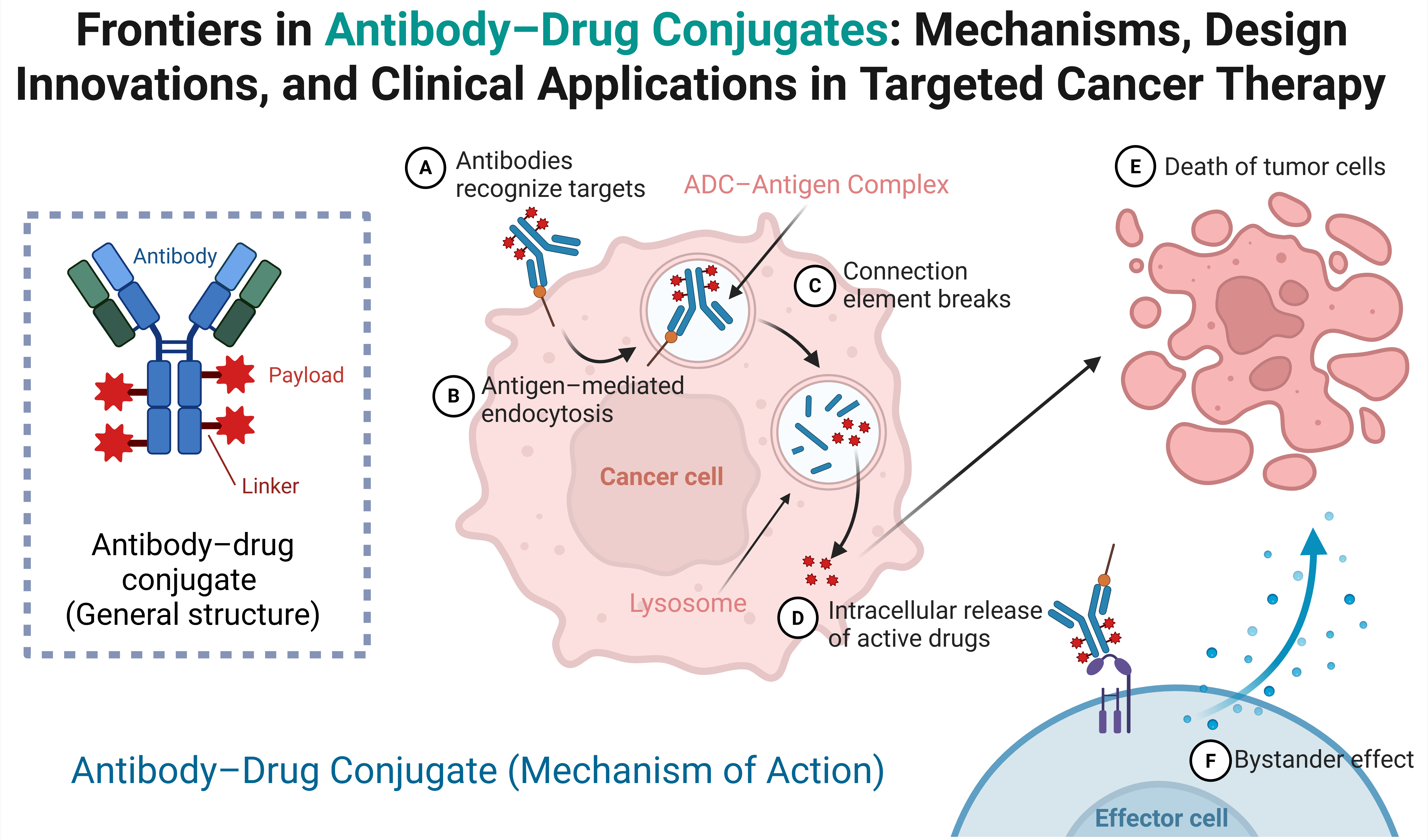
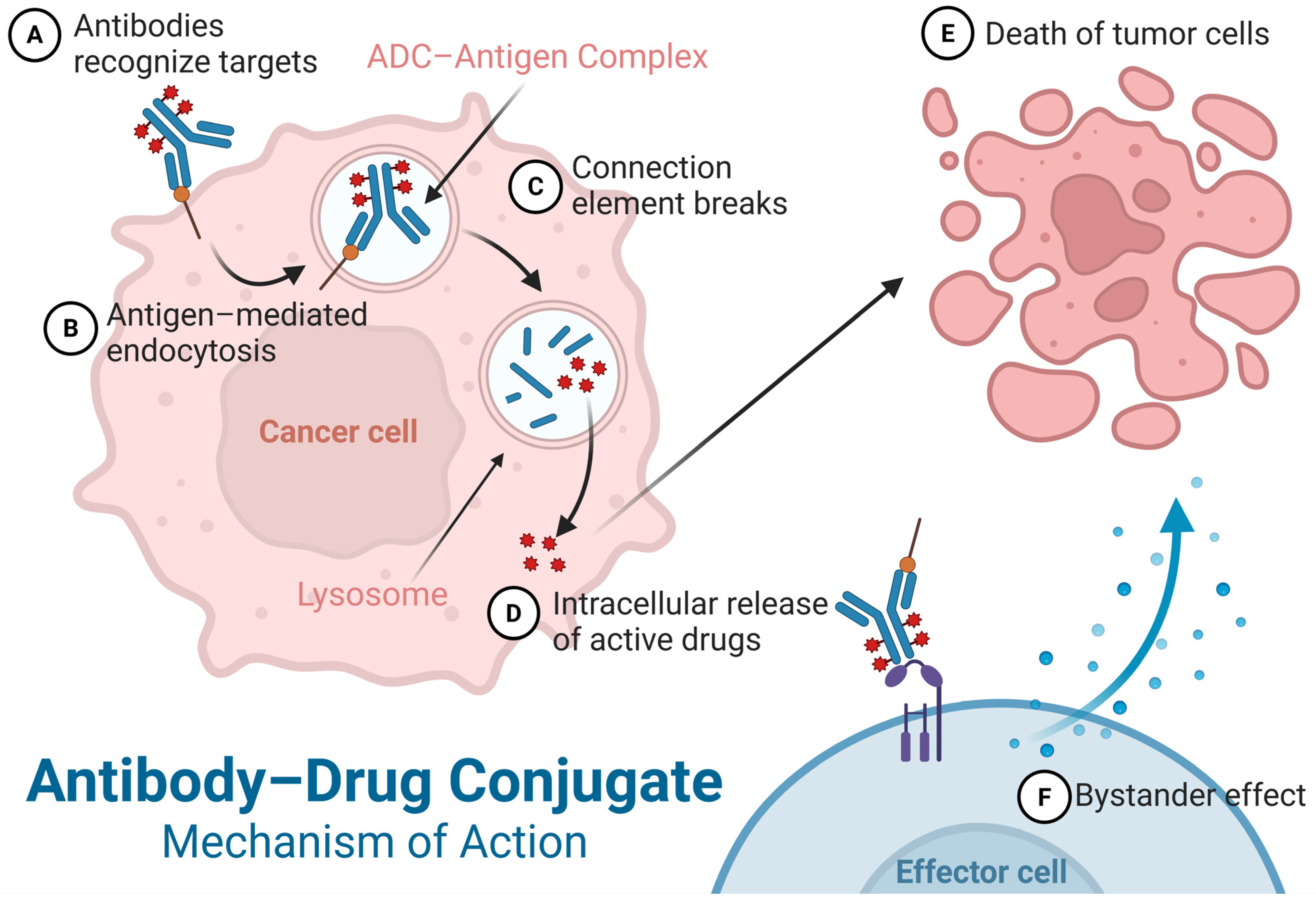
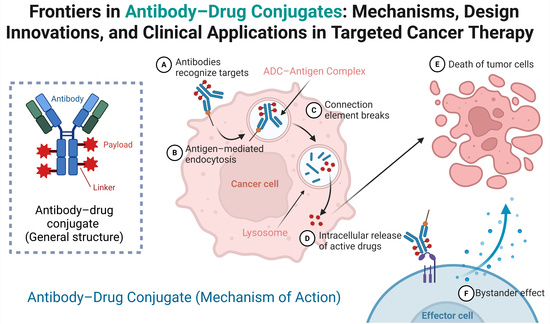
3. Mechanism of Action of ADCs
3.1. Targeted Recognition and Antibody Types in ADCs
3.1.1. Target Specificity of Monoclonal Antibodies and Advantages of Multi-Target ADCs
3.1.2. Antibody Conjugation Sites and Methods
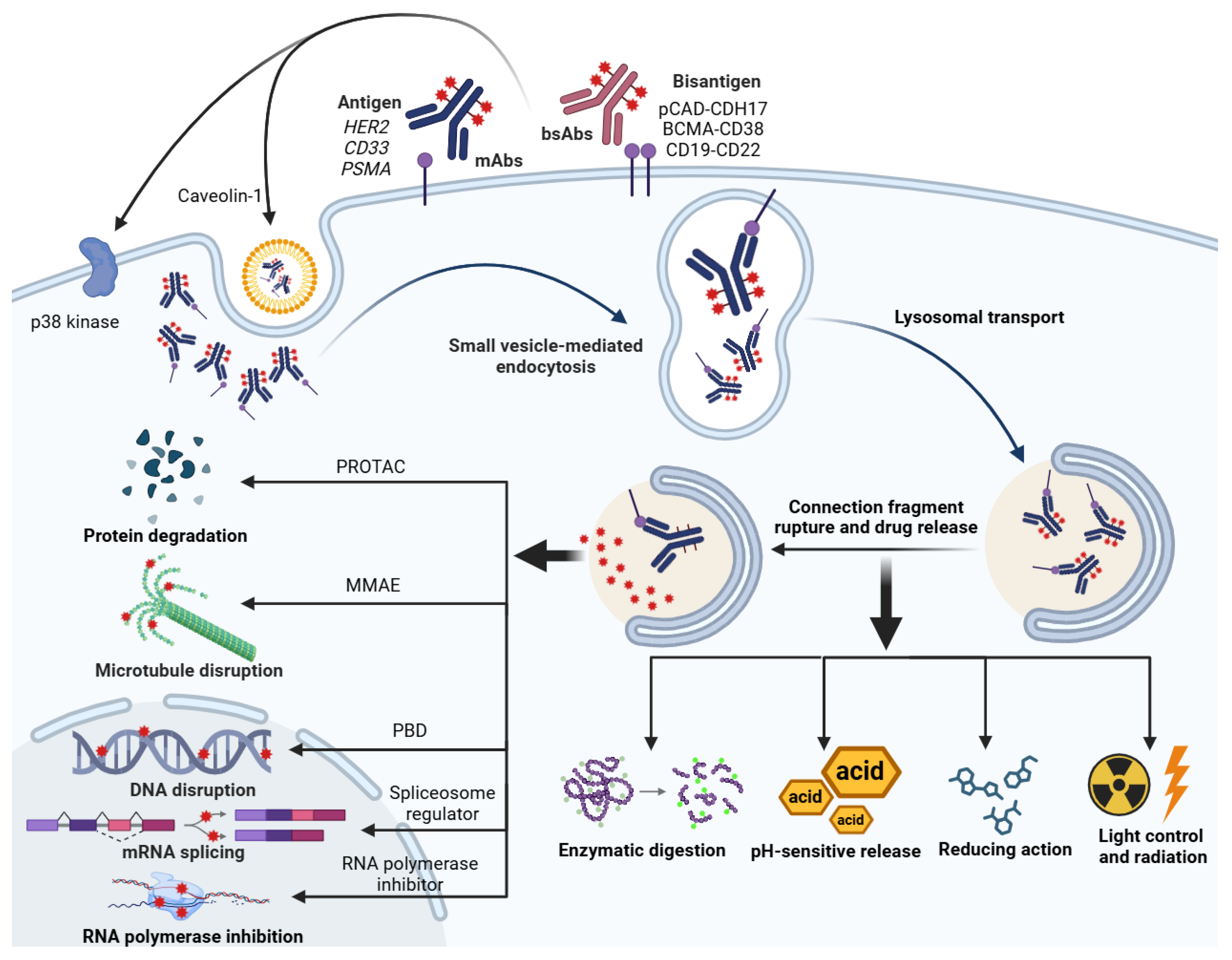
3.2. Intracellular Internalization and Trafficking Mechanisms of ADCs
3.2.1. Receptor-Mediated Endocytic Pathways
3.2.2. Intracellular Complex-Lysosome Trafficking
3.3. Drug Release Mechanisms
3.4. Mechanisms of Cytotoxic Payloads and Cell Death Pathways
3.4.1. Classic Cytotoxic Mechanisms
3.4.2. Novel Cytotoxic Mechanisms
3.4.3. Diversity of Cell Death Pathways
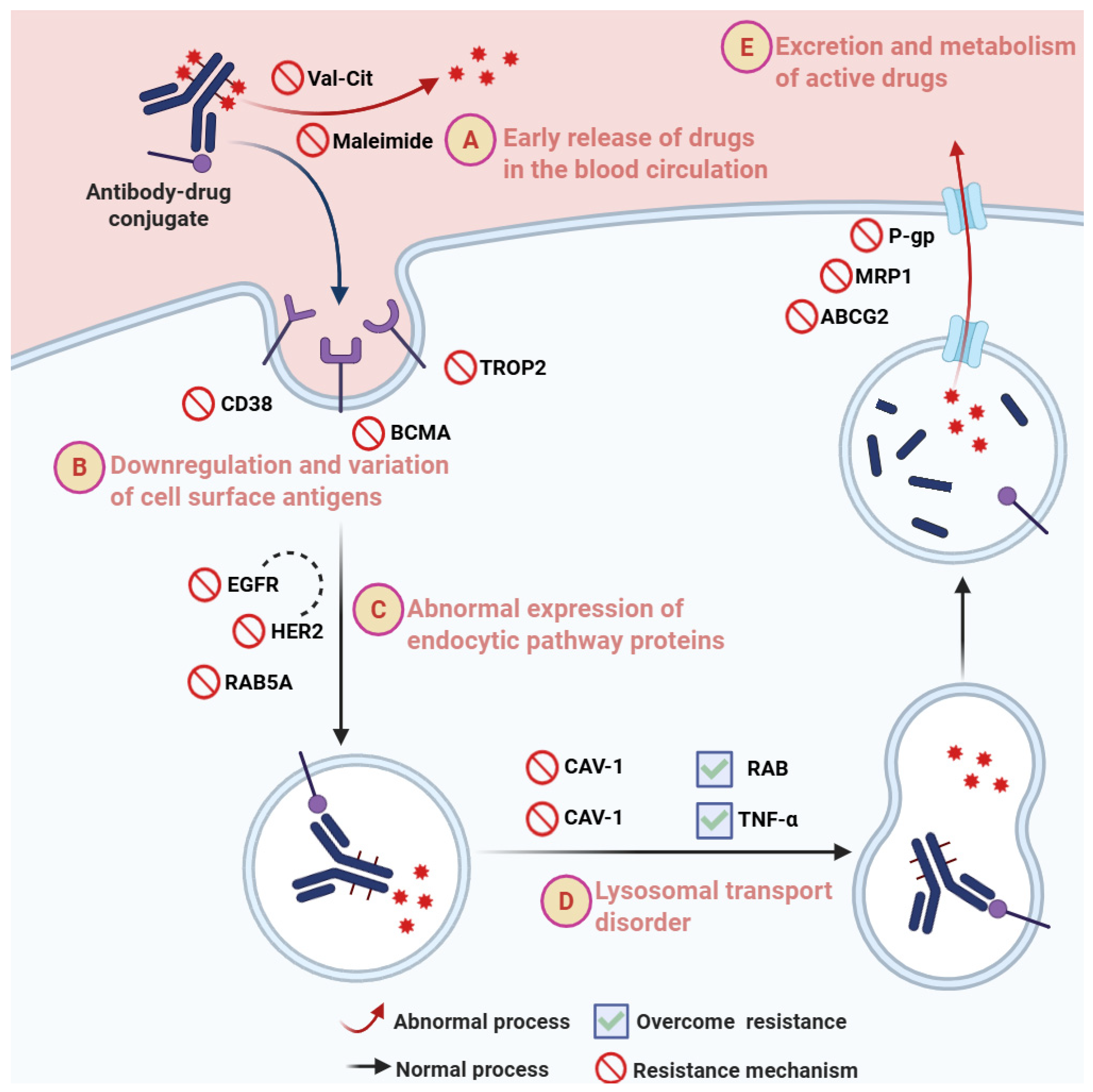
3.5. Mechanisms of ADC Resistance
3.5.1. Downregulation and Variation in Tumor Cell Antigen Expression
3.5.2. Alterations in Internalization and Trafficking Pathways
3.5.3. Linker Stability Dysregulation and Structural Heterogeneity
3.5.4. Drug Efflux and Metabolism
4. Clinical Applications of ADCs in Malignant Tumors
4.1. Application of ADCs in Hematological Malignancies
4.1.1. Acute Myeloid Leukemia (AML)
4.1.2. Acute Lymphoblastic Leukemia
4.1.3. Lymphoma
4.1.4. Multiple Myeloma (MM)
4.2. Application of ADCs in Solid Malignant Tumors
4.2.1. Breast Cancer
4.2.2. Gastric Cancer and Gastroesophageal Junction ADENOCARCINOMA
4.2.3. Urothelial Carcinoma
4.2.4. Gynecological Cancers
Cervical Cancer
Ovarian Cancer
4.2.5. Non-Small Cell Lung Cancer
5. Core Challenges Facing Current ADCs
5.1. Complexity of Target Expression and Efficacy Prediction
5.2. Intratumoral Distribution and Low Delivery Efficiency
5.3. The Balancing Act in Linker Design
5.4. Toxicity Profile and Resistance
5.5. Economic and Accessibility Challenges
6. Innovative Directions for Next-Generation ADC Technology
6.1. Innovation in Antibodies and Targeting Strategies
6.1.1. Bispecific ADCs
6.1.2. Prodrug ADCs (Pro-ADCs)
6.1.3. Novel Antibody Formats and Co-Administration
6.2. Upgrades in Linker and Conjugation Technology
6.2.1. TME-Responsive Linkers
6.2.2. Photo-Controlled Release and Amart-Responsive ADCs
6.2.3. Bioorthogonal Controlled Release and Novel Conjugation Strategies
6.2.4. Pharmacokinetic Module Optimization
6.3. Diversification and Platform Expansion of Payload Mechanisms
6.3.1. Immune-Stimulating Antibody Conjugates (ISACs)
6.3.2. Immunomodulatory ADCs
6.3.3. Degrader–Antibody Conjugates (DACs)
6.3.4. Radionuclide Drug Conjugates (RDCs)
6.3.5. Multi-Payload ADCs
6.4. Integration of Nanotechnology and ADCs
7. Conclusions
Author Contributions
Funding
Institutional Review Board Statement
Data Availability Statement
Acknowledgments
Conflicts of Interest
Glossary
| Abbreviation | Full Name |
| A + AVD | Brentuximab vedotin + doxorubicin + vinblastine + dacarbazine |
| ABVD | Doxorubicin + bleomycin + vinblastine + dacarbazine |
| ABC | ATP-binding cassette |
| ADCs | Antibody–drug conjugates |
| ALL | Acute lymphoblastic leukemia |
| AML | Acute myeloid leukemia |
| ASCT | Autologous hematopoietic stem cell transplantation |
| ATP | Adenosine triphosphate |
| B-ALL | B-cell acute lymphoblastic leukemia |
| BCMA | B-cell maturation antigen (TNFRSF17) |
| BsADC | Bispecific antibody–drug conjugate |
| BV | Brentuximab vedotin |
| cHL | Classical Hodgkin lymphoma |
| DAC | Degrader–antibody conjugate |
| DAR | Drug-to-antibody ratio |
| Dato-DXd | Datopotamab deruxtecan |
| DLBCL | Diffuse large B-cell lymphoma |
| DOR | Duration of response |
| EV | Enfortumab vedotin |
| FDA | U.S. Food and Drug Administration |
| FRα | Folate receptor-alpha |
| HCL | Hairy cell leukemia |
| HER | Human epidermal growth factor receptor |
| HMGB1 | High-mobility group box 1 |
| HR | Hazard ratio |
| HSCT | Hematopoietic stem cell transplantation |
| ICI | Immune checkpoint inhibitor |
| ICD | Immunogenic cell death |
| IHC | Immunohistochemistry |
| ILD | Interstitial lung disease |
| ISAC | Immune-stimulating antibody conjugate |
| LBCL | Large B-cell lymphoma |
| MMAE | Monomethyl auristatin E |
| NIR | Near-infrared |
| NSCLC | Non-small cell lung cancer |
| ORR | Objective response rate |
| PBD | Pyrrolobenzodiazepine |
| PD-1/PD-L1 | Programmed death-1/ligand-1 |
| PEG | Polyethylene glycol |
| PFS | Progression-free survival |
| PIT | Photoimmunotherapy |
| Pola | Polatuzumab vedotin |
| PROs | Patient-reported outcomes |
| PROTAC | PROteolysis-TArgeting Chimera |
| PSMA | Prostate-specific membrane antigen |
| R-CHOP | Rituximab + cyclophosphamide + doxorubicin + vincristine + prednisone |
| R-CHP | Rituximab + cyclophosphamide + doxorubicin + prednisone |
| RAB4a | Ras-related protein Rab-4A |
| RAB5A | Ras-related protein Rab-5A |
| RDC | Radionuclide (radiopharmaceutical) drug conjugate |
| ROS | Reactive oxygen species |
| SPARC | Synchronized payload release conjugate |
| SSTR | Somatostatin receptor |
| STING | Stimulator of interferon genes |
| T-DXd | Trastuzumab deruxtecan |
| TCE/TCR | Triple-class exposed/triple-class refractory |
| TF | Tissue factor |
| TLR | Toll-like receptor |
| TME | Tumor microenvironment |
| TOP1 | Topoisomerase I |
| TROP2 | Trophoblast cell surface antigen 2 (TACSTD2) |
| TV | Tisotumab vedotin |
| UC | Urothelial carcinoma |
| Val-Cit | Valine–citrulline |
| VOD | Veno-occlusive disease |
References
- Liu, B.; Zhou, H.; Tan, L.; Siu, K.T.H.; Guan, X.Y. Exploring treatment options in cancer: Tumor treatment strategies. Signal Transduct. Target. Ther. 2024, 9, 175. [Google Scholar] [CrossRef]
- Dumontet, C.; Reichert, J.M.; Senter, P.D.; Lambert, J.M.; Beck, A. Antibody-drug conjugates come of age in oncology. Nat. Rev. Drug Discov. 2023, 22, 641–661. [Google Scholar] [CrossRef]
- Jin, Y.; Schladetsch, M.A.; Huang, X.; Balunas, M.J.; Wiemer, A.J. Stepping forward in antibody-drug conjugate development. Pharmacol. Ther. 2022, 229, 107917. [Google Scholar] [CrossRef]
- Ward, R.A.; Fawell, S.; Floc’h, N.; Flemington, V.; McKerrecher, D.; Smith, P.D. Challenges and Opportunities in Cancer Drug Resistance. Chem. Rev. 2021, 121, 3297–3351. [Google Scholar] [CrossRef]
- Arceci, R.J.; Sande, J.; Lange, B.; Shannon, K.; Franklin, J.; Hutchinson, R.; Vik, T.A.; Flowers, D.; Aplenc, R.; Berger, M.S.; et al. Safety and efficacy of gemtuzumab ozogamicin in pediatric patients with advanced CD33+ acute myeloid leukemia. Blood 2005, 106, 1183–1188. [Google Scholar] [CrossRef] [PubMed]
- Connors, J.M.; Jurczak, W.; Straus, D.J.; Ansell, S.M.; Kim, W.S.; Gallamini, A.; Younes, A.; Alekseev, S.; Illés, Á.; Picardi, M.; et al. Brentuximab Vedotin with Chemotherapy for Stage III or IV Hodgkin’s Lymphoma. N. Engl. J. Med. 2018, 378, 331–344. [Google Scholar] [CrossRef] [PubMed]
- von Minckwitz, G.; Huang, C.S.; Mano, M.S.; Loibl, S.; Mamounas, E.P.; Untch, M.; Wolmark, N.; Rastogi, P.; Schneeweiss, A.; Redondo, A.; et al. Trastuzumab Emtansine for Residual Invasive HER2-Positive Breast Cancer. N. Engl. J. Med. 2019, 380, 617–628. [Google Scholar] [CrossRef]
- Modi, S.; Jacot, W.; Yamashita, T.; Sohn, J.; Vidal, M.; Tokunaga, E.; Tsurutani, J.; Ueno, N.T.; Prat, A.; Chae, Y.S.; et al. Trastuzumab Deruxtecan in Previously Treated HER2-Low Advanced Breast Cancer. N. Engl. J. Med. 2022, 387, 9–20. [Google Scholar] [CrossRef]
- Chan, A.C.; Martyn, G.D.; Carter, P.J. Fifty years of monoclonals: The past, present and future of antibody therapeutics. Nat. Rev. Immunol. 2025, 25, 745–765. [Google Scholar] [CrossRef] [PubMed]
- Hafeez, U.; Gan, H.K.; Scott, A.M. Monoclonal antibodies as immunomodulatory therapy against cancer and autoimmune diseases. Curr. Opin. Pharmacol. 2018, 41, 114–121. [Google Scholar] [CrossRef]
- Fu, Z.; Li, S.; Han, S.; Shi, C.; Zhang, Y. Antibody drug conjugate: The “biological missile” for targeted cancer therapy. Signal Transduct. Target. Ther. 2022, 7, 93. [Google Scholar] [CrossRef]
- Yamaizumi, M.; Mekada, E.; Uchida, T.; Okada, Y. One molecule of diphtheria toxin fragment A introduced into a cell can kill the cell. Cell 1978, 15, 245–250. [Google Scholar] [CrossRef]
- McGavin, J.K.; Spencer, C.M. Gemtuzumab ozogamicin. Drugs 2001, 61, 1317–1322, discussion 1323–1324. [Google Scholar] [CrossRef]
- Hamann, P.R.; Hinman, L.M.; Hollander, I.; Beyer, C.F.; Lindh, D.; Holcomb, R.; Hallett, W.; Tsou, H.R.; Upeslacis, J.; Shochat, D.; et al. Gemtuzumab ozogamicin, a potent and selective anti-CD33 antibody-calicheamicin conjugate for treatment of acute myeloid leukemia. Bioconjug. Chem. 2002, 13, 47–58. [Google Scholar] [CrossRef] [PubMed]
- Bross, P.F.; Beitz, J.; Chen, G.; Chen, X.H.; Duffy, E.; Kieffer, L.; Roy, S.; Sridhara, R.; Rahman, A.; Williams, G.; et al. Approval summary: Gemtuzumab ozogamicin in relapsed acute myeloid leukemia. Clin. Cancer Res. 2001, 7, 1490–1496. [Google Scholar] [PubMed]
- Ansell, S.M. Brentuximab vedotin. Blood 2014, 124, 3197–3200. [Google Scholar] [CrossRef]
- Verma, S.; Miles, D.; Gianni, L.; Krop, I.E.; Welslau, M.; Baselga, J.; Pegram, M.; Oh, D.Y.; Diéras, V.; Guardino, E.; et al. Trastuzumab emtansine for HER2-positive advanced breast cancer. N. Engl. J. Med. 2012, 367, 1783–1791. [Google Scholar] [CrossRef]
- Tsuchikama, K.; An, Z. Antibody-drug conjugates: Recent advances in conjugation and linker chemistries. Protein Cell 2018, 9, 33–46. [Google Scholar] [CrossRef] [PubMed]
- Gu, Y.; Wang, Z.; Wang, Y. Bispecific antibody drug conjugates: Making 1 + 1 > 2. Acta Pharm. Sin. B 2024, 14, 1965–1986. [Google Scholar] [CrossRef]
- Wang, R.; Hu, B.; Pan, Z.; Mo, C.; Zhao, X.; Liu, G.; Hou, P.; Cui, Q.; Xu, Z.; Wang, W.; et al. Antibody-Drug Conjugates (ADCs): Current and future biopharmaceuticals. J. Hematol. Oncol. 2025, 18, 51. [Google Scholar] [CrossRef]
- Sauter, M.; Strieker, M.; Kleist, C.; Wischnjow, A.; Daniel, V.; Altmann, A.; Haberkorn, U.; Mier, W. Improving antibody-based therapies by chemical engineering of antibodies with multimeric cell-penetrating peptides for elevated intracellular delivery. J. Control. Release 2020, 322, 200–208. [Google Scholar] [CrossRef]
- Yao, X.; Lu, Y.; Shi, S.; Wang, Y. Antibody-drug conjugates (ADCs): “Smart Missiles” targeting cancer therapy. Colloids Surf. B Biointerfaces 2025, 257, 115161. [Google Scholar] [CrossRef]
- Nader-Marta, G.; Molinelli, C.; Debien, V.; Martins-Branco, D.; Aftimos, P.; de Azambuja, E.; Awada, A. Antibody-drug conjugates: The evolving field of targeted chemotherapy for breast cancer treatment. Ther. Adv. Med. Oncol. 2023, 15, 17588359231183679. [Google Scholar] [CrossRef]
- Yu, J.; Li, M.; Liu, X.; Wu, S.; Li, R.; Jiang, Y.; Zheng, J.; Li, Z.; Xin, K.; Xu, Z.; et al. Implementation of antibody-drug conjugates in HER2-positive solid cancers: Recent advances and future directions. Biomed. Pharmacother. 2024, 174, 116522. [Google Scholar] [CrossRef] [PubMed]
- Abelman, R.O.; Medford, A.; Spring, L.; Bardia, A. Antibody-Drug Conjugates in Breast Cancer: Spotlight on HER2. Cancer J. 2022, 28, 423–428. [Google Scholar] [CrossRef] [PubMed]
- Sepp, A.; Stader, F.; Derbalah, A.; Liu, C.; Zyla, A.; Gardner, I.; Jamei, M. The physiological limits of bispecific monoclonal antibody tissue targeting specificity. mAbs 2025, 17, 2492236. [Google Scholar] [CrossRef]
- Zeng, H.; Ning, W.; Liu, X.; Luo, W.; Xia, N. Unlocking the potential of bispecific ADCs for targeted cancer therapy. Front. Med. 2024, 18, 597–621. [Google Scholar] [CrossRef]
- Hong, Y.; Nam, S.M.; Moon, A. Antibody-drug conjugates and bispecific antibodies targeting cancers: Applications of click chemistry. Arch. Pharm. Res. 2023, 46, 131–148. [Google Scholar] [CrossRef]
- Synan, A.; Wu, N.C.; Velazquez, R.; Gesner, T.; Logel, C.; Mueller, K.; Green, A.; Barzaghi-Rinaudo, P.; Simmons, Q.; Mercan, S.; et al. A bispecific antibody-drug conjugate targeting pCAD and CDH17 has antitumor activity and improved tumor-specificity. mAbs 2025, 17, 2441411. [Google Scholar] [CrossRef]
- De Novellis, D.; Fontana, R.; Giudice, V.; Serio, B.; Selleri, C. Innovative Anti-CD38 and Anti-BCMA Targeted Therapies in Multiple Myeloma: Mechanisms of Action and Resistance. Int. J. Mol. Sci. 2022, 24, 645. [Google Scholar] [CrossRef] [PubMed]
- Ida, N.; Yamauchi, T. Antibody-Drug Conjugate for Treating Leukemia and Lymphoma-The Present Status, Problems, and Future Development. Gan Kagaku Ryoho 2024, 51, 686–690. [Google Scholar]
- Coumans, R.G.E.; Ariaans, G.J.A.; Spijker, H.J.; Renart Verkerk, P.; Beusker, P.H.; Kokke, B.P.A.; Schouten, J.; Blomenröhr, M.; van der Lee, M.M.C.; Groothuis, P.G.; et al. A Platform for the Generation of Site-Specific Antibody-Drug Conjugates That Allows for Selective Reduction of Engineered Cysteines. Bioconjug. Chem. 2020, 31, 2136–2146. [Google Scholar] [CrossRef]
- Liao, X.; Haight, A.; Welch, D.; Han, L. Selective Reduction of Cysteine Mutant Antibodies for Site-Specific Antibody-Drug Conjugates. Bioconjug. Chem. 2023, 34, 2293–2301. [Google Scholar] [CrossRef]
- Dickgiesser, S.; Rieker, M.; Mueller-Pompalla, D.; Schröter, C.; Tonillo, J.; Warszawski, S.; Raab-Westphal, S.; Kühn, S.; Knehans, T.; Könning, D.; et al. Site-Specific Conjugation of Native Antibodies Using Engineered Microbial Transglutaminases. Bioconjug. Chem. 2020, 31, 1070–1076. [Google Scholar] [CrossRef]
- Takahashi, K.; Yamazaki, S.; Matsuda, Y. Structural Insights into Lipoate Ligase A-Mediated Antibody Modifications. Biochemistry 2025, 64, 2577–2582. [Google Scholar] [CrossRef]
- Thanasi, I.A.; Bouloc, N.; McMahon, C.; Wang, N.; Szijj, P.A.; Butcher, T.; Rochet, L.N.C.; Love, E.A.; Merritt, A.; Baker, J.R.; et al. Formation of mono- and dual-labelled antibody fragment conjugates via reversible site-selective disulfide modification and proximity induced lysine reactivity. Chem. Sci. 2025, 16, 2763–2776. [Google Scholar] [CrossRef] [PubMed]
- Yamazaki, S.; Matsuda, Y. Antibody Modification via Lipoic Acid Ligase A-Mediated Site-Specific Labeling. Chem. Biodivers. 2025, 22, e202402113. [Google Scholar] [CrossRef] [PubMed]
- Fujii, T.; Matsuda, Y.; Seki, T.; Shikida, N.; Iwai, Y.; Ooba, Y.; Takahashi, K.; Isokawa, M.; Kawaguchi, S.; Hatada, N.; et al. AJICAP Second Generation: Improved Chemical Site-Specific Conjugation Technology for Antibody-Drug Conjugate Production. Bioconjug. Chem. 2023, 34, 728–738. [Google Scholar] [CrossRef] [PubMed]
- Yamazoe, S.; Cheng, Q.; Kotapati, S.; Rangan, V.S.; Sung, M.C.; Deshpande, M.; Jashnani, A.; Qiang, C.; Smith, M.J.; Pan, C.; et al. The Impact of Conjugation Mode and Site on Tubulysin Antibody-Drug-Conjugate Efficacy and Stability. ChemistryOpen 2025, 14, e202400522. [Google Scholar] [CrossRef]
- Matsuda, Y.; Malinao, M.C.; Robles, V.; Song, J.; Yamada, K.; Mendelsohn, B.A. Proof of site-specificity of antibody-drug conjugates produced by chemical conjugation technology: AJICAP first generation. J. Chromatogr. B 2020, 1140, 121981. [Google Scholar] [CrossRef]
- Hashad, R.A.; Jap, E.; Casey, J.L.; Candace Ho, Y.T.; Wright, A.; Thalmann, C.; Sleeman, M.; Lupton, D.W.; Hagemeyer, C.E.; Cryle, M.J.; et al. Chemoselective Methionine Labelling of Recombinant Trastuzumab Shows High In Vitro and In Vivo Tumour Targeting. Chemistry 2023, 29, e202202491. [Google Scholar] [CrossRef] [PubMed]
- Matsuda, Y.; Seki, T.; Yamada, K.; Ooba, Y.; Takahashi, K.; Fujii, T.; Kawaguchi, S.; Narita, T.; Nakayama, A.; Kitahara, Y.; et al. Chemical Site-Specific Conjugation Platform to Improve the Pharmacokinetics and Therapeutic Index of Antibody-Drug Conjugates. Mol. Pharm. 2021, 18, 4058–4066. [Google Scholar] [CrossRef]
- Nilchan, N.; Li, X.; Pedzisa, L.; Nanna, A.R.; Roush, W.R.; Rader, C. Dual-mechanistic antibody-drug conjugate via site-specific selenocysteine/cysteine conjugation. Antib. Ther. 2019, 2, 71–78. [Google Scholar] [CrossRef] [PubMed]
- Sun, W.; Weng, W.; Shi, J.; Ma, B.; DeMarco, K.D.; Gui, F.; Jin, R.; Ruscetti, M.; Jia, L.; Hu, W.; et al. SPARC: A Multipayload ADC Architecture for Programmable Drug Combinations. Bioconjug. Chem. 2025, 36, 2158–2171. [Google Scholar] [CrossRef] [PubMed]
- Zhang, L.; Wang, Z.; Wang, Z.; Luo, F.; Guan, M.; Xu, M.; Li, Y.; Zhang, Y.; Wang, Z.; Wang, W. A Simple and Efficient Method to Generate Dual Site-Specific Conjugation ADCs with Cysteine Residue and an Unnatural Amino Acid. Bioconjug. Chem. 2021, 32, 1094–1104. [Google Scholar] [CrossRef]
- Park, J.; Lee, S.; Kim, Y.; Yoo, T.H. Methods to generate site-specific conjugates of antibody and protein. Bioorg. Med. Chem. 2021, 30, 115946. [Google Scholar] [CrossRef]
- Cochran, M.; Arias, D.; Burke, R.; Chu, D.; Erdogan, G.; Hood, M.; Kovach, P.; Kwon, H.W.; Chen, Y.; Moon, M.; et al. Structure-Activity Relationship of Antibody-Oligonucleotide Conjugates: Evaluating Bioconjugation Strategies for Antibody-siRNA Conjugates for Drug Development. J. Med. Chem. 2024, 67, 14852–14867. [Google Scholar] [CrossRef]
- Abelman, R.O.; Keenan, J.C.; Ryan, P.K.; Spring, L.M.; Bardia, A. Current and Emerging Role of Antibody-Drug Conjugates in HER2-Negative Breast Cancer. Hematol. Oncol. Clin. N. Am. 2023, 37, 151–167. [Google Scholar] [CrossRef]
- Hammood, M.; Craig, A.W.; Leyton, J.V. Impact of Endocytosis Mechanisms for the Receptors Targeted by the Currently Approved Antibody-Drug Conjugates (ADCs)-A Necessity for Future ADC Research and Development. Pharmaceuticals 2021, 14, 674. [Google Scholar] [CrossRef]
- Liang, K.; Mei, S.; Gao, X.; Peng, S.; Zhan, J. Dynamics of Endocytosis and Degradation of Antibody-Drug Conjugate T-DM1 in HER2 Positive Cancer Cells. Drug Des. Devel. Ther. 2021, 15, 5135–5150. [Google Scholar] [CrossRef]
- Takahashi, J.I.; Nakamura, S.; Onuma, I.; Zhou, Y.; Yokoyama, S.; Sakurai, H. Synchronous intracellular delivery of EGFR-targeted antibody-drug conjugates by p38-mediated non-canonical endocytosis. Sci. Rep. 2022, 12, 11561. [Google Scholar] [CrossRef]
- Min, B.; Jin, J.; Kim, H.; Her, N.G.; Park, C.; Kim, D.; Yang, J.; Hwang, J.; Kim, E.; Choi, M.; et al. cIRCR201-dPBD, a Novel Pyrrolobenzodiazepine Dimer-Containing Site-Specific Antibody-Drug Conjugate Targeting c-Met Overexpression Tumors. ACS Omega 2020, 5, 25798–25809. [Google Scholar] [CrossRef]
- Li, L.; Xu, M.Z.; Wang, L.; Jiang, J.; Dong, L.H.; Chen, F.; Dong, K.; Song, H.F. Conjugating MMAE to a novel anti-HER2 antibody for selective targeted delivery. Eur. Rev. Med. Pharmacol. Sci. 2020, 24, 12929–12937. [Google Scholar] [CrossRef]
- Paz-Manrique, R.; Pinto, J.A.; Gomez Moreno, H.L. Antibody-Drug Conjugates in Breast Cancer: Toward a Molecular Perspective Into Clinical Practice. JCO Precis. Oncol. 2024, 8, e2400173. [Google Scholar] [CrossRef]
- Tedeschini, T.; Campara, B.; Grigoletto, A.; Zanotto, I.; Cannella, L.; Gabbia, D.; Matsuno, Y.; Suzuki, A.; Yoshioka, H.; Armirotti, A.; et al. Optimization of a pendant-shaped PEGylated linker for antibody-drug conjugates. J. Control. Release 2024, 375, 74–89. [Google Scholar] [CrossRef]
- Mohamed Amar, I.A.; Huvelle, S.; Douez, E.; Letast, S.; Henrion, S.; Viaud-Massuard, M.C.; Aubrey, N.; Allard-Vannier, E.; Joubert, N.; Denevault-Sabourin, C. Dual intra- and extracellular release of monomethyl auristatin E from a neutrophil elastase-sensitive antibody-drug conjugate. Eur. J. Med. Chem. 2022, 229, 114063. [Google Scholar] [CrossRef]
- Cazzaniga, G.; Zambra, M.; Bongiolo, S.; Prpić, H.; Fasola, E.; Arrigoni, F.; Piarulli, U.; Gazzola, S. Comparative Enzymatic and Stability Assays Reveal GPLG as an Effective Cathepsin B Cleavable Linker for Tumor-Targeting Drug Conjugates. ACS Omega 2025, 10, 41783–41798. [Google Scholar] [CrossRef] [PubMed]
- Rady, T.; Turelli, L.; Nothisen, M.; Tobaldi, E.; Erb, S.; Thoreau, F.; Hernandez-Alba, O.; Cianferani, S.; Daubeuf, F.; Wagner, A.; et al. A Novel Family of Acid-Cleavable Linker Based on Cyclic Acetal Motifs for the Production of Antibody-Drug Conjugates with High Potency and Selectivity. Bioconjug. Chem. 2022, 33, 1860–1866. [Google Scholar] [CrossRef] [PubMed]
- Nadal-Bufi, F.; Salomon, P.L.; de Moliner, F.; Sarris, K.A.; Wang, Z.; Wills, R.D.; Marin, V.L.; Shi, X.; Zhou, K.; Wang, Z.; et al. Fluorogenic Platform for Real-Time Imaging of Subcellular Payload Release in Antibody-Drug Conjugates. J. Am. Chem. Soc. 2025, 147, 7578–7587. [Google Scholar] [CrossRef] [PubMed]
- Olatunji, F.P.; Savoy, E.A.; Panteah, M.; Mesbahi, N.; Abbasi, A.; Talley, C.M.; Lovingier, C.L.; Caromile, L.A.; Berkman, C.E. Prostate-Specific Membrane Antigen-Targeted Turn-on Probe for Imaging Cargo Release in Prostate Cancer Cells. Bioconjug. Chem. 2021, 32, 2386–2396. [Google Scholar] [CrossRef]
- Ferhati, X.; Jiménez-Moreno, E.; Hoyt, E.A.; Salluce, G.; Cabeza-Cabrerizo, M.; Navo, C.D.; Compañón, I.; Akkapeddi, P.; Matos, M.J.; Salaverri, N.; et al. Single Mutation on Trastuzumab Modulates the Stability of Antibody-Drug Conjugates Built Using Acetal-Based Linkers and Thiol-Maleimide Chemistry. J. Am. Chem. Soc. 2022, 144, 5284–5294. [Google Scholar] [CrossRef]
- Wei, D.; Wang, H.; Huangfu, S.; Qi, C.; Jiang, Y.; Yu, X.; Jiang, B.; Chen, H. Fine-tuning phenoxy silyl scaffolds for the development of glutathione-responsive prodrugs and antibody-drug conjugates. Bioorg. Med. Chem. 2025, 120, 118088. [Google Scholar] [CrossRef]
- Takahashi, K.; Yasui, H.; Taki, S.; Shimizu, M.; Koike, C.; Taki, K.; Yukawa, H.; Baba, Y.; Kobayashi, H.; Sato, K. Near-infrared-induced drug release from antibody-drug double conjugates exerts a cytotoxic photo-bystander effect. Bioeng. Transl. Med. 2022, 7, e10388. [Google Scholar] [CrossRef]
- Quintana, J.M.; Arboleda, D.; Hu, H.; Scott, E.; Luthria, G.; Pai, S.; Parangi, S.; Weissleder, R.; Miller, M.A. Radiation Cleaved Drug-Conjugate Linkers Enable Local Payload Release. Bioconjug. Chem. 2022, 33, 1474–1484. [Google Scholar] [CrossRef]
- Matsuda, Y.; Chang, J.R.; Mendelsohn, B.A. Advanced Antibody-Drug Conjugates Design: Innovation in Linker Chemistry and Site-Specific Conjugation Technologies. ChemBioChem 2025, 26, e2500305. [Google Scholar] [CrossRef]
- Hashmi, H.; Darwin, A.; Nishihori, T. Therapeutic Roles of Antibody Drug Conjugates (ADCs) in Relapsed/Refractory Lymphomas. Hematol. Oncol. Stem Cell Ther. 2023, 16, 21–34. [Google Scholar] [CrossRef] [PubMed]
- Tiberghien, A.C.; Vijayakrishnan, B.; Esfandiari, A.; Ahmed, M.; Pardo, R.; Bingham, J.; Adams, L.; Santos, K.; Kang, G.D.; Pugh, K.M.; et al. Comparison of Pyrrolobenzodiazepine Dimer Bis-imine versus Mono-imine: DNA Interstrand Cross-linking, Cytotoxicity, Antibody-Drug Conjugate Efficacy and Toxicity. Mol. Cancer Ther. 2023, 22, 254–263. [Google Scholar] [CrossRef] [PubMed]
- Tsuchikama, K.; Anami, Y.; Ha, S.Y.Y.; Yamazaki, C.M. Exploring the next generation of antibody-drug conjugates. Nat. Rev. Clin. Oncol. 2024, 21, 203–223. [Google Scholar] [CrossRef] [PubMed]
- Long, R.; Zuo, H.; Tang, G.; Zhang, C.; Yue, X.; Yang, J.; Luo, X.; Deng, Y.; Qiu, J.; Li, J.; et al. Antibody-drug conjugates in cancer therapy: Applications and future advances. Front. Immunol. 2025, 16, 1516419. [Google Scholar] [CrossRef]
- Wang, Y.; Nan, Y.; Ma, C.; Lu, X.; Wang, Q.; Huang, X.; Xue, W.; Fan, J.; Ju, D.; Ye, D.; et al. A potential strategy for bladder cancer treatment: Inhibiting autophagy to enhance antitumor effects of Nectin-4-MMAE. Cell Death Dis. 2024, 15, 293. [Google Scholar] [CrossRef]
- Geles, K.G.; Gao, Y.; Giannakou, A.; Sridharan, L.; Yamin, T.T.; Zhang, J.; Karim, R.; Bard, J.; Piche-Nicholas, N.; Charati, M.; et al. NOTCH3-targeted antibody drug conjugates regress tumors by inducing apoptosis in receptor cells and through transendocytosis into ligand cells. Cell Rep. Med. 2021, 2, 100279. [Google Scholar] [CrossRef]
- Wittwer, N.L.; Staudacher, A.H.; Liapis, V.; Cardarelli, P.; Warren, H.; Brown, M.P. An anti-mesothelin targeting antibody drug conjugate induces pyroptosis and ignites antitumor immunity in mouse models of cancer. J. Immunother. Cancer 2023, 11, e006274. [Google Scholar] [CrossRef]
- Li, C.; Chen, F.; Wu, J.; Ren, J.; Li, Y.; Li, S.; Xia, Z. Antibody-DNA nanostructure conjugates exhibit inhibited effects on CT26 cells and prevent upregulation of PD-1 in the tumor microenvironment. Int. J. Biol. Macromol. 2025, 330, 148101. [Google Scholar] [CrossRef] [PubMed]
- Xu, X.; Yu, T.; Wang, Z. Combining antibody-drug conjugates with immune checkpoint inhibitors: A new paradigm for breast cancer therapy. Cancer Treat. Rev. 2025, 140, 103012. [Google Scholar] [CrossRef]
- Lv, Y.; Cui, X.; Li, T.; Liu, C.; Wang, A.; Wang, T.; Zhou, X.; Li, R.; Zhang, F.; Hu, Y.; et al. Mechanism of action and future perspectives of ADCs in combination with immune checkpoint inhibitors for solid tumors. Clin. Exp. Med. 2025, 25, 139. [Google Scholar] [CrossRef]
- Zheng, Y.; Ding, Y.; Chen, L.; Zhang, Z.; Ding, R. Breaking therapeutic barriers in solid tumors: Clinical progress of antibody-drug conjugate/immune checkpoint inhibitor combinations (Review). Oncol. Rep. 2025, 54, 124. [Google Scholar] [CrossRef]
- Akram, F.; Ali, A.M.; Akhtar, M.T.; Fatima, T.; Shabbir, I.; Ul Haq, I. The journey of antibody-drug conjugates for revolutionizing cancer therapy: A review. Bioorg. Med. Chem. 2025, 117, 118010. [Google Scholar] [CrossRef]
- Figueroa-Vazquez, V.; Ko, J.; Breunig, C.; Baumann, A.; Giesen, N.; Pálfi, A.; Müller, C.; Lutz, C.; Hechler, T.; Kulke, M.; et al. HDP-101, an Anti-BCMA Antibody-Drug Conjugate, Safely Delivers Amanitin to Induce Cell Death in Proliferating and Resting Multiple Myeloma Cells. Mol. Cancer Ther. 2021, 20, 367–378. [Google Scholar] [CrossRef]
- Li, S.; Zhao, X.; Fu, K.; Zhu, S.; Pan, C.; Yang, C.; Wang, F.; To, K.K.W.; Fu, L. Resistance to antibody-drug conjugates: A review. Acta Pharm. Sin. B 2025, 15, 737–756. [Google Scholar] [CrossRef] [PubMed]
- Jiang, M.; Li, Q.; Xu, B. Spotlight on ideal target antigens and resistance in antibody-drug conjugates: Strategies for competitive advancement. Drug Resist. Updat. 2024, 75, 101086. [Google Scholar] [CrossRef] [PubMed]
- Zhou, K.; Liu, X.; Zhu, H. Overcoming resistance to antibody-drug conjugates: From mechanistic insights to cutting-edge strategies. J. Hematol. Oncol. 2025, 18, 96. [Google Scholar] [CrossRef] [PubMed]
- Cerci, B.; Saatci, O.; Basik, M.; Sahin, O. Mechanisms of resistance to antibody-drug conjugates in breast cancer. Drug Resist. Updat. 2026, 85, 101353. [Google Scholar] [CrossRef] [PubMed]
- Niquille, D.L.; Fitzgerald, K.M.; Gera, N. Biparatopic antibodies: Therapeutic applications and prospects. mAbs 2024, 16, 2310890. [Google Scholar] [CrossRef]
- Chang, T.Y.; Lin, C.J.; Wen, S.N.; Wu, Y.C.; Wei, C.Y.; Huang, J.Y.; Tsao, Y.H.; Chen, Y.J.; Tang, W.C.; Wu, Y.C.; et al. Preclinical evaluation of a novel antibody-drug conjugate OBI-992 for Cancer therapy. Sci. Rep. 2025, 15, 8735. [Google Scholar] [CrossRef]
- Ito, T.; Tanaka, Y.; Ogata, D.; Nishida, H.; Shiomi, T.; Tanaka, R.; Kawaguchi, A.; Miyashita, A.; Fukushima, S.; Shojiguchi, N.; et al. A multicenter study on TROP2 as a potential targeted therapy for extramammary Paget disease in Japan. Sci. Rep. 2025, 15, 409. [Google Scholar] [CrossRef]
- Bobrowicz, M.; Kusowska, A.; Krawczyk, M.; Zhylko, A.; Forcados, C.; Slusarczyk, A.; Barankiewicz, J.; Domagala, J.; Kubacz, M.; Šmída, M.; et al. CD20 expression regulates CD37 levels in B-cell lymphoma—Implications for immunotherapies. Oncoimmunology 2024, 13, 2362454. [Google Scholar] [CrossRef]
- Engebraaten, O.; Yau, C.; Berg, K.; Borgen, E.; Garred, Ø.; Berstad, M.E.B.; Fremstedal, A.S.V.; DeMichele, A.; Veer, L.V.; Esserman, L.; et al. RAB5A expression is a predictive biomarker for trastuzumab emtansine in breast cancer. Nat. Commun. 2021, 12, 6427. [Google Scholar] [CrossRef] [PubMed]
- Medhus, A.; Schink, K.O.; Longva, A.S.; Engebraaten, O.; Berg, K.; Weyergang, A. The mechanisms of HER2 targeted ADCs are dependent on Rab GTPases. Ther. Adv. Med. Oncol. 2025, 17, 17588359251332473. [Google Scholar] [CrossRef]
- Skeie, M.; Nikolaysen, F.; Chitano, Y.; Stang, E. Hsp90 inhibition and co-incubation with pertuzumab induce internalization and degradation of trastuzumab: Implications for use of T-DM1. J. Cell Mol. Med. 2020, 24, 10258–10262. [Google Scholar] [CrossRef]
- Li, B.T.; Michelini, F.; Misale, S.; Cocco, E.; Baldino, L.; Cai, Y.; Shifman, S.; Tu, H.Y.; Myers, M.L.; Xu, C.; et al. HER2-Mediated Internalization of Cytotoxic Agents in ERBB2 Amplified or Mutant Lung Cancers. Cancer Discov. 2020, 10, 674–687. [Google Scholar] [CrossRef]
- Gupta, A.; Michelini, F.; Shao, H.; Yeh, C.; Drago, J.Z.; Liu, D.; Rosiek, E.; Romin, Y.; Ghafourian, N.; Thyparambil, S.; et al. EGFR-directed antibodies promote HER2 ADC internalization and efficacy. Cell Rep. Med. 2024, 5, 101792. [Google Scholar] [CrossRef] [PubMed]
- Ning, J.; Shen, Y.; Gao, H.; Sun, L.; Bai, X.; Jin, S.; Wu, Y.; Sun, Y.; Xu, Y.; Li, X.; et al. Cathepsin B dependent activatable trigger fluorophore (CAT-Fluor) for in situ functional imaging of antibody-drug conjugates. Biosens. Bioelectron. 2025, 274, 117184. [Google Scholar] [CrossRef]
- Tomabechi, R.; Kishimoto, H.; Sato, T.; Saito, N.; Kiyomiya, K.; Takada, T.; Higuchi, K.; Shirasaka, Y.; Inoue, K. SLC46A3 is a lysosomal proton-coupled steroid conjugate and bile acid transporter involved in transport of active catabolites of T-DM1. PNAS Nexus 2022, 1, pgac063. [Google Scholar] [CrossRef]
- Tomabechi, R.; Miyasato, M.; Sato, T.; Takada, T.; Higuchi, K.; Kishimoto, H.; Shirasaka, Y.; Inoue, K. Identification of 5-Carboxyfluorescein as a Probe Substrate of SLC46A3 and Its Application in a Fluorescence-Based In Vitro Assay Evaluating the Interaction with SLC46A3. Mol. Pharm. 2023, 20, 491–499. [Google Scholar] [CrossRef]
- Chuprakov, S.; Ogunkoya, A.O.; Barfield, R.M.; Bauzon, M.; Hickle, C.; Kim, Y.C.; Yeo, D.; Zhang, F.; Rabuka, D.; Drake, P.M. Tandem-Cleavage Linkers Improve the In Vivo Stability and Tolerability of Antibody-Drug Conjugates. Bioconjug. Chem. 2021, 32, 746–754. [Google Scholar] [CrossRef]
- Wang, L.; Hobson, A.D.; Salomon, P.L.; Fitzgibbons, J.; Xu, J.; McCarthy, S.; Wu, K.; Jia, Y.; Hernandez, A., Jr.; Li, X.; et al. Linker substitution influences succinimide ring hydrolysis equilibrium impacting the stability of attachment to antibody-drug conjugates. RSC Med. Chem. 2024, 15, 612–622. [Google Scholar] [CrossRef] [PubMed]
- Watanabe, T.; Arashida, N.; Fujii, T.; Shikida, N.; Ito, K.; Shimbo, K.; Seki, T.; Iwai, Y.; Hirama, R.; Hatada, N.; et al. Exo-Cleavable Linkers: Enhanced Stability and Therapeutic Efficacy in Antibody-Drug Conjugates. J. Med. Chem. 2024, 67, 18124–18138. [Google Scholar] [CrossRef] [PubMed]
- Aoyama, M.; Tada, M.; Yokoo, H.; Ito, T.; Misawa, T.; Demizu, Y.; Ishii-Watabe, A. Linker and Conjugation Site Synergy in Antibody-Drug Conjugates: Impacts on Biological Activity. Bioconjug. Chem. 2024, 35, 1568–1576. [Google Scholar] [CrossRef]
- Tedeschini, T.; Campara, B.; Grigoletto, A.; Bellini, M.; Salvalaio, M.; Matsuno, Y.; Suzuki, A.; Yoshioka, H.; Pasut, G. Polyethylene glycol-based linkers as hydrophilicity reservoir for antibody-drug conjugates. J. Control. Release 2021, 337, 431–447. [Google Scholar] [CrossRef]
- Long, J.; Shao, T.; Wang, Y.; Chen, T.; Chen, Y.; Chen, Y.L.; Wang, Q.; Yu, X.; Yu, J.; He, K.; et al. PEGylation of Dipeptide Linker Improves Therapeutic Index and Pharmacokinetics of Antibody-Drug Conjugates. Bioconjug. Chem. 2025, 36, 179–189. [Google Scholar] [CrossRef]
- Roth, J.S.; Guo, H.; Chen, L.; Shen, M.; Gbadegesin, O.; Robey, R.W.; Gottesman, M.M.; Hall, M.D. Identification of antibody-drug conjugate payloads which are substrates of ATP-binding cassette drug efflux transporters. bioRxiv 2025. [Google Scholar] [CrossRef]
- Sun, D.; Bo, L.; Jiang, C.; Lan, Y.; Zhang, B.; Zhang, C.; Chen, Z.S.; Fan, Y. Beyond the boundary: The emerging roles of ATP-binding cassette transporters in multidrug resistance (MDR) and therapeutic targeting in cancer. Drug Resist. Updat. 2025, 84, 101310. [Google Scholar] [CrossRef]
- Yalamarty, S.S.K.; Filipczak, N.; Li, X.; Pathrikar, T.V.; Cotter, C.; Torchilin, V.P. Co-Delivery of siRNA and Chemotherapeutic Drug Using 2C5 Antibody-Targeted Dendrimer-Based Mixed Micelles for Multidrug Resistant Cancers. Pharmaceutics 2022, 14, 1470. [Google Scholar] [CrossRef]
- Tashima, T. Brain Cancer Chemotherapy through a Delivery System across the Blood-Brain Barrier into the Brain Based on Receptor-Mediated Transcytosis Using Monoclonal Antibody Conjugates. Biomedicines 2022, 10, 1597. [Google Scholar] [CrossRef]
- Ladror, D.; Gu, C.; Tong, V.; Schammel, A.; Gavrilyuk, J.; Haight, A.; Sarvaiya, H. Preclinical Characterization of Catabolic Pathways and Metabolism of ABBV-011, a Novel Calicheamicin-Based SEZ6-Targeting Antibody-Drug Conjugate. Drug Metab. Dispos. 2024, 52, 135–142. [Google Scholar] [CrossRef]
- Sun, W.; Hu, S.; Wang, X. Update of antibody-drug conjugates for hematological malignancies. Curr. Opin. Oncol. 2024, 36, 430–436. [Google Scholar] [CrossRef] [PubMed]
- Döhner, H.; Weisdorf, D.J.; Bloomfield, C.D. Acute Myeloid Leukemia. N. Engl. J. Med. 2015, 373, 1136–1152. [Google Scholar] [CrossRef]
- Song, F.; Lin, S.; Xu, T.; Yang, C.; Sharavyn, B.; Naranmandura, H.; Zhang, Y.; Huang, P. Targeted therapy in acute myeloid leukemia: Resistance and overcoming strategy. Drug Resist. Updat. 2025, 83, 101286. [Google Scholar] [CrossRef] [PubMed]
- Appelbaum, F.R.; Bernstein, I.D. Gemtuzumab ozogamicin for acute myeloid leukemia. Blood 2017, 130, 2373–2376. [Google Scholar] [CrossRef]
- Ricart, A.D. Antibody-drug conjugates of calicheamicin derivative: Gemtuzumab ozogamicin and inotuzumab ozogamicin. Clin. Cancer Res. 2011, 17, 6417–6427. [Google Scholar] [CrossRef] [PubMed]
- Petersdorf, S.H.; Kopecky, K.J.; Slovak, M.; Willman, C.; Nevill, T.; Brandwein, J.; Larson, R.A.; Erba, H.P.; Stiff, P.J.; Stuart, R.K.; et al. A phase 3 study of gemtuzumab ozogamicin during induction and postconsolidation therapy in younger patients with acute myeloid leukemia. Blood 2013, 121, 4854–4860. [Google Scholar] [CrossRef]
- Lambert, J.; Pautas, C.; Terré, C.; Raffoux, E.; Turlure, P.; Caillot, D.; Legrand, O.; Thomas, X.; Gardin, C.; Gogat-Marchant, K.; et al. Gemtuzumab ozogamicin for de novo acute myeloid leukemia: Final efficacy and safety updates from the open-label, phase III ALFA-0701 trial. Haematologica 2019, 104, 113–119. [Google Scholar] [CrossRef]
- Kantarjian, H.M.; DeAngelo, D.J.; Stelljes, M.; Liedtke, M.; Stock, W.; Gökbuget, N.; O’Brien, S.M.; Jabbour, E.; Wang, T.; Liang White, J.; et al. Inotuzumab ozogamicin versus standard of care in relapsed or refractory acute lymphoblastic leukemia: Final report and long-term survival follow-up from the randomized, phase 3 INO-VATE study. Cancer 2019, 125, 2474–2487. [Google Scholar] [CrossRef]
- Stelljes, M.; Raffel, S.; Alakel, N.; Wäsch, R.; Kondakci, M.; Scholl, S.; Rank, A.; Hänel, M.; Spriewald, B.; Hanoun, M.; et al. Inotuzumab Ozogamicin as Induction Therapy for Patients Older Than 55 Years With Philadelphia Chromosome-Negative B-Precursor ALL. J. Clin. Oncol. 2024, 42, 273–282. [Google Scholar] [CrossRef]
- Short, N.J.; Jabbour, E.; Jain, N.; Kantarjian, H. Inotuzumab ozogamicin for the treatment of adult acute lymphoblastic leukemia: Past progress, current research and future directions. J. Hematol. Oncol. 2024, 17, 32. [Google Scholar] [CrossRef]
- Drake, P.M.; Rabuka, D. Recent Developments in ADC Technology: Preclinical Studies Signal Future Clinical Trends. BioDrugs 2017, 31, 521–531. [Google Scholar] [CrossRef] [PubMed]
- Birrer, M.J.; Moore, K.N.; Betella, I.; Bates, R.C. Antibody-Drug Conjugate-Based Therapeutics: State of the Science. J. Natl. Cancer Inst. 2019, 111, 538–549. [Google Scholar] [CrossRef]
- Müller, P.; Martin, K.; Theurich, S.; Schreiner, J.; Savic, S.; Terszowski, G.; Lardinois, D.; Heinzelmann-Schwarz, V.A.; Schlaak, M.; Kvasnicka, H.M.; et al. Microtubule-depolymerizing agents used in antibody-drug conjugates induce antitumor immunity by stimulation of dendritic cells. Cancer Immunol. Res. 2014, 2, 741–755. [Google Scholar] [CrossRef] [PubMed]
- Heiser, R.A.; Cao, A.T.; Zeng, W.; Ulrich, M.; Younan, P.; Anderson, M.E.; Trueblood, E.S.; Jonas, M.; Thurman, R.; Law, C.L.; et al. Brentuximab Vedotin-Driven Microtubule Disruption Results in Endoplasmic Reticulum Stress Leading to Immunogenic Cell Death and Antitumor Immunity. Mol. Cancer Ther. 2024, 23, 68–83. [Google Scholar] [CrossRef]
- Younes, A.; Gopal, A.K.; Smith, S.E.; Ansell, S.M.; Rosenblatt, J.D.; Savage, K.J.; Ramchandren, R.; Bartlett, N.L.; Cheson, B.D.; de Vos, S.; et al. Results of a pivotal phase II study of brentuximab vedotin for patients with relapsed or refractory Hodgkin’s lymphoma. J. Clin. Oncol. 2012, 30, 2183–2189. [Google Scholar] [CrossRef] [PubMed]
- Moskowitz, C.H.; Nademanee, A.; Masszi, T.; Agura, E.; Holowiecki, J.; Abidi, M.H.; Chen, A.I.; Stiff, P.; Gianni, A.M.; Carella, A.; et al. Brentuximab vedotin as consolidation therapy after autologous stem-cell transplantation in patients with Hodgkin’s lymphoma at risk of relapse or progression (AETHERA): A randomised, double-blind, placebo-controlled, phase 3 trial. Lancet 2015, 385, 1853–1862. [Google Scholar] [CrossRef] [PubMed]
- Straus, D.J.; Długosz-Danecka, M.; Alekseev, S.; Illés, Á.; Picardi, M.; Lech-Maranda, E.; Feldman, T.; Smolewski, P.; Savage, K.J.; Bartlett, N.L.; et al. Brentuximab vedotin with chemotherapy for stage III/IV classical Hodgkin lymphoma: 3-year update of the ECHELON-1 study. Blood 2020, 135, 735–742. [Google Scholar] [CrossRef] [PubMed]
- Bartlett, N.L.; Hahn, U.; Kim, W.S.; Fleury, I.; Laribi, K.; Bergua, J.M.; Bouabdallah, K.; Forward, N.; Bijou, F.; MacDonald, D.; et al. Brentuximab Vedotin Combination for Relapsed Diffuse Large B-Cell Lymphoma. J. Clin. Oncol. 2025, 43, 1061–1072. [Google Scholar] [CrossRef]
- Deeks, E.D. Polatuzumab Vedotin: First Global Approval. Drugs 2019, 79, 1467–1475. [Google Scholar] [CrossRef] [PubMed]
- Tilly, H.; Morschhauser, F.; Sehn, L.H.; Friedberg, J.W.; Trněný, M.; Sharman, J.P.; Herbaux, C.; Burke, J.M.; Matasar, M.; Rai, S.; et al. Polatuzumab Vedotin in Previously Untreated Diffuse Large B-Cell Lymphoma. N. Engl. J. Med. 2022, 386, 351–363. [Google Scholar] [CrossRef]
- Budde, L.E.; Olszewski, A.J.; Assouline, S.; Lossos, I.S.; Diefenbach, C.; Kamdar, M.; Ghosh, N.; Modi, D.; Sabry, W.; Naik, S.; et al. Mosunetuzumab with polatuzumab vedotin in relapsed or refractory aggressive large B cell lymphoma: A phase 1b/2 trial. Nat. Med. 2024, 30, 229–239. [Google Scholar] [CrossRef]
- Wang, K.; Wei, G.; Liu, D. CD19: A biomarker for B cell development, lymphoma diagnosis and therapy. Exp. Hematol. Oncol. 2012, 1, 36. [Google Scholar] [CrossRef]
- Zammarchi, F.; Corbett, S.; Adams, L.; Tyrer, P.C.; Kiakos, K.; Janghra, N.; Marafioti, T.; Britten, C.E.; Havenith, C.E.G.; Chivers, S.; et al. ADCT-402, a PBD dimer-containing antibody drug conjugate targeting CD19-expressing malignancies. Blood 2018, 131, 1094–1105. [Google Scholar] [CrossRef]
- Caimi, P.F.; Ai, W.; Alderuccio, J.P.; Ardeshna, K.M.; Hamadani, M.; Hess, B.; Kahl, B.S.; Radford, J.; Solh, M.; Stathis, A.; et al. Loncastuximab tesirine in relapsed or refractory diffuse large B-cell lymphoma (LOTIS-2): A multicentre, open-label, single-arm, phase 2 trial. Lancet Oncol. 2021, 22, 790–800. [Google Scholar] [CrossRef]
- Alderuccio, J.P.; Alencar, A.J.; Schatz, J.H.; Kuker, R.A.; Pongas, G.; Reis, I.M.; Lekakis, L.J.; Spiegel, J.Y.; Sandoval-Sus, J.; Beitinjaneh, A.; et al. Loncastuximab tesirine with rituximab in patients with relapsed or refractory follicular lymphoma: A single-centre, single-arm, phase 2 trial. Lancet Haematol. 2025, 12, e23–e34. [Google Scholar] [CrossRef]
- Zammarchi, F.; Havenith, K.E.; Sachini, N.; Janghra, N.; Chivers, S.; Idusogie, E.; Gaudio, E.; Tarantelli, C.; Bertelli, F.; Santos, K.; et al. ADCT-602, a Novel PBD Dimer-containing Antibody-Drug Conjugate for Treating CD22-positive Hematologic Malignancies. Mol. Cancer Ther. 2024, 23, 520–531. [Google Scholar] [CrossRef]
- Kirchhoff, D.; Stelte-Ludwig, B.; Lerchen, H.G.; Wengner, A.M.; Ahsen, O.V.; Buchmann, P.; Märsch, S.; Mahlert, C.; Greven, S.; Dietz, L.; et al. IL3RA-Targeting Antibody-Drug Conjugate BAY-943 with a Kinesin Spindle Protein Inhibitor Payload Shows Efficacy in Preclinical Models of Hematologic Malignancies. Cancers 2020, 12, 3464. [Google Scholar] [CrossRef] [PubMed]
- Kreitman, R.J.; Dearden, C.; Zinzani, P.L.; Delgado, J.; Karlin, L.; Robak, T.; Gladstone, D.E.; le Coutre, P.; Dietrich, S.; Gotic, M.; et al. Moxetumomab pasudotox in relapsed/refractory hairy cell leukemia. Leukemia 2018, 32, 1768–1777. [Google Scholar] [CrossRef]
- Moreau, P.; Kumar, S.K.; San Miguel, J.; Davies, F.; Zamagni, E.; Bahlis, N.; Ludwig, H.; Mikhael, J.; Terpos, E.; Schjesvold, F.; et al. Treatment of relapsed and refractory multiple myeloma: Recommendations from the International Myeloma Working Group. Lancet Oncol. 2021, 22, e105–e118. [Google Scholar] [CrossRef]
- Sellner, L.; Fan, F.; Giesen, N.; Schubert, M.L.; Goldschmidt, H.; Müller-Tidow, C.; Dreger, P.; Raab, M.S.; Schmitt, M. B-cell maturation antigen-specific chimeric antigen receptor T cells for multiple myeloma: Clinical experience and future perspectives. Int. J. Cancer 2020, 147, 2029–2041. [Google Scholar] [CrossRef]
- Dimopoulos, M.A.; Hungria, V.T.M.; Radinoff, A.; Delimpasi, S.; Mikala, G.; Masszi, T.; Li, J.; Capra, M.; Maiolino, A.; Pappa, V.; et al. Efficacy and safety of single-agent belantamab mafodotin versus pomalidomide plus low-dose dexamethasone in patients with relapsed or refractory multiple myeloma (DREAMM-3): A phase 3, open-label, randomised study. Lancet Haematol. 2023, 10, e801–e812. [Google Scholar] [CrossRef]
- McCurdy, A.; Reece, D.; Louzada, M.L.; White, D.; Parkin, S.; Chu, M.P.; Kotb, R.; Mian, H.; Othman, I.; Su, J.; et al. Belantamab mafodotin, pomalidomide, and dexamethasone for triple class exposed/refractory relapsed multiple myeloma: A subgroup analysis of the ALGONQUIN trial. Blood Cancer J. 2024, 14, 155. [Google Scholar] [CrossRef] [PubMed]
- Katrini, J.; Boldrini, L.; Santoro, C.; Valenza, C.; Trapani, D.; Curigliano, G. Biomarkers for Antibody-Drug Conjugates in Solid Tumors. Mol. Cancer Ther. 2024, 23, 436–446. [Google Scholar] [CrossRef] [PubMed]
- Kondrashov, A.; Sapkota, S.; Sharma, A.; Riano, I.; Kurzrock, R.; Adashek, J.J. Antibody-Drug Conjugates in Solid Tumor Oncology: An Effectiveness Payday with a Targeted Payload. Pharmaceutics 2023, 15, 2160. [Google Scholar] [CrossRef]
- Tarantino, P.; Carmagnani Pestana, R.; Corti, C.; Modi, S.; Bardia, A.; Tolaney, S.M.; Cortes, J.; Soria, J.C.; Curigliano, G. Antibody-drug conjugates: Smart chemotherapy delivery across tumor histologies. CA Cancer J. Clin. 2022, 72, 165–182. [Google Scholar] [CrossRef]
- Shastry, M.; Gupta, A.; Chandarlapaty, S.; Young, M.; Powles, T.; Hamilton, E. Rise of Antibody-Drug Conjugates: The Present and Future. Am. Soc. Clin. Oncol. Educ. Book 2023, 43, e390094. [Google Scholar] [CrossRef]
- Ogitani, Y.; Aida, T.; Hagihara, K.; Yamaguchi, J.; Ishii, C.; Harada, N.; Soma, M.; Okamoto, H.; Oitate, M.; Arakawa, S.; et al. DS-8201a, A Novel HER2-Targeting ADC with a Novel DNA Topoisomerase I Inhibitor, Demonstrates a Promising Antitumor Efficacy with Differentiation from T-DM1. Clin. Cancer Res. 2016, 22, 5097–5108. [Google Scholar] [CrossRef]
- Cortés, J.; Kim, S.B.; Chung, W.P.; Im, S.A.; Park, Y.H.; Hegg, R.; Kim, M.H.; Tseng, L.M.; Petry, V.; Chung, C.F.; et al. Trastuzumab Deruxtecan versus Trastuzumab Emtansine for Breast Cancer. N. Engl. J. Med. 2022, 386, 1143–1154. [Google Scholar] [CrossRef]
- Bardia, A.; Hu, X.; Dent, R.; Yonemori, K.; Barrios, C.H.; O’Shaughnessy, J.A.; Wildiers, H.; Pierga, J.Y.; Zhang, Q.; Saura, C.; et al. Trastuzumab Deruxtecan after Endocrine Therapy in Metastatic Breast Cancer. N. Engl. J. Med. 2024, 391, 2110–2122. [Google Scholar] [CrossRef]
- Barok, M.; Joensuu, H.; Isola, J. Trastuzumab emtansine: Mechanisms of action and drug resistance. Breast Cancer Res. 2014, 16, 209. [Google Scholar] [CrossRef] [PubMed]
- Li, B.T.; Smit, E.F.; Goto, Y.; Nakagawa, K.; Udagawa, H.; Mazières, J.; Nagasaka, M.; Bazhenova, L.; Saltos, A.N.; Felip, E.; et al. Trastuzumab Deruxtecan in HER2-Mutant Non-Small-Cell Lung Cancer. N. Engl. J. Med. 2022, 386, 241–251. [Google Scholar] [CrossRef]
- Bardia, A.; Hurvitz, S.A.; Tolaney, S.M.; Loirat, D.; Punie, K.; Oliveira, M.; Brufsky, A.; Sardesai, S.D.; Kalinsky, K.; Zelnak, A.B.; et al. Sacituzumab Govitecan in Metastatic Triple-Negative Breast Cancer. N. Engl. J. Med. 2021, 384, 1529–1541. [Google Scholar] [CrossRef]
- Rugo, H.S.; Bardia, A.; Marmé, F.; Cortés, J.; Schmid, P.; Loirat, D.; Trédan, O.; Ciruelos, E.; Dalenc, F.; Gómez Pardo, P.; et al. Overall survival with sacituzumab govitecan in hormone receptor-positive and human epidermal growth factor receptor 2-negative metastatic breast cancer (TROPiCS-02): A randomised, open-label, multicentre, phase 3 trial. Lancet 2023, 402, 1423–1433. [Google Scholar] [CrossRef] [PubMed]
- Xu, B.; Ma, F.; Wang, T.; Wang, S.; Tong, Z.; Li, W.; Wu, X.; Wang, X.; Sun, T.; Pan, Y.; et al. A Phase IIb, single arm, multicenter trial of sacituzumab govitecan in Chinese patients with metastatic triple-negative breast cancer who received at least two prior treatments. Int. J. Cancer 2023, 152, 2134–2144. [Google Scholar] [CrossRef] [PubMed]
- Bardia, A.; Jhaveri, K.; Im, S.A.; Pernas, S.; De Laurentiis, M.; Wang, S.; Martínez Jañez, N.; Borges, G.; Cescon, D.W.; Hattori, M.; et al. Datopotamab Deruxtecan Versus Chemotherapy in Previously Treated Inoperable/Metastatic Hormone Receptor-Positive Human Epidermal Growth Factor Receptor 2-Negative Breast Cancer: Primary Results From TROPION-Breast01. J. Clin. Oncol. 2025, 43, 285–296. [Google Scholar] [CrossRef] [PubMed]
- Bardia, A.; Krop, I.E.; Kogawa, T.; Juric, D.; Tolcher, A.W.; Hamilton, E.P.; Mukohara, T.; Lisberg, A.; Shimizu, T.; Spira, A.I.; et al. Datopotamab Deruxtecan in Advanced or Metastatic HR+/HER2− and Triple-Negative Breast Cancer: Results from the Phase I TROPION-PanTumor01 Study. J. Clin. Oncol. 2024, 42, 2281–2294. [Google Scholar] [CrossRef] [PubMed]
- Toader, D.; Fessler, S.P.; Collins, S.D.; Conlon, P.R.; Bollu, R.; Catcott, K.C.; Chin, C.N.; Dirksen, A.; Du, B.; Duvall, J.R.; et al. Discovery and Preclinical Characterization of XMT-1660, an Optimized B7-H4-Targeted Antibody-Drug Conjugate for the Treatment of Cancer. Mol. Cancer Ther. 2023, 22, 999–1012. [Google Scholar] [CrossRef]
- Ma, Y.; Yang, Y.; Huang, Y.; Fang, W.; Xue, J.; Meng, X.; Fan, Y.; Fu, S.; Wu, L.; Zheng, Y.; et al. A B7H3-targeting antibody-drug conjugate in advanced solid tumors: A phase 1/1b trial. Nat. Med. 2025, 31, 1949–1957. [Google Scholar] [CrossRef]
- Wang, X.; Zhao, L.; Gao, F.; Meng, Y.; Yang, J.; Zhu, M.; Liao, D.; Jia, Y.; Kong, F. HER3-targeting Antibody-drug Conjugates Therapy for Solid Tumors: Recent Advances and Future Potentials. Curr. Med. Chem. 2025, 32, 1888–1899. [Google Scholar] [CrossRef]
- Criscitiello, C.; Morganti, S.; Curigliano, G. Antibody-drug conjugates in solid tumors: A look into novel targets. J. Hematol. Oncol. 2021, 14, 20. [Google Scholar] [CrossRef]
- Li, W.; Zhang, X.; Du, Y.; Zhang, Y.; Lu, J.; Hu, W.; Zhao, J. HER2-targeted advanced metastatic gastric/gastroesophageal junction adenocarcinoma: Treatment landscape and future perspectives. Biomark. Res. 2022, 10, 71. [Google Scholar] [CrossRef]
- Shitara, K.; Bang, Y.J.; Iwasa, S.; Sugimoto, N.; Ryu, M.H.; Sakai, D.; Chung, H.C.; Kawakami, H.; Yabusaki, H.; Lee, J.; et al. Trastuzumab Deruxtecan in Previously Treated HER2-Positive Gastric Cancer. N. Engl. J. Med. 2020, 382, 2419–2430. [Google Scholar] [CrossRef]
- Raghav, K.; Siena, S.; Takashima, A.; Kato, T.; Van den Eynde, M.; Pietrantonio, F.; Komatsu, Y.; Kawakami, H.; Peeters, M.; Andre, T.; et al. Trastuzumab deruxtecan in patients with HER2-positive advanced colorectal cancer (DESTINY-CRC02): Primary results from a multicentre, randomised, phase 2 trial. Lancet Oncol. 2024, 25, 1147–1162. [Google Scholar] [CrossRef]
- Peng, Z.; Liu, T.; Wei, J.; Wang, A.; He, Y.; Yang, L.; Zhang, X.; Fan, N.; Luo, S.; Li, Z.; et al. Efficacy and safety of a novel anti-HER2 therapeutic antibody RC48 in patients with HER2-overexpressing, locally advanced or metastatic gastric or gastroesophageal junction cancer: A single-arm phase II study. Cancer Commun. 2021, 41, 1173–1182. [Google Scholar] [CrossRef]
- Xu, G.; Liu, W.; Wang, Y.; Wei, X.; Liu, F.; He, Y.; Zhang, L.; Song, Q.; Li, Z.; Wang, C.; et al. CMG901, a Claudin18.2-specific antibody-drug conjugate, for the treatment of solid tumors. Cell Rep. Med. 2024, 5, 101710. [Google Scholar] [CrossRef]
- Zhou, K.I.; Strickler, J.H.; Chen, H. Targeting Claudin-18.2 for cancer therapy: Updates from 2024 ASCO annual meeting. J. Hematol. Oncol. 2024, 17, 73. [Google Scholar] [CrossRef]
- Challita-Eid, P.M.; Satpayev, D.; Yang, P.; An, Z.; Morrison, K.; Shostak, Y.; Raitano, A.; Nadell, R.; Liu, W.; Lortie, D.R.; et al. Enfortumab Vedotin Antibody-Drug Conjugate Targeting Nectin-4 Is a Highly Potent Therapeutic Agent in Multiple Preclinical Cancer Models. Cancer Res. 2016, 76, 3003–3013. [Google Scholar] [CrossRef]
- Brave, M.H.; Maguire, W.F.; Weinstock, C.; Zhang, H.; Gao, X.; Li, F.; Yu, J.; Fu, W.; Zhao, H.; Pierce, W.F.; et al. FDA Approval Summary: Enfortumab Vedotin plus Pembrolizumab for Locally Advanced or Metastatic Urothelial Carcinoma. Clin. Cancer Res. 2024, 30, 4815–4821. [Google Scholar] [CrossRef] [PubMed]
- Rosenberg, J.E.; O’Donnell, P.H.; Balar, A.V.; McGregor, B.A.; Heath, E.I.; Yu, E.Y.; Galsky, M.D.; Hahn, N.M.; Gartner, E.M.; Pinelli, J.M.; et al. Pivotal Trial of Enfortumab Vedotin in Urothelial Carcinoma After Platinum and Anti-Programmed Death 1/Programmed Death Ligand 1 Therapy. J. Clin. Oncol. 2019, 37, 2592–2600. [Google Scholar] [CrossRef] [PubMed]
- Powles, T.; Rosenberg, J.E.; Sonpavde, G.P.; Loriot, Y.; Durán, I.; Lee, J.L.; Matsubara, N.; Vulsteke, C.; Castellano, D.; Wu, C.; et al. Enfortumab Vedotin in Previously Treated Advanced Urothelial Carcinoma. N. Engl. J. Med. 2021, 384, 1125–1135. [Google Scholar] [CrossRef] [PubMed]
- Powles, T.; Valderrama, B.P.; Gupta, S.; Bedke, J.; Kikuchi, E.; Hoffman-Censits, J.; Iyer, G.; Vulsteke, C.; Park, S.H.; Shin, S.J.; et al. Enfortumab Vedotin and Pembrolizumab in Untreated Advanced Urothelial Cancer. N. Engl. J. Med. 2024, 390, 875–888. [Google Scholar] [CrossRef]
- Hoimes, C.J.; Flaig, T.W.; Milowsky, M.I.; Friedlander, T.W.; Bilen, M.A.; Gupta, S.; Srinivas, S.; Merchan, J.R.; McKay, R.R.; Petrylak, D.P.; et al. Enfortumab Vedotin Plus Pembrolizumab in Previously Untreated Advanced Urothelial Cancer. J. Clin. Oncol. 2023, 41, 22–31. [Google Scholar] [CrossRef]
- Bardia, A.; Messersmith, W.A.; Kio, E.A.; Berlin, J.D.; Vahdat, L.; Masters, G.A.; Moroose, R.; Santin, A.D.; Kalinsky, K.; Picozzi, V.; et al. Sacituzumab govitecan, a Trop-2-directed antibody-drug conjugate, for patients with epithelial cancer: Final safety and efficacy results from the phase I/II IMMU-132-01 basket trial. Ann. Oncol. 2021, 32, 746–756. [Google Scholar] [CrossRef]
- Powles, T.; Tagawa, S.; Vulsteke, C.; Gross-Goupil, M.; Park, S.H.; Necchi, A.; De Santis, M.; Duran, I.; Morales-Barrera, R.; Guo, J.; et al. Sacituzumab govitecan in advanced urothelial carcinoma: TROPiCS-04, a phase III randomized trial. Ann. Oncol. 2025, 36, 561–571. [Google Scholar] [CrossRef]
- Coleman, R.L.; Lorusso, D.; Gennigens, C.; González-Martín, A.; Randall, L.; Cibula, D.; Lund, B.; Woelber, L.; Pignata, S.; Forget, F.; et al. Efficacy and safety of tisotumab vedotin in previously treated recurrent or metastatic cervical cancer (innovaTV 204/GOG-3023/ENGOT-cx6): A multicentre, open-label, single-arm, phase 2 study. Lancet Oncol. 2021, 22, 609–619. [Google Scholar] [CrossRef]
- Vergote, I.; González-Martín, A.; Fujiwara, K.; Kalbacher, E.; Bagaméri, A.; Ghamande, S.; Lee, J.Y.; Banerjee, S.; Maluf, F.C.; Lorusso, D.; et al. Tisotumab Vedotin as Second- or Third-Line Therapy for Recurrent Cervical Cancer. N. Engl. J. Med. 2024, 391, 44–55. [Google Scholar] [CrossRef] [PubMed]
- Vergote, I.; Van Nieuwenhuysen, E.; O’Cearbhaill, R.E.; Westermann, A.; Lorusso, D.; Ghamande, S.; Collins, D.C.; Banerjee, S.; Mathews, C.A.; Gennigens, C.; et al. Tisotumab Vedotin in Combination with Carboplatin, Pembrolizumab, or Bevacizumab in Recurrent or Metastatic Cervical Cancer: Results from the innovaTV 205/GOG-3024/ENGOT-cx8 Study. J. Clin. Oncol. 2023, 41, 5536–5549. [Google Scholar] [CrossRef] [PubMed]
- de Bono, J.S.; Concin, N.; Hong, D.S.; Thistlethwaite, F.C.; Machiels, J.P.; Arkenau, H.T.; Plummer, R.; Jones, R.H.; Nielsen, D.; Windfeld, K.; et al. Tisotumab vedotin in patients with advanced or metastatic solid tumours (InnovaTV 201): A first-in-human, multicentre, phase 1-2 trial. Lancet Oncol. 2019, 20, 383–393. [Google Scholar] [CrossRef]
- Matulonis, U.A.; Lorusso, D.; Oaknin, A.; Pignata, S.; Dean, A.; Denys, H.; Colombo, N.; Van Gorp, T.; Konner, J.A.; Marin, M.R.; et al. Efficacy and Safety of Mirvetuximab Soravtansine in Patients with Platinum-Resistant Ovarian Cancer with High Folate Receptor Alpha Expression: Results from the SORAYA Study. J. Clin. Oncol. 2023, 41, 2436–2445. [Google Scholar] [CrossRef]
- Alvarez Secord, A.; Lewin, S.N.; Murphy, C.G.; Cecere, S.C.; Barquín, A.; Gálvez-Montosa, F.; Mathews, C.A.; Konecny, G.E.; Ray-Coquard, I.; Oaknin, A.; et al. The efficacy and safety of mirvetuximab soravtansine in FRα-positive, third-line and later, recurrent platinum-sensitive ovarian cancer: The single-arm phase II PICCOLO trial. Ann. Oncol. 2025, 36, 321–330. [Google Scholar] [CrossRef]
- Mauricio, D.; Harold, J.; Tymon-Rosario, J.R.; Zeybek, B.; Santin, A.D. Novel mesothelin antibody-drug conjugates: Current evidence and future role in the treatment of ovarian cancer. Expert. Opin. Biol. Ther. 2021, 21, 1087–1096. [Google Scholar] [CrossRef]
- Li, X.; Zhou, S.; Abrahams, C.L.; Krimm, S.; Smith, J.; Bajjuri, K.; Stephenson, H.T.; Henningsen, R.; Hanson, J.; Heibeck, T.H.; et al. Discovery of STRO-002, a Novel Homogeneous ADC Targeting Folate Receptor Alpha, for the Treatment of Ovarian and Endometrial Cancers. Mol. Cancer Ther. 2023, 22, 155–167. [Google Scholar] [CrossRef] [PubMed]
- Jiang, Y.; Xu, Y.; He, J.; Sui, L.; Li, T.; Xia, N.; Yao, Q. Uncovering potential targets for antibody-drug conjugates in the treatment of gynecologic malignancies. Front. Pharmacol. 2025, 16, 1525733. [Google Scholar] [CrossRef]
- Lee, E.K.; Kolin, D.L.; Matulonis, U.A.; Erickson, B.K. Diagnostic and therapeutic advances for HER2-expressing or amplified gynecologic cancers. Gynecol. Oncol. 2025, 195, 152–164. [Google Scholar] [CrossRef]
- Buza, N. The Rapidly Evolving Landscape of Human Epidermal Growth Factor Receptor 2 (HER2) Testing in Endometrial Carcinoma and Other Gynecologic Malignancies. Arch. Pathol. Lab. Med. 2025. [Google Scholar] [CrossRef]
- Pillai, R.N.; Behera, M.; Berry, L.D.; Rossi, M.R.; Kris, M.G.; Johnson, B.E.; Bunn, P.A.; Ramalingam, S.S.; Khuri, F.R. HER2 mutations in lung adenocarcinomas: A report from the Lung Cancer Mutation Consortium. Cancer 2017, 123, 4099–4105. [Google Scholar] [CrossRef]
- Li, Z.; Wang, Y.; Sun, Y.; Wang, L.; Li, X.; Sun, L.; He, Z.; Yang, H.; Wang, Y.; Wang, Q.; et al. Trastuzumab rezetecan, a HER2-directed antibody-drug conjugate, in patients with advanced HER2-mutant non-small-cell lung cancer (HORIZON-Lung): Phase 2 results from a multicentre, single-arm study. Lancet Oncol. 2025, 26, 437–446. [Google Scholar] [CrossRef] [PubMed]
- Li, Z.; Song, Z.; Hong, W.; Yang, N.; Wang, Y.; Jian, H.; Liang, Z.; Hu, S.; Peng, M.; Yu, Y.; et al. SHR-A1811 (antibody-drug conjugate) in advanced HER2-mutant non-small cell lung cancer: A multicenter, open-label, phase 1/2 study. Signal Transduct. Target. Ther. 2024, 9, 182. [Google Scholar] [CrossRef] [PubMed]
- Ahn, M.J.; Tanaka, K.; Paz-Ares, L.; Cornelissen, R.; Girard, N.; Pons-Tostivint, E.; Vicente Baz, D.; Sugawara, S.; Cobo, M.; Pérol, M.; et al. Datopotamab Deruxtecan Versus Docetaxel for Previously Treated Advanced or Metastatic Non-Small Cell Lung Cancer: The Randomized, Open-Label Phase III TROPION-Lung01 Study. J. Clin. Oncol. 2025, 43, 260–272. [Google Scholar] [CrossRef]
- Sands, J.; Ahn, M.J.; Lisberg, A.; Cho, B.C.; Blumenschein, G., Jr.; Shum, E.; Pons Tostivint, E.; Goto, Y.; Yoh, K.; Heist, R.; et al. Datopotamab Deruxtecan in Advanced or Metastatic Non-Small Cell Lung Cancer with Actionable Genomic Alterations: Results from the Phase II TROPION-Lung05 Study. J. Clin. Oncol. 2025, 43, 1254–1265. [Google Scholar] [CrossRef]
- Paz-Ares, L.G.; Juan-Vidal, O.; Mountzios, G.S.; Felip, E.; Reinmuth, N.; de Marinis, F.; Girard, N.; Patel, V.M.; Takahama, T.; Owen, S.P.; et al. Sacituzumab Govitecan Versus Docetaxel for Previously Treated Advanced or Metastatic Non-Small Cell Lung Cancer: The Randomized, Open-Label Phase III EVOKE-01 Study. J. Clin. Oncol. 2024, 42, 2860–2872. [Google Scholar] [CrossRef] [PubMed]
- Camidge, D.R.; Bar, J.; Horinouchi, H.; Goldman, J.; Moiseenko, F.; Filippova, E.; Cicin, I.; Ciuleanu, T.; Daaboul, N.; Liu, C.; et al. Telisotuzumab Vedotin Monotherapy in Patients with Previously Treated c-Met Protein-Overexpressing Advanced Nonsquamous EGFR-Wildtype Non-Small Cell Lung Cancer in the Phase II LUMINOSITY Trial. J. Clin. Oncol. 2024, 42, 3000–3011. [Google Scholar] [CrossRef]
- Jacobsen, E.D.; Sharman, J.P.; Oki, Y.; Advani, R.H.; Winter, J.N.; Bello, C.M.; Spitzer, G.; Palanca-Wessels, M.C.; Kennedy, D.A.; Levine, P.; et al. Brentuximab vedotin demonstrates objective responses in a phase 2 study of relapsed/refractory DLBCL with variable CD30 expression. Blood 2015, 125, 1394–1402. [Google Scholar] [CrossRef]
- Bardia, A.; Tolaney, S.M.; Punie, K.; Loirat, D.; Oliveira, M.; Kalinsky, K.; Zelnak, A.; Aftimos, P.; Dalenc, F.; Sardesai, S.; et al. Biomarker analyses in the phase III ASCENT study of sacituzumab govitecan versus chemotherapy in patients with metastatic triple-negative breast cancer. Ann. Oncol. 2021, 32, 1148–1156. [Google Scholar] [CrossRef]
- Klümper, N.; Ralser, D.J.; Ellinger, J.; Roghmann, F.; Albrecht, J.; Below, E.; Alajati, A.; Sikic, D.; Breyer, J.; Bolenz, C.; et al. Membranous NECTIN-4 Expression Frequently Decreases during Metastatic Spread of Urothelial Carcinoma and Is Associated with Enfortumab Vedotin Resistance. Clin. Cancer Res. 2023, 29, 1496–1505. [Google Scholar] [CrossRef]
- Yamaguchi, K.; Bang, Y.J.; Iwasa, S.; Sugimoto, N.; Ryu, M.H.; Sakai, D.; Chung, H.C.; Kawakami, H.; Yabusaki, H.; Lee, J.; et al. Trastuzumab Deruxtecan in Anti-Human Epidermal Growth Factor Receptor 2 Treatment-Naive Patients with Human Epidermal Growth Factor Receptor 2-Low Gastric or Gastroesophageal Junction Adenocarcinoma: Exploratory Cohort Results in a Phase II Trial. J. Clin. Oncol. 2023, 41, 816–825. [Google Scholar] [CrossRef]
- Beck, A.; Goetsch, L.; Dumontet, C.; Corvaïa, N. Strategies and challenges for the next generation of antibody-drug conjugates. Nat. Rev. Drug Discov. 2017, 16, 315–337. [Google Scholar] [CrossRef]
- Coats, S.; Williams, M.; Kebble, B.; Dixit, R.; Tseng, L.; Yao, N.S.; Tice, D.A.; Soria, J.C. Antibody-Drug Conjugates: Future Directions in Clinical and Translational Strategies to Improve the Therapeutic Index. Clin. Cancer Res. 2019, 25, 5441–5448. [Google Scholar] [CrossRef]
- Rudnick, S.I.; Adams, G.P. Affinity and avidity in antibody-based tumor targeting. Cancer Biother. Radiopharm. 2009, 24, 155–161. [Google Scholar] [CrossRef]
- Dennis, M.S.; Jin, H.; Dugger, D.; Yang, R.; McFarland, L.; Ogasawara, A.; Williams, S.; Cole, M.J.; Ross, S.; Schwall, R. Imaging tumors with an albumin-binding Fab, a novel tumor-targeting agent. Cancer Res. 2007, 67, 254–261. [Google Scholar] [CrossRef]
- Colombo, R.; Rich, J.R. The therapeutic window of antibody drug conjugates: A dogma in need of revision. Cancer Cell 2022, 40, 1255–1263. [Google Scholar] [CrossRef] [PubMed]
- Zhang, J.; Ji, D.; Shen, W.; Xiao, Q.; Gu, Y.; O’Shaughnessy, J.; Hu, X. Phase I Trial of a Novel Anti-HER2 Antibody-Drug Conjugate, ARX788, for the Treatment of HER2-Positive Metastatic Breast Cancer. Clin. Cancer Res. 2022, 28, 4212–4221. [Google Scholar] [CrossRef]
- Herrera, A.F.; Patel, M.R.; Burke, J.M.; Advani, R.; Cheson, B.D.; Sharman, J.P.; Penuel, E.; Polson, A.G.; Liao, C.D.; Li, C.; et al. Anti-CD79B Antibody-Drug Conjugate DCDS0780A in Patients with B-Cell Non-Hodgkin Lymphoma: Phase 1 Dose-Escalation Study. Clin. Cancer Res. 2022, 28, 1294–1301. [Google Scholar] [CrossRef]
- Gregson, S.J.; Pugh, K.; Patel, N.; Afif-Rider, S.; Vijayakrishnan, B.; Santos, K.; Riedl, J.; Hutchinson, I.; Kang, G.D.; Chooi, K.P.; et al. Efficacy, Tolerability, and Pharmacokinetic Studies of Antibody-Drug Conjugates Containing a Low-Potency Pyrrolobenzodiazepine Dimer. Mol. Cancer Ther. 2022, 21, 1439–1448. [Google Scholar] [CrossRef]
- Suzuki, Y.; Zhou, S.; Ota, Y.; Harrington, M.; Miyagi, E.; Takagi, H.; Kuno, T.; Wright, J.D. Toxicity profiles of antibody-drug conjugates for anticancer treatment: A systematic review and meta-analysis. JNCI Cancer Spectr. 2023, 7, pkad069. [Google Scholar] [CrossRef]
- Tarantino, P.; Ricciuti, B.; Pradhan, S.M.; Tolaney, S.M. Optimizing the safety of antibody-drug conjugates for patients with solid tumours. Nat. Rev. Clin. Oncol. 2023, 20, 558–576. [Google Scholar] [CrossRef]
- Hackshaw, M.D.; Danysh, H.E.; Singh, J.; Ritchey, M.E.; Ladner, A.; Taitt, C.; Camidge, D.R.; Iwata, H.; Powell, C.A. Incidence of pneumonitis/interstitial lung disease induced by HER2-targeting therapy for HER2-positive metastatic breast cancer. Breast Cancer Res. Treat. 2020, 183, 23–39. [Google Scholar] [CrossRef]
- Aoyama, M.; Tada, M.; Yokoo, H.; Demizu, Y.; Ishii-Watabe, A. Fcγ Receptor-Dependent Internalization and Off-Target Cytotoxicity of Antibody-Drug Conjugate Aggregates. Pharm. Res. 2022, 39, 89–103. [Google Scholar] [CrossRef]
- Chen, Y.F.; Xu, Y.Y.; Shao, Z.M.; Yu, K.D. Resistance to antibody-drug conjugates in breast cancer: Mechanisms and solutions. Cancer Commun. 2023, 43, 297–337. [Google Scholar] [CrossRef]
- Balamkundu, S.; Liu, C.F. Lysosomal-Cleavable Peptide Linkers in Antibody-Drug Conjugates. Biomedicines 2023, 11, 3080. [Google Scholar] [CrossRef] [PubMed]
- Murase, Y.; Nanjo, S.; Ueda, T.; Liu, Y.; Nomura, S.; Arai, S.; Terada, N.; Koba, H.; Tambo, Y.; Yano, S. Mechanisms of resistance to antibody-drug conjugates in cancers. Respir. Investig. 2025, 63, 693–698. [Google Scholar] [CrossRef]
- Chen, M.; Huang, R.; Chen, R.; Pan, F.; Shen, X.; Li, H.; Rong, Q.; An, X.; Xue, C.; Shi, Y. Optimal Sequential Strategies for Antibody-Drug Conjugate in Metastatic Breast Cancer: Evaluating Efficacy and Cross-Resistance. Oncologist 2024, 29, e957–e966. [Google Scholar] [CrossRef]
- Poumeaud, F.; Morisseau, M.; Cabel, L.; Gonçalves, A.; Rivier, C.; Trédan, O.; Volant, E.; Frenel, J.S.; Ladoire, S.; Jacot, W.; et al. Efficacy of administration sequence: Sacituzumab Govitecan and Trastuzumab Deruxtecan in HER2-low metastatic breast cancer. Br. J. Cancer 2024, 131, 702–708. [Google Scholar] [CrossRef]
- Bhushan, A.; Misra, P. Economics of Antibody Drug Conjugates (ADCs): Innovation, Investment and Market Dynamics. Curr. Oncol. Rep. 2024, 26, 1224–1235. [Google Scholar] [CrossRef]
- Li, M.; Zhao, X.; Yu, C.; Wang, L. Antibody-Drug Conjugate Overview: A State-of-the-art Manufacturing Process and Control Strategy. Pharm. Res. 2024, 41, 419–440. [Google Scholar] [CrossRef]
- Bechtold-Peters, K.; Ruggiero, A.; Vriezen, N.; Ihle, N.; Klein, A.; Morgan, C.; Schweizer, D.; Liu, D.; Jacobson, F.; Buecheler, J.; et al. CMC Regulatory Considerations for Antibody-Drug Conjugates. J. Pharm. Sci. 2023, 112, 2965–2980. [Google Scholar] [CrossRef] [PubMed]
- do Pazo, C.; Nawaz, K.; Webster, R.M. The oncology market for antibody-drug conjugates. Nat. Rev. Drug Discov. 2021, 20, 583–584. [Google Scholar] [CrossRef] [PubMed]
- Hu, Q.; Wang, L.; Yang, Y.; Lee, J.B. Review of dose justifications for antibody-drug conjugate approvals from clinical pharmacology perspective: A focus on exposure-response analyses. J. Pharm. Sci. 2024, 113, 3434–3446. [Google Scholar] [CrossRef]
- Ma, Y.; Huang, Y.; Zhao, Y.; Zhao, S.; Xue, J.; Yang, Y.; Fang, W.; Guo, Y.; Han, Y.; Yang, K.; et al. BL-B01D1, a first-in-class EGFR-HER3 bispecific antibody-drug conjugate, in patients with locally advanced or metastatic solid tumours: A first-in-human, open-label, multicentre, phase 1 study. Lancet Oncol. 2024, 25, 901–911. [Google Scholar] [CrossRef]
- Szijj, P.; Chudasama, V. The renaissance of chemically generated bispecific antibodies. Nat. Rev. Chem. 2021, 5, 78–92. [Google Scholar] [CrossRef]
- Autio, K.A.; Boni, V.; Humphrey, R.W.; Naing, A. Probody Therapeutics: An Emerging Class of Therapies Designed to Enhance On-Target Effects with Reduced Off-Tumor Toxicity for Use in Immuno-Oncology. Clin. Cancer Res. 2020, 26, 984–989. [Google Scholar] [CrossRef]
- Boni, V.; Fidler, M.J.; Arkenau, H.T.; Spira, A.; Meric-Bernstam, F.; Uboha, N.; Sanborn, R.E.; Sweis, R.F.; LoRusso, P.; Nagasaka, M.; et al. Praluzatamab Ravtansine, a CD166-Targeting Antibody-Drug Conjugate, in Patients with Advanced Solid Tumors: An Open-Label Phase I/II Trial. Clin. Cancer Res. 2022, 28, 2020–2029. [Google Scholar] [CrossRef]
- Pronk, S.D.; Schooten, E.; Heinen, J.; Helfrich, E.; Oliveira, S.; van Bergen En Henegouwen, P.M.P. Single Domain Antibodies as Carriers for Intracellular Drug Delivery: A Proof of Principle Study. Biomolecules 2021, 11, 927. [Google Scholar] [CrossRef]
- Bordeau, B.M.; Yang, Y.; Balthasar, J.P. Transient Competitive Inhibition Bypasses the Binding Site Barrier to Improve Tumor Penetration of Trastuzumab and Enhance T-DM1 Efficacy. Cancer Res. 2021, 81, 4145–4154. [Google Scholar] [CrossRef]
- Lu, G.; Nishio, N.; van den Berg, N.S.; Martin, B.A.; Fakurnejad, S.; van Keulen, S.; Colevas, A.D.; Thurber, G.M.; Rosenthal, E.L. Co-administered antibody improves penetration of antibody-dye conjugate into human cancers with implications for antibody-drug conjugates. Nat. Commun. 2020, 11, 5667. [Google Scholar] [CrossRef] [PubMed]
- Xiao, D.; Liu, L.; Xie, F.; Dong, J.; Wang, Y.; Xu, X.; Zhong, W.; Deng, H.; Zhou, X.; Li, S. Azobenzene-Based Linker Strategy for Selective Activation of Antibody-Drug Conjugates. Angew. Chem. Int. Ed. Engl. 2024, 63, e202310318. [Google Scholar] [CrossRef] [PubMed]
- António, J.P.M.; Carvalho, J.I.; André, A.S.; Dias, J.N.R.; Aguiar, S.I.; Faustino, H.; Lopes, R.; Veiros, L.F.; Bernardes, G.J.L.; da Silva, F.A.; et al. Diazaborines Are a Versatile Platform to Develop ROS-Responsive Antibody Drug Conjugates. Angew. Chem. Int. Ed. Engl. 2021, 60, 25914–25921. [Google Scholar] [CrossRef]
- Kono, Y.; Yokoyama, K.; Suzuki, M.; Takakura, H.; Ogawa, M. Surface Modification of Liposomes Using IR700 Enables Efficient Controlled Contents Release Triggered by Near-IR Light. Biol. Pharm. Bull. 2020, 43, 736–741. [Google Scholar] [CrossRef]
- Yan, X.; Zhao, J.H.; Wang, Q.; Wang, W.; Ding, Y.; Zhou, Y.; Chen, G.; Du, J.; Huang, W.; Chu, L. Silicon Rhodamine-Catalyzed Near-Infrared Light-Induced Photodecaging of Ortho-Nitrobenzyl Groups In Vitro and In Vivo. J. Am. Chem. Soc. 2025, 147, 20957–20966. [Google Scholar] [CrossRef] [PubMed]
- Miyazaki, N.L.; Furusawa, A.; Choyke, P.L.; Kobayashi, H. Review of RM-1929 Near-Infrared Photoimmunotherapy Clinical Efficacy for Unresectable and/or Recurrent Head and Neck Squamous Cell Carcinoma. Cancers 2023, 15, 5117. [Google Scholar] [CrossRef] [PubMed]
- Rossin, R.; Versteegen, R.M.; Wu, J.; Khasanov, A.; Wessels, H.J.; Steenbergen, E.J.; Ten Hoeve, W.; Janssen, H.M.; van Onzen, A.; Hudson, P.J.; et al. Chemically triggered drug release from an antibody-drug conjugate leads to potent antitumour activity in mice. Nat. Commun. 2018, 9, 1484. [Google Scholar] [CrossRef]
- Wu, K.L.; Yu, C.; Lee, C.; Zuo, C.; Ball, Z.T.; Xiao, H. Precision Modification of Native Antibodies. Bioconjug. Chem. 2021, 32, 1947–1959. [Google Scholar] [CrossRef]
- Lyon, R.P.; Bovee, T.D.; Doronina, S.O.; Burke, P.J.; Hunter, J.H.; Neff-LaFord, H.D.; Jonas, M.; Anderson, M.E.; Setter, J.R.; Senter, P.D. Reducing hydrophobicity of homogeneous antibody-drug conjugates improves pharmacokinetics and therapeutic index. Nat. Biotechnol. 2015, 33, 733–735. [Google Scholar] [CrossRef]
- Ackerman, S.E.; Pearson, C.I.; Gregorio, J.D.; Gonzalez, J.C.; Kenkel, J.A.; Hartmann, F.J.; Luo, A.; Ho, P.Y.; LeBlanc, H.; Blum, L.K.; et al. Immune-stimulating antibody conjugates elicit robust myeloid activation and durable antitumor immunity. Nat. Cancer 2021, 2, 18–33. [Google Scholar] [CrossRef]
- Bukhalid, R.A.; Duvall, J.R.; Lancaster, K.; Catcott, K.C.; Malli Cetinbas, N.; Monnell, T.; Routhier, C.; Thomas, J.D.; Bentley, K.W.; Collins, S.D.; et al. XMT-2056, a HER2-Directed STING Agonist Antibody-Drug Conjugate, Induces Innate Antitumor Immune Responses by Acting on Cancer Cells and Tumor-Resident Immune Cells. Clin. Cancer Res. 2025, 31, 1766–1782. [Google Scholar] [CrossRef]
- Pascual-Pasto, G.; McIntyre, B.; Shraim, R.; Buongervino, S.N.; Erbe, A.K.; Zhelev, D.V.; Sadirova, S.; Giudice, A.M.; Martinez, D.; Garcia-Gerique, L.; et al. GPC2 antibody-drug conjugate reprograms the neuroblastoma immune milieu to enhance macrophage-driven therapies. J. Immunother. Cancer 2022, 10, e004704. [Google Scholar] [CrossRef]
- Xing, L.; Wang, S.; Liu, J.; Yu, T.; Chen, H.; Wen, K.; Li, Y.; Lin, L.; Hsieh, P.A.; Cho, S.F.; et al. BCMA-Specific ADC MEDI2228 and Daratumumab Induce Synergistic Myeloma Cytotoxicity via IFN-Driven Immune Responses and Enhanced CD38 Expression. Clin. Cancer Res. 2021, 27, 5376–5388. [Google Scholar] [CrossRef]
- Yu, Y.; Hu, W.; Xu, Y.; Xu, H.B.; Gao, J. Advancements in delivery Systems for Proteolysis-Targeting Chimeras (PROTACs): Overcoming challenges and expanding biomedical applications. J. Control. Release 2025, 382, 113719. [Google Scholar] [CrossRef]
- Tran, H.H.; Yamaguchi, A.; Manning, H.C. Radiotheranostic landscape: A review of clinical and preclinical development. Eur. J. Nucl. Med. Mol. Imaging 2025, 52, 2685–2709. [Google Scholar] [CrossRef] [PubMed]
- Wilski, N.A.; Haytko, P.; Zha, Z.; Wu, S.; Jin, Y.; Chen, P.; Han, C.; Chiu, M.L. A Dual-Payload Bispecific ADC Improved Potency and Efficacy over Single-Payload Bispecific ADCs. Pharmaceutics 2025, 17, 967. [Google Scholar] [CrossRef] [PubMed]
- Watanabe, T.; Iwai, Y.; Stofleth, J.T.; Fujii, T.; Seki, T.; Matsuda, Y. Homogeneous Dual-Payload Antibody-Drug Conjugates Produced by Combined Distinct Conjugation Strategies. ACS Med. Chem. Lett. 2025, 16, 1334–1339. [Google Scholar] [CrossRef]
- Wen, M.; Yu, A.; Park, Y.; Calarese, D.; Gerber, H.P.; Yin, G. Homogeneous antibody-drug conjugates with dual payloads: Potential, methods and considerations. mAbs 2025, 17, 2498162. [Google Scholar] [CrossRef]
- Yamazaki, C.M.; Yamaguchi, A.; Anami, Y.; Xiong, W.; Otani, Y.; Lee, J.; Ueno, N.T.; Zhang, N.; An, Z.; Tsuchikama, K. Antibody-drug conjugates with dual payloads for combating breast tumor heterogeneity and drug resistance. Nat. Commun. 2021, 12, 3528. [Google Scholar] [CrossRef]
- Zhou, Z.Z.; Si, Y.; Zhang, J.; Chen, K.; George, A.; Kim, S.; Zhou, L.; Liu, X.M. A Dual-Payload Antibody-Drug Conjugate Targeting CD276/B7-H3 Elicits Cytotoxicity and Immune Activation in Triple-Negative Breast Cancer. Cancer Res. 2024, 84, 3848–3863. [Google Scholar] [CrossRef]
- Kocabey, S.; Ekim Kocabey, A.; Schneiter, R.; Rüegg, C. Membrane-Interacting DNA Nanotubes Induce Cancer Cell Death. Nanomaterials 2021, 11, 2003. [Google Scholar] [CrossRef] [PubMed]
- Valsala Kumari, R.; Pandya, A.D.; Pettersen, S.J.; Kvalvaag, A.; Myrann, A.G.; Ghiarasim, R.; Rotaru, A.; Dimofte, M.G.; Skotland, T.; Sandvig, K.; et al. Evaluation of HER2 Targeted Poly(Ethylene Glycol)-Poly(L-histidine) Copolymer Micelles in Breast Cancer Models. Macromol. Biosci. 2025, 25, e00047. [Google Scholar] [CrossRef] [PubMed]
- Thakur, C.K.; Karthikeyan, C.; Ashby, C.R., Jr.; Neupane, R.; Singh, V.; Babu, R.J.; Narayana Moorthy, N.S.H.; Tiwari, A.K. Ligand-conjugated multiwalled carbon nanotubes for cancer targeted drug delivery. Front. Pharmacol. 2024, 15, 1417399. [Google Scholar] [CrossRef] [PubMed]
- Kuwatani, M.; Sakamoto, N. Promising Highly Targeted Therapies for Cholangiocarcinoma: A Review and Future Perspectives. Cancers 2023, 15, 3686. [Google Scholar] [CrossRef] [PubMed]
- Brant, M.G.; Garnett, G.A.E.; Guedia, J.; Lasalle, M.; Lawn, S.; Petersen, M.E.; Duan, R.; Mendez-Campos, J.; Hirkala-Schaefer, T.; Winters, G.C.; et al. Generation and structure-activity relationships of novel imidazo-thienopyridine based TLR7 agonists: Application as payloads for immunostimulatory antibody drug-conjugates. Bioorg. Med. Chem. Lett. 2023, 91, 129348. [Google Scholar] [CrossRef]
- Adhikari, P.; Li, G.; Go, M.; Mandikian, D.; Rafidi, H.; Ng, C.; Anifa, S.; Johnson, K.; Bao, L.; Hernandez Barry, H.; et al. On Demand Bioorthogonal Switching of an Antibody-Conjugated SPECT Probe to a Cytotoxic Payload: From Imaging to Therapy. J. Am. Chem. Soc. 2024, 146, 19088–19100. [Google Scholar] [CrossRef]



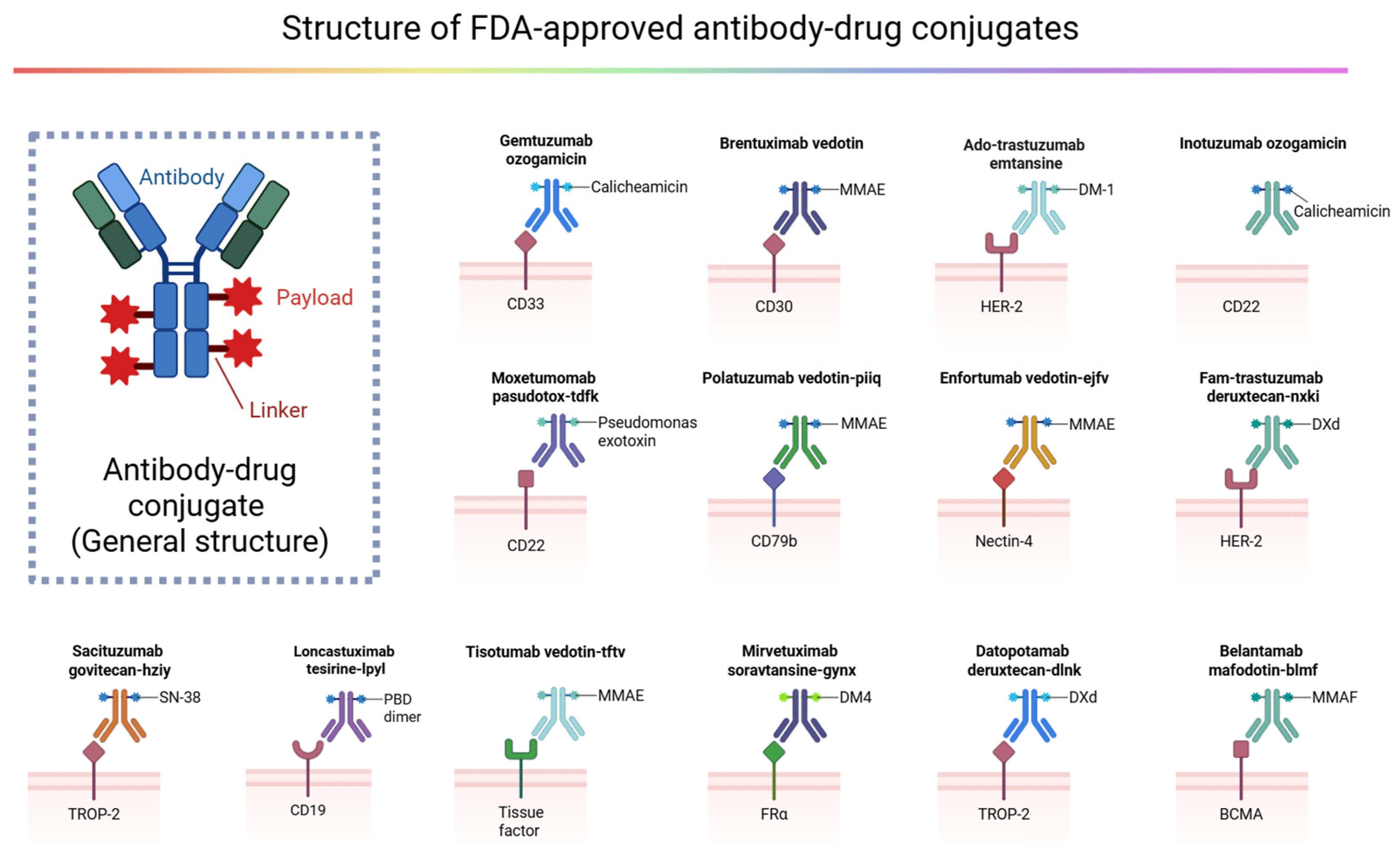
| Generic Name | Brand | Target Antigen | Payload | Linker (Type) | Initial FDA Approval (Date) | Key Label Milestones (Date → Note) | Primary U.S. Indications (Summary) |
|---|---|---|---|---|---|---|---|
| Gemtuzumab ozogamicin | Mylotarg | CD33 | Calicheamicin | Acid-labile hydrazone (cleavable) | 17 May 2000 | 1 September 2017 → U.S. re-approval with modified dose/schedule | CD33-positive AML (adult ± pediatric; label-specific) |
| Brentuximab vedotin | Adcetris | CD30 | MMAE (auristatin E) | Val-Cit–PABC (protease-cleavable) | 19 August 2011 | 11 September 2017 → regular approval/expanded indications | CD30-expressing lymphomas (cHL, sALCL; other CD30+ PTCLs) |
| Ado-trastuzumab emtansine | Kadcyla | HER2 | DM1 (maytansinoid) | MCC thioether (non-cleavable) | 22 February 2013 | 6 May 2019 → adjuvant EBC approval | HER2-positive breast cancer (various settings) |
| Inotuzumab ozogamicin | Besponsa | CD22 | Calicheamicin | Acid-cleavable | 17 August 2017 | — | R/R B-cell precursor ALL (adults) |
| Moxetumomab pasudotox-tdfk | Lumoxiti | CD22 | Pseudomonas exotoxin (recombinant immunotoxin) | Protein fusion (non-cleavable) | 13 September 2018 | July 2023 → U.S. market withdrawal (sponsor decision) | R/R hairy cell leukemia after ≥2 prior systemic therapies (incl. PNA) |
| Polatuzumab vedotin-piiq | Polivy | CD79b | MMAE | Val-Cit–PABC (protease-cleavable) | 10 June 2019 | 19 April 2023 → approval in previously untreated DLBCL (R-CHP) | DLBCL (in combination regimens) |
| Enfortumab vedotin-ejfv | Padcev | Nectin-4 | MMAE | Val-Cit–PABC (protease-cleavable) | 18 December 2019 | 9 July 2021 → conversion to full (regular) approval + expanded indications | Locally advanced/metastatic urothelial carcinoma (multiple settings) |
| Fam-trastuzumab deruxtecan-nxki | Enhertu | HER2 | DXd (exatecan derivative; topo-I inhibitor) | Tetrapeptide-based cleavable | 20 December 2019 | 11 August 2022 → HER2-mutant NSCLC (accelerated); 5 April 2024 → tumor-agnostic HER2-positive solid tumors (accelerated); 27 January 2025 → HER2-ultralow HR + MBC | Multiple HER2-expressing settings per label (breast incl. HER2-low/ultralow, NSCLC HER2-mutant, gastric/GEJ, tumor-agnostic) |
| Sacituzumab govitecan-hziy | Trodelvy | TROP2 | SN-38 (topoisomerase I inhibitor) | CL2A (hydrolyzable) | 22 April 2020 | 7 April 2021 → regular approval in mTNBC; 3 February 2023 → HR+/HER2- MBC expansion; 22 November 2024 → U.S. mUC indication withdrawn | mTNBC; HR+/HER2- metastatic breast cancer |
| Loncastuximab tesirine-lpyl | Zynlonta | CD19 | PBD dimer (SG3199) | Protease-cleavable (val-ala; tesirine/SG3249) | 23 April 2021 | — | R/R large B-cell lymphoma after ≥2 prior lines |
| Tisotumab vedotin-tftv | Tivdak | Tissue factor (TF) | MMAE | Val-Cit–PABC (protease-cleavable) | 20 September 2021 | 29 April 2024 → conversion to full approval | Recurrent/metastatic cervical cancer after chemotherapy |
| Mirvetuximab soravtansine-gynx | Elahere | FRα | DM4 (maytansinoid) | sulfo-SPDB (disulfide; cleavable) | 14 November 2022 | 22 March 2024 → conversion to full approval | FRα-positive, platinum-resistant ovarian/fallopian tube/primary peritoneal cancer |
| Datopotamab deruxtecan-dlnk | Datroway | TROP2 | DXd (exatecan derivative; topo-I inhibitor) | Tetrapeptide-based cleavable | 17 January 2025 | 23 June 2025 → accelerated approval for EGFR-mutated NSCLC | HR+/HER2- metastatic breast cancer; EGFR-mutated NSCLC (accelerated) |
| Belantamab mafodotin-blmf | Blenrep | BCMA | MMAF (auristatin F) | Maleimidocaproyl (mc; non-cleavable) | 5 August 2020 (original, withdrawn November 2022) | 23 October 2025 → U.S. re-approval in combination with bortezomib + dexamethasone | R/R multiple myeloma (BVd combination; see label details) |
| Cancer | ADC Drug Name (Code) | Target | Primary Objective of Phase III Clinical Trial | Clinical Trial Number | |
|---|---|---|---|---|---|
| Breast Cancer | HER2-Positive Breast Cancer | DP303c | HER2 | To evaluate the efficacy and safety of DP303c compared to T-DM1 in patients with HER2-positive advanced breast cancer. | NCT06313086 |
| HER2-Positive Advanced Breast Cancer | DP303c | HER2 | To evaluate the efficacy and safety of DP303c in patients with HER2-positive advanced breast cancer (comparator: trastuzumab, vinorelbine, or capecitabine). | NCT05901935 | |
| HER2-Low, HR-Positive Metastatic Breast Cancer | DB-1303/BNT323 | HER2 | To evaluate the efficacy of DB-1303/BNT323 compared to investigator’s choice of chemotherapy in terms of PFS. | NCT06018337 | |
| HER2-Positive Breast Cancer | ARX788 | HER2 | To compare the efficacy and safety of ARX788 combined with pyrotinib versus TCBHP (trastuzumab + pertuzumab + docetaxel + carboplatin) as neoadjuvant therapy. | NCT05426486 | |
| HER2-Positive Advanced/Metastatic Breast Cancer | MRG002 | HER2 | To evaluate the efficacy and safety of MRG002 versus T-DM1 in patients with HER2-positive, unresectable locally advanced or metastatic breast cancer. | NCT04924699 | |
| HR-Positive/HER2-Negative Breast Cancer | Dato-DXd | TROP2 | To compare the safety and efficacy of Dato-DXd with investigator’s choice of standard chemotherapy in patients with inoperable or metastatic HR-positive/HER2-negative breast cancer. | NCT05104866 | |
| HER2-Low, HR-Positive Breast Cancer | T-DXd | HER2 | To compare the efficacy, safety, and tolerability of T-DXd with investigator’s choice of chemotherapy in patients with HER2-low, HR-positive breast cancer. | NCT04494425 | |
| Lung Cancer | Small Cell Lung Cancer | Ifinatamab deruxtecan (I-DXd) | B7-H3 | To compare the efficacy and safety of I-DXd with physician’s choice of treatment in patients with relapsed small cell lung cancer. | NCT06203210 |
| EGFR-Mutant Non-Small Cell Lung Cancer | Patritumab Deruxtecan (HER3-DXd) | HER3 | To compare the efficacy and safety of Patritumab Deruxtecan with platinum-based chemotherapy in patients with EGFR-mutant non-small cell lung cancer. | NCT05338970 | |
| EGFR-Mutant Non-Small Cell Lung Cancer | SYS6010 | EGFR | To evaluate the efficacy and safety of SYS6010 compared to platinum-based chemotherapy in patients with EGFR-mutant locally advanced or metastatic non-small cell lung cancer. | NCT06927986 | |
| CEACAM5-Positive Non-Small Cell Lung Cancer | Tusamitamab ravtansine (SAR408701) | CEACAM5 | To evaluate the progression-free survival and overall survival of Tusamitamab ravtansine compared to docetaxel in patients with CEACAM5-high metastatic non-squamous non-small cell lung cancer. | NCT04154956 | |
| Gastrointestinal Cancer | Metastatic Colorectal Cancer | Telisotuzumab Adizutecan (ABBV-400) | c-Met | To compare the adverse events and disease activity of Telisotuzumab Adizutecan with LONSURF (trifluridine/tipiracil) plus bevacizumab in patients with c-Met protein overexpressing refractory metastatic colorectal cancer. | NCT06614192 |
| Gastric or Gastroesophageal Junction Adenocarcinoma | AZD0901 | CLDN18.2 | To evaluate the efficacy and safety of AZD0901 compared to investigator’s choice of therapy as second-line or later treatment in patients with CLDN18.2-positive advanced or metastatic gastric or GEJ adenocarcinoma. | NCT06346392 | |
| Esophageal Squamous Cell Carcinoma | Ifinatamab Deruxtecan (I-DXd) | B7-H3 | To evaluate the efficacy and safety of I-DXd compared to investigator’s choice of chemotherapy in patients with previously treated advanced or metastatic esophageal squamous cell carcinoma. | NCT06644781 | |
| Gynecological Tumors | Platinum-Resistant Recurrent Epithelial Ovarian Cancer | HS-20089 | B7-H4 | To evaluate the efficacy and safety of HS-20089 compared to investigator’s choice of chemotherapy in patients with platinum-resistant recurrent epithelial ovarian cancer. | NCT06855069 |
| Platinum-Resistant Ovarian Cancer, Fallopian Tube Cancer, Primary Peritoneal Cancer | Raludotatug Deruxtecan (R-DXd) | CDH6 | To evaluate the safety and efficacy of R-DXd in patients with platinum-resistant high-grade ovarian, fallopian tube, or primary peritoneal cancer. | NCT06161025 | |
| FOLR1-Positive Ovarian Cancer | Luveltamab tazevibulin | FOLR1 | To investigate the efficacy and safety of Luveltamab tazevibulin compared to investigator’s choice of chemotherapy in patients with FOLR1-positive ovarian cancer (including fallopian tube or primary peritoneal cancer). | NCT05870748 | |
| Cervical Cancer | Tisotumab vedotin | TF | To compare the efficacy of Tisotumab vedotin with chemotherapy in patients with recurrent or metastatic cervical cancer. | NCT04697628 | |
| Urinary System Tumors | HER2-Positive Urothelial Carcinoma | MRG002 | HER2 | To compare the overall survival and progression-free survival of MRG002 with investigator’s choice of chemotherapy in patients with HER2-positive unresectable advanced or metastatic urothelial carcinoma. | NCT05754853 |
| Urothelial Carcinoma | Sacituzumab Govitecan-hziy | TROP2 | To compare the overall survival of Sacituzumab govitecan with physician’s choice of treatment in patients with metastatic or locally advanced unresectable urothelial carcinoma. | NCT04527991 | |
| Urothelial Carcinoma | Enfortumab vedotin | Nectin-4 | To compare the efficacy of Enfortumab vedotin combined with pembrolizumab versus standard chemotherapy in patients with metastatic urothelial carcinoma. | NCT04223856 | |
| Hematological Tumors | Diffuse Large B-Cell Lymphoma | Zilovertamab vedotin | ROR1 | To evaluate the efficacy (progression-free survival) of Zilovertamab vedotin combined with R-CHP versus R-CHOP in previously untreated DLBCL patients. | NCT06717347 |
| Relapsed/Refractory Diffuse Large B-Cell Lymphoma | Zilovertamab vedotin | ROR1 | To evaluate the safety and efficacy (progression-free survival) of Zilovertamab vedotin combined with standard therapy (R-GemOx) versus standard therapy in patients with rrDLBCL. | NCT05139017 | |
| Relapsed/Refractory Diffuse Large B-Cell Lymphoma | Loncastuximab tesirine | CD19 | To compare the efficacy of Loncastuximab tesirine combined with rituximab versus standard immunochemotherapy in patients with relapsed/refractory DLBCL. | NCT04384484 | |
| Diffuse Large B-Cell Lymphoma | Polatuzumab vedotin | CD79b | To compare the efficacy, safety, and pharmacokinetics of Polatuzumab vedotin combined with R-CHP versus R-CHOP in previously untreated DLBCL patients. | NCT03274492 | |
| Hodgkin Lymphoma | BV | CD30 | To compare the modified progression-free survival of BV combined with AVD versus ABVD as first-line treatment in advanced classical Hodgkin lymphoma. | NCT01712490 | |
| Multiple Myeloma | Belantamab mafodotin | BCMA | To evaluate the effect of Belantamab mafodotin combined with other anticancer drugs in patients with relapsed/refractory multiple myeloma. | NCT04126200 | |
| Other Solid Tumors | Head and Neck Squamous Cell Carcinoma | MRG003 | EGFR | To compare the efficacy and safety of MRG003 versus cetuximab/methotrexate as second/third-line therapy in patients with recurrent metastatic head and neck squamous cell carcinoma. | NCT05751512 |
| Osteosarcoma | HS-20093 | B7-H3 | To evaluate the efficacy and safety of HS-20093 compared to gemcitabine combined with docetaxel in patients with osteosarcoma who have failed at least two lines of therapy. | NCT06935409 | |
| Glioblastoma | Depatuxizumab mafodotin (ABT-414) | EGFR | To evaluate the overall survival of ABT-414 combined with radiotherapy and temozolomide followed by ABT-414 combined with adjuvant temozolomide in patients with newly diagnosed EGFR-amplified glioblastoma. | NCT02573324 | |
| Drug/Agent | Target(s) | Mechanism/Innovation Point | Current Research Stage/Key Findings | Reference |
|---|---|---|---|---|
| BL-B01D1 | EGFR x HER3 | Bispecific ADC targeting both EGFR and HER3; payload is a novel TOP1 inhibitor. | Phase I (NCT05194982); Shows high ORR (52.5–63.5%) in heavily pretreated EGFR-mutant NSCLC and other solid tumors; manageable toxicity. | [214] |
| BDC-1001 | HER2 | ISAC carrying a TLR7/8 agonist; designed to activate innate immunity in situ. | Phase I/II (NCT04278144); Shows limited monotherapy efficacy in HER2-positive solid tumors, with some patients achieving stable disease; highlights challenges in safely activating immunity with ISACs. | [244] |
| XMT-2056 | HER2 | ISAC carrying a STING agonist; designed to activate the STING pathway in both tumor cells and tumor-resident immune cells. | Phase I (previously paused, resumed); Preclinical studies show induction of anti-tumor immunity by acting on both cancer cells and immune cells. | [230] |
| ORM-5029 | HER2 | DAC carrying a GSPT1 protein degrader (PROTAC); degrades target protein via the ubiquitin-proteasome system. | Phase I (NCT05511844); In patients with HER2-expressing advanced solid tumors; Preclinical studies show anti-tumor activity comparable to T-DXd in both high and low HER2 expression models. | [233] |
| CX-2009 (Pralvaztamab Ravtansine) | CD166 | Probody™ ADC; antibody masked by a peptide that is cleaved by proteases in the tumor microenvironment to activate. | Phase I/II; Evaluated in advanced solid tumors, but efficacy and toxicity control did not fully meet expectations, illustrating challenges of Probody ADC technology. | [217] |
| ARX788 | HER2 | Highly stable ADC utilizing non-natural amino acid incorporation for site-specific conjugation; non-cleavable linker. | Phase I; Shows anti-tumor activity in HER2-positive metastatic breast cancer, but target-related toxicities (ocular) were observed. | [197] |
| DCDS0780A | CD79b | Site-specific ADC utilizing engineered cysteines for conjugation. | Phase I; Evaluated in B-cell non-Hodgkin lymphoma; development hampered due to significant toxicities (ocular). | [198] |
| ADDIN EN.CITE.DATA ADDIN EN.CITE Enfortumab Vedotin | Nectin-4 | Traditional ADC; resistance research associated with target downregulation, prompting exploration of new strategies to overcome resistance. | Approved for urothelial carcinoma; Studies find frequent decrease in membranous Nectin-4 expression in metastases, associated with resistance. | [190] |
| Cetuximab Saratolacan (RM-1929) | EGFR | Photoimmunotherapy (PIT); antibody Cetuximab conjugated to photosensitizer IR700; cell killing activated by NIR light. | Approved in Japan for locally advanced or recurrent head and neck squamous cell carcinoma; suitable for superficial tumors, applied via light-guided fiber endoscopy. | [225] |
| GPC2-D3-PBD ADC | GPC2 | Immunomodulatory ADC; payload is PBD dimer; directly kills tumor cells and induces ICD, remodeling the tumor immune microenvironment. | Preclinical (neuroblastoma); shows synergy when combined with immunomodulators. | [231] |
| 177Lu-PSMA-617 (Pluvicto®) | PSMA | Radioligand Therapy/RDC; payload is radioactive Lutetium-177 (177Lu); killing is internalization-independent and exhibits a crossfire effect. | Approved for PSMA-positive metastatic castration-resistant prostate cancer; effectively overcomes tumor heterogeneity. | [234] |
| Anti-B7-H3 Dual-Payload ADC | CD276/B7-H3 | Dual-payload ADC co-conjugated with a tubulin inhibitor and a TOP1 inhibitor; combines direct cytotoxicity with immune activation. | Preclinical (triple-negative breast cancer); exhibits potent cytotoxicity and immune activation, with efficacy superior to single-payload ADCs. | [239] |
| Antibody-DNA Nanostructure ADC | Not Specified | Nanotechnology-based ADC; uses DNA nanotechnology to build a programmable nano-platform with high drug loading capacity; enhances binding and endocytosis to cancer cells. | Preclinical; achieves efficient drug delivery and controlled release, reducing toxicity to normal cells. | [240] |
| HER2-Targeted Polymeric Micelle ADC | HER2 | Nanotechnology-based ADC; conjugates Trastuzumab to PEG-polyhistidine copolymer micelles, improving drug delivery. | Preclinical (breast cancer models) shows improved tumor cell selectivity and enhanced intracellular delivery efficiency. | [241] |
| T-DM1-IR700 (Example) | HER2 | Photoactivatable ADC; T-DM1 conjugated to photosensitizer IR700; NIR light triggers membrane rupture and drug release. | Preclinical; NIR light-induced drug release and cytotoxicity confirmed in xenograft models, generating a “photo-bystander effect”. | [63] |
| Hypoxia-Responsive ADC (Example) | Not Specified | Smart linker ADC; uses an azobenzene linker that is cleaved by reduction in the hypoxic tumor microenvironment, releasing the payload. | Preclinical; demonstrates selective activation under hypoxic conditions, effectively reducing off-target toxicity and improving the therapeutic window. | [221] |
| Bioorthogonal ‘Click-Release’ ADC (Example) | Not Specified | Bioorthogonal chemistry-controlled release ADC; payload release triggered by exogenous administration of a trigger molecule (tetrazine) which undergoes a click reaction with trans-cyclooctene on the ADC. | Preclinical; achieves on-demand, localized activation of ADC cytotoxicity in mouse models, demonstrating potential for theranostic applications (imaging to therapy). | [245] |
| Dual-Payload ADC via AJICAP Technology | HER2 | Dual-payload ADC utilizing AJICAP site-specific conjugation technology to precisely load two drugs with different mechanisms onto the same antibody. | Preclinical; demonstrates excellent in vitro and in vivo anti-tumor efficacy in HER2-positive tumor models, with good physicochemical stability. | [236] |
| SPARC Platform Multi-Payload ADC | Not Specified | Multi-payload ADC architecture; allows programmable combination of different mechanism drugs on a single antibody for synergistic release. | Preclinical; achieves synergistic drug release in vivo through co-delivery of different drugs, reducing off-target toxicity and enhancing tumor killing. | [44] |
| Platform Category | Core Design | Example (Drug Candidate) | Clinical Validation Stage | Key Features | Reference | |
| Clinically Validated Platforms | Cytotoxic ADC (Standard) | Monoclonal antibody + cytotoxic payload via cleavable/non-cleavable linker. | Trastuzumab emtansine (T-DM1), Brentuximab vedotin (BV) | Approved; Standard of care in multiple indications. | Foundation of ADC field; “Targeted chemotherapy”; Bystander effect (cleavable linker). | [17] |
| Site-Specific Conjugation ADC | Engineered antibodies (e.g., THIOMAB, unnatural amino acids) for homogeneous Drug-to-Antibody Ratio (DAR). | Trastuzumab deruxtecan (T-DXd, DS-8201) | Approved; Demonstrated superior efficacy in several trials. | Improved pharmacokinetics, therapeutic index, and manufacturability; Enables higher DAR. | [38] | |
| Bispecific ADC (BsADC) | Bispecific antibody targeting two tumor-associated antigens, conjugated to a cytotoxic payload. | BL-B01D1 (EGFRxHER3) | Phase I/II (Emerging, but platform clinically validated in trials). | Enhanced tumor selectivity, internalization; Potential to overcome antigen heterogeneity. | [214] | |
| Trop-2 Directed ADC | Targeting TROP2, a pan-epithelial antigen, with topoisomerase I inhibitor payload. | Sacituzumab govitecan (SG, Trodelvy) | Approved for TNBC and HR+/HER2- breast cancer. | Expanded ADC utility to “non-HER2” solid tumors; Durable responses in refractory settings. | [147] | |
| Emerging Platforms | Immune-Stimulating ADC (ISAC) | Replaces cytotoxic payload with immune agonist (e.g., TLR, STING agonist) to remodel tumor microenvironment. | BDC-1001 (TLR7/8), XMT-2056 (STING) | Phase I/II; Faced challenges with narrow therapeutic window. | Aims to convert “cold” to “hot” tumors; Potential synergy with ICIs; Toxicity management is key. | [229] |
| Degrader-Antibody Conjugate (DAC) | Payload is a PROTAC or molecular glue, inducing targeted protein degradation via ubiquitin-proteasome system. | ORM-5029 (HER2-targeted GSPT1 degrader) | Phase I. | Potential to target “undruggable” proteins; Novel mechanism beyond cytotoxicity. | [233] | |
| Radiopharmaceutical Drug Conjugate (RDC) | Antibody conjugated to a therapeutic radionuclide (e.g., 177Lu). | [177Lu]Lu-PSMA-617 (Pluvicto) | Approved for prostate cancer; Platform validated. | Crossfire effect kills neighboring cells; Action independent of internalization; Theranostic potential. | [234] | |
| Dual-/Multi-Payload ADC | Single antibody conjugated to two or more distinct payloads with different mechanisms of action. | Anti-B7-H3 dual-payload ADC (Tubulin inhibitor + TOP1 inhibitor) | Preclinical/Early Clinical. | Aims to overcome heterogeneity and prevent resistance via synergistic killing; Requires advanced conjugation tech. | [238] | |
| Probody®-ADC (Masked ADC) | Antibody binding site masked by a peptide substrate cleaved by tumor-specific proteases. | CX-2009 (Praluzatamab ravtansine, anti-CD166) | Phase I/II (Development challenged). | Designed to minimize “on-target, off-tumor” toxicity by limiting activation to tumor microenvironment. | [217] | |
| Photoactivatable/Smart-Responsive ADC | Linker cleavage triggered by external (e.g., near-infrared light) or internal (e.g., hypoxia, high ROS) stimuli. | Cetuximab saratolacan (RM-1929, PIT) | Approved in Japan for head and neck cancer (PIT). | Unprecedented spatiotemporal control; Reduces systemic toxicity; Suitable for superficial/localized tumors. | [225] | |
Disclaimer/Publisher’s Note: The statements, opinions and data contained in all publications are solely those of the individual author(s) and contributor(s) and not of MDPI and/or the editor(s). MDPI and/or the editor(s) disclaim responsibility for any injury to people or property resulting from any ideas, methods, instructions or products referred to in the content. |
© 2026 by the authors. Licensee MDPI, Basel, Switzerland. This article is an open access article distributed under the terms and conditions of the Creative Commons Attribution (CC BY) license.
Share and Cite
Li, X.; Liu, J.; Meng, Y.; Li, J.; Zhao, J.; Liu, D.; Zhang, X. Frontiers in Antibody–Drug Conjugates: Mechanisms, Design Innovations, and Clinical Applications in Targeted Cancer Therapy. Pharmaceuticals 2026, 19, 324. https://doi.org/10.3390/ph19020324
Li X, Liu J, Meng Y, Li J, Zhao J, Liu D, Zhang X. Frontiers in Antibody–Drug Conjugates: Mechanisms, Design Innovations, and Clinical Applications in Targeted Cancer Therapy. Pharmaceuticals. 2026; 19(2):324. https://doi.org/10.3390/ph19020324
Chicago/Turabian StyleLi, Xinghan, Jiaming Liu, Yitong Meng, Jun Li, Jieling Zhao, Dequan Liu, and Xiaodong Zhang. 2026. "Frontiers in Antibody–Drug Conjugates: Mechanisms, Design Innovations, and Clinical Applications in Targeted Cancer Therapy" Pharmaceuticals 19, no. 2: 324. https://doi.org/10.3390/ph19020324
APA StyleLi, X., Liu, J., Meng, Y., Li, J., Zhao, J., Liu, D., & Zhang, X. (2026). Frontiers in Antibody–Drug Conjugates: Mechanisms, Design Innovations, and Clinical Applications in Targeted Cancer Therapy. Pharmaceuticals, 19(2), 324. https://doi.org/10.3390/ph19020324