Efficacy and Safety of Traditional Chinese Medicine Retention Enema for Endometriosis: A Systematic Review and Meta-Analysis

Abstract
1. Introduction
2. Materials and Methods
2.1. Study Design
2.2. Search Strategy
2.3. Eligibility Criteria
2.3.1. Types of Studies
2.3.2. Types of Participants
2.3.3. Types of Intervention and Comparators
2.3.4. Types of Outcome Measures
2.4. Data Extraction
2.5. Risk of Bias
2.6. Statistical Analysis
3. Results
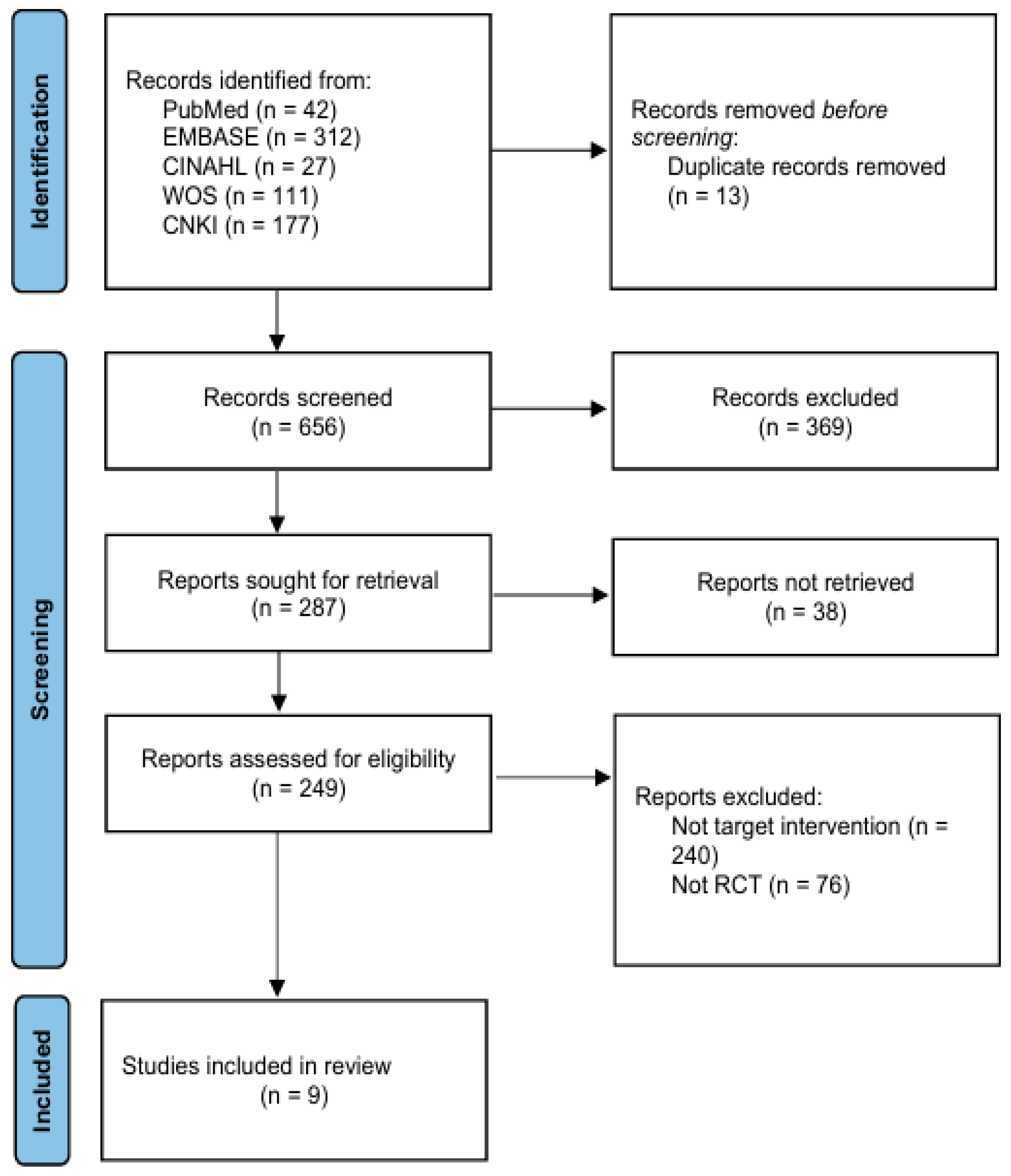
3.1. Study Selection
3.2. Characteristics of Included Studies
3.3. Characteristics of Intervention
3.4. Outcomes
3.4.1. Clinical Effectiveness
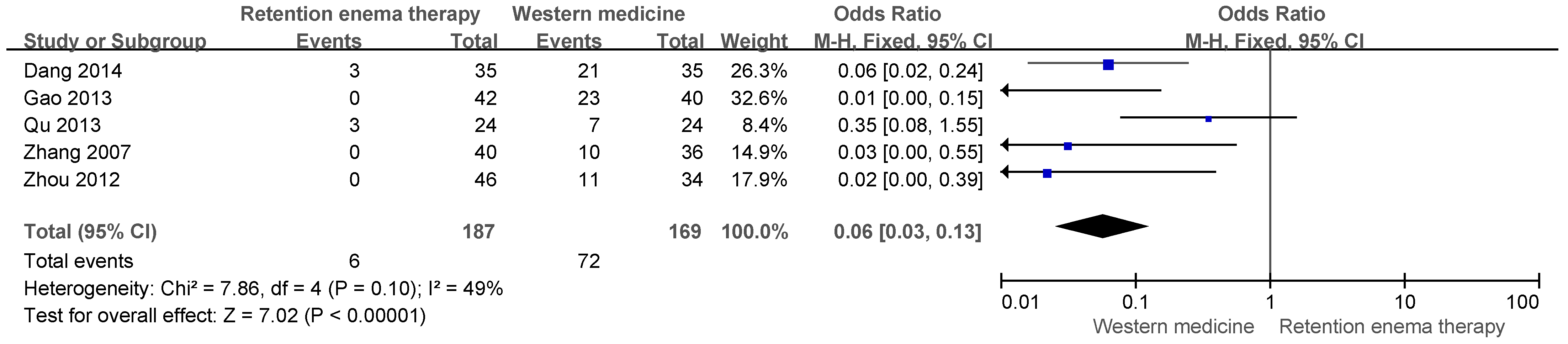
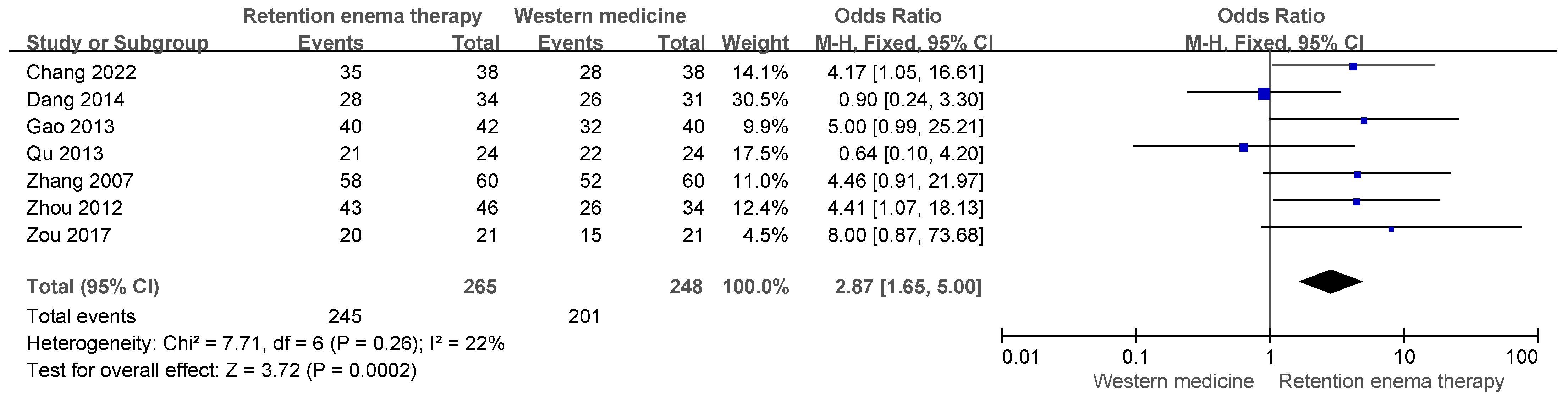
Retention Enema Versus Western Medicine
Retention Enema Versus Oral Herbal Medicine
3.4.2. Pain-Related Outcomes
3.4.3. Reproductive Outcomes
3.4.4. Other Reported Outcomes
3.5. Adverse Events
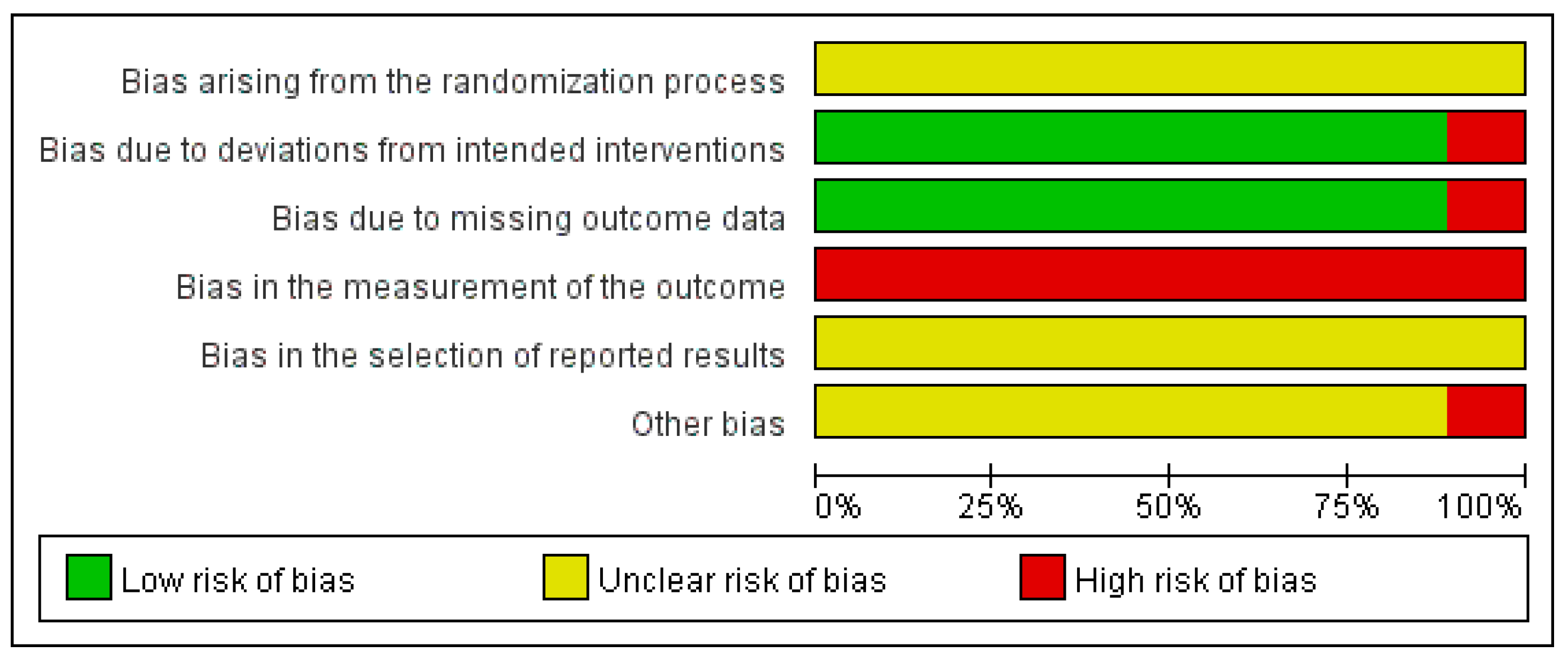
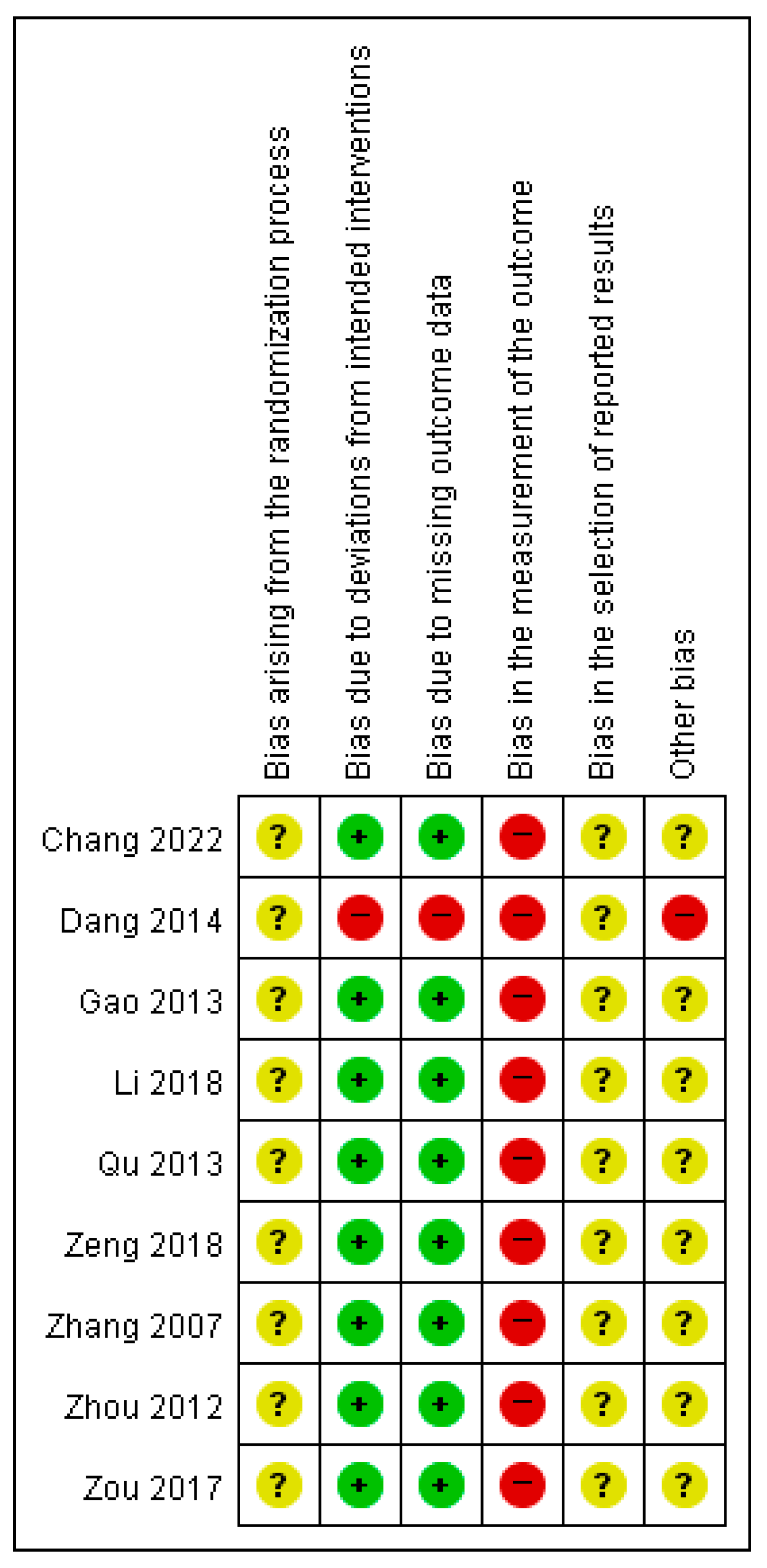
3.6. Risk of Bias Assessment
4. Discussion
4.1. Principal Findings and Clinical Implications
4.2. Comparison with Previous Studies
4.3. Limitation of the Study
4.4. Implications for Future Research
5. Conclusions
Supplementary Materials
Author Contributions
Funding
Institutional Review Board Statement
Informed Consent Statement
Data Availability Statement
Conflicts of Interest
Abbreviations
| 6-keto PGF1α | 6-keto-prostaglandin F1α |
| CA-125 | Cancer antigen 125 |
| CAM | Complementary and Alternative Medicine |
| Con | Control |
| E2 | Estradiol |
| Exp | Experiment |
| F/U | Follow up |
| FSH | Follicle-stimulating hormone |
| IL-1β | Interleukin-1 beta |
| NF-κB | Nuclear factor kappa B |
| N.R. | Not reported |
| OR | Odds ratio |
| PO | Per os |
| RCT | Randomized Controlled Trial |
| RoB | Risk of Bias |
| RR | Risk ratio |
| r-AFS | revised American Fertility Society classification |
| TNF-α | Tumor necrosis factor alpha |
| TXB2 | Thromboxane B2 |
References
- Kennedy, S.; Bergqvist, A.; Chapron, C.; D’Hooghe, T.; Dunselman, G.; Greb, R.; Hummelshoj, L.; Prentice, A.; Saridogan, E. ESHRE guideline for the diagnosis and treatment of endometriosis. Hum. Reprod. 2005, 20, 2698–2704. [Google Scholar] [CrossRef]
- Zondervan, K.T.; Becker, C.M.; Missmer, S.A. Endometriosis. N. Engl. J. Med. 2020, 282, 1244–1256. [Google Scholar] [CrossRef]
- Chapron, C.; Marcelline, L.; Borghese, B.; Santulli, P. Rethinking mechanisms, diagnosis and management of endometriosis. Nat. Rev. Endocrinol. 2019, 15, 666–682. [Google Scholar] [CrossRef]
- Simoens, S.; Dunselman, G.; Dirksen, C.; Hummelshoj, L.; Bokor, A.; Brandes, I.; Brodszky, V.; Canis, M.; Colombo, G.L.; DeLeire, T.; et al. The burden of endometriosis: Costs and quality of life of women with endometriosis and treated in referral centres. Hum. Reprod. 2012, 27, 1292–1299. [Google Scholar] [CrossRef] [PubMed]
- Falcone, T.; Lebovic, D. Clinical management of endometriosis. Obstet. Gynecol. 2011, 118, 691–705. [Google Scholar] [CrossRef] [PubMed]
- Huang, W.; Liu, T.; Yu, Y.; Ou, X.; Chen, L.; Tang, X.; Fang, X.; Ling, J.; Du, X. Efficacy and safety of chinese patent medicines combined with conventional therapies for endometriosis: A systematic review and bayesian network meta-analysis. J. Ethnopharmacol. 2025, 343, 119465. [Google Scholar] [CrossRef]
- Vercellini, P.; Somigliana, E.; Viganò, P.; De Matteis, S.; Barbara, G.; Fedele, L. The effect of second-line surgery on reproductive performance of women with recurrent endometriosis: A systematic review. Acta Obstet. Gynecol. Scand. 2009, 88, 1074–1082. [Google Scholar] [CrossRef]
- Chen, C.; Li, X.; Lu, S.; Yang, J.; Liu, Y. Acupuncture for clinical improvement of endometriosis-related pain: A systematic review and meta-analysis. Arch. Gynecol. Obstet. 2024, 310, 2101–2114. [Google Scholar] [CrossRef]
- Rashidian, P.; Amini-salehi, E.; Karami, S.; Nezhat, C.; Nezhat, F. Exploring the association between dietary fruit intake and endometriosis: A systematic review and meta-analysis. J. Clin. Med. 2025, 14, 1246. [Google Scholar] [CrossRef]
- Afreen, S.; Perthiani, A.; Sangster, E.; Lanka, N.; Acharya, P.; Virani, S.; Malasevskaia, I. Comparing surgical, acupuncture, and exercise interventions for improving the quality of life in women with endometriosis: A systematic review. Cureus 2024, 16, e65257. [Google Scholar] [CrossRef] [PubMed]
- Zheng, X.; Wang, F.; Liu, C.; Gu, J.; Zhu, Y.; Zhou, J.; Qu, F. Effects of Chinese Herbal Medicine on ovarian functions in the patients with endometriosis: A systematic review and meta-analysis of randomized controlled trials. Eur. J. Integr. Med. 2022, 51, 102125. [Google Scholar] [CrossRef]
- Wu, Z.; Liu, C.; Peng, Y.; Zhou, F.; Xu, B.; Zhang, Y.; Hu, Z.; Lu, M. Traditional Chinese herbal medicine retention enema combined with perineal massage (THREM): A promising therapeutic strategy for refractory chronic prostatitis/chronic pelvic pain syndrome (CP/CPPS). Transl. Androl. Urol. 2024, 13, 759–768. [Google Scholar] [CrossRef]
- Wang, C.Y.; Tang, X.D.; Zheng, P.Y.; Xiao, Z.; Zhang, L.; Ji, G. The Effectiveness of Herbal Enema for Irritable Bowel Syndrome: A Meta-Analysis of Randomized, Calcium Channel Blocker-Controlled Trials. World J. Tradit. Chin. Med. 2017, 3, 1–7. [Google Scholar] [CrossRef]
- Xu, S.J.; Jin, S.; Yang, L.Q.; Wang, L.; Zhang, Q. Evidence-based complementary and alternative medicine conventional surgery combined with traditional Chinese medicinal retention enema for tubal obstructive infertility: A systematic review and meta-analysis. PLoS ONE 2023, 18, e0285859. [Google Scholar] [CrossRef] [PubMed]
- Moher, D.; Liberati, A.; Tetzlaff, J.; Altman, D.G. Preferred reporting itens for systematic reviews and meta-analyses: The PRISMA statement. PLoS Med. 2009, 6, e1000097. [Google Scholar] [CrossRef]
- Study Quality Assessment Tools. Available online: https://www.nhlbi.nih.gov/health-topics/study-quality-assessment-tools (accessed on 28 January 2026).
- Gao, Q.; Xia, C. Efficacy observed on prevention and treatment of postoperative recurrence of pelvic endometriosis with Quyusanjie Fang for retention enema. J. Xinjiang Med. Univ. 2013, 36, 1470–1472. [Google Scholar]
- Qu, Y.L.; Liu, Y.Q.; Dang, H.M.; Chen, W.; Liu, R.X. Clinical effects of Neiyixiao retention enema in treating endometriosis. J. Xi’an Jiaotong Univ. 2013, 34, 397–402. [Google Scholar]
- Dang, H.M.; Wu, X.L.; Liu, Y.Q.; Cur, Y.L.; Liu, Y.M.; Yao, Y.I. Observation of the efficacy of retention enema for endometriosis in preventing postoperative recurrence. J. Xi’an Jiaotong Univ. (Med. Sci.) 2014, 35, 1194–1196. [Google Scholar]
- Li, N. Clinical observation of Funing Decoction retention enema therapy for endometriosis. J. Changzhi Med. Coll. 2018, 32, 64–66. [Google Scholar]
- Chang, C.Y.; Chen, X.H.; Zhao, Y.; Huang, L.L. Effect of Huayu Xiaozheng Decoction retention enema on endometriosis and its effect on recurrence rate. China Med. Herald 2022, 19, 100–103. [Google Scholar] [CrossRef]
- Zhou, J.H. Enema therapy with dysmenorrhea relief for endometriosis pain: A study of 46 cases. Guangming J. Chin. Med. 2012, 27, 2009–2010. [Google Scholar]
- Zeng, L.; Gao, J.Y.; Liu, X.G.; Cao, J.Y.; Cheng, L.; You, F. Clinical research on the treatment of cold causing blood stasis type endometriosis with warm meridian though stagnation formula. Res. Women’s Health China Abroad 2018, 21, 1–8. [Google Scholar]
- Zhang, L.; Zhu, P.Q. Observational Study on the Efficacy of Qingyi Decoction Retention Enema Therapy for Rectal Endometriosis. J. Sichuan Tradit. Chin. Med. 2007, 25, 84–85. [Google Scholar]
- Zou, L.Y. Clinical efficacy analysis of Neiyixiao retention enema in the treatment of endometriosis. Prim. Med. Forum 2017, 21, 541–542. [Google Scholar]
- Song, S.Y.; Jung, Y.W.; Shin, W.; Park, M.; Lee, G.W.; Jeong, S.; An, S.; Kim, K.; Ko, Y.B.; Lee, K.H.; et al. Endometriosis-related chronic pelvic pain. Biomedicines 2023, 11, 2868. [Google Scholar] [CrossRef]
- Zhang, M.; Geng, W.; Guan, X.Q.; Gao, S.J.; Mao, J.L. Antioxidant and anti-inflammatory effects of different ratios and preparations of Agelica sinensis and chuanxiong rhizome extracts. J. Ethnopharmacol. 2024, 334, 118559. [Google Scholar] [CrossRef]
- Zhou, Y.X.; Gong, X.H.; Zhang, H.; Peng, C. A review on the pharmacokinetics of paeoniflorin and its anti-inflammatory and immunomodulatory effects. Biomed. Pharmacother. 2020, 130, 110505. [Google Scholar] [CrossRef] [PubMed]
- Sadeghi, M.; Dehnavi, S.; Asadirad, A.; Xu, S.; Majeed, M.; Jamialahmadi, T.; Johnston, T.P.; Sahebkar, A. Curcumin and chemokines: Mechanism of action and therapeutic potential in inflammatory diseases. Inflammopharmacology 2023, 31, 1069–1093. [Google Scholar] [CrossRef]
- Rathi, R.; Sanshita; Kumar, A.; Vishvakarma, V.; Huanbutta, K.; Singh, I.; Sangnim, T. Advancements in Rectal Drug Delivery Systems: Clinical Trials, and Patents Perspective. Pharmaceutics 2022, 14, 2210. [Google Scholar] [CrossRef]
- Page, M.J.; McKenzie, J.E.; Bossuyt, P.M.; Boutron, I.; Hoffmann, T.C.; Mulrow, C.D.; Shamseer, L.; Tetzlaff, J.M.; Akl, E.A.; Brennan, S.E.; et al. The PRISMA 2020 statement: An updated guideline for reporting systematic reviews. BMJ 2021, 372, n71. [Google Scholar] [CrossRef] [PubMed]




| First Author (Year) | Diagnosis Criteria | Sample Size (Exp/Con) | Intervention | Comparator | Outcome | Result (Exp vs. Con) | F/U | Adverse Event (Exp vs. Con) |
|---|---|---|---|---|---|---|---|---|
| Gao (2013) [17] | Laparoscopic diagnosis | 42:40 | Retention enema therapy | Gestrinone 2.5 mg, twice/week | ① Total effective rate ② Recurrence rate ③ Pregnancy rate | ① 78.6% vs. 55.0% a ② 4.8% vs. 20.0% a ③ 58.3% vs. 27.2% a | 12 months | 0 vs. 23 |
| Qu (2013) [18] | Integrated Traditional Chinese and Western Medicine diagnostic criteria | 24:24 | Retention enema therapy | Danazol 200 mg, twice/day | ① Total effective rate ② Pregnancy rate ③ Dysmenorrhea score ④ Pelvic mass size ⑤ Serum markers | ① 87.5% vs. 91.6% d ② 33.3% vs. 18.2% d ③ 9.24 ± 2.18 → 6.31 ± 4.19 vs. 8.19 ± 2.64 → 2.86 ± 3.99 a ④ 40.83 ± 30.22 → 14.99 ± 21.70 vs. 45.52 ± 31.40 → 18.63 ± 24.87 b ⑤-1. TXB2 (pg/mL) 154.63 ± 149.2 → 91.30 ± 84.09 vs. 169.78 ± 153.3 → 96.59 ± 87.14 a ⑤-2. 6-keto PGF1α (pg/mL) 119.17 ± 117.23 → 75.23 ± 71.95 vs. 134.89 ± 126.18 → 81.03 ± 74.83 a ⑤-3. CA-125 (U/mL) 56.72 ± 30.11 → 49.91 ± 19.39 vs. 54.17 ± 31.85 → 47.17 ± 19.47 a | 3 months | 3 vs. 7 |
| Dang (2014) [19] | r-AFS stage II or higher | 35:35 | Retention enema therapy | Gestrionone 2.5 mg, twice/week | ① Total effective rate ② Symptom prevalence ③ Serum markers | ① 82.4% vs. 83.9% d ②-1. Dysmenorrhea 18 → 5 vs. 20 → 7 d ②-2. Menorrhagia 12 → 4 vs. 13 → 3 d ②-3. Infertility 14→5 vs. 12→6 d ③-1. IL-1β (pg/mL) 33.16 ± 3.25 → 10.48 ± 2.34 vs. 34.15 ± 3.48 → 12.76 ± 3.17 a ③-2. TNF-α (pg/mL) 83.22 ± 14.26 → 34.78 ± 11.47 vs. 82.95 ± 13.23 → 35.49 ± 12.15 a ③ NF-κB p56 (ng/L) 0.614 ± 0.042 → 0.273 ± 0.037 vs 0.667 ± 0.056 → 0.280 ± 0.044 a | N.R. | 3 vs. 21 |
| Li (2018) [20] | Integrated Traditional Chinese and Western Medicine diagnostic criteria | 40:40 | Retention enema therapy | Herbal medicine (oral) 3 capsules, three times/day | Total effective rate | 95.0% vs. 77.5% a | N.R. | N.R. |
| Chang (2022) [21] | Clinical Practice Guidelines for diagnosis | 38:38 | Retention enema therapy | Gestrinone 2.5 mg, twice/week | ① Total effective rate ② Symptom prevalence ③ Serum hormone level | ① 73.7% vs. 92.1% a ②-1. Dysmenorrhea 3.26 ± 1.34 → 0.72 ± 0.12 vs. 3.32 ± 1.11 → 1.82 ± 0.43 c ②-2. Breast pain 3.57 ± 0.88 → 0.62 ± 0.22 vs. 3.42 ± 0.91 → 1.71 ± 0.53 c ②-3. Anal swelling 3.45 ± 0.74 → 0.62 ± 0.28 vs. 3.32 ± 0.61 → 1.33 ± 0.31 c ③-1. FSH (IU/L) 9.77 ± 1.74 → 5.11 ± 1.66 vs. 9.85 ± 1.92 → 7.33 ± 2.41 c ③-2. E2 (pg/mL) 42.15 ± 3.89 → 12.31 ± 0.62 vs. 43.31 ± 3.62 → 17.43 ± 2.81 c | N.R. | N.R. |
| Zhou (2012) [22] | N.R. | 46:34 | Retention enema therapy | Gestrinone 25 mg, twice/week | ① Total effective rate ② Dysmenorrhea score | ① 93.4% vs. 76.5% a ② 11.28 ± 3.24 → 4.14 ± 1.12 vs. 11.15 ± 3.18 → 7.12 ± 3.21 a | N.R. | 0 vs. 11 |
| Zeng (2018) [23] | N.R. | 30:30 | Retention enema therapy | Herbal medicine PO, 3 times/day | ① Total effective rate ② Symptom score ③ Cyst diameter | ① 96.67% vs. 73.33% a ② 8.20 ± 3.17 → 0.87 ± 1.07 vs. 7.97 ± 2.77 → 2.00 ± 1.93 b ③ 30.18 ± 5.43 → 29.88 ± 5.01 (mm) vs. 27.73 ± 4.46 → 27.47 ± 4.22 (mm) a | N.R. | N.R. |
| Zhang (2007) [24] | Ultrasonography | 40:36 | Retention enema therapy | Danazol 200 mg, twice/day | Total effective rate | 85.0% vs. 86.7% d | N.R. | 0 vs. 10 |
| Zou (2017) [25] | N.R. | 21:21 | Retention enema therapy | Danazol 200 mg, twice/day | Total effective rate | 95.24% vs. 71.43% a | N.R. | N.R. |
| First Author (Year) | Name of Prescription | Herbal Composition | Dosage (mL) | Retention Time | Frequency | Total Duration | Additional Details |
|---|---|---|---|---|---|---|---|
| Gao (2013) [17] | Quyusanjie Fang | Angelica sinensis (Angelica sinensis (Oliv.) Diels) (15 g), Leonuri Herba (Leonurus japonicus Houtt.) (15 g), Achyranthis Bidentatae Radix (Achyranthes bidentata Blume) (12 g), Curculiginis Rhizoma (Curculigo orchioides Gaertn.) (12 g), Eucommiae Cortex (Eucommia ulmoides Oliv.) (12 g), Curcumae Rhizoma (Curcuma phaeocaulis Valeton) (10 g), Persicae Semen (Prunus persica (L.) Batsch) (10 g), Carthami Flos (Carthamus tinctorius L.) (10 g), Salviae Miltiorrhizae Radix (Salvia miltiorrhiza Bunge) (10 g), Paeoniae Radix Rubra (Paeonia lactiflora Pall.) (10 g), Curcumae Radix (Curcuma wenyujin Y.H.Chen & C.Ling) (9 g), Artemisiae Argyi Folium (Artemisia argyi H.Lév. & Vaniot) (9 g), Notoginseng Radix (Panax notoginseng (Burkill) F.H.Chen) (6 g) | 100 | More than 30 min | Once a day | 6 months | Treatment was initiated 7 days after surgery. Discontinued during menstruation. |
| Qu (2013) [18] | Not reported | Epimedii Herba (Epimedium brevicornum Maxim.) (15 g), Cuscutae Semen (Cuscuta chinensis Lam.) (15 g), Eupolyphaga seu Steleophaga (Eupolyphaga sinensis Walker) (15 g), Paeoniae Radix Alba (Paeonia lactiflora PalL.) (15 g), Fritillariae Thunbergii Bulbus (Fritillaria thunbergii Miq.) (15 g), Angelica sinensis (Angelica sinensis (Oliv.) Diels) (12 g), Curcumae Rhizoma (Curcuma phaeocaulis Valeton) (10 g), Curcumae Radix (Curcuma wenyujin Y.H.Chen & C.Ling) (10 g), Persicae Semen (Prunus persica (L.) Batsch) (10 g), Carthami Flos (Carthamus tinctorius L.) (10 g), Trogopterorum Faeces (feces of Trogopterus xanthipes Milne-Edwards) (10 g), Typhae Pollen (Typha angustifolia L.) (10 g), Cyperi Rhizoma (Cyperus rotundus L.) (10 g), Manis Squama (scales of Manis pentadactyla Linnaeus) (4 g) | 180 | Not reported | Once a day | 3 months | Discontinued during menstruation. |
| Dang (2014) [19] | Not reported | Epimedii Herba (Epimedium brevicornum Maxim.) (15 g), Cuscutae Semen (Cuscuta chinensis Lam.) (15 g), Eupolyphaga seu Steleophaga (Eupolyphaga sinensis Walker) (15 g), Paeoniae Radix Alba (Paeonia lactiflora PalL.) (15 g), Fritillariae Thunbergii Bulbus (Fritillaria thunbergii Miq.) (15 g), Angelica sinensis (Angelica sinensis (Oliv.) Diels) (12 g), Curcumae Rhizoma (Curcuma phaeocaulis Valeton) (10 g), Curcumae Radix (Curcuma wenyujin Y.H.Chen & C.Ling) (10 g), Persicae Semen (Prunus persica (L.) Batsch) (10 g), Carthami Flos (Carthamus tinctorius L.) (10 g), Trogopterorum Faeces (feces of Trogopterus xanthipes Milne-Edwards) (10 g), Typhae Pollen (Typha angustifolia L.) (10 g), Cyperi Rhizoma (Cyperus rotundus L.) (10 g), Manis Squama (scales of Manis pentadactyla Linnaeus) (5 g) | 180 | Not reported | Once a day | 6 months | Discontinued during menstruation. |
| Li (2018) [20] | Funing Tang | Paeoniae Radix Rubra (Paeonia lactiflora PalL.) (15 g), Curcumae Rhizoma (Curcuma phaeocaulis Valeton) (10 g), Persicae Semen (Prunus persica (L.) Batsch) (10 g), Cinnamomi Ramulus (Cinnamomum cassia (L.) J.Presl) (10 g), Moutan Cortex (Paeonia suffruticosa Andrews) (10 g), Achyranthis Bidentatae Radix (Achyranthes bidentata Blume) (10 g), Curcumae Radix (Curcuma wenyujin Y.H.Chen & C.Ling) (9 g), Gleditsiae Spina (Gleditsia sinensis Lam.) (9 g) | 150 | More than 30 min | Once a day | 3 menstrual cycles | Initiated after the end of menstruation Discontinued during menstruation |
| Chang (2022) [21] | Huayu Xiaozheng Decoction | Astragali Radix (Astragalus membranaceus (Fisch.) Bunge) (25 g), Impatientis Semen (Impatiens balsamina L.) (10 g), Typhae Pollen (Typha angustifolia L.) (10 g), Corydalis Rhizoma (Corydalis yanhusuo W.T.Wang) (10 g), Achyranthis Bidentatae Radix (Achyranthes bidentata Blume) (10 g), Cinnamomi Ramulus (Cinnamomum cassia (L.) J.Presl) (10 g), Eupolyphaga seu Steleophaga (Eupolyphaga sinensis Walker) (6 g), Hirudo (Hirudo nipponia Whitman) (5 g) | 100 | Not reported | Once a day | 6 months | Treatment was initiated 7 days after surgery. Administered from 10 days before menstruation to menstruation onset. |
| Zhou (2012) [22] | Yiwei Tongjingling | Salviae Miltiorrhizae Radix (Salvia miltiorrhiza Bunge) (30 g), Curcumae Rhizoma (Curcuma phaeocaulis Valeton) (15 g), Curcumae Radix (Curcuma wenyujin Y.H.Chen & C.Ling) (15 g), Astragali Radix (Astragalus membranaceus (Fisch.) Bunge) (15 g), Spatholobi Caulis (Spatholobus suberectus Dunn) (15 g), Psoraleae Fructus (Psoralea corylifolia L.) (12 g), Cinnamomi Ramulus (Cinnamomum cassia (L.) J.Presl) (10 g), Myrrha (Commiphora myrrha (Nees) EngL.) (10 g), Rhei Radix et Rhizoma (Rheum palmatum L.) (10 g), Vespae Nidus (nest of Polistes spp.) (10 g) | 100 | More than 2 h | Once a day | 3 months | Initiated 3–5 days after menstruation onset. Discontinued during menstruation. |
| Zeng (2018) [23] | Not reported | Cinnamomi Ramulus (Cinnamomum cassia (L.) J.Presl) (30 g), Curcumae Rhizoma (Curcuma phaeocaulis Valeton) (30 g), Corydalis Rhizoma (Corydalis yanhusuo W.T.Wang) (30 g), Artemisiae Anomalae Herba (Artemisia anomala S.Moore) (30 g), Curcumae Radix (Curcuma wenyujin Y.H.Chen & C.Ling) (30 g), Paeoniae Radix Rubra (Paeonia lactiflora PalL.) (30 g), Cnidii Fructus (Cnidium monnieri (L.) Cusson) (30 g), Cyperi Rhizoma (Cyperus rotundus L.) (30 g), Linderae Radix (Lindera aggregata (Sims) Kosterm.) (30 g), Lycopi Herba (Lycopus lucidus Turcz. ex Benth.) (30 g), Sargentodoxae Caulis (Sargentodoxa cuneata (Oliv.) Rehder & E.H.Wilson) (30 g), Gleditsiae Spina (Gleditsia sinensis Lam.) (30 g), Lonicerae Japonicae Caulis (Lonicera japonica Thunb.) (30 g), Spatholobi Caulis (Spatholobus suberectus Dunn) (30 g), Speranskiae Tuberculatae Herba (Speranskia tuberculata (Bunge) BailL.) (30 g), Ephedrae Herba (Ephedra sinica Stapf) (20 g), Morindae Officinalis Radix (Morinda officinalis F.C.How) (20 g), Poria (Wolfiporia cocos (Schwein.) Ryvarden & Gilb.) (20 g), Asari Radix et Rhizoma (Asarum heterotropoides F.Schmidt) (15 g), Olibanum (Boswellia carterii Birdw.) (15 g), Hirudo (Hirudo nipponia Whitman) (15 g), Myrrha (Commiphora myrrha (Nees) EngL.) (15 g), Gardeniae Fructus (Gardenia jasminoides J.Ellis) (15 g) | 100 | Not reported | Once a day | 3 months | Initiated after the end of menstruation. Discontinued during menstruation |
| Zhang (2007) [24] | Qingyi Tang | Spatholobi Caulis (Spatholobus suberectus Dunn) (30 g), Salviae Miltiorrhizae Radix (Salvia miltiorrhiza Bunge) (20 g), Patriniae Herba (Patrinia scabiosaefolia Fisch. ex Trevir.) (15 g), Corydalis Rhizoma (Corydalis yanhusuo W.T.Wang) (12 g), Paeoniae Radix Rubra (Paeonia lactiflora PalL.) (12 g), Angelica sinensis (Angelica sinensis (Oliv.) Diels) (12 g), Fritillariae Thunbergii Bulbus (Fritillaria thunbergii Miq.) (10 g), Persicae Semen (Prunus persica (L.) Batsch) (10 g), Olibanum (Boswellia carterii Birdw.) (6 g), Myrrha (Commiphora myrrha (Nees) EngL.) (6 g) | 100 | More than 4 h | Once a day | 3 months | Discontinued during menstruation. |
| Zou (2017) [25] | Neiyixiao | Epimedii Herba (Epimedium brevicornum Maxim.) (12 g), Cuscutae Semen (Cuscuta chinensis Lam.) (12 g), Eupolyphaga seu Steleophaga (Eupolyphaga sinensis Walker) (12 g), Paeoniae Radix Alba (Paeonia lactiflora PalL.) (12 g), Fritillariae Thunbergii Bulbus (Fritillaria thunbergii Miq.) (12 g), Angelica sinensis (Angelica sinensis (Oliv.) Diels) (10 g), Curcumae Rhizoma (Curcuma phaeocaulis Valeton) (8 g), Carthami Flos (Carthamus tinctorius L.) (8 g), Persicae Semen (Prunus persica (L.) Batsch) (8 g), Curcumae Radix (Curcuma wenyujin Y.H.Chen & C.Ling) (8 g), Typhae Pollen (Typha angustifolia L.) (8 g), Trogopterorum Faeces (feces of Trogopterus xanthipes Milne-Edwards) (8 g), Cyperi Rhizoma (Cyperus rotundus L.) (8 g) | 180 | Not reported | Once a day | 3 months | Discontinued during menstruation. |
Disclaimer/Publisher’s Note: The statements, opinions and data contained in all publications are solely those of the individual author(s) and contributor(s) and not of MDPI and/or the editor(s). MDPI and/or the editor(s) disclaim responsibility for any injury to people or property resulting from any ideas, methods, instructions or products referred to in the content. |
© 2026 by the authors. Licensee MDPI, Basel, Switzerland. This article is an open access article distributed under the terms and conditions of the Creative Commons Attribution (CC BY) license.
Share and Cite
Kwon, N.-Y.; Kim, E.-J.; Oh, Y.-T.; Sung, S.-H.; Sung, H.-K. Efficacy and Safety of Traditional Chinese Medicine Retention Enema for Endometriosis: A Systematic Review and Meta-Analysis. Pharmaceuticals 2026, 19, 279. https://doi.org/10.3390/ph19020279
Kwon N-Y, Kim E-J, Oh Y-T, Sung S-H, Sung H-K. Efficacy and Safety of Traditional Chinese Medicine Retention Enema for Endometriosis: A Systematic Review and Meta-Analysis. Pharmaceuticals. 2026; 19(2):279. https://doi.org/10.3390/ph19020279
Chicago/Turabian StyleKwon, Na-Yoen, Eun-Jin Kim, Yong-Taek Oh, Soo-Hyun Sung, and Hyun-Kyung Sung. 2026. "Efficacy and Safety of Traditional Chinese Medicine Retention Enema for Endometriosis: A Systematic Review and Meta-Analysis" Pharmaceuticals 19, no. 2: 279. https://doi.org/10.3390/ph19020279
APA StyleKwon, N.-Y., Kim, E.-J., Oh, Y.-T., Sung, S.-H., & Sung, H.-K. (2026). Efficacy and Safety of Traditional Chinese Medicine Retention Enema for Endometriosis: A Systematic Review and Meta-Analysis. Pharmaceuticals, 19(2), 279. https://doi.org/10.3390/ph19020279