Article

CYP2C:TG Haplotype in Native Mexicans, Molecular Ancestry and Its Implications for CYP2C19 Genotype–Phenotype Correlation


by
Carla González de la Cruz
1,2,
Nadine de Godoy Torso
1,2,3,
Juan Antonio Villatoro-García
1,2,
Carmen Mata-Martín
1,2,
Fernanda Rodrigues-Soares
1,2,4,
Carlos Galaviz-Hernández
1,5,
Eva Peñas-Lledó
1,2,6,
Martha Sosa-Macías
1,5,*,
Adrián LLerena
1,2,6,* and
RIBEF-IBEROFEN Consortium
1
RIBEF/SIFF Red y Sociedad Iberoamericana de Farmacogenética y Farmacogenómica, 06080 Badajoz, Spain
2
University Institute for Bio-Sanitary Research of Extremadura (INUBE), 06080 Badajoz, Spain
3
Facultad de Ciencias Médicas, Universidade Estadual de Campinas, Campinas 13083-887, Brazil
4
Department of Pathology, Genetic and Evolution, Universidade Federal do Triângulo Mineiro, Uberaba 38025-180, Brazil
5
Academia de Genómica, Instituto Politécnico Nacional, CIIDIR Unidad Durango, Durango 34220, Mexico
6
Faculty of Medicine and Health Sciences, University of Extremadura, 06006 Badajoz, Spain
*
Authors to whom correspondence should be addressed.
RIBEF-IBEROFEN Consortium for the Study of Phenotype-Genotype Relationships and Ancestry in Native American Populations authors is provided in the Appendix A.
Pharmaceuticals 2026, 19(1), 6; https://doi.org/10.3390/ph19010006
Submission received: 7 November 2025 / Revised: 26 November 2025 / Accepted: 15 December 2025 / Published: 19 December 2025
(This article belongs to the Section Pharmacology)

Abstract

Background: Recent studies have associated the presence of the CYP2C:TG haplotype with increased metabolism of CYP2C19 substrates such as escitalopram and sertraline, suggesting a potential regulatory interaction between CYP2C18 and CYP2C19. However, this association has not been demonstrated for other CYP2C19 substrates. Objective: This study aims to elucidate the role of the CYP2C:TG haplotype in modulating CYP2C19 activity using the omeprazole metabolic ratio (MR) within a cocktail drug approach, to characterize its distribution and prevalence among Native Mexican populations, and to evaluate its potential impact on CYP2C19 metabolic phenotypes. Materials and Methods: A total of 256 volunteers from various ethnic native groups from Mexico were genotyped for CYP2C19 (*2, *3, *4, *5, *17) and the CYP2C haplotype (rs2860840 and rs11188059). The MR of omeprazole to 5-hydroxyomeprazole was analyzed to determine individual CYP2C19 metabolic phenotypes and assess metabolic capacity. Results: The CYP2C:TG haplotype was the most prevalent (42.77%), followed by CYP2C:CG (35.74%) and CYP2C:TA (21.48%). The CYP2C:TG haplotype was consistently associated with the CYP2C19*1 allele. Significant differences in logMR values were observed between individuals with and without the TG haplotype (p = 0.02). A trend toward increased metabolic activity associated with CYP2C:TG was observed across most CYP2C19 metabolizer groups, except for rapid metabolizers. No significant association was found between molecular ancestry and the presence or functionality of the haplotype. Conclusions: The CYP2C:TG haplotype appears to be associated with increased CYP2C19 activity, warranting further functional validation before clinical implementation.

1. Introduction

The CYP2C locus includes four cytochrome P450 genes: CYP2C8, CYP2C9, CYP2C18, and CYP2C19 [1]. The CYP2C19 enzyme plays a key role in the metabolism of a wide range of clinically relevant drugs, including tricyclic antidepressants, selective serotonin reuptake inhibitors, antiplatelet agents, and proton pump inhibitors such as omeprazole.
Nucleotide variants within the CYP2C19 gene are well-established determinants of interindividual variability in drug response [2]. These genetic variants result in distinct CYP2C19 metabolic phenotypes, categorizing individuals into different metabolizer groups [3], and have been incorporated into clinical pharmacogenetic guidelines such as those for clopidogrel, omeprazole or antidepressants to optimize therapy [4,5,6]. However, no clinical guidelines currently exist for drugs metabolized by CYP2C18, despite evidence of its involvement in the metabolism of acenocoumarol, clobazam, diclofenac, and warfarin, as reported by ClinPGx [7].
A novel haplotype, the CYP2C:TG, which consists of two non-coding variants in the CYP2C18 gene, rs2860840 (NM_000772.3c.31C > T) and rs11188059 (NM_000772.2c.819 + 2182G > A) [8], has been associated with increased metabolic activity of CYP2C19 substrates, suggesting a potential regulatory interplay between CYP2C18 and CYP2C19 [8]. Initial findings linked the CYP2C:TG haplotype to ultrarapid metabolism of escitalopram and sertraline in European populations [8,9].
However, subsequent studies involving CYP2C19 substrates such as escitalopram [8] and clopidogrel [10], as well as investigations assessing in vivo drug exposure, CYP2C19 protein abundance and enzyme activity in human liver tissue [11], have failed to demonstrate any significant contribution of the CYP2C:TG haplotype to the metabolism of drugs primarily processed by CYP2C19. Thus, the mechanism underlying the increase in metabolic activity remains unclear.
On the other hand, the haplotype’s frequency varies widely across populations, suggesting ancestry-dependent effects and possible linkage with other variants [12]. While the haplotype may influence CYP2C19 metabolic phenotypes, particularly in populations such as Native Americans, where conventional gain-of-function alleles such as CYP2C19*17 are rare or absent, its clinical relevance requires further evaluation across diverse cohorts before it can be integrated into clinical pharmacogenetic practice [13].
Given the growing interest in the CYP2C:TG haplotype and its potential role in drug metabolism, this study aims to evaluate the role of this variant in modulating CYP2C19 activity, assessed through the omeprazole metabolic ratio (MR). The relationship between the CYP2C:TG haplotype and MR, as well as its prevalence across different genomic ancestry groups in Mexicans, will be studied.

2. Results

This section is divided by subheadings. It provides a concise and precise description of the experimental results, their interpretation, as well as the experimental conclusions that can be drawn.

2.1. CYP2C19 Genotype and CYP2C Haplotype

The genotype frequencies were consistent with Hardy–Weinberg equilibrium (p = 0.15). Among the possible haplotype combinations involving rs2860840C > T and rs11188059G > A, the CYP2C:TG haplotype was the most prevalent, with a frequency of 42.77%. The CYP2C:CG and CYP2C:TA haplotypes were observed at frequencies of 35.74% and 21.48%, respectively. Notably, the CYP2C:CA haplotype was absent in this cohort.
Table 1 presents the distribution of CYP2C19 genotypes in conjunction with the three observed CYP2C haplotypes. The CYP2C:TG haplotype was predominantly associated with the CYP2C19*1 allele (42.58%) and was not detected in combination with the CYP2C19*17 allele. The CYP2C19*2 allele was most frequently linked to the CYP2C:CG haplotype, with only one exception, whereas the CYP2C19*17 allele was exclusively found in combination with CYP2C:CG.

2.2. Effect of CYP2C19 Genotypes and CYP2C Haplotype on logMR

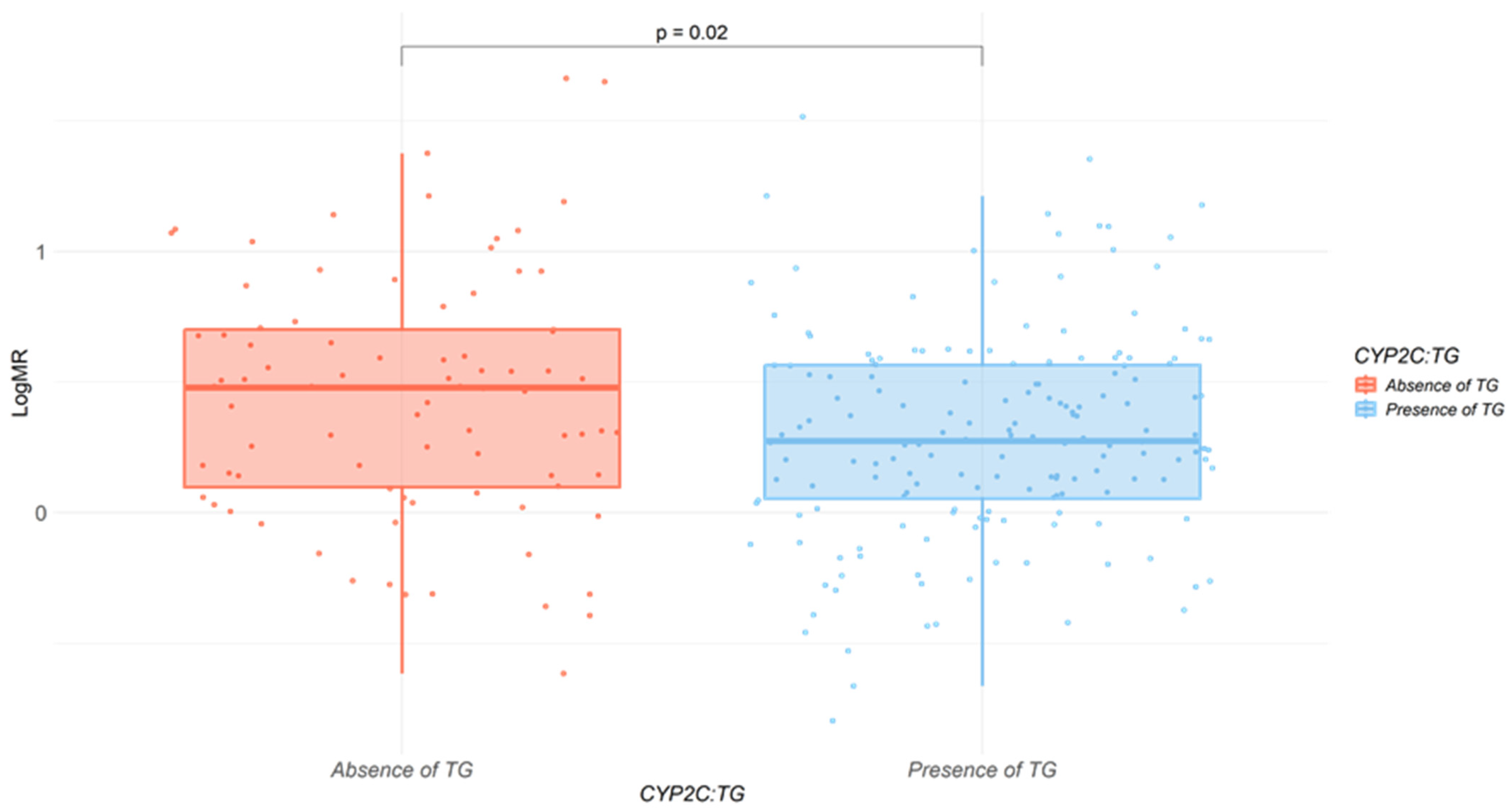
The presence of the CYP2C:TG haplotype was significantly associated with logMR of omeprazole/5-hydroxyomeprazole, as evidenced by a p-value of 0.02 (Figure 1).
In the process of inferring individual haplotypes and diplotypes derived from CYP2C19 star alleles and CYP2C genetic variants, the diplotype predominantly identified was *1/*1, in association with the CYP2C:TG haplotype either in a homozygous *1+TG/*1+TG (17.9%) or a heterozygous state *1/*1+TG (37.7%), representing a 55.6% sum within the study population. Individuals carrying the *1/*2 genotype and the CYP2C:TG haplotype in homozygosity (0.4%) or heterozygosity (9.7%) accounted for 10.1% of the cohort, while 1.6% of individuals were identified as carriers of the *1+TG/*17 diplotype.
The distribution of the CYP2C:TG haplotype across age groups was examined to assess whether age influences its functional impact (Table 2). The *1+TG/*17 genotype was associated with the oldest age subgroup, which also demonstrated the highest logMR values.
In the multivariate analysis, the diplotype and age were the most relevant factors influencing MR.
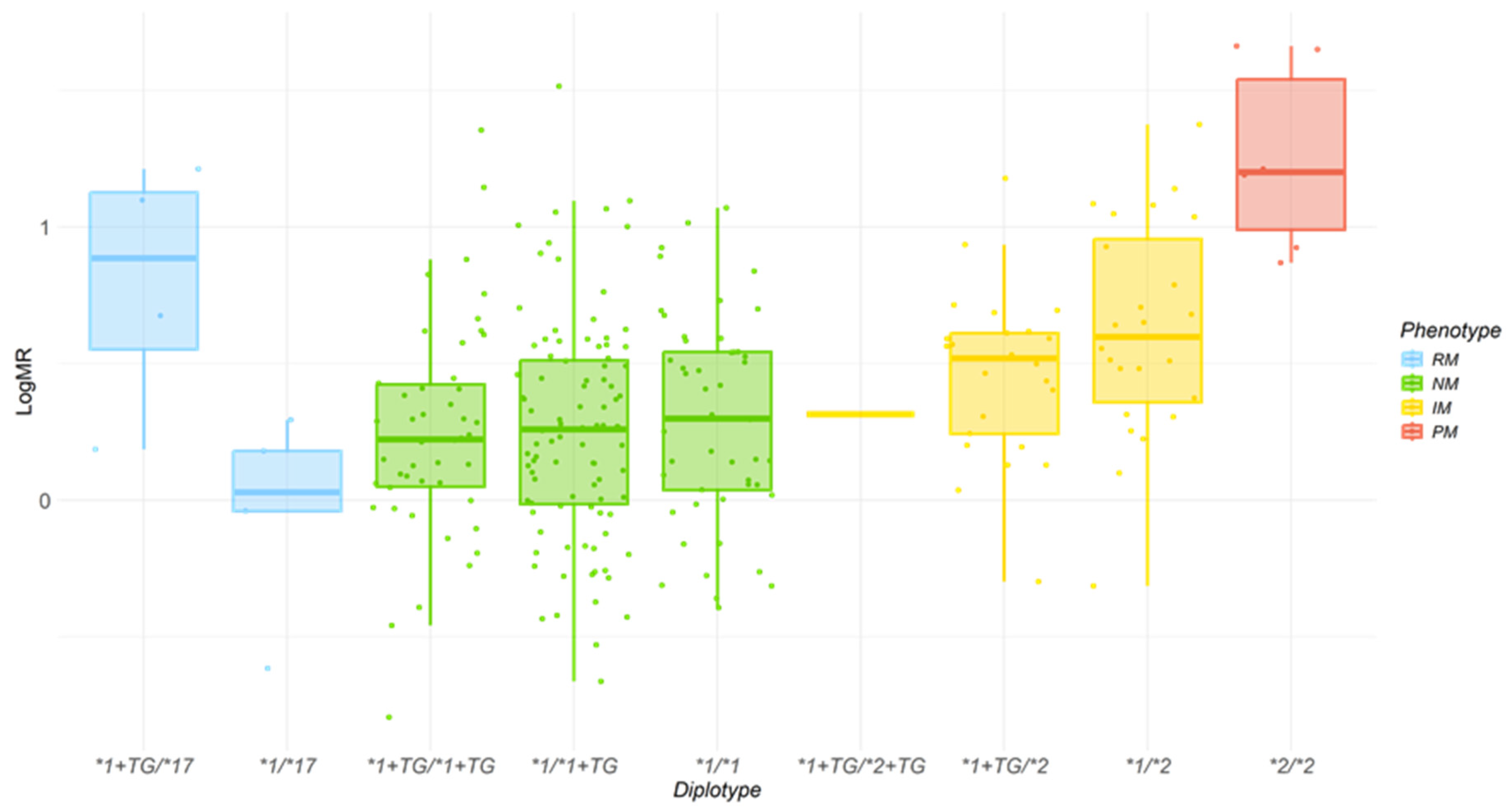
An association was observed between metabolizer phenotypes, defined by CYP2C diplotypes, and the resulting logMR (Figure 2). Individuals classified as gIMs, or gNMs exhibited enhanced metabolic capacity when carrying the CYP2C:TG haplotype, regardless of zygosity (homozygous or heterozygous). In contrast, gRMs did not display the increase in enzymatic activity, showing a MR comparable to that of gIMs individuals.
The analysis of the association between logMR and the combined presence of CYP2C19 genotype and the CYP2C:TG haplotype revealed several trends. Individuals with the CYP2C19*1/*1 genotype carrying one copy of the CYP2C:TG haplotype exhibited a 14.7% reduction in mean logMR compared to non-carriers, although this difference was not statistically significant (p = 0.43). Similarly, carriers of the two copies of the CYP2C:TG haplotype showed a 17.4% decrease in mean logMR relative to the baseline group (p = 0.45). Among individuals with the CYP2C19*1/*2 genotype, the presence of the CYP2C19*1 allele in combination with the CYP2C:TG haplotype was associated with a 25.8% reduction in mean logMR (p = 0.16). In contrast, only four individuals carrying the CYP2C19*1/*17 genotype showed an opposite effect: the presence of the combination of CYPC19*1/*17 and the CYP2C:TG haplotype was associated with an increase in mean logMR compared to the baseline group (p = 0.032).

2.3. Relationship Between Ancestry and Metabolic Ratio

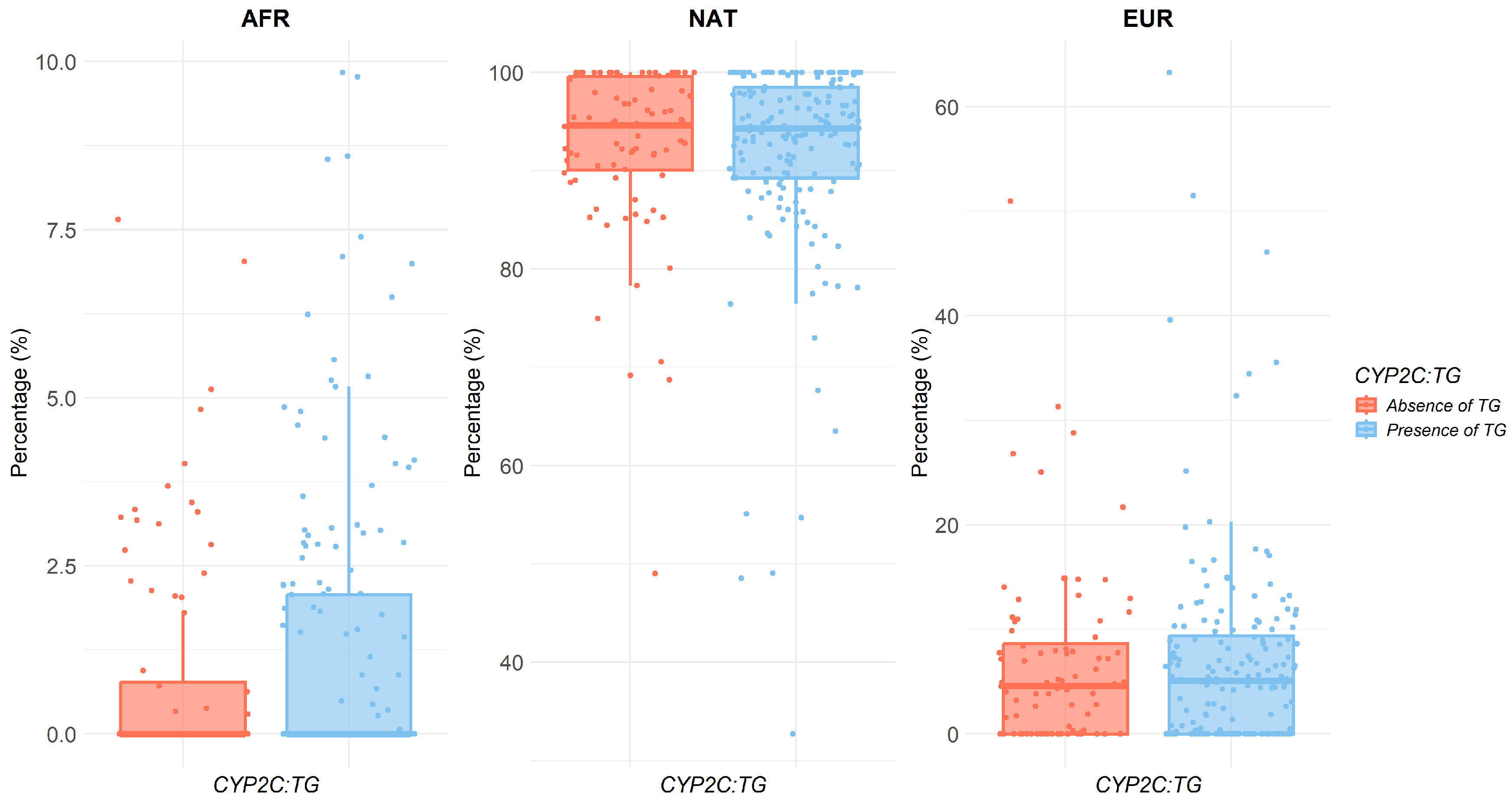
The analyzed Mexican Amerindian population exhibited a molecular ancestry composition of 92.12% Native American, 6.77% European, and 1.11% African. The high proportion of Native American ancestry was evaluated in relation to the presence of the CYP2C:TG haplotype. However, no statistically significant differences were observed across ancestry components (AFR p = 0.35, NAT p = 0.8, EUR p = 0.98), suggesting that molecular ancestry does not influence haplotype carriage (Figure 3, Table 3).
When comparing the mean ancestry proportions among individuals carrying the three possible CYP2C haplotypes, statistically significant differences were observed only for African ancestry, specifically between carriers of the CYP2C:TA haplotype and non-carriers.

3. Discussion

This study presents, for the first time, the relationship between the novel CYP2C haplotype and its potential contribution to predicting the CYP2C19 metabolic phenotype in a Native Mexican population, using a validated phenotyping cocktail approach [14,15]. The CYP2C haplotype, defined by two SNPs (rs2860840 and rs11188059), has been previously associated with significantly lower serum concentration of escitalopram [8] and sertraline [9]. These findings support the hypothesis that the CYP2C:TG haplotype is associated with ultrarapid CYP2C19 metabolism [9]. Nevertheless, the association between enhanced CYP2C19 metabolic activity and the presence of the CYP2C:TG haplotype, has not reached statistical significance for other CYP2C19 substrates, such as clopidogrel [10] or proton pump inhibitors [16].
Two hypotheses have been proposed to explain the mechanism underlying this haplotype’s effect: (a) CYP2C18 may complement the metabolic capacity of CYP2C19, with this interaction depending on the presence of CYP2C:TG, due to the high degree of sequence similarity and identity between the two enzymes; or (b) the haplotype may influence CYP2C19 gene expression at the regulatory level, thereby enhancing enzymatic activity [17].
Furthermore, the CYP2C:TG has been reported to be associated with ultrarapid CYP2C19 metabolism, similar to that conferred by CYP2C19*17. Therefore, genotyping this haplotype in populations such as Native Americans, where the frequency of CYP2C19*17 is low or nearly absent [13,18], may be useful for predicting gRMs or gUMs phenotypes.
According to a study [8] conducted in a European cohort, the CYP2C:CG haplotype was the most prevalent, with a frequency of 0.65, compared to 0.16 and 0.19 for the CYP2C:TA and CYP2C:TG haplotypes, respectively. These findings are consistent with those reported in European cohorts from the 1000 Genomes Projects [8]. However, they differ from the frequencies observed in the present study, where the CYP2C:TG haplotype was predominant (42.7%; Table 2). This difference likely reflects the predominantly Native American ancestry (92.12%) of the studied population, in agreement with previous reports showing higher CYP2C:TG frequencies in four Native American enriched cohorts derived from public databases [12]. The CYP2C:CA haplotype was not detected in the 1000 Genomes Project database nor in reference European cohorts from previous studies, suggesting that this haplotype is either absent or extremely rare [19]. Its absence was also confirmed in other ethnic groups, including the purely Native American population analyzed here.
The CYP2C:TG haplotype is found almost exclusively in combination with the CYP2C19*1 allele [20], although it has also been reported in associations with other alleles such as CYP2C19*4 [19]. Our results are consistent with this observation, as the haplotype was found almost exclusively with CYP2C19*1, with the exception of a single individual carrying CYP2C19*2 (Table 1). Moreover, CYP2C19*17 was absent in all CYP2C:TG homozygotes, which is consistent with previous findings showing the lack of CYP2C19*17+TG diplotype in individuals with gastroesophageal reflux disease treated with omeprazole [19]. Several authors have proposed a linkage disequilibrium between the CYP2C:TG haplotype and the CYP2C19*1 allele, based on the lack of co-occurrence with either CYP2C19*2 (rs4244285 A) or CYP2C19*17 (rs12248560 T) [8,12]. However, current findings only partially support this assumption, given the single individual identified with the CYP2C19*2+TG combination (Table 1).
When analyzing the impact of the CYP2C:TG haplotype on the logMR of omeprazole/5-hydroxyomeprazole, a statistically significant difference was observed (p = 0.02; Figure 1) between carriers and non-carriers. These results align with a previous study conducted in patients with gastrointestinal disorders treated with omeprazole, where therapeutic failure was associated with the CYP2C:TG/TG diplotype, but not with the increased-function variant CYP2C19*17 [19].
Regarding the analysis of omeprazole logMR across different diplotypes, we observed a trend toward increased CYP2C19-mediated metabolism in carriers of the CYP2C:TG haplotype, regardless of zygosity, across most metabolizer groups, except for the gRM group (Figure 2). However, this association did not reach statistical significance. These results are consistent with a recently published study that also failed to identify a significant association between CYP2C:TG or CYP2C19*1+TG and exposure to six drug substrates (pantoprazole, omeprazole, rabeprazole, citalopram, sertraline, and voriconazole) [20].
Conversely, current findings differ from previous reports that identified a significant association of the CYP2C:TG haplotype with an increased CYP2C19 enzymatic activity in the metabolism of escitalopram and sertraline [8,9]. Those studies suggest that genotyping for the CYP2C:TG haplotype may enhance therapeutic decision-making and improve phenotype prediction. Indeed, pharmacokinetic data for sertraline indicate that patients homozygous for either CYP2C19*17 or CYP2C:TG, or carrying both variants, may require higher doses of sertraline compared to CYP2C19*1/*1 carriers to achieve therapeutic plasma concentrations [9].
These discrepancies may be attributed to multiple factors, including the relative contribution of CYP2C19 to the metabolism of escitalopram and sertraline. Other cytochrome P405 enzymes also participate in the metabolism of these drugs [16]. For this reason, the omeprazole/5-hydroxyomeprazole concentration ratio was used in this study, as CYP2C19 is the sole enzyme responsible for this specific metabolic conversion [14,21].
A recent study proposed a phenotype reclassification based on the presence of the CYP2C:TG haplotype, suggesting that subjects with the CYP2C19*1+TG/*17 genotype should be classified as gUMs rather than gRMs, in accordance with clinical guideline criteria. Similarly, subjects with the CYP2C19*1+TG/*1+TG diplotype would be reclassified as gUMs instead of “normal metabolizers” (gNMs) [12]. However, this genotype-based phenotypic prediction does not align with present findings. Although the presence of the CYP2C:TG haplotype was observed in gNMs and gIMs individuals it was associated with increased CYP2C19-mediated omeprazole metabolism, but the differences were not statistically significant. Therefore, on the light of present results the presence of CYP2C:TG alone is not sufficient to reclassify individuals into different metabolizer categories or (predicted phenotypes) (Figure 2).
Furthermore, the genotype–phenotype discrepancy observed in Native American populations has been hypothesized that may be attributable to the presence of the CYP2C:TG haplotype, although they did not test it by the absence of plasma concentration measurements in that study [15]. Based on present data, the observed genotype–phenotype discordance cannot be explained solely by the presence or absence of the CYP2C:TG haplotype.
Given that the study was conducted in local health clinics in remote rural areas, there are limitations in controlling the intake of xenobiotics and habits of the participating indigenous Mexican population with deeply rooted traditions. Consequently, a significant limitation of this study is that potential concomitant use of other medications, herbal or traditional medicine remedies, cannot be ruled out, which may have contributed to partial inhibition of CYP450 enzymes [22]. Notably, in the gRM group, the measured enzymatic activity did not align with the phenotype inferred from genotype and the presence of the CYP2C:TG haplotype, as enzymatic activity was reduced (Figure 2). This discrepancy may be explained by the fact that this group had the highest mean age among the analyzed individuals, which could be associated with age-related decline in hepatic function and a greater likelihood of concomitant use of medication or medicinal plants, factors that are difficult to control in these populations. However, hepatic function tests were within normal parameters, suggesting that another possibility is the presence of an untested or previously undescribed genetic variant. Another limitation of this study is the lack of specific clinical data that could affect CYP2C19 metabolism, such as inflammatory biomarkers (i.e., CRP). Since it has been established that systemic inflammation can reduce CYP2C19 enzymatic activity [23,24]. Considering this, it is difficult to rule out the possibility that reduced CYP2C19 activity observed in some subgroups may be explained by underlying inflammation rather than by the CYP2C:TG haplotype itself.
This study represents the first analysis of the association between molecular ancestry and the presence or absence of the CYP2C:TG haplotype. Based on current data, molecular ancestry influences the likelihood of carrying this haplotype cannot be concluded. These findings are consistent with a previous study that reported no significant association between ethnicity and the presence of CYP2C:TG; however, that study only compared European individuals with a broadly defined “other” category, without specifying ethnic origins [20]. It is important to note that the population analyzed in the present study was predominantly Native American (92%), underscoring the need for future research in more ethnically diverse populations in order to support this observation, that CYP2C19 genotype frequencies vary across different ethnic groups and consequently metabolic phenotypes [25].
Specifically, when analyzing the presence of various CYP2C haplotypes in relation to the molecular ancestry proportions of each individual, we observed a statistically significant difference (p = 0.005) between the presence or absence of CYP2C:TA haplotype and African ancestry (Table 3). However, given the low proportion of African ancestry in our cohort and the limited number of individuals carrying the CYP2C:TA haplotype, these findings should be interpreted with caution and cannot be generalized to other populations.
The importance of studying the CYP2C haplotype as a tool for predicting the CYP2C19 metabolic phenotypes from genotyping data [3] lies in its clinical implications, particularly in contexts where increased CYP2C19 activity has been associated with therapeutic failure or adverse drug reactions, such as in patients undergoing antidepressant treatment [26], those with a history of depressive symptoms [27] or suicide attempts [28]. Furthermore, efforts should be directed toward ensuring the inclusion of non-European populations in pharmacogenomics research, thereby promoting equity in both scientific investigation and clinical practice.
The study of indigenous populations, in this case in the Americas, is essential to prevent widening inequalities and the biotechnology gap. This study is aligned with the need to include ethnicity in clinical research, which is the main motivation behind the RIBEF Network’s study and the basis for the Mérida/T’Hó Declaration issued by this Network together with Council of International Organizations of Medical Sciences (CIOMS) in 2020 [29].

4. Materials and Methods

4.1. Study Population

Pharmacokinetic data were obtained from a previous analysis [15] involving 256 volunteers (177 women and 79 men) with a mean age ± SD of 39.8 ±15.8 years, recruited from four different rural areas of Mexico (Chihuahua, Durango, Nayarit, and Sonora) [15]. Participants who identified self-identified as Native American were included in this study. Healthy volunteers were included based on routine clinical examination and blood tests. Information on their medical history was collected before the study. Moreover, pregnant women and volunteers with consanguineous relationship were excluded. Volunteers with a history of adverse drug effects or who had taken any medication in the two weeks prior to the study were also excluded. Alcohol, tobacco, and traditional medicine use, as well as concomitant medication, were recorded during the study. The study was approved by the Ethics and Research Committee of the Durango General Hospital, Mexican Health Ministry (CEI-HG450-24/165) and was conducted in accordance with the principles of the Declaration of Helsinki. Written informed consent was obtained from all participants prior to enrollment.

4.2. CYP2C19 Alleles and CYP2C Haplotype

Study participants were genotyped for CYP2C19*2, *3, *4, *5, and *17, as previously described [3,15]. Hardy–Weinberg equilibrium was calculated through χ2, and p-value was determined through 1-pchisq (χ2, df = 1). p > 0.05 was considered to indicate a Hardy–Weinberg equilibrium. Additionally, genotyping was performed by the same researcher by triplicate for two variants in the CYP2C18 gene, rs2860840 (C > T) and rs11188059 (G > A), using commercially available TaqMan® gene expression assay (Thermo Fisher Scientific, Waltham, MA, USA) (Table S1). All reactions were performed in 96-well plates using the QuantStudio™ 5 Real-Time PCR System (Applied Biosystems, Waltham, MA, USA) following the manufacturer’s protocol. Genotype-based phenotype predictions for CYP2C19 were assigned as follows: poor metabolizers (gPMs) carry two non-functional alleles, corresponding to an activity score (AS) of 0. Intermediate metabolizers (gIMs) carry either one normal function allele and one non-functional allele, or one increased function allele and one non-functional allele, resulting in AS of 1 to 1.5. Normal metabolizers (gNMs) have two alleles with standard enzymatic activity, yielding an AS of 2. Rapid (gRMs) and ultra-rapid metabolizers (gUMs) exhibit enhanced metabolic capacity due to the presence of one normal function allele paired with an increased-function allele, or two increased-function alleles, respectively [4].

4.3. Phenotyping Procedure

A phenotyping protocol (CEIBA cocktail) was developed and validated by the RIBEF network to investigate the indigenous populations of America, which includes probes drugs for CYP2D6, CYP2C9, CYP2C19, CYP3A4, and CYP1A2 [14,30]. In the present study the actual drug-metabolizing capacity was measured using this CEIBA phenotyping approach, which has been previously validated and applied to study populations in Mexico, Ecuador, and Nicaragua [15,31,32]. The participants received single oral doses of omeprazole (20 mg), losartan (25 mg), and caffeine (100 mg) followed one hour later by dextromethorphan (30 mg). Subjects fasted for 12 h before and up to 4 h after the administration of the test drugs. During the study period, participants were instructed to avoid concomitant medications, herbal remedies, over-the-counter drugs, and food products known to induce or inhibit CYP2D6, CYP2C9, CYP2C19, CYP3A4, or CYP1A2. Blood samples were collected 4 h after test drug administration, centrifuged for 10 min at 3500 rpm, and plasma aliquots were stored at −20 °C until analysis by liquid chromatography-tandem mass spectrometry (LC-MS/MS). The MR of omeprazole to 5-hydroxyomeprazole was analyzed to determine individual CYP2C19 functional phenotypes and assess their metabolic capacity [30].

4.4. Ancestry

Genomic ancestry for the study participants was previously determined [33]. Briefly, 83 ancestry informative markers (AIMs) were genotyped in all individuals included in this study, as well as in the other populations. Spaniards (n = 114) and Native Americans from Peru (n = 296) were used as parental European and Native American reference populations, respectively. The Yoruba individuals (n = 119) from the 1000 Genomes Project [34] were used as the African reference population. Admixture software (v. 1.3.0) [35] was used to perform individual ancestry analyses in an unsupervised mode, assuming a tri-hybrid model (k = 3).

4.5. Statistical Analysis

4.5.1. Analysis of the Impact of the CYP2C:TG Haplotype on the logMR Levels

To explore the potential impact of the CYP2C:TG haplotype on logMR levels, a univariate statistical analysis was performed. Initially, logMR values were visualized across individuals, or stratified based on the presence or absence of the TG haplotype. Subsequently, the Wilcoxon rank-sum test was applied to assess whether statistically significant differences existed between the two groups. This non-parametric test was selected due to the non-normal distribution of the variable under study. Statistical significance was defined as p < 0.05. Additionally, boxplots were generated to illustrate the variation in logMR levels as a function of the combined CYP2C19 genotypes, their predicted metabolic phenotypes, and the presence or absence of the CYP2C:TG haplotype. All univariate analyses were performed in R (version 4.4.3), using the ggplot2, ggsignif, and stats packages. Moreover, to obtain an integrated view of the combined effect of the variables considered, we performed a multivariate analysis using a generalized linear model the relative contribution of each predictor using the LMG metric implemented in the relaimpo R package (version 2.2.7) [36].

4.5.2. Analysis of the Relationship Between Ancestry and CYP2C Haplotypes

To assess the relationship between genomic ancestry levels and the presence of various CYP2C haplotypes, a univariate statistical analysis was conducted. The ancestry components considered included NAT (proportion of Native American ancestry), EUR (European ancestry) and AFR (African ancestry). For each ancestry component, comparisons were made between individuals carrying versus not carrying the respective CYP2C haplotypes. The Wilcoxon rank-sum test was applied to determine whether the distribution of each proportion significantly differed between carriers of one of the CYP2C haplotypes and those who did not.
All analyses were performed using R, using the ggplot2, ggsignif, and stats packages.

4.5.3. Inference of Individual Haplotypes and Diplotypes

Individual haplotypes and diplotypes were inferred using the HaploStats software (version 1.9.7) package within the R environment [37]. This tool assigns posterior probability values to each individual’s diplotype configuration based on estimated haplotype frequencies. For inclusion in the analysis, a minimum posterior probability threshold of 0.90 was applied for inclusion in the analysis.

5. Conclusions

The present study expands the limited evidence regarding the role of the CYP2C:TG haplotype in CYP2C19-mediated drug metabolism, particularly among non-European populations such as Mexican Indigenous cohort analyzed here. Although these findings do not yet support the clinical implementation of CYP2C:TG genotyping, they suggest that the mechanism by which the CYP2C:TG haplotype may enhance CYP2C19-dependent metabolism warrants further investigation across ethnically diverse populations, especially considering the variability in CYP2C19 genotype frequencies among different ethnic groups and its implications for metabolic phenotype prediction.

Supplementary Materials

The following supporting information can be downloaded at: https://www.mdpi.com/article/10.3390/ph19010006/s1, Table S1. CYP2C19 variants and their corresponding TaqMan gene expression assays utilized for Real-Time PCR genotyping.

Author Contributions

Conceptualization, A.L., F.R.-S., C.G.d.l.C., C.M.-M. and E.P.-L.; methodology, F.R.-S., N.d.G.T., C.G.d.l.C. and J.A.V.-G.; software, C.G.d.l.C. and J.A.V.-G.; validation, F.R.-S., C.G.d.l.C. and J.A.V.-G.; formal analysis, F.R.-S., N.d.G.T., C.G.d.l.C. and J.A.V.-G.; investigation, N.d.G.T., F.R.-S., C.M.-M., C.G.d.l.C., M.S.-M. and C.G.-H., resources, A.L. and M.S.-M.; data curation, C.G.d.l.C. and J.A.V.-G.; writing—original draft preparation, C.G.d.l.C., J.A.V.-G., C.M.-M. and M.S.-M.; writing—review and editing: C.G.d.l.C., J.A.V.-G., C.G.-H., C.M.-M., E.P.-L., M.S.-M. and A.L.; visualization, C.G.d.l.C., J.A.V.-G., C.G.-H., M.S.-M. and A.L.; supervision, A.L., C.M.-M., E.P.-L., RIBEF-IBEROFEN Consortium and M.S.-M.; project administration, A.L. and M.S.-M.; funding acquisition, RIBEF-IBEROFEN Consortium, A.L. and M.S.-M. All authors have read and agreed to the published version of the manuscript.

Funding

This research was funded by AEXCID-Junta de Extremadura (24IA001), Conselho Nacional de Desenvolvimento Cientifico e Tecnológico (CNPq), Brazil (200824/2024-4) to F.R.-S. and CAPES/PDSE 88881.981672/2024-01 to N.d.G.T.

Institutional Review Board Statement

The study was conducted in accordance with the Declaration of Helsinki and approved by Ethics and Research Committee of the Durango General Hospital of the Mexican Health Ministry (CEI-HG450-24/165, 18 March 2025).

Informed Consent Statement

Informed consent was obtained from all subjects involved in the study.

Data Availability Statement

The raw data supporting the conclusions of this article will be made available by the authors on request.

Acknowledgments

The authors thank all the study volunteers for their participation and Levin Thomas for his valuable suggestions on the manuscript.

Conflicts of Interest

The authors declare no conflicts of interest.

Abbreviations

The following abbreviations are used in this manuscript:
ASActivity score
gIMsIntermediate metabolizers
gNMsNormal metabolizers
gPMsPoor metabolizers
gRMsRapid metabolizers
gUMsUltrarapid metabolizers
logMRMetabolic ratio logarithm
MRMetabolic ratio

Appendix A

RIBEF-IBEROFEN Consortium for the Study of Phenotype-Genotype Relationships and Ancestry in Native American Populations

Adrián Llerena 1,2,3,4, Carla González de la Cruz 1,2,4, Carmen Mata-Martín 1,2,4, Juan Antonio Villatoro-García 1,2,4, Eva Peñas-Lledó 1,2,3, Pedro Dorado 1,2,3, Fernando de Andrés 1,5, Nadine de Godoy Torso 1,2,6, Fernanda Rodrigues-Soares 1,2,7, Martha Sosa-Macías 1,8, Carlos Galaviz-Hernández 1,8, Enrique Terán 1,9, Catalina Altamirano-Tinoco 1,10, Ronald Ramírez-Roa 1,11.
  • RIBEF/SIFF Red y Sociedad Iberoamericana de Farmacogenética y Farmacogenómica. Spain
  • INUBE University Institute for Bio-Sanitary Research of Extremadura. Badajoz, Spain.
  • Faculty of Medicine and Health Sciences, University of Extremadura. Badajoz, Spain.
  • Unit of Pharmacogenomics and Personalized Medicine. Clinical Pharmacology Service. Badajoz University Hospital, SES. Badajoz, Spain.
  • Current address: Department of Analytical Chemistry and Food Technology. Faculty of Pharmacy, University of Castilla-La Mancha. Albacete, Spain.
  • Facultad de Ciencias Médicas, Universidade de Campinas. Campinas, Sao Paulo, Brasil.
  • Department of Pathology, Genetic and Evolution, Universidade Federal do Triângulo Mineiro, Uberaba, Brasil.
  • IPN Instituto Politécnico Nacional. CIIDIR Unidad Durango. Academia de Genómica. Durango, México.
  • Colegio de Ciencias de la Salud, Universidad San Francisco de Quito, Quito, Ecuador.
  • UNAN Universidad Nacional Autónoma de Nicaragua, Facultad de Ciencias Médicas, León, Nicaragua.
  • Facultad de Odontología, Universidad Americana, Managua, Nicaragua.

References

  1. Botton, M.R.; Whirl-Carrillo, M.; Del Tredici, A.L.; Sangkuhl, K.; Cavallari, L.H.; Agúndez, J.A.G.; Duconge, J.; Lee, M.T.M.; Woodahl, E.L.; Claudio-Campos, K.; et al. PharmVar GeneFocus: CYP2C19. Clin. Pharmacol. Ther. 2021, 109, 352–366. [Google Scholar] [CrossRef]
  2. PharmVar. Available online: https://www.pharmvar.org/gene/CYP2C19 (accessed on 23 April 2025).
  3. de Godoy Torso, N.; Rodrigues-Soares, F.; Altamirano, C.; Ramírez-Roa, R.; Sosa-Macías, M.; Galavíz-Hernández, C.; Terán, E.; Peñas-LLedó, E.; Dorado, P.; LLerena, A. CYP2C19 Genotype-Phenotype Correlation: Current Insights and Unanswered Questions. Drug Metab. Pers. Ther. 2024, 39, 201–206. [Google Scholar] [CrossRef] [PubMed]
  4. Lee, C.R.; Luzum, J.A.; Sangkuhl, K.; Gammal, R.S.; Sabatine, M.S.; Stein, C.M.; Kisor, D.F.; Limdi, N.A.; Lee, Y.M.; Scott, S.A.; et al. Clinical Pharmacogenetics Implementation Consortium Guideline for CYP2C19 Genotype and Clopidogrel Therapy: 2022 Update. Clin. Pharmacol. Ther. 2022, 112, 959–967. [Google Scholar] [CrossRef] [PubMed]
  5. Bousman, C.A.; Stevenson, J.M.; Ramsey, L.B.; Sangkuhl, K.; Hicks, J.K.; Strawn, J.R.; Singh, A.B.; Ruaño, G.; Mueller, D.J.; Tsermpini, E.E.; et al. Clinical Pharmacogenetics Implementation Consortium (CPIC) Guideline for CYP2D6, CYP2C19, CYP2B6, SLC6A4, and HTR2A Genotypes and Serotonin Reuptake Inhibitor Antidepressants. Clin. Pharmacol. Ther. 2023, 114, 51–68. [Google Scholar] [CrossRef] [PubMed]
  6. Lima, J.J.; Thomas, C.D.; Barbarino, J.; Desta, Z.; Van Driest, S.L.; El Rouby, N.; Johnson, J.A.; Cavallari, L.H.; Shakhnovich, V.; Thacker, D.L.; et al. Clinical Pharmacogenetics Implementation Consortium (CPIC) Guideline for CYP2C19 and Proton Pump Inhibitor Dosing. Clin. Pharmacol. Ther. 2021, 109, 1417–1423. [Google Scholar] [CrossRef]
  7. CYP2C18. Available online: https://www.clinpgx.org/gene/PA127/pathway (accessed on 29 October 2025).
  8. Bråten, L.S.; Haslemo, T.; Jukic, M.M.; Ivanov, M.; Ingelman-Sundberg, M.; Molden, E.; Kringen, M.K. A Novel CYP2C-Haplotype Associated With Ultrarapid Metabolism of Escitalopram. Clin. Pharmacol. Ther. 2021, 110, 786–793. [Google Scholar] [CrossRef]
  9. Bråten, L.S.; Ingelman-Sundberg, M.; Jukic, M.M.; Molden, E.; Kringen, M.K. Impact of the Novel CYP2C:TG Haplotype and CYP2B6 Variants on Sertraline Exposure in a Large Patient Population. Clin. Transl. Sci. 2022, 15, 2135–2145. [Google Scholar] [CrossRef]
  10. Ganoci, L.; Palić, J.; Trkulja, V.; Starčević, K.; Šimičević, L.; Božina, N.; Lovrić-Benčić, M.; Poljaković, Z.; Božina, T. Is CYP2C Haplotype Relevant for Efficacy and Bleeding Risk in Clopidogrel-Treated Patients? Genes 2024, 15, 607. [Google Scholar] [CrossRef]
  11. Zubiaur, P.; Leeder, J.S.; Abad-Santos, F.; Gaedigk, A. Response to “What Is the Current Clinical Impact of the CYP2C:TG Haplotype?”. Clin. Pharmacol. Ther. 2024, 115, 184. [Google Scholar] [CrossRef]
  12. Fernandes, V.C.; Pretti, M.A.M.; Tsuneto, L.T.; Petzl-Erler, M.L.; Suarez-Kurtz, G. Distribution of a Novel CYP2C Haplotype in Native American Populations. Front. Genet. 2023, 14, 1114742. [Google Scholar] [CrossRef]
  13. Ortega-Ayala, A.; de la Cruz, C.G.; Dorado, P.; Rodrigues-Soares, F.; Castillo-Nájera, F.; LLerena, A.; Molina-Guarneros, J. Molecular Ancestry Across Allelic Variants of SLC22A1, SLC22A2, SLC22A3, ABCB1, CYP2C8, CYP2C9, and CYP2C19 in Mexican-Mestizo DMT2 Patients. Biomedicines 2025, 13, 1156. [Google Scholar] [CrossRef] [PubMed]
  14. De Andrés, F.; Terán, S.; Bovera, M.; Fariñas, H.; Terán, E.; LLerena, A. Multiplex Phenotyping for Systems Medicine: A One-Point Optimized Practical Sampling Strategy for Simultaneous Estimation of CYP1A2, CYP2C9, CYP2C19, and CYP2D6 Activities Using a Cocktail Approach. OMICS A J. Integr. Biol. 2016, 20, 88–96. [Google Scholar] [CrossRef]
  15. de Andrés, F.; Sosa-Macías, M.; Ramos, B.P.L.; Naranjo, M.E.G.; LLerena, A. CYP450 Genotype/Phenotype Concordance in Mexican Amerindian Indigenous Populations-Where to from Here for Global Precision Medicine? OMICS A J. Integr. Biol. 2017, 21, 509–519. [Google Scholar] [CrossRef]
  16. Kyler, K.E.; Gaedigk, A.; Abdel-Rahman, S.; Staggs, V.S.; Pearce, R.E.; Toren, P.; Leeder, J.S.; Shakhnovich, V. Influence of Novel CYP2C-Haplotype on Proton Pump Inhibitor Pharmacokinetics in Children. Clin. Transl. Sci. 2024, 17, e13782. [Google Scholar] [CrossRef] [PubMed]
  17. Zubiaur, P.; Gaedigk, A. CYP2C18: The Orphan in the CYP2C Family. Pharmacogenomics 2022, 23, 913–916. [Google Scholar] [CrossRef] [PubMed]
  18. Suarez-Kurtz, G. Pharmacogenetic Testing in Admixed Populations: Frequency of the Association for Molecular Pathology Pharmacogenomics Working Group Tier 1 Variant Alleles in Brazilians. J. Mol. Diagn. 2025, 27, 247–255. [Google Scholar] [CrossRef]
  19. Kee, P.S.; Maggo, S.D.S.; Kennedy, M.A.; Barclay, M.L.; Miller, A.L.; Lehnert, K.; Curtis, M.A.; Faull, R.L.M.; Parker, R.; Chin, P.K.L. Omeprazole Treatment Failure in Gastroesophageal Reflux Disease and Genetic Variation at the CYP2C Locus. Front. Genet. 2022, 13, 869160. [Google Scholar] [CrossRef]
  20. Zubiaur, P.; Soria-Chacartegui, P.; Boone, E.C.; Prasad, B.; Dinh, J.; Wang, W.Y.; Zugbi, S.; Rodríguez-Lopez, A.; González-Iglesias, E.; Leeder, J.S.; et al. Impact of CYP2C:TG Haplotype on CYP2C19 Substrates Clearance In Vivo, Protein Content, and In Vitro Activity. Clin. Pharmacol. Ther. 2023, 114, 1033–1042. [Google Scholar] [CrossRef]
  21. Andersson, T.; Miner, J.O.; Veronese, M.E.; Tassaneeyakul, W.; Tassaneeyakul, W.; Meyer, U.A.; Birkett, D.J. Identification of Human Liver Cytochrome P450 Isoforms Mediating Omeprazole Metabolism. Br. J. Clin. Pharmacol. 1993, 36, 521–530. [Google Scholar] [CrossRef]
  22. Li, Z.; Zhang, X.; Han, Q.; Zhou, X.; Cui, T.; Liu, S.; Zhao, T.; Wu, W.; Wang, X.; Wang, Z.; et al. Elucidation of the Compatibility Mechanism of Yuanhuzhitong Prescription in View of CYP-Mediated Herbal Inter-Component Interactions. Fitoterapia 2025, 187, 106934. [Google Scholar] [CrossRef]
  23. Veringa, A.; ter Avest, M.; Span, L.F.R.; van den Heuvel, E.R.; Touw, D.J.; Zijlstra, J.G.; Kosterink, J.G.W.; van der Werf, T.S.; Alffenaar, J.W.C. Voriconazole Metabolism Is Influenced by Severe Inflammation: A Prospective Study. J. Antimicrob. Chemother. 2017, 72, 261–267. [Google Scholar] [CrossRef] [PubMed]
  24. Ohnishi, A.; Murakami, S.; Akizuki, S.; Mochizuki, J.; Echizen, H.; Takagi, I. In Vivo Metabolic Activity of CYP2C19 and CYP3A in Relation to CYP2C19 Genetic Polymorphism in Chronic Liver Disease. J. Clin. Pharmacol. 2005, 45, 1221–1229. [Google Scholar] [CrossRef] [PubMed]
  25. Biswas, M. Global Distribution of CYP2C19 Risk Phenotypes Affecting Safety and Effectiveness of Medications. Pharmacogenom. J. 2021, 21, 190–199. [Google Scholar] [CrossRef] [PubMed]
  26. Hicks, J.K.; Sangkuhl, K.; Swen, J.J.; Ellingrod, V.L.; Müller, D.J.; Shimoda, K.; Bishop, J.R.; Kharasch, E.D.; Skaar, T.C.; Gaedigk, A.; et al. Clinical Pharmacogenetics Implementation Consortium Guideline (CPIC) for CYP2D6 and CYP2C19 Genotypes and Dosing of Tricyclic Antidepressants: 2016 Update. Clin. Pharmacol. Ther. 2017, 102, 37–44. [Google Scholar] [CrossRef]
  27. Jukic, M.M.; Opel, N.; Ström, J.; Carrillo-Roa, T.; Miksys, S.; Novalen, M.; Renblom, A.; Sim, S.C.; Peñas-Lledó, E.M.; Courtet, P.; et al. Elevated CYP2C19 Expression Is Associated with Depressive Symptoms and Hippocampal Homeostasis Impairment. Mol. Psychiatry 2017, 22, 1155–1163. [Google Scholar] [CrossRef]
  28. Peñas-Lledó, E.M.; Guillaume, S.; de Andrés, F.; Cortés-Martínez, A.; Dubois, J.; Kahn, J.P.; Leboyer, M.; Olié, E.; LLerena, A.; Courtet, P. A One-Year Follow-up Study of Treatment-Compliant Suicide Attempt Survivors: Relationship of CYP2D6-CYP2C19 and Polypharmacy with Suicide Reattempts. Transl. Psychiatry 2022, 12, 451. [Google Scholar] [CrossRef]
  29. Peñas-LLedó, E.; Terán, E.; Sosa-Macías, M.; Galaviz-Hernández, C.; Gil, J.P.; Nair, S.; Diwakar, S.; Hernández, I.; Lara-Riegos, J.; Ramírez-Roa, R.; et al. Challenges and Opportunities for Clinical Pharmacogenetic Research Studies in Resource-Limited Settings: Conclusions From the Council for International Organizations of Medical Sciences–Ibero-American Network of Pharmacogenetics and Pharmacogenomics Meeting. Clin. Ther. 2020, 42, 1595–1610.e5. [Google Scholar]
  30. De Andrés, F.; Sosa-Macías, M.; Llerena, A. A Rapid and Simple LC-MS/MS Method for the Simultaneous Evaluation of CYP1A2, CYP2C9, CYP2C19, CYP2D6 and CYP3A4 Hydroxylation Capacity. Bioanalysis 2014, 6, 683–696. [Google Scholar] [CrossRef]
  31. De Andrés, F.; Terán, S.; Hernández, F.; Terán, E.; Llerena, A. To Genotype or Phenotype for Personalized Medicine? CYP450 Drug Metabolizing Enzyme Genotype-Phenotype Concordance and Discordance in the Ecuadorian Population. OMICS J. Integr. Biol. 2016, 20, 699–710. [Google Scholar] [CrossRef]
  32. de Andrés, F.; Altamirano-Tinoco, C.; Ramírez-Roa, R.; Montes-Mondragón, C.F.; Dorado, P.; Peñas-Lledó, E.M.; LLerena, A. Relationships between CYP1A2, CYP2C9, CYP2C19, CYP2D6 and CYP3A4 Metabolic Phenotypes and Genotypes in a Nicaraguan Mestizo Population. Pharmacogenom. J. 2021, 21, 140–151. [Google Scholar] [CrossRef]
  33. Rodrigues-Soares, F.; Peñas-Lledó, E.M.; Tarazona-Santos, E.; Sosa-Macías, M.; Terán, E.; López-López, M.; Rodeiro, I.; Moya, G.E.; Calzadilla, L.R.; Ramírez-Roa, R.; et al. Genomic Ancestry, CYP2D6, CYP2C9, and CYP2C19 Among Latin Americans. Clin. Pharmacol. Ther. 2020, 107, 257–268. [Google Scholar] [CrossRef]
  34. Auton, A.; Abecasis, G.R.; Altshuler, D.M.; Durbin, R.M.; Bentley, D.R.; Chakravarti, A.; Clark, A.G.; Donnelly, P.; Eichler, E.E.; Flicek, P.; et al. A Global Reference for Human Genetic Variation. Nature 2015, 526, 68–74. [Google Scholar] [CrossRef]
  35. Alexander, D.H.; Novembre, J.; Lange, K. Fast Model-Based Estimation of Ancestry in Unrelated Individuals. Genome Res. 2009, 19, 1655–1664. [Google Scholar] [CrossRef]
  36. Grömping, U. Relative Importance for Linear Regression in R: The Package Relaimpo. J. Stat. Softw. 2007, 17, 1–27. [Google Scholar]
  37. Sinnwell, J.P.; Schaid, D.J. Title Statistical Analysis of Haplotypes with Traits and Covariates When Linkage Phase Is Ambiguous. 2016. Available online: https://cran.r-project.org/web/packages/haplo.stats/index.html (accessed on 6 November 2025).
Figure 1. Relationship between the presence of CYP2C:TG and logMR. Boxplot illustrating logMR levels according to the presence (red) or absence (blue) of the CYP2C:TG haplotype. The diagram also displays the p-obtained from the Wilcoxon rank-sum test, indicating the statistical significance of the observed differences.
Pharmaceuticals 19 00006 g001
Figure 2. Association between logMR and the presence of the CYP2C:TG haplotype, stratified by CYP2C19 diplotype distribution. Boxplot illustrating logMR levels across combinations of CYP2C19 genotypes and the presence or absence of the CYP2C:TG haplotype. Box colors indicate predicted metabolic phenotypes: red for gPMs, yellow for gNMs, green for gIMs and blue for gRMs.
Pharmaceuticals 19 00006 g002
Figure 3. Association between the presence of the CYP2C:TG haplotype and genomic ancestry. Boxplots showing the proportion of ancestral components—African (AFR), European (EUR), and Native American (NAT)—stratified by the presence (red) or absence (blue) of the CYP2C:TG haplotype.
Pharmaceuticals 19 00006 g003
Table 1. Distribution of CYP2C19 alleles frequencies according to CYP2C haplotypes (CYP2C:CG, CYP2C:TG, CYP2C:TA). Values are expressed as the number of alleles and their relative percentage (%).
CYP2C HaplotypesCYP2C19 Alleles (n, %)
*1*17*2
CG113 (22.07) 9 (1.76) 61 (11.91)
TG218 (42.58) 0 (0.00) 1 (0.19)
TA110 (21.48) 0 (0.00) 0 (0.00)
Table 2. Demographic, genetic, and phenotypic characteristics across CYP2C diplotype subgroups.
CYP2C DiplotypesPhenotypesSubjetcs, n, %SexAge, Years, Mean (sd)LogMR, Mean (sd)
Men %Women %
TG haplotypes
*1+TG/*17gRM4 (1.6)505055 (26.9)0.79 (0.47)
*1+TG/*1+TGgNM46 (17.9)30.469.641.5 (17.7)0.25 (0.40)
*1/*1+TGgNM96 (37.7)20.269.838.7 (15.2)0.26 (0.40)
*1+TG/*2+TGgIM1 (0.4)1000
*1+TG/*2gIM25 (9.7)406034.6 (14.9)0.46 (0.30)
CG or TA haplotypes
*1/*17gRM5 (1.9)802042.8 (1.48)−0.03 (0.35)
*1/*1gNM49 (19.1)18.481.638.6 (14.9)0.3 (0.38)
*1/*2gIM24 (9.3)386243.9 (16.0)0.62 (0.39)
*2/*2gPM6 (2.3)16.783.345.5 (15.1)1.25 (0.34)
Table 3. Comparison of ancestry proportions (AFR, NAT, EUR) according to the presence or absence of CYP2C haplotypes (CYP2C:TG, CYP2C:TA, CYP2C:CG).
CYP2C Haplotypes
TGTACG
AncestryMean (sd)p-ValueMean (sd)p-ValueMean (sd)p-Value
NoYesNoYesNoYes
AFR 0.87 (1.67)1.22 (2.15)0.351.33 (2.16)0.74 (1.67)0.005 0.92 (1.86)1.24 (2.10)0.13
NAT92.5 (8.67)91.9 (10.1)0.8091.7 (9.76)92.8 (9.53)0.0692.3 (9.88)92.0 (9.55)0.32
EUR6.62 (8.52)6.85 (9.46)0.986.98 (9.33)6.44 (8.89)0.366.78 (9.00)6.77 (9.28)0.81
Disclaimer/Publisher’s Note: The statements, opinions and data contained in all publications are solely those of the individual author(s) and contributor(s) and not of MDPI and/or the editor(s). MDPI and/or the editor(s) disclaim responsibility for any injury to people or property resulting from any ideas, methods, instructions or products referred to in the content.