Article

Real-World Data on Severe Cutaneous Adverse Reactions to Drugs

1
Department of General and Clinical Pharmacology, Peoples’ Friendship University of Russia Named After Patrice Lumumba (RUDN University), 6 Miklukho-Maklaya St., 117198 Moscow, Russia
2
Pharmacovigilance Center, Information and Methodological Center for Expert Evaluation, Record and Analysis of Circulation of Medical Products Under the Federal Service for Surveillance in Healthcare, 4-1 Slavyanskaya Square, 109074 Moscow, Russia
3
Moscow City Health Department, City Clinical Hospital No. 24, State Budgetary Institution of Healthcare of the City of Moscow, Pistzovaya Srt. 10, 127015 Moscow, Russia
4
Department of Immunology, Russian National Research Medical University Named After N.I. Pirogov, St. Ostrovityanova, 1, 117997 Moscow, Russia
*
Author to whom correspondence should be addressed.
Pharmaceuticals 2026, 19(1), 21; https://doi.org/10.3390/ph19010021
Submission received: 5 November 2025 / Revised: 9 December 2025 / Accepted: 18 December 2025 / Published: 22 December 2025
(This article belongs to the Special Issue Therapeutic Drug Monitoring and Adverse Drug Reactions: 2nd Edition)

Abstract

Background/Objectives: Cutaneous adverse drug reactions (CADRs) represent the most common manifestations of drug-induced allergy, with most unfavorable clinical outcomes seen in severe cutaneous adverse reactions (SCARs). To manage SCARs immediate cessation of the offending drug is needed; therefore, it is crucial to identify the list of medications associated with SCARs in real-world clinical practice. The objective of this study was to evaluate the structure of drugs associated with SCARs and to analyze drug-induced SCAR signals by calculating the reporting odds ratio (ROR) and proportional reporting ratio (PRR) based on spontaneous reports extracted from the Russian national pharmacovigilance database. Methods: A retrospective, descriptive pharmacoepidemiological analysis of spontaneous reports (SRs) registered in the pharmacovigilance database from 1 April 2019 to 31 March 2025. Results: A total of 7011 SRs with SCARs were finally revealed, with 907 identified drug triggers. The most frequently reported were antibacterial drugs for systemic use (22.8%), antineoplastic agents (17.8%), and antiepileptics (6.0%). The top five drugs involved in SCARs were dupilumab (2.14%, n = 244), piperacillin and beta-lactamase inhibitor (2.0%, n = 227), pembrolizumab (1.98%, n = 225), levofloxacin (1.95%, n = 222), and linagliptin (1.93%, n = 220). The strongest signals were detected for linagliptin (PRR = 15.37, 95% CI: 13.54–17.44; ROR = 17.24, 95% CI: 14.95–19.88), followed by clindamycin (PRR = 12.44, 95% CI: 10.89–14.21; ROR = 13.62, 95% CI: 11.77–15.77) and by piperacillin and beta-lactamase inhibitor (PRR = 10.02, 95% CI: 8.86–11.43; ROR = 10.81, 95% CI: 9.42–12.40). Conclusions: Pharmacovigilance databases facilitate the identification of diverse phenotypes of SCARs and the list of culprit drugs. The accumulated data serve as a valuable tool to enhance clinical practice outcomes and strengthen overall healthcare monitoring.

1. Introduction

Drug safety remains a pressing issue worldwide, with unpredictable reactions manifested as drug allergy among the most prevalent. Skin is a typical target organ involved in various drug-induced allergic reactions (Gell and Coombs hypersensitivity types I–IV). Most studies reported the incidence of CADRs in hospitalized patients to fall within the range of 1% to 5% [1,2]. A higher incidence was observed in critically ill patients, reaching 11.6% [3].
The majority of CADRs are usually mild and may resolve rapidly without the need for additional interventions; however, in certain instances, SCARs can occur, necessitating hospitalization and often posing a potentially life-threatening risk to patients [4]. The global incidence of SCARs ranges from 0.4 to 1.2 cases per million individuals annually, with a mortality rate between 14% and 70% [5]. Most common SCARs include drug reaction with eosinophilia and systemic symptoms (DRESS), Stevens–Johnson syndrome (SJS), toxic epidermal necrolysis (TEN), and acute generalized exanthematous pustulosis (AGEP). TEN is characterized by the highest lethality rate, followed by SJS and AGEP [6,7]. A nationwide, register-based matched cohort study performed in Denmark revealed that patients with TEN have a high rate of both short-term and long-term mortality. An average of 19.3% of patients die within 30 days and up to 28% within 90 days. Comparing median survival for patients with and without TEN, authors reported the values of 4.77 years (95% credit interval, CI: 2.02–9.46) and 25.96 years (95% CI: 25.19–27.20), respectively. It is of particular interest that even two years after diagnosis, the mortality risk in TEN patients compared to controls increased by 230% (HR 3.30; 95% CI: 2.34–4.66) [8].
It has been established that virtually any drug, regardless of dosage form and route of administration, can cause SCAR development. The spectrum of drugs involved in SCARs is broad; published data indicate antimicrobials and antiepileptics as the top culprit classes [9,10,11], though many other drugs have been shown to cause various types of SCARs, such as antifungals [12], anti-gout agents [13], monoclonal antibodies [14], antineoplastics [9,15], and vaccines [16].
Genetic predisposition constitutes a primary risk factor for the development of SCARs. There is strong evidence of the involvement of several genes, mainly human leukocyte antigens (HLA), in altered immune signaling, resulting in SCARs [17,18]. Other genetic markers of SCARs may include some genotypes of drug metabolism enzymes, drug transporters, and T-cell receptors [19]. Most studies demonstrated a higher overall incidence of SCARs in females, especially in case of SJS and TEN [20]. A meta-analysis conducted by Fathima, S. et al. (2024) identified male gender and HIV infection as primary risk factors for SJS/TEN; however, the analysis ultimately included only five studies, and the findings were deemed to be of low quality [21].
Diagnostics of SCARs should be based on medial history, anamnesis, clinical manifestations, and time of their development. The time interval for SJS and TEN is 4–28 days after the start of exposure, for AGEP 1–12 days, for DRESS 2–8 weeks, and for maculopapular drug exanthem 4–14 days [22]. Accurate identification of the causative agent and subsequent discontinuation of its administration represent the most critical steps in the management of SCARs. This process poses a considerable challenge for clinicians, as most patients are simultaneously subjected to multiple pharmacological interventions. To effectively address this clinical challenge, it is recommended to rely on lists of already-identified SCAR triggers, particularly those with a strong drug–adverse drug reaction (ADR) causal relationship. This information comes from both classical clinical trials and studies conducted within pharmacovigilance systems.
At present, diverse methodologies are employed to monitor drug safety within contemporary pharmacovigilance practices. Among these, the analysis of national and supranational databases of SRs of ADRs has demonstrated notable efficacy. Key advantages of this approach include the capacity to detect rare and severe ADRs, and identify pharmacological triggers of certain ADRs during the post-marketing phase. Additionally, it facilitates the assessment of causality between ADRs and drugs and provides comprehensive data on drug utilization across all patient populations in real-world clinical settings over extended durations, with dynamic updates captured in real time [23,24].
The aim of our study was to assess the structure of drugs involved in SCARs and analyze signals of drug-induced SCARs, calculating the ROR and PRR using SRs extracted from the Russian national pharmacovigilance database.

2. Results

2.1. General Characteristics of SMQ SCAR

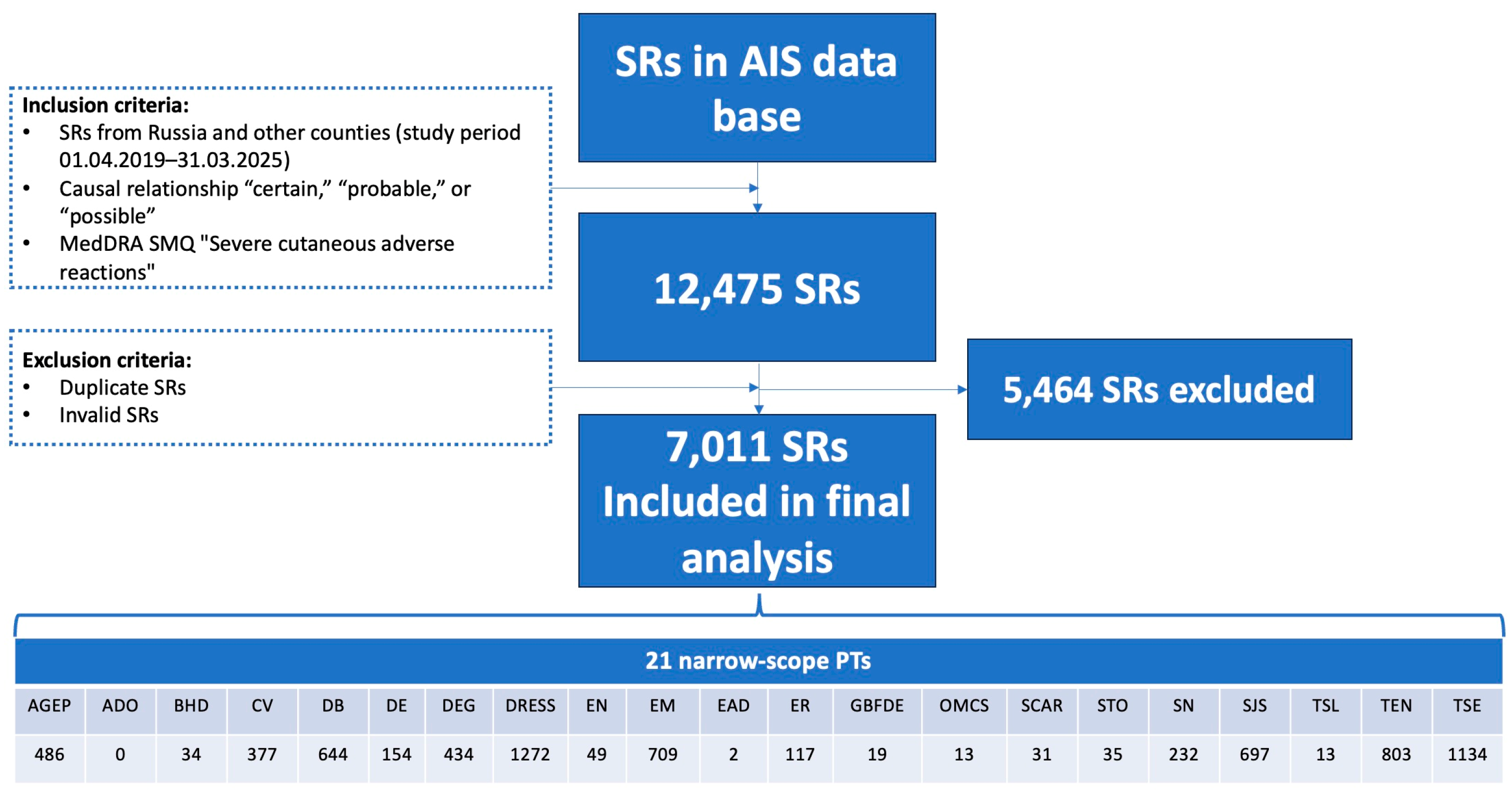
The total number of SRs with preferred terms (PTs) related to the standardized Medical Dictionary for Drug Regulatory Activities (MedDRA) query (SMQ) “SCAR” was 12,475 (6-year study period: from 1 April 2019 to 31 March 2025). After excluding duplicates and invalid messages, 7011 SRs were included in the study. Table 1 contains data on the structure of PTs within SMQ SCAR and demographic characteristics of patients derived from SRs. The mean age of patients according to the data derived from SRs with SMQ SCARs was 55.7 ± 22.4 years (min = 6 days, max = 99 years), 50.9% (n = 3570) were males, 44.5% (n = 3120) females, and in 4.6% (n = 321) the gender was unknown.
The most prevalent PT revealed in our study was DRESS (n= 1272), followed by toxic skin eruption, TSE (n = 1134), TEN (n = 803), erythema multiforme, EM (n = 709), and SJS (n= 697). In further analysis, we focused on the top 10 PTs.
A predominance of male gender was detected in most of PTs, but there were some exceptions where females were leaders, such as for dermatitis bullous (DB; males—45.7%, females—51.9%), dermatitis exfoliative (DE; males—35.7%, females—55.8%), and dermatitis exfoliative generalized (DEG; males—41.7%, females—52.1%).
The lowest mean age of patients was revealed in SRs with target skin lesion (TSL) (43.2 ± 25.6 years), while in SRs with oculomucocutaneous syndrome the highest mean value was reported (71.3 ± 13.2 years). The age distribution for the total SCAR sample and for top 10 PTs is presented in Table 2. According to SR data, SCARs developed mainly in young and middle-aged persons (18–59 years), the age group of 60–74 years ranked second (25.9%), and the age group of 75–89 years ranked third (16.6%) in the overall structure. It is worth noting that 53 cases (0.8%) of SCARs developed in neonates.
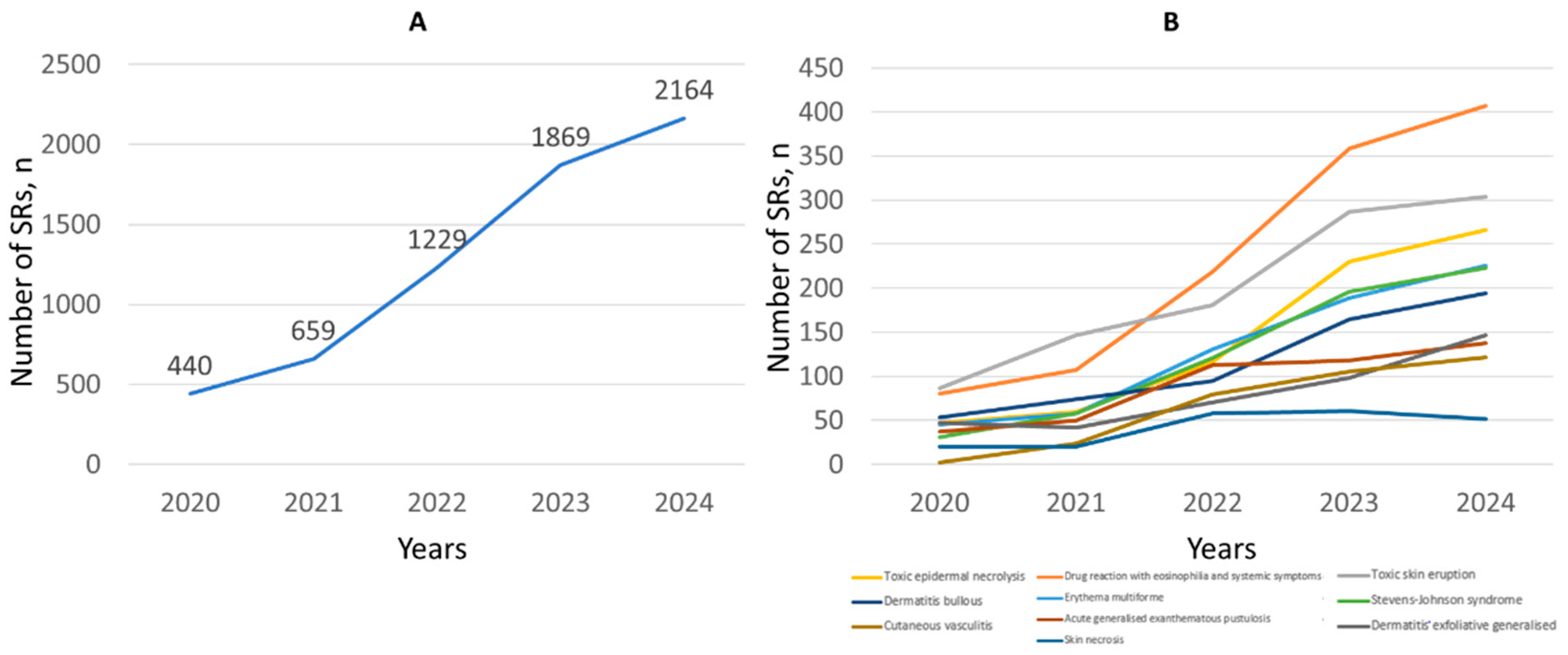
Analysis of annual dynamics of SCAR reporting was carried out for the period of 2020–2024; since in the year 2019 information was available only for 9 months (n = 101) and in 2025 for 3 months (n = 549). A stable increase in the number of SRs for SMQ SCAR was revealed over the observation period, with nearly a five-fold increase from 2020 to 2024 (Figure 1A). Considering the dynamics of reporting among the top 10 PTs, the same trends were observed for all except skin necrosis (61 SRs in 2023 versus 52 in 2024; Figure 1B). Detailed data on the total number of SRs for each PT are presented in Table S1 in the Supplementary Materials.
Estimating the country of SR origin revealed a total of 96 countries. The top five countries according to SCAR reporting included France (22.1%, n = 1560), Russia (14.1%, n = 985), Japan (8.6%, n = 603), USA (6.2%, n = 428), and China (6.1%, n = 417). Data on the distribution of SRs by country of origin are given in Table 3.
Analysis of the reporters indicated that the majority of SRs with SCARs (85.2%, n = 5974) were submitted by employees of pharmaceutical companies, while a significantly smaller proportion originated from healthcare professionals (10.0%, n = 701). Regional pharmacovigilance centers, authorized regulatory bodies, and personnel from World Health Organization (WHO) Centers for International Drug Monitoring were also involved in reporting, but with a drastically smaller contribution. Detailed information on reporter categories is provided in Table 4.
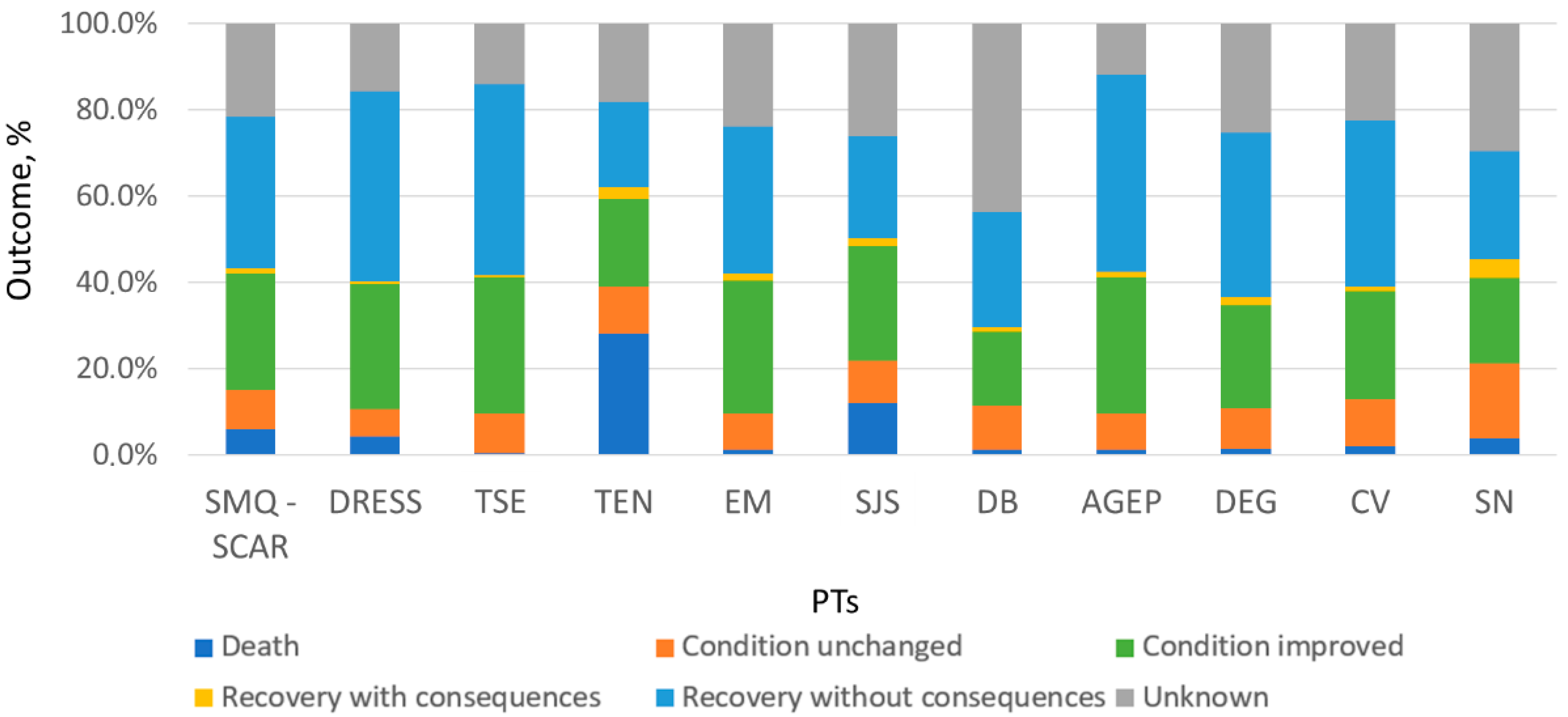
The outcomes identified in SRs demonstrated a predominance of generally favorable patterns. In the total sample of SRs with SCARs (n = 7011), 35% of SRs resulted in recovery without sequelae (n = 2457) and 26.8% in improvement in condition (n = 1880). Death was reported in 5.8% (n = 407) of the overall sample. Among the top 10 PTs, recovery without sequelae and improvement in condition were the most frequently reported outcomes. The highest proportion of lethal outcomes was revealed for TEN (28%), SJS (11.9%), and DRESS (4.2%). The outcome distribution for the total sample of SRs with SMQ SCAR and for the top 10 PTs is presented in Figure 2. Detailed data for all PTs detected are given in Table S2 in the Supplementary Materials.
Application of seriousness criteria led to the classification of 99.3% (n = 6964) of SRs as serious. The distribution of SRs by these criteria is presented in Table 5. The most frequently revealed seriousness criterion was “important medical events” (n = 3110, 44.4%), followed by “hospitalization or its prolongation” (n = 2761, 39.6%) and death (n = 407, 5.8%).

2.2. Suspected Drugs

One SR included ≥1 suspected drug, and a total of 11,701 drugs were identified in 7011 SRs with SCARs. After excluding drugs not classified by the Anatomical Therapeutic Chemical (ATC) classification, 11,376 drugs were detected. The total list of drugs for each PT is presented in Table S3 in the Supplementary Materials. To generate a list of possible drug triggers of SCARs, each drug was counted once; the final list included 907 suspected drugs (identified by their unique international non-proprietary name (INN)).
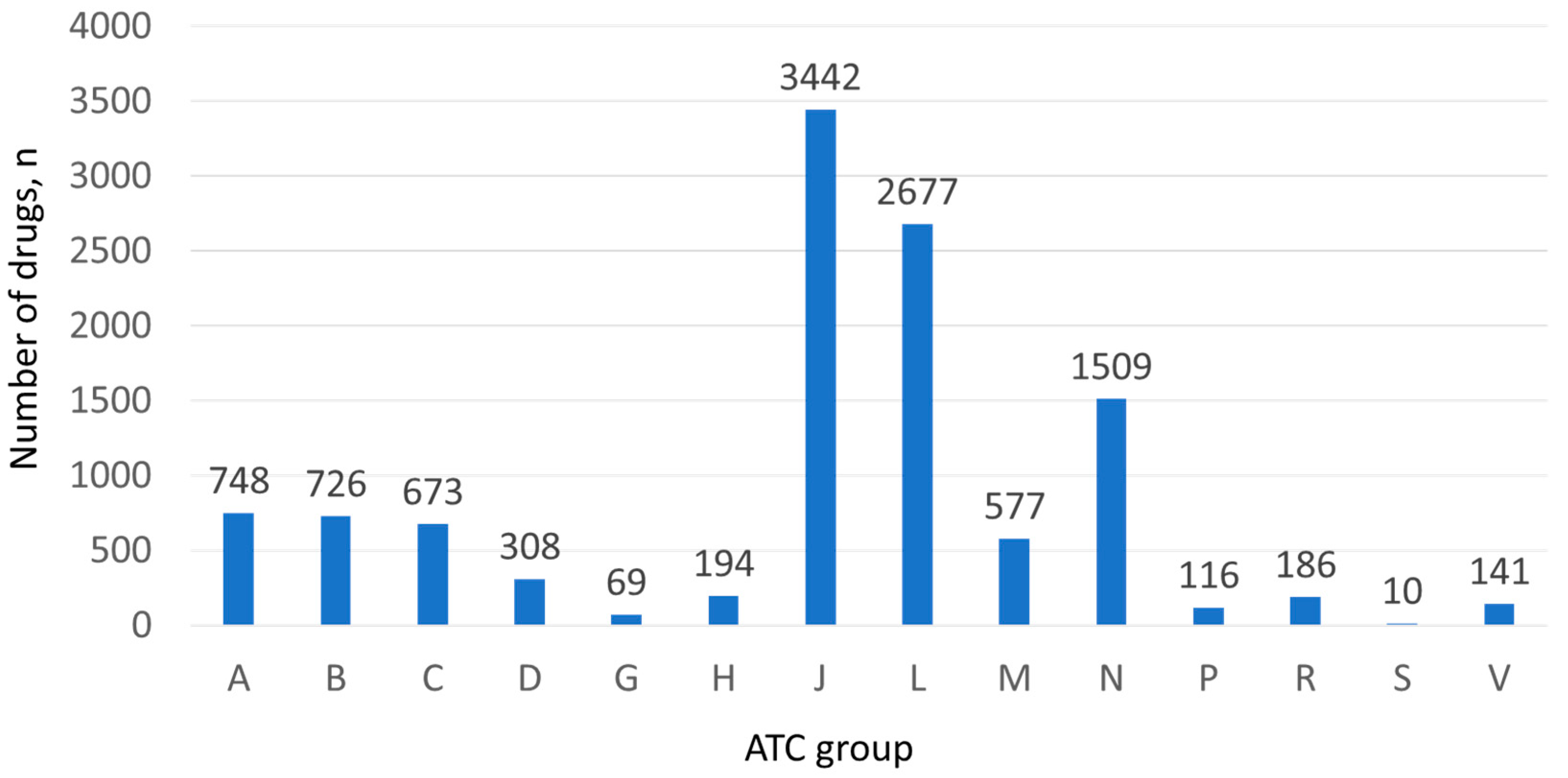
We revealed 14 ATC first-level groups involved in SMQ SCAR (Figure 3). The highest frequencies were detected for the following groups: J—antiinfectives for systemic use (n = 3442; 30.3%), L—antineoplastic and immunomodulating agents (n = 2677; 23.5%), and N—drug for treatment of the nervous system (n = 1509; 13.3%). Table S4 demonstrates full data on the ATC first-level groups revealed in SCARs.
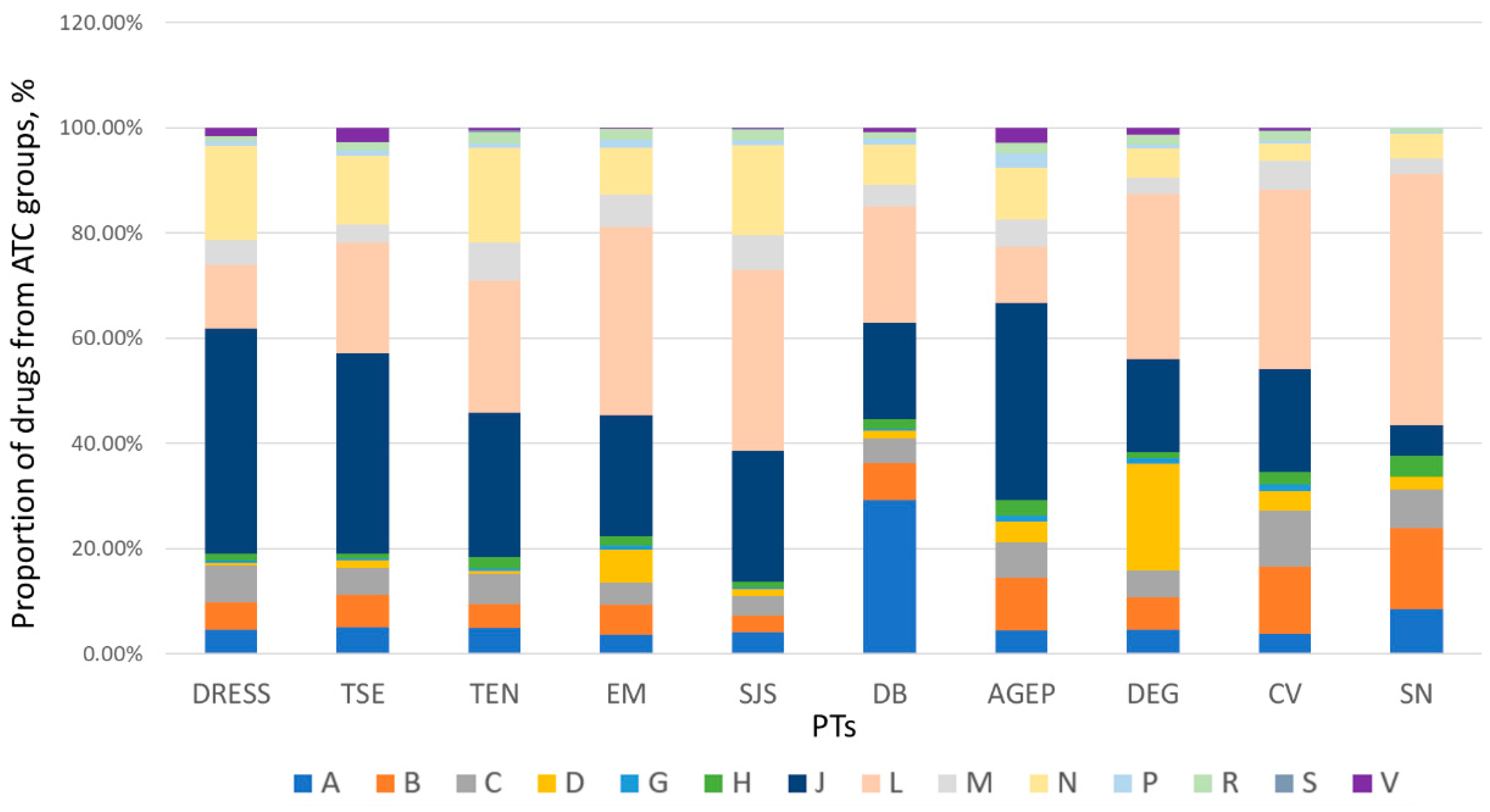
The ATC groups (first level) revealed for the top 10 PTs are demonstrated in Figure 4, and detailed data regarding all PTs are given in Table S5 in the Supplementary Materials. Antiinfectives for systemic use (group J) ranked first in the structure of suspected drugs in DRESS (42.8%), TSE (38.1%), TEN (27.5%), and AGEP (37.4%). Antineoplastic and immunomodulating agents (group L) were the leaders in EM (35.8%), SJS (34.4%), DEG (31.4%), cutaneous vasculitis (CV; 34.1%), and skin necrosis (SN; 47.7%). ATC group A (alimentary tract and metabolism) was the most prevalent in SRs with DB (29.3%).
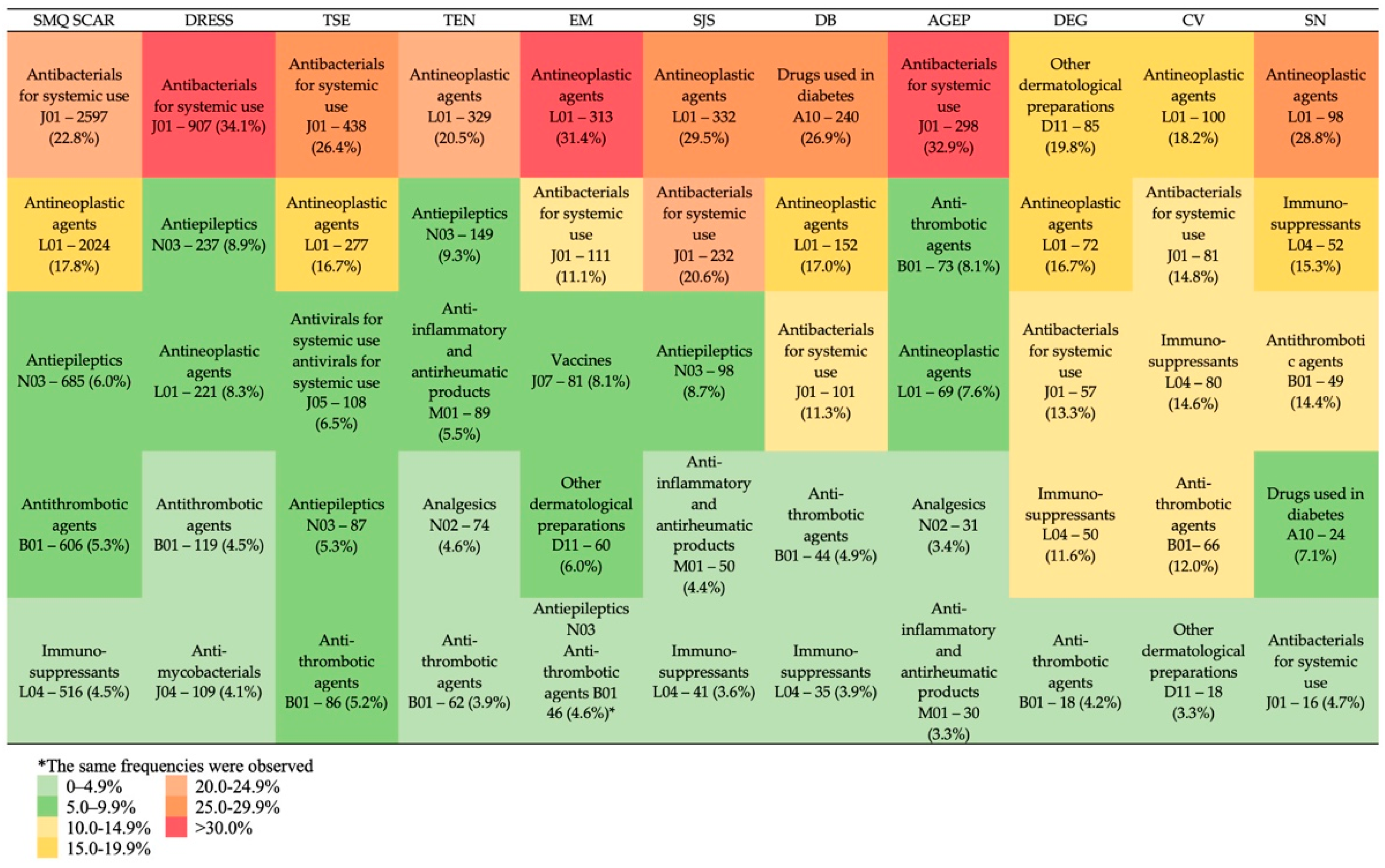
The next step was to classify 907 identified drug triggers into ATC second-level groups to identify the most frequently reported pharmacological groups involved in SCARs. Figure 5 illustrates five main pharmacological classes revealed for SMQ SCAR and for the top 10 PTs. In the total sample of SRs with SCARs, the following ATC second-level groups were the most frequently reported: J01—antibacterial drugs for systemic use (22.8%), L01—antineoplastic agents (17.8%), N03—antiepileptics (6.0%), B01—antithrombotic agents (5.3%), and L04—immunosuppressants (4.5%). Analyzing the leading ATC second-level groups among the top 10 PTs, we revealed the L01 group to head at least half of the cases (TEN, EM, SJS, CV, SN). The J01 group was the leader in DRESS, TSE, and AGEP, while the A10 group ranked first in DB and D11 in DEG (Figure 5).
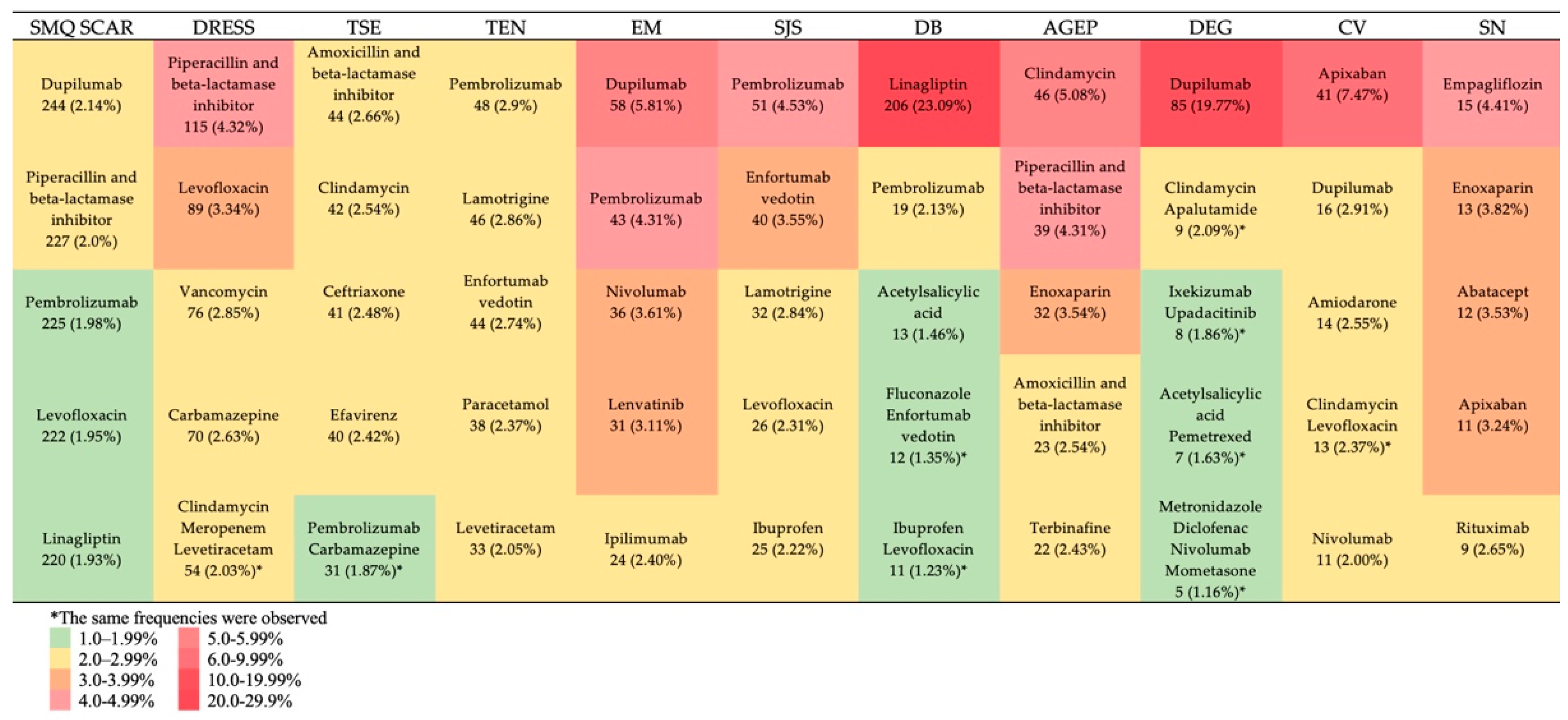
The subsequent phase of the analysis involved identifying the top five drugs exhibiting the highest reporting frequencies at the SMQ and the PT levels. Among the entire SCAR group, the following drugs were leaders: dupilumab (2.14%, n = 244), piperacillin and beta-lactamase inhibitor (2.0%, n = 227), pembrolizumab (1.98%, n = 225), levofloxacin (1.95%, n = 222), and linagliptin (1.93%, n = 220). Data on the top five drugs for the top 10 PTs are presented in Figure 6. Information on the top 10 drugs for the top 10 PTs is presented in Table S6 in the Supplementary Materials.

2.3. Disproportionality Analysis

The next phase of our study was aimed at safety signal detection. A disproportionality analysis was conducted to identify drug-adverse event (AE) pairs exhibiting statistically elevated reporting frequencies for SCARs in association with the specified drug. The analysis employed signal detection methodologies commonly utilized in pharmacovigilance, including the computation of the ROR and PRR values, as detailed in the Section 4. PRR and ROR values, along with their corresponding 95% confidence intervals (CIs), were calculated for each of the top 10 drugs with the highest reporting proportions at the SMQ SCAR level.
Disproportionality analysis performed with PRR calculation revealed notable safety signals for SCARs across several agents. Linagliptin demonstrated the strongest association (PRR = 15.37, 95% CI: 13.54–17.44), followed by clindamycin (PRR = 12.44, 95% CI: 10.89–14.21) and the combination of piperacillin with beta-lactamase inhibitor (PRR = 10.07, 95% CI: 8.86–11.43). Detailed data regarding the results of the PRR analysis performed for the top 10 drugs with the highest reporting proportions at the SMQ SCAR level are presented in Table 6 and Table S7.
ROR analysis for the same top 10 drugs revealed considerable variation in point estimates. Linagliptin exhibited the highest ROR (17.24, 95% CI: 14.95–19.88), followed by clindamycin (13.62, 95% CI: 11.77–15.77) and piperacillin and beta-lactamase inhibitor (10.81, 95% CI: 9.42–12.40). Detailed results of the ROR analysis for the top 10 drugs with the highest reporting frequencies at the SMQ SCAR level are given in Table 7.

3. Discussion

We analyzed 7011 SRs with SCARs submitted to the national Pharmacovigilance database over a 6-year period (February 2019–March 2024). These SRs originated from 96 countries, with 57.1% of cases occurring in France, Russia, Japan, USA, and China. The proportion of SRs marked as serious was 99.3%, with 407 cases (5.8%) resulting in death. There were 11,376 culprit drugs revealed in 7011 SRs. Our analysis allowed us to identify 907 INNs suspected in SCAR development. Th main SCAR phenotypes in our study were DRESS (n = 1272), TEN (n= 803), SJS (n = 697), and AGEP (n = 486).
In our study of SRs with SCARs, a negligible predominance of males was detected (50.9%), with the highest proportion of males in epidermal necrosis, TSL, and AGEP (65.3%, 61.5%, and 59.3%, respectively). Female gender was more frequently detected in DE and DEG (55.8% and 52.1%). Published data present conflicting evidence regarding the impact of patient gender on the development of SCARs. Some works consider female gender a risk factor of SCARs [3,25,26]. Keller, S.F. et al. (2018) stated that female gender is associated with a 2.5-fold increase in allopurinol-induced SCARs compared with male gender [25]. This observation is of particular interest, as allopurinol is used primarily in men, who are more likely to suffer from hyperuricemia and gout. Women have been consistently observed to utilize healthcare services more frequently and, as a result, receive a higher number of prescriptions. This increased exposure may theoretically contribute to a marginally elevated overall risk of experiencing ADRs, including SCARs.
Our study revealed the following age distribution of SRs with SCARs: 7.4% were from pediatric population, 34.0% from young and middle-aged adults, and 44.3% from persons > 60 years. Age is not considered to be a significant direct risk factor, but individuals belonging to older age groups tend to be more susceptible to developing SCARs, as they are exposed to many medications due to aging and multimorbidity [27,28]. It is known that drug allergy is less common in children, but current data challenge the general idea that the incidence of SCARs in children is lower than in adults [29,30]. Although SCARs can occur in children of any age, even in neonates, a systematic review by Afiouni, R. et al. (2021) indicated a mean age of onset of pediatric SCARs to be in the limits of between 8 and 10 years, particularly for DRESS [31]. Another review underscored the significance of DRESS among pediatric SCARs, with particular emphasis on the association between antibiotic-induced DRESS and the subsequent onset of autoimmune diseases [32].
We found that the most frequently reported ATC first-level groups involved in SCAR development were J—antiinfectives for systemic use (30.3%), L—antineoplastic and immunomodulating agents (23.5%), and N—nervous system (13.3%). Our findings exhibited comparable patterns of suspected medications to those reported by Li, D. et al., who conducted an analysis of 77,789 SRs with SCARs over a span of 17 years (1 January 2004 to 31 December 2021) within the FAERS database and revealed antibacterials (20.6%), antiepileptics (16.7%), and antineoplastics (11.3%) as being among the leading culprits in pharmacological classes [9]. A Korean study of individual case safety reports (n = 755) indicated antiepileptics (19.5%) and antibiotics for systemic use (12.7%) as the classes most involved in SCAR development [33]. Another study from South Korea, utilizing a nationwide multicenter registry spanning from 2010 to 2015 across 34 hospitals, identified a significant role of antibacterial agents in the development of SCARs, together with allopurinol and carbamazepine [34]. Antiepileptics are known to be common causes of SCARs like SJS and TEN [35]. The most involved antiepileptics demonstrated in published data are lamotrigine, valproic acid, carbamazepine, levetiracetam, and phenytoin [36,37,38]. Carbamazepine ranked seventh among the top 10 agents involved in SCARs in our study (n = 183, 1.61%), with significant signal detection (PRR = 8.64, 95% CI: 7.50–9.96; ROR = 9.17, 95% CI: 7.88–10.68), which is in line with a huge volume of published data describing the role of antiepileptics in SCARs.
Antineoplastic agents employed in cancer chemotherapy are well recognized for inducing a variety of toxic effects, and contemporary research increasingly substantiates their contributory role in SCAR development [9,15,39]. The antineoplastics identified as culprit drugs in our study were mainly monoclonal antibodies, and consideration of their role is provided in subsequent sections of the discussion.
Estimating the total structure of drugs involved in SCARs, we revealed that half of the top 10 drugs (Table S6) were antibacterials and 3 drugs were monoclonal antibodies. The top five medications involved in SCARs were dupilumab (2.14%, n = 244), piperacillin and beta-lactamase inhibitor (2.0%, n = 227), pembrolizumab (1.98%, n = 225), levofloxacin (1.95%, n = 222), and linagliptin (1.93%, n = 220).
A retrospective study (a 10-year period was analyzed) of antibacterials involved in SCARs in China [10] as well as a Taiwanese study [40] indicated cephalosporines as the main cause of CADRs (n = 20, 31.7% and n = 17, 23.0%, respectively), followed by penicillins (n = 16, 25.4% and n = 20, 30.0%) and quinolones (n = 12, 19.0% and n = 5, 6.8%). Russian data revealed third-generation cephalosporins as leaders among antibacterials involved in SJS and TEN (32%) [11]. It is important to highlight that beta-lactams are consistently identified as primary agents implicated in SCARs, as demonstrated by multiple pharmacovigilance studies [11,33,34,41,42]. Our analysis demonstrated that piperacillin combined with a beta-lactamase inhibitor (n = 227, 2.0%) ranked second among the drugs implicated in SCARs. Zhang, H. et al. (2024) ranked piperacillin third among the drugs involved in SCARs [43]. Genetic predisposition was demonstrated for some beta-lactams, including piperacillin [44] and amoxicillin. For the last one, a drug association with HLA-B*15:01 [odds ratio (OR) = 22.9, 95% CI: 1.68–1275.67; p = 7.34 × 10⁻³] was demonstrated [45]. A study of genetic associations between beta-lactams and SCARs in native Thai subjects revealed significant risks for carriers of alleles HLA-A*01:01, HLA-B*50:01, HLA-C*06:02, HLA-DRB1*15:01, HLA-DQA1*03:01, and HLA-DQB1*03:02 [46].
Piperacillin and amoxicillin were detected among the top 10 drugs involved in SCARS in our study, with formulations of both agents comprising combinations with beta-lactamase inhibitors. Rivolta, F. et al. assumed that beta-lactamase inhibitors such as clavulanic acid may significantly contribute to the development of CADRs, with patients exhibiting exclusively mucocutaneous reactions demonstrating greater sensitization to clavulanic acid compared to the β-lactam antibiotic itself [47].
Levofloxacin ranked fourth in our study (n = 222, 1.95%). A characteristic feature of SCARs induced by fluoroquinolones is the high mortality rate compared to most other groups of drugs [34]. Levofloxacin was shown to be involved in CADRs like fixed drug eruptions [48]. In the study of SJS and TEN triggers in Russia, levofloxacin accounted for up to 4% in the structure of antibacterials involved in the named SCARs [11].
Clindamycin is not listed among top SCAR triggers according to published data; however, there are some cases of clindamycin-induced CADRs described by authors from different countries [49,50,51,52,53]. Our results revealed clindamycin to be among the top 10 drugs involved in SCARs (n = 203, 1.78%), and disproportionality analysis revealed a strong signal detection (PRR = 12.44, 95% CI: 10.89–14.21; ROR = 13.62, 95% CI: 11.77–15.77).
An important issue highlighted in our study was the significant contribution of monoclonal antibodies (MAbs) to the development of SCARs. Pembrolizumab, nivolumab, and dupilumab were revealed to be among the top 10 drugs involved in SCARs. Pembrolizumab ranked third in the overall list of culprit drugs (1.98%, n = 225), and it was the leader in SRs with SJS and TEN. Nivolumab ranked ninth in the total structure of culprit drugs revealed in SRs with SCARs (1.41%, n = 160). Pembrolizumab and nivolumab are immune checkpoint inhibitors used in cancer treatment. To date, sufficient data have been accumulated indicating an association between MAbs and the development of SCARs, especially SJS and TEN. Zhu, J. et al., analyzing the FAERS database from 2004 to 2020, revealed 253 cases of SJS and 184 cases of TEN associated with immune checkpoint inhibitors (SJS/TEN: ROR = 2.88, 95% CI: 2.61–3.17). Pembrolizumab was found to be a culprit drug in 183 cases of SJS/TEN (SJS/TEN: ROR = 4.93; SJS: ROR = 4.36; TEN: ROR = 5.49) and nivolumab in 175 cases of SJS/TEN (SJS/TEN: ROR = 2.43; SJS: ROR = 2.29; TEN: ROR = 2.21) [54]. Dupilumab ranked first in the total structure of drugs involved in SCARs in our study (n = 244, 2.14%); the greatest contribution was made by DEG (here dupilumab also headed the drug list, with 19.77%, n = 85) and by EM (5.81% of all drugs involved in EM, n = 58). Dupilumab is a MAb that selectively binds to the alpha subunit of interleukin-4 receptor (IL-4Rα) and blocks the effects of IL-4 and IL-13. Its indications include a broad spectrum of allergic diseases, such as asthma, eosinophilic esophagitis, chronic spontaneous urticaria, etc. Among novel spheres of dupilumab use, it is important to note the treatment of immune-mediated CADRs induced by immune checkpoint inhibitors [55]. Dupilumab is known to produce various hypersensitivity reactions (e.g., anaphylaxis, AGEP, EM, serum sickness or serum sickness-like reactions, angioedema, generalized urticaria, rash, erythema nodosum) [56], though the most common ADRs seen in real-world practice include nasopharyngitis, conjunctivitis, upper respiratory tract infections, injection site reactions, alopecia, vitiligo, and psoriasis [57].
Disproportionality analysis performed in our study indicated linagliptin as the drug with the most significant safety signal for SCARs (PRR = 15.37, 95% CI: 13.54–17.44; ROR = 17.24, 95% CI: 14.95–19.88). Linagliptin ranked fifth in the total list of drugs involved in SCARS based on our results, and it was the first on the list of drugs involved in DB (n = 206, 23.09%). Huang, J. et al. (2020) [58] revealed disproportionality signals regarding SCARs for dipeptidyl-peptidase-4 (DPP-4) inhibitors based on FAERS database analysis (ROR = 6.12, 95% CI 4.69–8.00). The authors found ROR values indicating significant signal disproportionality for linagliptin (5.51, 95% CI 2.72–11.19), saxagliptin (4.84, 2.14–10.91), sitagliptin (5.34, 4.01–7.13), and vildagliptin (6.30, 2.33–17.01) [58]. Another study utilizing data from VigiBase® indicated a significant bullous pemphigoid signal for the group of DPP-4 inhibitors (ROR = 179.48, 95% CI: 166.41–193.58). The strongest signal was detected for teneligliptin (ROR = 975.04, 95% CI: 801.70–1185.87) [59]. ROR calculation for bullous pemphigoid performed within the FAERS database indicated the group of DPP-4 inhibitors to be the group with the highest association with mentioned SCARs: Comparison to all other drugs in the FAERS resulted in a ROR value of 109.79 (95% CI: 101.61–118.62) and comparison to other diabetes medications resulted in a ROR value of 74.46 (95% CI: 60.58–91.52) [60]. Published data point out high rates of DPP-4 inhibitor involvement in CADR development, including various hypersensitivity reactions [61,62,63]. The mechanisms of SCAR induction by DPP-4 inhibitors are still unrevealed, though excessive apoptosis of keratinocytes may be considered, which is supported by the data obtained by Duraisamy, P. et al. (2022), who found necrotic keratinocytes in 44% of histological samples of patients with CADRs induced by DPP-4 inhibitors [64].
Finally, we need to make an emphasis on the limitations of our study that may impact the interpretation and reliability of our findings. Despite the method of SRs representing the cornerstone of the postmarketing surveillance of drug safety, the nature of SRs may lead to underreporting and selective reporting bias, limiting representativeness and comprehensive safety profiling. The most salient limitation lies in the fact that the cumulative number of SRs does not correspond to the actual consumption rates of a given drug in the population, thereby precluding the estimation of true ADR incidence. It should be added that the retrospective character of our analysis, combined with the potential for incomplete data indicated in SRs, limits the ability to accurately predict the risk factors associated with the development of SCARs. Another important concern is related to disproportionality analysis (ROR and PRR calculation). Disproportionality analysis is aimed at the identification of patterns of disproportionate reporting of specific AEs in patients exposed to a particular drug, relative to overall reporting rates within the pharmacovigilance database. However, these statistical disproportions do not establish direct causal relationships. The observed strength of a signal may arise from alternative explanations summarized in the work by Fusaroli, M. et al. (2025) [65]: reverse causality (the drug was used to treat the event after diagnosis), protopathic bias (the drug was used to address early symptoms of an undiagnosed event), indication bias (underlying condition prompting drug use increases susceptibility to the event), notoriety bias (heightened regulatory or media attention enhances reporting), selective reporting practices, and variability among reporters.

4. Materials and Methods

The process of AE collection in the Russian Federation is governed by the central pharmacovigilance authority, the Federal Service for Surveillance in Healthcare (Roszdravnadzor), through the Automatized Information System (AIS) “pharmacovigilance” database, whose functioning is organized in compliance with the ICH E2B (R3) standard [66] and in integration with WHO and Naranjo algorithms. Identification of ADRs within the AIS is carried out utilizing MedDRA version 28.0 [67]. Reports submission to the AIS is carried out by healthcare professionals, pharmaceutical industry personnel, patients, and their representatives. The AIS database was used as a data source in our study. The most widely used pharmacovigilance databases are the World Health Organization’s (WHO’s) VigiBase®, the European Medicines Agency’s EudraVigilance, and the FDA’s FAERS databases. However, any national pharmacovigilance database may significantly enhance our understanding of real-world drug safety, giving valuable insights into ethnicity-specific ADR profiles. Thus, national pharmacovigilance databases constitute a valuable tool of postmarketing drug safety, providing a comprehensive overview of ADR characteristics. In this study, our research team presents an extensive characterization of SRs obtained from the Roszdravnadzor AIS database, facilitating an in-depth analysis of SCARs.
The design of our study is a retrospective, descriptive pharmacoepidemiological analysis of SRs registered in the AIS database from 1 April 2019 to 31 March 2025 (a total study period of 6 years). Causality assessment of ADRs was conducted using the Naranjo algorithm, with only those classified as “certain,” “probable,” or “possible” included in the final dataset. The Naranjo algorithm is a validated and structured method used for over 40 years in routine pharmacovigilance to assess the causal relationship between a suspected medicinal product and ADR. Currently, the Naranjo Algorithm is considered the “gold standard” for the initial assessment of ADR cases in clinical trials and is one of the most well-known and frequently used algorithms worldwide, allowing for the comparison of data from different authors and studies. Its advantages include standardization (common criteria, reproducibility), objectivity (minimizes subjectivity and variability in the assessment of the ADR–drug causal relationship), and simplicity of use. Limitations include low sensitivity in complex and non-standard cases. In such instances, the issue of a causal relationship was reviewed collegially by clinicians and expert staff of the pharmacovigilance center (at least 3 different specialists). Inclusion of ADRs marked with a “certain,” “probable,” or “possible” causal relationship in the final safety analysis is a standard of competent pharmacovigilance. It acknowledges the probabilistic and population-based nature of postmarketing surveillance. While individual SRs marked with a “possible” causal relationship are weak evidence (since they could be explained by disease or other drugs), in aggregate they form the essential epidemiological substrate for early signal detection, safeguarding public health by ensuring the safety surveillance system is tuned for sensitivity.
Drug identification in the SRs identified in our study was carried out using the ATC classification. For inclusion, SRs originating from Russia or other countries had to contain PTs coded as SCARs. Within an SMQ, PTs can be categorized as either narrow or broad. Narrow-scope PTs denote terms that are more specifically indicative of the condition or focal area of interest, whereas broad-scope PTs may ultimately exhibit limited or negligible relevance for inclusion in the analysis [68]. There are 21 “narrow” PTs within SMQ SCAR in MedDRA version 28.0 (Table 8).
If one of the “narrow” PTs listed in Table 8 was found in an SR in the “adverse reaction” field, we included that SR in the study. Duplicates and invalid SRs were excluded. The validation procedure was carried out in accordance with paragraph 407 of the “Rules of Good Pharmacovigilance Practice of the EAEU” [69], according to which SRs must contain four essential elements: an identifiable reporter, an identifiable patient, at least one suspected medicinal product, and at least one suspected ADR. SRs that lacked one or more of these elements were considered invalid. Completeness of the information pertaining to the suspected drug, the ADR, and patient and reporter data were estimated by each author. The seriousness of the ADR was assessed based on data presented in paragraph 2 of the EAEU guidelines [69]. A flowchart of our study is given in Figure 7.
Suspected medications were initially identified by their INNs and subsequently classified according to the ATC first- and second-level groups. Demographic data were extracted from SRs, and all data processing was carried out using Microsoft Excel 2019. A descriptive statistical approach was applied; qualitative variables were summarized by their absolute and relative frequencies (n, %), while quantitative variables were described using the mean and standard deviation. Statistical significance testing was not performed, as the analysis of SRs is characterized by the following limitation: the total number of SRs in the pharmacovigilance database is not accompanied by the data on the real level of drug consumption in the population, so we do not know the real population of medication users and are unable to calculate the incidence of SCARs in the total population.
To identify potential safety signals, disproportionality analysis was conducted using ROR and PRR. In pharmacovigilance studies, ROR quantifies the strength of association between a drug and AE by comparing the reporting frequency of a specific drug–AE pair to that of other drug–AE pairs. A ROR value greater than 1 indicates an increased reporting rate for the association. PRR compares the proportion of a particular AE associated with a drug to the proportion of the same AE reported for all other drugs in the database. A PRR value exceeding 1, together with a lower bound of the 95% CI above 1, suggests disproportion in reporting of the AE for the drug, signaling a potential safety concern requiring further investigation.
For disproportionality analysis, we used a 2 × 2 contingency table (Table 9).
The PRR was calculated according to the following formula:
P R R = a a + b c c + d
The 95% CI for the PRR was calculated using the following equation:
95 % C I P R R = e ln P R R ± 1.96 1 a a + b a + 1 c c + d c
A signal was considered detected when the following criteria were satisfied: a PRR of at least 2, a chi-squared (χ2) statistic of 4 or greater, a minimum of three cases (a ≥ 3), and a lower limit of the 95% confidence interval exceeding 1 [70,71].
The ROR was calculated as the odds of a specific ADR occurring with the suspected drug relative to the odds of the same reaction occurring with all other drugs:
R O R = a d b c
The 95% CI for the ROR was calculated using Woolf’s method:
95 % C I = e ln R O R ± 1.96 1 a + 1 b + 1 c + 1 d
A disproportionality safety signal (association between a specific drug and SCARs) was considered detected if the lower bound of the 95% CI for the ROR exceeded 1, and if there were at least three individual case reports for the drug–event combination of interest (a ≥ 3) [72].
We used the following definitions in our study [73]:
“Adverse reaction—A response to a medicinal product, which is noxious and un-intended. Adverse reaction may arise from use of the product within or outside the terms of the marketing authorization or from occupational exposure. Use outside the marketing authorization includes off-label use, overdose, misuse, abuse, and medication errors.”
“Causality—In accordance with ICH-E2A, the definition of an adverse reaction im-plies at least a reasonable possibility of a causal relationship between a suspected medicinal product and an adverse event. An adverse reaction, in contrast to an adverse event, is characterized by the fact that a causal relationship between a medicinal product and an occurrence is suspected. For regulatory reporting purposes, as detailed in ICH-E2D, if an event is spontaneously reported, even if the relationship is unknown or unstated, it meets the definition of an adverse reaction. Therefore, all spontaneous reports notified by healthcare professionals or consumers are considered suspected adverse re-actions, since they convey the suspicions of the primary sources, unless the reporters specifically state that they believe the events to be unrelated or that a causal relationship can be excluded.”
“A SR is an unsolicited communication by a healthcare professional, or consumer to a competent authority, marketing authorisation holder or other organization (e.g., regional pharmacovigilance center, poison control center) that describes one or more suspected adverse reactions in a patient who was given one or more medicinal products. It does not derive from a study or any organized data collection systems.”

5. Conclusions

Studies utilizing data from pharmacovigilance databases represent a valuable tool to analyze real-world data on drug safety. AIS database analysis demonstrated significant contribution of antibacterial agents and MAbs in SCAR developments. Among the top 10 drugs with the highest frequencies of reporting, the strongest signal suggesting an association with SCARs was detected for the antidiabetic medication linagliptin, indicating the need for subsequent studies aimed at the development of complex measures to improve outcomes and enhance clinical practice.

Supplementary Materials

The following supporting information can be downloaded at: https://www.mdpi.com/article/10.3390/ph19010021/s1, Table S1: Annual distribution of SRs for SMQ SCAR and PTs; Table S2: Outcomes revealed in SMQ SCAR and the top 10 PTs; Table S3: Initial and final numbers of culprit drugs; Table S4: ATC first-level groups revealed in SCARs; Table S5: Distribution of ATC first-level groups among PTs (total number—11,376); Table S6: Top 10 drugs with the highest reporting frequencies; Table S7: Data for PRR and ROR calculations.

Author Contributions

Conceptualization, E.T. and O.B.; methodology, S.Z. and E.T.; software, E.T. and V.P.; validation, O.B., E.T., A.Y. and I.A.; formal analysis, E.T., I.A. and A.Y.; investigation, E.T., I.A. and O.B.; resources, V.P. and S.Z.; data curation, S.Z., O.B. and I.A.; writing, original draft preparation, E.T. and O.B.; writing, review and editing, O.B. and I.A.; visualization, E.T. and O.B.; supervision, S.Z.; project administration, S.Z. and O.B. All authors have read and agreed to the published version of the manuscript.

Funding

This publication has been supported by project №032105-0-000 (RUDN University).

Institutional Review Board Statement

Not applicable.

Informed Consent Statement

Not applicable.

Data Availability Statement

The original contributions presented in this study are included in the article/Supplementary Materials. Further inquiries can be directed to the corresponding author.

Conflicts of Interest

The authors declare no conflicts of interest.

References

  1. Choon, S.E.; Lai, N.M. An epidemiological and clinical analysis of cutaneous adverse drug reactions seen in a tertiary hospital in Johor, Malaysia. Indian J. Dermatol. Venereol. Leprol. 2012, 78, 734–739. [Google Scholar] [CrossRef] [PubMed]
  2. Marzano, A.V.; Borghi, A.; Cugno, M. Adverse drug reactions and organ damage: The skin. Eur. J. Intern. Med. 2016, 28, 17–24. [Google Scholar] [CrossRef] [PubMed]
  3. Campos-Fernandez, M.D.M.; Ponce-De-Leon-Rosales, S.; Archer-Dubon, C.; Orozco-Topete, R. Incidence and risk factors for cutaneous adverse drug reactions in an intensive care unit. Rev. Investig. Clin. 2005, 57, 770–774. [Google Scholar]
  4. Del Pozzo-Magaña, B.R.; Liy-Wong, C. Drugs and the skin: A concise review of cutaneous adverse drug reactions. Br. J. Clin. Pharmacol. 2024, 90, 1838–1855. [Google Scholar] [CrossRef]
  5. Verma, R.; Vasudevan, B.; Pragasam, V. Severe cutaneous adverse drug reactions. Med. J. Armed Forces India 2013, 69, 375–383. [Google Scholar] [CrossRef] [PubMed]
  6. Owen, C.E.; Jones, J.M. Recognition and Management of Severe Cutaneous Adverse Drug Reactions (Including Drug Reaction with Eosinophilia and Systemic Symptoms, Stevens-Johnson Syndrome, and Toxic Epidermal Necrolysis). Med. Clin. N. Am. 2021, 105, 577–597. [Google Scholar] [CrossRef]
  7. Thong, B.Y.; Tan, T.C. Epidemiology and risk factors for drug allergy. Br. J. Clin. Pharmacol. 2011, 71, 684–700. [Google Scholar] [CrossRef]
  8. Heerfordt, M.; Middelboe, M.; Hærskjold, A.; Horwitz, A.; Olsen, R.H.; Horwitz, H. Toxic Epidermal Necrolysis and Mortality: A Danish Cohort Study With 30 Years of Follow-Up. J. Dermatol. 2025; early view. [Google Scholar] [CrossRef]
  9. Li, D.; Gou, J.; Zhu, J.; Zhang, T.; Liu, F.; Zhang, D.; Dai, L.; Li, W.; Liu, Q.; Qin, C.; et al. Severe cutaneous adverse reactions to drugs: A real-world pharmacovigilance study using the FDA Adverse Event Reporting System database. Front. Pharmacol. 2023, 14, 1117391. [Google Scholar] [CrossRef]
  10. Lu, Y.; Zhou, L.; Zou, Y.; Wei, H.; Zhou, Y.; Guo, X.; Li, Q.; Ye, Y.; Zhang, L. Antibiotic-induced severe cutaneous adverse reactions: A single-center retrospective study over ten years. Front. Immunol. 2024, 15, 1415830. [Google Scholar] [CrossRef]
  11. Zyryanov, S.; Asetskaya, I.; Butranova, O.; Terekhina, E.; Polivanov, V.; Yudin, A.; Samsonova, K. Stevens-Johnson Syndrome and Toxic Epidermal Necrolysis: Analysis of the Russian Database of Spontaneous Reports. Pharmaceuticals 2024, 17, 675. [Google Scholar] [CrossRef]
  12. Shan, H.; Wei, C.; Zhang, J.; Wu, B. Severe cutaneous adverse reactions associated with antifungal agents: A pharmacovigilance analysis based on the FDA Adverse Event Reporting System (FAERS) database. Expert Opin. Drug Saf. 2025, 1–8. [Google Scholar] [CrossRef]
  13. Liang, C.; An, P.; Zhang, Y.; Liu, X.; Zhang, B. Fatal outcome related to drug reaction with eosinophilia and systemic symptoms: A disproportionality analysis of FAERS database and a systematic review of cases. Front. Immunol. 2024, 15, 1490334. [Google Scholar] [CrossRef]
  14. Kherallah, K.; Ahmad, I.; Bandara, A.; Kattoula, J.; Rodriguez, I.; Worswick, S. Adverse Cutaneous Reactions to Monoclonal Antibodies: Stevens-Johnson Syndrome, Toxic Epidermal Necrolysis, Erythema Multiforme, and Fixed Drug Eruption—A Systematic Review. Biomed. Hub 2025, 10, 105–115. [Google Scholar] [CrossRef] [PubMed]
  15. Ng, C.Y.; Chen, C.B.; Wu, M.Y.; Wu, J.; Yang, C.H.; Hui, R.C.; Chang, Y.C.; Lu, C.W. Anticancer Drugs Induced Severe Adverse Cutaneous Drug Reactions: An Updated Review on the Risks Associated with Anticancer Targeted Therapy or Immunotherapies. J. Immunol. Res. 2018, 2018, 5376476. [Google Scholar] [CrossRef] [PubMed]
  16. Gubernot, D.; Menis, M.; Whitaker, B. Background rates for severe cutaneous reactions in the US: Contextual support for safety assessment of COVID-19 vaccines and novel biologics. Vaccine 2023, 41, 6922–6929. [Google Scholar] [CrossRef]
  17. Yang, S.C.; Chen, C.B.; Lin, M.Y.; Zhang, Z.Y.; Jia, X.Y.; Huang, M.; Zou, Y.F.; Chung, W.H. Genetics of Severe Cutaneous Adverse Reactions. Front. Med. 2021, 8, 652091. [Google Scholar] [CrossRef]
  18. Jung, J.W.; Kim, J.Y.; Park, I.W.; Choi, B.W.; Kang, H.R. Genetic markers of severe cutaneous adverse reactions. Korean J. Intern. Med. 2018, 33, 867–875. [Google Scholar] [CrossRef]
  19. Wang, C.W.; Preclaro, I.A.C.; Lin, W.H.; Chung, W.H. An Updated Review of Genetic Associations with Severe Adverse Drug Reactions: Translation and Implementation of Pharmacogenomic Testing in Clinical Practice. Front. Pharmacol. 2022, 13, 886377. [Google Scholar] [CrossRef]
  20. Lagacé, F.; D’Aguanno, K.; Prosty, C.; Laverde-Saad, A.; Cattelan, L.; Ouchene, L.; Oliel, S.; Genest, G.; Doiron, P.; Richer, V.; et al. The Role of Sex and Gender in Dermatology—From Pathogenesis to Clinical Implications. J. Cutan. Med. Surg. 2023, 27, NP1–NP36. [Google Scholar] [CrossRef] [PubMed]
  21. Fathima, S.; Grainge, M.J.; Wainman, H.; Swiderski, M.; Gran, S. Risk factors for the development of Stevens-Johnson syndrome/toxic epidermal necrolysis following drug administration: A systematic review and meta-analysis. Clin. Exp. Dermatol. 2024, 49, 1699–1704. [Google Scholar] [CrossRef]
  22. Brockow, K.; Przybilla, B.; Aberer, W.; Bircher, A.J.; Brehler, R.; Dickel, H.; Fuchs, T.; Jakob, T.; Lange, L.; Pfützner, W.; et al. Guideline for the diagnosis of drug hypersensitivity reactions: S2K-Guideline of the German Society for Allergology and Clinical Immunology (DGAKI) and the German Dermatological Society (DDG) in collaboration with the Association of German Allergologists (AeDA), the German Society for Pediatric Allergology and Environmental Medicine (GPA), the German Contact Dermatitis Research Group (DKG), the Swiss Society for Allergy and Immunology (SGAI), the Austrian Society for Allergology and Immunology (ÖGAI), the German Academy of Allergology and Environmental Medicine (DAAU), the German Center for Documentation of Severe Skin Reactions and the German Federal Institute for Drugs and Medical Products (BfArM). Allergo J. Int. 2015, 24, 94–105. [Google Scholar] [CrossRef]
  23. Lavertu, A.; Vora, B.; Giacomini, K.M.; Altman, R.; Rensi, S. A New Era in Pharmacovigilance: Toward Real-World Data and Digital Monitoring. Clin. Pharmacol. Ther. 2021, 109, 1197–1202. [Google Scholar] [CrossRef] [PubMed]
  24. Raschi, E.; La Placa, M.; Poluzzi, E.; De Ponti, F. The value of case reports and spontaneous reporting systems for pharmacovigilance and clinical practice. Br. J. Dermatol. 2021, 184, 581–583. [Google Scholar] [CrossRef]
  25. Keller, S.F.; Lu, N.; Blumenthal, K.G.; Rai, S.K.; Yokose, C.; Choi, J.W.J.; Kim, S.C.; Zhang, Y.; Choi, H.K. Racial/ethnic variation and risk factors for allopurinol-associated severe cutaneous adverse reactions: A cohort study. Ann. Rheum. Dis. 2018, 77, 1187–1193. [Google Scholar] [CrossRef]
  26. Gonçalo, M. HLA-B*58:01 is not the only risk factor associated with allopurinol-induced severe cutaneous adverse drug reactions. Ann. Transl. Med. 2018, 6, S7. [Google Scholar] [CrossRef]
  27. Singh, G.K.; Mitra, B.; Arora, S.; Akhoon, N.; Verma, R.; Sharma, P.; Mitra, D. A retrospective, 5-year, clinicoepidemiological study of severe cutaneous adverse reactions (SCARs). Int. J. Dermatol. 2021, 60, 579–588. [Google Scholar] [CrossRef]
  28. Sutaria, A.; Rawlani, S.; Sutaria, A.H. Causes and Management of Cutaneous Adverse Drug Reactions: A Comprehensive Review. Cureus 2024, 16, e55318. [Google Scholar] [CrossRef] [PubMed]
  29. Liccioli, G.; Mori, F.; Parronchi, P.; Capone, M.; Fili, L.; Barni, S.; Sarti, L.; Giovannini, M.; Resti, M.; Novembre, E.M. Aetiopathogenesis of severe cutaneous adverse reactions (SCARs) in children: A 9-year experience in a tertiary care pediatric hospital setting. Clin. Exp. Allergy 2020, 50, 61–73. [Google Scholar] [CrossRef] [PubMed]
  30. Kuyucu, S.; Blanca-Lopez, N.; Caubet, J.C.; Moral, L.; Sousa-Pinto, B.; Topal, O.Y.; Mori, F.; Atanaskovic-Markovic, M.; Gomes, E. Clinical diagnosis and management of drug reaction with eosinophilia and systemic symptoms (DRESS) in children: An EAACI position paper. Pediatr. Allergy Immunol. 2025, 36, e70103. [Google Scholar] [CrossRef]
  31. Afiouni, R.; Zeinaty, P.; Kechichian, E.; Zoghaib, S.; Matar, S.; Helou-Mallat, J.; Tomb, R. Pediatric drug reaction with eosinophilia and systemic symptoms: A systematic review of the literature, with a focus on relapsing cases. Pediatr. Dermatol. 2021, 38, 125–131. [Google Scholar] [CrossRef]
  32. Cherepacha, N.; St George-Hyslop, F.; Chugani, B.; Alabdeen, Y.; Sanchez-Espino, L.F.; Mahood, Q.; Sibbald, C.; Verstegen, R.H.J. Management and long-term outcomes of drug reaction with eosinophilia and systemic symptoms (DReSS) in children: A scoping review. Am. J. Clin. Dermatol. 2024, 25, 609–621. [Google Scholar] [CrossRef]
  33. Kang, M.G.; Sohn, K.H.; Kang, D.Y.; Park, H.K.; Yang, M.S.; Lee, J.Y.; Kang, H.R. Analysis of Individual Case Safety Reports of Severe Cutaneous Adverse Reactions in Korea. Yonsei Med. J. 2019, 60, 208–215. [Google Scholar] [CrossRef]
  34. Kang, D.Y.; Yun, J.; Lee, S.Y.; Koh, Y.I.; Sim, D.W.; Kim, S.; Nam, Y.H.; Park, J.W.; Kim, S.H.; Ye, Y.M.; et al. A Nationwide Study of Severe Cutaneous Adverse Reactions Based on the Multicenter Registry in Korea. J. Allergy Clin. Immunol. Pract. 2021, 9, 929–936.e7. [Google Scholar] [CrossRef]
  35. Park, C.S.; Kang, D.Y.; Kang, M.G.; Kim, S.; Ye, Y.M.; Kim, S.H.; Park, H.K.; Park, J.W.; Nam, Y.H.; Yang, M.S.; et al. Severe Cutaneous Adverse Reactions to Antiepileptic Drugs: A Nationwide Registry-Based Study in Korea. Allergy Asthma Immunol. Res. 2019, 11, 709–722. [Google Scholar] [CrossRef]
  36. Kim, H.K.; Kim, D.Y.; Bae, E.K.; Kim, D.W. Adverse Skin Reactions with Antiepileptic Drugs Using Korea Adverse Event Reporting System Database, 2008–2017. J. Korean Med. Sci. 2020, 35, e17. [Google Scholar] [CrossRef]
  37. Kim, D.; Lee, S. A Real-World Safety Profile in Neurological, Skin, and Sexual Disorders of Anti-Seizure Medications Using the Pharmacovigilance Database of the Korea Adverse Event Reporting System (KAERS). J. Clin. Med. 2024, 13, 3983. [Google Scholar] [CrossRef]
  38. Tardeh, S.; Sarmad, A.; Otaghi, M.; Heydari, F.; Adibi, A.; Malekan, Z.; Pakzad, R. The Prevalence of Stevens-Johnson Syndrome Complications due to Antiepileptic Drug Use: A Systematic Review and Meta-Analysis. Int. J. Prev. Med. 2025, 16, 41. [Google Scholar] [CrossRef] [PubMed]
  39. Zhang, Z.; Zhu, M.; Jiang, W. Risk Factors Analysis of Cutaneous Adverse Drug Reactions Caused by Targeted Therapy and Immunotherapy Drugs for Oncology and Establishment of a Prediction Model. Clin. Transl. Sci. 2025, 18, e70118. [Google Scholar] [CrossRef] [PubMed]
  40. Lin, Y.F.; Yang, C.H.; Sindy, H.; Lin, J.Y.; Rosaline Hui, C.Y.; Tsai, Y.C.; Wu, T.S.; Huang, C.T.; Kao, K.C.; Hu, H.C.; et al. Severe cutaneous adverse reactions related to systemic antibiotics. Clin. Infect. Dis. 2014, 58, 1377–1385. [Google Scholar] [CrossRef] [PubMed]
  41. Ambe, K.; Ohya, K.; Takada, W.; Suzuki, M.; Tohkin, M. In Silico Approach to Predict Severe Cutaneous Adverse Reactions Using the Japanese Adverse Drug Event Report Database. Clin. Transl. Sci. 2021, 14, 756–763. [Google Scholar] [CrossRef]
  42. Zhou, L.; Yang, J.; Xiao, M.; Shan, H.; Liu, M.; Lu, Y.; Zou, Y.; Wu, B. Severe cutaneous adverse reactions due to antibiotics therapy: A pharmacovigilance analysis of FDA adverse event reporting system events. Expert Opin. Drug Saf. 2023, 1–8. [Google Scholar] [CrossRef]
  43. Zhang, H.; Yang, L. Adverse reactions of piperacillin: A literature review of case reports. Open Med. 2024, 19, 20240931. [Google Scholar] [CrossRef]
  44. Rutkowski, K.; Taylor, C.; Wagner, A. HLA B62 as a possible risk factor for drug reaction with eosinophilia and systemic symptoms to piperacillin/tazobactam. J. Allergy Clin. Immunol. Pract. 2017, 5, 829–830. [Google Scholar] [CrossRef]
  45. Wang, T.; Yang, J.; Yang, F.; Cheng, Y.; Huang, Z.; Li, B.; Yang, L.; Xing, Q.; Luo, X. The association between HLA-B variants and amoxicillin-induced severe cutaneous adverse reactions in Chinese han population. Front. Pharmacol. 2024, 15, 1400239. [Google Scholar] [CrossRef]
  46. Wattanachai, P.; Amornpinyo, W.; Konyoung, P.; Purimart, D.; Khunarkornsiri, U.; Pattanacheewapull, O.; Tassaneeyakul, W.; Nakkam, N. Association between HLA alleles and beta-lactam antibiotics-related severe cutaneous adverse reactions. Front. Pharmacol. 2023, 14, 1248386. [Google Scholar] [CrossRef] [PubMed]
  47. Rivolta, F.; Cappelletti, C.; Sangalli, A.; Fasiello, A.; Longoni, V.; Pravettoni, V. Clavulanic acid sensitization seems more involved in cutaneous than systemic reactions in amoxicillinclavulanate drug reactions. Eur. Ann. Allergy Clin. Immunol. 2025, 57, 83–87. [Google Scholar] [CrossRef] [PubMed]
  48. Martínez Jiménez, H.S. Levofloxacin-Induced Generalized Fixed Drug Eruption. Cureus 2025, 17, e86372. [Google Scholar] [CrossRef] [PubMed]
  49. Scally, G.; Haile, Y.; Seylani, A.; Sheets, N.W. Severe Cutaneous Reaction Induced by Clindamycin: A Case Report of Toxic Epidermal Necrolysis. Cureus 2024, 16, e70098. [Google Scholar] [CrossRef]
  50. Aiempanakit, K.; Apinantriyo, B. Clindamycin-induced acute generalized exanthematous pustulosis: A case report. Medicine 2020, 99, e20389. [Google Scholar] [CrossRef]
  51. Vílchez-Sánchez, F.; Domínguez-Ortega, J.; González Muñoz, M.; Loli-Ausejo, D.; Heredia-Revuelto, R.; Fiandor Román, A.; Quirce, S. Two case reports of delayed-allergic reactions to clindamycin confirmed with a positive lymphocyte transformation test. Eur. Ann. Allergy Clin. Immunol. 2020, 52, 91–93. [Google Scholar] [CrossRef] [PubMed]
  52. Cabrera Hernandez, V.; Gonzalez Afonso, M.; Callero Viera, A.; Martin-Fernandez Martin, L. Symmetrical drug-related intertriginous and flexural exanthema due to clindamycin. BMJ Case Rep. 2019, 12, e230077. [Google Scholar] [CrossRef] [PubMed]
  53. Davey, M.G.; Birrane, J.; Brennan, M.; Breen, D.P.; Laing, M.E. Clindamycin induced toxic epidermal necrolysis versus Staphylococcal scalded skin syndrome: A case report. Oxf. Med. Case Rep. 2020, 2020, omaa020. [Google Scholar] [CrossRef] [PubMed]
  54. Zhu, J.; Chen, G.; He, Z.; Zheng, Y.; Gao, S.; Li, J.; Ling, Y.; Yu, X.; Qiu, K.; Wu, J. Stevens-Johnson syndrome/toxic epidermal necrolysis in patients treated with immune checkpoint inhibitors: A safety analysis of clinical trials and FDA pharmacovigilance database. EClinicalMedicine 2021, 37, 100951. [Google Scholar] [CrossRef]
  55. Kuo, A.M.; Gu, S.; Stoll, J.; Moy, A.P.; Dusza, S.W.; Gordon, A.; Haliasos, E.C.; Janjigian, Y.; Kraehenbuehl, L.; Quigley, E.A.; et al. Management of immune-related cutaneous adverse events with dupilumab. J. Immunother. Cancer 2023, 11, e007324. [Google Scholar] [CrossRef]
  56. Dupixent (Dupilumab) Injection. Available online: https://www.dupixenthcp.com/atopicdermatitis/about/mechanism-of-action (accessed on 1 November 2025).
  57. Camela, E.; Giampetruzzi, A.R.; De Pità, O.; Pallotta, S.; Russo, F. Dupilumab in real-life settings: A review of adverse events and their pathogenesis. Expert Opin. Drug Saf. 2024, 23, 439–447. [Google Scholar] [CrossRef]
  58. Huang, J.; Jia, Y.; Sun, S.; Meng, L. Adverse event profiles of dipeptidyl peptidase-4 inhibitors: Data mining of the public version of the FDA adverse event reporting system. BMC Pharmacol. Toxicol. 2020, 21, 68. [Google Scholar] [CrossRef]
  59. Carnovale, C.; Mazhar, F.; Arzenton, E.; Moretti, U.; Pozzi, M.; Mosini, G.; Leoni, O.; Scatigna, M.; Clementi, E.; Radice, S. Bullous pemphigoid induced by dipeptidyl peptidase-4 (DPP-4) inhibitors: A pharmacovigilance-pharmacodynamic/pharmacokinetic assessment through an analysis of the vigibase®. Expert Opin. Drug Saf. 2019, 18, 1099–1108. [Google Scholar] [CrossRef]
  60. Jedlowski, P.M.; Jedlowski, M.F.; Fazel, M.T. DPP-4 Inhibitors and Increased Reporting Odds of Bullous Pemphigoid: A Pharmacovigilance Study of the FDA Adverse Event Reporting System (FAERS) from 2006 to 2020. Am. J. Clin. Dermatol. 2021, 22, 891–900. [Google Scholar] [CrossRef]
  61. Kowalska, J.; Wrześniok, D. Skin-Related Adverse Reactions Induced by Oral Antidiabetic Drugs—A Review of Literature and Case Reports. Pharmaceuticals 2024, 17, 847. [Google Scholar] [CrossRef]
  62. Zaresharifi, S.; Niroomand, M.; Borran, S.; Dadkhahfar, S. Dermatological side effects of dipeptidyl Peptidase-4 inhibitors in diabetes management: A comprehensive review. Clin. Diabetes Endocrinol. 2024, 10, 6. [Google Scholar] [CrossRef]
  63. Boccardi, A.; Shubrook, J.H. Cutaneous Reactions to Antidiabetic Agents: A Narrative Review. Diabetology 2022, 3, 97–107. [Google Scholar] [CrossRef]
  64. Duraisamy, P.; Jagadeesan, S.; Eapen, M.; Thomas, J. Dipeptidyl peptidase-4 inhibitor-associated cutaneous eruptions: A retrospective observational study. Clin. Exp. Dermatol. 2022, 47, 1283–1290. [Google Scholar] [CrossRef]
  65. Fusaroli, M.; Salvo, F.; Bernardeau, C.; Idris, M.; Dolladille, C.; Pariente, A.; Poluzzi, E.; Raschi, E.; Khouri, C. Mapping Strategies to Assess and Increase the Validity of Published Disproportionality Signals: A Meta-Research Study. Drug Saf. 2023, 46, 857–866. [Google Scholar] [CrossRef] [PubMed]
  66. European Medicines Agency. ICH E2B (R3) Electronic Transmission of Individual Case Safety Reports (ICSRs)—Data Elements and Message Specification—Implementation Guide—Scientific Guideline. Available online: https://www.ema.europa.eu/en/ich-e2b-r3-electronic-transmission-individual-case-safety-reports-icsrs-data-elements-message (accessed on 1 November 2025).
  67. MedDRA. Available online: https://www.meddra.org/how-to-use/support-documentation/english (accessed on 1 November 2025).
  68. Mozzicato, P. Standardised MedDRA queries: Their role in signal detection. Drug Saf. 2007, 30, 617–619. [Google Scholar] [CrossRef] [PubMed]
  69. Rozhdestvensky, D.A. New Edition of the EAEU Good Pharmacovigilance Practice: What Has Changed? Saf. Risk Pharmacother. 2023, 11, 7–13. (In Russian) [Google Scholar] [CrossRef]
  70. Evans, S.J.; Waller, P.C.; Davis, S. Use of proportional reporting ratios (PRRs) for signal generation from spontaneous adverse drug reaction reports. Pharmacoepidemiol. Drug Saf. 2001, 10, 483–486. [Google Scholar] [CrossRef]
  71. Azab, M.; Pasina, L. Semaglutide: Nonarteritic Anterior Ischemic Optic Neuropathy in the FDA adverse event reporting system—A disproportionality analysis. Obes. Res. Clin. Pract. 2025, 19, 77–79. [Google Scholar] [CrossRef]
  72. Rothman, K.J.; Lanes, S.; Sacks, S.T. The reporting odds ratio and its advantages over the proportional reporting ratio. Pharmacoepidemiol. Drug Saf. 2004, 13, 519–523. [Google Scholar] [CrossRef]
  73. European Medicines Agency. Guideline on Good Pharmacovigilance Practices (GVP) Module VI—Collection, Management and Submission of Reports of Suspected Adverse Reactions to Medicinal Products (Rev 2). Available online: https://www.ema.europa.eu/en/documents/regulatory-procedural-guideline/guideline-good-pharmacovigilance-practices-gvp-module-vi-collection-management-submission-reports_en.pdf (accessed on 1 November 2025).
Figure 1. Annual distribution of SRs for SMQ SCAR (A) and top 10 PTs (B).
Pharmaceuticals 19 00021 g001
Figure 2. Outcome distribution for the total sample of SRs with SMQ SCAR and for the top 10 PTs. SMQ SCAR—standardized MedDRA query “severe cutaneous adverse reactions”; DRESS—drug reaction with eosinophilia and systemic symptoms; TSE—toxic skin eruption; TEN—toxic epidermal necrolysis; EM—erythema multiforme; SJS—Stevens–Johnson syndrome; DB—dermatitis bullous; AGEP—acute generalized exanthematous pustulosis; DEG—dermatitis exfoliative generalized; CV—cutaneous vasculitis; SN—skin necrosis.
Pharmaceuticals 19 00021 g002
Figure 3. ATC first-level groups involved in SMQ SCAR. A—alimentary tract and metabolism; B—blood and blood-forming organs; C—cardiovascular system; D—dermatologicals; G—genito-urinary system and sex hormones; H—systemic hormonal preparations, excl. sex hormones and insulins; J—antiinfectives for systemic use; L—antineoplastic and immunomodulating agents; M—musculo-skeletal system; N—nervous system; P—antiparasitic products, insecticides, and repellents; R—respiratory system; S—sensory organs; V—various.
Pharmaceuticals 19 00021 g003
Figure 4. Structure of ATC groups (1st level) revealed in top 10 PTs. DRESS—drug reaction with eosinophilia and systemic symptoms; TSE—toxic skin eruption; TEN—toxic epidermal necrolysis; EM—erythema multiforme; SJS—Stevens–Johnson syndrome; DB—dermatitis bullous; AGEP—acute generalized exanthematous pustulosis; DEG—dermatitis exfoliative generalized; CV—cutaneous vasculitis; SN—skin necrosis.
Pharmaceuticals 19 00021 g004
Figure 5. Top 5 ATC second-level groups for SMQ SCAR and top 10 PTs. SMQ SCAR—standardized MedDRA query “severe cutaneous adverse reactions”; DRESS—drug reaction with eosinophilia and systemic symptoms; TSE—Toxic skin eruption; TEN—Toxic epidermal necrolysis; EM—Erythema multiforme; SJS—Stevens-Johnson syndrome; DB—Dermatitis bullous; AGEP—Acute generalized exanthematous pustulosis; DEG—Dermatitis exfoliative generalized; CV—Cutaneous vasculitis; SN—Skin necrosis.
Pharmaceuticals 19 00021 g005
Figure 6. Top 5 drugs with the highest reporting proportions. SMQ SCAR—standardized MedDRA query “severe cutaneous adverse reactions”; DRESS—drug reaction with eosinophilia and systemic symptoms; TSE—toxic skin eruption; TEN—toxic epidermal necrolysis; EM—erythema multiforme; SSJ—Stevens–Johnson syndrome; DB—dermatitis bullous; AGEP—acute generalized exanthematous pustulosis; DEG—dermatitis exfoliative generalized; CV—cutaneous vasculitis; SN—skin necrosis.
Pharmaceuticals 19 00021 g006
Figure 7. Flowchart of SR selection from the AIS “pharmacovigilance” center. SMQ—standardized MedDRA query; PT—preferred term; SRs—spontaneous reports; AGEP—acute generalized exanthematous pustulosis; ADO—AGEP–DRESS overlap; BHD—bullous hemorrhagic dermatosis; CV—cutaneous vasculitis; DB—dermatitis bullous; DE—dermatitis exfoliative; DEG—dermatitis exfoliative generalized; DRESS—drug reaction with eosinophilia and systemic symptoms; EN—epidermal necrosis; EM—erythema multiforme; EAD—erythrodermic atopic dermatitis; ER—exfoliative rash; GBFDE—generalized bullous fixed drug eruption; OMCS—oculomucocutaneous syndrome; SCAR—severe cutaneous adverse reaction; STO—SJS–TEN overlap; SN—skin necrosis; SJS—Stevens–Johnson syndrome; TSL—target skin lesion; TEN—toxic epidermal necrolysis; TSE—toxic skin eruption.
Pharmaceuticals 19 00021 g007
Table 1. Structure of PTs within SMQ SCAR and demographic characteristics.
PTNMean Age, Years ± SDMinMax, YearsMales, n (%)Females, n (%)Unknown, n (%)
AGEP48658.8 ± 18.910 days94288 (59.3)181 (37.2)17 (3.5)
AGEP–DRESS overlap0
Bullous hemorrhagic dermatosis3468.9 ± 19.914 years9317 (50)17 (50)0
Cutaneous vasculitis37762.8 ± 19.29 years98190 (50.4)167 (44.3)20 (5.3)
Dermatitis bullous64458.67 ± 21.45 months94294 (45.7)334 (51.9)16 (2.5)
Dermatitis exfoliative15461.2 ± 21.71 year9555 (35.7)86 (55.8)13 (8.4)
Dermatitis exfoliative generalized43459.2 ± 19.82 months97181 (41.7)226 (52.1)27 (6.2)
DRESS127251.3 ± 23.52 months99615 (48.3)613 (48.2)44 (3.5)
Epidermal necrosis4955.2 ± 20.05 years9232 (65.3)17 (34.7)0
Erythema multiforme70950.9 ± 24.51 month94371 (52.3)291 (41.0)47 (6.6)
Erythrodermic atopic dermatitis269.0 ± 0.0--01 (50)1 (50)
Exfoliative rash11759.3 ± 23.22 months8663 (53.8)52 (44.4)2 (1.7)
Generalized bullous fixed drug eruption1950.4 ± 25.913 years8810 (52.6)9 (47.4)0
Oculomucocutaneous syndrome1371.3 ± 13.251 years880013 (100)
Severe cutaneous adverse reaction3150.3 ± 23.64 months8414 (45.2)11 (35.5)6 (19.4)
SJS–TEN overlap3546.1 ± 25.12 years8518 (51.4)15 (42.9)2 (5.7)
Skin necrosis23259.6 ± 20.71 month92135 (58.2)86 (37.1)11 (4.7)
SJS69755.4 ± 22.41 month97358 (51.4)291 (41.8)48 (6.9)
Target skin lesion1343.2 ± 25.62 months848 (61.5)5 (38.5)0
TEN80354.3 ± 23.53 months98407 (50.7)357 (44.5)39 (4.9)
Toxic skin eruption113455.6 ± 21.06 days94634 (55.9)464 (40.9)36 (3.2)
Table 2. Age distribution for the total sample of patients with SCARs and with top 10 PTs.
Age Group
(Years)
SMQ—SCAR
n (%)
Total Number—7011
DRESS
n (%)
Total Number—1272
TSE
n (%)
Total Number—1134
TEN
n (%)
Total Number—803
EM
n (%)
Total Number—709
SJS
n (%)
Total Number—697
DB
n (%)
Total Number—644
AGEP
n (%)
Total Number—486
DEG
n (%)
Total Number—434
CV
n (%) Total Number—377
SN
n (%) Total Number—232
0–153 (0.8)6 (0.5)4 (0.4)4 (0.5)19 (2.7)6 (0.9)3 (0.5)1 (0.2)3 (0.7)06 (2.6)
>1–5123 (1.8)24 (1.9)14 (1.2)21 (2.6)31 (4.4)10 (1.4)14 (2.2)1 (0.2)3 (0.7)02 (0.9)
6–11148 (2.1)64 (5.0)16 (1.4)28 (3.5)12 (1.7)12 (1.7)4 (0.6)3 (0.6)4 (0.9)2 (0.5)1 (0.4)
12–17189 (2.7)58 (4.6)22 (1.9)36 (4.5)20 (2.8)18 (2.6)12 (1.9)9 (1.9)7 (1.6)6 (1.6)1 (0.4)
18–592383 (34.0)492 (38.7)478 (42.2)262 (32.6)243 (34.3)215 (30.8)154 (23.9)189 (38.9)141 (32.5)108 (28.6)66 (28.4)
60–741815 (25.9)330 (25.9)307 (27.1)215 (26.8)158 (22.3)160 (23.0)179 (27.8)155 (31.9)105 (24.2)109 (28.9)65 (28.0)
75–891165 (16.6)173 (13.6)176 (15.5)142 (17.7)87 (12.3)97 (13.9)145 (22.5)85 (17.5)90 (20.7)83 (22.0)42 (18.1)
≥90124 (1.8)15 (1.2)19 (1.7)8 (1.0)9 (1.3)12 (1.7)18 (2.8)6 (1.2)10 (2.3)14 (3.7)4 (1.7)
No data1011 (14.4)110 (8.6)98 (8.6)87 (10.8)130 (18.3)167 (24.0)115 (17.9)37 (7.6)71 (16.4)55 (14.6)45 (19.4)
SMQ SCAR—standardized MedDRA query “severe cutaneous adverse reactions”; DRESS—drug reaction with eosinophilia and systemic symptoms; TSE—toxic skin eruption; TEN—toxic epidermal necrolysis; EM—erythema multiforme; SJS—Stevens–Johnson syndrome; DB—dermatitis bullous; AGEP—acute generalized exanthematous pustulosis; DEG—dermatitis exfoliative generalized; CV—cutaneous vasculitis; SN—skin necrosis.
Table 3. SR distribution by country of origin.
Countryn%
France156022.1
Russia98514.1
Japan6038.6
USA4286.2
China4176.1
Spain2974.2
Singapore2413.4
Italy2183.1
Canada1972.8
United Kingdom1752.5
Germany1612.4
Portugal1522.1
Switzerland741.3
Poland731.0
Australia721.0
South Korea711.0
Sweden691.0
Netherlands620.9
India540.8
Other *7129.9
No data3905.5
* Countries with <50 SRs.
Table 4. Structure of reporters.
Reportern
(Total—7011)
%
Pharmaceutical company597485.2
Healthcare professional70110.0
Regional pharmacovigilance center1361.9
Other (e.g., distributor or other organization)1331.9
Competent authority640.9
WHO Collaborating Centers for International Drug Monitoring10.01
Unknown20.03
Table 5. SR distribution based on the seriousness criteria.
Seriousness Criterian
(Total—7011)
%
Death4075.8
Life-threatening2403.4
Life-threatening; hospitalization or prolongation of existing hospitalization3535.1
Life-threatening; hospitalization or prolongation of existing hospitalization; disability/incapacity140.2
Life-threatening; disability or permanent damage20.03
Disability/incapacity340.5
Hospitalization or prolongation of existing hospitalization276139.6
Hospitalization or prolongation of existing hospitalization; disability/incapacity430.6
Important medical events311044.4
Table 6. Signal detection using PRR for the top 10 drugs with the highest reporting frequencies at the SMQ SCAR level.
DrugPRRCI 95%
Dupilumab1.201.06–1.36
Piperacillin and beta-lactamase inhibitor10.078.86–11.43
Pembrolizumab1.671.47–1.91
Levofloxacin4.143.63–4.72
Linagliptin15.3713.54–17.44
Clindamycin12.4410.89–14.21
Carbamazepine8.647.50–9.96
Ceftriaxone2.071.78–2.40
Nivolumab1.851.58–2.16
Amoxicillin and beta-lactamase inhibitor4.473.81–5.25
Table 7. Signal detection using ROR for the top 10 drugs with the highest reporting frequencies at the SMQ SCAR level.
DrugRORCI 95%
Dupilumab1.201.06–1.37
Piperacillin and beta-lactamase inhibitor10.819.42–12.40
Pembrolizumab1.681.47–1.92
Levofloxacin4.243.70–4.86
Linagliptin17.2414.95–19.88
Clindamycin13.6211.77–15.77
Carbamazepine9.177.88–10.68
Ceftriaxone2.081.79–2.43
Nivolumab1.861.59–2.18
Amoxicillin and beta-lactamase inhibitor4.593.89–5.42
Table 8. “Narrow” PTs within SMQ SCAR used in our study.
PTMedDRA Code
Acute generalized exanthematous pustulosis10048799
AGEP-DRESS overlap10089003
Bullous hemorrhagic dermatosis10083809
Cutaneous vasculitis10011686
Dermatitis bullous10012441
Dermatitis exfoliative10012455
Dermatitis exfoliative generalized10012456
DRESS10073508
Epidermal necrosis10059284
Erythema multiforme10015218
Erythrodermic atopic dermatitis10082985
Exfoliative rash10064579
Generalized bullous fixed drug eruption10084905
Oculomucocutaneous syndrome10030081
Severe cutaneous adverse reaction10085778
SJS-TEN overlap10083164
Skin necrosis10040893
SJS10042033
Target skin lesion10081998
TEN10044223
Toxic skin eruption10057970
SMQ—Severe cutaneous adverse reactions 120000020
1 This is an SMQ-level term that includes all 21 narrow-scope PTs.
Table 9. Two-by-two contingency table.
Reaction of InterestAll Other Reactions
Suspected drugab
All other drugscd
where a = number of reports for the selected drug with SCARs; b = number of reports for the selected drug with any other ADRs; c = number of reports for all other drugs with SCARs; d = number of reports for all other drugs with any other ADRs.
Disclaimer/Publisher’s Note: The statements, opinions and data contained in all publications are solely those of the individual author(s) and contributor(s) and not of MDPI and/or the editor(s). MDPI and/or the editor(s) disclaim responsibility for any injury to people or property resulting from any ideas, methods, instructions or products referred to in the content.