Article

Identification of Metabolites and Antioxidant Constituents from Pyrus ussuriensis

1
College of Pharmacy and Research Institute of Life and Pharmaceutical Sciences, Sunchon National University, 255 Jungangno, Suncheon 57922, Jeonnam, Republic of Korea
2
Department of Natural Cosmetics Science, Graduate School, Sunchon National University, 255 Jungangno, Suncheon 57922, Jeonnam, Republic of Korea
3
Jeollanamdo Forest Research Institute, Naju 58213, Jeonnam, Republic of Korea
4
Department of Food and Nutrition, Sunchon National University, 255 Jungangno, Suncheon 57922, Jeonnam, Republic of Korea
5
Department of Biomedicine, Health & Life Convergence Sciences, BK21 Four, Biomedical and Healthcare Research Institute, Mokpo National University, Mokpo 58554, Jeonnam, Republic of Korea
6
College of Pharmacy and Natural Medicine Research Institute, Mokpo National University, Mokpo 58554, Jeonnam, Republic of Korea
*
Author to whom correspondence should be addressed.
These authors contributed equally to this work.
Pharmaceuticals 2026, 19(1), 192; https://doi.org/10.3390/ph19010192
Submission received: 5 December 2025 / Revised: 13 January 2026 / Accepted: 20 January 2026 / Published: 22 January 2026
(This article belongs to the Section Natural Products)

Abstract

Background/Objectives: Pyrus ussuriensis Maxim. has been cultivated in many regions worldwide. This plant is also regarded as a profitable fruit crop for the development of many food and functional products. There is limited research on the application of the LC-MS associated reaction method for screening active compounds. In this study, we developed an analytical technique employing an ultra-high-performance liquid chromatography-electrospray ionization-tandem mass spectrometry (UHPLC-ESI-MS/MS) system. Methods: The metabolite annotation procedure was used to interpret and validate data analysis via spectral matching against public databases. Results: As a result, metabolites from P. ussuriensis water and EtOH extracts were identified, and their quantities were further evaluated. The established method was employed to determine antioxidant capacity using a pre-incubation UHPLC-2,2-diphenyl-1-picrylhydrazyl (DPPH) assay, thereby identifying antioxidant ingredients. The antioxidative interference of active constituents was predicted by calculating the decrease in the peak areas of the chemical composition detected in chromatograms between treated and non-treated samples. Furthermore, drug-likeness was also assessed via pharmacokinetics (absorption, distribution, metabolism, and excretion: ADME) evaluation. Conclusions: The online UHPLC-MS-DPPH method would be a powerful tool for the rapid characterization of antioxidant ingredients in plant extracts. The current study highlights the value of P. ussuriensis for improved health benefits.

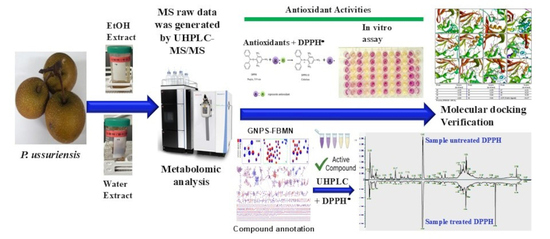
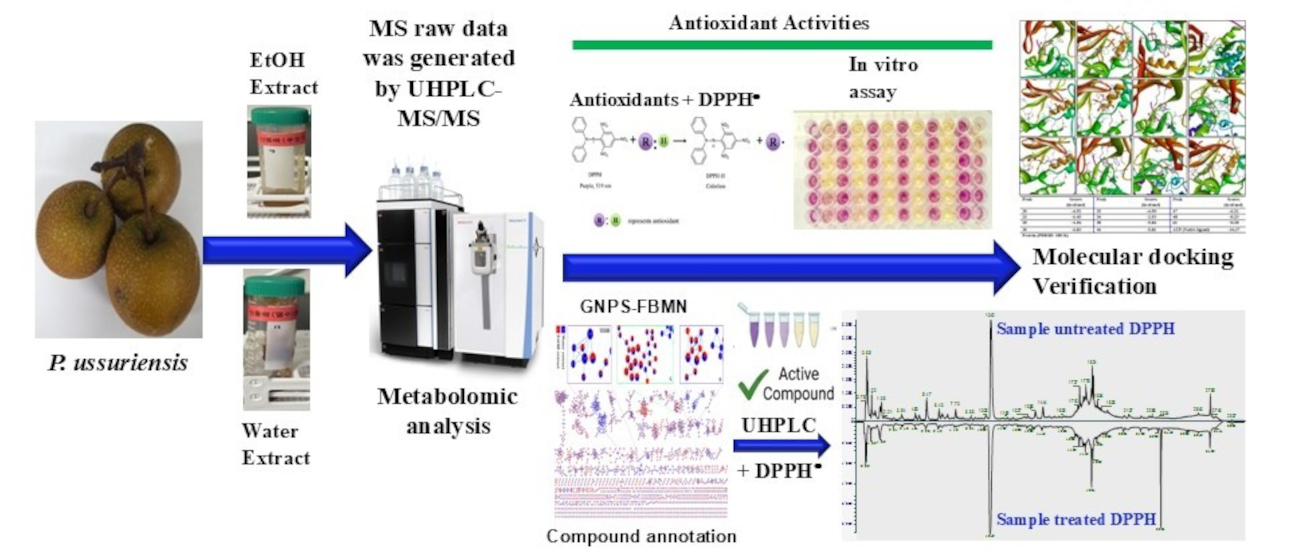
Graphical Abstract

1. Introduction

Pyrus ussuriensis belongs to the genus Pyrus and is known as an economic fruit crop [1]. Thus, it has been planted in many regions worldwide. It is a valuable plant material for studying its chemical composition and antioxidant activity because of its great flavor, drought tolerance, and delicate, disease-resistant traits [2,3,4]. It has also been used for millennia in traditional Chinese folk medicine due to its antitussive, phlegm-dispelling, and diuretic properties. Additionally, P. ussuriensis showed an inflammatory effect in the lung by inhibiting myeloperoxidase activity and reducing the production of pro-inflammatory cytokines, thereby inactivating the mitogen-activated protein kinase (MAPK) and nuclear factor erythroid-2-related factor 2/heme oxygenase-1 (Nrf2/HO-1) signaling pathways. On the other hand, the extract from P. ussuriensis was found to decrease the ulcer index by preventing gastric mucosal lesions, erosion, and cellular degeneration [2]. Its extract also revealed antiproliferative effects against Bel-7402 cells. In particular, the isolated compound from this plant may induce apoptosis via the caspase pathway and cause cell cycle arrest at the G0/G1 phase by inhibiting the cyclin D1/CDK4 pathway [2]. Notably, P. ussuriensis has a high phenolic content, demonstrating antioxidant capacity in extracts, fractions, and active components. Previous studies have shown that extracts from P. ussuriensis peels and fruits exhibit antioxidative capacity [3,5]. However, there is no report on the development of an effective methodology for applying DPPH-based LC systems to determine antioxidants from this plant to date.
LC-MS is a highly efficient analytical technique that combines the separation capabilities of liquid chromatography with mass spectrometry detection. LC-MS is a powerful analytical instrument with optimal characteristics, such as high sensitivity, versatility, accurate capacity, and high chromatographic resolution. Furthermore, because it is simple to use and operate, LC-MS is well known for its utility and convenience [6]. With the above-mentioned benefits, it can also develop accurate methods by quantifying diversity in combination with many integrated devices, depending on the purpose of use, to reduce the expense and duration of experimental procedures across a variety of industrial applications in cosmetics, pharmaceuticals, food, drugs, and biotechnology.
In this study, we established an analytical method using the UHPLC-MS/MS system to determine the chemical constituents from water and EtOH extracts of P. ussuriensis. By combining modern mass spectrometry methods, we identified the chemicals present in both water and EtOH extracts of P. ussuriensis through MS/MS dereplication strategies together with simultaneous mass spectrometry analysis in conjunction with open web platforms. From there, the active compounds and other constituents of extracts have been identified with the difference in mass spectral signals less than 5 mDa. As a result, 150 secondary metabolites were identified by analyzing their ion precursors, mass fragmentation, and spectral matching with public mass spectrometry databases and the GNPS web platform. To discover the active compounds targeting antioxidants, we established an LC-MS method to determine the antioxidative capacity of P. ussuriensis by applying the LC-DPPH method. The established method was to evaluate antioxidant activity by identifying active components in P. ussuriensis extracts. Subsequently, an in silico study was conducted to assess the antioxidative potential of the major ingredients of both P. ussuriensis extracts using docking scores from binding complexes.

2. Results and Discussion

2.1. Molecular Network Guided Identification of Metabolites from Extracts of P. ussuriensis

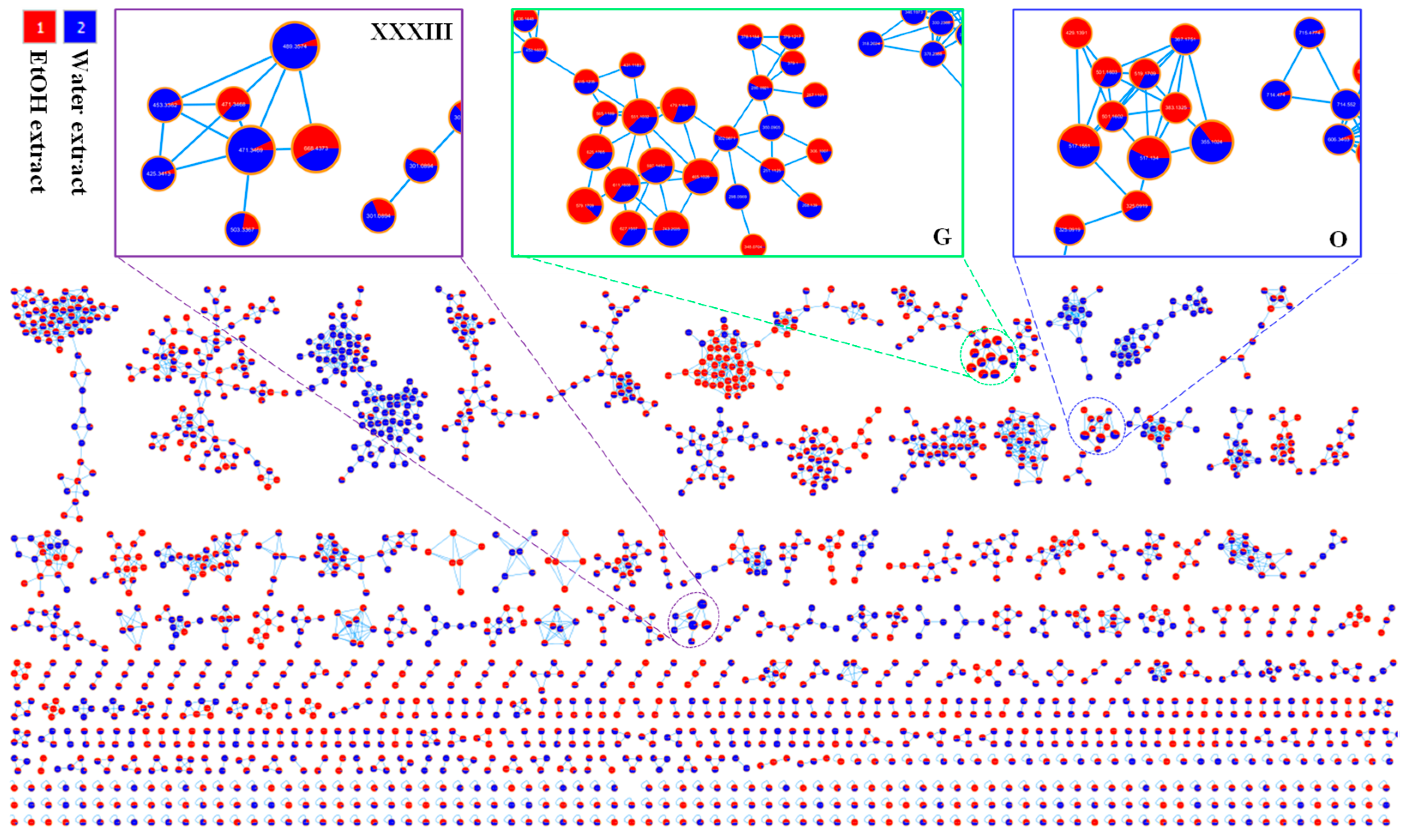
The feature-based molecular network built 305 clusters, which were classified by grouping compounds composed of molecules with similar fragmentation patterns (Figure 1). As shown in Figure 2, cluster G displayed nodes of flavonoid compounds. Briefly, their precursor ion peaks at m/z 743.2035 [M+H]+, 627.1557 [M+H]+, 611.1608 [M+H]+, 597.1452 [M+H]+, 551.1032 [M+H]+, and 465.1027 [M+H]+ were observed and displayed the same fragment at about m/z 303.10 [Quercetin+H]+, suggesting that they are quercetin derivatives. Analysis of mother patterns and fragmentation producing daughter ion peaks allowed us to identify those as quercetin-3-(2R-apiosylrutinoside), quercetin 3,4′-diglucosides, rutin, quercetin-3-O-(6-O-xylopyranosyl)-β-D-glucoside, quercetin-3-O-(6″-O-malonyl)glycoside, and quercetin-3-O-β-D-glucoside, respectively. Additionally, the precursor ion peaks at m/z 625.1765 [M+H]+ and 479.1184 [M+H]+, demonstrating the similarity with a fragmentation producing a putative ion at about m/z 317 [Quercetin+CH3]+, suggesting that two compounds belong to the quercetin backbone with an additional methoxy group. Thus, they were identified as isorhamnetin-3-robinobioside and isorhamnetin 3-O-glucoside, respectively. In contrast, another ion peak at m/z 579.1709 [M+H]+ was observed and showed the characteristic fragment of the apigenin backbone at m/z 271.0988 [Apigenin+H]+. Finally, this peak was assigned as apigenin-7-O-glucosyl-4′-O-rhamnoside. The identification of the above peaks detected in cluster G was accompanied by analysis of their mass fragmentation and spectral matching with previous reports on flavonoid glycosides [7,8]. Cluster O displayed the major component at m/z 355.1024 [M+H]+, showing the fragment of a caffeoyl moiety at m/z 163.0392 [Caffeoyl]+. Therefore, this peak was identified as chlorogenic acid.
This cluster also exhibited two quinic acid derivatives at m/z 517.1551 [M+H]+ and 517.1340 [M+H]+, each with an ion fragment corresponding to a caffeoyl unit of about 163 Da. Thus, these two compounds were further determined as 3,4-O-dicaffeoylquinic acid and 3,5-O-dicaffeoylquinic acid. Cluster XXXII demonstrated the protonated ion peaks at m/z 668.4373 [M+NH4]+, showing a fragment ion peak at m/z 489.3600 [M+NH4-Glc]+ due to a reduction of a glucose unit. Thus, peak 136 was identified. Furthermore, additional metabolites were identified using mass fragmentation analysis and comparison with an in-house library, as well as with entries in public mass spectrometry databases, yielding high spectral matching scores. As a result, 150 predicted compounds (Table 1) were identified from both EtOH and water extracts.

2.2. Identification of Antioxidants Using the LC-DPPH Method

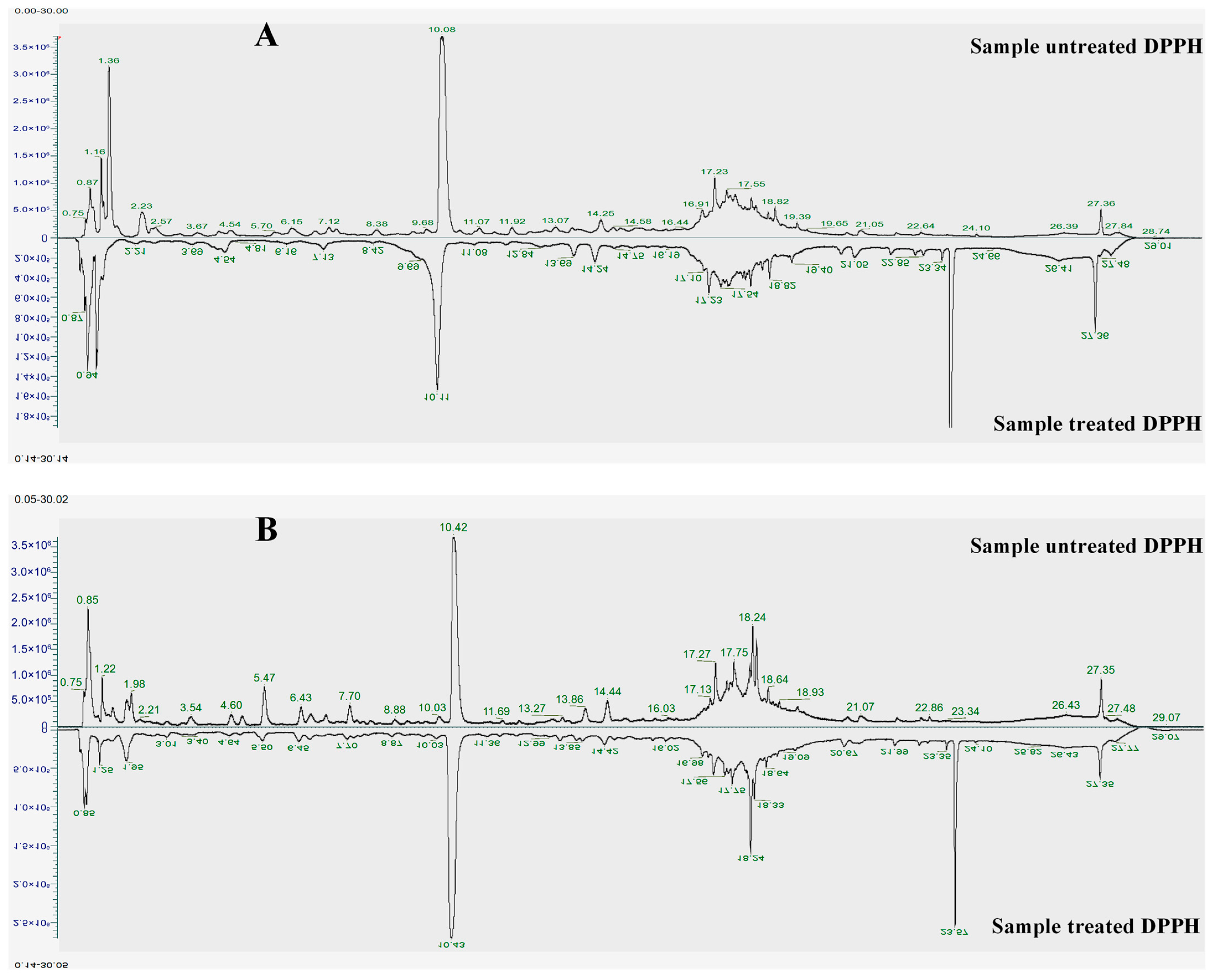
It is important to assess the antioxidant profile of products to avoid losing their commercial and nutritional value in pharmaceutical and herbal foods. On the other hand, pharmaceuticals and food products require the development of effective, simple methods to determine the antioxidant potential of herbs specifically chosen for their active ingredients. To accomplish these objectives, integrating liquid chromatography (LC) with the DPPH radical scavenging assay is an efficient and reliable high-throughput screening approach capable of identifying antioxidant constituents while simultaneously promoting consumer health and enhancing the economic value of herbal products [9]. Firstly, the extracts interacted with DPPH under conditions that showed a reduction in the violet color observed in DPPH-treated samples compared to non-treated DPPH samples. This phenomenon may be explained by the presence of ingredients that can transfer a hydride to DPPH, forming a DPPH-H hydrazine [10]. This reaction showed a decrease in the color of the mixture, which changed from violet to pale yellow due to radical reduction. It means that EtOH and water extracts of P. ussuriensis may contain the active ingredient that scavenges the DPPH radical. Subsequently, the above-mentioned method was employed, demonstrating chromatographic resolution based on peak-area measurements of signal detection between treated and untreated DPPH samples under the same experimental conditions. Additionally, the above-established method was applied to develop a pre-incubation UHPLC-DPPH to determine the active components from two extracts of P. ussuriensis. We found that the peak areas of the detected signals in chromatograms of the treated DPPH samples differed from those of the non-treated (control) DPPH samples under the same experimental conditions (Figure 2). It may be proposed that these compounds interact with the DPPH radical in hydrazine (DPPH-H), resulting in a reduction in their peak areas in the treated DPPH chromatograms. To validate the above-established method, the strong DPPH scavenger, ascorbic acid (AA), was reacted with DPPH, and the reaction mixture was evaluated using the above LC-DPPH method. The repeatability of the DPPH, AA, and reaction mixture of AA and DPPH was determined with a precision of 0.059%, 0.032%, and 0.048% (for retention time), respectively, and 1.714%, 1.501%, and 1.752% (for peak areas), respectively, reflecting the good repeatability and precision with acceptable RSD values of the analytical method (Figure S1, Supplementary Materials). Additionally, inter- and intra-day precision were also analyzed by using the above analytical method. Results indicated that the precision values were less than 0.061% (for retention time) and 1.327% (for peak areas) on inter-day analysis (Figure S2, Supplementary Materials) as well as less than 0.049% (for retention time) and 1.406% (for peak areas) in inter-day analysis (Figure S3, Supplementary Materials). This observation reveals that the established methodology was precise and reliable for quantification. Moreover, the regression equation was established based on their reduction in peak areas compared to those of the AA sample (without DPPH addition) at the same analytical conditions (Figure S4A, Supplementary Materials). The IC50 values of ascorbic acid (AA) were determined as 12.15 ± 1.01 μg/mL. In contrast, the DPPH radical-scavenging activity of ascorbic acid was determined using a 96-well microplate DPPH assay, and absorbance was measured at 517 nm with a microplate reader (ELISA). Ascorbic acid showed an IC50 value of 10.65 ± 0.85 μg/mL.
Subsequently, the established LC-DPPH method was employed to identify the active compounds, which were highlighted with an asterisk assignment in Table 1. Among them, peaks 8–11, 17, and 21 strongly reduced the peak areas after being treated with DPPH compared to the non-treated DPPH sample (Figure 2, Table S2).
Peaks 20, 21, 25, 30, 33, 34, 38, 41, 47, 48, 61, 66, 83, 86, 110, 115, 116, 119, 123, and 124 significantly decreased peak areas when treated with DPPH compared to the control. Previous studies revealed that 8-hydroxy-6,7-dimethoxychromen-2-one (41) displayed radical-scavenging activity [11]. Tryptophan (38) also demonstrated a potent scavenger activity [12,13]. 7-hydroxycoumarin (47) and chlorogenic acid (48) showed a significant reduction in peak area between treated and untreated DPPH samples. A previous report [14] found that chlorogenic acid provides many health benefits, including mitigating oxidative stress; therefore, it may be related to adverse effects associated with radical scavenging activity and an unbalanced intracellular redox state. In particular, chlorogenic acid may mediate the free radicals generated by oxidative sources by donating hydrogen and electrons, as well as chelating metal transition ions. As a result, the free radicals were converted into a stable state via their antioxidative effect. Thus, chlorogenic acid could mitigate oxidative stress through different molecular mechanisms, as it plays key roles in cell signaling activities [15] that underlie crucial contributions [16]. Previously, 7-hydroxycoumarin showed an antioxidative effect due to its structural property. Indeed, 7-hydroxycoumarin may produce reactive coumarin radical intermediates in the presence of enzymatic catalysts, thereby mediating its prooxidant property in scavenging reactive oxidizing species. Therefore, this compound may decrease enzymatic oxidants [17] and inhibit hydroxyl, superoxide anion, and 2,2-azino-bis(3-ethylbenzothiazoline-6-sulfonic acid) (ABTS) and DPPH radicals [18]. Additionally, compound 123 exhibited strong antioxidative effects by scavenging DPPH and ABTS radicals with IC50 values of 4.85 ± 0.58 and 5.35 ± 0.33 μg/mL, respectively, which were remarkably higher than that of the standard BHT (IC50 64.90 ± 0.75 μg/mL) [19].
Among identified compounds from EtOH extract, peaks (24, 27, 28, 30, 33, 35, 37, 40, 65, and 124) displayed a strong reduction of peak areas between treated and non-treated DPPH samples. Peaks 34, 41, 47, 61, 62, 83, 86, 111, 112, 116, 119, and 123) significantly demonstrated an antioxidative effect by reducing the peak areas between treated and non-treated DPPH samples. Peaks (22, 26, 48, 84, 115, 117, and 120) also exhibited an antioxidative effect with a weak reduction in peak areas. Among the active antioxidants detected from water extract, peaks (30, 38, 39, 41, 82, and 127) strongly reduced peak areas between treated and non-treated DPPH samples. Peaks (16–18, 22, 23, 47, 66, 80, 123, 124, 126, and 134) moderately reduced peak areas of the treated DPPH sample compared to the untreated sample. Peaks (21, 24, and 64) showed weak activity (Figures S1 and S2, Supplementary Materials). These results show that the EtOH and water extracts contain a variety of compounds that have strong antioxidant abilities, as seen by their significant decrease in DPPH peak areas. These findings demonstrate that the water and EtOH extracts contain various constituents with potent antioxidant properties, evaluated by the notable reduction in the DPPH peak regions. The discovery of these active constituents is consistent with information from previous studies demonstrating their antioxidant properties through known mechanisms and biological activity. Previously, ribitol (34) showed some antioxidative effects, in addition to its strong inhibition of cholinesterase, including acetylcholinesterase and butyrylcholinesterase [20]. Similarly, 4-caffeoylquinic acid displayed a stronger antioxidative effect than the positive control (ascorbic acid) [21]. Ibuprofen exhibited antioxidant effects by scavenging free radicals (DPPH, heme oxygenase-1 (HO), NO, and ABTS) [22]. Naringenin was reported to have some antioxidative effect [23,24] besides its novel anticancer effect in gastric carcinoma [25]. Compound 115 demonstrated significant antioxidative and hypoglycaemic effects [24]. Isorhamnetin 3-O-glucoside (116) and isorhamnetin derivatives demonstrated antioxidant capacities by inhibiting radicals, superoxide radicals, and xanthine oxidase [26]. Isorhamnetin (119) demonstrated the potential for antioxidative and anti-inflammatory activities, underlying the mechanisms of its anti-inflammatory and antioxidant effects [27]. A structural-activity relationship revealed that the antioxidative effect was negatively influenced by the glycosylation at the C-3 position of the flavonoid [28]. However, isorhamnetin and isorhamnetin 3-O-glucoside showed a significant antiproliferative effect towards human hepatocellular carcinoma cells (BEL-7402) and CaCO2 cells than those of flavonoid derivatives lacking a methoxy group at C-3′ of the B-ring [29]. Compound 86 showed antioxidative effect through suppressing reactive oxygen species (ROS) and nitric oxide generation (NO) by up-regulation of HO-1 via activation of nuclear factor erythroid 2-related factor 2 (Nrf2), besides its anti-inflammatory capacity by inactivation of MAPKs and the nuclear factor kappa-light-chain-enhancer of activated B cells (NF-κB) pathway resulting in decreased production of inflammatory cytokines [30]. These active constituents may enhance the overall antioxidant capacity of P. ussuriensis. This continuity between current screening outcomes and previous pharmacological investigations not only validates the reliability of the DPPH-guided LC approach but also highlights the therapeutic relevance of the detected active constituents.
Furthermore, the EtOH extract displayed 34 active compounds in the LC-DPPH assay, compared with 22 from the water extract (Figure S1, Supplementary Materials). The content of the active compound from EtOH is also much more than that of the water extract. However, the water extract demonstrated a stronger reduction in peak areas between treated and non-treated DPPH samples than the EtOH extract. Our data supported an overview of the discovery of active antioxidants of different extracted conditions for the development of further products on an industrial scale. To verify the antioxidative capacity of compounds, an in silico study was conducted to predict the antioxidative effect of active compounds found in the LC-DPPH assay.

2.3. Prediction of Active Compounds Target Antioxidative Activity

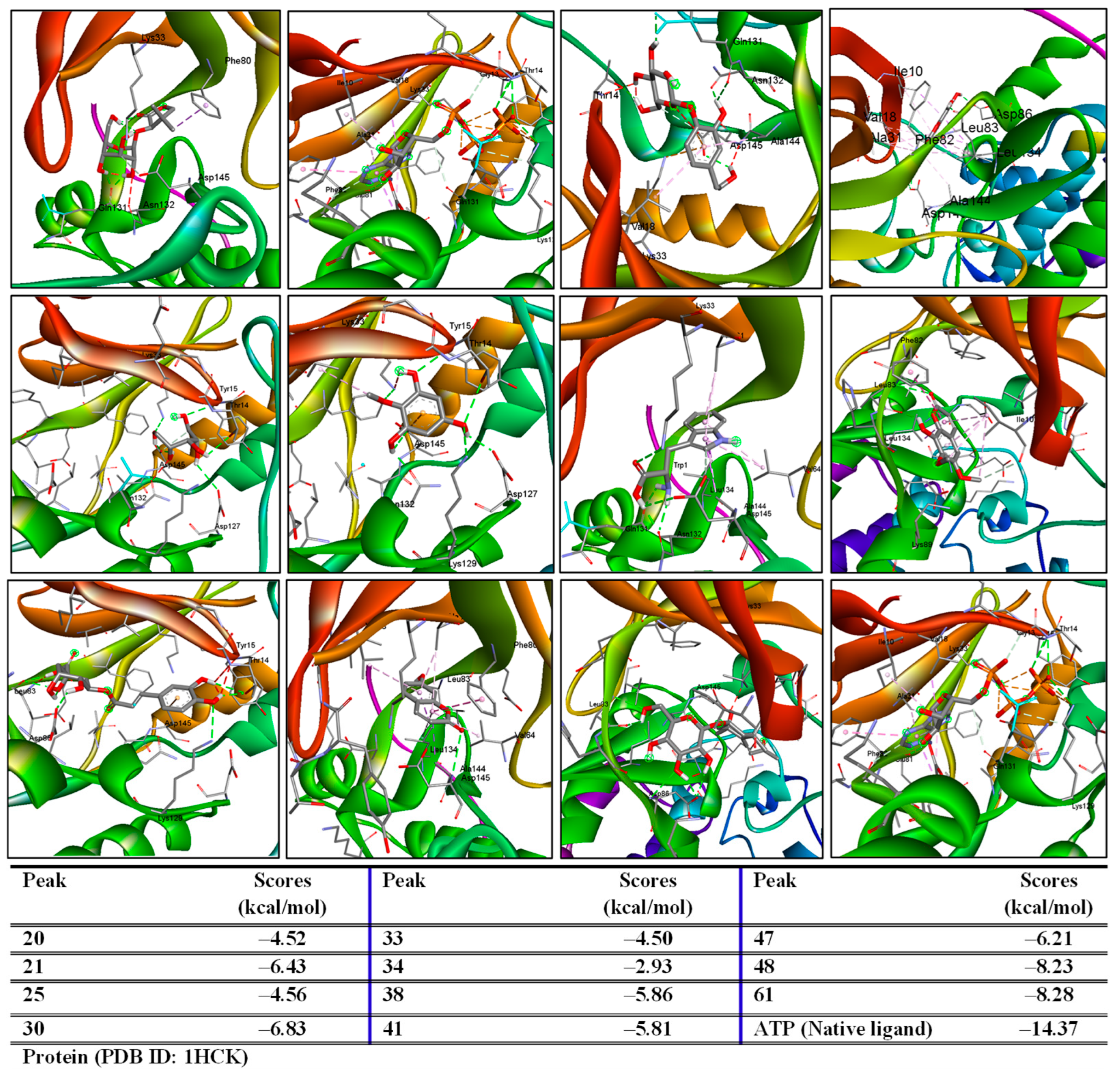
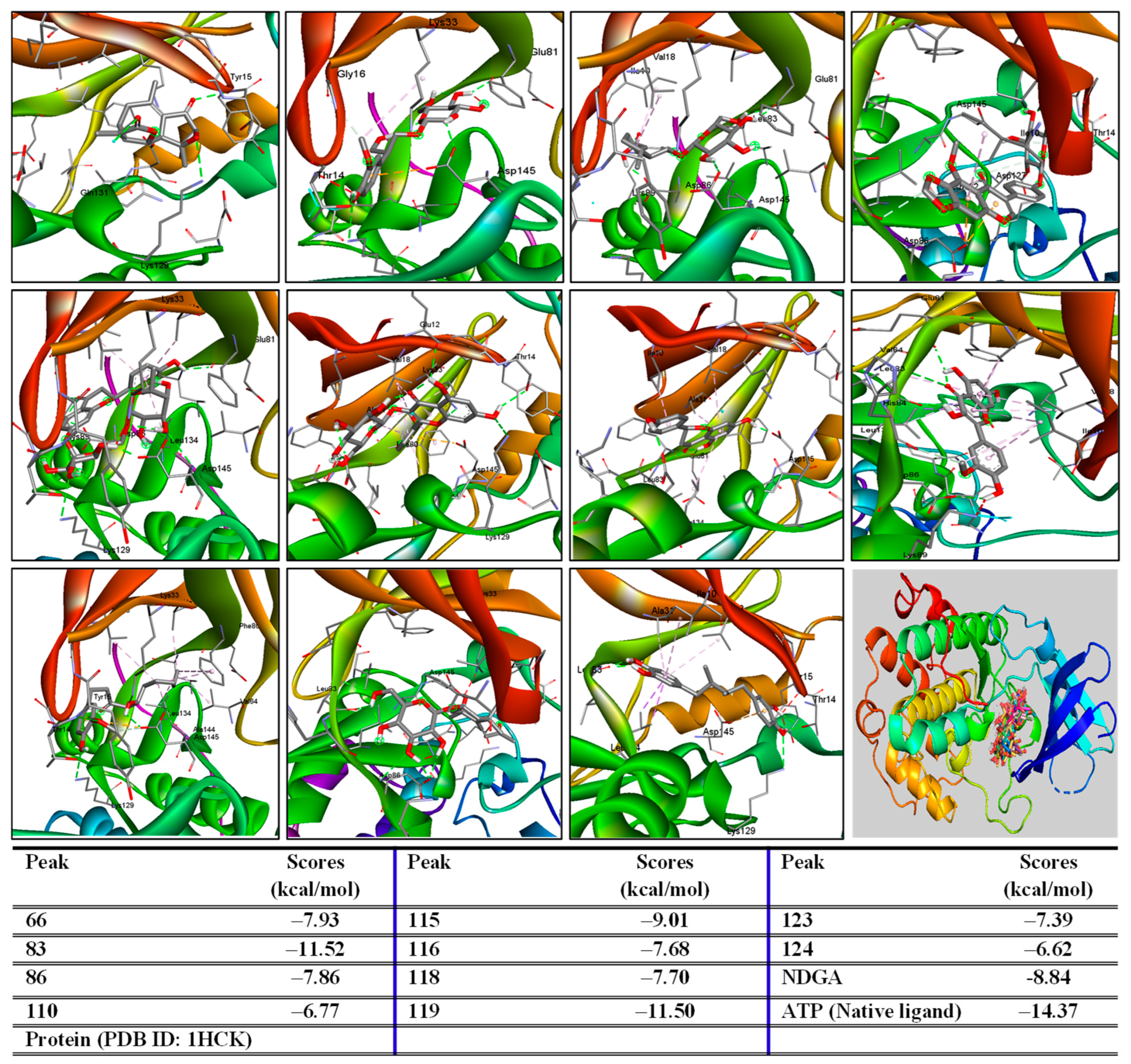
Adenosine-5′-triphosphate, ATP, the native ligand, was extracted from the protein’s pdb format. The complex was then formed by redocking this ligand into the protein. The small RMSD (1.60 Å) value reflects the accuracy of the docking protocol. Thus, the major peaks of both extracts were further analyzed for their binding affinity to protein to predict their antioxidative effects. As shown in Figure 3 and Figure 4, these major active compounds and the redocked native ligand (ATP), along with the oxidant inhibitor (Nordihydroguaiaretic acid, NDGA), occupied the same region in the protein’s binding pose.
Peaks 21, 30, 38, 47, 48, 61, 66, 86, 110, 115, 116, 118, 123, and 124 were prepared as ligands docked into the 1HCK protein to establish ligand-protein complexes. They exhibited low binding energies (ΔG ranging from −11.50 to −6.21 kcal/mol). Notably, these ligands may interact with key amino acids, including THR14, TYR15, LYS30, GLU81, LEU83, LYS129, and ASP145, which were identified as important residues in the protein’s binding pose [31].

2.4. Target Prediction and Drug-Likeness Assessment

To assess the antioxidant activities of the above active compounds, we used the PASS online tool on the Way2Drug web server to predict their bioactivities. Data were collected by setting Pa > 0.3 (Pa represents the probability of being active) (Table 2). Compounds 20, 25, 33, 41, 47, 48, and 61 displayed moderate to high probability ranging from 44.7% to 85.5% toward antioxidant, free radical scavenging, and lipid peroxidase activities. Briefly, compound 38 showed the strongest probability (77.7%), and compounds 30, 33, 34, 41, and 47 showed moderate probability (Pa values ranging from 30.9% to 63.4%) to superoxide dismutase and chloride peroxidase activity.
Compound 38 was also predicted with a high Pa value of 86.3%, higher than the effects of compounds 33, 34, and 47 toward catalase inhibitors (Table 2). With glutathione peroxidase activity, compounds 20, 33, 34, and 38 predicted moderate activity (Pa values ranging from about 31.4–38.2%). With the nitrite reductase (NO-forming) inhibitor, compound 34 showed the highest Pa value of 76.5%, followed by compounds 30, 33, 41, and 47 with Pa values of about 34.1–54.8%. All these compounds were predicted to suppress oxidoreductase activity with Pa values ranging from 34.2% to 84.6%. Compounds 25, 30, 41, and 47 moderately suppressed NADPH oxidase activity by the PASS prediction. These observations suggested that compounds 38, 48, 25, and 34 are particularly promising as multifunctional antioxidant agents. Compound 38 stands out for enzymatic antioxidant modulation, while compounds 48 and 25 are strong radical scavengers. In silico predictions offer helpful information regarding the potential biological activities of these compounds and their potential therapeutic applications in the context of oxidative stress-related diseases.
Assessment of potential target sequences also provides insights into essential properties. We employed web server platforms to evaluate drug-likeness based on their properties of physicochemical, biochemical, pharmacokinetic, and toxicity characteristics of the above active components that possess acceptable ADME properties (Table 3). The data reflect that increasing the number of hydrogen-bond donors and acceptors is due to their direct correlation with an increase in aqueous solubility and a decrease in lipophilicity. Compounds 25 and 48 demonstrated a high number of hydrogen bonds, which proposed a difficulty in oral delivery due to poor intestinal tract absorption [32]. Except for compounds 25 and 48, all compounds possessed Lipinski’s rule of five [33]. Most of the compounds were soluble in water. Among them, compounds 21, 30, 33, 38, 41, and 47 exerted high absorption through the gastrointestinal tract; therefore, they could be promising candidates to optimize as an oral administration. Compounds 41 and 47 may cross the blood–brain barrier, suggesting that they may be impacted to reach brain penetration. Overall, the predicted ADME profiles support the potential of these compounds as orally bioavailable drug candidates, with most demonstrating favorable drug-likeness properties without significant interference with GI, BBB, and PAINS alerts, meriting further investigation.

2.5. Analysis of Metabolites from Both Water and EtOH Extracts

Additionally, this analytical technique was employed to estimate the content of active DPPH components and other predicted compounds from both extracts of P. ussuriensis. As shown in Figure S2 (Supplementary Materials), the content of compounds detected from each extract was roughly determined by calculation of their peak areas detected from the chromatograms of each extract. The phytochemical investigation of EtOH and water extracts of P. ussuriensis used the established method to identify predicted compounds. Both extracts detected the major components, including peaks 4, 5, 7–9, 11–14, 37, 47, 48, 61, 62, and 124. Additionally, the water extract showed four additional major peaks (2, 73, 123, and 149). The EtOH extract exhibited three major peaks, including 30, 33, 35, 115, and 118 (Figure S3 and Table S1, Supplementary Materials). Thus, the difference in composition of compounds identified from different extracts of P. ussuriensis indicated that the extraction method is important and affects the chemical composition of the herbal extract.

3. Materials and Methods

3.1. Plant Materials

P. ussuriensis fruits were obtained from Gwangyang in Fall 2022. Identification of the plant species was authorized by Prof. Mina Lee (College of Pharmacy, Sunchon National University) and Dr. Deuk-Sil Oh (Jeollanamdo Forest Research Institute). A voucher specimen of P. ussuriensis (SCNUP 45) was deposited in the herbarium at the Pharmacognosy laboratory (College of Pharmacy, Sunchon National University).

3.2. Sample Preparation

The fruits of P. ussuriensis were freeze-dried for 5 days using freeze-drying equipment (FDTA-5050, OFERON, Gimpo, Republic of Korea). The dried materials were divided into two batches for extraction using water and EtOH. At first, the dried materials were extracted with water at 70 °C for 3 h. Subsequently, the solution was concentrated by using a vacuum rotavator for 8 h to obtain a crude extract. On the other hand, the second batch was extracted with 100% EtOH at 70 °C for 3 h. This solution focused on a vacuum-pressure rotavator (Rotary evaporator, EYELA, Bohemia, NY, USA) to obtain the crude extract. These crude extracts were stored for further use. These extracts were dissolved in 50% high-grade MeOH and filtered through a 0.22 μm PTFE membrane (Agilent Technologies, Santa Clara, CA, USA) prior to analysis. Then, these sample solutions were analyzed using LC-MS/MS instruments.

3.3. LC-MS/MS Analytical Conditions

Two extracts were analyzed using an Orbitrap Exploris 120 mass spectrometer (Thermo Fisher Scientific, Sunnyvale, CA, USA) in conjunction with a Vanquish UHPLC system. The chromatograms of samples were obtained at 40 °C using a Waters column [Acquity UPLC HSS T3 (4.6 × 100 mm, 1.8 μm, Waters, Milford, MA, USA)] with an injection volume of 4 μL and a flow rate of 0.3 mL/min. Phase A, pure water with 0.1% formic acid, and phase B, ACN with 0.1% formic acid, were applied as follows to create a gradient solvent system: 3–5% (B) for 0–4 min, 5–8% (B) for 4–8 min, 8–10% (B) for 8–11 min, 10–15% (B) for 11–15 min, 15–50% (B) for 15–20 min, 50–100% (B) for 20–24 min, 100–100% (B) for 24–27 min, and 100–3% (B) for 1 min before reaching a re-equilibrium with 3% (B).
Mass evolution was set as follows: mass (m/z) range, 100–1450; spray voltage, 3500 V (positive mode); vaporizer temperature, 350 °C; ion transfer tube temperature, 325 °C; ion source gas, 50 psi; and aux gas, 10 psi. The MS/MS parameter included HCD collision energies of 15, 30, and 60 V. Full scans and data-dependent mode were selected to obtain mass spectral data. Data processing using the mzmine3.9 program and feature-based molecular network using the GNPS platform were prepared following the previous report [34].

3.4. Construction of Global Natural Products Social-Feature-Based Molecular Network

The molecular networking was built using the Global Natural Products Social (GNPS) web platform (https://gnps.ucsd.edu) to construct the chemical networking of extracts of P. ussuriensis. At first, the output file from the UHPLC-MS/MS analysis was converted to the mzXML format using the MS converter tool (https://proteowizard.sourceforge.io/). Then, the molecular network (twig job ID: b1ee54ebcb9846e4a4f6dcd1f5b6d4f8) was obtained through the GNPS web tools on the online platform. Among them, the node is the same for a single MS2 spectrum or a consensus cluster of identical MS2 spectra representing a single molecule. Each cosine score, which accounts for precursor ions, fragment ions, or peak intensities, indicates the spectral similarity between two nodes in the molecular network. The cosine score was computed based on peak intensities, precursor ions, and fragment ions. Using a cosine similarity score between nodes, a line representing related but different MS2 spectra created edges. Visualization of data obtained from the feature-based molecular network and Network annotation propagation (NAP) was conducted using Cytoscape 3.9.0 (https://cytoscape.org/).

3.5. Structural Annotation of Predicted Compounds

The identification of components from both extracts was performed using MS-Dial and GNPS web tools, in combination with public mass spectrometry databases. The identification of chemical IDs was mainly achieved by analyzing their isotopic patterns and mass fragmentation of mass spectra. A feature-based molecular network was visualized by using Cytoscape 3.10.

3.6. LC Coupled with DPPH Assay

3.6.1. Reaction of Ascorbic Acid and Extracts

To screen the antioxidants derived from the extracts, ascorbic acid (AA) or each sample was prepared as follows: each sample was treated with DPPH, and the reaction mixture was incubated at 37 °C for 30 min. After a complete reaction, the sample was filtered through a 0.22 μm PTFE membrane (Agilent Technologies, Santa Clara, CA, USA) prior to further analysis. The control sample was prepared by adding the same volume of MeOH to replace the DPPH solution. Additionally, an untreated sample was prepared by either inserting only the DPPH solution or only MeOH, serving as a blank. Finally, all these samples were analyzed by using the above analytical conditions to obtain the raw data.

3.6.2. Validation of the LC-DPPH Method

Repeatability Analysis
The strong antioxidant (ascorbic acid, AA) was selected to validate the analytical method. Ascorbic acid, DPPH, and the reaction mixture of AA and DPPH were independently prepared and run six times by using the above-established LC-MS/MS method. The retention time and peak area values were collected and analyzed to ensure precision of less than 1% (for retention time) and 2% (for peak area). The reaction mixtures of AA and DPPH at low (4 μg/mL), middle (8 μg/mL), and high (16 μg/mL) levels were analyzed for inter-day and intra-day precision. The inhibition concentration of ascorbic acid was estimated using a regression equation derived from integrating the peak areas of the reaction mixture of ascorbic acid and DPPH under the same experimental conditions.
Antioxidant Assay
The DPPH assay was then performed to verify the antioxidative effect of ascorbic acid using a 96-well microplate. The reaction mixture was measured for absorbance at 517 nm after incubation in the shade. The experimental procedures followed those described in our previous publication [10].

3.7. Molecular Docking

A molecular docking study of selected compounds was performed using a previous report [35]. Protein (1HCK) was retrieved from the Protein Data Bank (https://rcsb.org, accessed on 28 November 2025). Ligands were retrieved from PubChem (https://pubchem.ncbi.nlm.nih.gov/, accessed on 18–20 and 22 November 2025). The protein and ligand preparation were conducted using MGLTools 1.57. Molecular docking was performed using AutoDock 4.2.6. Data visualization was performed using Discovery Studio.

3.8. Prediction of Biological Target

The Way2Drug PASS Online server was employed to predict the biological activities of selected compounds using the default set of web servers. Thereby, the output data are consistent with the predicted activities, ranked by the probability of a chemical exhibiting activity (Pa) and inactivity (Pi). The set Pa > 0.3 was used to rank the biological activities of each compound. Each compound generated SMILES by using the ChemDraw (ver. 2016) program. Then, this SMILES string was submitted to the PASS online server for a new prediction. Subsequently, output data is produced in accordance with a set of Pa options [36].

3.9. Physicochemical Characteristics and Computational Approach

For each structure, SMILES were generated using ChemDraw (ver. 2016). We computed basic molecular and physicochemical descriptors using a web tool, including pharmacokinetic behavior, ADME, the number of particular atom types, molecular weight (MW), molecular refractivity (MR), and topological polar surface area (TPSA). Based on the average values of the various computational factors, lipophilicity was evaluated using five alternative prediction models (XLOGP, WLOGP, MLOGP, SILICOS-IT, and iLOGP) and a consensus logP estimation. Similarly, three different models were used to determine the solubility in water. The goal of the ADME/pharmacokinetics analysis was to estimate key parameters, including gastrointestinal absorption, solubility, and blood–brain barrier (BBB) permeability. To achieve accurate predictions, the SwissADME tool [37] leverages a support vector machine (SVM) algorithm. This SVM is trained on comprehensive, rigorous datasets that differentiate between known inhibitors and non-inhibitors, and between substrates and non-substrates.

3.10. Drug Likeness Prediction

The drug-likeness analysis was carried out using the validated rules used as high-throughput screening filters, as follows: Lipinski (Pfizer, New York, NY, USA), Ghose (Amgen, Thousand Oaks, CA, USA), Veber (GSK, London, UK), Egan (Pharmacia, Peapack, NJ, USA), and Muegge (Bayer, Leverkusen, Germany). The Abbott bioavailability score was calculated to predict the probability of a 10% oral bioavailability. These filters have been developed to assess drug-likeness, i.e., to predict whether a chemical entity is likely to have useful pharmacokinetic properties, based on therapeutic principles and parameters such as molecular weight, LogP, and numbers of hydrogen bond acceptors and donors [9].

3.11. Statistical Analysis

Data were represented as the means ± standard deviations (S.D.) (n ≥ 3) of at least three replicates. The nonparametric one-way ANOVA followed by Dunnett’s multiple-comparison test was performed using GraphPad Prism version 8.0.1 (GraphPad Software, La Jolla, CA, USA) for statistical analyses.

4. Conclusions

In conclusion, Pear is a high-value crop and is popular in many parts of the world. Our study has developed an analytical method using high-tech equipment, a technology increasingly popular in pharmaceutical technology. The application and combination with supporting tools have brought high efficiency and utility in analyzing and determining the chemical composition of pear extract samples here. The detected chemical components span a diverse range of substance classes, reflecting the complex metabolic processes within P. ussuriensis. The application of advanced technologies not only helps orient well but also improves the optimization of input materials, specifically by identifying substances with antioxidant activity while consuming less input materials when using the above analytical method combined with DPPH to target antioxidants. This approach has helped identify active ingredients and evaluate their composition, as well as the other chemical components present in each extract from this plant. Therefore, the results obtained highlight the value of P. ussuriensis and guide the development of antioxidant therapeutic products from its active constituents.

Supplementary Materials

The following supporting information can be downloaded at https://www.mdpi.com/article/10.3390/ph19010192/s1. Figure S1: Analyzing the repeatability of DPPH, AA, and AA+DPPH reaction mixture by using the established LC-DPPH method. Rt represents the retention time (min). PA describes the peak areas detected from the chromatograms; Figure S2: Inter-day precision of AA+DPPH reaction mixture at different concentrations analyzed by applying the established LC-DPPH method. Rt represents the retention time (min). PA describes the peak areas detected from the chromatograms; Figure S3: Intra-day precision of AA+DPPH reaction mixture at different concentrations analyzed by applying the established LC-DPPH method. Rt represents the retention time (min). PA describes the peak areas detected from the chromatograms; Figure S4: Regress equation of ascorbic acid determined by LC-DPPH (A) and Elisa assay (B); Figure S5: Composition (A) and reduction (%, B) of peak areas of active DPPH components from EtOH extract; Figure S6: Composition (A) and reduction (%, B) of peak areas of active DPPH components from water extract; Figure S7: Peak areas of compounds identified from P. ussuriensis extracts. Table S1: Identification of components from SDB fractions. Table S2: Spectra of identified compound has an antioxidant activity, evaluated by LC-DPPH.

Author Contributions

Conceptualization, data curation, visualization, formal analysis, investigation, methodology, original draft, D.L.; Formal analysis, methodology, validation, T.D.; Data analysis, investigation, S.Y.; Methodology, Y.-J.L.; Software, data curation, H.-I.L.; Data curation, validation, J.W.P.; Visualization, methodology, resource, D.-S.O.; Manuscript approval, conceptualization, supervision, project manager, resource, and funding acquisition, M.L. All authors have read and agreed to the published version of the manuscript.

Funding

This work was supported by the National Research Foundation of Korea (NRF) grant funded by the Korea government (MSIT) (Grant no.: RS-2022-NR070862).

Institutional Review Board Statement

Not applicable.

Informed Consent Statement

Not applicable.

Data Availability Statement

The original contributions presented in this study are included in the article/Supplementary Materials. Further inquiries can be directed to the corresponding author.

Acknowledgments

The authors sincerely thank the Research Instrument Center of Sunchon National University.

Conflicts of Interest

The authors declare no conflicts of interest.

References

  1. Wang, X.; Liu, C.; Wang, Q.; Liu, C.; Sun, H.; Zhang, M.; Lyu, D.; Du, G. A comparative study on antioxidant, anti-inflammatory, antimicrobial activities and chemical composition of Pyrus ussuriensis cultivars from northeastern China. Hortic. Environ. Biotechnol. 2021, 62, 477–491. [Google Scholar] [CrossRef]
  2. Peng, F.; Li, G.; Xie, Y.; Yin, H.-Y.; Li, X.-J.; Yang, Y.-D. Compositional characterization of Pyrus ussuriensis Maxim and their antioxidant activities and induction of apoptosis in Bel-7402 cell. J. Food Biochem. 2020, 44, e13222. [Google Scholar] [CrossRef]
  3. Qiu, D.; Guo, J.; Yu, H.; Yan, J.; Yang, S.; Li, X.; Zhang, Y.; Sun, J.; Cong, J.; He, S.; et al. Antioxidant phenolic compounds isolated from wild Pyrus ussuriensis Maxim. fruit peels and leaves. Food Chem. 2018, 241, 182–187. [Google Scholar] [CrossRef]
  4. Peng, F.; Ren, X.; Du, B.; Yang, Y. Pyrus ussuriensis Maxim 70% ethanol eluted fraction ameliorates inflammation and oxidative stress in LPS-induced inflammation in vitro and in vivo. Food Sci. Nutr. 2023, 11, 458–469. [Google Scholar] [CrossRef] [PubMed]
  5. Uy, N.P.; Ku, J.; Lee, D.-H.; Nam, S.J.; Lee, S. Comparative assessment of phytochemical content and antioxidant activities in different parts of Pyrus ussuriensis cultivars. Horticulturae 2025, 11, 184. [Google Scholar] [CrossRef]
  6. Alanazi, S. Recent advances in liquid chromatography–mass spectrometry (LC–MS) applications in biological and applied sciences. Anal. Sci. Adv. 2025, 6, e70024. [Google Scholar] [CrossRef]
  7. Cao, L.-P.; Li, Y.-M.; Li, S.-G.; Ren, Q. Analysis of the phytochemical components of using high-performance liquid chromatography quadrupole time-of-flight mass spectrometry combined with molecular networking and assessment of their antioxidant and anti-α-glucosidase activities. Biomed. Chromatogr. 2024, 38, e5771. [Google Scholar] [CrossRef]
  8. Chen, Y.; Yu, H.; Wu, H.; Pan, Y.; Wang, K.; Jin, Y.; Zhang, C. Characterization and quantification by LC-MS/MS of the chemical components of the heating products of the flavonoids extract in Pollen Typhae for transformation rule exploration. Molecules 2015, 20, 18352–18366. [Google Scholar] [CrossRef] [PubMed]
  9. Ai, L.; Liu, L.; Zheng, L.; Liu, Y.; Sun, B.; Su, G.; Xu, J.; Chen, Y.; Zhao, M. An on-line stop-flow RPLC × SEC-MS/DPPH radical scavenging activity analysis system and its application in separation and identification of antioxidant peptides. Food Chem. 2024, 436, 137670. [Google Scholar] [CrossRef]
  10. Le, D.; Jang, Y.; Truong, V.; Dinh, T.; Dang, T.; Yu, S.; Lee, M. Anti-Inflammatory effects and metabolomic analysis of Ilex Rotunda extracted by supercritical fluid extraction. Int. J. Mol. Sci. 2024, 25, 11965. [Google Scholar] [CrossRef]
  11. Hu, H.-B.; Zheng, X.-D.; Jian, Y.-F.; Liu, J.-X.; Zhu, J.-H. Constituents of the root of Anemone tomentosa. Arch. Pharmacal Res. 2011, 34, 1097–1105. [Google Scholar] [CrossRef] [PubMed]
  12. Nayak, B.N.; Buttar, H.S. Evaluation of the antioxidant properties of tryptophan and its metabolites in in vitro assay. J. Complement. Integr. Med. 2016, 13, 129–136. [Google Scholar] [CrossRef]
  13. Wang, X.; Liu, R.; Yang, Y.; Zhang, M. Isolation, purification and identification of antioxidants in an aqueous aged garlic extract. Food Chem. 2015, 187, 37–43. [Google Scholar] [CrossRef] [PubMed]
  14. Le, D.; Han, S.; Ahn, J.; Yu, J.; Kim, C.-K.; Lee, M. Analysis of antioxidant phytochemicals and anti-inflammatory effect from Vitex rotundifolia L.f. Antioxidants 2022, 11, 454. [Google Scholar] [CrossRef]
  15. Tajik, N.; Tajik, M.; Mack, I.; Enck, P. The potential effects of chlorogenic acid, the main phenolic components in coffee, on health: A comprehensive review of the literature. Eur. J. Nutr. 2017, 56, 2215–2244. [Google Scholar] [CrossRef]
  16. Clifford, M.N. Chlorogenic acids and other cinnamates—Nature, occurrence and dietary burden. J. Sci. Food Agric. 1999, 79, 362–372. [Google Scholar] [CrossRef]
  17. Ramesh, B.; Pugalendi, K.V. Antioxidant role of Umbelliferone in STZ-diabetic rats. Life Sci. 2006, 79, 306–310. [Google Scholar] [CrossRef]
  18. Kanimozhi, G.; Prasad, N.R.; Ramachandran, S.; Pugalendi, K.V. Umbelliferone modulates gamma-radiation induced reactive oxygen species generation and subsequent oxidative damage in human blood lymphocytes. Eur. J. Pharmacol. 2011, 672, 20–29. [Google Scholar] [CrossRef]
  19. Ali, A.M.A.; El-Nour, M.E.M.; Yagi, S.M. Total phenolic and flavonoid contents and antioxidant activity of ginger (Zingiber officinale Rosc.) rhizome, callus and callus treated with some elicitors. J. Genet. Eng. Biotechnol. 2018, 16, 677–682. [Google Scholar] [CrossRef]
  20. Çayan, F.; Tel-Çayan, G.; Deveci, E.; Duru, M.E.; Öztürk, M. Isolation and identification of compounds from truffle Reddellomyces westraliensis and their antioxidant, cytotoxic and enzyme inhibitory activities. Process Biochem. 2022, 121, 553–562. [Google Scholar] [CrossRef]
  21. Xia, D.; Shi, J.; Gong, J.; Wu, X.; Yang, Q.; Zhang, Y. Antioxidant activity of Chinese mei (Prunus mume) and its active phytochemicals. J. Med. Plants Res. 2010, 4, 1156–1160. [Google Scholar]
  22. Tabrizi, L.; Nguyen, T.L.A.; Dao, D.Q. Experimental and theoretical investigation of cyclometalated phenylpyridine iridium(iii) complex based on flavonol and ibuprofen ligands as potent antioxidant. RSC Adv. 2019, 9, 17220–17237. [Google Scholar] [CrossRef]
  23. Yu, J.; Wang, L.; Walzem, R.L.; Miller, E.G.; Pike, L.M.; Patil, B.S. Antioxidant activity of citrus limonoids, flavonoids, and coumarins. J. Agric. Food Chem. 2005, 53, 2009–2014. [Google Scholar] [CrossRef] [PubMed]
  24. Tundis, R.; Bonesi, M.; Sicari, V.; Pellicanò, T.M.; Tenuta, M.C.; Leporini, M.; Menichini, F.; Loizzo, M.R. Poncirus trifoliata (L.) Raf.: Chemical composition, antioxidant properties and hypoglycaemic activity via the inhibition of α-amylase and α-glucosidase enzymes. J. Funct. Foods 2016, 25, 477–485. [Google Scholar] [CrossRef]
  25. Ekambaram, G.; Rajendran, P.; Magesh, V.; Sakthisekaran, D. Naringenin reduces tumor size and weight lost in N-methyl-N′-nitro-N-nitrosoguanidine–induced gastric carcinogenesis in rats. Nutr. Res. 2008, 28, 106–112. [Google Scholar] [CrossRef] [PubMed]
  26. Wang, H.; Chen, L.; Yang, B.; Du, J.; Chen, L.; Li, Y.; Guo, F. Structures, sources, identification/quantification methods, health benefits, bioaccessibility, and products of isorhamnetin glycosides as phytonutrients. Nutrients 2023, 15, 1947. [Google Scholar] [CrossRef]
  27. Seo, K.; Yang, J.H.; Kim, S.C.; Ku, S.K.; Ki, S.H.; Shin, S.M. The antioxidant effects of isorhamnetin contribute to inhibit COX-2 expression in response to inflammation: A potential role of HO-1. Inflammation 2014, 37, 712–722. [Google Scholar] [CrossRef]
  28. Hadj Salem, J.; Chevalot, I.; Harscoat-Schiavo, C.; Paris, C.; Fick, M.; Humeau, C. Biological activities of flavonoids from Nitraria retusa (Forssk.) Asch. and their acylated derivatives. Food Chem. 2011, 124, 486–494. [Google Scholar] [CrossRef]
  29. Teng, B.-S.; Lu, Y.-H.; Wang, Z.-T.; Tao, X.-Y.; Wei, D.-Z. In vitro anti-tumor activity of isorhamnetin isolated from Hippophae rhamnoides L. against BEL-7402 cells. Pharmacol. Res. 2006, 54, 186–194. [Google Scholar] [CrossRef]
  30. Simu, S.Y.; Alam, M.B.; Kim, S.Y. The activation of Nrf2/HO-1 by 8-epi-7-deoxyloganic acid attenuates inflammatory symptoms through the suppression of the MAPK/NF-κB signaling cascade in in vitro and in vivo models. Antioxidants 2022, 11, 1765. [Google Scholar] [CrossRef]
  31. Bharathi, R.; Santhi, N. Molecular docking analysis of selected pyrimidine derivatives with human cyclin-dependent kinase 2. Bioinformation 2021, 17, 680–685. [Google Scholar] [CrossRef] [PubMed]
  32. Chandrasekaran, K.; Kumar, R.T. Molecular properties prediction, docking studies and antimicrobial screening of ornidazole and its derivatives. J. Chem. Pharm. Res. 2016, 8, 849–861. [Google Scholar]
  33. Lipinski, C.A.; Lombardo, F.; Dominy, B.W.; Feeney, P.J. Experimental and computational approaches to estimate solubility and permeability in drug discovery and development settings. Adv. Drug Deliv. Rev. 2012, 64, 4–17. [Google Scholar] [CrossRef]
  34. Le, D.D.; Kim, Y.-R.; Yu, S.; Dang, T.; Lee, K.-T.; Lee, M. Phytochemical and bioactivities of promising flavonoid glycosides and their content from unmatured fruits of Vicia bungei with their bioactivity. Food Chem. 2024, 460, 140541. [Google Scholar] [CrossRef]
  35. Kumar, A.; Parveen, M.; Ali Khan, A.; Nami, S.A.; Murad Ghalib, R.; Malik, A.; Alam, M. Phytochemical investigation and spectral characterization of isolated compounds from Pyracantha crenulata (D. Don) M. Roem (syn. Crataegus crenulata Roxb) leaves: Evaluation of antioxidant activity and molecular docking analysis. Nat. Prod. Res. 2024, 1–10. [Google Scholar] [CrossRef]
  36. Filimonov, D.A.; Lagunin, A.A.; Gloriozova, T.A.; Rudik, A.V.; Druzhilovskii, D.S.; Pogodin, P.V.; Poroikov, V.V. Prediction of the biological activity spectra of organic compounds using the Pass online web resource. Chem. Heterocycl. Compd. 2014, 50, 444–457. [Google Scholar] [CrossRef]
  37. Rudrapal, M.; Chetia, D.; Singh, V. Novel series of 1,2,4-trioxane derivatives as antimalarial agents. J. Enzym. Inhib. Med. Chem. 2017, 32, 1159–1173. [Google Scholar] [CrossRef]
Figure 1. Feature-based molecular network of water (Blue) and EtOH (Red) extracts of P. ussuriensis. The G cluster showed the presence of flavonoid compounds. The O cluster displayed presence of quinic compounds. The XXXIII cluster demonstrated the fragments of glycosides.
Pharmaceuticals 19 00192 g001
Figure 2. Chromatograms of the sample, untreated and treated with DPPH of water (A) and EtOH (B) extracts of P. ussuriensis. The active compounds were determined by integrating the peak areas of chromatograms obtained at the same retention time and mass spectra for the reaction mixture and untreated DPPH samples. Significant compounds were identified by reducing the original peak areas by more than 10% in untreated DPPH samples.
Pharmaceuticals 19 00192 g002
Figure 3. Three-dimensional interactions and binding scores of major peaks identified from EtOH extract docking into the 1HCK protein.
Pharmaceuticals 19 00192 g003
Figure 4. Three-dimensional interactions and binding scores of major peaks identified from water extract docking into the 1HCK protein.
Pharmaceuticals 19 00192 g004
Table 1. Identification of components from P. ussuriensis extracts.
No.CompoundRT (min)FormulaAdductm/z (Da)Error (mDa)
1Unknown0.665-[M+H]+241.9996-
2Unknown0.708-[M+H]+219.0265-
3Unknown0.739-[M+H]+320.8663-
4Mannitol0.812C9H10O5[M+K]+221.04210.1220
5L-Proline0.877C5H9NO2[M+H]+116.07060.0230
6Sucrose0.887C12H22O11[M+H-H2O]+325.11300.7020
7(Z)-2-methyl-4-[(2R,3R,4S,5S,6R)-3,4,5-trihydroxy-6-(hydroxymethyl)oxan-2-yl]oxybut-2-enenitrile0.940C11H17NO6[M+H]+260.11280.0000
82-(5,6-Dihydroxy-3-methoxycarbonylcyclohex-3-en-1-yl)oxypropanoic acid0.940C11H16O7[M+NH4]+278.12340.0000
9Mycosporine serinol1.063C11H19NO6[M+H]+262.12850.5190
10Unknown1.235C12H20N2O3[M+H]+241.15470.0059
11Adenosine1.235C10H13N5O4[M+H]+268.10400.0000
12Unknown1.303-[M+H]+276.1442-
13Unknown1.303-[M+H]+294.1548-
14Norleucine1.313C6H13NO2[M+H]+132.10190.0150
15Kinetin riboside1.559C15H17N5O5[M+H]+348.12901.2820
16(2aS,5aR,7R,8aR)-6-Hydroxy-6-[2-(2-hydroxy-5-oxo-2,5-dihydro-3-furanyl)ethyl]-2a,5a,7-trimethyldecahydro-2H-naphtho [1,8-bc]furan-2-one *2.093C20H28O6[M+H]+365.19193.9670
17Picraquassioside D *2.120C13H18O8[M+Na]+325.08950.0920
18Benzyl glucopyranoside2.337C12H20O8[M+H+
CH3CHO]+
315.10512.8990
19Benzanthrone2.347C17H10O[M+H]+231.08393.5100
20(3R)-4,4-Dimethyl-2-oxotetrahydro-3-furanyl β-D-glucopyranoside *2.468C12H20O8[M+Na]+315.10510.0610
21Picrotin *2.524C15H18O7[M+H]+311.11260.0920
22Riboflavin *2.674C17H20N4O6[M+Na]+399.12620.0920
23Saccatoside3.613C30H38O16[M+H]+655.22112.1360
24Unknown *3.630-[M+H]+392.0953-
252-Hydroxy-4-(2-hydroxyethyl)phenyl β-D-glucopyranoside *3.655C14H20O8[M+Na]+339.10510.0920
26Dianthoside *3.692C12H16O8[M+H]+289.08942.3800
27Pantothenic acid *4.019-[M+H]+220.11790.0150
28Methocarbamol *4.019C11H15NO5[M+H]+242.09992.4110
295,7-Dihydroxy-2-methyl-8-[(2S,3R,4R,5S,6R)-3,4,5-trihydroxy-6-(hydroxymethyl)oxan-2-yl]chromen-4-one4.292C16H18O9[M+H]+355.10002.3500
30Ellagic acid *4.465C14H6O8[M+H]+303.10510.8850
314-(Hexopyranosyloxy)-3-methoxybenzoic acid *4.544C14H18O9[M+Na]+353.08440.0920
32(2R,3S,4S,5R,6R)-2-[[(2R,3R,4R)-3,4-dihydroxy-4-(hydroxymethyl)oxolan-2-yl]oxymethyl]-6-[2-(4-hydroxyphenyl)ethoxy]oxane-3,4,5-triol4.725C19H28O11[M+H]+433.16802.4410
33Iretol *5.641C7H8O4[M+H]+157.04950.0000
34Ribitol *5.641C5H12O5[M+Na]+175.06010.1070
35Unknown *5.669-[M+H]+243.0474-
36Geniposidic Acid5.778C16H22O10[M+Na]+397.11050.0310
37Unknown *5.896C11H9NO2[M+H]+188.0706-
38Tryptophan *5.917C11H12N2O2[M+H]+205.09710.0460
392-(1,2-Dihydroxyethyl)-3-[(E)-3-(3,4-dihydroxyphenyl)prop-2-enoyl]oxy-4-hydroxy-3,4-dihydro-2H-pyran-6-carboxylic acid *6.429C17H18O10[M+H]+383.09492.3190
40Secologanol *6.696C17H26O10[M+Na]+413.14180.0000
418-Hydroxy-6,7-dimethoxychromen-2-one *7.212C11H10O5[M+H]+223.05772.3960
42Methylxanthoxylin7.884C11H14O4[M+H]+211.09650.5040
43Hydrastine8.545C21H21NO6[M+H]+406.13444.6690
443,4-Di-O-caffeoylquinic acid9.348C25H24O12[M+H]+517.15510.0211
45Unknown9.646-[M+H]+319.1514-
46Unknown9.677-[M+H]+660.1710-
477-Hydroxy-coumarin *10.170C9H6O3[M+H]+163.038940.0310
48Chlorogenic acid *10.187C16H18O9[M+H]+355.10240.0014
49Grandidentoside10.802C21H28O10[M+Na]+463.15750.0000
50Periplanetin11.000C13H16O7[M+Na]+307.07890.0610
51Junipediol B 8-O-glucoside11.086C16H22O9[M+Na]+381.11570.0920
52Chicoric acid11.203C22H18O12[M+H]+163.03900.0526
537-Hydroxy-5-methyl-2-(2-oxopropyl)-8-[3,4,5-trihydroxy-6-(hydroxymethyl)oxan-2-yl]chromen-4-one11.395C19H22O9[M+H]+395.13132.3800
54Syringin11.400C17H24O9[M+NH4]+390.17590.0610
55Cyclopenta[c]pyran-4-carboxylic acid, 1-(β-D-glucopyranosyloxy)-1,4a,5,6,7,7a-hexahydro-4a-hydroxy-7-methyl-5-oxo-, 2-(3,4-dihydroxyphenyl)ethyl ester, (1S,4aR,7aR)-11.612C24H30O13[M+NH4]+544.20260.1220
56(2S,3R,4S,5S,6R)-2-[[(1S,4aR,7aS)-7-(hydroxymethyl)-1,4a,5,7a-tetrahydrocyclopenta[c]pyran-1-yl]oxy]-6-(hydroxymethyl)oxane-3,4,5-triol12.368C15H22O8[M+H]+331.13642.3190
57Procyanidin B212.469C30H26O12[M+H]+579.14980.1220
58Cichorioside B12.564C21H28O10[M+H]+441.17312.4410
59(+)-Genipin13.480C11H14O5[M+H]+227.09140.0150
60(−)-Epicatechin13.720C15H14O6[M+H]+291.08630.0003
614-[4-(β-D-glucopyranosyloxy)-2-hydroxy-2,6,6-trimethylcyclohexylidene]-3-buten-2-one *13.934C19H30O8[M+Na]+409.18330.0610
62Unknown *13.937-[M+H]+207.1379-
63Roseoside13.937C19H30O8[M+H]+387.20140.0610
64Cinnamoside *14.433C24H38O12[M+Na]+541.22560.0610
65Unknown *14.476-[M+H]+247.0812-
669,14-Dimethyl-5-methylidene-3,13-dioxatetracyclo [8.4.0.02,6.012,14]tetradec-9-ene-4,11-dione *14.481C15H16O4[M+H]+261.11210.0000
67(+)-Lyoniresinol 9-glucoside14.815C28H38O13[M+NH4]+600.26510.0610
68Unknown14.881-[M+H]+388.2540-
69Icariside B814.952C19H32O8[M+Na]+411.19900.0310
70(E)-3-[4-methoxy-2-[(2S,3R,4S,5S,6R)-3,4,5-trihydroxy-6-(hydroxymethyl)oxan-2-yl]oxyphenyl]prop-2-enoic acid15.903C16H20O9[M+H]+357.11572.3190
71Unknown15.908-[M+H]+352.1603-
723,4-Dihydroxyallylbenzene 3,4-di-O-glucoside15.967C21H30O12[M+NH4]+492.20760.0000
73Unknown16.109-[M+H]+343.1364-
74Acarbose16.109C25H43NO18[M+NH4]+663.28422.4410
755,7-Dihydroxy-2-[3-hydroxy-4-[(2S,3R,4S,5S,6R)-3,4,5-trihydroxy-6-(hydroxymethyl)oxan-2-yl]oxyphenyl]-3-[(2S,3R,4S,5S,6R)-3,4,5-trihydroxy-6-(hydroxymethyl)oxan-2-yl]oxychromen-4-one16.416C27H30O17[M+H]+627.15570.0007
763-[(2S,3R,4S,5S,6R)-6-[[(2R,3R,4R,5R,6S)-3-[(2S,3R,4R)-3,4-dihydroxy-4-(hydroxymethyl)oxolan-2-yl]oxy-4,5-dihydroxy-6-methyloxan-2-yl]oxymethyl]-3,4,5-trihydroxyoxan-2-yl]oxy-2-(3,4-dihydroxyphenyl)-5,7-dihydroxychromen-4-one16.762C32H38O20[M+H]+743.20350.0034
77Unknown16.829-[M+H]+205.1434-
78Gallomyrtucommulone C16.998C27H36O13[M+NH4]+586.24960.2440
792-(3,4-Dihydroxyphenyl)-5,7-dihydroxy-3-[(2S,3R,4S,5S,6R)-3,4,5-trihydroxy-6-[[(2S,3R,4S,5R)-3,4,5-trihydroxyoxan-2-yl]oxymethyl]oxan-2-yl]oxychromen-4-one17.120C26H28O16[M+H]+597.14520.0002
80Unknown *17.276-[M+H]+446.1656-
81Rhodioloside *17.296C14H20O7[M+H]+301.12582.3500
82Unknown *17.316-[M+H]+542.2596-
83Junipediol A *17.323C16H24O9[M+Na]+383.13140.0920
845-Hydroxy-2-[2-hydroxy-3-[(2S,3R,4S,5S,6R)-3,4,5-trihydroxy-6-(hydroxymethyl)oxan-2-yl]oxyphenyl]-7,8-dimethoxychromen-4-one *17.323C23H24O12[M+Na]+515.11852.5020
85Guaiphenesin *17.333C10H14O4[M+H]+199.09650.0460
867-Methyl-1-[(2S,3R,4S,5S,6R)-3,4,5-trihydroxy-6-(hydroxymethyl)oxan-2-yl]oxy-1,4a,5,6,7,7a-hexahydrocyclopenta[c]pyran-4-carboxylic acid *17.333C16H24O9[M+NH4]+378.17590.0610
87Fumitremorgin A17.350C32H41N3O7[M+Na]+602.28112.6250
88Ouabain17.350C29H44O12[M+Na]+607.23641.9530
898-Hydroxypinoresinol-4′-O-β-D-Glucopyranoside17.489C26H32O12[M+NH4]+554.22330.0000
901,2,3-Trimethoxy-5-[2-[4-(3-methylbut-2-enoxy)phenyl]ethyl]benzene17.529C22H28O4[M+Na]+379.18651.4950
91Unknown17.535-[M+H]+520.3329-
92Rutin17.593C27H30O16[M+H]+611.16160.9770
937-Hydroxy-2-(4-hydroxyphenyl)-8-[(2S,3R,4R,5S,6R)-3,4,5-trihydroxy-6-(hydroxymethyl)oxan-2-yl]chromen-4-one17.619C21H20O9[M+H]+417.11572.3190
94Clerodin17.634C24H34O7[M+Na]+457.24081.2510
95Quercetin17.659C15H10O7[M+H]+303.04990.0310
96Unknown17.673-[M+H]+554.2708-
97Unknown17.708-[M+H]+329.1596-
98Hyperoside17.767C21H20O12[M+H]+465.10280.0000
994-[3-[(2S,3R,4S,5S,6R)-6-[[(2R,3R,4R)-3,4-dihydroxy-4-(hydroxymethyl)oxolan-2-yl]oxymethyl]-3,4,5-trihydroxyoxan-2-yl]oxy-2-hydroxy-3-methylbutoxy]furo [3,2-g]chromen-7-one17.787C27H34O15[M+H]+599.19730.2440
100Asperulosidic acid17.792C18H24O12[M+H-H2O]+415.12350.0000
101Protopine17.827C20H19NO5[M+H]+354.17601.6780
102Unknown17.906-[M+H]+455.2252-
1032-Phenylethyl 3-O-(4-carboxy-3-hydroxy-3-methylbutanoyl)-β-D-glucopyranoside17.946C20H28O10[M+H]+429.17322.3800
104(E)-Coniferin18.018C16H22O8[M+Na]+365.12080.0610
1053-[[(2R,3S,4S,5R,6S)-6-[2-(3,4-Dihydroxyphenyl)-5,7-dihydroxy-4-oxochromen-3-yl]oxy-3,4,5-trihydroxyoxan-2-yl]methoxy]-3-oxopropanoic acid18.058C24H22O15[M+H]+551.10320.0610
106[(1R,2E,8S,10R,11S)-10,11-Dihydroxy-6-(methoxymethyl)-1,10-dimethyl-5-oxo-4,14-dioxatricyclo [9.2.1.03,7]tetradeca-2,6-dien-8-yl] 2-methylprop-2-enoate18.102C20H26O8[M+H]+395.16771.9840
107Isorhamnetin-3-O-galactoside-6-O-rhamnoside18.156C28H32O16[M+H]+625.17650.1830
108Unknown18.195-[M+H]+343.2092-
1099-Methoxy-7-[4-[(2S,3R,4S,5S,6R)-3,4,5-trihydroxy-6-(hydroxymethyl)oxan-2-yl]oxyphenyl]-[1,3]dioxolo [4,5-g]chromen-8-one *18.195C23H22O11[M+Na]+497.10792.5020
1105-Hydroxy-7-[3,4,5-trihydroxy-6-(hydroxymethyl)oxan-2-yl]oxy-2-[4-(3,4,5-trihydroxy-6-methyloxan-2-yl)oxyphenyl]chromen-4-one18.221C27H30O14[M+H]+579.17090.0001
111(3R,5R)-3,5-Bis[[(E)-3-(3,4-dihydroxyphenyl)prop-2-enoyl]oxy]-1,4-dihydroxycyclohexane-1-carboxylic acid18.245C25H24O12[M+H]+517.13400.0018
1123,5-Dicaffeoylquinic acid18.250C25H24O12[M+H-H2O]+499.12360.1220
113Methyl (2S,4aS,6aR,7R,10aR,10bR)-2-(3-furanyl)-1,4,4a,5,6,6a,7,10,10a,10b-decahydro-7-hydroxy-6a,10b-dimethyl-4-oxo-2H-naphtho [2,1-c]pyran-7-carboxylate *18.225C21H26O6[M+Na]+397.16462.4720
1145-Hydroxy-2-(4-hydroxyphenyl)-7-[(2S,3R,4S,5S,6R)-3,4,5-trihydroxy-6-[[(2R,3R,4R,5R,6S)-3,4,5-trihydroxy-6-methyloxan-2-yl]oxymethyl]oxan-2-yl]oxy-2,3-dihydrochromen-4-one *18.275C27H32O14[M+H]+581.18660.1830
115Isorhamnetin 3-O-glucoside *18.285C22H22O12[M+H]+479.11840.0024
116(2S,3R,4S,5S,6R)-2-[4-[(3S,3aR,6S,6aR)-3-(4-hydroxy-3,5-dimethoxyphenyl)-1,3,3a,4,6,6a-hexahydrofuro [3,4-c]furan-6-yl]-2,6-dimethoxyphenoxy]-6-(hydroxymethyl)oxane-3,4,5-triol18.314C28H36O13[M+NH4]+598.24960.1830
117(+)-Syringaresinol β-D-glucoside18.314C28H36O13[M+NH4]+598.24960.1830
118Naringenin *18.320C15H12O5[M+H]+273.07570.0920
119Isorhamnetin *18.364C16H12O7[M+H]+317.06570.0043
120Unknown18.416-[M+H]+476.2128-
121(2E,4E,8E)-7,13-Dihydroxy-4,8,12-trimethyltetradeca-2,4,8-trienoic acid18.440C17H28O4[M+H]+297.20382.2580
122Cyclopentaneacetic acid18.555C18H30O8[M+Na]+397.18340.0920
123(5R)-5-Hydroxy-1-(4-hydroxy-3-methoxyphenyl)decan-3-one *18.691C17H26O4[M+H]+295.18812.3500
124(4S,4aR)-4-(Hydroxymethyl)-3,4a,8,8-tetramethyl-4a,5,6,7,8,8a-hexahydro-1(4H)-naphthalenone *18.695C15H24O2[M+H]+237.18490.0150
1259-Hydroxyageraphorone18.696C15H24O2[M+H-H2O]+219.17440.0000
126Acantrifoside E *18.856C17H24O8[M+Na]+379.13640.0610
1276-Hydroxy-2,6,10,10-tetramethyl-1-oxaspiro [4.5]dec-8-yl 6-O-[(2R,3R,4R)-3,4-dihydroxy-4-(hydroxymethyl)tetrahydro-2-furanyl]-β-D-glucopyranoside*18.856C24H42O12[M+H-H2O]+505.26581.4950
128Unknown18.912-[M+H]+764.3127-
1295,5,8a-Trimethyl-1,4,4a,5,6,7,8,8a-octahydronaphthalene-1,2-dicarbaldehyde18.937C15H22O2[M+H+ CH3COOH]+293.17230.6710
130(1β,2α,9ξ,11β,12α,15β)-1,2,11,12,14,15-hexahydroxy-Picras-4-en-16-one19.017C20H30O8[M+H]+399.19902.3500
131Unknown19.107-[M+H]+439.2303-
1322-{[6-O-(6-Deoxy-α-L-mannopyranosyl)-β-D-glucopyranosyl]oxy}-3-methylbutanenitrile19.385C17H29NO10[M+Na]+430.17082.4410
1334-[(E)-3-[(2R,3R,4S,5S,6R)-3-[(2S,3R,4R)-3,4-Dihydroxy-4-(hydroxymethyl)oxolan-2-yl]oxy-4,5-dihydroxy-6-(hydroxymethyl)oxan-2-yl]oxybut-1-enyl]-3,5,5-trimethylcyclohex-2-en-1-one19.478C24H38O11[M+NH4]+520.27530.0610
1347-Hydroxy-3-[4-hydroxy-3-(3-methylbut-2-enyl)phenyl]chromen-4-one *19.942C20H18O4[2M+Na]+667.23676.7140
135Unknown20.137-[M+H]+607.2153-
1361-O-[(2α,3β,5ξ,9ξ,18ξ)-2,3,19-trihydroxy-28-oxours-12-en-28-yl]- β-D-Glucopyranose20.255C36H58O10[M+NH4]+668.43730.0003
137Berberine20.441C20H18NO4[M+H]+337.19843.9060
138Unknown20.572-[M+H]+226.1801-
139Parthenolide20.572C15H20O3[M+NH4]+266.17262.3800
140(10E,12E)-9-Hydroxyoctadeca-10,12-dienoic acid20.602C18H32O3[M+H-H2O]+279.23190.0610
1418-Hydroxy-8-(3-octyloxiran-2-yl)octanoic acid20.602C18H34O4[M+H-H2O]+297.24250.0610
142Unknown20.602-[M+H]+355.2456-
143Unknown20.644-[M+H]+555.2203-
144Phytosphingosine21.989C18H39NO3[M+H]+318.30030.0310
145Unknown22.186-[M+H]+316.3211-
146Tormentic acid22.661C30H48O5[M+H]+489.35740.0004
147(2α,3β,5ξ,9ξ,19α)-2,3,19-trihydroxy-olean-12-en-28-oic ξacid22.672C30H48O5[M+H-H2O]+471.34690.0009
148Unknown23.887-[M+H]+452.3218-
1495,7-Dihydroxy-6-[3,4,5-trihydroxy-6-(hydroxymethyl)oxan-2-yl]-8-[3,4,5-trihydroxy-6-(hydroxymethyl)oxan-2-yl]oxychromen-2-one25.445C21H26O15[M+NH4]+536.16564.5780
150Unknown27.406-[M+H]+612.3722-
* Compound has an antioxidant activity, evaluated by the LC-DPPH assay. - Not identified.
Table 2. Biological activities of compounds derived from the PASS online tool.
CompoundAntioxidantFree Radical ScavengerLipid Peroxidase InhibitorSuperoxide Dismutase InhibitorCatalase InhibitorGlutathione Peroxidase InhibitorNitrite Reductase (NO-forming) InhibitorOxidoreductase InhibitorChloride Peroxidase InhibitorNADPH Oxidase Inhibitor
2062.860.152.1--36.3-69.6--
21-------69.6--
2569.078.378.9----70.6-32.7
3069.959.653.642.330.926.053.262.453.732.4
3354.756.360.650.532.831.454.860.863.4-
34---63.057.038.276.535.963.4-
38---77.786.335.9-67.433.3-
4156.273.962.337.4--34.175.535.236.2
4756.367.157.040.745.9-54.383.450.436.2
4878.585.685.5----84.6--
6169.981.044.7----59.2--
Data was obtained from https://www.way2drug.com/passonline/predict, accessed on 20 November 2025. Data expressed for Pa values (%) which were the probability of activation for consideration using the threshold of Pa > 30%. -: Non-prediction.
Table 3. ADME and Drug-likeness properties of the active compounds.
CompoundMWLipophilicityTPSAH DonorsH AcceptorsSolubilityGIBBBBioavailabilityLipinskiPain
20292.1158−1.02125.6848Soluble--0.55+-
21310.10530.11105.5927Soluble+-0.55+-
25316.1158−0.95139.8468Soluble--0.55--
30302.10511.00141.3448Soluble+-0.55+-
33156.04230.6369.9234Soluble+-0.55+-
34152.0685−1.80101.1555Soluble--0.55+-
38204.08990.1879.1133Soluble+-0.55+-
41222.05281.4968.9015Soluble++0.55+-
47162.03171.5150.4413Soluble++0.55+-
48354.0951−0.39164.7569Soluble--0.11-+
61386.1941−0.14136.6858Soluble--0.55+-
Data were obtained from the Swiss target prediction web server. +: Pass. -: Not Pass.
Disclaimer/Publisher’s Note: The statements, opinions and data contained in all publications are solely those of the individual author(s) and contributor(s) and not of MDPI and/or the editor(s). MDPI and/or the editor(s) disclaim responsibility for any injury to people or property resulting from any ideas, methods, instructions or products referred to in the content.