Capric Acid-Based Therapeutic Deep Eutectic Systems: A Focused Review Within the Framework of Deep Eutectic Solvents




Abstract
1. Introduction
2. Background on DES and THEDES
3. CA as a Functional Component in Multicomponent Therapeutic Deep Eutectic Systems
4. Preparation and Characterization of CA-THEDES
5. Role of CA in Promoting Real DESy Formation: Insights from Solid–Liquid Phase Diagrams
6. Pharmaceutical Applications
7. Mechanisms of Drug–Solvent Interactions
8. Comparative Evaluation
8.1. Relative to THEDES Based on Other Fatty Acids
8.2. Relative to Other Formulation Strategies
9. Safety, Toxicity, and Regulatory Considerations
10. Challenges and Future Perspectives
11. Conclusions
Author Contributions
Funding
Data Availability Statement
Conflicts of Interest
Abbreviations
| CA | Capric acid |
| ILs | Ionic Liquids |
| THEDES | Therapeutic Deep Eutectic Systems |
| DES | Dee Eutectic Solvent |
| DESy | Deep Eutectic System |
References
- Kerton, F.M. Solvent systems for sustainable chemistry. Sust. Inorg. Chem. 2016, 5, 193–197. [Google Scholar]
- Nakaweh, A.; Al-Akayleh, F.; Al-Remawi, M.; Abdallah, Q.; Agha, A.S.A. Deep eutectic system-based liquisolid nanoparticles as drug delivery system of curcumin for in-vitro colon cancer cells. J. Pharm. Innov. 2024, 19, 18. [Google Scholar] [CrossRef]
- Adwan, S.; Qasmieh, M.; Al-Akayleh, F.; Ali Agha, A.S.A. Recent advances in ocular drug delivery: Insights into lyotropic liquid crystals. Pharmaceuticals 2024, 17, 1315. [Google Scholar] [CrossRef]
- Al-Mawla, L.; Al-Akayleh, F.; Daadoue, S.; Mahyoob, W.; Al-Tameemi, B.; Al-Remawi, M.; Adwan, S.; Agha, A.S.A. Development, characterization, and ex vivo permeation assessment of diclofenac diethylamine deep eutectic systems across human skin. J. Pharm. Innov. 2023, 18, 2196–2209. [Google Scholar] [CrossRef]
- Rifai, A.; Alkhawaja, B.; Al-Akayleh, F.; Al-Remawi, M.; Nasereddin, J.; Abdel Rahim, S.; Woodman, T.; Ali Agha, A.S.A. Eutectic-based self-emulsifying drug delivery system for enhanced oral delivery of risperidone. J. Dispers. Sci. Technol. 2024, 46, 1–12. [Google Scholar] [CrossRef]
- Al-Akayleh, F.; Alkhawaja, B.; Al-Remawi, M.; Al-Zoubi, N.; Nasereddin, J.; Woodman, T.; Jaber, N.; Ahmad, M.I.; AbuQatouseh, L.; Omari, D. An Investigation into the Preparation, Characterization, and Therapeutic Applications of Novel Gefitinib/CA Deep Eutectic Systems. J. Pharm. Innov. 2024, 19, 79. [Google Scholar] [CrossRef]
- Al-Akayleh, F.; Alkhawaja, B.; Al-Zoubi, N.; Abdelmalek, S.M.; Daadoue, S.; AlAbbasi, D.; Al-Masri, S.; Agha, A.S.A.; Olaimat, A.R.; Woodman, T. Novel therapeutic deep eutectic system for the enhancement of ketoconazole antifungal activity and transdermal permeability. J. Mol. Liq. 2024, 413, 125975. [Google Scholar] [CrossRef]
- Alkhawaja, B.; Al-Akayleh, F.; Nasereddin, J.; Kamran, M.; Woodman, T.; Al-Rubaye, Z.; Qinna, N.; Al-Remawi, M.; Olaimat, A.R. Structural insights into novel therapeutic deep eutectic systems with CA using 1D, 2D NMR and DSC techniques with superior gut permeability. RSC Adv. 2024, 14, 14793–14806. [Google Scholar] [CrossRef]
- Ali, H.H.; Ghareeb, M.M.; Al-Remawi, M.; Al-Akayleh, F.T. New insight into single phase formation of CA/menthol eutectic mixtures by Fourier-transform infrared spectroscopy and differential scanning calorimetry. Trop. J. Pharm. Res. 2020, 19, 361–369. [Google Scholar] [CrossRef]
- Al-Akayleh, F.; Ali, H.H.M.; Ghareeb, M.M.; Al-Remawi, M. Therapeutic deep eutectic system of CA and menthol: Characterization and pharmaceutical application. J. Drug Deliv. Sci. Technol. 2019, 53, 101159. [Google Scholar] [CrossRef]
- Silva, J.M.; Pereira, C.V.; Mano, F.; Silva, E.; Castro, V.n.I.; Sá-Nogueira, I.; Reis, R.L.; Paiva, A.; Matias, A.A.; Duarte, A.R.C. Therapeutic role of deep eutectic solvents based on menthol and saturated fatty acids on wound healing. ACS Appl. Bio Mater. 2019, 2, 4346–4355. [Google Scholar] [CrossRef]
- Alkhawaja, B.; Al-Akayleh, F.; Al-Rubaye, Z.; Bustami, M.; Smairat, M.A.; Agha, A.S.; Nasereddin, J.; Qinna, N.; Michael, A.; Watts, A.G. Dissecting the stability of Atezolizumab with renewable amino acid-based ionic liquids: Colloidal stability and anticancer activity under thermal stress. Int. J. Biol. Macromol. 2024, 270, 132208. [Google Scholar] [CrossRef]
- Al-Akayleh, F.; Al-Remawi, M.; Agha, A.; Abu-Nameh, E. Applications and risk assessments of ionic liquids in chemical and pharmaceutical domains: An updated overview. Jordan J. Chem. 2023, 18, 53–76. [Google Scholar] [CrossRef]
- Pitacco, W.; Samorì, C.; Pezzolesi, L.; Gori, V.; Grillo, A.; Tiecco, M.; Vagnoni, M.; Galletti, P. Extraction of astaxanthin from Haematococcus pluvialis with hydrophobic deep eutectic solvents based on oleic acid. Food Chem. 2022, 379, 132156. [Google Scholar] [CrossRef] [PubMed]
- Paiva, A.; Craveiro, R.; Aroso, I.; Martins, M.; Reis, R.L.; Duarte, A.R.C. Natural deep eutectic solvents–solvents for the 21st century. ACS Sustain. Chem. Eng. 2014, 2, 1063–1071. [Google Scholar] [CrossRef]
- Gotor-Fernández, V.; Paul, C.E. Deep eutectic solvents for redox biocatalysis. J. Biotechnol. 2019, 293, 24–35. [Google Scholar] [CrossRef]
- Lomba, L.; García, C.B.; Ribate, M.P.; Giner, B.; Zuriaga, E. Applications of deep eutectic solvents related to health, synthesis, and extraction of natural based chemicals. Appl. Sci. 2021, 11, 10156. [Google Scholar] [CrossRef]
- Liu, Y.; Wu, Y.; Liu, J.; Wang, W.; Yang, Q.; Yang, G. Deep eutectic solvents: Recent advances in fabrication approaches and pharmaceutical applications. Int. J. Pharm. 2022, 622, 121811. [Google Scholar] [CrossRef] [PubMed]
- Wang, Z.; Wang, S.; Zhang, Y.; Bi, W. Switching from deep eutectic solvents to deep eutectic systems for natural product extraction. Green. Chem. Eng. 2025, 6, 36–53. [Google Scholar] [CrossRef]
- Al-Akayleh, F.; Al-Remawi, M.; Abdel-Rahem, R.A.; Al-Adham, I.S.; Aburub, F.; Agha, A.S.A. AI-Driven Strategies in Prebiotic Research: Addressing Challenges and Advancing Human Health. In Proceedings of the 2025 1st International Conference on Computational Intelligence Approaches and Applications (ICCIAA), Amman, Jordan, 28–30 April 2025; pp. 1–5. [Google Scholar]
- Aroso, I.M.; Silva, J.C.; Mano, F.; Ferreira, A.S.; Dionísio, M.; Sá-Nogueira, I.; Barreiros, S.; Reis, R.L.; Paiva, A.; Duarte, A.R.C. Dissolution enhancement of active pharmaceutical ingredients by therapeutic deep eutectic systems. Eur. J. Pharm. Biopharm. 2016, 98, 57–66. [Google Scholar] [CrossRef]
- Hložek, T.; Bosáková, T.; Bosáková, Z.; Tůma, P. Hydrophobic eutectic solvents for endocrine disruptors purification from water: Natural and synthetic estrogens study. Sep. Purif. Technol. 2022, 303, 122310. [Google Scholar] [CrossRef]
- Van den Bruinhorst, A.; Gomes, M.C. Is there depth to eutectic solvents? Curr. Opin. Green. Sustain. Chem. 2022, 37, 100659. [Google Scholar] [CrossRef]
- National Toxicology Program. NTP Technical Report on the Toxicity Studies of Select Ionic Liquids (1-Ethyl-3-Methylimidazolium Chloride, 1-Butyl-3-Methylimidazolium Chloride, 1-Butyl-1-Methylpyrrolidinium Chloride, and N-Butylpyridinium Chloride) Administered in Drinking Water to Sprague Dawley (Hsd: Sprague Dawley® SD®) Rats and B6C3F1/N Mice; National Toxicology Program: Research Triangle Park, NC, USA, 2022.
- Yoon, B.K.; Jackman, J.A.; Kim, M.C.; Sut, T.N.; Cho, N.-J. Correlating membrane morphological responses with micellar aggregation behavior of CA and monocaprin. Langmuir 2017, 33, 2750–2759. [Google Scholar] [CrossRef]
- Trenzado, J.L.; Benito, C.; Atilhan, M.; Aparicio, S. Hydrophobic Deep eutectic Solvents based on cineole and organic acids. J. Mol. Liq. 2023, 377, 121322. [Google Scholar] [CrossRef]
- Al-Akayleh, F.; Adwan, S.; Khanfar, M.; Idkaidek, N.; Al-Remawi, M. A novel eutectic-based transdermal delivery system for risperidone. AAPS PharmSciTech 2020, 22, 4. [Google Scholar] [CrossRef]
- Tan, S.W.; Yoon, B.K.; Jackman, J.A. Membrane-disruptive effects of fatty acid and monoglyceride mitigants on E. coli bacteria-derived tethered lipid bilayers. Molecules 2024, 29, 237. [Google Scholar] [CrossRef] [PubMed]
- Suchodolski, J.; Derkacz, D.; Bernat, P.; Krasowska, A. CA secreted by Saccharomyces boulardii influences the susceptibility of Candida albicans to fluconazole and amphotericin B. Sci. Rep. 2021, 11, 6519. [Google Scholar] [CrossRef] [PubMed]
- Bakr El-Nassan, H. Applications of therapeutic deep eutectic solvents (THEDESs) as antimicrobial and anticancer agents. Pharm. Dev. Technol. 2024, 29, 1084–1092. [Google Scholar] [CrossRef]
- Daadoue, S.; Al-Remawi, M.; Al-Mawla, L.; Idkaidek, N.; Khalid, R.M.; Al-Akayleh, F. Deep eutectic liquid as transdermal delivery vehicle of Risperidone. J. Mol. Liq. 2022, 345, 117347. [Google Scholar] [CrossRef]
- Martins, M.A.; Pinho, S.P.; Coutinho, J.A. Insights into the nature of eutectic and deep eutectic mixtures. J. Solut. Chem. 2019, 48, 962–982. [Google Scholar] [CrossRef]
- Silva, E.; Oliveira, F.; Silva, J.M.; Matias, A.; Reis, R.L.; Duarte, A.R.C. Optimal design of THEDES based on perillyl alcohol and ibuprofen. Pharmaceutics 2020, 12, 1121. [Google Scholar] [CrossRef] [PubMed]
- Farooq, M.Q.; Abbasi, N.M.; Smith, E.A.; Petrich, J.W.; Anderson, J.L. Characterizing the solvation characteristics of deep eutectic solvents composed of active pharmaceutical ingredients as a hydrogen bond donor and/or acceptor. ACS Sustain. Chem. Eng. 2022, 10, 3066–3078. [Google Scholar] [CrossRef]
- Liu, J.; Grohganz, H.; Löbmann, K.; Rades, T.; Hempel, N.-J. Co-amorphous drug formulations in numbers: Recent advances in co-amorphous drug formulations with focus on co-formability, molar ratio, preparation methods, physical stability, in vitro and in vivo performance, and new formulation strategies. Pharmaceutics 2021, 13, 389. [Google Scholar] [CrossRef]
- Trombino, S.; Siciliano, C.; Procopio, D.; Curcio, F.; Laganà, A.S.; Di Gioia, M.L.; Cassano, R. Deep eutectic solvents for improving the solubilization and delivery of dapsone. Pharmaceutics 2022, 14, 333. [Google Scholar] [CrossRef]
- Swebocki, T.; Barras, A.; Abderrahmani, A.; Haddadi, K.; Boukherroub, R. Deep eutectic solvents comprising organic acids and their application in (bio) medicine. Int. J. Mol. Sci. 2023, 24, 8492. [Google Scholar] [CrossRef]
- Meletiadis, J.; Pournaras, S.; Roilides, E.; Walsh, T.J. Defining fractional inhibitory concentration index cutoffs for additive interactions based on self-drug additive combinations, Monte Carlo simulation analysis, and in vitro-in vivo correlation data for antifungal drug combinations against Aspergillus fumigatus. Antimicrob. Agents Chemother. 2010, 54, 602–609. [Google Scholar] [CrossRef] [PubMed]
- Silva, J.M.; Silva, E.; Reis, R.L.; Duarte, A.R.C. A closer look in the antimicrobial properties of deep eutectic solvents based on fatty acids. Sustain. Chem. Pharm. 2019, 14, 100192. [Google Scholar] [CrossRef]
- Alkhawaja, B.; Al-Akayleh, F.; Nasereddin, J.; Malek, S.A.; Alkhawaja, N.; Kamran, M.; Al-Rubaye, Z.; Smairat, M.A.; Al-Remawi, M.; Aburayyan, W.S. Levofloxacin–fatty acid systems: Dual enhancement through deep eutectic formation and solubilization for pharmaceutical potential and antibacterial activity. AAPS PharmSciTech 2023, 24, 244. [Google Scholar] [CrossRef]
- Li, M.; Yuan, J.; Yang, Q.; Liu, Z.; Meng, S.; Wang, X.; Peng, C.; Yin, T. Therapeutic deep eutectic solvents based on natural product matrine and caprylic acid: Physical properties, cytotoxicity and formation of surfactant free microemulsion. J. Drug Deliv. Sci. Technol. 2023, 90, 105177. [Google Scholar] [CrossRef]
- Kim, J.; Gao, Y.; Zhao, Z.; Rodrigues, D.; Tanner, E.E.; Ibsen, K.; Sasmal, P.K.; Jaladi, R.; Alikunju, S.; Mitragotri, S. A deep eutectic-based, self-emulsifying subcutaneous depot system for apomorphine therapy in Parkinson’s disease. Proc. Natl. Acad. Sci. USA 2022, 119, e2110450119. [Google Scholar] [CrossRef]
- Kahwaji, S.; Johnson, M.B.; Kheirabadi, A.C.; Groulx, D.; White, M.A. Stable, low-cost phase change material for building applications: The eutectic mixture of decanoic acid and tetradecanoic acid. Appl. Energy 2016, 168, 457–464. [Google Scholar] [CrossRef]
- Deepika, S.; Juneja, S.; Pandey, S. Water miscibility, surface tension, density, and dynamic viscosity of hydrophobic deep eutectic solvents composed of CA, menthol, and thymol. J. Chem. Eng. Data 2022, 67, 3400–3413. [Google Scholar] [CrossRef]
- Li, Z.; Zhang, E.; Li, W.; Liu, H. Tribological study of two ammonium chloride-decanoic acid deep eutectic solvents (DESs) as high-performance lubricants. Friction 2024, 12, 2441–2457. [Google Scholar] [CrossRef]
- Kyriakoudi, A.; Tsiouras, A.; Mourtzinos, I. Extraction of lycopene from tomato using hydrophobic natural deep eutectic solvents based on terpenes and fatty acids. Foods 2022, 11, 2645. [Google Scholar] [CrossRef]
- Majidi, E.; Bakhshi, H. Hydrophobic deep eutectic solvents characterization and performance for efficient removal of heavy metals from aqueous media. J. Water Process Eng. 2024, 57, 104680. [Google Scholar] [CrossRef]
- Wu, J.; Yin, T. Insight into the physicochemical properties and bioactivities of therapeutic deep eutectic solvents based on matrine and fatty acids. J. Mol. Liq. 2022, 360, 119560. [Google Scholar] [CrossRef]
- Yu, K.; Jia, M.; Liu, Y.; Yang, Y. Binary decanoic acid/polyethylene glycol as a novel phase change material for thermal energy storage: Eutectic behaviors and energy conservation evaluation. J. Energy Storage 2023, 68, 107663. [Google Scholar] [CrossRef]
- He, H.; Li, X.; Yuan, D.; Huang, X.; Qiu, Z.; Hong, Y.; He, J.; Guo, Y.; Lu, S. Novel therapeutic deep eutectic solvents based on mirtazapine and medium-chain fatty acids for enhancing the transdermal delivery of mirtazapine. Int. J. Pharm. 2025, 670, 125133. [Google Scholar] [CrossRef] [PubMed]
- Li, B.; Xiao, T.; Guo, S.; Wu, Y.; Lai, R.; Liu, Z.; Luo, W.; Xu, Y. Oxymatrine-fatty acid deep eutectic solvents as novel penetration enhancers for transdermal drug delivery: Formation mechanism and enhancing effect. Int. J. Pharm. 2023, 637, 122880. [Google Scholar] [CrossRef]
- Panbachi, S.; Beranek, J.; Kuentz, M. Abiraterone acetate fixed-dosed combinations with ibuprofen-based therapeutic eutectic and deep eutectic solvents. Int. J. Pharm. 2025, 671, 125279. [Google Scholar] [CrossRef]
- Al-Akayleh, F.; Alkhawaja, B.; Al-Zoubi, N.; Abdelmalek, S.M.; Daadoue, S.; AlAbbasi, D.; Al-Masri, S.; Agha, A.S.A.; Rifai, A.; Olaimat, A.R. Optimized ethylcellulose films incorporating a novel clotrimazole deep eutectic system for enhanced permeation and antifungal activity. Int. J. Pharm. 2025, 685, 126207. [Google Scholar] [CrossRef]
- Fan, C.; Sebbah, T.; Liu, Y.; Cao, X. Terpenoid-CA based natural deep eutectic solvent: Insight into the nature of low viscosity. Clean. Eng. Technol. 2021, 3, 100116. [Google Scholar] [CrossRef]
- Hymas, R.V.; Ho, N.F.H.; Higuchi, W.I. Transport of a Lipophilic Ionizable Permeant (CA) Across a Lipophilic Membrane (Silicone Polymer Membrane) from Aqueous Buffered Solutions in the Presence of Hydroxypropyl-β-Cyclodextrin. J. Pharm. Sci. 2012, 101, 2340–2352. [Google Scholar] [CrossRef]
- Gunstone, F.D.; Harwood, J.L. The Lipid Handbook with CD-ROM; CRC Press: Boca Raton, FL, USA, 2007. [Google Scholar]
- Small, D.M. The Physical Chemistry of Lipids; Plenum Press: New York, NY, USA, 1986. [Google Scholar]
- Wüthrich, C.; Fan, Z.; Vergères, G.; Wahl, F.; Zenobi, R.; Giannoukos, S. Analysis of volatile short-chain fatty acids in the gas phase using secondary electrospray ionization coupled to mass spectrometry. Anal. Methods 2023, 15, 553–561. [Google Scholar] [CrossRef] [PubMed]
- Vasudevan, D.M.; Sreekumari, S.; Vaidyanathan, K. Textbook of Biochemistry for Medical Students; JP Medical Ltd: London, UK, 2013. [Google Scholar]
- LipidBank. Fatty Acid. 2025. Available online: https://lipidbank.jp/DFA.html (accessed on 8 January 2026).
- Bi, M.; Hwang, S.-J.; Morris, K.R. Mechanism of eutectic formation upon compaction and its effects on tablet properties. Thermochim. Acta 2003, 404, 213–226. [Google Scholar] [CrossRef]
- Noureddini, H.; Teoh, B.; Davis Clements, L. Viscosities of vegetable oils and fatty acids. J. Am. Oil Chem. Soc. 1992, 69, 1189–1191. [Google Scholar] [CrossRef]
- Cyberlipid. Saturated Fatty Acids. 2025. Available online: https://cyberlipid.gerli.com/description/simple-lipids/fatty-acids/saturated-fa/ (accessed on 8 January 2026).
- Smith, E.L.; Abbott, A.P.; Ryder, K.S. Deep eutectic solvents (DESs) and their applications. Chem. Rev. 2014, 114, 11060–11082. [Google Scholar] [CrossRef]
- Mohite, P.; Singh, S.; Pawar, A.; Sangale, A.; Prajapati, B.G. Lipid-based oral formulation in capsules to improve the delivery of poorly water-soluble drugs. Front. Drug Deliv. 2023, 3, 1232012. [Google Scholar] [CrossRef]
- Dhaval, M.; Vaghela, P.; Patel, K.; Sojitra, K.; Patel, M.; Patel, S.; Dudhat, K.; Shah, S.; Manek, R.; Parmar, R. Lipid-based emulsion drug delivery systems—A comprehensive review. Drug Deliv. Transl. Res. 2022, 12, 1616–1639. [Google Scholar] [CrossRef]
- Liang, X.; Larsen, A.S.; Hans, P.; Xu, D.; Li, Y.; Martins, I.C.; Rades, T.; Jiang, Y. Recent developments on co-crystal polymorphs: From formation to prediction. CrystEngComm 2025, 27, 6415–6432. [Google Scholar] [CrossRef]
- Taylor, L.S.; Braun, D.E.; Steed, J.W. Crystals and crystallization in drug delivery design. Mol. Pharm. 2021, 18, 751–753. [Google Scholar] [CrossRef]
- Nonclinical Studies for the Safety Evaluation of Pharmaceutical Excipients. 2018. Available online: https://www.fda.gov/regulatory-information/search-fda-guidance-documents/nonclinical-studies-safety-evaluation-pharmaceutical-excipients (accessed on 11 November 2025).
- Substances Added to Food (formerly EAFUS). 2025. Available online: https://hfpappexternal.fda.gov/scripts/fdcc/index.cfm?set=FoodSubstances (accessed on 11 November 2025).
- García, C.B.; Concha, J.; Culleré, L.; Lomba, L.; Sangüesa, E.; Ribate, M.P. Has the Toxicity of Therapeutic Deep Eutectic Systems Been Assessed? Appl. Sci. 2023, 13, 5980. [Google Scholar] [CrossRef]
- Sharma, R.G.; Vankar, S.D.; Sharma, M.G. The cocrystal advantage: Overcoming polymorph patent barriers in generic drug development. Mol. Divers. 2025, 1–23. [Google Scholar] [CrossRef]
- Kwon, K.C.; Lee, C. Analysis of fixed-dose combination products approved by the US Food and Drug Administration, 2010–2015: Implications for designing a regulatory shortcut to new drug application. Ther. Innov. Regul. Sci. 2017, 51, 111–117. [Google Scholar] [CrossRef]
- Mohammed, T.H.I.; Zainal-Abidin, M.H.; El Enshasy, H.A.; Tan, L.T.; Kristianto, S.; Putri, R.E. Development of therapeutic deep eutectic solvent with anti-oxidant and anti-microbial properties for potential pharmaceutical applications. J. Mol. Struct. 2025, 1329, 141397. [Google Scholar] [CrossRef]
- Subba, N.; Das, N.; Sen, P. Partial viscosity decoupling of solute solvation, rotation, and translation dynamics in lauric acid/menthol deep eutectic solvent: Modulation of dynamic heterogeneity with length scale. J. Phys. Chem. B 2020, 124, 6875–6884. [Google Scholar] [CrossRef] [PubMed]
- Patel, D.; Suthar, K.J.; Balsora, H.K.; Patel, D.; Panda, S.R.; Bhavsar, N. Estimation of density and viscosity of deep eutectic solvents: Experimental and machine learning approach. Asia-Pac. J. Chem. Eng. 2024, 19, e3151. [Google Scholar] [CrossRef]
- Abel, G.; Amobonye, A.; Bhagwat, P.; Mohite, S.B.; Karpoormath, R.; Permaul, K.; Pillai, S. Structural and physicochemical characterisation of binary glutamine-based deep eutectic solvents. J. Mol. Liq. 2024, 414, 126065. [Google Scholar] [CrossRef]
- Lomba, L.; Ribate, M.P.; Sangüesa, E.; Concha, J.; Garralaga, M.P.; Errazquin, D.; García, C.B.; Giner, B. Deep eutectic solvents: Are they safe? Appl. Sci. 2021, 11, 10061. [Google Scholar] [CrossRef]
- Abdelquader, M.M.; Li, S.; Andrews, G.P.; Jones, D.S. Therapeutic deep eutectic solvents: A comprehensive review of their thermodynamics, microstructure and drug delivery applications. Eur. J. Pharm. Biopharm. 2023, 186, 85–104. [Google Scholar] [CrossRef]
- Oyoun, F.; Toncheva, A.; Henríquez, L.C.; Grougnet, R.; Laoutid, F.; Mignet, N.; Alhareth, K.; Corvis, Y. Deep eutectic solvents: An eco-friendly design for drug engineering. ChemSusChem 2023, 16, e202300669. [Google Scholar] [CrossRef]
- Hosseini, S.; Pierantozzi, M. Density, viscosity and CO2 solubility modeling of deep eutectic solvents from various neural network approaches. J. Taiwan. Inst. Chem. Eng. 2025, 169, 105988. [Google Scholar] [CrossRef]
- Tavares Duarte de Alencar, L.V.; Rodríguez-Reartes, S.B.; Tavares, F.W.; Llovell, F. Assessing viscosity in sustainable deep eutectic solvents and cosolvent mixtures: An artificial neural network-based molecular approach. ACS Sustain. Chem. Eng. 2024, 12, 7987–8000. [Google Scholar] [CrossRef]
- Ayres, L.B.; Bandara, M.; McMillen, C.D.; Pennington, W.T.; Garcia, C.D. eutXG: A Machine-Learning Model to Understand and Predict the Melting Point of Novel X-Bonded Deep Eutectic Solvents. ACS Sustain. Chem. Eng. 2024, 12, 11260–11273. [Google Scholar] [CrossRef]
- Mohan, M.; Jetti, K.D.; Smith, M.D.; Demerdash, O.N.; Kidder, M.K.; Smith, J.C. Accurate machine learning for predicting the viscosities of deep eutectic solvents. J. Chem. Theory Comput. 2024, 20, 3911–3926. [Google Scholar] [CrossRef]
- Cysewski, P.; Jeliński, T.; Przybyłek, M.; Mai, A.; Kułak, J. Experimental and machine-learning-assisted design of pharmaceutically acceptable deep eutectic solvents for the solubility improvement of non-selective COX inhibitors ibuprofen and ketoprofen. Molecules 2024, 29, 2296. [Google Scholar] [CrossRef] [PubMed]
- López-Flores, F.J.; Ramirez-Marquez, C.; González-Campos, J.B.; Ponce-Ortega, J.M. Machine learning for predicting and optimizing physicochemical properties of deep eutectic solvents: Review and perspectives. Ind. Eng. Chem. Res. 2024, 64, 3103–3117. [Google Scholar] [CrossRef]
- Christodoulou, S.; Cousseau, C.; Limanton, E.; Toucouere, L.; Gauffre, F.; Legouin, B.; Maron, L.; Paquin, L.; Poteau, R. Efficient machine-learning-based new tools to design eutectic mixtures and predict their viscosity. ACS Sustain. Chem. Eng. 2024, 12, 18537–18554. [Google Scholar] [CrossRef]
- Al-Akayleh, F.; Al-Remawi, M.; Agha, A.S.A. AI-driven physical rehabilitation strategies in post-cancer care. In Proceedings of the 2024 2nd International Conference on Cyber Resilience (ICCR), Dubai, United Arab Emirates, 26–28 February 2024; pp. 1–6. [Google Scholar]
- Al-Adham, I.S.; Agha, A.S.A.; Al-Akayleh, F.; Al-Remawi, M.; Jaber, N.; Al Manasur, M.; Collier, P.J. Prebiotics Beyond the Gut: Omics Insights, Artificial Intelligence, and Clinical Trials in Organ-Specific Applications. Probiotics Antimicrob. 2025, 17, 2500–2521. [Google Scholar] [CrossRef]
- Aburub, F.; Al-Remawi, M.; Abdel-Rahem, R.A.; Al-Akayleh, F.; Agha, A.S.A. AI-Driven Whole-Exome Sequencing: Advancing Variant Interpretation and Precision Medicine. In Proceedings of the 2025 1st International Conference on Computational Intelligence Approaches and Applications (ICCIAA), Amman, Jordan, 28–30 April 2025; pp. 1–5. [Google Scholar]
- Al-Remawi, M.; Abdel-Rahem, R.A.; Al-Akayleh, F.; Aburub, F.; Agha, A.S.A. Transforming Obesity Care Through Artificial Intelligence: Real-Case Implementations and Personalized Solutions. In Proceedings of the 2025 1st International Conference on Computational Intelligence Approaches and Applications (ICCIAA), Amman, Jordan, 28–30 April 2025; pp. 1–5. [Google Scholar]
- Al-Remawi, M.; Agha, A.S.A.; Al-Akayleh, F.; Aburub, F.; Abdel-Rahem, R.A. Artificial intelligence and machine learning techniques for suicide prediction: Integrating dietary patterns and environmental contaminants. Heliyon 2024, 10, e40925. [Google Scholar] [CrossRef]
- Ghunaim, L.; Ali Agha, A.S.; Aburjai, T. Integrating Artificial Intelligence and Advanced Genomic Technologies in Unraveling Autism Spectrum Disorder and Gastrointestinal Comorbidities: A Multidisciplinary Approach to Precision Medicine. Jordan. J. Pharm. Sci. 2024, 17, 567–581. [Google Scholar] [CrossRef]
- Aburub, F.; Agha, A.S.A. AI-driven psychological support and cognitive rehabilitation strategies in post-cancer care. In Proceedings of the 2024 2nd International Conference on Cyber Resilience (ICCR), Dubai, United Arab Emirates, 26–28 February 2024; pp. 1–6. [Google Scholar]
- Liu, Y.; Kashima, H. Chemical property prediction under experimental biases. Sci. Rep. 2022, 12, 8206. [Google Scholar] [CrossRef] [PubMed]
- Aburub, F.; Al-Akayleh, F.; Abdel-Rahem, R.A.; Al-Remawi, M.; Agha, A.S.A. AI-Driven Transcriptomics: Advancing Gene Expression Analysis and Precision Medicine. In Proceedings of the 2025 1st International Conference on Computational Intelligence Approaches and Applications (ICCIAA), Amman, Jordan, 28–30 April 2025; pp. 1–5. [Google Scholar]
- Al-Akayleh, F.; Abdel-Rahem, R.A.; Al-Remawi, M.; Aburub, F.; Al-Adham, I.S.; Agha, A.S.A. AI-Driven Tools and Methods for Wound Healing: Towards Precision Wound Care and Optimized Outcomes. In Proceedings of the 2025 1st International Conference on Computational Intelligence Approaches and Applications (ICCIAA), Amman, Jordan, 28–30 April 2025; pp. 1–5. [Google Scholar]
- Ghunaim, L.; Agha, A.S.A.; Al-Samydai, A.; Aburjai, T. The future of pediatric care: AI and ML as catalysts for change in genetic syndrome management. Jordan. Med. J. 2024, 58, 510–528. [Google Scholar] [CrossRef]



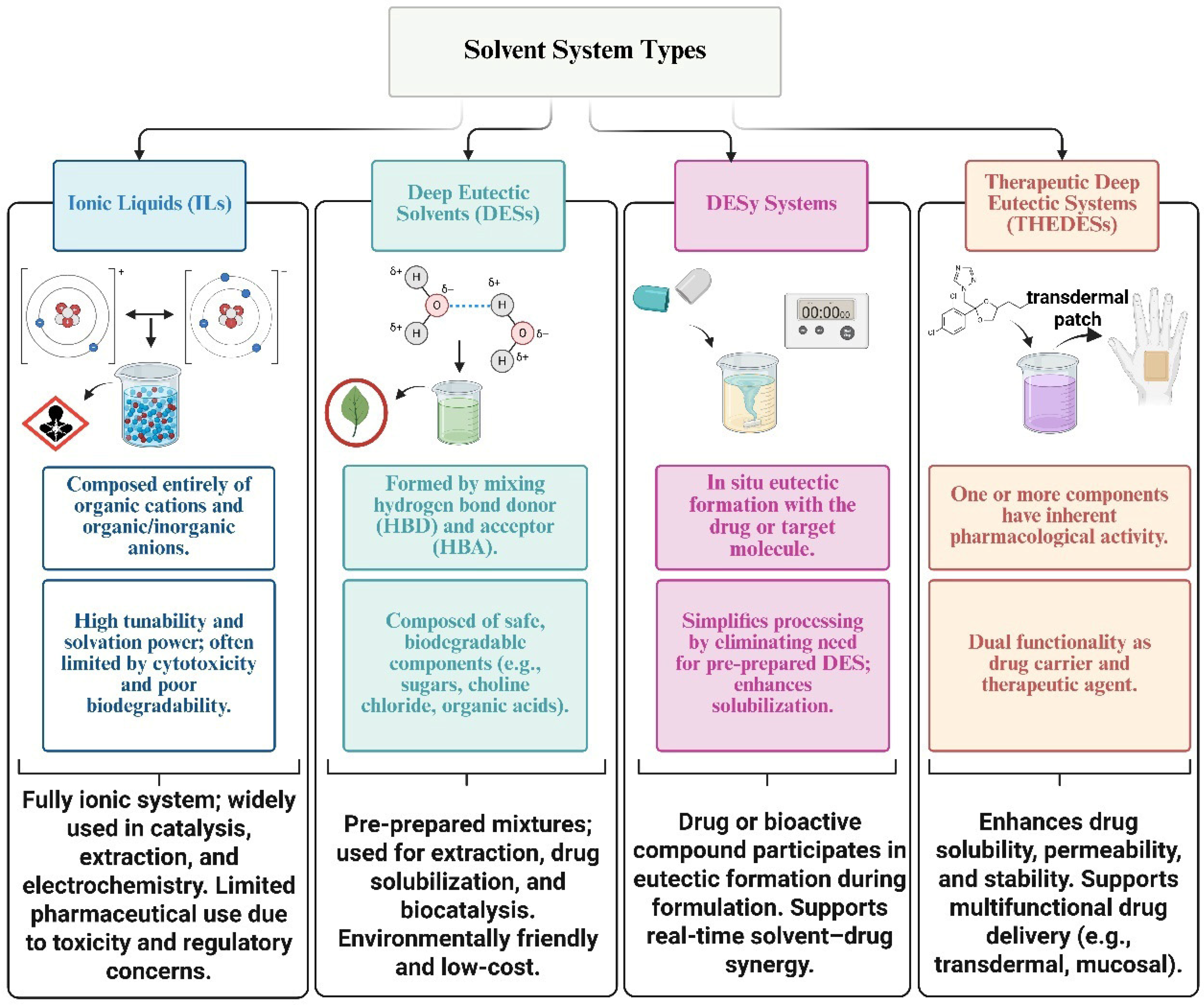
| Feature | ES | DES | ILs | DESy |
|---|---|---|---|---|
| Composition | Organic/inorganic blends of solid compounds | Mixtures of H-bond donors and acceptors (ionic or non-ionic) | Pure salts: discrete organic cations and inorganic/organic anions | In situ mixtures formed with the active compound as part of the eutectic system |
| Melting Behavior | Sharp melting point at eutectic composition (solid or semisolid at RT) | Depressed melting point; liquid at or near room temperature | Liquid at room temperature due to bulky asymmetric ions | Formed dynamically during application; liquid under process conditions |
| Type of Interactions | Weak van der Waals and minimal hydrogen bonding | Extensive hydrogen bonding network | Electrostatic (ionic) interactions | Hydrogen bonding and solvation driven by target molecule–solvent synergy |
| Polarity and Solubility | Moderate; limited to polar solutes | Polar; excellent for solubilizing poorly soluble APIs | Broad—dissolves both polar and non-polar compounds | Typically polar; designed to improve solubility of target APIs |
| Tunable Properties | Limited | Highly tunable via component selection and ratio adjustments | Highly tunable via cation/anion selection | Moderately tunable via selection of in situ interacting components and formulation conditions (e.g., temperature, water content). |
| Therapeutic Functionality | Typically absent | Possible if one or more components have inherent biological activity (THEDES) | Generally inert in drug delivery unless functionalized | Yes; active compound contributes to both therapeutic and solvent function |
| Toxicity and Biocompatibility | Depends on components | Often low (especially with natural components like fatty acids, amino acids, sugars) | Variable; some ILs have cytotoxicity and environmental concerns | Generally favorable if composed of GRAS or natural components |
| Environmental Impact | Moderate to high (based on solvents used) | Low (especially for NaDES and THEDES based on natural compounds) | Often high; requires careful design for biodegradability | Low; reduced processing steps and mild preparation conditions |
| Example Systems | Benzoic acid–urea | Choline chloride–urea, choline chloride–CA, menthol–ibuprofen | 1-butyl-3-methylimidazolium chloride ([Bmim] Cl), [EtPy] [BF4] | In situ systems formed with kiwifruit or date seed polysaccharides |
| Applications | Melting point depression, food, metallurgy | Green extraction, pharmaceutical formulation, topical/transdermal delivery (THEDES) | Organic synthesis, catalysis, electrochemistry, solubilization | Prebiotic extraction, drug solubilization, biocompatible formulations |
| Reference | [22] | [23] | [24] | [19] |
| Components with CA | Ratio | Observation | Application | Reference |
|---|---|---|---|---|
| Tetradecanoic acid (myristic acid) | CA: Myristic acid = 82:18 (mol%) or 78:22 (wt%) | Smooth, homogeneous, congruent melt; no phase separation | As a phase change material (PCM) of potential interest for passive temperature control in buildings | [43] |
| Myristic acid, Lauric acid, Steric acid | Molar Ratio (CA: Myristic acid) 3:1 | Pasty-like solid | Synergistic antimicrobial activity | [39] |
| Molar Ratio (CA: Lauric acid) 2:1 | Transparent liquid | |||
| Molar Ratio (CA: Stearic acid) 4:1 | White solid | |||
| Thymol, Menthol | (Thymol: CA) 0.33:0.67 | Homogeneous liquid | Reported physical properties and their dependence on constituents/composition of the NADESs will enhance their utility and help establish them as novel alternate media in science and technology. (Menthol: CA) | [44] |
| (Thymol: CA) 0.50:0.50 | Homogeneous liquid | |||
| (Thymol: CA) 0.67:0.33 | Homogeneous liquid | |||
| (Menthol: CA) 0.33:0.67 | Homogeneous liquid | |||
| (Menthol: CA) 0.50:0.50 | Homogeneous liquid | |||
| (Menthol: CA) 0.67:0.33 | Homogeneous liquid | |||
| Gefitinib | (Gefitinib: CA) 80:20 | Clear liquid | Enhance Gefitinib solubility and exhibit a synergistic cytotoxic effect against EGFR-expressing cell lines | [6] |
| (Gefitinib: CA) ≤70:30 | Pasty | |||
| (Gefitinib: CA)Extreme ratios | Powder/solid | |||
| Tetrabutylammonium chloride (TBAC), methyl tricaprylmethylammonium chloride (TOMAC) | (TBAC:CA) 1:2 | Clear, viscous fluid | Have the potential to be a novel class of lubricants | [45] |
| (TOMAC:CA) 1:2 | Clear, viscous fluid | |||
| Cineole | (Cineole: CA) 1: 1 | Clear, low-viscosity liquid | Very low viscous and dense fluid, with suitable properties for several solubilization technologies. its suitability to penetrate and stabilize cell membranes may lead to adverse outcomes when living organisms are exposed to this hydrophobic deep eutectic solvent. | [26] |
| Droperidol | (Droperidol: CA) 0.9:0.1 (D1) | Clear eutectic liquid; 1H NMR showed Δδ = +0.08–0.09 ppm at protons adjacent to piperidine N; DOSY confirmed reduced CA diffusion; DSC showed no melting peaks; highest intestinal flux (1.182 mg cm−2 s−1 at 15 min). | Solvent-free THEDES platform for enhancing droperidol solubility and intestinal permeability; suitable for green pharmaceutical formulation. | [8] |
| (Droperidol: CA) 0.8:0.2 (D2) | Homogeneous liquid; similar NMR shifts; DSC revealed CA recrystallization on cooling (−8.1 °C); slightly lower flux than D1. | |||
| (Droperidol: CA) 0.7:0.3 (D3) | Partial melting; depressed CA melting at 17.7 °C in DSC; signs of phase separation. | |||
| (Droperidol: CA) ≤ 0.6:0.4 (D4–D8) | Pasty mixtures; recrystallization and Tg observed in DSC; weak interaction. | |||
| Aripiprazole | (Aripiprazole: CA) 0.9:0.1 (A1) | Clear eutectic liquid; downfield shifts in amide (Δδ = +0.62 ppm) and piperazine CH2 (Δδ = +0.10 ppm); strong H-bonding confirmed. | Hydrogen-bond-stabilized eutectic systems enabling improved solubility and biopharmaceutical performance of aripiprazole. | [8] |
| (Aripiprazole: CA) 0.8:0.2 (A2) | Similar spectral shifts: eutectic liquid maintained; no residual crystallinity. | |||
| (Aripiprazole: CA) ≤ 0.7:0.3 (A3–A8) | Heterogeneous pastes; DSC showed unincorporated CA (e.g., CA melting at 18.7 °C in A3); weak or absent interactions. | |||
| Lauric acid | (Lauric acid: CA) 1:2 | Clear, homogeneous liquid; lowest density (0.859 g/cm3); Newtonian flow; visually stable. Lycopene yield 7.51 mg/100 g FW, total carotenoids 8.04 mg/100 g. | Green solvent for lycopene extraction; practical operating window established. | [46] |
| Lauric acid |
(CA: Lauric Acid)
1:1 | Transparent liquid; thicker flow (shear-thickening). Lycopene 2.98 mg/100 g. | Alternative HNADES with moderate performance. | [46] |
| (CA: Lauric Acid) 2:1 | Transparent liquid; more viscous feel; Lycopene 3.19 mg/100 g. | Lower-performing variant. | ||
| Dodecanoic acid |
(Dodecanoic cid:CA)
1:2 | Clear, uniform liquid; noticeably viscous; stable hydrophobic phase. Effective for Cu2+, Co2+, Ni2+ extraction | Green solvent for metal recovery; applicable in wastewater treatment. | [47] |
| Matrine | (Matrine:CA) 1:1 | Slightly yellowish homogeneous liquid; density and viscosity decrease with temperature; moderate thermal stability | better antibacterial activity on S. aureus as compared with matrine | [48] |
| Polyethylene glycol | Weigh% Mass Ratio (polyethylene glycol:CA) 1:1 | Congruent eutectic at ~22.9 °C with high latent heat (173.9 J g−1); reduced supercooling, faster crystallization, stable after 200 cycles, negligible corrosion. | Thermal energy storage for solar passive buildings; energy saving (≈4.9 kWh·kg−1·yr−1), cost-effective, and carbon neutral within ~3 years. | [49] |
| Mirtazapine | (Mirtazapine:CA) 1:2 | Light-yellow transparent viscous liquid; no crystals (polarized microscopy) | Transdermal delivery of MTZ to bypass first-pass metabolism; promising topical antidepressant THEDES. | [50] |
| Levofloxacine: | (CA:Levofloxacin) 9:1, 8:2, 7:3 (DES liquids formed at these ranges; eutectic ~80:20–70:30 | Clear liquids (THDES); DES formation confirmed by 1H NMR and ATR-FTIR (H-bonding) and DSC (melting point depression; excess CA signal decreases with more LEV). | Green THDES to enhance LEV performance: solubilization + antibacterial synergy; potential to combat resistance. | [40] |
| Ketoconazole: | Molar Ratio (Ketoconazole: CA) 1:5 | Clear, stable liquid at room temperature for ≥ 5 months. | Enhanced antifungal efficacy, solubility, and transdermal permeability using a green, stable THEDES system. | [7] |
| Oxymatrine: | (Oxymatrine: CA) 1: 1 | Stable transparent DES. | Biocompatible, low-toxicity enhancer; suitable when high safety is prioritized. | [51] |
| Ibuprofen: | (Ibuprofen: CA) 1:3 | Clear, stable liquid at 37 °C. | Effective transient eutectic solubilizer; excellent for dual-drug oral systems when combined with; balances high solubility and moderate release. | [52] |
| Clotrimazole | (Clotrimazole:CA) 1:1 | Solid at RT (not a DES) | Therapeutic DES (THEDES) for enhanced antifungal potency and skin permeation | [53] |
| (Clotrimazole:CA) 1:2 | Transparent liquid; physically stable ≥ 1 year | |||
| (Clotrimazole:CA) 1:3 |
(DES candidate)
Eutectic point; transparent liquid | |||
| (Clotrimazole:CA) 1:4 | Transparent liquid; physically stable (DES candidate) | |||
| (Clotrimazole:CA)1:5 | Solid at RT (not a DES) |
| Fatty Acid | Carbon No. | Melting Point (°C) | Relevant Viscosity | Aqueous Solubility (g/L) at 20 °C |
|---|---|---|---|---|
| Octanoic acid | C8 | 16.7 | Low | 0.7 |
| Nonanoic acid | C9 | 12.5 | Low | 0.3 |
| CA | C10 | 31.6 | Low-moderate | 0.15 |
| Lauric acid | C12 | 44.2 | Moderate–high | 0.055 |
| Myristic acid | C14 | 53.9 | High | 0.02 |
| Palmitic acid | C16 | 63.1 | High | 0.007 |
| Stearic acid | C18 | 69.6 | Very high | 0.003 |
Disclaimer/Publisher’s Note: The statements, opinions and data contained in all publications are solely those of the individual author(s) and contributor(s) and not of MDPI and/or the editor(s). MDPI and/or the editor(s) disclaim responsibility for any injury to people or property resulting from any ideas, methods, instructions or products referred to in the content. |
© 2026 by the authors. Licensee MDPI, Basel, Switzerland. This article is an open access article distributed under the terms and conditions of the Creative Commons Attribution (CC BY) license.
Share and Cite
Al-Akayleh, F.; Ali Agha, A.S.A.; Olaimat, A.R.; Biagini, G. Capric Acid-Based Therapeutic Deep Eutectic Systems: A Focused Review Within the Framework of Deep Eutectic Solvents. Pharmaceuticals 2026, 19, 159. https://doi.org/10.3390/ph19010159
Al-Akayleh F, Ali Agha ASA, Olaimat AR, Biagini G. Capric Acid-Based Therapeutic Deep Eutectic Systems: A Focused Review Within the Framework of Deep Eutectic Solvents. Pharmaceuticals. 2026; 19(1):159. https://doi.org/10.3390/ph19010159
Chicago/Turabian StyleAl-Akayleh, Faisal, Ahmed S. A. Ali Agha, Ali R. Olaimat, and Giuseppe Biagini. 2026. "Capric Acid-Based Therapeutic Deep Eutectic Systems: A Focused Review Within the Framework of Deep Eutectic Solvents" Pharmaceuticals 19, no. 1: 159. https://doi.org/10.3390/ph19010159
APA StyleAl-Akayleh, F., Ali Agha, A. S. A., Olaimat, A. R., & Biagini, G. (2026). Capric Acid-Based Therapeutic Deep Eutectic Systems: A Focused Review Within the Framework of Deep Eutectic Solvents. Pharmaceuticals, 19(1), 159. https://doi.org/10.3390/ph19010159