Article

An Investigational Study on the Role of ADME Agents’ Genetic Variation on DD217 Pharmacokinetics and Safety Profile

by
Dmitry A. Sychev
1,2,
Sherzod P. Abdullaev
1,2,*,
Anastasia V. Rudik
3,
Alexander V. Dmitriev
3,
Svetlana N. Tuchkova
1,2,
Natalia P. Denisenko
1,2,
Denis S. Makarov
4 and
Karin B. Mirzaev
1,2
1
Federal State Budgetary Research Institution «Russian Research Center of Surgery Named After Academician B.V. Petrovsky», Abrikosovsky Lane, 2, 119991 Moscow, Russia
2
Federal State Budgetary Educational Institution of Further Professional Education “Russian Medical Academy of Continuous Professional Education” of the Ministry of Healthcare of the Russian Federation, Barrikadnaya Str. 2/1, Bld. 1, 125993 Moscow, Russia
3
Institute of Biomedical Chemistry, Bldg. 8, 10, Pogodinskaya Str., 119121 Moscow, Russia
4
Avexima Diol LLC, 690922 Vladivostok, Russia
*
Author to whom correspondence should be addressed.
Pharmaceuticals 2025, 18(11), 1617; https://doi.org/10.3390/ph18111617
Submission received: 25 September 2025 / Revised: 20 October 2025 / Accepted: 23 October 2025 / Published: 27 October 2025
(This article belongs to the Special Issue Pharmacotherapy of Thromboembolism)

Abstract

Background/Objectives: Direct oral anticoagulants (DOACs) have transformed the prevention of thromboembolic events, but their efficacy and safety remain highly variable across individuals. DD217, a novel oral direct factor Xa inhibitor, has demonstrated potent anticoagulant activity in preclinical and clinical studies. No pharmacogenetic data are currently available for this compound. Based on in silico predictions of metabolic pathways and transporter involvement, and evidence from other DOACs, we hypothesized that variants in CYP2C and P-glycoprotein genes may contribute to variability in pharmacokinetics (PK) and clinical outcomes. Methods: Fifty-two patients undergoing total knee arthroplasty were enrolled, of whom 34 received the investigational drug (40 mg/day, n = 16; 60 mg/day, n = 18). DNA was extracted from peripheral blood cells, and genotyping of CYP2C9, CYP2C19, CYP2C8, CYP3A4, CYP3A5, and ABCB1 was performed by real-time PCR. Pharmacokinetics (PK) parameters (Tmax, AUClast, Cmax) were assessed. In silico docking and pathway modeling predicted CYP2C and P-glycoprotein (ABCB1) involvement in drug disposition. Associations of genetic variants with PK parameters and adverse events (thrombosis, bleeding) were analyzed. Results: Carriers of reduced-function CYP2C9 alleles (intermediate [IM] or poor metabolizers [PM]) in the 60 mg group had a significantly shorter Tmax compared with normal metabolizers (p = 0.005227), with trends toward higher AUClast (p = 0.06926) and Cmax (p = 0.1259). No significant associations were observed for CYP2C19, CYP3A4/5, or CYP2C8. In contrast, ABCB1 polymorphisms were associated with systemic exposure: carriers of the C allele at rs1045642 had higher AUClast and Cmax compared to TT (wild-type) homozygotes, while rs2032582 T allele carriers showed lower exposure (p < 0.05). At the haplotype level, the C–G–C–T combination of ABCB1 was more frequent in patients with thrombotic events at the 40 mg dose (p = 0.038). Overall, 5 thrombosis events and 1 bleedings were recorded on DD217, with no consistent associations to single SNPs. Conclusions: This first pharmacogenetic evaluation of DD217 shows that CYP2C9 variants are associated with differences in early-phase pharmacokinetics (Tmax), while ABCB1 polymorphisms appear to modulate systemic exposure (AUClast, Cmax) and may influence thrombotic risk. These observations are consistent with in silico predictions of metabolic and transporter pathways. Despite limitations in sample size and event frequency, the study highlights the feasibility and importance of early pharmacogenetic evaluation during the drug development cycle of novel DOACs.

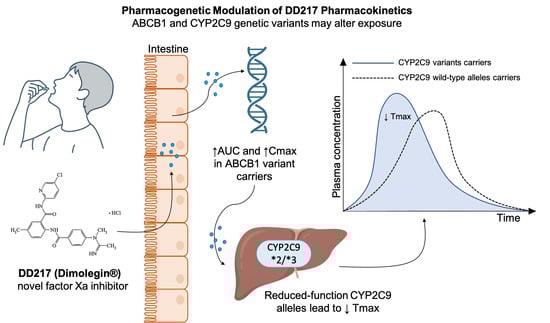
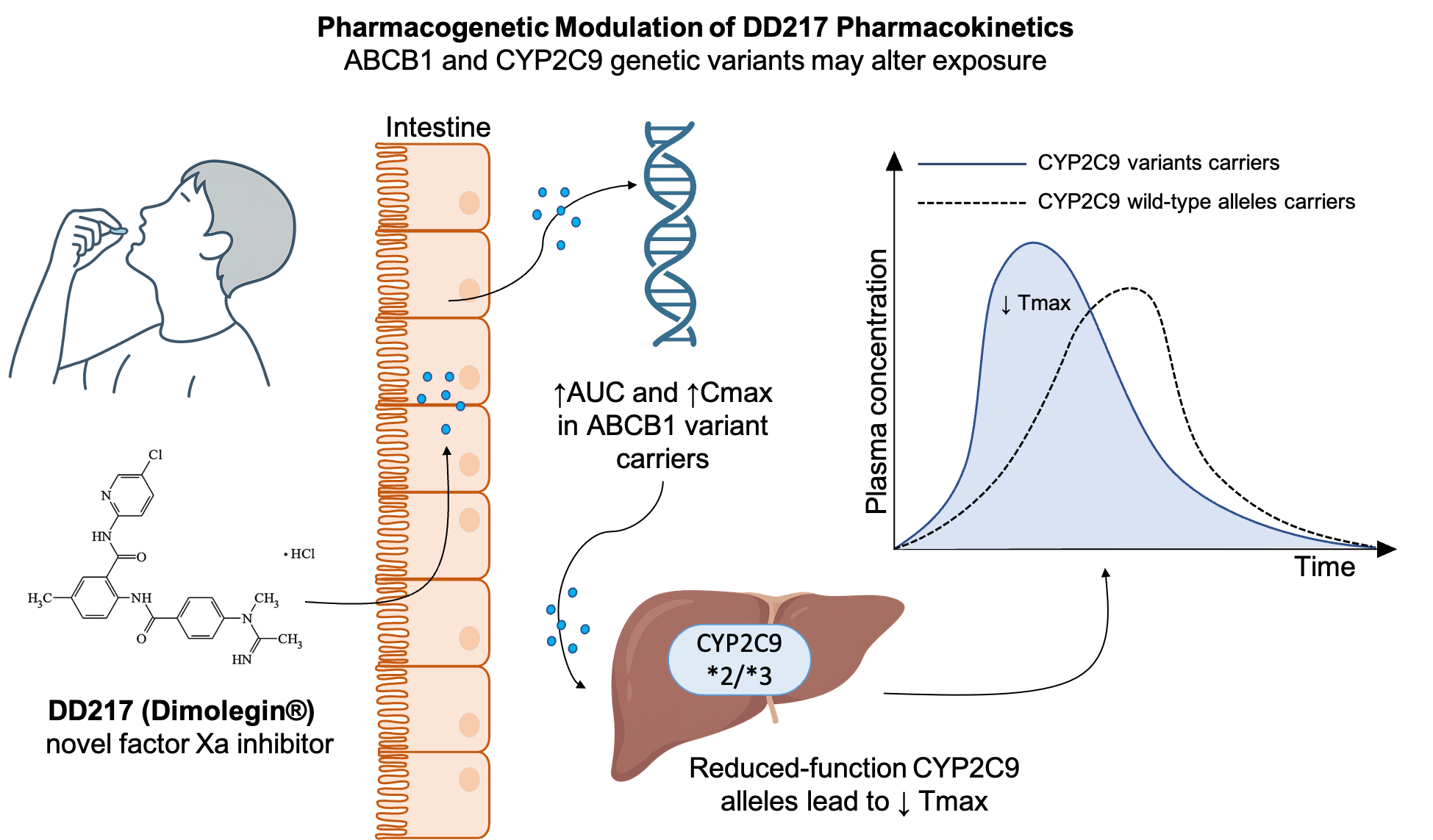
Graphical Abstract

1. Introduction

Venous thromboembolic events (VTEs), including deep vein thrombosis (DVT) and pulmonary embolism (PE), rank among the leading causes of cardiovascular morbidity and mortality worldwide [1]. In recent years, direct oral anticoagulants (DOACs)—factor Xa inhibitors (rivaroxaban, apixaban, edoxaban, betrixaban) and the direct thrombin inhibitor dabigatran—have largely replaced vitamin K antagonists, particularly warfarin, due to their predictable pharmacokinetic properties, fixed dosing regimens, and the lack of need for routine laboratory monitoring of hemostasis parameters [2,3].
A major challenge associated with DOAC therapy is the pronounced interindividual variability in pharmacological response, which may lead either to thromboembolic events or to bleeding complications. Inappropriate dose selection can increase the likelihood of thrombotic events in cases of insufficient anticoagulation or, conversely, result in bleeding due to drug overexposure. It is estimated that one-third to one-half of adverse reactions caused by anticoagulants are iatrogenic and therefore potentially preventable. For example, in the ORBIT-AF II Registry, among 5738 reviewed medical records, 541 patients (9.4%) were prescribed an insufficient dose of a DOAC, 197 patients (3.4%) received an inappropriately high dose, while the remaining 5000 patients were treated in accordance with clinical guidelines [4]. Prescription of DOAC doses exceeding the recommended levels was associated with increased all-cause mortality (OR 1.91, 95% CI 1.02–3.60; p = 0.04). Conversely, intentional underdosing was linked to a higher rate of hospitalizations due to cardiovascular events (OR 1.26, 95% CI 1.07–1.50; p = 0.007) [5]. Epidemiological studies further indicate that each year, 2–4% of patients receiving DOAC therapy experience major bleeding events, while 10–12% experience clinically relevant non-major bleeding [6].
Variability in the efficacy and safety of DOAC therapy is largely determined by individual clinical and demographic characteristics, including sex, age, comorbidities, hepatic and renal function, as well as concomitant medication use. In recent years, increasing attention has been directed toward the role of genetic factors that may influence the pharmacokinetics and safety profile of DOACs. Polymorphic variants in genes encoding cytochrome P450 enzymes (CYP3A4, CYP3A5, CYP2J2, CYP2C9), carboxylesterase 1 (CES1), and transport proteins (ABCB1, ABCG2) can affect DOAC absorption, bioavailability, and elimination [7,8,9]. However, results obtained across different populations have been inconsistent [10,11,12,13], and, to date, no clinical algorithms exist that allow for drug or dose selection of DOACs based on a patient’s pharmacogenetic profile [14].
DD217 (Dimolegin®, N-(5-chloropyridin-2-yl)-5-methyl-2-[4-(N-methylacetimidamido)benzamido]benzamide hydrochloride) is the new direct factor Xa inhibitor [15]. Preclinical studies demonstrated that DD217 exhibits high affinity for the active site of factor Xa, providing a pronounced anticoagulant effect upon oral administration [16]. According to docking and in silico modeling data, DD217 shows strong “tight binding” interactions with key amino acids in the S4 subpocket of factor Xa, resulting in high affinity and a pharmacodynamic potential comparable to that of internationally approved DOACs [17]. Several clinical trials have been conducted with Dimolegin® for the prevention of thromboembolic complications in patients hospitalized with COVID-19 (Larvol Sigma. Company profile: PharmaDiall. Available online: https://sigma.larvol.com/company.php?CompanyId=995122&tab=newstrac (accessed on 25 August 2025)). Currently, Dimolegin® is approved in Russia for the prevention of VTE in adult patients with moderate coronavirus disease (SARS-CoV-2 infection) (marketing authorization No. LP-008704, dated 14 December 2022; State Register of Medicines (Russia). DD217 marketing authorization. Available online: https://grls.rosminzdrav.ru/Grls_View_v2.aspx?routingGuid=e3484e4c-b843-425e-8861-49b7e4709997 (accessed on 25 August 2025)).
The impact of genetic factors on the pharmacokinetics and safety of DD217 has not yet been investigated. Therefore, investigating polymorphisms in genes involved in ADME processes at an early stage of the drug’s life cycle is particularly important, as the identification of relevant markers could pave the way for personalized use of this novel anticoagulant and help optimize the balance between efficacy and safety.

2. Results

2.1. Genotyping Results

The distribution of alleles and genotypes for all investigated markers, with the exception of CYP3A4*18B (rs28371759 A>G), was consistent with Hardy–Weinberg equilibrium (HWE) (p > 0.05). For CYP3A4*18B (rs28371759 A>G), this test could not be applied due to the absence of patients carrying alternative genotypes. The results are summarized in Table 1.
Allele frequencies in this relatively small cohort were generally comparable to those reported for populations of European ancestry [18].
Based on the combined genotyping results, patients were stratified into phenotypic categories of metabolism for the main cytochrome P450 isoenzymes. For CYP2C9, the categories included poor metabolizers (PM), intermediate metabolizers (IM), and normal metabolizers (NM); for CYP2C19, PM, IM, NM, rapid metabolizers (RM), and ultrarapid metabolizers (UM); and for CYP3A, intermediate metabolizers (IM) and extensive metabolizers (EM). The distribution of patients across these phenotypic categories is shown in Table 2.

2.2. Association Between Pharmacogenetic Markers and Pharmacokinetic Parameters of DD217

Analysis of the relationship between carriage of polymorphic variants in CYP2C9, CYP2C19, and CYP3A genes and the pharmacokinetic parameters of DD217—Cmax (maximum plasma concentration), Tmax (time to reach Cmax), and AUClast (area under the plasma concentration-time curve up to the last measurable point)—revealed several significant associations (Table 3).
For CYP2C9, in the group of patients receiving 60 mg/day of DD217, carriers of reduced-function alleles (IM and PM) demonstrated significantly lower Tmax values compared with normal metabolizers (NM) (p = 0.005227). For AUClast and Cmax, only a trend toward higher values was observed in IM/PM carriers, which did not reach statistical significance (p = 0.06926 and p = 0.1259, respectively). At the 40 mg/day dose, no significant associations between CYP2C9 genotypes and pharmacokinetic parameters were identified.
For CYP2C19 and CYP3A polymorphisms, no statistically significant differences in Tmax, AUClast, or Cmax were observed across the phenotypic groups (PM, IM, NM, RM, UM for CYP2C19; EM and IM for CYP3A), either at the 40 mg/day or 60 mg/day dose levels.
Analysis of associations between CYP2C8 variants (rs10509681 and rs11572080) and pharmacokinetic parameters revealed no statistically significant differences in either the 40 mg/day or 60 mg/day groups (Table 4). Mean values of Tmax, AUClast, and Cmax in carriers of minor alleles did not differ from those observed in wild-type homozygotes (p > 0.05 in all cases). In addition, a haplotype-based analysis was performed to assess the potential combined effect of the studied CYP2C8 variants. The distribution of haplotypes and their relationship with pharmacokinetic parameters are presented in Table 5, with no statistically significant associations detected (p > 0.05 for all comparisons).
In the group of patients receiving 40 mg/day, no significant associations were found between ABCB1 genotypes and pharmacokinetic parameters (Table 6). Similarly, haplotype analysis did not reveal any statistically significant differences between carriers of different allele combinations (Table 7).
In contrast, in the group of patients receiving 60 mg/day, several ABCB1 variants were found to be associated with drug exposure (Table 8). Specifically, carriage of the C allele at rs1045642 was associated with higher AUClast and Cmax values compared with T/T homozygotes. Conversely, carriage of the T allele at rs2032582 was linked to lower AUClast and Cmax. For rs1128503 and rs4148738, the opposite pattern was observed: the presence of the C allele (rs1128503) or the T allele (rs4148738) was associated with increased drug exposure. However, haplotype analysis of ABCB1 variants (Table 9) did not confirm statistically significant associations at the level of combined allelic patterns; no differences in Tmax, AUClast, or Cmax were observed between haplotype groups (p > 0.05 for all comparisons).

2.3. Association Between Pharmacogenetic Markers and the Incidence of Adverse Events During DD217 Therapy

During the study, seven cases of thromboembolic complications (DVT/PE) and two bleeding episodes were recorded among patients receiving DD217. The genotypic and phenotypic characteristics of these patients are summarized in Table 10.
Among patients who experienced thromboembolic events, no consistent patterns were observed to suggest an association between carriage of specific CYP2C9, CYP2C19, or CYP3A variants and an increased frequency of complications. DVT/PE cases occurred both in normal metabolizers (NM) and in carriers of altered phenotypes (IM, PM), with no statistically significant differences between groups. Similarly, bleeding episodes were observed in patients with different CYP2C9 and CYP2C19 phenotypes, which also precluded the identification of gene-level associations (Table 11). These findings are most likely attributable to the limitations of our analysis, including the small sample size, the low frequency of clinical events, and the need for further studies in larger cohorts with extended and long-term follow-up.
On the other hand, similar analyses demonstrated that in the group of patients receiving 40 mg/day of DD217, carriage of the C–G–C–T haplotype (rs1045642–rs2032582–rs1128503–rs4148738) of the ABCB1 gene was significantly more frequent among those who developed thromboembolic complications (p = 0.038; Table 12). This finding suggests that the haplotypic structure of ABCB1, rather than individual SNPs, may influence the risk of thrombotic outcomes.
However, at the level of individual markers, no significant associations with the incidence of adverse events were identified, as no differences were observed between groups (Table 13).
In the cohort of patients receiving 60 mg/day, no statistically significant differences were observed between those with and without adverse outcomes, either at the level of individual SNPs (Table 14) or ABCB1 haplotypes (Table 15). The small number of bleeding and thrombotic events precluded more detailed analyses and limited the statistical power of the study.

3. Discussion

The inclusion of pharmacogenetic investigations in the clinical development of novel drugs at early stages of their life cycle represents an important direction in modern pharmaceutical research. Traditionally, the impact of genetic factors on pharmacokinetics and pharmacodynamics has been assessed only after market approval, once sufficient clinical experience has accumulated and interindividual differences in efficacy and safety have become evident. For DOACs such as rivaroxaban, apixaban, and dabigatran, meaningful insights into the contribution of cytochrome P450 and drug transporter gene polymorphisms to variability in pharmacological response were largely obtained retrospectively, under conditions of clinical use. Regulatory agencies, including the FDA and EMA, now strongly encourage the integration of pharmacogenetic approaches into the early stages of drug development and clinical trials, as this enables the identification of predictors of efficacy and risk of adverse events before a drug is widely released into the market [19,20,21]. Such an approach supports the development of a more comprehensive safety and efficacy profile at an early stage in the drug’s life cycle and can provide the foundation for algorithms guiding individualized pharmacotherapy. Experience with pharmacogenetic studies in phase I–II trials underscore their practical relevance: the identification of associations between ADME gene variants (CYP2C9, CYP2C19, ABCB1, among others) and pharmacokinetic parameters can inform the design of subsequent studies and reduce the likelihood of unfavorable outcomes [22,23].
The in silico screening confirmed the anticipated anticoagulant activity of DD217 and its inhibition of factor Xa (PASS: Pa = 0.894 and Pa = 0.609, respectively), providing internal consistency with preclinical and clinical evidence on the drug’s mechanism of action [24]. Beyond the pharmacodynamic profile, in silico tools suggested possible involvement of CYP2C family isoenzymes in DD217 metabolism: PASS predicted CYP2C8 inhibition, while results from multiple platforms (SwissADME, CYPstrate, P450-Analyzer, CYPlebrity) indicated both substrate potential and inhibitory activity for CYP2C9, CYP2C19, and CYP3A4. On the one hand, these dual signals supported the rationale for including CYP2C9, CYP2C19, CYP3A4, and CYP2C8 in the candidate genotyping panel, demonstrating how in silico results can serve as a prioritization tool for ADME targets. They also point to the theoretical possibility of clinically relevant drug–drug interactions (DDIs) when co-administered with substrates of these enzymes, warranting validation in in vitro systems and clinical settings [25,26]. Another interpretation is that potential inhibition could lead to phenoconversion—that is, attenuation of genetically determined differences in enzyme activity due to pharmacological blockade [27]. In other words, CYP inhibition may “mask” genetically driven variability in enzyme function, thereby reducing the observable differences between carriers of distinct allelic variants.
An additional in silico finding was the structural comparison: among molecules with similar metabolic profiles, betrixaban emerged as the closest analogue (Tanimoto = 0.587; Hausdorff = 0.358). This is consistent with the known pharmacokinetics of betrixaban, characterized by predominant circulation of the unchanged parent compound in plasma and the formation of two inactive hydrolytic metabolites with minimal CYP involvement (<1% of metabolism via CYP) (DrugBank. Betrixaban (DB12364). Available online: https://go.drugbank.com/drugs/DB12364 (accessed on 12 August 2025)). Betrixaban is also recognized as a P-glycoprotein (ABCB1) substrate, with corresponding interactions when co-administered with P-gp inhibitors [28]. These parallels allowed us to extrapolate structurally informed expectations regarding the contribution of P-gp transport to DD217 disposition and justified the inclusion of ABCB1 variants among the candidate genes, a rationale partially supported by our results: ABCB1 polymorphisms were indeed associated with altered drug exposure.
In our study, statistically significant associations were identified in the 60 mg/day cohort between specific ABCB1 variants (rs1045642, rs2032582, rs1128503, and rs4148738) and AUClast and Cmax (p < 0.05), but not Tmax (p > 0.05). In the 40 mg/day group, no significant associations with pharmacokinetic parameters were observed, either at the level of individual SNPs or haplotypes. Similarly, haplotype-based analyses in the 60 mg/day group did not reveal statistically significant associations. This distribution of effects appears biologically plausible and aligns with the classical pharmacokinetics of P-gp substrates in the gastrointestinal tract. P-gp plays a key role in limiting substrate absorption; variability in efflux activity primarily affects the extent of absorption (exposure and peak concentration), whereas the rate of peak appearance (Tmax) is more often determined by solubility constraints, gastric emptying, and baseline permeability, making it less sensitive to moderate alterations in efflux activity [29].
The dose-dependent nature of the associations (observed at 60 mg but not at 40 mg) may reflect saturation or threshold-level involvement of the efflux transporter P-gp at higher drug concentrations, where transporter-mediated efflux becomes rate-limiting and interindividual differences in its activity translate more strongly into variability in exposure. This interpretation is consistent with findings for other DOACs—particularly rivaroxaban and apixaban, both P-gp substrates. For rivaroxaban, ABCB1 involvement has been demonstrated in cellular models, although the influence of specific ABCB1 polymorphisms on transport has not always been observed in vitro [30], and clinical associations between ABCB1 variants and DOAC exposure have not been consistently reported across studies, including population PK models and systematic reviews [8,9,31]. The heterogeneity of these findings may partly reflect the common practice in pharmacogenetic studies of “normalizing” concentrations relative to DOAC dose (C/Dose), which could interfere with or obscure potential marker effects. This issue warrants further investigation.
Three major ABCB1 variants—3435T>C, 2677T>G/A, and 1236T>C—have been extensively studied; together they form a haplotype associated with altered P-gp function and, more broadly, with reduced activity and substrate specificity of this transporter [32]. However, evidence regarding their impact remains inconsistent. In our study, the absence of haplotype-level associations despite the presence of SNP-level effects is likely attributable to the low frequency of certain allele combinations and the limited sample size, which reduced statistical power, as well as to the possible functional nonequivalence of individual variants within haplotypes [11]. Moreover, only moderate linkage disequilibrium between these loci (r2 = 0.3–0.7 in European populations) suggests that their combined evaluation may have diluted the effects observed for individual SNPs.
For CYP2C9, an association between metabolic phenotype and Tmax was observed at the 60 mg/day dose: carriers of reduced-function alleles (IM + PM) exhibited a significantly shorter time to reach Cmax compared with normal metabolizers (NM), alongside a trend toward higher AUClast and Cmax values. At the 40 mg dose, no consistent pattern was found, which may reflect a combination of dose-dependent pharmacokinetic effects and limited subgroup size, whereas at 60 mg partial saturation of CYP2C9-mediated clearance could enhance differences in exposure.
The observed association between CYP2C9 phenotype and shorter Tmax values in 60 mg group may be explained by reduced early-phase clearance and attenuated presystemic metabolism, resulting in more rapid and pronounced plasma concentration increases (Cmax) together with a tendency toward greater overall exposure (AUC). Although this shift could theoretically lead to an earlier onset of anticoagulant action, no consistent relationship with thrombotic or bleeding events was observed in our cohort. Further studies including time-matched anti-Xa pharmacokinetic/pharmacodynamic profiling and larger patient samples are warranted to clarify whether earlier peak exposure translates into clinically meaningful differences in DD217’s anticoagulant efficacy or safety.
Taken together, the results suggest that at the higher DD217 dose, intestinal efflux (ABCB1) and early elimination processes (CYP2C9) become rate-limiting steps, translating into differences in AUC and Cmax for ABCB1 and in Tmax for CYP2C9. At the lower dose (40 mg), the contribution of these pathways either does not limit systemic exposure or is masked by overall variability and the limited statistical power of the sample. This interpretation is consistent with fundamental pharmacokinetic and biopharmaceutical models describing the impact of P-gp and metabolic enzymes on absorption profiles and early-phase plasma concentrations [29]. Comparable findings have been reported for other DOACs: the evidence for CYP polymorphisms influencing exposure to factor Xa inhibitors is heterogeneous and generally weaker than for transporters. Systematic reviews and GWAS studies more consistently emphasize the role of ABCB1 and ABCG2 [8,33,34], whereas associations with CYP polymorphisms are less frequent, less consistent, and often dependent on study design and cohort size [9].
No significant associations were identified between carriage of CYP2C9, CYP2C19, CYP3A4/5, CYP2C8, or ABCB1 variants and the incidence of thromboembolic complications or bleeding events, regardless of the daily DD217 dose. Isolated cases of thrombosis and bleeding were observed both in carriers of “normal” phenotypes and in patients with reduced enzymatic or transporter activity, precluding statistically significant differences between groups. First, the low frequency of clinical outcomes combined with the limited sample size substantially reduced the statistical power of the analysis. Second, the occurrence of thrombotic and bleeding complications is inherently multifactorial: in addition to pharmacokinetic determinants (including enzyme and transporter genetics), risk is influenced by clinical and demographic characteristics, comorbidities, concomitant pharmacotherapy, and other factors [35,36]. This complexity complicates efforts to disentangle the contribution of individual genetic markers in a small-scale analytical study. Even when such variants affect pharmacokinetic parameters (AUClast, Cmax, Tmax), translating these differences directly into clinical outcomes is challenging within a limited cohort. A clinically observable effect on complication risk typically requires either a more pronounced modification of drug exposure or the presence of additional risk factors. Similar observations have been reported in studies and meta-analyses of rivaroxaban and apixaban: while ABCB1 polymorphisms have been linked to altered drug exposure [33,34,37], consistent associations with bleeding or thrombotic risk have not been demonstrated [8,10,11], or risk was shaped by a combination of clinical and laboratory factors [13].
Overall, this study identified specific associations between ABCB1 and CYP2C9 genetic variants and the pharmacokinetic parameters of DD217, highlighting their potential role in shaping interindividual variability in drug exposure. Although consistent links between pharmacogenetic markers and clinical outcomes could not be demonstrated within the limited cohort, the findings, supported by in silico predictions, provide a biologically plausible basis for further exploration of these pathways in larger patient populations. The magnitude of the observed genotype effects appears modest and comparable to that reported for other DOACs, supporting the feasibility of early pharmacogenetic evaluation rather than indicating immediate clinical applicability.

Limitations

This study has several limitations that must be considered when interpreting the findings. First, the limited sample size substantially reduced the statistical power of the analysis and the likelihood of detecting weaker associations. In addition, the low frequency of clinical outcomes (seven thrombotic events and two bleeding episodes) precluded a reliable assessment of the influence of genetic factors on the risk of complications, consistent with the limitations observed in other pharmacogenetic studies of DOACs. Another limitation is the relatively short observation period (14 days of therapy), which did not allow for the evaluation of long-term thrombotic and hemorrhagic events. Furthermore, the selection of genes was based on a candidate gene approach and in silico predictions, which does not permit the identification of unexpected associations that could emerge from genome-wide analyses. Finally, the results should be interpreted with caution due to the absence of in vitro verification of the predicted interactions (e.g., CYP2C9/2C19 inhibition, P-gp transport) and the limited generalizability of the findings to broader patient populations with diverse comorbidities. These limitations underscore the need for larger and longer-term studies employing multifactorial models that integrate both genetic and clinical determinants of risk—including demographic characteristics (age, sex), renal function, and concomitant medications—in line with current trends in anticoagulant pharmacogenetics [14,38].

4. Materials and Methods

4.1. Study Population

The design, eligibility criteria, and outcomes of the phase II clinical trial evaluating the safety and tolerability of DD217 (NCT05189002, ClinicalTrials.gov) have been described previously [39]. Briefly, this was a multicenter, double-blind, randomized, prospective phase II study designed to determine the optimal dosing regimen and to assess the safety and efficacy of DD217 for the prevention of venous thromboembolism (VTE) in patients undergoing knee replacement surgery. Patients were randomized into one of three groups: two groups received oral DD217 at doses of 40 mg or 60 mg once daily, starting on the morning of the first postoperative day, and one group received the active comparator, dalteparin sodium. The treatment duration was 14 days.
The study was conducted in compliance with Russian legislation and international regulatory standards, including the Declaration of Helsinki (World Medical Association, 2013) and the principles of Good Clinical Practice (National Standard of the Russian Federation, GOST R 52379-2005) [40]. All patients provided written informed consent prior to participation. The study protocol and related documents were approved by the Ethics Committee of the Ministry of Health of the Russian Federation (protocol excerpt No. 192, 21 May 2019). For the present analysis, blood samples and de-identified clinical and pharmacokinetic data were provided by the trial sponsor (Avexima Diol LLC, Vladivostok, Russia). All data were de-identified prior to analysis, and investigators had no access to personal identifiers. The authors of this manuscript were not involved in patient recruitment or in the conduct of the clinical trial.
In total, data from 52 patients who underwent knee replacement surgery were included in the analysis. Of these, 34 patients received DD217 at daily doses of 40 mg (n = 16) or 60 mg (n = 18), and 18 patients received dalteparin sodium. The clinical and demographic characteristics, as well as laboratory parameters of the study participants, are summarized in Table 16.
In total, seven cases of DVT/PE were documented during the trial: four in the DD217 40 mg/day group, one in the DD217 60 mg/day group, and two in the dalteparin sodium group. In addition, two bleeding events were recorded: one clinically relevant non-major bleed in the DD217 60 mg/day group and one clinically non-relevant minor bleed in the dalteparin sodium group. These data were subsequently used to evaluate the contribution of the studied genetic markers to the incidence of adverse events associated with DD217 therapy.
To characterize the pharmacokinetic profile of DD217 in our study, three parameters were assessed: Cmax, Tmax, and AUClast. The results are presented in Table 17.

4.2. In Silico Assessment of Pharmacological Potential of DD217

The structural formula of DD217 (N-(5-chloropyridin-2-yl)-5-methyl-2-[4-(N-methylacetimidamido)benzamido]benzamide hydrochloride) is shown in Figure 1.
The pharmacological potential of DD217 was assessed by predicting its effects, metabolism, and transporter interactions. For pharmacological effect prediction, we used the PASS program [41,42], a well-established program trained on large, curated structure–activity datasets. PASS was selected because of its broad coverage of pharmacological endpoints, repeated peer-reviewed validation, and suitability for exploring novel chemotypes. (see, e.g., Abdul-Hammed M. et al. (2022) [43]; Bocharova O.A. et al. (2023) [44]; Gangwal A. et al. (2025) [45]; Medvedeva S.M. et al. (2024) [46]; Muratov E.N. et al. (2020) [47]; Panina S.V. et al. (2022) [48]; Schimunek J. et al. (2024) [49]; Sukhachev V.S. et al. (2024) [50]). We used PASS 2022 which is based on the training set including over 1.6 million biologically active compounds. It predicts more than eight thousand biological activities with average accuracy of 0.936.
As a result of the prediction, the user obtains a list of probable types of activity with two values: Pa and Pi. Pa (Pi) represents the probability of the compound belonging to class of active (inactive) compounds, respectively.
Pharmacological effects and mechanisms of action predicted for DD217 with threshold at Pa > 0.5 are given in Table 18.
As one may see from Table 18, probable biological activities correspond to the pharmacological effects and mechanisms of action confirmed in the preclinical and clinical studies [23].
The result of the prediction of DD217’s interaction with metabolic enzymes, obtained using the PASS at the threshold Pa > Pi, is presented in Table 19.
It should be noted that CYP2C29 is a cytochrome P450 enzyme in mice, and CYP2C3 is in rabbits. CYP2C8 is a human enzyme.
For pharmacokinetic profiling of DD217 we used various widely issued publicly available online resources, including SwissADME [51], CYPstrate [52], P450 Analyzer [53], CYPlebrity [54], ADMETlab 2.0 [55] and MetaPASS [56]. These tools were chosen based on their predictive performance and their complementarity in terms of metabolic and transporter-related endpoints. The use of multiple prediction tools improves the reliability of the final assessment of the pharmacokinetic profile of DD217.
SwissADME and ADMETlab 2.0 provide a comprehensive analysis of ADME parameters and use multiple machine learning models to predict various parameters. They were used for assessing the belonging of DD217 to the inhibitors of cytochrome P450 enzymes and to inhibitors and substrates of P-gp. The CYPstrate resource is a tool focused on the prediction of substrates of major CYPs. It returns “Non-substrate” or “Substrate” values without specifying the probabilities of this value. The P450 Analyzer resource is focused on P450 enzymes interaction and provides both the estimation of pIC50 value (calculated using the GUSAR algorithm [57]) and the Pa and Pi values. CYPlebrity uses a high-quality ML algorithm to estimate the probability of inhibitory activity against P450.
The summary tables below (Table 20, Table 21 and Table 22) list the resources and prediction results for DD217 in relation to the substrates (Table 20 and Table 22) or inhibitors (Table 21 and Table 22) of the corresponding enzymes (CYP P450 or P-gp). For the P450 Analyzer resource, the Pa-Pi values are presented in the tables. The results of other resources are presented “as is”, including the phrase “No prediction” in CYPstrate web resource.
Based on the prediction results given in Table 20 and Table 21, it can be assumed that DD217 is the potential substrate and inhibitor of CYP2C.
Using the MetaPASS web resource [56], structures of the pharmaceutical substances similar to DD217 were found among the known metabolic schemes. The most similar was the direct oral anticoagulant Betrixaban, an inhibitor of factor X (DrugBank. Betrixaban (DB12364). Available online: https://go.drugbank.com/drugs/DB12364 (accessed on 12 August 2025)). The similarity between DD217 and Betrixaban is equal to 0.587 (Tanimoto coefficient, based on MNA descriptors) and 0.358 (Hausdorff distance, based on QNA descriptors). It is known [58] that unmetabolized Betrixaban is the predominant form in human plasma, followed by two hydrolytic CYP-independent inactive metabolites.

4.3. Candidate Gene Selection

The official drug label indicates that DD217 is metabolized to form a hydroxylated derivative. It also specifies a potential risk of drug-drug interactions at the level of cytochrome P450 enzymes, particularly CYP2C9 (e.g., losartan, diclofenac, ibuprofen, naproxen) and CYP3A4 (azole antifungals such as ketoconazole and fluconazole). Considering known metabolic pathways and the spectrum of predicted biological activities, DD217 most closely resembles the anticoagulant betrixaban, which is not approved in Russia.
Based on the predicted metabolic pathways from in silico modeling (derived from the structure of the active substance and its activity spectrum), available information on drug metabolism and potential drug–drug interactions, pharmacogenetic data from other DOACs, as well as a review of the scientific literature and the PharmGKB database (PharmGKB. Available online: https://www.pharmgkb.org/ (accessed on 15 April 2025)), we selected genetic markers that may potentially be associated with variability in the pharmacological response and pharmacokinetic parameters of DD217. A candidate gene panel was assembled, including the following single nucleotide polymorphisms (SNPs): CYP2C9*2 (rs179985, 430C>T), CYP2C9*3 (rs1057910, 1075A>C), CYP2C19*2 (rs4244285, 681G>A), CYP2C19*3 (rs4986893, 636G>A), CYP2C19*17 (rs12248560, −806C>T), CYP2C8*3 (rs10509681, T>C), CYP2C8*3 (rs11572080, C>T), CYP3A4*18B (rs28371759, 878T>C), CYP3A4*1B (rs2740574, C>T), CYP3A4*22 (rs35599367, C>T), CYP3A5*3 (rs776746, A>G), and four variants of ABCB1 (rs4148738, C>T; rs1045642, 3435T>C; rs2032582, 2677G>T; rs1128503, 1236C>T). Selection of candidate genes for genotyping was guided by several criteria: the strength of available evidence, allele frequencies in the general population, and inclusion of the variants in international professional pharmacogenetic guidelines issued by the Clinical Pharmacogenetics Implementation Consortium, the Dutch Pharmacogenetics Working Group, and the Association for Molecular Pathology.

4.4. Genotyping

Whole blood was collected from the cubital vein into vacutainers containing 3.2% sodium citrate (Minimed LLC, Bryansk, Russia). After centrifugation, blood cells were isolated and used as the source of DNA for subsequent genotyping. Samples were stored at −80 °C until analysis.
Genomic DNA was extracted from blood cells using a sorbent-based DNA extraction kit (Syntol LLC, Moscow, Russia) according to the manufacturer’s instructions. DNA yield and purity were assessed with a NanoDrop 2000 spectrophotometer (Thermo Fisher Scientific, Waltham, MA, USA). Genotyping was performed using real-time PCR on a CFX96 Touch Real-Time System with CFX Manager software v3.0 (Bio-Rad, Hercules, CA, USA).
Genotyping was performed using commercial reagent kits with allele-specific probes (Syntol LLC, Moscow, Russia) used according to the manufacturer’s instructions. Each reaction mixture contained 10 μL PCR mix, 10 μL diluent, 0.5 μL Taq polymerase, and 5 μL genomic DNA from the tested sample. The amplification program for all polymorphisms, except CYP3A5 rs776746 and CYP2C19 rs12248560, consisted of an initial incubation at 95 °C for 3 min, followed by denaturation at 95 °C for 15 s and annealing at 63 °C for 40 s, repeated for 40 cycles, according to the manufacturer’s instructions. Fluorescence signals were detected in the corresponding channels: FAM and HEX. The amplification program included an initial incubation at 95 °C for 3 min, followed by denaturation at 95 °C for 15 s and annealing at 60 °C for 40 s, repeated for 40 cycles, in accordance with the manufacturer’s instructions. Fluorescence signals were detected in the following channels: HEX and ROX for CYP3A5 rs776746, and FAM and HEX for CYP2C19 rs12248560.
Genotyping of CYP2C8 (rs10509681, rs11572080) and CYP3A4 (rs28371759) was performed using commercial kits “TaqMan® SNP Genotyping Assays” and TaqMan Universal Master Mix II, no UNG (Thermo Fisher Scientific, Waltham, MA, USA) according to the manufacturer’s instructions. Each reaction contained 0.5 μL of “TaqMan® SNP Genotyping Assay” (diluted 1:40), 10 μL of TaqMan Universal Master Mix II, 9.5 μL of RNase-free water, and 5 μL of genomic DNA from the tested sample. The amplification program consisted of an initial incubation at 95 °C for 10 min, followed by denaturation at 95 °C for 15 s and annealing at 60 °C for 1 min, repeated for 50 cycles. Fluorescence signals were detected in the FAM and VIC channels.
Genotyping of CYP3A4 rs35599367 and ABCB1 rs4148738 was performed using commercial reagent kits with allele-specific probes (TestGen LLC, Ulyanovsk, Russia), according to the manufacturer’s instructions. Each reaction mixture contained 4 μL PCR mix, 2 μL Taq polymerase, 3 μL water, and 1 μL genomic DNA from the tested sample. The amplification program consisted of an initial incubation at 95 °C for 2 min, followed by denaturation at 94 °C for 10 s and annealing at 60 °C for 30 s, repeated for 40–50 cycles. Fluorescence signals were detected in the FAM and HEX channels.
For each of the three genotyping platforms, every analytical run included positive controls (reference samples with known genotypes provided by the manufacturer) and negative controls (no-template controls) to exclude contamination. Approximately 10% of study samples were genotyped in duplicate, yielding a 100% concordance rate. Samples with low fluorescence signal intensity or ambiguous clustering were reanalyzed or excluded from the final dataset. DNA yield and purity were confirmed before analysis (OD260/280 ratio 1.8–2.0).

4.5. Statistical Analysis

Study data were analyzed using both parametric and non-parametric statistical methods. All analyses were performed with Statsoft Statistica 12.0 (Dell Statistica, Tulsa, OK, USA).
Quantitative variables were assessed for normality of distribution using the Kolmogorov–Smirnov test as well as measures of skewness and kurtosis. For variables demonstrating a normal distribution, data were summarized as arithmetic means (M) and standard deviations (SD).
For comparisons of mean values in normally distributed datasets, Student’s t-test was applied. The obtained t-values were evaluated against critical values, with differences considered statistically significant at p < 0.05.
For comparisons involving multiple groups of quantitative data that did not follow a normal distribution, the Kruskal–Wallis test was used as a non-parametric alternative to one-way ANOVA. The Kruskal–Wallis statistic was calculated after ranking all elements of the analyzed datasets. Bonferroni correction was applied to account for multiple testing. If the calculated value exceeded the critical threshold, differences were deemed statistically significant; otherwise, the null hypothesis was accepted.
When statistically significant differences between groups were identified, pairwise comparisons were additionally performed using Dunn’s post hoc test.

5. Conclusions

This study provides the first insights into the influence of genetic polymorphisms on the pharmacokinetics and clinical outcomes of DD217 therapy. Associations were identified between CYP2C9 variants and changes in Tmax, as well as between ABCB1 variants and drug exposure (AUClast, Cmax), findings that are consistent with in silico predictions and biologically plausible given the role of CYP2C enzymes and the P-gp transporter in drug metabolism and absorption. At the same time, no consistent associations with the incidence of thrombotic events or bleeding were observed, warranting cautious interpretation of these results. The limited sample size, low frequency of clinical events, and short observation period preclude definitive conclusions regarding the clinical relevance of the detected associations. Nevertheless, this work illustrates the potential value of incorporating pharmacogenetic studies early in the drug life cycle. Such investigations are rarely conducted at this stage of development, yet they can provide the foundation for personalized medicine and improved treatment safety. Future research should focus on larger patient cohorts, longer follow-up periods, and the use of genome-wide analyses to explore pharmacokinetic and pharmacodynamic correlations, as well as the construction of multifactorial models that integrate clinical and demographic risk factors. We believe that such efforts will contribute to building the evidence base for the role of pharmacogenetics in personalizing DOAC therapy and may ultimately lead to the development of practical dosing algorithms based on a patient’s genetic profile.

Author Contributions

Conceptualization, supervision, writing—review and editing, D.A.S.; writing—original draft preparation, project administration, formal analysis, S.P.A.; writing—original draft preparation, in silico analysis, A.V.R. and A.V.D.; formal analysis, investigation (genotyping), S.N.T.; writing—original draft preparation, N.P.D.; resources, D.S.M.; project administration, funding acquisition, K.B.M. All authors have read and agreed to the published version of the manuscript.

Funding

Genotyping and formal analysis were supported by the Ministry of Science and Higher Education of the Russian Federation (the Federal Scientific-technical program for genetic technologies development for 2019–2030, agreement No. 075-15-2025-463 dated 29 May 2025); In silico assessment of pharmacological potential of DD217 (Dimolegin®) was supported by grant No. 25-25-00148 from the Russian Science Foundation (https://rscf.ru/project/25-25-00148/).

Institutional Review Board Statement

The study protocol and related documents were approved by the Ethics Committee of the Ministry of Health of the Russian Federation (protocol excerpt No. 192, approved on 21 May 2019).

Informed Consent Statement

All patients provided written informed consent prior to participation. The present work contains no personal data that could allow identification of patients.

Data Availability Statement

The datasets generated and analyzed during the current study are not publicly available due to privacy and ethical restrictions, as they contain clinical information obtained from participants of a sponsor-initiated clinical trial. De-identified data supporting the findings of this study are available from the corresponding author upon reasonable request and with permission of the trial sponsor (Avexima Diol LLC, Vladivistok, Russia). Requests should include a detailed research proposal and data protection plan.

Conflicts of Interest

The sponsor of the original clinical trial (Avexima Diol LLC, Vladivistok, Russia) provided blood samples and de-identified clinical and pharmacokinetic data. All data were de-identified prior to analysis, and investigators had no access to personal identifiers. The sponsor had no role in the design of the present study, in the analyses or interpretation of data, in the writing of the manuscript, or in the decision to publish the results. One of the co-authors (Denis S. Makarov) is an employee of Avexima Diol LLC, but his participation was limited to authorship and did not affect the independence of the study. The remaining authors declare no conflicts of interest.

Abbreviations

The following abbreviations are used in this manuscript:
ABCB1ATP Binding Cassette Subfamily B Member 1 (P-glycoprotein)
ABCG2ATP Binding Cassette Subfamily G Member 2
ADMEAbsorption, Distribution, Metabolism, and Excretion
AUCArea Under the Concentration-Time Curve
AUClastArea Under the Concentration-Time Curve from time zero to last measurable concentration
CmaxMaximum Plasma Concentration
DOACDirect Oral Anticoagulant
DVTDeep Vein Thrombosis
EMExtensive Metabolizer
HWEHardy–Weinberg Equilibrium
IMIntermediate Metabolizer
NMNormal Metabolizer
PCRPolymerase Chain Reaction
PEPulmonary Embolism
PKPharmacokinetics
PMPoor Metabolizer
RMRapid Metabolizer
SNPSingle Nucleotide Polymorphism
TmaxTime to Maximum Plasma Concentration
UMUltrarapid Metabolizer
VTEVenous Thromboembolism

References

  1. Heit, J.A. Epidemiology of venous thromboembolism. Nat. Rev. Cardiol. 2015, 12, 464–474. [Google Scholar] [CrossRef]
  2. Steffel, J.; Verhamme, P.; Potpara, T.S.; Albaladejo, P.; Antz, M.; Desteghe, L.; Haeusler, K.G.; Oldgren, J.; Reinecke, H.; Roldan-Schilling, V.; et al. The 2018 European Heart Rhythm Association Practical Guide on the use of non-vitamin K antagonist oral anticoagulants in patients with atrial fibrillation. Eur. Heart J. 2018, 39, 1330–1393. [Google Scholar] [CrossRef]
  3. Connolly, S.J.; Ezekowitz, M.D.; Yusuf, S.; Eikelboom, J.; Oldgren, J.; Parekh, A.; Pogue, J.; Reilly, P.A.; Themeles, E.; Varrone, J.; et al. Dabigatran versus warfarin in patients with atrial fibrillation. N. Engl. J. Med. 2009, 361, 1139–1151. [Google Scholar] [CrossRef]
  4. Connolly, S.J.; Wallentin, L.; Ezekowitz, M.D.; Eikelboom, J.; Oldgren, J.; Reilly, P.A.; Brueckmann, M.; Pogue, J.; Alings, M.; Amerena, J.V.; et al. The Long-Term Multicenter Observational Study of Dabigatran Treatment in Patients with Atrial Fibrillation (RELY-ABLE) Study. Circulation 2013, 128, 237–243. [Google Scholar] [CrossRef]
  5. Steinberg, B.A.; Shrader, P.; Pieper, K.; Thomas, L.; Allen, L.A.; Ansell, J.; Chan, P.S.; Ezekowitz, M.D.; Fonarow, G.C.; Freeman, J.V.; et al. Frequency and outcomes of reduced dose non-vitamin K antagonist anticoagulants: Results from ORBIT-AF II. J. Am. Heart Assoc. 2018, 7, e007633. [Google Scholar] [CrossRef]
  6. Chornenki, N.L.J.; Tritschler, T.; Stucki, F.; Odabashian, R.; Leentjens, J.; Khan, F.; Ly, V.; Siegal, D.M. All-cause mortality after major gastrointestinal bleeding among patients receiving direct oral anticoagulants: A protocol for a systematic review and meta-analysis. Syst. Rev. 2022, 11, 269. [Google Scholar] [CrossRef] [PubMed]
  7. Paré, G.; Eriksson, N.; Lehr, T.; Connolly, S.; Eikelboom, J.; Ezekowitz, M.D.; Axelsson, T.; Haertter, S.; Oldgren, J.; Reilly, P.; et al. Genetic determinants of dabigatran plasma levels and their relation to bleeding. Circulation 2013, 127, 1404–1412. [Google Scholar] [CrossRef] [PubMed]
  8. Attelind, S.; Hallberg, P.; Wadelius, M.; Hamberg, A.K.; Siegbahn, A.; Granger, C.B.; Lopes, R.D.; Alexander, J.H.; Wallentin, L.; Eriksson, N. Genetic determinants of apixaban plasma levels and their relationship to bleeding and thromboembolic events. Front. Genet. 2022, 13, 982955. [Google Scholar] [CrossRef] [PubMed]
  9. Raymond, J.; Imbert, L.; Cousin, T.; Duflot, T.; Varin, R.; Wils, J.; Lamoureux, F. Pharmacogenetics of direct oral anticoagulants: A systematic review. J. Pers. Med. 2021, 11, 37. [Google Scholar] [CrossRef]
  10. Campos-Staffico, A.M.; Dorsch, M.P.; Barnes, G.D.; Zhu, H.J.; Limdi, N.A.; Luzum, J.A. Eight pharmacokinetic genetic variants are not associated with the risk of bleeding from direct oral anticoagulants in non-valvular atrial fibrillation patients. Front. Pharmacol. 2022, 13, 1007113. [Google Scholar] [CrossRef]
  11. Lähteenmäki, J.; Vuorinen, A.L.; Pajula, J.; Harno, K.; Lehto, M.; Niemi, M.; van Gils, M. Pharmacogenetics of bleeding and thromboembolic events in direct oral anticoagulant users. Clin. Pharmacol. Ther. 2021, 110, 768–776. [Google Scholar] [CrossRef]
  12. Ueshima, S.; Hira, D.; Fujii, R.; Kimura, Y.; Tomitsuka, C.; Yamane, T.; Tabuchi, Y.; Ozawa, T.; Itoh, H.; Horie, M.; et al. Impact of ABCB1, ABCG2, and CYP3A5 polymorphisms on plasma trough concentrations of apixaban in Japanese patients with atrial fibrillation. Pharmacogenet. Genom. 2017, 27, 329–336. [Google Scholar] [CrossRef]
  13. Kim, H.; Song, T.J.; Yee, J.; Kim, D.H.; Park, J.; Gwak, H.S. ABCG2 gene polymorphisms may affect the bleeding risk in patients on apixaban and rivaroxaban. Drug Des. Devel. Ther. 2023, 17, 2513–2522. [Google Scholar] [CrossRef]
  14. Cross, B.; Turner, R.M.; Zhang, J.E.; Pirmohamed, M. Being precise with anticoagulation to reduce adverse drug reactions: Are we there yet? Pharmacogenom. J. 2024, 24, 7. [Google Scholar] [CrossRef]
  15. PharmaDiall. Results of Work. Available online: https://www.pharmadiall.com/en/about/results-of-work.html (accessed on 24 August 2025).
  16. Tarasov, D.N.; Tovbin, D.G.; Malakhov, D.V.; Aybush, A.V.; Tserkovnikova, N.A.; Savelyeva, M.I.; Sychev, D.A.; Drozd, N.N.; Savchenko, A.Y. The development of new factor Xa inhibitors based on amide synthesis. Curr. Drug Discov. Technol. 2018, 15, 335–350. [Google Scholar] [CrossRef] [PubMed]
  17. Shulga, D.A.; Tserkovnikova, N.A.; Tarasov, D.N.; Tovbin, D.G. Investigation of the tight binding mechanism of a new anticoagulant DD217 to factor Xa by means of molecular docking and molecular dynamics. J. Biomol. Struct. Dyn. 2023, 41, 4723–4734. [Google Scholar] [CrossRef] [PubMed]
  18. Dyer, S.C.; Austine-Orimoloye, O.; Azov, A.G.; Barba, M.; Barnes, I.; Barrera-Enriquez, V.P.; Becker, A.; Bennett, R.; Beracochea, M.; Berry, A.; et al. Ensembl 2025. Nucleic Acids Res. 2025, 53, D948–D957. [Google Scholar] [CrossRef]
  19. Tremaine, L.; Brian, W.; DelMonte, T.; Francke, S.; Groenen, P.; Johnson, K.; Li, L.; Pearson, K.; Marshall, J.C. The role of ADME pharmacogenomics in early clinical trials: Perspective of the Industry Pharmacogenomics Working Group (I-PWG). Pharmacogenomics 2015, 16, 2055–2067. [Google Scholar] [CrossRef] [PubMed]
  20. U.S. Food and Drug Administration (FDA). Guidance for Industry: Clinical Pharmacogenomics—Premarket Evaluation in Early-Phase Clinical Studies and Recommendations for Labeling. Available online: https://www.fda.gov/regulatory-information/search-fda-guidance-documents/clinical-pharmacogenomics-premarket-evaluation-early-phase-clinical-studies-and-recommendations (accessed on 1 September 2025).
  21. European Medicines Agency (EMA). Good Pharmacogenomic Practice—Scientific Guideline. Available online: https://www.ema.europa.eu/en/good-pharmacogenomic-practice-scientific-guideline (accessed on 1 September 2025).
  22. Relling, M.V.; Evans, W.E. Pharmacogenomics in the clinic. Nature 2015, 526, 343–350. [Google Scholar] [CrossRef]
  23. Ehmann, F.; Caneva, L.; Prasad, K.; Paulmichl, M.; Maliepaard, M.; Llerena, A.; Ingelman-Sundberg, M.; Papaluca-Amati, M. Pharmacogenomic information in drug labels: European Medicines Agency perspective. Pharmacogenom. J. 2015, 15, 201–210. [Google Scholar] [CrossRef]
  24. Suchkov, I.A.; Mzhavanadze, N.D.; Shuldyakov, A.A.; Tatarintseva, Z.G.; Kirichenko, N.V.; Sychev, D.A.; Brizhan, L.K.; Balashov, O.E.; Chobanian, A.A.; Maksaev, D.A.; et al. Efficacy and safety of a new selective oral factor Xa inhibitor amidine hydrochloride for prevention of thromboembolic events in hospitalized patients with COVID-19: A multicenter prospective randomized controlled study. J. Venous Disord. 2024, 18, 154–162. (In Russian) [Google Scholar] [CrossRef]
  25. U.S. Food and Drug Administration (FDA). Drug–Drug Interaction Studies—Guidance for Industry. Available online: https://downloads.regulations.gov/FDA-2017-D-5961-0023/attachment_1.pdf (accessed on 4 September 2025).
  26. European Medicines Agency (EMA). Investigation of Drug Interactions—Scientific Guideline. Available online: https://www.ema.europa.eu/en/investigation-drug-interactions-scientific-guideline (accessed on 4 September 2025).
  27. Klomp, S.D.; Manson, M.L.; Guchelaar, H.J.; Swen, J.J. Phenoconversion of cytochrome P450 metabolism: A systematic review. J. Clin. Med. 2020, 9, 2890. [Google Scholar] [CrossRef] [PubMed]
  28. U.S. Food and Drug Administration (FDA). Bevyxxa (Betrixaban) Prescribing Information. Available online: https://www.accessdata.fda.gov/drugsatfda_docs/label/2017/208383s000lbl.pdf (accessed on 7 September 2025).
  29. Nguyen, T.T.; Duong, V.A.; Maeng, H.J. Pharmaceutical formulations with P-glycoprotein inhibitory effect as promising approaches for enhancing oral drug absorption and bioavailability. Pharmaceutics 2021, 13, 1103. [Google Scholar] [CrossRef]
  30. Sennesael, A.L.; Panin, N.; Vancraeynest, C.; Pochet, L.; Spinewine, A.; Haufroid, V.; Elens, L. Effect of ABCB1 genetic polymorphisms on the transport of rivaroxaban in HEK293 recombinant cell lines. Sci. Rep. 2018, 8, 10514. [Google Scholar] [CrossRef]
  31. Wang, F.; Li, Z.; Huang, Y.; Liu, Q.; Zhao, L.; Wang, H.; Gao, H.; Chen, M.; Lin, Y.; Li, X.; et al. Effect of ABCB1 SNP polymorphisms on the plasma concentrations and clinical outcomes of rivaroxaban in Chinese NVAF patients: A population pharmacokinetic-based study. Front. Pharmacol. 2025, 16, 1574949. [Google Scholar] [CrossRef] [PubMed]
  32. Hodges, L.M.; Markova, S.M.; Chinn, L.W.; Gow, J.M.; Kroetz, D.L.; Klein, T.E.; Altman, R.B. Very important pharmacogene summary: ABCB1 (MDR1, P-glycoprotein). Pharmacogenet. Genom. 2011, 21, 152–161. [Google Scholar] [CrossRef] [PubMed]
  33. Xie, Q.; Xiang, Q.; Mu, G.; Ma, L.; Chen, S.; Zhou, S.; Hu, K.; Zhang, Z.; Cui, Y.; Jiang, J. Effect of ABCB1 genotypes on the pharmacokinetics and clinical outcomes of new oral anticoagulants: A systematic review and meta-analysis. Curr. Pharm. Des. 2018, 24, 3558–3565. [Google Scholar] [CrossRef]
  34. Shi, J.; Wu, T.; Wu, S.; Chen, X.; Ye, Q.; Zhang, J. Effect of genotype on the pharmacokinetics and bleeding events of direct oral anticoagulants: A systematic review and meta-analysis. J. Clin. Pharmacol. 2023, 63, 277–287. [Google Scholar] [CrossRef]
  35. Ballestri, S.; Romagnoli, E.; Arioli, D.; Coluccio, V.; Marrazzo, A.; Athanasiou, A.; Di Girolamo, M.; Cappi, C.; Marietta, M.; Capitelli, M. Risk and management of bleeding complications with direct oral anticoagulants in patients with atrial fibrillation and venous thromboembolism: A narrative review. Adv. Ther. 2023, 40, 41–66. [Google Scholar] [CrossRef]
  36. Hindricks, G.; Potpara, T.; Dagres, N.; Arbelo, E.; Bax, J.J.; Blomström-Lundqvist, C.; Boriani, G.; Castella, M.; Dan, G.A.; Dilaveris, P.E.; et al. 2020 ESC Guidelines for the diagnosis and management of atrial fibrillation developed in collaboration with the European Association for Cardio-Thoracic Surgery (EACTS). Eur. Heart J. 2021, 42, 373–498. [Google Scholar] [CrossRef]
  37. Dimatteo, C.; D’Andrea, G.; Vecchione, G.; Paoletti, O.; Tiscia, G.L.; Santacroce, R.; Correale, M.; Brunetti, N.; Grandone, E.; Testa, S.; et al. ABCB1 SNP rs4148738 modulation of apixaban interindividual variability. Thromb. Res. 2016, 145, 24–26. [Google Scholar] [CrossRef]
  38. Cullell, N.; Carrera, C.; Muiño, E.; Torres, N.; Krupinski, J.; Fernandez-Cadenas, I. Pharmacogenetic studies with oral anticoagulants: Genome-wide association studies in vitamin K antagonist and direct oral anticoagulants. Oncotarget 2018, 9, 29238–29258. [Google Scholar] [CrossRef] [PubMed]
  39. ClinicalTrials.gov. NCT05189002: DD217. Available online: https://clinicaltrials.gov/study/NCT05189002 (accessed on 28 August 2025).
  40. GOST R 52379-2005; Good Clinical Practice. National Standard of the Russian Federation: Moscow, Russia, 2006. Available online: https://docs.cntd.ru/document/1200041147 (accessed on 26 August 2025).
  41. Filimonov, D.A.; Lagunin, A.A.; Gloriozova, T.A.; Rudik, A.V.; Druzhilovskiy, D.S.; Pogodin, P.V.; Poroikov, V.V. Prediction of the biological activity spectra of organic compounds using the PASS Online web resource. Chem. Heterocycl. Compd. 2014, 50, 444–457. [Google Scholar] [CrossRef]
  42. Filimonov, D.; Druzhilovskiy, D.; Lagunin, A.; Gloriozova, T.; Rudik, A.; Dmitriev, A.; Pogodin, P.; Poroikov, V. Computer-aided prediction of biological activity spectra for chemical compounds: Opportunities and limitations. Biomed. Chem. Res. Methods 2018, 1, e00004. [Google Scholar] [CrossRef]
  43. Abdul-Hammed, M.; Adedotun, I.O.; Olajide, M.; Irabor, C.O.; Afolabi, T.I.; Gbadebo, I.O.; Rhyman, L.; Ramasami, P. Virtual screening, ADMET profiling, PASS prediction, and bioactivity studies of potential inhibitory roles of alkaloids, phytosterols, and flavonoids against COVID-19 main protease (Mpro). Nat. Prod. Res. 2022, 36, 3110–3116. [Google Scholar] [CrossRef]
  44. Bocharova, O.A.; Ionov, N.S.; Kazeev, I.V.; Shevchenko, V.E.; Bocharov, E.V.; Karpova, R.V.; Sheychenko, O.P.; Aksenov, A.A.; Chulkova, S.V.; Kucheryanu, V.G.; et al. Computer-Aided Evaluation of Polyvalent Medications’ Pharmacological Potential: Multiphytoadaptogen as a Case Study. Mol. Inform. 2023, 41, 2200176. [Google Scholar] [CrossRef]
  45. Gangwal, A.; Lavecchia, A. Artificial Intelligence in Natural Product Drug Discovery: Current Applications and Future Perspectives. J. Med. Chem. 2025, 68, 3948–3969. [Google Scholar] [CrossRef]
  46. Medvedeva, S.M.; Petrou, A.; Fesatidou, M.; Gavalas, A.; Geronikaki, A.A.; Savosina, P.I.; Druzhilovskiy, D.S.; Poroikov, V.V.; Shikhaliev, K.S.; Kartsev, V.G. Anti-inflammatory action of new hybrid N-acyl-[1,2]dithiolo-[3,4-c]quinoline-1-thione. SAR QSAR Environ. Res. 2024, 35, 343–366. [Google Scholar] [CrossRef]
  47. Muratov, E.N.; Bajorath, J.; Sheridan, R.P.; Tetko, I.; Filimonov, D.; Poroikov, V.; Oprea, T.; Baskin, I.I.; Varnek, A.; Roitberg, A.; et al. QSAR Without Borders. Chem. Soc. Rev. 2020, 49, 3525–3564. [Google Scholar] [CrossRef]
  48. Panina, S.B.; Pei, J.; Baran, N.; Tjahjono, E.; Patel, S.; Alatrash, G.; Konoplev, S.N.; Stolbov, L.A.; Poroikov, V.V.; Konopleva, M.; et al. Novel mitochondria-targeting compounds selectively kill human leukemia cells. Leukemia 2022, 36, 2009–2021. [Google Scholar] [CrossRef]
  49. Schimunek, J.; Seidl, P.; Elez, K.; Hempel, T.; Le, T.; Noé, F.; Olsson, S.; Raich, L.; Winter, R.; Gokcan, H.; et al. A community effort in SARS-CoV-2 drug discovery. Mol. Inform. 2024, 43, e202300262. [Google Scholar] [CrossRef] [PubMed]
  50. Sukhachev, V.S.; Dmitriev, A.V.; Ivanov, S.M.; Savosina, P.I.; Druzhilovskiy, D.S.; Filimonov, D.A.; Poroikov, V.V. Assessment of the Efficiency of Selecting Promising Compounds during Virtual Screening Based on Various Estimations of Drug-Likeness. Pharm. Chem. J. 2024, 58, 1388–1396. [Google Scholar] [CrossRef]
  51. Daina, A.; Michielin, O.; Zoete, V. SwissADME: A free web tool to evaluate pharmacokinetics, drug-likeness and medicinal chemistry friendliness of small molecules. Sci. Rep. 2017, 7, 42717. [Google Scholar] [CrossRef]
  52. Holmer, M.; de Bruyn Kops, C.; Stork, C.; Kirchmair, J. CYPstrate: A set of machine learning models for the accurate classification of cytochrome P450 enzyme substrates and non-substrates. Molecules 2021, 26, 4678. [Google Scholar] [CrossRef] [PubMed]
  53. Rudik, A.; Dmitriev, A.; Lagunin, A.; Filimonov, D.; Poroikov, V. Computational prediction of inhibitors and inducers of the major isoforms of cytochrome P450. Molecules 2022, 27, 5875. [Google Scholar] [CrossRef]
  54. Plonka, W.; Stork, C.; Šícho, M.; Kirchmair, J. CYPlebrity: Machine learning models for the prediction of inhibitors of cytochrome P450 enzymes. Bioorg. Med. Chem. 2021, 46, 116388. [Google Scholar] [CrossRef]
  55. Xiong, G.; Wu, Z.; Yi, J.; Fu, L.; Yang, Z.; Hsieh, C.; Yin, M.; Zeng, X.; Wu, C.; Lu, A.; et al. ADMETlab 2.0: An integrated online platform for accurate and comprehensive predictions of ADMET properties. Nucleic Acids Res. 2021, 49, W5–W14. [Google Scholar] [CrossRef]
  56. Rudik, A.; Pogodin, P.; Lagunin, A.; Filimonov, D.; Poroikov, V. MetaPASS 2024: Visualization of biological activity spectra of organic compounds taking into account their biotransformation. Biomed. Chem. Res. Methods 2025, 8, e00243. [Google Scholar] [CrossRef]
  57. Filimonov, D.A.; Zakharov, A.V.; Lagunin, A.A.; Poroikov, V.V. QNA-based “Star Track” QSAR approach. SAR QSAR Environ. Res. 2009, 20, 679–709. [Google Scholar] [CrossRef]
  58. Chan, N.C.; Bhagirath, V.; Eikelboom, J.W. Profile of betrixaban and its potential in the prevention and treatment of venous thromboembolism. Vasc. Health Risk Manag. 2015, 11, 343–351. [Google Scholar] [CrossRef]
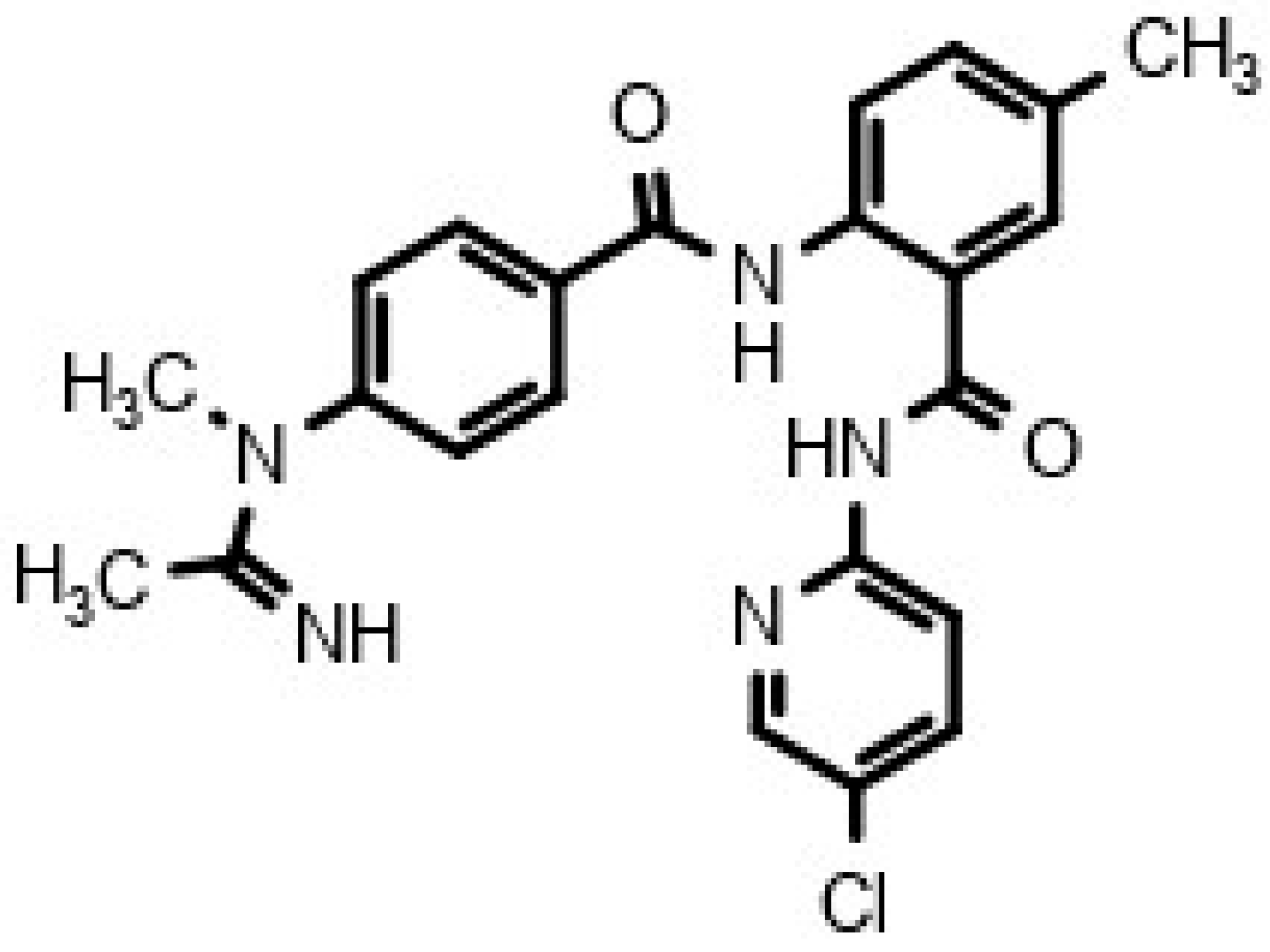
Figure 1. Chemical structure of DD217.
Pharmaceuticals 18 01617 g001
Table 1. Distribution of genetic variants in the study cohort.
GeneSNPFrequencyMinor Allele Frequency (%)HWE Conformity
GenotypeObserved (n)Expected (n)χ2p-Value
CYP2C9rs1799853CC4141.5810.60.7270.695
CT119.84
TT00.58
rs1057910AA4241.5810.60.3760.829
AC99.84
CC10.58
CYP2C19rs4244285GG4443.398.71.1470.563
GA78.22
AA10.39
rs4986893GG5151.001.00.0050.998
GA10.99
AA00.00
12248560CC2929.2525.00.0340.983
CT2019.50
TT33.25
CYP2C8rs10509681TT4545.246.70.2710.873
TC76.53
CC00.24
rs11572080CC4545.246.70.2710.873
CT76.53
TT00.24
CYP3A4rs35599367CC5050.021.90.0200.990
CT21.96
TT00.02
rs28371759AA52 NA0--
AG0NA
GG0NA
rs2740574AA4848.083.80.0830.959
AG43.85
GG00.08
CYP3A5rs776746GG4545.246.70.2710.873
GA76.53
AA00.24
ABCB1rs1045642TT1212.5051.00.0780.962
TC2725.99
CC1313.50
rs2032582GG1917.8941.30.4030.817
GT2325.22
TT108.89
rs1128503TT1919.0839.40.0020.999
TC2524.84
CC88.08
rs4148738CC108.8958.70.4030.817
CT2325.22
TT1917.89
Table 2. Distribution of CYP phenotypic categories among study participants receiving DD217.
CytochromePhenotype40 mg (n, %)60 mg (n, %)Genotypesp-Value
CYP2C9PM2 (12.5)2 (11.1)*2/*3, *3/*30.884
IM6 (37.5)5 (27.8)*1/*3, *1/*20.765
NM8 (50)11 (61.1)*1/*10.491
CYP2C19PM-1 (5.6)*2/*2NA
IM1 (6.25)3 (16.7)*1/*2, *2/*170.722
NM6 (37.5)8 (44.4)*1/*10.287
RM7 (43.75)6 (33.3)*1/*171.000
UM2 (12.5)-*17/*17NA
CYP3AIM12 (75)16 (88.9)*1/*1 + *3/*3
*1/*22 + *1/*3
0.132
EM4 (25)2 (11.1)*1/*1 + *1/*3
*1/*1 + *1/*1
0.378
Note: PM—poor metabolizers; IM—intermediate metabolizers; NM—normal metabolizers; RM—rapid metabolizers; UM—ultrarapid metabolizers; EM—extensive metabolizers.
Table 3. Association of CYP2C9, CYP2C19, and CYP3A variants with Tmax, AUClast, and Cmax of DD217.
CytochromeDD217 DoseGenotypePhenotypeTmaxAUClastCmaxp-Value
CYP2C940 mg*1/*1NM (n = 8)8.00 ± 7.1554.50 ± 49.377.28 ± 8.71>0.05
Tmax: p NM vs. IM+PM = 0.3894
AUC: p NM vs. IM+PM = 0.2786
Cmax: p NM vs. IM+PM = 0.2345
*1/*2, *1/*3IM (n = 6)9.00 ± 8.1733.86 ± 36.253.72 ± 5.61
*2/*3, *3/*3PM (n = 2)24.018.65 ± 22.503.11 ± 3.75
60 mg*1/*1NM (n = 11)12.91 ± 9.1437.55 ± 42.413.66 ± 4.070.002 *
Tmax: p = 0.005227 *
AUC: p NM vs. IM+PM = 0.06926
Cmax: p NM vs. IM+PM = 0.1259
*1/*2, *1/*3IM (n = 5)3.20 ± 2.1789.75 ± 89.279.24 ± 9.59
*2/*3PM (n = 2)2.50 ± 2.12177.19 ± 223.6111.28 ± 13.60
CYP2C1940 mg*1/*17, *17/*17RM + UM (n = 9)7.67 ± 6.7147.70 ± 42.565.80 ± 6.73>0.05
Tmax: p RM+UM vs. NM vs. IM+PM = 0.2123
AUC: p RM+UM vs. NM vs. IM+PM = 0.3765
Cmax: p RM+UM vs. NM vs. IM+PM = 0.6185
*1/*1NM (n = 6)15.50 ± 9.9533.13 ± 48.125.25 ± 8.82
*1/*2IM (n = 1)4.0048.453.12
60 mg*1/*17RM (n = 6)9.17 ± 7.3350.5 ± 51.614.50 ± 4.61>0.05
Tmax: p RM vs. NM vs. IM+PM = 0.5459
AUC: p RM vs. NM vs. IM+PM = 0.8896
Cmax: p RM vs. NM vs. IM+PM = 0.806
*1/*1NM (n = 8)8.75 ± 10.0798.0 ± 123.818.44 ± 9.71
*1/*2, *2/*2, *2/*17IM + PM (n = 4)9.50 ± 9.9832.28 ± 22.53.64 ± 3.51
CYP3A40 mg*1/*1EM (n = 12)11.75 ± 9.5040.04 ± 42.115.02 ± 6.92>0.05
Tmax: p EM vs. IM = 0.5345
AUC: p EM vs. IM = 0.5989
Cmax: p EM vs. IM = 0.5209
*1/*22, *1/*3IM (n = 4)6.25 ± 3.5048.99 ± 48.746.63 ± 8.63
60 mg*1/*1EM (n = 16)9.75 ± 8.9352.71 ± 63.325.32 ± 6.58>0.05
Tmax: p EM vs. IM = 0.3201
AUC: p EM vs. IM = 0.2092
Cmax: p EM vs. IM = 0.3268
*1/*3IM (n = 2)3.50 ± 3.54186.36 ± 210.6511.94 ± 12.67
Note: *—Statistically significant p-values were observed; RM—rapid metabolizers; EM—extensive metabolizers; NM—normal metabolizers; IM—intermediate metabolizers; PM—poor metabolizers.
Table 4. Association of CYP2C8 variants with Tmax, AUClast, and Cmax of DD217.
GroupSNPGenotypenTmax (h, SD)p-Value (Tmax)AUClast (SD)p-Value (AUClast)Cmax (SD)p-Value (Cmax)
40 mgrs10509681T/C316.67 (7.33)0.1746.88 (28.46)0.847.06 (4.27)0.67
T/T138.92 (2.04)41.22 (11.86)5.05 (2.02)
rs11572080C/C138.92 (2.04)0.1741.22 (11.86)0.845.05 (2.02)0.67
C/T316.67 (7.33)46.88 (28.46)7.06 (4.27)
60 mgrs10509681T/C23 (1)0.3162.47 (43.39)0.945.69 (4.02)0.94
T/T169.81 (2.23)68.2 (23.49)6.11 (1.89)
rs11572080C/C169.81 (2.23)0.3168.2 (23.49)0.946.11 (1.89)0.94
C/T23 (1)62.47 (43.39)5.69 (4.02)
Note: Tmax—time to maximum plasma concentration; AUClast—area under the concentration-time curve up to the last measurable point; Cmax—maximum plasma concentration.
Table 5. Distribution of CYP2C8 haplotypes and their association with pharmacokinetic parameters of DD217.
Grouprs10509681rs11572080Haplotype Frequencyp-Value
TmaxAUClastCmax
40 mg/dayTC0.90620.170.840.67
CT0.0938
60 mg/dayTC0.94440.310.940.94
CT0.0556
Table 6. Association of ABCB1 variants with Tmax, AUClast, and Cmax of DD217 in patients receiving 40 mg/day.
SNPGenotypenTmax (SD)p-Value (Tmax)AUClast (SD)p-Value (AUClast)Cmax (SD)p-Value (Cmax)
rs1045642 T>CT/T49.5 (4.99)0.07435.53 (22.23)0.174.63 (3.47)0.42
T/C76 (1.56)63.6 (18.31)8.03 (3.45)
C/C517.2 (4.1817.83 (5.08)2.42 (1)
rs2032582 G>TG/G812.88 (3.44)0.3634.57 (14.34)0.734.84 (2.64)0.84
G/T69.5 (3.12)46.36 (19.01)5.24 (2.94)
T/T23 (1)60.88 (40.28)8.35 (6.66)
rs1128503 T>CC/C812.88 (3.44)0.3634.57 (14.34)0.734.84 (2.64)0.84
C/T69.5 (3.12)46.36 (19.01)5.24 (2.94)
T/T23 (1)60.88 (40.28)8.35 (6.66)
rs4148738 C>TC/C23 (1)0.3660.88 (40.28)0.738.35 (6.66)0.84
T/C69.5 (3.12)46.36 (19.01)5.24 (2.94)
T/T812.88 (3.44)34.57 (14.34)4.84 (2.64)
Note: Tmax—time to maximum plasma concentration; AUClast—area under the concentration-time curve up to the last measurable point; Cmax—maximum plasma concentration.
Table 7. Distribution of ABCB1 haplotypes in patients receiving DD217 40 mg/day and their association with pharmacokinetic parameters.
#rs1045642rs2032582rs1128503rs4148738Frequencyp-Value
TmaxAUClastCmax
1CGCT0.53120.610.90.84
2TTTC0.3125
3TGCT0.1563
4CTTC0
Table 8. Association of ABCB1 variants with Tmax, AUClast, and Cmax of DD217 in patients receiving 60 mg/day.
SNPGenotypenTmax (SD)p-Value (Tmax)AUClast (SD)p-Value (AUClast)Cmax (SD)p-Value (Cmax)
rs1045642T/T713.57 (3.72)0.1327.6 (5.59)0.0094 *2.42 (0.56)0.013 *
T/C87.75 (2.63)53.88 (18.59)5.54 (1.74)
C/C32 (1)197.3 (93.48)15.95 (7.25)
rs2032582G/G42 (0.71)0.12163.65 (74.17)0.03 *14.13 (5.44)0.018 *
T/G99.56 (2.82)51.62 (16.19)4.87 (1.49)
T/T513.8 (4.39)19.38 (5.28)1.74 (0.51)
rs1128503T/T416.25 (4.7)0.05714 (4.32)0.029 *1.49 (0.41)0.019 *
T/C109 (2.59)50.55 (14.43)4.66 (1.36)
C/C42 (0.71)163.65 (74.17)14.13 (5.44)
rs4148738C/C510.6 (3.63)0.1818.86 (5.38)0.03 *1.78 (0.5)0.019 *
C/T911.33 (3.23)51.92 (16.11)4.85 (1.5)
T/T42 (0.71)163.65 (74.17)14.13 (5.44)
Note: *—Statistically significant p-values were observed; Tmax—time to maximum plasma concentration; AUClast—area under the concentration-time curve up to the last measurable point; Cmax—maximum plasma concentration.
Table 9. Distribution of ABCB1 haplotypes in patients receiving DD217 60 mg/day and their association with pharmacokinetic parameters.
#rs1045642rs2032582rs1128503rs4148738Frequencyp-Value
TmaxAUClastCmax
1TTTC0.44160.170.990.94
2CGCT0.3021
3TGCT0.1139
4CTTC0.0306
5CGTT0.0284
6TTCC0.0284
7CGCC0.0278
8TTCT0.0278
Table 10. Genotypic and phenotypic profiles of patients with adverse events (DVT/PE or bleeding).
Adverse EventPatient
ID
DD217 DosePhenotypeCYP2C8*3 ABCB1
CYP2C9 CYP2C19 CYP3Ars10509681rs11572080rs1045642rs2032582rs1128503rs4148738
DVT/PE11200140 mgNMRMEMTCCGCT
11303040 mgNMRMEMTCCGCT
11303240 mgPMNMEMCTCGCT
11303540 mgNMRMIMTCTTTC
11303660 mgNMRMEMTCTTTC
Bleeding11200860 mgIMNMEMTCCGCT
Note: RM—rapid metabolizers; EM—extensive metabolizers; NM—normal metabolizers; IM—intermediate metabolizers; PM—poor metabolizers.
Table 11. Association of CYP2C9, CYP2C19, and CYP3A variants with adverse events (DVT/PE or bleeding).
CytochromeDD217 DoseGenotypePhenotypeDVT/PE (n)p-ValueBleeding (n)p-Value
CYP2C940 mg*1/*1NM (n = 8)3p NM vs. IM+PM = 0.56920NA
*1/*2, *1/*3IM (n = 6)00
*2/*3, *3/*3PM (n = 2)10
60 mg*1/*1NM (n = 11)1p NM vs. IM+PM = 1.00000p NM vs. IM+PM = 0.3889
*1/*2, *1/*3IM (n = 5)01
*2/*3PM (n = 2)00
CYP2C1940 mg*1/*17, *17/*17RM + UM (n = 9)3p RM+UM vs. NM vs. IM+PM = 0.58460NA
*1/*1NM (n = 6)10
*1/*2IM (n = 1)00
60 mg*1/*17RM (n = 6)1p RM vs. NM vs. IM+PM = 0.33330p RM vs. NM+IM+PM = 0.3333
*1/*1NM (n = 8)01
*1/*2, *2/*2, *2/*17IM + PM (n = 4)00
CYP3A40 mg*1/*1EM (n = 12)3p EM vs. IM = 1.00000NA
*1/*22, *1/*3IM (n = 4)10
60 mg*1/*1EM (n = 16)1p EM vs. IM = 1.00001p EM vs. IM = 1.0000
*1/*3IM (n = 2)00
Note: RM—rapid metabolizers; UM—ultrarapid metabolizers; EM—extensive metabolizers; NM—normal metabolizers; IM—intermediate metabolizers; PM—poor metabolizers.
Table 12. Distribution of ABCB1 haplotypes in patients receiving DD217 40 mg/day and their association with thromboembolic outcomes.
#rs1045642rs2032582rs1128503rs4148738Frequencyp-Value
1CGCT0.53120.038 *
2TTTC0.3125
3TGCT0.1563
4CTTC0
Note: *—Statistically significant p-values were observed.
Table 13. Association of ABCB1 variants with thromboembolic outcomes in patients receiving DD217 40 mg/day.
SNPGenotypenWithout DVT/PEWith DVT/PEp-Value
rs1045642T/T 4400.063
T/C761
C/C 523
rs2032582G/G8530.37
G/T651
T/T220
rs1128503C/C8530.37
C/T651
T/T220
rs4148738C/C2200.37
T/C651
T/T853
Note: DVT/PE—deep vein thrombosis/pulmonary embolism.
Table 14. Association of ABCB1 variants with adverse outcomes in patients receiving DD217 60 mg/day.
SNPGenotypenDVT/PE (n)p-Value (DVT/PE)Bleeding (n)p-Value (Bleeding)
rs1045642T/T700.4300.14
T/C810
C/C301
rs2032582G/G400.4910.2
G/T910
T/T500
rs1128503C/C400.5410.2
C/T1010
T/T400
rs4148738C/C500.4900.2
T/C910
T/T401
Note: DVT/PE—deep vein thrombosis/pulmonary embolism.
Table 15. Distribution of ABCB1 haplotypes in patients receiving DD217 60 mg/day and association with adverse outcomes.
#rs1045642rs2032582rs1128503rs4148738Frequencyp-Value (DVT/PE)p-Value (Bleeding)
1TTTC0.4410.980.79
2CGCT0.3021
3TGCT0.1139
4CTTC0.0306
5CGTT0.0284
6TTCC0.0284
7CGCC0.0278
8TTCT0.0278
Note: DVT/PE—deep vein thrombosis/pulmonary embolism.
Table 16. General clinical and laboratory characteristics of study participants.
Parameter (Me ± SD/M/n)In Total CohortDD217Dalteparin Sodium
40 mg/day60 mg/day
Sample size52161818
SexMale7322
Female45131616
Age, years63 ± 6.1162.5 ± 6.0262 ± 4.963 ± 7.48
BMI, kg/m234 ± 4.6934 ± 3.4134.3 ± 4.734.2 ± 5.78
Complete blood count and biochemical blood test
Sodium, mmol/L141141141.5142
Potassium, mmol/L4.21 ± 0.474.28 ± 0.334.32 ± 0.564.03 ± 0.45
Glucose, mmol/L 6.16.116.16.14
Total protein, g/L72.44 ± 3.6872.44 ± 3.2973.06 ± 3.6971.83 ± 4.09
Albumin, g/L41.69 ± 2.3741.68 ± 2.8841.81 ± 2.3341.59 ± 2.02
C-reactive protein, mg/L2.652.053.13.25
Total cholesterol, mmol/L6.05 ± 1.216.24 ± 1.465.82 ± 1.046.1 ± 1.16
Total bilirubin, µmol/L11.111.2511.510.8
Direct bilirubin, µmol/L2.13 ± 0.682.08 ± 0.572.23 ± 0.692.08 ± 0.78
Indirect bilirubin, µmol/L9.1599.358.9
ALT, U/L171817.516.5
AST, U/L20.520.520.520
GGT, U/L2321.52320
Alkaline phosphatase, U/L78.65 ± 22.5772.81 ± 19.2379.33 ± 24.9183.17 ± 22.95
Lipase, U/L24 ± 15.0328 ± 17.8124 ± 13.223 ± 14.35
Amylase, U/L 20.35 ± 8.9420.9 ± 11.1819.75 ± 8.7821.1 ± 6.69
Creatinine, µmol/L76.3 ± 12.0579.85 ± 8.8577.15 ± 16.4572.35 ± 8.94
eGFR, mL/min/1.73 m274.47 ± 10.8673.21 ± 10.9273.42 ± 10.6976.64 ± 11.26
Hematology
RBC, ×1012/L4.67 ± 0.414.6 ± 0.494.74 ± 0.434.65 ± 0.29
MCV, fL90.3590.8590.889.95
MCH, pg30.0530.053030.4
MCHC, g/dL33.28 ± 0.6733.35 ± 0.833.13 ± 0.5833.37 ± 0.65
ESR, mm/h16.71 ± 8.2415.81 ± 6.7317.22 ± 7.0217 ± 10.66
Hematocrit, %41.79 ± 3.3141.73 ± 4.3242.23 ± 2.9841.42 ± 2.68
Hemoglobin, g/dL13.91 ± 1.1313.91 ± 1.5213.97 ± 0.8513.84 ± 1.05
Platelets, ×109/L248240259250.5
WBC, ×109/L6.055.65.96.15
Neutrophils, %57.75 ± 8.2255.66 ± 8.9960.23 ± 8.8257.13 ± 6.53
Eosinophils, %1.752.051.51.85
Basophils, %11.210.9
Monocytes, %5.955.65.656.2
Lymphocytes, %29 ± 6.9330.61 ± 7.4726.36 ± 7.1730.22 ± 5.66
Coagulation tests
aPTT, sec34.48 ± 3.4835.29 ± 3.6834.45 ± 3.8333.8 ± 2.91
INR0.97 ± 0.050.98 ± 0.060.96 ± 0.050.98 ± 0.05
D-dimer, ng/mL455462.5359508.5
Safety outcomes
PE/DVT, n7412
Bleeding, n2011
Table 17. Pharmacokinetic parameters (Tmax, AUClast, Cmax) of DD217 in the study population.
Subject IDDose, mg/dayAgeSexBMITmax, hAUClastCmax
1120014057Woman36.302421.2113.535
1120134054Woman34.00242.7350.456
1120184063Woman35.30884.6315.034
1120204065Woman30.501210.4120.72
1120274070Man28.70244.9280.405
1120314072Woman29.70448.4513.119
1120344063Woman38.90817.6021.379
1120404056Man37.90839.73.95
1130044062Woman39.101128.52622.764
1130144058Man34.00420.6011.686
1130164061Woman37.20813.0491.136
1130214064Woman30.40818.2131.739
1130304071Woman31.50610.2340.656
1130324072Woman36.702434.565.76
1130334055Woman31.602101.16615.011
1130354061Woman32.901120.46219.462
1120036064Woman35.90419.081.663
1120086060Woman33.801237.52225.28
1120106056Woman34.70435.8523.324
1120126058Man34.702416.5971.155
1120216060Woman34.90621.4621.59
1120226071Woman25.702105.8549.707
1120286060Woman36.40258.5137.329
1120376057Woman39.00124.5890.325
1120396065Woman42.10525.3752.291
1130066051Woman30.10851.9294.963
1130156061Woman37.90637.4072.974
1130206060Woman34.602414.4831.614
1130256066Woman30.00813.9761.37
1130296068Woman34.00262.6988.694
1130316063Woman30.202411.571.712
1130366063Woman33.106152.35913.569
1130386065Man22.002411.5520.613
1130396068Woman31.601335.30620.897
Note: Tmax—time to maximum plasma concentration; AUClast—area under the concentration-time curve up to the last measurable point; Cmax—maximum plasma concentration.
Table 18. Prediction of potential pharmacological effects and mechanisms of action for DD217.
PaPiActivity
0.8940.004 Anticoagulant
0.609 0.002Factor Xa inhibitor
Table 19. Prediction of the interaction of DD217 with metabolic enzymes.
PaPiActivity
0.2290.109CYP2C29 substrate
0.2670.149CYP2C8 inhibitor
0.1850.144CYP2C3 substrate
Table 20. Prediction of DD217 belonging to the substrates of cytochrome P450 enzymes.
Web-Resource1A22A62D62C82C192C93A4
CYPstrate (model “best performance”)No predictionNon-substrateNo predictionSubstrateNo predictionSubstrateSubstrate
CYPstrate (model “full coverage”)Non-substrateNon-substrateSubstrateSubstrateSubstrateSubstrateSubstrate
ADMETlab 2.00.917No prediction0.762No prediction0.0790.2130.600
Table 21. Prediction of DD217 belonging to the inhibitors of cytochrome P450 enzymes.
Web-Resource1A22D62C192C93A4
SwissADME--+++
P450 Analyzer0.115−0.5250.2870.242−0.628
CYPlebrity0.580.280.560.450.42
ADMETlab 2.00.2560.6920.4530.780.453
Table 22. Prediction of DD217 belonging to the inhibitors/substrate of P-gp.
Web-ResourceSubstrateInhibitor
SwissADME-
ADMETlab 2.00.9960.851
Disclaimer/Publisher’s Note: The statements, opinions and data contained in all publications are solely those of the individual author(s) and contributor(s) and not of MDPI and/or the editor(s). MDPI and/or the editor(s) disclaim responsibility for any injury to people or property resulting from any ideas, methods, instructions or products referred to in the content.