Signal Detection Method for OTFS System Based on Adaptive Wavelet Convolutional Neural Network



Abstract
1. Introduction
2. Materials and Methods
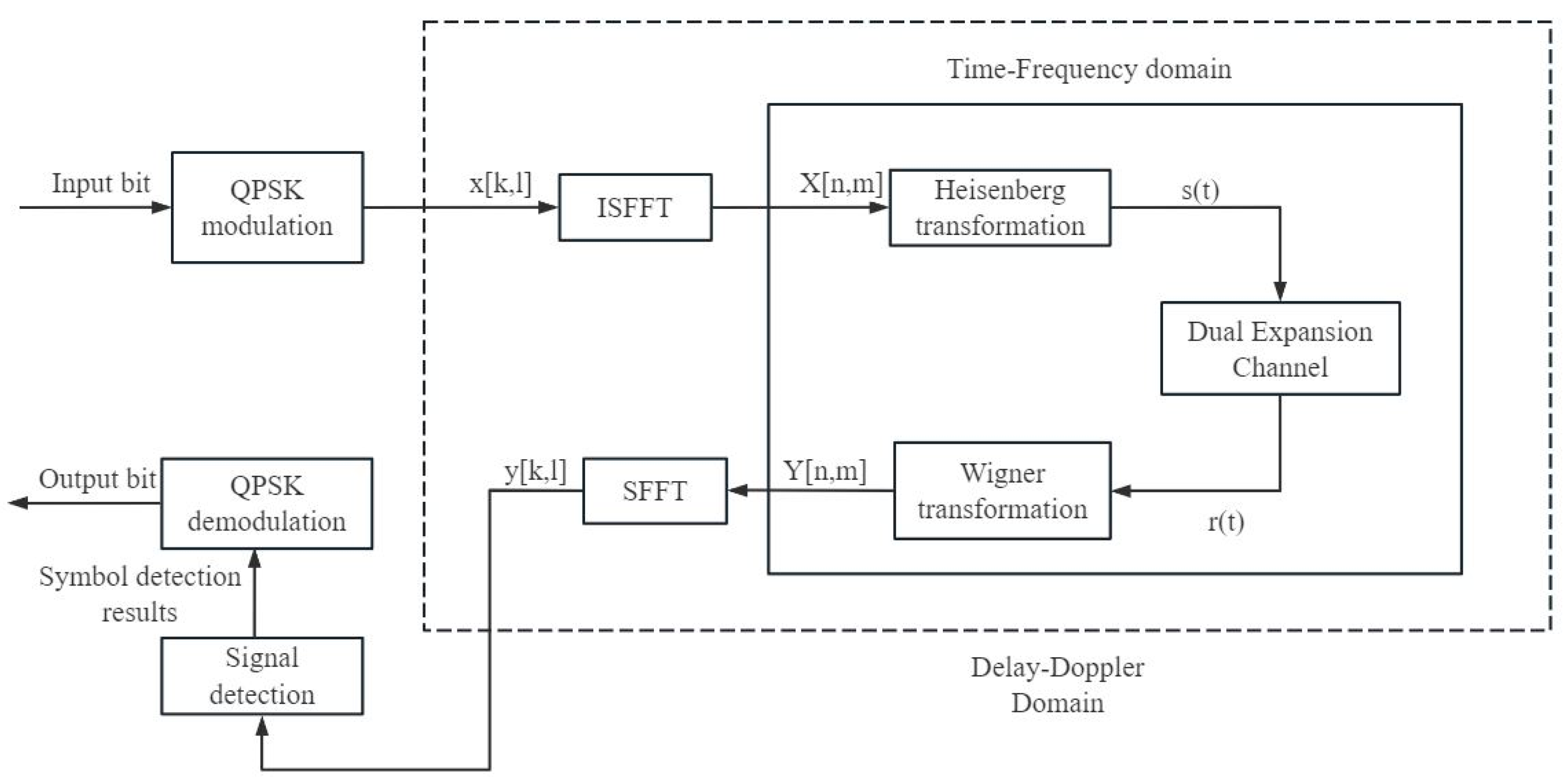
2.1. OTFS System Model
2.1.1. Transmitter
2.1.2. Dual Expansion Channel
2.1.3. Receiver
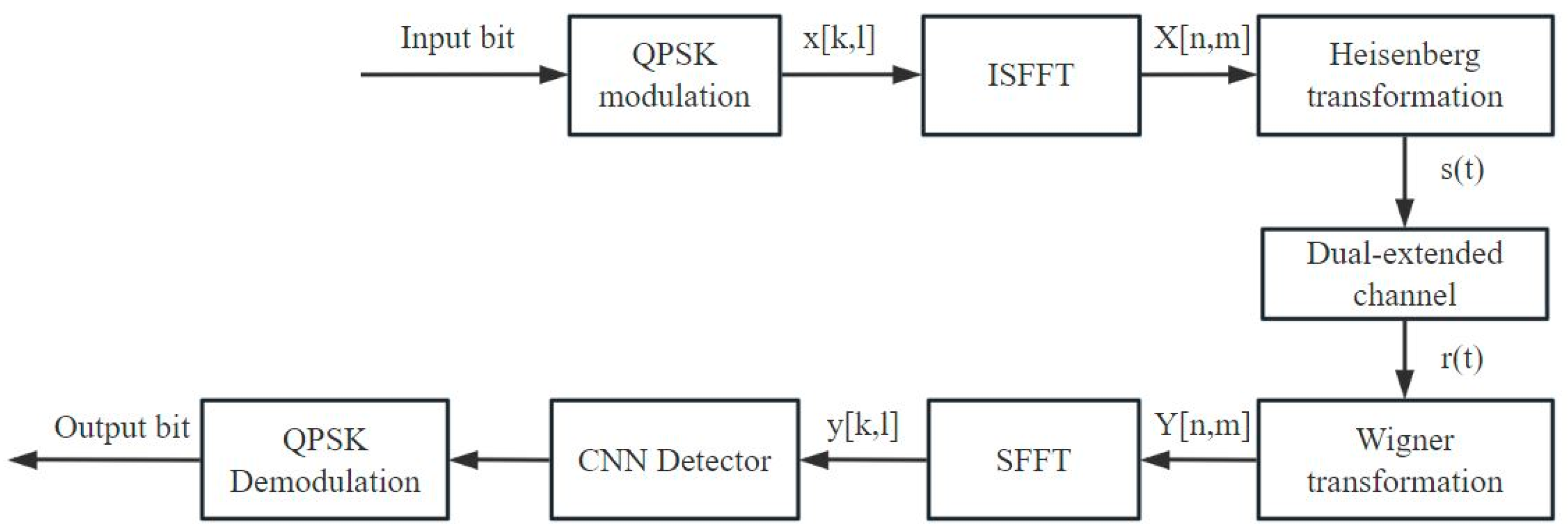
2.2. Neural Network-Based OTFS System Signal Detection Method
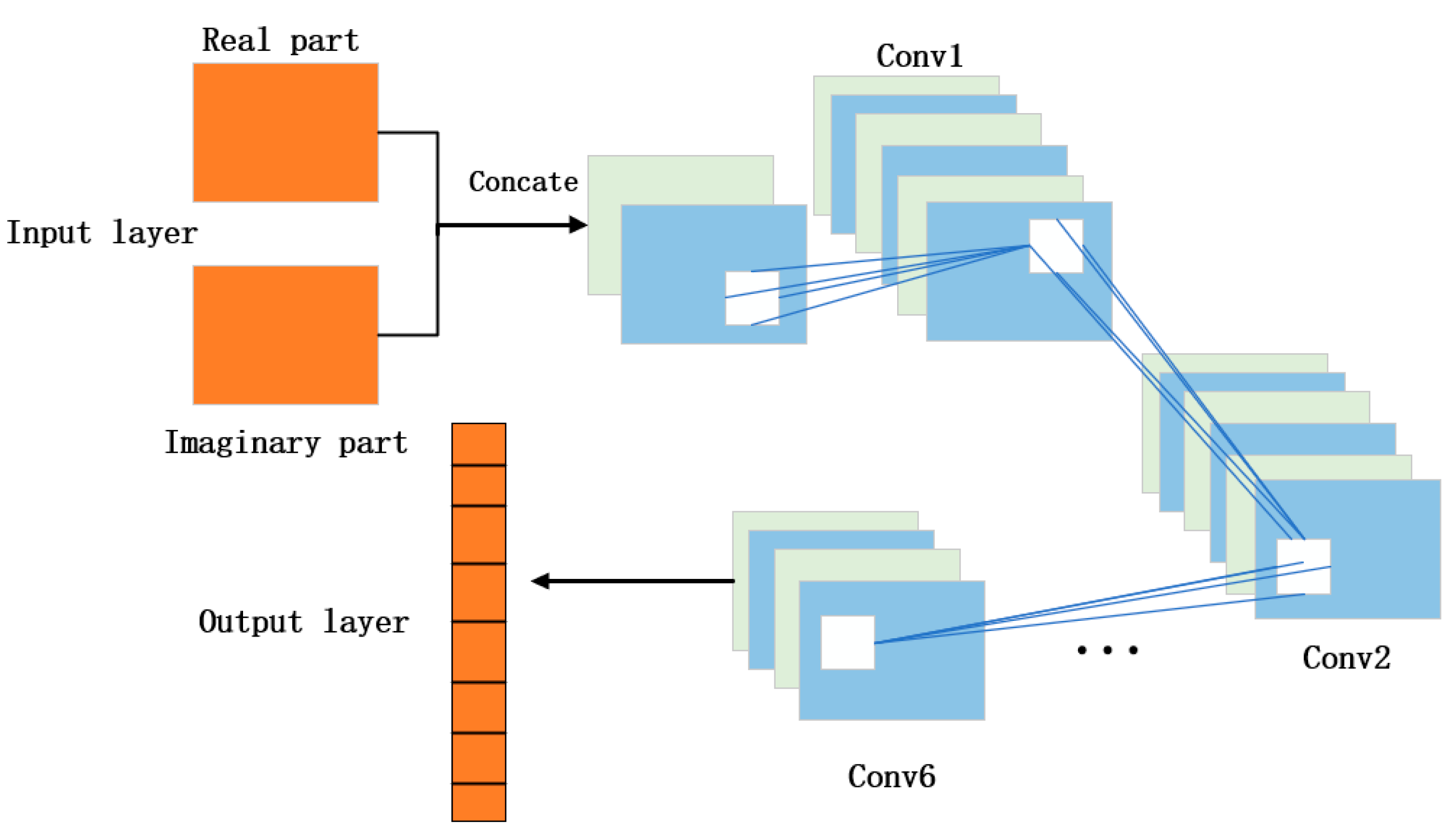
2.2.1. CNN-OTFS Network Structure
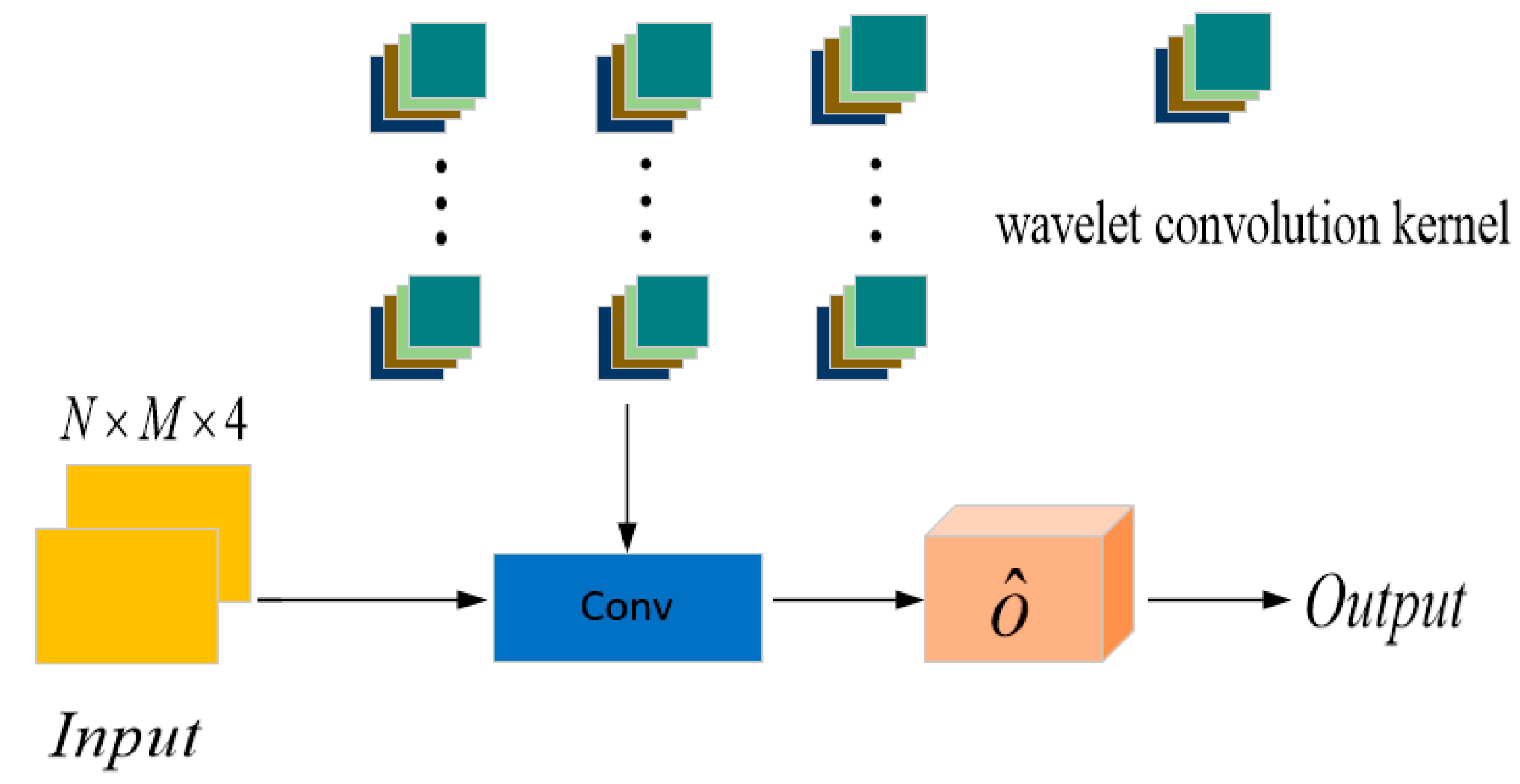
2.2.2. Improved Methods
- (1)
- The filter impulse response length of the Sym4 wavelet is 8. Compared to shorter wavelets such as Haar (length = 2) and Db2 (length = 4), the longer filter of Sym4 offers improved frequency localization. This enables more accurate characterization of the complex channel gain of each scatterer in the DD domain of OTFS signals, while avoiding noise amplification caused by excessive localization.
- (2)
- Sym4 possesses a fourth-order vanishing moment. The vanishing moment governs the wavelet’s ability to suppress polynomial components. The equivalent channel response of OTFS in the DD domain exhibits sparse impulse characteristics, with effective information concentrated in a limited number of non-zero taps. The high vanishing moment of Sym4 helps in effectively capturing these dominant components.
- (3)
- The Sym4 wavelet has a continuous second-order derivative, resulting in high regularity in the reconstructed signal. This ensures that the time–frequency feature maps reconstructed from wavelet coefficients are smooth, which aligns well with the continuously varying nature of physical channel responses. This smoothness also helps mitigate potential numerical instability during gradient backpropagation.
- (4)
- Given the OTFS frame dimensions used in this study (N = 8, M = 16), the Sym4 filter with length 8 interacts effectively with the signal grid along both the delay and Doppler axes. Longer filters such as Sym8 may introduce significant boundary effects in small-sized frames, whereas Sym4 strikes a balanced trade-off, allowing the convolution operation to cover meaningful regions without excessively spanning the entire dimension.
- (5)
- Although the Db4 wavelet also possesses fourth-order vanishing moments, its filters are severely asymmetric, which introduces nonlinear phase shifts during signal decomposition and reconstruction, leading to phase distortion in the reconstructed signal. For OTFS systems where symbol phase in the delay-Doppler domain directly conveys modulation information, phase distortion is unacceptable. As a symmetrized variant of the Daubechies wavelet family, Sym4 achieves near-perfect symmetry while retaining fourth-order vanishing moments, thereby suppressing phase distortion to the greatest extent possible. This characteristic grants Sym4 a fundamental advantage over Db4 in phase-sensitive digital communication systems.
- (6)
- Wavelets of the Coiflet family (e.g., Coif4) also support fourth-order vanishing moments but require significantly longer filter support—typically 18 taps for Coif4, compared to only 8 taps for Sym4. Under the OTFS frame dimensions adopted in this study (N = 8, M = 16), excessively long filter support induces severe boundary effects, resulting in incomplete coverage of the delay-Doppler grid along frame edges. By achieving fourth-order vanishing moments with the shortest possible filter length, Sym4 strikes an optimal balance among vanishing moment order, compact support, and boundary effect mitigation.
2.2.3. AWCNN-OTFS Network Architecture
| Algorithm 1 MP algorithm |
| Input: Received signal , Equivalent channel matrix 1. Initialize : Calculate the set of observed nodes for each variable node : Calculate the set of variable nodes for each observation node 2. repeat 3. Observation node uses the mean and variance of the interference terms as messages, and passes the messages from the observation node to variable node . 4. Send the message from variable node to observation node using , and . 5. Use the MAP criterion to make decisions on the output. At the same time, introduce a convergence factor of to accelerate the algorithm’s convergence. 6. Check the stopping condition: when any one of the three conditions , , or reaches the set maximum number of iterations, the MP detection algorithm stops iterating and proceeds to the final detection symbol decision. |
| Output: |
| Algorithm 2 Adaptive wavelet convolution module |
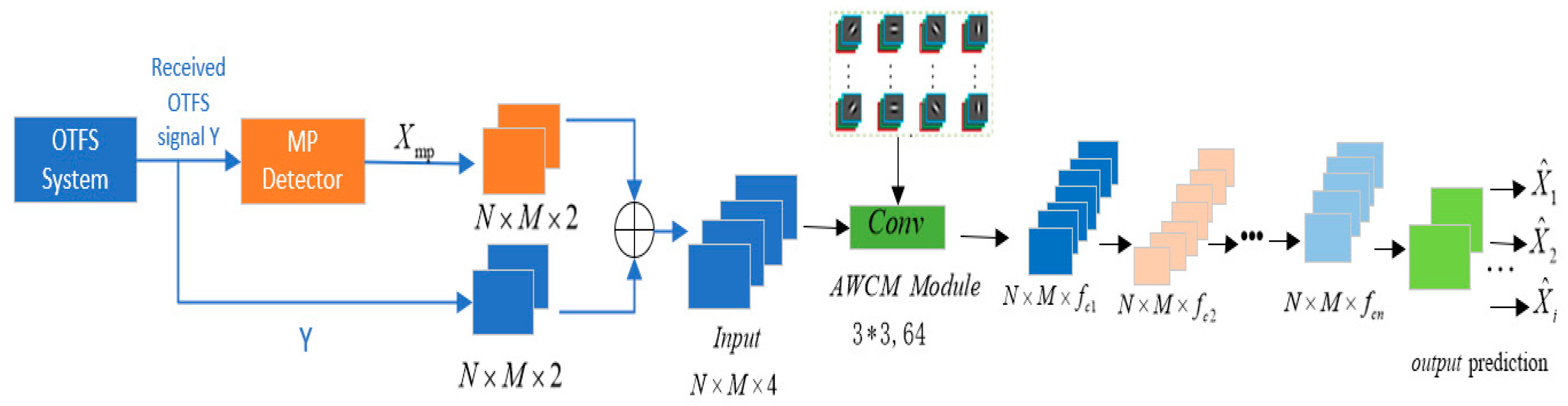
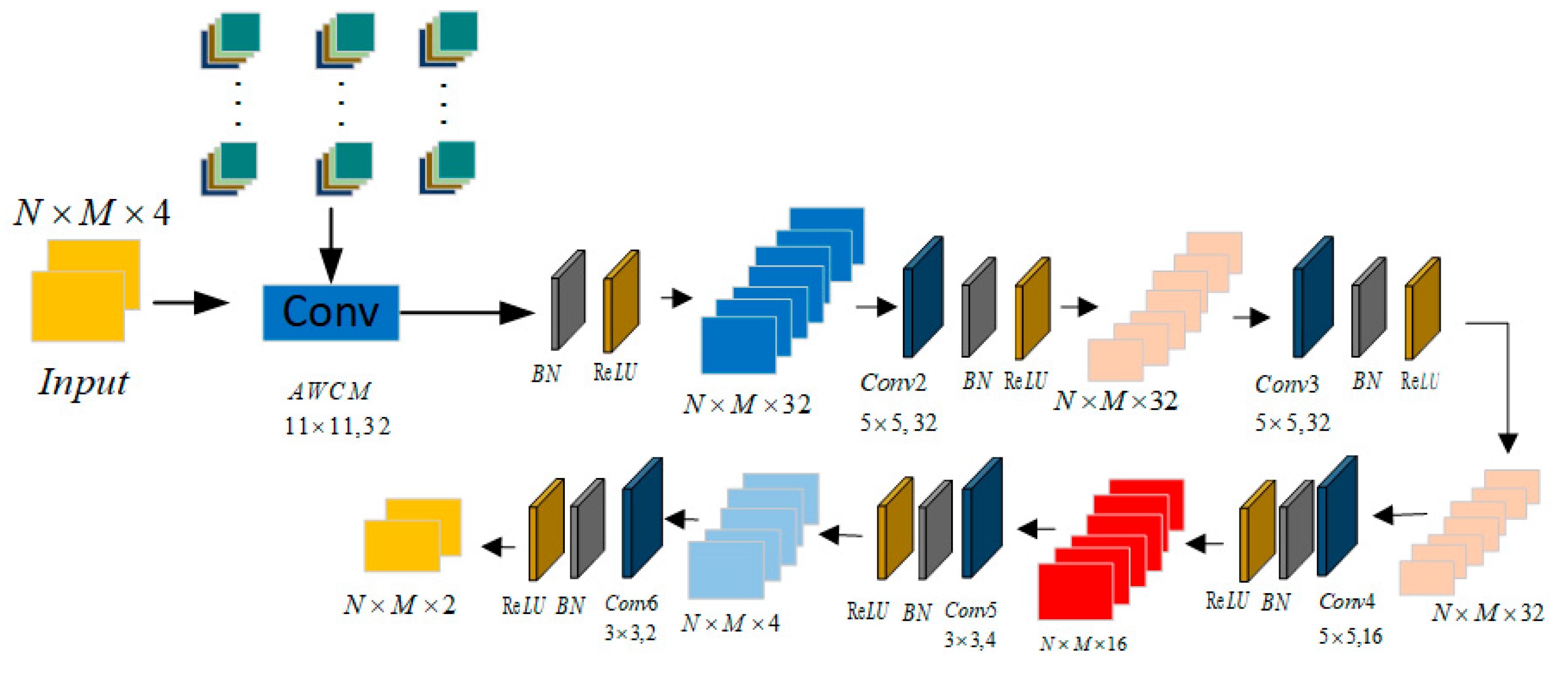
Input: The original received signal and the signal after the MP detector are concatenated along the channel to obtain a new feature tensor
|
| Output: Feature tensor after adaptive wavelet convolution processing |
2.3. Model Training
3. Results
3.1. Bit Error Rate Performance Analysis
3.2. Computational Complexity Analysis
4. Discussion
5. Conclusions
6. Patents
Author Contributions
Funding
Data Availability Statement
Acknowledgments
Conflicts of Interest
References
- Farhang, A.; RezazadehReyhani, A.; Doyle, L.E.; Farhang-Boroujeny, B. Low Complexity Modem Structure for OFDM-Based Orthogonal Time Frequency Space Modulation. IEEE Wirel. Commun. Lett. 2018, 7, 344–347. [Google Scholar] [CrossRef]
- Hadani, R.; Rakib, S.; Tsatsanis, M.; Monk, A.; Goldsmith, A.J.; Molisch, A.F.; Calderbank, R. Orthogonal Time Frequency Space Modulation. In Proceedings of the 2017 IEEE Wireless Communications and Networking Conference (WCNC), San Francisco, CA, USA, 19–22 March 2017; pp. 1–6. [Google Scholar] [CrossRef]
- Li, S.; Yuan, W.; Wei, Z.; Schober, R.; Caire, G. Orthogonal Time Frequency Space Modulation—Part II: Transceiver Designs. IEEE Commun. Lett. 2023, 27, 9–13. [Google Scholar] [CrossRef]
- Yuan, W.; Wei, Z.; Li, S.; Schober, R.; Caire, G. Orthogonal Time Frequency Space Modulation—Part III: ISAC and Potential Applications. IEEE Commun. Lett. 2023, 27, 14–18. [Google Scholar] [CrossRef]
- Wei, Z.; Yuan, W.; Li, S.; Yuan, J.; Bharatula, G.; Hadani, R.; Hanzo, L. Orthogonal Time-Frequency Space Modulation: A Promising Next-Generation Waveform. IEEE Wirel. Commun. 2021, 28, 136–144. [Google Scholar] [CrossRef]
- Yong, L.I.O.; Yu, L.U.; Yahao, J.I.G. 6G New Time-delay Doppler Communication Paradigm: Technical Advantages, Design Challenges, Applications and Prospects of OTFS. J. Electron. Inf. Technol. 2024, 46, 1827–1842. [Google Scholar] [CrossRef]
- Feng, J.; Ngo, H.Q.; Flanagan, M.F.; Matthaiou, M. Performance Analysis of OTFS-based Uplink Massive MIMO with ZF Receivers. In Proceedings of the 2021 IEEE International Conference on Communications Workshops (ICC Workshops), Montreal, QC, Canada, 14–18 June 2021; pp. 1–7. [Google Scholar] [CrossRef]
- Surabhi, G.D.; Augustine, R.M.; Chockalingam, A. On the Diversity of Uncoded OTFS Modulation in Doubly-Dispersive Channels. IEEE Trans. Wirel. Commun. 2019, 18, 3049–3063. [Google Scholar] [CrossRef]
- Thaj, T.; Viterbo, E. Low Complexity Iterative Rake Decision Feedback Equalizer for Zero-Padded OTFS Systems. IEEE Trans. Veh. Technol. 2020, 69, 15606–15622. [Google Scholar] [CrossRef]
- Raviteja, P.; Phan, K.T.; Hong, Y.; Viterbo, E. Interference Cancellation and Iterative Detection for Orthogonal Time Frequency Space Modulation. IEEE Trans. Wirel. Commun. 2018, 17, 6501–6515. [Google Scholar] [CrossRef]
- Yuan, Z.; Liu, F.; Yuan, W.; Guo, Q.; Wang, Z.; Yuan, J. Iterative Detection for Orthogonal Time Frequency Space Modulation with Unitary Approximate Message Passing. IEEE Trans. Wirel. Commun. 2022, 21, 714–725. [Google Scholar] [CrossRef]
- Ye, H.; Li, G.Y.; Juang, B.-H. Power of Deep Learning for Channel Estimation and Signal Detection in OFDM Systems. IEEE Wirel. Commun. Lett. 2018, 7, 114–117. [Google Scholar] [CrossRef]
- Li, Q.; Gong, Y.; Wang, J.; Meng, F.; Xu, Z. Exploring the Performance of Receiver Algorithm in OTFS Based on CNN. In Proceedings of the 2022 IEEE International Conference on Communications Workshops (ICC Workshops), Seoul, Republic of Korea, 16–20 May 2022; pp. 957–962. [Google Scholar] [CrossRef]
- Li, Q.; Gong, Y.; Meng, F.; Xu, Z. Data-Driven Receiver for OTFS System with Deep Learning. In Proceedings of the 2021 7th IEEE International Conference on Network Intelligence and Digital Content (IC-NIDC), Beijing, China, 17–19 November 2021; pp. 172–176. [Google Scholar] [CrossRef]
- Naikoti, A.; Chockalingam, A. Low-complexity Delay-Doppler Symbol DNN for OTFS Signal Detection. In Proceedings of the 2021 IEEE 93rd Vehicular Technology Conference (VTC2021-Spring), Helsinki, Finland, 25–28 April 2021; pp. 1–6. [Google Scholar] [CrossRef]
- Enku, Y.K.; Bai, B.; Wan, F.; Guyo, C.U.; Tiba, I.N.; Zhang, C.; Li, S. Two-Dimensional Convolutional Neural Network-Based Signal Detection for OTFS Systems. IEEE Wirel. Commun. Lett. 2021, 10, 2514–2518. [Google Scholar] [CrossRef]
- Pfadler, A.; Jung, P.; Stanczak, S. Pulse-Shaped OTFS for V2X Short-Frame Communication with Tuned One-Tap Equalization. In Proceedings of the WSA 2020; 24th International ITG Workshop on Smart Antennas, Hamburg, Germany, 18–20 February 2020; pp. 1–6. [Google Scholar]
- Wu, Y.; Zhou, M.; Lin, Y.; Liao, Z. Signal Detection Method for OTFS System Based on Feature Fusion and CNN. Electronics 2025, 14, 4041. [Google Scholar] [CrossRef]
- Li, S.; Huang, C. Using convolutional neural networks for image semantic segmentation and object detection. Syst. Soft Comput. 2024, 6, 200172. [Google Scholar] [CrossRef]
- Li, T.; Zhao, Z.; Sun, C.; Cheng, L.; Chen, X.; Yan, R.; Gao, R.X. WaveletKernelNet: An Interpretable Deep Neural Network for Industrial Intelligent Diagnosis. IEEE Trans. Syst. Man Cybern. Syst. 2022, 52, 2302–2312. [Google Scholar] [CrossRef]
- Wang, J.; Chen, X.; Liu, B. Seismic trace interpolation via score-based diffusion model with wavelet convolution. J. Appl. Geophys. 2025, 243, 105928. [Google Scholar] [CrossRef]
- Vaswani, A.; Shazeer, N.; Parmar, N.; Uszkoreit, J.; Jones, L.; Gomez, A.N.; Kaiser, Ł.; Polosukhin, I. Attention is all you need? arXiv 2021, arXiv:1706.03762. [Google Scholar] [PubMed]
- Zhou, M. “OTFS AWCNNdataset”, Mendeley Data, V1. 2025. Available online: https://data.mendeley.com/datasets/gp5hht8gys/1 (accessed on 12 November 2025).



| Parameter Name | Parameter Value |
|---|---|
| OTFS frame size (N, M) | (8, 16) |
| Subcarrier interval/kHz | 240 |
| Carrier frequency/GHz | 15 |
| Bandwidth/kHz | 2 |
| Modulation method | QPSK |
| Channel path taps | 3 |
| delay_ taps delay_ taps/ | [0, 5, 10] |
| Doppler frequency bias _ taps/ | [0, 1, −1] |
| SNR/dB | 0:2:30 |
| Layer | Parameters | Activation Function |
|---|---|---|
| Input layer | N × M × 4 | - |
| AWCNN Layer1 | (11 × 11.32) | ReLU |
| Convolutional Layer2 | (5 × 5.32) | ReLU |
| Convolutional Layer3 | (5 × 5.32) | ReLU |
| Convolutional Layer4 | (5 × 5.32) | ReLU |
| Convolutional Layer5 | (3 × 3.16) | ReLU |
| Convolutional Layer6 | (3 × 3.4) | ReLU |
| Output layer | (3 × 3.2) | Tanh |
| Tip Number | Multipath Delay/ns | Normalized Power/dB |
|---|---|---|
| 1 | 0 | 0.0 |
| 2 | 30 | −1.5 |
| 3 | 150 | −1.4 |
| 4 | 310 | −3.6 |
| 5 | 370 | −0.6 |
| 6 | 710 | −9.1 |
| 7 | 1090 | −7.0 |
| 8 | 1730 | −12.0 |
| 9 | 2510 | −16.9 |
| Detection Algorithm | Computational Complexity | Explanation of Key Parameters |
|---|---|---|
| ML | Time step T, hidden layer H | |
| MRC | Number of antennas N, number of symbols K | |
| MP | Number of iterations (I = 10), number of paths (P), number of symbols (K) | |
| CNN | CNN depth (D), F_h/F_w: kernel size, H/W: feature map size | |
| AWCNN | S: the scaling and translation parameter space of the wavelet convolution kernel |
Disclaimer/Publisher’s Note: The statements, opinions and data contained in all publications are solely those of the individual author(s) and contributor(s) and not of MDPI and/or the editor(s). MDPI and/or the editor(s) disclaim responsibility for any injury to people or property resulting from any ideas, methods, instructions or products referred to in the content. |
© 2026 by the authors. Licensee MDPI, Basel, Switzerland. This article is an open access article distributed under the terms and conditions of the Creative Commons Attribution (CC BY) license.
Share and Cite
Wu, Y.; Zhou, M. Signal Detection Method for OTFS System Based on Adaptive Wavelet Convolutional Neural Network. Sensors 2026, 26, 1397. https://doi.org/10.3390/s26041397
Wu Y, Zhou M. Signal Detection Method for OTFS System Based on Adaptive Wavelet Convolutional Neural Network. Sensors. 2026; 26(4):1397. https://doi.org/10.3390/s26041397
Chicago/Turabian StyleWu, You, and Mengyao Zhou. 2026. "Signal Detection Method for OTFS System Based on Adaptive Wavelet Convolutional Neural Network" Sensors 26, no. 4: 1397. https://doi.org/10.3390/s26041397
APA StyleWu, Y., & Zhou, M. (2026). Signal Detection Method for OTFS System Based on Adaptive Wavelet Convolutional Neural Network. Sensors, 26(4), 1397. https://doi.org/10.3390/s26041397