A Systematic Review of Design of Electrodes and Interfaces for Non-Contact and Capacitive Biomedical Measurements: Terminology, Electrical Model, and System Analysis

Abstract
1. Introduction
1.1. Introduction and Motivation
1.2. Objectives and Contributions
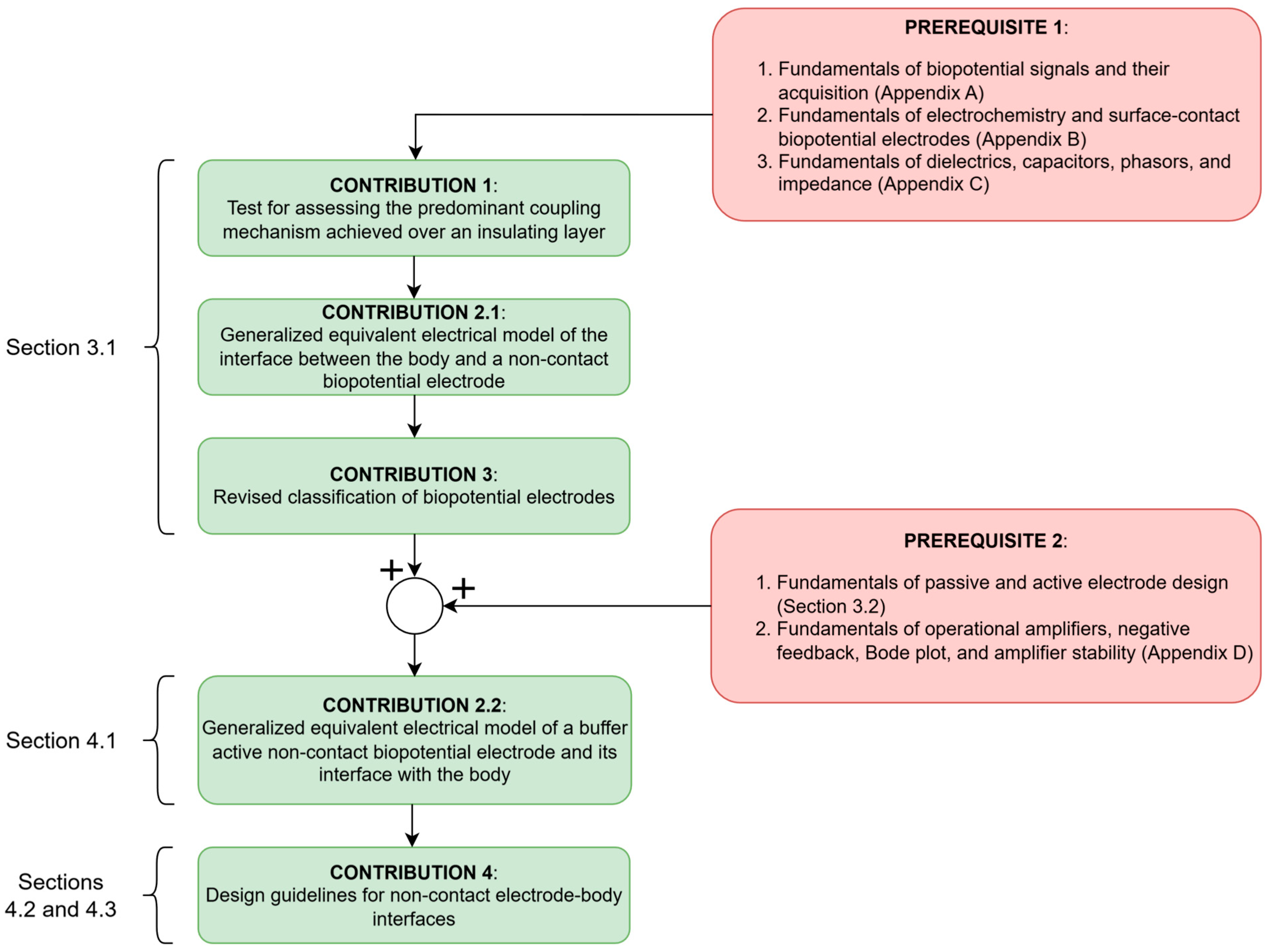
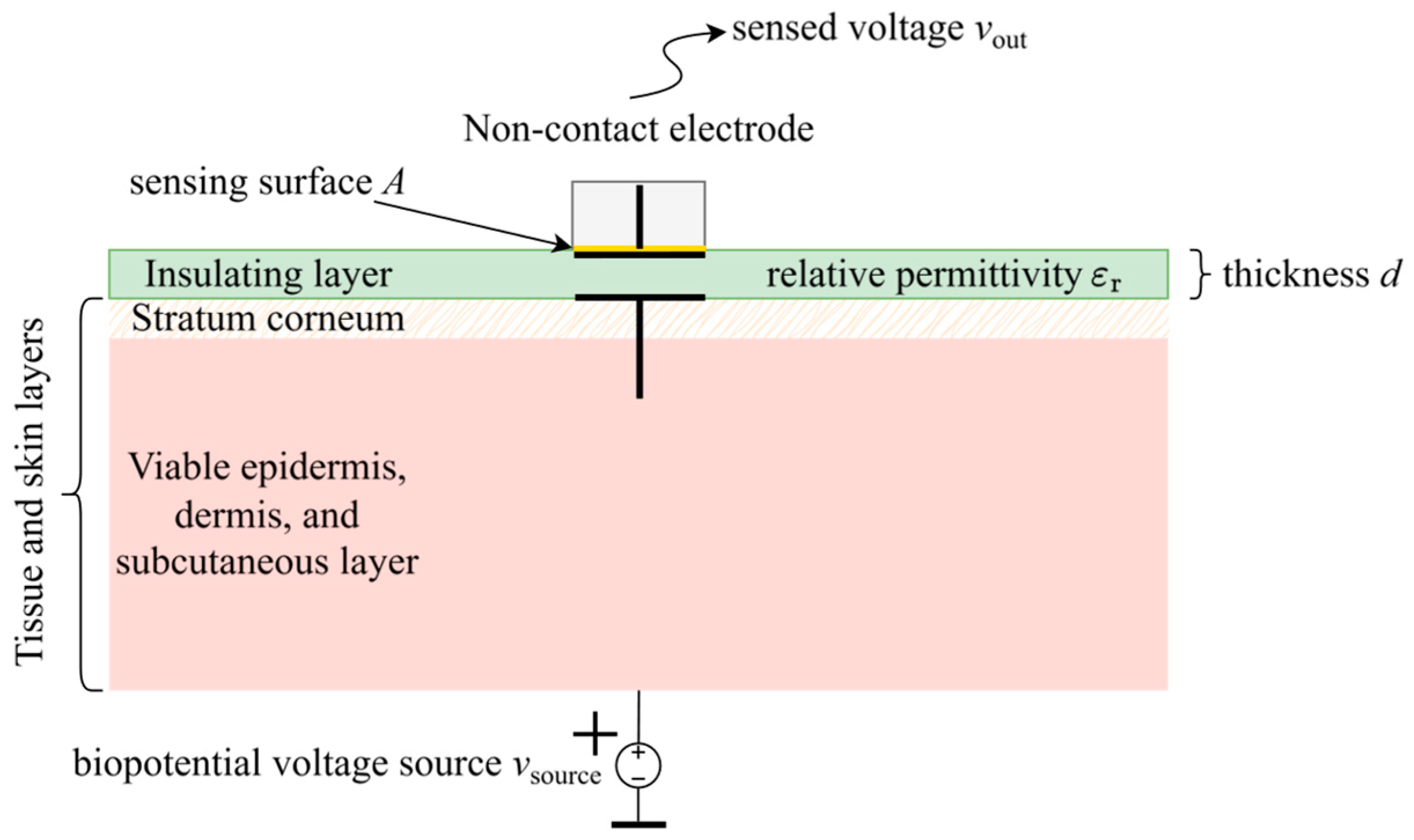
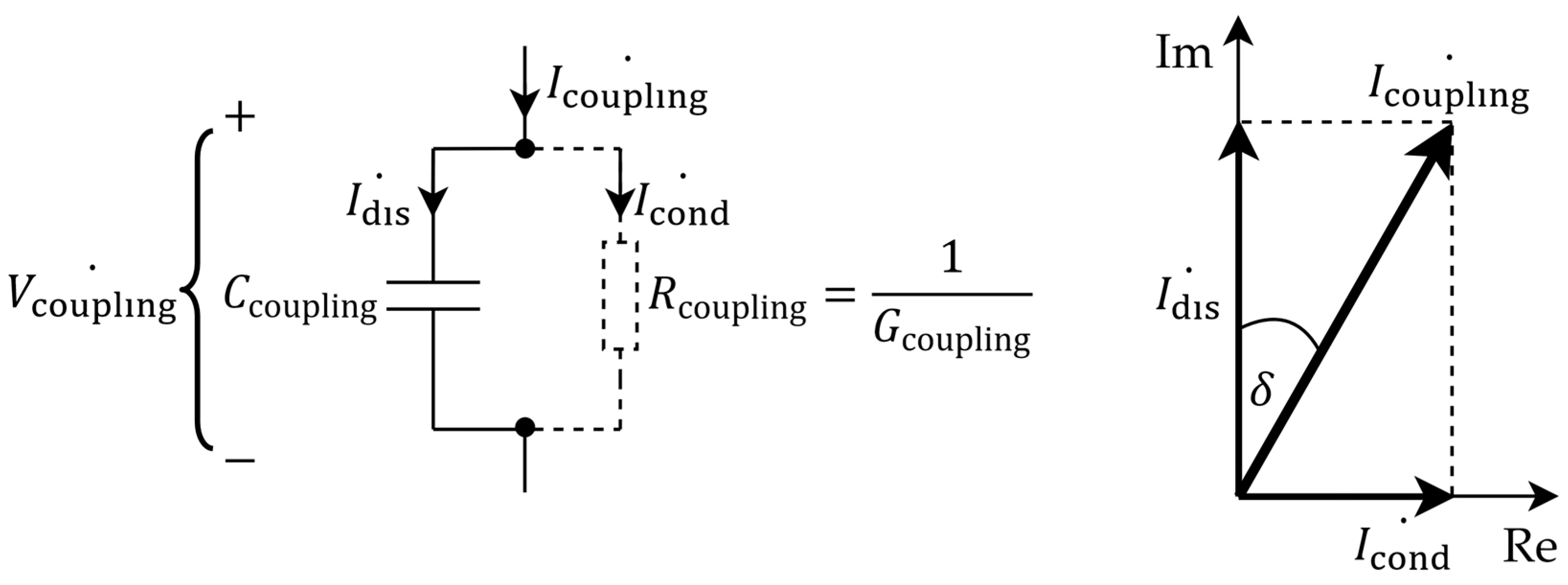
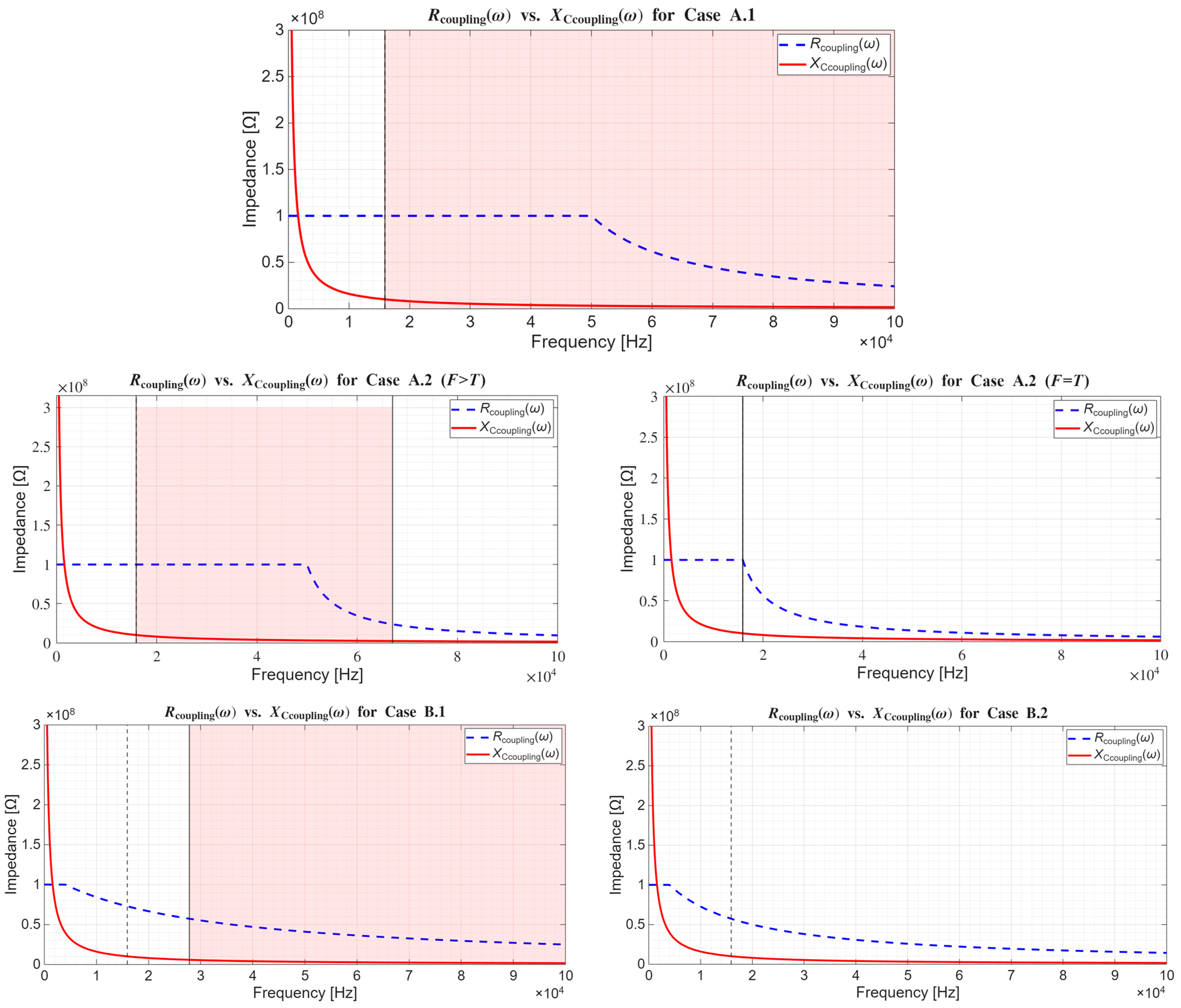
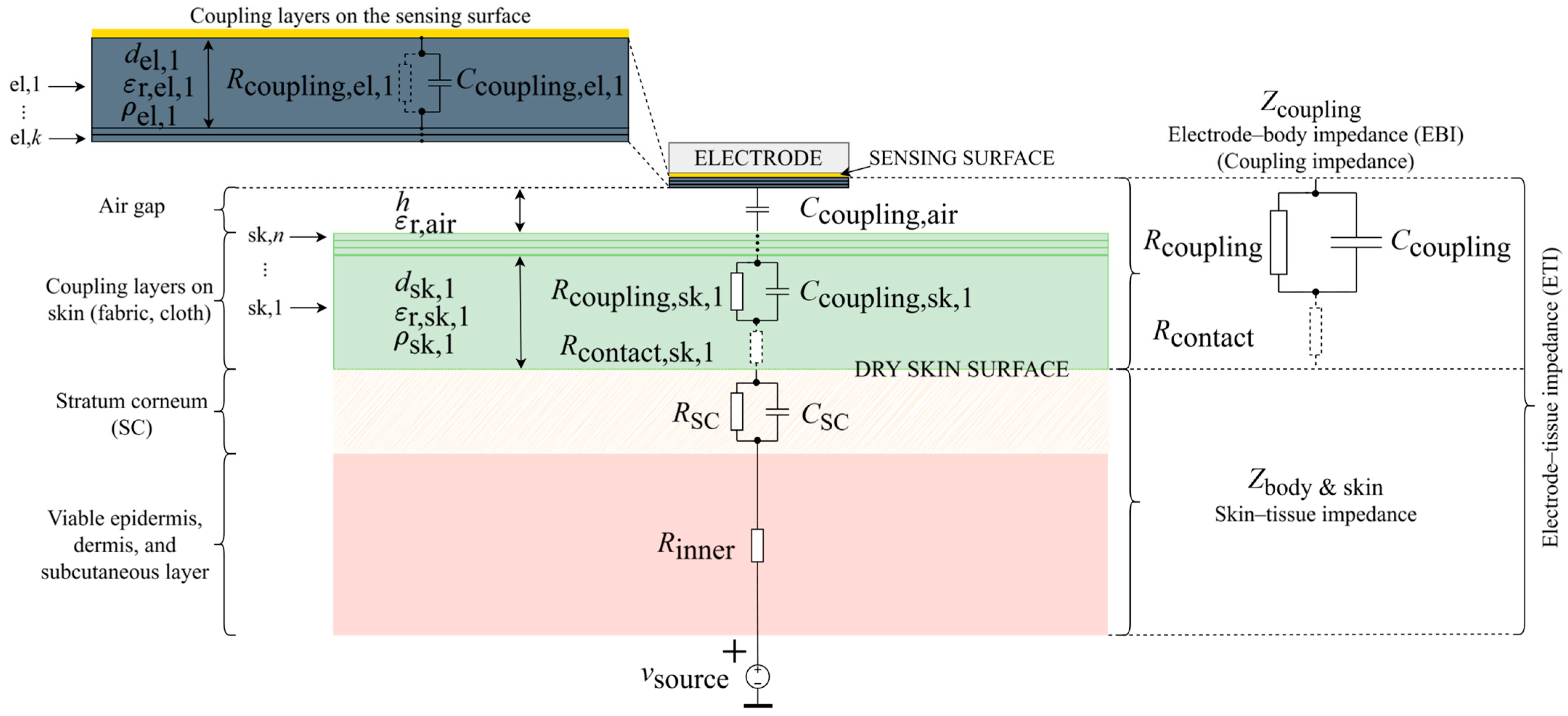
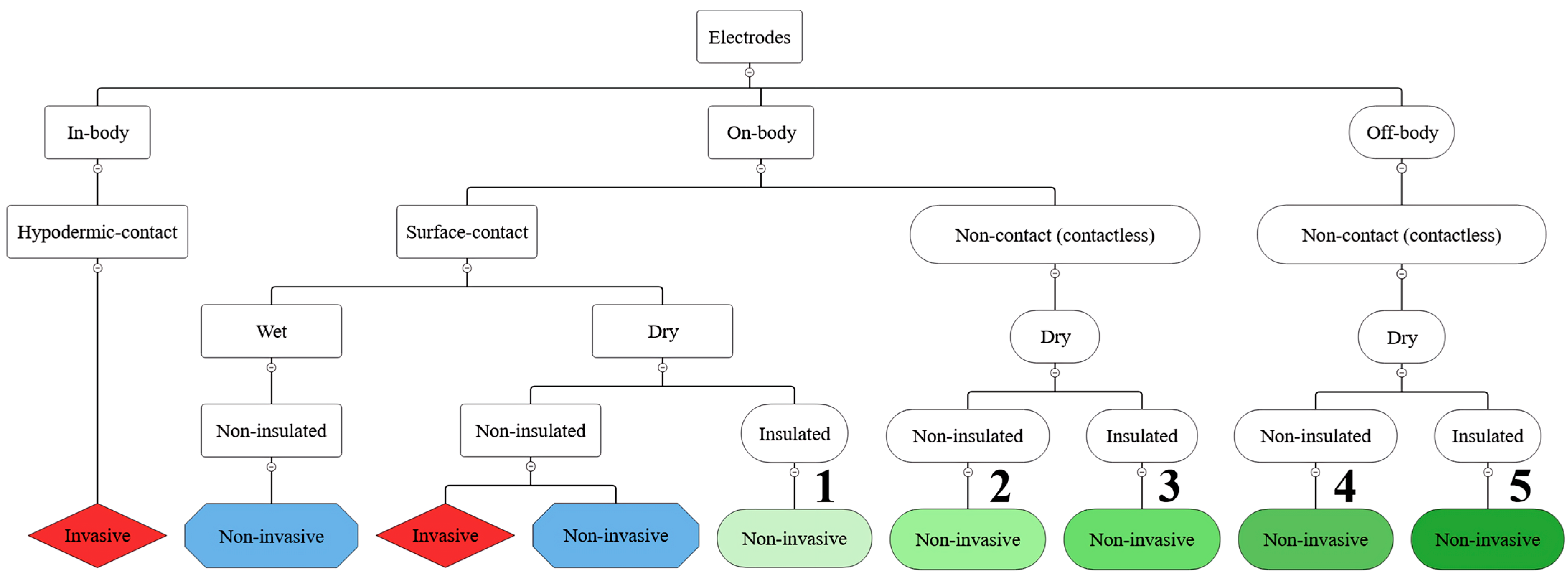
- This study is based on previously published reviews on non-contact and capacitive biopotential electrodes [86,87,88,89,90,91,92,93,94,95]. Yet, it is composed with the aim of consolidating various equivalent electrical models of the electrode–body interface and clarifying the terminology used in the field of non-contact and capacitive biopotential sensing, which is often inconsistently applied, as this complex matter is discussed from the perspective of various scientific disciplines such as electronics, biomedicine, chemistry, and textile technology. The need for such demystification of erroneously used terms and unclear concepts was intelligibly emphasized in the 2010s by several letters and comments on earlier papers and reviews [96,97,98,99]. Relying on the caveats therein expressed, this study is carried out with the hope of preventing such misinterpretations in the future. As a result of a systematic review of differences and similarities between electrical models of various electrode–body interfaces, a revised classification of biopotential electrodes is proposed. Accordingly, practical limitations of capacitive coupling are addressed and extended to the concept of predominantly capacitive coupling. A test for assessing the predominant coupling mechanism is proposed and employed to examine the parameters of the generalized equivalent electrical model of non-contact biopotential electrodes and their interface with the body. The resulting framework analytically corroborates the common practice, leading to the proposal for guidelines for designing non-contact electrode–body interfaces. This first objective results in four contributions, which are listed and visualized later in this section.
- This study also serves as a review paper, covering the trends that have been followed since some of the most recent general overviews on non-contact and capacitive biopotential electrodes [90,93] have been published. Hence, when possible and convenient, papers dating from 2016 onward are chosen for modern applications and system examples.
- By surveying discussions provided in the cited papers and summarizing their outcomes through a bottom-up analytical approach, up-to-date feedback to other research groups in the area of non-contact and capacitive biopotential measurement is given. The aim of such a report is to identify major challenges and speed up future research, steering it towards open questions that have to be addressed in order for non-contact and capacitive biopotential electrodes to live up to their commercialization and become standard practice in long-term biomonitoring and wearable biomedical devices. The adopted systematic approach and narrative style have allowed authors to carefully choose the most relevant papers and thoroughly tailor the order of their introduction, creating an “all-in-one-place” digital library that garners the fundamentals of non-contact and capacitive biopotential sensing. The established corpus can later be used to gain quick access to important historical milestones, as well as to instructive theoretical discussions and practical design examples. The build-up of a modern, up-to-date non-contact biopotential electrode, with all of its intricacies, is supported by book chapters, theses, papers, reports, lecture notes, handouts, application notes, and datasheets to accompany the calculations and simulations with practice, thereby verifying the theoretical background scattered across papers published over the last several decades. To fully grasp the context behind common practice and important tradeoffs in the design, no steps in the analysis are skipped, even in the case of applying elementary mathematical derivations and fundamental concepts of electronics or signals and systems analysis, which are elsewhere in the respective literature often implied or considered to be self-explanatory. The ultimate goal of these guiding principles is to make this study as suitable as possible, even for readers without a priori knowledge of biopotential electrodes, providing them with an educative example of using mathematical apparatus and engineering fundamentals in practice and encouraging them to join the deep dive into this sometimes-daunting research niche. Strategies for improving readability will be further described in Section 2 on Materials and Methods.
- Contribution 1: Proposal for a test for assessing the predominant mechanism of coupling achieved over an insulating layer (Section 3.1);
- Contribution 2: Proposal for a generalized equivalent electrical model of the interface between the body and a non-contact biopotential electrode (Contribution 2.1, Section 3.1), that is further developed into an equivalent electrical model of a buffer active non-contact electrode (Contribution 2.2, Section 4.1);
- Contribution 3: Proposal for revised classification of biopotential electrodes with respect to inaccuracies in the used terminology (Section 3.1);
- Contribution 4: Proposal for guidelines for designing non-contact electrode–body interfaces (Section 4.2), along with practical aspects of their implementation (Section 4.2 and Section 4.3).
1.3. Paper Structure
2. Materials and Methods
- Biomedical monitoring;
- Biopotential monitoring;
- Non-invasive biopotential monitoring;
- Non-contact and capacitive non-invasive biopotential monitoring.
- Motivation for biomedical and biopotential measurements;
- Type of biopotential electrodes discussed based on their distance from the body, type of contact, and invasiveness;
- Motivation for using non-contact and capacitive biopotential electrodes specifically;
- Type of biomedical and/or biopotential application of non-contact and capacitive electrodes;
- Original and unique applications of non-contact and capacitive biopotential electrodes;
- Important milestones in the historical development of non-contact and capacitive biopotential electrodes;
- Elaborate equivalent electrical models;
- Elaborate numerical models;
- Elaborate analytical models;
- Elaborate calculation examples;
- Elaborate methods of procedure, protocols, and evaluation metrics;
- Elaborate procedures for a specific electrical measurement;
- Illustrative measurement results;
- Discussions on electrical modeling of electrode–body interfaces;
- Discussions on insulating materials and their fabrication;
- Discussions on electrode size, shape, material, and fabrication;
- Discussions on the number of electrodes used and their configuration;
- Discussions on feasibility and limitations in activity monitoring;
- Discussions on feasibility and limitations in long-term monitoring;
- Discussions on feasibility and limitations in clinical-grade applications;
- Subcategories on analysis and illustrative examples of remaining challenges (parasitic elements and stability analysis, intrinsic noise, crosstalk, motion artifacts, extrinsic noise);
- Subcategories on addressing these remaining challenges (electrode–body interface design, discrete and integrated hardware solutions, digital signal processing, machine learning approach and deep learning methods).
- biomedical/bio-medical;
- biopotential/bio-potential;
- unobtrusive/non-obtrusive/nonobtrusive/non-intrusive/nonintrusive;
- non-invasive/noninvasive;
- surface;
- contact;
- wet;
- gel;
- electrolyte;
- paste;
- dry/dry-contact/dry contact;
- gelless/gel-less;
- pasteless/paste-less;
- active;
- passive;
- on-body;
- off-body;
- non-contact/noncontact;
- indirect;
- contactless;
- insulating/insulated;
- capacitive.
- rigid;
- multi-layer;
- substrate;
- soft;
- flex;
- stretch;
- nano;
- fabric;
- textile;
- patch.
- ECG;
- cECG;
- heart;
- heart rate;
- EMG;
- muscle;
- EEG;
- brain;
- evoked;
- EOG;
- seat;
- chair;
- bed;
- mattress;
- cushion;
- drive/driving;
- ambulatory;
- body area/body-area/BAN;
- long-term;
- home.
- skin;
- impedance;
- sweat;
- perspiration;
- humid;
- moist;
- motion;
- movement;
- artifact/artefact;
- air gap;
- triboelectric;
- microphony/microphonic;
- noise;
- interference;
- powerline/power-line/power line;
- right leg.
- Action potentials and biopotential signals;
- ECG biopotential signal and ECG measurement methods;
- Electrochemistry;
- Electrical modeling of real-world electric components and electrode–body interfaces;
- Capacitors and dielectrics;
- Electromagnetism and Maxwell’s equations, fringing fields, and finite models;
- Operational amplifiers and negative feedback;
- Stability analysis;
- Time-domain and frequency-domain system analysis;
- Intrinsic noise analysis;
- Triboelectricity;
- Microphony;
- Interference analysis, electric and magnetic coupling, cabling, and shielding;
- Fabrication of e-textiles and smart fabrics.
- What is the level of complexity and which level of prior knowledge is required for understanding the work?
- Does the work have an educational value?
- Is the work significant in the context of historical development?
- Is there an informative literature review present?
- Is there an instructive research methodology or measurement protocol provided?
- Are there any analytical or equivalent electrical models, illustrative calculation examples, or illustrative measurement results provided?
- Are the phenomena described in the work clearly distinguishable and separately addressed?
- Are the challenges presented in the work clearly distinguishable and separately addressed?
- Is the presented solution clearly elaborated and differentiated from the existing solutions?
- Non-contact and capacitive electrodes: general overview of capacitive sensing applications [12], overview specifically focused on biochemical applications [20], review from the perspective of electrosurgery [55], integrated unobtrusive biomedical sensing solutions [43], and specifically electric field and biopotential sensing [86,88,89,90]; reviews on biopotential measurement with the addition of noise analysis [87]; reviews focused on ECG [93] and EMG [91] applications, dielectrics [92], and structural design for wearability [21];
- Wearable design: modalities and prospects [124], advancements in devices for arrhythmia detection [125], hydrogel-based devices [126], textile-based electrodes [127,128,129,130], printed wearable electronics [131], biocompatibility [132] and biodegradability [133], wearable antennae [134,135,136], energy harvesting [137], plant monitoring [17], BANs [10,79,80,81], exoskeletons [84], and specifically smart-textile exosuits [85];
- Beginnings of discussions inside each section are highlighted with a brief heading indicating the subject of the discussion;
- Assumptions and simplifications that are used throughout this study are enumerated and highlighted within a dedicated paragraph titled “Assumption X.” This way, each assumption represents a stepping stone in the bottom-up analysis, summarizing the findings built upon the previous assumptions, as well as offering an abridged version of the content for quick access. Throughout the paper, nine assumptions are established in total.
- Each topic discussed contains a brief literature overview, which serves as a collecting point for all the cited literature on the respective topic. The provided references offer a progressive learning path, as they span a broad spectrum of complexity, ranging from foundational concepts for novices to advanced, expert-level content.
- Finally, to reduce the main body of the text, elementary mathematical derivations and prior knowledge (Prerequisites 1 and 2 in Figure 1) are strategically relocated to four appendixes, which are appropriately cross-referenced at the beginning of Section 3.1 and Section 4.1. Their content is described in Figure 1 and Section 1.3:
- Appendix A. Origin and Acquisition of Biopotential Signals;
- Appendix B. Surface-Contact Electrodes;
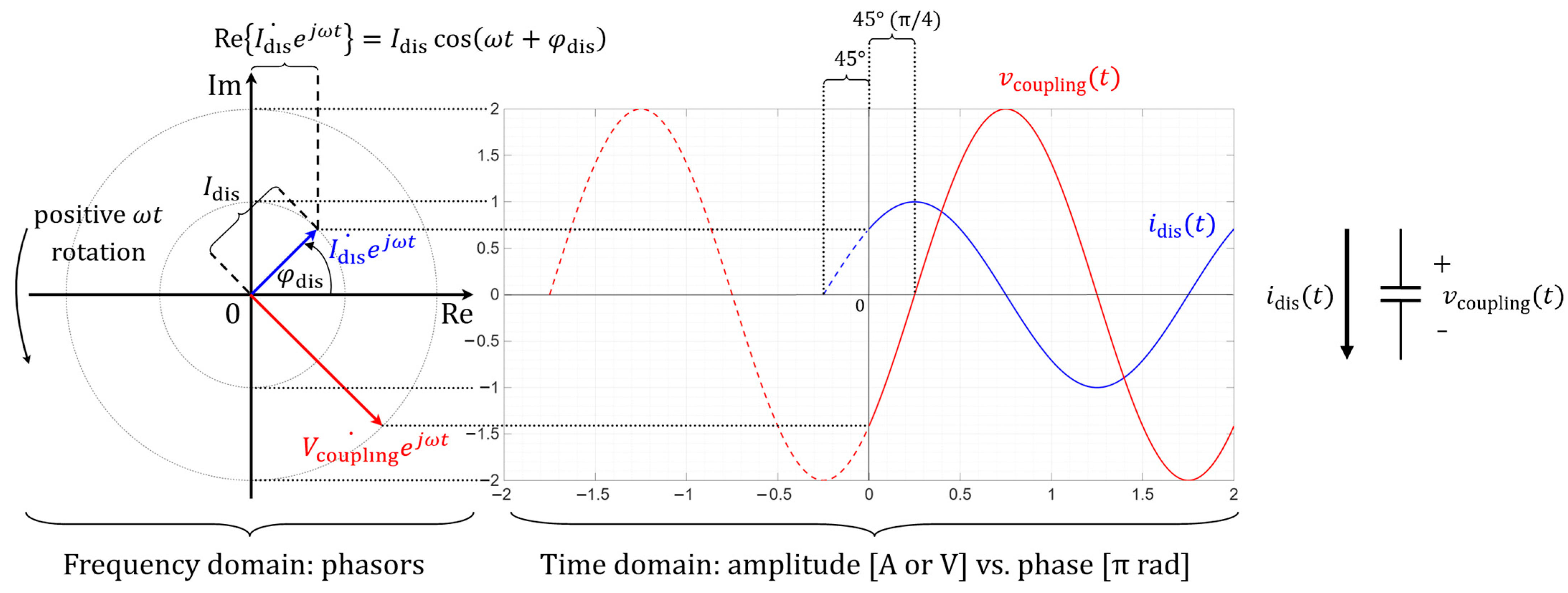
- Appendix C. Fundamentals of Capacitors and Phasor Algebra;
- Appendix D. First Subsystem: Operational Amplifier.
3. Electrodes
3.1. Non-Contact Electrodes

- Increasing Ccoupling (reactance reduction (A4));
- Increasing Rcoupling,DC (leakage reduction (9));
- Reducing tanδ (slowing down the leakage increase (9));
- Increasing factor F and consequently ωδ (delaying the leakage increase (9));
- Decreasing T (relaxing the criterion for assessing the frequency at which the coupling becomes predominantly capacitive (Table 1)).
- Fundamentals of dielectrics, polarization, and capacitors: insulators and dielectrics on a quantum level in [256], and polarization effect in [255,256,257,258,260,284]; extensive discussion on electrical, mechanical, and thermal properties of dielectrics is given in [257]; physical basis of capacitance is given in [256,258,259,263,285] and further extended to linear and non-linear capacitor models and their properties in [264], and applications of capacitor circuits in [261,264]; more on properties and manufacturing of real-world capacitors is given in [260,261] and subchapter 1x.3 in [282]; an overview of historical development of capacitive sensing is given in [10].
- Physical basis of resistance [287] and inductance [302]; therein presented fundamentals, along with references on physical basis of capacitance listed in the previous bullets, can be extended to discussions on modeling PCB parasitic elements ([274] and subchapter 1x.1 in [282]), package lead parasitics [303], and on-chip interconnects parasitics [304], as well as equivalent circuits of capacitors, resistors, inductors, and diodes [260,305,306,307,308]. More on manufacturing of real-world passive components and diodes along with their non-idealities can be found in [282,305,306,307], with a focus on capacitors in [260] and subchapter 1x.3 in [282], and with a focus on resistors in [288] and subchapter 1x.2 in [282].
- Various important rules and useful formulae for board-level and system-level design are highlighted in [273] and will be occasionally referenced. Various PCB design issues are covered in [274,306], chapter 3 in [104], and subchapter 1x.1 in [282]; specifically, more on power supply noise and decoupling is given in [310].
- With the addition of the literature on operational amplifiers and systems theory that will be listed throughout Section 3.2 and Section 4.1, all these references will serve as the basis for the rest of the assumptions.
3.2. Passive and Active Design
4. System Analysis
4.1. System Transfer Function and Impulse Response
- (I) For the given amplitudes of interest (Assumption 1), the operational amplifier is considered to operate in the linear, small-signal regime. In other words, analysis considers a small-amplitude, time-varying AC biopotential signal superimposed to any DC voltage present at the interface.
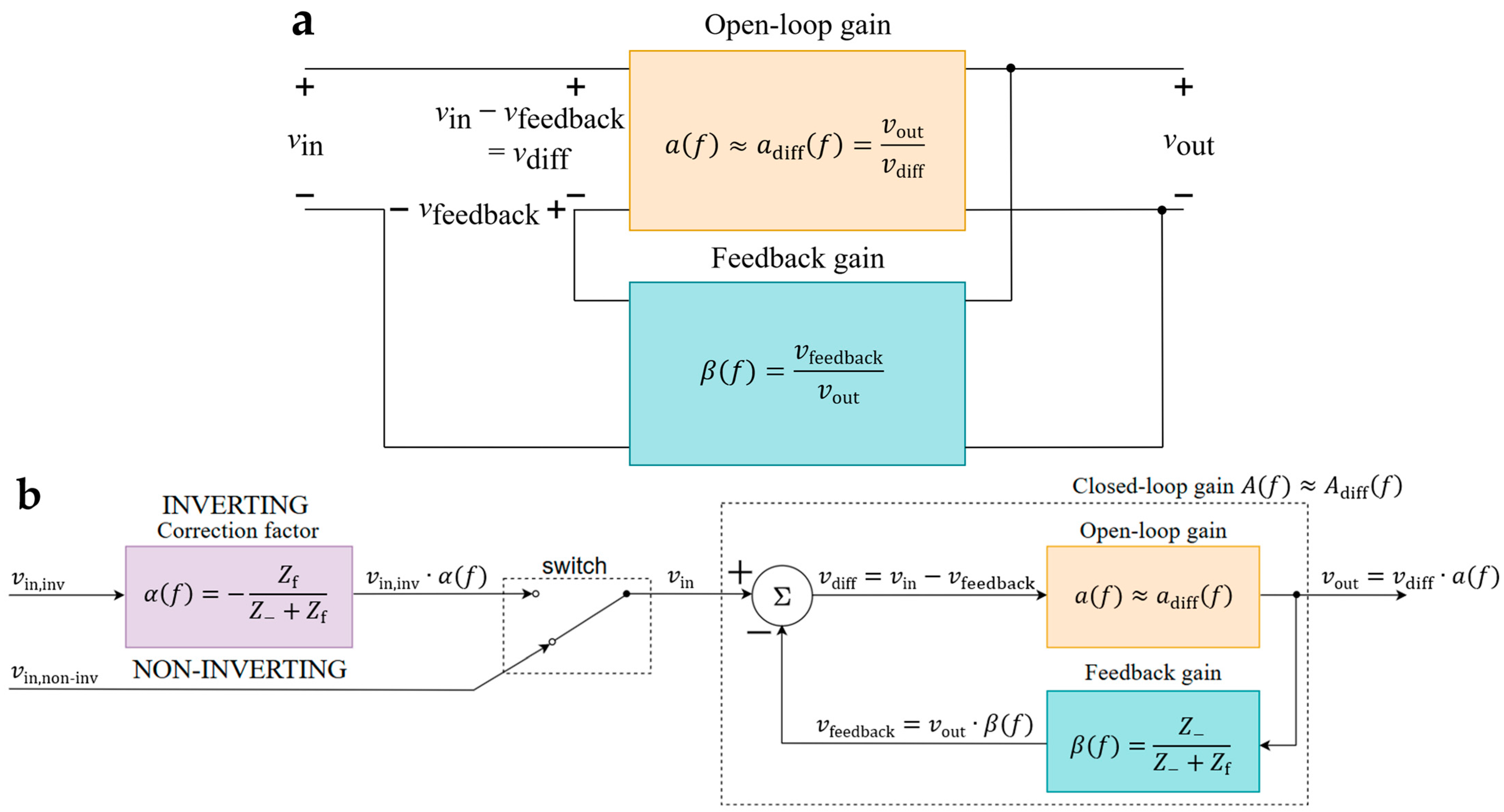
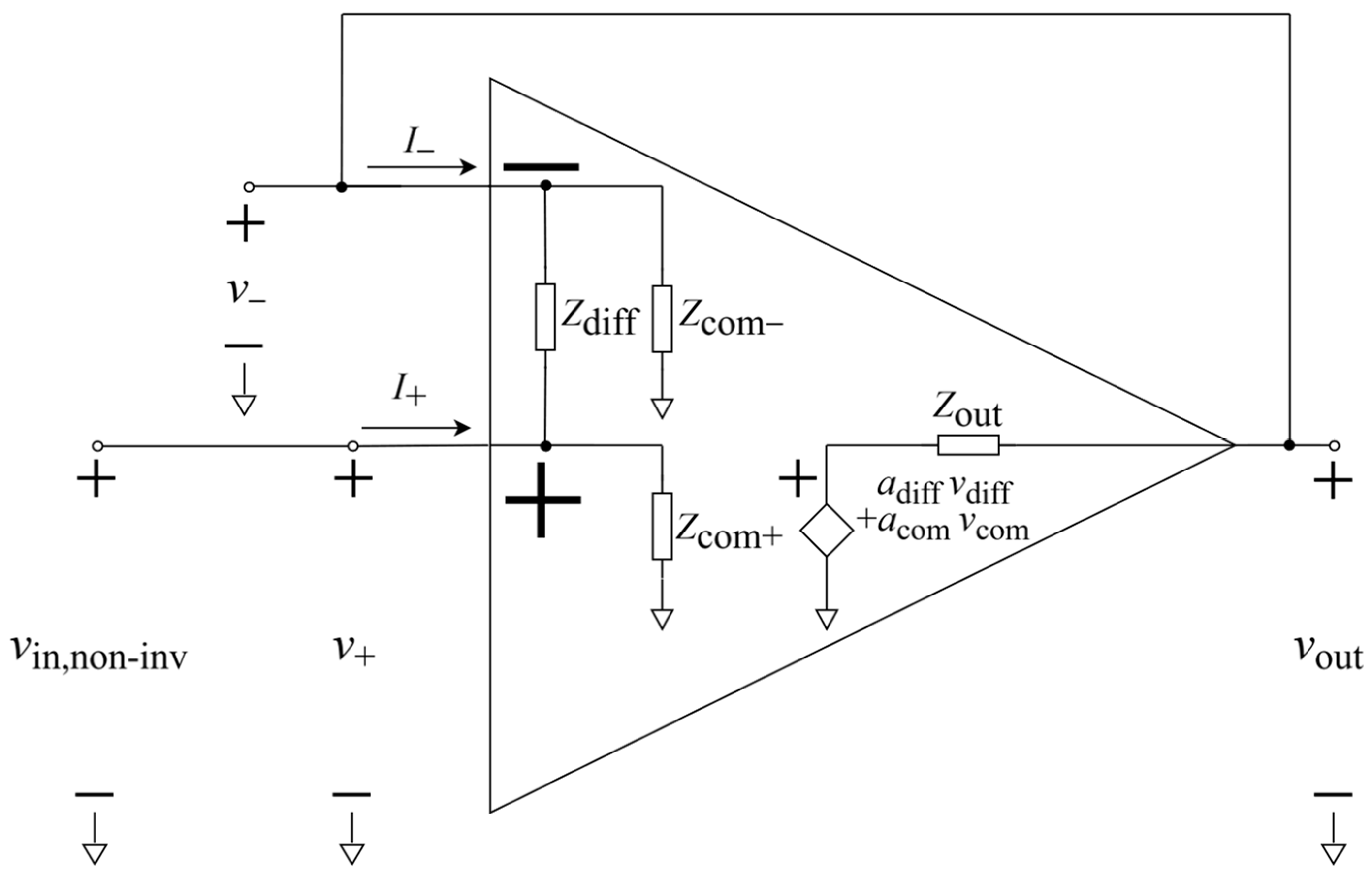
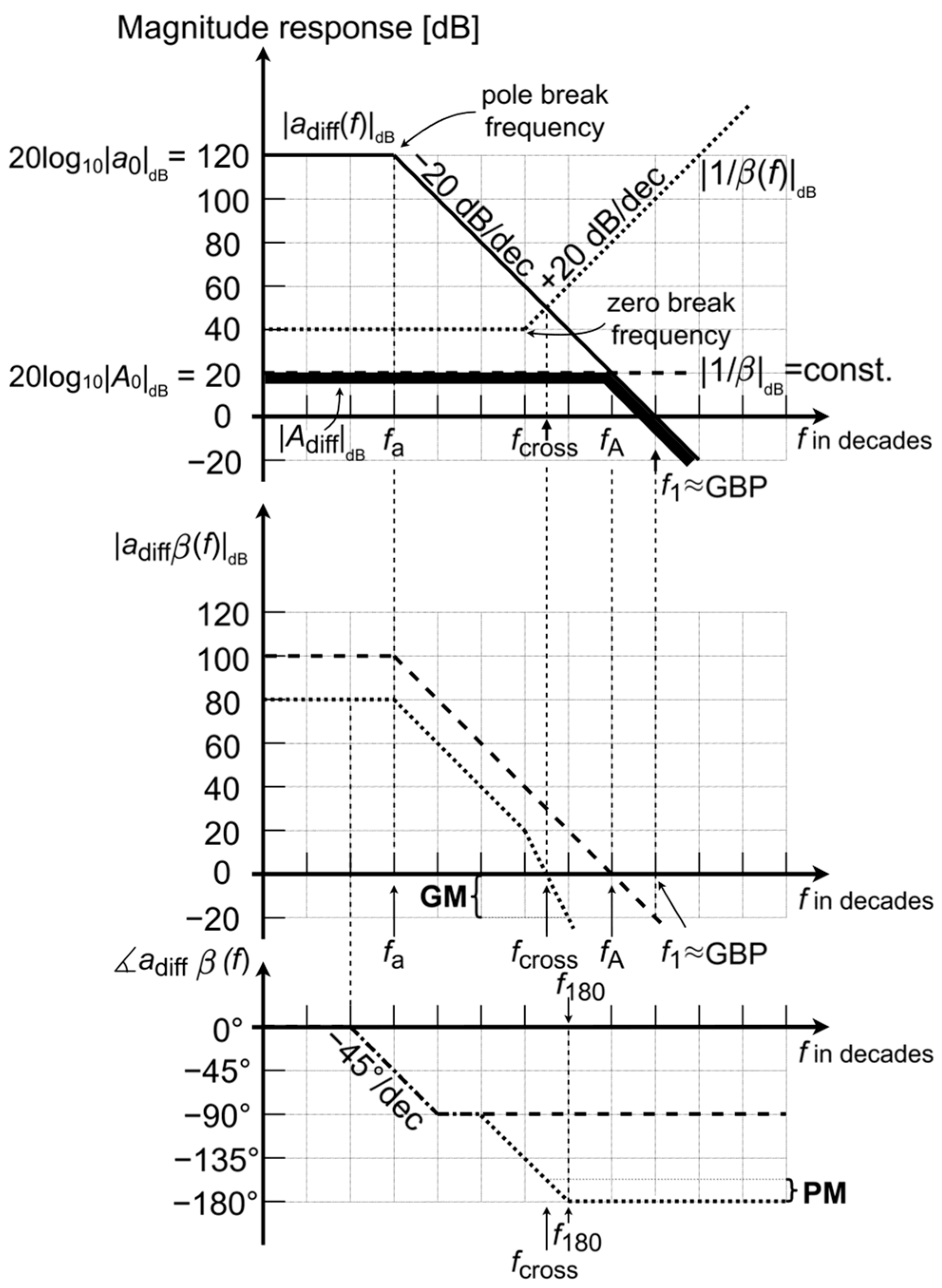
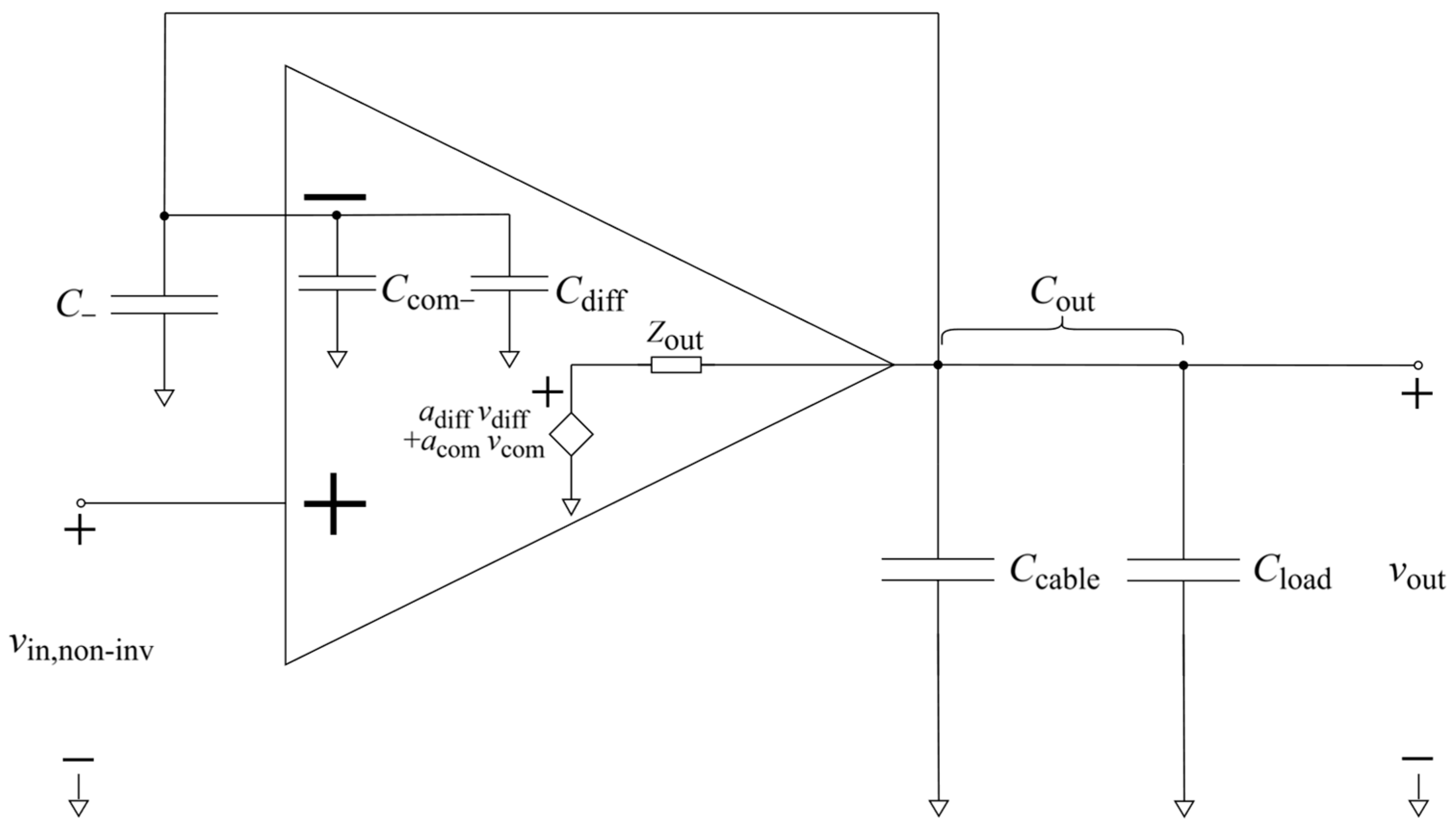
- (II) Open-loop common-mode voltage gain acom is neglected in comparison with the open-loop differential-mode voltage gain adiff, i.e., a ≈ adiff and vout,open-loop ≈ adiffvdiff (A8). Also, adiff is sufficiently high at frequencies of interest (at least 90 dB [336,337,338]) that the virtual short concept can be adopted and that the resulting closed-loop differential-mode voltage gain Adiff at frequencies of interest depends only on the gain of the external feedback path β. In other words, Equations (A17) and (A18) can be used. The operational amplifier is assumed to be internally compensated and modeled with a first-order system: open-loop gain adiff(f) (A14) and closed-loop gain Adiff(f) (A19) with a unity closed-loop gain A0 = 1 V/V = 1 (0 dB) for a voltage follower (buffer) configuration. Given the typical gain-bandwidth product (GBP) of 1 MHz [336,337,338], the influence of capacitance at the inverting input and at the output will be neglected (A21) and revisited in Section 4.3. On the other hand, the capacitance at the non-inverting input will be introduced in the subsequent pages.
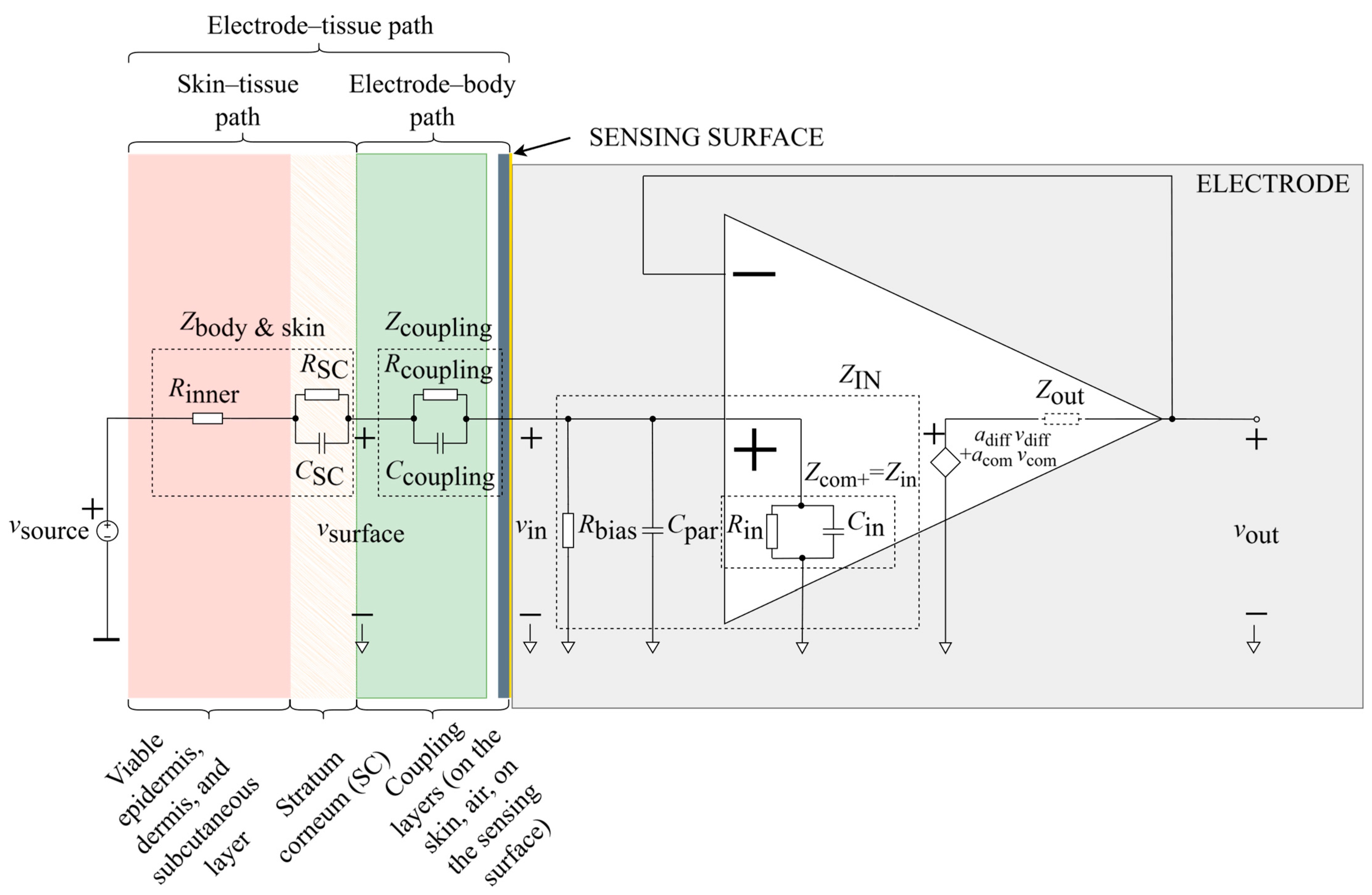
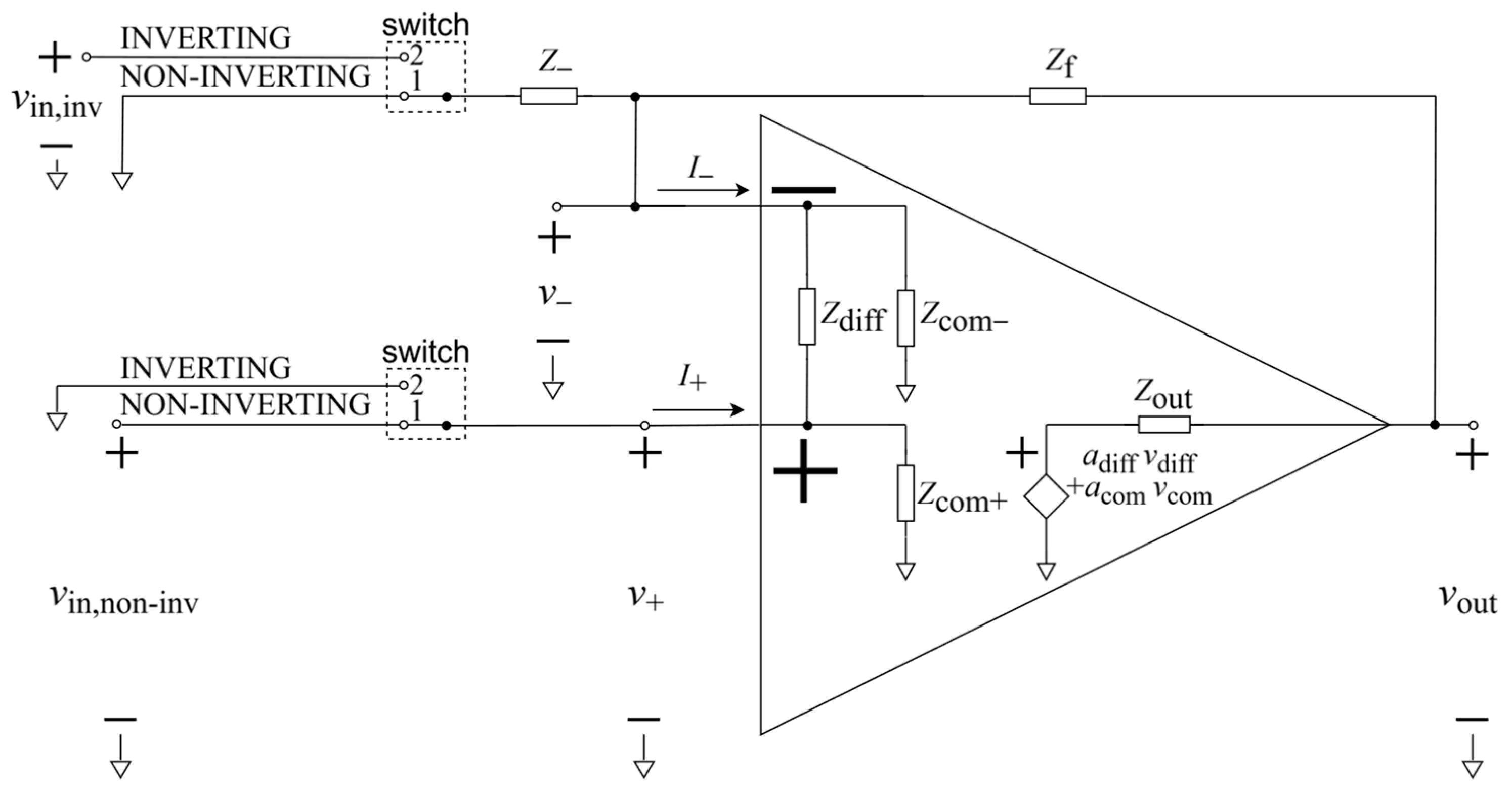
- (III) Given that the implementation of a series–parallel negative feedback increases Zdiff, the relation Zdiff >> Zcom−,Zcom+ will be assumed. Similarly, Zout is decreased by the series–parallel negative feedback and will be neglected [331,333,334,340,342]. Further, Zcom− and Zcom+ are considered to be approximately equal (matched, balanced). Since the negative feedback path is short-circuited (Rf = 0 Ω) and since the signals source is present at the non-inverting input, for practical considerations of the equivalent electrical circuit at the buffer preamplifier input, only Zcom+ will be of interest and, from now on, named Zin [332].
- (IV) Furthermore, internal errors of the operational amplifier and effects of its native non-linearities, significantly reduced by the presence of negative feedback, will not be considered.
- (V) Similarly, the influence of power supply fluctuations on output voltage and their finite rejection, expressed by the power supply rejection ratio (PSRR) [315,330,332,375], are neglected. In general, the implementation and intricacies of amplifier power supply are not considered [333,376], and in addition, proper power supply decoupling, along with proper biasing of internal circuitry, is assumed (refer to Section 27 in [335], and to [310]).
- (VI) Also, manufacturer tolerances and mismatch in components and input stages, as well as asymmetry in the signal path, are neglected. Therefore, output offset voltage or zero error, as the output voltage present when input terminals are short-circuited and grounded, and input offset current, as the difference between bias currents I+ and I− (Figure A8) [315,330,332,333,335,374,375], are neglected. Just like DC and slow-fluctuating errors arising from the electrode–body interface, such as the half-cell potential, these DC limitations and offset errors are in practice mitigated through various procedures of correction, filtering, cancelation, and calibration, more on which can be found in [332,333,335,374,375]. For instance, instead of an input series blocking capacitor, DC rejection can be achieved with the use of a DC servo loop that allows for automatic control of amplifier output offset [314,377,378]. Specifically, the influence of non-zero bias currents I+ and I− will be addressed in the subsequent pages in the context of DC biasing circuitry.
- (VII) Next, constant ambient conditions and constant ambient temperature are assumed (Assumption 2). Hence, output voltage drift due to the temperature dependence of reverse-biased leakage of p-n junctions, as well as due to the temperature dependence of amplifier input offset voltage and input offset current, is not considered. Similarly, drift with time due to aging is not considered.
- (VIII) Finally, AC and large-signal limitations can also be considered—more specifically, slew rate and swing limitations. Although the addition of a capacitance for internal compensation severely impacted the slew rate, and although lower amplifier consumption usually draws lower slew rates, commonly used amplifiers achieve slew rates of at least 2 V/μs [336,337,338]. With these values of slew rate, even a 10 V amplitude sine wave would yield a full power bandwidth of at least 31.8 kHz (in accordance with the magnitude of the time derivative of a sinusoid; refer to subchapter 2.2 in [331], and [273,332,335,344,379]). Therefore, slew rates of off-the-shelf amplifiers commonly employed for biopotential monitoring are more than sufficient for most biopotential signals. In other words, rate of change in output voltage is fast enough to track the input voltage. Hence, the slew rate-induced distortion is not considered, and the small-signal bandwidth, described in Appendix D, is rather limited by the input and output swing limitations [330,332,375]. Given the amplitudes of biopotential signals (Assumption 1), clipping distortion (i.e., truncation of signal peaks) as a result of exceeding the swing specifications will not be considered for the system analysis.
- (I) Given the frequencies of interest (Assumption 1), transmission line effects will be neglected.
- (II) Furthermore, PCB parasitics can be considered. Firstly, for a typical FR-4 PCB at room temperature, given that a 1 oz (35 microns) thick copper trace exhibits about 0.5 mOhm per square area, unit-length resistance of a PCB copper trace achieves orders of 10–100 mOhms/cm [273,287]. Secondly, PCB trace inductance per unit length is in the order of 10 nH/cm, whereas via inductance achieves values of about 1–2 nH [273,302], which is negligible at frequencies of interest (Assumption 1). Thirdly, unit-length stray capacitance between adjacent copper traces on the same layer can reach the order of 100 fF/cm for very small distances of 0.1 mm, which is negligible even for fairly long coupling lengths [259,273]. Therefore, PCB trace resistance and inductance, as well as stray capacitance between adjacent traces on the same layer, will be neglected and considered minimized with proper PCB stack-up and PCB layout (refer to paragraph “Fundamental literature overview” at the end of Section 3.1 for details). Likewise, in the case of using e-textile devices, the parasitic capacitance of conductive yarns that is usually in the order of 1 fF/cm would be neglected at frequencies of interest [381].
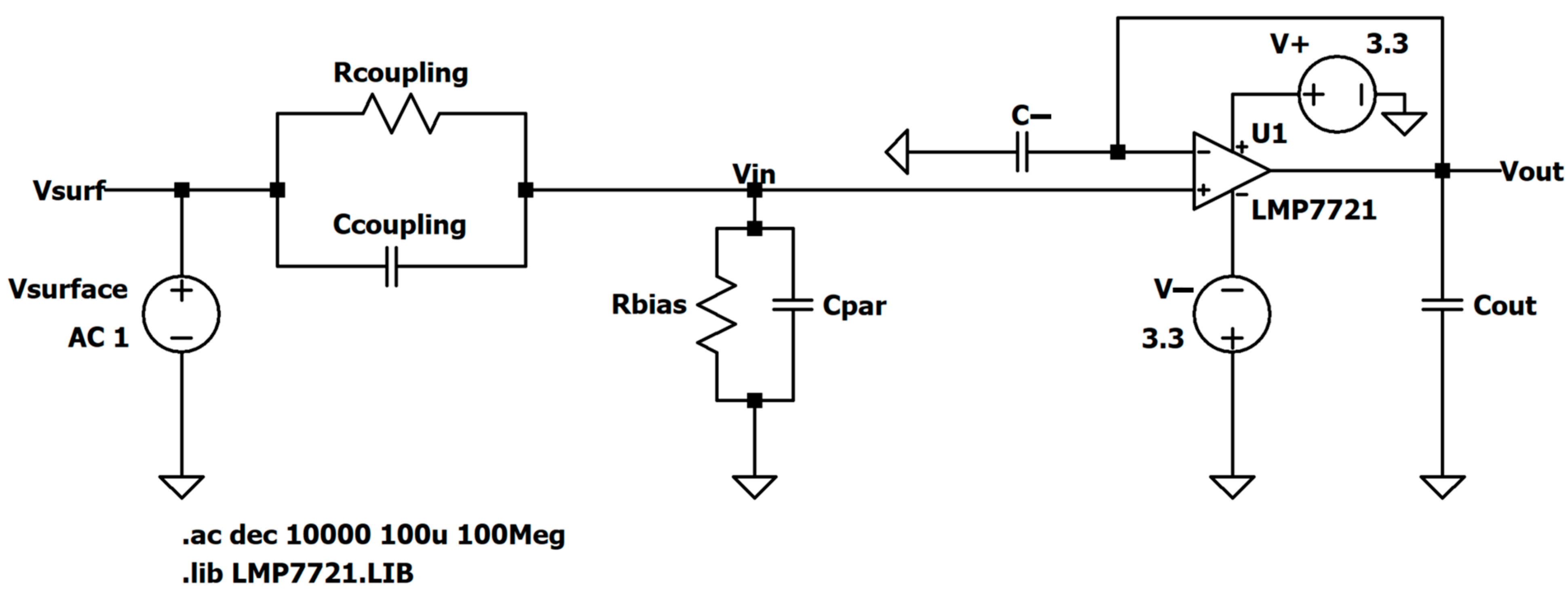
- (III) Aside from PCB and e-textile parasitics, parasitic elements of the operational amplifier (buffer preamplifier) can also be considered. Firstly, in accordance with estimation (A21), capacitance present at the inverting input terminal and output capacitance will not be considered. Their influence, elaborated in Appendix D, will be appropriately revisited in Section 4.3. On the other hand, the paragraph “Parasitic input capacitance” in Section 4.1. will introduce the parasitic capacitance present at the non-inverting input terminal. Secondly, considering the frequencies of interest (Assumption 1), amplifier input inductance [352], as well as parasitic resistance and inductance of package leads [303] and on-chip interconnects [304], will be neglected.
- (IV) Lastly, non-idealities and parasitic elements of any additional discrete component are neglected at frequencies of interest (Assumption 1); hence, equivalent electrical models for components such as resistors, inductors, ceramic capacitors, electrolytic capacitors, and diodes are not considered. More on equivalent electrical circuits and non-idealities of various components can be found in the paragraph “Fundamental literature overview” in Section 3.1.

4.2. Second Subsystem: Input Voltage Divider


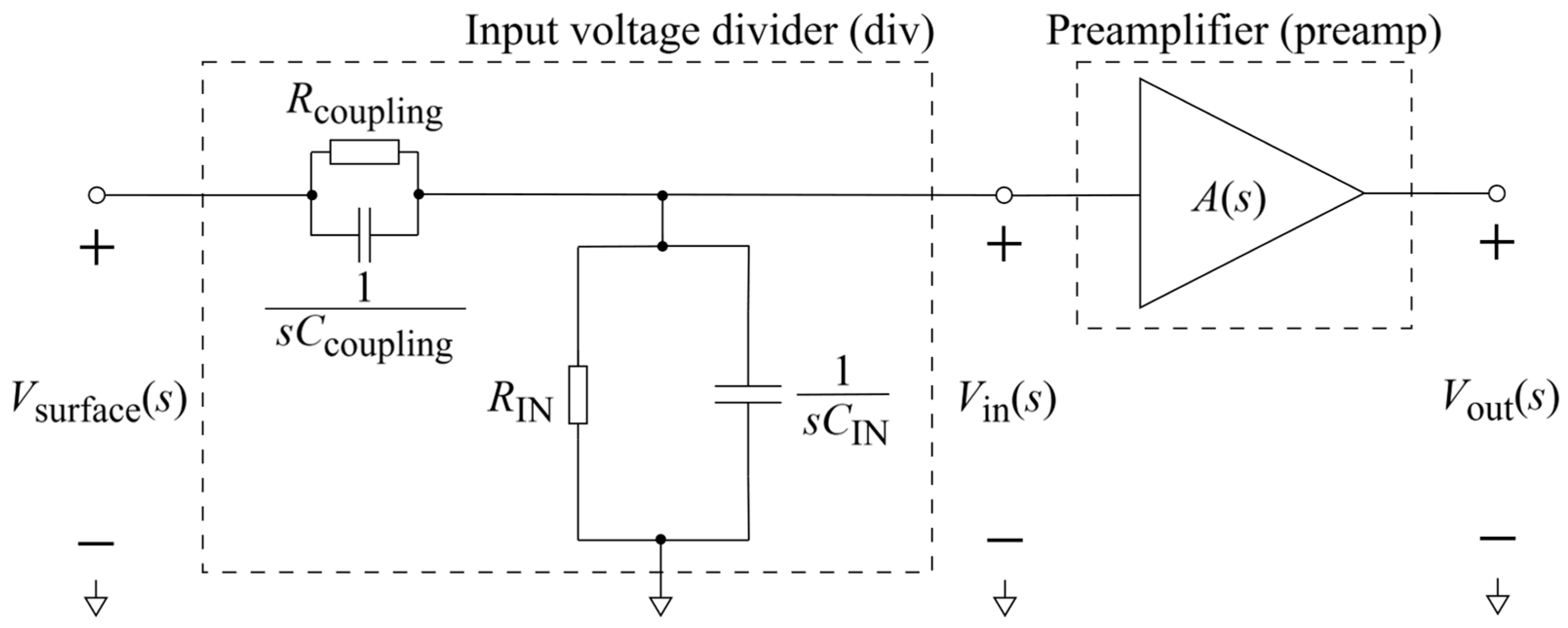
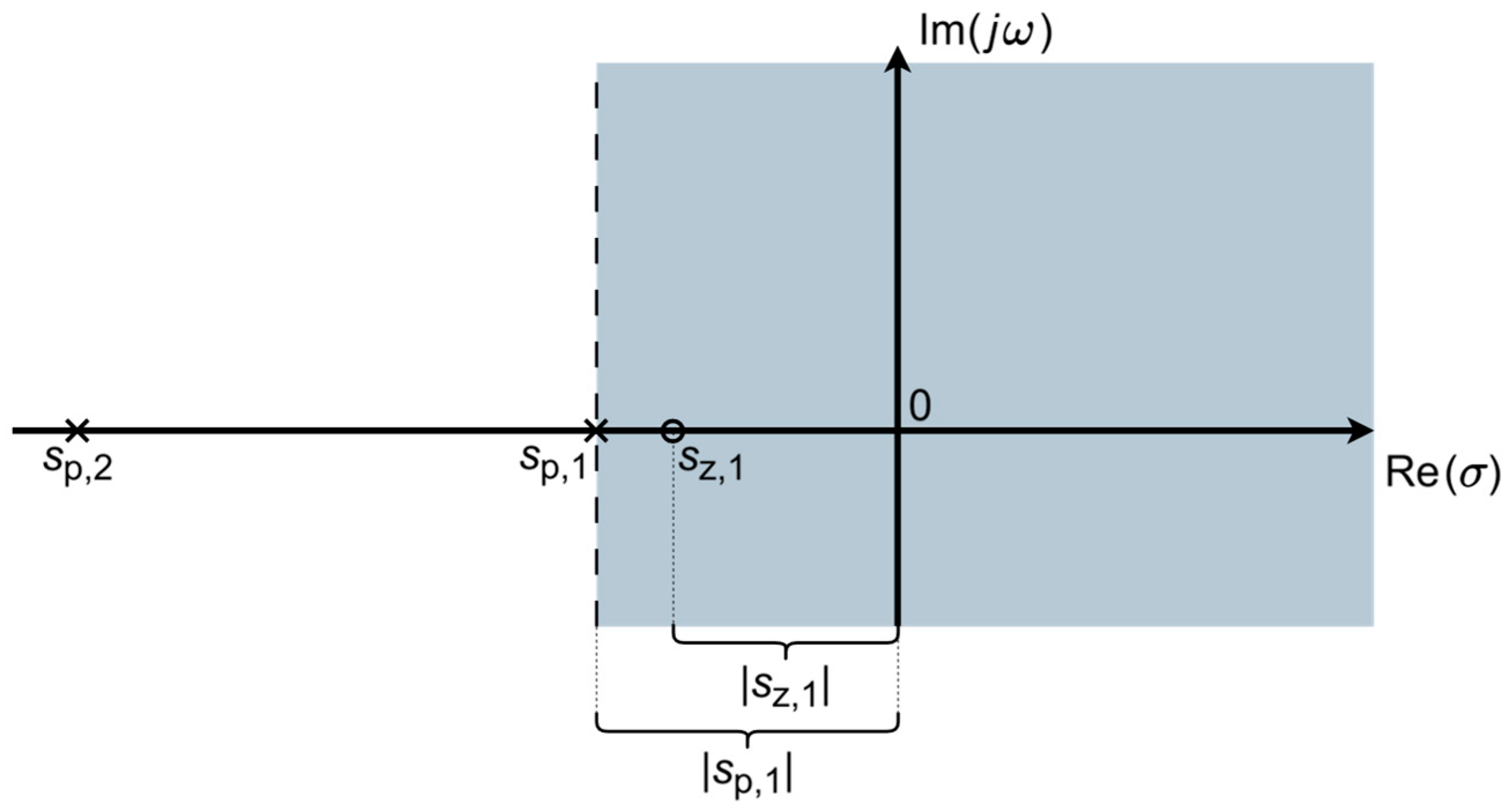
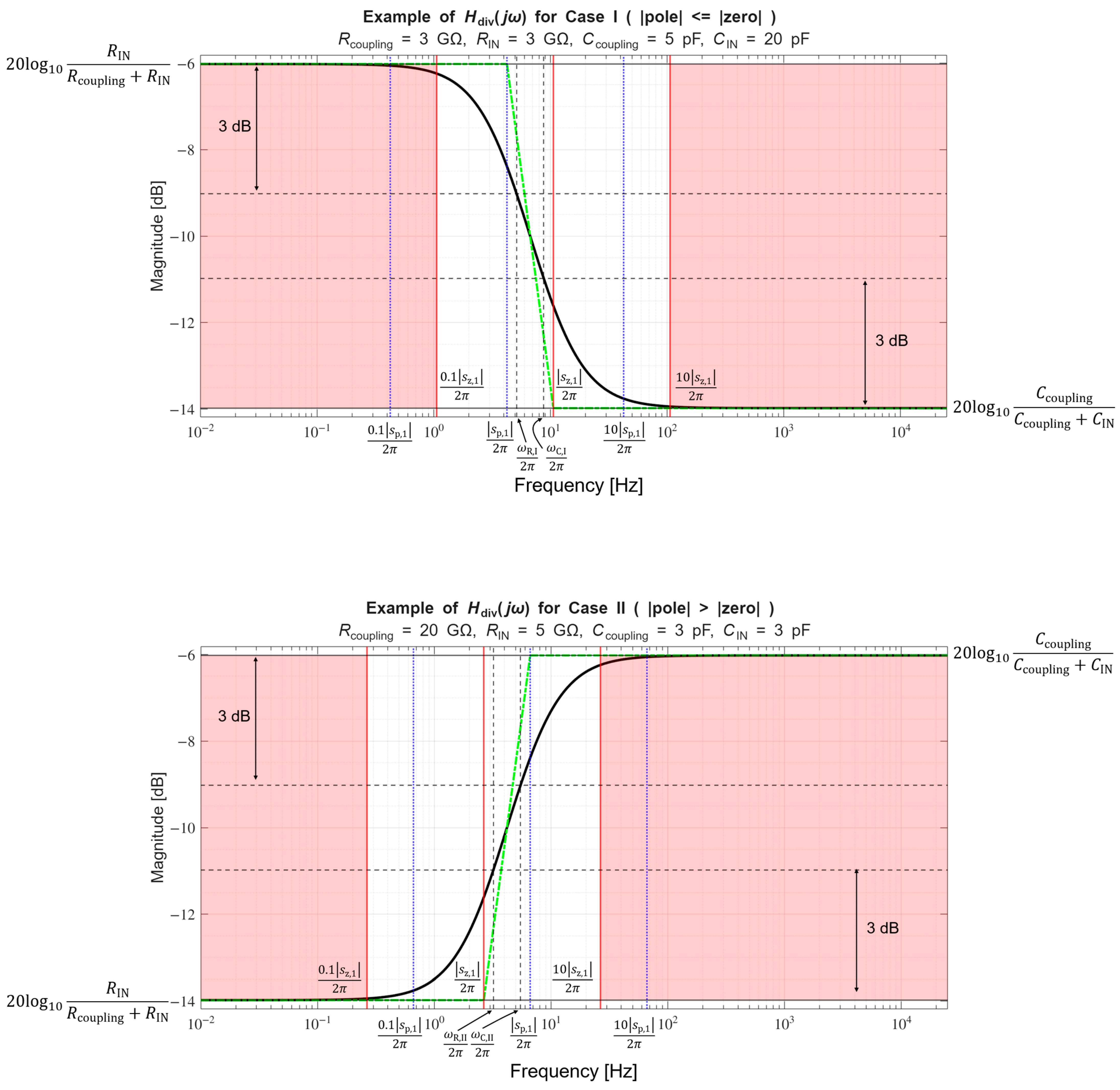
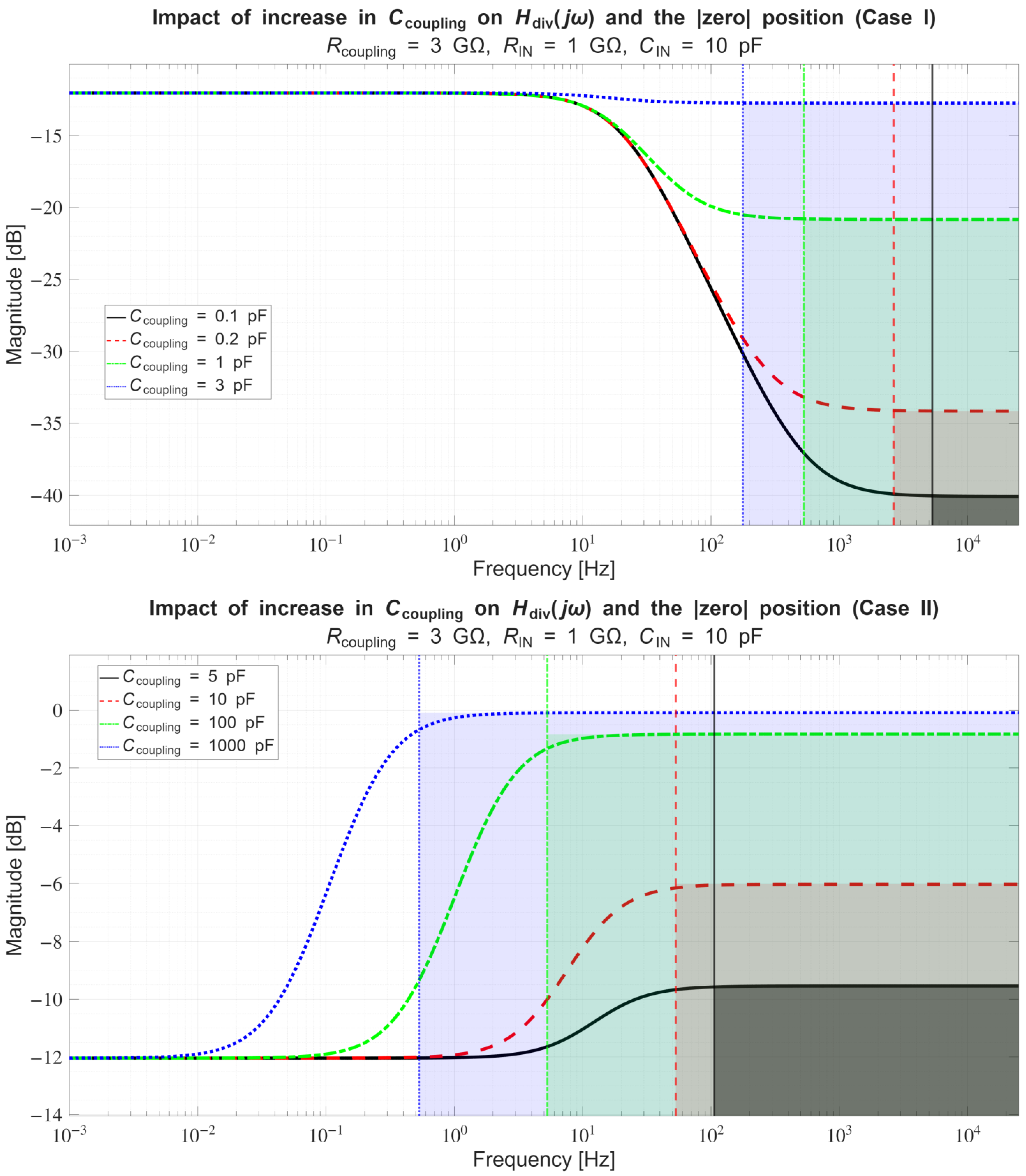
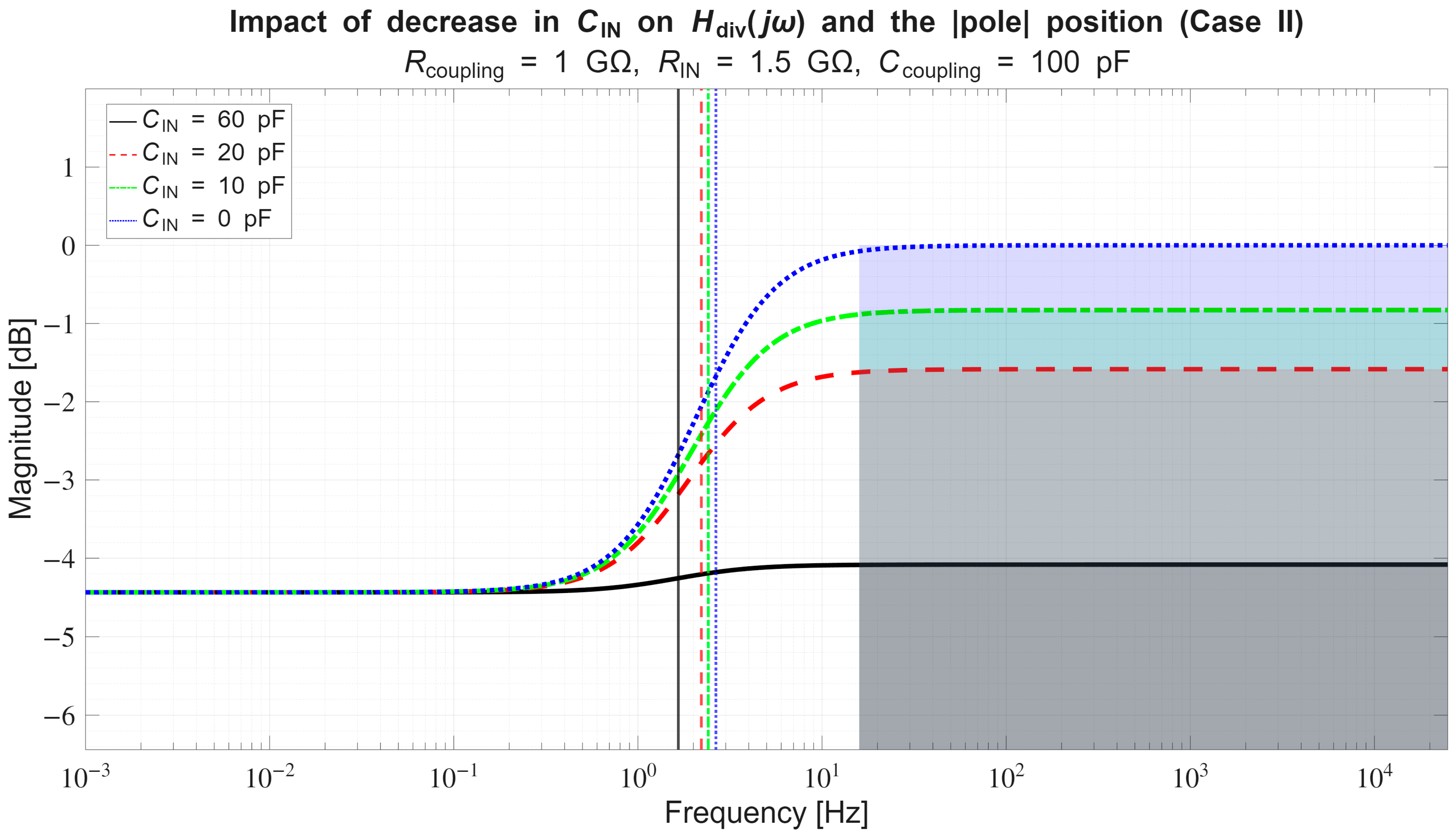
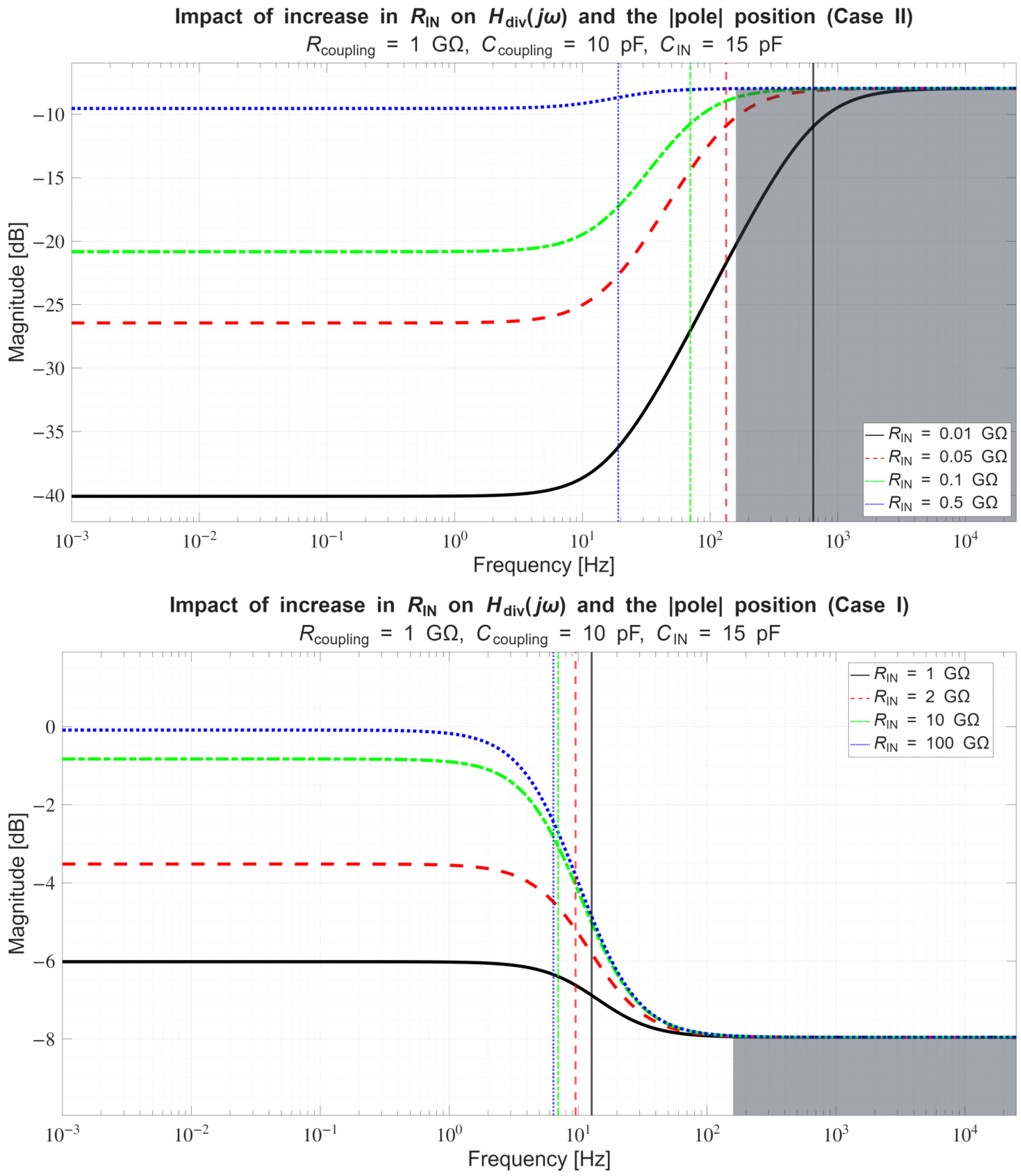
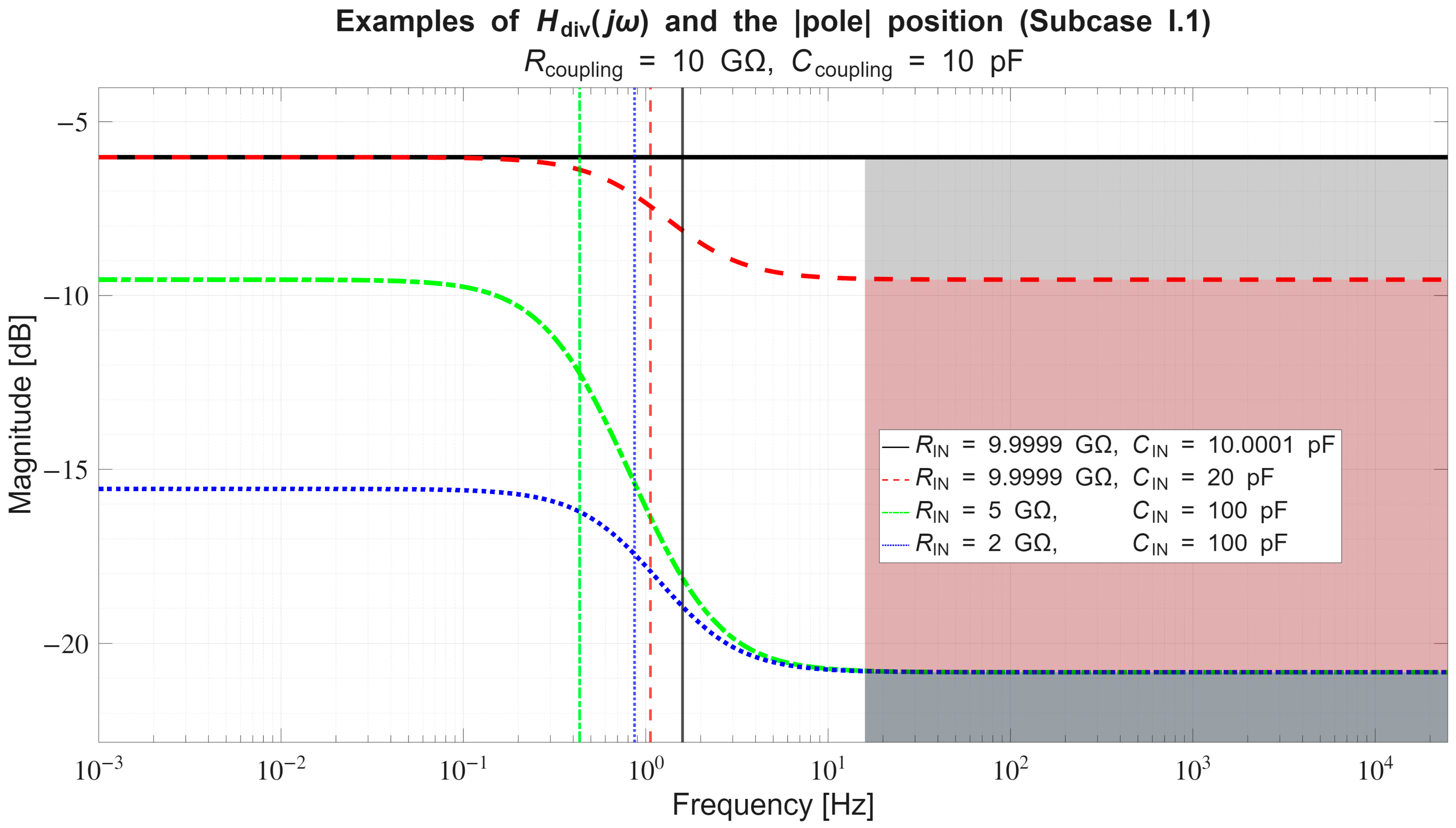
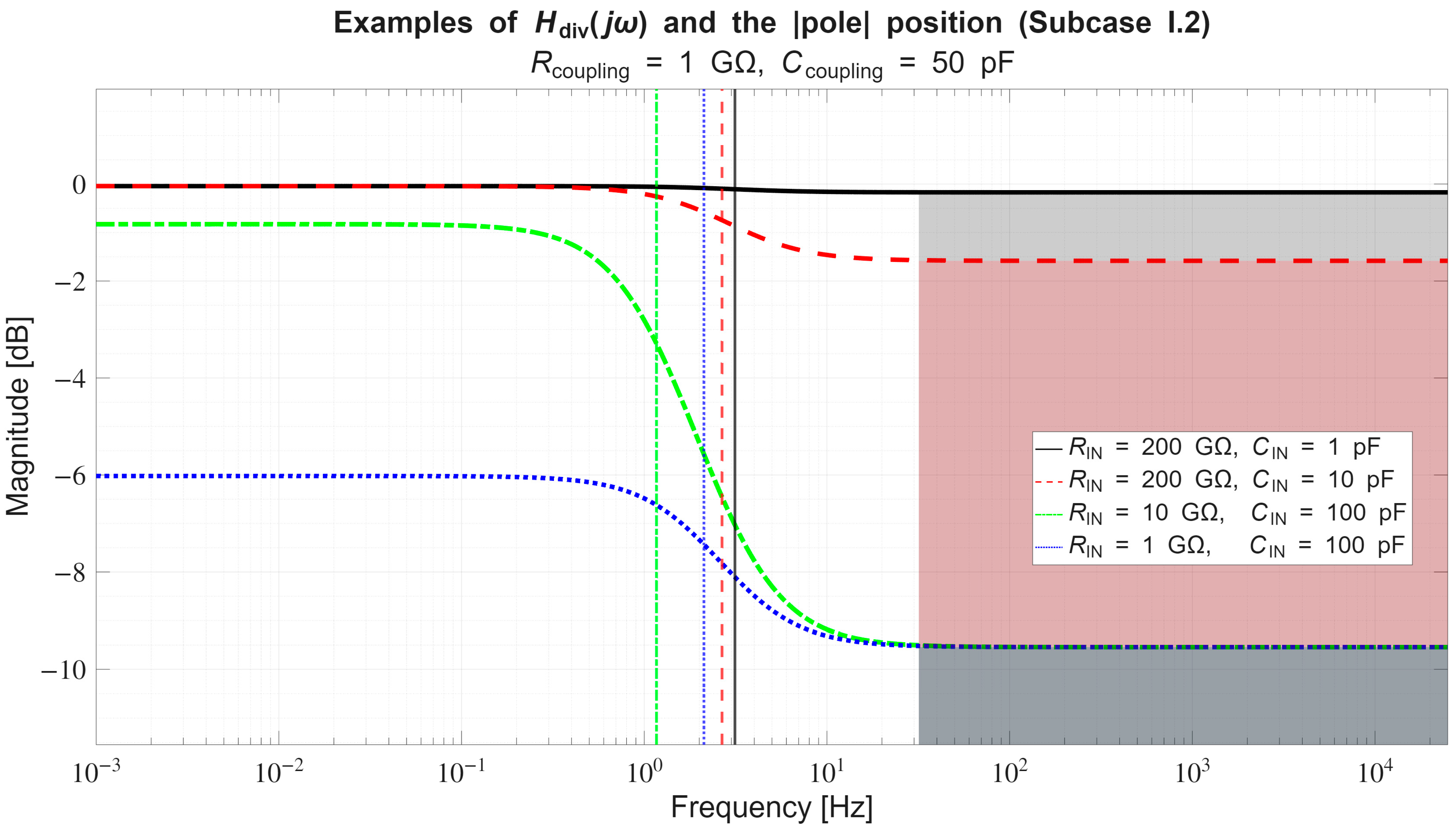
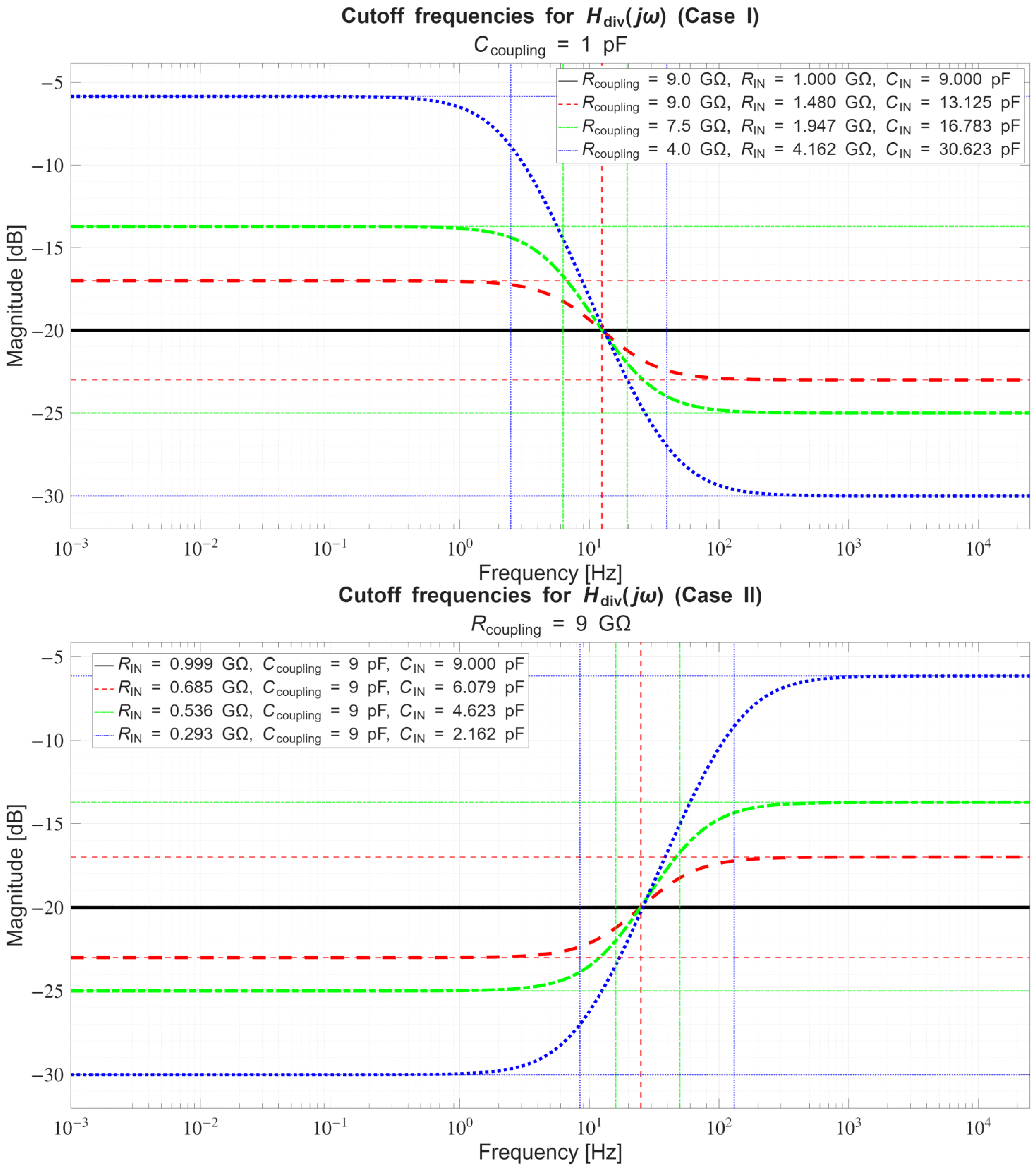
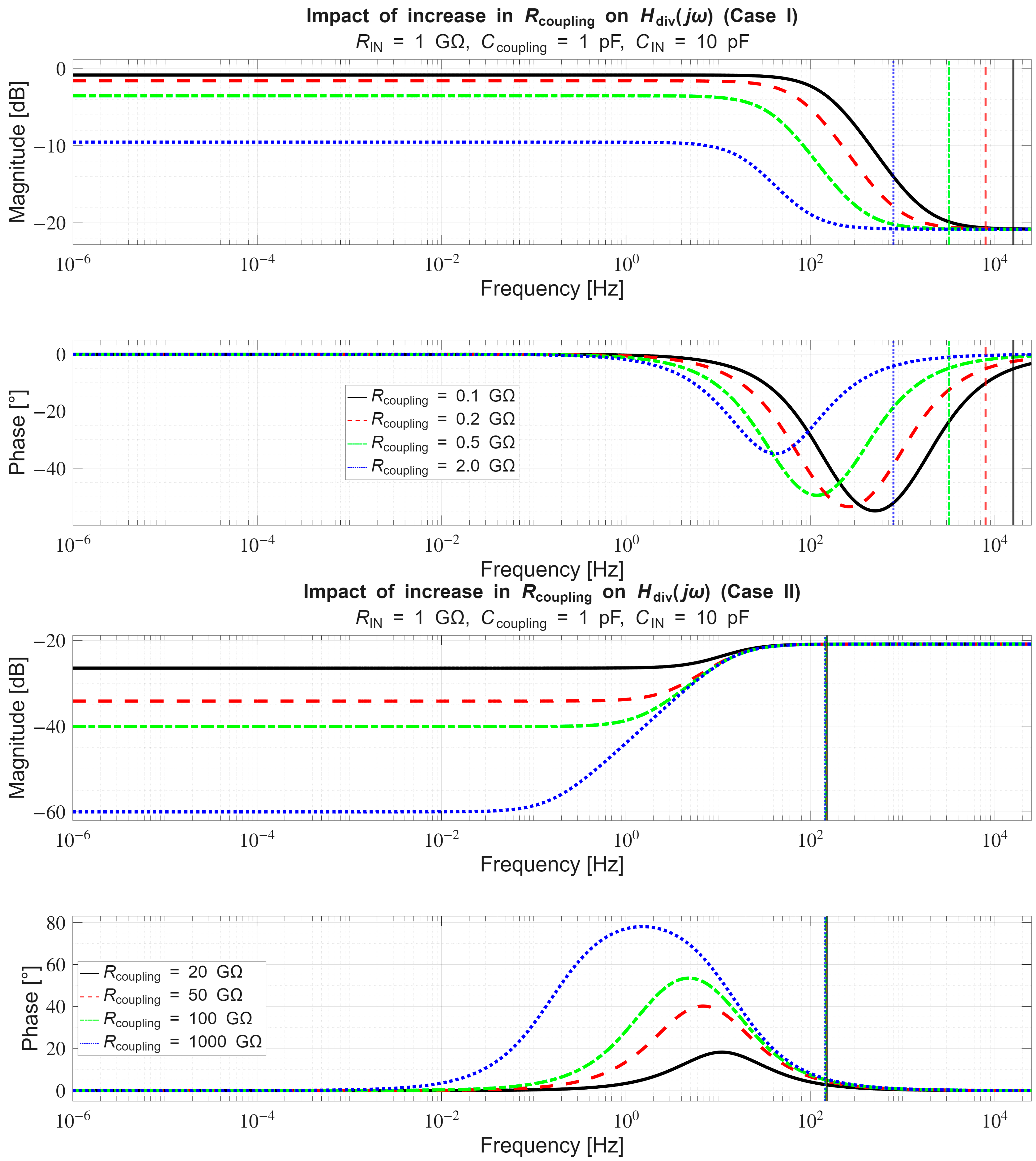
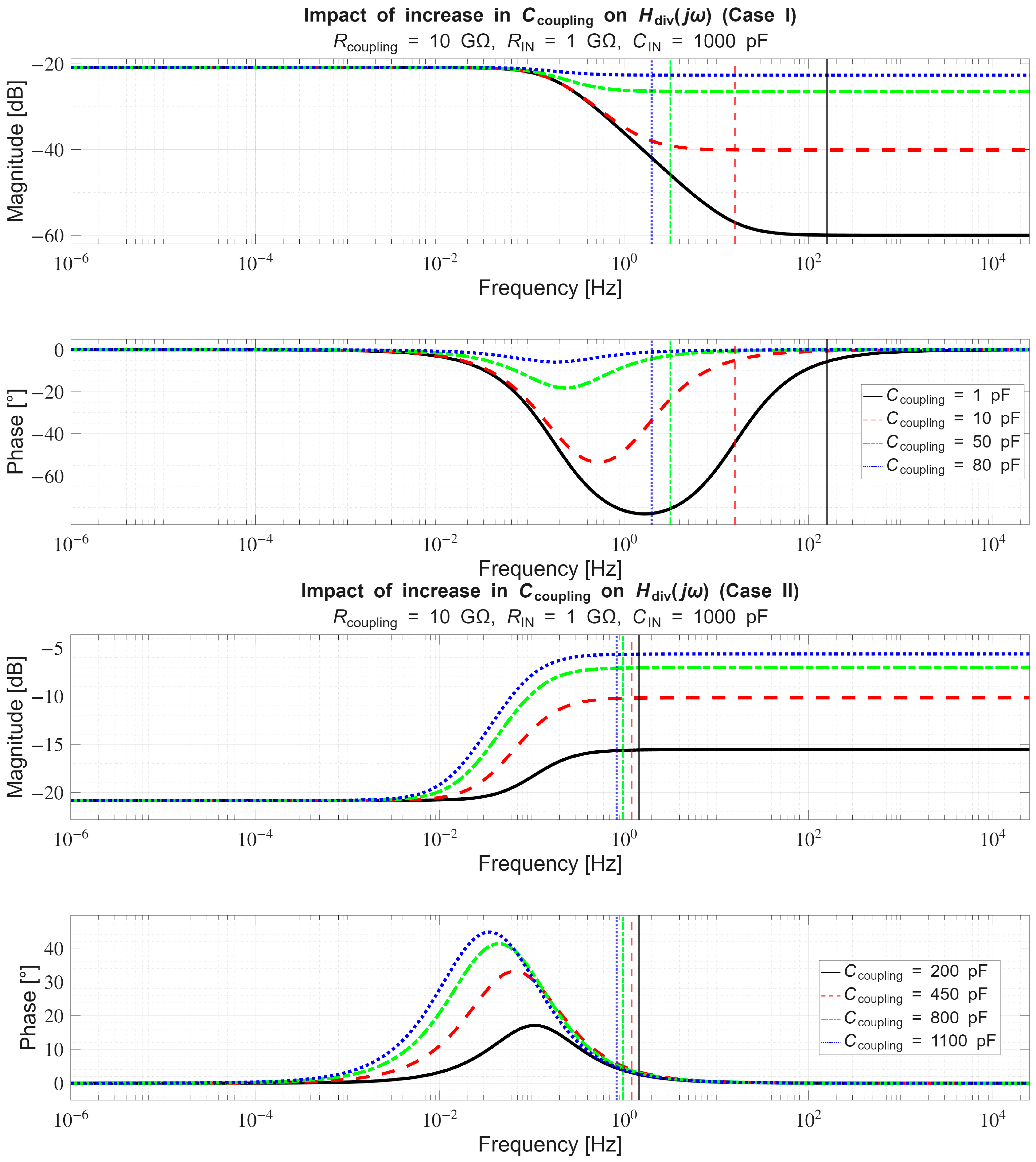
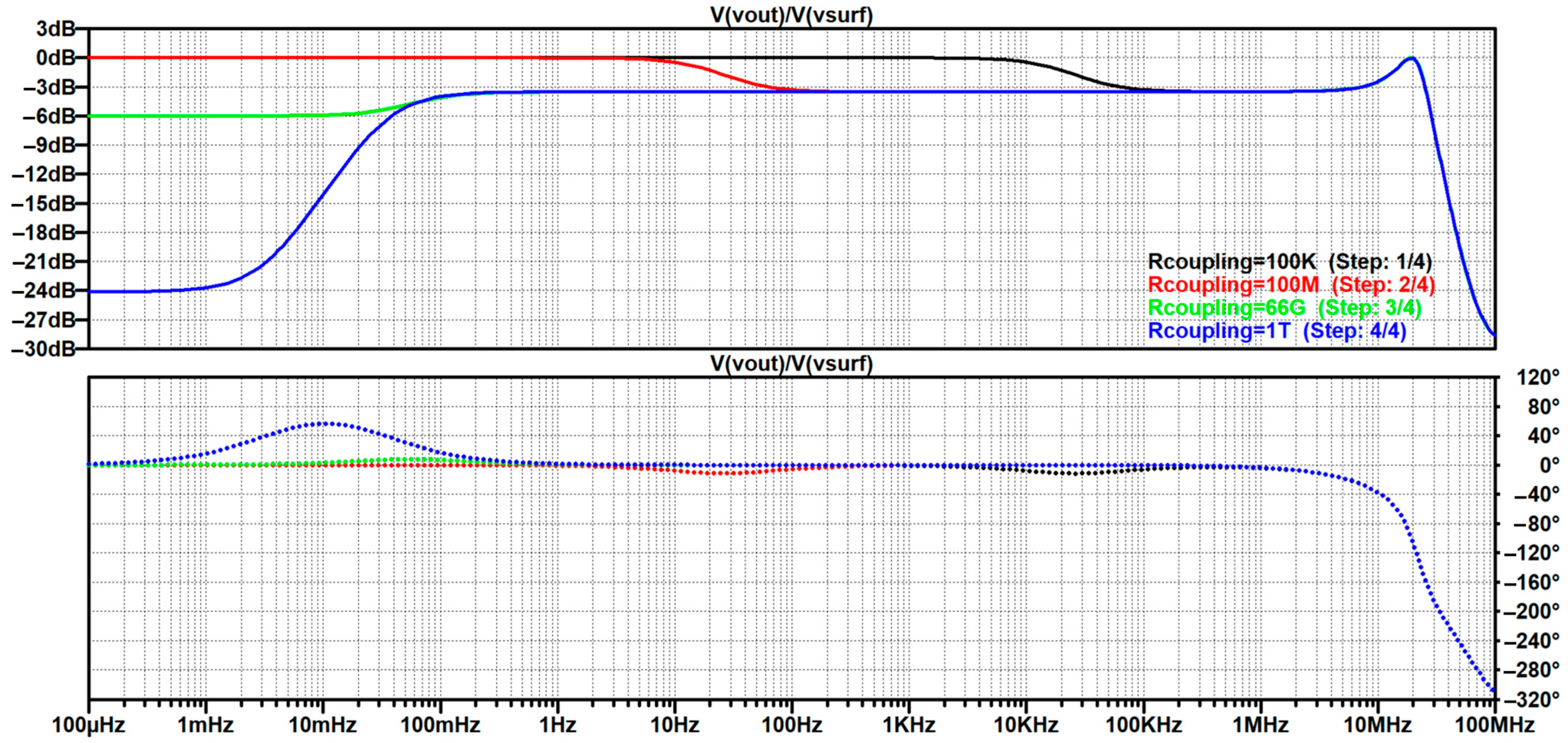
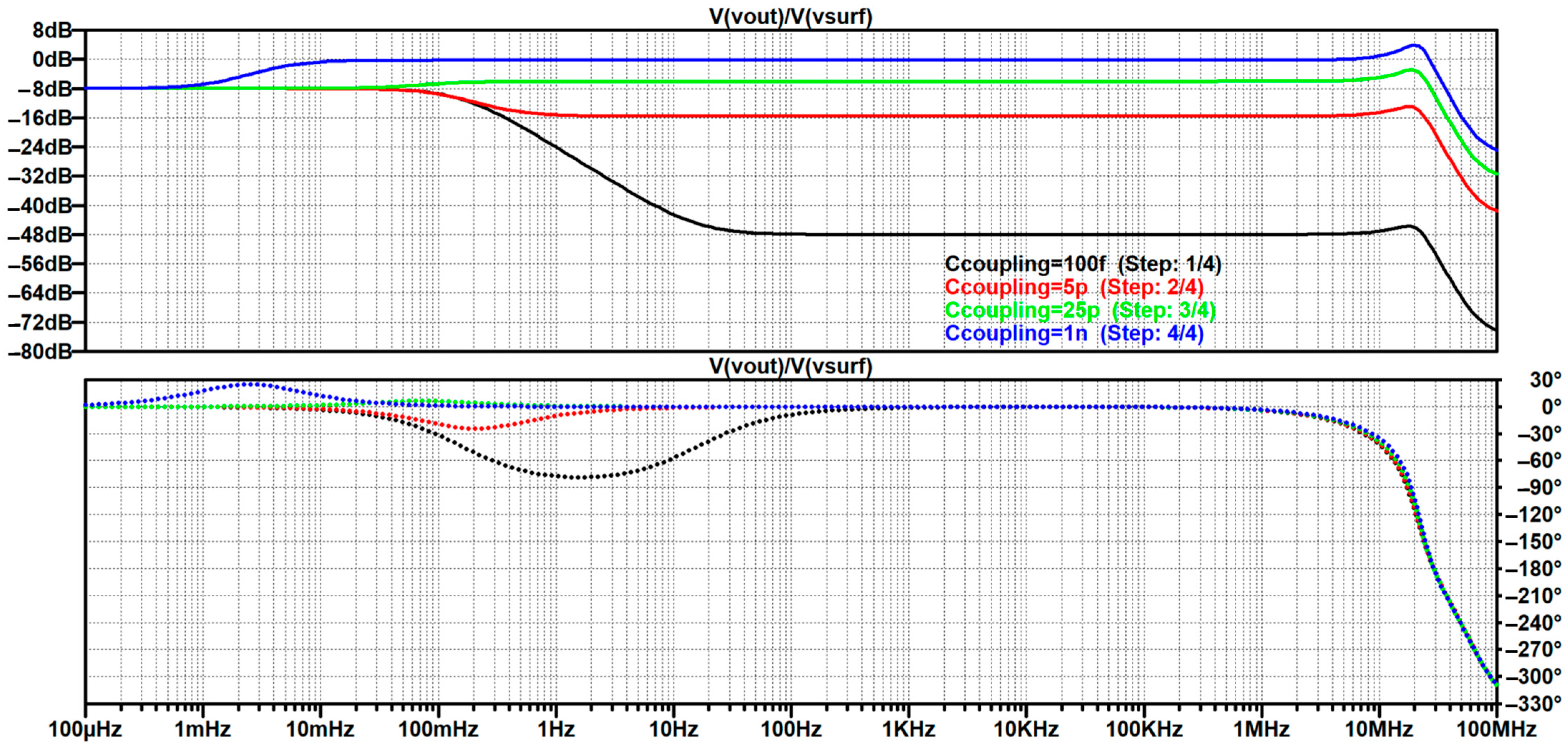
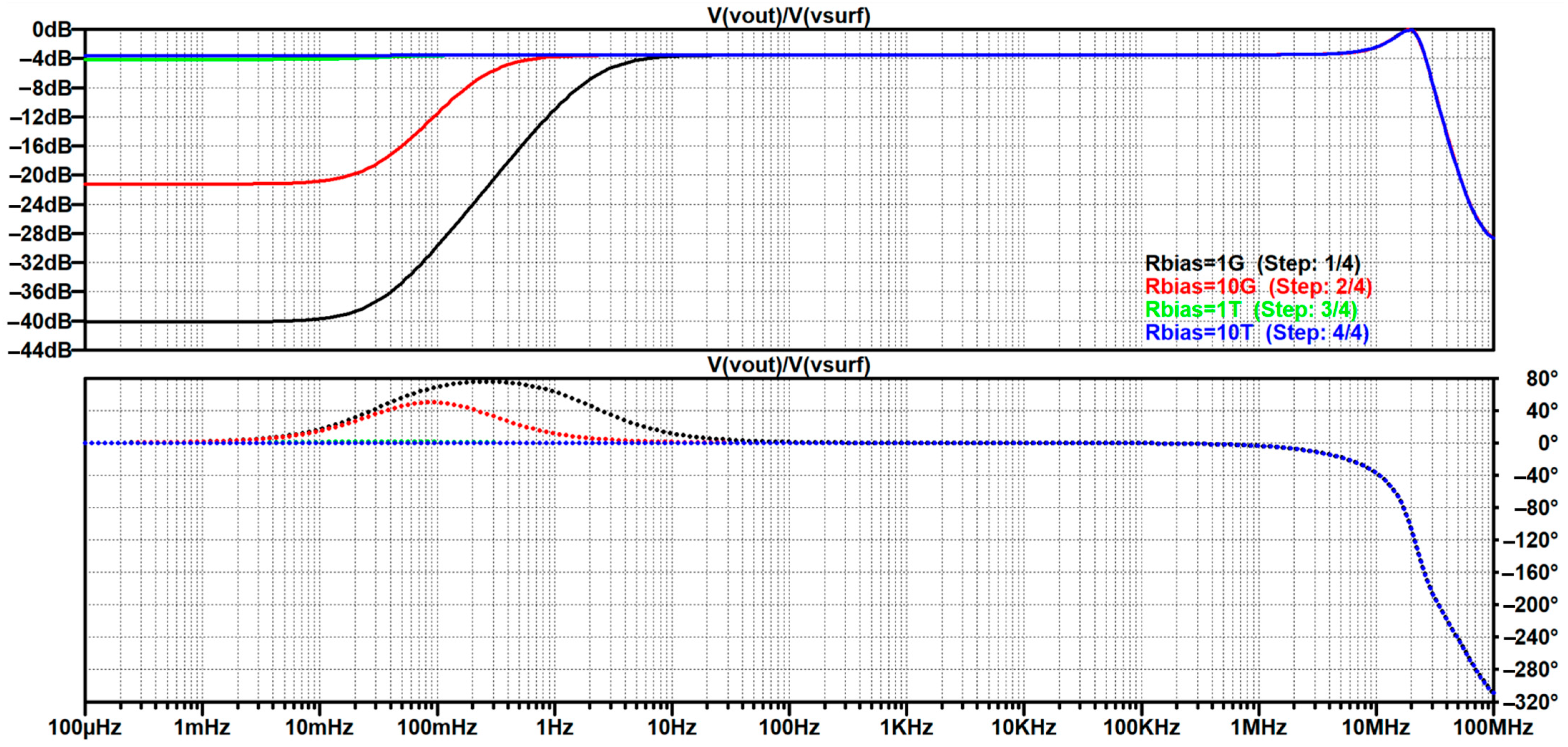
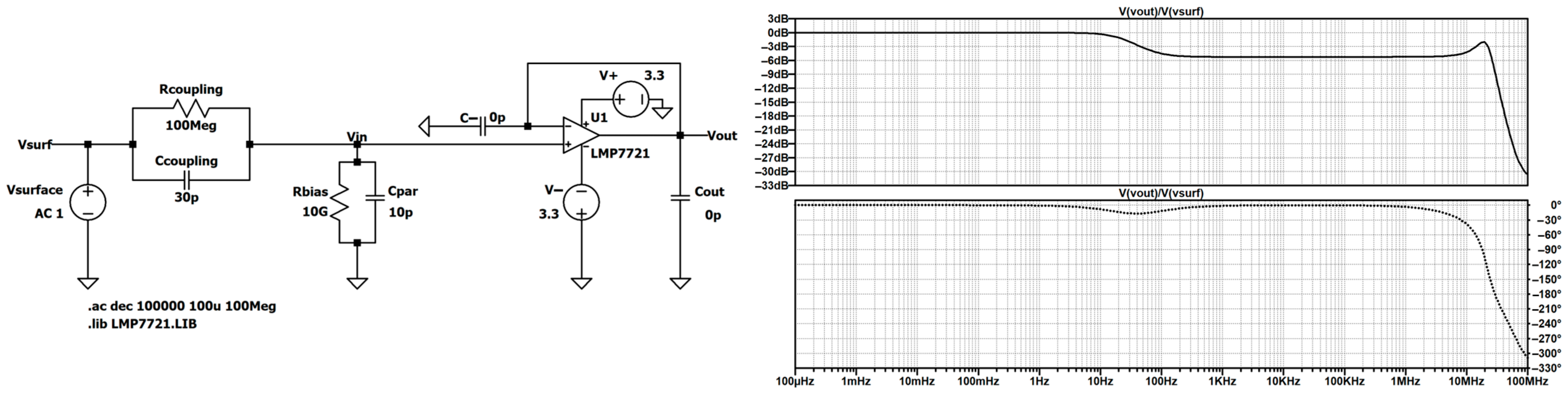
- Decrease |sz,1| below ωmin/10 by increasing Rcoupling and Ccoupling of the interface.
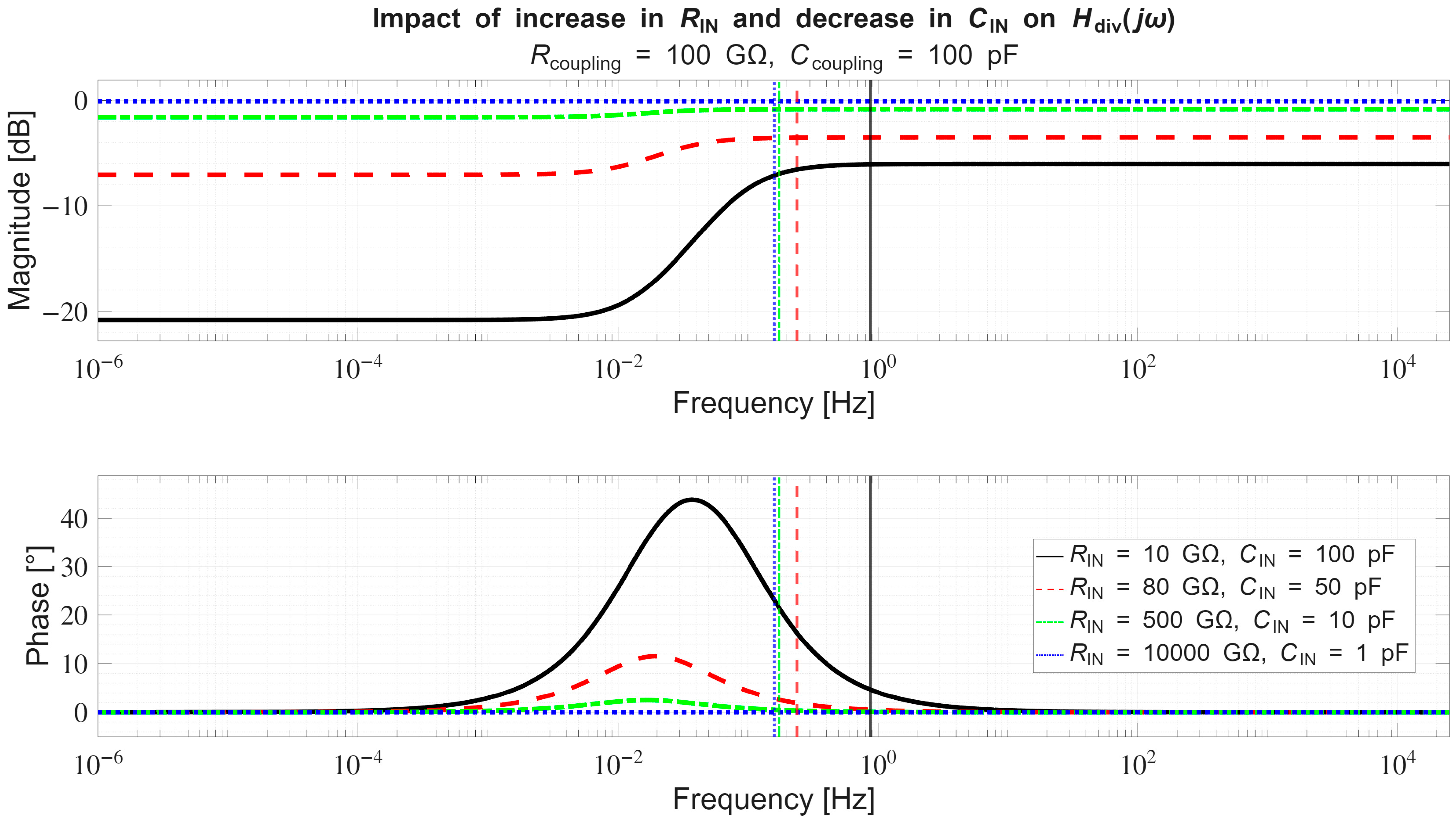
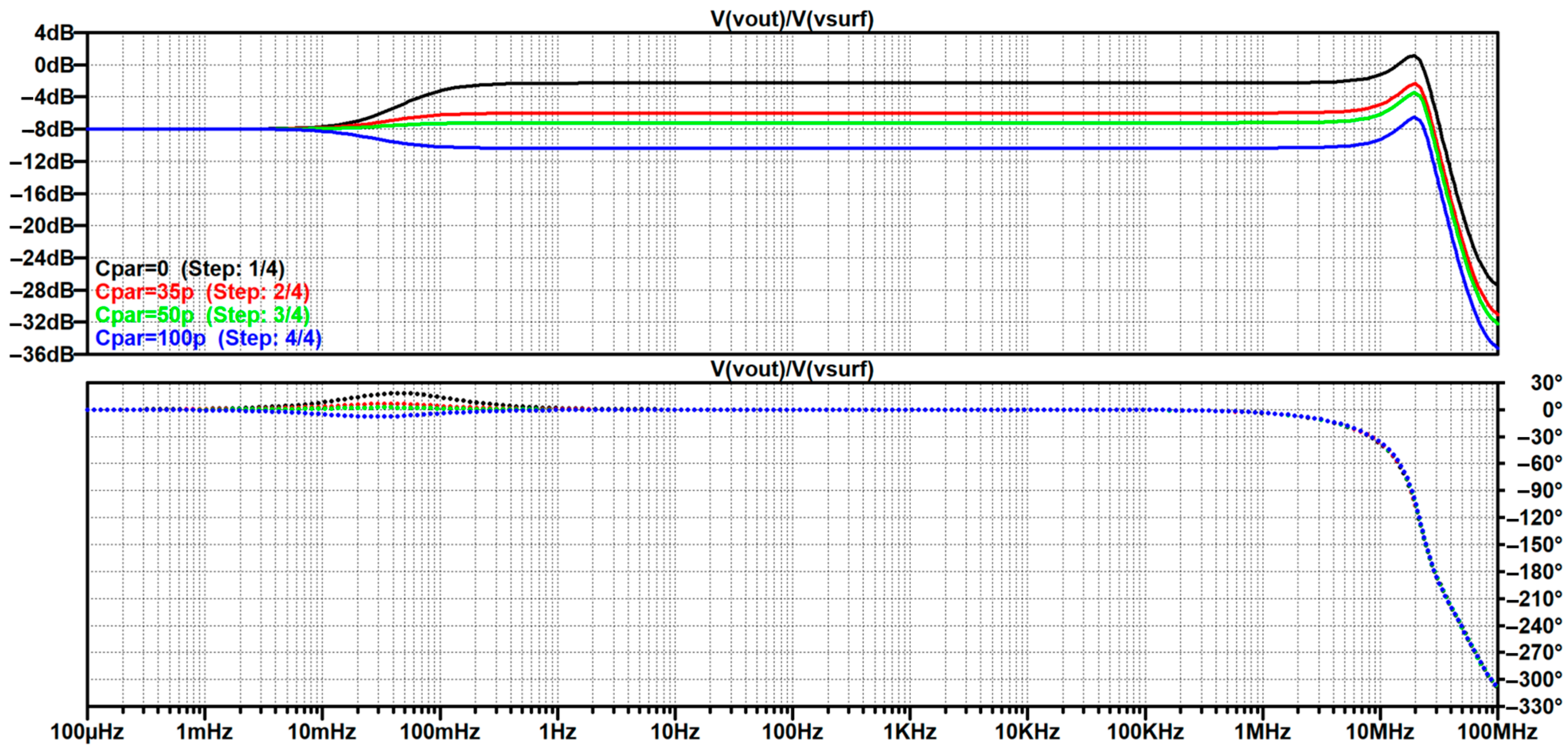
- Ensure Ccoupling >> CIN to minimize attenuation from the capacitive voltage divider;
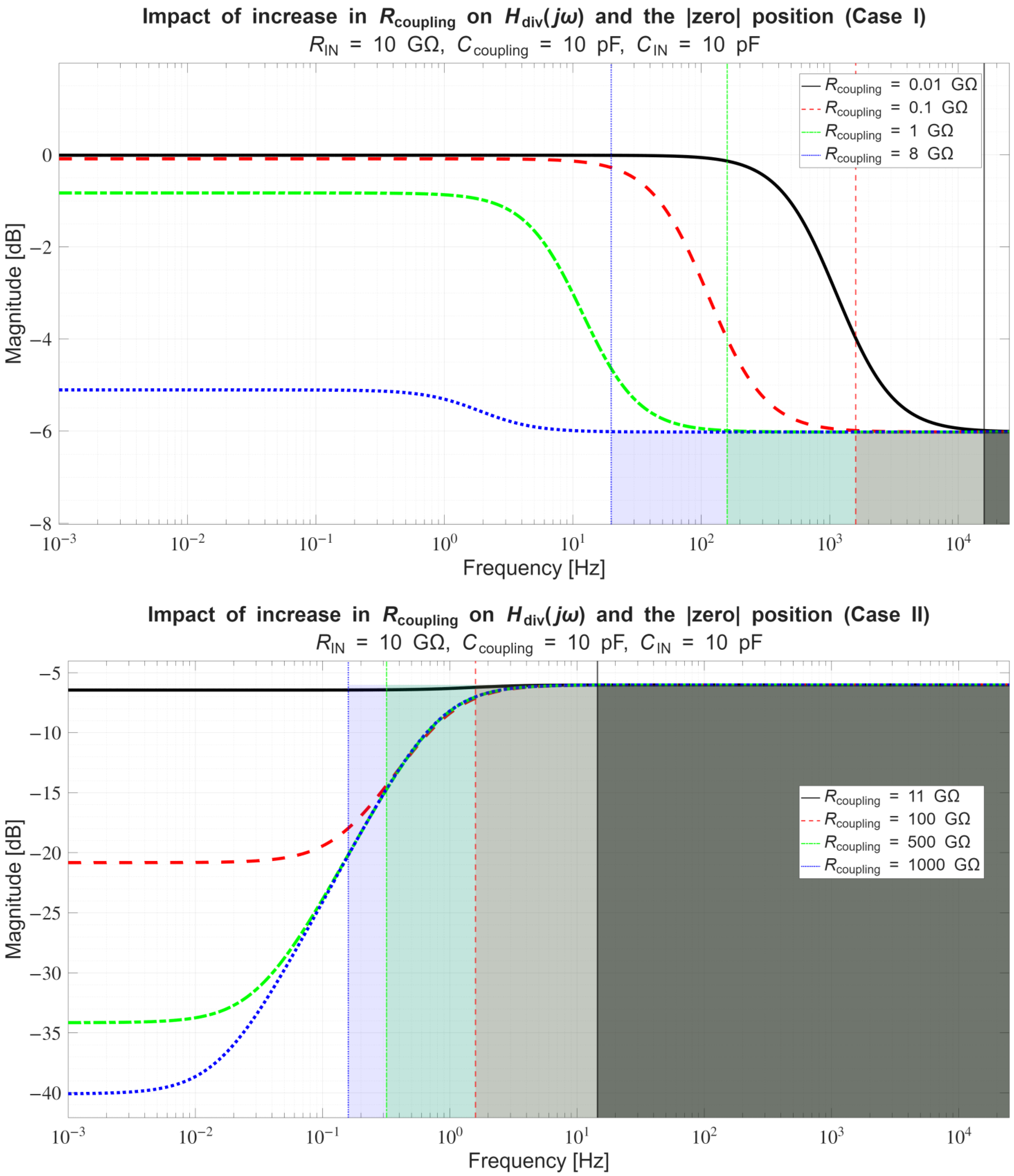
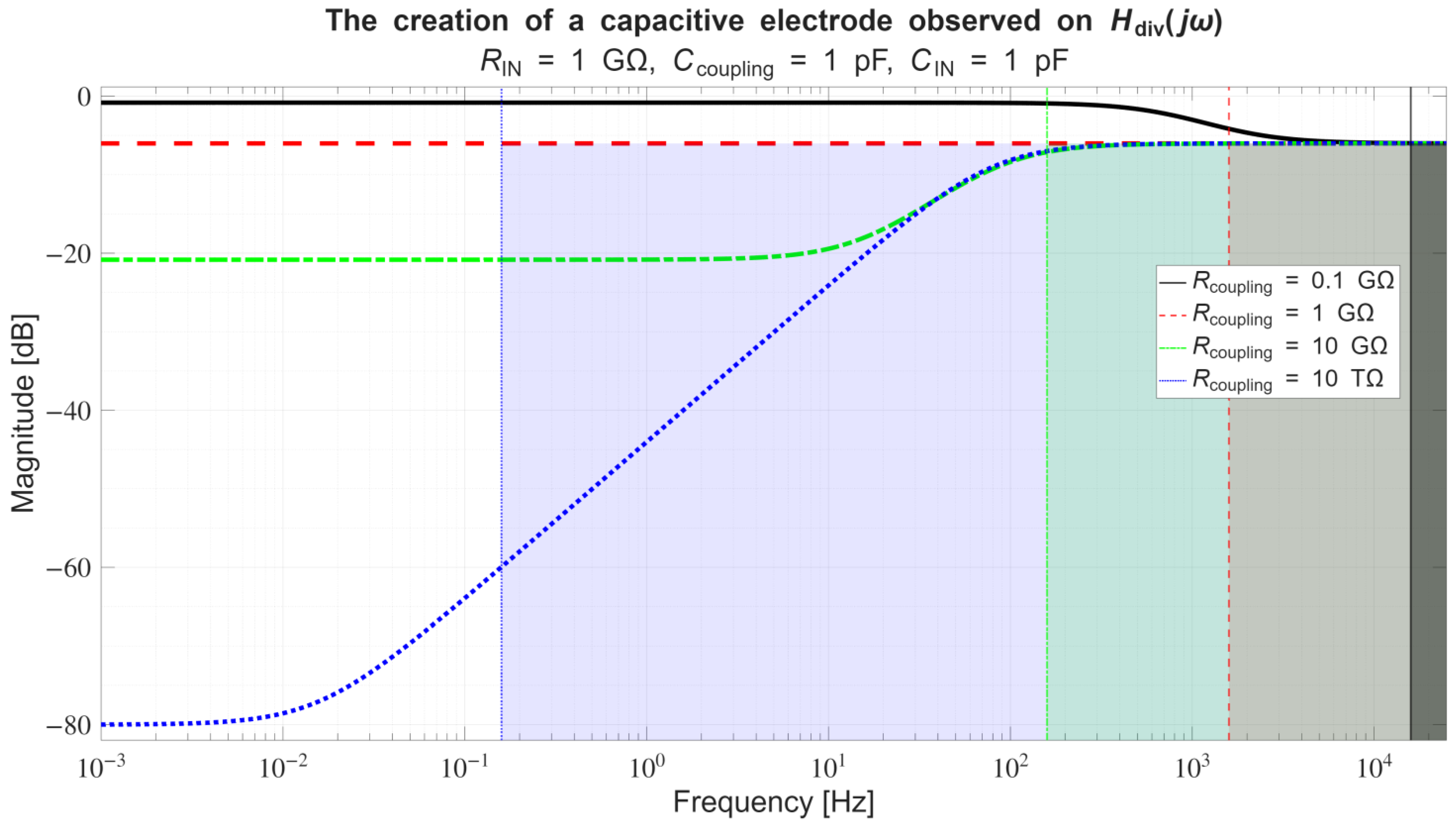
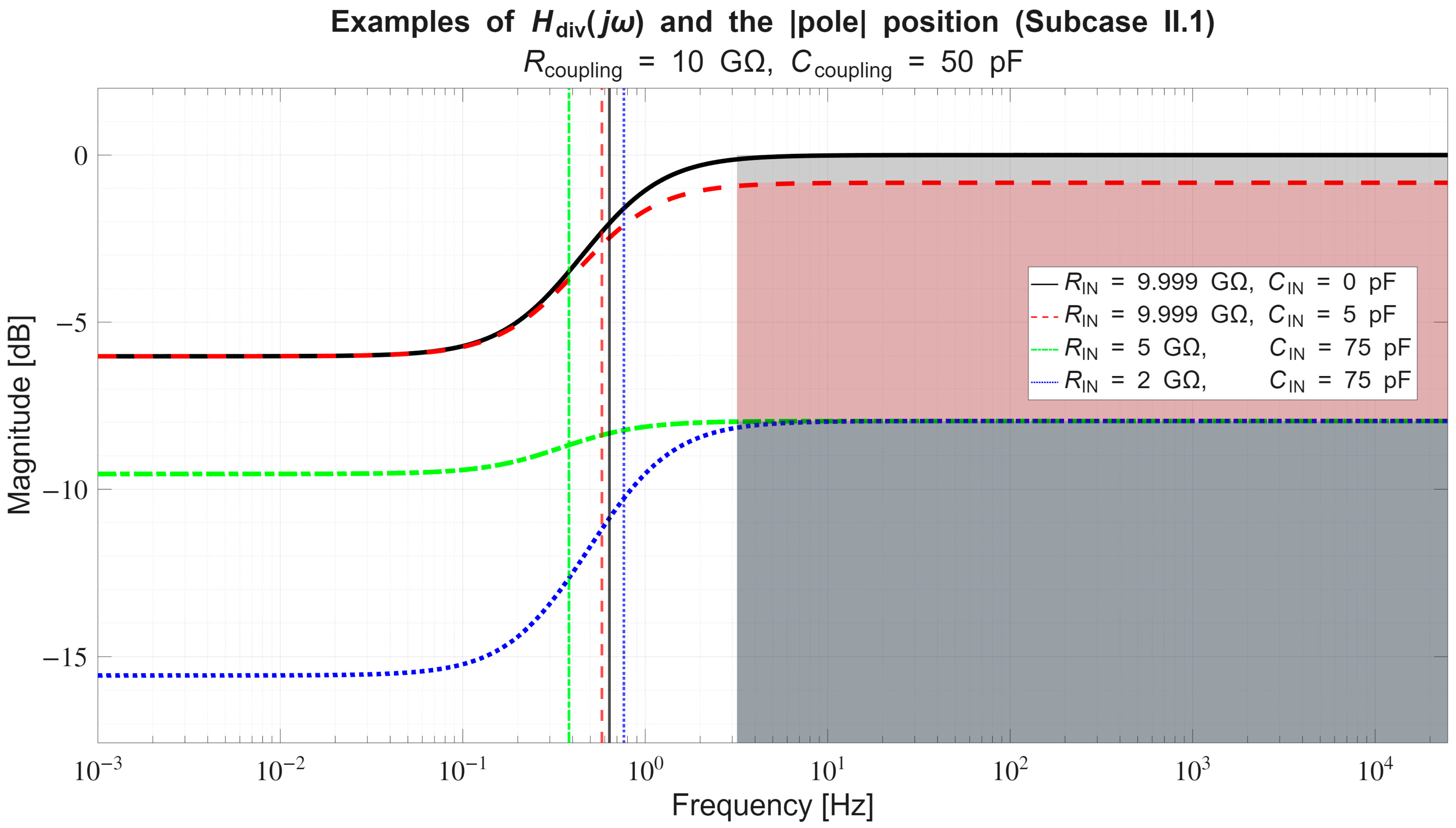
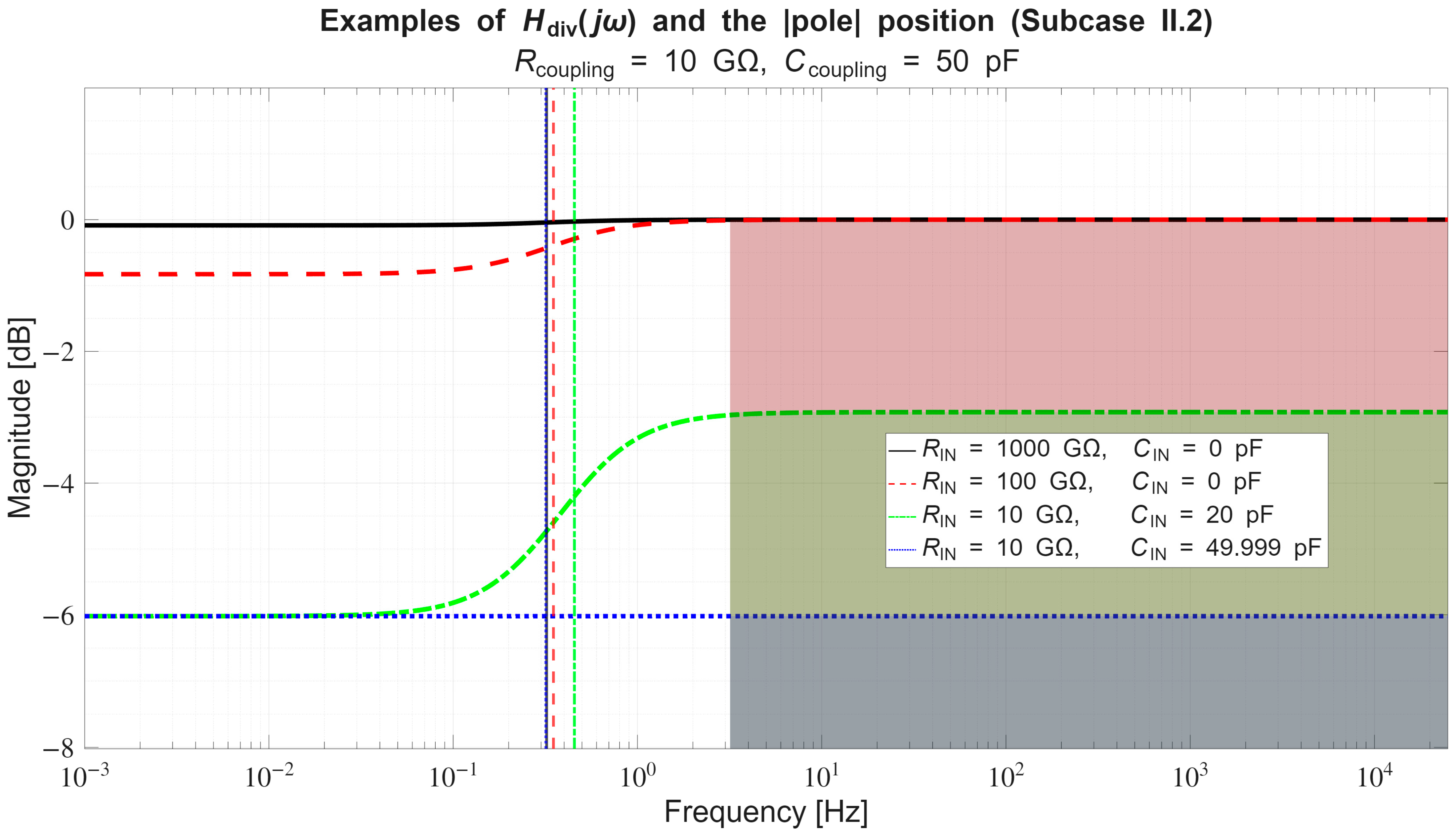
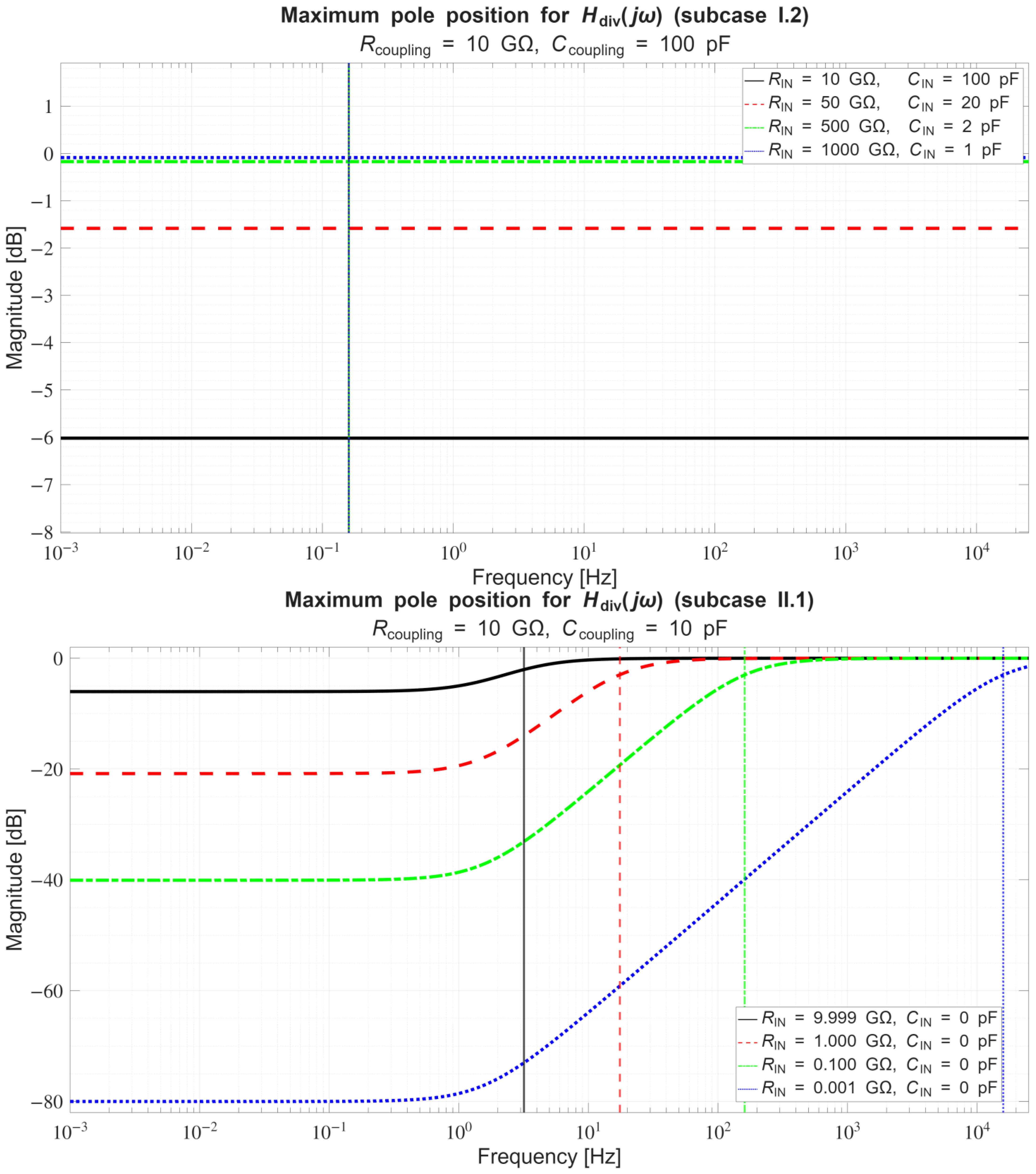
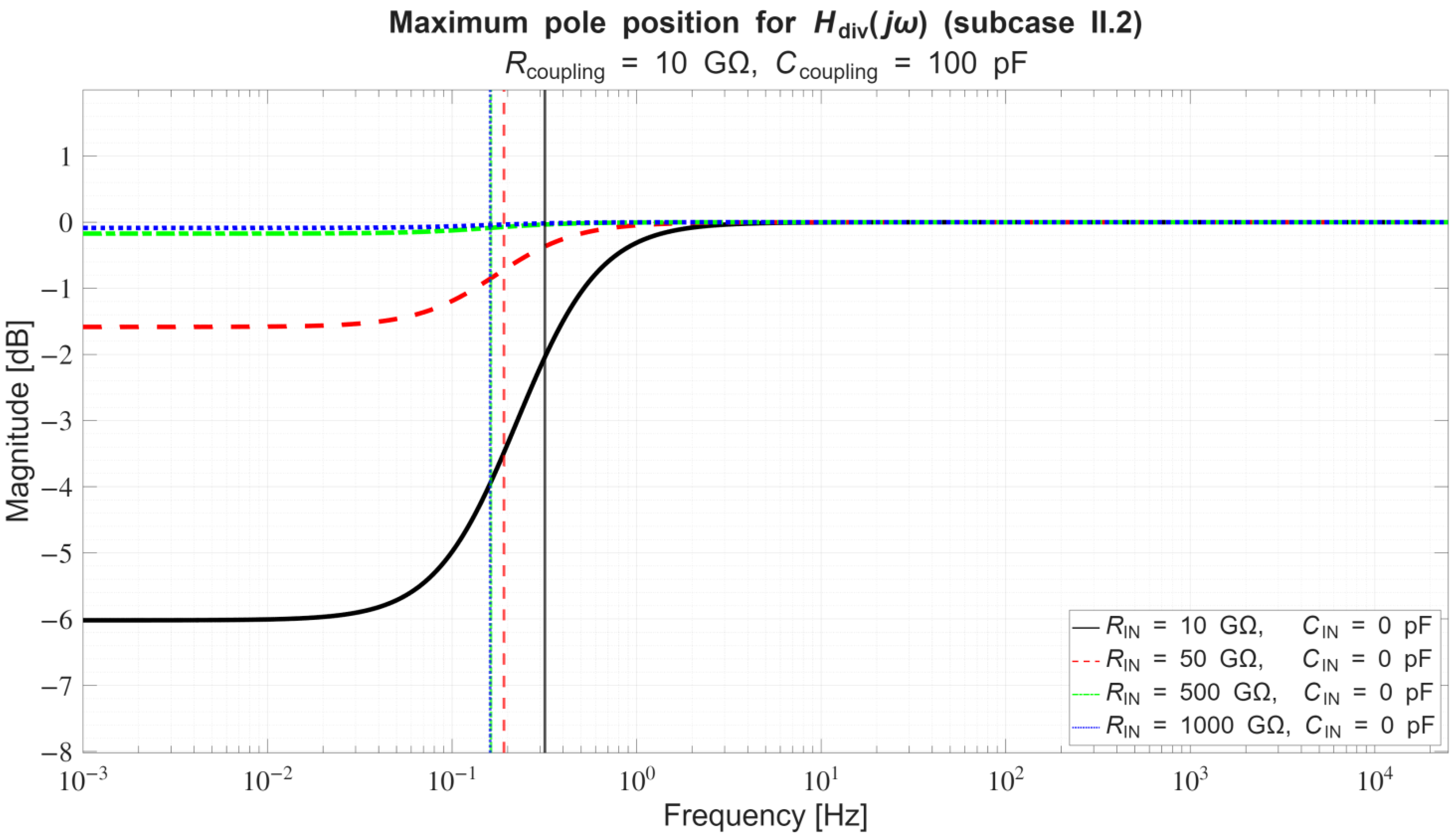
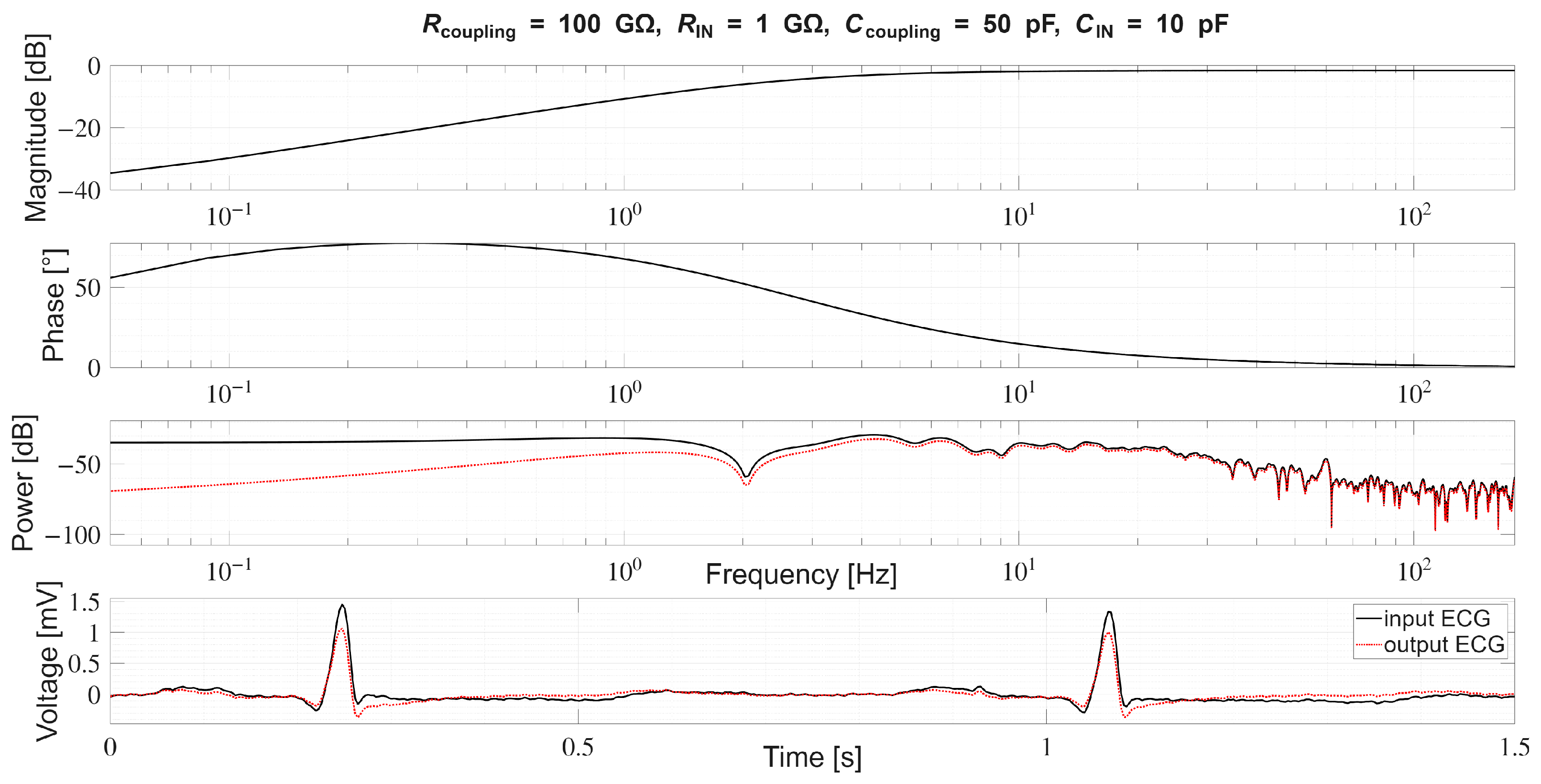
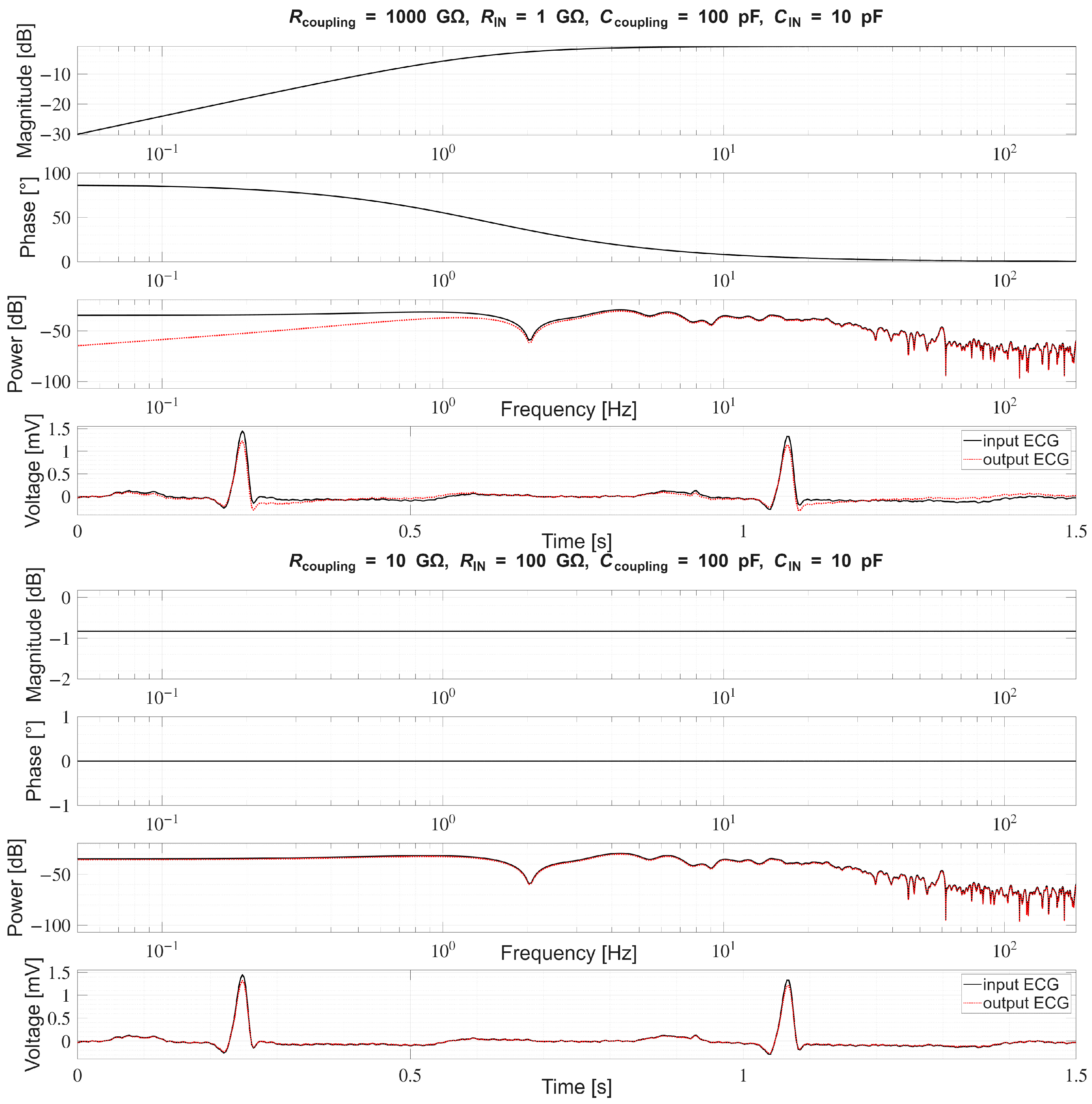
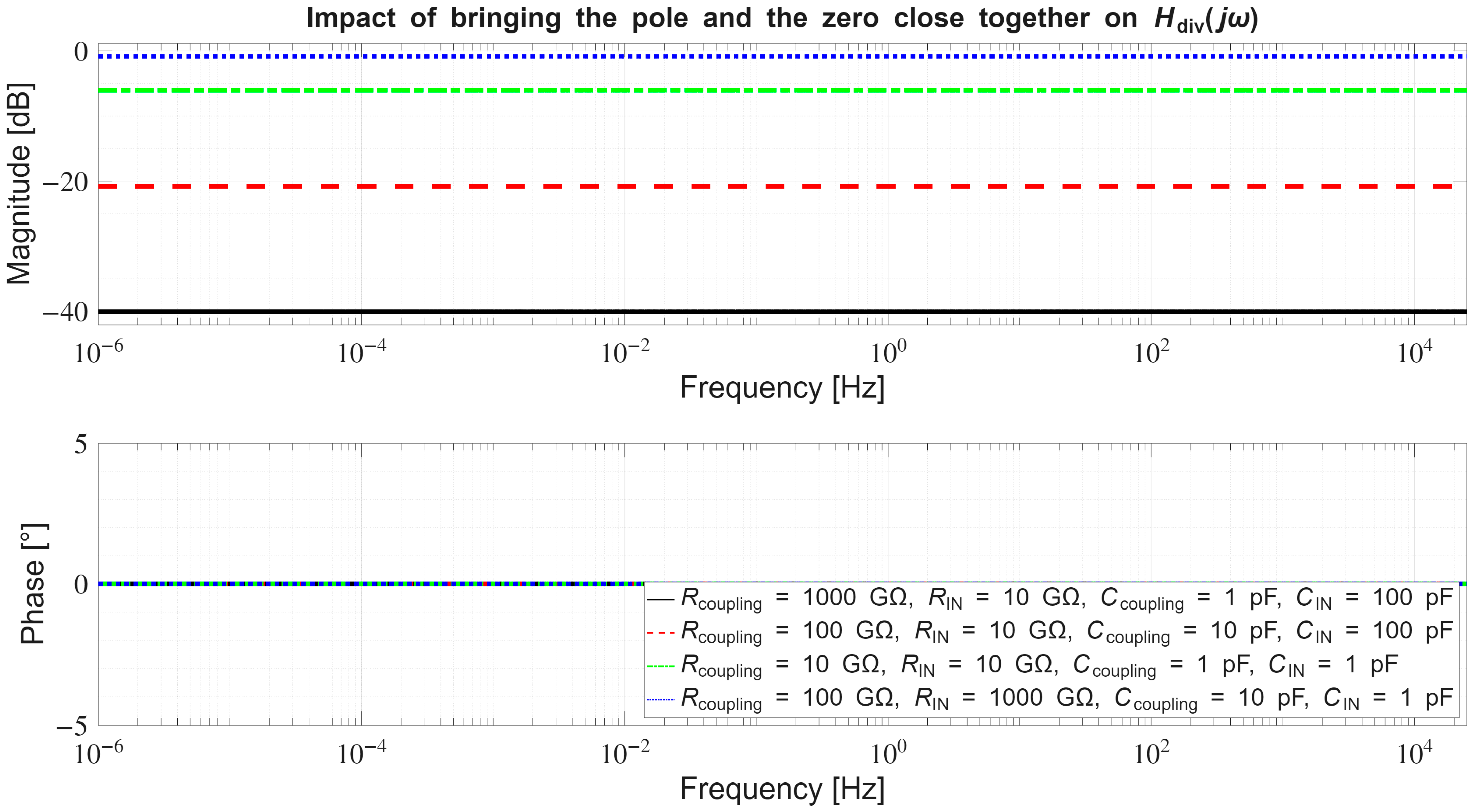
- For a high-pass configuration, ensure Rcoupling >> RIN to achieve a roll-on in magnitude response (subcase II.1) and move |sp,1| away from |sz,1| toward higher frequencies. For an all-pass configuration, ensure RIN >> Rcoupling and keep |sp,1| in proximity of |sz,1| to flatten the frequency response, minimize phase shifts in the phase response, and maximize the magnitude response (subcase I.2 and subcase II.2). These requirements are relaxed in subcase II.2 compared to subcase I.2.
- Finally, constrain the measurements to ω ≥ max{10|sz,1|, 10|sp,1|} to mitigate phase shifts and degradation of signal morphology. In addition, bear in mind that ωmin should be as high as possible compared to this low-side limit to account for the error of Bode approximation.
4.3. System Frequency Response


5. Conclusions
Supplementary Materials
Author Contributions
Funding
Data Availability Statement
Conflicts of Interest
Appendix A. Origin and Acquisition of Biopotential Signals

Appendix B. Surface-Contact Electrodes


Appendix C. Fundamentals of Capacitors and Phasor Algebra

Appendix D. First Subsystem: Operational Amplifier


References
- Mehra, R. Global Public Health Problem of Sudden Cardiac Death. J. Electrocardiol. 2007, 40, S118–S122. [Google Scholar] [CrossRef] [PubMed]
- Martin, S.S.; Aday, A.W.; Allen, N.B.; Almarzooq, Z.I.; Anderson, C.A.M.; Arora, P.; Avery, C.L.; Baker-Smith, C.M.; Bansal, N.; Beaton, A.Z.; et al. 2025 Heart Disease and Stroke Statistics: A Report of US and Global Data from the American Heart Association. Circulation 2025, 151, e41–e660. [Google Scholar] [CrossRef]
- World Health Organization. World Health Statistics 2025: Monitoring Health for the SDGs, Sustainable Development Goals; World Health Organization: Geneva, Switzerland, 2025. [Google Scholar]
- United Nations. World Population Prospects 2024: Summary of Results; United Nations: New York, NY, USA, 2024. [Google Scholar]
- Feigin, V.L.; Vos, T.; Nichols, E.; Owolabi, M.O.; Carroll, W.M.; Dichgans, M.; Deuschl, G.; Parmar, P.; Brainin, M.; Murray, C. The Global Burden of Neurological Disorders: Translating Evidence into Policy. Lancet Neurol. 2020, 19, 255–265. [Google Scholar] [CrossRef]
- Rivadeneira, J.E.; Fernandes, J.M.; Rodrigues, A.; Boavida, F.; Silva, J.S. An Evaluation of Unobtrusive Sensing in a Healthcare Case Study. IEEE Access 2024, 12, 89405–89417. [Google Scholar] [CrossRef]
- Kranjec, J.; Beguš, S.; Drnovšek, J.; Geršak, G. Novel Methods for Noncontact Heart Rate Measurement: A Feasibility Study. IEEE Trans. Instrum. Meas. 2014, 63, 838–847. [Google Scholar] [CrossRef]
- Brüser, C.; Antink, C.H.; Wartzek, T.; Walter, M.; Leonhardt, S. Ambient and Unobtrusive Cardiorespiratory Monitoring Techniques. IEEE Rev. Biomed. Eng. 2015, 8, 30–43. [Google Scholar] [CrossRef]
- Tang, X.; Chen, W.; Mandal, S.; Bi, K.; Özdemir, T. High-Sensitivity Electric Potential Sensors for Non-Contact Monitoring of Physiological Signals. IEEE Access 2022, 10, 19096–19111. [Google Scholar] [CrossRef]
- Bian, S.; Liu, M.; Zhou, B.; Lukowicz, P.; Magno, M. Body-Area Capacitive or Electric Field Sensing for Human Activity Recognition and Human-Computer Interaction: A Comprehensive Survey. Proc. ACM Interact. Mob. Wearable Ubiquitous Technol. 2024, 8, 1–49. [Google Scholar] [CrossRef]
- Liang, K.; Chen, J.; He, T.; Wang, W.; Singh, A.K.; Rawat, D.B.; Song, H.; Lyu, Z. Review of the Open Data Sets for Contactless Sensing. IEEE Internet Things J. 2024, 11, 19000–19022. [Google Scholar] [CrossRef]
- Cheng, A.J.; Wu, L.; Sha, Z.; Chang, W.; Chu, D.; Wang, C.H.; Peng, S. Recent Advances of Capacitive Sensors: Materials, Microstructure Designs, Applications, and Opportunities. Adv. Mater. Technol. 2023, 8, 2201959. [Google Scholar] [CrossRef]
- Nouira, H.; Vissiere, A.; Damak, M.; David, J.-M. Investigation of the Influence of the Main Error Sources on the Capacitive Displacement Measurements with Cylindrical Artefacts. Precis. Eng. 2013, 37, 721–737. [Google Scholar] [CrossRef]
- Rosario, P.; Fruett, F. Flexible Electrode Capacitive Sensors System for Human Fluid Detection. In Proceedings of the IEEE Latin America Electron Devices Conference (LAEDC), Virtual, 19–21 April 2021. [Google Scholar] [CrossRef]
- Ren, Y.; Luo, B.; Feng, X.; Feng, Z.; Song, Y.; Yan, F. Capacitive and Non-Contact Liquid Level Detection Sensor Based on Interdigitated Electrodes with Flexible Substrate. Electronics 2024, 13, 2228. [Google Scholar] [CrossRef]
- Abdelmoneim, A.A.; Al Kalaany, C.M.; Khadra, R.; Derardja, B.; Dragonetti, G. Calibration of Low-Cost Capacitive Soil Moisture Sensors for Irrigation Management Applications. Sensors 2025, 25, 343. [Google Scholar] [CrossRef]
- Yan, X.; Pang, Y.; Niu, K.; Hu, B.; Zhu, Z.; Tan, Z.; Lei, H. Wearable Sensors for Plants: Status and Prospects. Biosensors 2025, 15, 53. [Google Scholar] [CrossRef] [PubMed]
- Yao, J.; Zhen, Z.; Xu, H.; Zhao, L.; Duan, Y.; Guo, X. Pinpointing Moisture: The Capacitive Detection for Standing Tree Health. Sensors 2024, 24, 4040. [Google Scholar] [CrossRef]
- Strand, E.J.; Gopalakrishnan, A.; Crichton, C.A.; Palizzi, M.J.; Lee, O.; Borsa, T.; Bihar, E.; Goodrich, P.; Arias, A.C.; Shaheen, S.E.; et al. Ultrathin Screen-printed Plant Wearable Capacitive Sensors for Environmental Monitoring. Adv. Sens. Res. 2025, 4, 2400177. [Google Scholar] [CrossRef]
- Poghossian, A.; Schöning, M.J. Capacitive Field-Effect EIS Chemical Sensors and Biosensors: A Status Report. Sensors 2020, 20, 5639. [Google Scholar] [CrossRef]
- Ullah, H.; Wahab, M.A.; Will, G.; Karim, M.R.; Pan, T.; Gao, M.; Lai, D.; Lin, Y.; Miraz, M.H. Recent Advances in Stretchable and Wearable Capacitive Electrophysiological Sensors for Long-Term Health Monitoring. Biosensors 2022, 12, 630. [Google Scholar] [CrossRef]
- Takahashi, I.; Yokoyama, K.; Knaflitz, M. Indirect Skin Contact Electrocardiogram Monitoring System Using Flexible Capacitive Electrodes. Forma 2017, 32, S19–S23. [Google Scholar] [CrossRef]
- Jang, Y.; Kim, S.; Kim, K.; Yoo, D.-S. A Study of Sofa-Type Capacitive Coupling Electrocardiograph System to Measure Stress Relief for Sleeping or Resting with Oxygen Taking. In Proceedings of the 42nd Annual International Conference of the IEEE Engineering in Medicine and Biology Society (EMBC), Montréal, QC, Canada, 20–24 July 2020. [Google Scholar] [CrossRef]
- Hou, Z.; Xiang, J.; Dong, Y.; Xue, X.; Xiong, H.; Yang, B. Capturing Electrocardiogram Signals from Chairs by Multiple Capacitively Coupled Unipolar Electrodes. Sensors 2018, 18, 2835. [Google Scholar] [CrossRef]
- Vlaović, Z.; Jaković, M.; Domljan, D. Smart Office Chairs with Sensors for Detecting Sitting Positions and Sitting Habits: A Review. Drv. Ind. 2022, 73, 227–243. [Google Scholar] [CrossRef]
- Pinheiro, E.; Postolache, O.; Girão, P. A Survey on Unobtrusive Measurements of the Cardiovascular Function and Their Practical Implementation in Wheelchairs. Sens. Transducers 2010, 9, 182–199. [Google Scholar]
- Kim, K.K.; Lim, Y.K.; Park, K.S. The Electrically Noncontacting ECG Measurement on the Toilet Seat Using the Capacitively-Coupled Insulated Electrodes. In Proceedings of the 26th Annual International Conference of the IEEE Engineering in Medicine and Biology Society (EMBC), San Francisco, CA, USA, 1–5 September 2004. [Google Scholar] [CrossRef]
- Motoi, K.; Yamakoshi, Y.; Yamakoshi, T.; Sakai, H.; Tanaka, N.; Yamakoshi, K. Measurement of Electrocardiograms in a Bath through Tap Water Utilizing Capacitive Coupling Electrodes Placed Outside the Bathtub Wall. Biomed. Eng. Online 2017, 16, 12. [Google Scholar] [CrossRef]
- Leonhardt, S.; Leicht, L.; Teichmann, D. Unobtrusive Vital Sign Monitoring in Automotive Environments—A Review. Sensors 2018, 18, 3080. [Google Scholar] [CrossRef]
- Castro, I.D.; Mercuri, M.; Patel, A.; Puers, R.; Van Hoof, C.; Torfs, T. Physiological Driver Monitoring Using Capacitively Coupled and Radar Sensors. Appl. Sci. 2019, 9, 3994. [Google Scholar] [CrossRef]
- Uguz, D.U.; Dettori, R.; Napp, A.; Walter, M.; Marx, N.; Leonhardt, S.; Hoog Antink, C. Car Seats with Capacitive ECG Electrodes Can Detect Cardiac Pacemaker Spikes. Sensors 2020, 20, 6288. [Google Scholar] [CrossRef] [PubMed]
- Sun, Y.; Yu, X. An Innovative Nonintrusive Driver Assistance System for Vital Signal Monitoring. IEEE J. Biomed. Health Inform. 2014, 18, 1932–1939. [Google Scholar] [CrossRef]
- Stanešić, A.; Čuljak, I.; Klaić, L.; Šajinović, P.; Vrhoci, I.; Cifrek, M.; Džapo, H. Noise Level Detection Analysis in Biomedical Signals Based on Capacitive Electrodes for Electric Bicycles. In IFMBE Proceedings of International Conference on Biomedical and Health Informatics, Concepción, Chile, 24–26 November 2022; Springer: Cham, Switzerland, 2024; pp. 219–226. [Google Scholar] [CrossRef]
- Schumm, J.; Setz, C.; Bächlin, M.; Bächler, M.; Arnrich, B.; Tröster, G. Unobtrusive Physiological Monitoring in an Airplane Seat. Pers. Ubiquitous Comput. 2010, 14, 541–550. [Google Scholar] [CrossRef]
- Lim, Y.G.; Kim, K.K.; Park, K.S. ECG Recording on a Bed during Sleep without Direct Skin-Contact. IEEE Trans. Biomed. Eng. 2007, 54, 718–725. [Google Scholar] [CrossRef] [PubMed]
- Kahankova, R.; Kolarik, J.; Brablik, J.; Barnova, K.; Simkova, I.; Martinek, R. Alternative Measurement Systems for Recording Cardiac Activity in Animals: A Pilot Study. Anim. Biotelem. 2022, 10, 15. [Google Scholar] [CrossRef]
- González-Sánchez, C.; Fraile, J.-C.; Pérez-Turiel, J.; Damm, E.; Schneider, J.G.; Zimmermann, H.; Schmitt, D.; Ihmig, F.R. Capacitive Sensing for Non-Invasive Breathing and Heart Monitoring in Non-Restrained, Non-Sedated Laboratory Mice. Sensors 2016, 16, 1052. [Google Scholar] [CrossRef]
- Wang, T.-W.; Lin, S.-F. Non-Contact Capacitive Sensing for ECG Recording in Small Animals. Meas. Sci. Technol. 2020, 31, 125703. [Google Scholar] [CrossRef]
- Griffith, M.E.; Portnoy, W.M.; Stotts, L.J.; Day, J.L. Improved Capacitive Electrocardiogram Electrodes for Burn Applications. Med. Biol. Eng. Comput. 1979, 17, 641–646. [Google Scholar] [CrossRef]
- Atallah, L.; Serteyn, A.; Meftah, M.; Schellekens, M.; Vullings, R.; Bergmans, J.W.M.; Osagiator, A.; Oetomo, S.B. Unobtrusive ECG Monitoring in the NICU Using a Capacitive Sensing Array. Physiol. Meas. 2014, 35, 895–913. [Google Scholar] [CrossRef]
- Cibis, T.; Gradl, S.; McEwan, A. Chapter 6: Biomedical Monitoring in Underwater Environments. In Engineering and Medicine in Extreme Environments; Cibis, T., McGregor, C., Eds.; Springer Nature Switzerland AG: Cham, Switzerland, 2022; pp. 107–118. [Google Scholar]
- Ohtsu, M.; Fukuoka, Y.; Ueno, A. Underwater Electromyographic Measurement Using a Waterproof Insulated Electrode. Adv. Biomed. Eng. 2012, 1, 81–88. [Google Scholar] [CrossRef]
- Postolache, O.; Girão, P.S.; Pinheiro, E.; Postolache, G. Unobtrusive and Non-Invasive Sensing Solutions for on-Line Physiological Parameters Monitoring. In Wearable and Autonomous Biomedical Devices and Systems for Smart Environment: Issues and Characterization; Springer: Berlin/Heidelberg, Germany, 2010; pp. 277–314. [Google Scholar] [CrossRef]
- Sakajiri, Y.; Ueno, A. Simultaneous Measurements of Capacitive Electrocardiogram and Ballistocardiogram Using In-Bed Fabric Sheet Electrode for Blood Pressure Estimation. In Proceedings of the 42nd Annual International Conference of the IEEE Engineering in Medicine and Biology Society (EMBC), Montréal, QC, Canada, 20–24 July 2020. [Google Scholar] [CrossRef]
- Bijender; Kumar, A. Flexible and Wearable Capacitive Pressure Sensor for Blood Pressure Monitoring. Sens. Bio-Sens. Res. 2021, 33, 100434. [Google Scholar] [CrossRef]
- Lin, B.-S.; Chou, W.; Wang, H.-Y.; Huang, Y.-J.; Pan, J.-S. Development of Novel Non-Contact Electrodes for Mobile Electrocardiogram Monitoring System. IEEE J. Transl. Eng. Health Med. 2013, 1, 2700108. [Google Scholar] [CrossRef] [PubMed]
- Huang, J.-J.; Cai, Z.-L. Using Flexible Curved Noncontact Active Electrodes to Monitor Long-Term Heart Rate Variability. J. Healthc. Eng. 2020, 2020, 8867712. [Google Scholar] [CrossRef] [PubMed]
- Galli, A.; Montree, R.J.H.; Que, S.; Peri, E.; Vullings, R. An Overview of the Sensors for Heart Rate Monitoring Used in Extramural Applications. Sensors 2022, 22, 4035. [Google Scholar] [CrossRef]
- Moreno-García, E.; Mújica-Ascencio, S.; de la Rosa-Vázquez, J.M.; Stolik-Isakina, S. A Capacitive Bioelectrode for Recording Electrophysiological Signals. Rev. Cuba. De Física 2013, 30, 89–92. [Google Scholar]
- Loong Ng, C.; Bin Ibne Reaz, M. Capacitive Electromyography Biosensor with Wearable Material as an Insulator. In Proceedings of the International Conference on Advances in Electrical, Electronic and Systems Engineering (ICAEES), Putrajaya, Malaysia, 14–16 November 2016. [Google Scholar] [CrossRef]
- Ng, C.L.; Reaz, M.B.I.; Crespo, M.L.; Cicuttin, A.; Shapiai, M.I.B.; Ali, S.H.B.M.; Chowdhury, M.E.H. A Versatile and Wireless Multichannel Capacitive EMG Measurement System for Digital Healthcare. IEEE Internet Things J. 2024, 11, 20120–20137. [Google Scholar] [CrossRef]
- Hazrati, M.K.; Husin, H.M.; Hofmann, U.G. Wireless Brain Signal Recordings Based on Capacitive Electrodes. In Proceedings of the IEEE 8th International Symposium on Intelligent Signal Processing, Funchal, Portugal, 16–18 September 2013. [Google Scholar] [CrossRef]
- Shaikh, U.Q.; Kalra, A.M.; Lowe, A.; Niazi, I.K. Advanced Technique for EEG and HRV Measurement Using Around-Ear Capacitive Electrodes. In Proceedings of the 2024 IEEE 20th International Conference on Body Sensor Networks (BSN), Chicago, IL, USA, 15–17 October 2024. [Google Scholar] [CrossRef]
- Baek, H.J.; Chang, M.H.; Heo, J.; Park, K.S. Enhancing the Usability of Brain-Computer Interface Systems. Comput. Intell. Neurosci. 2019, 2019, 5427154. [Google Scholar] [CrossRef]
- Borgmeier, P.R.; Ricketts, C.D.; Clymer, J.W.; Gangoli, G.; Tommaselli, G.A. A Review of Capacitive Return Electrodes in Electrosurgery. J. Surg. 2021, 9, 31. [Google Scholar] [CrossRef]
- Naranjo-Hernández, D.; Reina-Tosina, J.; Min, M. Fundamentals, Recent Advances, and Future Challenges in Bioimpedance Devices for Healthcare Applications. J. Sens. 2019, 2019, 9210258. [Google Scholar] [CrossRef]
- Castro, I.D.; Patel, A.; Torfs, T.; Puers, R.; Van Hoof, C. Capacitive Multi-Electrode Array with Real-Time Electrode Selection for Unobtrusive ECG & BIOZ Monitoring. In Proceedings of the 41st Annual International Conference of the IEEE Engineering in Medicine and Biology Society (EMBC), Berlin, Germany, 23–27 July 2019. [Google Scholar] [CrossRef]
- Guo, Y.; Zhu, L.; Wang, M.; Jiang, Y.; Soleimani, M.; Zhang, M. Capacitively Coupled Electrical Impedance Tomography in Lung Imaging. IEEE Sens. J. 2024, 24, 33072–33082. [Google Scholar] [CrossRef]
- Pinheiro, E.; Postolache, O.; Girão, P. Contactless Impedance Cardiography Using Embedded Sensors. Meas. Sci. Rev. 2013, 13, 157–164. [Google Scholar] [CrossRef]
- Luna-Lozano, P.S.; Pallás-Areny, R. Heart rate detection from impedance plethysmography based on concealed capacitive electrodes. In Proceedings of the 19th IMEKO World Congress on Fundamental and Applied Metrology, Lisbon, Portugal, 6–11 September 2009. [Google Scholar]
- Yang, B.; Dong, Y.; Hou, Z.; Xue, X. Simultaneously Capturing Electrocardiography and Impedance Plethysmogram Signals from Human Feet by Capacitive Coupled Electrode System. IEEE Sens. J. 2017, 17, 5654–5662. [Google Scholar] [CrossRef]
- Steffen, M.; Aleksandrowicz, A.; Leonhardt, S. Mobile Noncontact Monitoring of Heart and Lung Activity. IEEE Trans. Biomed. Circuits Syst. 2007, 1, 250–257. [Google Scholar] [CrossRef] [PubMed]
- Ali, A.; Wei, Y.; Tyson, J.; Akerman, H.; Jackson, A.I.R.; Lane, R.; Spencer, D.; White, N.M. Enhancing the Response of a Wearable Sensor for Improved Respiratory Rate (RR) Monitoring. IEEE Access 2024, 12, 180913–180925. [Google Scholar] [CrossRef]
- Chang, W.-Y.; Huang, C.-C.; Chen, C.-C.; Chang, C.-C.; Yang, C.-L. Design of a Novel Flexible Capacitive Sensing Mattress for Monitoring Sleeping Respiratory. Sensors 2014, 14, 22021–22038. [Google Scholar] [CrossRef] [PubMed]
- Castro, I.D.; Varon, C.; Torfs, T.; Van Huffel, S.; Puers, R.; Van Hoof, C. Evaluation of a Multichannel Non-Contact ECG System and Signal Quality Algorithms for Sleep Apnea Detection and Monitoring. Sensors 2018, 18, 577. [Google Scholar] [CrossRef]
- Kido, K.; Tamura, T.; Ono, N.; Altaf-Ul-Amin, M.; Sekine, M.; Kanaya, S.; Huang, M. A Novel CNN-Based Framework for Classification of Signal Quality and Sleep Position from a Capacitive ECG Measurement. Sensors 2019, 19, 1731. [Google Scholar] [CrossRef]
- Martínez-Estrada, M.; Vuohijoki, T.; Poberznik, A.; Shaikh, A.; Virkki, J.; Gil, I.; Fernández-García, R. A Smart Chair to Monitor Sitting Posture by Capacitive Textile Sensors. Materials 2023, 16, 4838. [Google Scholar] [CrossRef]
- Škorić, T. Stress Level Detection Based on the Capacitive Electrocardiogram Signals of Driving Subjects. Sensors 2023, 23, 9158. [Google Scholar] [CrossRef]
- George, B.; Zangl, H.; Bretterklieber, T.; Brasseur, G. Seat Occupancy Detection Based on Capacitive Sensing. IEEE Trans. Instrum. Meas. 2009, 58, 1487–1494. [Google Scholar] [CrossRef]
- Iqbal, J.; Lazarescu, M.T.; Tariq, O.B.; Lavagno, L. Long Range, High Sensitivity, Low Noise Capacitive Sensor for Tagless Indoor Human Localization. In Proceedings of the 7th IEEE International Workshop on Advances in Sensors and Interfaces (IWASI), Vieste, Italy, 15–16 June 2017. [Google Scholar] [CrossRef]
- Matthies, D.J.C.; Weerasinghe, C.; Urban, B.; Nanayakkara, S. CapGlasses: Untethered Capacitive Sensing with Smart Glasses. In Proceedings of the Augmented Humans (AHs) International Conference 2021, Rovaniemi, Finland, 22–24 February 2021. [Google Scholar] [CrossRef]
- Alam, A.; Urooj, S.; Ansari, A.Q. Design and Development of a Non-Contact ECG-Based Human Emotion Recognition System Using SVM and RF Classifiers. Diagnostics 2023, 13, 2097. [Google Scholar] [CrossRef] [PubMed]
- Grosse-Puppendahl, T.; Holz, C.; Cohn, G.; Wimmer, R.; Bechtold, O.; Hodges, S.; Reynolds, M.S.; Smith, J.R. Finding Common Ground: A Survey of Capacitive Sensing in Human-Computer Interaction. In Proceedings of the 2017 CHI Conference on Human Factors in Computing Systems, Denver, CO, USA, 6–11 May 2017. [Google Scholar] [CrossRef]
- Polachan, K.; Chatterjee, B.; Weigand, S.; Sen, S. Human Body–Electrode Interfaces for Wide-Frequency Sensing and Communication: A Review. Nanomaterials 2021, 11, 2152. [Google Scholar] [CrossRef]
- Naranjo-Hernández, D.; Callejón-Leblic, A.; Lučev Vasić, Ž.; Seyedi, M.; Gao, Y.-M. Past Results, Present Trends, and Future Challenges in Intrabody Communication. Wirel. Commun. Mob. Comput. 2018, 2018, 9026847. [Google Scholar] [CrossRef]
- Lecluyse, C.; Minnaert, B.; Kleemann, M. A Review of the Current State of Technology of Capacitive Wireless Power Transfer. Energies 2021, 14, 5862. [Google Scholar] [CrossRef]
- Wang, Z.; Zhang, Y.; He, X.; Luo, B.; Mai, R. Research and Application of Capacitive Power Transfer System: A Review. Electronics 2022, 11, 1158. [Google Scholar] [CrossRef]
- Chi, Y.M.; Wang, Y.-T.; Wang, Y.; Maier, C.; Jung, T.-P.; Cauwenberghs, G. Dry and Noncontact EEG Sensors for Mobile Brain–Computer Interfaces. IEEE Trans. Neural Syst. Rehabil. Eng. 2012, 20, 228–235. [Google Scholar] [CrossRef]
- Pantelopoulos, A.; Bourbakis, N.G. A Survey on Wearable Sensor-Based Systems for Health Monitoring and Prognosis. IEEE Trans. Syst. Man Cybern. Part C (Appl. Rev.) 2010, 40, 1–12. [Google Scholar] [CrossRef]
- Alemdar, H.; Ersoy, C. Wireless Sensor Networks for Healthcare: A Survey. Comput. Netw. 2010, 54, 2688–2710. [Google Scholar] [CrossRef]
- Bhatti, D.S.; Saleem, S.; Imran, A.; Iqbal, Z.; Alzahrani, A.; Kim, H.; Kim, K.-I. A Survey on Wireless Wearable Body Area Networks: A Perspective of Technology and Economy. Sensors 2022, 22, 7722. [Google Scholar] [CrossRef] [PubMed]
- Baek, H.J.; Chung, G.S.; Kim, K.K.; Park, K.S. A Smart Health Monitoring Chair for Nonintrusive Measurement of Biological Signals. IEEE Trans. Inf. Technol. Biomed. 2012, 16, 150–158. [Google Scholar] [CrossRef]
- Chi, Y.M.; Deiss, S.R.; Cauwenberghs, G. Non-Contact Low Power EEG/ECG Electrode for High Density Wearable Biopotential Sensor Networks. In Proceedings of the Sixth International Workshop on Wearable and Implantable Body Sensor Networks, Berkeley, CA, USA, 3–5 June 2009. [Google Scholar] [CrossRef]
- Yang, C.; Yu, L.; Xu, L.; Yan, Z.; Hu, D.; Zhang, S.; Yang, W. Current Developments of Robotic Hip Exoskeleton toward Sensing, Decision, and Actuation: A Review. Wearable Technol. 2022, 3, e15. [Google Scholar] [CrossRef]
- Boich, R.T. Multi-Array Textile-Based Pressure Sensors for Improved Human-Machine Interaction in Exoskeleton Control. Ph.D. Thesis, RWTH Aachen University, Aachen, Germany, 2025. [Google Scholar]
- Spinelli, E.; Haberman, M. Insulating Electrodes: A Review on Biopotential Front Ends for Dielectric Skin–Electrode Interfaces. Physiol. Meas. 2010, 31, S183–S198. [Google Scholar] [CrossRef]
- Chi, Y.M.; Jung, T.-P.; Cauwenberghs, G. Dry-Contact and Noncontact Biopotential Electrodes: Methodological Review. IEEE Rev. Biomed. Eng. 2010, 3, 106–119. [Google Scholar] [CrossRef]
- Prance, H. Sensor Developments for Electrophysiological Monitoring in Healthcare. In Applied Biomedical Engineering; Gargiulo, G.D., McEwan, A., Eds.; IntechOpen Limited: London, UK, 2011. [Google Scholar] [CrossRef]
- Kim, J.H.; Lee, S.M.; Lee, S.-H. Capacitive Monitoring of Bio and Neuro Signals. Biomed. Eng. Lett. 2014, 4, 142–148. [Google Scholar] [CrossRef]
- Sun, Y.; Yu, X.B. Capacitive Biopotential Measurement for Electrophysiological Signal Acquisition: A Review. IEEE Sens. J. 2016, 16, 2832–2853. [Google Scholar] [CrossRef]
- Ng, C.L.; Reaz, M.B.I. Evolution of a Capacitive Electromyography Contactless Biosensor: Design and Modelling Techniques. Measurement 2019, 145, 460–471. [Google Scholar] [CrossRef]
- Umar, A.H.; Othman, M.A.; Harun, F.K.C.; Yusof, Y. Dielectrics for Non-Contact ECG Bioelectrodes: A Review. IEEE Sens. J. 2021, 21, 18353–18367. [Google Scholar] [CrossRef]
- Xiao, Z.; Xing, Y.; Yang, C.; Li, J.; Liu, C. Non-Contact Electrocardiograms Acquisition Method Based on Capacitive Coupling. IEEE Instrum. Meas. Mag. 2022, 25, 53–61. [Google Scholar] [CrossRef]
- Sirtoli, V.G.; Liamini, M.; Lins, L.T.; Lessard-Tremblay, M.; Cowan, G.E.R.; Zednik, R.J.; Gagnon, G. Removal of Motion Artifacts in Capacitive Electrocardiogram Acquisition: A Review. IEEE Trans. Biomed. Circuits Syst. 2023, 17, 394–412. [Google Scholar] [CrossRef]
- Khalili, M.; GholamHosseini, H.; Lowe, A.; Kuo, M.M.Y. Motion Artifacts in Capacitive ECG Monitoring Systems: A Review of Existing Models and Reduction Techniques. Med. Biol. Eng. Comput. 2024, 62, 3599–3622. [Google Scholar] [CrossRef]
- Pallás-Areny, R.; Casas, O. On Bio-Activity Related Signals from Contactless Electrode Measurements. Sens. Actuators A Phys. 2016, 238, 249–250. [Google Scholar] [CrossRef][Green Version]
- Pallás-Areny, R.; Casas, O. Letter to the Editor “On the Feasibility of Noncontact ECG Measurements”. IEEE Trans. Instrum. Meas. 2016, 65, 727–728. [Google Scholar] [CrossRef][Green Version]
- Pallás-Areny, R. Comments on “Capacitive Biopotential Measurement for Electrophysiological Signal Acquisition: A Review”. IEEE Sens. J. 2017, 17, 2607–2609. [Google Scholar] [CrossRef]
- Pallás-Areny, R. Comments on “A Novel High Input Impedance Front-End for Capacitive Biopotential Measurement”. Med. Biol. Eng. Comput. 2019, 58, 267–269. [Google Scholar] [CrossRef] [PubMed]
- Page, M.J.; McKenzie, J.E.; Bossuyt, P.M.; Boutron, I.; Hoffmann, T.C.; Mulrow, C.D.; Shamseer, L.; Tetzlaff, J.M.; Akl, E.A.; Brennan, S.E.; et al. The PRISMA 2020 Statement: An Updated Guideline for Reporting Systematic Reviews. BMJ 2021, 372, n71. [Google Scholar] [CrossRef] [PubMed]
- Page, M.J.; Moher, D.; Bossuyt, P.M.; Boutron, I.; Hoffmann, T.C.; Mulrow, C.D.; Shamseer, L.; Tetzlaff, J.M.; Akl, E.A.; Brennan, S.E.; et al. Prisma 2020 Explanation and Elaboration: Updated Guidance and Exemplars for Reporting Systematic Reviews. BMJ 2021, 372, n160. [Google Scholar] [CrossRef]
- Degen, T.W. Portable Devices for Mobile Health Monitoring. Ph.D. Thesis, ETH Zürich, Zürich, Switzerland, 2011. [Google Scholar]
- Chi, Y.M. Non-Contact Biopotential Sensing. Ph.D. Thesis, University of California, San Diego, CA, USA, 2011. [Google Scholar]
- Ryan, B. High Impedance Amplifiers for Non-Contact Bio-Potential Sensing. Master’s Thesis, Victoria University of Wellington, Wellington, New Zealand, 2013. [Google Scholar]
- Chi, Y.M.; Cauwenberghs, G. Micropower Non-Contact EEG Electrode with Active Common-Mode Noise Suppression and Input Capacitance Cancellation. In Proceedings of the 2009 Annual International Conference of the IEEE Engineering in Medicine and Biology Society (EMBC), Minneapolis, MN, USA, 3–6 September 2009. [Google Scholar] [CrossRef]
- Chi, Y.M.; Cauwenberghs, G. Wireless Non-Contact EEG/ECG Electrodes for Body Sensor Networks. In Proceedings of the 2010 International Conference on Body Sensor Networks, Singapore, 7–9 June 2010. [Google Scholar] [CrossRef]
- Chi, Y.M.; Ng, P.; Kang, E.; Kang, J.; Fang, J.; Cauwenberghs, G. Wireless Non-Contact Cardiac and Neural Monitoring. In Proceedings of the Wireless Health 2010, San Diego, CA, USA, 5–7 October 2010. [Google Scholar] [CrossRef]
- Gandhi, N.; Khe, C.; Chung, D.; Chi, Y.M.; Cauwenberghs, G. Properties of Dry and Non-Contact Electrodes for Wearable Physiological Sensors. In Proceedings of the 2011 International Conference on Body Sensor Networks, Dallas, TX, USA, 23–25 May 2011. [Google Scholar] [CrossRef]
- Chi, Y.M.; Maier, C.; Cauwenberghs, G. Ultra-High Input Impedance, Low Noise Integrated Amplifier for Noncontact Biopotential Sensing. IEEE J. Emerg. Sel. Top. Circuits Syst. 2011, 1, 526–535. [Google Scholar] [CrossRef]
- Shad, E.H.T.; Molinas, M.; Ytterdal, T. Impedance and Noise of Passive and Active Dry EEG Electrodes: A Review. IEEE Sens. J. 2020, 20, 14565–14577. [Google Scholar] [CrossRef]
- Yao, S.; Zhu, Y. Nanomaterial-Enabled Dry Electrodes for Electrophysiological Sensing: A Review. JOM 2016, 68, 1145–1155. [Google Scholar] [CrossRef]
- Fu, Y.; Zhao, J.; Dong, Y.; Wang, X. Dry Electrodes for Human Bioelectrical Signal Monitoring. Sensors 2020, 20, 3651. [Google Scholar] [CrossRef] [PubMed]
- Lee, E.K.; Baruah, R.K.; Bhamra, H.; Kim, Y.-J.; Yoo, H. Recent Advances in Electrode Development for Biomedical Applications. Biomed. Eng. Lett. 2021, 11, 107–115. [Google Scholar] [CrossRef] [PubMed]
- Niu, X.; Gao, X.; Liu, Y.; Liu, H. Surface Bioelectric Dry Electrodes: A Review. Measurement 2021, 183, 109774. [Google Scholar] [CrossRef]
- Kim, H.; Kim, E.; Choi, C.; Yeo, W.-H. Advances in Soft and Dry Electrodes for Wearable Health Monitoring Devices. Micromachines 2022, 13, 629. [Google Scholar] [CrossRef]
- Liu, H.; Chen, X.; Wang, Z.; Liu, Y.; Liang, C.; Zhu, M.; Qi, D. Development of Soft Dry Electrodes: From Materials to Structure Design. Soft Sci. 2023, 3, 27. [Google Scholar] [CrossRef]
- Cheng, L.; Li, J.; Guo, A.; Zhang, J. Recent Advances in Flexible Noninvasive Electrodes for Surface Electromyography Acquisition. npj Flex. Electron. 2023, 7, 39. [Google Scholar] [CrossRef]
- Kang, T.W.; Lee, J.; Kwon, Y.; Lee, Y.J.; Yeo, W.-H. Recent Progress in the Development of Flexible Wearable Electrodes for Electrocardiogram Monitoring during Exercise. Adv. NanoBiomed Res. 2024, 4, 2300169. [Google Scholar] [CrossRef]
- Kumar, G.; Duggal, B.; Singh, J.P.; Shrivastava, Y. Efficacy of Various Dry Electrode-Based ECG Sensors: A Review. J. Biomed. Mater. Res. Part A 2024, 113, e37845. [Google Scholar] [CrossRef] [PubMed]
- Lopez-Gordo, M.A.; Sanchez-Morillo, D.; Valle, F.P. Dry EEG Electrodes. Sensors 2014, 14, 12847–12870. [Google Scholar] [CrossRef] [PubMed]
- Liu, Q.; Yang, L.; Zhang, Z.; Yang, H.; Zhang, Y.; Wu, J. The Feature, Performance, and Prospect of Advanced Electrodes for Electroencephalogram. Biosensors 2023, 13, 101. [Google Scholar] [CrossRef]
- Xiong, F.; Fan, M.; Feng, Y.; Li, Y.; Yang, C.; Zheng, J.; Wang, C.; Zhou, J. Advancements in Dry and Semi-Dry EEG Electrodes: Design, Interface Characteristics, and Performance Evaluation. AIP Adv. 2025, 15, 040703. [Google Scholar] [CrossRef]
- Yuan, H.; Li, Y.; Yang, J.; Li, H.; Yang, Q.; Guo, C.; Zhu, S.; Shu, X. State of the Art of Non-Invasive Electrode Materials for Brain–Computer Interface. Micromachines 2021, 12, 1521. [Google Scholar] [CrossRef]
- Heikenfeld, J.; Jajack, A.; Rogers, J.; Gutruf, P.; Tian, L.; Pan, T.; Li, R.; Khine, M.; Kim, J.; Wang, J.; et al. Wearable Sensors: Modalities, Challenges, and Prospects. Lab Chip 2018, 18, 217–248. [Google Scholar] [CrossRef]
- Abdelrazik, A.; Eldesouky, M.; Antoun, I.; Lau, E.Y.M.; Koya, A.; Vali, Z.; Suleman, S.A.; Donaldson, J.; Ng, G.A. Wearable Devices for Arrhythmia Detection: Advancements and Clinical Implications. Sensors 2025, 25, 2848. [Google Scholar] [CrossRef]
- Saeidi, M.; Chenani, H.; Orouji, M.; Rastkhiz, M.A.; Bolghanabadi, N.; Vakili, S.; Mohamadnia, Z.; Hatamie, A.; Simchi, A. Electrochemical Wearable Biosensors and Bioelectronic Devices Based on Hydrogels: Mechanical Properties and Electrochemical Behavior. Biosensors 2023, 13, 823. [Google Scholar] [CrossRef]
- Xu, P.J.; Zhang, H.; Tao, X.M. Textile-Structured Electrodes for Electrocardiogram. Text. Prog. 2008, 40, 183–213. [Google Scholar] [CrossRef]
- Acar, G.; Ozturk, O.; Golparvar, A.J.; Elboshra, T.A.; Böhringer, K.; Yapici, M.K. Wearable and Flexible Textile Electrodes for Biopotential Signal Monitoring: A Review. Electronics 2019, 8, 479. [Google Scholar] [CrossRef]
- Nigusse, A.B.; Mengistie, D.A.; Malengier, B.; Tseghai, G.B.; Van Langenhove, L. Wearable Smart Textiles for Long-Term Electrocardiography Monitoring—A Review. Sensors 2021, 21, 4174. [Google Scholar] [CrossRef]
- Vidhya, C.M.; Maithani, Y.; Singh, J.P. Recent Advances and Challenges in Textile Electrodes for Wearable Biopotential Signal Monitoring: A Comprehensive Review. Biosensors 2023, 13, 679. [Google Scholar] [CrossRef]
- Ma, L.-Y.; Soin, N. Recent Progress in Printed Physical Sensing Electronics for Wearable Health-Monitoring Devices: A Review. IEEE Sens. J. 2022, 22, 3844–3859. [Google Scholar] [CrossRef]
- Lu, T.; Ji, S.; Jin, W.; Yang, Q.; Luo, Q.; Ren, T.-L. Biocompatible and Long-Term Monitoring Strategies of Wearable, Ingestible and Implantable Biosensors: Reform the Next Generation Healthcare. Sensors 2023, 23, 2991. [Google Scholar] [CrossRef] [PubMed]
- Li, Y.; Chen, W.; Lu, L. Wearable and Biodegradable Sensors for Human Health Monitoring. ACS Appl. Bio Mater. 2020, 4, 122–139. [Google Scholar] [CrossRef] [PubMed]
- Salvado, R.; Loss, C.; Gonçalves, R.; Pinho, P. Textile Materials for the Design of Wearable Antennas: A Survey. Sensors 2012, 12, 15841–15857. [Google Scholar] [CrossRef]
- Almohammed, B.; Ismail, A.; Sali, A. Electro-Textile Wearable Antennas in Wireless Body Area Networks: Materials, Antenna Design, Manufacturing Techniques, and Human Body Consideration—A Review. Text. Res. J. 2020, 91, 646–663. [Google Scholar] [CrossRef]
- Hertleer, C. Design of Planar Antennas Based on Textile Materials. Ph.D. Thesis, Ghent University, Ghent, Belgium, 2009. [Google Scholar]
- Shuvo, M.M.H.; Titirsha, T.; Amin, N.; Islam, S.K. Energy Harvesting in Implantable and Wearable Medical Devices for Enduring Precision Healthcare. Energies 2022, 15, 7495. [Google Scholar] [CrossRef]
- Ha, S.; Chul, K.; Chi, Y.M.; Akinin, A.; Maier, C.; Ueno, A.; Cauwenberghs, G. Integrated Circuits and Electrode Interfaces for Noninvasive Physiological Monitoring. IEEE Trans. Biomed. Eng. 2014, 61, 1522–1537. [Google Scholar] [CrossRef]
- Xu, J.; Mitra, S.; Van Hoof, C.; Yazicioglu, R.F.; Makinwa, K.A.A. Active Electrodes for Wearable EEG Acquisition: Review and Electronics Design Methodology. IEEE Rev. Biomed. Eng. 2017, 10, 187–198. [Google Scholar] [CrossRef]
- Song, S.; Zhou, Y.; Li, M.; Zhao, M. A Review on Recent Development of Input Impedance Boosting for Bio-Potential Amplifiers. In Proceedings of the 2021 18th International SoC Design Conference (ISOCC), Jeju, Republic of Korea, 6–9 October 2021. [Google Scholar] [CrossRef]
- Wang, P.; Yi, T.; Hong, Z. High-Input-Impedance Amplifiers Design for Dry-Electrode Biopotential Acquisition: A Review. In Proceedings of the 2021 IEEE 14th International Conference on ASIC (ASICON), Kunming, China, 26–29 October 2021. [Google Scholar] [CrossRef]
- Lin, Q.; Song, S.; Castro, I.D.; Jiang, H.; Konijnenburg, M.; van Wegberg, R.; Biswas, D.; Stanzione, S.; Sijbers, W.; Van Hoof, C.; et al. Wearable Multiple Modality Bio-Signal Recording and Processing on Chip: A Review. IEEE Sens. J. 2021, 21, 1108–1123. [Google Scholar] [CrossRef]
- Wan, S.W.S.; Nguyen, H.T. 50Hz Interference and Noise in ECG Recordings—A Review. Aust. Phys. Eng. Sci. Med. 1994, 17, 108–115. [Google Scholar]
- Jiang, X.; Bian, G.-B.; Tian, Z. Removal of Artifacts from EEG Signals: A Review. Sensors 2019, 19, 987. [Google Scholar] [CrossRef]
- Seok, D.; Lee, S.; Kim, M.; Cho, J.; Kim, C. Motion Artifact Removal Techniques for Wearable EEG and PPG Sensor Systems. Front. Electron. 2021, 2, 685513. [Google Scholar] [CrossRef]
- MATLAB, R2025b; MathWorks: Natick, MA, USA, 2025.
- LTspice, version 24.1.10; Analog Devices: Wilmington, MA, USA, 2025.
- Pławiak, P. ECG Signals (1000 Fragments) (Dataset), version 3; Mendeley Data: London, UK, 2017. [Google Scholar] [CrossRef]
- Wartzek, T.; Czaplik, M.; Antink, C.H.; Eilebrecht, B.; Walocha, R.; Leonhardt, S. UnoViS: The MedIT Public Unobtrusive Vital Signs Database. Health Inf. Sci. Syst. 2015, 3, 2. [Google Scholar] [CrossRef]
- Mayer, J.; Garner, A. Action Potentials: Understanding Generation, Propagation and Their Clinical Relevance. Br. J. Neurosci. Nurs. 2009, 5, 367–371. [Google Scholar] [CrossRef]
- Khadria, A. Tools to Measure Membrane Potential of Neurons. Biomed. J. 2022, 45, 749–762. [Google Scholar] [CrossRef] [PubMed]
- Barrett, K.E.; Barman, S.M.; Boitano, S.; Brooks, H.L. Chapter 30: Origin of the Heartbeat & the Electrical Activity of the Heart. In Ganong’s Review of Medical Physiology, 23rd ed.; McGraw-Hill: Columbus, OH, USA, 2010; pp. 489–505. [Google Scholar]
- Reisner, A.T.; Clifford, G.D.; Mark, R.G. Chapter 1: The Physiological Basis of the Electrocardiogram. In Advanced Methods and Tools for ECG Data Analysis; Clifford, G.D., Azuaje, F., McSharry, P.E., Eds.; Artech House, Inc.: Norwood, MA, USA, 2006; pp. 1–25. [Google Scholar]
- Clifford, G.D. Chapter 3: ECG Statistics, Noise, Artifacts, and Missing Data. In Advanced Methods and Tools for ECG Data Analysis; Clifford, G.D., Azuaje, F., McSharry, P.E., Eds.; Artech House, Inc.: Norwood, MA, USA, 2006; pp. 55–99. [Google Scholar]
- Martins, N.R.A.; Bauer, F.; Baty, F.; Boesch, M.; Brutsche, M.; Rossi, R.M.; Annaheim, S. Introduction to Electrocardiogram Signal Quality Assessment and Estimated Accuracy for Textile Electrodes. Sci. Rep. 2025, 15, 41365. [Google Scholar] [CrossRef] [PubMed]
- Merletti, R.; Muceli, S. Tutorial. Surface EMG Detection in Space and Time: Best Practices. J. Electromyogr. Kinesiol. 2019, 49, 102363. [Google Scholar] [CrossRef]
- Konrad, P. The ABC of EMG: A Practical Introduction to Kinesiological Electromyography; Noraxon U.S.A., Inc.: Scottsdale, AZ, USA, 2005. [Google Scholar]
- Neuman, M.R. Chapter 5: Biopotential Electrodes. In Medical Instrumentation: Application and Design, 4th ed.; Webster, J.G., Ed.; John Wiley & Sons, Inc.: Hoboken, NJ, USA, 2010; pp. 189–240. [Google Scholar]
- Gygi, A.E.; Moschytz, G.S. Low-Pass Filter Effect in the Measurement of Surface EMG. In Proceedings of the Computer-Based Medical Systems, Maribor, Slovenia, 11–13 June 1997. [Google Scholar] [CrossRef]
- Taheri, B.A.; Knight, R.T.; Smith, R.L. A Dry Electrode for EEG Recording. Electroencephalogr. Clin. Neurophysiol. 1994, 90, 376–383. [Google Scholar] [CrossRef] [PubMed]
- Goyal, K.; Borkholder, D.A.; Day, S.W. Dependence of Skin-Electrode Contact Impedance on Material and Skin Hydration. Sensors 2022, 22, 8510. [Google Scholar] [CrossRef]
- Rosell, J.; Colominas, J.; Riu, P.; Pallás-Areny, R.; Webster, J.G. Skin Impedance from 1 Hz to 1 MHz. IEEE Trans. Biomed. Eng. 1988, 35, 649–651. [Google Scholar] [CrossRef]
- Lu, F.; Wang, C.; Zhao, R.; Du, L.; Fang, Z.; Guo, X.; Zhao, Z. Review of Stratum Corneum Impedance Measurement in Non-Invasive Penetration Application. Biosensors 2018, 8, 31. [Google Scholar] [CrossRef]
- van Dooren, M.; de Vries, J.J.G.; Janssen, J.H. Emotional Sweating across the Body: Comparing 16 Different Skin Conductance Measurement Locations. Physiol. Behav. 2012, 106, 298–304. [Google Scholar] [CrossRef] [PubMed]
- Yamamoto, Y.; Yamamoto, T.; Ohta, S.; Uehara, T.; Tahara, S.; Ishizuka, Y. The Measurement Principle for Evaluating the Performance of Drugs and Cosmetics by Skin Impedance. Med. Biol. Eng. Comput. 1978, 16, 623–632. [Google Scholar] [CrossRef]
- Biesheuvel, P.M.; Porada, S.; Dykstra, J.E. The Difference between Faradaic and Non-Faradaic Electrode Processes. arXiv 2021, arXiv:1809.02930. [Google Scholar] [CrossRef]
- Marcôndes, D.W.C.; Paterno, A.S.; Bertemes-Filho, P. Parasitic Effects on Electrical Bioimpedance Systems: Critical Review. Sensors 2022, 22, 8705. [Google Scholar] [CrossRef]
- McAdams, E.T.; Lackermeier, A.; McLaughlin, J.A.; Macken, D.; Jossinet, J. The Linear and Non-Linear Electrical Properties of the Electrode-Electrolyte Interface. Biosens. Bioelectron. 1995, 10, 67–74. [Google Scholar] [CrossRef]
- Walsh, F.C. Faraday and His Laws of Electrolysis: An Appreciation. Bull. Electrochem. 1991, 7, 481–484. [Google Scholar]
- Flowers, P.; Theopold, K.; Langley, R.; Robinson, W.R. Chapter 17: Electrochemistry. In Chemistry 2e; OpenStax: Houston, TX, USA, 2019; pp. 817–855. Available online: https://openstax.org/details/books/chemistry-2e (accessed on 4 May 2024).
- Ghasemiahangarani, P.; Farhan, G.; del Mundo, D.; Schoetz, T. Charge Storage Mechanisms in Batteries and Capacitors: A Perspective of the Electrochemical Interface. Adv. Energy Mater. 2024, 15, 2404704. [Google Scholar] [CrossRef]
- Mathis, T.S.; Kurra, N.; Wang, X.; Pinto, D.; Simon, P.; Gogotsi, Y. Energy Storage Data Reporting in Perspective—Guidelines for Interpreting the Performance of Electrochemical Energy Storage Systems. Adv. Energy Mater. 2019, 9, 1902007. [Google Scholar] [CrossRef]
- Luo, R.; Dai, J.; Zhang, J.; Li, Z. Accelerated Skin Wound Healing by Electrical Stimulation. Adv. Healthc. Mater. 2021, 10, 2100557. [Google Scholar] [CrossRef] [PubMed]
- de Talhouet, H.; Webster, J.G. The Origin of Skin-Stretch-Caused Motion Artifacts under Electrodes. Physiol. Meas. 1996, 17, 81–93. [Google Scholar] [CrossRef]
- Vos, W.K.; Bergveld, P.; Marani, E. Low Frequency Changes in Skin Surface Potentials by Skin Compression: Experimental Results and Theories. Arch. Physiol. Biochem. 2003, 111, 369–376. [Google Scholar] [CrossRef]
- Buxi, D.; Kim, S.; van Helleputte, N.; Altini, M.; Wijsman, J.; Yazicioglu, R.F.; Penders, J.; van Hoof, C. Correlation between Electrode-Tissue Impedance and Motion Artifact in Biopotential Recordings. IEEE Sens. J. 2012, 12, 3373–3383. [Google Scholar] [CrossRef]
- Degen, T.; Jäckel, H. Continuous Monitoring of Electrode–Skin Impedance Mismatch during Bioelectric Recordings. IEEE Trans. Biomed. Eng. 2008, 55, 1711–1715. [Google Scholar] [CrossRef]
- Malmivuo, J.; Plonsey, R. Chapter 27: The Electrodermal Response. In Bioelectromagnetism: Principles and Applications of Bioelectric and Biomagnetic Fields; Oxford University Press, Inc.: New York, NY, USA, 1995; pp. 428–434. [Google Scholar]
- Grimnes, S.; Jabbari, A.; Martinsen, Ø.G.; Tronstad, C. Electrodermal Activity by DC Potential and AC Conductance Measured Simultaneously at the Same Skin Site. Skin Res. Technol. 2011, 17, 26–34. [Google Scholar] [CrossRef]
- Shishavan, H.H.; Severgnini, F.M.Q.; Singh, P.; Schmalenberg, P.; Dede, E.M. Electrodermal Activity Monitoring with Flexible Dry Electrodes and AC Measurement. IEEE Trans. Instrum. Meas. 2024, 73, 4011513. [Google Scholar] [CrossRef]
- Hewson, D.J.; Hogrel, J.-Y.; Langeron, Y.; Duchêne, J. Evolution in Impedance at the Electrode-Skin Interface of Two Types of Surface EMG Electrodes during Long-Term Recordings. J. Electromyogr. Kinesiol. 2003, 13, 273–279. [Google Scholar] [CrossRef] [PubMed]
- Yang, L.; Gan, L.; Zhang, Z.; Zhang, Z.; Yang, H.; Zhang, Y.; Wu, J. Insight into the Contact Impedance between the Electrode and the Skin Surface for Electrophysical Recordings. ACS Omega 2022, 7, 13906–13912. [Google Scholar] [CrossRef]
- Gan, Y.; Rahajandraibe, W.; Vauche, R.; Ravelo, B.; Lorriere, N.; Bouchakour, R. A New Method to Reduce Motion Artifact in Electrocardiogram Based on an Innovative Skin-Electrode Impedance Model. Biomed. Signal Process. Control 2022, 76, 103640. [Google Scholar] [CrossRef]
- López-Villanueva, J.A.; Rodríguez Bolívar, S. Constant Phase Element in the Time Domain: The Problem of Initialization. Energies 2022, 15, 792. [Google Scholar] [CrossRef]
- Kanai, H.; Chatterjee, I.; Gandhi, O.P. Human Body Impedance for Electromagnetic Hazard Analysis in the VLF to MF Band. IEEE Trans. Microw. Theory Tech. 1984, 32, 763–772. [Google Scholar] [CrossRef]
- Merletti, R.; Botter, A.; Barone, U. Chapter 3: Detection and Conditioning of Surface EMG Signals. In Surface Electromyography: Physiology, Engineering, and Applications, 1st ed.; Merletti, R., Farina, D., Eds.; John Wiley & Sons, Inc.: Hoboken, NJ, USA, 2016; pp. 54–66. [Google Scholar]
- Özkaya, E.; Kavlak Bozkurt, P. Allergic Contact Dermatitis Caused by Self-Adhesive Electrocardiography Electrodes: A Rare Case with Concomitant Roles of Nickel and Acrylates. Contact Dermat. 2014, 70, 121–123. [Google Scholar] [CrossRef]
- Deswysen, A.-C.; Zimerson, E.; Goossens, A.; Bruze, M.; Baeck, M. Allergic Contact Dermatitis Caused by Self-Adhesive Electrocardiography Electrodes in an Infant. Contact Dermat. 2013, 69, 379–381. [Google Scholar] [CrossRef] [PubMed]
- Joutsen, A.; Cömert, A.; Kaappa, E.; Vanhatalo, K.; Riistama, J.; Vehkaoja, A.; Eskola, H. ECG Signal Quality in Intermittent Long-term Dry Electrode Recordings with Controlled Motion Artifacts. Sci. Rep. 2024, 14, 8882. [Google Scholar] [CrossRef]
- Xuan, Y.; Hara, H.; Honda, S.; Li, Y.; Fujita, Y.; Arie, T.; Akita, S.; Takei, K. Wireless, Minimized, Stretchable, and Breathable Electrocardiogram Sensor System. Appl. Phys. Rev. 2022, 9, 011425. [Google Scholar] [CrossRef]
- Mota, A.R.; Duarte, L.; Rodrigues, D.; Martins, A.C.; Machado, A.V.; Vaz, F.; Fiedler, P.; Haueisen, J.; Nóbrega, J.M.; Fonseca, C. Development of a Quasi-Dry Electrode for EEG Recording. Sens. Actuators A Phys. 2013, 199, 310–317. [Google Scholar] [CrossRef]
- Wang, C.; Wang, H.; Wang, B.; Miyata, H.; Wang, Y.; Nayeem, M.O.G.; Kim, J.J.; Lee, S.; Yokota, T.; Onodera, H.; et al. On-Skin Paintable Biogel for Long-Term High-Fidelity Electroencephalogram Recording. Sci. Adv. 2022, 8, eabo1396. [Google Scholar] [CrossRef]
- Leleux, P.; Johnson, C.; Strakosas, X.; Rivnay, J.; Hervé, T.; Owens, R.M.; Malliaras, G.G. Ionic Liquid Gel-Assisted Electrodes for Long-Term Cutaneous Recordings. Adv. Healthc. Mater. 2014, 3, 1377–1380. [Google Scholar] [CrossRef]
- Li, G.; Liu, Y.; Chen, Y.; Xia, Y.; Qi, X.; Wan, X.; Jin, Y.; Liu, J.; He, Q.; Li, K.; et al. Robust, Self-Adhesive, and Low-Contact Impedance Polyvinyl Alcohol/Polyacrylamide Dual-Network Hydrogel Semidry Electrode for Biopotential Signal Acquisition. SmartMat 2023, 5, e1173. [Google Scholar] [CrossRef]
- Lobodzinski, S.S.; Laks, M.M. New Devices for Very Long-Term ECG Monitoring. Cardiol. J. 2012, 19, 210–214. [Google Scholar] [CrossRef]
- Fung, E.; Järvelin, M.-R.; Doshi, R.N.; Shinbane, J.S.; Carlson, S.K.; Grazette, L.P.; Chang, P.M.; Sangha, R.S.; Huikuri, H.V.; Peters, N.S. Electrocardiographic Patch Devices and Contemporary Wireless Cardiac Monitoring. Front. Physiol. 2015, 6, 149. [Google Scholar] [CrossRef]
- Searle, A.; Kirkup, L. A Direct Comparison of Wet, Dry and Insulating Bioelectric Recording Electrodes. Physiol. Meas. 2000, 21, 271–283. [Google Scholar] [CrossRef]
- Li, G.; Wang, S.; Duan, Y.Y. Towards Gel-Free Electrodes: A Systematic Study of Electrode-Skin Impedance. Sens. Actuators B Chem. 2017, 241, 1244–1255. [Google Scholar] [CrossRef]
- Li, G.; Wang, S.; Duan, Y.Y. Towards Conductive-Gel-Free Electrodes: Understanding the Wet Electrode, Semi-Dry Electrode and Dry Electrode-Skin Interface Impedance Using Electrochemical Impedance Spectroscopy Fitting. Sens. Actuators B Chem. 2018, 277, 250–260. [Google Scholar] [CrossRef]
- Fiedler, P.; Fonseca, C.; Pedrosa, P.; Martins, A.; Vaz, F.; Griebel, S.; Haueisen, J. Novel Flexible Dry Multipin Electrodes for EEG: Signal Quality and Interfacial Impedance of Ti and TiN Coatings. In Proceedings of the 2013 35th Annual International Conference of the IEEE Engineering in Medicine and Biology Society (EMBC), Osaka, Japan, 3–7 July 2013. [Google Scholar] [CrossRef]
- Mullen, T.R.; Kothe, C.A.E.; Chi, Y.M.; Ojeda, A.; Kerth, T.; Makeig, S.; Jung, T.-P.; Cauwenberghs, G. Real-Time Neuroimaging and Cognitive Monitoring Using Wearable Dry EEG. IEEE Trans. Biomed. Eng. 2015, 62, 2553–2567. [Google Scholar] [CrossRef]
- Wang, F.; Yao, W.; Lu, B.; Fu, R. ECG-Based Real-Time Drivers’ Fatigue Detection Using a Novel Elastic Dry Electrode. IEEE Trans. Instrum. Meas. 2024, 73, 9502916. [Google Scholar] [CrossRef]
- Wang, Z.; Ding, Y.; Yuan, W.; Chen, H.; Chen, W.; Chen, C. Active Claw-Shaped Dry Electrodes for EEG Measurement in Hair Areas. Bioengineering 2024, 11, 276. [Google Scholar] [CrossRef] [PubMed]
- Grozea, C.; Voinescu, C.D.; Fazli, S. Bristle-Sensors—Low-Cost Flexible Passive Dry EEG Electrodes for Neurofeedback and BCI Applications. J. Neural Eng. 2011, 8, 025008. [Google Scholar] [CrossRef] [PubMed]
- Brugarolas, R.; Dieffenderfer, J.; Walker, K.; Wagner, A.; Sherman, B.; Roberts, D.; Bozkurt, A. Wearable Wireless Biophotonic and Biopotential Sensors for Canine Health Monitoring. In Proceedings of the IEEE Sensors 2014, Valencia, Spain, 2–5 November 2014. [Google Scholar] [CrossRef]
- Dias, N.S.; Carmo, J.P.; da Silva, A.F.; Mendes, P.M.; Correia, J.H. New Dry Electrodes Based on Iridium Oxide (IrO) for Non-Invasive Biopotential Recordings and Stimulation. Sens. Actuators A Phys. 2010, 164, 28–34. [Google Scholar] [CrossRef]
- Pei, W.; Zhang, H.; Wang, Y.; Guo, X.; Xing, X.; Huang, Y.; Xie, Y.; Yang, X.; Chen, H. Skin-Potential Variation Insensitive Dry Electrodes for ECG Recording. IEEE Trans. Biomed. Eng. 2017, 64, 463–470. [Google Scholar] [CrossRef]
- Ji, H.; Wang, M.; Wang, Y.; Wang, Z.; Ma, Y.; Liu, L.; Zhou, H.; Xu, Z.; Wang, X.; Chen, Y.; et al. Skin-Integrated, Biocompatible, and Stretchable Silicon Microneedle Electrode for Long-Term EMG Monitoring in Motion Scenario. NPJ Flex. Electron. 2023, 7, 46. [Google Scholar] [CrossRef]
- Hou, Y.; Li, Z.; Wang, Z.; Yu, H. Miura-Ori Structured Flexible Microneedle Array Electrode for Biosignal Recording. Microsyst. Nanoeng. 2021, 7, 53. [Google Scholar] [CrossRef]
- Valchinov, E.S.; Pallikarakis, N.E. An Active Electrode for Biopotential Recording from Small Localized Bio-Sources. Biomed. Eng. Online 2004, 3, 25. [Google Scholar] [CrossRef] [PubMed]
- Lee, Y.-D.; Chung, W.-Y. Wireless Sensor Network Based Wearable Smart Shirt for Ubiquitous Health and Activity Monitoring. Sens. Actuators B Chem. 2009, 140, 390–395. [Google Scholar] [CrossRef]
- Kusche, R.; Kaufmann, S.; Ryschka, M. Dry Electrodes for Bioimpedance Measurements—Design, Characterization and Comparison. Biomed. Phys. Eng. Express 2018, 5, 015001. [Google Scholar] [CrossRef]
- Gargiulo, G.; Bifulco, P.; Cesarelli, M.; Ruffo, M.; Romano, M.; Calvo, R.A.; Jin, C.; van Schaik, A. An Ultra-High Input Impedance ECG Amplifier for Long-Term Monitoring of Athletes. Med. Devices Evid. Res. 2010, 3, 1–9. [Google Scholar] [CrossRef]
- Li, C.; Xu, K.; Chen, Y. Study on the Anti-Interference Performance of Substrate-Free PEDOT:PSS ECG Electrodes. Appl. Sci. 2024, 14, 6367. [Google Scholar] [CrossRef]
- Lee, M.S.; Paul, A.; Xu, Y.; Hairston, W.D.; Cauwenberghs, G. Characterization of Ag/AgCl Dry Electrodes for Wearable Electrophysiological Sensing. Front. Electron. 2022, 2, 700363. [Google Scholar] [CrossRef]
- Takeshita, T.; Yoshida, M.; Takei, Y.; Ouchi, A.; Hinoki, A.; Uchida, H.; Kobayashi, T. Development of Wearable Multi-Lead ECG Measurement Device Using Cubic Flocked Electrode. Sci. Rep. 2022, 12, 19308. [Google Scholar] [CrossRef] [PubMed]
- Ahmad, M.; Malik, S.; Somappa, L.; Sonkusale, S.; Baghini, M.S. A Flexible Dry ECG Patch for Heart Rate Variability Monitoring. In Proceedings of the 2020 IEEE International Conference on Flexible and Printable Sensors and Systems (FLEPS), Virtual, 16–19 August 2020. [Google Scholar] [CrossRef]
- Jiang, Y.; Liu, L.; Chen, L.; Zhang, Y.; He, Z.; Zhang, W.; Zhao, J.; Lu, D.; He, J.; Zhu, H.; et al. Flexible and Stretchable Dry Active Electrodes with PDMS and Silver Flakes for Bio-Potentials Sensing Systems. IEEE Sens. J. 2021, 21, 12255–12268. [Google Scholar] [CrossRef]
- Momota, M.M.R.; Morshed, B.I.; Ferdous, T.; Fujiwara, T. Fabrication and Characterization of Inkjet Printed Flexible Dry ECG Electrodes. IEEE Sens. J. 2023, 23, 7917–7928. [Google Scholar] [CrossRef]
- Shamkhalichenar, H.; Bueche, C.J.; Choi, J.-W. Printed Circuit Board (PCB) Technology for Electrochemical Sensors and Sensing Platforms. Biosensors 2020, 10, 159. [Google Scholar] [CrossRef] [PubMed]
- Shahandashti, P.F.; Pourkheyrollah, H.; Jahanshahi, A. Performance of PDMS-Based Inexpensive Stretchable Dry Electrodes in Long-Term sEMG Monitoring. In Proceedings of the 2020 28th Iranian Conference on Electrical Engineering (ICEE), Tabriz, Iran, 4–6 August 2020. [Google Scholar] [CrossRef]
- Yang, S.; Chen, Y.-C.; Nicolini, L.; Pasupathy, P.; Sacks, J.; Su, B.; Yang, R.; Sanchez, D.; Chang, Y.-F.; Wang, P.; et al. “Cut-and-paste” Manufacture of Multiparametric Epidermal Sensor Systems. Adv. Mater. 2015, 27, 6423–6430. [Google Scholar] [CrossRef]
- Norton, J.J.S.; Lee, D.S.; Lee, J.W.; Lee, W.; Kwon, O.; Won, P.; Jung, S.-Y.; Cheng, H.; Jeong, J.-W.; Akce, A.; et al. Soft, Curved Electrode Systems Capable of Integration on the Auricle as a Persistent Brain–Computer Interface. Proc. Natl. Acad. Sci. USA 2015, 112, 3920–3925. [Google Scholar] [CrossRef]
- Catrysse, M.; Puers, R.; Hertleer, C.; Van Langenhove, L.; van Egmond, H.; Matthys, D. Towards the Integration of Textile Sensors in a Wireless Monitoring Suit. Sens. Actuators A Phys. 2004, 114, 302–311. [Google Scholar] [CrossRef]
- Moineau, B.; Marquez-Chin, C.; Alizadeh-Meghrazi, M.; Popovic, M.R. Garments for Functional Electrical Stimulation: Design and Proofs of Concept. J. Rehabil. Assist. Technol. Eng. 2019, 6, 2055668319854340. [Google Scholar] [CrossRef]
- Shen, D.; Wang, J.; Koncar, V.; Goyal, K.; Tao, X. Design, Fabrication, and Evaluation of 3D Biopotential Electrodes and Intelligent Garment System for Sports Monitoring. Sensors 2024, 24, 4114. [Google Scholar] [CrossRef]
- Yokus, M.A.; Jur, J.S. Fabric-Based Wearable Dry Electrodes for Body Surface Biopotential Recording. IEEE Trans. Biomed. Eng. 2016, 63, 423–430. [Google Scholar] [CrossRef]
- Kang, T.-H.; Merritt, C.R.; Grant, E.; Pourdeyhimi, B.; Nagle, H.T. Nonwoven Fabric Active Electrodes for Biopotential Measurement during Normal Daily Activity. IEEE Trans. Biomed. Eng. 2008, 55, 188–195. [Google Scholar] [CrossRef]
- Ouyang, Y.; Chappell, W.J. High Frequency Properties of Electro-Textiles for Wearable Antenna Applications. IEEE Trans. Antennas Propag. 2008, 56, 381–389. [Google Scholar] [CrossRef]
- Silva, M.; Catarino, A.; Carvalho, H.; Rocha, A.; Monteiro, J.; Montagna, G. Study of Vital Sign Monitoring with Textile Sensors in Swimming Pool Environment. In Proceedings of the 2009 35th Annual Conference of IEEE Industrial Electronics, Porto, Portugal, 3–5 November 2009. [Google Scholar] [CrossRef]
- Cömert, A.; Hyttinen, J. Investigating the Possible Effect of Electrode Support Structure on Motion Artifact in Wearable Bioelectric Signal Monitoring. Biomed. Eng. Online 2015, 14, 44. [Google Scholar] [CrossRef]
- Guo, J.; Wang, X.; Bai, R.; Zhang, Z.; Chen, H.; Xue, K.; Ma, C.; Zang, D.; Yin, E.; Gao, K.; et al. A Cost-Effective and Easy-to-Fabricate Conductive Velcro Dry Electrode for Durable and High-Performance Biopotential Acquisition. Biosensors 2024, 14, 432. [Google Scholar] [CrossRef] [PubMed]
- Terada, T.; Toyoura, M.; Sato, T.; Mao, X. Noise-Reducing Fabric Electrode for ECG Measurement. Sensors 2021, 21, 4305. [Google Scholar] [CrossRef] [PubMed]
- Bihar, E.; Roberts, T.; Ismailova, E.; Saadaoui, M.; Isik, M.; Sanchez-Sanchez, A.; Mecerreyes, D.; Hervé, T.; De Graaf, J.B.; Malliaras, G.G. Fully Printed Electrodes on Stretchable Textiles for Long-term Electrophysiology. Adv. Mater. Technol. 2017, 2, 1600251. [Google Scholar] [CrossRef]
- Lam, E.; Alizadeh-Meghrazi, M.; Schlums, A.; Eskandarian, L.; Mahnam, A.; Moineau, B.; Popovic, M.R. Exploring Textile-Based Electrode Materials for Electromyography Smart Garments. J. Rehabil. Assist. Technol. Eng. 2022, 9, 20556683211061995. [Google Scholar] [CrossRef]
- Ruffini, G.; Dunne, S.; Fuentemilla, L.; Grau, C.; Farrés, E.; Marco-Pallarés, J.; Watts, P.C.P.; Silva, S.R.P. First Human Trials of a Dry Electrophysiology Sensor Using a Carbon Nanotube Array Interface. Sens. Actuators A Phys. 2008, 144, 275–279. [Google Scholar] [CrossRef]
- Reza, M.S.; Jin, L.; Jeong, Y.J.; Oh, T.I.; Kim, H.; Kim, K.J. Electrospun Rubber Nanofiber Web-Based Dry Electrodes for Biopotential Monitoring. Sensors 2023, 23, 7377. [Google Scholar] [CrossRef]
- Ban, S.; Lee, C.W.; Sakthivelpathi, V.; Chung, J.-H.; Kim, J.-H. Continuous Biopotential Monitoring via Carbon Nanotubes Paper Composites (CPC) for Sustainable Health Analysis. Sensors 2023, 23, 9727. [Google Scholar] [CrossRef]
- Barua, A.; Gogoi, R.; Reddy, P.G.; Jolaiy, S.; Bodaghi, M.; Laukkanen, T.; Speck, T.; Sariola, V.; Sharma, V. Biomimetic Freestanding Microfractals for Flexible Electronics. NPJ Flex. Electron. 2025, 9, 10. [Google Scholar] [CrossRef]
- Hoffmann, K.-P.; Ruff, R.; Poppendieck, W. Long-Term Characterization of Electrode Materials for Surface Electrodes in Biopotential Recording. In Proceedings of the 2006 28th International Conference of the IEEE Engineering in Medicine and Biology Society (EMBC), New York, NY, USA, 30 August–3 September 2006. [Google Scholar] [CrossRef]
- Ishijima, M. Monitoring of Electrocardiograms in Bed without Utilizing Body Surface Electrodes. IEEE Trans. Biomed. Eng. 1993, 40, 593–594. [Google Scholar] [CrossRef]
- Lopez, A.; Richardson, P.C. Capacitive Electrocardiographic and Bioelectric Electrodes. IEEE Trans. Biomed. Eng. 1969, 16, 99. [Google Scholar] [CrossRef] [PubMed]
- Potter, A.; Menke, L. Capacitive Type of Biomedical Electrode. IEEE Trans. Biomed. Eng. 1970, 17, 350–351. [Google Scholar] [CrossRef] [PubMed]
- Lagow, C.H.; Sladek, K.J.; Richardson, P.C. Anodic Insulated Tantalum Oxide Electrocardiograph Electrodes. IEEE Trans. Biomed. Eng. 1971, 18, 162–164. [Google Scholar] [CrossRef]
- Matsuo, T.; Iinuma, K.; Esashi, M. A Barium-Titanate-Ceramics Capacitive-Type EEG Electrode. IEEE Trans. Biomed. Eng. 1973, 20, 299–300. [Google Scholar] [CrossRef]
- Clippingdale, A.J.; Prance, R.J.; Clark, T.D.; Prance, H.; Spiller, T.P. Ultra-High Impedance Voltage Probes and Non-Contact Electrocardiography. In Sensors: Technology, Systems and Applications, 1st ed.; Grattan, K.T.V., Ed.; Adam Hilger, Ltd.: Bristol, UK, 1991; pp. 469–472. [Google Scholar]
- Clippingdale, A.J.; Prance, R.J.; Clark, T.D.; Watkins, C. Ultrahigh Impedance Capacitively Coupled Heart Imaging Array. Rev. Sci. Instrum. 1994, 65, 269–270. [Google Scholar] [CrossRef]
- Prance, R.J.; Clark, T.D.; Prance, H.; Clippingdale, A. Non-Contact VLSI Imaging Using a Scanning Electric Potential Microscope. Meas. Sci. Technol. 1998, 9, 1229–1235. [Google Scholar] [CrossRef]
- Prance, R.J.; Debray, A.; Clark, T.D.; Prance, H.; Nock, M.; Harland, C.J.; Clippingdale, A.J. An Ultra-Low-Noise Electrical-Potential Probe for Human-Body Scanning. Meas. Sci. Technol. 2000, 11, 291–297. [Google Scholar] [CrossRef]
- Harland, C.J.; Clark, T.D.; Prance, R.J. Electric Potential Probes–New Directions in the Remote Sensing of the Human Body. Meas. Sci. Technol. 2001, 13, 163–169. [Google Scholar] [CrossRef]
- Harland, C.J.; Clark, T.D.; Prance, R.J. Remote Detection of Human Electroencephalograms Using Ultrahigh Input Impedance Electric Potential Sensors. Appl. Phys. Lett. 2002, 81, 3284–3286. [Google Scholar] [CrossRef]
- Harland, C.J.; Clark, T.D.; Peters, N.S.; Everitt, M.J.; Stiffell, P.B. A Compact Electric Potential Sensor Array for the Acquisition and Reconstruction of the 7-Lead Electrocardiogram without Electrical Charge Contact with the Skin. Physiol. Meas. 2005, 26, 939–950. [Google Scholar] [CrossRef]
- Gebrial, W.; Prance, R.J.; Harland, C.J.; Clark, T.D. Noninvasive Imaging Using an Array of Electric Potential Sensors. Rev. Sci. Instrum. 2006, 77, 063708. [Google Scholar] [CrossRef]
- Beardsmore-Rust, S.T.; Watson, P.; Prance, R.J.; Harland, C.J.; Prance, H. Imaging of Charge Spatial Density on Insulating Materials. Meas. Sci. Technol. 2009, 20, 095711. [Google Scholar] [CrossRef]
- Tommasini, D. Dielectric Insulation and High-Voltage Issues. arXiv 2011, arXiv:1104.0802. [Google Scholar] [CrossRef]
- Bain, A.K.; Chand, P. Chapter 1: Dielectric Properties of Materials. In Ferroelectrics: Principles and Applications, 1st ed.; Wiley-VCH: Weinheim, Germany, 2017; pp. 1–18. [Google Scholar]
- Poplavko, Y.M. Chapter 7: Dielectrics. In Electronic Materials: Principles and Applied Science, 1st ed.; Elsevier Inc.: Amsterdam, The Netherlands, 2019; pp. 287–408. [Google Scholar]
- Dourmashkin, P.; Rajagopal, K.; Tomasik, M.; Barrantes, A.; MacDonagh, A.; Stephans, G.; Rayyan, S. Electricity and Magnetism: MIT 8.02 Course Notes—Chapter 5: Capacitance and Dielectrics. MIT Open Learning Library. 2019. Available online: https://openlearninglibrary.mit.edu/courses/course-v1:MITx+8.02.1x+1T2019/course/ (accessed on 22 June 2025).
- Bogatin, E. Chapter 5: The Physical Basis of Capacitance. In Signal and Power Integrity—Simplified, 2nd ed.; Pearson Education, Inc.: Boston, MA, USA, 2010; pp. 127–150. [Google Scholar]
- AIC tech Inc. The Three Essential Characteristics of Capacitors, 1st ed.; AIC tech Inc.: Moka, Japan, 2023. [Google Scholar]
- Horowitz, P.; Hill, W. Chapter 1.4: Capacitors and AC Circuits. In The Art of Electronics, 3rd ed.; Cambridge University Press: New York, NY, USA, 2015; pp. 18–28. [Google Scholar]
- Fleisch, D. A Student’s Guide to Maxwell’s Equations; Cambridge University Press: New York, NY, USA, 2008. [Google Scholar]
- Hyodo, T. Maxwell’s Displacement Current and the Magnetic Field between Capacitor Electrodes. Eur. J. Phys. 2022, 43, 065202. [Google Scholar] [CrossRef]
- Chua, L.O.; Desoer, C.A.; Kuh, E.S. Chapter 6: First-Order Circuits. In Linear and Nonlinear Circuits; McGraw-Hill: Columbus, OH, USA, 1987; pp. 295–320, 350–353. [Google Scholar]
- Chaniotakis, M.; Cory, D. Introduction to Electronics, Signals, and Measurement: MIT Lecture Notes: Capacitors and Inductors. MIT OpenCourseWare. 2006. Available online: https://ocw.mit.edu/courses/6-071j-introduction-to-electronics-signals-and-measurement-spring-2006/pages/lecture-notes/ (accessed on 22 June 2025).
- Jeltsema, D.; Borja Rosales, P. On Linearity, Phasors and Steady-State Response of Electrical Circuits. In Proceedings of the 2020 12th International Conference and Exhibition on Electrical Power Quality and Utilisation (EPQU), Krakow, Poland, 14–15 September 2020. [Google Scholar] [CrossRef]
- Horowitz, P.; Hill, W. Chapter 1.7: Impedance and Reactance. In The Art of Electronics, 3rd ed.; Cambridge University Press: New York, NY, USA, 2015; pp. 40–55. [Google Scholar]
- Chua, L.O.; Desoer, C.A.; Kuh, E.S. Chapter 9: Sinusoidal Steady-State Analysis. In Linear and Nonlinear Circuits; McGraw-Hill: Columbus, OH, USA, 1987; pp. 505–574. [Google Scholar]
- Zhao, S. Euler’s Formula and Its Applications in Modern Mathematics. Sci. Technol. Eng. Chem. Environ. Prot. 2024, 2, 5. [Google Scholar] [CrossRef]
- Mandrić Radivojević, V.; Rupčić, S.; Srnović, M.; Benšić, G. Measuring the Dielectric Constant of Paper Using a Parallel Plate Capacitor. Int. J. Electr. Comput. Eng. Syst. 2018, 9, 1–10. [Google Scholar] [CrossRef]
- Klaić, L.; Stanešić, A.; Čuljak, I.; Džapo, H.; Cifrek, M. Comparison of Simulated and Measured Results of Non-Contact Capacitive Electrodes for Biomedical Applications. In Proceedings of the 5th International Conference on Biomedical and Health Informatics (ICBHI), Concepción, Chile, 24–26 November 2022. [Google Scholar] [CrossRef]
- Standard Wire & Cable Co. Formula for Capacitance in 2 Conductor (Shielded & Non-Shielded) Wires & Coax. Available online: https://standard-wire.com/resource/formula-for-capacitance-in-2-conductor-shielded-non-shielded-wires-coax/ (accessed on 28 December 2024).
- Texas Instruments. Analog Engineer’s Pocket Reference, 5th ed.; Kay, A., Green, T., Eds.; Texas Instruments: Dallas, TX, USA, 2019. [Google Scholar]
- Analog Devices. Section 12-2: Traces. In Linear Circuit Design Handbook; Zumbahlen, H., Ed.; Elsevier Inc.: Amsterdam, The Netherlands, 2008; pp. 827–862. Available online: https://www.analog.com/en/resources/technical-books/linear-circuit-design-handbook.html (accessed on 22 June 2025).
- Faircloth, D.C. Technological Aspects: High Voltage. arXiv 2014, arXiv:1404.0952. [Google Scholar] [CrossRef]
- Benson, M.R.; Knisely, A.G.; Marciniak, M.A.; Seal, M.D.; Urbas, A.M. Permittivity and Permeability Tensor Extraction Technique for Arbitrary Anisotropic Materials. IEEE Photonics J. 2015, 7, 2600613. [Google Scholar] [CrossRef]
- Anand, G.; Lowe, A.; Jones, R.; Arnold, W.M.; Kalra, A.; Simpkin, R.; Sinno, I.; Budgett, D. Quantification of Edge Effects in Capacitive Biopotential Sensing. In Proceedings of the TENCON 2021—IEEE Region 10 Conference (TENCON) 2021, Auckland, New Zealand, 7–10 December 2021. [Google Scholar] [CrossRef]
- Liu, Y.; Abali, B.E.; Yang, H.; Müller, W.H. Plate Capacitor Problem as a Benchmark Case for Verifying the Finite Element Implementation. Contin. Mech. Thermodyn. 2022, 35, 245–265. [Google Scholar] [CrossRef]
- Chen, X.; Zhang, Z.; Yu, S.; Zsurzsan, T.-G. Fringing Effect Analysis of Parallel Plate Capacitors for Capacitive Power Transfer Application. In Proceedings of the 2019 IEEE 4th International Future Energy Electronics Conference (IFEEC), Singapore, 25–28 November 2019. [Google Scholar] [CrossRef]
- Zou, L.J.; Zhu, Q.; Van Neste, C.W.; Hu, A.P. Modeling Single-Wire Capacitive Power Transfer System with Strong Coupling to Ground. IEEE J. Emerg. Sel. Top. Power Electron. 2021, 9, 2295–2302. [Google Scholar] [CrossRef]
- Daul, L.; Jin, T.; Busch, I.; Koenders, L. Influence of Geometric Properties of Capacitive Sensors on Slope Error and Nonlinearity of Displacement Measurements. Sensors 2021, 21, 4270. [Google Scholar] [CrossRef]
- Horowitz, P.; Hill, W. Chapter ONE: Real-World Passive Components. In The Art of Electronics—The x-Chapters, 1st ed.; Cambridge University Press: Croydon, UK, 2025; pp. 1–95. [Google Scholar]
- Bogatin, E. Chapter 9: Lossy Lines, Rise-Time Degradation, and Material Properties. In Signal and Power Integrity—Simplified, 2nd ed.; Pearson Education, Inc.: Boston, MA, USA, 2010; pp. 337–404. [Google Scholar]
- Kim, M.P.; Um, D.-S.; Shin, Y.-E.; Ko, H. High-Performance Triboelectric Devices via Dielectric Polarization: A Review. Nanoscale Res. Lett. 2021, 16, 35. [Google Scholar] [CrossRef] [PubMed]
- MP3/P3 Electromagnetism—Chapter 15: Dielectric Media (Dielectric Materials). University of Edinburgh. 2013. Available online: https://www2.ph.ed.ac.uk/~mevans/em/ (accessed on 22 June 2025).
- Liu, L. Physics of Electrical Discharge Transitions in Air. Ph.D. Thesis, KTH Royal Institute of Technology, Stockholm, Sweden, 2017. [Google Scholar]
- Bogatin, E. Chapter 4: The Physical Basis of Resistance. In Signal and Power Integrity—Simplified, 2nd ed.; Pearson Education, Inc.: Boston, MA, USA, 2010; pp. 113–125. [Google Scholar]
- van Oorschot, P.F.; Pustjens, J.W. The Resistor Guide: The Complete Guide to the World of Resistors, 2nd ed.; Wilson, D., Hahn, I., Belviz, R., Candole, P., Eds.; EETech media, LLC.: Boise, ID, USA, 2022. [Google Scholar]
- Bang, K.; Park, S. Design and Characteristics of Underwater Stacked Capacitive Power Transfer Coupler and Analysis of Propagation in Water Medium. Appl. Sci. 2025, 15, 1901. [Google Scholar] [CrossRef]
- Sierra Circuits Inc. Controlled Impedance Design Guide; Sierra Circuits Inc.: Sunnyvale, CA, USA, 2022. [Google Scholar]
- Steiner, A.; Larsson, A.; Hammarberg, O. Air and Silicon Resistivity Design Space for Dielectric Simulations. Course Exam Thesis, Uppsala University, Uppsala, Sweden, 2022. [Google Scholar]
- Alcayde, A.; Pallás-Areny, R. Bipolar Capacitive Transducer to Detect Small Physiological Movements. In Proceedings of the 1985 3rd Mediterranean Electrotechnical Conference (MELECON ’85), Madrid, Spain, 8–10 October 1985. [Google Scholar]
- Haberman, M.A.; Spinelli, E.M. A Noncontact Voltage Measurement System for Power-Line Voltage Waveforms. IEEE Trans. Instrum. Meas. 2020, 69, 2790–2797. [Google Scholar] [CrossRef]
- Mahdi, A.E.; Faggion, L. New Displacement Current Sensor for Contactless Detection of Bio-Activity Related Signals. Sens. Actuators A Phys. 2015, 222, 176–183. [Google Scholar] [CrossRef]
- Kang, Y.; Choi, S.; Koo, C.; Joung, Y. Development and Optimization of Silicon–Dioxide–Coated Capacitive Electrode for Ambulatory ECG Measurement System. Sensors 2022, 22, 8388. [Google Scholar] [CrossRef] [PubMed]
- Ueno, A.; Yamaguchi, T.; Iida, T.; Fukuoka, Y.; Uchikawa, Y.; Noshiro, M. Feasibility of Capacitive Sensing of Surface Electromyographic Potential through Cloth. Sens. Mater. 2012, 24, 335–346. [Google Scholar] [CrossRef]
- Kato, T.; Ueno, A.; Kataoka, S.; Hoshino, H.; Ishiyama, Y. An Application of Capacitive Electrode for Detecting Electrocardiogram of Neonates and Infants. In Proceedings of the 2006 28th International Conference of the IEEE Engineering in Medicine and Biology Society (EMBC), New York, NY, USA, 30 August–3 September 2006. [Google Scholar] [CrossRef]
- Lim, Y.G.; Kim, K.K.; Park, K.S. ECG Measurement on a Chair without Conductive Contact. IEEE Trans. Biomed. Eng. 2006, 53, 956–959. [Google Scholar] [CrossRef]
- Bogatin, E. Chapter 7: The Physical Basis of Transmission Lines. In Signal and Power Integrity—Simplified, 2nd ed.; Pearson Education, Inc.: Boston, MA, USA, 2010; pp. 209–280. [Google Scholar]
- Bogatin, E. Chapter 8: Transmission Lines and Reflections. In Signal and Power Integrity—Simplified, 2nd ed.; Pearson Education, Inc.: Boston, MA, USA, 2010; pp. 281–335. [Google Scholar]
- Bogatin, E. Chapter 10: Cross Talk in Transmission Lines. In Signal and Power Integrity—Simplified, 2nd ed.; Pearson Education, Inc.: Boston, MA, USA, 2010; pp. 405–474. [Google Scholar]
- Bogatin, E. Chapter 6: The Physical Basis of Inductance. In Signal and Power Integrity—Simplified, 2nd ed.; Pearson Education, Inc.: Boston, MA, USA, 2010; pp. 151–208. [Google Scholar]
- Texas Instruments. SNOA405A: AN-1205 Electrical Performance of Packages—Texas Instruments Application Report. Available online: https://www.ti.com/lit/an/snoa405a/snoa405a.pdf (accessed on 23 June 2025).
- Sejas García, S.C. Characterization and Modeling of Passive Components and Interconnects Using Microwave Techniques. Ph.D. Thesis, National Institute of Astrophysics, Optics and Electronics (INAOE), Santa María Tonantzintla, Mexico, 2014. [Google Scholar]
- Analog Devices. Chapter 10: Passive Components. In Linear Circuit Design Handbook; Zumbahlen, H., Ed.; Elsevier Inc.: Amsterdam, The Netherlands, 2008; pp. 753–777. Available online: https://www.analog.com/en/resources/technical-books/linear-circuit-design-handbook.html (accessed on 22 June 2025).
- Thompson, M.T. Chapter 15: Passive Components, Prototyping Issues, and a Case Study in PC Board Layout. In Intuitive Analog Circuit Design, 2nd ed.; Elsevier Inc.: Amsterdam, The Netherlands, 2014; pp. 585–616. [Google Scholar]
- Mancini, R. SLOA027: Understanding Basic Analog—Passive Devices—Texas Instruments Application Report. Available online: https://www.ti.com.cn/cn/lit/an/sloa027/sloa027.pdf (accessed on 23 June 2025).
- Kovacs, L.; Kohlrusz, G.; Enisz, K.; Fodor, D. Aluminium Electrolytic Capacitor Model for Capacitor Materials Structure Transformation Analysis in PWM Applications. In Proceedings of the 2018 IEEE 18th International Power Electronics and Motion Control Conference (PEMC), Budapest, Hungary, 26–30 August 2018. [Google Scholar] [CrossRef]
- Hanshaw, T. Chapter 6: Energy Storage Elements. In Real Analog: An Introduction to Electrical Circuits; Franz, K., Migliacio, M., Etheridge, I., MacDonald, N., Eds.; Digilent, Inc.: Pullman, WA, USA, 2025; Available online: https://digilent.com/reference/learn/courses/real-analog/start (accessed on 10 January 2026).
- Murata Manufacturing Co., Ltd. Application Manual for Power Supply Noise Suppression and Decoupling for Digital ICs; Murata Manufacturing Co., Ltd.: Kyoto, Japan, 2010. [Google Scholar]
- Neuman, M.R. Chapter 6.2: The Electrocardiograph. In Medical Instrumentation: Application and Design, 4th ed.; Webster, J.G., Ed.; John Wiley & Sons, Inc.: Hoboken, NJ, USA, 2010; pp. 243–254. [Google Scholar]
- Karki, J. SLOA054E: Fully-Differential Amplifiers—Texas Instruments Application Report. Available online: https://www.ti.com/lit/an/sloa054e/sloa054e.pdf (accessed on 23 June 2025).
- Spinelli, E.M.; Guerrero, F.N.; García, P.A.; Catacora, V.A.; Haberman, M.A. A Fully-Differential Biopotential Amplifier with a Reduced Number of Parts. IEEE Trans. Instrum. Meas. 2022, 71, 2006908. [Google Scholar] [CrossRef]
- Shad, E.H.T.; Molinas, M.; Ytterdal, T. A Fully Differential Capacitively-Coupled High CMRR Low-Power Chopper Amplifier for EEG Dry Electrodes. Analog Integr. Circuits Signal Process. 2020, 102, 353–362. [Google Scholar] [CrossRef]
- Pallás-Areny, R.; Webster, J.G. Chapter 2: Voltage Amplification. In Analog Signal Processing; John Wiley & Sons: New York, NY, USA, 1999; pp. 42–121. [Google Scholar]
- Kirchner, J.; Roth, N.; Meyer, A.; Fischer, G. ECG Measurement by Use of Passive Capacitively Coupled Electrodes. In Proceedings of the IEEE Sensors 2016, Orlando, FL, USA, 30 October–2 November 2016. [Google Scholar] [CrossRef]
- Kirchner, J.; Pfeiffer, S.; Fischer, G. Passive Capacitive ECG Sensing: Assessment of Signal Quality during Different Types of Body Movement. In Proceedings of the 2018 IEEE International Symposium on Medical Measurements and Applications (MeMeA), Rome, Italy, 11–13 June 2018. [Google Scholar] [CrossRef]
- Ott, H.W. Chapter 2: Cabling. In Electromagnetic Compatibility Engineering, 1st ed.; John Wiley & Sons, Inc.: Hoboken, NJ, USA, 2009; p. 54. [Google Scholar]
- Bergey, G.E.; Squires, R.D.; Sipple, W.C. Electrocardiogram Recording with Pasteless Electrodes. IEEE Trans. Biomed. Eng. 1971, 18, 206–211. [Google Scholar] [CrossRef]
- Le, T.; Han, H.-D.; Hoang, T.-H.; Nguyen, V.C.; Nguyen, C.K. A Low Cost Mobile ECG Monitoring Device Using Two Active Dry Electrodes. In Proceedings of the IEEE Sixth International Conference on Communications and Electronics (ICCE), Ha-Long, Vietnam, 27–29 July 2016. [Google Scholar] [CrossRef]
- Tysler, M.; Rosik, V.; Kneppo, P. Multichannel ECG Measurement for Noninvasive Identification of Heart Regions with Changed Repolarization. In Proceedings of the 18th IMEKO World Congress on Metrology for a Sustainable Development, Rio de Janeiro, Brazil, 17–22 September 2006. [Google Scholar]
- Degen, T.; Jäckel, H. Enhancing Interference Rejection of Preamplified Electrodes by Automated Gain Adaption. IEEE Trans. Biomed. Eng. 2004, 51, 2031–2039. [Google Scholar] [CrossRef] [PubMed]
- Degen, T.; Jäckel, H. A Pseudodifferential Amplifier for Bioelectric Events with DC-Offset Compensation Using Two-Wired Amplifying Electrodes. IEEE Trans. Biomed. Eng. 2006, 53, 300–310. [Google Scholar] [CrossRef] [PubMed]
- Peng, G.; Ignjatovic, Z.; Bocko, M.F. Preamplifiers for Non-Contact Capacitive Biopotential Measurements. In Proceedings of the 2013 35th Annual International Conference of the IEEE Engineering in Medicine and Biology Society (EMBC), Osaka, Japan, 3–7 July 2013. [Google Scholar] [CrossRef]
- Zhang, Y.; Ouzounov, S.; Meftah, M.; Cantatore, E.; Harpe, P. Preamplifier Design Strategies for Capacitive Sensing of Electrophysiological Signals. In Proceedings of the 2022 29th IEEE International Conference on Electronics, Circuits and Systems (ICECS), Glasgow, UK, 24–26 October 2022. [Google Scholar] [CrossRef]
- Zhang, Y.; Xu, L.; van der Ven, M.; Ouzounov, S.; Meftah, M.; Mischi, M.; Cantatore, E.; Harpe, P. Comparison and Integration of Voltage and Charge Amplifiers for Capacitive ECG Measurements. IEEE Trans. Biomed. Eng. 2023, 70, 501–510. [Google Scholar] [CrossRef] [PubMed]
- Portelli, A.J.; Nasuto, S.J. Design and Development of Non-Contact Bio-Potential Electrodes for Pervasive Health Monitoring Applications. Biosensors 2017, 7, 2. [Google Scholar] [CrossRef]
- Demirtaş, M.; Erişmiş, M.A.; Güneş, S. Analysis and Design of a Transimpedance Amplifier Based Front-End Circuit for Capacitance Measurements. SN Appl. Sci. 2020, 2, 280. [Google Scholar] [CrossRef]
- Peng, S.; Xu, K.; Chen, W. Comparison of Active Electrode Materials for Non-Contact ECG Measurement. Sensors 2019, 19, 3585. [Google Scholar] [CrossRef]
- Karki, J. SLOA011B: Understanding Operational Amplifier Specifications—Texas Instruments Application Report. Available online: https://www.ti.com/lit/an/sloa011b/sloa011b.pdf (accessed on 23 June 2025).
- Schaumann, R.; Van Valkenburg, M.E. Chapter 2: Operational Amplifiers. In Design of Analog Filters; Oxford University Press, Inc.: New York, NY, USA, 2001; pp. 15–63. [Google Scholar]
- Analog Devices. Chapter 1: Op Amp Basics. In Op Amp Applications Handbook; Jung, W., Ed.; Elsevier Inc.: Amsterdam, The Netherlands, 2005; Available online: https://www.analog.com/en/resources/technical-books/op-amp-applications-handbook.html (accessed on 21 September 2024).
- Horowitz, P.; Hill, W. Chapter 4: Operational Amplifiers. In The Art of Electronics, 3rd ed.; Cambridge University Press: New York, NY, USA, 2015; pp. 223–291. [Google Scholar]
- Franco, S. Chapter 1: Operational Amplifier Fundamentals. In Design with Operational Amplifiers and Analog Integrated Circuits, 4th ed.; McGraw-Hill Education: Columbus, OH, USA, 2015; pp. 1–66. [Google Scholar]
- Trump, B. The Signal: A Compendium of Blog Posts on Op Amp Design Topics; Texas Instruments: Dallas, TX, USA, 2020. [Google Scholar]
- Texas Instruments LMP7721 Datasheet, SNOSAW6E. Available online: https://www.ti.com/lit/ds/symlink/lmp7721.pdf (accessed on 23 June 2025).
- Texas Instruments OPA129 Datasheet, SBOS026A. Available online: https://datasheet.octopart.com/OPA129U-Texas-Instruments-datasheet-8443484.pdf (accessed on 23 June 2025).
- Analog Devices AD8641/AD8642/AD8643 Datasheet, Rev. B. Available online: https://datasheet.octopart.com/AD8643ARZ-Analog-Devices-datasheet-9758399.pdf (accessed on 23 June 2025).
- Ott, H.W. Chapter 4.1.1: Common-Mode Rejection Ratio. In Electromagnetic Compatibility Engineering, 1st ed.; John Wiley & Sons, Inc.: Hoboken, NJ, USA, 2009; pp. 161–162. [Google Scholar]
- Fiore, J.M. (Ed.) Chapter 3.4: The Four Variants of Negative Feedback. In Operational Amplifiers & Linear Integrated Circuits: Theory and Application, version 3.2.11; dissidents: Utica, NY, USA, 2024; pp. 90–112. Available online: http://www.mvcc.edu/jfiore (accessed on 20 July 2025).
- Mancini, R. Chapter 5: Feedback and Stability Theory. In Op Amps for Everyone: Design Reference, 2nd ed.; Mancini, R., Ed.; Elsevier Inc.: Amsterdam, The Netherlands, 2003; pp. 51–66. [Google Scholar]
- Horowitz, P.; Hill, W. Chapter 2.5: Negative feedback. In The Art of Electronics, 3rd ed.; Cambridge University Press: New York, NY, USA, 2015; pp. 115–123. [Google Scholar]
- Barnes, E. Ask The Applications Engineer—22: Current feedback amplifiers I. Analog. Dialogue 1996, 30, 20–21. [Google Scholar]
- Franco, S. Chapter 6: Dynamic Op Amp Limitations. In Design with Operational Amplifiers and Analog Integrated Circuits, 4th ed.; McGraw-Hill Education: Columbus, OH, USA, 2015; pp. 277–332. [Google Scholar]
- Franco, S. Chapter 8: Stability. In Design with Operational Amplifiers and Analog Integrated Circuits, 4th ed.; McGraw-Hill Education: Columbus, OH, USA, 2015; pp. 371–433. [Google Scholar]
- Mancini, R. Chapter 7: Voltage-Feedback Op Amp Compensation. In Op Amps for Everyone: Design Reference, 2nd ed.; Mancini, R., Ed.; Elsevier Inc.: Columbus, OH, USA, 2003; pp. 77–97. [Google Scholar]
- Schaumann, R.; Van Valkenburg, M.E. Chapter 1.1: Fundamentals. In Design of Analog Filters; Oxford University Press, Inc.: New York, NY, USA, 2001; pp. 1–5. [Google Scholar]
- Schaumann, R.; Van Valkenburg, M.E. Chapter 3.3: Bode Plots. In Design of Analog Filters; Oxford University Press, Inc.: New York, NY, USA, 2001; pp. 78–84. [Google Scholar]
- Burr-Brown Research Corp. Chapter 5.1: Frequency Stability and Bode Diagram Analysis. In Operational Amplifiers: Design and Applications; Tobey, G.E., Graeme, J.G., Huelsman, L.P., Eds.; McGraw-Hill: Columbus, OH, USA, 1971; pp. 166–174. [Google Scholar]
- Chua, L.O.; Desoer, C.A.; Kuh, E.S. Chapter 11: Network Functions and Stability. In Linear and Nonlinear Circuits; McGraw-Hill: Columbus, OH, USA, 1987; pp. 660–685. [Google Scholar]
- Hartung, D. SLVA947: Conditional Stability in Feedback Systems—Texas Instruments Application Note. Available online: https://www.ti.com/lit/an/slva947/slva947.pdf (accessed on 11 September 2025).
- Graeme, J.G. SBOA015: Feedback Plots Define Op Amp AC Performance—Texas Instruments Application Bulletin. Available online: https://www.ti.com/lit/an/sboa015/sboa015.pdf (accessed on 11 September 2025).
- Burr-Brown Research Corp. Chapter 5.3: Frequency Response Peaking and Step Response. In Operational Amplifiers: Design and Applications; Tobey, G.E., Graeme, J.G., Huelsman, L.P., Eds.; McGraw-Hill: Columbus, OH, USA, 1971; pp. 186–190. [Google Scholar]
- Burr-Brown Research Corp. Chapter 5.3: Frequency Response Peaking and Step Response. In Operational Amplifiers: Design and Applications; Tobey, G.E., Graeme, J.G., Huelsman, L.P., Eds.; McGraw-Hill: Columbus, OH, USA, 1971; pp. 190–197. [Google Scholar]
- Horowitz, P.; Hill, W. Chapter FOUR: Advanced Topics in Operational Amplifiers. In The Art of Electronics—The x-Chapters, 1st ed.; Cambridge University Press: Croydon, UK, 2025; pp. 271–390. [Google Scholar]
- Karki, J. SLOA013A: Effect of Parasitic Capacitance in Op Amp Circuits—Texas Instruments Application Report. Available online: https://www.ti.com/lit/an/sloa013a/sloa013a.pdf (accessed on 23 June 2025).
- King, G. Ask the Applications Engineer—25: Op Amps Driving Capacitive Loads. Analog Dialogue 1997, 31, 19–21. [Google Scholar]
- Blake, K. AN884—Driving Capacitive Loads with Op Amps—Microchip Application Note. Available online: https://ww1.microchip.com/downloads/en/Appnotes/00884b.pdf (accessed on 23 June 2025).
- Renesas Electronics. R34AN0011EU0100: Capacitive Load Compensation of Voltage Followers Using the ISL7xx44 Amplifiers—Renesas Electronics Application Note. Available online: https://www.renesas.com/en/document/apn/r34an0011eu-capacitive-load-compensation-voltage-followers-using-isl7xx44-amplifiers (accessed on 11 September 2025).
- Mancini, R. Op Amp Stability and Input Capacitance. Analog Appl. J. 2004, 24–27. Available online: https://www.ti.com/lit/an/slyt087/slyt087.pdf (accessed on 11 September 2025).
- Analog Devices AD620 Datasheet, Rev. H. Available online: https://www.analog.com/media/en/technical-documentation/data-sheets/AD620.pdf (accessed on 23 June 2025).
- Analog Devices AD8221 Datasheet, Rev. C. Available online: https://www.analog.com/media/en/technical-documentation/data-sheets/AD8221.pdf (accessed on 23 June 2025).
- Texas Instruments INA333 Datasheet, SBOS445C. Available online: https://www.ti.com/lit/ds/symlink/ina333.pdf (accessed on 23 June 2025).
- Renesas ISL28533, ISL28534, ISL28535, ISL28633, ISL28634, ISL28635 Datasheet, FN8364. Available online: https://www.renesas.com/en/document/dst/isl28533-isl28534-isl28535-isl28633-isl28634-isl28635-datasheet (accessed on 11 September 2025).
- Texas Instruments ADS129x Datasheet, SBAS502C. Available online: https://www.ti.com/lit/ds/symlink/ads1292.pdf (accessed on 23 June 2025).
- Analog Devices MAX30001 Datasheet, 19-100133. Available online: https://www.analog.com/media/en/technical-documentation/data-sheets/max30001.pdf (accessed on 23 June 2025).
- Spinelli, E.M.; Reverter, F. On the Stability of Shield-Driver Circuits. IEEE Trans. Instrum. Meas. 2010, 59, 458–462. [Google Scholar] [CrossRef]
- Alnasser, E. The Stability Analysis of a Biopotential Measurement System Equipped with Driven-Right-Leg and Shield-Driver Circuits. IEEE Trans. Instrum. Meas. 2014, 63, 1731–1738. [Google Scholar] [CrossRef]
- Nakamura, H.; Kato, Y.; Ueno, A. Design and Validation of Front-End Voltage Follower for Capacitive Electrocardiogram Measurement Using Bootstrapping Technique. In Proceedings of the 2018 40th Annual International Conference of the IEEE Engineering in Medicine and Biology Society (EMBC), Honolulu, HI, USA, 18–21 July 2018. [Google Scholar] [CrossRef]
- Nakamura, H.; Ueno, A. Bootstrapped Non-Inverting Front-End Amplifier for Capacitive Electrocardiogram Measurement. In Proceedings of the 2018 IEEE Biomedical Circuits and Systems Conference (BioCAS), Cleveland, OH, USA, 17–19 October 2018. [Google Scholar] [CrossRef]
- Guermandi, M.; Benatti, S.; Benini, L. A Noncontact ECG Sensing System with a Micropower, Ultrahigh Impedance Front-End, and BLE Connectivity. IEEE Sens. J. 2024, 24, 4609–4617. [Google Scholar] [CrossRef]
- Guerrero, F.N.; Spinelli, E.M. Stability of Power Supply Bootstrapped Unity-Gain Buffers. IEEE Trans. Circuits Syst. II Express Briefs 2022, 69, 4258–4262. [Google Scholar] [CrossRef]
- Burr-Brown Research Corp. Chapter 5.2: Phase Compensation Techniques. In Operational Amplifiers: Design and Applications; Tobey, G.E., Graeme, J.G., Huelsman, L.P., Eds.; McGraw-Hill: Columbus, OH, USA, 1971; pp. 174–186. [Google Scholar]
- Palmer, R.; Li, K. SLOA059B: DC Parameters: Input Offset Voltage (VOS)—Texas Instruments Application Note. Available online: https://www.ti.com/lit/an/sloa059b/sloa059b.pdf (accessed on 23 June 2025).
- Franco, S. Chapter 5: Static Op Amp Limitations. In Design with Operational Amplifiers and Analog Integrated Circuits, 4th ed.; McGraw-Hill Education: Columbus, OH, USA, 2015; pp. 221–276. [Google Scholar]
- Mancini, R. Chapter 4: Single-Supply Op Amp Design Techniques. In Op Amps for Everyone: Design Reference, 2nd ed.; Mancini, R., Ed.; Elsevier Inc.: Amsterdam, The Netherlands, 2003; pp. 29–50. [Google Scholar]
- Gonzalez-Landaeta, R.; Spinelli, E.M. DC Servo Loop Circuits: A Comparative Noise Analysis. TechRxiv 2024. [Google Scholar] [CrossRef] [PubMed]
- Cordell, B. Chapter 8: DC Servos. In Designing Audio Power Amplifiers; McGraw-Hill: Columbus, OH, USA, 2011; pp. 155–169. [Google Scholar]
- Fiore, J.M. (Ed.) Chapter 5.4: Slew Rate and Power Bandwidth. In Operational Amplifiers & Linear Integrated Circuits: Theory and Application, version 3.2.11; dissidents: Utica, NY, USA, 2024; pp. 169–180. Available online: http://www.mvcc.edu/jfiore (accessed on 20 July 2025).
- Bednar, T.; Babusiak, B.; Smondrk, M.; Cap, I.; Borik, S. The Impact of Active Electrode Guard Layer in Capacitive Measurements of Biosignals. Measurement 2021, 171, 108740. [Google Scholar] [CrossRef]
- Qu, Z.; Zhu, Z.; Liu, Y.; Yu, M.; Ye, T.T. Parasitic Capacitance Modeling and Measurements of Conductive Yarns for E-Textile Devices. Nat. Commun. 2023, 14, 2785. [Google Scholar] [CrossRef]
- Renesas Electronics. R13AN0003EU0100: Operational Amplifiers: How to Bias Op-Amps Correctly—Application Note. Available online: https://www.renesas.com/en/document/apn/r13an0003-how-bias-op-amps-correctly (accessed on 24 September 2025).
- Lis, M. SBOA355: Trade-Offs Between CMOS, JFET, and Bipolar Input Stage Technology—Texas Instruments Application Report. Available online: https://www.ti.com/lit/ab/sboa355/sboa355.pdf (accessed on 24 September 2025).
- Asl, S.N.; Oehler, M.; Schilling, M. Noise Model of Capacitive and Textile Capacitive Noncontact Electrodes for Bioelectric Applications. IEEE Trans. Biomed. Circuits Syst. 2018, 12, 851–859. [Google Scholar] [CrossRef]
- Poletti, M.; Terreni, P. Topological Conditions for the Unique Solvability of Linear Time-Invariant and Time-Varying Networks. Int. J. Circuit Theory Appl. 1987, 15, 311–325. [Google Scholar] [CrossRef]
- Lee, E.A.; Varaiya, P. Chapter 8: Frequency Response. In Structure and Interpretation of Signals and Systems, 2nd ed.; UC Berkeley: Berkeley, CA, USA, 2011; pp. 311–361. [Google Scholar]
- Chua, L.O.; Desoer, C.A.; Kuh, E.S. Chapter 10: Linear Time-Invariant Circuits. In Linear and Nonlinear Circuits; McGraw-Hill: Columbus, OH, USA, 1987; pp. 575–643. [Google Scholar]
- Lee, E.A.; Varaiya, P. Chapter 13: Laplace and Z Transforms. In Structure and Interpretation of Signals and Systems, 2nd ed.; UC Berkeley: Berkeley, CA, USA, 2011; pp. 537–610. [Google Scholar]
- Szidarovszky, F.; Bahill, A.T. Chapter 3: Characterization of Systems. In Linear Systems Theory, 2nd ed.; CRC Press: Boca Raton, FL, USA, 1998; pp. 107–140. [Google Scholar]
- Analysis and Design of Feedback Control Systems—Understanding Poles and Zeros. MIT Handouts. 2004. Available online: https://web.mit.edu/2.14/www/Handouts/Handouts.html (accessed on 22 June 2025).
- Chua, L.O.; Desoer, C.A.; Kuh, E.S. Chapter 11: Network Functions and Stability. In Linear and Nonlinear Circuits; McGraw-Hill: Columbus, OH, USA, 1987; pp. 644–660. [Google Scholar]
- Lee, E.A.; Varaiya, P. Chapter 12: Stability. In Structure and Interpretation of Signals and Systems, 2nd ed.; UC Berkeley: Berkeley, CA, USA, 2011; pp. 499–536. [Google Scholar]
- Chaparro, L.F. Chapter 6.3.1: Stability and Stabilization. In Signals and Systems Using MATLAB®, 1st ed.; Elsevier Inc.: Amsterdam, The Netherlands, 2011; pp. 369–370. [Google Scholar]
- Szidarovszky, F.; Bahill, A.T. Chapter 4: Stability Analysis. In Linear Systems Theory, 2nd ed.; CRC Press: Boca Raton, FL, USA, 1998; pp. 197–241. [Google Scholar]
- Szidarovszky, F.; Bahill, A.T. Chapter 3.5.1: Dynamic Systems in Engineering. In Linear Systems Theory, 2nd ed.; CRC Press: Boca Raton, FL, USA, 1998; pp. 149–173. [Google Scholar]
- 2nd Order Low Pass Filter Design. Stafford Analogue Design. Available online: https://stades.co.uk/ (accessed on 7 September 2025).
- Schaumann, R.; Van Valkenburg, M.E. Chapter 3: First-Order Filters: Bilinear Transfer Functions and Frequency Response. In Design of Analog Filters; Oxford University Press, Inc.: New York, NY, USA, 2001; pp. 64–78. [Google Scholar]
- Tsiotras, P. The Relation between the 3-D Bode Diagram and the Root Locus: Insights into the Connection between These Classical Methods. IEEE Contr. Syst. Mag. 2005, 25, 88–96. [Google Scholar]
- Schaumann, R.; Van Valkenburg, M.E. Chapter 10.1: Time-Delay and Transfer Functions. In Design of Analog Filters; Oxford University Press, Inc.: New York, NY, USA, 2001; pp. 398–401. [Google Scholar]
- Chaparro, L.F. Chapter 11.2.1: Linear Phase. In Signals and Systems Using MATLAB®, 1st ed.; Elsevier Inc.: Amsterdam, The Netherlands, 2011; pp. 641–643. [Google Scholar]
- White, P. Group Delay Explanations and Applications—Applied Radio Labs Design File. 1999. Available online: https://www.radio-labs.com/DesignFile/DN004.pdf (accessed on 19 September 2025).
- Isaksen, J.; Leber, R.; Schmid, R.; Schmid, H.-J.; Generali, G.; Abächerli, R. The First-Order High-Pass Filter Influences the Automatic Measurements of the Electrocardiogram. In Proceedings of the 2016 41st IEEE International Conference on Acoustics, Speech and Signal Processing (ICASSP), Shanghai, China, 20–25 March 2016. [Google Scholar] [CrossRef]
- Czaplik, M.; Eilebrecht, B.; Ntouba, A.; Walter, M.; Schauerte, P.; Leonhardt, S.; Rossaint, R. Clinical Proof of Practicability for an ECG Device without Any Conductive Contact. Biomed. Tech./Biomed. Eng. 2010, 55, 291–300. [Google Scholar] [CrossRef]
- Weil, M.B.; Oehler, M.; Schilling, M.; Maier, L.S. First Clinical Evaluation of a Novel Capacitive ECG System in Patients with Acute Myocardial Infarction. Clin. Res. Cardiol. 2011, 101, 165–174. [Google Scholar] [CrossRef] [PubMed][Green Version]
- Wu, Y.; Xu, K.; Peng, S.; Cao, Y.; Huang, Y.; Cui, R.; Zhu, H.; Guo, Y.; Wang, Z.; Dai, C.; et al. Clinical Validation of a Capacitive Electrocardiogram Cushion Utilized for Arrhythmias Monitoring. IEEE Trans. Instrum. Meas. 2023, 72, 1–13. [Google Scholar] [CrossRef]
- Zhang, W.; Li, Z.; Gryak, J.; Gunaratne, P.; Wittrup, E.; Najarian, K. Evaluation of Capacitive ECG for Unobtrusive Atrial Fibrillation Monitoring. IEEE Sens. Lett. 2023, 7, 6007004. [Google Scholar] [CrossRef]
- Li, H.; Boulanger, P. A Survey of Heart Anomaly Detection Using Ambulatory Electrocardiogram (ECG). Sensors 2020, 20, 1461. [Google Scholar] [CrossRef]
- Maji, S.; Burke, M.J. Establishing the Input Impedance Requirements of ECG Recording Amplifiers. IEEE Trans. Instrum. Meas. 2020, 69, 825–835. [Google Scholar] [CrossRef]
- Texas Instruments. SNOS555B: LPC662 Low Power CMOS Dual Operational Amplifier—Datasheet. Available online: https://www.ti.com/cn/lit/ds/symlink/lpc662.pdf (accessed on 23 June 2025).
- Spinelli, E.; Guerrero, F.; García, P.; Haberman, M. A Simple and Reproducible Capacitive Electrode. Med. Eng. Phys. 2016, 38, 286–289. [Google Scholar] [CrossRef]
- Spinelli, E.; Haberman, M.; García, P.; Guerrero, F. A Capacitive Electrode with Fast Recovery Feature. Physiol. Meas. 2012, 33, 1277–1288. [Google Scholar] [CrossRef] [PubMed]
- Nakamura, H.; Sakajiri, Y.; Ishigami, H.; Ueno, A. A Novel Analog Front End with Voltage-Dependent Input Impedance and Bandpass Amplification for Capacitive Biopotential Measurements. Sensors 2020, 20, 2476. [Google Scholar] [CrossRef]
- Sirtoli, V.G.; Granata, S.; Gagnon, G.; Cowan, G.E.R. Input Resistance Boosting for Capacitive Biosignal Acquisition Electrodes. IEEE Sens. J. 2024, 24, 3004–3014. [Google Scholar] [CrossRef]
- Horowitz, P.; Hill, W. Chapter 3x.11: MOSFETs Through the Ages. In The Art of Electronics—The x-Chapters, 1st ed.; Cambridge University Press: Croydon, UK, 2025; pp. 219–232. [Google Scholar]
- Guerrero, F.N.; Spinelli, E.M. A Two-Wired Ultra-High Input Impedance Active Electrode. IEEE Trans. Biomed. Circuits Syst. 2018, 12, 437–445. [Google Scholar] [CrossRef]
- Camós-Vidal, R.; Rosell-Ferrer, J. Ultra-High Input Impedance Buffer for Dry or Capacitive Electrodes: Design and Characterization for Industry. IEEE Access 2023, 11, 68316–68323. [Google Scholar] [CrossRef]
- Mao, S.; Li, J.; Guo, A.; Zhao, T.; Zhang, J. An Active Multielectrode Array for Collecting Surface Electromyogram Signals Using a-IGZO TFT Technology on Polyimide Substrate. IEEE Trans. Electron Devices 2020, 67, 1613–1618. [Google Scholar] [CrossRef]
- Degen, T.; Torrent, S.; Jäckel, H. Low-Noise Two-Wired Buffer Electrodes for Bioelectric Amplifiers. IEEE Trans. Biomed. Eng. 2007, 54, 1328–1332. [Google Scholar] [CrossRef]
- Texas Instruments. LMP7721 PSpice Model (Rev. D). Available online: https://www.ti.com/product/LMP7721#design-tools-simulation (accessed on 17 November 2025).
- Texas Instruments. OPA129 PSpice Model (Rev. A). Available online: http://www.ti.com/litv/zip/sbom038a (accessed on 17 November 2025).
- Allelco Limited. Quality (Q) Factor: Equations and Applications. Allelco Blog & Posts. 20 August 2024. Available online: https://www.allelcoelec.com/blog/quality(q)-factor-equations-and-applications.html (accessed on 24 June 2025).
- Schaumann, R.; Van Valkenburg, M.E. Chapter 4: Second-Order Lowpass and Bandpass Filters. In Design of Analog Filters; Oxford University Press, Inc.: New York, NY, USA, 2001; pp. 125–147. [Google Scholar]
- Chua, L.O.; Desoer, C.A.; Kuh, E.S. Chapter 7: Second-Order Circuits. In Linear and Nonlinear Circuits; McGraw-Hill: Columbus, OH, USA, 1987; pp. 363–399, 439–440. [Google Scholar]
- Stanešić, A.; Klaić, L.; Cindrić, D.; Cifrek, M. Temporal Stability of Signal Quality in Non-Contact Biopotential Electrodes. Sensors 2025, 25, 3077. [Google Scholar] [CrossRef]
- Torfs, T.; Chen, Y.-H.; Kim, H.; Yazicioglu, R.F. Noncontact ECG Recording System with Real Time Capacitance Measurement for Motion Artifact Reduction. IEEE Trans. Biomed. Circuits Syst. 2014, 8, 617–625. [Google Scholar] [CrossRef]
- Casal, L.; La Mura, G. Skin-Electrode Impedance Measurement during ECG Acquisition: Method’s Validation. J. Phys. Conf. Ser. 2016, 705, 012006. [Google Scholar] [CrossRef]
- Bujnowski, A.; Kaczmarek, M.; Wtorek, J.; Osinski, K.; Strupinska, D. Estimation of Electrode Contact in Capacitive ECG Measurement. In Proceedings of the 2019 12th International Conference on Human System Interaction (HSI), Richmond, VA, USA, 25–27 June 2019. [Google Scholar]
- Uguz, D.U.; Tufan, T.B.; Uzun, A.; Leonhardt, S.; Hoog Antink, C. Physiological Motion Artifacts in Capacitive ECG: Ballistocardiographic Impedance Distortions. IEEE Trans. Instrum. Meas. 2020, 69, 3297–3307. [Google Scholar] [CrossRef]
- Chen, M.; Wang, J.; Anzai, D.; Fischer, G.; Kirchner, J. Common-Mode Noise Reduction in Noncontact Biopotential Acquisition Circuit Based on Imbalance Cancellation of Electrode-Body Impedance. Sensors 2020, 20, 7140. [Google Scholar] [CrossRef] [PubMed]
- Gordon, S.; Hsieh, Y.-L. Chapter 2.5.1: Electrical properties. In Cotton: Science and Technology, 1st ed.; CRC Press: Boca Raton, FL, USA, 2007; pp. 57–59. [Google Scholar]



| Case A | Condition: 10 in this paper | |
| Area of predominantly capacitive coupling | Subcase A.1 10 in this paper | |
| Subcase A.2 10 in this paper | ||
| Case B | Condition: 10 in this paper | |
| Area of predominantly capacitive coupling | Subcase B.1 10 in this paper | |
| Subcase B.2 10 in this paper | ||
| zero: | |||||
| pole: | |||||
| Area of predominantly capacitive coupling: no high-side frequency limit (only subcase A.1 from Table 1 is considered for each of the coupling layers) | |||||
| Case I | Case II | ||||
| Condition | i.e., | i.e., | |||
| Cutoff frequencies | |||||
| They exist if | They exist if | ||||
| Area of predominant capacitive divider for case II | |||||
| Area of minimized phase shifts | |||||
| Subcases | I.1 | I.2 | II.1 | II.2 | |
| Condition | |||||
feasible? | Never because | if | Always | if | |
| Area of predominantly capacitive coupling + area of predominant capacitive divider + area of minimized phase shifts: for case II | |||||
Disclaimer/Publisher’s Note: The statements, opinions and data contained in all publications are solely those of the individual author(s) and contributor(s) and not of MDPI and/or the editor(s). MDPI and/or the editor(s) disclaim responsibility for any injury to people or property resulting from any ideas, methods, instructions or products referred to in the content. |
© 2026 by the authors. Licensee MDPI, Basel, Switzerland. This article is an open access article distributed under the terms and conditions of the Creative Commons Attribution (CC BY) license.
Share and Cite
Klaić, L.; Cindrić, D.; Stanešić, A.; Cifrek, M. A Systematic Review of Design of Electrodes and Interfaces for Non-Contact and Capacitive Biomedical Measurements: Terminology, Electrical Model, and System Analysis. Sensors 2026, 26, 1374. https://doi.org/10.3390/s26041374
Klaić L, Cindrić D, Stanešić A, Cifrek M. A Systematic Review of Design of Electrodes and Interfaces for Non-Contact and Capacitive Biomedical Measurements: Terminology, Electrical Model, and System Analysis. Sensors. 2026; 26(4):1374. https://doi.org/10.3390/s26041374
Chicago/Turabian StyleKlaić, Luka, Dino Cindrić, Antonio Stanešić, and Mario Cifrek. 2026. "A Systematic Review of Design of Electrodes and Interfaces for Non-Contact and Capacitive Biomedical Measurements: Terminology, Electrical Model, and System Analysis" Sensors 26, no. 4: 1374. https://doi.org/10.3390/s26041374
APA StyleKlaić, L., Cindrić, D., Stanešić, A., & Cifrek, M. (2026). A Systematic Review of Design of Electrodes and Interfaces for Non-Contact and Capacitive Biomedical Measurements: Terminology, Electrical Model, and System Analysis. Sensors, 26(4), 1374. https://doi.org/10.3390/s26041374