Conducting Polymers for Electrochemical Sensing: From Materials and Metrology to Intelligent and Sustainable Biointerfaces



Highlights
- Reported performance metrics of conducting polymer–based electrochemical biosensors (LOD, sensitivity, linear range, stability) are strongly affected by metrological variability arising from polymer formulation, film morphology, electrode geometry, electrolyte composition, and measurement protocols.
- A critical analysis reveals that the apparent performance gains reported across PEDOT:PSS, polyaniline, polypyrrole, and polythiophenes are often not directly comparable due to non-standardized calibration procedures, reference electrode instability, and inconsistent data treatment.
- The lack of standardized metrology represents a primary barrier to reproducibility, long-term reliability, and technology transfer of conducting polymer–based biosensors from laboratory demonstrations to real-world applications.
- The adoption of unified reporting frameworks—including explicit uncertainty analysis, statistically validated LOD definitions, and protocol-level transparency—is essential for meaningful benchmarking and rational device optimization.
Abstract
1. Introduction
Unresolved Challenges and Open Questions
- (i)
- materials chemistry and emerging OMIECs;
- (ii)
- structure–property relationships governing charge transport and transduction;
- (iii)
- engineering strategies for enhancing stability, reproducibility, and antifouling; and
- (iv)
- new directions in wearable, implantable, and sustainable CP-based bioelectronics.
2. Fundamentals of Conducting Polymers for Electrochemical Sensing
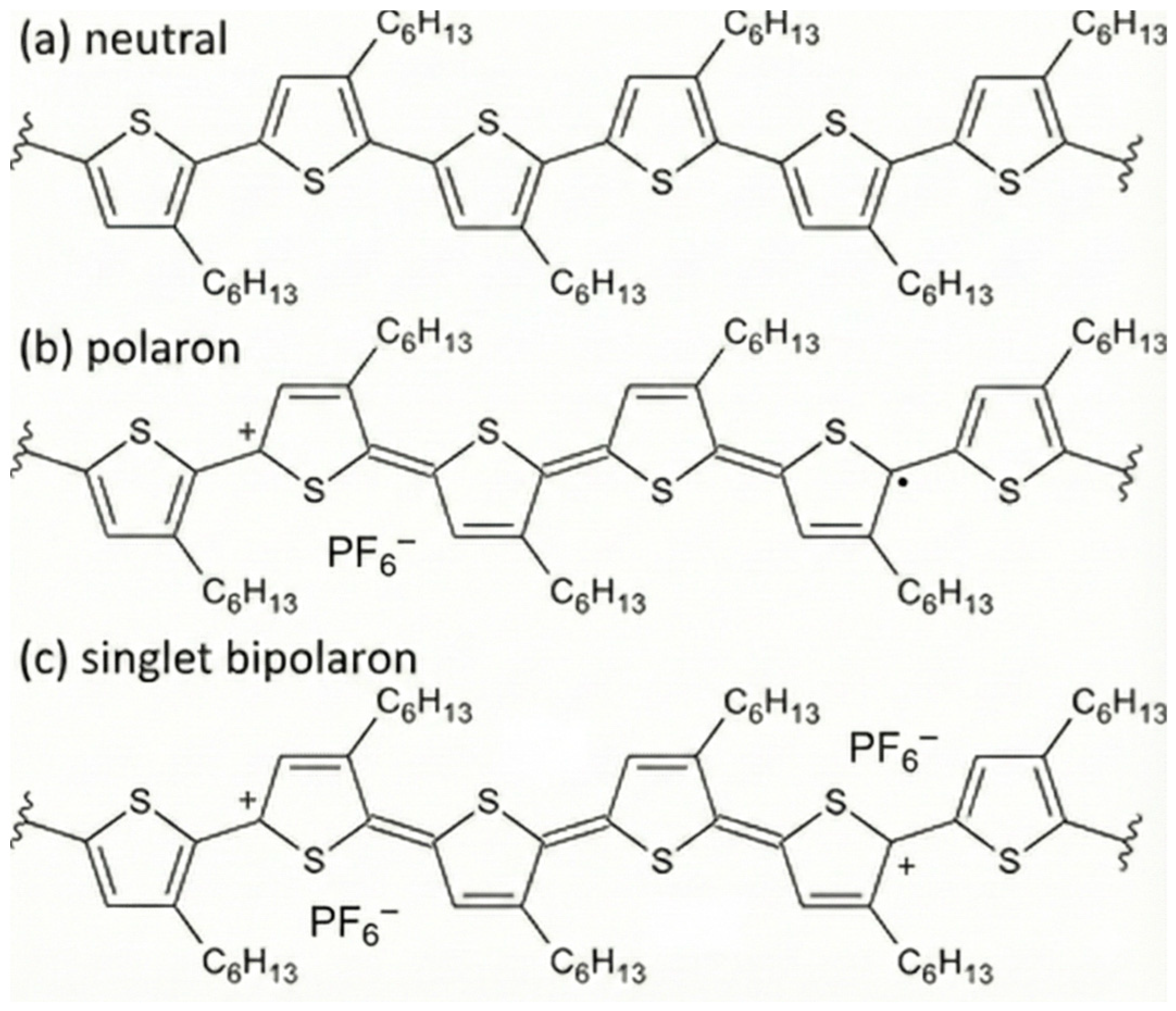
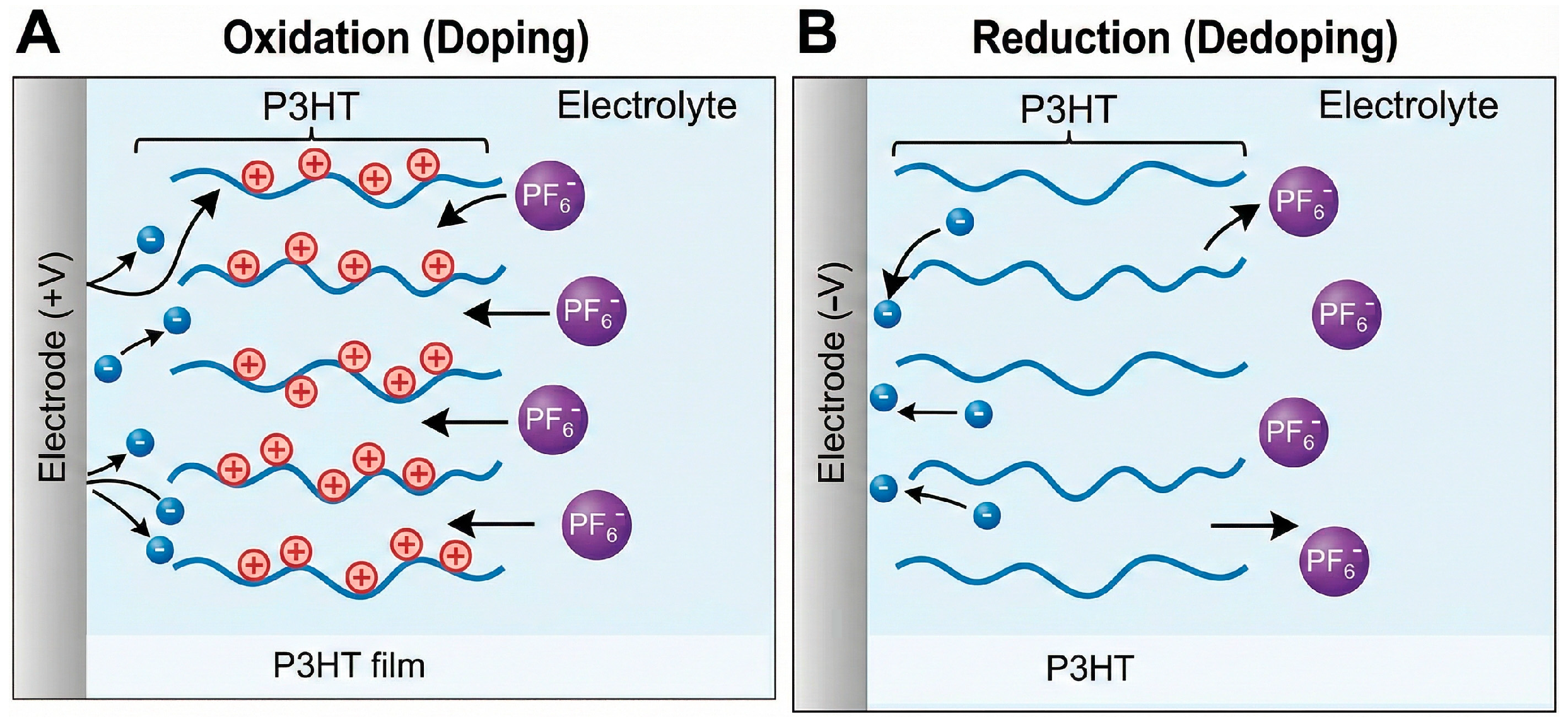
2.1. Doping and Mixed Conduction
2.2. Structure–Property Relationships
2.3. Electrochemical Behavior and Charge Transport
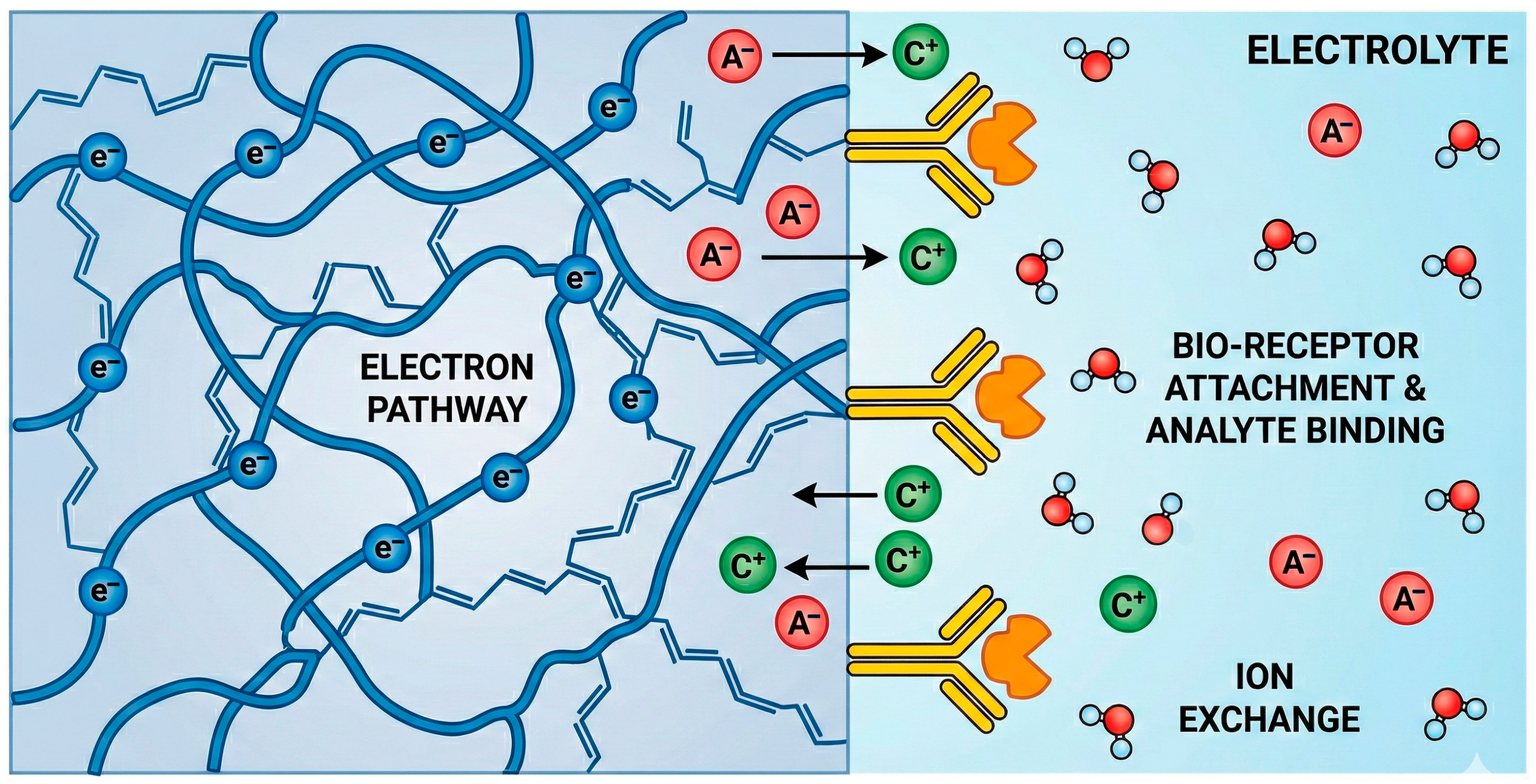
2.4. Interface Chemistry and Biofunctionalization
2.5. Processing and Patterning Techniques
2.6. Key Insights for Sensing Applications
3. Families of Conducting Polymers and Their Properties
3.1. Poly(3,4-ethylenedioxythiophene):Poly(styrene sulfonate)
3.2. Polyaniline (PANI)
3.3. Polypyrrole (PPy)
3.4. Polythiophene (PTh) and Derivatives
3.5. Emerging CP Composites and Hybrids
4. Electrochemical Sensing and Biosensing Mechanisms


| Polymer System | Dominant Sensing Modalities | Typical LOD (Order of Magnitude) | Linear Range (Typical) | Operational Stability * | Reproducibility (Typical RSD) | Dominant Failure Modes | Representative References (This Review) |
|---|---|---|---|---|---|---|---|
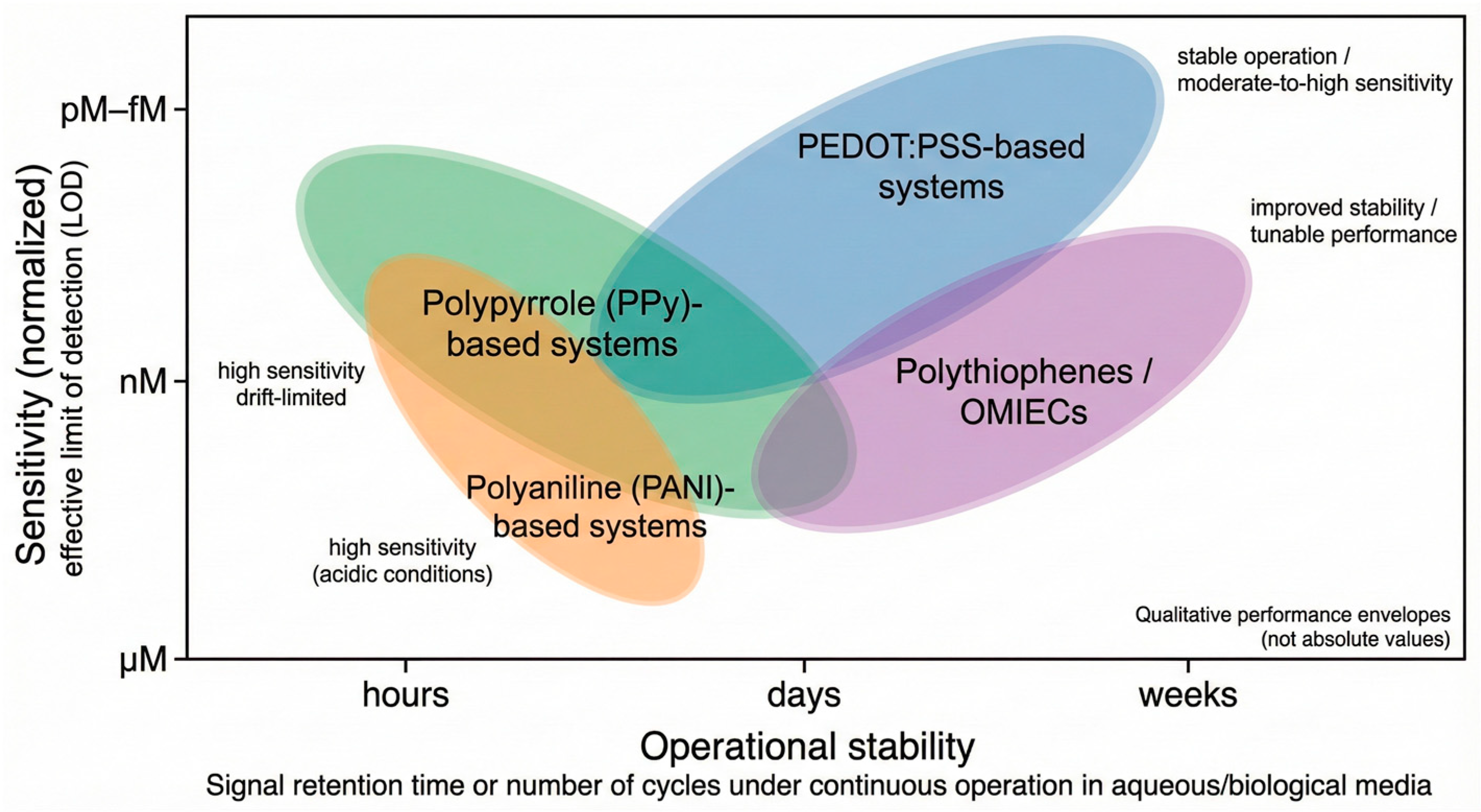
| PEDOT:PSS | Amperometric, EIS, OECT | nM–µM (enzymatic); fM–pM (EIS) | 2–4 decades | Hours–days (continuous operation); weeks (intermittent use) | 5–10% (intra-batch) | Dopant migration, hydration-induced drift, biofouling | [37,38,39,40,41,42,48,49,50,73] |
| Polypyrrole (PPy) | Amperometric, voltammetric, EIS | nM–µM | 1–3 decades | Hours–days | 10–20% | Overoxidation, delamination, conductivity loss | [47,50,51,63,78] |
| Polyaniline (PANI) | Amperometric, potentiometric | nM–µM (acidic media) | 1–3 decades | Hours–days (pH-dependent) | 10–25% | pH instability, redox fatigue | [43,44,45,46,64] |
| Polythiophenes/OMIECs | OECT, EIS | pM–nM | 2–4 decades | Days–weeks | 5–15% | Synthetic and processing complexity, batch-to-batch variability, processing variability | [30,34,73] |
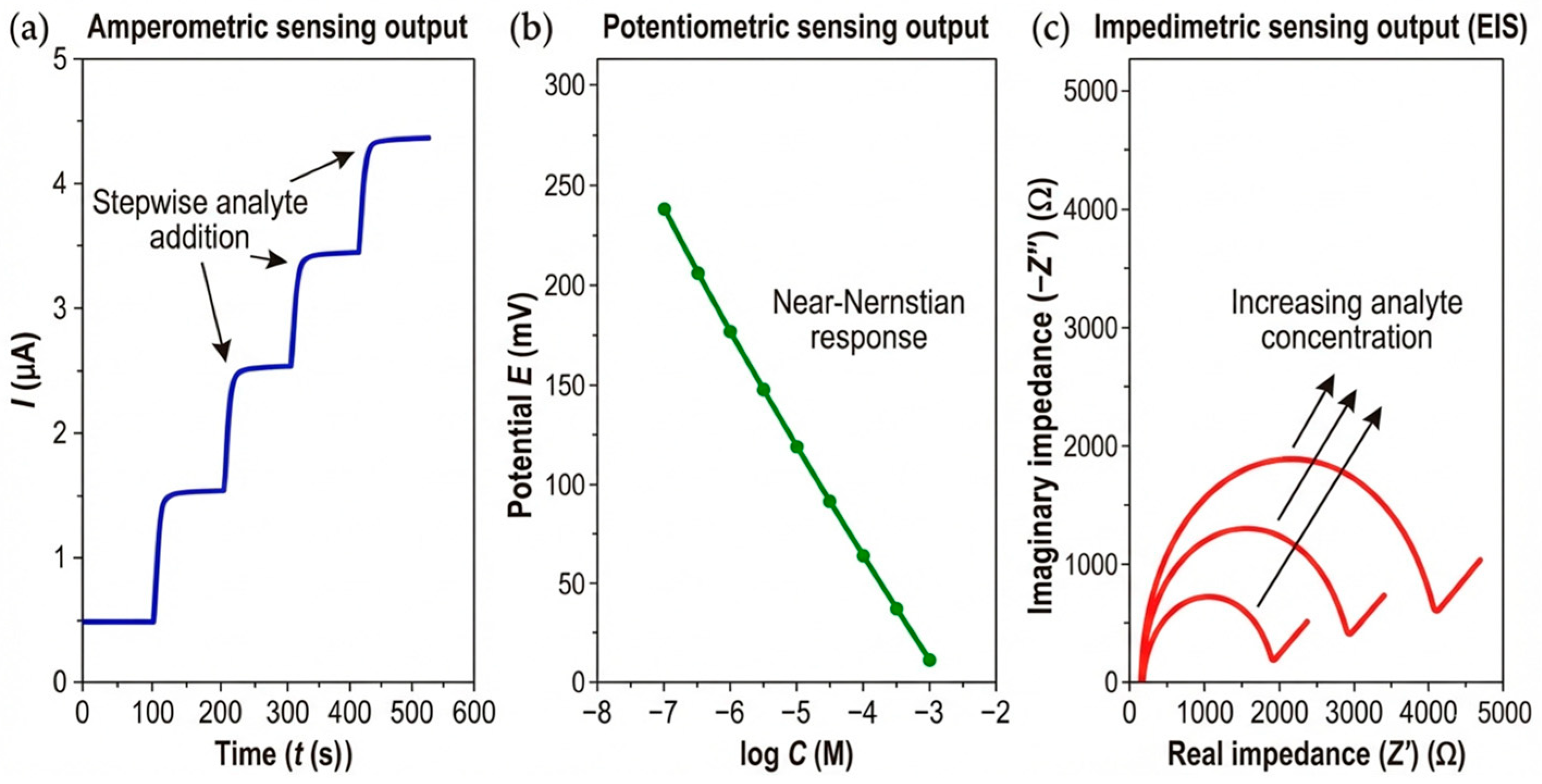
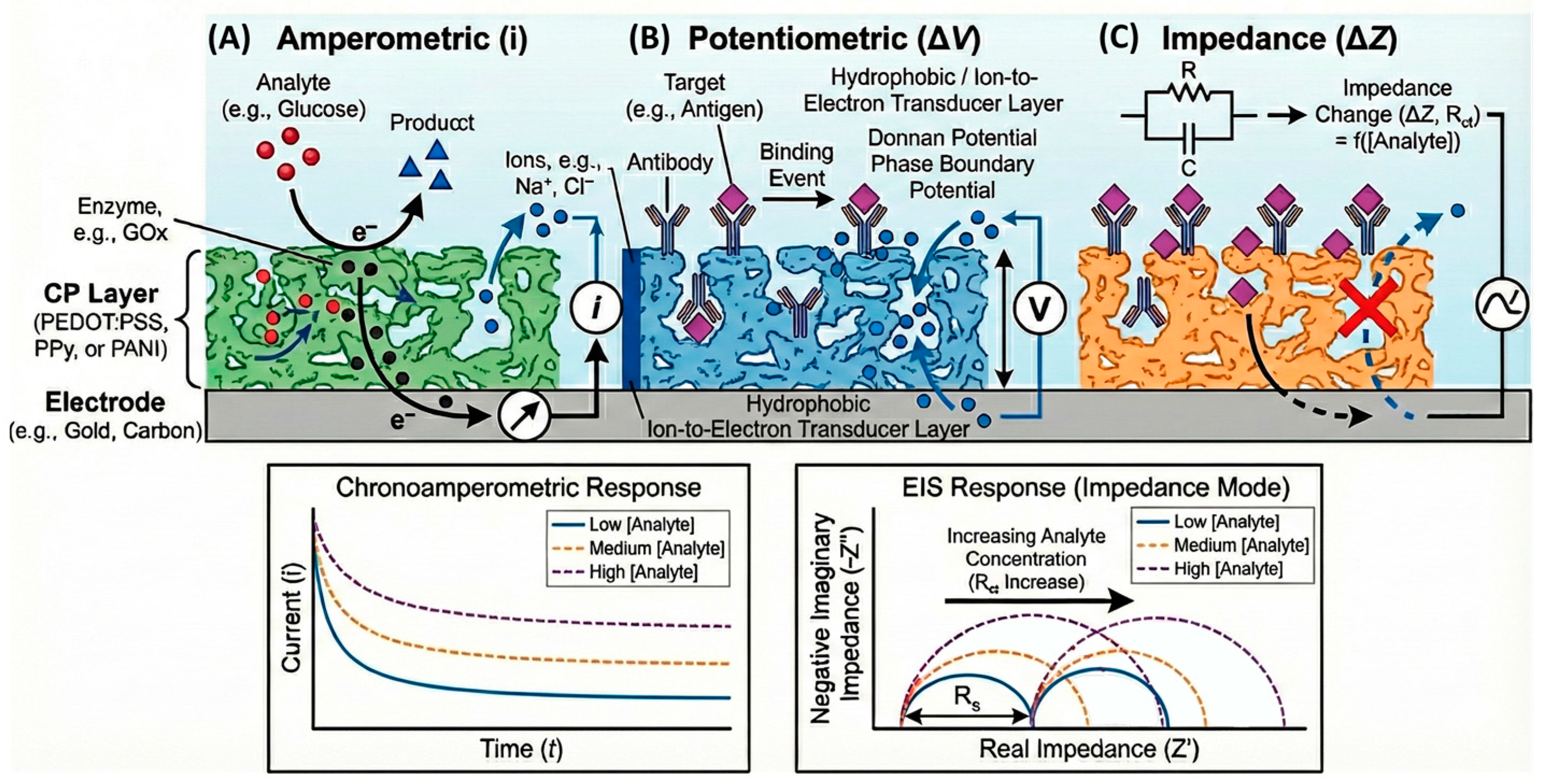
4.1. Amperometric Sensors
4.2. Potentiometric Sensors
4.3. Voltammetric and Differential Pulse Techniques
4.4. Impedimetric (Capacitive) Sensors
4.5. Signal Transduction Pathways and Hybrid Mechanisms
5. Engineering Conducting Polymers for Enhanced Performance
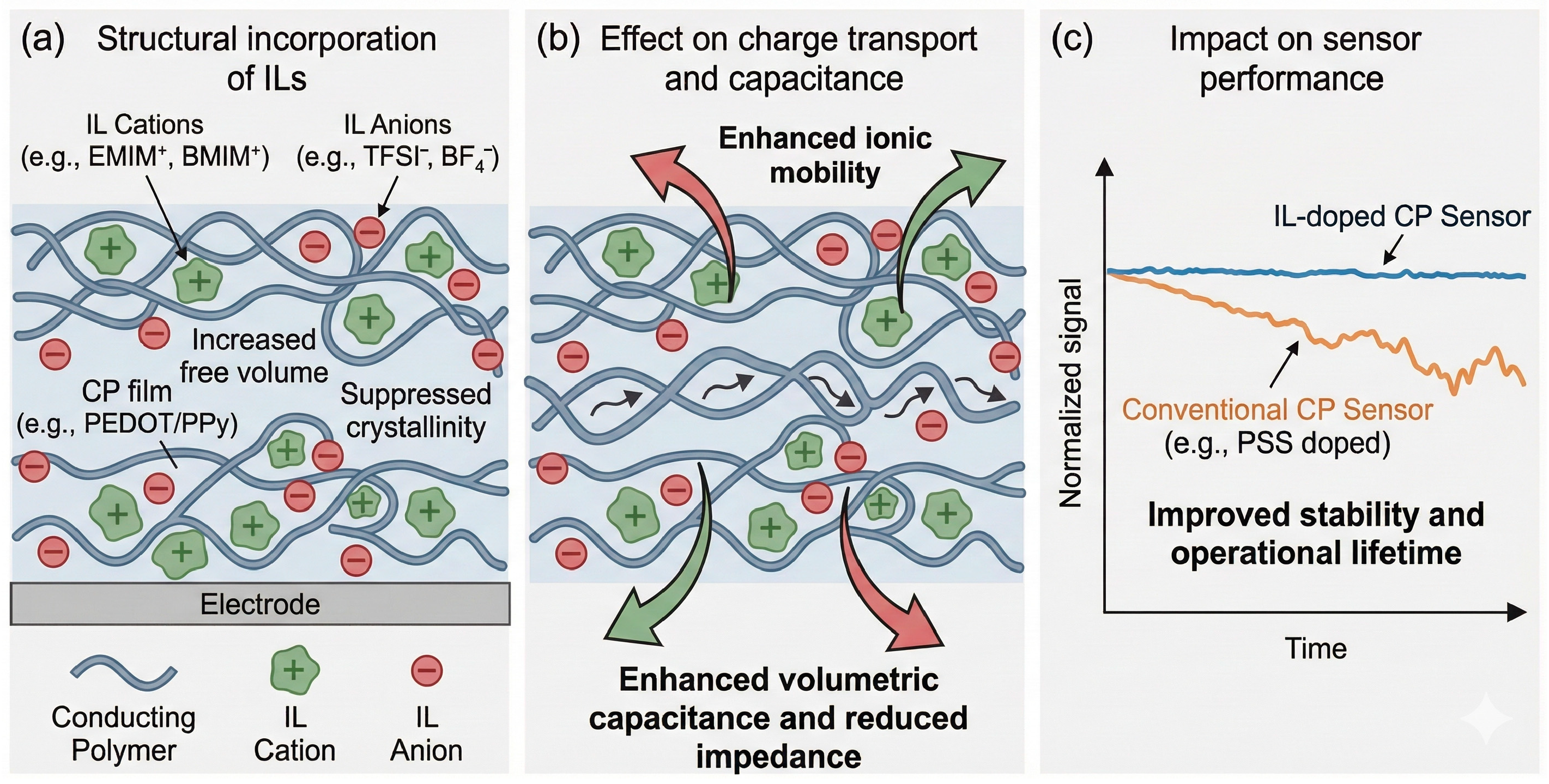
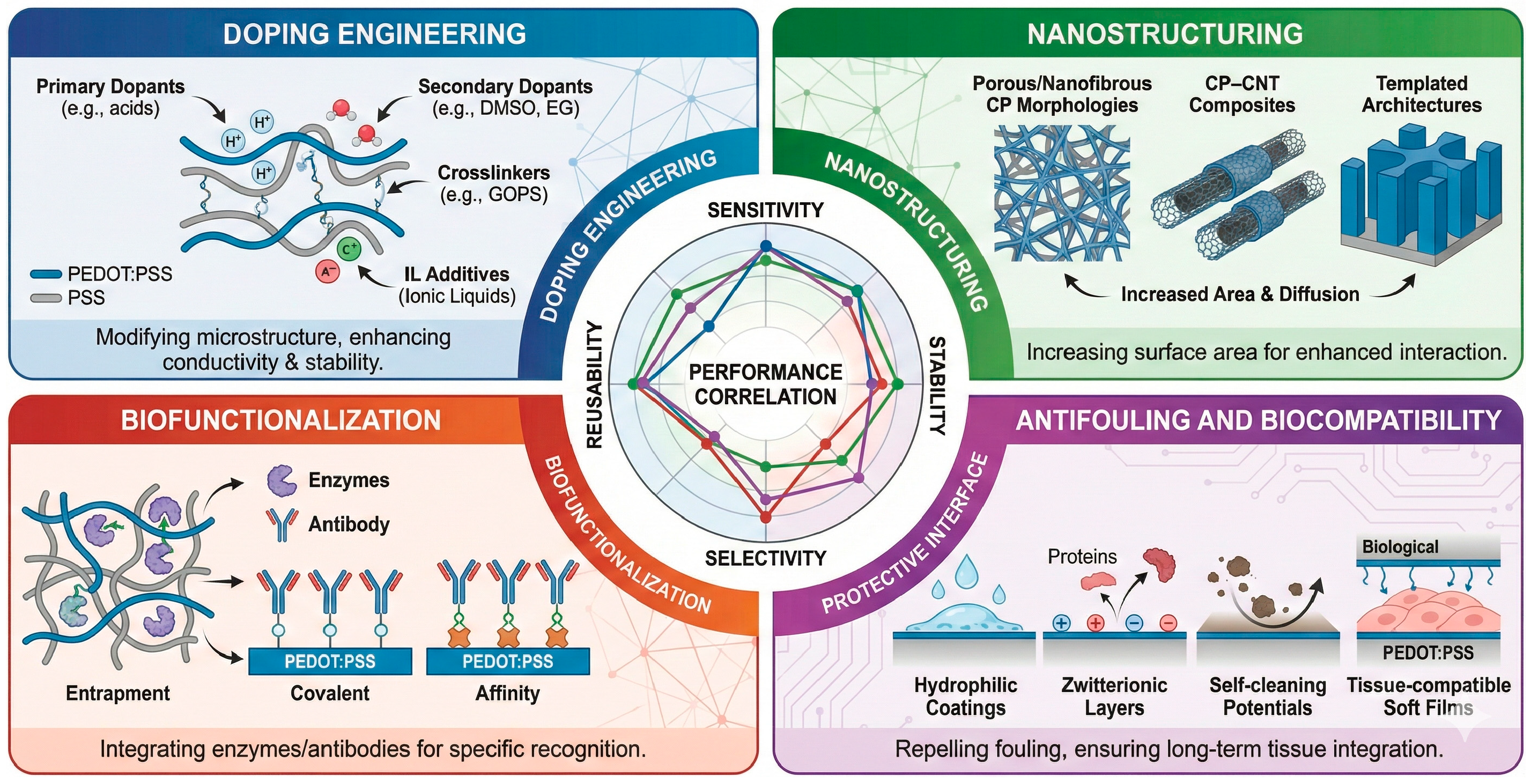
5.1. Doping and Secondary Dopants
5.2. Nanostructuring and Surface Engineering
- Template-assisted polymerization enables the formation of nanostructured PPy architectures with increased surface roughness and accessible electroactive domains, which promote faster ion transport and enhanced electrochemical activity compared to dense films [55].
- Self-assembled PEDOT:PSS microgel and hydrogel networks generate interconnected porous pathways that facilitate ion diffusion throughout the bulk of the electrode, effectively increasing the density of electroactive sites and the volumetric capacitance [29].
- Nanofibrous architectures obtained by electrospinning or printing provide highly accessible conductive pathways and mechanically compliant meshes, leading to enhanced electrochemical performance through increased interfacial area and improved ion diffusion kinetics [18].
5.3. Biofunctionalization and Bioreceptor Immobilization
- Physical entrapment—Enzymes, antibodies, or DNA strands are immobilized during electropolymerization (e.g., PPy–glucose oxidase), ensuring intimate electrical contact while retaining activity [83].
- Covalent coupling—Surface functional groups (–COOH, –NH2, –OH) introduced via copolymerization or plasma treatment enable stable bonding of biomolecules through EDC/NHS or glutaraldehyde chemistry [107].
- Affinity interactions—Biorecognition elements can be anchored via streptavidin–biotin, peptide tags, or electrostatic adsorption on PSS-rich PEDOT:PSS films [108].
5.4. Antifouling and Biocompatible Interfaces
- Surface passivation with hydrophilic or zwitterionic polymers (polyvinyl alcohol, MPC, sulfobetaines) to form hydration layers that repel nonspecific adsorption [109].
- Incorporation of biopolymers (chitosan, alginate, gelatin) within CP matrices, combining natural antifouling with improved softness and biodegradability [107].
- Dynamic coatings and self-cleaning interfaces, where potential pulses or electrochemical redox cycling remove adsorbed foulants [110].
- Nano- and micro-patterned surfaces, exploiting topographical cues to minimize effective contact area with fouling species [111].
5.5. Balancing Performance and Stability
- Strong dopants may increase conductivity but accelerate degradation.
- High surface area enhances sensitivity but exacerbates fouling.
- Crosslinking improves stability but reduces flexibility.
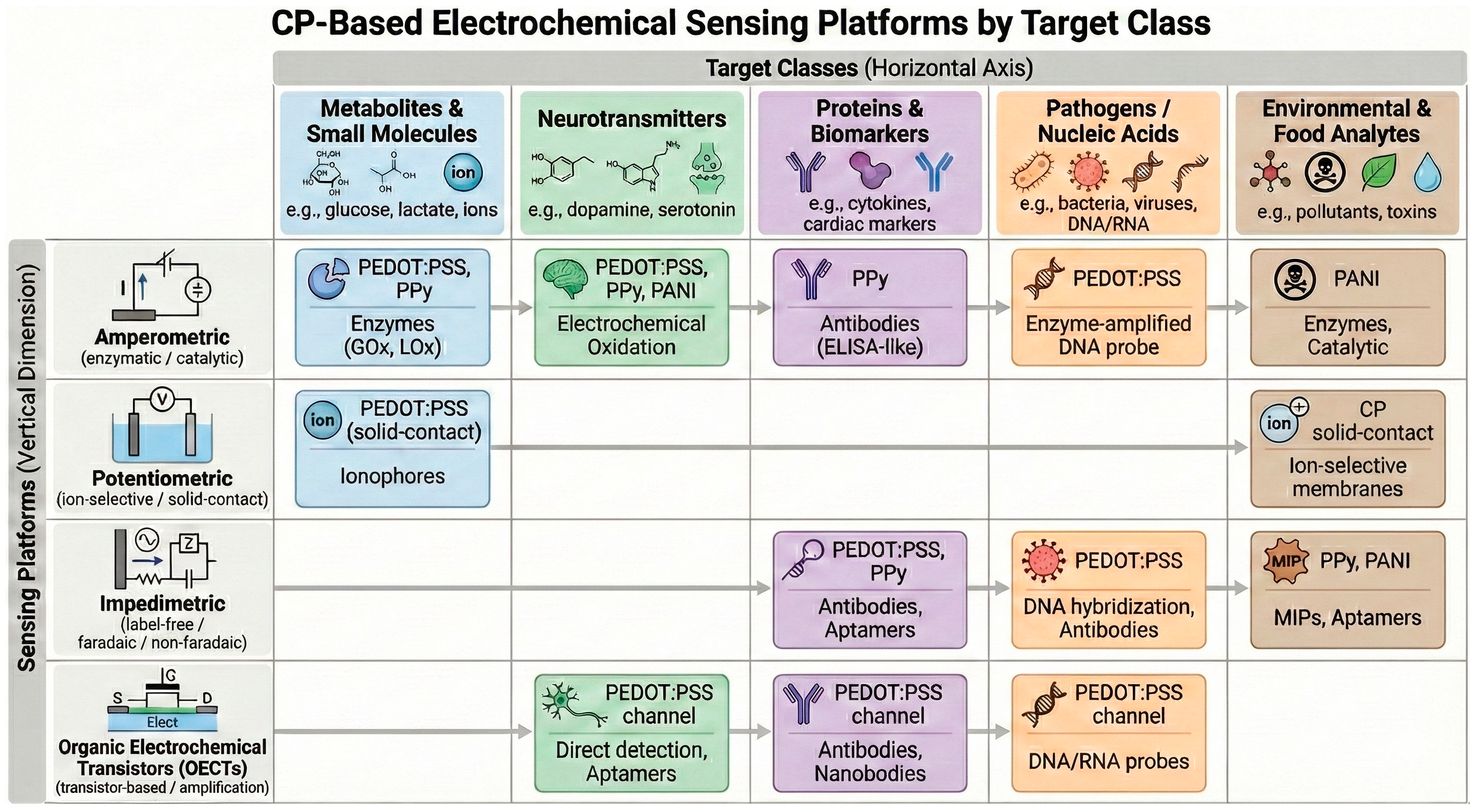
6. CP-Based Electrochemical Biosensors by Target Class
6.1. Metabolites and Small Molecules
- Glucose sensors: PEDOT:PSS and PPy are the most widely used CPs for glucose oxidase (GOx) immobilization. The polymer provides a hydrophilic matrix allowing diffusion of both glucose and O2, while the redox-active backbone mediates electron transfer between the enzyme and electrode [25]. Incorporation of Au or Pt nanoparticles into PEDOT:PSS films further lowers the overpotential for H2O2 oxidation and extends linearity down to µM levels.
- Hydrogen peroxide and ROS detection: CP composites with reduced graphene oxide (rGO) or metal nanostructures (AuNW/rGO–PEDOT:PSS) can directly sense reactive oxygen species released from living cells with LODs < 10 nM, offering real-time monitoring of oxidative stress [115].
6.2. Neurotransmitters and Neurochemicals
6.3. Protein Biomarkers and Disease Diagnostics
6.4. Pathogens, Nucleic Acids, and Molecular Recognition
6.5. Environmental and Food Analysis
- Heavy metals: PANI and PPy modified with chelating ligands (EDTA, crown ethers) act as preconcentrators for Pb2+, Cd2+, or Hg2+, allowing detection via anodic stripping voltammetry [122].
- Pesticides: acetylcholinesterase (AChE)-based electrochemical biosensors exploiting enzyme inhibition have been widely implemented on PEDOT:PSS-modified electrodes for the selective detection of organophosphates in food and water matrices [123].
6.6. Emerging Trends Across Analyte Classes
- PEDOT:PSS composites frequently offer a favorable balance of conductivity, mechanical flexibility, and biocompatibility relative to many alternative materials, and are widely adopted as transduction/immobilization matrices in diverse biosensors. However, performance is analyte- and architecture-dependent, and in some cases other polymers or composites may deliver superior trade-offs for specific targets or operating conditions.
- PPy and PANI are among the most commonly used CPs for enzymatic biosensors because of facile electropolymerization, good film-forming ability, and effective enzyme entrapment. Nonetheless, many reports note stability challenges in neutral/physiological media, motivating the use of composites, mediators, or alternative architectures to enhance robustness under near-neutral conditions.
- Nanocomposite and conductive hydrogel systems increasingly enable soft, flexible, and wearable/transient biosensors, supporting opportunities for continuous biochemical monitoring. Reported advantages include improved mechanical compliance, biocompatibility, and, in some cases, enhanced signal transduction; challenges remain for long-term stability, biocompatibility in vivo, and reproducible large-area fabrication.
- Impedance-based (label-free) detection has gained prominent traction in recent years and is frequently highlighted in reviews as a scalable, low-power readout for many CP- and hydrogel-based biosensors. However, amperometric and voltammetric approaches continue to be widely reported for enzymatic glucose sensors, including GOx-based systems, so impedance-based methods have not universally surpassed amperometry in the literature. The relative prevalence is method- and application-dependent and shows an increasing but not exclusive trend toward impedance.
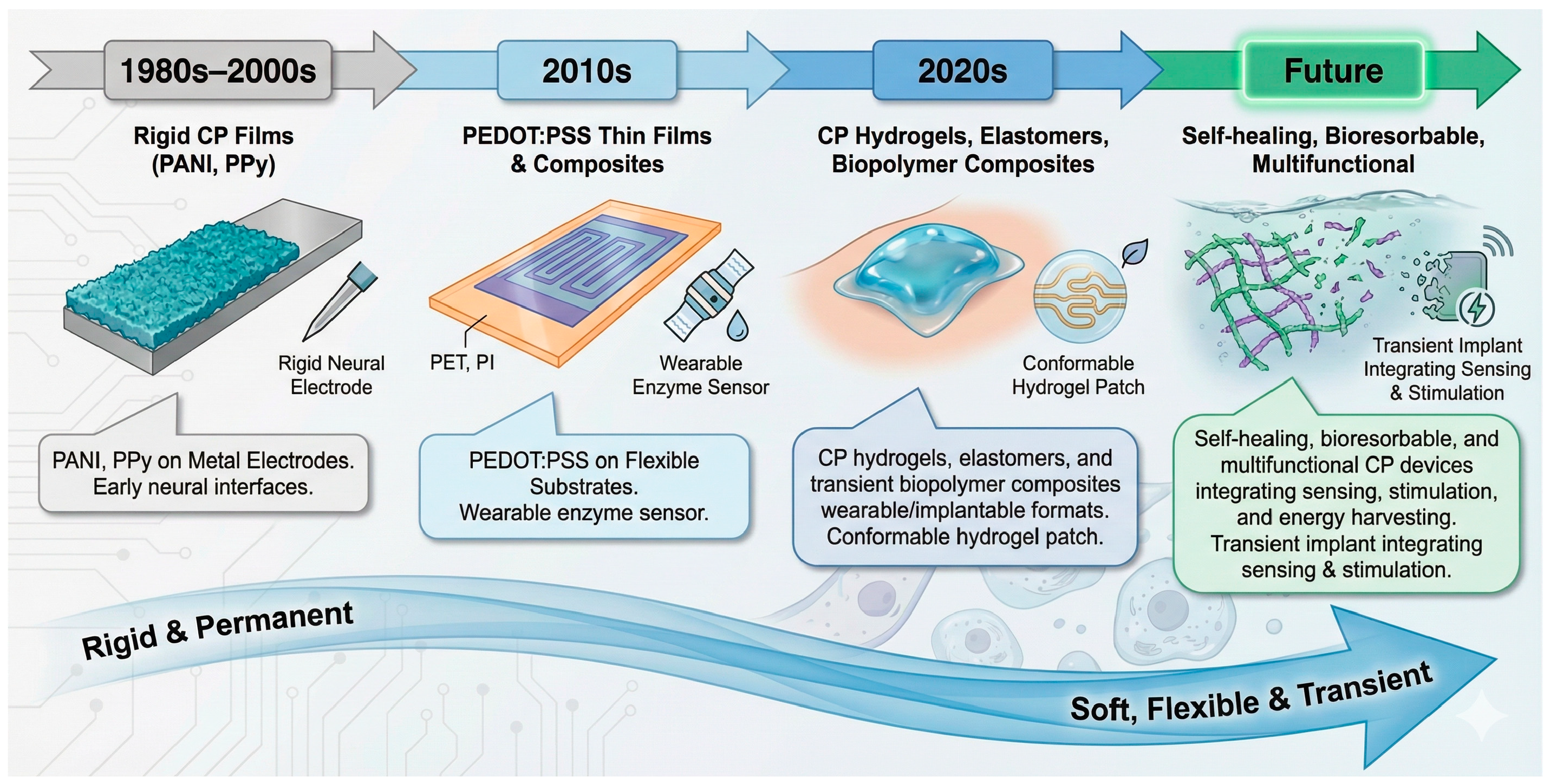
7. CPs in Wearable, Implantable and Soft Bioelectronics
7.1. Wearable Electrochemical Biosensors
7.2. Implantable and Neural Interfaces
7.3. Transient and Biodegradable CP-Based Electronics
7.4. Integration Challenges and Opportunities
- Mechanical–electrical coupling: maintaining stable conductivity under repeated bending, stretching, and hydration cycles.
- Encapsulation and environmental stability: preventing water uptake or dopant leaching without sacrificing ionic accessibility.
- Biocompatibility and immune response: ensuring long-term tissue compatibility through surface modification or use of naturally derived matrices.
- Scalability and reproducibility: achieving uniform CP coatings and crosslinking over large areas for industrial-scale production.
7.5. Outlook: Toward Seamless Bioelectronic Integration
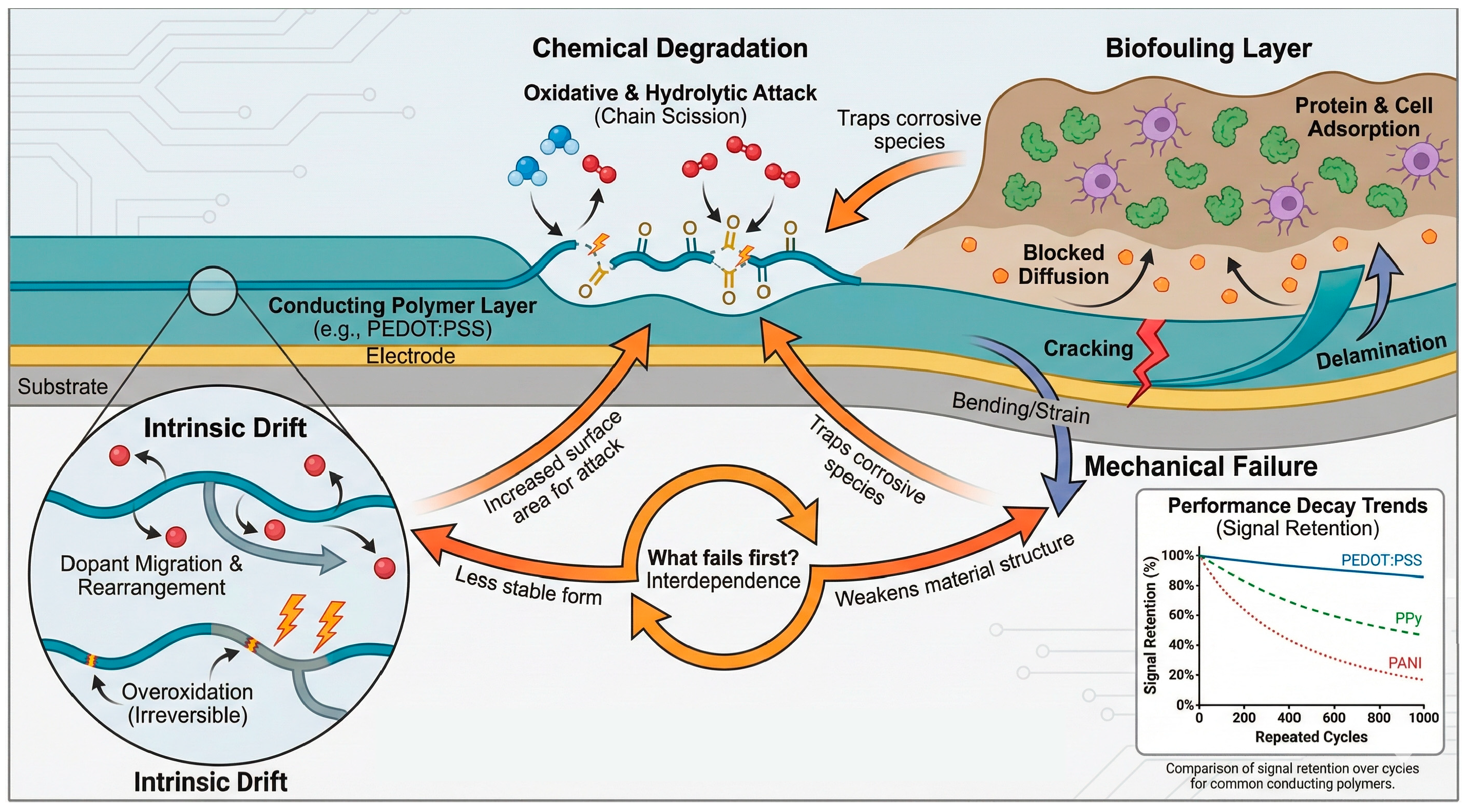
8. Reliability, Drift, Fouling and Reproducibility
8.1. Electrical and Electrochemical Drift
- Crosslinking or encapsulation to immobilize dopants and limit swelling (e.g., GOPS-treated PEDOT:PSS).
- Operation within the polymer’s stable potential window (avoiding overoxidation).
- Periodic reconditioning cycles (e.g., potential pulsing to restore redox balance).
- Use of redox mediators to stabilize electron-transfer pathways without excessive polymer polarization.
8.2. Chemical and Environmental Degradation
8.3. Biofouling and Matrix Effects
8.4. Reproducibility and Inter-Batch Variability
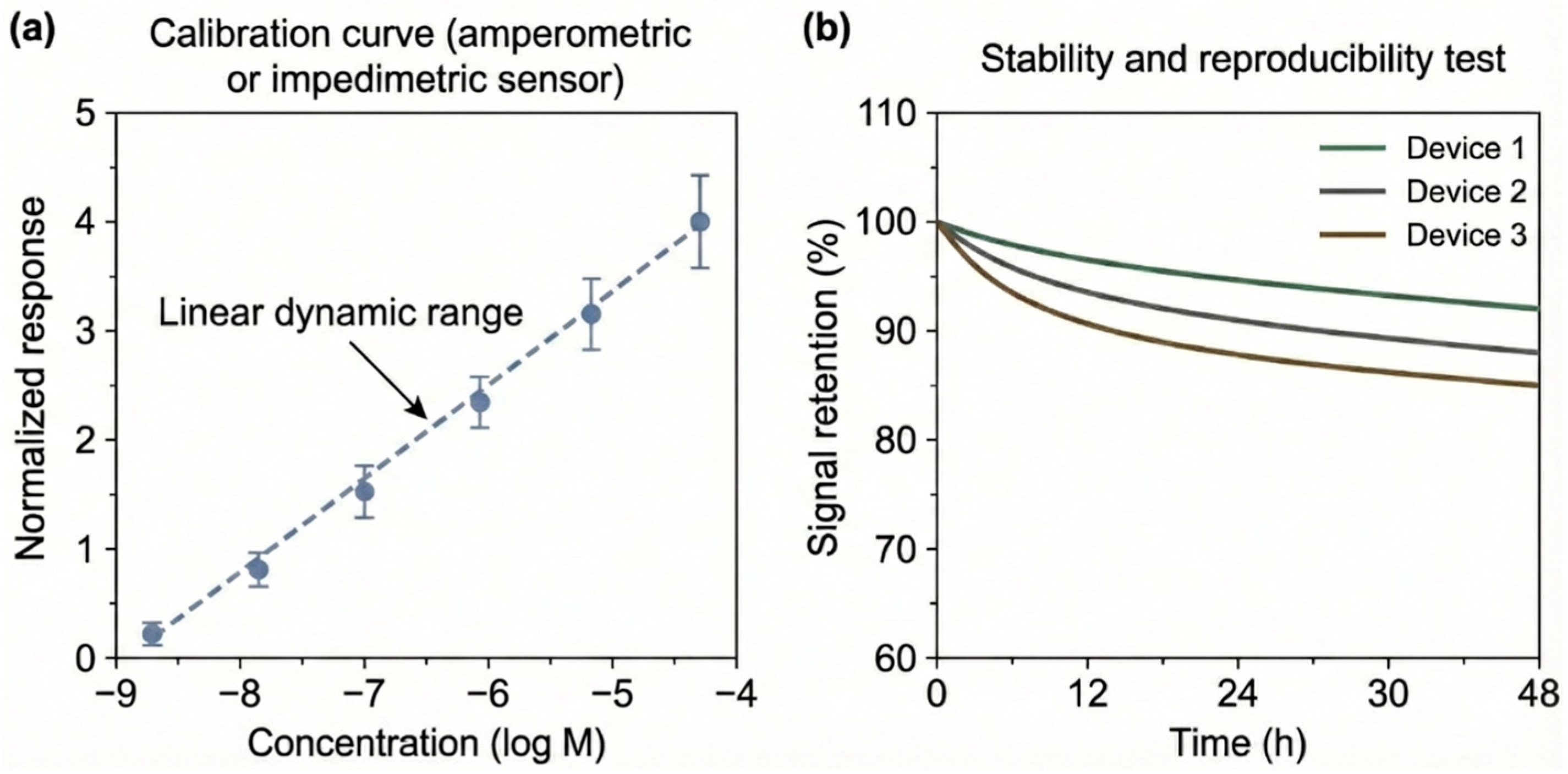
- Reporting of sample size (n ≥ 3–5 devices per condition).
- Statistical treatment of calibration data (mean ± SD).
- Documentation of preconditioning and storage protocols.
- Use of reference electrodes and control experiments in complex matrices.
8.5. Coupled Degradation Mechanisms
8.6. Toward Standardized Reliability Testing
- Accelerated aging (continuous bias or redox cycling over 24–72 h).
- Repeated mechanical stress (bending, stretching cycles).
- Storage stability under defined humidity and temperature.
- Real-matrix exposure tests (serum, sweat, environmental water).
9. Metrology, Reporting Standards and Benchmarking
9.1. The Metrological Gap
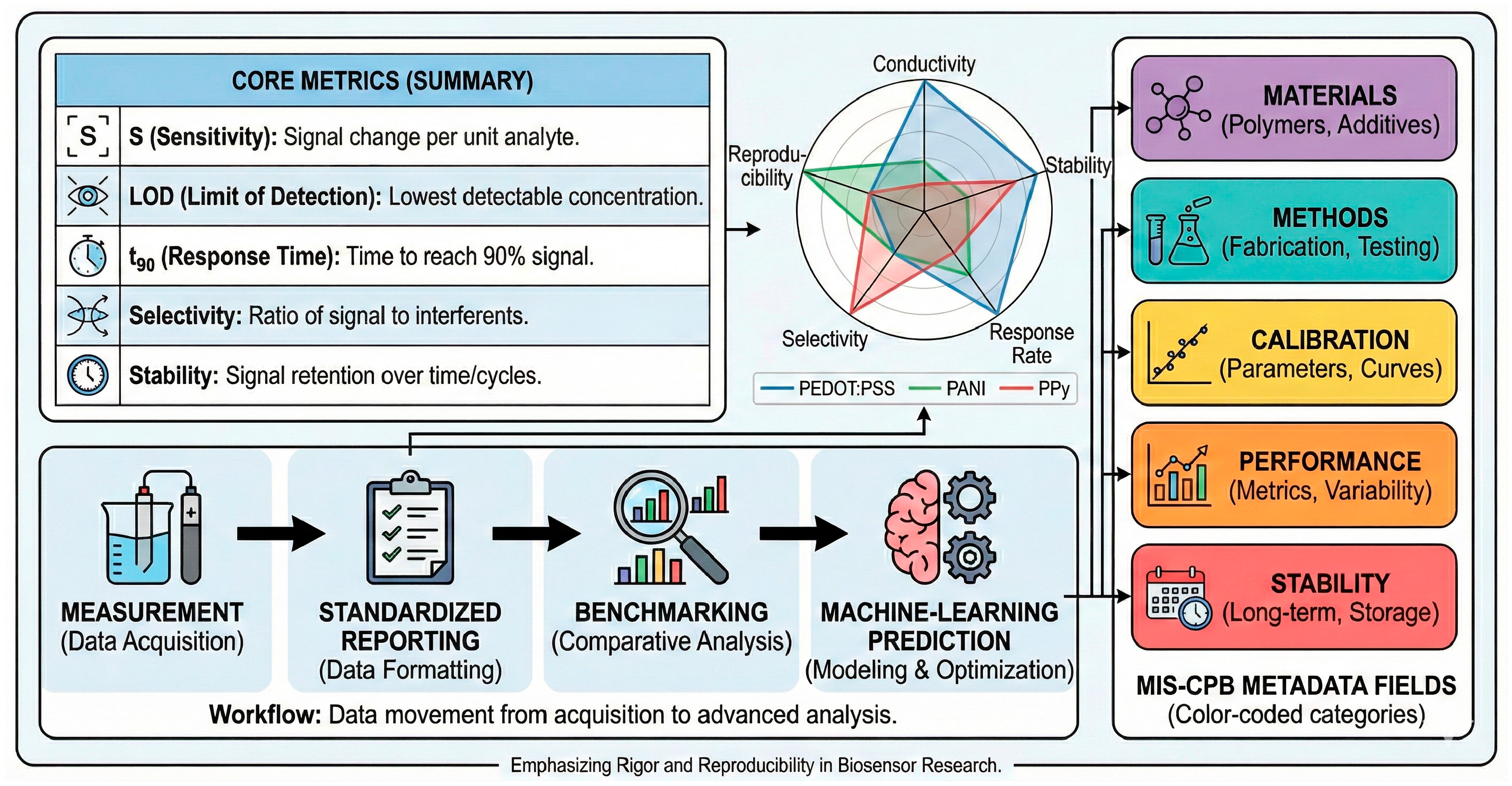
- Electrode area normalization (geometric vs. electroactive surface).
- Unit reporting (e.g., mA·mM−1·cm−2 vs. µA·µM−1·cm−2).
- LOD estimation, often inconsistently defined as 3σ/S or visual extrapolation.
- Reference electrode and potential scale, especially in miniaturized or wearable systems.
- Matrix composition, with artificial buffers replacing complex biological fluids.
9.2. Standardized Metrics for Electrochemical Biosensors
9.3. Reference Electrodes and Calibration Protocols
9.4. Interlaboratory Reproducibility and Data Curation
- Polymer system and dopant.
- Fabrication route and film thickness.
- Electrochemical configuration (reference, counter, working).
- Analyte and biological matrix.
- Calibration methodology and statistics.
- Stability and reproducibility data.
9.5. Benchmarking, Performance Envelopes, and Trade-Offs
9.6. Toward Predictive and Data-Driven Metrology
10. Emerging Directions and Future Outlook
10.1. Beyond PEDOT:PSS: Next-Generation Mixed Conductors
10.2. Biohybrid and Living Polymer Interfaces
- Cell-laden CP hydrogels that can sense and respond to biochemical signals while supporting cell viability [164].
- Enzymatically polymerized CPs, using oxidoreductases to catalyze in situ polymer growth directly on biological substrates [165].
- Bacterial cellulose-based biodegradable composites, providing mechanically robust and flexible sensing platforms [166].
- Biomimetic self-assembly of CP nanofibers guided by peptides or polysaccharides to achieve hierarchical organization reminiscent of extracellular matrices [167].
10.3. Integration with Artificial Intelligence and Digital Twins
10.4. Transient, Sustainable, and Circular Bioelectronics
10.5. Toward Multifunctional and Multimodal Systems
10.6. Clinical Translation and Regulatory Pathways
10.7. The Grand Vision: Bio-Intelligent Materials
11. Conclusions and Design Guidelines
11.1. Key Insights
- Mixed conduction is both strength and weakness.The same ion–electron coupling that enables high sensitivity also introduces drift and environmental dependence. Engineering strategies must balance ionic mobility with structural stability via controlled doping and crosslinking.
- Hierarchy matters.Nanoscale architecture (porosity, morphology) determines macroscopic performance. Hierarchical structures combining ordered conductive domains and soft, hydrated interfaces provide optimal performance for biological operation.
- Interfaces define reliability.The polymer–biointerface, rather than the bulk material, dictates long-term reproducibility. Functionalization chemistry, antifouling coatings, and mechanical matching with tissues are as important as conductivity itself.
- Metrology equals credibility.Reliable comparison requires standardized metrics (sensitivity, LOD, stability, selectivity) and transparent data reporting. Without reproducible benchmarks, no real progress can be measured.
- Sustainability is not optional.As the field moves toward large-scale applications, the environmental and ethical footprint of CPs—solvent use, dopant toxicity, device disposal—will become critical design constraints.
- Convergence defines the future.The fusion of CP materials with AI, biopolymers, and living systems will shape the coming decade of bioelectronics—where sensing, computation, and adaptation co-exist in a single material platform.
11.2. Design Rules for CP-Based Electrochemical Biosensors
11.3. The Path Forward
Author Contributions
Funding
Institutional Review Board Statement
Informed Consent Statement
Data Availability Statement
Conflicts of Interest
References
- Diaz, A.F.; Kanazawa, K.K.; Gardini, G.P. Electrochemical Polymerization of Pyrrole. J. Chem. Soc. Chem. Commun. 1979, 14, 635–636. [Google Scholar] [CrossRef]
- Macdiarmid, A.G.; Chiang, J.-C.; Halpern, M.; Huang, W.-S.; Mu, S.-L.; Nanaxakkara, L.D.; Wu, S.W.; Yaniger, S.I. “Polyaniline”: Interconversion of Metallic and Insulating Forms. Mol. Cryst. Liq. Cryst. 1985, 121, 173–180. [Google Scholar] [CrossRef]
- Heywang, G.; Jonas, F. Poly(alkylenedioxythiophene)s—New, Very Stable Conducting Polymers. Adv. Mater. 1992, 4, 116–118. [Google Scholar] [CrossRef]
- Rivnay, J.; Inal, S.; Salleo, A.; Owens, R.M.; Berggren, M.; Malliaras, G.G. Organic Electrochemical Transistors. Nat. Rev. Mater. 2018, 3, 17086. [Google Scholar] [CrossRef]
- Gkoupidenis, P.; Zhang, Y.; Kleemann, H.; Ling, H.; Santoro, F.; Fabiano, S.; Salleo, A.; van de Burgt, Y. Organic Mixed Conductors for Bioinspired Electronics. Nat. Rev. Mater. 2024, 9, 134–149. [Google Scholar] [CrossRef]
- Gerard, M.; Chaubey, A.; Malhotra, B.D. Application of Conducting Polymers to Biosensors. Biosens. Bioelectron. 2002, 17, 345–359. [Google Scholar] [CrossRef]
- Someya, T.; Bao, Z.; Malliaras, G.G. The Rise of Plastic Bioelectronics. Nature 2016, 540, 379–385. [Google Scholar] [CrossRef]
- Yuk, H.; Lu, B.; Zhao, X. Hydrogel Bioelectronics. Chem. Soc. Rev. 2019, 48, 1642–1667. [Google Scholar] [CrossRef]
- Dube, A.; Malode, S.J.; Alodhayb, A.N.; Mondal, K.; Shetti, N.P. Conducting Polymer-Based Electrochemical Sensors: Progress, Challenges, and Future Perspectives. Talanta Open 2025, 11, 100395. [Google Scholar] [CrossRef]
- Xue, S.; Shi, M.; Wang, J.; Li, J.; Peng, G.; Xu, J.; Gao, Y.; Duan, X.; Lu, L. TiO2-MXene/PEDOT:PSS Composite as a Novel Electrochemical Sensing Platform for Sensitive Detection of Baicalein. Molecules 2023, 28, 3262. [Google Scholar] [CrossRef]
- Montazerian, H.; Davoodi, E.; Wang, C.; Lorestani, F.; Li, J.; Haghniaz, R.; Sampath, R.R.; Mohaghegh, N.; Khosravi, S.; Zehtabi, F.; et al. Boosting Hydrogel Conductivity via Water-Dispersible Conducting Polymers for Injectable Bioelectronics. Nat. Commun. 2025, 16, 3755. [Google Scholar] [CrossRef]
- Rahman, M.S.; Shon, A.; Joseph, R.; Pavlov, A.; Stefanov, A.; Namkoong, M.; Guo, H.; Bui, D.; Master, R.; Sharma, A.; et al. Soft, Stretchable Conductive Hydrogels for High-Performance Electronic Implants. Sci. Adv. 2025, 11, eads4415. [Google Scholar] [CrossRef]
- Uçar, A.; González-Fernández, E.; Staderini, M.; Murray, A.F.; Mount, A.R.; Bradley, M. pH-Activated Dissolvable Polymeric Coatings to Reduce Biofouling on Electrochemical Sensors. J. Funct. Biomater. 2023, 14, 329. [Google Scholar] [CrossRef]
- Fratini, S.; Nikolka, M.; Salleo, A.; Schweicher, G.; Sirringhaus, H. Charge Transport in High-Mobility Conjugated Polymers and Molecular Semiconductors. Nat. Mater. 2020, 19, 491–502. [Google Scholar] [CrossRef]
- Petsagkourakis, I.; Kim, N.; Tybrandt, K.; Zozoulenko, I.; Crispin, X. Poly(3,4-ethylenedioxythiophene): Chemical Synthesis, Transport Properties, and Thermoelectric Devices. Adv. Electron. Mater. 2019, 5, 1800918. [Google Scholar] [CrossRef]
- Paulsen, B.D.; Tybrandt, K.; Stavrinidou, E.; Rivnay, J. Organic Mixed Ionic–Electronic Conductors. Nat. Mater. 2020, 19, 13–26. [Google Scholar] [CrossRef]
- Gregorio, T.; Mombrú, D.; Romero, M.; Faccio, R.; Mombrú, Á.W. Exploring Mixed Ionic–Electronic-Conducting PVA/PEDOT: PSS Hydrogels as Channel Materials for Organic Electrochemical Transistors. Polymers 2024, 16, 1478. [Google Scholar] [CrossRef]
- He, H.; Chen, Y.; Pu, A.; Wang, L.; Li, W.; Zhou, X.; Tang, C.Y.; Ban, K.; Yang, M.; Xu, L. Strong and High-Conductivity Hydrogels with All-Polymer Nanofibrous Networks for Applications as High-Capacitance Flexible Electrodes. npj Flex. Electron. 2024, 8, 56. [Google Scholar] [CrossRef]
- Khodagholy, D.; Rivnay, J.; Sessolo, M.; Gurfinkel, M.; Leleux, P.; Jimison, L.H.; Stavrinidou, E.; Herve, T.; Sanaur, S.; Owens, R.M.; et al. High Transconductance Organic Electrochemical Transistors. Nat. Commun. 2013, 4, 2133. [Google Scholar] [CrossRef]
- Stavrinidou, E.; Leleux, P.; Rajaona, H.; Khodagholy, D.; Rivnay, J.; Lindau, M.; Sanaur, S.; Malliaras, G.G. Direct Measurement of Ion Mobility in a Conducting Polymer. Adv. Mater. 2013, 25, 4488–4493. [Google Scholar] [CrossRef]
- Volkov, A.V.; Wijeratne, K.; Mitraka, E.; Ail, U.; Zhao, D.; Tybrandt, K.; Andreasen, J.W.; Berggren, M.; Crispin, X.; Zozoulenko, I.V. Understanding the Capacitance of PEDOT:PSS. Adv. Funct. Mater. 2017, 27, 1700329. [Google Scholar] [CrossRef]
- Wu, X.; Stephen, M.; Hidalgo, T.C.; Salim, T.; Surgailis, J.; Surendran, A.; Su, X.; Li, T.; Inal, S.; Leong, W.L. Ionic-Liquid Induced Morphology Tuning of PEDOT:PSS for High-Performance Organic Electrochemical Transistors. Adv. Funct. Mater. 2022, 32, 2108510. [Google Scholar] [CrossRef]
- Tzaneva, B.; Mateev, V.; Stefanov, B.; Aleksandrova, M.; Iliev, I. Electrochemical Investigation of PEDOT:PSS/Graphene Aging in Artificial Sweat. Polymers 2024, 16, 1706. [Google Scholar] [CrossRef] [PubMed]
- Cihan, E.; Melnik, E.; Kurzhals, S.; Plata, P.; Mutinati, G.C.; Hainberger, R.; Felice, A.K.; Schulz, C.; Lieberzeit, P. Novel Approach for the Immobilization of Cellobiose Dehydrogenase in PEDOT: PSS Conductive Layer on Planar Gold Electrodes. Chemosensors 2024, 12, 36. [Google Scholar] [CrossRef]
- Murugan, P.; Annamalai, J.; Atchudan, R.; Govindasamy, M.; Nallaswamy, D.; Ganapathy, D.; Reshetilov, A.; Sundramoorthy, A.K. Electrochemical Sensing of Glucose Using Glucose Oxidase/PEDOT:4-Sulfocalix [4]Arene/MXene Composite Modified Electrode. Micromachines 2022, 13, 304. [Google Scholar] [CrossRef]
- Salahandish, R.; Haghayegh, F.; Khetani, S.; Hassani, M.; Nezhad, A.S. Immuno-Affinity Potent Strip with Pre-Embedded Intermixed PEDOT:PSS Conductive Polymers and Graphene Nanosheets for Bio-Ready Electrochemical Biosensing of Central Nervous System Injury Biomarkers. ACS Appl. Mater. Interfaces 2022, 14, 28651–28662. [Google Scholar] [CrossRef]
- Li, D.; Zhang, W.; Miao, M.; Liu, Y.; Yang, H. A High-Performance PEDOT:PSS Platform Electrochemical Biosensor for the Determination of HER2 Based on Carboxyl-Functionalized MWCNTs and ARGET ATRP. New J. Chem. 2023, 47, 15579–15587. [Google Scholar] [CrossRef]
- Tuntiwongmetee, T.; Khumngern, S.; Nontipichet, N.; Romportong, S.; Thavarungkul, P.; Kanatharana, P.; Numnuam, A. Flow Injection Amperometric Uric Acid Biosensor Based on AuNPs–GO–CS Porous Composite Cryogel Coated on PB–PEDOT:PSS Modified Screen-Printed Carbon Electrode. Bioelectrochemistry 2024, 158, 108725. [Google Scholar] [CrossRef]
- Goestenkors, A.P.; Liu, T.; Okafor, S.S.; Semar, B.A.; Alvarez, R.M.; Montgomery, S.K.; Friedman, L.; Rutz, A.L. Manipulation of Cross-Linking in PEDOT:PSS Hydrogels for Biointerfacing. J. Mater. Chem. B 2023, 11, 11357–11371. [Google Scholar] [CrossRef]
- Solazzo, M.; Monaghan, M.G. Hydrophilic, Conductive and Flexible Piezoresistive PEDOT:PSS 3D Sensors with Tunable Microarchitecture and Crosslinked Using a PEGylated Crosslinker. Synth. Met. 2022, 290, 117157. [Google Scholar] [CrossRef]
- Valdés-Ramírez, G.; Galicia, L. Glucose Oxidase Captured into Electropolymerized P-Coumaric Acid towards the Development of a Glucose Biosensor. Chemosensors 2023, 11, 345. [Google Scholar] [CrossRef]
- Ghazal, M.; Susloparova, A.; Lefebvre, C.; Mansour, M.D.; Ghodhbane, N.; Melot, A.; Scholaert, C.; Guérin, D.; Janel, S.; Barois, N. Electropolymerization Processing of Side-Chain Engineered EDOT for High Performance Microelectrode Arrays. Biosens. Bioelectron. 2023, 237, 115538. [Google Scholar] [CrossRef] [PubMed]
- Peng, H.-L.; Zhang, Y.; Liu, H.; Gao, C. Flexible Wearable Electrochemical Sensors Based on AuNR/PEDOT: PSS for Simultaneous Monitoring of Levodopa and Uric Acid in Sweat. ACS Sens. 2024, 9, 3296–3306. [Google Scholar] [CrossRef] [PubMed]
- Yılmaz, K.; Hussaini, A.A.; Yıldırım, M.; Karaman, M. Vapor Phase Polymerization of PEDOT on ITO/Glass Surfaces for Nonenzymatic Detection of Dopamine. Synth. Met. 2024, 307, 117691. [Google Scholar] [CrossRef]
- Kim, D.H.; Lee, H.J.; Park, D.; Yim, J.-H.; Choi, H.K. Fabrication of a Nanoscale 2D PEDOT Pattern via the Combination of Colloidal Lithography and Vapor Phase Polymerization for Application in Transparent, Highly Sensitive Bending Sensors. Nanoscale 2023, 15, 4620–4627. [Google Scholar] [CrossRef]
- Rinaldi, G.; Vurro, D.; Cicolini, M.; Babic, J.; Liboà, A.; Tarabella, G.; D’Angelo, P.; Marasso, S.L.; Cocuzza, M.; Vigna, L. PEDOT: PSS Deposition in OECTs: Inkjet Printing, Aerosol Jet Printing and Spin Coating. Micro Nano Eng. 2024, 24, 100272. [Google Scholar] [CrossRef]
- Mattei, F.; Vurro, D.; Spoltore, D.; Pavesi, M.; Kalvani, P.R.; Pasini, S.; Foti, G.; D’Angelo, P.; Bosio, A.; Baraldi, A. Planar Hybrid UV-C Photodetectors Based on Aerosol-Jet Printed PEDOT: PSS on Different Ga2O3 Thin Films. Mater. Today Phys. 2025, 51, 101663. [Google Scholar] [CrossRef]
- Liang, Y.; Offenhäusser, A.; Ingebrandt, S.; Mayer, D. PEDOT:PSS-Based Bioelectronic Devices for Recording and Modulation of Electrophysiological and Biochemical Cell Signals. Adv. Healthc. Mater. 2021, 10, 2100061. [Google Scholar] [CrossRef]
- Altana, A.; Shkodra, B.; Ibba, P.; Angeli, M.A.C.; Ploner, M.; Petrelli, M.; Korek, E.-M.; Lugli, P.; Petti, L. Textile-Integrated Organic Electrochemical Transistor for Selective Ion Detection via Electrical Impedance Spectroscopy. IEEE Sens. Lett. 2024, 8, 1–4. [Google Scholar] [CrossRef]
- Tseng, H.-S.; Chen, Y.-L.; Zhang, P.-Y.; Hsiao, Y.-S. Additive Blending Effects on PEDOT:PSS Composite Films for Wearable Organic Electrochemical Transistors. ACS Appl. Mater. Interfaces 2024, 16, 13384–13398. [Google Scholar] [CrossRef]
- Demuru, S.; Kim, J.; Kiselev, I.; Jeanneret-Grosjean, G.J.; Kunnel, B.P.; Liu, M.; Chen, X.; Saubade, M.; Lafaye, C.; Liu, S.-C. Advanced Analysis of Fully-Printed Organic Transistors Platform for Multi-Ion Detection in Sweat. Biosens. Bioelectron. X 2025, 26, 100661. [Google Scholar] [CrossRef]
- Wang, Y.-F.; Sekine, T.; Takeda, Y.; Yokosawa, K.; Matsui, H.; Kumaki, D.; Shiba, T.; Nishikawa, T.; Tokito, S. Fully Printed PEDOT:PSS-Based Temperature Sensor with High Humidity Stability for Wireless Healthcare Monitoring. Sci. Rep. 2020, 10, 2467. [Google Scholar] [CrossRef]
- Filho, G.; Júnior, C.; Spinelli, B.; Damasceno, I.; Fiuza, F.; Morya, E. All-Polymeric Electrode Based on PEDOT:PSS for In Vivo Neural Recording. Biosensors 2022, 12, 853. [Google Scholar] [CrossRef]
- Gao, F.; Liu, C.; Zhang, L.; Liu, T.; Wang, Z.; Song, Z.; Cai, H.; Fang, Z.; Chen, J.; Wang, J.; et al. Wearable and Flexible Electrochemical Sensors for Sweat Analysis: A Review. Microsyst. Nanoeng. 2023, 9, 1. [Google Scholar] [CrossRef] [PubMed]
- Beygisangchin, M.; Abdul Rashid, S.; Shafie, S.; Sadrolhosseini, A.R.; Lim, H.N. Preparations, Properties, and Applications of Polyaniline and Polyaniline Thin Films—A Review. Polymers 2021, 13, 2003. [Google Scholar] [CrossRef] [PubMed]
- Hossain, S.; Padmanathan, N.; Badal, M.R.; Razeeb, K.M.; Jamal, M. Highly Sensitive Potentiometric pH Sensor Based on Polyaniline Modified Carbon Fiber Cloth for Food and Pharmaceutical Applications. ACS Omega 2024, 9, 40122–40133. [Google Scholar] [CrossRef]
- Anisimov, Y.A.; Evitts, R.W.; Cree, D.E.; Wilson, L.D. Polyaniline/Biopolymer Composite Systems for Humidity Sensor Applications: A Review. Polymers 2021, 13, 2722. [Google Scholar] [CrossRef]
- Arias-Ferreiro, G.; Lasagabáster-Latorre, A.; Ares-Pernas, A.; Dopico-García, M.S.; Pereira, N.; Costa, P.; Lanceros-Mendez, S.; Abad, M.-J. Flexible 3D Printed Acrylic Composites Based on Polyaniline/Multiwalled Carbon Nanotubes for Piezoresistive Pressure Sensors. Adv. Electron. Mater. 2022, 8, 2200590. [Google Scholar] [CrossRef]
- Qiao, X.; Xu, Z.; Wei, Z.; Hou, Y.; Gao, F.; Yu, X.; Luo, X. A Wearable Electrochemical Biosensor Based on Antifouling and Conducting Polyaniline Hydrogel for Cortisol Detection in Sweat. Chin. Chem. Lett. 2025, 36, 110884. [Google Scholar] [CrossRef]
- Khonyoung, S.; Thanedsed, N.; Tiyapongpattana, W.; Butcha, S.; Chailapakul, O.; Srisomwat, C. Reagentless and Label-Free Electrochemical Aptasensor Using Polyaniline Incorporated with a Battery-Free NFC Potentiostat for One-Step Detection of Cortisol. ACS Omega 2025, 10, 41868–41877. [Google Scholar] [CrossRef]
- Janmanee, R.; Sriwichai, S. Development of an Electrochemical Biosensor Based on Polypyrrole-3-Carboxylic Acid/Polypyrrole/Au Nanoparticle Composites for Detection of Dopamine. Polymers 2025, 17, 754. [Google Scholar] [CrossRef]
- Deniz, A.; Karasu, T.; Özgür, E.; Uzun, L. PolyPyrrole Based-Impedimetric Aptasensor for Selective Determination of Beta-HCG from Urine Sample. Bioelectrochemistry 2025, 161, 108820. [Google Scholar] [CrossRef] [PubMed]
- Zhong, J.; Zhao, H.; Cheng, Y.; Feng, T.; Lan, M.; Zuo, S. A High-Performance Electrochemical Sensor for the Determination of Pb(II) Based on Conductive Dopamine Polymer Doped Polypyrrole Hydrogel. J. Electroanal. Chem. 2021, 902, 115815. [Google Scholar] [CrossRef]
- Priyanto, S.A.N.; Yulianti, E.S.; Zakiyuddin, A.; Rahman, S.F. Amperometric Biosensor Detecting Dopamine Based on Polypyrrole/Reduced Graphene Oxide/Nickel Oxide/Glassy Carbon Electrode. J. Electr. Comput. Eng. 2024, 2024, 7453474. [Google Scholar] [CrossRef]
- Samwang, T.; Watanabe, N.M.; Okamoto, Y.; Srinives, S.; Umakoshi, H. Study of Chemical Polymerization of Polypyrrole with SDS Soft Template: Physical, Chemical, and Electrical Properties. ACS Omega 2023, 8, 48946–48957. [Google Scholar] [CrossRef]
- German, N.; Popov, A.; Ramanaviciene, A. Reagentless Glucose Biosensor Based on Combination of Platinum Nanostructures and Polypyrrole Layer. Biosensors 2024, 14, 134. [Google Scholar] [CrossRef]
- Namsheer, K.; Kenz, M.K.; Lakshmy, S.; Sharma, C.S.; Jeong, S.M.; Rout, C.S. Carbon Nanotube Interconnected Polypyrrole@ E-MXene Organic-Inorganic Hybrids for Interdigitated In-Plane Supercapacitor Applications. Adv. Mater. Technol. 2025, 10, 2401838. [Google Scholar] [CrossRef]
- Sukumaran, R.A.; Lakavath, K.; Kumar, V.P.; Karingula, S.; Mahato, K.; Kotagiri, Y.G. Eco-Friendly Synthesis of a Porous Reduced Graphene Oxide–Polypyrrole–Gold Nanoparticle Hybrid Nanocomposite for Electrochemical Detection of Methotrexate Using a Strip Sensor. Nanoscale 2025, 17, 4472–4484. [Google Scholar] [CrossRef]
- Dang, F.; Cai, Y.; Yang, P. Electrodeposition of Graphene/Polypyrrole Electrode for Flexible Supercapacitor with Large Areal Capacitance. ACS Appl. Energy Mater. 2024, 7, 5832–5838. [Google Scholar] [CrossRef]
- Yang, Y.-J.; Wang, S.; Kang, D.; Lu, X.; Lu, Z.-C.; Liu, Z.-C.; Yang, L.-M.; Cui, D. Newly Graphene/Polypyrrole (rGO/PPy) Modified Carbon Felt as Bio-Cathode in Bio-Electrochemical Systems (BESs) Achieving Complete Denitrification. Environ. Res. 2024, 252, 118881. [Google Scholar] [CrossRef]
- Khaleque, M.A.; Sazza, M.R.; Akter, S.; Ali, M.R.; Hossain, S.I.; Saidur, R.; Aly, M.A.S.; Khan, M.Z.H. Polypyrrole Functionalized (Ti3C2Tx–SnO2 NPs) Nanocomposite-Based Hybrid Capacitive Electrode for Electrochemical Detection of Klebsiella Pneumoniae. RSC Adv. 2025, 15, 32041–32055. [Google Scholar] [CrossRef]
- Luo, W.; Sun, Y.; Han, Y.; Ding, J.; Li, T.; Hou, C.; Ma, Y. Flexible Ti3C2Tx MXene/Polypyrrole Composite Films for High-Performance All-Solid Asymmetric Supercapacitors. Electrochimica Acta 2023, 441, 141818. [Google Scholar] [CrossRef]
- Pathak, I.; Acharya, D.; Chhetri, K.; Lohani, P.C.; Ko, T.H.; Muthurasu, A.; Subedi, S.; Kim, T.; Saidin, S.; Dahal, B. Ti3C2Tx MXene Integrated Hollow Carbon Nanofibers with Polypyrrole Layers for MOF-Derived Freestanding Electrodes of Flexible Asymmetric Supercapacitors. Chem. Eng. J. 2023, 469, 143388. [Google Scholar] [CrossRef]
- Tseng, H.-S.; Puangniyom, T.; Chang, C.-Y.; Janardhanan, J.A.; Yu, H.; Chen, W.-C.; Chueh, C.-C.; Hsiao, Y.-S. Strategically Tailoring Ethylene Glycol Side Chains with Bridged-Carbonyl Ester in Polythiophene-Based Organic Electrochemical Transistors for Bioelectronics. Chem. Eng. J. 2024, 486, 150371. [Google Scholar] [CrossRef]
- Neusser, D.; Malacrida, C.; Kern, M.; Gross, Y.M.; van Slageren, J.; Ludwigs, S. High Conductivities of Disordered P3HT Films by an Electrochemical Doping Strategy. Chem. Mater. 2020, 32, 6003–6013. [Google Scholar] [CrossRef]
- Thakur, R.M.; Easley, A.D.; Wang, S.; Zhang, Y.; Ober, C.K.; Lutkenhaus, J.L. Real Time Quantification of Mixed Ion and Electron Transfer Associated with the Doping of Poly(3-hexylthiophene). J. Mater. Chem. C 2022, 10, 7251–7262. [Google Scholar] [CrossRef]
- Hu, Z.; Hu, Y.; Huang, L.; Zhong, W.; Zhang, J.; Lei, D.; Chen, Y.; Ni, Y.; Liu, Y. Recent Progress in Organic Electrochemical Transistor-Structured Biosensors. Biosensors 2024, 14, 330. [Google Scholar] [CrossRef]
- Li, Y.; Geng, C.; Xu, X.; Lv, X.; Fang, Y.; Wang, N.; Yang, Y.; Cui, B. Construction of Polythiophene-Derivative Films as a Novel Electrochemical Sensor for Highly Sensitive Detection of Nitrite. Anal. Bioanal. Chem. 2021, 413, 6639–6647. [Google Scholar] [CrossRef]
- Pilo, M.I.; Baluta, S.; Loria, A.C.; Sanna, G.; Spano, N. Poly(Thiophene)/Graphene Oxide-Modified Electrodes for Amperometric Glucose Biosensing. Nanomaterials 2022, 12, 2840. [Google Scholar] [CrossRef] [PubMed]
- Meng, Z.; Zhang, Y.; Yang, L.; Zhao, S.; Zhou, Q.; Chen, J.; Sui, J.; Wang, J.; Guo, L.; Chang, L. A Novel Poly(3-hexylthiophene) Engineered Interface for Electrochemical Monitoring of Ascorbic Acid during the Occurrence of Glutamate-Induced Brain Cytotoxic Edemas. Research 2023, 6, 0149. [Google Scholar] [CrossRef]
- Bondar, N.; Slimp, A.; Dong, R.; Kim, D.; Gruoner, P.; Lin, J.; Osuji, C.O.; Zhang, S. Anisotropic Mixed Conduction of Electrons and Ions in Liquid Crystalline Supramolecular Complexes of Polythiophene and Imidazolium-Based Ionic Liquids. Macromolecules 2025, 58, 5590–5599. [Google Scholar] [CrossRef]
- Ahmed, Y.M.; Eldin, M.A.; Galal, A.; Atta, N.F. Electrochemical Sensor Based on PEDOT/CNTs-Graphene Oxide for Simultaneous Determination of Hazardous Hydroquinone, Catechol, and Nitrite in Real Water Samples. Sci. Rep. 2024, 14, 5654. [Google Scholar] [CrossRef] [PubMed]
- Chen, T.; Liu, C.; Liu, X.; Zhu, C.; Zheng, D. Simultaneous Electrochemical Detection of Catechol and Hydroquinone Based on a Carbon Nanotube Paste Electrode Modified with Electro-Reduced Graphene Oxide. Int. J. Mol. Sci. 2024, 25, 9829. [Google Scholar] [CrossRef]
- Wahyuni, W.T.; Rahman, H.A.; Hidayat, R.A.; Aris, A.; Khalil, M.; Takai-Yamashita, C.; Putra, B.R. Electrochemical Sensors Based on Gold Nanoparticles and Nanocomposite of MWCNT-OH/Graphene for Detecting Hydrazine and Nitrite Simultaneously. Next Mater. 2025, 8, 100677. [Google Scholar] [CrossRef]
- Roh, H.; Kim, D.-H.; Cho, Y.; Jo, Y.-M.; Del Alamo, J.A.; Kulik, H.J.; Dincă, M.; Gumyusenge, A. Robust Chemiresistive Behavior in Conductive Polymer/MOF Composites. Adv. Mater. 2024, 36, 2312382. [Google Scholar] [CrossRef]
- Pan, Q.; Wu, Q.; Sun, Q.; Zhou, X.; Cheng, L.; Zhang, S.; Yuan, Y.; Zhang, Z.; Ma, J.; Zhang, Y.; et al. Biomolecule-Friendly Conducting PEDOT Interface for Long-Term Bioelectronic Devices. Sens. Actuators B Chem. 2022, 373, 132703. [Google Scholar] [CrossRef]
- Gao, C.; Liu, Y.; Gu, F.; Chen, Z.; Su, Z.; Du, H.; Xu, D.; Liu, K.; Xu, W. Biodegradable Ecoflex Encapsulated Bacterial Cellulose/Polypyrrole Strain Sensor Detects Motion with High Sensitivity, Flexibility and Scalability. Chem. Eng. J. 2023, 460, 141769. [Google Scholar] [CrossRef]
- Sanmugam, A.; Vanitha, C.; Almansour, A.I.; Karuppasamy, K.; Maiyalagan, T.; Kim, H.-S.; Vikraman, D.; Alfantazi, A. Unveiling the PEDOT-Polypyrrole Hybrid Electrode for the Electrochemical Sensing of Dopamine. Sci. Rep. 2025, 15, 10989. [Google Scholar] [CrossRef] [PubMed]
- Baruah, S.; Mohanta, D.; Betty, C.A. Composite PEDOT-PSS Based Highly Sensitive Electrochemical Sensors for Sensing Glucose from Human Saliva. Microchem. J. 2024, 206, 111411. [Google Scholar] [CrossRef]
- Xu, C.; Jiang, D.; Ge, Y.; Huang, L.; Xiao, Y.; Ren, X.; Liu, X.; Zhang, Q.; Wang, Y. A PEDOT:PSS Conductive Hydrogel Incorporated with Prussian Blue Nanoparticles for Wearable and Noninvasive Monitoring of Glucose. Chem. Eng. J. 2022, 431, 134109. [Google Scholar] [CrossRef]
- Sun, J.; Dai, W.; Guo, Q.; Gao, Y.; Chen, J.; Chen, J.L.; Mao, G.; Sun, H.; Peng, Y.-K. Self-Powered Wearable Electrochemical Sensor Based on Composite Conductive Hydrogel Medium for Detection of Lactate in Human Sweat. Biosens. Bioelectron. 2025, 277, 117303. [Google Scholar] [CrossRef]
- Keene, S.T.; Gueskine, V.; Berggren, M.; Malliaras, G.G.; Tybrandt, K.; Zozoulenko, I. Exploiting Mixed Conducting Polymers in Organic and Bioelectronic Devices. Phys. Chem. Chem. Phys. 2022, 24, 19144–19163. [Google Scholar] [CrossRef]
- Pan, Y.; Zhang, J.; Guo, X.; Li, Y.; Li, L.; Pan, L. Recent Advances in Conductive Polymers-Based Electrochemical Sensors for Biomedical and Environmental Applications. Polymers 2024, 16, 1597. [Google Scholar] [CrossRef]
- Kang, Q.; Takehara, H.; Ichiki, T. A Polyaniline/Polyvinyl Acetate Composite Film Electrode for Highly Sensitive Electrochemical Sensing of pH. Synth. Met. 2023, 297, 117380. [Google Scholar] [CrossRef]
- Fathy, M.A.; Bühlmann, P. Next-Generation Potentiometric Sensors: A Review of Flexible and Wearable Technologies. Biosensors 2025, 15, 51. [Google Scholar] [CrossRef] [PubMed]
- Ni, J.; Wei, H.; Ji, W.; Xue, Y.; Zhu, F.; Wang, C.; Jiang, Y.; Mao, L. Aptamer-Based Potentiometric Sensor Enables Highly Selective and Neurocompatible Neurochemical Sensing in Rat Brain. ACS Sens. 2024, 9, 2447–2454. [Google Scholar] [CrossRef]
- Neyra Recky, J.R.; Montero-Jimenez, M.; Scotto, J.; Azzaroni, O.; Marmisollé, W.A. Urea Biosensing through Integration of Urease to the PEDOT-Polyamine Conducting Channels of Organic Electrochemical Transistors: pH-Change-Based Mechanism and Urine Sensing. Chemosensors 2024, 12, 124. [Google Scholar] [CrossRef]
- You, Q.; Guo, Z.; Zhang, R.; Chang, Z.; Ge, M.; Mei, Q.; Dong, W.-F. Simultaneous Recognition of Dopamine and Uric Acid in the Presence of Ascorbic Acid via an Intercalated MXene/PPy Nanocomposite. Sensors 2021, 21, 3069. [Google Scholar] [CrossRef]
- Abdullah, A.J.; Ismail, H.K.; Qader, I.B. Electrochemical Synthesis and Characterization of a Poly(3,4-ethylenedioxythiophene)/Graphene Oxide Electrode from a Deep Eutectic Solvent for the Simultaneous Detection of Acetaminophen and Ascorbic Acid. Diam. Relat. Mater. 2025, 161, 113155. [Google Scholar] [CrossRef]
- GeGen, S.; Meng, G.; Aodeng, G.; Ga, L.; Ai, J. Advances in Aptamer-Based Electrochemical Biosensors for Disease Diagnosis: Integration of DNA and Nanomaterials. Nanoscale Horiz. 2025, 10, 2668–2687. [Google Scholar] [CrossRef]
- Hui, N.; Wang, J.; Wang, D.; Wang, P.; Luo, X.; Lv, S. An Ultrasensitive Biosensor for Prostate Specific Antigen Detection in Complex Serum Based on Functional Signal Amplifier and Designed Peptides with Both Antifouling and Recognizing Capabilities. Biosens. Bioelectron. 2022, 200, 113921. [Google Scholar] [CrossRef] [PubMed]
- Centane, S.; Nyokong, T. Impedimetric Aptasensor for HER2 Biomarker Using Graphene Quantum Dots, Polypyrrole and Cobalt Phthalocyanine Modified Electrodes. Sens. Bio-Sens. Res. 2021, 34, 100467. [Google Scholar] [CrossRef]
- Liu, H.; Song, J.; Zhao, Z.; Zhao, S.; Tian, Z.; Yan, F. Organic Electrochemical Transistors for Biomarker Detections. Adv. Sci. 2024, 11, 2305347. [Google Scholar] [CrossRef] [PubMed]
- Thirumalai, D.; Santhamoorthy, M.; Kim, S.-C.; Lim, H.-R. Conductive Polymer-Based Hydrogels for Wearable Electrochemical Biosensors. Gels 2024, 10, 459. [Google Scholar] [CrossRef]
- Gamboa, J.; Paulo-Mirasol, S.; Estrany, F.; Torras, J. Recent Progress in Biomedical Sensors Based on Conducting Polymer Hydrogels. ACS Appl. Bio Mater. 2023, 6, 1720–1741. [Google Scholar] [CrossRef] [PubMed]
- Wang, Z.; Cong, Y.; Fu, J. Stretchable and Tough Conductive Hydrogels for Flexible Pressure and Strain Sensors. J. Mater. Chem. B 2020, 8, 3437–3459. [Google Scholar] [CrossRef]
- Choi, Y.J.; Choi, M.S.; Kim, M.-G.; Kim, M. All-Organic Flexible Piezoelectric Self-Powered Sensors Through Gradient Engineering of P(VDF-TrFE) Fibers and PEDOT:PSS. Macromol. Rapid Commun. 2025, 46, 2500118. [Google Scholar] [CrossRef]
- Tzaneva, B.; Aleksandrova, M.; Mateev, V.; Stefanov, B.; Iliev, I. Electrochemical Properties of PEDOT: PSS/Graphene Conductive Layers in Artificial Sweat. Sensors 2023, 24, 39. [Google Scholar] [CrossRef]
- Shahrim, N.A.; Ahmad, Z.; Wong Azman, A.; Fachmi Buys, Y.; Sarifuddin, N. Mechanisms for Doped PEDOT:PSS Electrical Conductivity Improvement. Mater. Adv. 2021, 2, 7118–7138. [Google Scholar] [CrossRef]
- Li, Y.; Pang, Y.; Wang, L.; Li, Q.; Liu, B.; Li, J.; Liu, S.; Zhao, Q. Boosting the Performance of PEDOT: PSS Based Electronics via Ionic Liquids. Adv. Mater. 2024, 36, 2310973. [Google Scholar] [CrossRef]
- Osazuwa, P.O.; Lo, C.-Y.; Feng, X.; Nolin, A.; Dhong, C.; Kayser, L.V. Surface Functionalization with (3-Glycidyloxypropyl)trimethoxysilane (GOPS) as an Alternative to Blending for Enhancing the Aqueous Stability and Electronic Performance of PEDOT:PSS Thin Films. ACS Appl. Mater. Interfaces 2023, 15, 54711–54720. [Google Scholar] [CrossRef]
- Doshi, S.; Forner, M.O.A.; Wang, P.; Hadwe, S.E.; Jin, A.T.; Dijk, G.; Brinson, K.; Lim, J.; Dominguez-Alfaro, A.; Lim, C.Y.J.; et al. Thermal Processing Creates Water-Stable PEDOT:PSS Films for Bioelectronics. Adv. Mater. 2025, 37, 2415827. [Google Scholar] [CrossRef]
- Zhu, X.; Sun, H.; Yu, B.; Xu, L.; Xiao, H.; Fu, Z.; Gao, T.; Yang, X. A Flexible pH Sensor Based on Polyaniline@ Oily Polyurethane/Polypropylene Spunbonded Nonwoven Fabric. RSC Adv. 2024, 14, 5627–5637. [Google Scholar] [CrossRef] [PubMed]
- Hao, L.; Dong, C.; Zhang, L.; Zhu, K.; Yu, D. Polypyrrole Nanomaterials: Structure, Preparation and Application. Polymers 2022, 14, 5139. [Google Scholar] [CrossRef] [PubMed]
- Mubasshira; Rahman, M.M.; Uddin, M.N.; Rhaman, M.; Roy, S.; Sarker, M.S. Next-Generation Smart Carbon–Polymer Nanocomposites: Advances in Sensing and Actuation Technologies. Processes 2025, 13, 2991. [Google Scholar] [CrossRef]
- Morshedi Dehaghi, F.; Aberoumand, M.; Sundararaj, U. A Review on Multifunctional Polymer–MXene Hybrid Materials for Electronic Applications. Molecules 2025, 30, 1955. [Google Scholar] [CrossRef]
- Lu, T.-C.; Lin, Y.-T.; Xiao, W.-B.; Qiu, Q.-Z.; Tian, H.-Y.; Lei, Y.; Liu, A.-L. Reagent-Free Anti-Fouling Electrochemical Immunosensor Based on AL-BSA/AuNPs/PANI Coating for the Point-of-Care Detection of C-Reactive Protein in Plasma and Whole Blood. Biosens. Bioelectron. 2024, 264, 116667. [Google Scholar] [CrossRef]
- Diacci, C.; Burtscher, B.; Berto, M.; Ruoko, T.-P.; Lienemann, S.; Greco, P.; Berggren, M.; Borsari, M.; Simon, D.T.; Bortolotti, C.A.; et al. Organic Electrochemical Transistor Aptasensor for Interleukin-6 Detection. ACS Appl. Mater. Interfaces 2024, 16, 61467–61474. [Google Scholar] [CrossRef]
- Guo, Z.; Wang, S.; Wang, L.; Wang, J.; Li, M.; Li, Y.; Liu, S.; Liu, D.; Gu, C.; Wu, H.; et al. An Electrochemical Immunobiosensor Based on PVA/PDA/PEDOT Conductive Antifouling Coating for Direct Detection of CNS Injury Biomarker in Forensic Clinical Sample. Anal. Chim. Acta 2025, 1380, 344762. [Google Scholar] [CrossRef]
- Jia, Y.; Chen, S.; Wang, Q.; Li, J. Recent Progress in Biosensor Regeneration Techniques. Nanoscale 2024, 16, 2834–2846. [Google Scholar] [CrossRef]
- Zhang, S.; Zuo, P.; Wang, Y.; Onck, P.; den Toonder, J.M.J. Anti-Biofouling and Self-Cleaning Surfaces Featured with Magnetic Artificial Cilia. ACS Appl. Mater. Interfaces 2020, 12, 27726–27736. [Google Scholar] [CrossRef]
- Li, J.; Mo, D.; Hu, J.; Wang, S.; Gong, J.; Huang, Y.; Li, Z.; Yuan, Z.; Xu, M. PEDOT:PSS-Based Bioelectronics for Brain Monitoring and Modulation. Microsyst. Nanoeng. 2025, 11, 87. [Google Scholar] [CrossRef] [PubMed]
- Ding, Y.; Yang, L.; Wen, J.; Ma, Y.; Dai, G.; Mo, F.; Wang, J. A Comprehensive Review of Advanced Lactate Biosensor Materials, Methods, and Applications in Modern Healthcare. Sensors 2025, 25, 1045. [Google Scholar] [CrossRef]
- Koch, M.; Silina, Y.E. Uric Acid Detection by Hydrogen Peroxide Independent Biosensors: Novel Insights and Applications. Microchem. J. 2024, 207, 112091. [Google Scholar] [CrossRef]
- Li, Y.; Zhang, X.; Tan, S.; Li, Z.; Sun, J.; Li, Y.; Xie, Z.; Li, Z.; Han, F.; Liu, Y. Design Strategies of PEDOT:PSS-Based Conductive Hydrogels and Their Applications in Health Monitoring. Polymers 2025, 17, 1192. [Google Scholar] [CrossRef]
- Ko, S.H.; Kim, S.W.; Lee, S.H.; Lee, Y.J. Electrodeposited Reduced Graphene Oxide-PEDOT:PSS/Nafion Hybrid Interface for the Simultaneous Determination of Dopamine and Serotonin. Sci. Rep. 2023, 13, 20274. [Google Scholar] [CrossRef]
- Ko, S.H.; Kim, S.W.; Lee, Y.J. Flexible Sensor with Electrophoretic Polymerized Graphene Oxide/PEDOT:PSS Composite for Voltammetric Determination of Dopamine Concentration. Sci. Rep. 2021, 11, 21101. [Google Scholar] [CrossRef]
- Kim, H.W.; Kim, J.; Kim, J.Y.; Kim, K.; Lee, J.Y.; Kim, T.; Cho, S.; An, J.B.; Kim, H.J.; Sun, L.; et al. Transparent, Metal-Free PEDOT:PSS Neural Interfaces for Simultaneous Recording of Low-Noise Electrophysiology and Artifact-Free Two-Photon Imaging. Nat. Commun. 2025, 16, 4032. [Google Scholar] [CrossRef]
- Riaz, U.; Nabi, N.; Pointer, I.; Kumar, A.; Taylor, D.K. Recent Advances in the Utilization of Polyaniline in Protein Detection: A Short Review. RSC Adv. 2022, 12, 32885–32897. [Google Scholar] [CrossRef] [PubMed]
- Zhang, H.; Sun, Z.; Sun, K.; Liu, Q.; Chu, W.; Fu, L.; Dai, D.; Liang, Z.; Lin, C.-T. Electrochemical Impedance Spectroscopy-Based Biosensors for Label-Free Detection of Pathogens. Biosensors 2025, 15, 443. [Google Scholar] [CrossRef] [PubMed]
- Jamshid, A.M.; Arjomandi, J.; Shi, H.; Shuang, S. Electrochemical Aptasensor Based on RGO/PPy/Au*NPs for Diagnostic Biosensing of SARS-CoV-2 in Clinical Samples: Experimental and Molecular Dynamics Simulations Approaches. Synth. Met. 2024, 307, 117708. [Google Scholar] [CrossRef]
- Mahadik, M.; Patil, H.; Bodkhe, G.; Ingle, N.; Sayyad, P.; Al-Gahaouri, T.; Shirsat, S.M.; Shirsat, M. EDTA Modified PANI/GO Composite Based Detection of Hg (II) Ions. Front. Mater. 2020, 7, 81. [Google Scholar] [CrossRef]
- Bohra, P.; Priya; Sweety; Hudda, D.; Kumar, D. Cus@rGO Grafted PEDOT:PSS Paper-Based Electrochemical Biosensor for Sensitive Detection of Fenitrothion. Appl. Organomet. Chem. 2025, 39, e70002. [Google Scholar] [CrossRef]
- Matindoust, S.; Farzi, G.; Nejad, M.B.; Shahrokhabadi, M.H. Polymer-Based Gas Sensors to Detect Meat Spoilage: A Review. React. Funct. Polym. 2021, 165, 104962. [Google Scholar] [CrossRef]
- Almeida, C.M.R.; Magalhães, J.M.C.S.; Barroso, M.F.; Durães, L. Biogenic Amines Detection in Food: Emerging Trends in Electrochemical Sensors. Talanta 2025, 292, 127918. [Google Scholar] [CrossRef]
- Xu, Z.; Song, J.; Liu, B.; Lv, S.; Gao, F.; Luo, X.; Wang, P. A Conducting Polymer PEDOT:PSS Hydrogel Based Wearable Sensor for Accurate Uric Acid Detection in Human Sweat. Sens. Actuators B Chem. 2021, 348, 130674. [Google Scholar] [CrossRef]
- Soni, M.; Bhattacharjee, M.; Ntagios, M.; Dahiya, R. Printed Temperature Sensor Based on PEDOT: PSS-Graphene Oxide Composite. IEEE Sens. J. 2020, 20, 7525–7531. [Google Scholar] [CrossRef]
- Chen, C.; Liu, Y.; Zhang, K.; Fan, Q.; Luo, T.; Peng, S.; Wei, L.; Yin, Y.; He, M.; Yu, J. An Enzyme-Free Flexible and Wearable Sensor Based on PEDOT/CNTs/Au for Continuous Detection of Glucose in Sweat. Colloids Surf. Physicochem. Eng. Asp. 2026, 728, 138696. [Google Scholar] [CrossRef]
- Uguz, I.; Shepard, K.L. Spatially Controlled, Bipolar, Cortical Stimulation with High-Capacitance, Mechanically Flexible Subdural Surface Microelectrode Arrays. Sci. Adv. 2022, 8, eabq6354. [Google Scholar] [CrossRef]
- Ferlauto, L.; Vagni, P.; Fanelli, A.; Zollinger, E.G.; Monsorno, K.; Paolicelli, R.C.; Ghezzi, D. All-Polymeric Transient Neural Probe for Prolonged In-Vivo Electrophysiological Recordings. Biomaterials 2021, 274, 120889. [Google Scholar] [CrossRef]
- Jones, P.D.; Moskalyuk, A.; Barthold, C.; Gutöhrlein, K.; Heusel, G.; Schröppel, B.; Samba, R.; Giugliano, M. Low-Impedance 3D PEDOT:PSS Ultramicroelectrodes. Front. Neurosci. 2020, 14, 405. [Google Scholar] [CrossRef]
- Zhang, P.; Yang, Y.; Li, Z.; Xue, Y.; Wang, F.; Shan, L.; Wang, Y.; Shi, X.; Wu, K.; Liu, J. Conducting Hydrogel-Based Neural Biointerfacing Technologies. Adv. Funct. Mater. 2025, 35, 2422869. [Google Scholar] [CrossRef]
- Uda, Y.; Zhang, P.; Travas-Sejdic, J. Highly Stretchable and Aqueous Solution-Stable Poly(3,4-ethylenedioxythiophene) Doped with Elastomeric Sulfonated-SEBS. Polym. Chem. 2024, 15, 2342–2353. [Google Scholar] [CrossRef]
- Yan, C.; Wang, X.; Wang, Q.; Li, H.; Song, H.; Zhou, J.; Peng, Z.; Yin, W.; Fan, X.; Yang, K.; et al. A Novel Conductive Polypyrrole-Chitosan Hydrogel Containing Human Endometrial Mesenchymal Stem Cell-Derived Exosomes Facilitated Sustained Release for Cardiac Repair. Adv. Healthc. Mater. 2024, 13, 2304207. [Google Scholar] [CrossRef]
- Pradhan, S.; Yadavalli, V.K. Photolithographically Printed Flexible Silk/PEDOT:PSS Temperature Sensors. ACS Appl. Electron. Mater. 2021, 3, 21–29. [Google Scholar] [CrossRef]
- Sun, X.; Barker, D.; Travas-Sejdic, J. Transient Degradable Electronics Enabled by Systems of Conducting Polymers and Natural Biopolymers. J. Mater. Chem. C 2026. [Google Scholar] [CrossRef]
- Liu, C.; Kelley, S.O.; Wang, Z. Self-Healing Materials for Bioelectronic Devices. Adv. Mater. 2024, 36, 2401219. [Google Scholar] [CrossRef]
- Holze, R. Overoxidation of Intrinsically Conducting Polymers. Polymers 2022, 14, 1584. [Google Scholar] [CrossRef]
- Guo, Y.; Wang, C.; Han, G.; Nyein, H.Y.Y. Wearable Ion-Selective Sensors with Rapid Conditioning and Extended Stability Achieved through Modulation of Water and Ion Transport. Biosens. Bioelectron. X 2024, 19, 100509. [Google Scholar] [CrossRef]
- Riordan, K.T.; Yang, K.; Brazelton, E.; Eslami, M.A.; Copenhaver, A.; Esmaeili, F.; Flynn, C.D.; Wu, Z.; Isaacson, S.E.; Chang, D.; et al. Dual-Chronoamperometry Drift Correction for Electrochemical Sensors. ACS Sens. 2025, 10, 7051–7059. [Google Scholar] [CrossRef] [PubMed]
- Prasad, S.; Genene, Z.; Marchiori, C.F.N.; Singh, S.; Ericsson, L.K.E.; Wang, E.; Araujo, C.M.; Moons, E. Effect of Molecular Structure on the Photochemical Stability of Acceptor and Donor Polymers Used in Organic Solar Cells. Mater. Adv. 2024, 5, 7708–7720. [Google Scholar] [CrossRef]
- Dallaev, R. Conductive Polymer Thin Films for Energy Storage and Conversion: Supercapacitors, Batteries, and Solar Cells. Polymers 2025, 17, 2346. [Google Scholar] [CrossRef] [PubMed]
- Mohamed Ismail, K.B.; Arun Kumar, M.; Mahalingam, S.; Jayavel, R.; Arivanandhan, M.; Kim, J. Conducting Polymer Based Electrodes in Metal-Ion Batteries: A State-of-the-Art Review. Renew. Sustain. Energy Rev. 2025, 222, 115982. [Google Scholar] [CrossRef]
- Keshmiri, N.; Sambyal, P.; Najmi, P.; Milani, A.S.; Arjmand, M. Stretchable Water-Repellent PEDOT:PSS-Impregnated Polyurethane Nanofiber Mats for Electromagnetic Interference Shielding. Small 2025, 21, 2500723. [Google Scholar] [CrossRef]
- Lin, H.-W.; Wu, C.-T.; Chang, C.-W.; Lo, T.-Y.; Chen, H.-R.; Chen, J.-T. Enhancing Conductivity and Self-Healing in PEDOT:PSS/Poly(ionic liquid) Elastomers for Sensor Applications. ACS Appl. Polym. Mater. 2024, 6, 14740–14748. [Google Scholar] [CrossRef]
- Jang, T.-M.; Han, W.B.; Han, S.; Dutta, A.; Lim, J.H.; Kim, T.; Lim, B.H.; Ko, G.-J.; Shin, J.-W.; Kaveti, R.; et al. Stretchable and Biodegradable Self-Healing Conductors for Multifunctional Electronics. Sci. Adv. 2024, 10, eadp9818. [Google Scholar] [CrossRef]
- Russo, M.J.; Han, M.; Desroches, P.E.; Manasa, C.S.; Dennaoui, J.; Quigley, A.F.; Kapsa, R.M.I.; Moulton, S.E.; Guijt, R.M.; Greene, G.W.; et al. Antifouling Strategies for Electrochemical Biosensing: Mechanisms and Performance toward Point of Care Based Diagnostic Applications. ACS Sens. 2021, 6, 1482–1507. [Google Scholar] [CrossRef]
- Saxena, S.; Sen, P.; Soleymani, L.; Hoare, T. Anti-Fouling Polymer or Peptide-Modified Electrochemical Biosensors for Improved Biosensing in Complex Media. Adv. Sens. Res. 2024, 3, 2300170. [Google Scholar] [CrossRef]
- Sardini, E.; Serpelloni, M.; Tonello, S. Printed Electrochemical Biosensors: Opportunities and Metrological Challenges. Biosensors 2020, 10, 166. [Google Scholar] [CrossRef]
- Schiavone, G.; Kang, X.; Fallegger, F.; Gandar, J.; Courtine, G.; Lacour, S.P. Guidelines to Study and Develop Soft Electrode Systems for Neural Stimulation. Neuron 2020, 108, 238–258. [Google Scholar] [CrossRef]
- Fenoy, G.E.; Azzaroni, O.; Knoll, W.; Marmisollé, W.A. Functionalization Strategies of PEDOT and PEDOT:PSS Films for Organic Bioelectronics Applications. Chemosensors 2021, 9, 212. [Google Scholar] [CrossRef]
- Jafari, M.J.; Pedersen, J.O.; Barhemat, S.; Ederth, T. In Situ Surface-Enhanced Raman Spectroscopy on Organic Mixed Ionic-Electronic Conductors: Tracking Dynamic Doping in Light-Emitting Electrochemical Cells. ACS Appl. Mater. Interfaces 2024, 16, 28938–28948. [Google Scholar] [CrossRef] [PubMed]
- Alessandri, I.; Torricelli, F.; Cerea, B.; Speziani, M.; Romele, P.; Kovacs-Vajna, Z.M.; Vassalini, I. Why PEDOT:PSS Should Not Be Used for Raman Sensing of Redox States (and How It Could Be). ACS Appl. Mater. Interfaces 2022, 14, 56363–56373. [Google Scholar] [CrossRef]
- Moulahoum, H.; Ghorbanizamani, F. The LOD Paradox: When Lower Isn’t Always Better in Biosensor Research and Development. Biosens. Bioelectron. 2024, 264, 116670. [Google Scholar] [CrossRef]
- Kuczak, J.; Grzeszyk, K.; Kochman, K.; Królikowski, M.; Królikowska, M.; Górski, Ł. Reference Electrodes with Polymeric Membranes Containing Ionic Liquids of Various Physicochemical Properties. Sens. Actuators B Chem. 2022, 357, 131446. [Google Scholar] [CrossRef]
- Tsou, K.-L.; Cheng, Y.-T. A Miniaturization Scheme of Flexible Inkjet-Printed Ag/AgCl(s) Reference Electrodes Using the Ionic Liquid (IL)-Typed PVC Membrane with the Addition of Graphene for Electrochemical Sensing Applications. Sens. Actuators Rep. 2023, 5, 100145. [Google Scholar] [CrossRef]
- Lach, P.; Cieplak, M.; Noworyta, K.R.; Pieta, P.; Lisowski, W.; Kalecki, J.; Chitta, R.; D’Souza, F.; Kutner, W.; Sharma, P.S. Self-Reporting Molecularly Imprinted Polymer with the Covalently Immobilized Ferrocene Redox Probe for Selective Electrochemical Sensing of p-Synephrine. Sens. Actuators B Chem. 2021, 344, 130276. [Google Scholar] [CrossRef]
- Gao, L.; Tian, Y.; Gao, W.; Xu, G. Recent Developments and Challenges in Solid-Contact Ion-Selective Electrodes. Sensors 2024, 24, 4289. [Google Scholar] [CrossRef]
- de Assis, M.B.S.; Trommer, K.; Kick, A.; Mertig, M. Stability and Reproducibility Study for the Development of a Potentiometric Nitrate Sensor for In-Situ Use. Talanta Open 2025, 12, 100556. [Google Scholar] [CrossRef]
- Yoon, J.W.; Kumar, A.; Kumar, P.; Hippalgaonkar, K.; Senthilnath, J.; Chellappan, V. Explainable Machine Learning to Enable High-Throughput Electrical Conductivity Optimization and Discovery of Doped Conjugated Polymers. Knowl.-Based Syst. 2024, 295, 111812. [Google Scholar] [CrossRef]
- Ge, W.; De Silva, R.; Fan, Y.; Sisson, S.A.; Stenzel, M.H. Machine Learning in Polymer Research. Adv. Mater. 2025, 37, 2413695. [Google Scholar] [CrossRef]
- Bonafè, F.; Decataldo, F.; Cramer, T.; Fraboni, B. Ionic Solvent Shell Drives Electroactuation in Organic Mixed Ionic-Electronic Conductors. Adv. Sci. 2024, 11, 2308746. [Google Scholar] [CrossRef]
- Kukhta, N.A.; Marks, A.; Luscombe, C.K. Molecular Design Strategies toward Improvement of Charge Injection and Ionic Conduction in Organic Mixed Ionic–Electronic Conductors for Organic Electrochemical Transistors. Chem. Rev. 2022, 122, 4325–4355. [Google Scholar] [CrossRef]
- Peñas-Núñez, S.J.; Mecerreyes, D.; Criado-Gonzalez, M. Recent Advances and Developments in Injectable Conductive Polymer Gels for Bioelectronics. ACS Appl. Bio. Mater. 2024, 7, 7944–7964. [Google Scholar] [CrossRef]
- Priyadarshini, D.; Abrahamsson, T.; Biesmans, H.; Strakosas, X.; Gerasimov, J.Y.; Berggren, M.; Simon, D.T.; Musumeci, C. Enzymatically Polymerized Organic Conductors on Native Lipid Membranes. Langmuir 2024, 40, 27299–27306. [Google Scholar] [CrossRef] [PubMed]
- DI Pasquale, G.; Graziani, S.; Pollicino, A.; Trigona, C. Performance Characterization of a Biodegradable Deformation Sensor Based on Bacterial Cellulose. IEEE Trans. Instrum. Meas. 2020, 69, 2561–2569. [Google Scholar] [CrossRef]
- Nandi, A.K. A Review on Self-Assembly Driven Optoelectronic Properties of Polythiophene-Peptide and Polythiophene-Polymer Conjugates. Langmuir 2024, 40, 9385–9405. [Google Scholar] [CrossRef]
- Johnson, Z.; Saikia, M.J. Digital Twins for Healthcare Using Wearables. Bioengineering 2024, 11, 606. [Google Scholar] [CrossRef]
- Kang, M.; Kim, D.; Kim, J.; Kim, N.; Lee, S. Strategies to Enrich Electrochemical Sensing Data with Analytical Relevance for Machine Learning Applications: A Focused Review. Sensors 2024, 24, 3855. [Google Scholar] [CrossRef]
- Cinotti, E.; Gragnaniello, M.; Parlato, S.; Centracchio, J.; Andreozzi, E.; Bifulco, P.; Riccio, M.; Esposito, D. An Edge AI Approach for Low-Power, Real-Time Atrial Fibrillation Detection on Wearable Devices Based on Heartbeat Intervals. Sensors 2025, 25, 7244. [Google Scholar] [CrossRef] [PubMed]
- Teixeira, S.C.; Gomes, N.O.; de Oliveira, T.V.; Fortes-Da-Silva, P.; Soares, N.d.F.F.; Raymundo-Pereira, P.A. Review and Perspectives of Sustainable, Biodegradable, Eco-Friendly and Flexible Electronic Devices and (Bio)Sensors. Biosens. Bioelectron. X 2023, 14, 100371. [Google Scholar] [CrossRef]
- Dennison, M.S.; S, K.J.; Samraj, A.; Zaroog, O.S.; Wanazusi, T.; Milon, A.M.; Rajamani, N. Biodegradable Electronic Materials for Promoting Sustainability in Next-Generation Electronics—A Comprehensive Review. Discov. Mater. 2025, 5, 182. [Google Scholar] [CrossRef]
- Wang, Y.; Wu, C.; Zhang, Y.; Du, S.; Zhou, X. Wearable and Implantable Transient Bioelectronics. J. Mater. Chem. C 2025, 13, 14682–14696. [Google Scholar] [CrossRef]
- Yamada, S. Recent Progress in Transient Energy Storage Using Biodegradable Materials. Adv. Energy Sustain. Res. 2023, 4, 2300083. [Google Scholar] [CrossRef]
- Guo, P.; Zhou, J.; Qian, C.; Cao, W.; Yu, Y.; Cheng, L.; Guo, D.; Wu, H.; Liu, A. Integrated Conductive Hydrogel Soft Actuators for Remote Photothermal Actuation and Multimodal Self-Sensing. Mater. Horiz. 2026. [Google Scholar] [CrossRef]
- Diehl, F.; Hageneder, S.; Fossati, S.; Auer, S.K.; Dostalek, J.; Jonas, U. Plasmonic Nanomaterials with Responsive Polymer Hydrogels for Sensing and Actuation. Chem. Soc. Rev. 2022, 51, 3926–3963. [Google Scholar] [CrossRef] [PubMed]
- Huang, S.; Wang, W.; Yang, C.; Liu, J.; Li, K.; Zhou, L.; Zhang, H.; Zhang, D. Highly Stretchable Conductive Hydrogel-Based Flexible Triboelectric Nanogenerators for Ultrasensitive Tactile Sensing. Polymers 2025, 17, 342. [Google Scholar] [CrossRef]
- Liu, Y.; Feig, V.R.; Bao, Z. Conjugated Polymer for Implantable Electronics toward Clinical Application. Adv. Healthc. Mater. 2021, 10, 2001916. [Google Scholar] [CrossRef]
- Sacchi, M.; Sauter-Starace, F.; Mailley, P.; Texier, I. Resorbable Conductive Materials for Optimally Interfacing Medical Devices with the Living. Front. Bioeng. Biotechnol. 2024, 12, 1294238. [Google Scholar] [CrossRef] [PubMed]


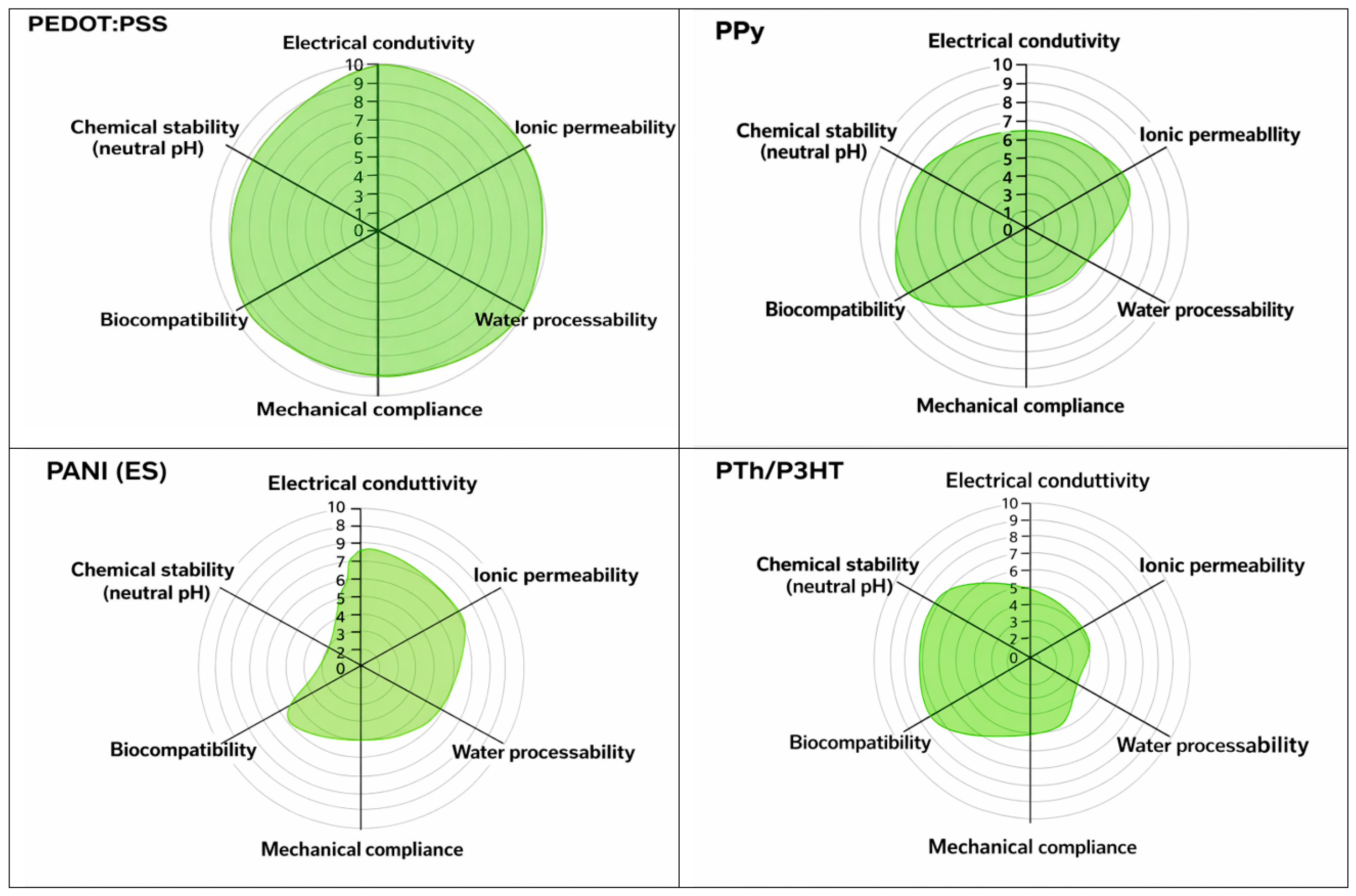
| CP Family | Typical σ (S cm−1) | Water Processable | Mechanical Compliance | Biocompatibility | Stability (Neutral pH) | Representative Use |
|---|---|---|---|---|---|---|
| PEDOT:PSS | 102–103 | ✔ | High | Excellent | Excellent | Neural, wearable, enzyme sensors |
| PANI (ES) | 1–100 | ✖ (acidic only) | Low | Conditioned (pH dependent) | Poor–Moderate | Gas, pH, enzymatic sensors |
| PPy | 1–50 | ✖ (Emulsion/Suspension Polymerization—Requires surfactants) | Low | Good (medium term) | Moderate | Enzyme entrapment, neurotransmitters |
| PTh/P3HT | 10−2–101 | ✖ Poor (with polar side chains) | Very low | Poor/Modest | Good | OECTs, printed sensors |
| Metric | Definition/Method | Notes/Common Pitfalls |
|---|---|---|
| Sensitivity (S) | S = ΔI/ΔC (amperometric) or ΔE/ΔlogC (potentiometric) | Always specify normalization (current per cm2, potential per decade) and calibration range. |
| Limit of Detection (LOD) | LOD = 3σ_blank/S | σ from ≥10 blank measurements; avoid visual estimation. |
| Response Time (t90) | Time to reach 90% of steady-state signal | Specify measurement conditions (stirring, temperature). |
| Selectivity | Ratio of target response to interferent response | Report interferent concentrations and experimental medium. |
| Stability/Retention (%) | (Signal after aging or cycles/initial signal) × 100 | Specify number of cycles, time, and storage medium. |
Disclaimer/Publisher’s Note: The statements, opinions and data contained in all publications are solely those of the individual author(s) and contributor(s) and not of MDPI and/or the editor(s). MDPI and/or the editor(s) disclaim responsibility for any injury to people or property resulting from any ideas, methods, instructions or products referred to in the content. |
© 2026 by the authors. Licensee MDPI, Basel, Switzerland. This article is an open access article distributed under the terms and conditions of the Creative Commons Attribution (CC BY) license.
Share and Cite
Di Pasquale, G.; Pollicino, A. Conducting Polymers for Electrochemical Sensing: From Materials and Metrology to Intelligent and Sustainable Biointerfaces. Sensors 2026, 26, 908. https://doi.org/10.3390/s26030908
Di Pasquale G, Pollicino A. Conducting Polymers for Electrochemical Sensing: From Materials and Metrology to Intelligent and Sustainable Biointerfaces. Sensors. 2026; 26(3):908. https://doi.org/10.3390/s26030908
Chicago/Turabian StyleDi Pasquale, Giovanna, and Antonino Pollicino. 2026. "Conducting Polymers for Electrochemical Sensing: From Materials and Metrology to Intelligent and Sustainable Biointerfaces" Sensors 26, no. 3: 908. https://doi.org/10.3390/s26030908
APA StyleDi Pasquale, G., & Pollicino, A. (2026). Conducting Polymers for Electrochemical Sensing: From Materials and Metrology to Intelligent and Sustainable Biointerfaces. Sensors, 26(3), 908. https://doi.org/10.3390/s26030908