Generative Models for Medical Image Creation and Translation: A Scoping Review
 , ,
, ,  ,
,
Abstract
1. Background
- 1.
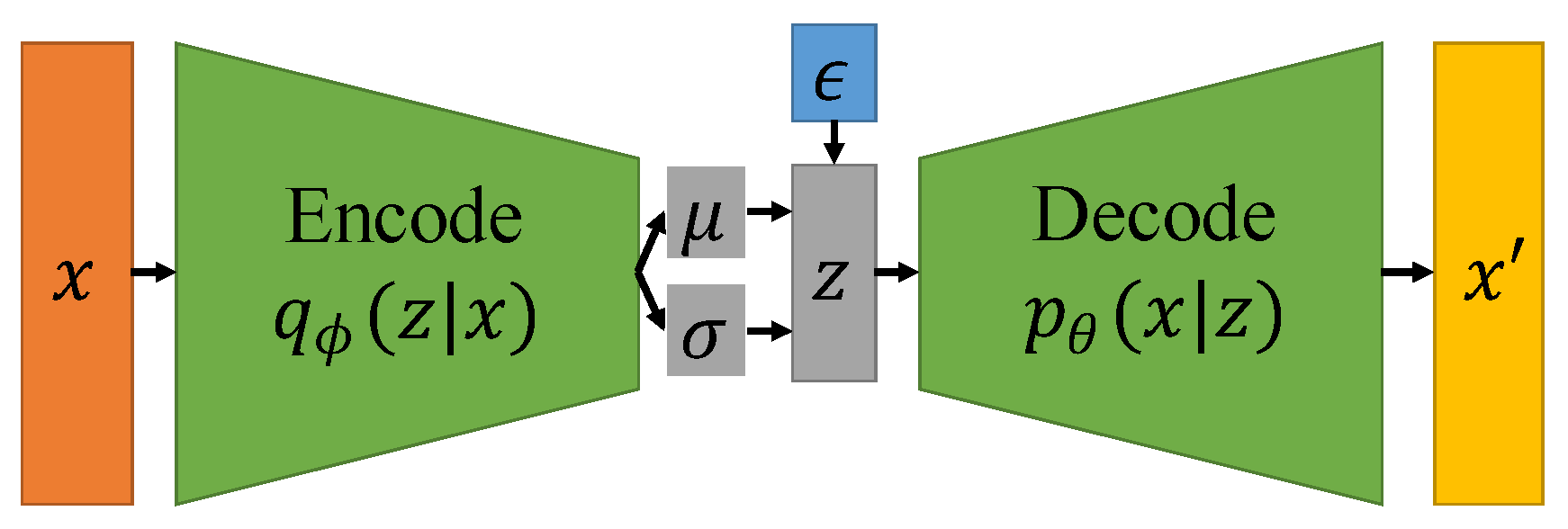
- This review conducts a thorough review of three widely employed generative models: VAEs, GANs, and diffusion models (DMs). We outline algorithms within these generative models that have found extensive applications in the domain of medical image analysis and provide analyses thereof.
- 2.
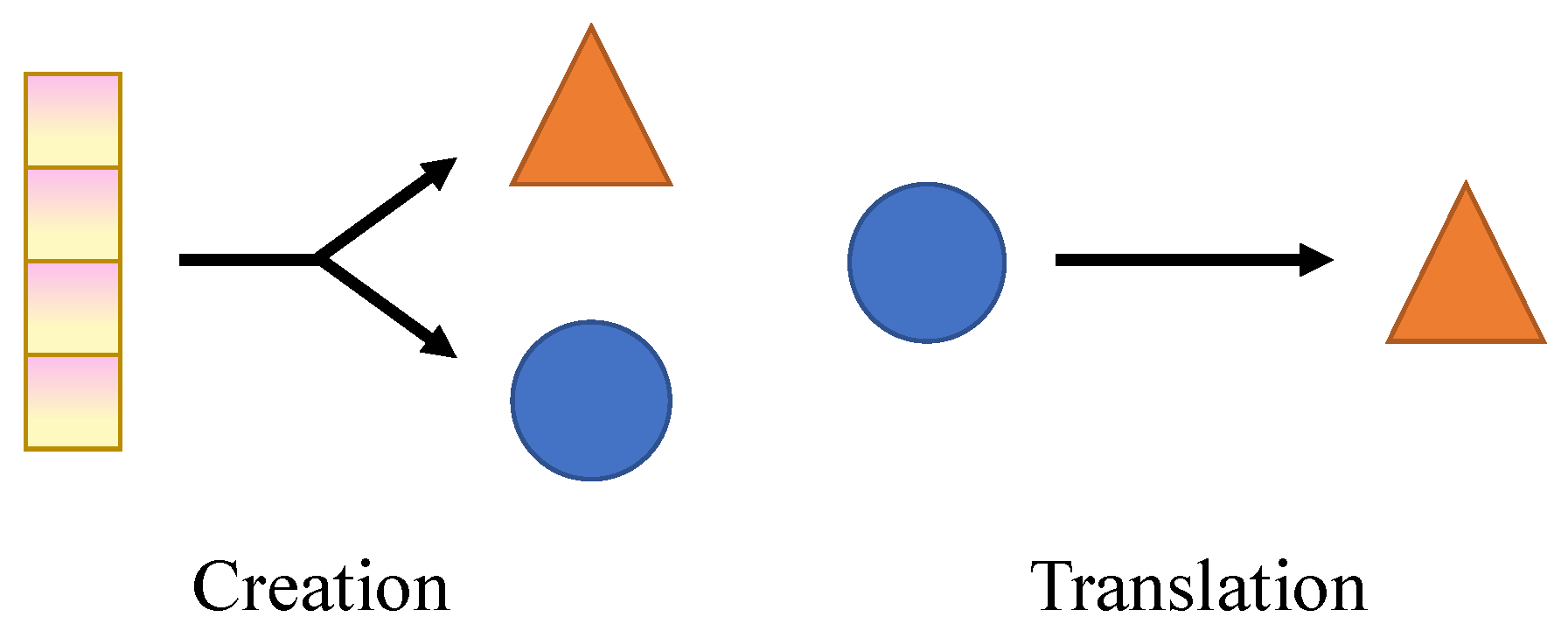
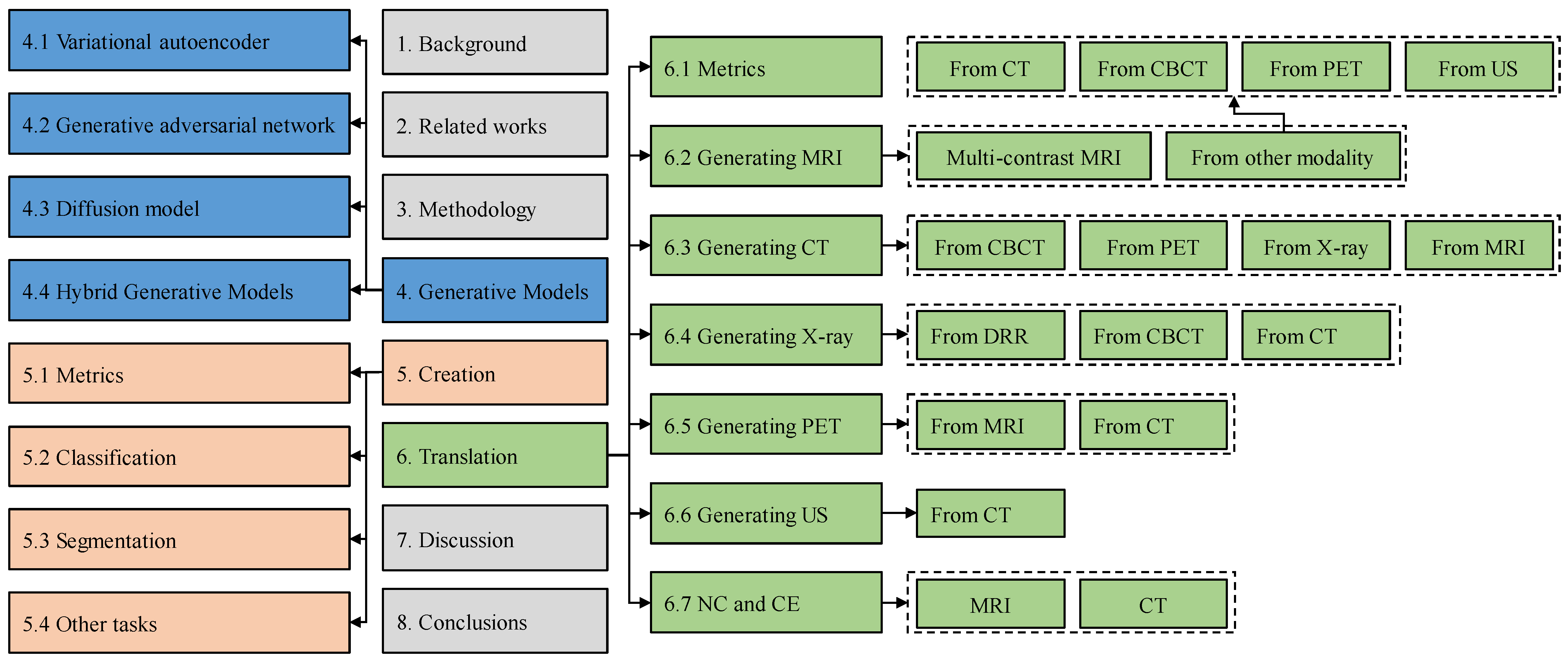
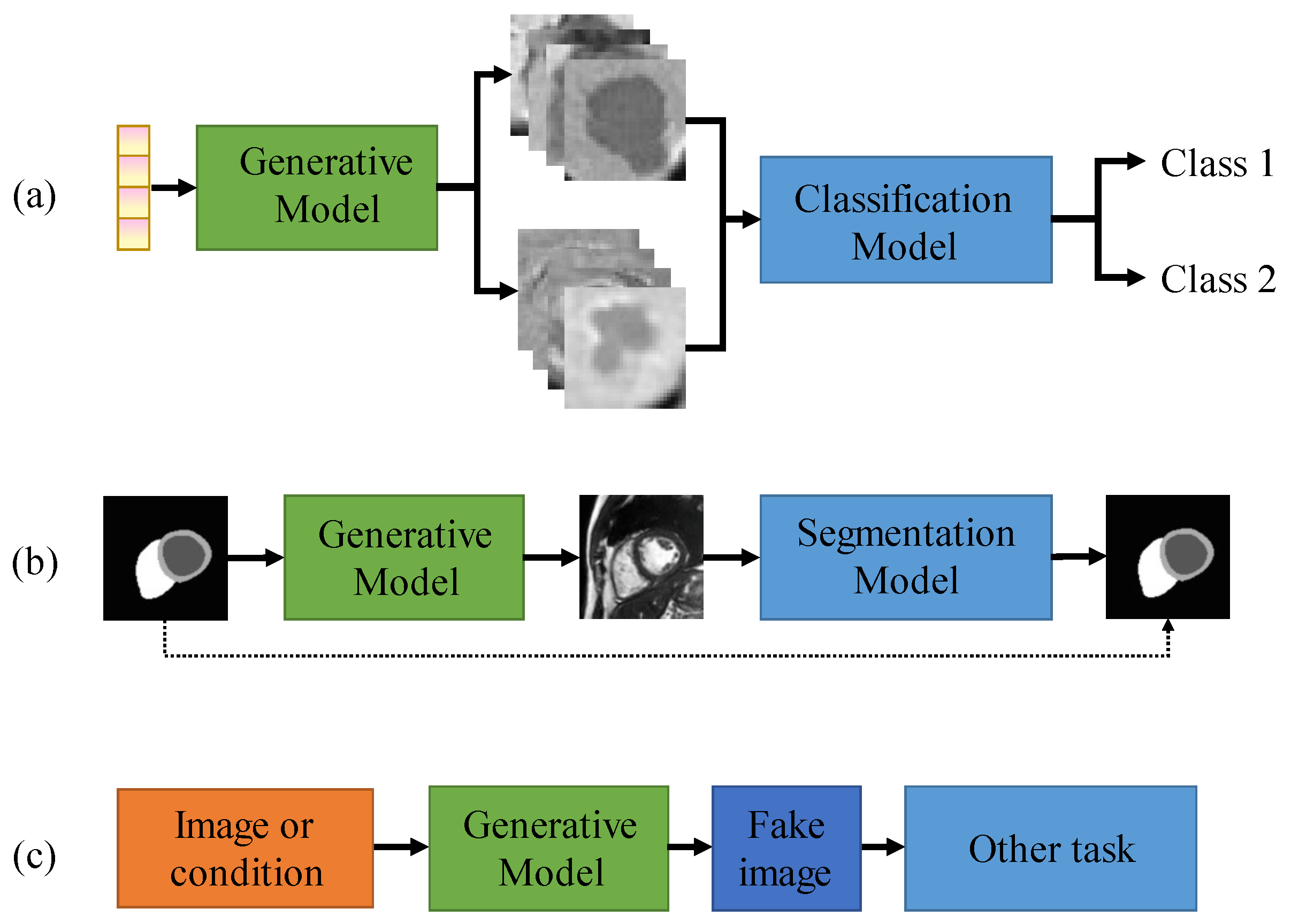
- This review categorizes the applications of generative models in medical image analysis into creation and translation. We present an extensive review of creation methods and classify their downstream applications into three distinct categories: classification, segmentation, and others. We classify translation methods based on the target modality.
- 3.
- This review organizes previous studies into categories and offers practical implementation guidelines gleaned from the lessons learned in these works.
2. Related Works
3. Methodology
4. Generative Models
4.1. Variational Autoencoder
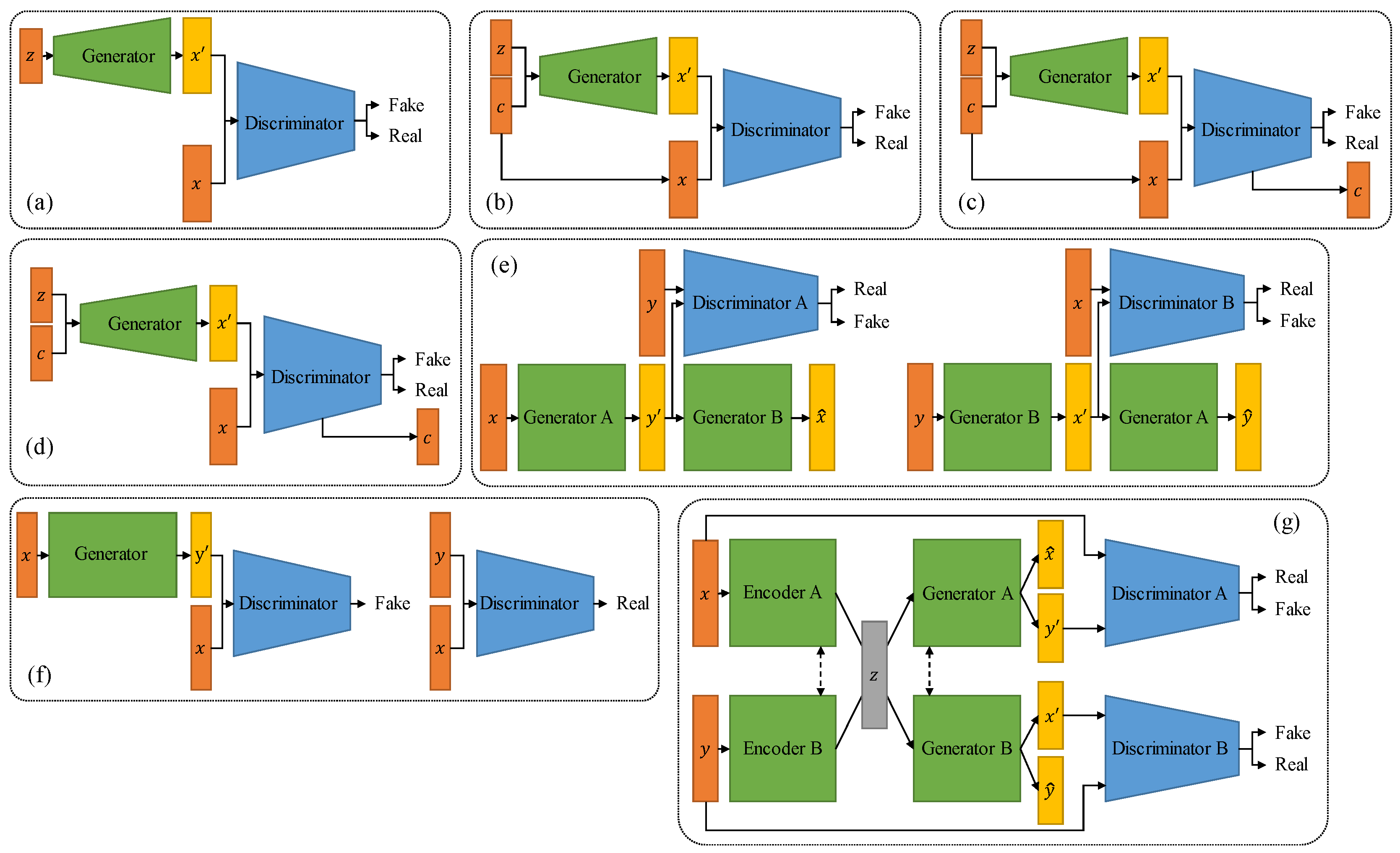
4.2. Generative Adversarial Network
4.3. Diffusion Model
4.4. Hybrid Generative Models
4.5. Training Stability and Computational Requirements
5. Creation
5.1. Metrics of Medical Image Creation
5.2. Classification
5.3. Segmentation
5.4. Other Tasks
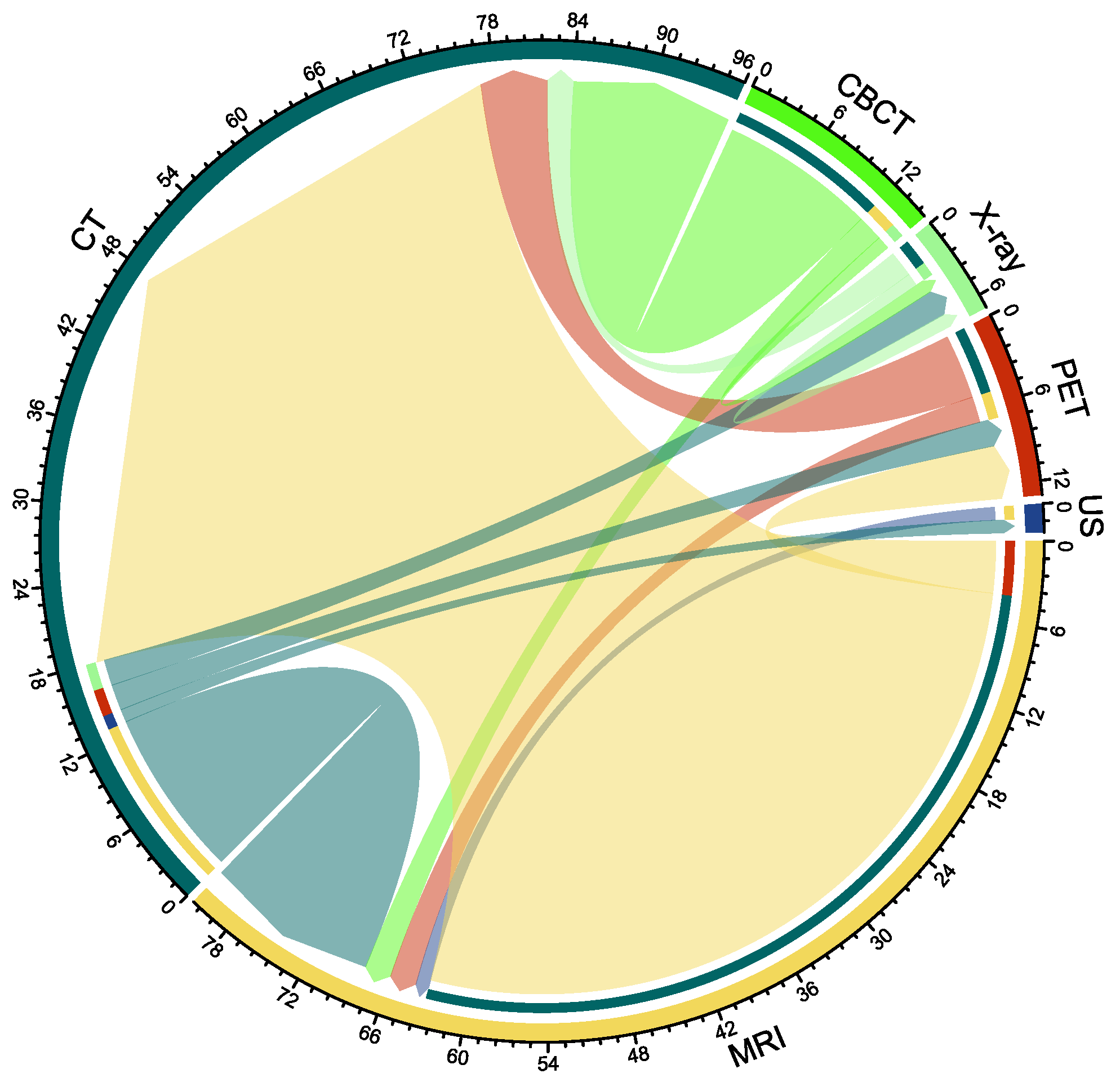
6. Translation
6.1. Metrics of Medical Image Translation
6.2. Generating MRI
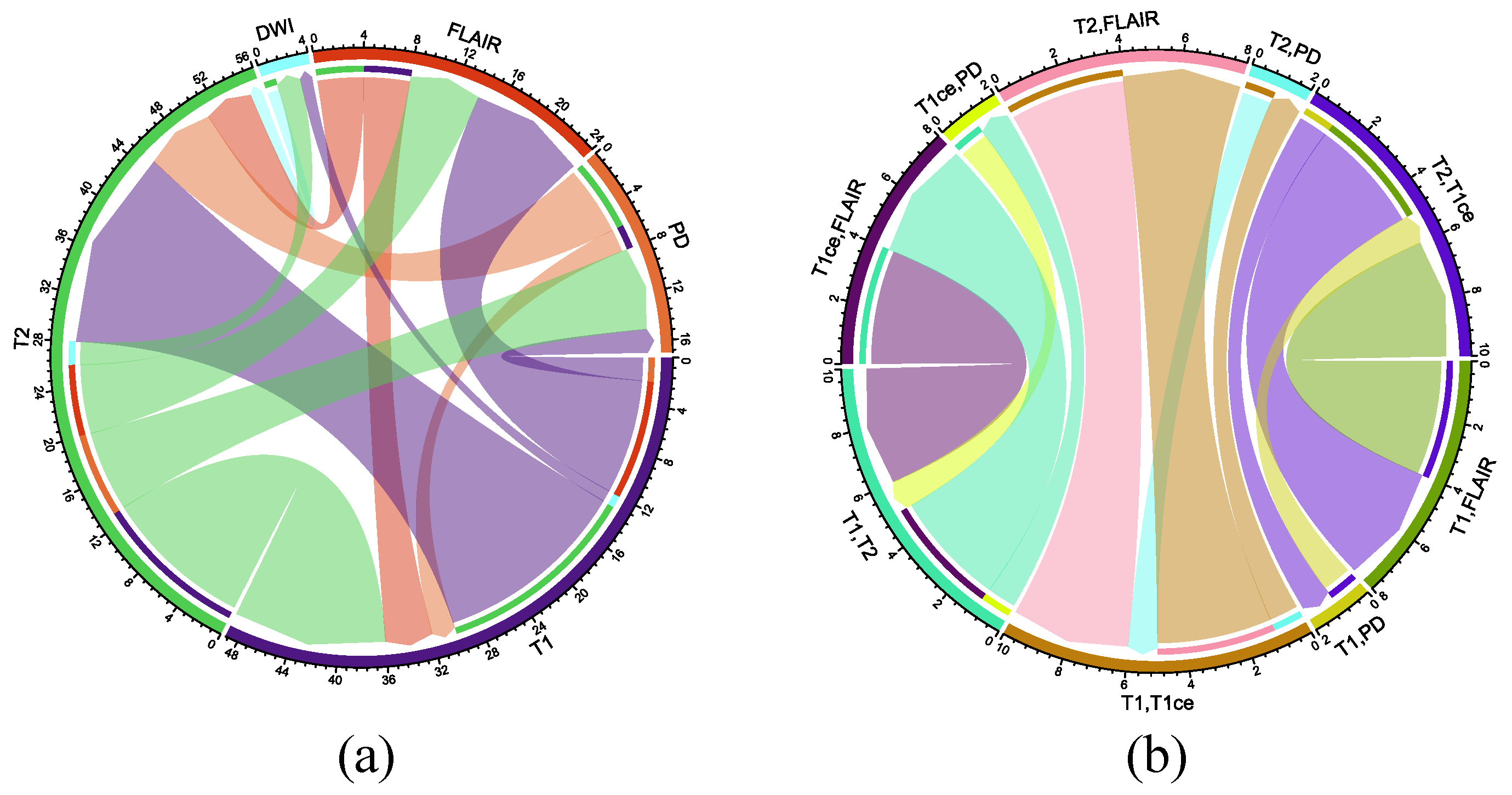
6.2.1. Multi-Contrast MRI Translation
6.2.2. Generating MRI from Other Modalities
6.3. Generating CT
6.4. Generating X-Ray Image
6.5. Generating PET Image
6.6. Generating Ultrasound Image
6.7. Non-Contrast and Contrast-Enhanced Image
7. Discussion
7.1. Implementation Suggestion
7.1.1. Unified Model or Task-Specific Model?
7.1.2. GAN or Diffusion Model?
7.1.3. Translation with Prior Knowledge
7.1.4. Paired Versus Unpaired Image Translation
7.1.5. Other Possible Optimization Strategies for Training
7.2. Challenges in Medical Image Creation and Translation
7.2.1. Privacy Preservation and Data Protection
7.2.2. Safe Deployment and Clinical Reliability
7.2.3. Open Problems and Research Gaps
7.3. Limitations and Future Research
8. Conclusions
Author Contributions
Funding
Institutional Review Board Statement
Informed Consent Statement
Data Availability Statement
Conflicts of Interest
Abbreviations
| CBCT | Cone Beam Computed Tomography | MRA | Magnetic Resonance Angiography |
| CT | Computed Tomography | MRI | Magnetic Resonance Imaging |
| DM | Diffusion Model | PD | Proton density image |
| DWI | Diffusion-Weighted Image | PET | Positron Emission Tomography |
| FID | Fréchet Inception Distance | PSNR | Peak Signal-to-Noise Ratio |
| FLAIR | Fluid-Attenuated Inversion Recovery | RMSE | Root Mean Square Error |
| GAN | Generative Adversarial Network | SSIM | Structural Similarity Index |
| IS | Inception Score | T1w | T1-weighted image |
| MAE | Mean Absolute Error | T2w | T2-weighted image |
| MMD | Maximum Mean Discrepancy | US | Ultrasound imaging |
| MS | Mode Score | VAE | Variational Autoencoder |
| MSE | Mean Squared Error | WD | Wasserstein distance |
References
- Chen, X.; Wang, X.; Zhang, K.; Fung, K.-M.; Thai, T.C.; Moore, K.; Mannel, R.S.; Liu, H.; Zheng, B.; Qiu, Y. Recent advances and clinical applications of deep learning in medical image analysis. Med. Image Anal. 2022, 79, 102444. [Google Scholar] [CrossRef]
- Zhou, Y.; Chia, M.A.; Wagner, S.K.; Ayhan, M.S.; Williamson, D.J.; Struyven, R.R.; Liu, T.; Xu, M.; Lozano, M.G.; Woodward-Court, P. A foundation model for generalizable disease detection from retinal images. Nature 2023, 622, 156–163. [Google Scholar] [CrossRef]
- Ma, J.; He, Y.; Li, F.; Han, L.; You, C.; Wang, B. Segment anything in medical images. Nat. Commun. 2024, 15, 654. [Google Scholar] [CrossRef]
- Cao, K.; Xia, Y.; Yao, J.; Han, X.; Lambert, L.; Zhang, T.; Tang, W.; Jin, G.; Jiang, H.; Fang, X. Large-scale pancreatic cancer detection via non-contrast CT and deep learning. Nat. Med. 2023, 29, 3033–3043. [Google Scholar] [CrossRef] [PubMed]
- Liu, C.; Zhuo, Z.; Qu, L.; Jin, Y.; Hua, T.; Xu, J.; Tan, G.; Li, Y.; Duan, Y.; Wang, T. DeepWMH: A deep learning tool for accurate white matter hyperintensity segmentation without requiring manual annotations for training. Sci. Bull. 2024, 69, 872–875. [Google Scholar] [CrossRef] [PubMed]
- Lu, Q.; Liu, W.; Zhuo, Z.; Li, Y.; Duan, Y.; Yu, P.; Qu, L.; Ye, C.; Liu, Y. A transfer learning approach to few-shot segmentation of novel white matter tracts. Med. Image Anal. 2022, 79, 102454. [Google Scholar] [CrossRef] [PubMed]
- Liu, W.; Zhuo, Z.; Liu, Y.; Ye, C. One-shot segmentation of novel white matter tracts via extensive data augmentation and adaptive knowledge transfer. Med. Image Anal. 2023, 90, 102968. [Google Scholar] [CrossRef]
- Vellmer, S.; Tabelow, M.; Zhang, H. Diffusion MRI GAN Synthesizing Fibre Orientation Distributions for White Matter Simulation. Commun. Biol. 2025, 8, 7936. [Google Scholar] [CrossRef]
- Schuit, G.; Parra, D.; Besa, C. Perceptual Evaluation of GANs and Diffusion Models for Generating X-rays. arXiv 2025, arXiv:2508.07128. [Google Scholar] [CrossRef]
- Ejiga, O.O.; Anifowose, M.; Yuan, L. Advancing AI-Powered Medical Image Synthesis: Insights from the MedVQA-GI Challenge. arXiv 2025, arXiv:2502.20667. [Google Scholar]
- Yang, Z.; Li, Y.; Wang, W. seg2med: A Segmentation-based Medical Image Generation Framework Using Denoising Diffusion Probabilistic Models. arXiv 2025, arXiv:2504.09182. [Google Scholar]
- Zhao, C.; Guo, P.; Xu, Y. MAISI-v2: Accelerated 3D High-Resolution Medical Image Synthesis with Rectified Flow and Region-specific Contrastive Loss. arXiv 2025, arXiv:2508.05772. [Google Scholar]
- Kim, J.; Lee, S. FMed-Diffusion: Federated Learning on Medical Image Diffusion Models for Privacy-Preserving Data Generation. bioRxiv 2025. [Google Scholar] [CrossRef]
- Chakraborty, T.; Naik, S.M.; Panja, M.; Manvitha, B. Ten Years of Generative Adversarial Nets (GANs): A survey of the state-of-the-art. arXiv 2023, arXiv:2308.16316. [Google Scholar] [CrossRef]
- Goceri, E. Medical image data augmentation: Techniques, comparisons and interpretations. Artif. Intell. Rev. 2023, 56, 12561–12605. [Google Scholar] [CrossRef]
- Kebaili, A.; Lapuyade-Lahorgue, J.; Ruan, S. Deep Learning Approaches for Data Augmentation in Medical Imaging: A Review. J. Imaging 2023, 9, 81. [Google Scholar] [CrossRef]
- Dayarathna, S.; Islam, K.T.; Uribe, S.; Yang, G.; Hayat, M.; Chen, Z. Deep learning based synthesis of MRI, CT and PET: Review and analysis. Med. Image Anal. 2023, 92, 103046. [Google Scholar] [CrossRef]
- Wang, T.H.; Lei, Y.; Fu, Y.B.; Wynne, J.F.; Curran, W.J.; Liu, T.; Yang, X.F. A review on medical imaging synthesis using deep learning and its clinical applications. J. Appl. Clin. Med. Phys. 2021, 22, 11–36. [Google Scholar] [CrossRef] [PubMed]
- Yi, X.; Walia, E.; Babyn, P. Generative adversarial network in medical imaging: A review. Med. Image Anal. 2019, 58, 101552. [Google Scholar] [CrossRef] [PubMed]
- Kazeminia, S.; Baur, C.; Kuijper, A.; van Ginneken, B.; Navab, N.; Albarqouni, S.; Mukhopadhyay, A. GANs for medical image analysis. Artif. Intell. Med. 2020, 109, 101938. [Google Scholar] [CrossRef] [PubMed]
- Chen, Y.Z.; Yang, X.H.; Wei, Z.H.; Heidari, A.A.; Zheng, N.G.; Li, Z.C.; Chen, H.L.; Hu, H.G.; Zhou, Q.W.; Guan, Q. Generative Adversarial Networks in Medical Image augmentation: A review. Comput. Biol. Med. 2022, 144, 105382. [Google Scholar] [CrossRef]
- Osuala, R.; Kushibar, K.; Garrucho, L.; Linardos, A.; Szafranowska, Z.; Klein, S.; Glocker, B.; Diaz, O.; Lekadir, K. Data synthesis and adversarial networks: A review and meta-analysis in cancer imaging. Med. Image Anal. 2022, 84, 102704. [Google Scholar] [CrossRef]
- Zhao, J.; Hou, X.Y.; Pan, M.Q.; Zhang, H. Attention-based generative adversarial network in medical imaging: A narrative review. Comput. Biol. Med. 2022, 149, 105948. [Google Scholar] [CrossRef] [PubMed]
- Frangi, A.F.; Tsaftaris, S.A.; Prince, J.L. Simulation and Synthesis in Medical Imaging. IEEE Trans. Med. Imaging 2018, 37, 673–679. [Google Scholar] [CrossRef]
- Oussidi, A.; Elhassouny, A. Deep generative models: Survey. In Proceedings of the 2018 International Conference on Intelligent Systems and Computer Vision (ISCV), Fez, Morocco, 2–4 April 2018; pp. 1–8. [Google Scholar]
- Kingma, D.P.; Welling, M. Auto-encoding variational bayes. arXiv 2013, arXiv:1312.6114. [Google Scholar]
- Salimans, T.; Kingma, D.; Welling, M. Markov chain monte carlo and variational inference: Bridging the gap. In Proceedings of the 32nd International Conference on Machine Learning, Lille, France, 6–11 July 2015; PMLR: Pittsburgh, PA, USA, 2015; pp. 1218–1226. [Google Scholar]
- Kulkarni, T.D.; Whitney, W.F.; Kohli, P.; Tenenbaum, J. Deep convolutional inverse graphics network. Adv. Neural Inf. Process. Syst. 2015, 28, 2539–2547. [Google Scholar]
- Gregor, K.; Danihelka, I.; Graves, A.; Rezende, D.; Wierstra, D. Draw: A recurrent neural network for image generation. In Proceedings of the 32nd International Conference on Machine Learning, Lille, France, 6–11 July 2015; PMLR: Pittsburgh, PA, USA, 2015; pp. 1462–1471. [Google Scholar]
- Pesteie, M.; Abolmaesumi, P.; Rohling, R.N. Adaptive augmentation of medical data using independently conditional variational auto-encoders. IEEE Trans. Med. Imaging 2019, 38, 2807–2820. [Google Scholar] [CrossRef]
- Alex, L.Y.H.; Galeotti, J. Ultrasound Variational Style Transfer to Generate Images Beyond the Observed Domain. In Proceedings of the 1st Workshop on Deep Generative Models for Medical Image Computing and Computer Assisted Intervention (DGM4MICCAI)/1st MICCAI Workshop on Data Augmentation, Labelling, and Imperfections (DALI), Strasbourg, France, 1 October 2021; pp. 14–23. [Google Scholar]
- Wei, R.; Mahmood, A. Recent advances in variational autoencoders with representation learning for biomedical informatics: A survey. IEEE Access 2020, 9, 4939–4956. [Google Scholar] [CrossRef]
- Goodfellow, I.; Pouget-Abadie, J.; Mirza, M.; Xu, B.; Warde-Farley, D.; Ozair, S.; Courville, A.; Bengio, Y. Generative adversarial networks. Commun. ACM 2020, 63, 139–144. [Google Scholar] [CrossRef]
- Kazerouni, A.; Aghdam, E.K.; Heidari, M.; Azad, R.; Fayyaz, M.; Hacihaliloglu, I.; Merhof, D. Diffusion models in medical imaging: A comprehensive survey. Med. Image Anal. 2023, 88, 102846. [Google Scholar] [CrossRef]
- Isola, P.; Zhu, J.-Y.; Zhou, T.; Efros, A.A. Image-to-image translation with conditional adversarial networks. In Proceedings of the IEEE Conference on Computer Vision and Pattern Recognition, Honolulu, HI, USA, 21–26 July 2017; pp. 1125–1134. [Google Scholar]
- Zhu, J.-Y.; Park, T.; Isola, P.; Efros, A.A. Unpaired image-to-image translation using cycle-consistent adversarial networks. In Proceedings of the IEEE International Conference on Computer Vision, Venice, Italy, 22–29 October 2017; pp. 2223–2232. [Google Scholar]
- Sun, B.; Jia, S.F.; Jiang, X.L.; Jia, F.C. Double U-Net CycleGAN for 3D MR to CT image synthesis. Int. J. Comput. Assist. Radiol. Surg. 2023, 18, 149–156. [Google Scholar] [CrossRef] [PubMed]
- Dar, S.U.H.; Yurt, M.; Karacan, L.; Erdem, A.; Erdem, E.; Cukur, T. Image Synthesis in Multi-Contrast MRI With Conditional Generative Adversarial Networks. IEEE Trans. Med. Imaging 2019, 38, 2375–2388. [Google Scholar] [CrossRef]
- Pang, H.; Qi, S.; Wu, Y.; Wang, M.; Li, C.; Sun, Y.; Qian, W.; Tang, G.; Xu, J.; Liang, Z. NCCT-CECT image synthesizers and their application to pulmonary vessel segmentation. Comput. Methods Programs Biomed. 2023, 231, 107389. [Google Scholar] [CrossRef] [PubMed]
- Pan, S.; Wang, T.; Qiu, R.L.; Axente, M.; Chang, C.W.; Peng, J.; Patel, A.B.; Shelton, J.; Patel, S.A.; Roper, J.; et al. 2D medical image synthesis using transformer-based denoising diffusion probabilistic model. Phys. Med. Biol. 2023, 68, 105004. [Google Scholar] [CrossRef] [PubMed]
- Dorjsembe, Z.; Odonchimed, S.; Xiao, F. Three-dimensional medical image synthesis with denoising diffusion probabilistic models. Med. Imaging Deep. Learn. 2022. [Google Scholar]
- Özbey, M.; Dalmaz, O.; Dar, S.U.; Bedel, H.A.; Özturk, Ş.; Güngör, A.; Çukur, T. Unsupervised medical image translation with adversarial diffusion models. IEEE Trans. Med. Imaging 2023, 42, 3524–3539. [Google Scholar] [CrossRef]
- Cui, Z.-X.; Cao, C.; Liu, S.; Zhu, Q.; Cheng, J.; Wang, H.; Zhu, Y.; Liang, D. Self-score: Self-supervised learning on score-based models for mri reconstruction. arXiv 2022, arXiv:2209.00835. [Google Scholar]
- Peng, C.; Guo, P.; Zhou, S.K.; Patel, V.M.; Chellappa, R. Towards performant and reliable undersampled MR reconstruction via diffusion model sampling. In Proceedings of the International Conference on Medical Image Computing and Computer-Assisted Intervention, Singapore, 18–22 September 2022; Springer: Berlin/Heidelberg, Germany, 2022; pp. 623–633. [Google Scholar]
- Hu, D.; Tao, Y.K.; Oguz, I. Unsupervised denoising of retinal OCT with diffusion probabilistic model. In Proceedings of the Medical Imaging 2022: Image Processing, San Diego, CA, USA, 20 February–28 March 2022; SPIE: Bellingham, WA, USA, 2022; pp. 25–34. [Google Scholar]
- Kim, B.; Han, I.; Ye, J.C. DiffuseMorph: Unsupervised deformable image registration using diffusion model. In Proceedings of the European Conference on Computer Vision, Tel Aviv, Israel, 23–27 October 2022; Springer: Berlin/Heidelberg, Germany, 2022; pp. 347–364. [Google Scholar]
- Yang, Y.; Fu, H.; Aviles-Rivero, A.; Schönlieb, C.-B.; Zhu, L. DiffMIC: Dual-Guidance Diffusion Network for Medical Image Classification. arXiv 2023, arXiv:2303.10610. [Google Scholar]
- Rahman, A.; Valanarasu, J.M.J.; Hacihaliloglu, I.; Patel, V.M. Ambiguous medical image segmentation using diffusion models. In Proceedings of the IEEE/CVF Conference on Computer Vision and Pattern Recognition, Vancouver, BC, Canada, 17–24 June 2023; pp. 11536–11546. [Google Scholar]
- Wolleb, J.; Sandkühler, R.; Bieder, F.; Valmaggia, P.; Cattin, P.C. Diffusion models for implicit image segmentation ensembles. In Proceedings of the 5th International Conference on Medical Imaging with Deep Learning, Zürich, Switzerland, 6–8 July 2022; PMLR: Pittsburgh, PA, USA, 2022; pp. 1336–1348. [Google Scholar]
- Larsen, A.B.L.; Sønderby, S.K.; Larochelle, H.; Winther, O. Autoencoding beyond pixels using a learned similarity metric. In Proceedings of the 33rd International Conference on Machine Leasrning, New York, NY, USA, 19–24 June 2016; PMLR: Pittsburgh, PA, USA, 2016; pp. 1558–1566. [Google Scholar]
- Rosca, M.; Lakshminarayanan, B.; Warde-Farley, D.; Mohamed, S. Variational approaches for auto-encoding generative adversarial networks. arXiv 2017, arXiv:1706.04987. [Google Scholar] [CrossRef]
- Ho, J.; Jain, A.; Abbeel, P. Denoising diffusion probabilistic models. Adv. Neural Inf. Process. Syst. 2020, 33, 6840–6851. [Google Scholar]
- Dhariwal, P.; Nichol, A. Diffusion models beat gans on image synthesis. Adv. Neural Inf. Process. Syst. 2021, 34, 8780–8794. [Google Scholar]
- Huang, S.-C.; Pareek, A.; Jensen, M.; Lungren, M.P.; Yeung, S.; Chaudhari, A.S. Self-supervised learning for medical image classification: A systematic review and implementation guidelines. npj Digit. Med. 2023, 6, 74. [Google Scholar] [CrossRef]
- Obukhov, A.; Krasnyanskiy, M. Quality assessment method for GAN based on modified metrics inception score and Fréchet inception distance. In Software Engineering Perspectives in Intelligent Systems, Proceedings of 4th Computational Methods in Systems and Software 2020, Virtual, 14–16 October 2020; Springer: Berlin/Heidelberg, Germany, 2020; Volume 1, pp. 102–114. [Google Scholar]
- Miranda, E.; Aryuni, M.; Irwansyah, E. A survey of medical image classification techniques. In Proceedings of the 2016 International Conference on Information Management and Technology (ICIMTech), Bandung, Indonesia, 16–18 November 2016; pp. 56–61. [Google Scholar]
- Gao, L.; Zhang, L.; Liu, C.; Wu, S. Handling imbalanced medical image data: A deep-learning-based one-class classification approach. Artif. Intell. Med. 2020, 108, 101935. [Google Scholar] [CrossRef]
- Frid-Adar, M.; Diamant, I.; Klang, E.; Amitai, M.; Goldberger, J.; Greenspan, H. GAN-based synthetic medical image augmentation for increased CNN performance in liver lesion classification. Neurocomputing 2018, 321, 321–331. [Google Scholar] [CrossRef]
- Zhang, Q.Q.; Wang, H.F.; Lu, H.Y.; Won, D.; Yoon, S.W.; Soc, I.C. Medical Image Synthesis with Generative Adversarial Networks for Tissue Recognition. In Proceedings of the 6th IEEE International Conference on Healthcare Informatics (ICHI), New York, NY, USA, 4–7 June 2018; pp. 199–207. [Google Scholar]
- Lin, Y.J.; Chung, I.F. Medical Data Augmentation Using Generative Adversarial Networks X-ray Image Generation for Transfer Learning of Hip Fracture Detection. In Proceedings of the International Conference on Technologies and Applications of Artficial Intelligence (TAAI), Kaohsiung, Taiwan, 21–23 November 2019. [Google Scholar]
- Salehinejad, H.; Colak, E.; Dowdell, T.; Barfett, J.; Valaee, S. Synthesizing Chest X-Ray Pathology for Training Deep Convolutional Neural Networks. IEEE Trans. Med. Imaging 2019, 38, 1197–1206. [Google Scholar] [CrossRef] [PubMed]
- Yang, J.; Liu, S.Q.; Grbic, S.; Setio, A.A.A.; Xu, Z.B.; Gibson, E.; Chabin, G.; Georgescu, B.; Laine, A.F.; Comaniciu, D. Class-Aware Adversarial Lung Nodule Synthesis in CT Images. In Proceedings of the 16th IEEE International Symposium on Biomedical Imaging (ISBI), Venice, Italy, 8–11 April 2019; pp. 1348–1352. [Google Scholar]
- Choong, R.Z.J.; Harding, S.A.; Tang, B.Y.; Liao, S.W. 3-To-1 Pipeline: Restructuring Transfer Learning Pipelines for Medical Imaging Classification via Optimized GAN Synthetic Images. In Proceedings of the 42nd Annual International Conference of the IEEE-Engineering-in-Medicine-and-Biology-Society (EMBC), Montreal, QC, Canada, 20–24 July 2020; pp. 1596–1599. [Google Scholar]
- Menon, S.; Galita, J.; Chapman, D.; Gangopadhyay, A.; Mangalagiri, J.; Nguyen, P.; Yesha, Y.; Yesha, Y.; Saboury, B.; Morris, M. Generating Realistic COVID-19 x-rays with a Mean Teacher plus Transfer Learning GAN. In Proceedings of the 8th IEEE International Conference on Big Data (Big Data), Atlanta, GA, USA, 10–13 December 2020; pp. 1216–1225. [Google Scholar]
- Ahmad, P.; Wang, Y.; Havaei, M. CT-SGAN: Computed Tomography Synthesis GAN. In Proceedings of the 1st Workshop on Deep Generative Models for Medical Image Computing and Computer Assisted Intervention (DGM4MICCAI)/1st MICCAI Workshop on Data Augmentation, Labelling, and Imperfections (DALI), Strasbourg, France, 1 October 2021; pp. 67–79. [Google Scholar]
- Ambita, A.A.E.; Boquio, E.N.V.; Naval, P.C. COViT-GAN: Vision Transformer for COVID-19 Detection in CT Scan Images with Self-Attention GAN for Data Augmentation. In Proceedings of the 30th International Conference on Artificial Neural Networks (ICANN), Bratislava, Slovakia, 14–17 September 2021; pp. 587–598. [Google Scholar]
- Che, H.; Ramanathan, S.; Foran, D.J.; Nosher, J.L.; Patel, V.M.; Hacihaliloglu, I. Realistic Ultrasound Image Synthesis for Improved Classification of Liver Disease. In Proceedings of the 2nd International Workshop on Advances in Simplifying Medical UltraSound (ASMUS), Strasbourg, France, 27 September 2021; pp. 179–188. [Google Scholar]
- Pang, T.; Wong, J.H.D.; Ng, W.L.; Chan, C.S. Semi-supervise d GAN-base d Radiomics Model for Data Augmentation in Breast Ultrasound Mass Classification. Comput. Methods Programs Biomed. 2021, 203, 106018. [Google Scholar] [CrossRef]
- Toda, R.; Teramoto, A.; Tsujimoto, M.; Toyama, H.; Imaizumi, K.; Saito, K.; Fujita, H. Synthetic CT image generation of shape-controlled lung cancer using semi-conditional InfoGAN and its applicability for type classification. Int. J. Comput. Assist. Radiol. Surg. 2021, 16, 241–251. [Google Scholar] [CrossRef]
- Venu, S.K. Improving the Generalization of Deep Learning Classification Models in Medical Imaging Using Transfer Learning and Generative Adversarial Networks. In Proceedings of the 13th International Conference on Agents and Artificial Intelligence (ICAART), Virtual, 4–6 February 2021; pp. 218–235. [Google Scholar]
- Zhang, G.Y.; Chen, K.X.; Xu, S.L.; Cho, P.C.A.; Nan, Y.; Zhou, X.; Lv, C.A.F.; Li, C.S.; Xie, G.T. Lesion synthesis to improve intracranial hemorrhage detection and classification for CT images. Comput. Med. Imaging Graph. 2021, 90, 101929. [Google Scholar] [CrossRef]
- Abirami, R.N.; Vincent, P.; Rajinikanth, V.; Kadry, S. COVID-19 Classification Using Medical Image Synthesis by Generative Adversarial Networks. Int. J. Uncertain. Fuzziness Knowl.-Based Syst. 2022, 30, 385–401. [Google Scholar] [CrossRef]
- Fernandez-Quilez, A.; Parvez, O.; Eftestol, T.; Kjosavik, S.R.; Oppedal, K. Improving prostate cancer triage with GAN-based synthetically generated prostate ADC MRI. In Proceedings of the Conference on Medical Imaging—Computer-Aided Diagnosis, San Diego, CA, USA, 20 February–28 March 2022. [Google Scholar]
- Guan, Q.; Chen, Y.Z.; Wei, Z.H.; Heidari, A.A.; Hu, H.G.; Yang, X.H.; Zheng, J.W.; Zhou, Q.W.; Chen, H.L.; Chen, F. Medical image augmentation for lesion detection using a texture-constrained multichannel progressive GAN. Comput. Biol. Med. 2022, 145, 105444. [Google Scholar] [CrossRef]
- Liang, Z.; Huang, J.X.; Antani, S. Image translation by Ad cycleGAN for COVID-19 X-ray images: A new approach for controllable GAN. Sensors 2022, 22, 9628. [Google Scholar] [CrossRef] [PubMed]
- Mao, J.W.; Yin, X.S.; Zhang, G.D.; Chen, B.W.; Chang, Y.Q.; Chen, W.B.; Yu, J.Y.; Wang, Y.G. Pseudo-labeling generative adversarial networks for medical image classification. Comput. Biol. Med. 2022, 147, 105729. [Google Scholar] [CrossRef]
- Moris, D.I.; de Moura, J.; Novo, J.; Ortega, M. Unsupervised contrastive unpaired image generation approach for improving tuberculosis screening using chest X-ray images. Pattern Recognit. Lett. 2022, 164, 60–66. [Google Scholar] [CrossRef]
- Ovalle-Magallanes, E.; Avina-Cervantes, J.G.; Cruz-Aceves, I.; Ruiz-Pinales, J. Improving convolutional neural network learning based on a hierarchical bezier generative model for stenosis detection in X-ray images. Comput. Methods Programs Biomed. 2022, 219, 106767. [Google Scholar] [CrossRef] [PubMed]
- Shah, P.M.; Ullah, H.; Ullah, R.; Shah, D.; Wang, Y.L.; Islam, S.U.; Gani, A.; Rodrigues, J. DC-GAN-based synthetic X-ray images augmentation for increasing the performance of EfficientNet for COVID-19 detection. Expert Syst. 2022, 39, e12823. [Google Scholar] [CrossRef] [PubMed]
- Chen, Y.F.; Lin, Y.L.; Xu, X.D.; Ding, J.Z.; Li, C.Z.; Zeng, Y.M.; Xie, W.F.; Huang, J.L. Multi-domain medical image translation generation for lung image classification based on generative adversarial networks. Comput. Methods Programs Biomed. 2023, 229, 107200. [Google Scholar] [CrossRef] [PubMed]
- Kim, Y.; Lee, J.H.; Kim, C.; Jin, K.N.; Park, C.M. GAN based ROI conditioned Synthesis of Medical Image for Data Augmentation. In Proceedings of the Conference on Medical Imaging—Image Processing, San Diego, CA, USA, 19–24 February 2023. [Google Scholar]
- Wali, A.; Ahmad, M.; Naseer, A.; Tamoor, M.; Gilani, S.A.M. StynMedGAN: Medical images augmentation using a new GAN model for improved diagnosis of diseases. J. Intell. Fuzzy Syst. 2023, 44, 10027–10044. [Google Scholar] [CrossRef]
- Chlap, P.; Min, H.; Vandenberg, N.; Dowling, J.; Holloway, L.; Haworth, A. A review of medical image data augmentation techniques for deep learning applications. J. Med. Imaging Radiat. Oncol. 2021, 65, 545–563. [Google Scholar] [CrossRef]
- Kaissis, G.A.; Makowski, M.R.; Rückert, D.; Braren, R.F. Secure, privacy-preserving and federated machine learning in medical imaging. Nat. Mach. Intell. 2020, 2, 305–311. [Google Scholar] [CrossRef]
- Wang, R.; Lei, T.; Cui, R.; Zhang, B.; Meng, H.; Nandi, A.K. Medical image segmentation using deep learning: A survey. IET Image Process. 2022, 16, 1243–1267. [Google Scholar] [CrossRef]
- Tom, F.; Sheet, D. Simulating Patho-Realistic Ultrasound Images Using Deep Generative Networks with Adversarial Learning. In Proceedings of the 15th IEEE International Symposium on Biomedical Imaging (ISBI), Washington, DC, USA, 4–7 April 2018; pp. 1174–1177. [Google Scholar]
- Bargsten, L.; Schlaefer, A. SpeckleGAN: A generative adversarial network with an adaptive speckle layer to augment limited training data for ultrasound image processing. Int. J. Comput. Assist. Radiol. Surg. 2020, 15, 1427–1436. [Google Scholar] [CrossRef]
- Cronin, N.J.; Finni, T.; Seynnes, O. Using deep learning to generate synthetic B-mode musculoskeletal ultrasound images. Comput. Methods Programs Biomed. 2020, 196, 105583. [Google Scholar] [CrossRef]
- Qu, Y.L.; Su, W.Q.; Lv, X.; Deng, C.F.; Wang, Y.; Lu, Y.T.; Chen, Z.G.; Xiao, N. Synthesis of Registered Multimodal Medical Images with Lesions. In Proceedings of the 29th International Conference on Artificial Neural Networks (ICANN), Bratislava, Slovakia, 15–18 September 2020; pp. 774–786. [Google Scholar]
- Zama, A.; Park, S.H.; Bang, H.; Park, C.W.; Park, I.; Joung, S. Generative approach for data augmentation for deep learning-based bone surface segmentation from ultrasound images. Int. J. Comput. Assist. Radiol. Surg. 2020, 15, 931–941. [Google Scholar] [CrossRef]
- Fernandez-Quilez, A.; Larsen, S.V.; Goodwin, M.; Gulsrud, T.O.; Kjosavik, S.R.; Oppedal, K. Improving Prostate Whole Gland Segmentation in T2-Weighted MRI with Synthetically Generated Data. In Proceedings of the 18th IEEE International Symposium on Biomedical Imaging (ISBI), Nice, France, 13–16 April 2021; pp. 1915–1919. [Google Scholar]
- Liang, J.Z.; Chen, J.Y. Data Augmentation of Thyroid Ultrasound Images Using Generative Adversarial Network. In Proceedings of the IEEE International Ultrasonics Symposium (IEEE IUS), Xi’an, China, 11–16 September 2021. [Google Scholar]
- Yao, S.Z.; Tan, J.H.; Chen, Y.; Gu, Y.H. A weighted feature transfer gan for medical image synthesis. Mach. Vis. Appl. 2021, 32, 22. [Google Scholar] [CrossRef]
- Zhang, J.; Yu, L.D.; Chen, D.C.; Pan, W.D.; Shi, C.; Niu, Y.; Yao, X.W.; Xu, X.B.; Cheng, Y. Dense GAN and multi-layer attention based lesion segmentation method for COVID-19 CT images. Biomed. Signal Process. Control 2021, 69, 102901. [Google Scholar] [CrossRef]
- Amirrajab, S.; Lorenz, C.; Weese, J.; Pluim, J.; Breeuwer, M. Pathology Synthesis of 3D Consistent Cardiac MR Images Using 2D VAEs and GANs. In Proceedings of the 7th International Workshop on Simulation and Synthesis in Medical Imaging (SASHIMI), Singapore, 18 September 2022; pp. 34–42. [Google Scholar]
- Gao, J.; Zhao, W.H.; Li, P.; Huang, W.; Chen, Z.K. LEGAN: A Light and Effective Generative Adversarial Network for medical image synthesis. Comput. Biol. Med. 2022, 148, 105878. [Google Scholar] [CrossRef]
- Liang, J.M.; Yang, X.; Huang, Y.H.; Li, H.M.; He, S.C.; Hu, X.D.; Chen, Z.J.; Xue, W.F.; Cheng, J.; Ni, D. Sketch guided and progressive growing GAN for realistic and editable ultrasound image synthesis. Med. Image Anal. 2022, 79, 102461. [Google Scholar] [CrossRef] [PubMed]
- Lustermans, D.; Amirrajab, S.; Veta, M.; Breeuwer, M.; Scannell, C.M. Optimized automated cardiac MR scar quantification with GAN-based data augmentation. Comput. Methods Programs Biomed. 2022, 226, 107116. [Google Scholar] [CrossRef]
- Lyu, F.; Ye, M.; Ma, A.J.; Yip, T.C.F.; Wong, G.L.H.; Yuen, P.C. Learning from Synthetic CT Images via Test-Time Training for Liver Tumor Segmentation. IEEE Trans. Med. Imaging 2022, 41, 2510–2520. [Google Scholar] [CrossRef]
- Platscher, M.; Zopes, J.; Federau, C. Image translation for medical image generation: Ischemic stroke lesion segmentation. Biomed. Signal Process. Control 2022, 72, 103283. [Google Scholar] [CrossRef]
- Sasuga, S.; Kudo, A.; Kitamura, Y.; Iizuka, S.; Simo-Serra, E.; Hamabe, A.; Ishii, M.; Takemasa, I. Image Synthesis-Based Late Stage Cancer Augmentation and Semi-supervised Segmentation for MRI Rectal Cancer Staging. In Proceedings of the 2nd MICCAI International Workshop on Data Augmentation, Labeling, and Imperfections (DALI), Singapore, 22 September 2022; pp. 1–10. [Google Scholar]
- Shabani, S.; Homayounfar, M.; Vardhanabhuti, V.; Mahani, M.A.N.; Koohi-Moghadam, M. Self-supervised region-aware segmentation of COVID-19 CT images using 3D GAN and contrastive learning. Comput. Biol. Med. 2022, 149, 106033. [Google Scholar] [CrossRef] [PubMed]
- Sirazitdinov, I.; Schulz, H.; Saalbach, A.; Renisch, S.; Dylov, D.V. Tubular shape aware data generation for segmentation in medical imaging. Int. J. Comput. Assist. Radiol. Surg. 2022, 17, 1091–1099. [Google Scholar] [CrossRef] [PubMed]
- Tomar, D.; Bozorgtabar, B.; Lortkipanidze, M.; Vray, G.; Rad, M.S.; Thiran, J.P. Self-Supervised Generative Style Transfer for One-Shot Medical Image Segmentation. In Proceedings of the 22nd IEEE/CVF Winter Conference on Applications of Computer Vision (WACV), Waikoloa, HI, USA, 3–8 January 2022; pp. 1737–1747. [Google Scholar]
- Beji, A.; Blaiech, A.G.; Said, M.; Abdallah, A.B.; Bedoui, M.H. An innovative medical image synthesis based on dual GAN deep neural networks for improved segmentation quality. Appl. Intell. 2023, 53, 3381–3397. [Google Scholar] [CrossRef]
- Mendes, J.; Pereira, T.; Silva, F.; Frade, J.; Morgado, J.; Freitas, C.; Negrao, E.; de Lima, B.F.; da Silva, M.C.; Madureira, A.J.; et al. Lung CT image synthesis using GANs. Expert Syst. Appl. 2023, 215, 119350. [Google Scholar] [CrossRef]
- Shen, Z.R.; Ouyang, X.; Xiao, B.; Cheng, J.Z.; Shen, D.G.; Wang, Q. Image synthesis with disentangled attributes for chest X-ray nodule augmentation and detection. Med. Image Anal. 2023, 84, 102708. [Google Scholar] [CrossRef]
- Xing, X.; Papanastasiou, G.; Walsh, S.; Yang, G. Less is More: Unsupervised Mask-guided Annotated CT Image Synthesis with Minimum Manual Segmentations. IEEE Trans. Med. Imaging 2023, 42, 2566–2576. [Google Scholar] [CrossRef] [PubMed]
- Zhang, Y.P.; Wang, Q.; Hu, B.L. MinimalGAN: Diverse medical image synthesis for data augmentation using minimal training data. Appl. Intell. 2023, 53, 3899–3916. [Google Scholar] [CrossRef]
- Guo, P.F.; Wang, P.Y.; Yasarla, R.; Zhou, J.Y.; Patel, V.M.; Jiang, S.S. Anatomic and Molecular MR Image Synthesis Using Confidence Guided CNNs. IEEE Trans. Med. Imaging 2021, 40, 2832–2844. [Google Scholar] [CrossRef]
- Han, C.; Hayashi, H.; Rundo, L.; Araki, R.; Shimoda, W.; Muramatsu, S.; Furukawa, Y.; Mauri, G.; Nakayama, H. GAN-Based Synthetic Brain MR Image Generation. In Proceedings of the 15th IEEE International Symposium on Biomedical Imaging (ISBI), Washington, DC, USA, 4–7 April 2018; pp. 734–738. [Google Scholar]
- Han, C.; Kitamura, Y.; Kudo, A.; Ichinose, A.; Rundo, L.; Furukawa, Y.; Umemoto, K.; Li, Y.Z.; Nakayama, H.; Soc, I.C. Synthesizing Diverse Lung Nodules Wherever Massively: 3D Multi-Conditional GAN-based CT Image Augmentation for Object Detection. In Proceedings of the 7th International Conference on 3D Vision (3DV), Quebec City, QC, Canada, 16–19 September 2019; pp. 729–737. [Google Scholar]
- Kamli, A.; Saouli, R.; Batatia, H.; Naceur, M.B.B.; Youkana, I. Synthetic medical image generator for data augmentation and anonymisation based on generative adversarial network for glioblastoma tumors growth prediction. IET Image Process. 2020, 14, 4248–4257. [Google Scholar] [CrossRef]
- Lee, L.H.; Noble, J.A. Generating Controllable Ultrasound Images of the Fetal Head. In Proceedings of the IEEE 17th International Symposium on Biomedical Imaging (ISBI), Iowa City, IA, USA, 3–7 April 2020; pp. 1761–1764. [Google Scholar]
- Wang, Z.W.; Lin, Y.; Cheng, K.T.; Yang, X. Semi-supervised mp-MRI data synthesis with StitchLayer and auxiliary distance maximization. Med. Image Anal. 2020, 59, 101565. [Google Scholar] [CrossRef]
- Rodriguez-de-la-Cruz, J.A.; Acosta-Mesa, H.G.; Mezura-Montes, E. Evolution of Generative Adversarial Networks Using PSO for Synthesis of COVID-19 Chest X-ray Images. In Proceedings of the IEEE Congress on Evolutionary Computation (IEEE CEC), Kraków, Poland, 28 June–1 July 2021; pp. 2226–2233. [Google Scholar]
- Shen, Z.R.; Ouyang, X.; Wang, Z.C.; Zhan, Y.Q.; Xue, Z.; Wang, Q.; Cheng, J.Z.; Shen, D.G. Nodule Synthesis and Selection for Augmenting Chest X-ray Nodule Detection. In Proceedings of the 4th Chinese Conference on Pattern Recognition and Computer Vision (PRCV), Beijing, China, 29 October–1 November 2021; pp. 536–547. [Google Scholar]
- Sungmin, H.; Marinescu, R.; Dalca, A.V.; Bonkhoff, A.K.; Bretzner, M.; Rost, N.S.; Golland, P. 3D-StyleGAN: A Style-Based Generative Adversarial Network for Generative Modeling of Three-Dimensional Medical Images. In Proceedings of the 1st Workshop on Deep Generative Models for Medical Image Computing and Computer Assisted Intervention (DGM4MICCAI)/1st MICCAI Workshop on Data Augmentation, Labelling, and Imperfections (DALI), Strasbourg, France, 1 October 2021; pp. 24–34. [Google Scholar]
- Kiru, M.U.; Belaton, B.; Chew, X.; Almotairi, K.H.; Hussein, A.M.; Aminu, M. Comparative analysis of some selected generative adversarial network models for image augmentation: A case study of COVID-19 x-ray and CT images. J. Intell. Fuzzy Syst. 2022, 43, 7153–7172. [Google Scholar] [CrossRef]
- Cepa, B.; Brito, C.; Sousa, A. Generative Adversarial Networks in Healthcare: A Case Study on MRI Image Generation. In Proceedings of the IEEE 7th Portuguese Meeting on Bioengineering (ENBENG), Porto, Portugal, 22–23 June 2023; pp. 48–51. [Google Scholar]
- Li, Z.Y.; Fan, Q.Y.; Bilgic, B.; Wang, G.Z.; Wu, W.C.; Polimeni, J.R.; Miller, K.L.; Huang, S.Y.; Tian, Q.Y. Diffusion MRI data analysis assisted by deep learning synthesized anatomical images (DeepAnat). Med. Image Anal. 2023, 86, 102744. [Google Scholar] [CrossRef]
- Kong, L.; Lian, C.; Huang, D.; Hu, Y.; Zhou, Q. Breaking the dilemma of medical image-to-image translation. Adv. Neural Inf. Process. Syst. 2021, 34, 1964–1978. [Google Scholar]
- Korhonen, J.; You, J. Peak signal-to-noise ratio revisited: Is simple beautiful? In Proceedings of the 2012 Fourth International Workshop on Quality of Multimedia Experience, Melbourne, Australia, 5–7 July 2012; pp. 37–38. [Google Scholar]
- Brunet, D.; Vrscay, E.R.; Wang, Z. On the mathematical properties of the structural similarity index. IEEE Trans. Image Process. 2011, 21, 1488–1499. [Google Scholar] [CrossRef]
- Sharma, A.; Hamarneh, G. Missing MRI Pulse Sequence Synthesis Using Multi-Modal Generative Adversarial Network. IEEE Trans. Med. Imaging 2020, 39, 1170–1183. [Google Scholar] [CrossRef] [PubMed]
- Yu, B.T.; Zhou, L.P.; Wang, L.; Fripp, J.; Bourgeat, P. 3D cGAN Based Cross-Modality MR Image Synthesis for Brain Tumor Segmentation. In Proceedings of the 15th IEEE International Symposium on Biomedical Imaging (ISBI), Washington, DC, USA, 4–7 April 2018; pp. 626–630. [Google Scholar]
- Yu, B.; Zhou, L.; Wang, L.; Shi, Y.; Fripp, J.; Bourgeat, P. Ea-GANs: Edge-aware generative adversarial networks for cross-modality MR image synthesis. IEEE Trans. Med. Imaging 2019, 38, 1750–1762. [Google Scholar] [CrossRef]
- Cao, B.; Zhang, H.; Wang, N.; Gao, X.; Shen, D. Auto-GAN: Self-Supervised Collaborative Learning for Medical Image Synthesis. In Proceedings of the 34th AAAI Conference on Artificial Intelligence/32nd Innovative Applications of Artificial Intelligence Conference/10th AAAI Symposium on Educational Advances in Artificial Intelligence, New York, NY, USA, 7–12 February 2020; pp. 10486–10493. [Google Scholar]
- Shen, A.Z.M.; Chen, B.Y.F.; Zhou, C.K.S.; Georgescu, D.B.; Liu, E.X.Q.; Huang, F.T.S. Learning a Self-Inverse Network for Bidirectional MRI Image Synthesis. In Proceedings of the IEEE 17th International Symposium on Biomedical Imaging (ISBI), Iowa City, IA, USA, 3–7 April 2020; pp. 1765–1769. [Google Scholar]
- Wu, K.; Qiang, Y.; Song, K.; Ren, X.T.; Yang, W.K.; Zhang, W.J.; Hussain, A.; Cui, Y.F. Image synthesis in contrast MRI based on super resolution reconstruction with multi-refinement cycle-consistent generative adversarial networks. J. Intell. Manuf. 2020, 31, 1215–1228. [Google Scholar] [CrossRef]
- Xin, B.Y.; Hu, Y.F.; Zheng, Y.F.; Liao, O.G. Multi-Modality Generative Adversarial Networks with Tumor Consistency Loss for Brain MR Image Synthesis. In Proceedings of the IEEE 17th International Symposium on Biomedical Imaging (ISBI), Iowa City, IA, USA, 3–7 April 2020; pp. 1803–1807. [Google Scholar]
- Yu, B.T.; Zhou, L.P.; Wang, L.; Shi, Y.H.; Fripp, J.; Bourgeat, P. Sample-Adaptive GANs: Linking Global and Local Mappings for Cross-Modality MR Image Synthesis. IEEE Trans. Med. Imaging 2020, 39, 2339–2350. [Google Scholar] [CrossRef]
- Zhou, T.; Fu, H.Z.; Chen, G.; Shen, J.B.; Shao, L. Hi-Net: Hybrid-Fusion Network for Multi-Modal MR Image Synthesis. IEEE Trans. Med. Imaging 2020, 39, 2772–2781. [Google Scholar] [CrossRef] [PubMed]
- Islam, M.; Wijethilake, N.; Ren, H.L. Glioblastoma multiforme prognosis: MRI missing modality generation. segmentation and radiogenomic survival prediction. Comput. Med. Imaging Graph. 2021, 91, 101906. [Google Scholar] [CrossRef]
- Kumar, V.; Sharma, M.K.; Jehadeesan, R.; Venkatraman, B.; Suman, G.; Patra, A.; Goenka, A.H.; Sheet, D. Learning to Generate Missing Pulse Sequence in MRI using Deep Convolution Neural Network Trained with Visual Turing Test. In Proceedings of the 43rd Annual International Conference of the IEEE-Engineering-in-Medicine-and-Biology-Society (IEEE EMBC), Virtual, 1–5 November 2021; pp. 3419–3422. [Google Scholar]
- Luo, Y.M.; Nie, D.; Zhan, B.; Li, Z.A.; Wu, X.; Zhou, J.L.; Wang, Y.; Shen, D.G. Edge-preserving MRI image synthesis via adversarial network with iterative multi-scale fusion. Neurocomputing 2021, 452, 63–77. [Google Scholar] [CrossRef]
- Ren, M.W.; Kim, H.; Dey, N.; Gerig, G. Q-space Conditioned Translation Networks for Directional Synthesis of Diffusion Weighted Images from Multi-modal Structural MRI. In Proceedings of the International Conference on Medical Image Computing and Computer Assisted Intervention (MICCAI), Strasbourg, France, 27 September–1 October 2021; pp. 530–540. [Google Scholar]
- Upadhyay, U.; Sudarshan, V.P.; Awate, S.P.; Soc, I.C. Uncertainty-aware GAN with Adaptive Loss for Robust MRI Image Enhancement. In Proceedings of the 18th IEEE/CVF International Conference on Computer Vision (ICCV), Montreal, BC, Canada, 11–17 October 2021; pp. 3248–3257. [Google Scholar]
- Wang, C.J.; Yang, G.; Papanastasiou, G.; Tsaftaris, S.A.; Newby, D.E.; Gray, C.; Macnaught, G.; MacGillivray, T.J. DiCyc: GAN-based deformation invariant cross-domain information fusion for medical image synthesis. Inf. Fusion 2021, 67, 147–160. [Google Scholar] [CrossRef]
- Yan, K.; Liu, Z.Z.; Zheng, S.; Guo, Z.Y.; Zhu, Z.F.; Zhao, Y. Coarse-to-Fine Learning Framework for Semi-supervised Multimodal MRI Synthesis. In Proceedings of the 6th Asian Conference on Pattern Recognition (ACPR), Jeju Island, Republic of Korea, 9–12 November 2021; pp. 370–384. [Google Scholar]
- Yang, H.R.; Sun, J.; Yang, L.W.; Xu, Z.B. A Unified Hyper-GAN Model for Unpaired Multi-contrast MR Image Translation. In Proceedings of the International Conference on Medical Image Computing and Computer Assisted Intervention (MICCAI), Strasbourg, France, 27 September–1 October 2021; pp. 127–137. [Google Scholar]
- Yurt, M.; Dar, S.U.H.; Erdem, A.; Erdem, E.; Oguz, K.K.; Cukur, T. mustGAN: Multi-stream Generative Adversarial Networks for MR Image Synthesis. Med. Image Anal. 2021, 70, 101944. [Google Scholar] [CrossRef]
- Zhan, B.; Li, D.; Wang, Y.; Ma, Z.Q.; Wu, X.; Zhou, J.L.; Zhou, L.P. LR-cGAN: Latent representation based conditional generative adversarial network for multi-modality MRI synthesis. Biomed. Signal Process. Control 2021, 66, 102457. [Google Scholar] [CrossRef]
- Zhou, T.X.; Canu, S.; Vera, P.; Ruan, S. Feature-enhanced generation and multi-modality fusion based deep neural network for brain tumor segmentation with missing MR modalities. Neurocomputing 2021, 466, 102–112. [Google Scholar] [CrossRef]
- Zhu, N.Y.; Liu, C.; Feng, X.Y.; Sikka, D.; Gjerswold-Selleck, S.; Small, S.A.; Guo, J. Deep Learning Identifies Neuroimaging Signatures of Alzheimeris Disease Using Structural and Synthesized Functional MRI Data. In Proceedings of the 18th IEEE International Symposium on Biomedical Imaging (ISBI), Nice, France, 13–16 April 2021; pp. 216–220. [Google Scholar]
- Amirkolaee, H.A.; Bokov, D.O.; Sharma, H. Development of a GAN architecture based on integrating global and local information for paired and unpaired medical image translation. Expert Syst. Appl. 2022, 203, 117421. [Google Scholar] [CrossRef]
- Dalmaz, O.; Yurt, M.; Cukur, T. ResViT: Residual Vision Transformers for Multimodal Medical Image Synthesis. IEEE Trans. Med. Imaging 2022, 41, 2598–2614. [Google Scholar] [CrossRef]
- Huang, P.; Li, D.W.; Jiao, Z.C.; Wei, D.M.; Cao, B.; Mo, Z.H.; Wang, Q.; Zhang, H.; Shen, D.G. Common feature learning for brain tumor MRI synthesis by context-aware generative adversarial network. Med. Image Anal. 2022, 79, 102472. [Google Scholar] [CrossRef]
- Li, J.X.; Chen, H.J.; Li, Y.F.; Peng, Y.H.; Sun, J.; Pan, P. Cross-modality synthesis aiding lung tumor segmentation on multi-modal MRI images. Biomed. Signal Process. Control 2022, 76, 103655. [Google Scholar] [CrossRef]
- Lin, Y.; Han, H.; Zhou, S.K. Deep Non-Linear Embedding Deformation Network for Cross-Modal Brain MRI Synthesis. In Proceedings of the 19th IEEE International Symposium on Biomedical Imaging (IEEE ISBI), Kolkata, India, 28–31 March 2022. [Google Scholar]
- Xu, L.M.; Zhang, H.; Song, L.Y.; Lei, Y.R. Bi-MGAN: Bidirectional T1-to-T2 MRI images prediction using multi-generative multi-adversarial nets. Biomed. Signal Process. Control 2022, 78, 103994. [Google Scholar] [CrossRef]
- Yurt, M.; Ozbey, M.; Dar, S.U.H.; Tinaz, B.; Oguz, K.K.; Cukur, T. Progressively volumetrized deep generative models for data-efficient contextual learning of MR image recovery. Med. Image Anal. 2022, 78, 102429. [Google Scholar] [CrossRef] [PubMed]
- Zhan, B.; Zhou, L.; Li, Z.; Wu, X.; Pu, Y.; Zhou, J.; Wang, Y.; Shen, D. D2FE-GAN: Decoupled dual feature extraction based GAN for MRI image synthesis. Knowl.-Based Syst. 2022, 252, 109362. [Google Scholar] [CrossRef]
- Zhang, X.Z.; He, X.Z.; Guo, J.; Ettehadi, N.; Aw, N.; Semanek, D.; Posner, J.; Laine, A.; Wang, Y. PTNet3D: A 3D High-Resolution Longitudinal Infant Brain MRI Synthesizer Based on Transformers. IEEE Trans. Med. Imaging 2022, 41, 2925–2940. [Google Scholar] [CrossRef]
- Zhu, L.; He, Q.; Huang, Y.; Zhang, Z.H.; Zeng, J.M.; Lu, L.; Kong, W.M.; Zhou, F.Q. DualMMP-GAN: Dual-scale multi-modality perceptual generative adversarial network for medical image segmentation. Comput. Biol. Med. 2022, 144, 105387. [Google Scholar] [CrossRef]
- Cao, B.; Bi, Z.W.; Hu, Q.H.; Zhang, H.; Wang, N.N.; Gao, X.B.; Shen, D.G. AutoEncoder-Driven Multimodal Collaborative Learning for Medical Image Synthesis. Int. J. Comput. Vis. 2023, 131, 1995–2014. [Google Scholar] [CrossRef]
- Kawahara, D.; Yoshimura, H.; Matsuura, T.; Saito, A.; Nagata, Y. MRI image synthesis for fluid-attenuated inversion recovery and diffusion-weighted images with deep learning. Phys. Eng. Sci. Med. 2023, 46, 313–323. [Google Scholar] [CrossRef]
- Liu, J.; Pasumarthi, S.; Duffy, B.; Gong, E.; Datta, K.; Zaharchuk, G. One model to synthesize them all: Multi-contrast multi-scale transformer for missing data imputation. IEEE Trans. Med. Imaging 2023, 42, 2577–2591. [Google Scholar] [CrossRef] [PubMed]
- Touati, R.; Kadoury, S. A least square generative network based on invariant contrastive feature pair learning for multimodal MR image synthesis. Int. J. Comput. Assist. Radiol. Surg. 2023, 18, 971–979. [Google Scholar] [CrossRef]
- Touati, R.; Kadoury, S. Bidirectional feature matching based on deep pairwise contrastive learning for multiparametric MRI image synthesis. Phys. Med. Biol. 2023, 68, 125010. [Google Scholar] [CrossRef] [PubMed]
- Wang, B.; Pan, Y.; Xu, S.; Zhang, Y.; Ming, Y.; Chen, L.; Liu, X.; Wang, C.; Liu, Y.; Xia, Y. Quantitative Cerebral Blood Volume Image Synthesis from Standard MRI Using Image-to-Image Translation for Brain Tumors. Radiology 2023, 308, e222471. [Google Scholar] [CrossRef] [PubMed]
- Yu, Z.Q.; Han, X.Y.; Zhang, S.J.; Feng, J.F.; Peng, T.Y.; Zhang, X.Y. MouseGAN plus plus: Unsupervised Disentanglement and Contrastive Representation for Multiple MRI Modalities Synthesis and Structural Segmentation of Mouse Brain. IEEE Trans. Med. Imaging 2023, 42, 1197–1209. [Google Scholar] [CrossRef]
- Jiang, J.; Hu, Y.-C.; Tyagi, N.; Zhang, P.; Rimner, A.; Mageras, G.S.; Deasy, J.O.; Veeraraghavan, H. Tumor-aware, adversarial domain adaptation from CT to MRI for lung cancer segmentation. In Medical Image Computing and Computer Assisted Intervention–MICCAI 2018, Proceedings of the 21st International Conference, Granada, Spain, 16–20 September 2018; Proceedings, Part II 11; Springer: Berlin/Heidelberg, Germany, 2018; pp. 777–785. [Google Scholar]
- Jin, C.B.; Kim, H.; Jung, W.; Joo, S.; Park, E.; Ahn, Y.S.; Han, I.H.; Lee, J.I.; Cui, X.N. CT-based MR Synthesis using Adversarial Cycle-consistent Networks with Paired Data Learning. In Proceedings of the 11th International Congress on Image and Signal Processing, BioMedical Engineering and Informatics (CISP-BMEI), Beijing, China, 13–15 October 2018. [Google Scholar]
- Dong, X.; Lei, Y.; Tian, S.; Wang, T.; Patel, P.; Curran, W.J.; Jani, A.B.; Liu, T.; Yang, X. Synthetic MRI-aided multi-organ segmentation on male pelvic CT using cycle consistent deep attention network. Radiother. Oncol. 2019, 141, 192–199. [Google Scholar] [CrossRef]
- Yang, H.; Xia, K.J.; Bi, A.Q.; Qian, P.J.; Khosravi, M.R. Abdomen MRI synthesis based on conditional GAN. In Proceedings of the 6th Annual Conference on Computational Science and Computational Intelligence (CSCI), Las Vegas, NV, USA, 5–7 December 2019; pp. 1021–1025. [Google Scholar]
- Chen, X.; Lian, C.F.; Wang, L.; Deng, H.N.; Fung, S.H.; Nie, D.; Thung, K.H.; Yap, P.T.; Gateno, J.; Xia, J.J.; et al. One-Shot Generative Adversarial Learning for MRI Segmentation of Craniomaxillofacial Bony Structures. IEEE Trans. Med. Imaging 2020, 39, 787–796. [Google Scholar] [CrossRef]
- Xu, L.M.; Zeng, X.H.; Zhang, H.; Li, W.S.; Lei, J.B.; Huang, Z.W. BPGAN: Bidirectional CT-to-MRI prediction using multi-generative multi-adversarial nets with spectral normalization and localization. Neural Netw. 2020, 128, 82–96. [Google Scholar] [CrossRef]
- Chen, J.X.; Wei, J.; Li, R. TarGAN: Target-Aware Generative Adversarial Networks for Multi-modality Medical Image Translation. In Proceedings of the International Conference on Medical Image Computing and Computer Assisted Intervention (MICCAI), Strasbourg, France, 27 September–1 October 2021; pp. 24–33. [Google Scholar]
- Lei, Y.; Wang, T.H.; Tian, S.B.; Fu, Y.B.; Patel, P.; Jani, A.B.; Curran, W.J.; Liu, T.; Yang, X.F. Male pelvic CT multi-organ segmentation using synthetic MRI-aided dual pyramid networks. Phys. Med. Biol. 2021, 66, 085007. [Google Scholar] [CrossRef] [PubMed]
- Touati, R.; Le, W.T.; Kadoury, S. A feature invariant generative adversarial network for head and neck MRI/CT image synthesis. Phys. Med. Biol. 2021, 66, 095001. [Google Scholar] [CrossRef]
- Kang, H.; Podgorsak, A.R.; Venkatesulu, B.P.; Saripalli, A.L.; Chou, B.; Solanki, A.A.; Harkenrider, M.; Shea, S.; Roeske, J.C.; Abuhamad, M. Prostate segmentation accuracy using synthetic MRI for high-dose-rate prostate brachytherapy treatment planning. Phys. Med. Biol. 2023, 68, 155017. [Google Scholar] [CrossRef] [PubMed]
- Wang, J.Y.; Wu, Q.M.J.; Pourpanah, F. DC-cycleGAN: Bidirectional CT-to-MR synthesis from unpaired data. Comput. Med. Imaging Graph. 2023, 108, 102249. [Google Scholar] [CrossRef] [PubMed]
- Han, X. MR-based synthetic CT generation using a deep convolutional neural network method. Med. Phys. 2017, 44, 1408–1419. [Google Scholar] [CrossRef]
- Lei, Y.; Wang, T.H.; Tian, S.B.; Dong, X.; Jani, A.B.; Schuster, D.; Curran, W.J.; Patel, P.; Liu, T.; Yang, X.F. Male pelvic multi-organ segmentation aided by CBCT-based synthetic MRI. Phys. Med. Biol. 2020, 65, 035013. [Google Scholar] [CrossRef]
- Sun, H.F.; Xi, Q.Y.; Sun, J.W.; Fan, R.B.; Xie, K.; Ni, X.Y.; Yang, J.H. Research on new treatment mode of radiotherapy based on pseudo-medical images. Comput. Methods Programs Biomed. 2022, 221, 106932. [Google Scholar] [CrossRef]
- Jiang, C.H.; Zhang, X.; Zhang, N.; Zhang, Q.Y.; Zhou, C.; Yuan, J.M.; He, Q.; Yang, Y.F.; Liu, X.; Zheng, H.R.; et al. Synthesizing PET/MR (T1-weighted) images from non-attenuation-corrected PET images. Phys. Med. Biol. 2021, 66, 135006. [Google Scholar] [CrossRef] [PubMed]
- Bazangani, F.; Richard, F.J.; Ghattas, B.; Guedj, E. FDG-PET to T1 Weighted MRI Translation with 3D Elicit Generative Adversarial Network (E-GAN). Sensors 2022, 22, 4640. [Google Scholar] [CrossRef] [PubMed]
- Jiao, J.B.; Namburete, A.I.L.; Papageorghiou, A.T.; Noble, J.A. Self-Supervised Ultrasound to MRI Fetal Brain Image Synthesis. IEEE Trans. Med. Imaging 2020, 39, 4413–4424. [Google Scholar] [CrossRef]
- Thummerer, A.; de Jong, B.A.; Zaffino, P.; Meijers, A.; Marmitt, G.G.; Seco, J.; Steenbakkers, R.; Langendijk, J.A.; Both, S.; Spadea, M.F.; et al. Comparison of the suitability of CBCT- and MR-based synthetic CTs for daily adaptive proton therapy in head and neck patients. Phys. Med. Biol. 2020, 65, 235036. [Google Scholar] [CrossRef]
- Zhang, T.; Pang, H.; Wu, Y.; Xu, J.; Liang, Z.; Xia, S.; Jin, C.; Chen, R.; Qi, S. InspirationOnly: Synthesizing expiratory CT from inspiratory CT to estimate parametric response map. Med. Biol. Eng. Comput. 2025, 63, 2277–2294. [Google Scholar] [CrossRef]
- Zhang, T.; Pang, H.; Wu, Y.; Xu, J.; Liu, L.; Li, S.; Xia, S.; Chen, R.; Liang, Z.; Qi, S. BreathVisionNet: A pulmonary-function-guided CNN-transformer hybrid model for expiratory CT image synthesis. Comput. Methods Programs Biomed. 2025, 259, 108516. [Google Scholar] [CrossRef]
- Yu, P.; Zhang, H.; Wang, D.; Zhang, R.; Deng, M.; Yang, H.; Wu, L.; Liu, X.; Oh, A.S.; Abtin, F.G. Spatial resolution enhancement using deep learning improves chest disease diagnosis based on thick slice CT. npj Digit. Med. 2024, 7, 335. [Google Scholar] [CrossRef] [PubMed]
- Yang, H.R.; Sun, J.; Carass, A.; Zhao, C.; Lee, J.; Prince, J.L.; Xu, Z.B. Unsupervised MR-to-CT Synthesis Using Structure-Constrained CycleGAN. IEEE Trans. Med. Imaging 2020, 39, 4249–4261. [Google Scholar] [CrossRef]
- Wei, R.; Liu, B.; Zhou, F.G.; Bai, X.Z.; Fu, D.S.; Liang, B.; Wu, Q.W. A patient-independent CT intensity matching method using conditional generative adversarial networks (cGAN) for single x-ray projection-based tumor localization. Phys. Med. Biol. 2020, 65, 145009. [Google Scholar] [CrossRef]
- Zhang, Y.W.; Li, C.P.; Dai, Z.H.; Zhong, L.M.; Wang, X.T.; Yang, W. Breath-Hold CBCT-Guided CBCT-to-CT Synthesis via Multimodal Unsupervised Representation Disentanglement Learning. IEEE Trans. Med. Imaging 2023, 42, 2313–2324. [Google Scholar] [CrossRef]
- Li, Y.H.; Zhu, J.H.; Liu, Z.B.; Teng, J.J.; Xie, Q.Y.; Zhang, L.W.; Liu, X.W.; Shi, J.P.; Chen, L.X. A preliminary study of using a deep convolution neural network to generate synthesized CT images based on CBCT for adaptive radiotherapy of nasopharyngeal carcinoma. Phys. Med. Biol. 2019, 64, 145010. [Google Scholar] [CrossRef]
- Liang, X.; Chen, L.Y.; Nguyen, D.; Zhou, Z.G.; Gu, X.J.; Yang, M.; Wang, J.; Jiang, S. Generating synthesized computed tomography (CT) from cone-beam computed tomography (CBCT) using CycleGAN for adaptive radiation therapy. Phys. Med. Biol. 2019, 64, 125002. [Google Scholar] [CrossRef]
- Zhang, Y.G.; Pei, Y.R.; Qin, H.F.; Guo, Y.K.; Ma, G.Y.; Xu, T.M.; Zha, H.B. Masseter Muscle Segmentation from Cone-Beam CT Images Using Generative Adversarial Network. In Proceedings of the 16th IEEE International Symposium on Biomedical Imaging (ISBI), Venice, Italy, 8–11 April 2019; pp. 1188–1192. [Google Scholar]
- Thummerer, A.; Zaffino, P.; Meijers, A.; Marmitt, G.G.; Seco, J.; Steenbakkers, R.; Langendijk, J.A.; Both, S.; Spadea, M.F.; Knopf, A.C. Comparison of CBCT based synthetic CT methods suitable for proton dose calculations in adaptive proton therapy. Phys. Med. Biol. 2020, 65, 095002. [Google Scholar] [CrossRef]
- Chen, L.Y.; Liang, X.; Shen, C.Y.; Nguyen, D.; Jiang, S.; Wang, J. Synthetic CT generation from CBCT images via unsupervised deep learning. Phys. Med. Biol. 2021, 66, 115019. [Google Scholar] [CrossRef]
- Deng, L.W.; Zhang, M.X.; Wang, J.; Huang, S.J.; Yang, X. Improving cone-beam CT quality using a cycle-residual connection with a dilated convolution-consistent generative adversarial network. Phys. Med. Biol. 2022, 67, 145010145010. [Google Scholar] [CrossRef] [PubMed]
- Deng, L.W.; Ji, Y.F.; Huang, S.J.; Yang, X.; Wang, J. Synthetic CT generation from CBCT using double-chain-CycleGAN. Comput. Biol. Med. 2023, 161, 106889. [Google Scholar] [CrossRef] [PubMed]
- Joseph, J.; Biji, I.; Babu, N.; Pournami, P.N.; Jayaraj, P.B.; Puzhakkal, N.; Sabu, C.; Patel, V. Fan beam CT image synthesis from cone beam CT image using nested residual UNet based conditional generative adversarial network. Phys. Eng. Sci. Med. 2023, 46, 703–717. [Google Scholar] [CrossRef] [PubMed]
- Szmul, A.; Taylor, S.; Lim, P.; Cantwell, J.; Moreira, I.; Zhang, Y.; D’Souza, D.; Moinuddin, S.; Gaze, M.N.; Gains, J.; et al. Deep learning based synthetic CT from cone beam CT generation for abdominal paediatric radiotherapy. Phys. Med. Biol. 2023, 68, 105006. [Google Scholar] [CrossRef]
- Dong, X.; Wang, T.H.; Lei, Y.; Higgins, K.; Liu, T.; Curran, W.J.; Mao, H.; Nye, J.A.; Yang, X.F. Synthetic CT generation from non-attenuation corrected PET images for whole-body PET imaging. Phys. Med. Biol. 2019, 64, 215016. [Google Scholar] [CrossRef]
- Hu, Z.L.; Li, Y.C.; Zou, S.J.; Xue, H.Z.; Sang, Z.R.; Liu, X.; Yang, Y.F.; Zhu, X.H.; Liang, D.; Zheng, H.R. Obtaining PET/CT images from non-attenuation corrected PET images in a single PET system using Wasserstein generative adversarial networks. Phys. Med. Biol. 2020, 65, 215010. [Google Scholar] [CrossRef]
- Rao, F.; Yang, B.; Chen, Y.W.; Li, J.S.; Wang, H.K.; Ye, H.W.; Wang, Y.F.; Zhao, K.; Zhu, W.T. A novel supervised learning method to generate CT images for attenuation correction in delayed pet scans. Comput. Methods Programs Biomed. 2020, 197, 105764. [Google Scholar] [CrossRef]
- Li, J.T.; Wang, Y.W.; Yang, Y.; Zhang, X.; Qu, Z.J.; Hu, S.B. Small animal PET to CT image synthesis based on conditional generation network. In Proceedings of the 14th International Congress on Image and Signal Processing, BioMedical Engineering and Informatics (CISP-BMEI), Shanghai, China, 23–25 October 2021. [Google Scholar]
- Ying, X.D.; Guo, H.; Ma, K.; Wu, J.; Weng, Z.X.; Zheng, Y.F. X2CT-GAN: Reconstructing CT from Biplanar X-Rays with Generative Adversarial Networks. In Proceedings of the 32nd IEEE/CVF Conference on Computer Vision and Pattern Recognition (CVPR), Long Beach, CA, USA, 15–20 June 2019; pp. 10611–10620. [Google Scholar]
- Lewis, A.; Mahmoodi, E.; Zhou, Y.Y.; Coffee, M.; Sizikova, E. Improving Tuberculosis (TB) Prediction using Synthetically Generated Computed Tomography (CT) Images. In Proceedings of the IEEE/CVF International Conference on Computer Vision (ICCVW), Montreal, BC, Canada, 11–17 October 2021; pp. 3258–3266. [Google Scholar]
- Li, G.; Bai, L.; Zhu, C.W.; Wu, E.H.; Ma, R.B. A Novel Method of Synthetic CT Generation from MR Images based on Convolutional Neural Networks. In Proceedings of the 11th International Congress on Image and Signal Processing, BioMedical Engineering and Informatics (CISP-BMEI), Beijing, China, 13–15 October 2018. [Google Scholar]
- Maspero, M.; Savenije, M.H.F.; Dinkla, A.M.; Seevinck, P.R.; Intven, M.P.W.; Jurgenliemk-Schulz, I.M.; Kerkmeijer, L.G.W.; van den Berg, C.A.T. Dose evaluation of fast synthetic-CT generation using a generative adversarial network for general pelvis MR-only radiotherapy. Phys. Med. Biol. 2018, 63, 185001. [Google Scholar] [CrossRef]
- Nie, D.; Trullo, R.; Lian, J.; Wang, L.; Petitjean, C.; Ruan, S.; Wang, Q.; Shen, D. Medical Image Synthesis with Deep Convolutional Adversarial Networks. IEEE Trans. Biomed. Eng. 2018, 65, 2720–2730. [Google Scholar] [CrossRef]
- Xiang, L.; Wang, Q.; Nie, D.; Zhang, L.C.; Jin, X.Y.; Qiao, Y.; Shen, D.G. Deep embedding convolutional neural network for synthesizing CT image from T1-Weighted MR image. Med. Image Anal. 2018, 47, 31–44. [Google Scholar] [CrossRef]
- Ge, Y.H.; Wei, D.M.; Xue, Z.; Wang, Q.; Zhou, X.; Zhan, Y.Q.; Liao, S. Unpaired MR to CT Synthesis with Explicit Structural Constrained Adversarial Learning. In Proceedings of the 16th IEEE International Symposium on Biomedical Imaging (ISBI), Venice, Italy, 8–11 April 2019; pp. 1096–1099. [Google Scholar]
- Largent, A.; Nunes, J.C.; Saint-Jalmes, H.; Baxter, J.; Greer, P.; Dowling, J.; de Crevoisier, R.; Acosta, O. Pseudo-CT Generation for Mri-Only Radiotherapy: Comparative Study Between a Generative Adversarial Network, a U-Net Network, a Patch-Based, and an Atlas Based Methods. In Proceedings of the 16th IEEE International Symposium on Biomedical Imaging (ISBI), Venice, Italy, 8–11 April 2019; pp. 1109–1113. [Google Scholar]
- Liu, Y.Z.; Lei, Y.; Wang, Y.N.; Shafai-Erfani, G.; Wang, T.H.; Tian, S.B.; Patel, P.; Jani, A.B.; McDonald, M.; Curran, W.J.; et al. Evaluation of a deep learning-based pelvic synthetic CT generation technique for MRI-based prostate proton treatment planning. Phys. Med. Biol. 2019, 64, 205022. [Google Scholar] [CrossRef]
- Liu, Y.Z.; Lei, Y.; Wang, Y.N.; Wang, T.H.; Ren, L.; Lin, L.Y.; McDonald, M.; Curran, W.J.; Liu, T.; Zhou, J.; et al. MRI-based treatment planning for proton radiotherapy: Dosimetric validation of a deep learning-based liver synthetic CT generation method. Phys. Med. Biol. 2019, 64, 145015. [Google Scholar] [CrossRef] [PubMed]
- Zeng, G.; Zheng, G. Hybrid generative adversarial networks for deep MR to CT synthesis using unpaired data. In Medical Image Computing and Computer Assisted Intervention–MICCAI 2019, Proceedings of the 22nd International Conference, Shenzhen, China, 13–17 October 2019; Proceedings, Part IV 22; Springer: Berlin/Heidelberg, Germany, 2019; pp. 759–767. [Google Scholar]
- Arabi, H.; Zeng, G.; Zheng, G.; Zaidi, H. Novel adversarial semantic structure deep learning for MRI-guided attenuation correction in brain PET/MRI. Eur. J. Nucl. Med. Mol. Imaging 2019, 46, 2746–2759. [Google Scholar] [CrossRef]
- Boni, K.; Klein, J.; Vanquin, L.; Wagner, A.; Lacornerie, T.; Pasquier, D.; Reynaert, N. MR to CT synthesis with multicenter data in the pelvic area using a conditional generative adversarial network. Phys. Med. Biol. 2020, 65, 075002. [Google Scholar] [CrossRef] [PubMed]
- Emami, H.; Dong, M.; Glide-Hurst, C.K. Attention-Guided Generative Adversarial Network to Address Atypical Anatomy in Synthetic CT Generation. In Proceedings of the 21st IEEE International Conference on Information Reuse and Integration for Data Science (IEEE IRI), Las Vegas, NV, USA, 11–13 August 2020; pp. 188–193. [Google Scholar]
- Fetty, L.; Lofstedf, T.; Heilemann, G.; Furtado, H.; Nesvacil, N.; Nyholm, T.; Georg, D.; Kuess, P. Investigating conditional GAN performance with different generator architectures, an ensemble model, and different MR scanners for MR-sCT conversion. Phys. Med. Biol. 2020, 65, 105004. [Google Scholar] [CrossRef] [PubMed]
- Liu, L.L.; Johansson, A.; Cao, Y.; Dow, J.; Lawrence, T.S.; Balter, J.M. Abdominal synthetic CT generation from MR Dixon images using a U-net trained with ‘semi-synthetic’ CT data. Phys. Med. Biol. 2020, 65, 125001. [Google Scholar] [CrossRef]
- Massa, H.A.; Johnson, J.M.; McMillan, A.B. Comparison of deep learning synthesis of synthetic CTs using clinical MRI inputs. Phys. Med. Biol. 2020, 65, 23NT03. [Google Scholar] [CrossRef]
- Oulbacha, R.; Kadoury, S. MRI TO CT SYNTHESIS OF THE LUMBAR SPINE FROM A PSEUDO-3D CYCLE GAN. In Proceedings of the IEEE 17th International Symposium on Biomedical Imaging (ISBI), Iowa City, IA, USA, 3–7 April 2020; pp. 1784–1787. [Google Scholar]
- Abu-Srhan, A.; Almallahi, I.; Abushariah, M.A.M.; Mahafza, W.; Al-Kadi, O.S. Paired-unpaired Unsupervised Attention Guided GAN with transfer learning for bidirectional brain MR-CT synthesis. Comput. Biol. Med. 2021, 136, 104763. [Google Scholar] [CrossRef] [PubMed]
- Bajger, M.; To, M.S.; Lee, G.; Wells, A.; Chong, C.; Agzarian, M.; Poonnoose, S. Lumbar Spine CT synthesis from MR images using CycleGAN—A preliminary study. In Proceedings of the International Conference on Digital Image Computing—Techniques and Applications (DICTA), Gold Coast, Australia, 29 November–1 December 2021; pp. 420–427. [Google Scholar]
- Chourak, H.; Barateau, A.; Mylona, E.; Cadin, C.; Lafond, C.; Greer, P.; Dowling, J.; de Crevoisier, R.; Acosta, O. Voxel-Wise Analysis for Spatial Characterisation of Pseudo-CT Errors in MRI-Only Radiotherapy Planning. In Proceedings of the 18th IEEE International Symposium on Biomedical Imaging (ISBI), Nice, France, 13–16 April 2021; pp. 395–399. [Google Scholar]
- Emami, H.; Dong, M.; Nejad-Davarani, S.P.; Glide-Hurst, C.K. SA-GAN: Structure-Aware GAN for Organ-Preserving Synthetic CT Generation. In Proceedings of the International Conference on Medical Image Computing and Computer Assisted Intervention (MICCAI), Strasbourg, France, 27 September–1 October 2021; pp. 471–481. [Google Scholar]
- Kang, S.K.; An, H.J.; Jin, H.; Kim, J.I.; Chie, E.K.; Park, J.M.; Lee, J.S. Synthetic CT generation from weakly paired MR images using cycle-consistent GAN for MR-guided radiotherapy. Biomed. Eng. Lett. 2021, 11, 263–271. [Google Scholar] [CrossRef] [PubMed]
- Liu, R.R.; Lei, Y.; Wang, T.H.; Zhou, J.; Roper, J.; Lin, L.Y.; McDonald, M.W.; Bradley, J.D.; Curran, W.J.; Liu, T.; et al. Synthetic dual-energy CT for MRI-only based proton therapy treatment planning using label-GAN. Phys. Med. Biol. 2021, 66, 065014. [Google Scholar] [CrossRef] [PubMed]
- Liu, Y.X.; Chen, A.N.; Shi, H.Y.; Huang, S.J.; Zheng, W.J.; Liu, Z.Q.; Zhang, Q.; Yang, X. CT synthesis from MRI using multi-cycle GAN for head-and-neck radiation therapy. Comput. Med. Imaging Graph. 2021, 91, 101953. [Google Scholar] [CrossRef]
- Olberg, S.; Chun, J.; Choi, B.S.; Park, I.; Kim, H.; Kim, T.; Kim, J.S.; Green, O.; Park, J.C. Abdominal synthetic CT reconstruction with intensity projection prior for MRI-only adaptive radiotherapy. Phys. Med. Biol. 2021, 66, 204001. [Google Scholar] [CrossRef]
- Wang, R.Z.; Zheng, G.Y. Disentangled Representation Learning for Deep MR to CT Synthesis Using Unpaired Data. In Proceedings of the IEEE International Conference on Image Processing (ICIP), Anchorage, AK, USA, 19–22 September 2021; pp. 274–278. [Google Scholar]
- Shi, Z.; Mettes, P.; Zheng, G.; Snoek, C. Frequency-Supervised MR-to-CT Image Synthesis. In Proceedings of the 1st Workshop on Deep Generative Models for Medical Image Computing and Computer Assisted Intervention (DGM4MICCAI)/1st MICCAI Workshop on Data Augmentation, Labelling, and Imperfections (DALI), Strasbourg, France, 1 October 2021; pp. 3–13. [Google Scholar]
- Ang, S.P.; Phung, S.L.; Field, M.; Schira, M.M. An Improved Deep Learning Framework for MR-to-CT Image Synthesis with a New Hybrid Objective Function. In Proceedings of the 19th IEEE International Symposium on Biomedical Imaging (IEEE ISBI), Kolkata, India, 28–31 March 2022. [Google Scholar]
- Dovletov, G.; Pham, D.D.; Lörcks, S.; Pauli, J.; Gratz, M.; Quick, H.H. Grad-CAM guided U-net for MRI-based pseudo-CT synthesis. In Proceedings of the 2022 44th Annual International Conference of the IEEE Engineering in Medicine & Biology Society (EMBC), Glasgow, UK, 11–15 July 2022; pp. 2071–2075. [Google Scholar]
- Dovletov, G.; Pham, D.D.; Pauli, J.; Gratz, M.; Quick, H. Improved MRI-based Pseudo-CT Synthesis via Segmentation Guided Attention Networks. In Proceedings of the 15th International Joint Conference on Biomedical Engineering Systems and Technologies (BIOSTEC)/9th International Conference on Bioimaging (BIOIMAGING), Virtual, 9–11 February 2022; pp. 131–140. [Google Scholar]
- Boroojeni, P.E.; Chen, Y.; Commean, P.K.; Eldeniz, C.; Skolnick, G.B.; Merrill, C.; Patel, K.B.; An, H. Deep-learning synthesized pseudo-CT for MR high-resolution pediatric cranial bone imaging (MR-HiPCB). Magn. Reson. Med. 2022, 88, 2285–2297. [Google Scholar] [CrossRef]
- Hernandez, A.G.; Fau, P.; Rapacchi, S.; Wojak, J.; Mailleux, H.; Benkreira, M.; Adel, M. Generation of synthetic CT with Deep Learning for Magnetic Resonance Guided Radiotherapy. In Proceedings of the 16th International Conference on Signal-Image Technology and Internet-Based Systems (SITIS), Dijon, France, 19–21 October 2022; pp. 368–371. [Google Scholar]
- Jabbarpour, A.; Mahdavi, S.R.; Sadr, A.V.; Esmaili, G.; Shiri, I.; Zaidi, H. Unsupervised pseudo CT generation using heterogenous multicentric CT/MR images and CycleGAN: Dosimetric assessment for 3D conformal radiotherapy. Comput. Biol. Med. 2022, 143, 105277. [Google Scholar] [CrossRef]
- Liu, H.; Sigona, M.K.; Manuel, T.J.; Chen, L.M.; Caskey, C.F.; Dawant, B.M. Synthetic CT Skull Generation for Transcranial MR Imaging-Guided Focused Ultrasound Interventions with Conditional Adversarial Networks. In Proceedings of the Conference on Medical Imaging—Image-Guided Procedures, Robotic Interventions, and Modeling, San Diego, CA, USA, 20 February–28 March 2022. [Google Scholar]
- Lyu, Q.; Wang, G. Conversion between CT and MRI images using diffusion and score-matching models. arXiv 2022, arXiv:2209.12104. [Google Scholar] [CrossRef]
- Park, S.H.; Choi, D.M.; Jung, I.H.; Chang, K.W.; Kim, M.J.; Jung, H.H.; Chang, J.W.; Kim, H.; Chang, W.S. Clinical application of deep learning-based synthetic CT from real MRI to improve dose planning accuracy in Gamma Knife radiosurgery: A proof of concept study. Biomed. Eng. Lett. 2022, 12, 359–367. [Google Scholar] [CrossRef]
- Ranjan, A.; Lalwani, D.; Misra, R. GAN for synthesizing CT from T2-weighted MRI data towards MR-guided radiation treatment. Magn. Reson. Mater. Phys. Biol. Med. 2022, 35, 449–457. [Google Scholar] [CrossRef]
- Sun, H.F.; Xi, Q.Y.; Fan, R.B.; Sun, J.W.; Xie, K.; Ni, X.Y.; Yang, J.H. Synthesis of pseudo-CT images from pelvic MRI images based on an MD-CycleGAN model for radiotherapy. Phys. Med. Biol. 2022, 67, 035006. [Google Scholar] [CrossRef]
- Estakhraji, S.I.Z.; Pirasteh, A.; Bradshaw, T.; McMillan, A. On the effect of training database size for MR-based synthetic CT generation in the head. Comput. Med. Imaging Graph. 2023, 107, 102227. [Google Scholar] [CrossRef] [PubMed]
- Li, Y.; Xu, S.S.; Chen, H.B.; Sun, Y.; Bian, J.; Guo, S.S.; Lu, Y.; Qi, Z.Y. CT synthesis from multi-sequence MRI using adaptive fusion network. Comput. Biol. Med. 2023, 157, 106738. [Google Scholar] [CrossRef] [PubMed]
- Liu, X.M.; Pan, J.L.; Li, X.; Wei, X.K.; Liu, Z.P.; Pan, Z.F.; Tang, J.S. Attention Based Cross-Domain Synthesis and Segmentation From Unpaired Medical Images. IEEE Trans. Emerg. Top. Comput. Intell. 2023, 8, 917–929. [Google Scholar] [CrossRef]
- Parrella, G.; Vai, A.; Nakas, A.; Garau, N.; Meschini, G.; Camagni, F.; Molinelli, S.; Barcellini, A.; Pella, A.; Ciocca, M.; et al. Synthetic CT in Carbon Ion Radiotherapy of the Abdominal Site. Bioengineering 2023, 10, 250. [Google Scholar] [CrossRef]
- Wang, J.Y.; Wu, Q.M.J.; Pourpanah, F. An attentive-based generative model for medical image synthesis. Int. J. Mach. Learn. Cybern. 2023, 14, 3897–3910. [Google Scholar] [CrossRef]
- Wang, L.F.; Liu, Y.; Mi, J.; Zhang, J. MSE-Fusion: Weakly supervised medical image fusion with modal synthesis and enhancement. Eng. Appl. Artif. Intell. 2023, 119, 105744. [Google Scholar] [CrossRef]
- Zhao, B.; Cheng, T.T.; Zhang, X.R.; Wang, J.J.; Zhu, H.; Zhao, R.C.; Li, D.W.; Zhang, Z.J.; Yu, G. CT synthesis from MR in the pelvic area using Residual Transformer Conditional GAN. Comput. Med. Imaging Graph. 2023, 103, 102150. [Google Scholar] [CrossRef]
- Nyholm, T.; Svensson, S.; Andersson, S.; Jonsson, J.; Sohlin, M.; Gustafsson, C.; Kjellén, E.; Söderström, K.; Albertsson, P.; Blomqvist, L. MR and CT data with multiobserver delineations of organs in the pelvic area—Part of the Gold Atlas project. Med. Phys. 2018, 45, 1295–1300. [Google Scholar] [CrossRef]
- Zhong, L.M.; Chen, Z.L.; Shu, H.; Zheng, Y.K.; Zhang, Y.W.; Wu, Y.K.; Feng, Q.J.; Li, Y.; Yang, W. QACL: Quartet attention aware closed-loop learning for abdominal MR-to-CT synthesis via simultaneous registration. Med. Image Anal. 2023, 83, 102692. [Google Scholar] [CrossRef]
- Zhou, X.R.; Cai, W.W.; Cai, J.J.; Xiao, F.; Qi, M.K.; Liu, J.W.; Zhou, L.H.; Li, Y.B.; Song, T. Multimodality MRI synchronous construction based deep learning framework for MRI-guided radiotherapy synthetic CT generation. Comput. Biol. Med. 2023, 162, 107054. [Google Scholar] [CrossRef]
- Zhang, Y.; Miao, S.; Mansi, T.; Liao, R. Unsupervised X-ray image segmentation with task driven generative adversarial networks. Med. Image Anal. 2020, 62, 101664. [Google Scholar] [CrossRef] [PubMed]
- Huang, Y.X.; Fan, F.X.; Syben, C.; Roser, P.; Mill, L.; Maier, A. Cephalogram synthesis and landmark detection in dental cone-beam CT systems. Med. Image Anal. 2021, 70, 102028. [Google Scholar] [CrossRef] [PubMed]
- Peng, C.; Liao, H.F.; Wong, N.; Luo, J.B.; Zhou, S.K.; Chellappa, R. XraySyn: Realistic View Synthesis From a Single Radiograph Through CT Priors. In Proceedings of the 35th AAAI Conference on Artificial Intelligence/33rd Conference on Innovative Applications of Artificial Intelligence/11th Symposium on Educational Advances in Artificial Intelligence, Virtual, 2–9 February 2021; pp. 436–444. [Google Scholar]
- Yuen, P.H.H.; Wang, X.H.; Lin, Z.P.; Chow, N.K.W.; Cheng, J.; Tan, C.H.; Huang, W.M. CT2CXR: CT-based CXR Synthesis for COVID-19 Pneumonia Classification. In Proceedings of the 13th International Workshop on Machine Learning in Medical Imaging (MLMI), Singapore, 18 September 2022; pp. 210–219. [Google Scholar]
- Shen, L.Y.; Yu, L.Q.; Zhao, W.; Pauly, J.; Xing, L. Novel-view X-ray projection synthesis through geometry-integrated deep learning. Med. Image Anal. 2022, 77, 102372. [Google Scholar] [CrossRef]
- Hu, S.Y.; Lei, B.Y.; Wang, S.Q.; Wang, Y.; Feng, Z.G.; Shen, Y.Y. Bidirectional Mapping Generative Adversarial Networks for Brain MR to PET Synthesis. IEEE Trans. Med. Imaging 2022, 41, 145–157. [Google Scholar] [CrossRef]
- Raichle, M.E. Positron emission tomography. Annu. Rev. Neurosci. 1983, 6, 249–267. [Google Scholar] [CrossRef]
- Ben-Cohen, A.; Klang, E.; Raskin, S.P.; Soffer, S.; Ben-Haim, S.; Konen, E.; Amitai, M.M.; Greenspan, H. Cross-modality synthesis from CT to PET using FCN and GAN networks for improved automated lesion detection. Eng. Appl. Artif. Intell. 2019, 78, 186–194. [Google Scholar] [CrossRef]
- Yan, Y.; Lee, H.; Somer, E.; Grau, V. Generation of Amyloid PET Images via Conditional Adversarial Training for Predicting Progression to Alzheimer’s Disease. In Proceedings of the 1st International Workshop on PRedictive Intelligence in MEdicine (PRIME), Granada, Spain, 16 September 2018; pp. 26–33. [Google Scholar]
- Emami, H.; Dong, M.; Glide-Hurst, C. CL-GAN: Contrastive Learning-Based Generative Adversarial Network for Modality Transfer with Limited Paired Data. In Proceedings of the European Conference on Computer Vision, Tel Aviv, Israel, 23–27 October 2022; Springer: Berlin/Heidelberg, Germany, 2022; pp. 527–542. [Google Scholar]
- Zhang, J.; He, X.H.; Qing, L.B.; Gao, F.; Wang, B. BPGAN: Brain PET synthesis from MRI using generative adversarial network for multi-modal Alzheimer’s disease diagnosis. Comput. Methods Programs Biomed. 2022, 217, 106676. [Google Scholar] [CrossRef] [PubMed]
- Aldrich, J.E. Basic physics of ultrasound imaging. Crit. Care Med. 2007, 35, S131–S137. [Google Scholar] [CrossRef]
- Grimwood, A.; Ramalhinho, J.; Baum, Z.M.C.; Montana-Brown, N.; Johnson, G.J.; Hu, Y.P.; Clarkson, M.J.; Pereira, S.P.; Barratt, D.C.; Bonmati, E. Endoscopic Ultrasound Image Synthesis Using a Cycle-Consistent Adversarial Network. In Proceedings of the 2nd International Workshop on Advances in Simplifying Medical UltraSound (ASMUS), Strasbourg, France, 27 September 2021; pp. 169–178. [Google Scholar]
- Kim, R.J.; Wu, E.; Rafael, A.; Chen, E.-L.; Parker, M.A.; Simonetti, O.; Klocke, F.J.; Bonow, R.O.; Judd, R.M. The use of contrast-enhanced magnetic resonance imaging to identify reversible myocardial dysfunction. N. Engl. J. Med. 2000, 343, 1445–1453. [Google Scholar] [CrossRef]
- Edelman, R.R. Contrast-enhanced MR imaging of the heart: Overview of the literature. Radiology 2004, 232, 653–668. [Google Scholar] [CrossRef]
- Mallio, C.A.; Radbruch, A.; Deike-Hofmann, K.; van der Molen, A.J.; Dekkers, I.A.; Zaharchuk, G.; Parizel, P.M.; Zobel, B.B.; Quattrocchi, C.C. Artificial intelligence to reduce or eliminate the need for gadolinium-based contrast agents in brain and cardiac MRI: A literature review. Investig. Radiol. 2023, 58, 746–753. [Google Scholar] [CrossRef]
- Olut, S.; Sahin, Y.H.; Demir, U.; Unal, G. Generative Adversarial Training for MRA Image Synthesis Using Multi-contrast MRI. In Proceedings of the 1st International Workshop on PRedictive Intelligence in MEdicine (PRIME), Granada, Spain, 16 September 2018; pp. 147–154. [Google Scholar]
- Campello, V.M.; Martin-Isla, C.; Izquierdo, C.; Petersen, S.E.; Ballester, M.A.G.; Lekadir, K. Combining Multi-Sequence and Synthetic Images for Improved Segmentation of Late Gadolinium Enhancement Cardiac MRI. In Proceedings of the 10th International Workshop on Statistical Atlases and Computational Modelling of the Heart (STACOM), Shenzhen, China, 13 October 2019; pp. 290–299. [Google Scholar]
- Zhao, J.F.; Li, D.W.; Kassam, Z.; Howey, J.; Chong, J.; Chen, B.; Li, S. Tripartite-GAN: Synthesizing liver contrast-enhanced MRI to improve tumor detection. Med. Image Anal. 2020, 63, 101667. [Google Scholar] [CrossRef]
- Bone, A.; Ammari, S.; Lamarque, J.P.; Elhaik, M.; Chouzenoux, E.; Nicolas, F.; Robert, P.; Balleyguier, C.; Lassau, N.; Rohe, M.M. Contrast-Enhanced Brain MRI Synthesis with Deep Learning: Key Input Modalities and Asymptotic Performance. In Proceedings of the 18th IEEE International Symposium on Biomedical Imaging (ISBI), Nice, France, 13–16 April 2021; pp. 1159–1163. [Google Scholar]
- Pan, M.Q.; Zhang, H.; Tang, Z.C.; Zhao, Y.H.; Tian, J. Attention-Based Multi-Scale Generative Adversarial Network for synthesizing contrast-enhanced MRI. In Proceedings of the 43rd Annual International Conference of the IEEE-Engineering-in-Medicine-and-Biology-Society (IEEE EMBC), Virtual, 1–5 November 2021; pp. 3650–3653. [Google Scholar]
- Xu, C.C.; Zhang, D.; Chong, J.; Chen, B.; Li, S. Synthesis of gadolinium-enhanced liver tumors on nonenhanced liver MR images using pixel-level graph reinforcement learning. Med. Image Anal. 2021, 69, 101976. [Google Scholar] [CrossRef]
- Chen, H.W.; Yan, S.A.; Xie, M.X.; Huang, J.L. Application of cascaded GAN based on CT scan in the diagnosis of aortic dissection. Comput. Methods Programs Biomed. 2022, 226, 107130. [Google Scholar] [CrossRef] [PubMed]
- Hu, T.; Oda, M.; Hayashi, Y.; Lu, Z.Y.; Kumamaru, K.K.; Akashi, T.; Aoki, S.; Mori, K. Aorta-aware GAN for non-contrast to artery contrasted CT translation and its application to abdominal aortic aneurysm detection. Int. J. Comput. Assist. Radiol. Surg. 2022, 17, 97–105. [Google Scholar] [CrossRef] [PubMed]
- Xue, Y.; Dewey, B.E.; Zuo, L.R.; Han, S.; Carass, A.; Duan, P.Y.; Remedios, S.W.; Pham, D.L.; Saidha, S.; Calabresi, P.A.; et al. Bi-directional Synthesis of Pre- and Post-contrast MRI via Guided Feature Disentanglement. In Proceedings of the 7th International Workshop on Simulation and Synthesis in Medical Imaging (SASHIMI), Singapore, 18 September 2022; pp. 55–65. [Google Scholar]
- Chen, C.; Raymond, C.; Speier, W.; Jin, X.Y.; Cloughesy, T.F.; Enzmann, D.; Ellingson, B.M.; Arnold, C.W. Synthesizing MR Image Contrast Enhancement Using 3D High-Resolution ConvNets. IEEE Trans. Biomed. Eng. 2023, 70, 401–412. [Google Scholar] [CrossRef] [PubMed]
- Khan, R.A.; Luo, Y.G.; Wu, F.X. Multi-level GAN based enhanced CT scans for liver cancer diagnosis. Biomed. Signal Process. Control 2023, 81, 104450. [Google Scholar] [CrossRef]
- Killekar, A.; Kwiecinski, J.; Kruk, M.; Kepka, C.; Shanbhag, A.; Dey, D.; Slomka, P. Pseudo-contrast cardiac CT angiography derived from non-contrast CT using conditional generative adversarial networks. In Proceedings of the Conference on Medical Imaging—Image Processing, San Diego, CA, USA, 19–24 February 2023. [Google Scholar]
- Kim, E.; Cho, H.H.; Kwon, J.; Oh, Y.T.; Ko, E.S.; Park, H. Tumor-Attentive Segmentation-Guided GAN for Synthesizing Breast Contrast-Enhanced MRI Without Contrast Agents. IEEE J. Transl. Eng. Health Med. 2023, 11, 32–43. [Google Scholar] [CrossRef]
- Ristea, N.-C.; Miron, A.-I.; Savencu, O.; Georgescu, M.-I.; Verga, N.; Khan, F.S.; Ionescu, R.T. CyTran: A Cycle-Consistent Transformer with Multi-Level Consistency for Non-Contrast to Contrast CT Translation. Neurocomputing 2023, 538, 126211. [Google Scholar] [CrossRef]
- Welland, S.H.; Melendez-Corres, G.; Teng, P.Y.; Coy, H.; Li, A.; Wahi-Anwar, M.W.; Raman, S.; Brown, M.S. Using a GAN for CT contrast enhancement to improve CNN kidney segmentation accuracy. In Proceedings of the Conference on Medical Imaging—Image Processing, San Diego, CA, USA, 19–24 February 2023. [Google Scholar]
- Zhang, H.X.; Zhang, M.H.; Gu, Y.; Yang, G.Z. Deep anatomy learning for lung airway and artery-vein modeling with contrast-enhanced CT synthesis. Int. J. Comput. Assist. Radiol. Surg. 2023, 18, 1287–1294. [Google Scholar] [CrossRef]
- Zhong, L.M.; Huang, P.Y.; Shu, H.; Li, Y.; Zhang, Y.W.; Feng, Q.J.; Wu, Y.K.; Yang, W. United multi-task learning for abdominal contrast-enhanced CT synthesis through joint deformable registration. Comput. Methods Programs Biomed. 2023, 231, 107391. [Google Scholar] [CrossRef]
- Alqahtani, H.; Kavakli-Thorne, M.; Kumar, G. Applications of generative adversarial networks (gans): An updated review. Arch. Comput. Methods Eng. 2021, 28, 525–552. [Google Scholar] [CrossRef]
- Croitoru, F.-A.; Hondru, V.; Ionescu, R.T.; Shah, M. Diffusion models in vision: A survey. IEEE Trans. Pattern Anal. Mach. Intell. 2023, 45, 10850–10869. [Google Scholar] [CrossRef]
- Song, J.; Meng, C.; Ermon, S. Denoising diffusion implicit models. arXiv 2020, arXiv:2010.02502. [Google Scholar]
- Yang, L.; Zhang, Z.; Song, Y.; Hong, S.; Xu, R.; Zhao, Y.; Zhang, W.; Cui, B.; Yang, M.-H. Diffusion models: A comprehensive survey of methods and applications. ACM Comput. Surv. 2023, 56, 1–39. [Google Scholar] [CrossRef]
- Sun, L.; Wang, J.; Huang, Y.; Ding, X.; Greenspan, H.; Paisley, J. An adversarial learning approach to medical image synthesis for lesion detection. IEEE J. Biomed. Health Inform. 2020, 24, 2303–2314. [Google Scholar] [CrossRef] [PubMed]
- Kaur, A.; Dong, G.; Basu, A. GradXcepUNet: Explainable AI based medical image segmentation. In Proceedings of the International Conference on Smart Multimedia, Marseille, France, 25–27 August 2022; Springer International Publishing: Cham, Switzerland, 2022; pp. 174–188. [Google Scholar]
- Azadmanesh, M.; Ghahfarokhi, B.S.; Talouki, M.A.; Eliasi, H. On the local convergence of GANs with differential Privacy: Gradient clipping and noise perturbation. Expert Syst. Appl. 2023, 224, 120006. [Google Scholar] [CrossRef]
- Hinton, G.; Vinyals, O.; Dean, J. Distilling the knowledge in a neural network. arXiv 2015, arXiv:1503.02531. [Google Scholar] [CrossRef]
- Miyato, T.; Kataoka, T.; Koyama, M.; Yoshida, Y. Spectral normalization for generative adversarial networks. arXiv 2018, arXiv:1802.05957. [Google Scholar] [CrossRef]
- Kim, C.; Park, S.; Hwang, H.J. Local stability of wasserstein GANs with abstract gradient penalty. IEEE Trans. Neural Netw. Learn. Syst. 2021, 33, 4527–4537. [Google Scholar] [CrossRef] [PubMed]
- Yim, J.; Joo, D.; Bae, J.; Kim, J. A gift from knowledge distillation: Fast optimization, network minimization and transfer learning. In Proceedings of the IEEE Conference on Computer Vision and Pattern Recognition, Honolulu, HI, USA, 21–26 July 2017; pp. 4133–4141. [Google Scholar]
- Wang, X.; Yu, K.; Wu, S.; Gu, J.; Liu, Y.; Dong, C.; Qiao, Y.; Loy, C.C. Esrgan: Enhanced super-resolution generative adversarial networks. In Proceedings of the European Conference on Computer Vision (ECCV) Workshops, Munich, Germany, 8–14 September 2018; pp. 63–79. [Google Scholar]
- Salimans, T.; Goodfellow, I.; Zaremba, W.; Cheung, V.; Radford, A.; Chen, X. Improved techniques for training gans. Adv. Neural Inf. Process. Syst. 2016, 29. [Google Scholar]
- Wang, T.-C.; Liu, M.-Y.; Zhu, J.-Y.; Tao, A.; Kautz, J.; Catanzaro, B. High-resolution image synthesis and semantic manipulation with conditional gans. In Proceedings of the IEEE Conference on Computer Vision and Pattern Recognition, Salt Lake City, UT, USA, 18–23 June 2018; pp. 8798–8807. [Google Scholar]
- Beaulieu-Jones, B.K.; Wu, Z.S.; Williams, C.; Lee, R.; Bhavnani, S.P.; Byrd, J.B.; Greene, C.S. Privacy-preserving generative deep neural networks support clinical data sharing. Circ. Cardiovasc. Qual. Outcomes 2019, 12, e005122. [Google Scholar] [CrossRef] [PubMed]
- Xie, L.; Lin, K.; Wang, S.; Wang, F.; Zhou, J. Differentially private generative adversarial network. arXiv 2018, arXiv:1802.06739. [Google Scholar] [CrossRef]
- Chen, Q.; Xiang, C.; Xue, M.; Li, B.; Borisov, N.; Kaarfar, D.; Zhu, H. Differentially private data generative models. arXiv 2018, arXiv:1812.02274. [Google Scholar] [CrossRef]
- Rieke, N.; Hancox, J.; Li, W.; Milletari, F.; Roth, H.R.; Albarqouni, S.; Bakas, S.; Galtier, M.N.; Landman, B.A.; Maier-Hein, K.; et al. The future of digital health with federated learning. npj Digit. Med. 2020, 3, 119. [Google Scholar] [CrossRef]
- Zech, J.R.; Badgeley, M.A.; Liu, M.; Costa, A.B.; Titano, J.J.; Oermann, E.K. Variable generalization performance of a deep learning model to detect pneumonia in chest radiographs: A cross-sectional study. PLoS Med. 2018, 15, e1002683. [Google Scholar] [CrossRef]
- Finlayson, S.G.; Chung, H.W.; Kohane, I.S.; Beam, A.L. Adversarial attacks against medical deep learning systems. arXiv 2018, arXiv:1804.05296. [Google Scholar]



| Symbol | Name | Formula |
|---|---|---|
| IS | Inception Score | |
| MS | Mode Score | |
| MMD | Kernel Maximum Mean Discrepancy | |
| WD | Wasserstein distance | |
| FID | Fréchet Inception Distance |
| Paper | Model | Anatomy | Modality | Dimension |
|---|---|---|---|---|
| [58] | DCGAN, ACGAN | Liver | CT | 2D |
| [59] | DCGAN, WGAN, BEGAN | Thyroid | OCT | 2D |
| [60] | ACGAN | Limb | X-ray | 2D |
| [30] | ICVAE | Spine, brain | Ultrasound, MRI | 2D |
| [61] | DCGAN | Chest | X-ray | 2D |
| [62] | - | Lung | CT | 3D |
| [63] | PGGAN | Chest | X-ray | 2D |
| [64] | MTT-GAN | Chest | X-ray | 2D |
| [65] | CT-SGAN | Chest | CT | 3D |
| [66] | COViT-GAN | Chest | CT | 2D |
| [67] | Two-stage GAN | Liver | Ultrasound | 2D |
| [68] | TripleGAN | Breast | Ultrasound | 2D |
| [69] | InfoGAN | Lung | CT | 2D |
| [70] | GAN | Chest | X-ray | 2D |
| [71] | LSN | Brain | CT | 2D |
| [72] | StyleGAN2 | Chest | X-ray | 2D |
| [73] | DCGAN, cGAN | Prostate | MRI | 2D |
| [74] | TMP-GAN | Breast, pancreatic | X-ray, CT | 2D |
| [75] | CycleGAN | Chest | X-ray | 2D |
| [76] | PLGAN | Ophthalmology, brain, lung | OCT, MRI, CT, X-ray | 2D |
| [77] | CUT | Chest | X-ray | 2D |
| [78] | HBGM | Coronary | X-ray | 2D |
| [79] | DC-GAN | Chest | X-ray | 2D |
| [80] | MI-GAN | Chest | CT | 2D |
| [81] | StyleGAN2 | Chest | X-ray | 2D |
| [40] | DDPM | Chest, heart, pelvis, abdomen | MRI, CT, X-ray | 2D |
| [82] | StynMedGAN | Chest, brain | MRI, CT, X-ray | 2D |
| Paper | Model | Anatomy | Modality | Dimension |
|---|---|---|---|---|
| [86] | Two-stage GAN | Intravascular | Ultrasound | 2D |
| [87] | SpeckleGAN | Intravascular | Ultrasound | 2D |
| [88] | CycleGAN | Gastrocnemius medialis muscle | Ultrasound | 2D |
| [89] | Private | - | - | 2D |
| [90] | Pix2Pix | Bone surface | Ultrasound | 2D |
| [31] | VAE | - | Ultrasound | 2D |
| [91] | Pix2Pix | Prostate | MRI | 2D |
| [86] | CG-SAMR | Brain | MRI | 3D |
| [92] | GAN, VAE | Thyroid | Ultrasound | 2D |
| [93] | WFT-GAN | - | - | 2D |
| [94] | Dense GAN | Lung | CT | 2D |
| [95] | VAE, GAN | Cardiac | MRI | 3D |
| [96] | LEGAN | Retinal | Digital retinal images | 2D |
| [97] | spGAN | Lung, hip joint, ovary | Ultrasound | 2D |
| [98] | cGAN | Cardiac | MRI | 2D |
| [99] | SR-TTT | Liver | CT | 2D |
| [100] | Pix2Pix, CycleGAN, SPADE | Brain | MRI | 2D |
| [101] | SPADE | Rectal | MRI | 3D |
| [102] | Three-dimensional GAN | Lung | CT | 3D |
| [103] | - | Lung | X-ray | 2D |
| [104] | - | Brain | MRI | 3D |
| [105] | DCGAN | Retinal, coronary, knee | X-ray, MRI | 2D |
| [106] | Pix2Pix | Lung | CT | 2D |
| [107] | - | Cheat | X-ray | 2D |
| [108] | Pix2Pix | Lung | CT | 2D |
| [109] | MinimalGAN | Retinal fundus | Nature | 2D |
| Paper | Model | Anatomy | Modality | Dimension | Task |
|---|---|---|---|---|---|
| [111] | DCGAN, WGAN | Brain | MRI | 2D | None |
| [112] | MCGAN | Lung nodules | CT | 3D | Object detection |
| [113] | SMIG | Brain glioblastoma | MRI | 3D | Tumors growth prediction |
| [114] | InfoGAN | Fetal head | Ultrasound | 2D | None |
| [115] | Private | Prostate | MRI | 2D | Prostate Cancer Localization |
| [116] | DCGAN-PSO | Lung | X-ray | 2D | None |
| [117] | U-Net | Lung nodules | X-ray | 2D | Object detection |
| [118] | 3D-StyleGAN | Brain | MRI | 3D | None |
| [119] | CGAN, DCGAN, f-GAN, WGAN, CycleGAN | Lung | X-ray, CT | 2D | None |
| [120] | DCGAN | Brian | MRI | 2D | None |
| [121] | DeepAnat | Brian | MRI | 3D | Neuroscientific applications |
| Symbol | Name | Formula |
|---|---|---|
| MAE | Mean Absolute Error | |
| MSE | Mean Squared Error | |
| RMSE | Root Mean Squared Error | |
| PSNR | Peak Signal-to-Noise Ratio | |
| SSIM | Structural Similarity Index |
| Paper | Dataset | Dimension | Modality Translation | Model | |
|---|---|---|---|---|---|
| Name | Paired Image | ||||
| [126] | BraTS 2015 | 3D | T1→FLAIR | Three-dimensional cGAN | Yes |
| [38] | MIDAS, IXI, BraTS | 2D | T1↔T2 | pGAN, cGAN | Yes, No |
| [127] | BraTS 2015, IXI | 3D | T1→FLAIR; T1→T2 | Ea-GANs | Yes |
| [128] | BraTS 2018 | 2D | T1, T2, T1ce, FLAIR (three-to-one) | Auto-GAN | Yes |
| [125] | ISLES 2015, BraTS 2018 | 2D | T1, T2, DWI; T1, T1ce, T2, FLAIR (generating the missing contrast(s)) | MM-GAN | Yes |
| [129] | BraTS 2018 | 2D | T1↔T2 | - | Yes |
| [130] | Private | 2D | T1↔T2 | CACGAN | No |
| [131] | BraTS 2018 | 2D | T2→(FLAIR, T1, T1ce) | TC-MGAN | Yes |
| [132] | BraTS 2015, SISS 2015 | 3D | T1→FLAIR; T1→T2 | SA-GAN | Yes |
| [133] | BraTS 2018 | 2D | T1↔T2; T1↔FLAIR; T2↔FLAIR; T1, T2, FLAIR (Two-to-One) | Hi-Net | Yes |
| [134] | BraTS 2017, TCGA | 2D | (T1ce, FLAIR)→T2 | - | Yes |
| [135] | BraTS 2018 | 2D | T1, T2, T1ce, FLAIR (generating the missing contrast(s)) | - | Yes |
| [136] | BraTS 2015 | 2D | T1→FLAIR; T1→T2 | EP-IMF-GAN | Yes |
| [137] | HCP 500 | 2D | B0→DWI; B0, T2→DWI; B0, T1, T2→DWI | - | Yes |
| [138] | Private, IXI | 2.5D | T1→T2 | - | Yes |
| [139] | IXI | 2D | T2↔PD | DiCyc | No |
| [140] | BraTS 2015 | 2D | T1↔T2 | - | No |
| [141] | IXI, BraTS 2019 | 2D | Unified model | Hyper-GAN | Yes |
| [142] | IXI, ISLES | 2D | T1↔T2; T1↔PD; T2↔PD; T1↔FLAIR; T2↔FLAIR; T1, T2, PD (two-to-one); T1, T2, FLAIR (two-to-one) | mustGAN | Yes |
| [143] | BraTS 2015 | 2D | T1, T1ce→FLAIR; T1, T2→FLAIR; T1, T1ce→T2 | LR-cGAN | Yes |
| [144] | BraTS 2018 | 3D | T1, T2, T1ce, FLAIR (generating the missing contrast(s)) | - | Yes |
| [145] | ADNI | 2D | T1→CBV | DeepContrast | Yes |
| [146] | Private | 2D | PD↔T2 | - | No |
| [147] | IXI, BraTS | 2D | T1, T2, PD (two-to-one); T1, T2, FLAIR (two-to-one) PD↔T2; FLAIR↔T2 | ResViT | Yes |
| [94] | IXI | 2D | T2→PD | TR-GAN | Yes |
| [148] | BraTS2019 | 3D | T1, T2, T1ce, FLAIR (generating the missing contrast(s)) | CoCa-GAN | Yes |
| [149] | - | 2D | T2↔DWI | CICVAE | No |
| [150] | BraTS2019 | 2D | T1→T2 | NEDNet | Yes |
| [151] | BraTS, Brain, SPLP | 2D | T1↔T2 | Bi-MGAN | No |
| [152] | IXI, vivo brain dataset | 2D | T1, T2, PD (two-to-one); T1, T2, T1ce, FLAIR (three-to-one) | ProvoGAN | Yes |
| [153] | BraTS 2015, IXI | 2D | T1↔T2; T1→FLAIR; T2→FLAIR; T2↔PD | D2FE-GAN | Yes |
| [154] | dHCP, BCP | 3D | T1↔T2 | PTNet3D | Yes |
| [155] | BraTS 2018 | 2D | T1↔FLAIR; T1↔T2 | DualMMP-GAN | No |
| [156] | BraTS 2020, ISLES 2015, CBMFM | 2D | T1, T2, FLAIR, T1ce (three-to-one); T1, T2, FLAIR, DWI (three-to-one) | AE-GAN | Yes |
| [157] | Private | 2D | T1→DWI; T2→DWI; T1, T2→DWI; T1→FLAIR; T2→FLAIR; T1, T2→FLAIR | GAN | Yes |
| [158] | IXI, BraTS 2021 | 2D | T1, T2, PD; T1, T1ce, T2, PD (generating the missing contrast(s)) | MMT | Yes |
| [42] | BraTS, IXI | 2D | T1↔T2; T1↔PD; T2↔PD; T1↔FLAIR; T2↔FLAIR | SynDiff | No |
| [159] | BraTS 2018, IXI | 2D | PD, MRA, T2 (two-to-one) | LSGAN | No |
| [160] | BraTS 2018, IXI | 2D | PD, MRA, T2 (two-to-one) | - | Yes |
| [161] | Private | 2D | T1, T2, ADC, T1ce, FLAIR→CBV | - | Yes |
| [162] | MRM NeAt Dataset; Private | 2D | T1↔T2 | MouseGAN | No |
| Paper | Origin Modality | Anatomy | Dataset | Dimension | Model | |
|---|---|---|---|---|---|---|
| Name | Paired Image | |||||
| [163] | CT | Lung | NSCLC | 2D | CycleGAN | No |
| [164] | CT | Brain | Private | 2D | - | Yes |
| [165] | CT | Pelvis | Private | 3D | CycleGAN | No |
| [166] | CT | Abdomen | Private | 2D | Pix2Pix | Yes |
| [167] | CT | Brain | ADNI | 3D | - | Yes |
| [168] | CT | Brain, abdomen | Private | 2D | BPGAN | Yes |
| [169] | CT | Liver | CHAOS | 2D | TarGAN | Yes |
| [170] | CT | Pelvis | Private | 3D | CycleGAN | No |
| [171] | CT | Head and neck | Private | 2D | - | Yes |
| [93] | CT | Abdomen | CHAOS | 2D | WFT-GAN | No |
| [146] | CT | Brain | Private | 2D | - | No |
| [172] | CT | Prostate | Private | 2D | PxCGAN | Yes |
| [173] | CT | Brain | From [174] | 2D | DC-CycleGAN | No |
| [175] | CBCT | Prostate | Private | 3D | CycleGAN | Yes |
| [176] | CBCT | Brain | Private | 3D | TGAN | Yes |
| [177] | PET | Brain | Private | 2D | - | Yes |
| [178] | PET | Brain | ADNI | 3D | E-GAN | Yes |
| [179] | Ultrasound | Brain | INTERGROWTH-21st, CRL | 2D | - | No |
| Paper | Origin Modality | Anatomy | Dataset | Dimension | Model | |
|---|---|---|---|---|---|---|
| Name | Paired Image | |||||
| [187] | CBCT | Nasopharyngeal carcinoma | Private | 2D | U-Net | Yes |
| [188] | CBCT | Head and neck | Private | 2D | CycleGAN | No |
| [189] | CBCT | masseter | Private | 2D | CycleGAN-based | No |
| [180] | CBCT, MRI | Head and neck | Private | 2D | U-Net | Yes |
| [190] | CBCT | Head and neck | Private | 2D | U-Net | Yes |
| [191] | CBCT | Head and neck | Private | 2D | USsCTU-net | No |
| [192] | CBCT | Head and neck, pelvic | Private | 2D | Cycle-RCDC-GAN | Yes |
| [176] | CBCT, MRI | Brain | Private | 3D | TGAN | Yes |
| [193] | CBCT | Head and neck, pelvic | Private | 2D | DCC-GAN | No |
| [194] | CBCT | Brain | Private | 2D | CGAN | Yes |
| [195] | CBCT | Abdomen | Private | 2D | CycleGAN | No |
| [186] | CBCT | Lung | Private | 2D | MURD | No |
| [196] | NAC-PET | Whole body | Private | 3D | CycleGAN | No |
| [197] | NAC-PET | Whole body | Private | 2D | Wasserstein GAN | Yes |
| [198] | PET | Whole body | Private | 2D | U-Net | Yes |
| [199] | PET | Animal | Private | 2D | - | Yes |
| [146] | PET, MRI | Brain, whole body | Private | 2D | - | No |
| [200] | X-Ray | Lung | LIDC-IDRI | 2D-3D | X2CT-GAN | Yes |
| [201] | X-Ray | Lung | PadChest | 2D-3D | X2CT-GAN | Yes |
| [202] | MRI | Brain | Private | 2D | U-Net | Yes |
| [203] | MRI | Pelvis | Private | 2D | Pix2Pix | Yes |
| [204] | MRI | Brain, pelvis | ADNI, Private | 3D | - | Yes |
| [205] | MRI | Brain, prostate | Private | 3D | DECNN | Yes |
| [206] | MRI | Whole body | Private | 2D | CycleGAN | No |
| [207] | MRI | Prostate | Private | 2D | U-Net, GAN | Yes |
| [208] | MRI | Pelvis | Private | 3D | Dense-Cycle-GAN | No |
| [209] | MRI | Liver | Private | 3D | CycleGAN | No |
| [210] | MRI | Brain | [211] | 3D | hGAN | No |
| [212] | MRI | Pelvis | Private | 2D | Pix2PixHD | Yes |
| [128] | MRI | Brain | ADNI | 2D | Auto-GAN | Yes |
| [167] | MRI | Brain | ADNI | 3D | - | Yes |
| [213] | MRI | Brain | Private | 2D | Attention-GAN | Yes |
| [214] | MRI | Pelvis | Private | 2D | - | Yes |
| [215] | MRI | Liver | Private | 2D | U-Net | Yes |
| [216] | MRI | Brain | Private | 2D | U-Net | Yes |
| [217] | MRI | Lumbar spine | SpineWeb | 3D | CycleGAN | No |
| [168] | MRI | Brain, abdomen | Private | 2D | BPGAN | Yes |
| [184] | MRI | Brain, abdomen | Private, CHAOS | 2D | SC-CycleGAN | No |
| [218] | MRI | Brain | Han et al. [112] and the JUH dataset | 2D | uagGAN | Yes |
| [219] | MRI | Lumbar Spine | Private | 2D | CycleGAN | No |
| [169] | MRI | Liver | CHAOS | 2D | TarGAN | Yes |
| [220] | MRI | Pseudo | Private | 2D | U-Net, GAN | Yes |
| [221] | MRI | Abdomen | Private | 2D | SA-GAN | Yes |
| [222] | MRI | Pelvis, thorax, abdomen | Private | 2.5D | CycleGAN | No |
| [223] | MRI | Head and neck | Private | 3D | Label-GAN | Yes |
| [224] | MRI | Head and neck | Private | 2D | Multi-Cycle GAN | No |
| [225] | MRI | Abdomen | Private | 2D | - | Yes |
| [171] | MRI | Head and neck | Private | 2D | - | Yes |
| [139] | MRI | Brain | IXI, MA3RS | 2D | DiCyc | Yes |
| [226] | MRI | Brain | Private | 2D | - | No |
| [93] | MRI | Abdomen | CHAOS | 2D | WFT-GAN | No |
| [227] | MRI | Brian | Private | 3D | - | Yes |
| [228] | MRI | Head and neck | Private | 2D | - | Yes |
| [147] | MRI | Pelvis | Private | 2D | ResViT | Yes |
| [229] | MRI | Brain | RIRE | 2D | GCG U-Net | Yes |
| [230] | MRI | Head | RIRE | 2D | U-NetE-SGA, cWGANE-SGA | Yes |
| [231] | MRI | Head | Private | 3D | ResUNet | Yes |
| [232] | MRI | Abdomen | Private | 2D | U-Net, cGAN | Yes |
| [233] | MRI | Brain | Private | 2D | CycleGAN | Yes |
| [234] | MRI | Brain | Private | 3D | cGAN | Yes |
| [235] | MRI | Pelvis | Gold Atlas | 2D | Diffusion | Yes |
| [236] | MRI | Brain | GKRS | 2D | Pix2Pix | Yes |
| [237] | MRI | Brain | Atlas project | 2D | Pix2Pix | Yes |
| [238] | MRI | Pelvis | VMAT | 3D | MD-CycleGAN | No |
| [156] | MRI | Brain | CBMFM | 2D | AE-GAN | Yes |
| [239] | MRI | Brain | Private | 2D | CycleGAN | No |
| [240] | MRI | Brain | Private | 2D | AMSF-Net | Yes |
| [241] | MRI | Abdomen | CHAOS | 2D | SSA-Net | No |
| [42] | MRI | Pelvis | Private | 2D | SynDiff | No |
| [242] | MRI | Abdomen | Private | 2D | Pix2Pix | Yes |
| [37] | MRI | Brain | ABCs | 2.5D | DU-CycleGAN | No |
| [243] | MRI | Brain | From [173] | 2D | DC-cycleGAN | No |
| [244] | MRI | Brain | MedPix, Private | 2D | MSE-Fusion | Yes |
| [245] | MRI | Pelvis | From [246] | 2D | RTCGAN | Yes |
| [247] | MRI | Abdomen | Private | 3D | QACL | Yes |
| [248] | MRI | Head and neck | Private | 2D | CMSG-Net | Yes |
| Paper | Origin Modality | Anatomy | Dataset | Dimension | Model | |
|---|---|---|---|---|---|---|
| Name | Paired Image | |||||
| [249] | DRR | Chest | JSRT, NIH | 2D | TD-GAN | No |
| [250] | CBCT | Head | CQ500 | 2D | Pix2Pix | Yes |
| [251] | CT | Chest | LIDC-IDRI, TBX11K | 2D | XraySyn | No |
| [252] | CT | Chest | CheXpert | 2D | CT2CXR | No |
| [253] | X-ray | Chest | LIDC-IDRI | 2D | DL-GIPS | Yes |
| Paper | Origin Modality | Anatomy | Dataset | Dimension | Model | |
|---|---|---|---|---|---|---|
| Name | Paired Image | |||||
| [257] | MRI | Brain | ADNI | 3D | - | Yes |
| [258] | MRI | Brain | ADNI | 2D | CL-GAN | Yes |
| [254] | MRI | Brain | ADNI | 3D | BMGAN | Yes |
| [259] | MRI | Brain | ADNI | 3D | BPGAN | Yes |
| [256] | CT | Liver | Private | 2D | FCN-GAN | Yes |
| [146] | CT | Whole body | Private | 2D | - | No |
| Paper | Modality | Translation | Anatomy | Dataset | Dimension | Model | |
|---|---|---|---|---|---|---|---|
| Name | Paired Image | ||||||
| [265] | MRI | NC to CE | Brain | IXI | 2D | Steerable GAN | Yes |
| [266] | MRI | NC to CE | Cardiac | CycleGAN | 2D | MS-CMRSeg | No |
| [267] | MRI | NC to CE | Liver | Private | 2D | Tripartite-GAN | Yes |
| [268] | MRI | NC to CE | Brain | Private | 3D | V-net | Yes |
| [269] | MRI | NC to CE | Ankylosing spondylitis | Private | 2D | AMCGAN | Yes |
| [270] | MRI | NC to CE | Liver | Private | 2D | Pix-GRL | Yes |
| [271] | CT | NC to CE | Aorta | Private | 2D | Cascade GAN | Yes |
| [272] | CT | NC to CE | Aorta | Private | 2.5D | aGAN | Yes |
| [273] | MRI | NC to CE | Brain | Private | 3D | BICEPS | Yes |
| [274] | MRI | NC to CE | Brain | Private | 3D | - | Yes |
| [275] | CT | NC to CE | Liver | Ircadb, Sliver07, LiTS | 2D | - | Yes |
| [276] | CT | NC to CE | Cardiac | Private | 2D | Pix2Pix | Yes |
| [277] | MRI | NC to CE | Breast | Private | 2D | TSGAN | Yes |
| [39] | CT | Mutual synthesis | Lung | Private | 3D | Pix2Pix | Yes |
| [278] | CT | Mutual synthesis | Lung | Coltea-Lung-CT-100W | 2D | CyTran | No |
| [279] | CT | NC to CE | Kidney | Private | 2D | CycleGAN | No |
| [280] | CT | NC to CE | Lung | LIDC-IDRI, EXACT09, CARVE14, PARSE | 3D | CGAN | No |
| [281] | CT | NC to CE | Abdomen | CHAOS, Private | 3D | UMTL | Yes |
Disclaimer/Publisher’s Note: The statements, opinions and data contained in all publications are solely those of the individual author(s) and contributor(s) and not of MDPI and/or the editor(s). MDPI and/or the editor(s) disclaim responsibility for any injury to people or property resulting from any ideas, methods, instructions or products referred to in the content. |
© 2026 by the authors. Licensee MDPI, Basel, Switzerland. This article is an open access article distributed under the terms and conditions of the Creative Commons Attribution (CC BY) license.
Share and Cite
Pang, H.; Zhang, T.; Wu, Y.; Chen, S.; Qian, W.; Yao, Y.; Ye, C.; Monkam, P.; Qi, S. Generative Models for Medical Image Creation and Translation: A Scoping Review. Sensors 2026, 26, 862. https://doi.org/10.3390/s26030862
Pang H, Zhang T, Wu Y, Chen S, Qian W, Yao Y, Ye C, Monkam P, Qi S. Generative Models for Medical Image Creation and Translation: A Scoping Review. Sensors. 2026; 26(3):862. https://doi.org/10.3390/s26030862
Chicago/Turabian StylePang, Haowen, Tiande Zhang, Yanan Wu, Shannan Chen, Wei Qian, Yudong Yao, Chuyang Ye, Patrice Monkam, and Shouliang Qi. 2026. "Generative Models for Medical Image Creation and Translation: A Scoping Review" Sensors 26, no. 3: 862. https://doi.org/10.3390/s26030862
APA StylePang, H., Zhang, T., Wu, Y., Chen, S., Qian, W., Yao, Y., Ye, C., Monkam, P., & Qi, S. (2026). Generative Models for Medical Image Creation and Translation: A Scoping Review. Sensors, 26(3), 862. https://doi.org/10.3390/s26030862