1. Introduction
High-hydroelectric-power plants comprise several hydroelectric units. Each hydroelectric unit primarily consists of a hydro generator and a hydraulic turbine (hereafter referred to as simply the turbine). During operation, the turbine head-cover experiences significant static and dynamic loads. According to the study presented in [
1], the hydraulic flow can generate axial forces acting on the head-cover during the startup phase, reaching values up to 33 times its weight. During load rejection tests, these forces exceed 10 times the total weight of the head-cover and rotating shaft, as reported in [
2].
These forces induce significant mechanical stresses and deformations both in the head-cover [
3,
4], and in the bolts that fasten the cover to the turbine stator (the casing component) [
5,
6]. Furthermore, phenomena such as cavitation [
7], vortex formation [
8], and water hammer [
9], which occur during turbine operation, generate vibrations that not only accelerate the wear of mechanical components but also impose additional mechanical loads on the fastening bolts [
10,
11,
12,
13]. Due to these substantial loads, the fastening bolts are among the most critical components of a hydroelectric unit.
Numerical studies on the deformation of fastening bolts have focused on analyzing both static (preload) and dynamic (preload and hydraulic force) loads that cause bolt deformation. Research [
4,
14,
15] indicates that the greatest deformation in a turbine occurs in the inner central part of the head-cover, while the deformation of the bolts around its perimeter is lower. As noted in [
5,
16,
17], the bolts are subjected not only to tensile but also to bending stresses, leading to stress concentration at the transition area between the threaded surface and the smooth surface of the bolt. It has also been demonstrated that bolt deformation varies depending on the head-cover structure along its perimeter, being greater in covers with a double-flange design [
18].
There are relatively few methods reported in the literature for measuring mechanical stress or deformation in fastening bolts. A review of systems for measuring these quantities [
19] notes that, although they enable quantitative evaluation of their behavior, only the PTK KM-Delta system ensures measurement reliability through its sensor fault detection function. However, this function is limited and cannot detect faults related to changes in precision, offset, or measurement drift.
Fault detection and diagnosis in measurement systems have been the subject of extensive research employing diverse methods and technologies coexist. Digital twins create an advanced virtual model of the physical system, enabling the continuous detection of anomalies by comparing expected (simulated) behavior with actual measured performance [
20,
21]. Graph Neural Networks, based on deep learning, model relationships and dependencies between sensors and components to infer the system’s state and thus diagnose faults from its interconnection structure [
22,
23,
24,
25]. For their part, systems based on fuzzy logic effectively handle imprecision and expert knowledge through linguistic rules, being especially useful in contexts where the system is not known with mathematical exactitude or where variables lack clearly defined limits [
26,
27,
28]. An emerging approach uses trained large language models to acquire industrial reasoning capabilities for complex tasks like fault detection [
29,
30,
31]; however, it requires extensive industrial datasets.
On the other hand, the reliability of measurement results is inextricably linked to the outcomes of metrological conformity assessment, which, according to ISO 10012 [
32,
33], encompasses calibration and verification, any necessary adjustment and repair followed by recalibration, comparison with the metrological requirements for the intended use of the equipment, as well as sealing and labeling. However, traditional calibration and verification methods face significant challenges in critical sectors—such as oil and gas, aerospace, nuclear, and power generation [
34,
35,
36,
37,
38,
39]. These limitations are primarily due to the complexity of disassembling the measurement systems and the impact of harsh operating conditions, which hinder the execution of traditional calibration and verification procedures. In view of these constraints, alternative approaches are being investigated, such as self-calibration (SC) [
40,
41,
42], on-line calibration monitoring (OLM) [
43,
44,
45,
46,
47], metrological self-check (MSC) in intelligent sensors/systems as per the Russian standard GOST R 8.734 [
48,
49,
50], and self-validating sensor (SEVA) technology [
51,
52,
53]. Each approach is based on utilizing additional information derived from structural, temporal, or functional (analytical) redundancy.
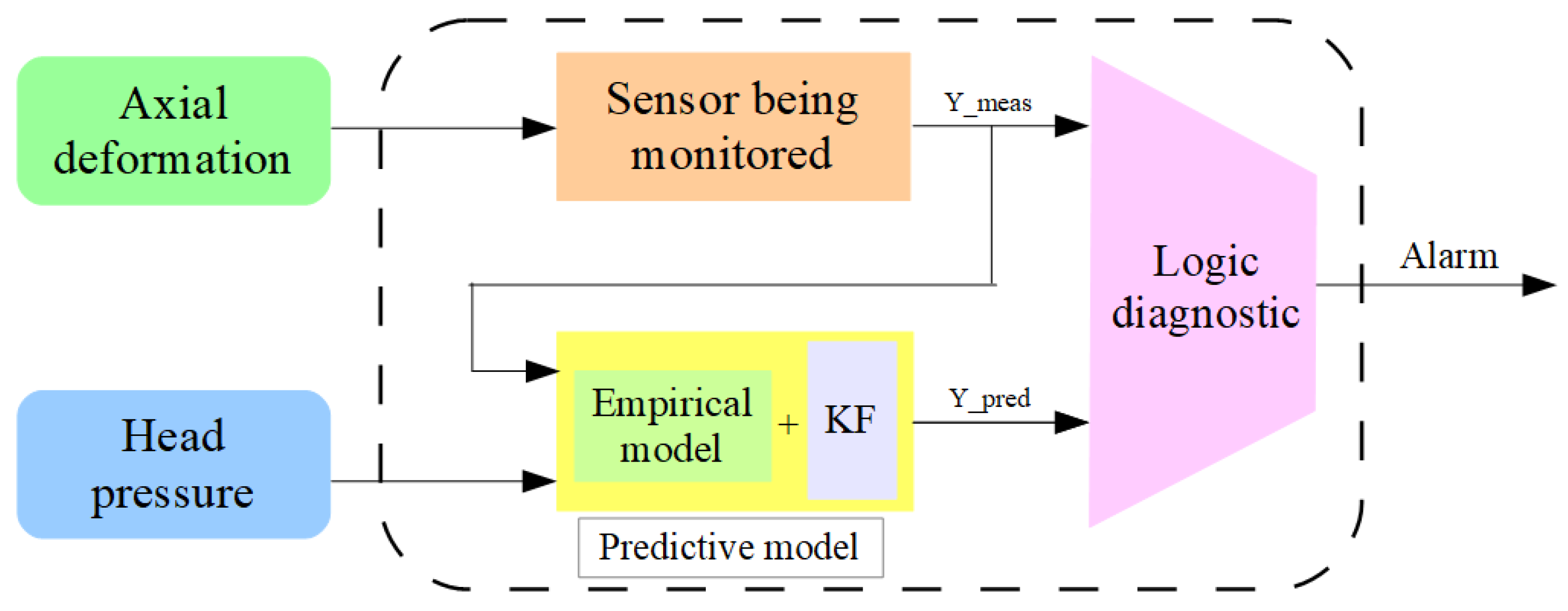
Given the critical importance of ensuring the structural integrity of the hydraulic turbine head-cover fastening bolts, this paper proposes a method based on analytical redundancy to ensure the reliability of measurement results provided by the sensors of a system that monitors the axial deformation of these bolts. The method is aimed at early fault detection in the sensors of the measurement system.
This study is organized as follows.
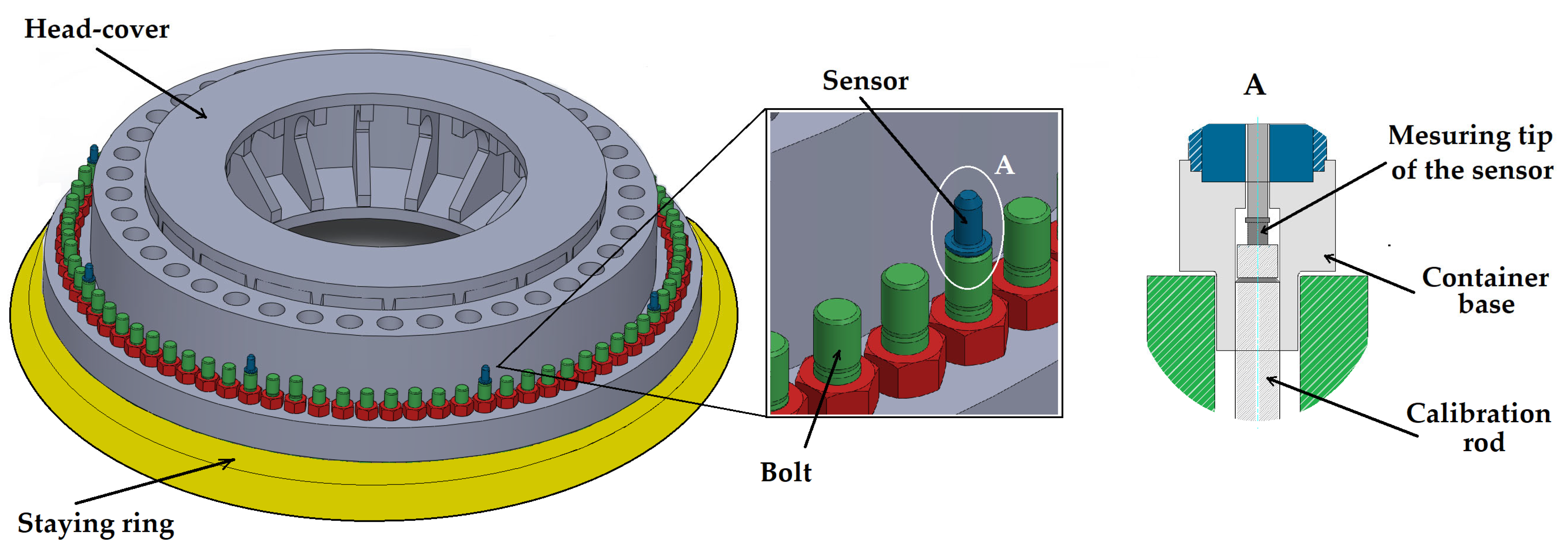
Section 2 presents the measurement system used to obtain the measurement data analyzed in this work, as well as the proposed method.
Section 3 is devoted to the procedure for constructing the predictive models required for implementation of the method.
Section 4 describes the procedure used for their validation.
Section 5 defines the metrics used to assess their performance.
Section 6 presents and discusses the obtained results. Finally,
Section 7 formulates the main conclusions of the study and outlines directions for future research.
3. Methodology for Developing Predictive Models
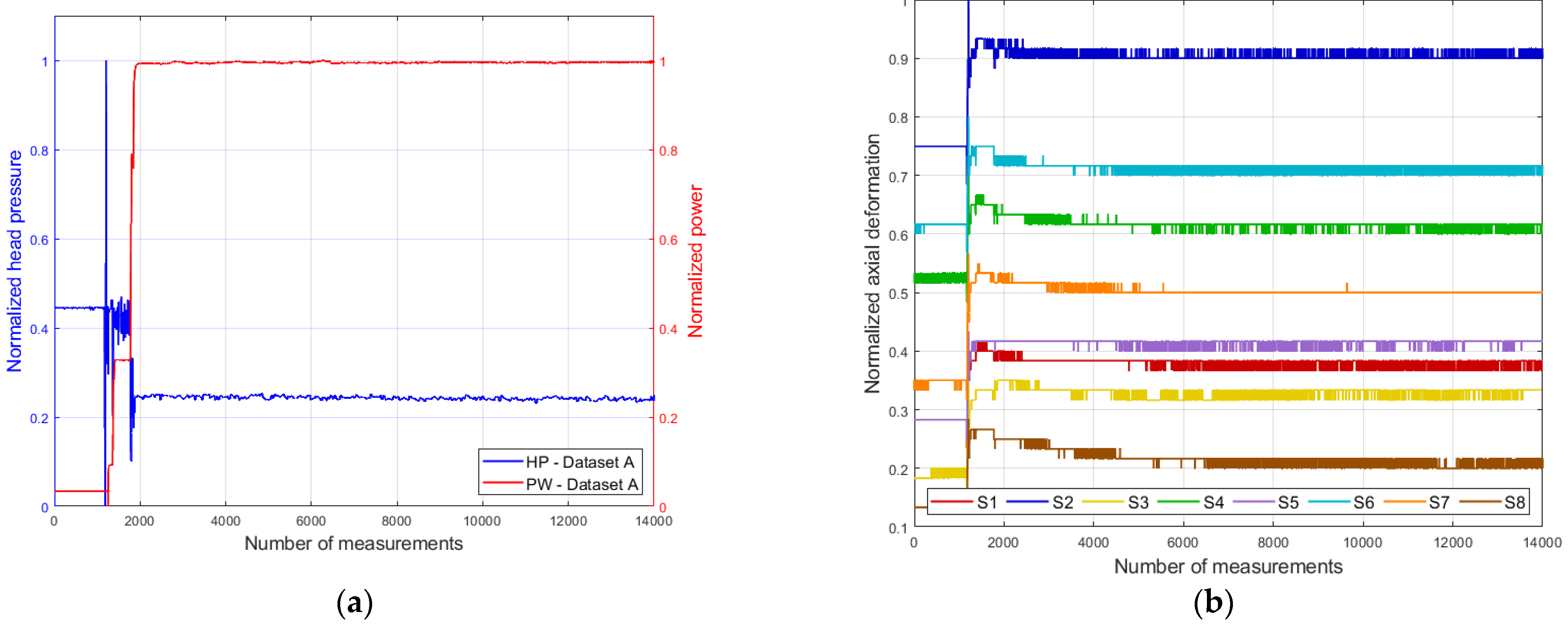
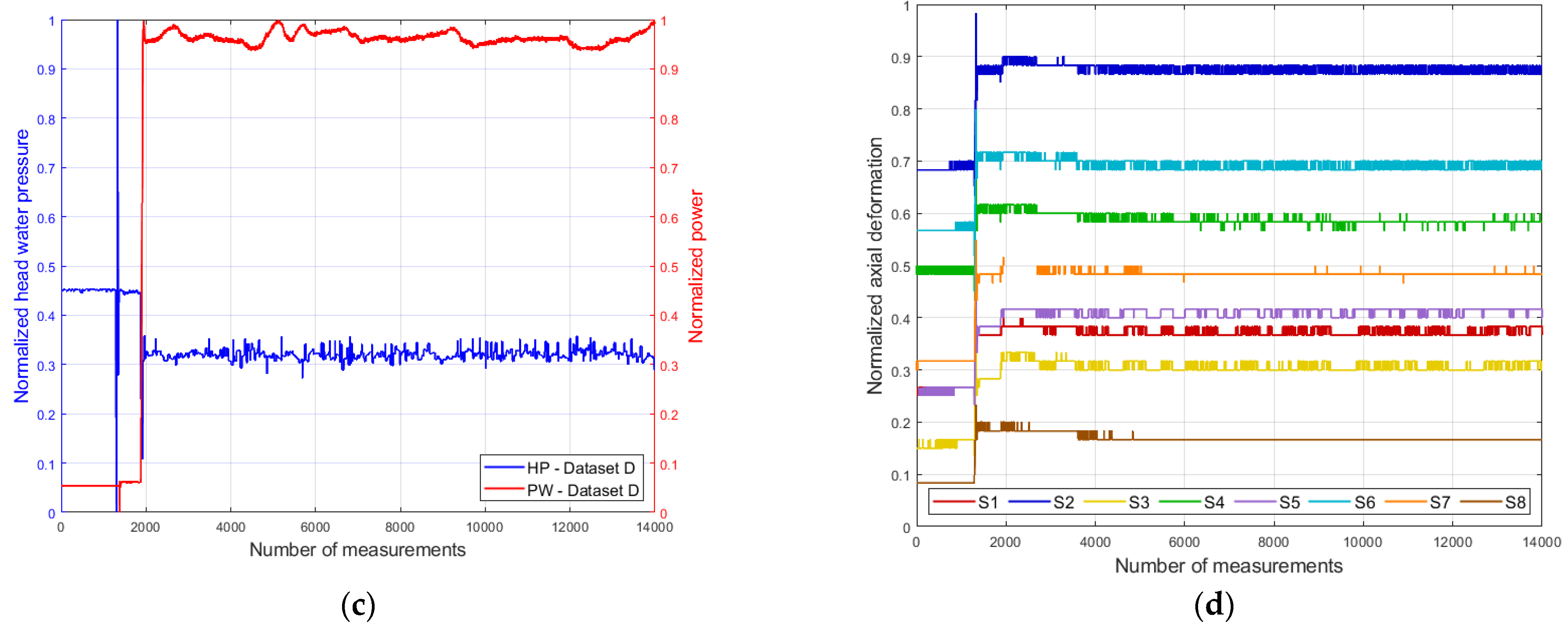
Figure 4 presents the methodology for developing predictive models, which includes four stages: modeling, verification, optimization, and validation. Specific datasets were used for each stage: dataset D1 was applied for estimating the parameters of empirical models; dataset D2 was used for empirical model verification and optimization of axial deformation estimation for the bolts; and dataset D3 for predicted models’ validation. Data from dataset D4 were used in one of the validation procedures for the predictive models.
3.1. Modeling
During the modeling stage, empirical models predicting the deformation dynamics of the fastening bolts were identified for each sensor (eight models in total) based on dataset D1, using the System Identification Toolbox in MATLAB. Additionally, the prediction uncertainty was quantitatively estimated for each obtained model.
3.1.1. Model Structure and Parameters
The identification process involved determining a mathematical structure that models the effect of head pressure changes (input signal) on the axial deformation of a fastening bolt (output signal). The selected model structure is presented as a transfer function (2) of the complex variable ‘
s’ (Laplace variable).
where
is the transfer function describing the deformation dynamics of the
i-th bolt;
Kp,
Tz,
Tp1, and
Tp2 are the parameters characterizing the dynamic properties of the corresponding bolt under head pressure influence;
i denotes the specific model for each sensor.
The second-order structure was selected based on the bolt deformation behavior in response to head-pressure changes, as observed when plotting datasets D1–D3. This behavior exhibits the characteristic step response of a second-order system. The adaptive Gauss–Newton method was selected to estimate the Gi(s) parameters using MATLAB’s Toolbox, as it yields a lower mean squared error compared to other available methods, achieving superior fit to the validation data.
The transfer function Gi(s) constitutes an empirical model approximating the “head pressure–deformation” dynamics for the fastening bolt. This model serves, firstly, to verify the adequacy of the bolt deformation dynamics description and, secondly, as the basis for the subsequent stage focused on optimizing the bolt deformation estimation.
3.1.2. Model Uncertainty Estimation
The parameters of the empirical models
Gi(
s) were estimated based on data obtained from sensors installed on eight bolts of the turbine head-cover and a head pressure sensor. These sensors possess their own inherent error. Furthermore, during measurement, factors such as measurement noise, external interference, and discretization could have affected the measurement accuracy [
59,
60,
61]. The aforementioned factors directly impact the representativeness and quality of the datasets used for models’ estimation. Therefore, quantifying the uncertainty associated with each empirical model is necessary. Methods for uncertainty estimation—the analytical method and the Monte Carlo method—are detailed in the Guide to the Expression of Uncertainty in Measurement (GUM), according to the normative documents JCGM 100 [
62] and JCGM 101 [
63].
The models’ uncertainty using the analytical method was estimated based on the mathematical structure of Gi(s) (Formula (2)), initially assuming that the parameters Kpi, Tzi, Tp1i, and Tp2i are uncorrelated. Sensitivity coefficients were computed using the partial derivatives of Gi(s) with respect to each parameter. The variance in each parameter was determined from the diagonal of the covariance matrix obtained during the parameters’ estimation using the Adaptive Gauss–Newton method. The square root of these variances represents the individual uncertainty of each parameter. Subsequently, the combined standard uncertainty for each model was calculated. Finally, the expanded uncertainty UAM with a confidence level of 95% (k = 2) was determined.
Model uncertainty estimation using the Monte Carlo method was performed through N stochastic simulations of the parameters Kpi, Tzi, Tp1i, and Tp2i. For this purpose, the parameter values, initially estimated by the Adaptive Gauss–Newton method, were assigned normal probability distributions. This choice is justified by the fact that the estimation method used provides parameter covariance matrices, whose calculation assumes normality of the estimates. The means of each distribution corresponded to the nominal parameter values, and the standard deviation (σ) was calculated as the square root of the elements on the diagonal of the covariance matrix obtained during the parameter estimation. The variation limits for each parameter were set at ±3σ from the nominal value, encompassing approximately 99.7% of the distribution. Based on these distributions, N random parameters sets were generated, which allowed for the construction of N empirical models for each sensor. These models were applied to the input signal (head pressure), resulting in N model responses. The standard deviation of this response was taken as the models’ standard uncertainty. To determine the expanded uncertainty UMC, the standard deviation was multiplied by a coverage factor of k = 2, corresponding to a 95% confidence level.
3.2. Verification
During the verification stage, dataset D2 was used to assess the systematic error (bias) of the predictions performed by the empirical models. Bias for
N measurements is calculated as the average of the differences between each measured value and the true (reference) value [
64]. Since it is necessary to analyze the bias of each axial deformation prediction, measured values from dataset D2 were taken as reference. Thus, in this work, bias was calculated using Formula (3) to determine whether the predicted values from the empirical models overestimate or underestimate the measured values.
where
N is the number of measurements,
is the measured value for the j-th measurement, and
is the corresponding predicted value.
Additionally, it is analyzed whether the empirical models Gi(s) reproduce the axial deformation dynamics, specifically its transient and steady-state responses. The transient state is the time interval during which the system responds to head pressure changes before reaching equilibrium. When the head pressure no longer changes over time, the system reaches equilibrium or steady-state condition.
3.3. Optimization
During the optimization stage, the accuracy of estimating the axial deformation of the fastening bolts was improved using previously verified empirical models. For this purpose, a recursive Kalman filter algorithm was applied to the representation of the empirical model
Gi(
s) in state space. According to theory [
65,
66] the Kalman filter enables the estimation of the state of a dynamic system under conditions where measurements contain noise and errors, optimizing estimation accuracy through a recursive process of prediction and correction. The application of the Kalman filter is widespread, covering various fields from engineering [
67,
68] to economics [
69,
70,
71,
72].
The representation of
Gi(
s) in state-space form was obtained by transforming it into the controllable canonical form of second order, as described in [
73]. In continuous time, this representation takes the form of Equation (4):
where
is the state vector of the system,
is the state vector derivative,
is the input vector,
is the output vector,
is the system matrix,
is the input matrix,
is the output matrix,
is the feedthrough matrix and
i denotes the correspondence to each estimated model.
Subsequently, the discretization of Equation (4) was performed using MATLAB’s
c2
d function and a sampling rate of 1 s, which converts the continuous-time model to discrete-time. Thus, the state-space representation of
Gi(
s) is given by (5), enabled the development of predictive models S1–S8.
where
is the state vector of the system at time k + 1,
is the state vector at the previous time
k,
is the control input vector, and
is the measurement vector of the quantity that the model attempts to estimate indirectly through the system state.
F—is the state transition matrix,
G—is the input matrix, and
H—is the observation matrix. Matrices
F,
G, and
H describe the system dynamics and the relationship between the state and the measurement. The terms
and
correspond to process noise and measurement noise, respectively, both modeled as Gaussian random variables with zero mean and covariances
Q and
R.
It should be noted that process noise models external and internal disturbances and errors in the system dynamics not accounted for in the idealized model. Meanwhile, measurement noise reflects random measurement errors and disturbances arising during data collection about the system state.
For optimal state estimation, the Kalman filter algorithm operates in two stages:
Prediction—the algorithm determines a preliminary (a priori) state estimate based on the system’s dynamic model and its uncertainty (covariance) before obtaining the current measurement.
where
represent the a priori state estimate and
is the uncertainty of the prediction (before measurement),
and
correspond to the a posteriori estimate and covariance (after the measurement), and
Q is the process noise covariance matrix.
Correction—after obtaining the current measurement, the previous prediction is corrected by combining it with the current measurement. For this correction, the Kalman gain is calculated, which determines how much the prediction should be adjusted based on the uncertainty of the measurement and the prediction. Subsequently, the state estimate
and the error covariance
are updated.
where
is the Kalman gain coefficient,
H—is the observation matrix,
R—is the measurement noise covariance matrix, and
I—is the identity matrix.
Therefore, the stages complement each other: the prediction forms the basis, while the correction refines the estimate by incorporating new data. These two stages are repeated at each step of the filter’s operation, providing optimal smoothing and state estimation of the system.
Additionally, the diagonal elements of the covariance matrix Q, which quantify the prediction uncertainty of the empirical models Gi(s), were calculated from the maximum modeling uncertainty estimated via analytical (UAM) and Monte Carlo (UMC) methods. Since both uncertainties can be understood as the standard deviation multiplied by a coverage factor k = 2 (95% confidence level), the variance was calculated using σ2 = (U/k)2.
The variation in the axial deformation sensor measurements reflects the associated measurements uncertainty. Therefore, the element of the covariance matrix R, which quantifies sensor measurement error uncertainty, was adjusted to the maximum steady-state variance across the eight sensors, ensuring a conservative estimate of the actual hydraulic unit operation.
4. Validation of Predictive Models
The validation of predictive models is carried out by evaluating their performance under the influence of various factors, combined with an analysis of residual behavior during sensor faults.
4.1. Model Performance Under Different Operating Conditions
To analyze the performance of the models under different operating conditions, testing methods were developed that account for the following factors: the presence of outliers, measurement noise, and change in the operating mode of the hydroelectric unit (HU).
Outliers are defined as data points that significantly deviate from the system’s expected behavior. They may arise from sensor errors, data transmission issues, or rare physical phenomena [
74]. For simulation purposes, ten outlier values were generated using Formula (8), based on the three-sigma rule.
where
is the measured value and
σ is the maximum standard deviation calculated from the deformation measurements of the eight bolts.
The value of σ was determined based on measurements taken once the system reached equilibrium. These outliers were randomly added to the bolt axial deformation data in the D3 dataset.
On the other hand, measurement noise consists of random, unpredictable errors that distort the values of a system’s input and output signals. It is present in any real-world data acquisition process and is a continuous stochastic process. The simulation of measurement noise was performed by adding random perturbations, with an amplitude not exceeding the ±2σ interval, to the bolt axial deformation data in the D3 dataset.
Change in operating mode refers to the operation of the HU at various load levels, determined by the needs of the power system. The need for such evaluation arises because the parameters of the empirical models were estimated based on dataset D1, collected during full load operation of the HU. Evaluating the predictive capability of the models exclusively in this mode would lead to an overestimated, and therefore, incorrect assessment of their adequacy. This is because, in real-world conditions, the HU operates not only at full load but also, for example, at 70% of its nominal load. For this test, the dataset D4, which reflects HU operation at partial load (70%), was used.
The conducted tests allowed for the evaluation of prediction accuracy, model robustness, and their ability to forecast under changing HU operating modes. To quantitatively assess the predictive models’ performance, accuracy, sensitivity, and detectability metrics were used, which are described in detail in
Section 5.
4.2. Model Response to Sensor Faults
As noted in
Section 2.2, analytical redundancy enables the generation of additional information to detect sensor faults, which constitute a potential cause of their failure—terms clearly differentiated in the ISO 13372 [
75] and ISO/IEC/IEEE 24765 [
76] standards. This subsection analyzes the response of the predictive models during simulated faults.
Based on a literature analysis,
Table 2 was developed, summarizing fault types, their definitions, and causes.
The analysis of model response to sensor faults is based on calculating the residual vector that arises from comparing measured and predicted values (Formula (9)).
where
is the residual vector,
is the measured value,
is the corresponding predicted value, and
j is the measurement index.
The fault types described in
Table 2 were simulated by injecting anomalous axial deformation values into dataset D3. Each fault was artificially simulated using a specific mathematical model described in [
79].
The Bias Fault was simulated using the following expression, which applies a constant offset to the measured value:
where
is the biased sensor reading,
is the measured value, and
bias% is the percentage of added offset relative to the system’s absolute error.
To simulate drift, a linear model was used that gradually changes the measured value:
where
is the drifted sensor reading,
z is the current measurement index,
is the measurement index at the fault initiation moment,
is the measurement index at the final simulation moment, and
drift% is the percentage of added drift relative to the system’s absolute error.
Precision degradation was simulated by adding variance with increasing amplitude to the measurement results. To simulate progressive degradation, three levels were applied, corresponding to the sensor’s scale division: 0.5 µm, 1.0 µm, and 1.5 µm. The simulation was performed using the formula:
where
is the sensor reading with degraded precision and
var is Gaussian noise with zero mean and a variance equal to the specified degradation level.
The stuck-at fault was simulated by fixing the sensor readings to the value reached at the moment of fault initiation. This value, remained constant until the end of the measurements, regardless of changes in the actual axial deformation, and is expressed as:
where
is the sensor reading with a stuck value and
is the measurement index at the moment of fault initiation.
The goal of the analysis is to identify patterns in residual behavior (such as minima, maxima) to determine the time of occurrence, type, and location of the fault. It should be noted that under ideal conditions (in the absence of sensor faults), the values of the residual vector tend toward zero, and their deviations form the basis for diagnostics.
6. Results and Discussion
This section outlines the parameters of the empirical models, estimated to represent the axial deformation dynamics in state-space and to implement the Kalman filter. The results of the performance evaluation of the predictive models, conducted during tests in the presence of outliers, measurement noise, and changes in the operating mode of the HU, are presented.
6.1. Predictive Models
Predictive models S1–S8 are the result of the modeling, verification, and optimization stages described in
Section 2. They were determined using data on head pressure and axial deformation of the bolts, corresponding to datasets D1 and D2. Following the identification of the empirical models
Gi(
s), the verification stage revealed the presence of a slight negative bias in the predictions (see
Table 3), with the greatest discrepancies observed during the system’s transient operation.
When applying the Kalman filter, the diagonal elements of the covariance matrix
Q were set according to the relationship described in
Section 3.3, using the maximum estimated uncertainty
UMC for the models
Gi(
s), which corresponds to model S2 (see
Table 3). The element of the covariance matrix
R was set to the variance in sensor 7, as it represents the maximum axial deformation measurement variance among the eight sensors in dataset D2. The corresponding values are:
Q = 0.008 and
R = 0.061 (both in μm
2).
Table 3 presents the parameters of the empirical models used for the state-space representation and the subsequent application of the Kalman filter to obtain the predictive models. The table also shows the accuracy metrics before and after applying the KF and the uncertainty associated with each model.
From
Table 3, it can be seen that the accuracy metrics (
Acc) for predicting the axial deformation of the bolts, calculated before applying the Kalman filter (BFK), do not exceed a value of 0.672 µm. This value represents approximately 7% of the measurement system’s absolute error (see
Table 1). After applying the filter (AFK), the maximum value of the accuracy metric decreases to 0.146 µm, which is equivalent to only 1.5% of the system’s absolute error. The uncertainties, estimated by the analytical method (
UAM) and the Monte Carlo method (
UMC), correspond to a 95% confidence interval (k = 2). The uncertainty
UMC was estimated with
N = 1000 simulations.
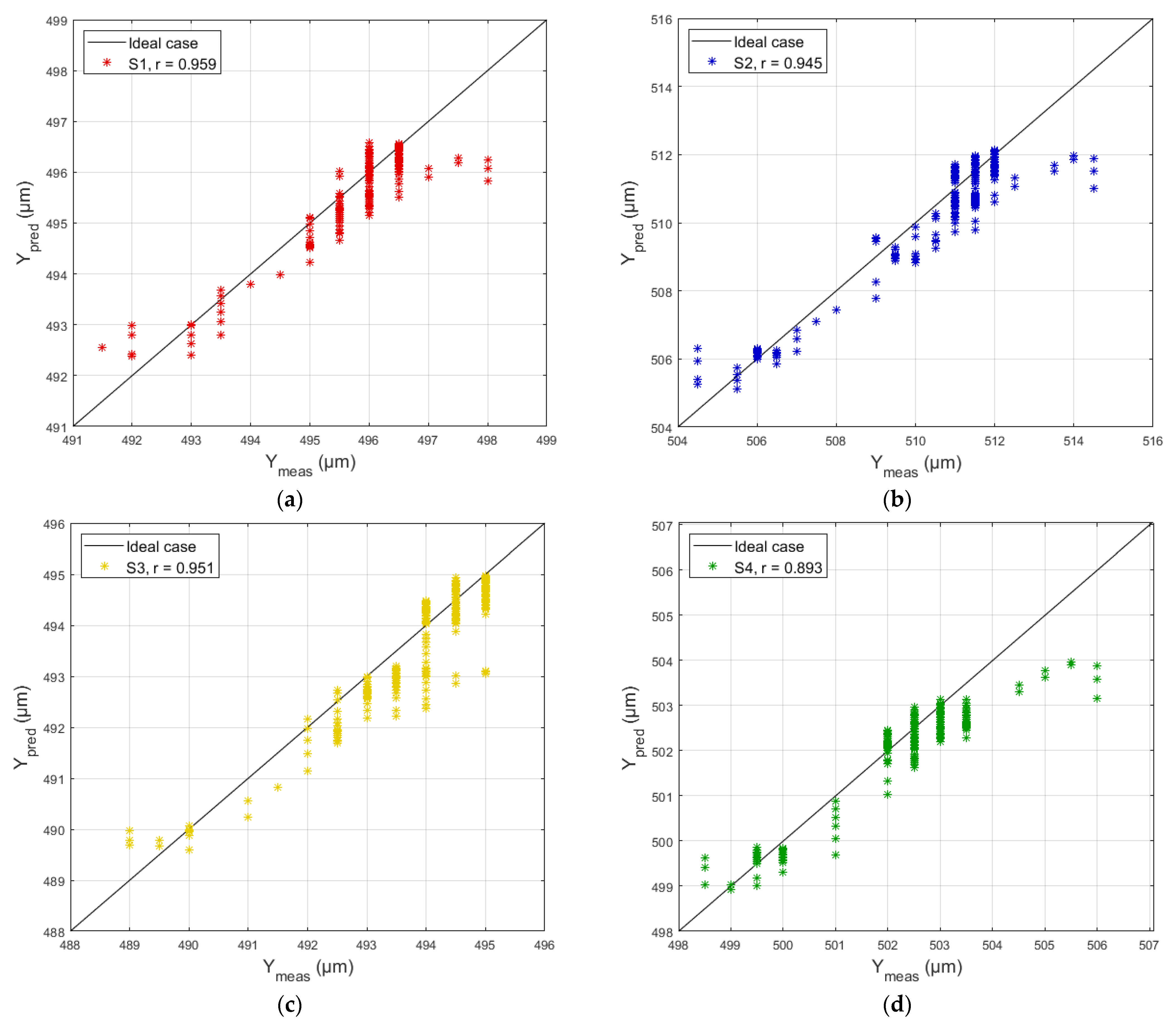
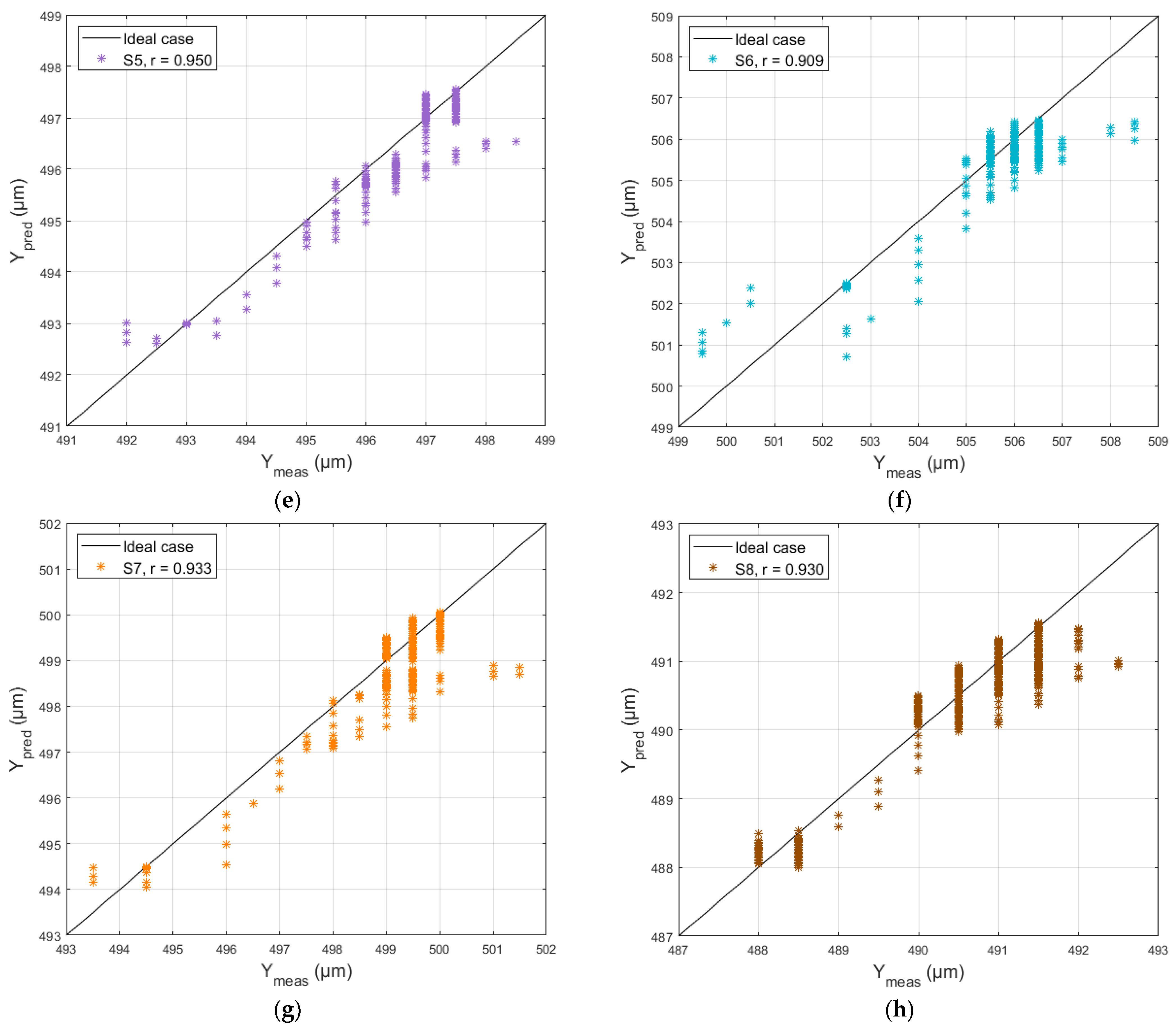
Figure 5 shows the correlation between the measured and predicted values.
As can be seen in
Figure 5, the Pearson correlation coefficient ‘
r’ is close to 1, indicating a strong positive linear correlation. This confirms that the predicted values correspond to the measured ones.
6.2. Performance in the Presence of Outliers and Measurement Noise
As noted in
Section 4.1, factors such as outliers and measurement noise can affect the predictive capability of the models. This subsection presents the test results for evaluating accuracy, sensitivity, and detectability under the influence of these factors. For calculating the sensitivity metric, in accordance with its defining Formula (15), both data containing deviations (outliers or noise) and data without deviations were used.
6.2.1. Outlier Test
To evaluate the performance of the models in the presence of outliers, 10 outliers were randomly introduced into the axial deformation measurement data for each bolt from dataset D3. The simulated outlier values exceed the limit
specified in
Section 4.1. The maximum σ value, calculated from the data of all eight sensors and amounting to 0.239 µm, corresponds to the measurements from sensor S7 in dataset D3.
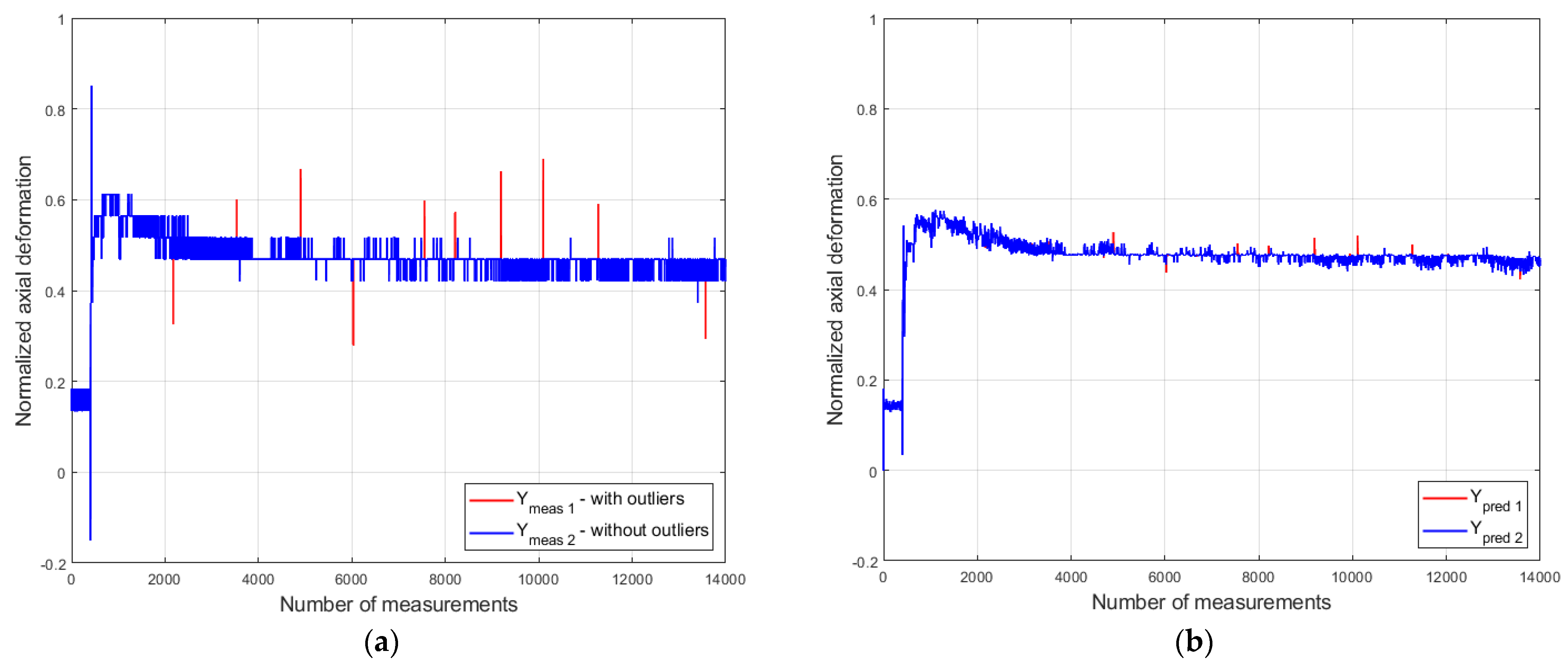
Figure 6 shows the test results in the presence of outliers, using model S2 as a representative example.
As can be seen from
Figure 6b, the predictive model S2 mitigates the influence of outliers on the predicted axial deformation.
Table 4 presents the performance metrics obtained in the presence of such outliers.
Despite the presence of outliers, the accuracy metric (Acc) reached a maximum value of 0.184 µm (model S8), which constitutes only 1.8% of the measurement system’s absolute error. In turn, the sensitivity metric () did not exceed the value of 0.0001 for any of the models. Regarding the fault detectability metric (), calculated using the EULM method while accounting for prediction uncertainty, its value did not exceed 0.05% of the sensor’s operational measurement range. This means that the predictive models are capable of detecting fault values exceeding 0.25 µm by monitoring the uncertainty of the prediction residuals.
6.2.2. Measurement Noise Test
Based on the definition of measurement noise provided in
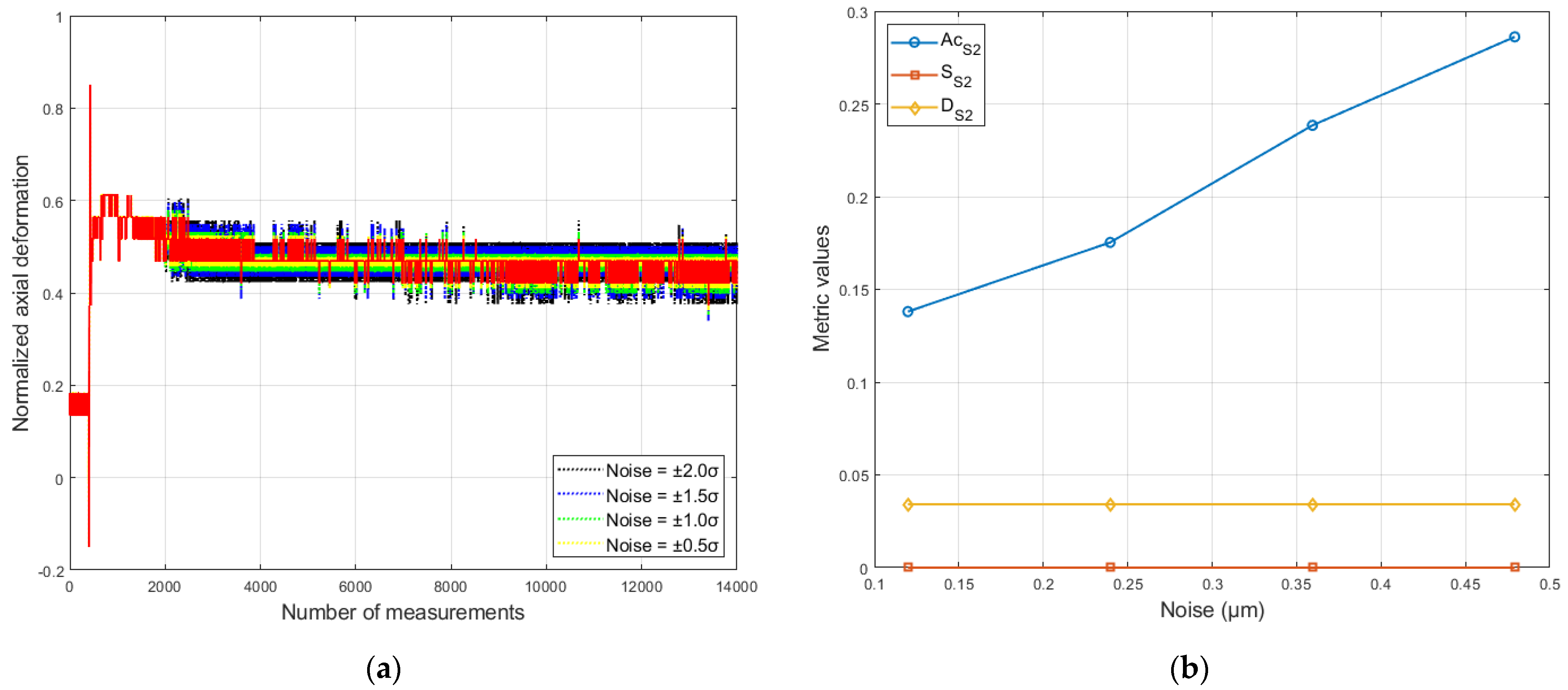
Section 4.1, the predictive capability of the models under its influence was evaluated. The simulated noise consisted of random values uniformly distributed within the ranges of ±0.5σ, ±1.0σ, ±1.5σ, and ±2.0σ. This allowed us to study its effect on the forecast by conducting four independent tests for each model. The simulated noise was added to the recorded deformation values of the bolts from dataset D3, starting from the 2000th measurement, as shown in
Figure 7.
As can be seen from
Figure 7b, the accuracy metric (
Acc) exhibits an almost linear increase with the rise in simulated noise level. This pattern is observed for all analyzed models. On the other hand, the sensitivity (
) and detectability (
) metrics remain practically unchanged as noise increases.
Table 5 provides a quantitative summary of these results, confirming the described patterns.
6.3. Performance Under a Change in the Operating Mode of the Hydroelectric Unit
As explained in
Section 4.1, it is necessary to verify the predictive capability of the models when the HU operates under a different mode (regime). This subsection evaluates the accuracy metric (
Acc) of the predictive models under an operating regime at 70% of the nominal load, using data from the registration dataset D4.
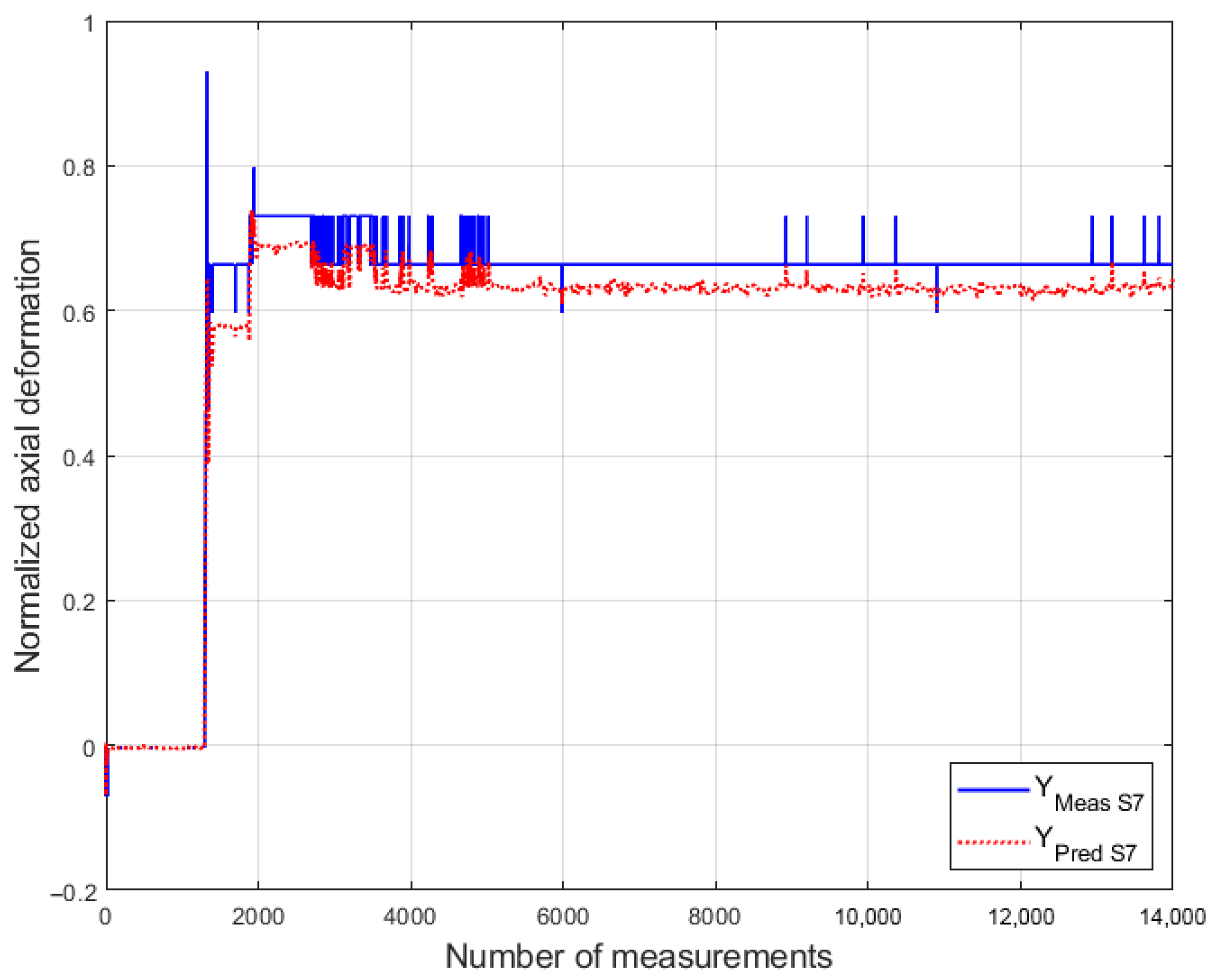
Figure 8 presents the measured bolt deformation values and the values predicted by model S7.
In turn,
Table 6 presents the prediction accuracy metric (
Acc) for each model, calculated using MAE, during a change in the HU operating mode.
6.4. Residual Behavior in the Presence of Faults
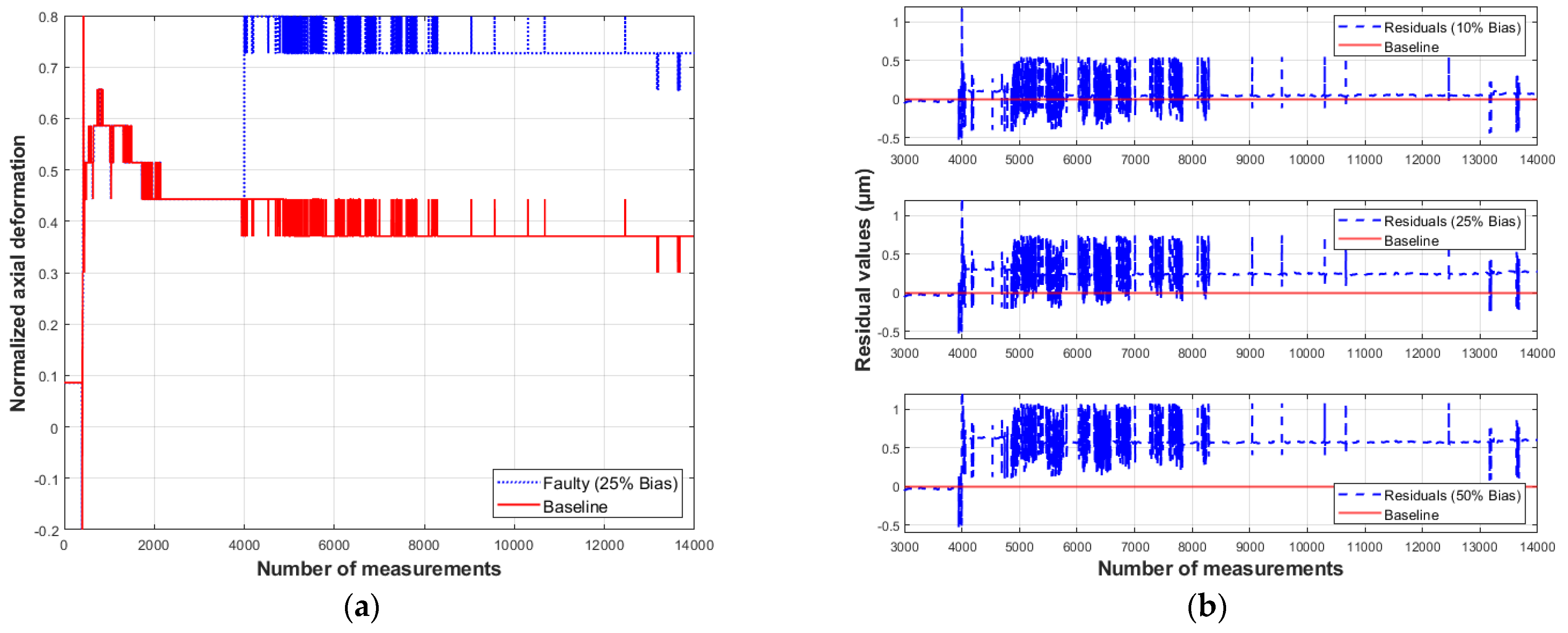
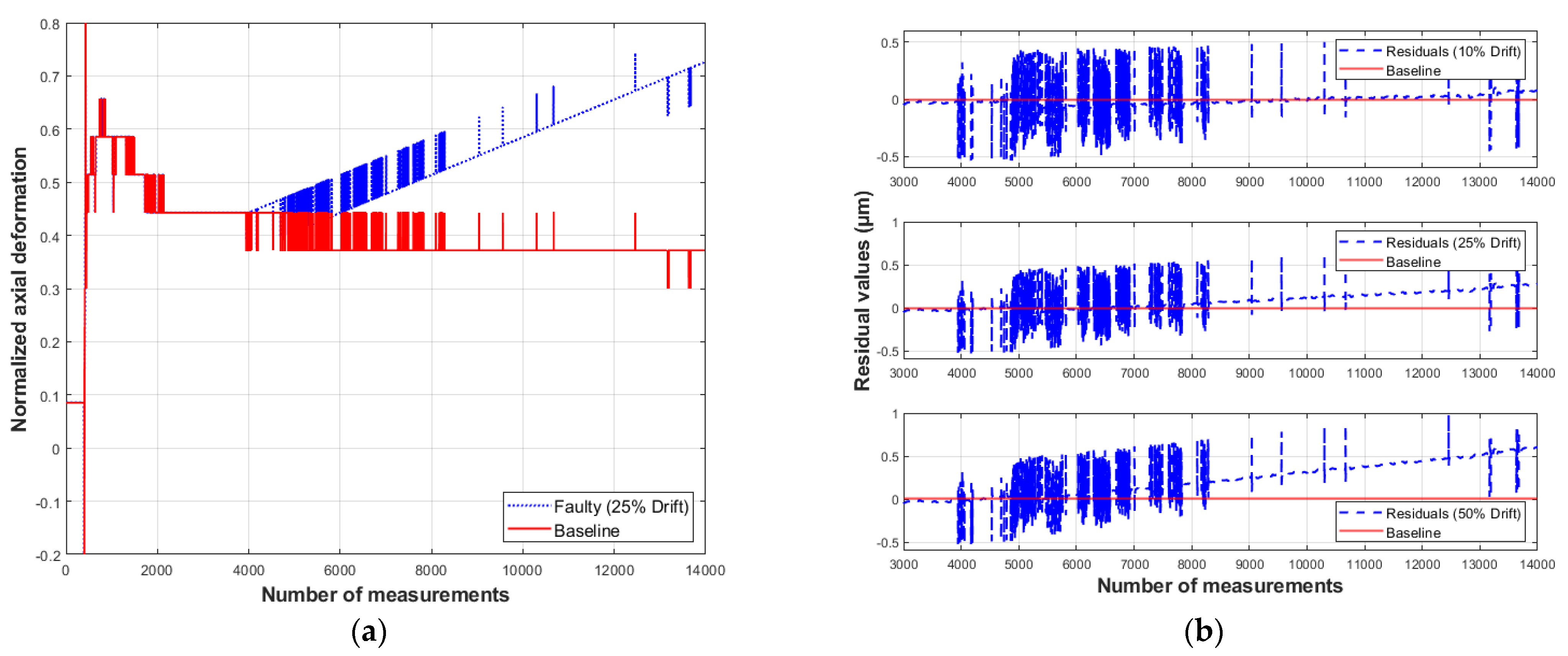
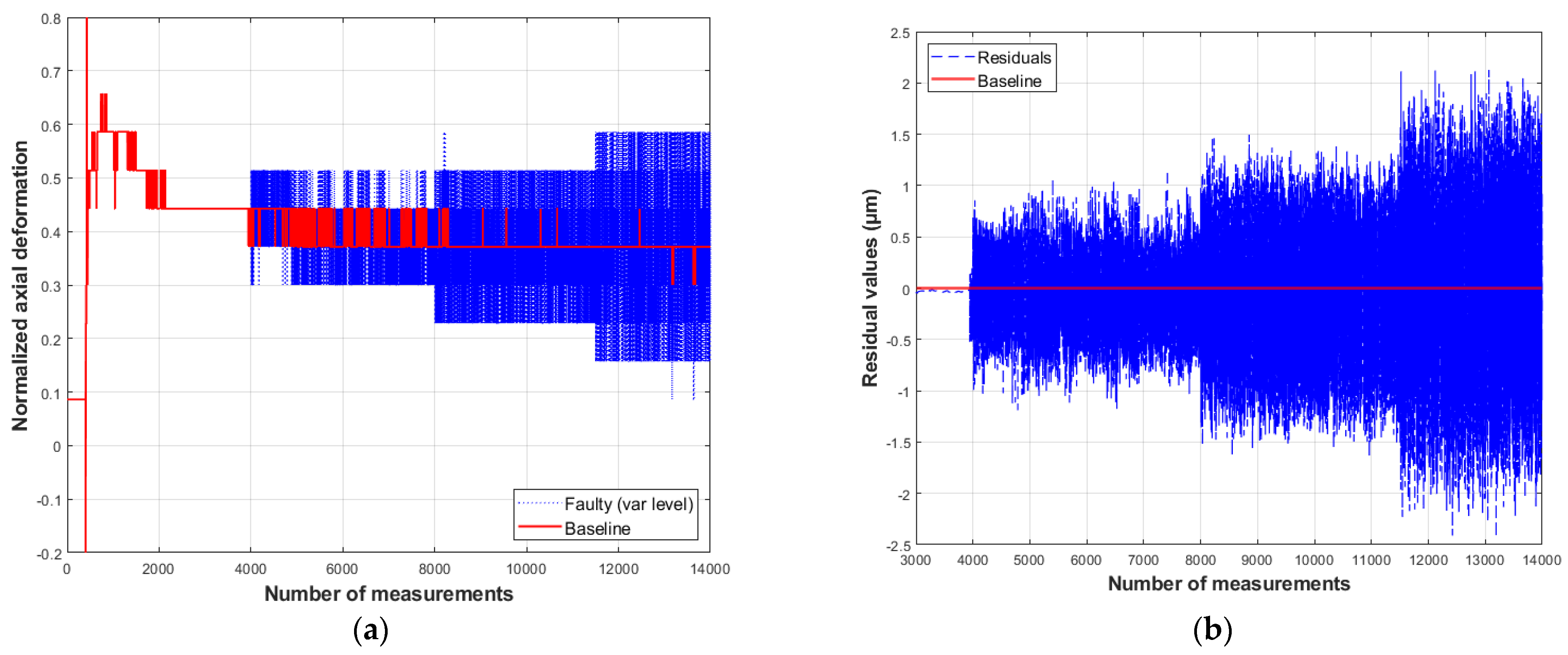
To study the models’ response to various types of faults, simulated anomalous values representing specific faults were artificially introduced into the axial bolt deformation data of dataset D3, starting from the 4000th measurement. For clear visualization, these anomalies are plotted alongside the measured values, which serve as a reference (baseline).
On the residual plots, the baseline indicates no difference between the measured and predicted values. The residual vectors presented below illustrate the model’s response to the introduced anomalies (
Figure 9,
Figure 10,
Figure 11 and
Figure 12).
It is observed that a bias-type fault produces a peak at the moment of its occurrence. For a bias fault magnitude equal to 10% of the measurement system’s absolute error (equivalent to 1 µm), the residuals show virtually no deviation from the baseline. As the fault magnitude increases to 25% and 50%, the residual values deviate noticeably from the baseline. For a 50% fault, the change in the residual value is approximately 0.6 µm.
The results for the drift-type fault indicate that with a drift equivalent to 10% of the measurement system’s absolute error, the residuals remain close to the baseline without noticeable deviation. For a 25% drift (2.5 µm), beginning at the 4000th measurement, the residuals gradually deviate starting from the 8000th measurement, reaching ~0.3 µm. For a 50% drift, the deviation of the residuals begins at the 6000th measurement and reaches a maximum value of 0.6 µm.
The residual behavior during the simulation of a precision degradation in sensor 1 (
Figure 10b) shows that the deviation of the residual values from the baseline increases proportionally to the fault severity. Specifically, when simulating an increase in measurement variance by 0.5, 1.0, and 1.5 µm, a corresponding rise in the residual value is observed, which is most significant at the maximum degradation level.
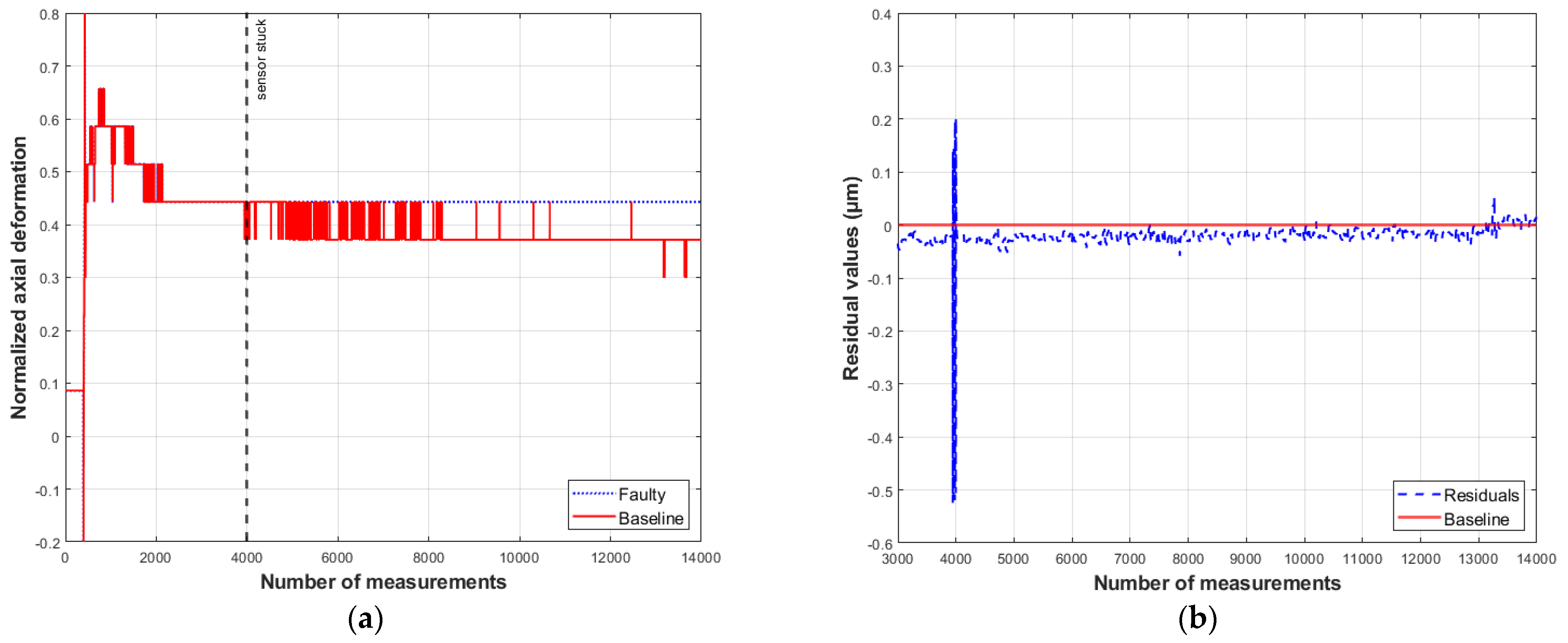
As seen in
Figure 12a, the signal values of sensor S1 remain constant after the fault occurs. On the other hand,
Figure 12b shows that residual behavior oscillates around the baseline after a transient period, without converging to zero. A peak is observed, caused by the change in axial deformation measurements at the moment of fault inception. Although the residual values are close to zero, they fluctuate randomly.
6.5. Discussion
According to the results obtained, the maximum value of the accuracy metric (Acc) achieved for the predictive models is 0.146 µm. This value corresponds to 1.5% of the measurement system’s absolute error, confirming the reliability of the predictions. Thus, the predictive models adequately describe the deformation dynamics of the turbine head-cover bolts under normal sensor operation during the HU power grid connection stage.
Tests conducted in the presence of outliers and measurement noise confirm the robustness of the models, as evidenced by sensitivity metric () values below 0.001. Detectability, assessed via the () metric, reaches a maximum value of approximately 0.01%. This result indicates that by monitoring residual uncertainty, it is possible to detect faults exceeding 0.05 µm.
Test conducted under changing operating mode of the HU showed an increase in prediction error, characterized by the accuracy metric (Acc). Although such an increase was expected, it is necessary to evaluate the predictive models under other operating modes. This would not only help determine the maximum prediction errors but also analyze their impact on the prediction uncertainty estimated for each model. Furthermore, these tests would allow for characterizing the maximum or variable prediction error depending on the operating mode, taking into account the uncertainty introduced by the dynamic operating conditions of the HU.
Based on the analysis of residual behavior under bias-type faults, it is evident that the moments of fault occurrence are evident; however, their magnitudes do not match the residual values. For example, according to
Figure 9b, a fault equivalent to 50% of the measurement system’s absolute error (5 µm) results in a residual of about 0.6 µm. Regarding drift-type faults, the residual values not only fail to reflect the magnitudes of the introduced faults but also become distinguishable only after several measurements taken after their occurrence, as shown in
Figure 10b. These results reveal a limitation of the proposed method, as for faults smaller than 50% of the system’s absolute error, the residuals are not easily distinguishable.
As previously indicated, the magnitudes of the simulated faults are not fully reflected in the residuals due to the partial compensation of the fault effect by the predictive models. More specifically, during the correction stage of the axial deformation estimation, the Kalman gain coefficient () attenuates the fault values based on the ratio of the covariance matrices Q (confidence in the dynamic model) and R (confidence in the actual observations). Therefore, the balance between both matrices could be optimized to improve the method’s sensitivity to lower-magnitude faults.
In contrast to the results for bias and drift faults, the residual signal for a fault caused by precision degradation exhibits distinct values corresponding to the simulated fault magnitude, which increase with the degradation level. Conversely, the residual values for a stuck-at fault do not converge to a constant value, as occurs with the sensor measurements. Instead, the residuals values fluctuate randomly with a small amplitude.
Although the predictive models S1–S8 partially compensate for the magnitude of faults when estimating bolt deformation, they generate characteristic residual patterns that allow for the identification of the fault type. These patterns can be integrated into fault detection and isolation (FDI) algorithms, enabling continuous and reliable monitoring of the sensors’ operational health. However, the fault detection time will be determined by the FDI algorithm, since each fault must be analyzed differently. We consider that, to ensure the reliability of axial deformation measurement results, this algorithm should include, among others, the following aspects:
The various operating stages of the hydraulic unit and the changes in its operational loading modes;
The definition of the maximum allowable deformation value for the fastening bolts;
The permissible fault thresholds for the sensors before a failure state is considered;
The analysis and estimation of measurement uncertainty sources, which will determine whether the sensors are within permissible thresholds.




 ,
,