This is an early access version, the complete PDF, HTML, and XML versions will be available soon.
Open AccessArticle
Machine Learning-Enhanced Evaluation of Handheld Laser-Induced Breakdown Spectroscopy (LIBS) Analytical Performance for Multi-Element Analysis of Rock Samples
1
CNR-Istituto per la Scienza e Tecnologia dei Plasmi (ISTP) Sede di Bari, Via Amendola, 122/D, 70126 Bari, Italy
2
Dipartimento di Scienze e Tecnologie Biologiche ed Ambientali, Università del Salento, Via Monterioni 165, 73100 Lecce, Italy
3
Dipartimento di Scienze del Suolo, della Pianta e degli Alimenti, Università degli Studi di Bari, Via G. Amendola 165/A, 70126 Bari, Italy
4
Programa de Pós-Graduação em Ciência dos Materiais, UFMS–Universidade Federal de Mato Grosso do Sul, Av. Costa e Silva, s/nº, Campo Grande 79070-900, Brazil
*
Author to whom correspondence should be addressed.
Sensors 2026, 26(3), 1076; https://doi.org/10.3390/s26031076 (registering DOI)
Submission received: 30 November 2025
/
Revised: 27 January 2026
/
Accepted: 5 February 2026
/
Published: 6 February 2026
Abstract
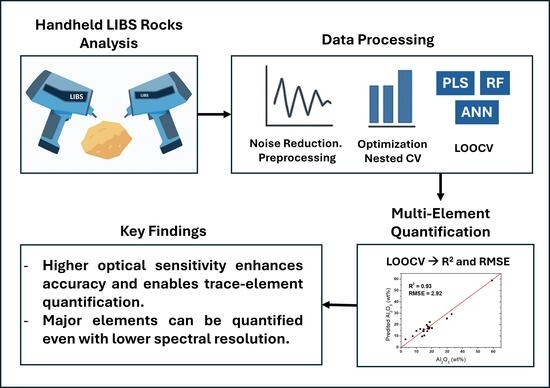
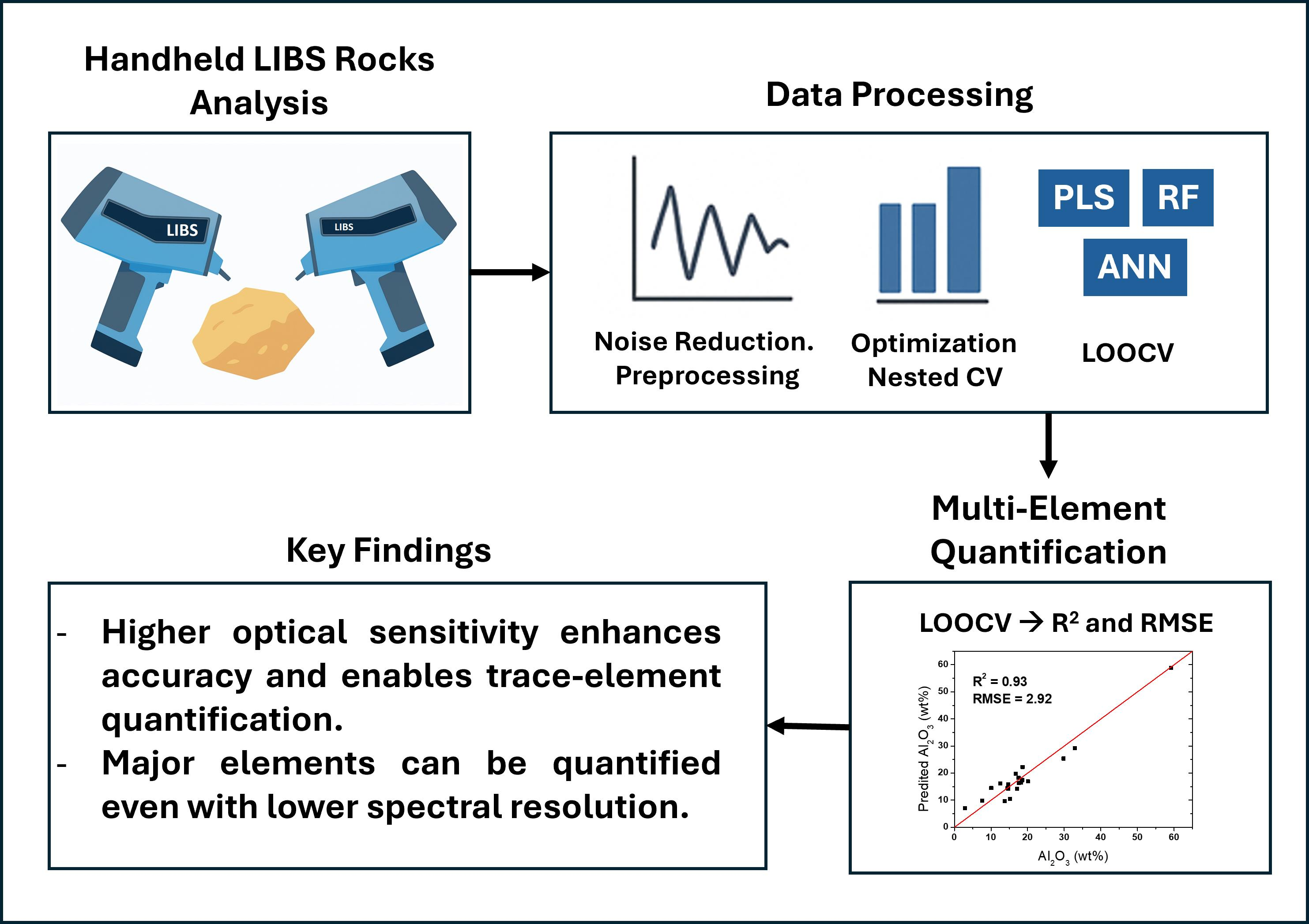
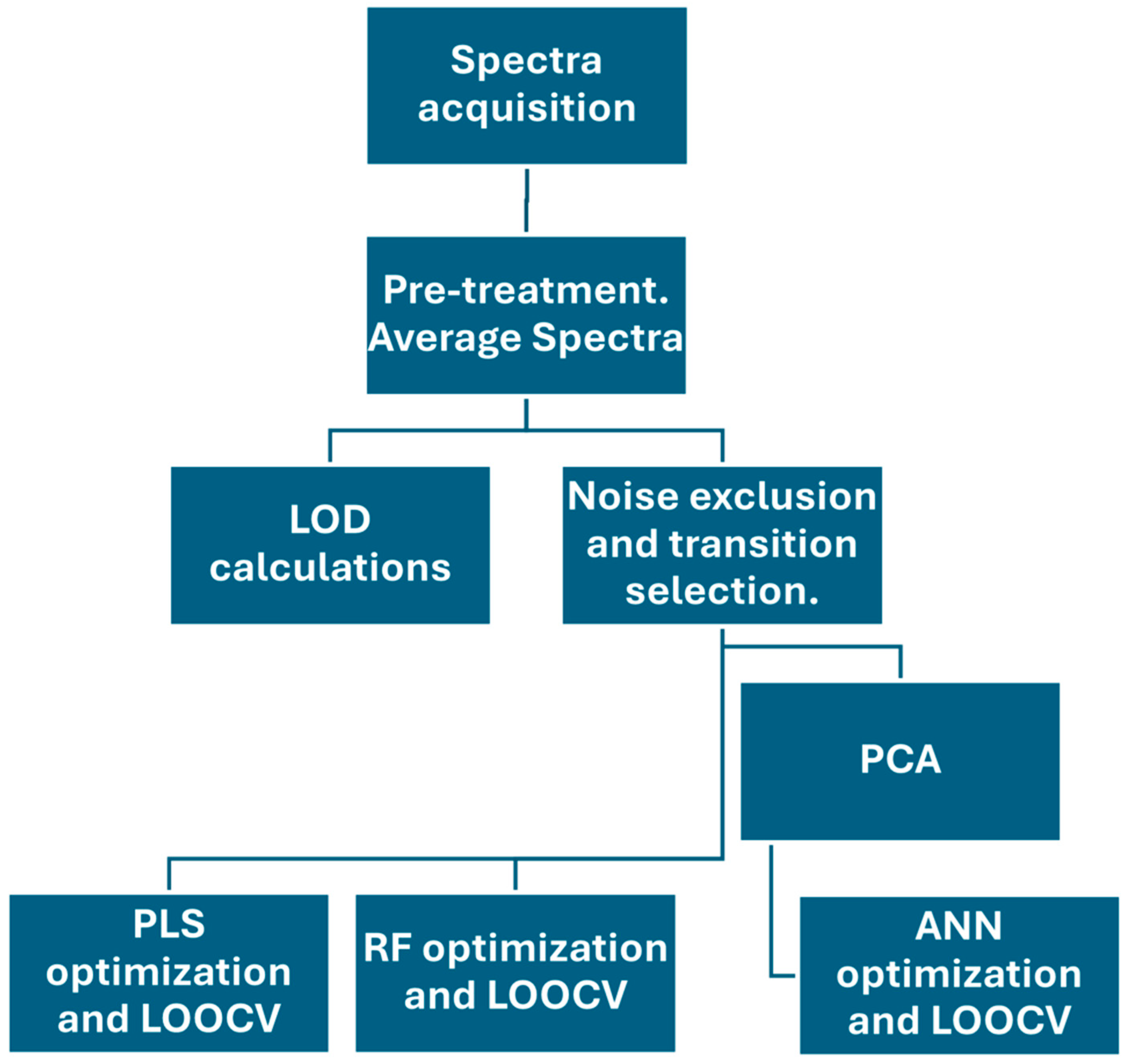
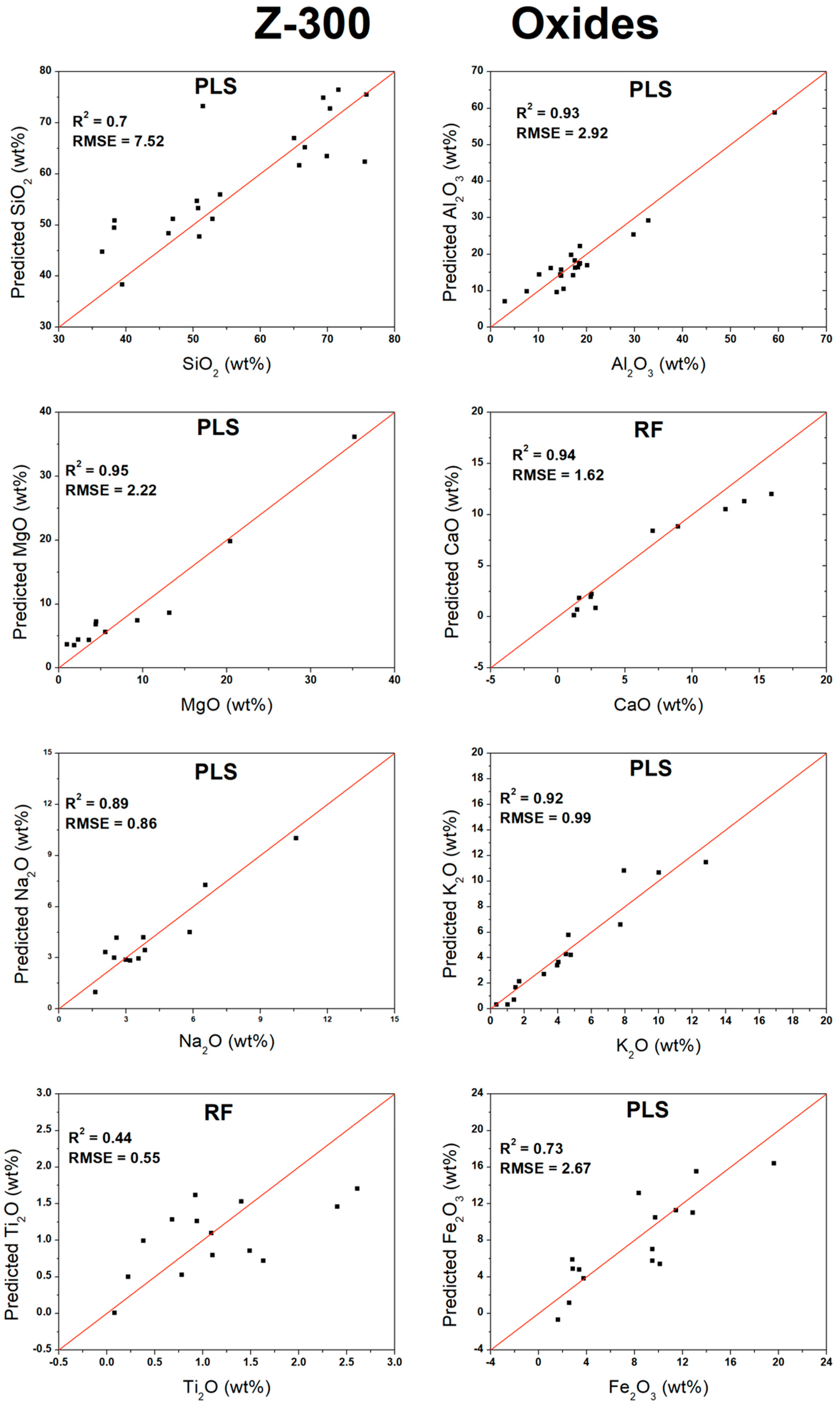
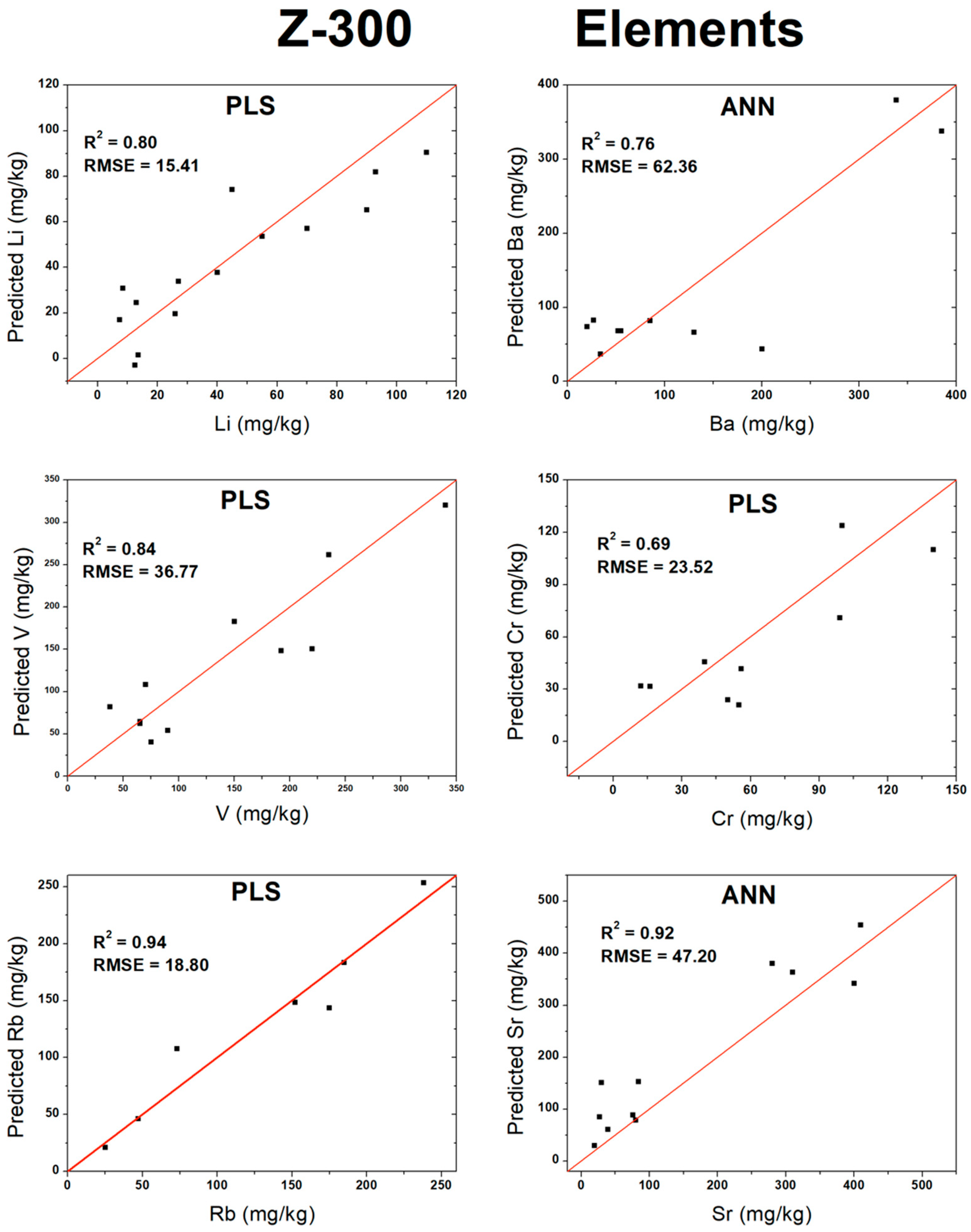
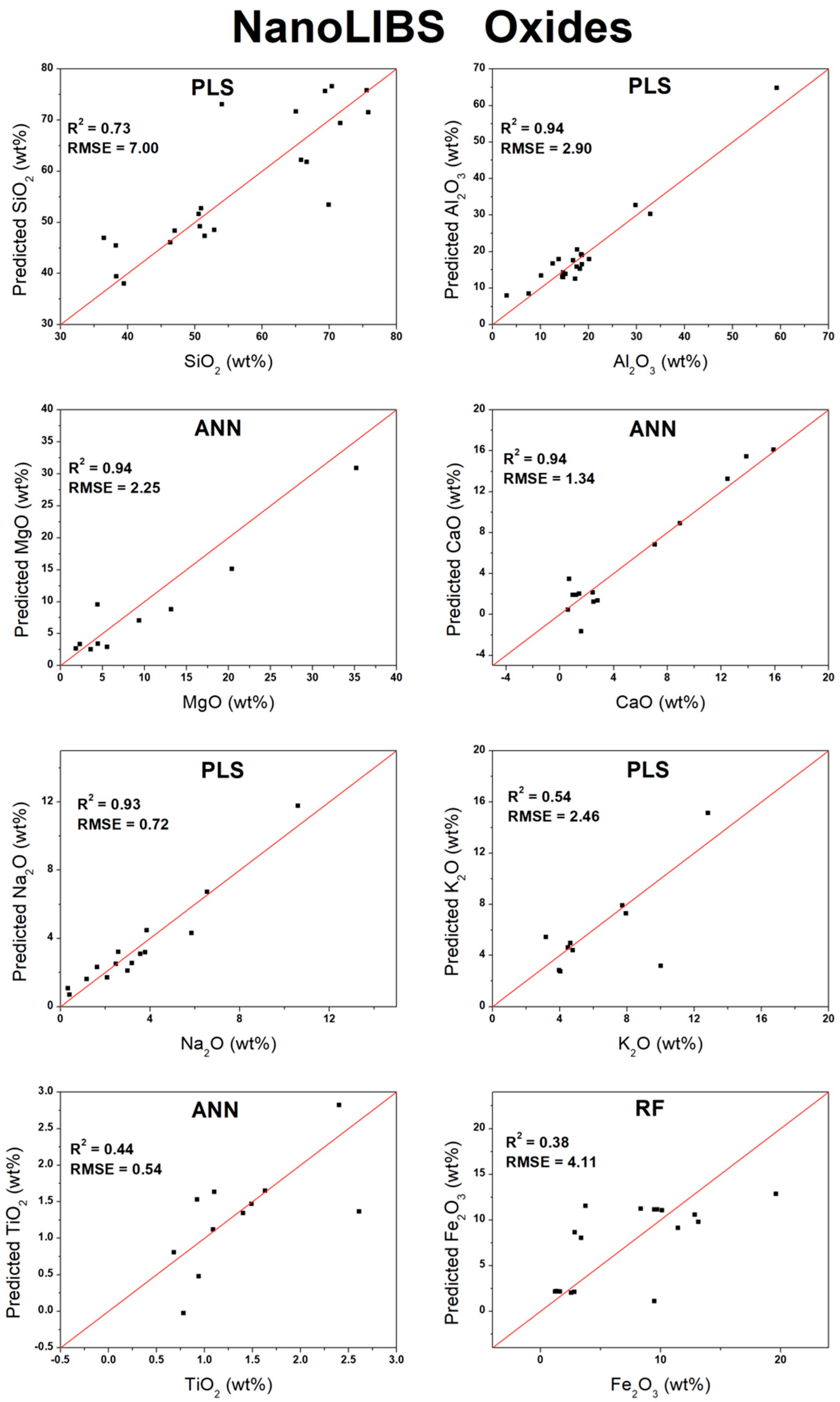
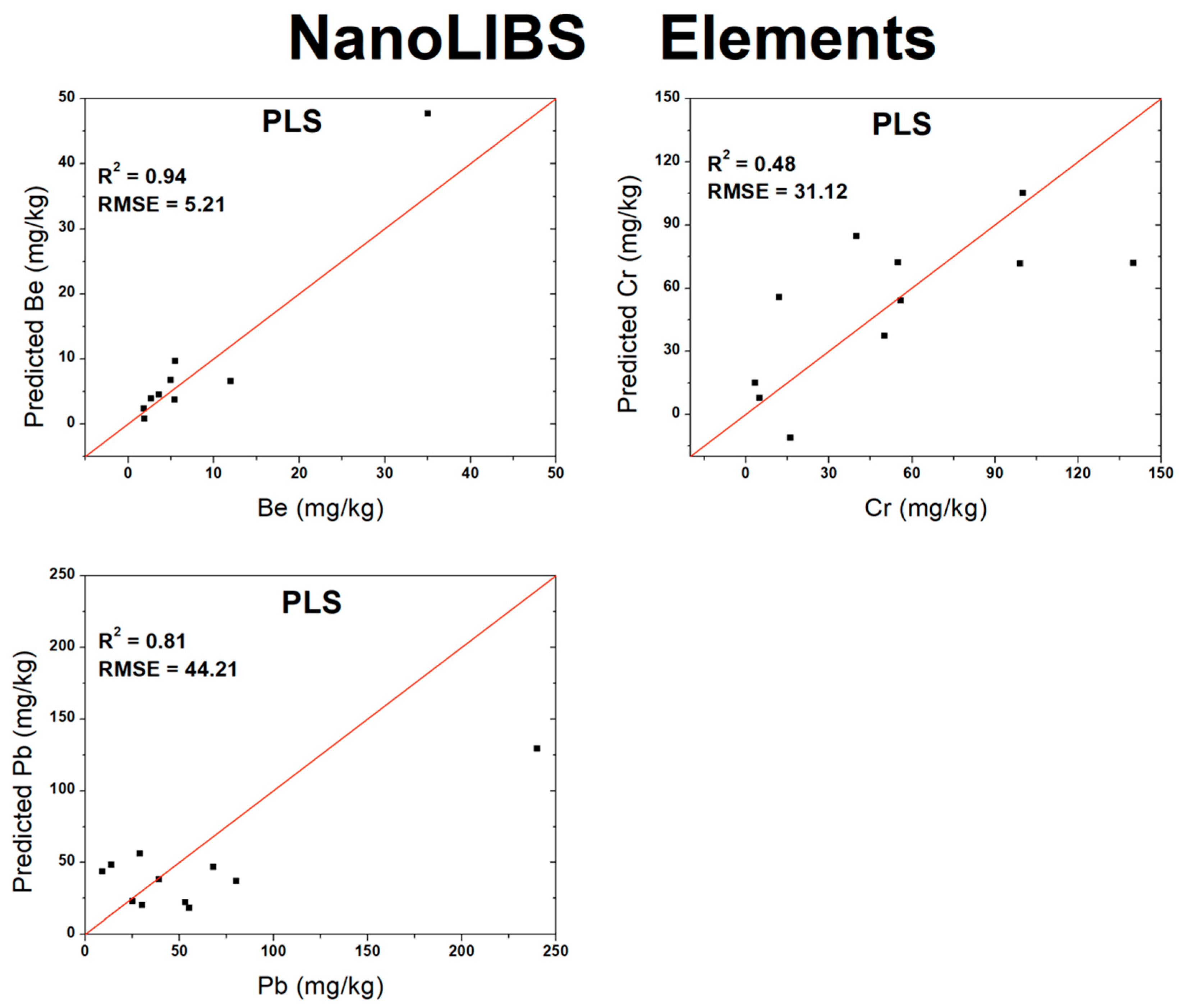
Handheld laser-induced breakdown spectroscopy (hLIBS) can be considered one of the most recent techniques for rock characterization in situ. Handheld LIBS devices are useful tools for providing “fit for purpose” qualitative and quantitative geochemical data. The analytical performance of hLIBS instruments varies significantly between similar instruments from different manufacturers. This study employed two commercial hLIBS instruments, both making use of noise reduction and multivariate partial-least-squares (PLS) calibration. Model validation was performed using the Leave-One-Out Cross-Validation (LOOCV) method. The Random Forest (RF) and Artificial Neural Network (ANN) algorithms were also employed as complementary approaches to PLS modeling, with the goal of exploring potential nonlinear relationships between spectral intensities and reference analyte concentrations. A comparison was also made with the most basic and commonly used approach, univariate analysis, demonstrating that multivariate methods achieve superior performances. To evaluate the predictive performance and quantification capability of the acquired LIBS spectra, the Pearson’s coefficient (R2) and root-mean-square error (RMSE) were employed in the analysis of 21 diverse certified geochemical reference materials (CRMs). The results achieved suggested that the spectral resolution was the key factor determining the performance of multivariate LIBS calibrations. The PLS model proved to be satisfactory for analyses performed by the higher-spectral-resolution instrument, whereas complementary algorithms were necessary to achieve better results with the lower-spectral-resolution instrument.
Share and Cite
MDPI and ACS Style
Senesi, G.S.; De Pascale, O.; Allegretta, I.; Terzano, R.; Marangoni, B.
Machine Learning-Enhanced Evaluation of Handheld Laser-Induced Breakdown Spectroscopy (LIBS) Analytical Performance for Multi-Element Analysis of Rock Samples. Sensors 2026, 26, 1076.
https://doi.org/10.3390/s26031076
AMA Style
Senesi GS, De Pascale O, Allegretta I, Terzano R, Marangoni B.
Machine Learning-Enhanced Evaluation of Handheld Laser-Induced Breakdown Spectroscopy (LIBS) Analytical Performance for Multi-Element Analysis of Rock Samples. Sensors. 2026; 26(3):1076.
https://doi.org/10.3390/s26031076
Chicago/Turabian Style
Senesi, Giorgio S., Olga De Pascale, Ignazio Allegretta, Roberto Terzano, and Bruno Marangoni.
2026. "Machine Learning-Enhanced Evaluation of Handheld Laser-Induced Breakdown Spectroscopy (LIBS) Analytical Performance for Multi-Element Analysis of Rock Samples" Sensors 26, no. 3: 1076.
https://doi.org/10.3390/s26031076
APA Style
Senesi, G. S., De Pascale, O., Allegretta, I., Terzano, R., & Marangoni, B.
(2026). Machine Learning-Enhanced Evaluation of Handheld Laser-Induced Breakdown Spectroscopy (LIBS) Analytical Performance for Multi-Element Analysis of Rock Samples. Sensors, 26(3), 1076.
https://doi.org/10.3390/s26031076

Note that from the first issue of 2016, this journal uses article numbers instead of page numbers. See further details
here.
Article Metrics
Article metric data becomes available approximately 24 hours after publication online.