Article

Enhanced Room-Temperature Optoelectronic NO2 Sensing Performance of Ultrathin Non-Layered Indium Oxysulfide via In Situ Sulfurization


1
Institute for Advanced Study, Chengdu University, Chengdu 610106, China
2
Key Laboratory of Advanced Technologies of Materials, Ministry of Education, School of Materials Science and Engineering, Southwest Jiaotong University, Chengdu 610031, China
3
School of Engineering, Royal Melbourne Institute of Technology University, Melbourne 3000, Australia
4
College of Engineering and Technology, Southwest University, Chongqing 400715, China
*
Author to whom correspondence should be addressed.
Sensors 2026, 26(2), 670; https://doi.org/10.3390/s26020670
Submission received: 11 December 2025 / Revised: 13 January 2026 / Accepted: 17 January 2026 / Published: 19 January 2026
(This article belongs to the Special Issue Gas Sensing for Air Quality Monitoring)

Abstract

The detection of trace nitrogen dioxide (NO2) is critical for environmental monitoring and industrial safety. Among various sensing technologies, chemiresistive sensors based on semiconducting metal oxides are prominent due to their high sensitivity and fast response. However, their application is hindered by inherent limitations, including low selectivity and elevated operating temperatures, which increase power consumption. Two-dimensional metal oxysulfides have recently attracted attention as room-temperature sensing materials due to their unique electronic properties and fully reversible sensing performance. Meanwhile, their combination with optoelectronic gas sensing has emerged as a promising solution, combining higher efficiency with minimal energy requirements. In this work, we introduce non-layered 2D indium oxysulfide (In2SxO3−x) synthesized via a two-step process: liquid metal printing of indium followed by thermal annealing of the resulting In2O3 in a H2S atmosphere at 300 °C. The synthesized material is characterized by a micrometer-scale lateral dimension with 6.3 nm thickness and remaining n-type semiconducting behavior with a bandgap of 2.53 eV. It demonstrates a significant response factor of 1.2 toward 10 ppm NO2 under blue light illumination at room temperature. The sensor exhibits a linear response across a low concentration range of 0.1 to 10 ppm, alongside greatly improved reversibility, selectivity, and sensitivity. This study successfully optimizes the application of 2D metal oxysulfide and presents its potential for the development of energy-efficient NO2 sensing systems.

1. Introduction

With rapid industrialization, the threat posed by air pollution to global health has grown significantly in recent decades. Nitrogen dioxide (NO2), one of the most hazardous gases, is primarily emitted from industrial processes and vehicle exhaust [1,2]. NO2 not only causes acid rain and photochemical smog but also triggers serious health conditions including emphysema, chronic bronchitis, and respiratory irritation even at the per-million (ppm) level [3,4]. Hence, there is a pressing need for reliable methods to monitor atmospheric NO2 in real time with accuracy [5,6]. Traditional metal oxides are widely used in the gas sensing field due to their low cost, easy integration, excellent physicochemical properties, and unique structures [7,8]. In light of the drawbacks of high operating temperatures (>200 °C) and the limited sensitivity and slow response of metal oxide-based sensors, recent research has increasingly focused on nanoscale material design. Various nanostructures with a high surface-to-volume ratio, such as nanorods [9], nanofibers [10], nanotubes [11], and nanoflowers [12], have been widely employed in gas sensor fabrication to enhance sensing performance. Beyond these nanostructures, two-dimensional (2D) materials, composed of single or several atomic layers, are different from those based on conventional metal oxides [13], in which electrical dipoles are formed on the 2D surface by physisorption. Hence, 2D planar structures are considered suitable materials due to being highly sensitive [14], low power consuming, and uniquely selective to NO2 sensing [15].
Nevertheless, conventional metal oxides have a non-layered structure in two dimensions [16], which grants them the unique features of abundant surface dangling bonds and crystal structure distortion, thus improving their kinetic and gas sensing properties. However, metal oxides with a non-layered structure are usually difficult to prepare by traditional approaches. Although a variety of non-layered materials have been synthesized successfully in the 2D ultrathin form [17], such as TiO2 [18], In2O3 [19], and WO3 [20], utilizing diverse exfoliation techniques, achieving a uniform and large-area 2D structure remains difficult. Using the recently emerging liquid metal printing method, we can prepare large-area metal oxides and control the oxygen concentration. When the low-melting-point metal indium is heated to the liquid state, the surface metal will be oxidized to form an oxide film to prevent further reaction between the oxygen and the liquid metal internally, and then, through the van der Waals force, the oxide film will be reproduced [21]. For example, Cheng et al. [22] successfully synthesized large-area 2D In2O3 crystals by the liquid metal printing method, which displayed excellent response and selectivity for NO2 gas at room temperature with 365 nm light illumination.
Additionally, while conventional metal oxides have a wide band gap, containing insulators and semiconductors, they also have the defects of higher operating temperature, lower gas sensing response, poor gas selectivity, and difficulty in excitation of visible light due to their wide band gap [23,24]. To address these issues, we focused on ultrathin two-dimensional transition metal sulfides with special physicochemical properties and electronic properties at atomic level thicknesses. Metal sulfides have narrower and more-favorable bandgaps for visible light absorption, e.g., In2S3 has a bandgap of 1.9–2.5 eV, which is greatly reduced compared with that of In2O3 (3.0–3.8 eV). Using metal oxides to form heterojunctions with semiconductors (e.g., metal sulfides) with low-energy bandgaps effectively reduces the bandgap and is an effective way to achieve visible-light-driven room-temperature gas sensing performance [25,26]. Xu Kai [27] and others formed a unique oxygen sulfide heterostructure by doping the surrounding oxygen atoms into In2S3, which greatly improved the gas sensing performance of the material by increasing the exciton lifetime generated by photoexcitation by more than two orders of magnitude compared with that of pure In2S3. Chung Kim Nguyen et al. [28] reported on the 2D oxysulfide semiconductor, which was fabricated by printing indium oxide skins and a low-temperature wet chemical reaction; it exhibited a notably high electron mobility of ~20.4 cm2 V−1 s−1 and had excellent performance in the ultraviolet (UV) region.
To overcome these limitations, we turned to metal sulfides, which offer advantageous properties such as a small bandgap, room-temperature operation, and high selectivity. By constructing heterojunctions between metal oxides and these narrow-bandgap metal sulfides, we aim to develop high-performance gas sensors that operate at room temperature and are activatable by visible light. In this work, we prepare large-area, high-quality two-dimensional In2O3 by extracting the self-limited oxide layer from liquid indium droplets in a controlled environment and place the two-dimensional In2O3 under high-temperature conditions and a H2S atmosphere. The replacement reaction of O atoms and S atoms will occur on the surface of In2O3 to form a non-layered metal-oxygen sulfide two-dimensional transition state material In2SxO3−x. The electrical properties and gas sensing abilities of In2O3 and transition state material In2SxO3−x are then studied to determine the effect of sulfidation on the precursor and the role of the gas sensing mechanism. Finally, we obtain a low-power, highly sensitive, highly stable room-temperature gas sensor with full recovery. We investigate the gas sensing application of transition state In2SxO3−x formed by large-area metal oxides and construct a model of the gas sensing mechanism, which will provide guidance for the subsequent preparation of gas sensing sensor devices for two-dimensional non-laminated metal-oxygen sulfides.

2. Experimental Section

2.1. Synthesis of Two-Dimensional In2O3 and In2SxO3−x

The liquid metal van der Waals exfoliation synthesis process was performed under ambient conditions (20.9% O2, Shimao Gas Co., Ltd., Chengdu, China). Typically, the lateral dimension of the printed ultrathin layer is determined by the size of the indium liquid droplet. In this paper, 3 mg of the indium metal was utilized to obtain a sensitive layer of approximately 100 μm. Specifically, a heating plate was set to 180 °C to completely melt a small droplet of indium metal (99.99%, Jingrui Alloy Co., Ltd., Nangong, China). Then the pre-existing native dark oxide layer was swept off by a glass rod, thereby exposing the underlying fresh metal surface to oxygen. After 30 s, a clean and preheated SiO2 substrate was gently pressed upon the surface of the molten liquid metal. Immediately afterward, the heating plate was turned off to allow the molten metal to cool naturally. Subsequently, the SiO2 substrate with the attached metal was then ultrasonicated in alcohol for 10 min to achieve separation. Finally, the large-area, high-quality two-dimensional In2O3, which had formed on the fresh metal surface, was obtained on the target wafer. The sulfurization process is shown in Figure S1. Specifically, the two-dimensional In2O3 sample was put into the center of the tube furnace; then the furnace was purged with N2 at a flow rate of 50 sccm for 30 min to displace the air. Subsequently, the gas was switched to H2S (50 sccm) for another 30 min to purge the residual N2. Finally, the furnace temperature was raised to 300 °C and maintained for 120 min under the H2S atmosphere. After naturally cooling to room temperature, the vulcanized 2D In2SxO3−x material was obtained.

2.2. Characterization

The lateral dimensions and thickness of 2D In2SxO3−x were measured using AFM (Park NX10, Park Systems, Seongnam-si, South Korea). Raman spectra were examined by Raman spectroscopy (Raman, Lab-RAM HR Evolution, HORIBA, Paris, France) with a laser source of 532 nm. The valence band analysis and chemical structure analysis were performed on an X-ray photoelectron spectroscopy (XPS, Thermo Fisher Scientific, Waltham, MA, USA) ESCALAB Xi+ with an Al Kα source. The electronic band structure of the material was calculated by scanning tunneling microscopy (STS) using the STS module of an atomic force microscope (Park NX 10, Park Systems, Seomgnaam-si, South Korea) with a bias voltage of −2 ~ 2 V and a tunneling current setting of 0.5 nA. The electrical measurements of the materials were performed using a source meter (Keithley 2602B, Tektronix, Beaverton, OR, USA). The real-time drain current measurements were conducted at a fixed Vds of −0.02, −0.2, −0.4, −0.6, −0.8, and −1 V.

2.3. Sensor Fabrication and Measurement

The sensitive devices were fabricated by depositing a pair of Au electrodes with 100 nm thickness on SiO2 substrates coated with either In2O3 or In2SxO3−x. The sensing measurements were conducted at room temperature under blue light (460 nm) illumination. A mass flow system controlled the inlet of target gases, using N2 as the balance gas. The gas flow introduced into the testing chamber was maintained at 200 standard cubic centimeters per minute (sccm) using a computer-controlled multichannel gas flow controller. Prior to data acquisition, N2 was purged through the chamber for 30 min to remove residual air and stabilize the sensor components. The current response of the sensors was measured with a Tektronix 2602B digital multimeter at a sampling rate of 1 Hz.

3. Result and Discussion

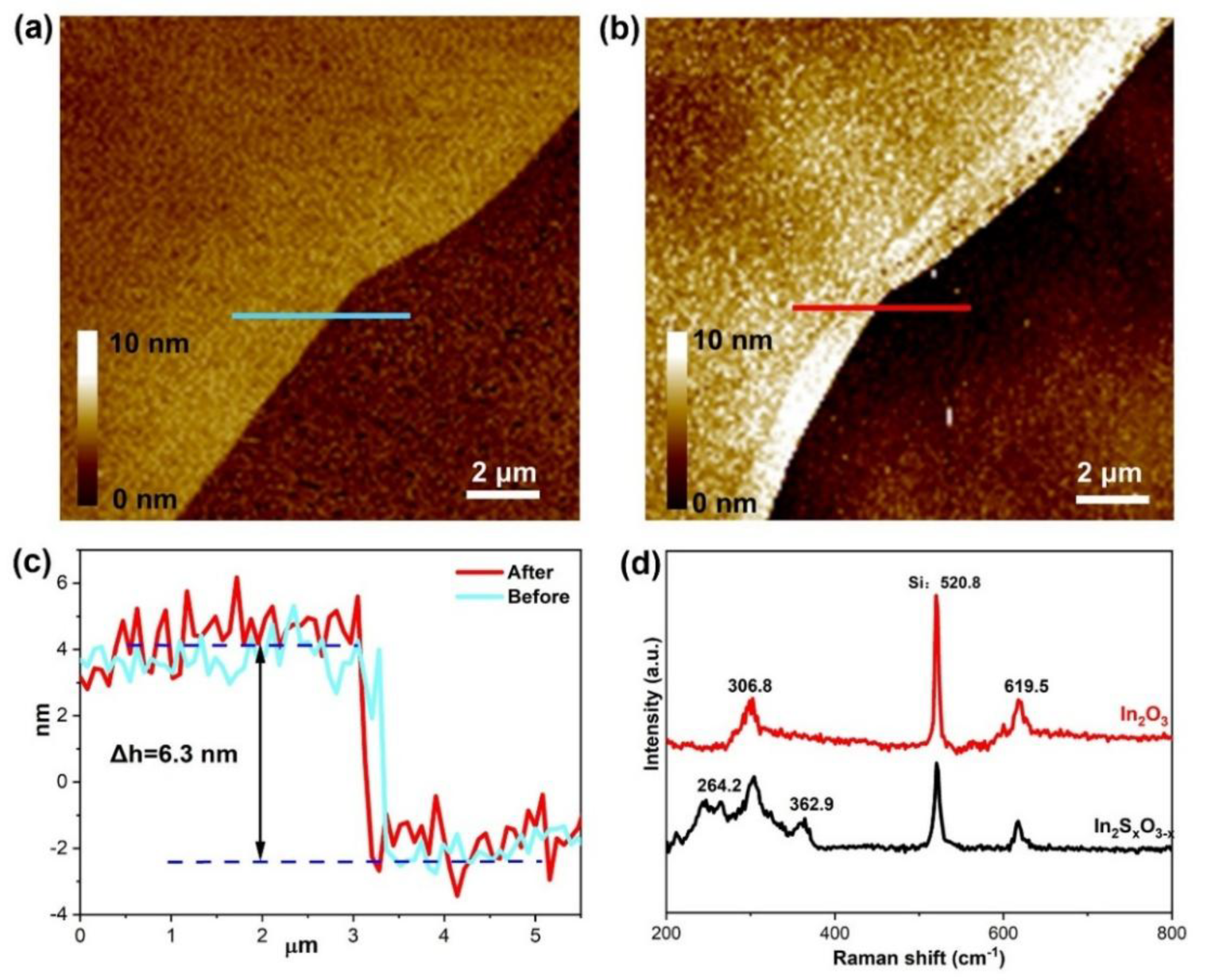
The 2D In2O3 nanosheets were synthesized via the liquid metal printing method. Subsequent sulfidation of these nanosheets through calcination treatment in H2S yielded 2D In2SxO3−x nanosheets. As shown in Figure 1a,b, AFM measurements revealed the large-area morphology of both the synthesized In2O3 and In2SxO3−x. Profile analysis further confirmed that both In2O3 and In2SxO3−x nanosheets exhibited a similar ultrathin thickness of ~ 6.3 nm with micrometer-scale lateral dimensions (Figure 1c). To investigate the chemical bond configurations, Raman spectroscopy was employed. As shown in Figure 1d, Raman peaks located at 520.8 cm−1 indicated Si from the background, which can be found in both samples. In addition, the peaks observed at 306.8 and 619.5 cm−1 are attributed to the vibrational modes of the In-O bond [6,29]. Upon sulfidation from In2O3 to In2SxO3−x, extra weaker shoulder peaks at 264.2 and 362.9 cm−1 arise from In–S vibrational modes [30,31], corresponding to the S atom’s replacement within the In2O3 structure in the calcination process.
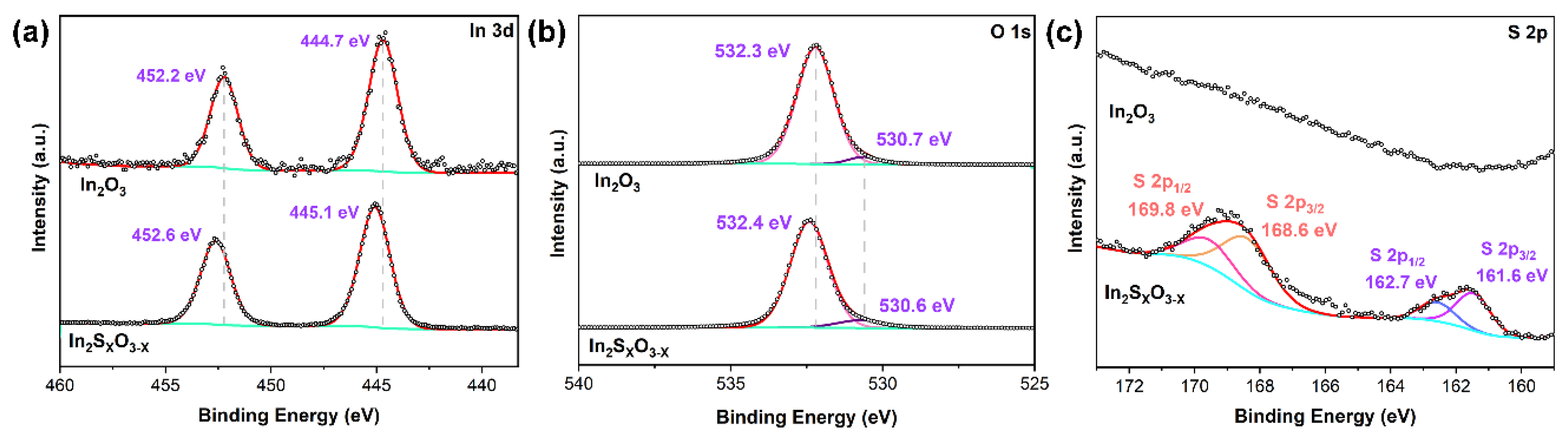
The surface compositions and chemical states of In2O3 and In2SxO3−x were characterized by XPS. As shown in Figure 2a, two dominant peaks of In2O3 at 452.2 and 444.7 eV could be seen and were attributed to In 3d3/2 and In 3d5/2, respectively, representing In-O bonds [32]. Meanwhile, the In 3d spectra of In2SxO3−x present two peaks at 452.6 and 445.1 eV, which show a slight blue-shift of 0.4 eV compared with In2O3. The shift in the binding energy of In in XPS is primarily attributed to changes in the atomic chemical environment, specifically the substitution of bonded atoms from oxygen (O) to sulfur (S), which alters the electron density around the indium atoms. As is well known, O has a high electronegativity, while S has a relatively lower electronegativity. In pristine In2O3, In is bonded to highly electronegative O atoms (forming In–O bonds). The oxygen atoms strongly attract the electron cloud from the outer shell of the indium atoms, resulting in a stronger effective binding of the core electrons to the nucleus. For In2SXO3−X, partial substitution of O atoms by S atoms leads to the formation of In–S bonds [33]. Due to the weaker electron-withdrawing ability of S atoms, the indium atoms bonded to sulfur retain a higher electron cloud density. The shift in the In 3d binding energy serves as the most direct and compelling spectroscopic evidence for the successful incorporation of sulfur, partial replacement of oxygen, and formation of In-S chemical bonds. In Figure 2b, the O 1s spectrum of In2SxO3−x is similar to that of In2O3. The peaks at 532.3 eV in the O 1s spectrum are attributed to Si-O bonds that are associated with the sample background, and the shoulder peak at 530.7 eV is associated with the formation of In-O bonds [6]. However, as shown in Figure 2c, the S 2p spectrum of In2SxO3−x reveals distinct peaks at 169.8 eV and 169.1 eV, as well as at 162.7 eV and 161.8 eV, which can be, respectively, assigned to the S 2p1/2 and S 2P3/2 components of S-O [34] bonds and to the S 2p1/2 and S 2p3/2 components of In-S bonds [35]. The formation of O-S bonds withdraws electron density from the In atoms. This electron withdrawal reduces the charge density at adjacent metal sites, effectively increasing their oxidation state and accounting for the observed positive shift (~0.4 eV) in the In 3d binding energy. The formation of In-S bonds suggests that elevated temperature weakens the original In-O bonds, leading to cleavage of the crystal structure of indium oxide and allowing oxygen atoms to be replaced by sulfur atoms through vulcanization. From Figure S2, the composition of the obtained 2D In2SXO3−X can be estimated to be In: S: O = 2:0.35:2.62 by using the O:S area ratio obtained from XPS. The result indicates the value of x in In2SxO3−x as ~0.35.
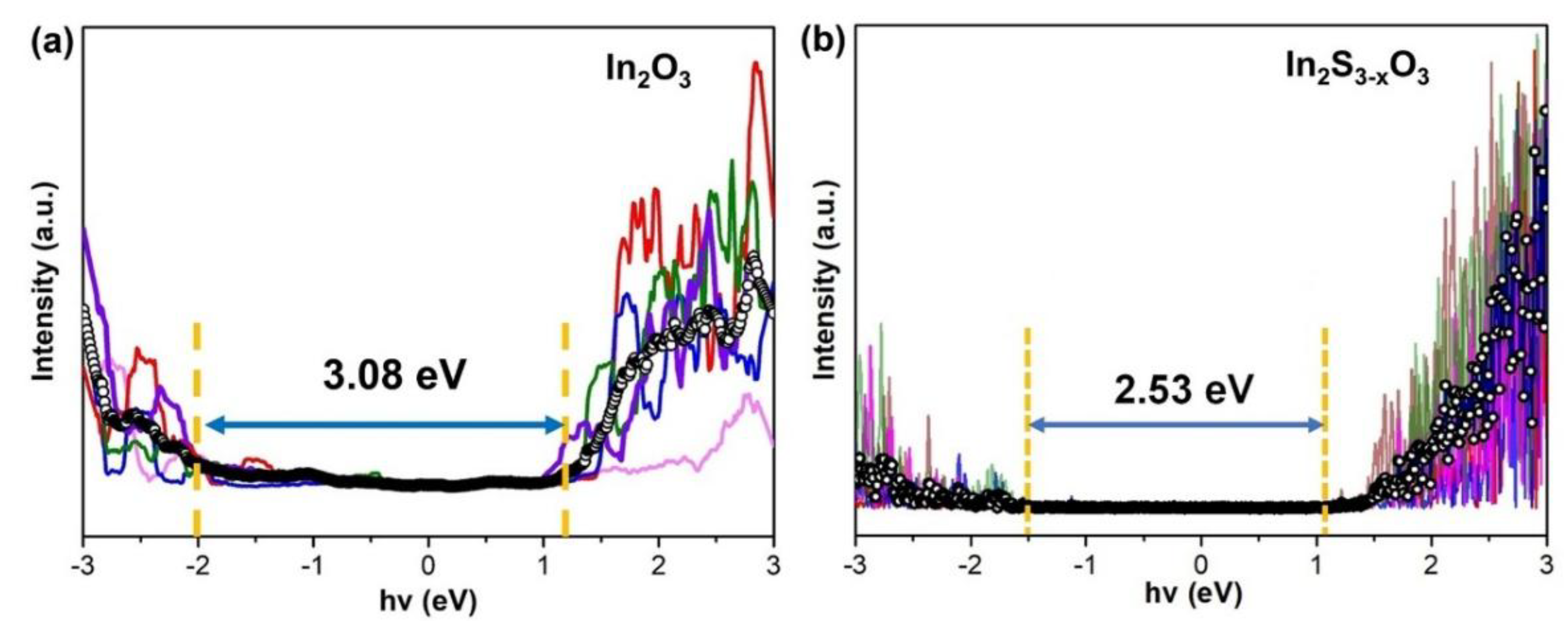
Figure 2. Black circles represent raw data and red lines are fitted envelopes. (a) High-resolution In 3d spectrum; (b) high-resolution O 1s spectrum; (c) high-resolution S 2p spectrum.The sulfurization of In2O3 induces a significant modification of the material’s electronic band structure. To quantify this change, STS measurements were conducted to determine the electronic band structure of 2D In2O3 and In2SxO3−x. To improve accuracy, we depicted five representative measurements and one STS result averaged from 40 I–V spectra shown as black circles in Figure 3. From Figure 3a, the STS spectrum of pristine In2O3 reveals a band gap of 3.08 eV. In contrast, the band gap of the In2SxO3−x is reduced to 2.53 eV (Figure 3b), indicating a substantial narrowing. This narrowing is directly observed as a suppression of the tunneling current within the band gap region for both materials. According to the energy positions of the band edges, the valence band (VB) is located at approximately −1.98 eV for In2O3 and shifts to −1.50 eV for In2SxO3−x. Conversely, the conduction band (CB) shifts from +1.10 eV for In2O3 to +1.03 eV for In2SxO3−x. This upward shift of the VB is the primary contributor to the observed band gap reduction, suggesting a successful alteration of the electronic band structure through the partial replacement of oxygen with sulfur.
Sensors 26 00670 g002
Figure 3. The colored lines represent five representative measurements and the black circles is the STS result averaged from 40 I−V spectra of (a) In2O3 and (b) In2SxO3−x.
Sensors 26 00670 g003
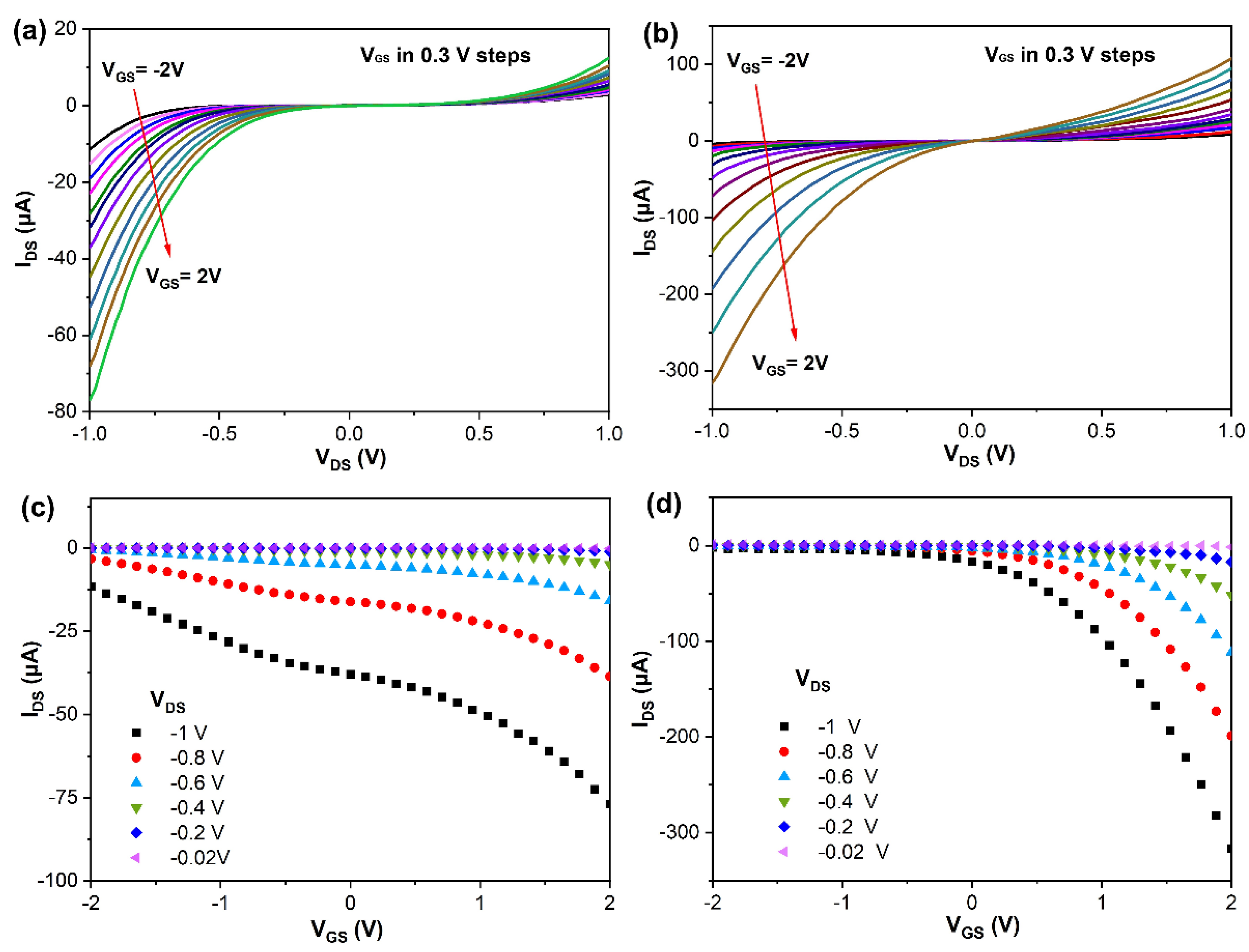
To further characterize their electrical properties, the output drain source current (IDS) with respect to variation of the drain source voltage VDS (−1.0 to 1.0 V) is illustrated in Figure 4a,b for In2O3 and In2SxO3−x, respectively. The resulting curves evaluate the viability of these materials for photodetection applications. The analysis reveals that In2SxO3−x supports a higher current than In2O3 at the same bias voltage. This enhanced current offers practical advantages, including greater signal strength, improved anti-interference capability, a wider dynamic range, and better circuit compatibility [36,37]. Furthermore, the transfer characteristics IDS with respect to variation of back-gate voltage (VGS) of the fabricated In2O3 and In2SxO3−x devices are shown in Figure 4c,d, which exhibit that both materials are n-type semiconducting materials. The mobility of 2D In2O3 and In2SxO3−x devices was calculated from the linear segment of the IDSVGS curve elucidated via the following equation
μ = ( I D S V G S ) × L ( W C V D S )
where L, W, and C are the channel length, channel width, and gate capacitance per unit area, respectively. The L and W are 20 and 40 μm for all devices, respectively. The capacitance per unit area between the channel and the back gate (Cox) was calculated to be 11.5 × 10⁻⁹ F cm−2 for the 300 nm dielectric SiO2 layer. The calculated mobility of the In2SxO3−x device is ~11.1 cm2 V−1 s−1 at VDS = 1 V, which is higher than the value for In2O3 (4.10 cm2 V−1 s−1). These results further demonstrate the superior electrical properties of In2SxO3−x and denote that it is more appropriate for the photodetector and resistive gas sensor.
Figure 4. Output IDSVDS characteristics of (a) In2O3, (b) In2SxO3−x; gate voltage and drain current transfer curves of the devices based on (c) In2O3, (d) In2SxO3−x.
Sensors 26 00670 g004
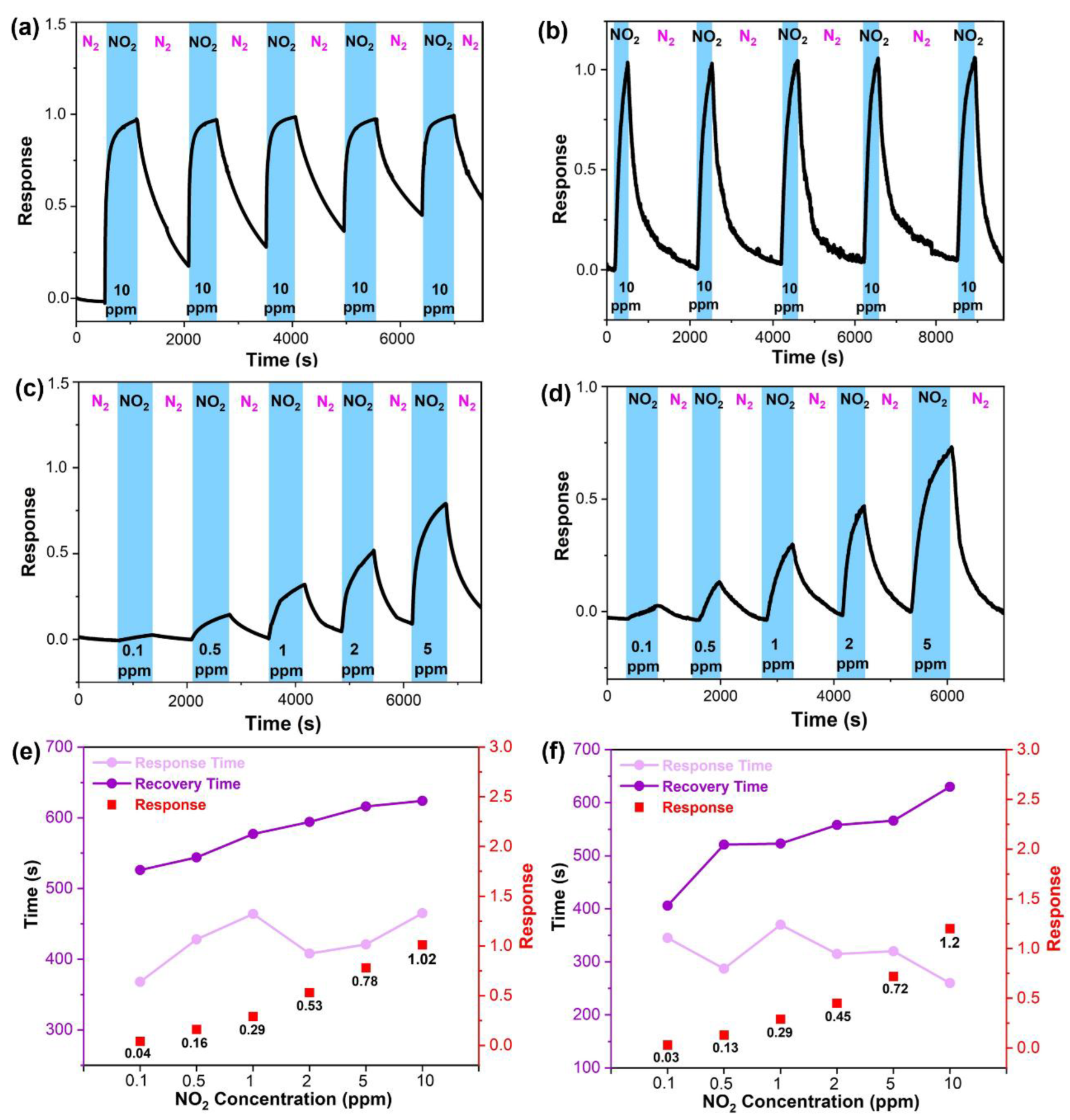
To experimentally evaluate the NO2 sensing performance of 2D In2SxO3−x, sensors were fabricated by depositing a pair of Au electrodes with 100 nm thickness on SiO2 substrates coated with either In2O3 or In2SxO3−x. The sensing measurements were conducted at room temperature under blue light (460 nm) illumination. A mass flow system controlled the inlet of target gases, using N2 as the balance gas. The sensing response was evaluated by the calculation formula I N 2 I g I g , where Ig is the sensor current in the analyte gas and IN2 is the current in pure N2. Figure 5a shows the response of the In2O3 sensor for five repeated cycles with 10 ppm NO2. It exhibited a response factor of 1.02, along with degrading recovery and a shifting baseline over successive cycles. In contrast, the In2SxO3−x sensor demonstrated superior performance under the same conditions (Figure 5b), with a higher response factor of 1.2, better recovery performance, and significantly improved stability over five cycles. The dynamic response to NO2 concentrations ranging from 0.1 to 5 ppm was also investigated. The In2O3 sensor yielded response factors of 0.04, 0.16, 0.29, 0.53, and 0.78, as shown in Figure 5c. The In2SxO3−x sensor showed comparable response factors of 0.03, 0.13, 0.29, 0.45, and 0.72, as shown in Figure 5d, indicating a similar sensitivity to In2O3 in this concentration range. A key difference was observed in response time. The response time, the time to reach 90% of the maximum response, for In2SxO3−x was significantly shorter than for In2O3, especially at higher gas concentrations as shown in Figure 5e,f. While their response times were similar at low NO2 levels, In2SxO3−x responded much faster as the concentration increased, with times of 260 s and 465 s for In2SxO3−x and In2O3, respectively, at 10 ppm. In addition, the recovery time, which is defined as the time to recover to 10% of the maximum response, for both sensors followed a similar trend that increased with NO2 concentration. Selectivity was assessed by exposing the sensors to various industrial gases, including 3% H2, 300 ppm NH3, 500 ppm CO2, and 50 ppm SO2. As shown in Figure S3, both In2O3 and In2SxO3−x exhibit a relatively better selectivity to NO2 than to any other gas, despite NO2 being tested at a concentration at least 5-fold lower. Additionally, through a linear fit of response versus concentration and a fifth-order polynomial fit to the noise (Figure S4, Table S1), the sensor demonstrates an excellent theoretical detection limit of 31.3 ppb. Furthermore, the NO2 sensing performance of In2SxO3−x is benchmarked against other reported In2O3 and In2S3 sensors in Table 1. As we all know, an ideal gas sensor requires high response and selectivity, low operating temperature, and a low detection limit. The In2SxO3−x sensor demonstrates a comparatively high response to low-concentration NO2 at room temperature, offering a simple path toward potentially lower-cost sensors.
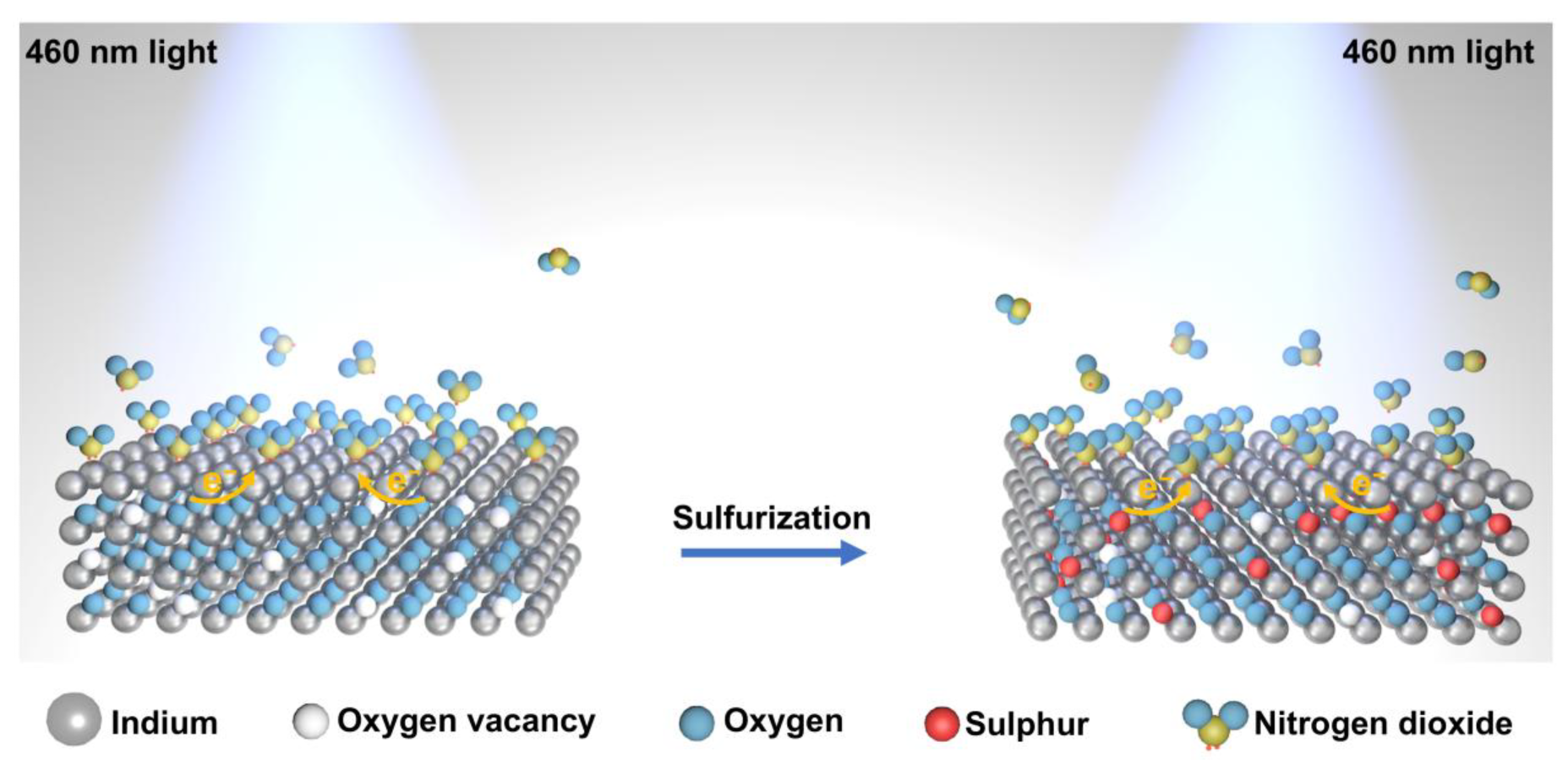
Unlike conventional metal oxide-based sensors, the interaction between NO2 and this 2D surface is majorly dominated by physisorption. The fully reversible and stable resistance cycles of In2SxO3−x (Figure 5b), with minimal baseline drift, are characteristic of predominant physisorption. This behavior contrasts with the baseline drift often associated with strong chemisorption or surface oxidation. This mechanism enables operation at room temperature, significantly reducing power consumption [45,46]. We propose that the sulfurization process, through the replacement of oxygen with sulfur, increases the carrier concentration of the material. Consequently, under identical test conditions, In2SxO3−x exhibits better recovery performance than In2O3. Furthermore, the optical driving method can excite electrons and induce them to migrate to the surface of the material, further enhancing the carrier concentration at the surface. This reduces the required excitation energy, allowing In2SxO3−x to be activated by visible light of longer wavelengths than required for In2O3, as shown in the schematic diagram of Figure 6. When NO2 molecules contact the material, electron dipoles are formed on the interface between In2SxO3−x and NO2 due to its paramagnetic nature. This promotes charge transfer from the n-type In2SxO3−x, which acts as an electron donor, to the electron-accepting NO2 molecules. The consequent decrease in the carrier concentration of the material leads to an increase in resistance and resistance recovery after the desorption of NO2 [47].

4. Conclusions

A large lateral dimension of the 2D In2SxO3−x nanosheet in micrometer scale was synthesized using a liquid metal printing method for In2O3 followed by a controlled annealing treatment. This annealing process induced sulfurization, partially replacing oxygen with sulfur to transform In2O3 into In2SxO3−x. The resulting material demonstrated highly selective and completely reversible NO2 sensing performance at room temperature. Individual 2D flakes of both In2O3 and In2SxO3−x were isolated with thicknesses of ~6.3 nm. Sulfurization significantly modified the bandgap, yielding an n-type semiconducting material. The electronic structure of 2D In2SxO3−x was particularly favorable for NO2 physisorption and interfacial charge transfer due to optimal band alignment and carrier concentrations. This was supported by I–V characterization, which revealed the superior electrical properties of In2SxO3−x compared with In2O3. Consequently, the In2SxO3−x sensor demonstrated excellent performance at room temperature, achieving response factors from 0.03 to 1.2 for low NO2 concentrations (0.1 to 10 ppm) under 460 nm visible light excitation. The sensor was highly selective towards NO2 despite being tested at concentrations at least five times lower than those of other referential gases. It also exhibited complete reversibility and a faster response time. This study establishes 2D non-layered metal oxysulfides as a promising class of high-performance sensing materials with strong potential for developing lower-cost, low-power, and room-temperature NO2 sensors.

Supplementary Materials

The following supporting information can be downloaded at: https://www.mdpi.com/article/10.3390/s26020670/s1, Figure S1: (a) Tube furnace, (b) Schematic diagram of vulcanization process; Figure S2. The integral areas of (a) O 1s and (b) S 2p peaks from the O 1s XPS spectra of In2SXO3−x; Figure S3. Selectivity tests of 3% H2, 300 ppm NH3, 500 CO2, 50 ppm SO2 and 10 ppm NO2 for In2O3 and In2SxO3−x; Figure S4 (a) Response at different NO2 concentrations (black dots) and the corresponding fit curve. (b) The 5th order polynomial fitted response of the sensor versus time at the baseline before NO2 exposure; Table S1: 5th order polynomial fitting data for sensor.

Author Contributions

Y.C.: Conceptualization, Data curation, Writing—original draft. N.M.: Methodology. Z.L.: Methodology, Supervision. D.H.: Supervision. Z.J.: Methodology. L.L.: Supervision. R.O.: Methodology. Z.S.: Investigation. J.O.: Writing—review and editing, Methodology, Supervision. All authors have read and agreed to the published version of the manuscript.

Funding

This work is supported by the National Natural Science Foundation of China (52002337, 52172155).

Institutional Review Board Statement

Not applicable.

Data Availability Statement

Data are contained within the article.

Conflicts of Interest

The authors declare no conflicts of interest.

References

  1. Sun, S.P.; Li, X.L.; Wang, N.; Huang, B.Y.; Li, X.G. A sensitive ppb-level NO2 sensor based on SnO2 decorated Te nanotubes. Sens. Actuator B-Chem. 2025, 428, 137238. [Google Scholar] [CrossRef]
  2. Yang, W.Y.; Huo, Y.Y.; Wang, T.Q.; Liu, X.T.; Li, D.; Yu, H.; Dong, X.T.; Yang, Y. RGO@In2O3 based flexible gas sensor: Efficient monitoring of trace NO2 gas at room temperature. Sens. Actuator B-Chem. 2025, 430, 137359. [Google Scholar] [CrossRef]
  3. Lobell, D.B.; Di Tommaso, S.; Burney, J.A. Globally ubiquitous negative effects of nitrogen dioxide on crop growth. Sci. Adv. 2022, 8, eabm9909. [Google Scholar] [CrossRef]
  4. Bauwens, M.; Compernolle, S.; Stavrakou, T.; Müller, J.-F.; van Gent, J.; Eskes, H.; Levelt, P.F.; van der A, R.; Veefkind, J.P.; Vlietinck, J.; et al. Impact of Coronavirus Outbreak on NO2 Pollution Assessed Using TROPOMI and OMI Observations. Geophys. Res. Lett. 2020, 47, e2020GL087978. [Google Scholar] [CrossRef] [PubMed]
  5. Daood, S.S.; Ottolini, M.; Taylor, S.; Ogunyinka, O.; Hossain, M.M.; Lu, G.; Yan, Y.; Nimmo, W. Pollutant and Corrosion Control Technology and Efficient Coal Combustion. Energy Fuels 2017, 31, 5581–5596. [Google Scholar] [CrossRef]
  6. Tang, T.; Li, Z.; Cheng, Y.F.; Xie, H.G.; Wang, X.X.; Chen, Y.L.; Cheng, L.; Liang, Y.; Hu, X.Y.; Hung, C.M.; et al. In-situ mechanochemically tailorable 2D gallium oxyselenide for enhanced optoelectronic NO2 gas sensing at room temperature. J. Hazard. Mater. 2023, 451, 131184. [Google Scholar] [CrossRef] [PubMed]
  7. Bonardo, D.; Septiani, N.L.W.; Amri, F.; Estananto; Humaidi, S.; Suyatman; Yuliarto, B. Review—Recent Development of WO3 for Toxic Gas Sensors Applications. J. Electrochem. Soc. 2021, 168, 107502. [Google Scholar] [CrossRef]
  8. Sun, K.; Zhan, G.H.; Zhang, L.; Wang, Z.L.; Lin, S.W. Highly sensitive NO2 gas sensor based on ZnO nanoarray modulated by oxygen vacancy with Ce doping. Sens. Actuator B-Chem. 2023, 379, 133294. [Google Scholar] [CrossRef]
  9. Tseng, S.-F.; Chen, P.-S.; Hsu, S.-H.; Hsiao, W.-T.; Peng, W.-J. Investigation of fiber laser-induced porous graphene electrodes in controlled atmospheres for ZnO nanorod-based NO2 gas sensors. Appl. Surf. Sci. 2023, 620, 156847. [Google Scholar] [CrossRef]
  10. Cai, Z.; Park, S. Highly selective acetone sensor based on Co3O4-decorated porous TiO2 nanofibers. J. Alloys Compd. 2022, 919, 165875. [Google Scholar] [CrossRef]
  11. Iwata, K.; Abe, H.; Ma, T.; Tadaki, D.; Hirano-Iwata, A.; Kimura, Y.; Suda, S.; Niwano, M. Application of neural network based regression model to gas concentration analysis of TiO2 nanotube-type gas sensors. Sens. Actuator B-Chem. 2022, 361, 131732. [Google Scholar] [CrossRef]
  12. Du, H.Y.; Li, X.R.; Zhang, Z.; Li, Q.Y.; Zhao, L.; Wang, J. Ultrasensitive NO2 sensor based on In2O3 nanocubes/SnS2 nanoflowers hetero composites. Sens. Actuator B-Chem. 2025, 444, 138277. [Google Scholar] [CrossRef]
  13. Ko, J.K.; Park, I.H.; Hong, K.; Kwon, K.C. Recent Advances in Chemoresistive Gas Sensors Using Two-Dimensional Materials. Nanomaterials 2024, 14, 1397. [Google Scholar] [CrossRef]
  14. Gao, M.Y.; Zhang, W.; Guo, J.; Liu, L. Gas sensor based on two-dimensional GaSe for sensitive NO2 detection. Sens. Actuator B-Chem. 2025, 444, 138447. [Google Scholar] [CrossRef]
  15. Kim, Y.H.; Phan, D.T.; Ahn, S.; Nam, K.H.; Park, C.M.; Jeon, K.J. Two-dimensional SnS materials as high-performance NO sensors with fast response and high sensitivity. Sens. Actuator B-Chem. 2018, 255, 616–621. [Google Scholar] [CrossRef]
  16. Tang, T.; Li, Z.; Cheng, Y.F.; Xu, K.; Xie, H.G.; Wang, X.X.; Hu, X.Y.; Yu, H.; Zhang, B.Y.; Tao, X.W.; et al. Single-step growth of p-type 1D Se/2D GeSexOy heterostructures for optoelectronic NO2 gas sensing at room temperature. J. Mater. Chem. A 2023, 11, 6361–6374. [Google Scholar] [CrossRef]
  17. Zhou, N.; Yang, R.; Zhai, T. Two-dimensional non-layered materials. Mater. Today Nano 2019, 8, 100051. [Google Scholar] [CrossRef]
  18. Guo, J.L.; Liang, G.H.; Wang, R.Y.; Gao, F.E.; Liu, X.; Zhang, X. Strong coupling effects at the interfacial sites of a heterojunction formed by 0D/2D Ir quantum dots and TiO2 ultrathin nanosheets for robust photocatalytic H2 production. Appl. Surf. Sci. 2025, 691, 162700. [Google Scholar] [CrossRef]
  19. Liu, Y.N.; Li, S.; Meng, S.J.; Xiao, S.; Song, H.; Du, K. Defects-enriched two-dimensional ultrathin g-C3N4/In2O3 nanoparticles for effective NO2 detection at room temperature. Sens. Actuator B-Chem. 2023, 396, 134558. [Google Scholar] [CrossRef]
  20. Guan, G.J.; Xia, J.; Liu, S.H.; Cheng, Y.; Bai, S.Q.; Tee, S.Y.; Zhang, Y.W.; Han, M.Y. Electrostatic-Driven Exfoliation and Hybridization of 2D Nanomaterials. Adv. Mater. 2017, 29, 1700326. [Google Scholar] [CrossRef] [PubMed]
  21. Cheng, Y.F.; Li, Z.; Zhang, M.; Xie, H.G.; Tang, T.; Liang, Y.; Wang, X.X.; Xu, K.; Zhang, B.Y.; Haidry, A.A.; et al. Liquid-tin-printed two-dimensional SnO for optoelectronic NO2 gas sensing at room temperature. J. Mater. Chem. C 2023, 11, 14187–14198. [Google Scholar] [CrossRef]
  22. Cheng, Y.F.; Li, Z.; Cheng, L.; Yuan, Y.X.; Xie, E.; Cao, X.L.; Xin, Z.Q.; Liu, Y.Y.; Tang, T.; Hu, X.Y.; et al. Thickness-Dependent Room-Temperature Optoelectronic Gas Sensing Performances of 2D Nonlayered Indium Oxide Crystals from a Liquid Metal Printing Process. ACS Appl. Mater. Interfaces 2023, 15, 57496–57506. [Google Scholar] [CrossRef]
  23. Nikolic, M.V.; Milovanovic, V.; Vasiljevic, Z.Z.; Stamenkovic, Z. Semiconductor Gas Sensors: Materials, Technology, Design, and Application. Sensors 2020, 20, 6694. [Google Scholar] [CrossRef] [PubMed]
  24. Reddy, B.K.S.; Borse, P.H. Review-Recent Material Advances and Their Mechanistic Approaches for Room Temperature Chemiresistive Gas Sensors. J. Electrochem. Soc. 2021, 168, 057521. [Google Scholar] [CrossRef]
  25. Yang, Z.; Guo, L.J.; Zu, B.Y.; Guo, Y.A.; Xu, T.; Dou, X.C. CdS/ZnO Core/Shell Nanowire-Built Films for Enhanced Photodetecting and Optoelectronic Gas-Sensing Applications. Adv. Opt. Mater. 2014, 2, 738–745. [Google Scholar] [CrossRef]
  26. Zhang, K.; Qin, S.W.; Tang, P.G.; Feng, Y.J.; Li, D.Q. Ultra-sensitive ethanol gas sensors based on nanosheet-assembled hierarchical ZnO-In2O3 heterostructures. J. Hazard. Mater. 2020, 391, 122191. [Google Scholar] [CrossRef]
  27. Xu, K.; Zhang, B.Y.; Mohiuddin, M.; Ha, N.; Wen, X.; Zhou, C.; Li, Y.; Ren, G.; Zhang, H.; Zavabeti, A.; et al. Free-standing ultra-thin Janus indium oxysulfide for ultrasensitive visible-light-driven optoelectronic chemical sensing. Nano Today 2021, 37, 101096. [Google Scholar] [CrossRef]
  28. Nguyen, C.K.; Low, M.X.; Zavabeti, A.; Jannat, A.; Murdoch, B.J.; Della Gaspera, E.; Orrell-Trigg, R.; Walia, S.; Elbourne, A.; Truong, V.K.; et al. Ultrathin oxysulfide semiconductors from liquid metal: A wet chemical approach. J. Mater. Chem. C 2021, 9, 11815–11826. [Google Scholar] [CrossRef]
  29. Armstrong, C.; Otero, K.; Hernandez-Pagan, E.A. Unraveling the molecular and growth mechanism of colloidal black In2O3−x. Nanoscale 2024, 16, 9875–9886. [Google Scholar] [CrossRef]
  30. Nguyen, T.T.; Singh, J.; Nguyen, V.A.; Hoang, T.L.G.; Nguyen-Tri, P. Synthesis of Three-Dimensional β-In2S3 Nanoflowers with a Tunable Surface Area for Boosted Photocatalytic Degradation of Tetracycline and Rhodamine B. Langmuir 2025, 41, 14229–14243. [Google Scholar] [CrossRef]
  31. Karmakar, G.; Tyagi, A.; Shah, A.Y.; Kumbhare, L.B.; Wadawale, A.P.; Kedarnath, G.; Singh, V. Synthesis of photoresponsive and photoemissive ultrathin 2D nanosheets of In2S3 achieved through a new single source molecular precursor. RSC Adv. 2022, 12, 27292–27299. [Google Scholar] [CrossRef]
  32. Yang, W.; Chen, H.T.; Lu, J.M. Assembly of stacked In2O3 nanosheets for detecting trace NO2 with ultrahigh selectivity and promoted recovery. Appl. Surf. Sci. 2021, 539, 148217. [Google Scholar] [CrossRef]
  33. Abdullah, H.; Gultom, N.S.; Kuo, D.-H. Indium oxysulfide nanosheet photocatalyst for the hexavalent chromium detoxification and hydrogen evolution reaction. J. Mater. Sci. 2017, 52, 6249–6264. [Google Scholar] [CrossRef]
  34. Alkathiri, T.; Xu, K.; Fei, Z.D.; Ren, G.H.; Ha, N.; Khan, M.W.; Syed, N.; Almutairi, A.F.M.; Zhang, B.Y.; Ou, R.; et al. Ultrathin 2D silver sulphate nanosheets for visible-light-driven NO2 sensing at room temperature. J. Mater. Chem. C 2022, 10, 16108–16115. [Google Scholar] [CrossRef]
  35. Ou, R.; Xu, K.; Ha, N.; Ren, G.H.; Trinh, V.; Hu, Y.H.; Ma, Q.; Zhang, B.Y.; Wen, X.M.; Cheng, Y.F.; et al. Visible-Light-Driven Two-Dimensional Indium Oxysulfide for Sensitive NO2 Detection. ACS Appl. Nano Mater. 2024, 7, 14223–14231. [Google Scholar] [CrossRef]
  36. Jannat, A.; Yao, Q.F.; Zavabeti, A.; Syed, N.; Zhang, B.Y.; Ahmed, T.; Kuriakose, S.; Mohiuddin, M.; Pillai, N.; Haque, F.; et al. Ordered-vacancy-enabled indium sulphide printed in wafer-scale with enhanced electron mobility. Mater. Horiz. 2020, 7, 827–834. [Google Scholar] [CrossRef]
  37. Jannat, A.; Syed, N.; Xu, K.; Rahman, M.A.; Talukder, M.M.M.; Messalea, K.A.; Mohiuddin, M.; Datta, R.S.; Khan, M.W.; Alkathiri, T.; et al. Printable single-unit-cell-thick transparent zinc-doped indium oxides with efficient electron transport properties. ACS Nano 2021, 15, 4045–4053. [Google Scholar] [CrossRef] [PubMed]
  38. Wang, Z.Y.; Ding, H.Z.; Liu, X.F.; Zhao, J. Synthesis and NO2 Sensing Properties of In2O3 Micro-Flowers Composed of Nanorods. Nanomaterials 2023, 13, 2289. [Google Scholar] [CrossRef] [PubMed]
  39. Patil, S.P.; Patil, V.L.; Vanalakar, S.A.; Shendage, S.S.; Pawar, S.A.; Kim, J.H.; Ryu, J.; Patil, D.R.; Patil, P.S. Porous In2O3 thick films as a low temperature NO2 gas detector. Mater. Lett. 2022, 306, 130916. [Google Scholar] [CrossRef]
  40. Xiao, B.X.; Zhao, Q.; Wang, D.X.; Ma, G.S.; Zhang, M.Z. Facile synthesis of nanoparticle packed In2O3 nanospheres for highly sensitive NO2 sensing. New J. Chem. 2017, 41, 8530–8535. [Google Scholar] [CrossRef]
  41. Vishnuraj, R.; Unnathpadi, R.; Rangarajan, M.; Pullithadathil, B. n–n type In2O3@WO3 heterojunction nanowires: Enhanced NO2 gas sensing characteristics for environmental monitoring. Microchimica Acta 2024, 191, 645. [Google Scholar] [CrossRef]
  42. Wang, H.; Fan, G.J.; Yang, Z.X.; Han, N.; Chen, Y.F.; Yang, J. Low-Temperature As-Doped In2O3 Nanowires for Room Temperature NO2 Gas Sensing. ACS Appl. Nano Mater. 2022, 5, 7983–7992. [Google Scholar] [CrossRef]
  43. Malathi, B.; Parveen, R.A.; Bharathi, P.; Nakamura, A.; Archana, J.; Navaneethan, M.; Harish, S. Interface engineering of 2D/2D MoS2/In2S3 heterostructure for highly sensitive NO2 detection at room temperature gas sensor. J. Environ. Chem. Eng. 2024, 12, 113023. [Google Scholar] [CrossRef]
  44. Wang, B.L.; Sun, Y.J.; Dong, Y.M.; Hou, Y.C.; Lu, Z.Y.; Wei, Z.H.; Zhang, W.D.; Suematsu, K.; Hu, J. Chemiresistive flexible gas sensor for NO2 sensing at room-temperature using in situ constructed Au@In2S3/In2O3 hybrid microflowers. Sens. Actuator B-Chem. 2025, 422, 136666. [Google Scholar] [CrossRef]
  45. Ou, J.Z.; Ge, W.; Carey, B.; Daeneke, T.; Rotbart, A.; Shan, W.; Wang, Y.; Fu, Z.; Chrimes, A.F.; Wlodarski, W.; et al. Physisorption-Based Charge Transfer in Two-Dimensional SnS2 for Selective and Reversible NO2 Gas Sensing. ACS Nano 2015, 9, 10313–10323. [Google Scholar] [CrossRef] [PubMed]
  46. Shangguan, C.; Xu, K.; Dong, M.; Ren, G.; You, R.; Liu, Z.; Ou, R.; Lu, L.; Hu, Y.; Ma, Q.; et al. Two-Dimensional Iron Oxyhydroxide for Visible-Light-Driven NO2 Sensing. ACS Appl. Nano Mater. 2025, 8, 952–961. [Google Scholar] [CrossRef]
  47. Tang, T.; Li, Z.; Liu, Y.Y.; Chen, Y.L.; Cheng, Y.F.; Liang, Y.; Zhuang, J.H.; Hu, X.Y.; Jannat, A.; Ou, R.; et al. Ultrathin two-dimensional titanium oxysulfide for enhanced sensitivity and stability of room temperature NO2 sensing. Ceram. Int. 2025, 51, 3216–3223. [Google Scholar] [CrossRef]
Figure 1. (a) AFM photographs of In2O3, with height calibrated by the blue line; (b) AFM photographs of In2SxO3−x, with height calibrated by the blue line; (c) AFM height maps containing blue (In2O3) and red (In2SxO3−x) lines; (d) Raman spectra of In2O3 and In2SxO3−x.
Sensors 26 00670 g001
Figure 5. The dynamic response curves of (a) In2O3; (b) In2SxO3−x upon the exposure to 10 ppm NO2 gas in 5 repeated cycles; the dynamic response curves of (c) In2O3; (d) In2SxO3−x sensor upon the exposure to NO2 gas with different concentrations at room temperature under blue light (460 nm); the response time and recovery time of (e) In2O3; (f) In2SxO3−x.
Sensors 26 00670 g005
Figure 6. Schematic diagram of In2O3 sulfurto In2SxO3−x process and gas sensing mechanism diagram.
Sensors 26 00670 g006
Table 1. Performance comparison of the NO2 sensors based on In2S3 or In2O3 materials.
MaterialsTemperature
(°C)
Light Cond.NO2
(ppm)
Response
R g R a R g
tres./trec
(s)
LOD
(ppb)
Reference
In2O3 microflowers100Dark162.6344/318[38]
In2O3 nanocubes50Dark39.021/52260.0[39]
In2O3 nanospheres120Dark1370.9148/7210.0[40]
In2O3/SnS2 nanoflowers180Dark514.634/6512.0[12]
In2O3@WO3 nanowires200Dark37.422.2/216[41]
As-doped In2O3 nanowiresRTDark5000.7—/—500.0[42]
2D/2D MoS2/In2S3RTDark501.996/408450.0[43]
Au@In2S3/In2O3 hybrid microflowersRTDark10019.712/27200.0[44]
In2S3−xO3RT460 nm101.2260/62031.3This work
Temperature.: working temperature; RT: room temperature; Light cond.: Light condition; R g : resistance of the sensor exposed to NO2; R a : resistance of the sensor exposed to air or N2; tres.: response time; trec.: recovery time; LOD: low detection limit.
Disclaimer/Publisher’s Note: The statements, opinions and data contained in all publications are solely those of the individual author(s) and contributor(s) and not of MDPI and/or the editor(s). MDPI and/or the editor(s) disclaim responsibility for any injury to people or property resulting from any ideas, methods, instructions or products referred to in the content.