Fault Diagnosis and Classification of Rolling Bearings Using ICEEMDAN–CNN–BiLSTM and Acoustic Emission

Abstract
1. Introduction
2. Methodology Overview
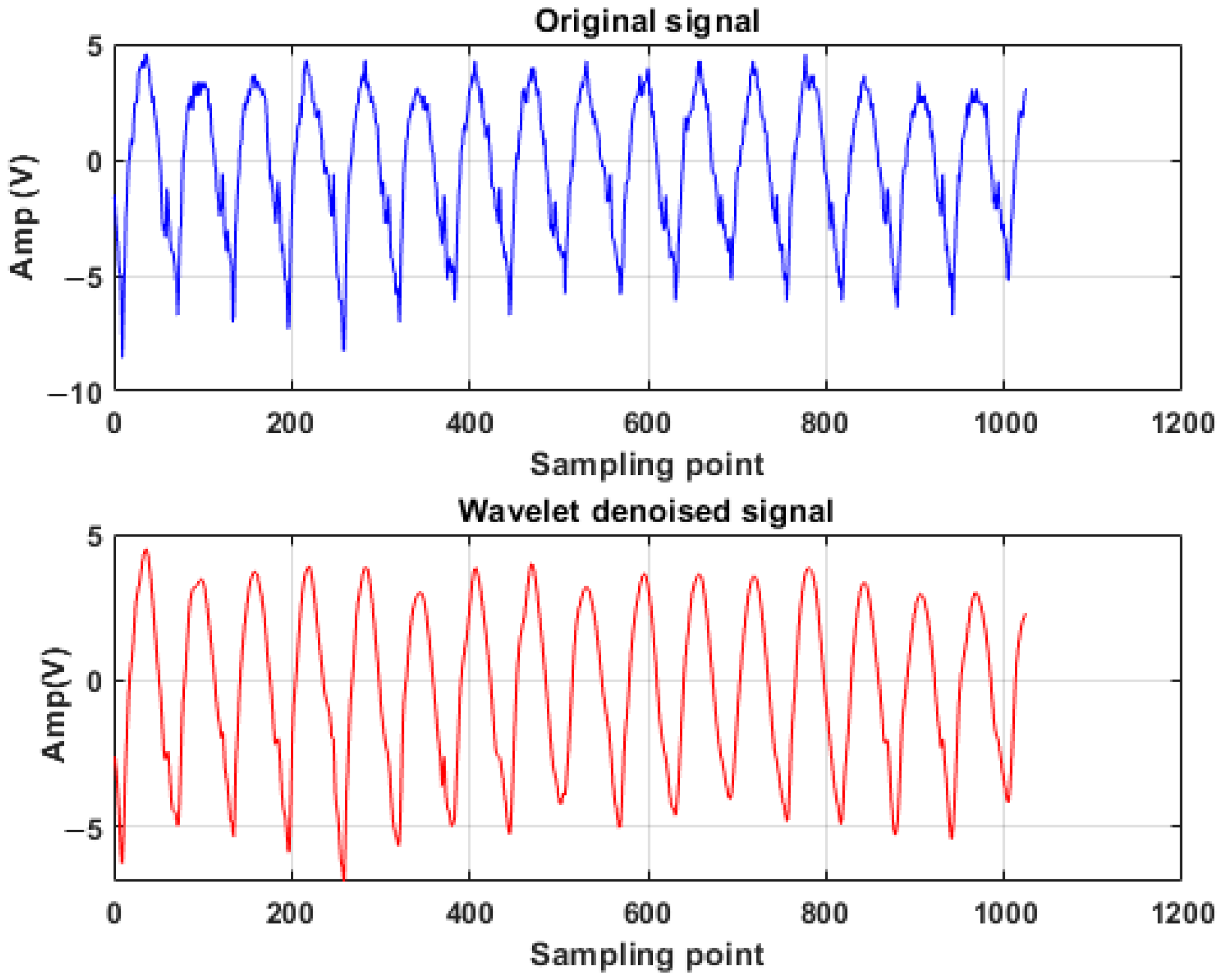
- Apply wavelet thresholding to suppress background noise and improve the signal-to-noise ratio.
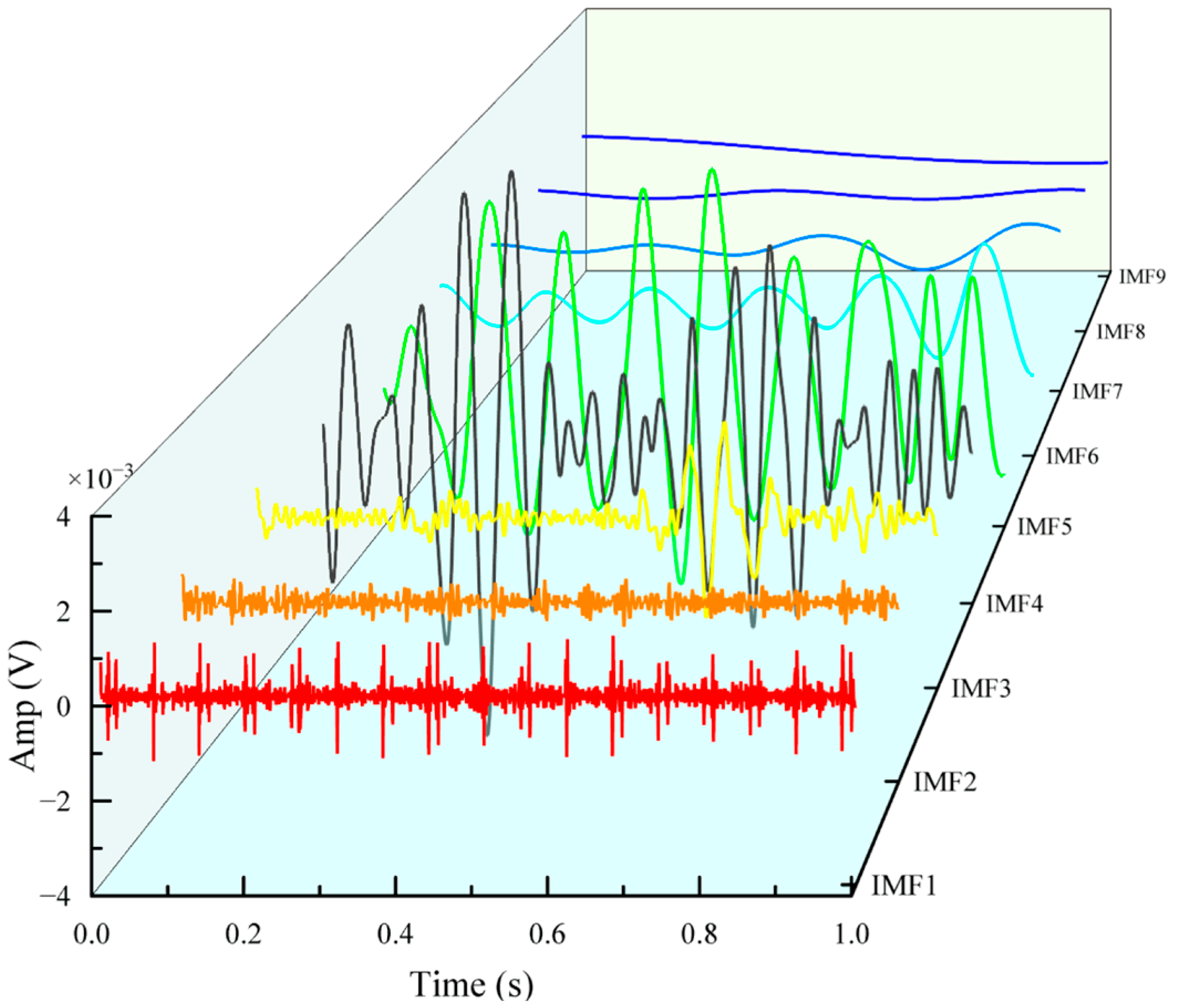
- Use ICEEMDAN to decompose AE signals into intrinsic mode functions IMFs, and select key IMFs strongly associated with impact features using a kurtosis-based criterion.
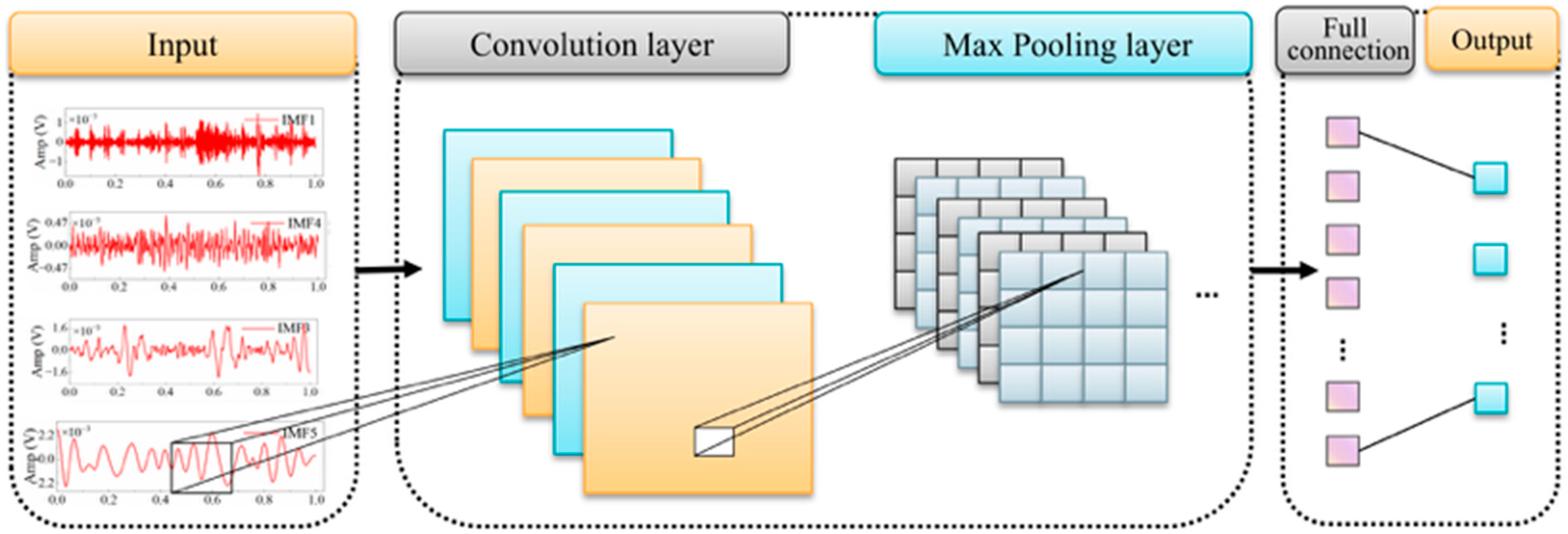
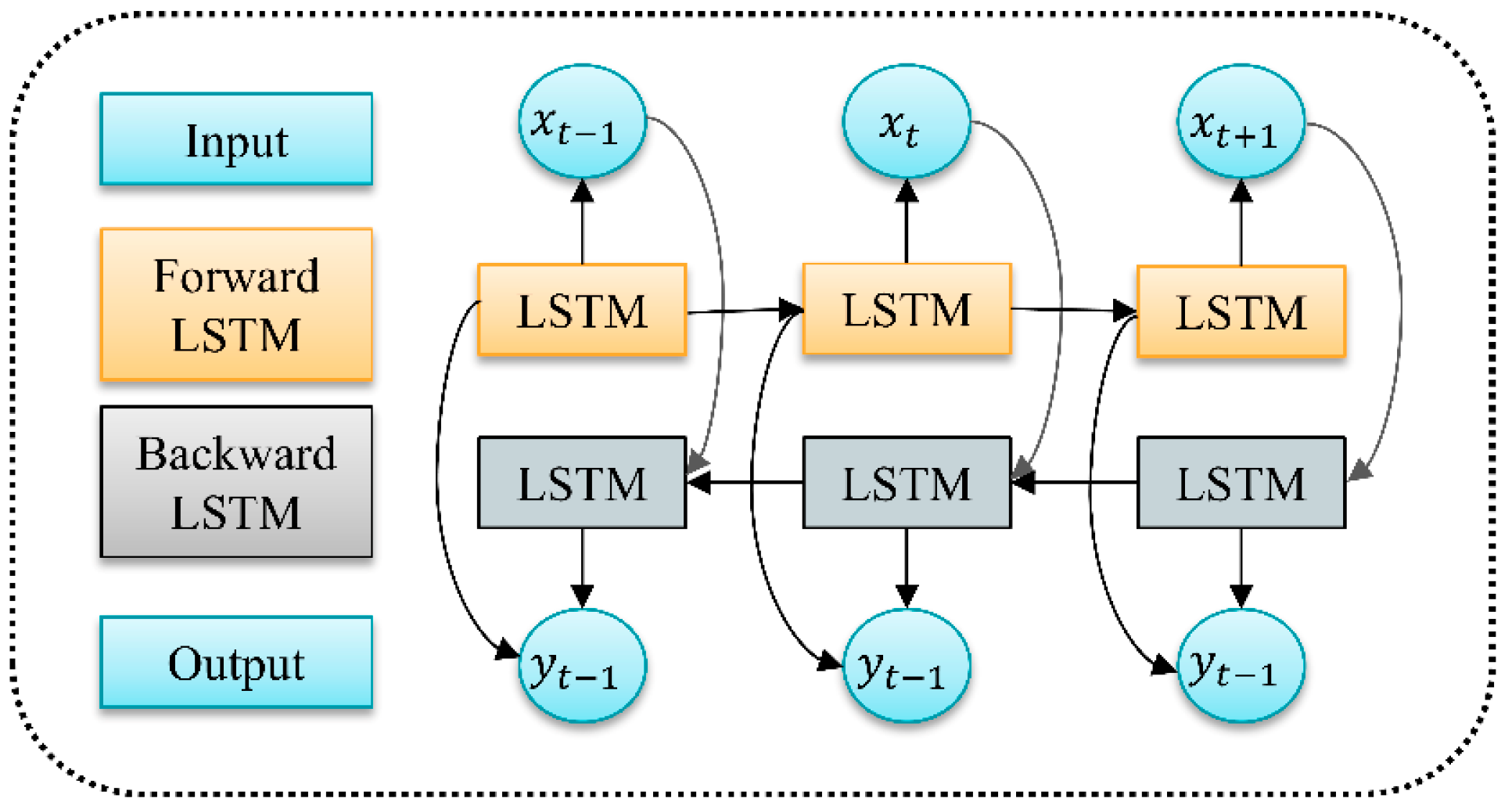
- Employ a CNN to extract discriminative time–frequency features, and a BiLSTM to model temporal dependencies, effectively fusing local patterns with long-range dynamics.
- Use a terminal classifier to recognize fault types. The method combines adaptive handling of non-stationary components with discriminative deep feature learning, making it suitable for complex operating conditions.
2.1. Wavelet Threshold Denoising
- Select a wavelet basis and determine the decomposition levels. Perform wavelet decomposition on the noisy fault signal to obtain wavelet coefficients .
- Apply an appropriate threshold and threshold function to quantize the high-frequency coefficients at each level.
- Reconstruct the denoised signal (t) using the thresholded high-frequency coefficients and low-frequency coefficients from each level.
2.2. ICEEMDAN Algorithm
- Add Gaussian white noise to the original signal
- 2.
- Calculate the first decomposition residual.
- 3.
- Calculate the first intrinsic mode component IMF1
- 4.
- Estimate the second residual as a series of means and define the second intrinsic mode component IMF2
- 5.
- Calculate the k-th residual rk
- 6.
- Calculate the k-th intrinsic mode component
- 7
- Return to step 5 for calculation
2.3. CNN-BiLSTM Model for Fault Type Classification
2.3.1. Convolutional Neural Network
2.3.2. Bidirectional Long Short-Term Memory Network
3. Experimental Validation
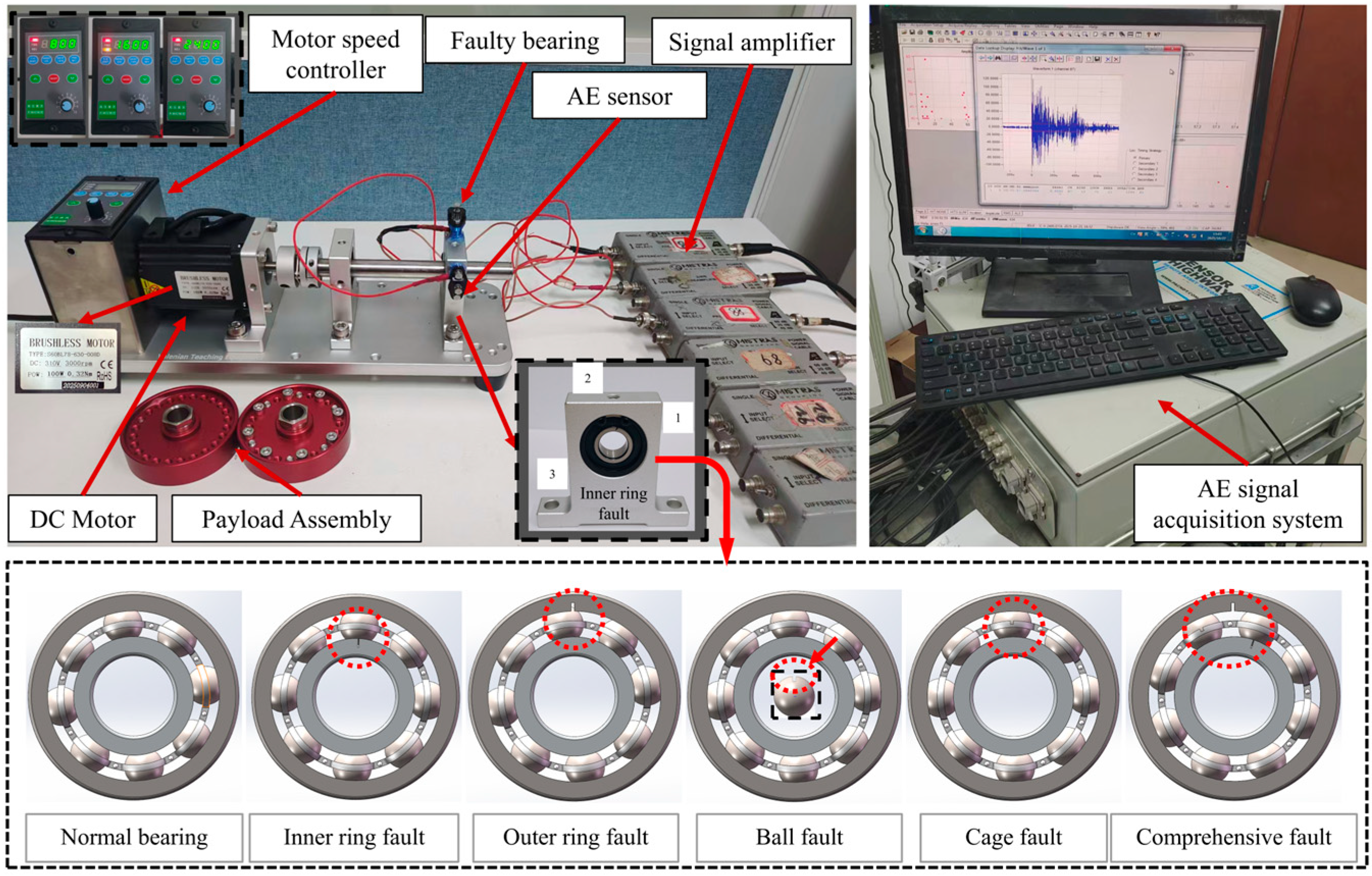
3.1. Test Platform and Experimental Procedure Introduction
3.2. Data Processing and Dataset Establishment
3.2.1. Denoising of AE Signals from Faulty Bearings
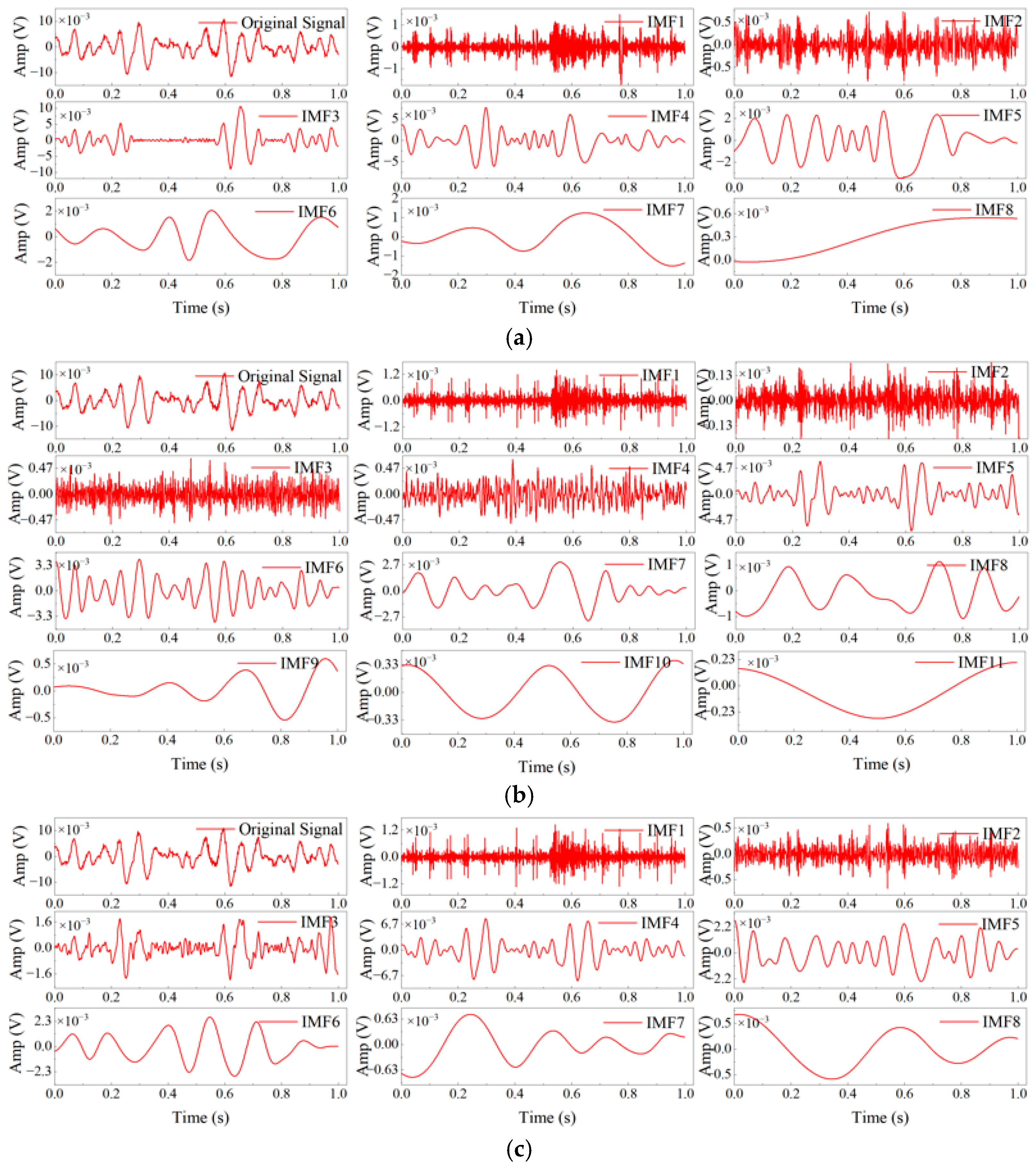
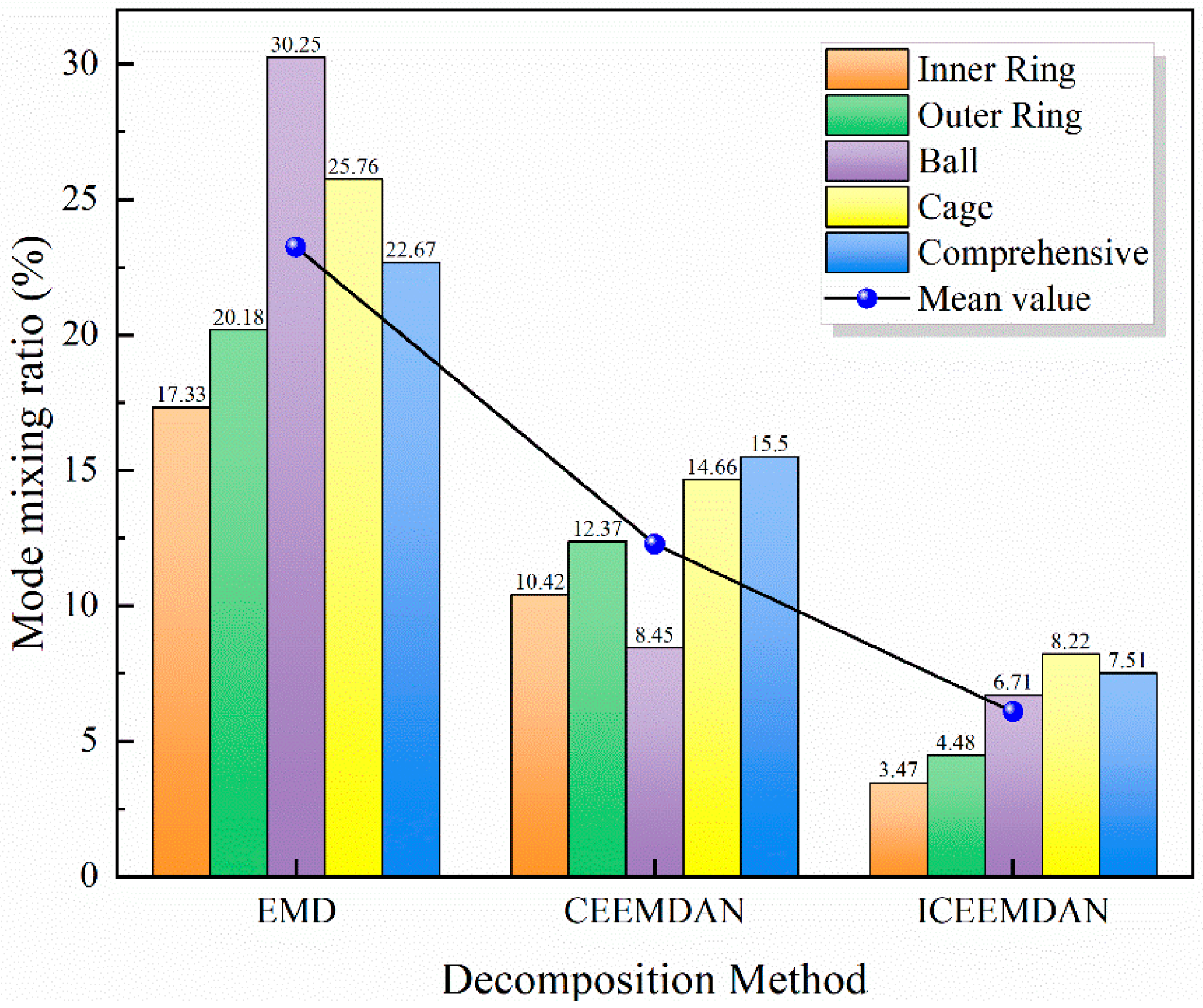
3.2.2. Comparison of EMD, CEEMDAN, and ICEEMDAN Decompositions
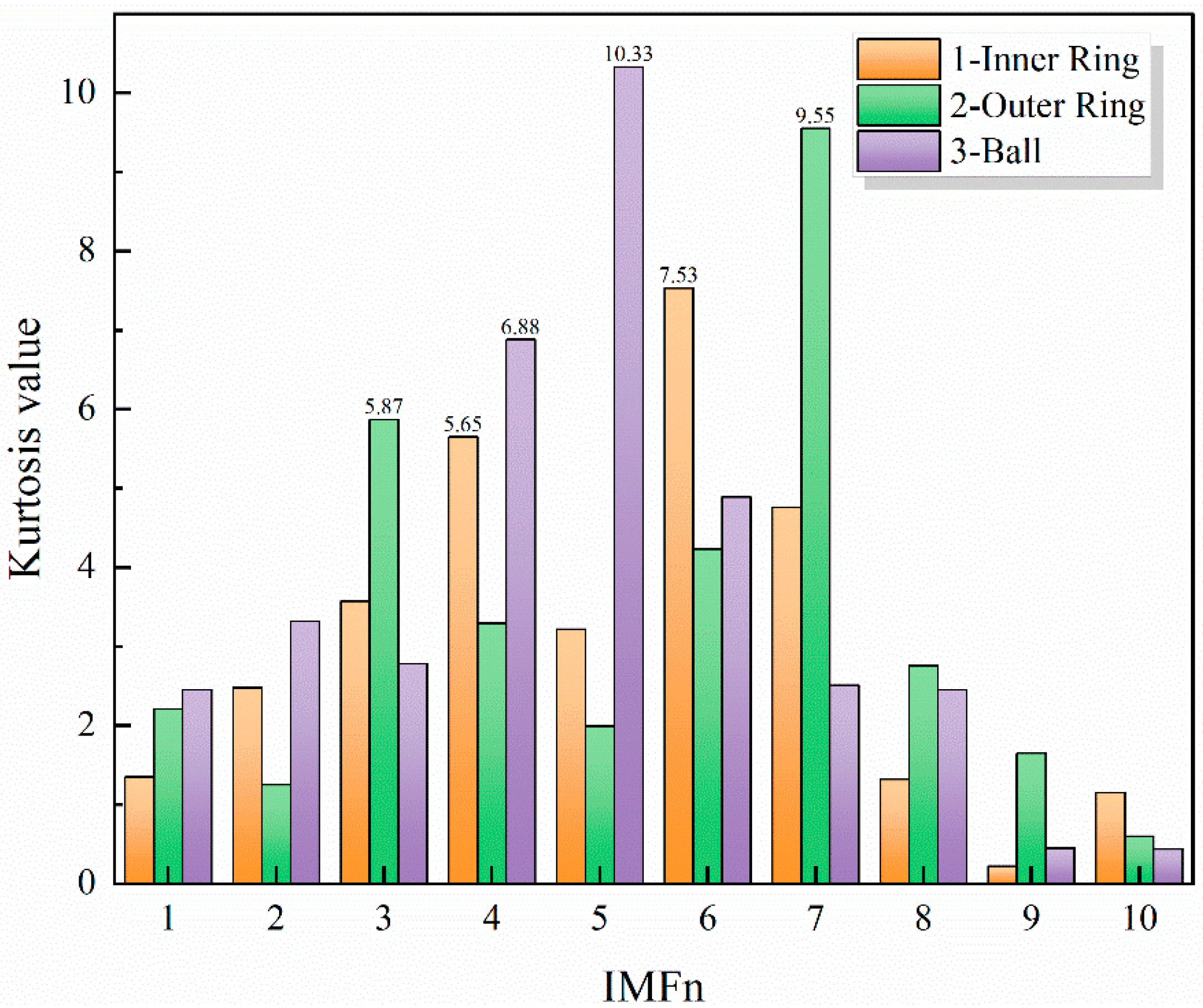
3.2.3. Kurtosis Values
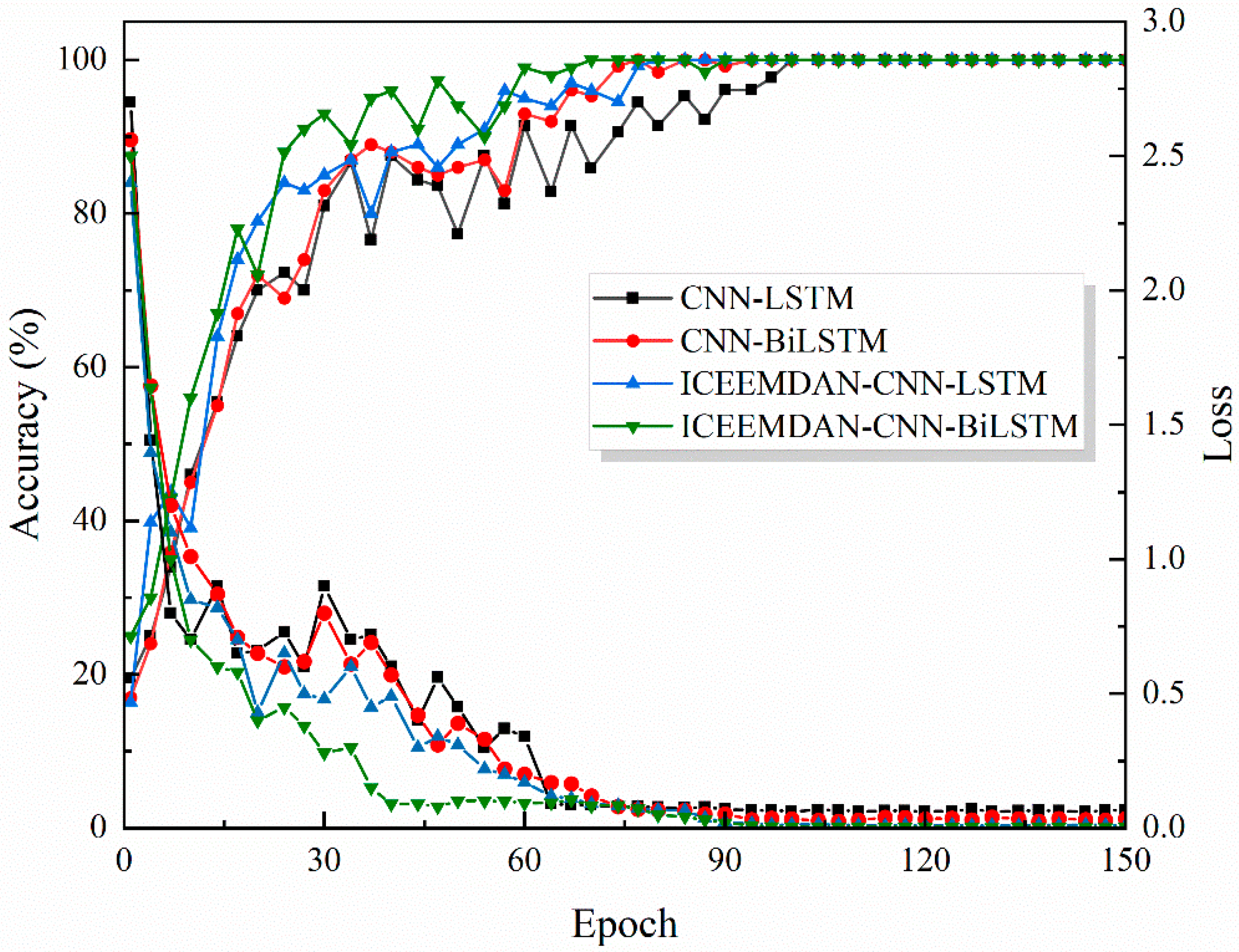
3.3. Model Training and Validation
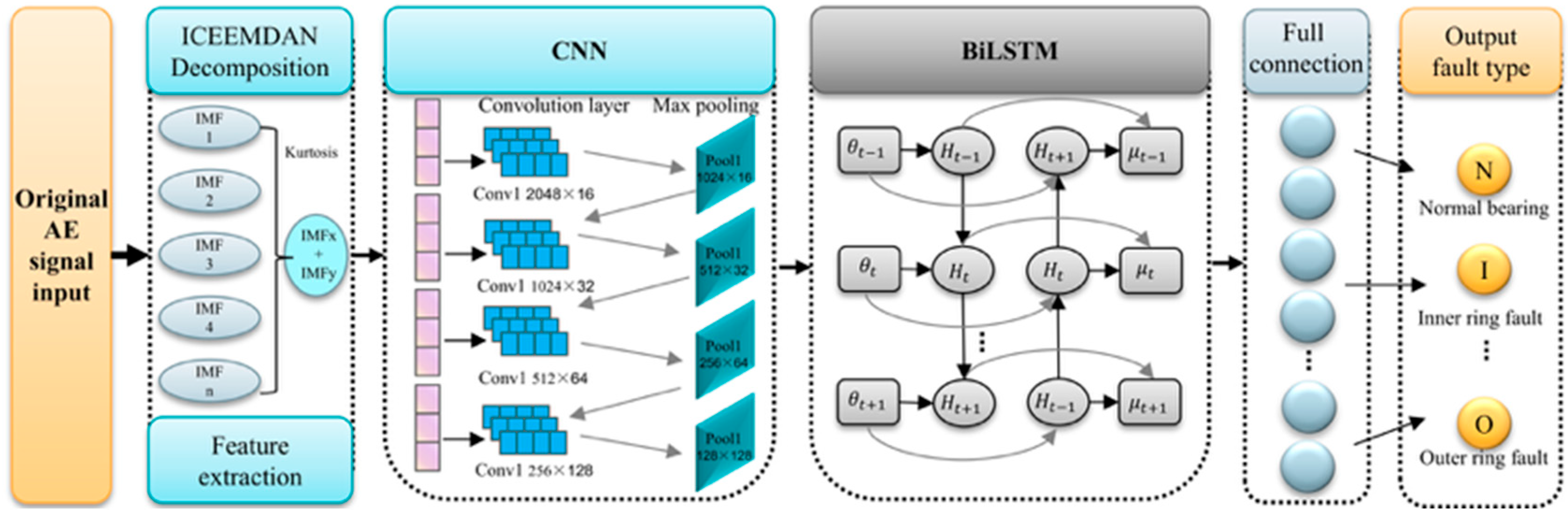
- Signal Preprocessing: The fault bearing AE signals collected from the mechanical fault test rig are organized, segmented, selected, and then subjected to wavelet threshold denoising.
- Signal Decomposition: The processed AE signals are decomposed into a series of IMF components using the ICEEMDAN algorithm.
- Signal Reconstruction: The kurtosis value of each IMF component is calculated. IMF components with larger kurtosis values are selected for signal reconstruction, forming feature vectors.
- Feature Extraction: Time–frequency domain features are extracted using CNN and then fused.
- Pattern Recognition: The BiLSTM network is utilized to learn sequential features for training and pattern recognition, thereby accomplishing the fault diagnosis of rolling bearing AE signals.
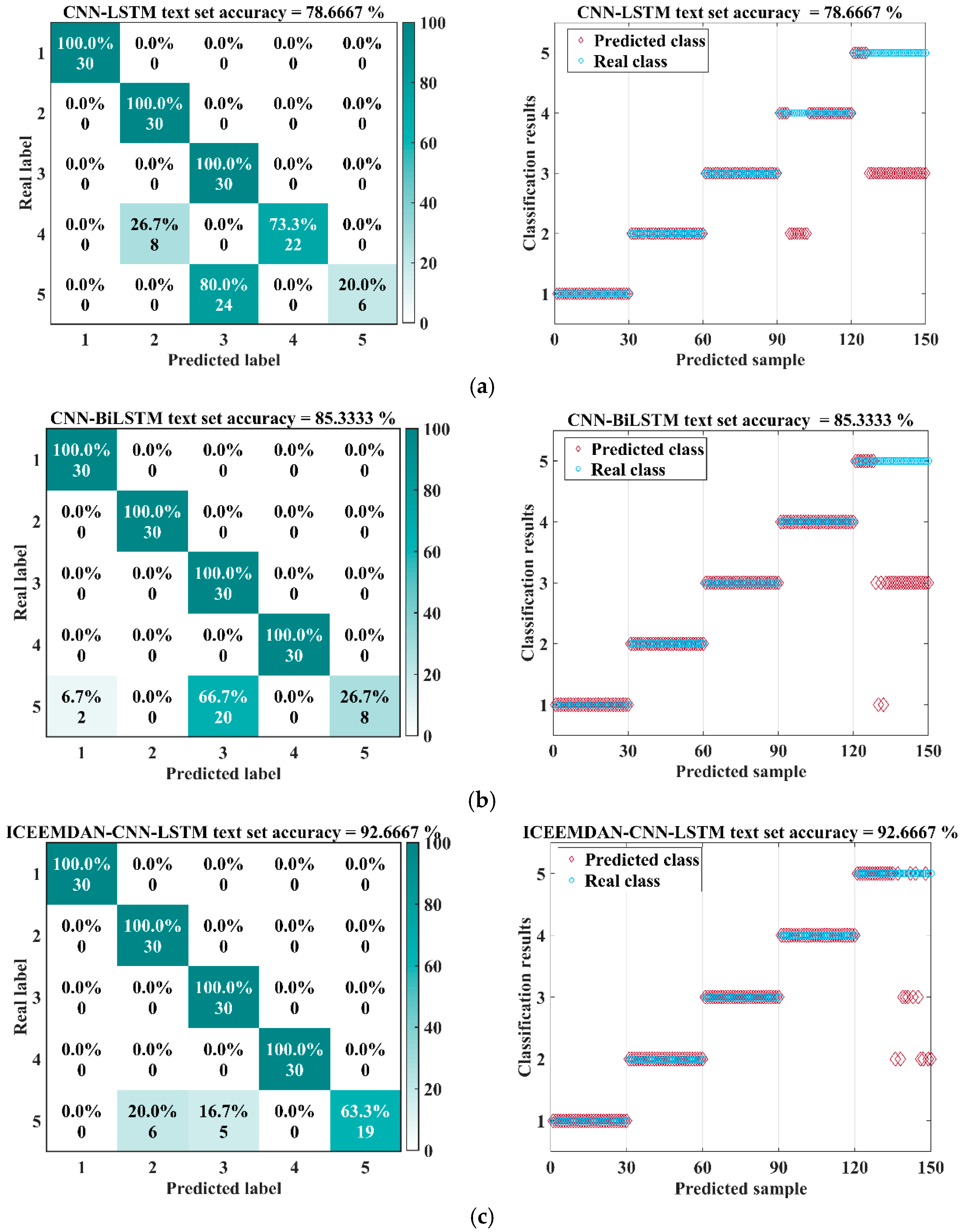
3.4. Model Application
4. Discussion
- In the ICEEMDAN–CNN–BiLSTM model, raw acoustic emission (AE) signals from faulty bearings are denoised using wavelet thresholding to improve the signal-to-noise ratio. The ICEEMDAN algorithm decomposes the processed signal into multiple intrinsic mode function (IMF) components. Those with higher kurtosis values are selected to represent the original fault signal, thereby reducing the dimensionality of the feature set and lessening the computational load for subsequent fault identification. CNN then extracts and fuses time–frequency domain features from these components. Finally, BiLSTM learns sequential dependencies within the features for model training and pattern recognition, enabling fault diagnosis of rolling bearing AE signals.
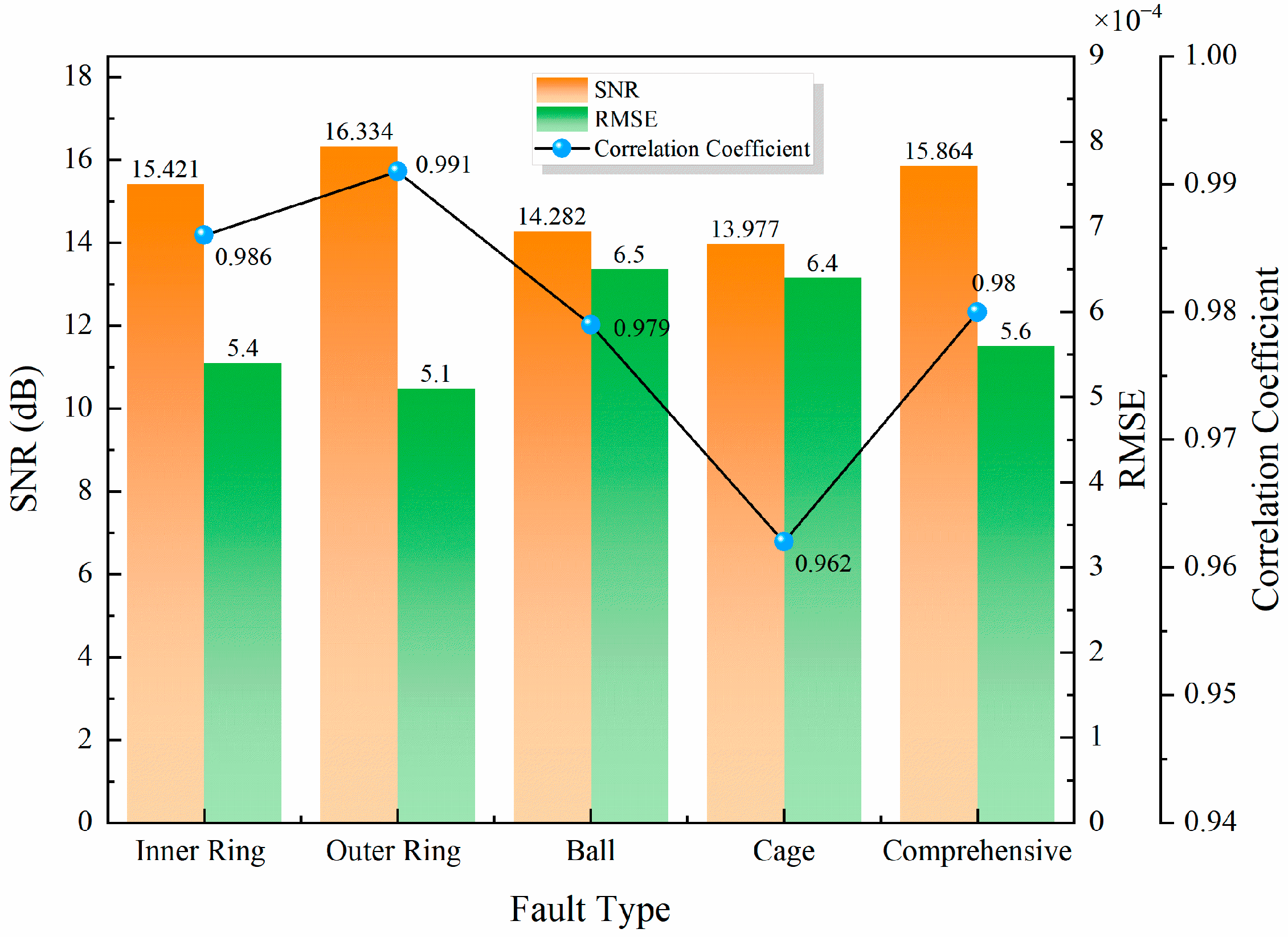
- In the signal preprocessing stage, the wavelet threshold denoising method effectively eliminates background noise while optimally preserving the transient impact components that characterize bearing fault conditions. Following wavelet threshold denoising, the processed signals achieved an average signal-to-noise ratio (SNR) of 15.175 dB, a root-mean-square error (RMSE) as low as 0.00058, and an average correlation coefficient between the denoised and original signals of up to 0.979.
- The ICEEMDAN decomposition algorithm demonstrated superior performance compared to traditional EMD and CEEMDAN when processing nonlinear and non-stationary acoustic emission signals. By analyzing mode-mixing rates, it was evident that ICEEMDAN achieved the lowest mixing rate, averaging only 6.08%, which was significantly lower than EMD’s 23.24% and CEEMDAN’s 12.28%. This finding validates ICEEMDAN’s distinct advantages in mitigating mode mixing, eliminating residual noise redundancy, and removing spurious modes, thereby yielding purer IMFs with enhanced discriminability across frequency scales. Notably, the high-frequency IMF effectively characterizes fault impacts, while the mid-to-low-frequency components exhibit regular waveforms, providing a more precise modal basis for subsequent feature extraction.
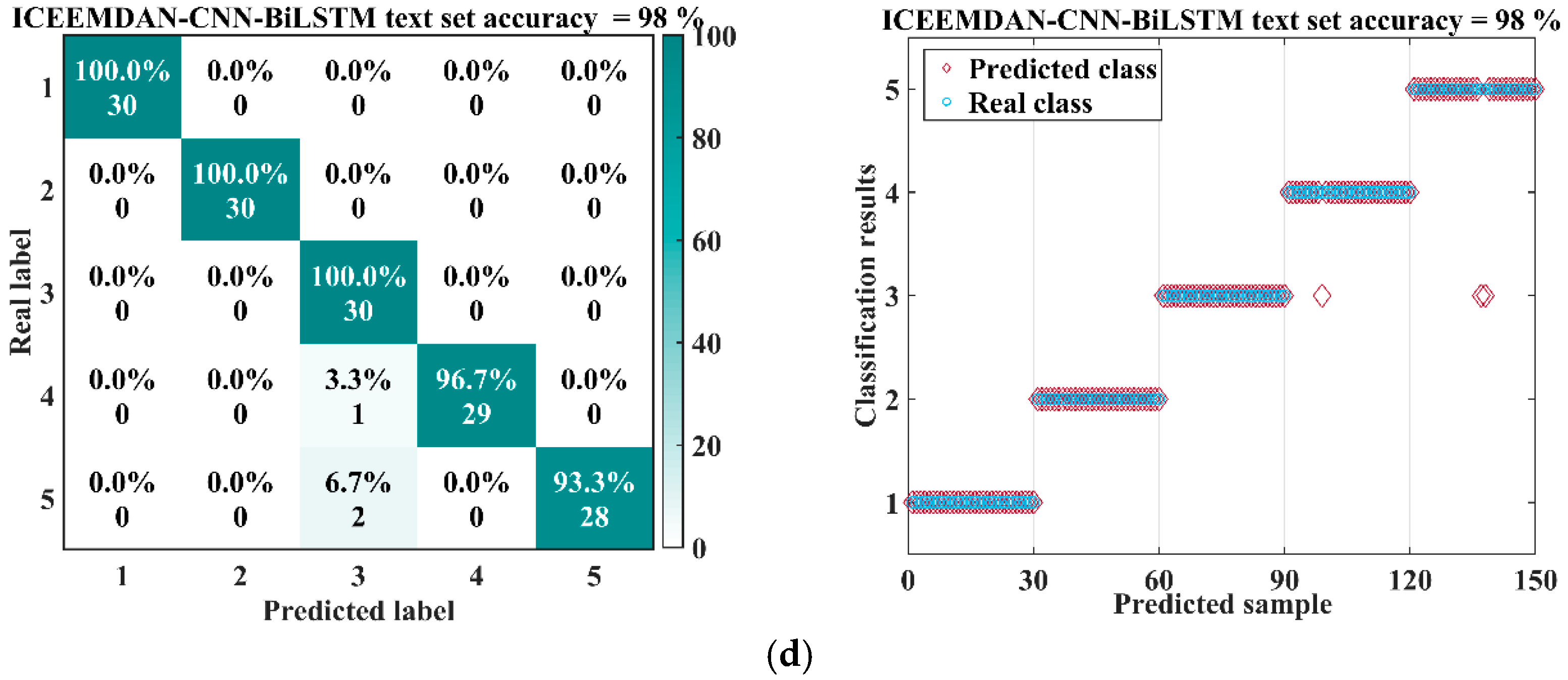
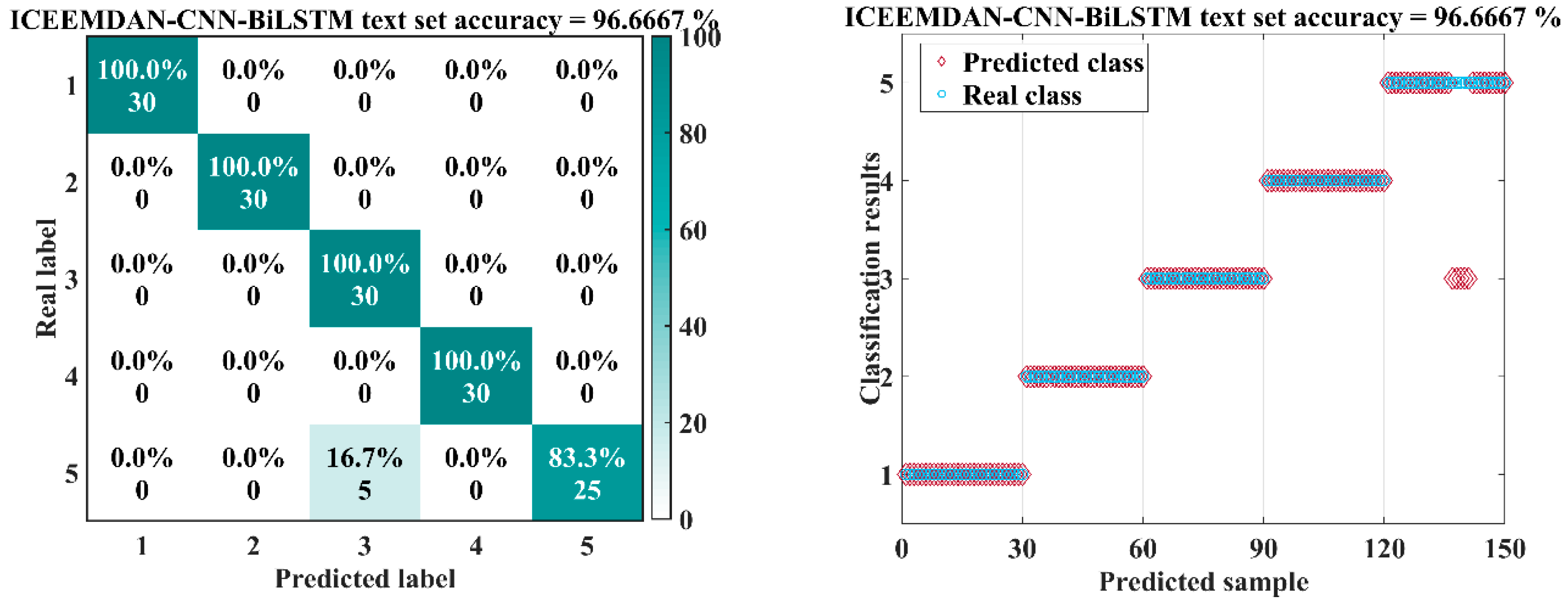
- The ICEEMDAN–CNN–BiLSTM model exhibits high fault recognition rates and robust performance in practical applications. When compared to the CNN–LSTM, CNN–BiLSTM, and ICEEMDAN–CNN–LSTM models, the proposed model clearly achieved superior recognition performance. In the experimental evaluations, the average recognition accuracy across the test and validation sets reached an impressive 97.33%, demonstrating strong generalization capabilities.
5. Conclusions
5.1. Summary of Findings
5.2. Limitations and Future Work
Author Contributions
Funding
Data Availability Statement
Conflicts of Interest
References
- Chen, Z.; Wang, Y.; Wu, J.; Deng, C.; Hu, K. Sensor Data-Driven Structural Damage Detection Based on Deep Convolutional Neural Networks and Continuous Wavelet Transform. Appl. Intell. 2021, 51, 5598–5609. [Google Scholar] [CrossRef]
- Li, Y.; Cao, R.; Jiang, L. Fault Diagnosis Method of Rotating Machinery Based on Sparse Filtering and Long-Short Term Memory Network. J. Vib. Shock 2022, 41, 144–151. [Google Scholar] [CrossRef]
- Tao, Y.; Ge, C.; Feng, H.; Xue, H.; Yao, M.; Tang, H.; Liao, Z.; Chen, P. A Novel Approach for Adaptively Separating and Extracting Compound Fault Features of the In-Wheel Motor Bearing. ISA Trans. 2025, 159, 337–351. [Google Scholar] [CrossRef]
- Wang, L.; Qi, J.; Qin, Y. A Contrastive Cluster Zero-Shot Model for Cross-Type Fault Diagnosis of Bearings. Adv. Eng. Inform. 2026, 69, 103885. [Google Scholar] [CrossRef]
- Yuan, Y.; Zhao, X.; Fei, J.; Zhao, Y.; Wang, J. Study on Fault Diagnosis of Rolling Bearing Based on Time-Frequency Generalized Dimension. Shock Vib. 2015, 2015, 808457. [Google Scholar] [CrossRef]
- Shehadeh, M.; Osman, A.; Elbatran, A.A.; Steel, J.; Reuben, R. Experimental Investigation Using Acoustic Emission Technique for Quasi-Static Cracks in Steel Pipes Assessment. Machines 2021, 9, 73. [Google Scholar] [CrossRef]
- Kim, J.; Kim, J.-M. Bearing Fault Diagnosis Using Grad-CAM and Acoustic Emission Signals. Appl. Sci. 2020, 10, 2050. [Google Scholar] [CrossRef]
- Zhao, L.; Kang, L.; Yao, S. Research and Application of Acoustic Emission Signal Processing Technology. IEEE Access 2019, 7, 984–993. [Google Scholar] [CrossRef]
- Xie, X.; Cheng, S.; Li, X. Vibration Diagnosis and Optimization of Industrial Robot Based on TPA and EMD Methods. Comput. Model. Eng. Sci. 2023, 135, 2425–2448. [Google Scholar] [CrossRef]
- Zhao, K.; Xiao, J.; Li, C.; Xu, Z.; Yue, M. Fault Diagnosis of Rolling Bearing Using CNN and PCA Fractal Based Feature Extraction. Measurement 2023, 223, 113754. [Google Scholar] [CrossRef]
- Colominas, M.A.; Schlotthauer, G.; Torres, M.E. Improved Complete Ensemble EMD: A Suitable Tool for Biomedical Signal Processing. Biomed. Signal Process. Control 2014, 14, 19–29. [Google Scholar] [CrossRef]
- Wang, H.; Cui, B.; Peng, Z.; Ren, C. Fault Diagnosis of Planetary Gearbox Using ICEEMDAN and SVM. Mech. Sci. Technol. Aerosp. Eng. 2023, 42, 24–30. [Google Scholar] [CrossRef]
- Lü, F.; Miao, Y.; Bie, F.; Peng, J.; Li, R. Application of ICEEMDAN and GS-SVM Algorithms for Fault Diagnosis of Rolling Bearings Based on Acoustic Emission. Noise Vib. Control. 2022, 42, 92–97. [Google Scholar] [CrossRef]
- Wan, S.; Zhang, X. Teager Energy Entropy Ratio of Wavelet Packet Transform and Its Application in Bearing Fault Diagnosis. Entropy 2018, 20, 388. [Google Scholar] [CrossRef]
- Safin, N.R.; Prakht, V.A.; Dmitrievskii, V.A.; Dmitrievskii, A.A. Stator Current Fault Diagnosis of Induction Motor Bearings Based on the Fast Fourier Transform. Russ. Electr. Eng. 2016, 87, 661–665. [Google Scholar] [CrossRef]
- Melluso, F.; Spirto, M.; Nicolella, A.; Malfi, P.; Tordela, C.; Cosenza, C.; Savino, S.; Niola, V. Torque Fault Signal Extraction in Hybrid Electric Powertrains through a Wavelet-Supported Processing of Residuals. Mech. Syst. Signal Process. 2026, 242, 113652. [Google Scholar] [CrossRef]
- Gao, P.; Wu, W.; Li, J. Multi-Source Fast Transfer Learning Algorithm Based on Support Vector Machine. Appl. Intell. 2021, 51, 8451–8465. [Google Scholar] [CrossRef] [PubMed]
- Kale, A.P.; Wahul, R.M.; Patange, A.D.; Soman, R.; Ostachowicz, W. Development of Deep Belief Network for Tool Faults Recognition. Sensors 2023, 23, 1872. [Google Scholar] [CrossRef] [PubMed]
- Aljemely, A.H.; Xuan, J.; Xu, L.; Jawad, F.K.J.; Al-Azzawi, O. Wise-Local Response Convolutional Neural Network Based on Naïve Bayes Theorem for Rotating Machinery Fault Classification. Appl. Intell. 2021, 51, 6932–6950. [Google Scholar] [CrossRef]
- Kaewkongka, T. Bearing Condition Monitoring Using Acoustic Emission and Vibration: The Systems Approach. Ph.D. Thesis, Brunel University School of Engineering and Design, London, UK, 2002. [Google Scholar]
- Pham, M.T.; Kim, J.-M.; Kim, C.H. Intelligent Fault Diagnosis Method Using Acoustic Emission Signals for Bearings under Complex Working Conditions. Appl. Sci. 2020, 10, 7068. [Google Scholar] [CrossRef]
- Song, X.; Cong, Y.; Song, Y.; Chen, Y.; Liang, P. A Bearing Fault Diagnosis Model Based on CNN with Wide Convolution Kernels. J. Ambient. Intell. Humaniz. Comput. 2022, 13, 4041–4056. [Google Scholar] [CrossRef]
- Liu, X.; Tian, Y.; Lei, X.; Liu, M.; Wen, X.; Huang, H.; Wang, H. Deep Forest Based Intelligent Fault Diagnosis of Hydraulic Turbine. J. Mech. Sci. Technol. 2019, 33, 2049–2058. [Google Scholar] [CrossRef]
- Heaton, J. Ian Goodfellow, Yoshua Bengio, and Aaron Courville: Deep Learning. Genet. Program. Evolvable Mach. 2018, 19, 305–307. [Google Scholar] [CrossRef]
- Li, Y.; Jiang, W.; Zhang, G.; Shu, L. Wind Turbine Fault Diagnosis Based on Transfer Learning and Convolutional Autoencoder with Small-Scale Data. Renew. Energy 2021, 171, 103–115. [Google Scholar] [CrossRef]
- Li, S.; Liu, G.; Tang, X.; Lu, J.; Hu, J. An Ensemble Deep Convolutional Neural Network Model with Improved D-S Evidence Fusion for Bearing Fault Diagnosis. Sensors 2017, 17, 1729. [Google Scholar] [CrossRef]
- Ding, X.; He, Q. Energy-Fluctuated Multiscale Feature Learning with Deep ConvNet for Intelligent Spindle Bearing Fault Diagnosis. IEEE Trans. Instrum. Meas. 2017, 66, 1926–1935. [Google Scholar] [CrossRef]
- Zhang, W.; Li, C.; Peng, G.; Chen, Y.; Zhang, Z. A Deep Convolutional Neural Network with New Training Methods for Bearing Fault Diagnosis under Noisy Environment and Different Working Load. Mech. Syst. Signal Process. 2018, 100, 439–453. [Google Scholar] [CrossRef]
- Chen, J.; Li, T.; He, J.; Liu, T. An Interpretable Wavelet Kolmogorov–Arnold Convolutional LSTM for Spatial-Temporal Feature Extraction and Intelligent Fault Diagnosis. J. Dyn. Monit. Diagn. 2025, 4, 183–193. [Google Scholar] [CrossRef]
- Hao, S.; Ge, F.-X.; Li, Y.; Jiang, J. Multisensor Bearing Fault Diagnosis Based on One-Dimensional Convolutional Long Short-Term Memory Networks. Measurement 2020, 159, 107802. [Google Scholar] [CrossRef]
- Yang, H.; Zhang, J.; Chen, J.; Cai, H.; Jiao, Y.; Wang, M.; Liu, E.; Li, B. Denoising of Laser Cladding Crack Acoustic Emission Signals Based on Wavelet Thresholding Method. J. Phys. Conf. Ser. 2024, 2713, 012069. [Google Scholar] [CrossRef]
- Hu, P.; Zhao, C.; Huang, J.; Song, T. Intelligent and Small Samples Gear Fault Detection Based on Wavelet Analysis and Improved CNN. Processes 2023, 11, 2969. [Google Scholar] [CrossRef]
- Liang, K.; Qin, N.; Huang, D.; Fu, Y. Convolutional Recurrent Neural Network for Fault Diagnosis of High-Speed Train Bogie. Complexity 2018, 2018, 4501952. [Google Scholar] [CrossRef]
- You, D.; Chen, L.; Liu, F.; Zhang, Y.; Shang, W.; Hu, Y.; Liu, W. Intelligent Fault Diagnosis of Bearing Based on Convolutional Neural Network and Bidirectional Long Short-Term Memory. Shock Vib. 2021, 2021, 7346352. [Google Scholar] [CrossRef]



| Parameter | Value | Description |
|---|---|---|
| Inner diameter | 12 mm | Bearing bore diameter |
| Outer diameter | 28 mm | Bearing outer diameter |
| Width | 8 mm | Bearing thickness |
| Pitch circle diameter | 24 mm | Diameter of the circle passing through the centers of the rolling elements |
| Rolling element diameter | 4.76 mm | Steel ball diameter |
| Number of rolling elements | 8 | Number of steel balls |
| Contact angle | 0° | Deep groove ball bearing characteristics |
| Network Layer | Dimension | Stride | Number of Kernels | Output Dimension |
|---|---|---|---|---|
| Conv1 | 1 × 64 | 1 × 1 | 10 | 2048 × 16 |
| MaxPool1 | 2 × 1 | 2 × 1 | 10 | 1024 × 16 |
| Conv2 | 1 × 4 | 1 × 1 | 32 | 1024 × 32 |
| MaxPool2 | 2 × 1 | 2 × 1 | 32 | 512 × 32 |
| Conv3 | 1 × 4 | 1 × 1 | 64 | 512 × 64 |
| MaxPool3 | 2 × 1 | 2 × 1 | 64 | 256 × 64 |
| Conv4 | 1 × 4 | 1 × 1 | 128 | 256 × 128 |
| MaxPool4 | 2 × 1 | 2 × 1 | 128 | 128 × 128 |
| BiLSTM | - | - | 35 | 512 × 1 |
| Dropout | - | - | - | 512 × 1 |
| FullyConnected | - | - | 5 | 5 |
| Softmax | - | - | - | 5 |
| No. | Type | Groups | Sample Length | Training Samples | Test Samples | Tags |
|---|---|---|---|---|---|---|
| 1 | Inner ring fault | 3 | 2048 | 90 | 30 | 1 |
| 2 | Outer ring fault | 3 | 2048 | 90 | 30 | 2 |
| 3 | Ball fault | 3 | 2048 | 90 | 30 | 3 |
| 4 | Cage fault | 3 | 2048 | 90 | 30 | 4 |
| 5 | Combined fault | 3 | 2048 | 90 | 30 | 5 |
| Model | Accuracy (%) | Precision (%) | Recall (%) | F1-Score (%) | Standard Deviations |
|---|---|---|---|---|---|
| CNN–LSTM | 78.67 | 77.50 | 79.83 | 78.63 | ±2.10 |
| CNN–BiLSTM | 85.33 | 84.20 | 86.45 | 85.03 | ±1.85 |
| ICEEMDAN–CNN–LSTM | 92.67 | 91.80 | 93.53 | 92.63 | ±1.50 |
| ICEEMDAN–CNN–BiLSTM | 98.00 | 97.53 | 98.62 | 98.00 | ±0.80 |
Disclaimer/Publisher’s Note: The statements, opinions and data contained in all publications are solely those of the individual author(s) and contributor(s) and not of MDPI and/or the editor(s). MDPI and/or the editor(s) disclaim responsibility for any injury to people or property resulting from any ideas, methods, instructions or products referred to in the content. |
© 2026 by the authors. Licensee MDPI, Basel, Switzerland. This article is an open access article distributed under the terms and conditions of the Creative Commons Attribution (CC BY) license.
Share and Cite
Li, J.; Sheng, H.; Liu, B.; Liu, X. Fault Diagnosis and Classification of Rolling Bearings Using ICEEMDAN–CNN–BiLSTM and Acoustic Emission. Sensors 2026, 26, 507. https://doi.org/10.3390/s26020507
Li J, Sheng H, Liu B, Liu X. Fault Diagnosis and Classification of Rolling Bearings Using ICEEMDAN–CNN–BiLSTM and Acoustic Emission. Sensors. 2026; 26(2):507. https://doi.org/10.3390/s26020507
Chicago/Turabian StyleLi, Jinliang, Haoran Sheng, Bin Liu, and Xuewei Liu. 2026. "Fault Diagnosis and Classification of Rolling Bearings Using ICEEMDAN–CNN–BiLSTM and Acoustic Emission" Sensors 26, no. 2: 507. https://doi.org/10.3390/s26020507
APA StyleLi, J., Sheng, H., Liu, B., & Liu, X. (2026). Fault Diagnosis and Classification of Rolling Bearings Using ICEEMDAN–CNN–BiLSTM and Acoustic Emission. Sensors, 26(2), 507. https://doi.org/10.3390/s26020507