A Low-Noise, Low-Power, and Wide-Bandwidth Regulated Cascode Transimpedance Amplifier with Cascode-Feedback in 40 nm CMOS †

Abstract
1. Introduction
- (1)
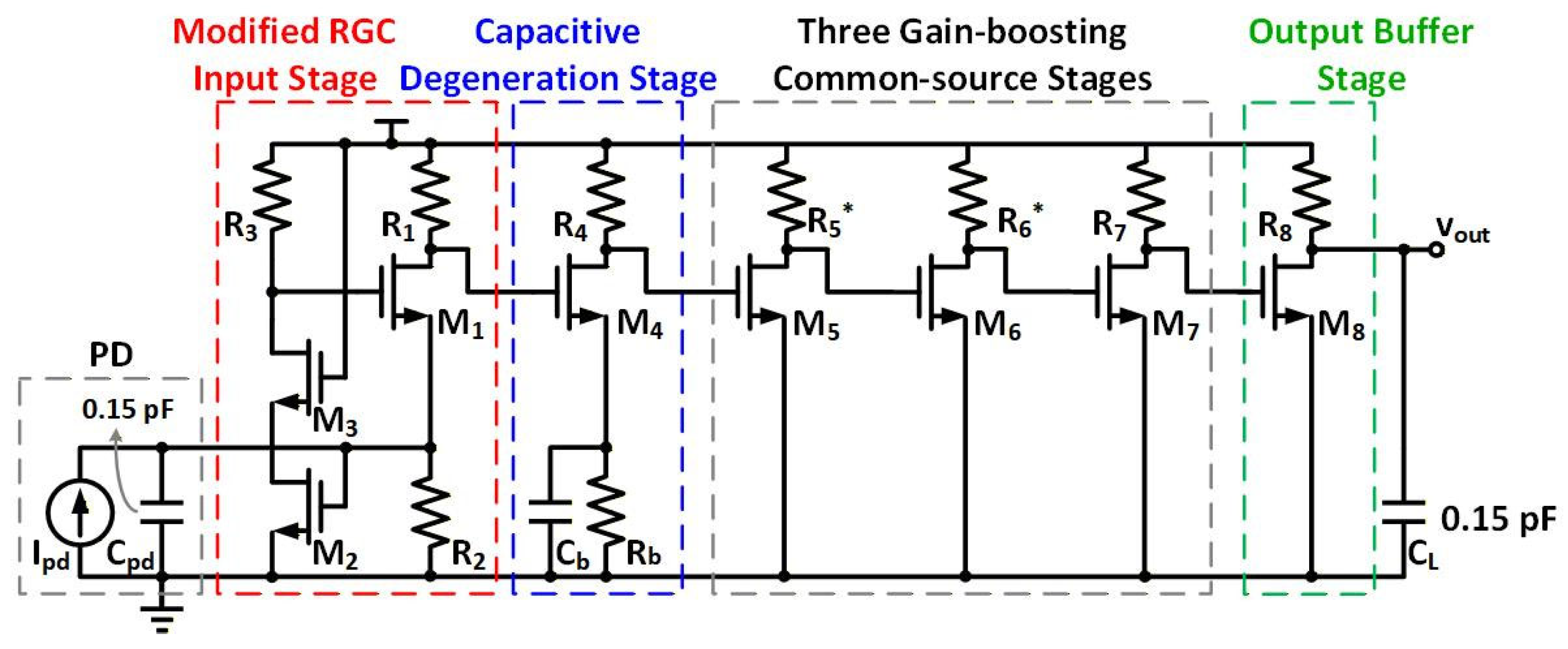
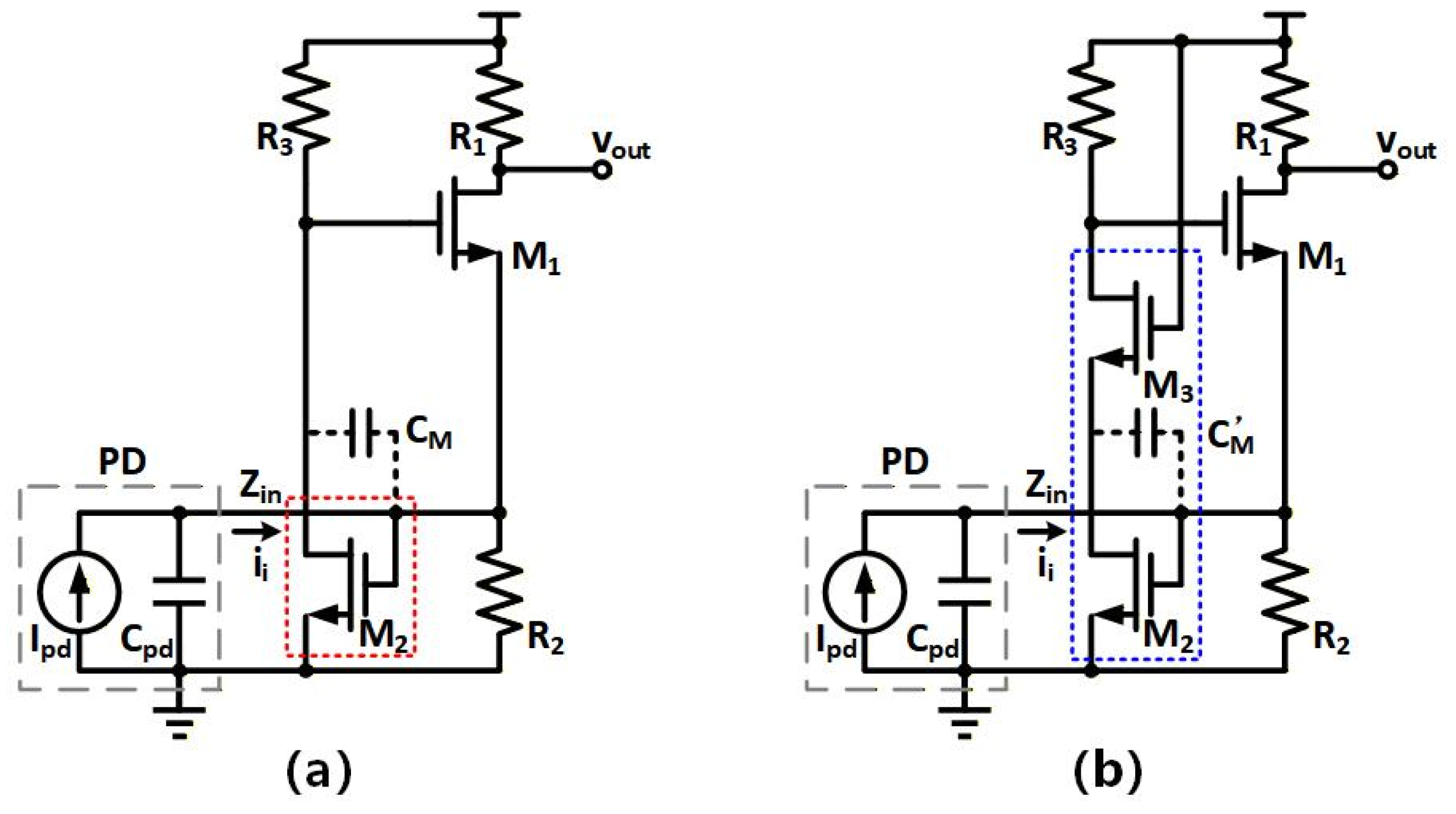
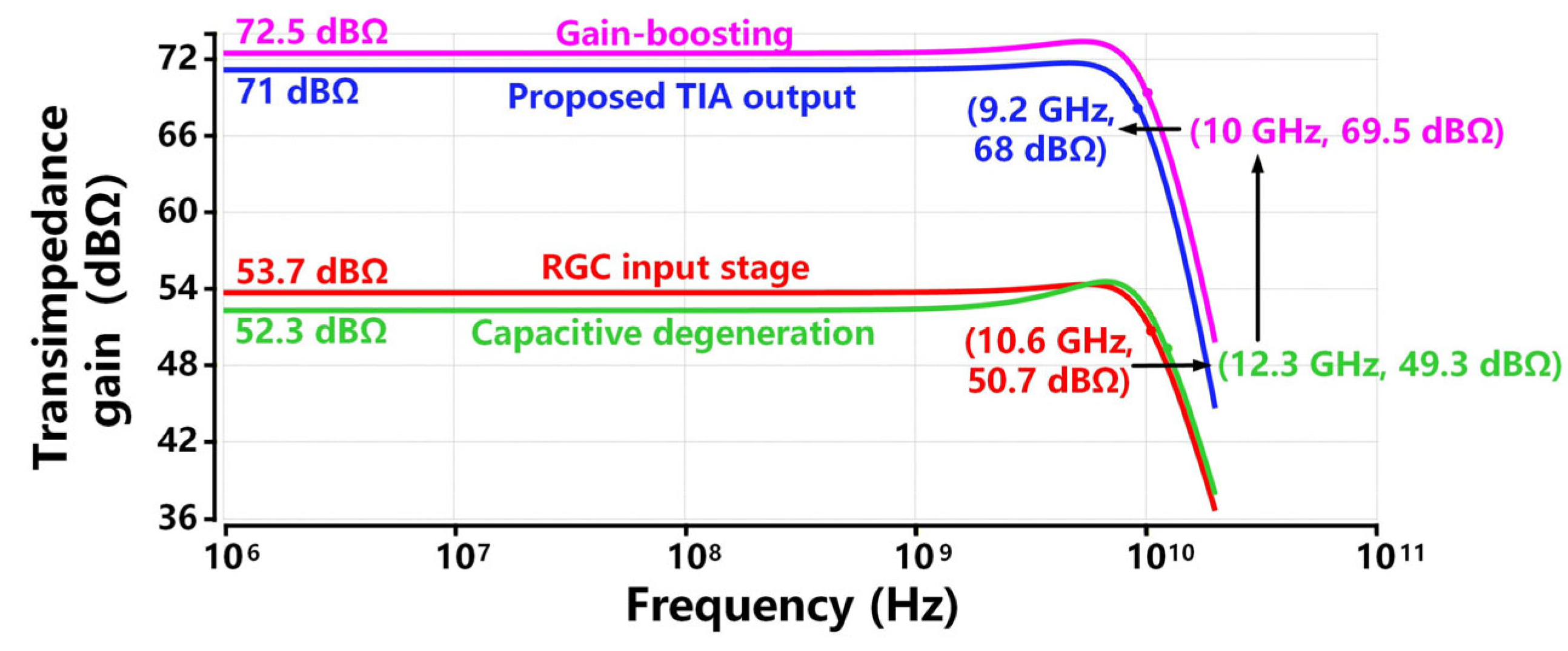
- To address the issues of limited bandwidth and noise in the existing designs such as the dual-feedback RGC TIAs, a single-stage cascode feedback structure is employed as the feedback amplifier in the proposed RGC input stage to boost feedback gain and also reduce Miller capacitance at the input node. By increasing the pole frequency, the bandwidth is dramatically extended for isolating the large from bandwidth determination. To balance the bandwidth, gain, and noise, a bandwidth-extension stage with capacitive degeneration and three gain-boosting stages with near-zero noise are cascaded after the RGC input stage with negligible noise contribution to the proposed TIA design.
- (2)
- To address the issues of high supply voltage and bias current in the existing RGC TIA works with transistors working in strong inversion for sufficient , the design strategy under low supply voltage near 1 V required by advanced process technology below 65 nm is discussed. The design strategy suggests biasing the common-source (CS) feedback transistor in weak inversion to achieve sufficient voltage headroom and improve the power and noise efficiency of the CS transistor with enough in advanced CMOS technology. Therefore, the design strategy enables the proposed TIA to achieve considerable bandwidth and much lower power under low supply voltage.
- (3)
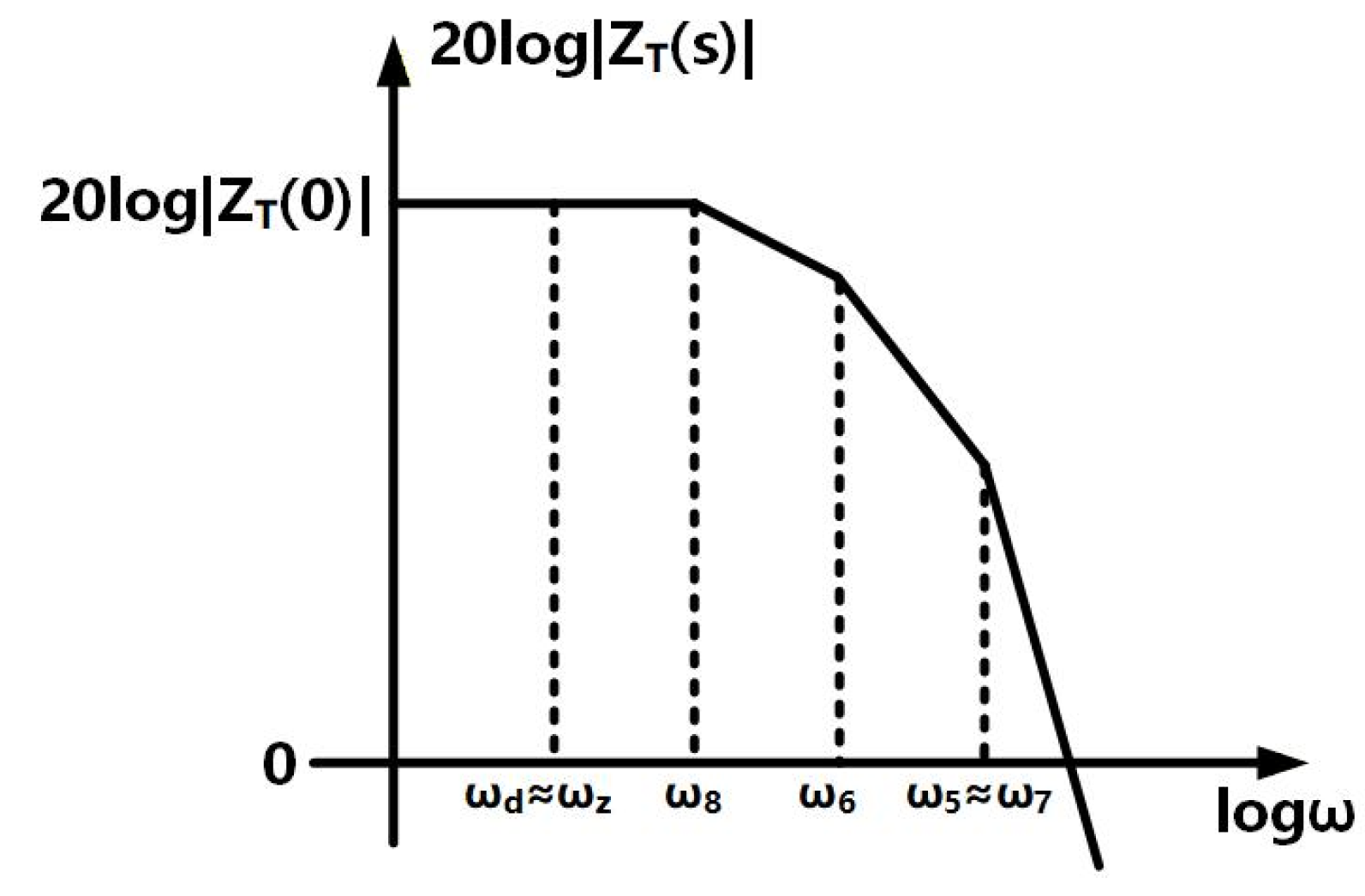
- To characterize the bandwidth and noise of the proposed RGC TIA, the frequency response and noise analysis are carried out. By the pole-zero analysis based on derived pole-zero equations and precise setting of the pole-zero frequencies, the proposed TIA achieves a flat frequency response within a wide bandwidth. In addition, by the noise analysis based on the derived input-referred noise current of the RGC TIA, the noise-critical devices are identified, and therefore, the dimensions of these key devices are optimized for effective noise reduction.
2. Modified RGC TIA Design
2.1. Cascode-Feedback RGC Input Stage
2.2. Design Strategy Under Low Supply Voltage
2.3. Bandwidth Extension and Gain-Boosting Stage
2.4. Frequency Response
2.5. Noise Analysis
3. Simulation Results and Comparison
4. Conclusions
Author Contributions
Funding
Institutional Review Board Statement
Informed Consent Statement
Data Availability Statement
Conflicts of Interest
References
- Qin, P.; Huo, J.; Zhang, X.; Bai, H.; Huangfu, W.; Long, K. Carrier-assisted differential detection for short-reach optical communications: Research progress and future trends. Opt. Fiber Technol. 2025, 93, 104272. [Google Scholar] [CrossRef]
- Tan, M.; Wang, Y.; Wang, K.X.; Yu, Y.; Zhang, X. Circuit-level convergence of electronics and photonics: Basic concepts and recent advances. Front. Optoelectron. 2022, 15, 16. [Google Scholar] [CrossRef] [PubMed]
- Xue, Z.; He, J.; Fang, Y.; Wang, H.; Chang, S.; Huang, Q.; Zhu, Y. A 10-Gb/s inductorless optical receiver in 0.18-μm SiGe BiCMOS. Microelectron. J. 2019, 86, 34–39. [Google Scholar] [CrossRef]
- Ji, H.; Wang, Z.; Li, X.; Li, J.; Unnithan, R.R.; Su, Y. Photonic integrated self-coherent homodyne receiver without optical polarization control for polarization-multiplexing short-reach optical interconnects. J. Light. Technol. 2022, 41, 911–918. [Google Scholar] [CrossRef]
- Chen, Y.; Liao, X.; Xiao, J.; Wang, X.; Ye, M.; Yu, Y.; Wang, C. Wide-Steering Integrated Sensing and Communication OPA-Based Lidar Design with Joint Waveform and Thinned Antenna. In Proceedings of the OptoElectronics and Communications Conference (OECC), Sapporo, Japan, 19 August 2025. [Google Scholar]
- Wen, Y.; Yang, F.; Song, J.; Zhu, H. Optical Integrated Sensing and Communication: Architectures, Potentials and Challenges. IEEE Internet Things Mag. 2024, 7, 68–74. [Google Scholar] [CrossRef]
- Nguyen, R.L.; Mellati, A.; Fernandez, A.; Iyer, A.; Fan, A.; Reyes, B. A 200GS/s 8b 20fJ/c-s Receiver with >60GHz AFE Bandwidth for 800 Gb/s Optical Coherent Communications in 5 nm FinFET. In Proceedings of the IEEE International Solid-State Circuits Conference (ISSCC), San Francisco, CA, USA, 18–22 February 2024. [Google Scholar]
- Yang, Y.; Li, D.; Qi, N.; Wang, B. A 2 pA/√ Hz Input-Referred Noise TIA in 180-nm CMOS With 2.5 GHz Bandwidth for Optical Receiver. IEEE Solid-State Circ. Lett. 2025, 8, 189–192. [Google Scholar] [CrossRef]
- Razavi, B. Design of Integrated Circuits for Optical Communications, 2nd ed.; Wiley: Hoboken, NJ, USA, 2012. [Google Scholar]
- Razavi, B. The transimpedance amplifier [a circuit for all seasons]. IEEE Solid-State Circ. Mag. 2019, 11, 10–97. [Google Scholar] [CrossRef]
- Zhou, G.; Mao, X.; Xie, S.; Cai, H. 4-channel, 100 Gbps inductorless optical receiver analog front-end in CMOS for optical interconnect. IEEE Access 2021, 9, 131780–131788. [Google Scholar] [CrossRef]
- Wang, J.; Pan, Q.; Qin, Y.; Chen, X.; Hu, S.; Bai, R. A Fully-Integrated 25Gb/s Low-Noise TIA+CDR Optical Receiver designed in 40nm-CMOS. In Proceedings of the IEEE Asian Solid-State Circuits Conference, Tainan, Taiwan, 5–7 November 2018. [Google Scholar]
- Güngördü, A.D.; Yelten, M.B. A Noise-Canceling TIA Topology Compatible with Large-Area Photodetectors in 40 nm CMOS Process. In Proceedings of the IEEE International Midwest Symposium on Circuits and Systems (MWSCAS), Fukuoka, Japan, 7–10 August 2022. [Google Scholar]
- Wang, J.; Wang, T.; Yang, X.; Zhang, H. A Low-Noise Analog Frontend with Large PD Capacitance Tolerance in 65-nm CMOS for Optical Receivers. In Proceedings of the IEEE International Conference on Integrated Circuits, Technology and Applications (ICTA), Zhuhai, China, 24–26 November 2021; pp. 86–87. [Google Scholar]
- Zhang, Z.; Zhang, Y.; Xu, Y.; Shen, X.; Li, G.; Qi, N.; Liu, J.; Wu, N.; Liu, L. A Wideband Low-Noise Linear LiDAR Analog Front-End Achieving 1.6-GHz Bandwidth, 2.7-pA/Hz0.5 Input-Referred Noise, and 103-dBΩ Transimpedance Gain. IEEE Solid-State Circ. Lett. 2024, 7, 131–134. [Google Scholar] [CrossRef]
- Güngördü, A.D.; Dündar, G.; Yelten, M.B. A High Performance TIA Design in 40 nm CMOS. In Proceedings of the IEEE International Symposium on Circuits and Systems (ISCAS), Seville, Spain, 12–14 October 2020. [Google Scholar]
- Park, S.; Yoo, H. 1.25-Gb/s regulated cascode CMOS transimpedance amplifier for Gigabit Ethernet applications. IEEE J. Solid-State Circuits 2004, 39, 112–121. [Google Scholar] [CrossRef]
- Lu, Z.; Yeo, K.S.; Ma, J.; Do, M.A.; Lim, W.M.; Chen, X. Broad-band design techniques for transimpedance amplifiers. IEEE Trans. Circuits Syst. I Regul. Pap. 2007, 54, 590–600. [Google Scholar] [CrossRef]
- Ray, S.; Hella, M.M. A 30–75 dBΩ 2.5 GHz 0.13-μm CMOS Receiver Front-End with Large Input Capacitance Tolerance for Short-Range Optical Communication. IEEE Trans. Circuits Syst. I Regul. Pap. 2016, 63, 1404–1415. [Google Scholar] [CrossRef]
- Ray, S.; Hella, M.M. A 53 dBΩ 7-GHz Inductorless Transimpedance Amplifier and a 1-THz+ GBP Limiting Amplifier in 0.13-μm CMOS. IEEE Trans. Circuits Syst. I Regul. Pap. 2018, 65, 2365–2377. [Google Scholar] [CrossRef]
- Wu, W.; Zhang, L.; Wang, Y. A 20-Gb/s CMOS Cross-Coupled Dual-Feedback Loop Transimpedance Amplifier. In Proceedings of the IEEE International Symposium on Circuits and Systems (ISCAS), Seville, Spain, 12–14 October 2020. [Google Scholar]
- Abdollahi, B.; Mesgari, B.; Saeedi, S.; Roshanshomal, E.; Nabavi, A.; Zimmermann, H. Transconductance Boosting Technique for Bandwidth Extension in Low-Voltage and Low-Noise Optical TIAs. IEEE Trans. Circuits Syst. II Express Briefs 2022, 69, 834–838. [Google Scholar] [CrossRef]
- Taghavi, M.H.; Belostotski, L.; Haslett, J.W.; Ahmadi, P. 10-Gb/s 0.13-μm CMOS inductorless modified-RGC transimpedance amplifier. IEEE Trans. Circuits Syst. I Regul. Pap. 2015, 62, 1971–1980. [Google Scholar] [CrossRef]
- Chen, X.; Takahashi, Y. Floating Active Inductor Based Trans-Impedance Amplifier in 0.18 μm CMOS Technology for Optical Applications. Electronics 2019, 8, 1547. [Google Scholar] [CrossRef]
- Parapari, E.; Koozehkanani, Z.; Toofan, S. A 10-GHz Inductorless Modified Regulated Cascode Transimpedance Amplifier for Optical Fiber Communication. Microelectron. J. 2021, 114, 105123. [Google Scholar] [CrossRef]
- Takahashi, Y.; Ito, D.; Nakamura, M.; Tsuchiya, A.; Inoue, T.; Kishine, K. Low-Power Regulated Cascode CMOS Transimpedance Amplifier with Local Feedback Circuit. Electronics 2022, 11, 854. [Google Scholar] [CrossRef]
- Zhang, X.; Lu, Z.; Zhu, W.; Yuan, W.; Zhao, Y.; Yu, G.; Yu, Y.; Wang, C. A Broad-Bandwidth Cascode-Feedback Transimpedance Amplifier for Short-Range Optical Communication. In Proceedings of the 5th International Conference on Circuits and Systems (ICCS), Huzhou, China, 27–30 October 2023. [Google Scholar]
- Takemoto, T.; Yamashita, H.; Yazaki, T.; Chujo, N.; Lee, Y.; Matsuoka, Y. A 25-to-28 Gb/s High-Sensitivity (−9.7 dBm) 65 nm CMOS Optical Receiver for Board-to-Board Interconnects. IEEE J. Solid-State Circuits 2014, 49, 2259–2276. [Google Scholar] [CrossRef]
- Song, L.; Sern, T.; Thangarasu, B.; Yeo, K. An Inductorless Variable-Gain Transimpedance Amplifier Design for 4GHz Optical Communication using 0.18-μm CMOS. In Proceedings of the International Conference on Computer Networks and Communication Technology (CNCT), Xiamen, China, 16–18 December 2016. [Google Scholar]
- Säckinger, E. Broadband Circuits for Optical Fiber Communication, 1st ed.; John Wiley & Sons, Inc.: Hoboken, NJ, USA, 2005. [Google Scholar]
- Sadeghi, S.; Nayeri, M.; Dolatshahi, M.; Moftakharzadeh, A. An active CMOS optical receiver employing an inductor-less, low-noise and high-gain regulated cascode transimpedance amplifier. Microelectron. J. 2021, 110, 105015. [Google Scholar] [CrossRef]



| Conventional RGC Structure | Cascode-Feedback RGC Input Stage | |
|---|---|---|
| Feedback gain | ||
| Input impedance | ||
| Miller capacitance |
| Component | Size | Component | Size |
|---|---|---|---|
| 100 fF |
| Design | ISCAS [16] b | Electronics [24] b | TCAS-I [18] a | TCAS-I [23] a | Electronics [26] b | MEJ [25] b | This Work b |
|---|---|---|---|---|---|---|---|
| Technology | 40 nm | 0.18 μm | 0.18 μm | 0.13 μm | 65 nm | 0.13 μm | 40 nm |
| Topology | Inverter | RGC | RGC | RGC | RGC | RGC | RGC |
| Supply (V) | 1.1 | 1.8 | 1.8 | 1.5 | 1 | 1.3 | 1.2 |
| BW (GHz) | 5.2 c | 10 c | 8 c | 7 | 11.4 c | 10.1 | 9.2 |
| PD cap. (pF) | 0.075 | 0.15 | 0.25 | 0.25 | 0.1 | 1 | 0.15 |
| Gain (dBΩ) | 75 | 41 | 53 | 50.1 | 46 | 47 | 71 |
| Noise () | 6.9 | 30.7 | 18 | 31.3 | 46.6 | 42 | 18.3 |
| Power (mW) | 7.15 | 10.7 | 13.5 | 7.5 | 23.9 | 12.2 | 6.6 |
| FOM | 48.9 | 0.92 | 6.6 | 3.6 | 0.2 | 5.7 | 48.6 |
Disclaimer/Publisher’s Note: The statements, opinions and data contained in all publications are solely those of the individual author(s) and contributor(s) and not of MDPI and/or the editor(s). MDPI and/or the editor(s) disclaim responsibility for any injury to people or property resulting from any ideas, methods, instructions or products referred to in the content. |
© 2026 by the authors. Licensee MDPI, Basel, Switzerland. This article is an open access article distributed under the terms and conditions of the Creative Commons Attribution (CC BY) license.
Share and Cite
Zhang, X.; Zhao, Y.; Yu, G.; Lu, Z.; Wang, C. A Low-Noise, Low-Power, and Wide-Bandwidth Regulated Cascode Transimpedance Amplifier with Cascode-Feedback in 40 nm CMOS. Sensors 2026, 26, 465. https://doi.org/10.3390/s26020465
Zhang X, Zhao Y, Yu G, Lu Z, Wang C. A Low-Noise, Low-Power, and Wide-Bandwidth Regulated Cascode Transimpedance Amplifier with Cascode-Feedback in 40 nm CMOS. Sensors. 2026; 26(2):465. https://doi.org/10.3390/s26020465
Chicago/Turabian StyleZhang, Xiangyi, Yuansheng Zhao, Guoyi Yu, Zhenghao Lu, and Chao Wang. 2026. "A Low-Noise, Low-Power, and Wide-Bandwidth Regulated Cascode Transimpedance Amplifier with Cascode-Feedback in 40 nm CMOS" Sensors 26, no. 2: 465. https://doi.org/10.3390/s26020465
APA StyleZhang, X., Zhao, Y., Yu, G., Lu, Z., & Wang, C. (2026). A Low-Noise, Low-Power, and Wide-Bandwidth Regulated Cascode Transimpedance Amplifier with Cascode-Feedback in 40 nm CMOS. Sensors, 26(2), 465. https://doi.org/10.3390/s26020465