


Abstract
At-rest PPG signals have been explored for detecting atrial fibrillation (AF), yet current signal-processing techniques do not achieve perfect accuracy even under low-motion artifact (MA) conditions. This study evaluates the effectiveness of a single-degree-of-freedom time–frequency (SDOF-TF) method in analyzing at-rest PPG signals for AF detection. The method leverages the influence of MA on the instant parameters of each harmonic, which is identified using an SDOF model in which the tissue–contact–sensor (TCS) stack is treated as an SDOF system. In this model, MA induces baseline drift and time-varying system parameters. The SDOF-TF method enables the quantification and removal of MA and noise, allowing for the accurate extraction of the arterial pulse waveform, heart rate (HR), heart rate variability (HRV), respiration rate (RR), and respiration modulation (RM). Using data from the MIMIC PERform AF dataset, the method achieved 100% accuracy in distinguishing AF from non-AF cases based on three features: (1) RM, (2) HRV derived from instant frequency and instant initial phase, and (3) standard deviation of HR across harmonics. Compared with non-AF, the RM for each harmonic was increased by AF. RM exhibited an increasing trend with harmonic order in non-AF subjects, whereas this trend was diminished in AF subjects.
1. Introduction
Atrial fibrillation (AF) is a common cardiac arrhythmia that poses significant health risks, including stroke and heart failure, making timely and accurate detection crucial for mitigating these risks [1,2,3,4,5]. Compared to the gold-standard electrocardiogram (ECG) for AF detection, photoplethysmography (PPG) has emerged as a viable alternative that allows for the routine monitoring of cardiovascular (CV) health in clinical settings or at home due to its accessibility and ease of use [1,2,3,4,5]. When utilizing PPG sensors for AF detection, measurements can be categorized into two distinct types: wearable PPG sensors at the wrist during movement [1,2] and non-wearable PPG sensors on the finger at rest [6,7,8,9,10,11,12,13]. The shift towards wearable PPG signals for AF detection is driven by the practical benefits of continuous monitoring [1,2]; however, these signals typically exhibit lower fidelity and are more susceptible to high motion artifacts (MAs), resulting in significantly lower detection accuracy compared to at-rest PPG signals [1,2,14,15].
While at-rest PPG signals are much less affected by MAs than their wearable counterparts, they still do not achieve a perfect match with the gold-standard ECG, primarily due to three factors: MA, noise, and individual variability (i.e., physiological condition) [3,4,5,16,17,18]. Improving the precision of at-rest PPG analysis is essential for enabling cost-effective and scalable AF screening in both clinical and home environments. Thus, there is a critical need to develop more effective signal-processing algorithms to achieve a 100% accuracy rate for at-rest PPG signals, reducing false positives and negatives to ensure timely and accurate detection and treatment [2,9,19,20].
Among the datasets for at-rest PPG signals used in AF detection, the MIMIC PERform AF dataset, available on the PhysioNet website [21], has been extensively studied for testing various signal-processing techniques [6,7,8,9,10,11,12,13]. Despite the relatively high quality (i.e., low MA) of these at-rest signals, no signal-processing techniques have yet achieved perfect accuracy for AF detection [6,7,8,9,10,11,12]. Traditional time-domain techniques have been employed to identify irregularities in the PPG signals [6,7]. In addition, time–frequency techniques have been utilized to decompose the PPG signals into different frequency components, allowing for improved noise reduction and feature extraction [9]. Recently, machine learning algorithms have gained prominence due to their ability to learn complex patterns from data [11,12]. Deep learning techniques have also been implemented, which capitalize on their capability to automatically extract relevant features from PPG signals, with reported accuracy rates reaching 98% for this dataset [8]. However, deep learning techniques often function like a black box, lacking interpretability and transparency, which can make it challenging for clinicians to trust their results [22,23,24]. Moreover, these techniques require training on specific datasets, raising concerns about the generalizability of findings across diverse demographic groups, highlighting the need for proper validation to ensure their widespread clinical applicability [22,23,24]. Above all, the persistent, albeit small, margin of error underscores the necessity for further improvement in signal-processing techniques on at-rest PPG signals to attain clinical-grade accuracy [19,20].
This study aims to apply a generalized single-degree-of-freedom (SDOF) time–frequency (SDOF-TF) method [25] to the at-rest PPG signals in the MIMIC PERform AF dataset to examine the effectiveness of this method in removing MA and noise from these pulse signals for AF detection. The SDOF-TF method is built on an SDOF model of MA in a measured pulse signal, where the tissue–contact–sensor (TCS) stack, sandwiched between an artery and the PPG sensor at the skin’s surface, is treated as an SDOF system [26]. MA causes a baseline drift (BD), which refers to the time-varying distance change in the PPG sensor relative to the artery, and, consequently, time-varying system parameters (TVSPs) of the TCS stack [27,28]. While BD manifests as additive noise, which is low-frequency (<0.7 Hz) and can be easily removed, TVSP-generated distortion manifests as multiplicative noise that rides on each harmonic in a PPG signal [25,27,28]. In [25], the working principle of the SDOF-TF method was detailed and applied to analyze three pulse signals measured using a tactile sensor and four PPG signals under varying physiological conditions (note: of the four PPG signals, one is from the AF group and one is from the non-AF group within the MIMIC PERform AF dataset); the effectiveness and generalizability of the method in removing MA and noise from these signals measured using both sensor types were qualitatively demonstrated by the consistency of the derived differences between physiological conditions with the related findings in the literature. In particular, several extracted parameters in [25] revealed significant differences between the AF and the non-AF subjects, but these differences lacked statistical significance.
As compared to the previous study [25], which focused on the SDOF-TF method itself—its working principle, generalizability to different sensor types, and qualitative validation—the original contributions of this study include (1) applying the SDOF-TF method to the entire MIMIC PERform AF dataset, enabling the quantitative validation of its effectiveness in removing MA and noise from at-rest PPG signals; (2) identifying all extracted parameters that show non-overlapping values between the AF and non-AF groups, thereby serving as statistically significant indices for AF detection; and (3) revealing the physiological implications of some of the observed differences between AF and non-AF subjects.
2. Materials and Methods
2.1. An SDOF-TF Method for Time-Frequency Analysis
2.1.1. An SDOF Model of MA in a PPG Signal
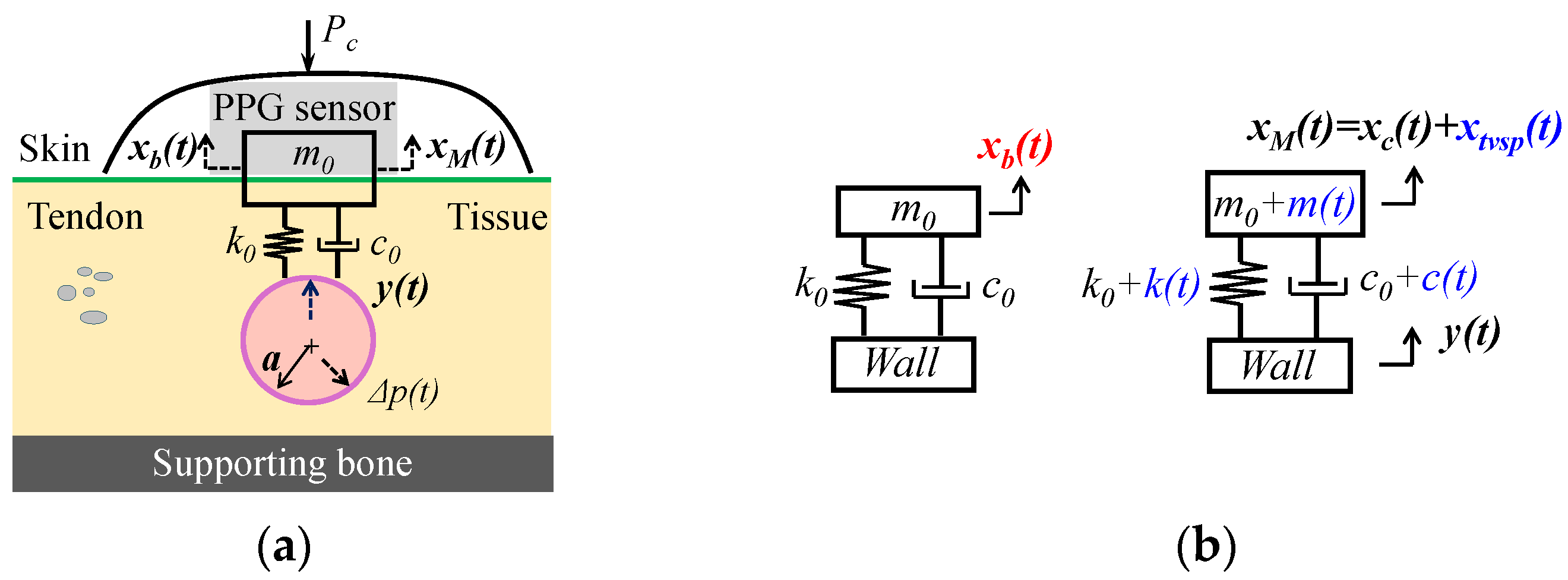
The SDOF model of MA in a PPG signal is based on three assumptions: (1) the tissue–contact–sensor (TCS) stack behaves linearly during pulse signal measurement and (2) the effect of the TCS stack in the true pulse signal is negligible, and thus the input pulse signal to the TCS stack is the arterial wall displacement y(t) instead of the pulsatile pressure Δp(t), as shown in Figure 1a.
Figure 1.
The tissue–contact–sensor (TCS) stack between a PPG sensor and an artery. (a) Schematic; (b) an SDOF model of MA in a PPG signal.
A PPG sensor contains a light emitter and a photodetector. As shown in Figure 1a, a tape (or a mechanical fixture) is used to fix a PPG sensor with contact pressure Pc for establishing the tissue–sensor contact. Due to the deformability of the tissue above the artery, the tissue–contact–sensor (TCS) stack is treated as an SDOF system with spring stiffness k0, damping coefficient c0, and mass m0, to capture its dynamic behavior during pulse measurement. The PPG sensor forms part of m0. Note that Pc presets the nominal values of m0, k0, and c0 and is fully accounted for by the three system parameters. The light sent by the light emitter passes through the TCS stack and is partially absorbed by blood in the artery, and the transmitted or reflected light is detected by the photodetector as the measured pulse signal (i.e., PPG signal). Optical transduction in a PPG signal is extremely complex [4]. For simplicity, optical transduction is neglected here, except when considering the effect of MA on a PPG signal, and thus a PPG signal is represented as the displacement at the mass.
Figure 1b shows the SDOF model of MA in a PPG signal. Due to MA, the PPG sensor itself encounters a time-varying displacement xb(t) (i.e., BD) at the mass, which further induces time-varying system parameters (TVSPs): m(t), k(t), and c(t) of the TCS stack:
The true pulse signal in an artery serves as the base excitation for the SDOF system and is time-harmonic [28,29]:
where , , and are the amplitude, phase, and angular frequency of , respectively. causes displacement at the mass [25,27,28]:
Due to TVSP in Equation (3), is non-stationary and takes the following form [25]:
where , , and are the instant amplitude, phase, and frequency of , respectively. The PPG signal becomes [25]
where is BD; is the measured pulse signal when free of MA (i.e., free of TVSP); and is the TVSP-generated distortion in Equation (3). When free of MA, based on Equation (3), the measured pulse signal is
Thus, the total distortion caused by MA in a PPG signal is
While xb(t) is a low-frequency additive noise (<0.7 Hz), xtvsp(t) rides on each harmonic of the true pulse signal, as shown in Equation (3), and thus is multiplicative noise.
The further analysis of xtvsp(t) [25] reveals that xtvsp(t) (1) dramatically swings the instant amplitude, (2) slightly affects the instant frequency, and (3) almost has no effect on the instant initial phase of each harmonic in xM(t). Based on these identified effects, an SDOF-TF method is developed for the removal of MA (i.e., xb(t) + xtvsp(t)) and noise from a PPG signal and the extraction of arterial pulse waveform (APW), heart rate (HR), and respiration parameters.
2.1.2. An SDOF-TF Method
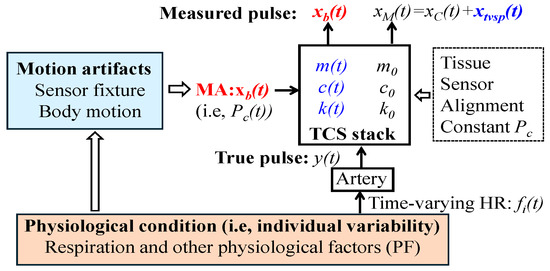
As shown in Figure 2, the tissue, sensor, alignment, and constant Pc (i.e., sensor fixture) involved during pulse measurement cannot be independently quantified. Instead, their collective behavior can be quantified as the nominal parameters m0, c0, and k0 of the SDOF system representing the TCS stack. The physiological condition of an individual (i.e., individual variability) manifests in a PPG signal in two ways. First, physiological condition governs time-varying HR, and thus manifests as time-varying frequency fi(t) of the ith harmonic in the true pulse signal y(t). Second, it influences body motion, which, in conjunction with the sensor fixture, gives rise to MA. MA induces BD xb(t)—equivalent to a time-varying Pc(t)—and TVSP-generated distortion xtvsp(t). Consequently, xb(t) and xtvsp(t) collectively quantify the inseparable effect of the physiological condition and sensor fixture on a PPG signal, from the perspective of MA formation in a PPG signal.
Figure 2.
All the factors (except sensor noise) involved in PPG signal measurement and their quantitative manifestation in a PPG signal via the SDOF model of MA in a PPG signal.
From the perspective of the time-varying HR of an arterial pulse signal, physiological condition includes respiration and other physiological factors (PFs) [30]. While the effect of respiration on time-varying HR is commonly assumed to be time-harmonic, the effect of PF is deemed to be non-time-harmonic. The true pulse signal y(t) is a collection of multiple harmonics of HR [30]:
where f0 is the frequency of constant HR, Ai and ϕ0i are the amplitude and initial phase of the ith harmonic, respectively, and is related to respiration. Note that Ai, f0, and ϕ0i are all constant, and the effect of PF on HR is excluded in Equation (9). The frequency of the ith harmonic is altered by respiration as i·f0 + B·cos (2πfrt + α0), where B is respiration modulation (RM), indicating the strength of respiratory sinus arrhythmia (RSA) on altering HR [30], and fr and α0 are the respiration rate (RR) and initial phase of respiration, respectively.
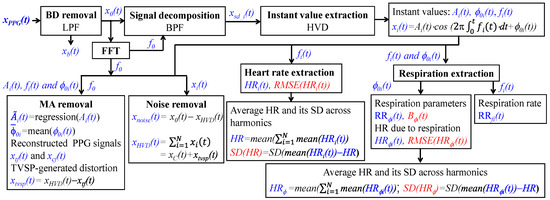
Figure 3 illustrates a simplified signal-processing algorithm of the SDOF-TF method. The detailed algorithm can be found in [25]. A PPG signal xPPG(t) goes through a low-pass filter (LPF) to remove xb(t) and obtain x0(t):
where xnoise(t) denotes noise associated with the sensor.
Figure 3.
A block diagram of the SDOF-TF method for quantifying and removing MA and noise from a PPG signal and extraction of APW, HR, and respiration parameters (note that the parameters in red font are the identified indices for AF detection with 100% accuracy).
Fast Fourier transform (FFT) is conducted on x0(t) to obtain the frequency of the first harmonic of the PPG signal. Then, a bandpass filter (BPF) is used to separate the ith harmonic xsd_i(t) from x0(t). Hilbert vibration decomposition (HVD) [28] is used to extract instant amplitude Ai(t), instant frequency fi(t), and instant initial phase ϕ0i(t)of the ith harmonic, whose sum is denoted as xHVD(t) and is equal to xC(t) +xtvsp(t) in Equation (5):
As compared to xsd_i(t), sensor noise is greatly alleviated in xi(t) [25,28]. The sensor noise is then calculated as
To remove MA (i.e., xtvsp(t)), the regression line of Ai(t): and the mean of ϕ0i(t): are obtained. Then, free of MA and noise, the pulse signal xtf(t) with time-varying frequency (or HRV) is reconstructed [25]:
To examine the effect of time-varying frequency (or HRV) on the APW of a PPG signal, the corresponding pulse signal xcf(t) with constant frequency (i.e., constant HR) is reconstructed [25]:
Accordingly, xtvsp(t) riding on each harmonic in a PPG signal is calculated as
We further extract HRi(t) from the instant frequency fi(t) of the ith harmonic [25]. Note that HRi(t) represents the total HR, which accounts for the effects of both respiration and PF on HR. HRV is calculated using root mean squared error (RMSE). The total HVR is then calculcated as RMSE(HRi(t)).
To calculate one value for the total HR of a subject from the three harmonics, the average HR of each harmonic is calculated as mean (HRi(t)). The HR of a subject is then calculated as the average of the averaged HR of the three harmonics, and the difference in average HR between the three harmonics is calculated as their standard deviation (SD):
Extraction of the respiration signal is conducted on both fi(t) and ϕ0i(t) [25]. While the RR extracted from fi(t) is denoted as RRfi(t), the RR extracted form ϕ0i(t) is denoted as RRϕi(t). As will be seen in Section 3, RRfi(t) underestimates the RR, as compared to RRϕi(t). Thus, the RM is only extracted from ϕ0i(t) and denoted as Bϕi(t).
The HR accounting solely for the effect of respiration on HR is also calculated and is denoted as HRϕi(t), and the associated HRV is calculated as RMSE (HRϕi(t)). Similarly to HR and SD (HR) from fi(t) in Equation (16), we also calculate one value for the HR, which accounts solely for respiration, of a subject from the three harmonics:
where HRϕ denotes the average value from the three harmonics and SD (HRϕ) is their standard deviation of the three harmonics.
2.2. PPG Signals of AF and Non-AF Subjects and Their Analysis
To evaluate the effectiveness of the SDOF-TF method in removing MA and noise from a PPG signal measured at rest, we choose to apply it to analyze the at-rest PPG signals in the MIMIC PERform AF Dataset [21], which contains data recorded from 35 critically ill adults during routine clinical care using a bedside monitor. Each subject has 20 min of data sampled at 125 Hz. The PPG signals of all subjects in the dataset are labeled as either AF or non-AF. However, the PPG signals for one subject in the non-AF group and two subjects in the AF group are missing (see Table A1 in Appendix A). Thus, there are 14 subjects in the non-AF group and 18 subjects in the AF group.
The signal-processing algorithm for implementing the SDOF-TF method was developed in MATLAB2025a and follows the procedure described in [25]. Compared with [25], four additional parameters—average HR and its SD across harmonics from the instant frequency and instant initial phases—are extracted from a PPG signal. An 80 s segment with no abrupt change was selected from each PPG signal for analysis (see Table A1 in Appendix A). Only the first three harmonics of the PPG signals were analyzed, since the higher harmonics in the PPG signals of the AF group were extremely small, compared with their lower counterparts. As will be seen in Section 3, multiple extracted parameters can effectively distinguish between the AF and non-AF groups with 100% accuracy; therefore, no further statistical analysis is necessary. All the figures illustrating the analyzed results were generated using the same software (see Table A2 and Table A3 in Appendix A for the numerical values corresponding to these figures).
3. Results
3.1. Examination of MA, Noise, APW, HR, and Respiration Parameters
As the detailed analysis of the first subject in each group has been previously reported in [25], the present work focuses on the intermediate results of the SDOF-TF method from the second subject in each group. This aims to elucidate the effects of MA and noise on the PPG signals under two physiological conditions: non-AF versus AF, and to further enhance the interpretability and transparency of the method.
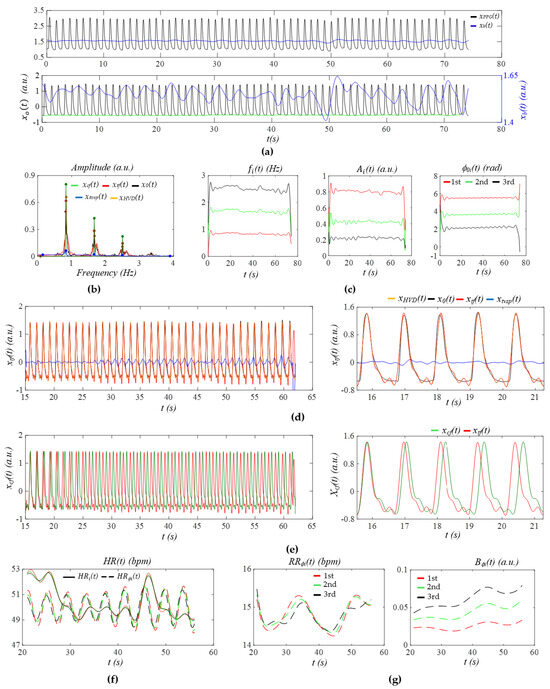
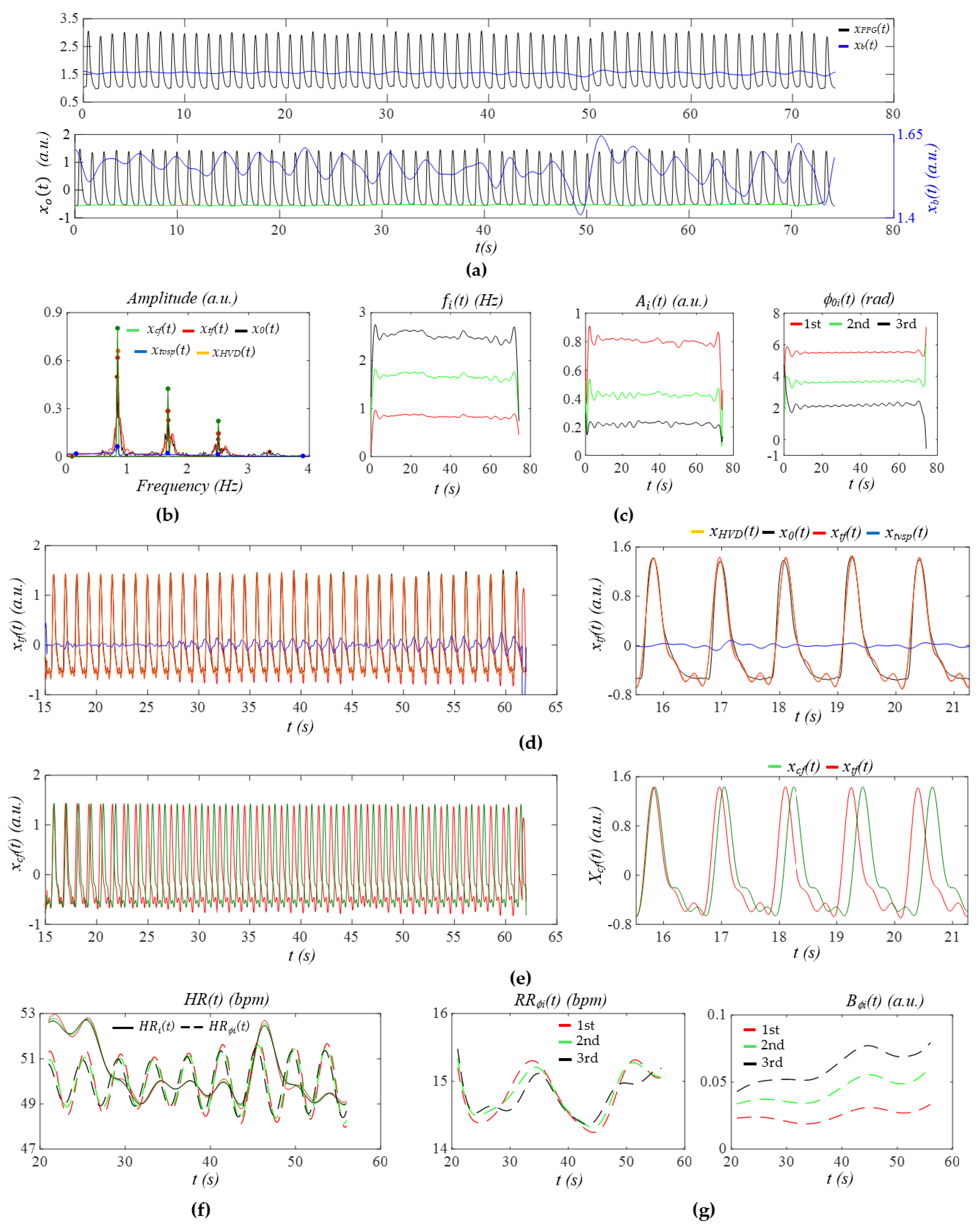
Figure 4a shows the PPG signal (segment: 945~1025 s) of Subject 2 in the non-AF group. After the removal of xb(t), all the pulse cycles are aligned to a similar level. Except the pulse cycles around 50 s, which experience relatively large MA, MA in the remaining pulse cycles is minimal. Figure 4b presents the frequency spectrum of x0(t), xtf(t), xHVD(t), xcf(t), and xtvsp(t), revealing small sidebands from HRV and a small xtvsp(t). In Figure 4c, the relatively large MA around 50 s causes noticeable changes in fi(t) and Ai(t), but no change in ϕ0i(t). Compared to fi(t), ϕ0i(t) exhibits a more consistent time-harmonic behavior, capturing the respiration signal far more effectively.
Figure 4.
The PPG signal (segment: 945~1025 s) of Subject 2 in the non−AF group: (a) xPPG(t), x0(t), and xb(t) (green line: baseline of x0(t)); (b) frequency spectra of x0(t), xHVD(t), xtf(t), xcf(t), and xtvsp(t); (c) instant parameters of the harmonics; (d) reconstructed pulse signal xtf(t) with fi(t); (e) reconstructed pulse signal xcf(t) with f0; (f) HRi(t) and HRϕi(t); and (g) ϕ0i(t) −based respiration parameters.
Figure 4d compares the reconstructed pulse signal with time-varying frequency xtf(t) with xHVD(t), x0(t), and xtvsp(t). The difference between x0(t) and xHVD(t) represents noise, which obscures the dicrotic notch. The small difference between xtf(t) and xHVD(t) indicates small MA (or small xtvsp(t)). As shown in Figure 4e, due to low HRV, the difference in APW between xcf(t) and xtf(t) is very small, except that there is a large phase shift between them, possibly due to the large swing of HRi(t), as shown in Figure 4f. Note that in Figure 4f, HRi(t) and HRϕi(t) from the three harmonics are almost identical. The difference between HRi(t) and HRϕi(t) is believed to arise from the fact that HRi(t) reflects the combined effects of respiration and PF on HR, whereas HRϕi(t) captures only the influence of respiration. Furthermore, HRi(t) is affected by MA to a larger extent than HRϕi(t) [25]. Additionally, HRϕi(t) exhibits a clear time-harmonic pattern. Figure 4g presents the instant RR RRϕi(t) and instant RM Bϕi(t) extracted from ϕi(t). While RRϕi(t) does not vary with harmonic order, Bϕi(t) shows an increasing trend with harmonic order.
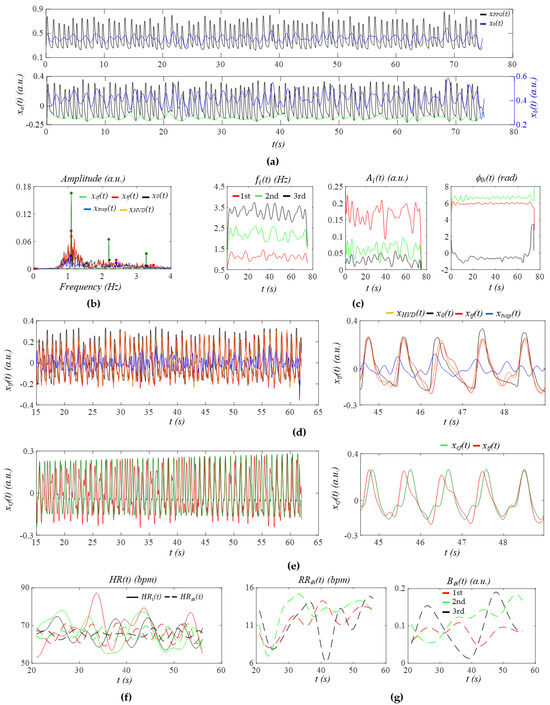
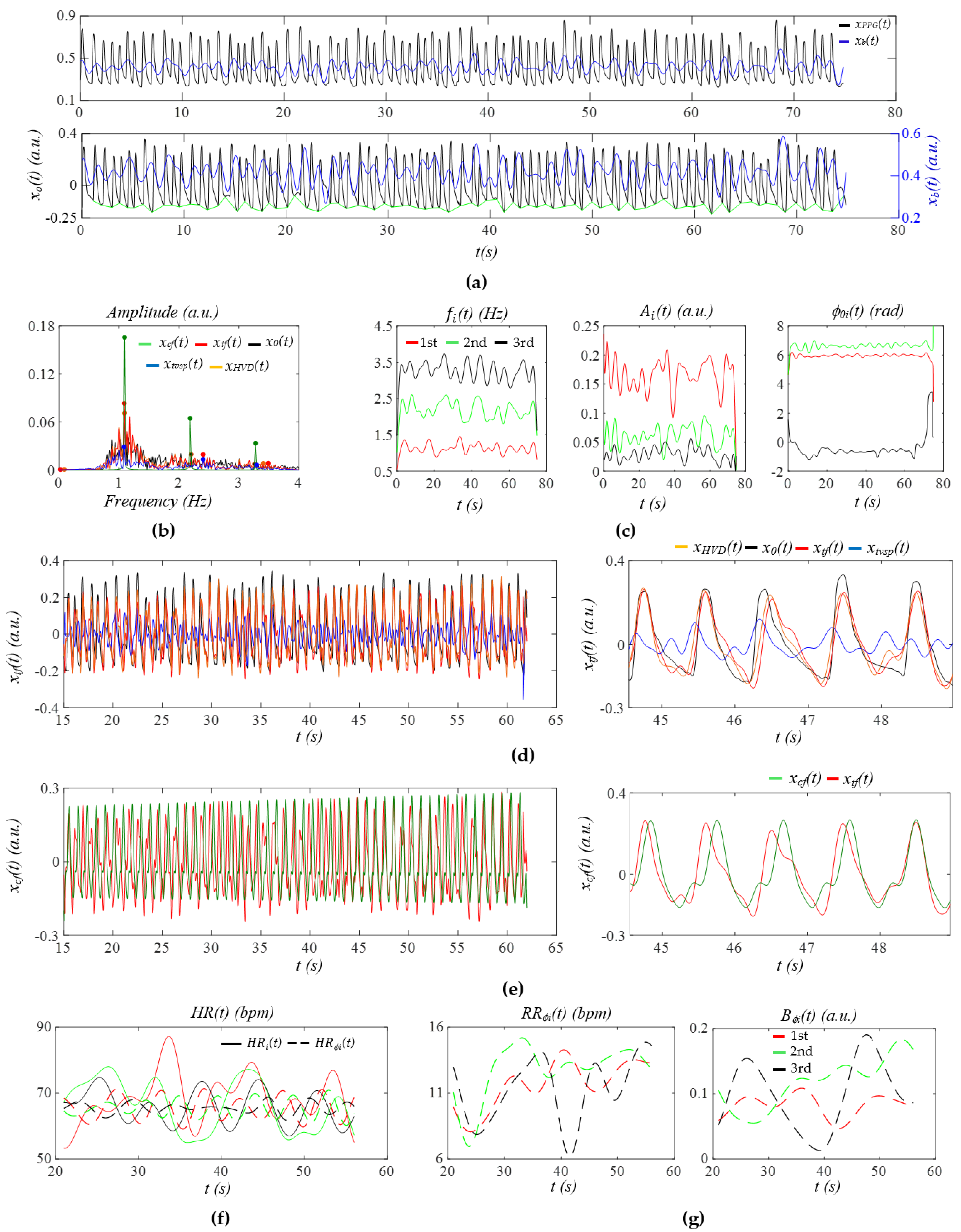
Figure 5a shows the PPG signal (segment: 955~1035 s) from Subject 2 in the AF group. Compared to Figure 4a, xb(t) exhibits pronounced temporal variations, with an amplitude ranging from one-third to one-half of the pulse signal amplitude. As shown in Figure 5b, the large and wide sidebands of xtf(t) indicate substantial HRV, and the wide and relatively large sidebands of xtvsp(t) reflect large MA, compared to Figure 4b. Similarly to Figure 4c, ϕi(t) in Figure 5c captures the respiration signal more effectively than fi(t).
Figure 5.
The PPG signal (segment: 955~1035 s) of Subject 2 in the AF group: (a) xPPG(t), x0(t), and xb(t) (green line: baseline of x0(t)); (b) frequency spectra of x0(t), xHVD(t), xtf(t), xcf(t), and xtvsp(t); (c) instant parameters of the harmonics; (d) reconstructed pulse signal xtf(t) with fi(t); (e) reconstructed pulse signal xcf(t) with f0; (f) HRi(t) and HRϕi(t); and (g) ϕ0i(t)−based respiration parameters.
As shown in Figure 5d, the moderate difference between xtf(t) and xHVD(t) indicates a relatively large xtvsp(t). As shown in Figure 5e, the substantial changes in the time-varying frequency (i.e., large HRV) result in pronounced variations in the pulse waveform between cycles. Figure 5f highlights that the remarkable difference between xcf(t) and xtf(t) underscores the significant role of HRV in preserving the dicrotic notch in the diastolic portion of the pulse waveform. As shown in Figure 5f, HRi(t) and HRϕi(t) are comparable in amplitude and their time-varying patterns are remarkably misaligned across the harmonics. Figure 5g reveals that both RRϕi(t) and Bϕi(t) do not exhibit any changing trends with harmonic order.
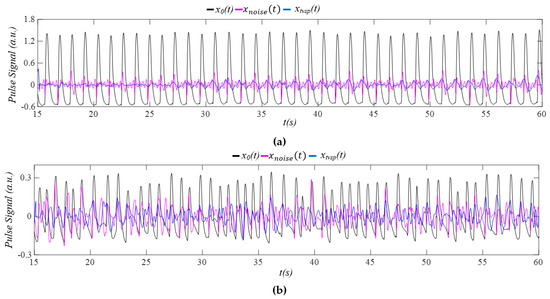
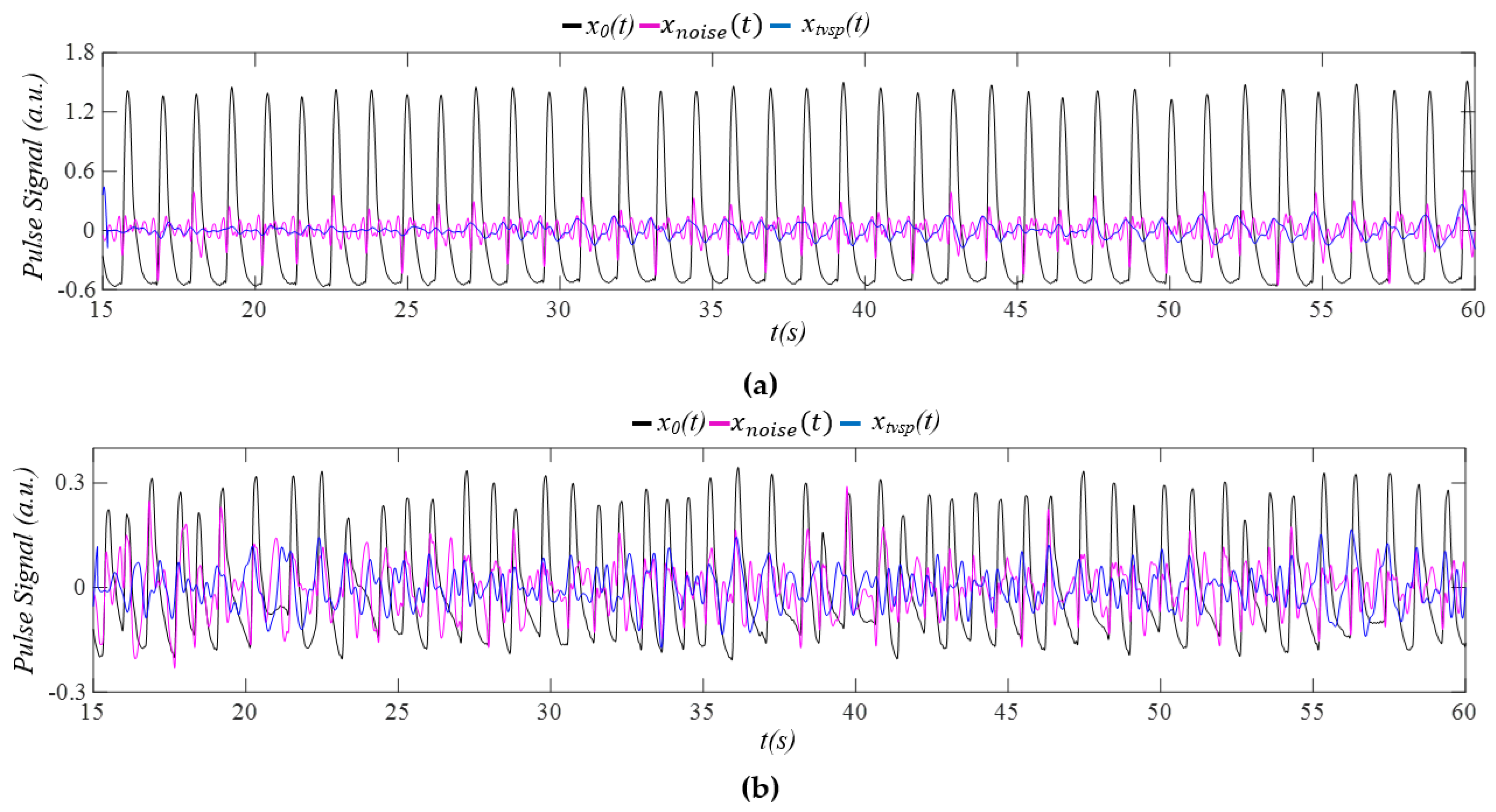
Figure 6 compares noise xnoise(t) and MA xtvsp(t) with x0(t). As shown in Figure 6a, xnoise(t) exhibits a large spike at the peak of each pulse cycle in the non−AF subject. The magnitude of xnoise(t) is comparable to that of xtvsp(t). Interestingly, both xnoise(t) and xtvsp(t) display time−varying characteristics. In contrast to the AF subject shown in Figure 6b, xnoise(t) and xtvsp(t) are similar in magnitude and both demonstrate random time−varying behavior. These two signals are relatively large, as compared to x0(t).
Figure 6.
Comparison of xtvsp(t) versus xnoise(t) in the PPG signal x0(t) free of BD xb(t): (a) Subject 2 in the non−AF group; (b) Subject 2 in the AF group.
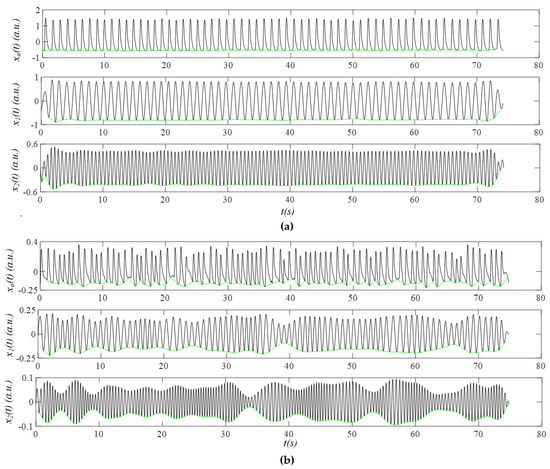
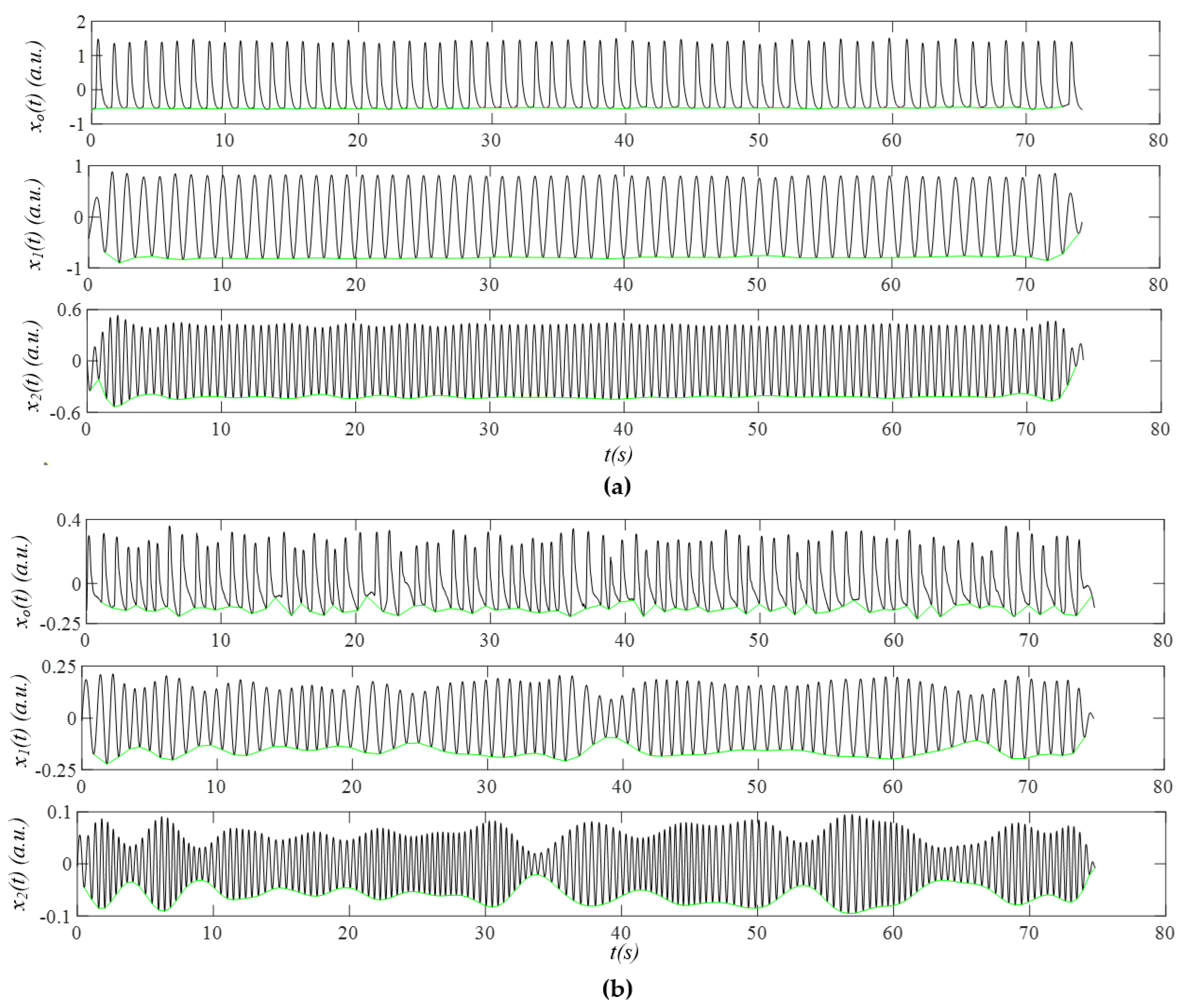
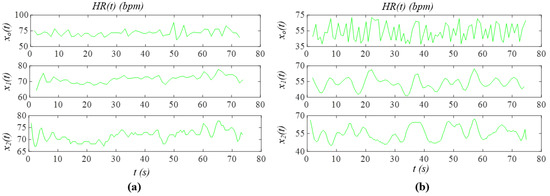
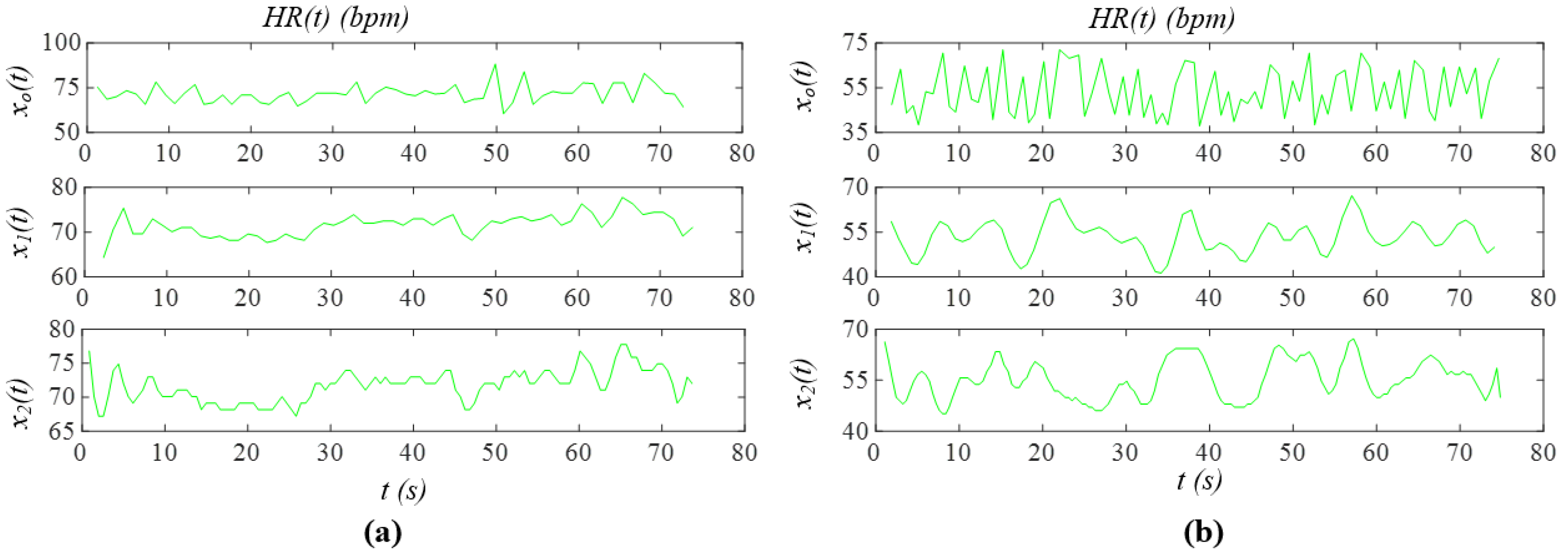
Figure 7 shows x0(t), the first harmonic x1(t), and the second harmonic x2(t) (see Equation (11)). While x0(t) includes both xnoise(t) and xtvsp(t), x1(t) and x2(t) contain only xtvsp(t). The baseline connecting the start and end points of the pulse cycles are used to extract HR from these cycles in the time domain. As shown in Figure 7a, due to small MA and low HRV in the non−AF subject, the baselines for x0(t) and x1(t) remain nearly flat. In contrast, the baseline for x2(t) exhibits discernable variation between pulse cycles, as the smaller amplitude of x2(t) makes it more sensitive to MA and HRV. As shown in Figure 7b, large MA and high HRV in the AF subject produce substantial baseline variation across pulse cycles for all three signals: x0(t), x1(t), and x2(t). Figure 8 shows the extracted HR based on the baselines in Figure 7. As compared to the non-AF subject, the HR extracted from x0(t) in the AF subject exhibits pronounced temporal variation. The HR time-varying pattern derived from both x1(t) and x2(t) varies less in the non-AF subject than in the AF subject.
Figure 7.
The signals of x0(t), the first harmonic x1(t), and the second harmonic x2(t): (a) Subject 2 in the non−AF group; (b) Subject 2 in the AF group (note: green line—the baseline of a signal connecting the start and end points of pule cycles).
Figure 8.
Extraction of HR in the time domain from x0(t), x1(t), and x2(t) in Figure 7: (a) Subject 2 in the non-AF group; (b) Subject 2 in the AF group.
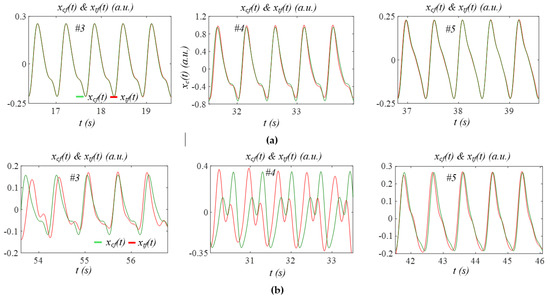
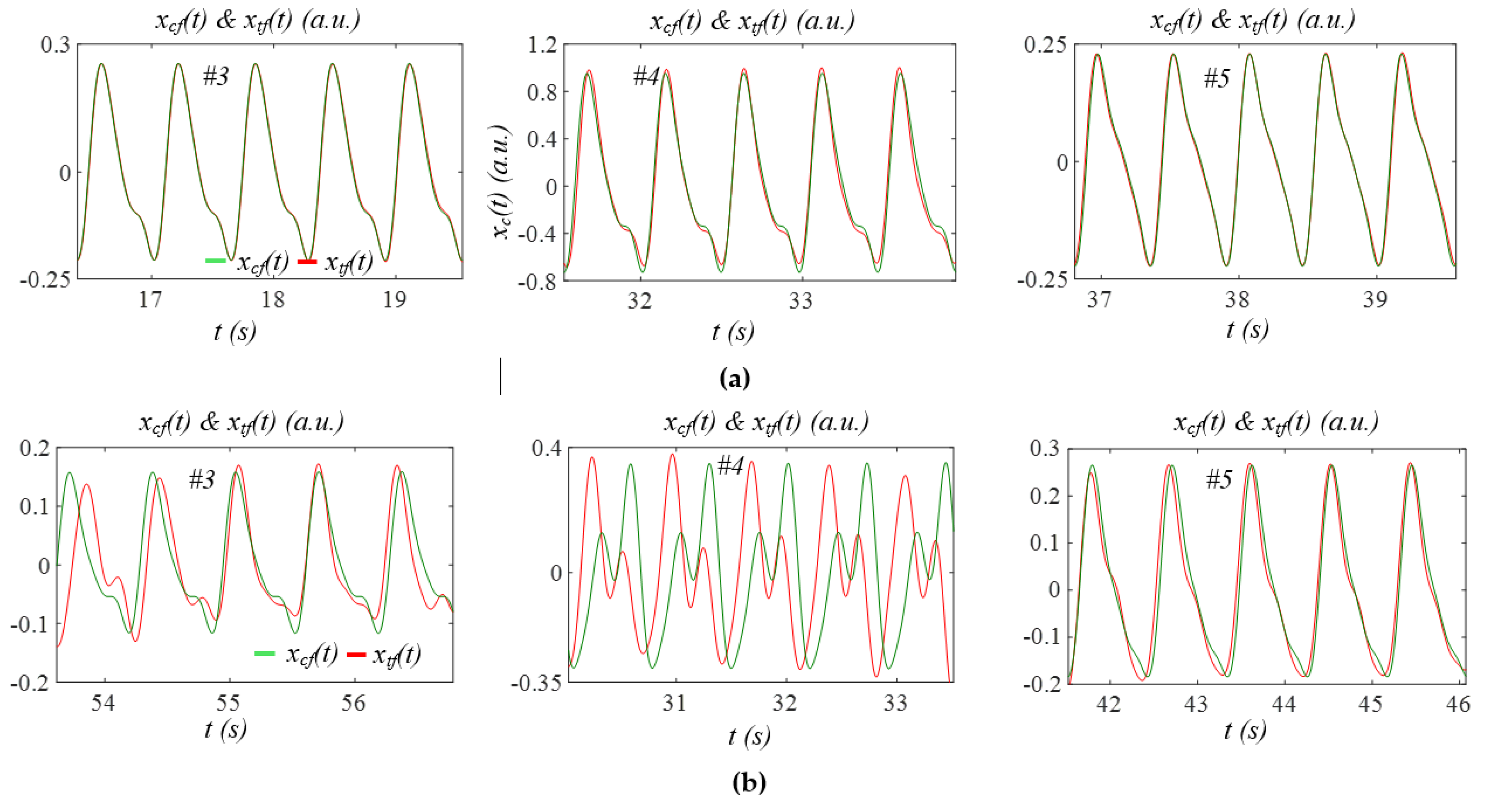
Figure 9 shows additional extracted APWs from subjects in each group. For non-AF subjects, low HRV results in xtf(t) and xcf(t) are nearly identical. In AF subjects, high HRV leads to a pronounced difference between xcf(t) and xtf(t). The observed small difference between xtf(t) and xcf(t) in Subject 5 in the AF group arises from the fact that this subject exhibits the lowest HRV among all the AF subjects, as will be seen later. Finally, the APW varies dramatically between subjects in each group.
Figure 9.
Comparison of APW between time-varying HR and constant HR: (a) xtf(t) and xcf(t) of Subjects 3, 4, and 5 in the non−AF group; (b) xtf(t) and xcf(t) of Subjects 3, 4, and 5 in the AF group.
3.2. Comparison of AF Versus Non−AF Groups’ Extracted Parameters
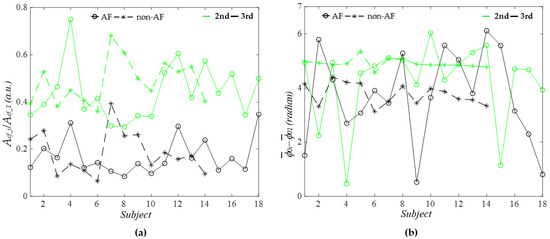
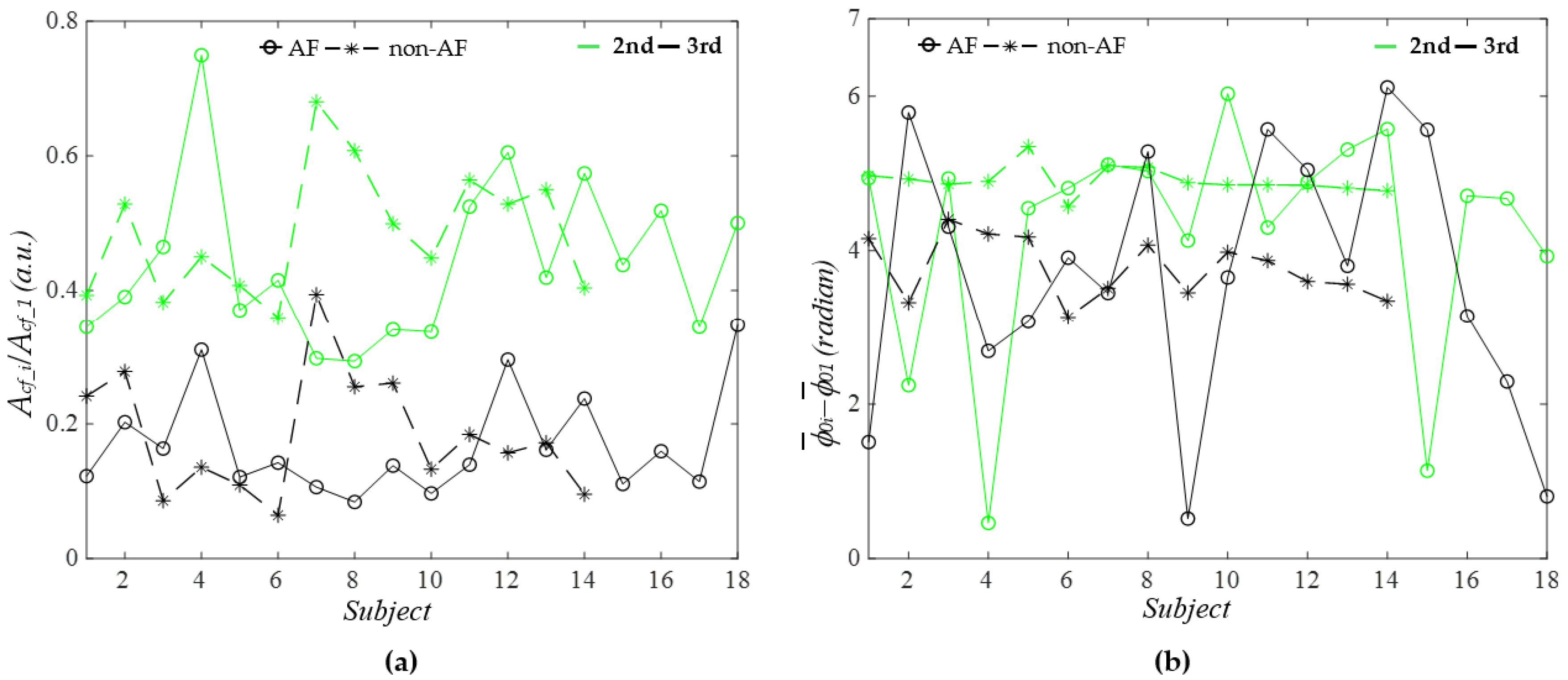
Given that pulse amplitude is highly sensitive to contact pressure, the normalized amplitude and initial phase difference of each harmonic—relative to the first harmonic—were used to compare the two groups. As shown in Figure 10a, the normalized amplitude of the second harmonic is consistently larger than that of the third harmonic, irrespective of AF or non-AF status. No significant difference in the normalized amplitudes of the two harmonics was observed between the AF and non-AF groups, and the amplitudes varied considerably across subjects within each group.
Figure 10.
Comparison of AF versus non−AF Acf_i/Acf_1 and 0i − 01 of the harmonics of the PPG signals: (a) Acf_i/Acf_1 and (b) 0i − 01.
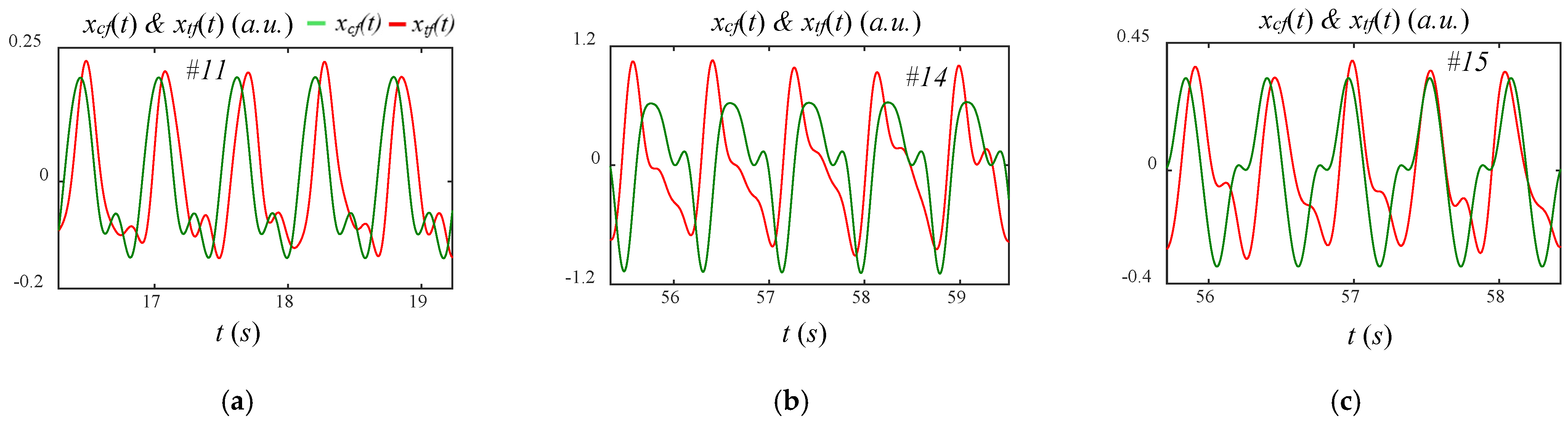
Figure 10b shows the initial phase differences of the two harmonics, which also do not differ between AF and non-AF subjects. For the non-AF group, the initial phase of the second harmonic remains larger than that of the third harmonic. In contrast, for the AF group, the initial phase of the third harmonic exceeds that of the second harmonic in some subjects (03 > 02 for Subjects 2, 4, 8, 11, 12, 14, 15). While the initial phase differences in the non-AF group exhibit only slight variation between subjects, they fluctuate substantially among the AF subjects. As shown in Figure 5e and Figure 9b, time-varying HR contributes to preserving the dicrotic notch in the diastolic portion in Subjects 2 and 4, as compared to the APWs of Subjects 3 and 5. To further validate whether time-varying HR contributes to this effect on the dicrotic notch for other PPG signals with 03 > 02, the APWs with time-varying HR and constant HR for Subjects 11, 14, and 15 were plotted (see Figure A2 in Appendix A). It becomes clear that only when 03 significantly exceeds 02 does time-varying HR contribute to preserving the dicrotic notch in the diastolic portion.
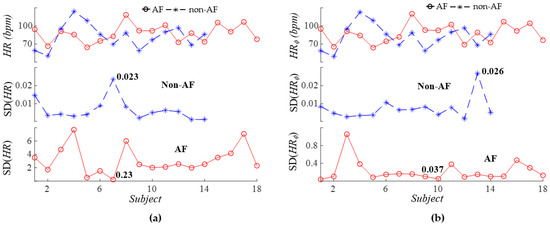
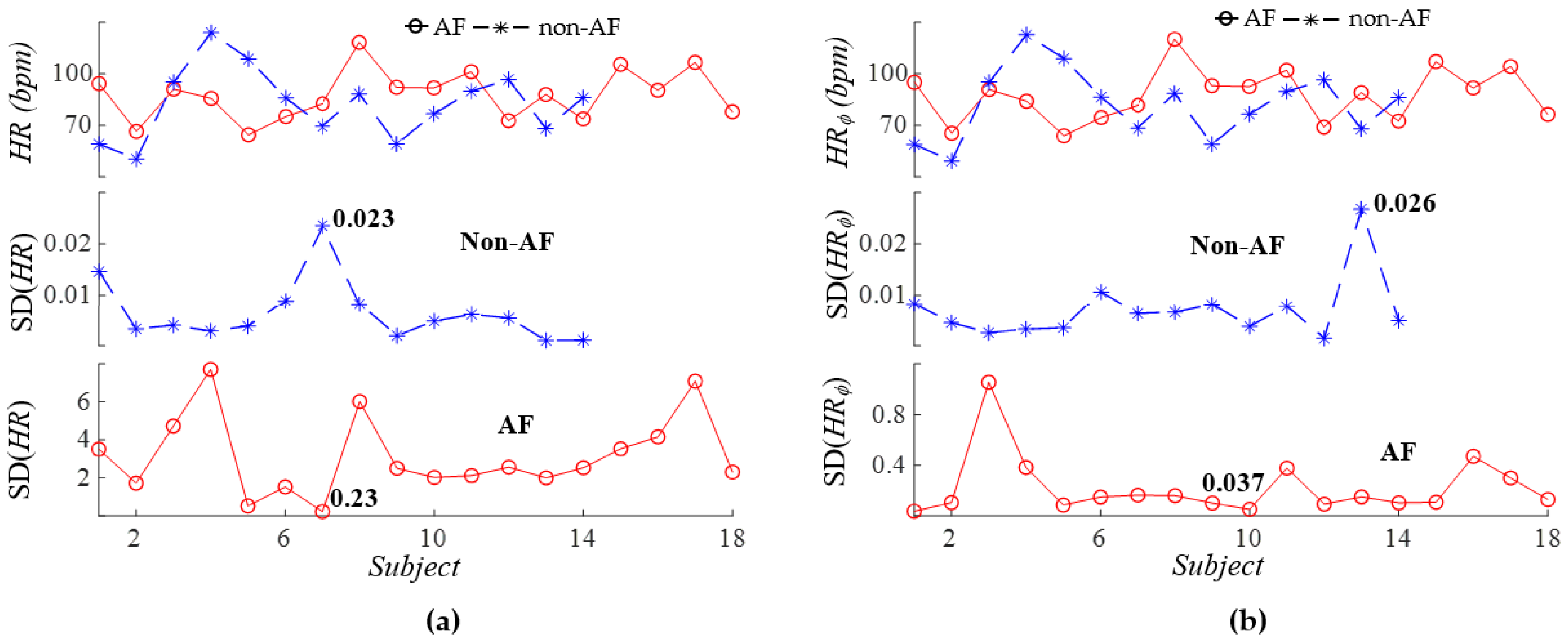
Figure 11a compares the HR and standard deviation of HR extracted from fi(t) (averaged from the three harmonics, see Equation (16) and Figure 3) between the two groups. Figure 11b compares the HR and standard deviation of HRV extracted from ϕ0i(t) (averaged from the three harmonics, see Equation (17) and Figure 3) between the two groups. Both HR and HRϕ do not differ between the two groups. Yet, SD (HR) in the AF group (lowest value: 0.23) is well above that in the non-AF group (highest value: 0.023). SD (HRϕ) in the AF group is also large in the AF group (lowest value: 0.037), as compared to the non-AF group (highest value: 0.027).
Figure 11.
Comparison of AF versus non−AF average HR and standard deviation extracted from the three harmonics: (a) HR and SD (HR) and (b) HRϕ and SD (HRϕ).
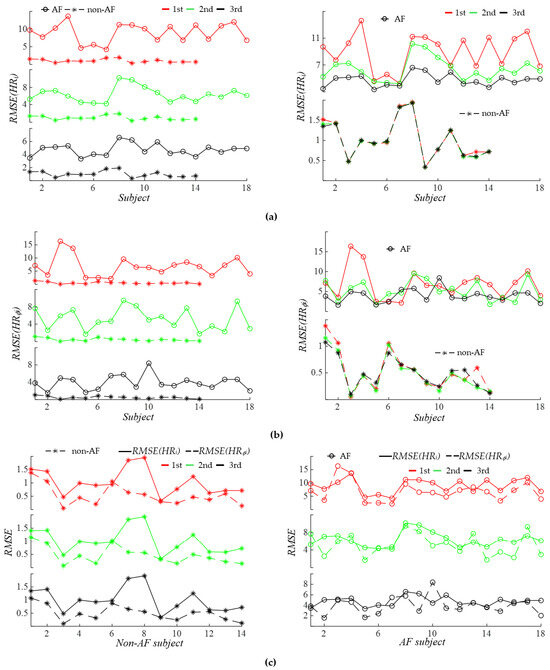
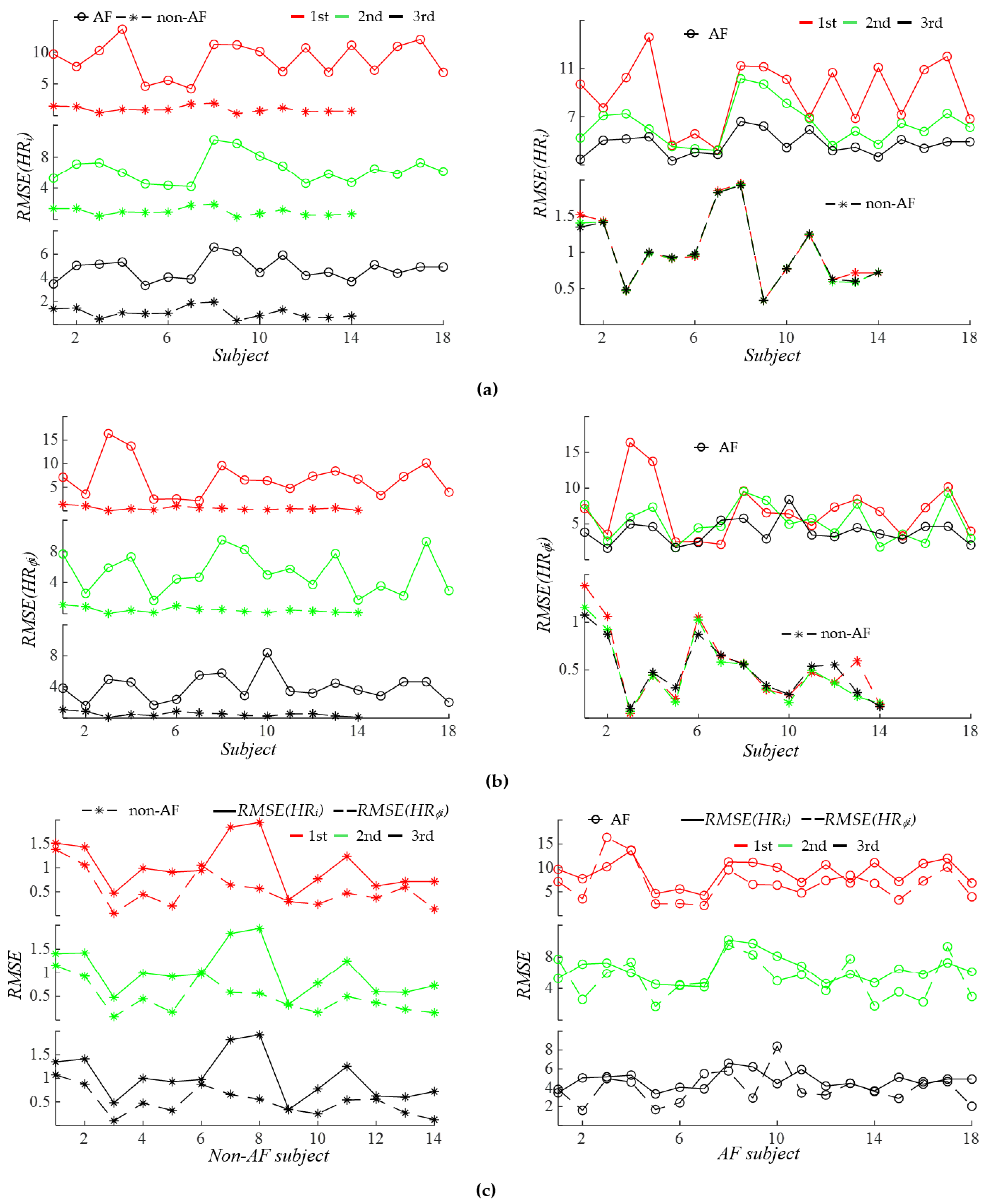
Figure 12 compares the HRV extracted from fi(t) and ϕ0i(t) between the two groups. As shown in Figure 12a, RMSE (HRi) represents the toal HRV, accounting for both respiration and PF. Regardless of the harmonics, RMSE (HRi) is always larger in the AF group as compared to the non-AF group. While RMSE (HRi) remains nearly identical for all the harmonics in the non-AF group, it swings dramatically between the harmonics in the AF group. As shown in Figure 12b, RMSE (HRϕi) represents the HRV accounting solely for respiration. Regardless of the harmonics, RMSE (HRϕi) is always larger in the AF group as compared to the non-AF group. While RMSE (HRϕi) remain very similar between the harmonics in the non-AF group, it swings greatly between the harmonics and does not display any changing trend with harmonic order.
Figure 12.
Comparison of AF versus non−AF HRV: (a) total HRV, RMSE (HRi); (b) HRV accounting solely for respiration RMSE (HRϕi); and (c) comparison of RMSE (HRi) with RMSE (HRϕi) in the non-AF group and the AF group.
Figure 12c compares RMSE (HRi) with RMSE (HRϕi) in each group. From the physiological perspective, RMSE (HRi) should always be higher than RMSE (HRϕi), in that the former accounts for both respiration and PF, whereas the latter accounts for only respiration. For some subjects in the AF group, RMSE (HRϕi) is noticeably higher than RMSE (HRi), which can attribute to the relatively large effect of MA on fi(t). Theoretically, the difference between RMSE (HRi) and RMSE (HRϕi) should represent the effect of PF on the HRV. However, given that (1) RMSE (HRi) is affected by MA and (2) this difference shown in Figure 12c is not substantial for all the subjects, the effect of MA on RMSE (HRi) cannot be neglected, rendering this difference unreliable. Consequently, it remains unclear which factor—respiration or PF—makes more of a contribution to HRV.
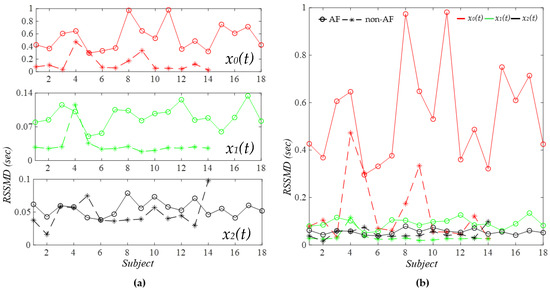
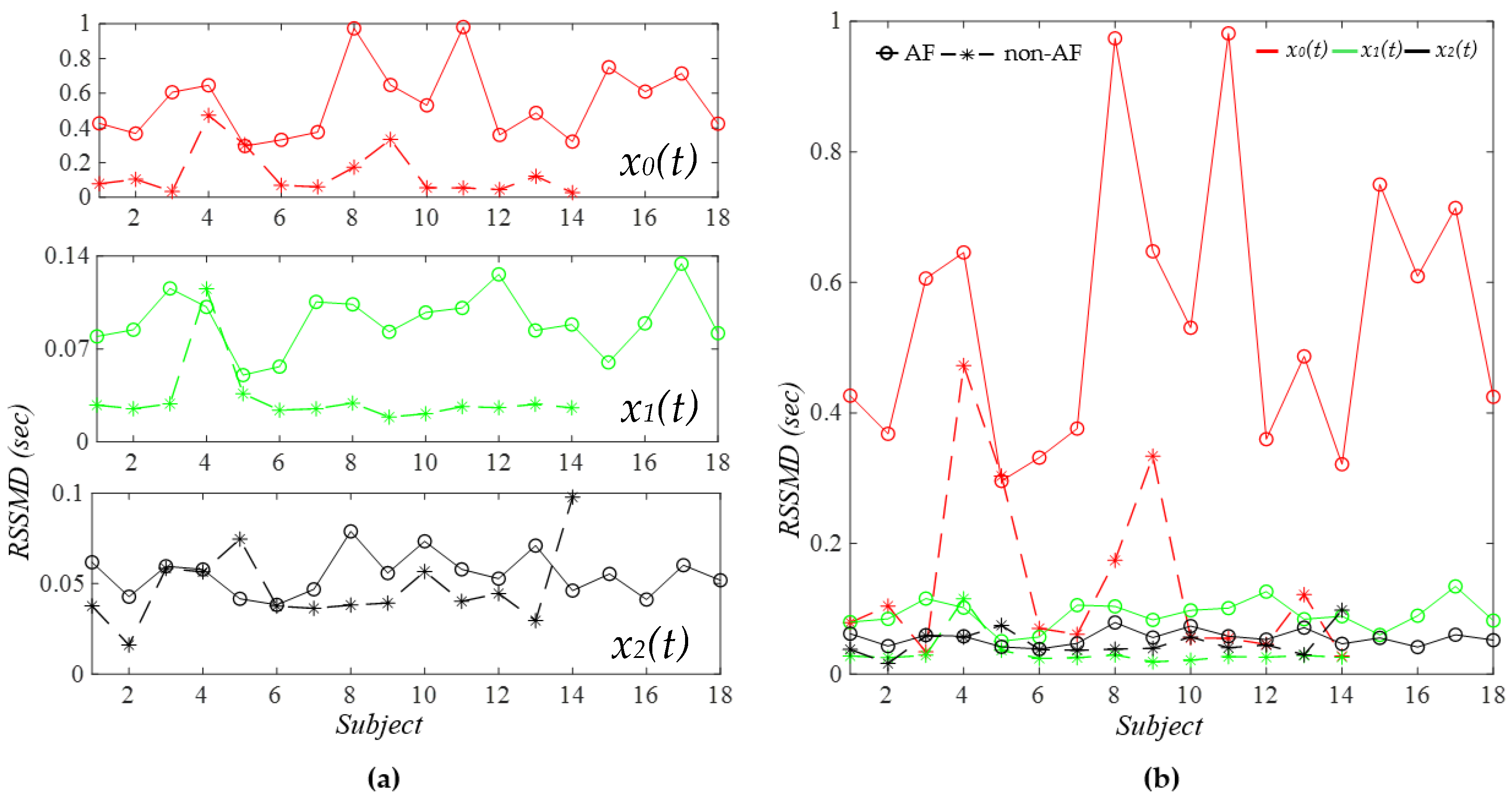
Figure 13 compared the HRV calculated in the time domain, in terms of RMSSD (Root Mean Square of Successive Differences), between the two groups based on the results in Figure 7 and Figure 8. As shown in Figure 13a, the calculated RMSSD from x0(t) and x1(t) is overall larger in the AF group as compared to the non-AF group. In particular, if the RMSSD from x1(t) is used for AF detection, only Subject 4 is a false positive. As shown in Figure A1 (see Appendix A), the reason for this subject being falsely positive is simply due to large MA in the PPG signal. As with RMSSD from x2(t), as pointed out earlier, its small amplitude makes it extremely sensitive to MA. As shown in Figure 13b, RMSSD from x0(t) is overall much larger than its counterparts from x1(t) and x2(t), which might stem from xnoise(t) in x0(t).
Figure 13.
Comparison of AF versus non−AF RSSMD with no MA removal: (a) separate plots for x0(t), x1(t), and x2(t) and (b) one plot for x0(t), x1(t), and x2(t).
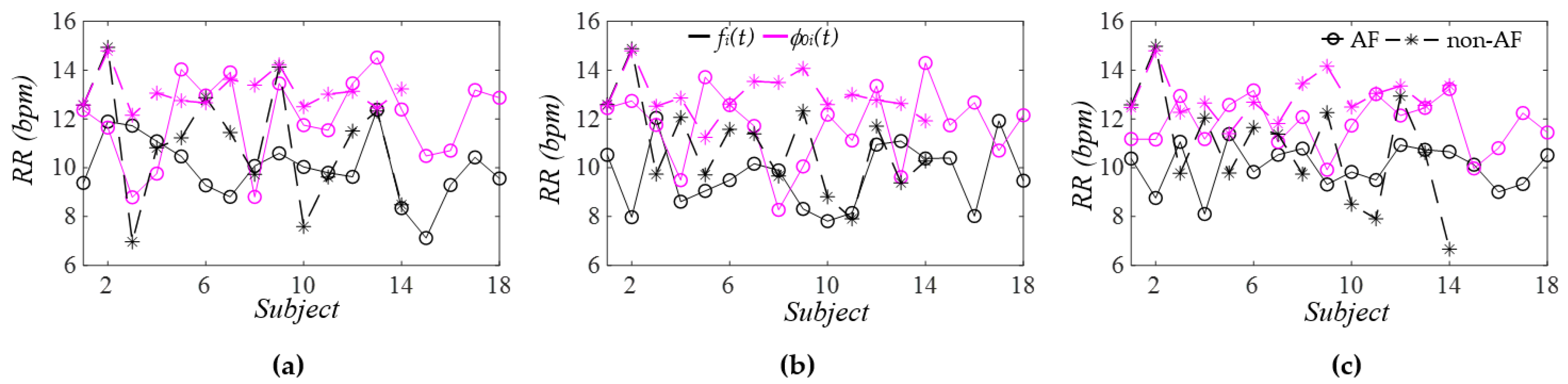
Figure 14 compares the respiration rate (RR) extracted from fi(t) and ϕi(t) of the three harmonics. Regardless of the harmonic or AF/non-AF status, the RR derived from ϕi(t) is consistently higher than that obtained from fi(t). Since ϕi(t) is more robust to MA than fi(t), respiration modulation (RM) is extracted exclusively from ϕi(t). Notably, the extracted RR does not differ between harmonics for either the AF or the non-AF group. There is also no difference in RR between the two groups.
Figure 14.
Comparison of AF versus non−AF RR extracted from fi(t) and ϕ0i(t): (a) the first harmonic; (b) the second harmonic; and (c) the third harmonic.
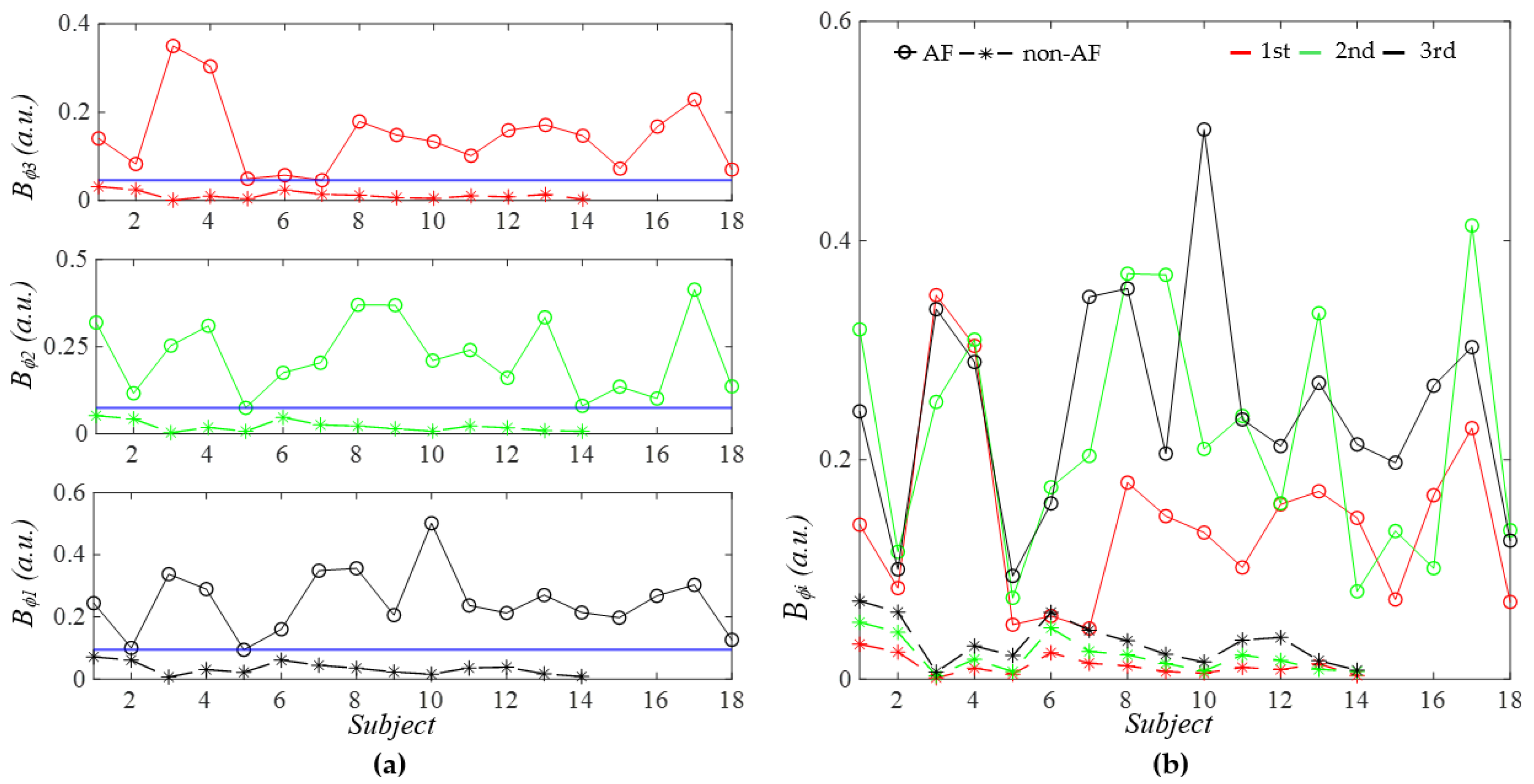
As shown in Figure 15, the respiration modulation (RM) of each harmonic is lower in the non-AF group compared to the AF group. Furthermore, RM remains relatively consistent across subjects in the non-AF group, whereas it varies substantially between subjects in the AF group. Interestingly, while RM in the non-AF group overall exhibits an increasing trend with harmonic order, such a trend is diminished in the AF group. Note that Subject 5 in the AF group exhibits the lowest RM, which is consistent with the other corresponding results: the lowest RMSE (HRi) and RMSE (HRϕi) in Figure 12 and the small difference between xtf(t) and xcf(t) in Figure 9.
Figure 15.
Comparison of AF versus non-AF RM: mean (Bϕi) extracted from ϕ0i(t). (a) Separate plots for each harmonic and (b) one plot for all the three harmonics.
4. Discussion
The comparison of this method with related time–frequency approaches, as well as with machine learning and deep learning techniques, has been presented in [25] and is not repeated here. Briefly, compared with the other time–frequency approaches in the literature, the SDOF-TF method [25] is built upon the SDOF model of MA, which leads to the following findings regarding the effects of TVSP on instant parameters: (1) TVSP greatly swings the instant amplitude of each harmonic; (2) TVSP slightly affects the instant frequency of each harmonic; (3) TVSP has almost no effect on the instant initial phase of each harmonic; (4) the instant frequency of each harmonic carries both the respiration signal and PF; and (5) the instant initial phase of each harmonic carries only the respiration signal. Based on these findings, the SDOF-TF method was developed to extract the corresponding parameters for a pulse signal. Among all the studies that have evaluated signal-processing methods for AF detection using the same dataset, the proposed SDOF-TF method is, to the best of the authors’ knowledge, the first to achieve perfect AF detection accuracy. This section thus concentrates on the implications of the analyzed results and the limitations in the present study.
4.1. Implications of the Analyzed Results
4.1.1. Entangled MA, Noise, and HRV
The analysis in Section 3 reveals entangled relationships among MA, HRV, and noise. As shown in Figure 2, physiological condition appears both in MA and in the true pulse signal. In the true pulse signal, it manifests solely as HRV (i.e., time-varying frequency), whereas in MA (i.e., xtvsp(t)), it is complicated by the contributions of sensor fixture and the TCS stack. Nevertheless, as demonstrated in Figure 6 and Figure A1, the temporal variation in xtvsp(t) is dominated by physiological condition. Similarly, the noise in a PPG signal xnoise(t) is correlated with the PPG signal itself and xtvsp(t). For the non-AF subject, the temporal variation in xnoise(t) follows that of xtvsp(t), whereas for the AF subject, both xnoise(t) and xtvsp(t) exhibit random time-varying behavior.
4.1.2. APW with Time-Varying HR Versus APW with Constant HR
As shown in Figure 4e, Figure 5e and Figure 9, and A2, large time-varying HR causes significant variation in APW between pulse cycles in the AF subjects, whereas small time-varying HR in the non-AF subjects translates to slight variation in APW between pulse cycles. To reveal the role of time-varying HR in APW, we reconstructed the APW with constant HR for both groups. As shown in Figure 5e and Figure 9b, and A2, large time-varying HR can greatly affect APW, as compared to its counterpart with constant HR.
Since the visual examination of the APW between AF and non-AF subjects does not reveal any distinguishing features, we further compare their normalized amplitudes and initial phases of the second and third harmonics, relative to the first harmonic. As illustrated in Figure 10, neither the amplitudes nor the initial phases of the harmonics effectively separate AF from non-AF subjects. Notably, in Subjects 2 and 4 of the AF group, the initial phase of the third harmonic exceeds that of the second harmonic (i.e., 03 > 02), which may explain the appearance of a notch in the systolic portion of the pulse cycle in the APW with constant HR. To further verify whether 03 > 02 underlies the appearance of the dicrotic notch in the systolic portion, Subjects 11, 14, and 15 with 03 > 02 in Figure 10b were analyzed. Their APWs with time-varying HR and constant HR show that only when 03 significantly exceeds 02 does time-varying HR contribute to preserving the dicrotic notch in the diastolic portion. These results suggest that time-varying HR contributes to maintaining the pulse waveform near its normal shape when the initial phase of the third harmonic is substantially higher than that of the second harmonic in an AF subject.
4.1.3. HR and HRV Derived from Instant Frequency and Instant Initial Phase
As shown in Equation (9), the instant frequency fi(t) of a harmonic accounts for both respiration and PF. Accordingly, the HR derived from fi(t) represents the total HR. In contrast, the HR derived from the instant initial phase ϕi(t) excludes the contribution of PF to the HR. Yet, based on the SDOF model of MA [25], MA has almost no effect on ϕi(t) but does influence fi(t) to some extent.
As shown in Figure 11a, the average HR HR derived from fi(t) of the three harmonics does not exhibit any clear difference between AF and non-AF subjects. In contrast, the standard deviation of HR SD (HR) across the harmonics effectively separates AF from non-AF subjects. As illustrated in Figure 4 and Figure 5, the effect of MA on fi(t) is similar across the harmonics. As such, the large SD (HR) observed in the AF group is believed to reflect the elevated HRV characteristic of AF. As shown in Figure 11b, the average HR HRϕ derived from ϕi(t) shows no noticeable difference between the two groups. However, the standard deviation of HR SD (HRϕ) provides clear separation between AF and non-AF subjects. This large SD (HRϕ) in the AF group is believed to arise from substantial variation in respiration modulation (RM) across the harmonics, as evidenced in Figure 15.
As shown in Figure 13, the HRV RSSMD extracted in the time domain from x0(t) fails to effectively distinguish AF from non-AF subjects, highlighting the necessity of removing MA and noise. Even in the absence of noise, the HRV extracted from x1(t) misdiagnosed one non-AF subject due to large MA in the signal. These findings stress that the effective removal of MA and noise is critical for accurate AF detection using time-domain HRV.
4.1.4. Identified Indices for AF Detection and Observed Physiological Implications
In addition to SD (HR) and SD (HRϕ), as shown in Figure 12, both the total HRV RMSE (HRi) derived from fi(t) and the HRV RMSE (HRϕi) derived from ϕi(t) demonstrate clear separation between AF and AF subjects for each harmonic. Furthermore, as illustrated in Figure 15, RM mean (Bϕi(t)) derived from ϕi(t) also effectively distinguishes AF from non-AF subjects.
In summary, three categories of parameters extracted from an at-rest PPG signal can be used for AF detection:
- (1)
- SD (HR) and SD (HRϕ);
- (2)
- RMSE (HRi) and RMSE (HRϕi) of each harmonic;
- (3)
- mean (Bϕi(t)) of each harmonic.
The mean, standard deviation, median, and range of these indices are summarized in Table A4 in Appendix A, showing non-overlapping values between the AF and non-AF groups, whereas the other extracted parameters exhibit overlapping values between the two groups. These parameters serve as effective indices for AF detection, as each captures aspects of HRV within a PPG signal that is largely free of MA and noise.
Furthermore, three physiological implications emerge from this study:
- (1)
- AF increases RM for each harmonic;
- (2)
- AF disrupts the increasing trend of RM with harmonic order;
- (3)
- Elevated HRV contributes to maintaining the pulse waveform near its normal shape, when AF causes the initial phase of the third harmonic to significantly exceed that of the second harmonic.
Finally, it is worth noting that the increase in RM in AF does not necessarily indicate that respiration plays a more dominant role in determining HRV compared with PF.
4.2. Study Limitations
This study has six limitations. First, the complexity of optical transduction in a PPG sensor is substantially simplified. As demonstrated by the analyzed results, this simplification does not obscure the expected differences in HRV between AF and non-AF subjects. Second, the SDOF-TF method is applicable only to at-rest PPG signals and is unsuitable for wearable PPG signals (i.e., PPG signals recorded during activities). As described in [25], the frequency of MA during activities falls into the frequency range of the pulse signal itself and may vary between pulse cycles. Based on the SDOF model of MA, as seen in Equation (3), such MA will generate multiple signals at different frequencies and thus contaminate those harmonics whose frequencies are close to theirs [25]. Furthermore, activities can easily cause intermittent tissue–sensor contact, create nonlinearity in the TCS stack (manifested as abrupt changes in the pulse waveform), and severely distort pulse cycles.
Third, the nonlinearity of the TCS stack is neglected in the analysis. As long as there is no abrupt change in the pulse waveform of a PPG signal, tissue–sensor contact remains consistent, and the assumption of linearity in the TCS stack is practical. As noted in Section 2.2, segments of the PPG signals were selected to avoid abrupt changes. The results presented here indicate that this assumption does not affect the identification of indices for AF detection. It is worth noting that the analysis of PPG signals with abrupt changes may increase the risk of false-positive detections. False-negative detections are unlikely unless the PPG sensor malfunctions.
Fourth, no comparison of the SDOF-TF method with other time–frequency methods reported in the literature was conducted. Since the SDOF-TF method achieves 100% detection accuracy, such a comparison was deemed unnecessary. Fifth, the sample size of the dataset is small. In future work, the identified indices for AF detection and the observed physiological implications will need to be further validated using datasets with larger sample sizes.
Lastly, the effect of the system parameters m0, k0, and c0 of the TCS stack on a PPG signal is not explored. Based on its working principle [25], the SDOF-TF method is applicable to various sensor types: tactile sensors, accelerometers, PPG sensors, and even an ultrasound probe for measuring radial arterial wall displacement [31]. As illustrated in Figure 2, the nominal values of m0, k0, and c0 represent the collective behavior of the sensor, contact pressure, and the individual (i.e., tissue). Clearly, TVSP—m(t), k(t), and c(t)—of the TCS stack is related not only to baseline drift (BD) but also to m0, k0, and c0. At the same time, BD is also related to m0, k0, and c0 as well as the individual (i.e., physiological condition). All these system parameters of the TCS stack vary with sensor type, individual, and contact pressure. For instance, high contact pressure translates to low BD and, consequently, low TVSP. Th effect of contact pressure on a measured pulse signal is multifaceted, and a detailed discussion can be found in the literature [25,26,27,28,31]; it is beyond the scope of this study. Given that there are six unknowns but only one measured pulse signal, there is currently no method for identifying their exact values. However, as demonstrated in this study, not knowing the values of these parameters does not affect the removal of the MA and noise of a PPG signal for AF detection.
5. Conclusions
In this study, the SDOF-TF method was applied to at-rest PPG signals from the MIMIC PERform AF dataset to evaluate its effectiveness in removing MA and noise and detecting AF. The arterial pulse waveform (APW)—characterized by normalized amplitudes and relative initial phase differences with respect to the first harmonic—was found to be ineffective in distinguishing AF from non-AF subjects. In contrast, three categories of time–frequency parameters enabled AF detection with 100% accuracy: (1) respiration modulation (RM), (2) total HRV derived from instant frequency and HRV attributable solely to respiration derived from instant initial phase, and (3) the standard deviation of total HR and HR accounting solely for respiration across harmonics.
Compared with non-AF subjects, RM was increased in AF subjects. RM exhibited an increasing trend with harmonic order in the non-AF group, whereas this trend was diminished in the AF group. Elevated HRV was also found to contribute to maintaining the pulse waveform near its normal shape (i.e., the dicrotic notch in the diastolic portion) in those AF subjects where the initial phase of the third harmonic substantially exceeds that of the second harmonic.
Author Contributions
Conceptualization, Z.H.; methodology, Z.H.; software, Z.H.; validation, M.H. and Z.H.; formal analysis, M.H.; investigation, M.H. and Z.H.; resources, Z.H.; data curation, M.H.; writing—original draft preparation, Z.H.; writing—review and editing, Z.H. and M.H.; visualization, M.H. and Z.H.; supervision, Z.H.; project administration, Z.H.; funding acquisition, Z.H. All authors have read and agreed to the published version of the manuscript.
Funding
This research received no external funding.
Institutional Review Board Statement
Not applicable.
Informed Consent Statement
Not applicable.
Data Availability Statement
The data in the MIMIC PERform AF Dataset [21] are used.
Conflicts of Interest
The authors declare no conflicts of interest, except that the SDOF-TF method used in this study is patent-pending.
Abbreviations
The following abbreviations are used in this manuscript:
| AF | Atrial fibrillation |
| APW | Arterial pulse waveform |
| BD | Baseline drift |
| SDOF | Single-degree-of-freedom |
| TVSPs | Time-varying system parameters |
| MA | Motion artifacts |
| SDOF-TF | Single-degree-of-freedom time–frequency |
| HVD | Hilbert vibration transform |
| PFs | Other physiological factors |
| FFT | Fast Fourier transform |
Appendix A
Table A1.
Selected segments: tstart − tend of the PPG signals in (a) the AF group and (b) the non-AF group used in the analysis.
Figure A1.
The PPG signal (segment: 730–810 s) of Subject 4 in the non−AF group: (a) xPPG(t), x0(t), and xb(t) (green line: baseline of x0(t)); (b) x1(t) and x2(t) containing xtvsp(t) (green line: baseline of x1(t) and x2(t)); (c) x0(t), xtvsp(t), and xnoise(t).
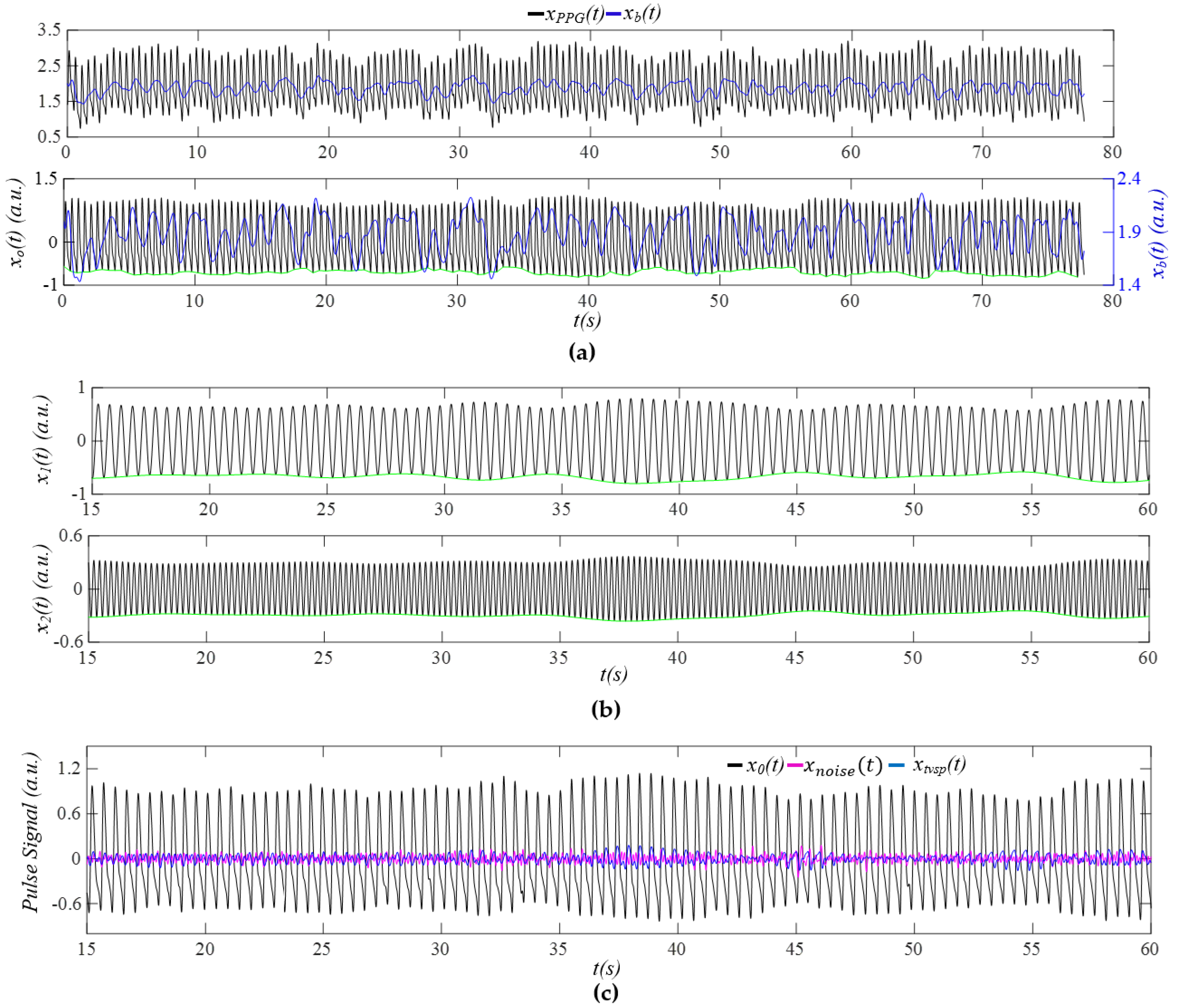
Table A2.
The numerical values of the extracted parameters for the non-AF group.
Table A3.
The numerical values of the extracted parameters from the AF group dataset.
Table A4.
The mean, median, standard deviation (SD), and range of all the extracted parameters from the PPG signals, with the identified indices for AF detection highlighted in bold.
Figure A2.
Comparison of APW between time-varying HR and constant HR: (a) Subject 11; (b) Subject 14; (c) Subject 15 in the AF group.
References
- Aschbacher, K.; Yilmaz, D.; Kerem, Y.; Crawford, S.; Benaron, D.; Liu, J.; Eaton, M.; Tison, G.H.; Olgin, J.E.; Li, Y.; et al. Atrial fibrillation detection from raw photoplethysmography waveforms: A deep learning application. Heart Rhythm O2 2020, 1, 3–9. [Google Scholar] [CrossRef] [Scilit] [PubMed]
- Bashar, S.K.; Han, D.; Hajeb-Mohammadalipour, S.; Ding, E.; Whitcomb, C.; McManus, D.D.; Chon, K.H. Atrial Fibrillation Detection from Wrist Photoplethysmography Signals Using Smartwatches. Sci. Rep. 2019, 9, 15054. [Google Scholar] [CrossRef] [Scilit] [PubMed]
- Yin, Z.; Liu, C.; Xie, C.; Nie, Z.; Wei, J.; Zhang, W.; Liang, H. Identification of Atrial Fibrillation Using Heart Rate Variability: A Meta-Analysis. Front. Cardiovasc. Med. 2025, 12, 1581683. [Google Scholar] [CrossRef] [Scilit] [PubMed]
- Park, J.; Seok, H.S.; Kim, S.S.; Shin, H. Photoplethysmogram Analysis and Applications: An Integrative Review. Front. Physiol. 2022, 12, 808451. [Google Scholar] [CrossRef] [Scilit]
- Pereira, T.; Tran, N.; Gadhoumi, K.; Pelter, M.M.; Do, D.H.; Lee, R.J.; Colorado, R.; Meisel, K.; Hu, X. Photoplethysmography-Based Atrial Fibrillation Detection: A Review. npj Digit. Med. 2020, 3, 3. [Google Scholar] [CrossRef] [Scilit]
- Lee, Y.; Lee, S.; Kim, S.K.; Yon, D.K.; Nam, Y.; Lee, J. Cooperative PPG/ECG Wearable System for Atrial Fibrillation Diagnosis. IEEE Sen. J. 2025, 25, 7331–7344. [Google Scholar] [CrossRef] [Scilit]
- Charlton, P.H.; Kotzen, K.; Mejía-Mejía, E.; Aston, P.J.; Budidha, K.; Mant, J.; Pettit, C.; Behar, J.A.; Kyriacou, P.A. Detecting Beats in the Photoplethysmogram: Benchmarking Open-Source Algorithms. Physiol. Meas. 2022, 43, 085007. [Google Scholar] [CrossRef] [Scilit]
- Pedrosa-Rodriguez, A.; Camara, C.; Peris-Lopez, P. Leveraging IoT Devices for Atrial Fibrillation Detection: A Comprehensive Study of AI Techniques (99%). Appl. Sci. 2024, 14, 8945. [Google Scholar] [CrossRef] [Scilit]
- Pachori, D.; Tripathy, R.K.; Jain, T.K. Detection of Atrial Fibrillation from PPG Sensor Data Using Variational Mode Decomposition. IEEE Sens. Lett. 2024, 8, 1–4. [Google Scholar] [CrossRef] [Scilit]
- Bashar, S.K.; Ding, E.; Albuquerque, D.; Winter, M.; Binici, S.; Walkey, A.J.; McManus, D.D.; Chon, K.H. Atrial Fibrillation Detection in ICU Patients: A Pilot Study on MIMIC III Data. In Proceedings of the 2019 41st Annual International Conference of the IEEE Engineering in Medicine and Biology Society (EMBC), Berlin, Germany, 23–27 July 2019; pp. 298–301. [Google Scholar] [CrossRef] [Scilit]
- Mathivani, H.; Niranjana, V.; Vaishali, B.; Jayanthi, T. AI-Based Atrial Fibrillation Detection Using Pulse Rate Variability from PPG: A Comparative Study with HRV. In Proceedings of the 2025 International Conference on Artificial Intelligence and Data Engineering (AIDE), Nitte, India, 6–7 February 2025; pp. 262–266. [Google Scholar]
- Davies, H.J.; Monsen, J.; Mandic, D.P. Interpretable Pre-Trained Transformers for Heart Time-Series Data. In Proceedings of the International Conference on Learning Representations (ICLR), Vienna, Austria, 7–11 May 2024. [Google Scholar]
- Aldughayfiq, B.; Ashfaq, F.; Jhanjhi, N.Z.; Humayun, M. A Deep Learning Approach for Atrial Fibrillation Classification Using Multi-Feature Time Series Data from ECG and PPG. Diagnostics 2023, 13, 2442. [Google Scholar] [CrossRef] [Scilit]
- Zhang, Z.; Pi, Z.; Liu, B. TROIKA: A General Framework for Heart Rate Monitoring Using Wrist-Type Photoplethysmographic Signals During Intensive Physical Exercise. IEEE Trans. Biomed. Eng. 2015, 62, 522–531. [Google Scholar] [CrossRef] [Scilit]
- Obi, A.I. An Overview of Wearable Photoplethysmographic Sensors and Various Algorithms for Tracking of Heart Rates. Eng. Proc. 2021, 10, 77. [Google Scholar] [CrossRef] [Scilit]
- Pollreisz, D.; Taherinejad, N. Detection and Removal of Motion Artifacts in PPG Signals. Mob. Netw. Appl. 2022, 27, 728–738. [Google Scholar] [CrossRef] [Scilit]
- Ismail, S.; Akram, U.; Siddiqi, I. Heart rate tracking in photoplethysmography signals affected by motion artifacts: A review. EURASIP J. Adv. Signal Process. 2021, 2021, 5. [Google Scholar] [CrossRef] [Scilit]
- Seok, D.; Lee, S.; Kim, M.; Cho, J.; Kim, C. Motion Artifact Removal Techniques for Wearable EEG and PPG Sensor Systems. Front. Electron. 2021, 2, 685513. [Google Scholar] [CrossRef] [Scilit]
- Blok, S.; Piek, M.A.; Tulevski, I.I.; Somsen, G.A.; Winter, M.M. The accuracy of heartbeat detection using photoplethysmography technology in cardiac patients. J. Electrocardiol. 2021, 67, 148–157. [Google Scholar] [CrossRef] [Scilit]
- Gruwez, H.; Ezzat, D.; Van Puyvelde, T.; Dhont, S.; Meekers, E.; Bruckers, L.; Wouters, F.; Kellens, M.; Van Herendael, H.; Rivero-Ayerza, M.; et al. Real-world validation of smartphone-based photoplethysmography for rate and rhythm monitoring in atrial fibrillation. EP Eur. 2024, 26, euae065. [Google Scholar] [CrossRef] [Scilit] [PubMed]
- Charlton, P.H. MIMIC PERform Datasets (1.01) [Data Set]. Zenodo. 2022. Available online: https://zenodo.org/records/6807403 (accessed on 22 September 2025).
- Kraft, D.; Rumm, P. Atrial Fibrillation and Atrial Flutter Detection Using Deep Learning. Sensors 2025, 25, 4109. [Google Scholar] [CrossRef] [Scilit]
- Neha; Sardana, H.K.; Kanawade, R.; Dogra, N. Photoplethysmograph-Based Arrhythmia Detection Using Morphological Features. Biomed. Signal Process. Control 2023, 81, 104422. [Google Scholar] [CrossRef] [Scilit]
- Chen, W.; Yi, Z.; Lim, L.J.R.; Lim, R.Q.R.; Zhang, A.; Qian, Z.; Huang, J.; He, J.; Liu, B. Deep Learning and Remote Photoplethysmography Powered Advancements in Contactless Physiological Measurement. Front. Bioeng. Biotechnol. 2024, 12, 1420100. [Google Scholar] [CrossRef] [Scilit]
- Hao, Z. Motion Artifacts Removal from Measured Arterial Pulse Signals at Rest: A Generalized SDOF-Model-Based Time–Frequency Method. Sensors 2025, 25, 6808. [Google Scholar] [CrossRef] [Scilit]
- Hao, Z. A 2-DOF Model of the Artery-Sensor System for Interpreting Variability in Measured Arterial Pulse Waveform. IEEE Sens. J. 2023, 23, 22668–22678. [Google Scholar] [CrossRef] [Scilit]
- Rahman, M.M.; Toraskar, S.; Hasan, M.; Hao, Z. An Analytical Model of Motion Artifacts in a Measured Arterial Pulse Signal—Part I: Accelerometers and PPG Sensors. Sensors 2025, 25, 5710. [Google Scholar] [CrossRef] [Scilit]
- Rahman, M.M.; Hasan, M.; Hao, Z. Motion Artifacts (MA) At-Rest in Measured Arterial Pulse Signals: Time-Varying Amplitude in Each Harmonic and Non-Flat Harmonic-MA-Coupled Baseline. Biosensors 2025, 15, 578. [Google Scholar] [CrossRef] [Scilit] [PubMed]
- Hao, Z. Harmonics of Pulsatile Pressure at Different Ages and Its Effect on Other Pulsatile Parameters and Waveform-Based Clinical Indices. J. Eng. Sci. Med. Diagn. Ther. 2024, 7, 011001. [Google Scholar] [CrossRef] [Scilit]
- Chen, Z.; Brown, E.N.; Barbieri, R. Assessment of autonomic control and respiratory sinus arrhythmia using point process models of human heart beat dynamics. IEEE Trans. Biomed. Eng. 2009, 56, 1791–1802. [Google Scholar] [CrossRef] [Scilit]
- Toraskar, S.; Rahman, M.M.; Hao, Z. Pulse measurement alters the true pulse signal in an artery: A coupled string-SDOF model. ASME J. Med. Diagn. 2026, 9, 011207. [Google Scholar] [CrossRef] [Scilit]
Disclaimer/Publisher’s Note: The statements, opinions and data contained in all publications are solely those of the individual author(s) and contributor(s) and not of MDPI and/or the editor(s). MDPI and/or the editor(s) disclaim responsibility for any injury to people or property resulting from any ideas, methods, instructions or products referred to in the content. |
© 2026 by the authors. Licensee MDPI, Basel, Switzerland. This article is an open access article distributed under the terms and conditions of the Creative Commons Attribution (CC BY) license.