
A Sensor-Based and GIS-Linked Analysis of Road Characteristics Influencing Lateral Passing Distance Between Motor Vehicles and Bicycles in Austria



Highlights
- Using 11,399 OpenBikeSensor (OBS) overtaking records linked to Austria’s national GIS road graph (GIP), the study reveals statistically robust patterns in lateral passing distance (LPD) between motor vehicles and cyclists related to infrastructure.
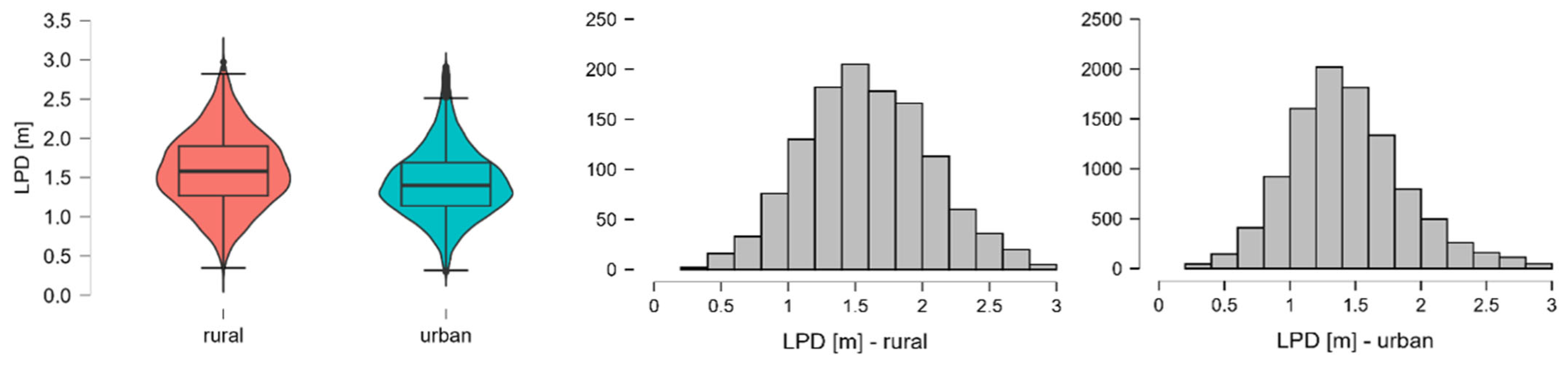
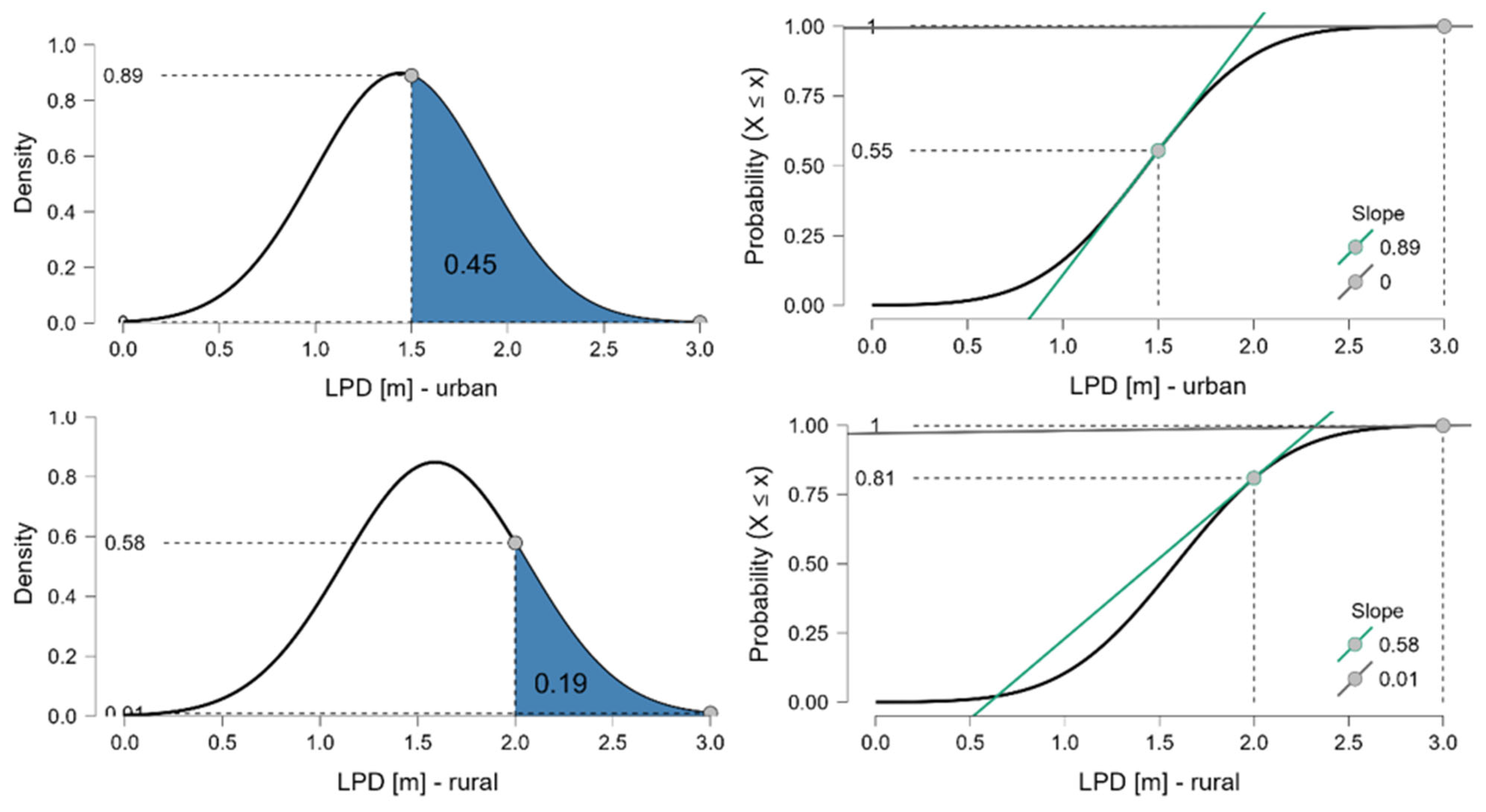
- LPD is significantly higher in rural areas than in urban ones, with compliance to Austria’s 2023 legal thresholds averaging ~40% in cities (≥1.5 m) and ~19% in rural areas (≥2.0 m). Small but consistent positive correlations were found between LPD and lane width, speed limit, and functional road class.
- The results highlight that road geometry and network hierarchy shape overtaking safety, emphasising the need for more explicit cyclist allocation and physical separation in constrained or high-speed environments.
- The study demonstrates how sensor-based, GIS-linked nonparametric analysis can support evidence-based road design and policy evaluation regarding safe passing distances.
Abstract
1. Introduction
2. Data and Methods
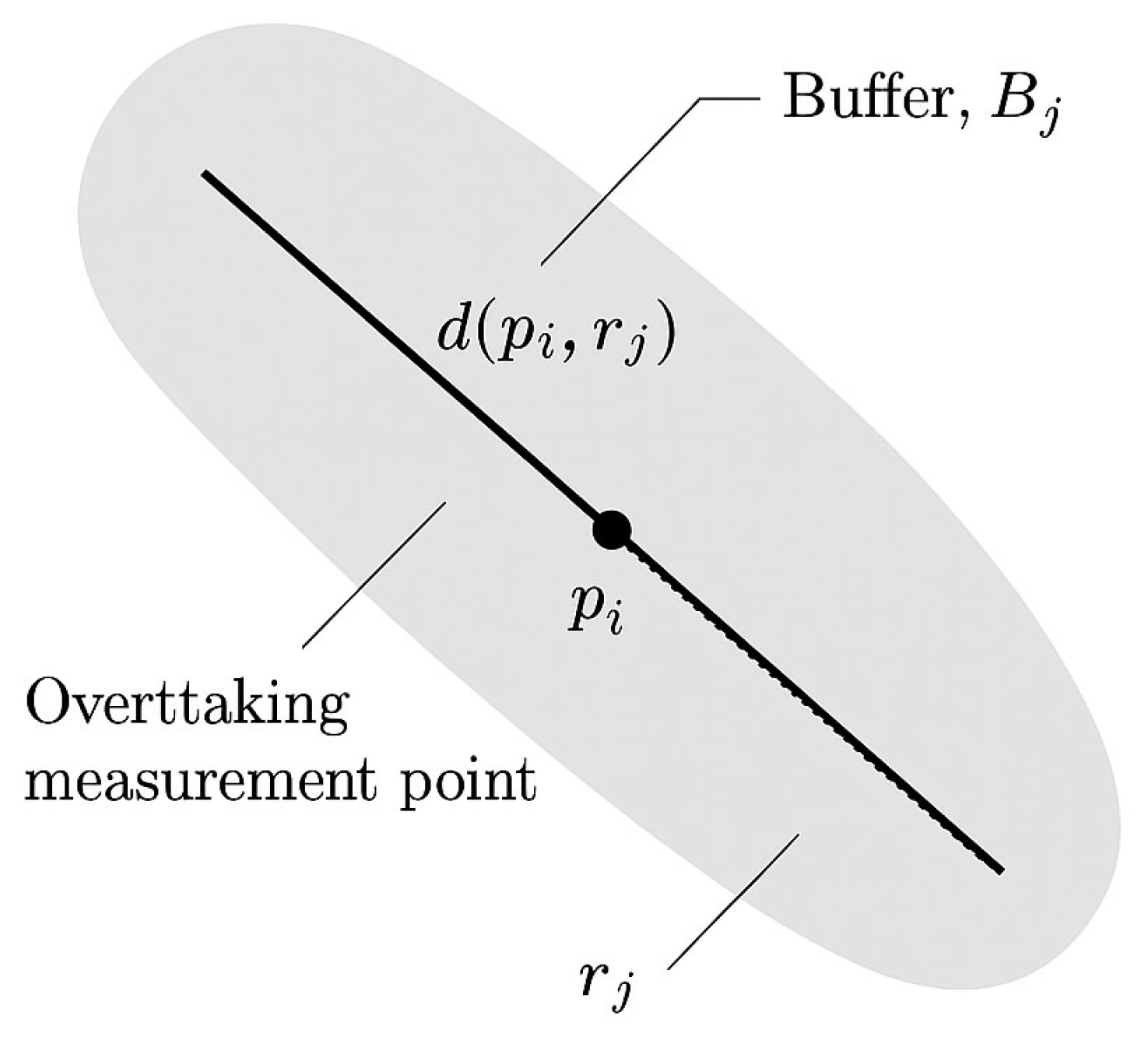
2.1. Data Sources and GIS Integration
2.2. Independent Variables
- Metric Variables: These variables describe the geometric and regulatory characteristics of the roadway at or near the point of overtaking:
- Speed limit: Posted speed limit in kilometres per hour [km/h].
- Lane width: Road segment width at the location of the overtaking event [m].
- Lanes: Number of lanes in the direction of travel at the location of the event.
- Categorical Variables: These variables represent structural and functional classifications of the road network, as defined by the GIP road network:
- Functional Road Class represents the hierarchical level of the network (e.g., municipal, regional, central network), reflecting the road’s functional role within the transport system.
- Road Configuration (derived from the GIP attribute Form of Way) describes the physical layout or division of the carriageway (whether the road is divided or undivided, includes tramway corridors, or forms shared or access spaces). This variable therefore captures the structural arrangement of the roadway.
- Infrastructure Type (derived from the GIP attribute Basetype) indicates the specific surface or facility on which the overtaking event occurred, distinguishing, for instance, between standard roadways, multi-purpose bike lanes, dedicated bicycle lanes, sidewalks, shared pedestrian-bicycle paths, and tram tracks.
2.3. Statistical Methods
- Bivariate correlation analysis: Associations between metric variables and overtaking distance were assessed using Spearman’s rho and Kendall’s Tau-b.
- Group comparison for categorical variables: The Kruskal–Wallis test was used to identify significant differences in overtaking distances between groups (e.g., different road classes). Where significant, post hoc analyses were conducted using Dunn’s test with Bonferroni and Holm adjustments.
3. Results
3.1. Descriptive Analyses
3.1.1. Speed Limit, Lane Width and Number of Lanes
3.1.2. Compliance Modelling
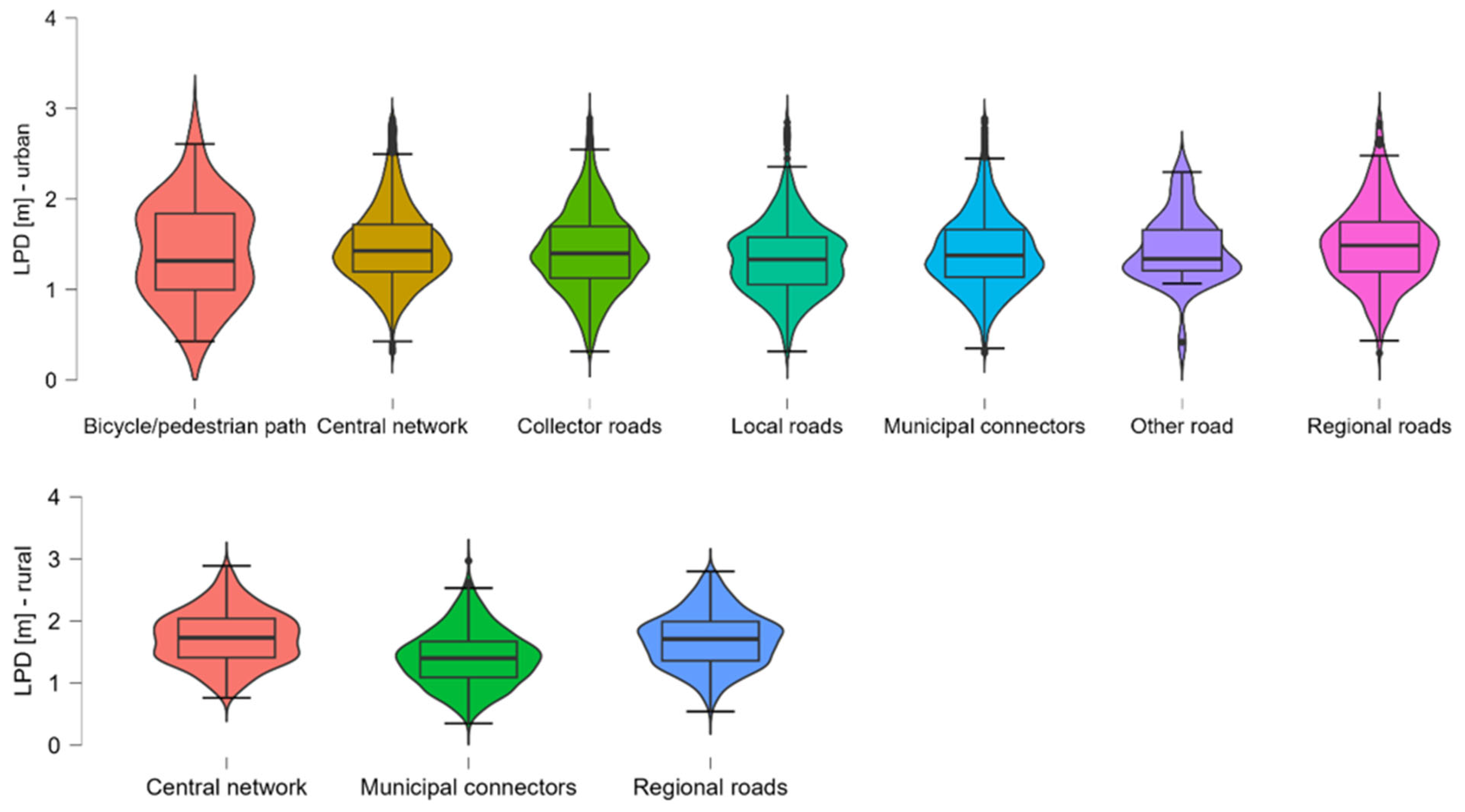
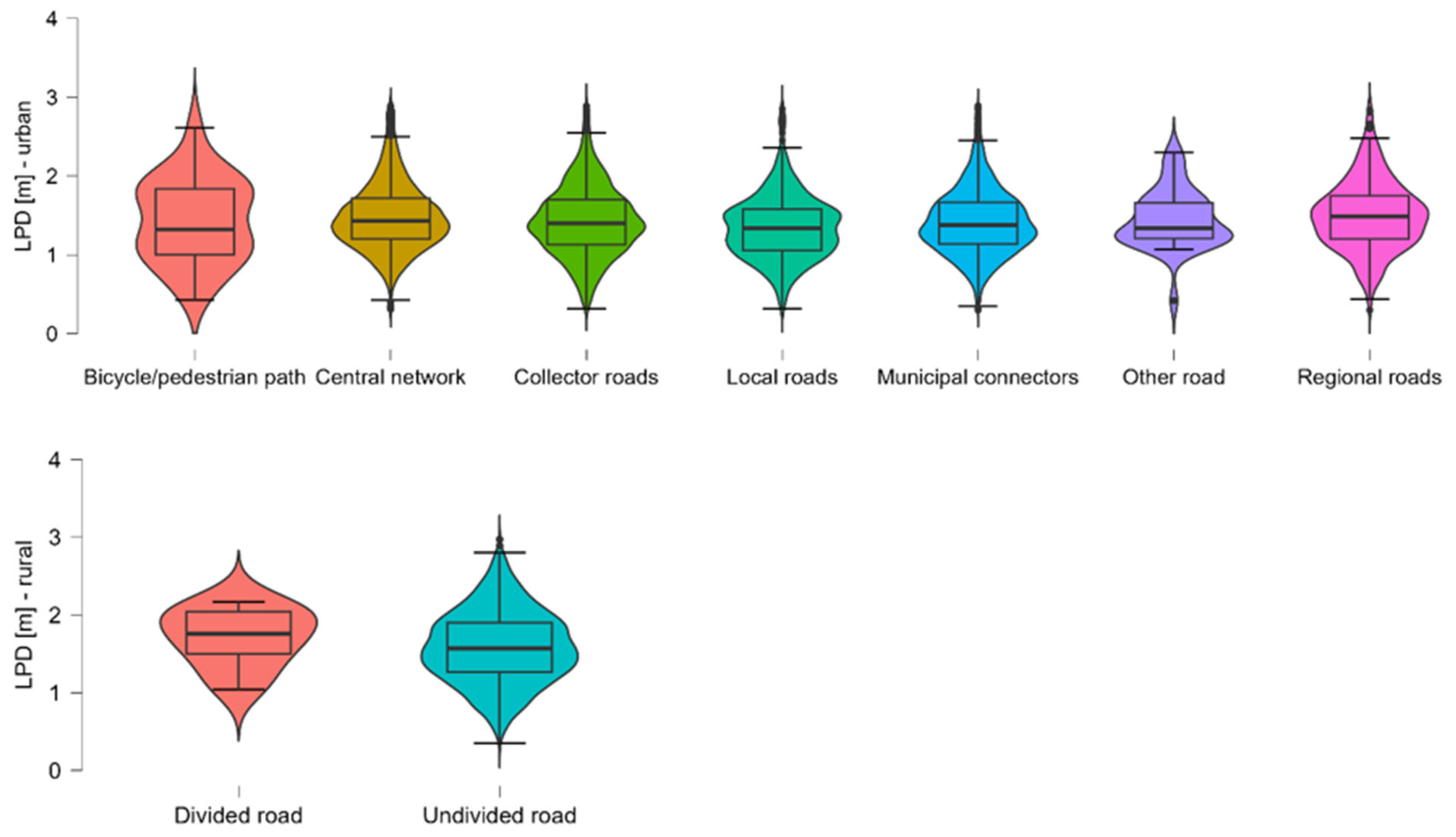
3.1.3. Functional Road Class
3.1.4. Road Configuration
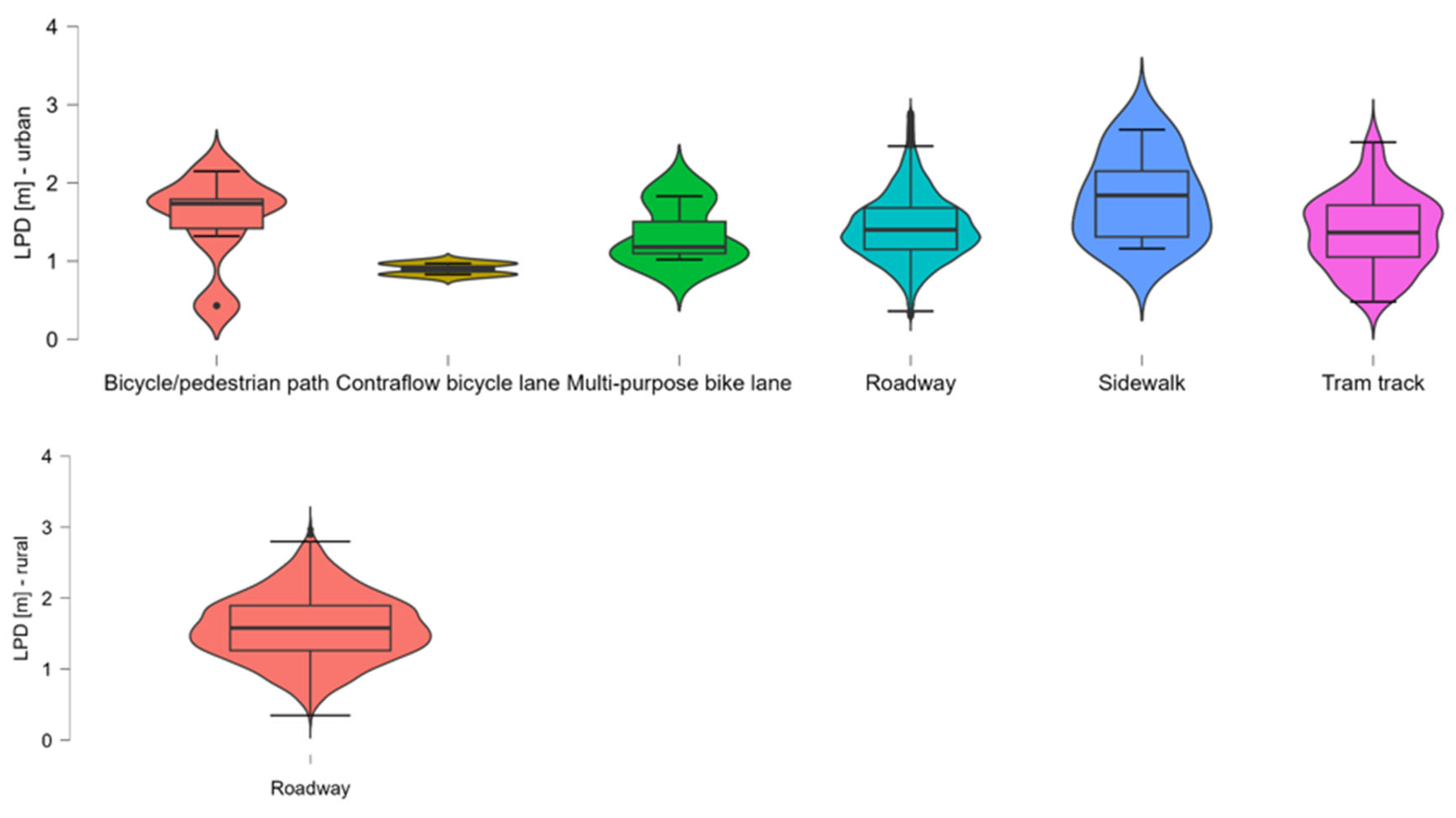
3.1.5. Infrastructure Type
3.2. Bivariate Correlation Analysis
3.3. Group Comparison for Categorical Variables
3.3.1. Functional Road Class
3.3.2. Road Configuration
3.3.3. Infrastructure Type
4. Discussion
5. Conclusions
Author Contributions
Funding
Institutional Review Board Statement
Informed Consent Statement
Data Availability Statement
Acknowledgments
Conflicts of Interest
References
- Apasnore, P.; Ismail, K.; Kassim, A. Bicycle-vehicle interactions at mid-sections of mixed traffic streets: Examining passing distance and bicycle comfort perception. Accid. Anal. Prev. 2017, 106, 141–148. [Google Scholar] [CrossRef] [PubMed]
- Reh, J.; Lißner, S. Pathways to more space. What factors influence the lateral distance of overtaking vehicles from cyclists? Transp. Res. Procedia 2023, 72, 3585–3592. [Google Scholar] [CrossRef]
- Rubie, E.; Haworth, N.; Yamamoto, N. Passing distance, speed and perceived risks to the cyclist and driver in passing events. J. Saf. Res. 2023, 87, 86–95. [Google Scholar] [CrossRef] [PubMed]
- Li, Y.; van der Walt, J.D.; Basnet, A.; Acharya, T.; Scheepbouwer, E.; Guo, B.; Patel, T. Examining the Lateral Positioning and Clearance of Cyclists and Motor Vehicles in Christchurch, New Zealand. Can. J. Civ. Eng. 2025, 52, 668–679. [Google Scholar] [CrossRef]
- Stewart, K.; McHale, A. Cycle lanes: Their effect on driver passing distances in urban areas. Transport 2014, 29, 307–316. [Google Scholar] [CrossRef]
- von Stülpnagel, R.; Hologa, R.; Riach, N. Cars overtaking cyclists on different urban road types–Expectations about passing safety are not aligned with observed passing distances. Transp. Res. Part F Traffic Psychol. Behav. 2022, 89, 334–346. [Google Scholar] [CrossRef]
- Henao, A.; Apparicio, P. Dangerous overtaking of cyclists in Montréal. Safety 2022, 8, 16. [Google Scholar] [CrossRef]
- Ivanišević, T.; Trifunović, A.; Čičević, S.; Pešić, D.; Simović, S.; Zunjic, A.; Duplakova, D.; Duplak, J.; Manojlovic, U. Analysis and Determination of the Lateral Distance Parameters of Vehicles When Overtaking an Electric Bicycle from the Point of View of Road Safety. Appl. Sci. 2023, 13, 1621. [Google Scholar] [CrossRef]
- Llorca, C.; Angel-Domenech, A.; Agustin-Gomez, F.; Garcia, A. Motor vehicles overtaking cyclists on two-lane rural roads: Analysis on speed and lateral clearance. Saf. Sci. 2017, 92, 302–310. [Google Scholar] [CrossRef]
- Feng, F.; Bao, S.; Hampshire, R.C.; Delp, M. Drivers overtaking bicyclists—An examination using naturalistic driving data. Accid. Anal. Prev. 2018, 115, 98–109. [Google Scholar] [CrossRef]
- Dozza, M.; Schindler, R.; Bianchi-Piccinini, G.; Karlsson, J. How do drivers overtake cyclists? Accid. Anal. Prev. 2016, 88, 29–36. [Google Scholar] [CrossRef] [PubMed]
- Shackel, S.C.; Parkin, J. Influence of road markings, lane widths and driver behaviour on proximity and speed of vehicles overtaking cyclists. Accid. Anal. Prev. 2014, 73, 100–108. [Google Scholar] [CrossRef]
- Rodwell, D.; Ho, B.; Pascale, M.T.; Elrose, F.; Neary, A.; Lewis, I. Risk-based analysis of lateral passing distance: The role of road typology, vehicle speed, and sight distance in overtaking cyclists. Transp. Res. Part F Traffic Psychol. Behav. 2023, 97, 126–137. [Google Scholar] [CrossRef]
- Mackenzie, J.R.; Ponte, G. Long-term monitoring of cyclist passing distances in the ACT. Universität Adelaide. 2024. Available online: https://www.cityservices.act.gov.au/__data/assets/pdf_file/0003/2527041/Report-UA-CASR-Long-term-monitoring-of-cycling-passing-distances-FINAL-web-version.pdf (accessed on 10 December 2025).
- Kay, J.J.; Savolainen, P.T.; Gates, T.J.; Datta, T.K. Driver behavior during bicycle passing maneuvers in response to a Share the Road sign treatment. Accid. Anal. Prev. 2014, 70, 92–99. [Google Scholar] [CrossRef] [PubMed]
- Louro, T.V.; Junior, J.U.P.; Gardin, G.T.D.O.; da Silva Junior, C.A.P. Factors influencing lateral distance and speed of motorised vehicles overtaking bicycles. Transp. Res. Rec. J. Transp. Res. Board 2023, 2677, 51–61. [Google Scholar] [CrossRef]
- Casey, L.; Gaspers, L.; Mandel, H. Overtaking in Stuttgart—Analysis of the lateral distances between motor vehicles and bicycle traffic with reference to traffic volume and cycling infrastructure. Traffic Saf. Res. 2024, 7, e000052. [Google Scholar] [CrossRef]
- Mehta, K.; Mehran, B.; Hellinga, B. Evaluation of the passing behavior of motorised vehicles when overtaking bicycles on urban arterial roadways. Transp. Res. Rec. 2019, 2520, 8–17. [Google Scholar] [CrossRef]
- Fournier, N.; Bakhtiari, S.; Valluru, K.D.; Campbell, N.; Christofa, E.; Roberts, S.; Knodler, M. Accounting for drivers’ bicycling frequency and familiarity with bicycle infrastructure treatments when evaluating safety. Accid. Anal. Prev. 2020, 137, 105410. [Google Scholar] [CrossRef]
- Parkin, J.; Meyers, C. The effect of cycle lanes on the proximity between motor traffic and cycle traffic. Accid. Anal. Prev. 2010, 42, 159–165. [Google Scholar] [CrossRef]
- LaMondia, J.J.; Duthie, J.C. Analysis of Factors Influencing Bicycle-Vehicle Interactions on Urban Roadways. Transp. Res. Rec. 2012, 2314, 81–88. [Google Scholar] [CrossRef]
- Feizi, A.; Mastali, M.; Van Houten, R.; Kwigizile, V.; Oh, J.-S. Effects of bicycle passing distance law on drivers’ behavior. Transp. Res. Part A Policy Pract. 2021, 145, 1–16. [Google Scholar] [CrossRef]
- Austrian Federal Ministry of Justice. Straßenverkehrsordnung 1960 (StVO 1960), BGBl. Nr. 159/1960, Last Amended BGBl. I Nr. 24/2023. 2023. Available online: https://www.ris.bka.gv.at (accessed on 10 December 2025).
- Kircher, K.; Lindman, M.; Sliacan, J.; Ochel, L. Rural Cycling in Focus. SAFER. 2024. Available online: https://diva-portal.org/smash/get/diva2:1862909/FULLTEXT01.pdf (accessed on 10 December 2025).




| Influencing Factor | Mentioned in Study | Key Finding |
|---|---|---|
| Lane width | [1,2,10,11,12] | Wider lanes tend to increase LPD; mixed findings at low-speed limits |
| Number of lanes | [10,17] | More lanes can reduce LPD if they increase traffic pressure |
| Speed limit | [1,14] | Higher speeds may reduce LPD unless paired with sufficient road width |
| Cycling infrastructure | [3,4,5,6,16,17,18,19,20] | Mixed effects: most studies report increased LPD with bike lanes, but exceptions exist |
| Functional road class | [7,8] | Lower-class roads tend to yield shorter LPD |
| Road Configuration | [5,9] | Divided roads offer greater LPD than undivided ones |
| Infrastructure Type | [3,5] | Cycle lanes yield greater LPD than shared or pedestrian paths |
| Parked cars | [24] | Parked vehicles reduce available space, decreasing LPD |
| Urban vs. rural context | [3,8] | Rural contexts show greater variance due to diverse road typologies |
| Oncoming traffic | [2,9] | Oncoming traffic reduces passing distances |
| Centre line markings | [10,15] | Solid centre lines reduce LPD more than dashed lines |
| Rider appearance | [8] | Helmets and reflective vests correlate with shorter passing distances |
| Vehicle type | [8] | SUVs pass with less distance than trucks or passenger cars |
| Bicycle speed | [8] | Higher cycling speeds lead to shorter LPD |
| Sharrows | [1,3,22] | Mixed findings: some studies report increased LPD, others none or reduced |
| LPD [m] | Speed Limit [km/h] | Lane Width [m] | Number of Lanes | |||||
|---|---|---|---|---|---|---|---|---|
| Rural | Urban | Rural | Urban | Rural | Urban | Rural | Urban | |
| Valid | 1222 | 10,177 | 818 | 6686 | 1113 | 7823 | 1112 | 7536 |
| Missing | 0 | 0 | 404 | 3491 | 109 | 2354 | 110 | 2641 |
| Median | 1.580 | 1.400 | 80.000 | 50.000 | 6.500 | 7.000 | 1.000 | 1.000 |
| Mean | 1.589 | 1.439 | 77.226 | 47.584 | 6.325 | 7.170 | 1.001 | 1.056 |
| Std. Deviation | 0.470 | 0.444 | 12.526 | 9.474 | 1.337 | 2.384 | 0.030 | 0.267 |
| IQR | 0.630 | 0.550 | 10.000 | 5.000 | 1.000 | 2.000 | 0.000 | 0.000 |
| Skewness | 0.143 | 0.498 | −0.214 | 0.321 | 0.353 | 1.240 | n/a | n/a |
| Std. Error of Skewness | 0.070 | 0.024 | 0.085 | 0.030 | 0.073 | 0.028 | n/a | n/a |
| Kurtosis | −0.292 | 0.448 | 0.285 | 5.089 | 0.614 | 4.437 | n/a | n/a |
| Std. Error of Kurtosis | 0.140 | 0.049 | 0.171 | 0.060 | 0.147 | 0.055 | n/a | n/a |
| Minimum | 0.350 | 0.300 | 40.000 | 5.000 | 3.500 | 1.000 | 1.000 | 1.000 |
| Maximum | 2.970 | 2.910 | 100.000 | 100.000 | 13.200 | 22.000 | 2.000 | 4.000 |
| Functional Road Class | Zone | N | Mean | Median | SD | IQR | Min | Max |
|---|---|---|---|---|---|---|---|---|
| Bicycle/pedestrian path | Urban | 25 | 1.434 | 1.320 | 0.534 | 0.840 | 0.430 | 2.610 |
| Central network | Urban | 2419 | 1.515 | 1.460 | 0.437 | 0.550 | 0.310 | 2.890 |
| Central network | Rural | 275 | 1.734 | 1.730 | 0.429 | 0.630 | 0.760 | 2.890 |
| Collector roads | Urban | 1177 | 1.431 | 1.400 | 0.448 | 0.570 | 0.320 | 2.890 |
| Local roads | Urban | 542 | 1.353 | 1.335 | 0.410 | 0.520 | 0.320 | 2.850 |
| Municipal connectors | Urban | 3679 | 1.414 | 1.380 | 0.417 | 0.540 | 0.300 | 2.970 |
| Municipal connectors | Rural | 465 | 1.407 | 1.400 | 0.451 | 0.580 | 0.350 | 2.970 |
| Other road | Urban | 35 | 1.450 | 1.340 | 0.377 | 0.450 | 0.420 | 2.300 |
| Regional roads | Urban | 737 | 1.601 | 1.580 | 0.450 | 0.610 | 0.300 | 2.840 |
| Regional roads | Rural | 365 | 1.700 | 1.710 | 0.438 | 0.630 | 0.540 | 2.800 |
| Road Configuration | Area | Valid N | Mean | Median | SD | IQR | Min | Max |
|---|---|---|---|---|---|---|---|---|
| Divided road (not motorway) | Urban | 183 | 1.677 | 1.620 | 0.554 | 0.795 | 0.670 | 2.890 |
| Divided road (not motorway) | Rural | 9 | 1.709 | 1.760 | 0.378 | 0.540 | 1.040 | 2.170 |
| Undivided road | Urban | 7527 | 1.431 | 1.400 | 0.423 | 0.530 | 0.300 | 2.890 |
| Undivided road | Rural | 1099 | 1.582 | 1.570 | 0.468 | 0.640 | 0.350 | 2.970 |
| Tramway corridor | Urban | 32 | 1.448 | 1.405 | 0.416 | 0.677 | 0.710 | 2.320 |
| Bicycle/pedestrian path | Urban | 12 | 1.544 | 1.515 | 0.587 | 0.630 | 0.430 | 2.610 |
| Sidewalk | Urban | 11 | 1.342 | 1.160 | 0.504 | 0.895 | 0.690 | 1.990 |
| Parking lot | Urban | 17 | 1.342 | 1.250 | 0.384 | 0.430 | 0.420 | 2.300 |
| Driveway to/from parking area | Urban | 9 | 1.511 | 1.400 | 0.369 | 0.330 | 0.920 | 2.260 |
| Other | Urban | 13 | 1.585 | 1.600 | 0.260 | 0.530 | 1.240 | 1.980 |
| Infrastructure Type | Context | Valid N | Mean | Median | SD | IQR | Min | Max |
|---|---|---|---|---|---|---|---|---|
| Roadway | Urban | 6888 | 1.430 | 1.390 | 0.424 | 0.530 | 0.300 | 2.900 |
| Roadway | Rural | 1059 | 1.581 | 1.570 | 0.470 | 0.640 | 0.350 | 2.970 |
| Bicycle/pedestrian path | Urban | 8 | 1.546 | 1.735 | 0.516 | 0.375 | 0.430 | 2.150 |
| Sidewalk | Urban | 24 | 1.586 | 1.460 | 0.553 | 0.785 | 0.640 | 2.680 |
| Multi-purpose bike lane | Urban | 35 | 1.069 | 1.000 | 0.425 | 0.465 | 0.490 | 2.550 |
| Bicycle lane | Urban | 7 | 1.206 | 1.280 | 0.181 | 0.190 | 0.880 | 1.420 |
| Contraflow bicycle lane | Urban | 4 | 0.865 | 0.855 | 0.081 | 0.085 | 0.780 | 0.970 |
| Tram track | Urban | 110 | 1.339 | 1.335 | 0.453 | 0.665 | 0.480 | 2.520 |
| Variable | Urban Area (ρ) | p-Value | Rural Area (ρ) | p-Value |
|---|---|---|---|---|
| Speed limit [km/h] | 0.084 | <0.001 | 0.217 | <0.001 |
| Lane width [m] | 0.062 | <0.001 | 0.164 | <0.001 |
| Number of lanes | 0.089 | <0.001 | −0.045 | 0.136 |
| Area | Comparison | Holm-Adjusted p | rrb |
|---|---|---|---|
| Urban | Local roads vs. regional roads | <0.001 | 0.207 |
| Urban | Local roads vs. central network | <0.001 | 0.174 |
| Urban | Collector roads vs. local roads | 0.015 | 0.105 |
| Rural | Municipal connectors vs. regional roads | <0.001 | 0.361 |
| Rural | Municipal connectors vs. central network | <0.001 | 0.400 |
| Comparison | Holm-Adjusted p | rrb |
|---|---|---|
| Divided road vs. undivided road | <0.001 | 0.246 |
| Comparison | Holm-Adjusted p | rrb |
|---|---|---|
| Standard road vs. multi-purpose bike lane | <0.001 | 0.511 |
| Standard road vs. contraflow bike lane | 0.052 | 0.846 |
Disclaimer/Publisher’s Note: The statements, opinions and data contained in all publications are solely those of the individual author(s) and contributor(s) and not of MDPI and/or the editor(s). MDPI and/or the editor(s) disclaim responsibility for any injury to people or property resulting from any ideas, methods, instructions or products referred to in the content. |
© 2025 by the authors. Licensee MDPI, Basel, Switzerland. This article is an open access article distributed under the terms and conditions of the Creative Commons Attribution (CC BY) license.
Share and Cite
Fian, T.; Hauger, G.; Soteropoulos, A.; Zuser, V.; Scheibmayr, M. A Sensor-Based and GIS-Linked Analysis of Road Characteristics Influencing Lateral Passing Distance Between Motor Vehicles and Bicycles in Austria. Sensors 2026, 26, 87. https://doi.org/10.3390/s26010087
Fian T, Hauger G, Soteropoulos A, Zuser V, Scheibmayr M. A Sensor-Based and GIS-Linked Analysis of Road Characteristics Influencing Lateral Passing Distance Between Motor Vehicles and Bicycles in Austria. Sensors. 2026; 26(1):87. https://doi.org/10.3390/s26010087
Chicago/Turabian StyleFian, Tabea, Georg Hauger, Aggelos Soteropoulos, Veronika Zuser, and Maria Scheibmayr. 2026. "A Sensor-Based and GIS-Linked Analysis of Road Characteristics Influencing Lateral Passing Distance Between Motor Vehicles and Bicycles in Austria" Sensors 26, no. 1: 87. https://doi.org/10.3390/s26010087
APA StyleFian, T., Hauger, G., Soteropoulos, A., Zuser, V., & Scheibmayr, M. (2026). A Sensor-Based and GIS-Linked Analysis of Road Characteristics Influencing Lateral Passing Distance Between Motor Vehicles and Bicycles in Austria. Sensors, 26(1), 87. https://doi.org/10.3390/s26010087