Sparse Subsystem Discovery for Intelligent Sensor Networks

 ,
,
Abstract
1. Introduction
2. Related Work
2.1. Sparse Subgraph Finding (SGF) Methods
2.2. Deep Learning and Reinforcement Learning in GCO
2.3. Dynamic and Spectral Graph Sparsification
2.4. Optimization and Scalable Graph Mining
3. Problem Formulation
3.1. Graph Representation
3.2. Sparse Subgraph
3.3. Sparse Subgraph Finding (SGF) Problem
- Input:
- -
- An undirected graph G = (V, E).
- -
- A positive integer k, representing the size constraint for the subgraph.
- Output:
- -
- A subgraph T = (VT, ET) where VT ⊆ V, |VT| = k, and T minimizes the sparse metric.
3.4. Complexity Discussion
3.5. Evaluation Metrics
- k-Line Metric: This metric calculates the number of k-lines (paths of length k) within the subgraph. Fewer k-lines suggest weaker connectivity [10].
- Potential Friends (PF) Metric: An advanced metric introduced in recent research, PF combines the k-triangle and k-line metrics to more effectively capture latent relation-ships between nodes, enhancing the assessment of subgraph sparsity [29].
4. Method Design of RL-SGF
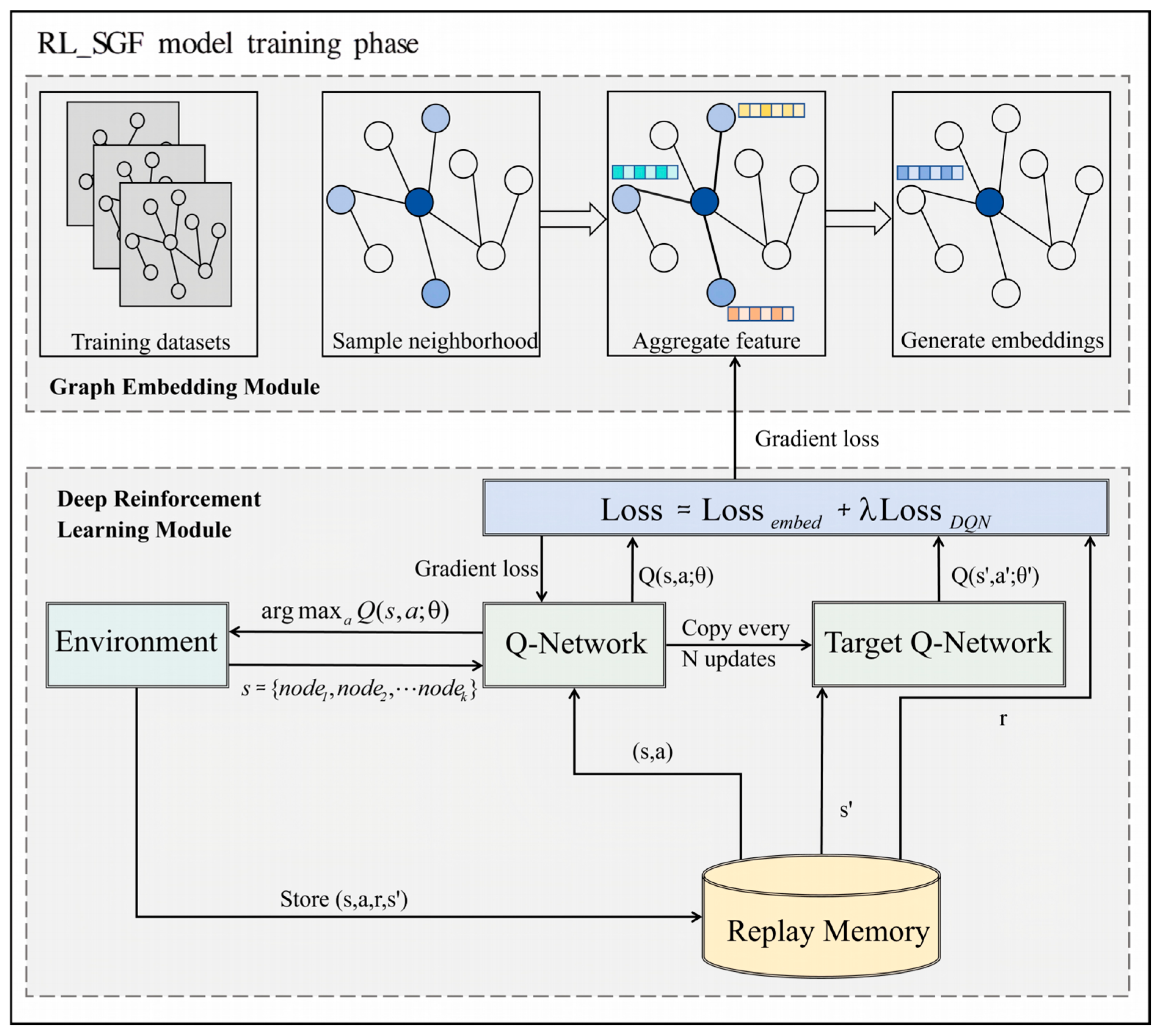
4.1. Graph Embedding Module
4.2. Deep Reinforcement Learning Module
4.2.1. States and Actions in RL-SGF
4.2.2. PF Metric for SGF in RL-SGF
4.2.3. Reward Definition in RL-SGF
- : The reward received at time step t, negatively proportional to the PF value of the residual graph.
- : The PF metric of the graph after removing selected nodes.
- Objective: Maximizing cumulative reward encourages the agent to generate subgraphs with minimal social interaction (high sparsity).
4.2.4. Deep Q-Network for SGF in RL-SGF
- : Scales the ReLU activation output.
- : Weights the embeddings of neighbors , reflecting local structural information.
- : Encodes global sparse information for the target node v.
- : Refersto “concatenation” (the process of joining), which involves combining the embedding information of the target node with that of its neighboring nodes.
- θtarget: the parameter of the target network
- θonline: the parameter of the main network
- τ: the soft update factor (usually set to 0.001)
- A policy network that generates Q-values for current decisions.
- A target network that is periodically updated from the policy network to stabilize learning.
4.3. MDP Definition
- State Space S: Each state St contains three components:
- Action Space A: An action At ∈ A selects a node from the remaining node set:
- State Transition Function T: Given current state St and action At = vt, the transition is defined as:
- Discount Factor γ: The discount factor is set to
4.4. Joint Optimization Strategy
4.5. Time Complexity Analysis
4.5.1. Overall Time Complexity
- Node embedding: O(|V|·|N(v)|), where |V| is the number of nodes and |N(v)| is the sampled neighborhood size.
- Sparse evaluation: Also O(|V|·|N(v)|), due to the reused embeddings and local graph operations.
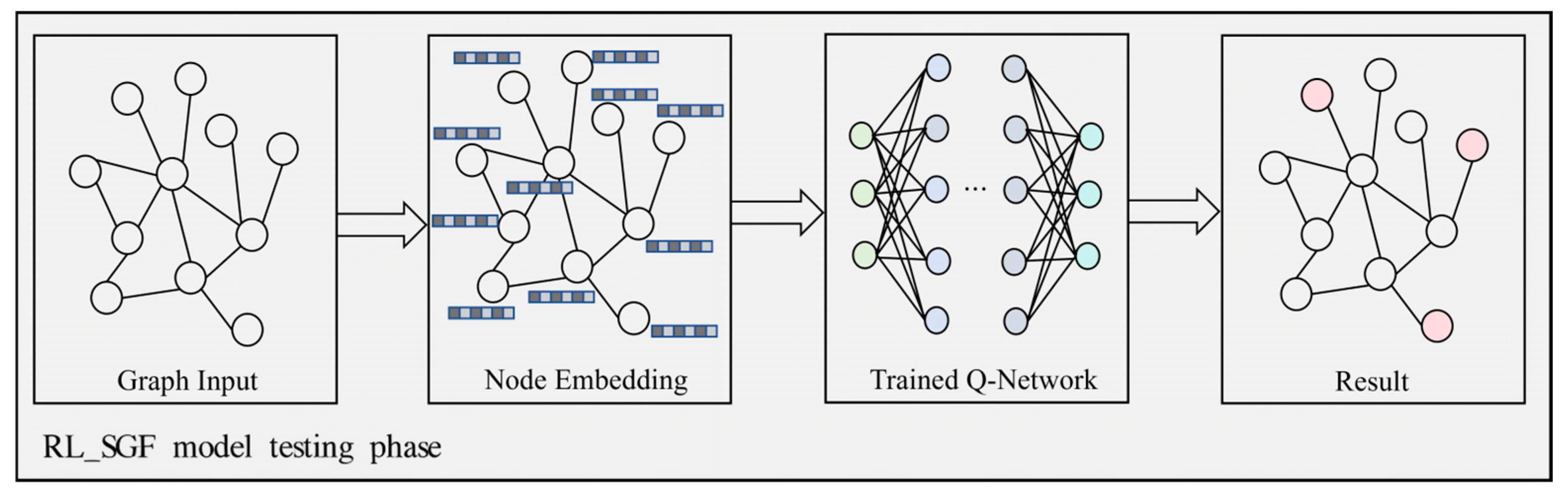
- Subgraph construction: Selecting top-k nodes based on Q-values costs O(|V|). Thus, the overall time complexity is O(|V|·|N(v)|), which is efficient and scalable for large graphs.
4.5.2. Comparative Analysis
5. Computational Experiments
5.1. Datasets
5.1.1. Benchmark Datasets
- Hvr (Hvr2018): A gene network where nodes represent genes of malaria parasites and edges denote gene interactions. This dataset features highly recombinant characteristics and is commonly used for evaluating community detection algorithms and studying gene functions and evolution.
- Cora (Cora2008): A citation network composed of academic papers as nodes and citation links as edges, with papers categorized into seven classes, often applied in research on paper classification and citation network analysis.
- Citeseer (Citeseer2008): Another citation network similar to Cora, where papers are divided into six categories and represented by high-dimensional binary word vectors, widely used for classification and analysis of high-dimensional data.
- Digg (Digg2009): Asocial media network dataset where nodes represent users and edges represent friendship relations. It includes rich information about user interactions, such as social ties and voting behavior, making it suitable for studying information diffusion, user influence, and social impact prediction.
- Enron (Enron2004): An email communication network from the Enron Corporation, consisting of email users as nodes and communication links as edges, derived from approximately 500,000 emails spanning 1999–2002, frequently used for email network analysis and social network studies.
- Facebook (Facebook2009): A social network dataset where nodes represent users and edges represent friendships. This dataset, which includes user features and anonymized data, is commonly used to analyze social network structures and user behaviors.
5.1.2. Synthetic Datasets
5.2. Baselines and Evaluation Criteria
- WK: A traditional SGF method that minimizes the number of k-lines with in a subgraph, often used as a standard for evaluating sparse subgraphs [10].
- TERA: An algorithm designed to find sparse groups by leveraging the k-triangle metric, which is specifically useful for capturing tightly connected substructures within a network [14].
- GNNM: A graph neural network-based model that incorporates both structural and attribute information to identify subgraphs, providing a modern approach to SGF problems [29].
- GAE (GAT): A variant of the graph autoencoder model that utilizes graph attention networks(GAT) to enhance the learning of node embeddings [48].
- GAE (SGC): Another variant of the graph auto encoder that employs simple graph convolution (SGC) layers, simplifying the model while retaining its capacity to capture subgraph structures [48].
- 1-line: A simplified metric that counts the number of 1-hop common neighbors between nodes in the subgraph, providing a basic measure of connection [10].
- 1-triangle: A metric that evaluates the presence of triangles within the subgraph, helping to identify tightly knit substructures [14].
- Potential Friends (PF): The PF value, which measures the sparsity of the subgraph by combining k-lines and k-triangles to capture both direct and indirect relationships [29].
5.3. Experimental Design and Configuration
5.3.1. Hyperparameter Optimization and Tuning
- Learning Rate and Optimizer: The initial learning rate was set to 0.001, with the Adam optimizer selected. To enhance the model’s convergence efficiency, we adopted a dynamic learning rate adjustment strategy during training: a relatively high learning rate was maintained in the early stages to achieve rapid convergence, followed by gradual reductions based on performance on the validation set to prevent overfitting.
- Batch Size: The batch size was set to 64. To identify the optimal value, we conducted a grid search within the range of 32, 64, and 128. We found that a batch size of 64 achieved the best trade-off between computational efficiency and performance.
- Embedding Dimension: The dimension of node embeddings was set to 64. Comparative experiments with embedding dimensions of 32, 64, and 128 demonstrated that a 64-dimensional embedding provided sufficient expressiveness for capturing graph structure information without significantly increasing computational complexity.
- Exploration Strategy: An ϵ-greedy strategy was used to balance exploration and exploitation during node selection. The initial exploration rate (ϵ) was set to 0.1 and decayed progressively during training to ensure a smooth transition from early exploration to later exploitation.
- Training Epochs: Each experiment was trained for 200 epochs. To ensure stability in the experimental results, the training process incorporated both a target Q-network and an experience replay mechanism, which reduced instability caused by sampling biases and enhanced the model’s generalization ability.
5.3.2. Experimental Setup and Reproducibility
- Independent Runs: All experiments were independently run, with the results in Table 5 and Table 6 coming from 30 independent runs, and the results of the other experiments coming from 5 independent runs. Each run was initialized using a different random seed, chosen from the range [1, 1000], ensuring that the initial conditions for each run were independent. This multi-run setup minimized biases caused by random initialization and provided a more comprehensive evaluation of the model’s performance.
- Hardware Environment: All experiments were conducted on a high-performance machine equipped with an NVIDIA GeForce RTX 3090 GPU, running a Linux operating system. The development environment was based on Python 3.8 and TensorFlow 2.0.
- Impact of Randomness: To eliminate potential biases from random seeds and initial conditions, each independent run of the experiment followed a complete process from training to testing. This rigorous approach ensured that the full experimental workflow was covered in every run.
5.4. Ablation Study
5.5. Main Results
5.5.1. Same Subgraph Constraint
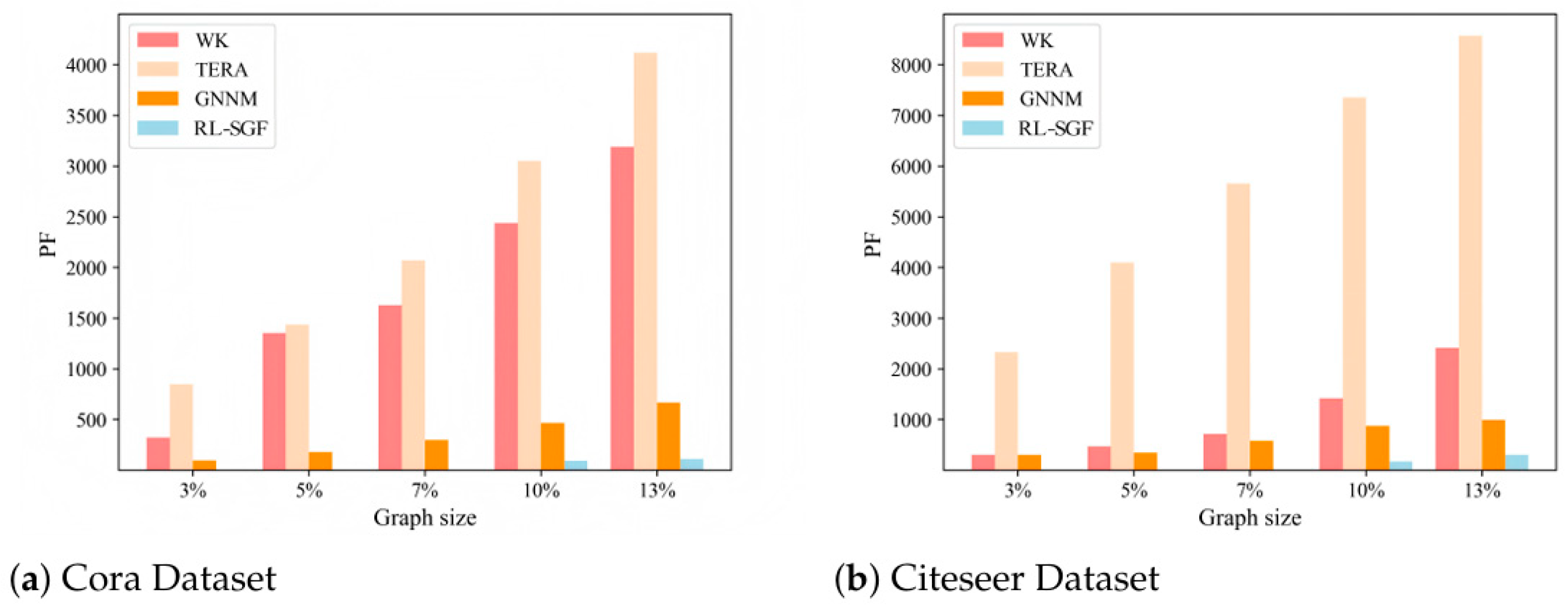
5.5.2. Different Subgraph Constraints
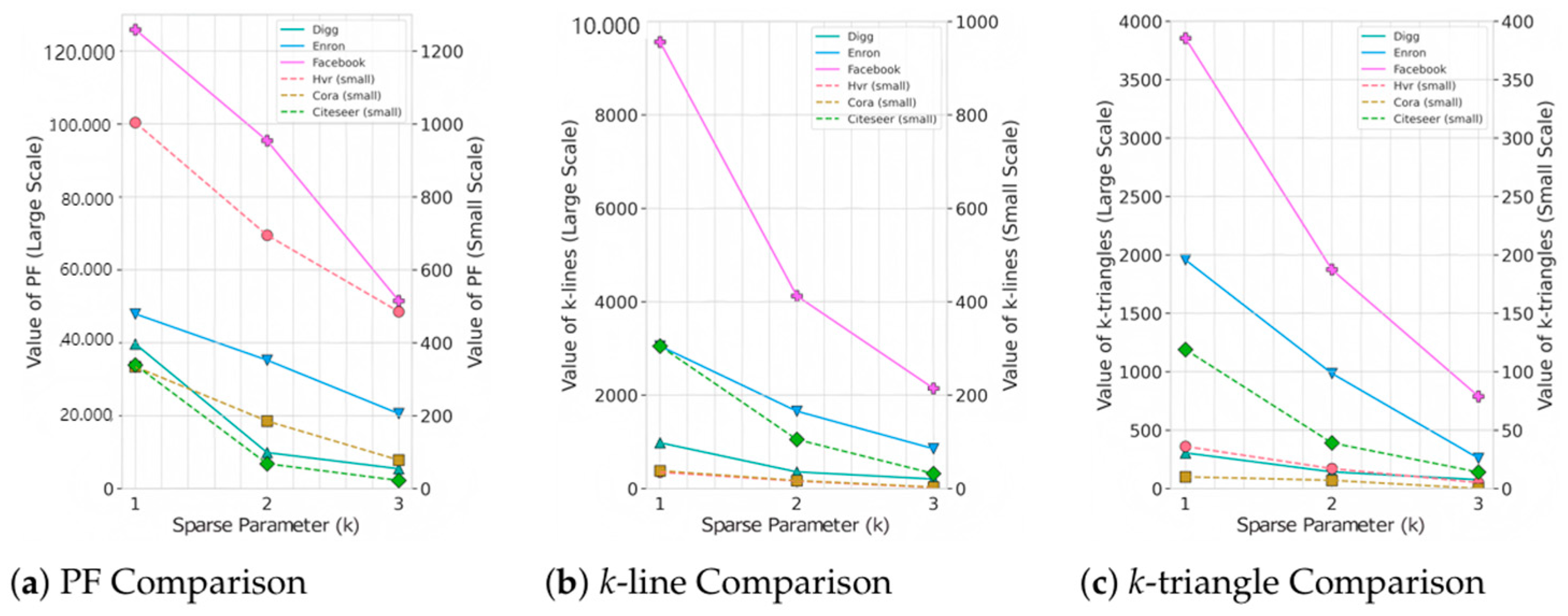
5.5.3. Impact of k on Performance Analysis
- PF Metric Figure 4a: The PF metric integrates k-line and k-triangle to provide a com- prehensive evaluation of subgraph sparsity. As k increases, the PF value consistently decreases because chain connections and triangle structures are progressively eliminated. This trend is more significant in large datasets, while smaller datasets show a more gradual decline. This demonstrates that the PF metric effectively captures weak connections and sparsity, with k directly influencing its measurement scope and accuracy.
- k-Line Metric Figure 4b: The k-line metric measures chain-like connections, defined as node pairs with a shortest path length less than k. As k increases, the number of k-lines decreases due to the inclusion of longer paths. This reduction is more pronounced in large-scale datasets (e.g., Facebook and Enron), where chain connections drop significantly at k = 3. In smaller datasets (e.g., Cora and Hvr), the changes are less noticeable due to the limited graph size.
- k-Triangle Metric Figure 4c: The k-triangle metric measures local triangle structures where all node pairs in a triplet have a shortest path length less than k. Increasing k significantly reduces the number of triangles, indicating a decrease in local dense structures. This trend is particularly evident in large-scale graphs like Facebook and Enron, validating the effectiveness of k-triangle in assessing sparsity.
5.6. Model Analysis
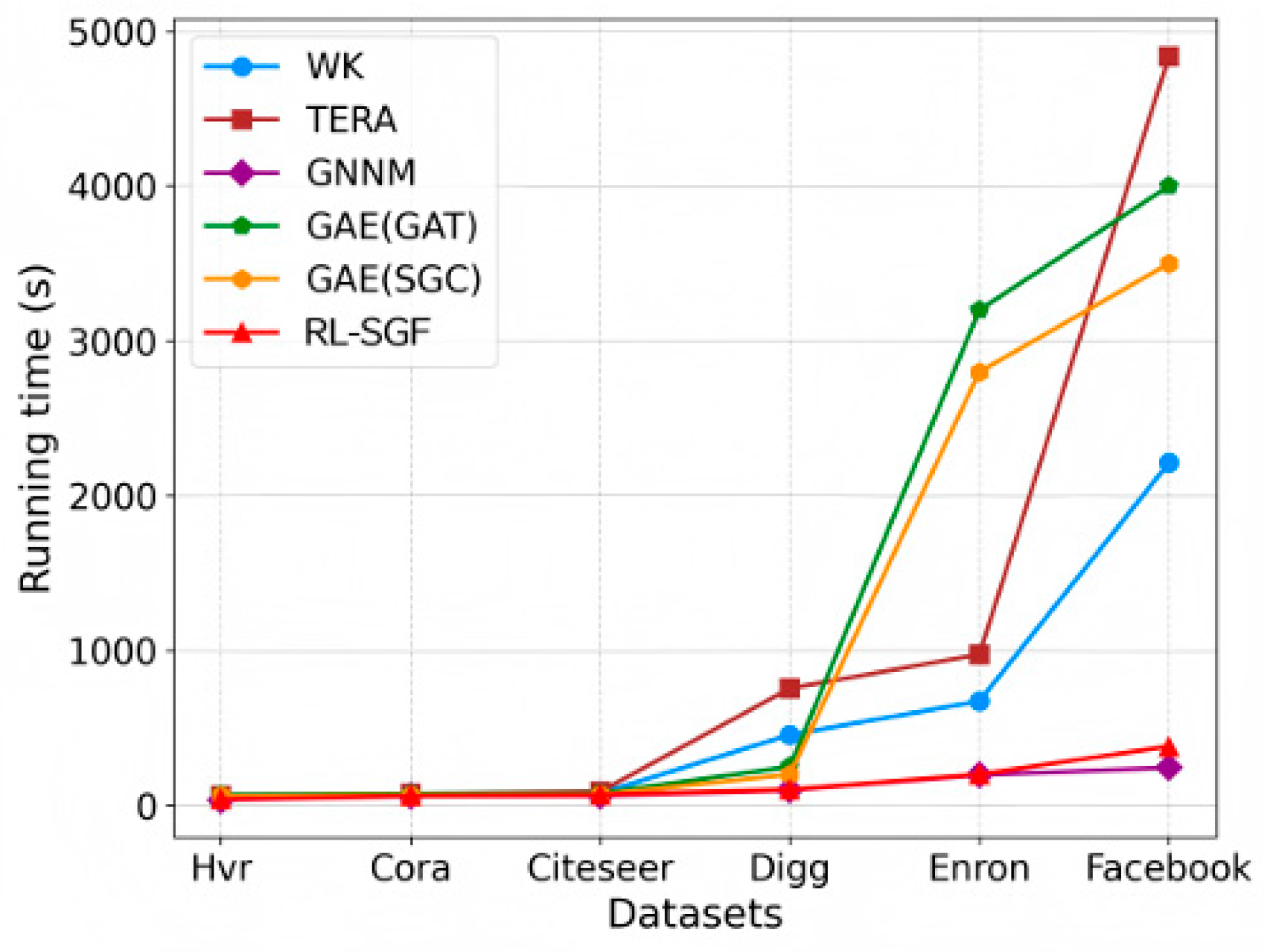
5.6.1. Time Efficiency and Scalability
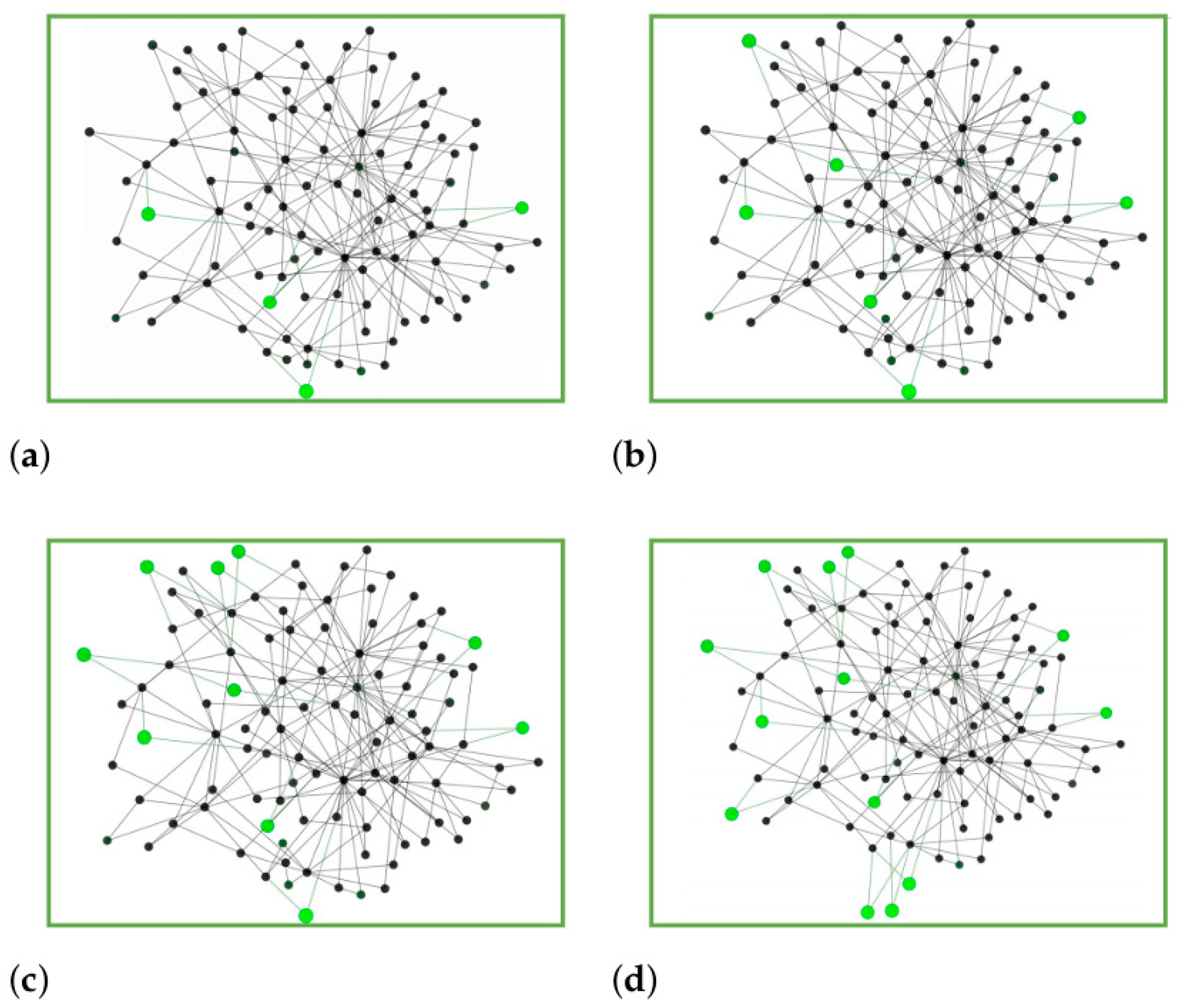
5.6.2. Visual Ana
5.7. Case Study: Sensor Network Analysis on a Real Deployment Dataset
5.7.1. Dataset and Network Construction
5.7.2. Baselines
- Original: the full communication graph without any node removal.
- Random-k: randomly selecting k nodes and taking the induced subgraph (results averaged over 20 random trials).
- Degree-based pruning: selecting the top-k nodes with the highest degrees.
- RL-SGF(ours): the proposed reinforcement learning based sparse subgraph finder.
5.7.3. Evaluation Metrics for Sensor Network Case Study
5.7.4. Results and Discussion
6. Conclusions
Author Contributions
Funding
Institutional Review Board Statement
Informed Consent Statement
Data Availability Statement
Acknowledgments
Conflicts of Interest
References
- Nguyen, L.B.; Vo, B.; Le, N.T.; Snasel, V.; Zelinka, I. Fast and scalable algorithms for mining subgraphs in a single large graph. Eng. Appl. Artif. Intell. 2020, 90, 103539. [Google Scholar] [CrossRef]
- Bothorel, C.; Cruz, J.D.; Magnani, M.; Micenková, B. Clustering attributed graphs: Models, measures and methods. Netw. Sci. 2015, 3, 408–444. [Google Scholar] [CrossRef]
- Sanei-Mehri, S.V.; Das, A.; Tirthapura, S. Enumerating Top-k Quasi-Cliques. In Proceedings of the 2018 IEEE International Conference on Big Data (Big Data), Seattle, WA, USA, 10–13 December 2018; pp. 1107–1112. [Google Scholar]
- Wen, D.; Qin, L.; Zhang, Y.; Chang, L.; Chen, L. Enumerating k-Vertex Connected Components in Large Graphs. In Proceedings of the 2019 IEEE 35th International Conference on Data Engineering (ICDE), Macao, China, 8–11 April 2019; pp. 52–63. [Google Scholar]
- Liu, F.; Xue, S.; Wu, J.; Zhou, C.; Hu, W.; Paris, C.; Nepal, S.; Yang, J.; Yu, P.S. Deep Learning for Community Detection: Progress, Challenges and Opportunities. arXiv 2020, arXiv:2005.08225. [Google Scholar] [CrossRef]
- Li, Y.; Sun, H.; He, L.; Huang, J.; Chen, J.; He, H.; Jia, X. Querying Tenuous Group in Attributed Networks. Comput. J. 2020, 65, 858–873. [Google Scholar] [CrossRef]
- Zhu, H.; Liu, W.; Yin, J.; Cui, N.; Xu, J.; Huang, X.; Lee, W.C. Keyword-based Socially Tenuous Group Queries. In Proceedings of the 2023 IEEE 39th International Conference on Data Engineering (ICDE), Anaheim, CA, USA, 3–7 April 2023; pp. 965–977. [Google Scholar]
- Shen, C.Y.; Shuai, H.H.; Yang, D.N.; Lan, Y.F.; Lee, W.C.; Yu, P.S.; Chen, M.S. Forming Online Support Groups for Internet and Behavior Related Addictions. In Proceedings of the CIKM ’15: 24th ACM International on Conference on Information and Knowledge Management, Melbourne, Australia, 18–23 October 2015; pp. 163–172. [Google Scholar]
- Shuai, H.H.; Shen, C.Y.; Yang, D.N.; Lan, Y.F.; Lee, W.C.; Yu, P.S.; Chen, M.S. Mining Online Social Data for Detecting Social Network Mental Disorders. In Proceedings of the 25th International Conference on World Wide Web, Montreal, QC, Canada, 11–15 April 2016; pp. 275–285. [Google Scholar]
- Li, W. Finding Tenuous Groups in Social Networks. In Proceedings of the 2018 IEEE International Conference on Data Mining Workshops (ICDMW), Singapore, 17–20 November 2018; IEEE: Piscataway, NJ, USA, 2018; pp. 284–291. [Google Scholar]
- Fotsing, C.P.K.; Shen, C.Y.; Huang, L.H.; Chen, Y.S.; Lee, W.C.; Yang, D.N. On Efficient Processing of Queries for Live Multi-Streaming Soiree Organization. IEEE Trans. Serv. Comput. 2023, 16, 2812–2826. [Google Scholar] [CrossRef]
- Hsu, B.Y.; Yeh, L.Y.; Chang, M.Y.; Shen, C.Y. Willingness Maximization for Ego Network Data Extraction in Multiple Online Social Networks. IEEE Trans. Knowl. Data Eng. 2023, 35, 8672–8686. [Google Scholar] [CrossRef]
- Shen, C.Y.; Yang, D.N.; Lee, W.C.; Chen, M.S. Activity Organization for Friend-Making Optimization in Online Social Networks. IEEE Trans. Knowl. Data Eng. 2022, 34, 122–137. [Google Scholar] [CrossRef]
- Shen, C.Y.; Huang, L.H.; Yang, D.N.; Shuai, H.H.; Lee, W.C.; Chen, M.S. On finding socially tenuous groups for online social networks. In Proceedings of the KDD ’17: 23rd ACM SIGKDD International Conference on Knowledge Discovery and Data Mining, Halifax, NS, Canada, 13–17 August 2017; pp. 415–424. [Google Scholar]
- Shen, C.Y.; Shuai, H.H.; Yang, D.N.; Lee, G.S.; Huang, L.H.; Lee, W.C.; Chen, M.S. On Extracting Socially Tenuous Groups for Online Social Networks with k k-triangles. IEEE Trans. Knowl. Data Eng. 2020, 34, 3431–3446. [Google Scholar] [CrossRef]
- He, X.; Wang, Y.; Du, H.; Feldman, M.W. A memetic algorithm for finding multiple subgraphs that optimally cover an input network. PLoS ONE 2023, 18, e0280506. [Google Scholar] [CrossRef]
- Xie, J.; Kelley, S.; Szymanski, B.K. Overlapping Community Detection in Networks: The State-of-the-Art and Comparative Study. ACM Comput. Surv. 2013, 45, 1–35. [Google Scholar] [CrossRef]
- Huang, X.; Cheng, H.; Qin, L.; Tian, W.; Yu, J.X. Querying k-truss community in large and dynamic graphs. In Proceedings of the SIGMOD ’14: 2014 ACM SIGMOD International Conference on Management of Data, Snowbird, UT, USA, 22–27 June 2014; pp. 1311–1322. [Google Scholar]
- Conte, A.; De Matteis, T.; De Sensi, D.; Grossi, R.; Marino, A.; Versari, L. D2K: Scalable Community Detection in Massive Networks via Small-Diameter k-Plexes. In Proceedings of the KDD ’18: 24th ACM SIGKDD International Conference on Knowledge Discovery & Data Mining, London, UK, 19–23 August 2018; pp. 1272–1281. [Google Scholar]
- Behera, R.K.; Naik, D.; Rath, S.K.; Dharavath, R. Genetic algorithm-based community detection in large-scale social networks. Neural Comput. Appl. 2020, 32, 9649–9665. [Google Scholar] [CrossRef]
- Zhang, R.; Prokhorchuk, A.; Dauwels, J. Deep reinforcement learning for traveling salesman problem with time windows and rejections. In Proceedings of the 2020 International Joint Conference on Neural Networks (IJCNN), Glasgow, UK, 19–24 July 2020; IEEE: Piscataway, NJ, USA, 2020; pp. 1–8. [Google Scholar]
- Nazari, M.; Oroojlooy, A.; Snyder, L.; Takác, M. Reinforcement learning for solving the vehicle routing problem. In Advances in Neural Information Processing Systems 31, Proceedings of the NeurIPS 2018, Montréal, QC, Canada, 3–8 December 2018; Neural Information Processing Systems Foundation, Inc.: San Diego, CA, USA, 2018. [Google Scholar]
- Zhao, S.; Gu, S. A deep reinforcement learning algorithm framework for solving multi-objective traveling salesman problem based on feature transformation. Neural Netw. 2024, 176, 106359. [Google Scholar] [CrossRef]
- Huang, J.P.; Gao, L.; Li, X.Y. An end-to-end deep reinforcement learning method based on graph neural network for distributed job-shop scheduling problem. Expert Syst. Appl. 2024, 238, 121756. [Google Scholar] [CrossRef]
- Almasan, P.; Suárez-Varela, J.; Rusek, K.; Barlet-Ros, P.; Cabellos-Aparicio, A. Deep reinforcement learning meets graph neural networks: Exploring a routing optimization use case. Comput. Commun. 2022, 196, 184–194. [Google Scholar] [CrossRef]
- Li, C.; Li, G.; Varshney, P.K. Distributed detection of sparse signals with censoring sensors in clustered sensor networks. Inf. Fusion 2022, 83–84, 1–18. [Google Scholar] [CrossRef]
- Tang, J.; Wu, S.; Wei, L.; Liu, W.; Qin, T.; Zhou, Z.; Gu, J. Energy-efficient sensory data collection based on spatiotemporal correlation in IoT networks. Int. J. Crowd Sci. 2022, 6, 34–43. [Google Scholar] [CrossRef]
- Wu, D.; Xu, X.; Lu, C.; Mu, D. Energy-Efficient Connectivity Algorithm for Directional Sensor Networks in Edge Intelligence Systems. Symmetry 2024, 17, 20. [Google Scholar] [CrossRef]
- Sun, H.; Sun, M.; Liu, X.; Zhu, L.; He, L.; Jia, X.; Chen, Y. Graph Neural Networks with Motisf-Aware for Tenuous Subgraph Finding. ACM Trans. Knowl. Discov. Data 2023, 17, 1–19. [Google Scholar] [CrossRef]
- Alsentzer, E.; Finlayson, S.; Li, M.; Zitnik, M. Subgraph neural networks. In Advances in Neural Information Processing Systems 33, Proceedings of the NeurIPS 2020, Online, 6–12 December 2020; Neural Information Processing Systems Foundation, Inc.: San Diego, CA, USA, 2020; pp. 8017–8029. [Google Scholar]
- Wang, Y.; Chen, S.; Chen, G.; Shurberg, E.; Liu, H.; Hong, P. Motif-based graph representation learning with application to chemical molecules. Informatics 2023, 10, 8. [Google Scholar] [CrossRef]
- Liu, C.; Zhan, Y.; Ma, X.; Ding, L.; Tao, D.; Wu, J.; Hu, W. Gapformer: Graph Transformer with Graph Pooling for Node Classification. In Proceedings of the IJCAI, Macao, China, 19–25 August 2023; pp. 2196–2205. [Google Scholar]
- Liu, X.Y.; Zhu, M. K-Spin Ising Model for Combinatorial Optimizations over Graphs: A Reinforcement Learning Approach. In Proceedings of the OPT 2023: Optimization for Machine Learning, 15th International OPT Workshop on Optimization for Machine Learning, held as part of NeurIPS 2023, New Orleans Ernest N. Morial Convention Center, New Orleans, LA, USA, 10–16 December2023. [Google Scholar]
- Lv, B.; Jiang, J.; Wu, L.; Zhao, H. Team formation in large organizations: A deep reinforcement learning approach. Decis. Support Syst. 2024, 187, 114343. [Google Scholar] [CrossRef]
- Zhang, Y.; Xiong, Y.; Ye, Y.; Liu, T.; Wang, W.; Zhu, Y.; Yu, P.S. SEAL: Learning heuristics for community detection with generative adversarial networks. In Proceedings of the 26th ACM SIGKDD International Conference on Knowledge Discovery & Data Mining, Virtual, 23–27 August 2020; pp. 1103–1113. [Google Scholar]
- Tam, P.; Ros, S.; Song, I.; Kang, S.; Kim, S. A survey of intelligent end-to-end networking solutions: Integrating graph neural networks and deep reinforcement learning approaches. Electronics 2024, 13, 994. [Google Scholar] [CrossRef]
- Khalil, E.; Dai, H.; Zhang, Y.; Dilkina, B.; Song, L. Learning combinatorial optimization algorithms over graphs. In Advances in Neural Information Processing Systems 30, Proceedings of the NIPS 2017, Long Beach, CA, USA, 4–9 December 2017; Neural Information Processing Systems Foundation, Inc.: San Diego, CA, USA, 2017. [Google Scholar]
- Li, Z.; Chen, Q.; Koltun, V. Combinatorial optimization with graph convolutional networks and guided tree search. In Advances in Neural Information Processing Systems 31, Proceedings of the NIPS 2018, Montréal, QC, Canada, 3–8 December 2018; Neural Information Processing Systems Foundation, Inc.: San Diego, CA, USA, 2018. [Google Scholar]
- Wang, Y.; Liang, X. Application of Reinforcement Learning Methods Combining Graph Neural Networks and Self-Attention Mechanisms in Supply Chain Route Optimization. Sensors 2025, 25, 955. [Google Scholar] [CrossRef]
- Zhao, X.; Yan, Y. A Deep Reinforcement Learning and Graph Convolution Approach to On-Street Parking Search Navigation. Sensors 2025, 25, 2389. [Google Scholar] [CrossRef]
- Wickman, R.; Zhang, X.; Li, W. A generic graph sparsification framework using deep rein-forcement learning. In Proceedings of the 2022 IEEE International Conference on Data Mining (ICDM), Orlando, FL, USA, 28 November–1 December 2022; IEEE: Piscataway, NJ, USA, 2022; pp. 1221–1226. [Google Scholar]
- Yuan, Y.; Aghdaei, A.; Feng, Z. dyGRASS: Dynamic Spectral Graph Sparsification via Localized Random Walks on GPUs. arXiv 2025, arXiv:2505.02741. [Google Scholar] [CrossRef]
- Spielman, D.A.; Teng, S.H. Spectral sparsification of graphs. SIAM J. Comput. 2011, 40, 981–1025. [Google Scholar] [CrossRef]
- Hashemi, M.; Gong, S.; Ni, J.; Fan, W.; Prakash, B.A.; Jin, W. A comprehensive survey on graph reduction: Sparsification, coarsening, and condensation. arXiv 2024, arXiv:2402.03358. [Google Scholar] [CrossRef]
- Zhao, H.; Li, X.; Li, C.; Yao, L. GAPO: A Graph Attention-Based Reinforcement Learning Algorithm for Congestion-Aware Task Offloading in Multi-Hop Vehicular Edge Computing. Sensors 2025, 25, 4838. [Google Scholar] [CrossRef] [PubMed]
- Barabasi, A.L.; Albert, R.; Jeong, H. Scale-Free Characteristics of Random Networks: The Topology of the World-Wide Web. Phys. A Stat. Mech. Its Appl. 2000, 281, 69–77. [Google Scholar] [CrossRef]
- Barabási, A.L.; Albert, R. Emergence of Scaling in Random Networks. Science 1999, 286, 509–512. [Google Scholar] [CrossRef] [PubMed]
- Wu, F.; Souza, A.; Zhang, T.; Fifty, C.; Yu, T.; Weinberger, K. Simplifying Graph Convolutional Networks. In Proceedings of the 36th International Conference on Machine Learning, Long Beach, CA, USA, 9–15 June 2019; Chaudhuri, K., Salakhutdinov, R., Eds.; PMLR (Proceedings of Machine Learning Research): Cambridge, MA, USA, 2019; Volume 97, pp. 6861–6871. [Google Scholar]



| Symbol | Description |
|---|---|
| Gt | Remaining graph at step t |
| Vt | Node set of Gt |
| Et | Edge set of Gt |
| Ft | Selected node set at step t (|Ft| ≤ k) |
| Ht = {v} | Node embeddings at step t |
| hv | Embedding of node v |
| At = vt | Action selecting node vt |
| St | MDP state at step t |
| T | State transition function |
| γ | Discount factor |
| k | Required SGF subgraph size |
| Dataset | |V| | |E| | Avg. Degree |
|---|---|---|---|
| Hvr | 304 | 3263 | 21.467 |
| Cora | 2708 | 5429 | 4.009 |
| Citeseer | 3264 | 4532 | 2.777 |
| Digg | 29,652 | 84,781 | 5.718 |
| Enron | 36,692 | 183,831 | 10.020 |
| 63,392 | 816,831 | 25.771 |
| Dataset | |V| | |E| | Avg. Degree |
|---|---|---|---|
| Synthetic_1000 | 1000 | 1373 | 2.746 |
| Synthetic_2000 | 2000 | 2341 | 2.341 |
| Synthetic_5000 | 5000 | 6875 | 2.750 |
| Dataset | |V| | |E| | Avg. Degree |
|---|---|---|---|
| Synthetic_1000 | 1000 | 1373 | 2.746 |
| Synthetic_5000 | 5000 | 6875 | 2.750 |
| Synthetic_10,000 | 10,000 | 16,757 | 3.351 |
| Synthetic_50,000 | 50,000 | 69,104 | 2.764 |
| Synthetic_100,000 | 100,000 | 168,206 | 3.360 |
| Dataset | Metrics | WK | TERA | GNNM | GAE(GAT) | GAE(SGC) | RL-SGF |
|---|---|---|---|---|---|---|---|
| Hvr | PF | 48 ± 2 | 12,699 ± 641 | 2023 ± 105 | 1853 ± 138 | 2382 ± 98 | 1009 ± 58 |
| 1-line | 0 ± 0 | 324 ± 9 | 68 ± 2 | 41 ± 2 | 55 ± 2 | 32 ± 1 | |
| 1-triangle | 0 ± 0 | 2342 ± 165 | 39 ± 3 | 45 ± 3 | 48 ± 3 | 34 ± 2 | |
| Cora | PF | 2475 ± 121 | 3112 ± 205 | 1998 ± 151 | 2467 ± 260 | 2782 ± 162 | 333 ± 29 |
| 1-line | 0 ± 0 | 348 ± 8 | 211 ± 5 | 230 ± 10 | 234 ± 5 | 39 ± 1 | |
| 1-triangle | 0 ± 0 | 117 ± 9 | 39 ± 3 | 46 ± 3 | 47 ± 3 | 11 ± 1 | |
| Citeseer | PF | 1377 ± 91 | 7324 ± 601 | 5558 ± 476 | 5456 ± 648 | 5689 ± 415 | 330 ± 30 |
| 1-line | 0 ± 0 | 789 ± 39 | 501 ± 26 | 519 ± 32 | 589 ± 24 | 302 ± 18 | |
| 1-triangle | 0 ± 0 | 504 ± 25 | 169 ± 9 | 159 ± 13 | 202 ± 9 | 112 ± 7 | |
| Digg | PF | 17,445 ± 156 | 41,334 ± 915 | 39,456 ± 8179 | 40,899 ± 685 | 42,023 ± 2736 | 39,567 ± 1368 |
| 1-line | 0 ± 0 | 1070 ± 105 | 901 ± 98 | 924 ± 110 | 962 ± 83 | 988 ± 114 | |
| 1-triangle | 0 ± 0 | 742 ± 92 | 509 ± 68 | 568 ± 85 | 608 ± 70 | 301 ± 40 | |
| Enron | PF | 147,345 ± 156 | 9,648,556 ± 915 | 6,171,112 ± 754 | 6,414,102 ± 935,817 | 6,774,433 ± 685 | 47,789 ± 6852 |
| 1-line | 0 ± 0 | 82,678 ± 6615 | 50,385 ± 4105 | 51,441 ± 4408 | 54,887 ± 4351 | 3035 ± 251 | |
| 1-triangle | 0 ± 0 | 567,862 ± 52,145 | 327,431 ± 30,152 | 297,356 ± 35,771 | 395,431 ± 36,211 | 1948 ± 202 | |
| PF | 257,331 ± 2885 | 197,435 ± 27,486 | 154,259 ± 23,260 | 132,886 ± 27,906 | 146,734 ± 17,405 | 125,887 ± 18,985 | |
| 1-line | 0 ± 0 | 9805 ± 682 | 8512 ± 625 | 9729 ± 931 | 9963 ± 592 | 9559 ± 764 | |
| 1-triangle | 0 ± 0 | 72,356 ± 6842 | 67,237 ± 6182 | 69,349 ± 20,423 | 74,522 ± 6840 | 3849 ± 456 |
| Dataset | Algorithm | PF | 1-line | 1-triangle |
|---|---|---|---|---|
| Syn_1000 | WK | 141 ± 5 | 2 ± 0 | 0 ± 0 |
| TERA | 155 ± 7 | 15 ± 0 | 11 ± 1 | |
| GNNM | 34 ± 2 | 2 ± 0 | 7 ± 0 | |
| RL-SGF | 7 ± 0 | 0 ± 0 | 0 ± 0 | |
| Syn_2000 | WK | 309 ± 18 | 8 ± 0 | 0 ± 0 |
| TERA | 381 ± 24 | 39 ± 2 | 27 ± 1 | |
| GNNM | 43 ± 3 | 4 ± 0 | 5 ± 2 | |
| RL-SGF | 34 ± 3 | 3 ± 0 | 0 ± 0 | |
| Syn_5000 | WK | 273 ± 18 | 7 ± 0 | 0 ± 0 |
| TERA | 130 ± 9 | 14 ± 2 | 9 ± 1 | |
| GNNM | 72 ± 5 | 8 ± 1 | 2 ± 0 | |
| RL-SGF | 40 ± 3 | 5 ± 0 | 0 ± 0 |
| Method | |Vs| | ASPL ↓ | Robustness ↑ |
|---|---|---|---|
| Original | 54 | 3.21 | 0.83 |
| Random-k | k | 4.07 | 0.60 |
| Degree-based | k | 3.74 | 0.72 |
| RL-SGF (ours) | k | 3.15 | 0.88 |
Disclaimer/Publisher’s Note: The statements, opinions and data contained in all publications are solely those of the individual author(s) and contributor(s) and not of MDPI and/or the editor(s). MDPI and/or the editor(s) disclaim responsibility for any injury to people or property resulting from any ideas, methods, instructions or products referred to in the content. |
© 2026 by the authors. Licensee MDPI, Basel, Switzerland. This article is an open access article distributed under the terms and conditions of the Creative Commons Attribution (CC BY) license.
Share and Cite
Sun, H.; Liu, X.; Sun, M.; Cao, R.; Xing, B.; He, L.; He, H. Sparse Subsystem Discovery for Intelligent Sensor Networks. Sensors 2026, 26, 288. https://doi.org/10.3390/s26010288
Sun H, Liu X, Sun M, Cao R, Xing B, He L, He H. Sparse Subsystem Discovery for Intelligent Sensor Networks. Sensors. 2026; 26(1):288. https://doi.org/10.3390/s26010288
Chicago/Turabian StyleSun, Heli, Xuechun Liu, Miaomiao Sun, Ruichen Cao, Bin Xing, Liang He, and Hui He. 2026. "Sparse Subsystem Discovery for Intelligent Sensor Networks" Sensors 26, no. 1: 288. https://doi.org/10.3390/s26010288
APA StyleSun, H., Liu, X., Sun, M., Cao, R., Xing, B., He, L., & He, H. (2026). Sparse Subsystem Discovery for Intelligent Sensor Networks. Sensors, 26(1), 288. https://doi.org/10.3390/s26010288