


Deep Learning Wavefront Sensing from Object Scene for Directed Energy HEL Systems


Abstract
1. Introduction
2. Preliminaries
2.1. Wavefront Sensing
2.2. Deep Learning Wavefront Sensing
2.3. Data Sets
- Wavefront expansion (turbulence-induced phase). The turbulence-induced phase distortion across the pupil is represented as a Zernike expansion,where are the normalized Zernike polynomials and the coefficients quantify the strength of each aberration mode. The coefficients are generated as zero-mean Gaussian random variables whose variances follow Noll’s formulation of Kolmogorov turbulence. In practice, each coefficient is obtained by sampling from the distributionwhere are mode-dependent constants and D is the aperture diameter. Air turbulence causes fluctuations in the index of refraction, resulting in aberrations in the laser beam. Air turbulence is commonly referred to as , a measure of fluctuation in the reflected index in a plane. Fried number is a widely used metric for quantifying the strength of turbulence at a location. Fried number is given as a function of as follows:If the aperture diameter D equals , then air turbulence does not affect the laser beam. However, if is greater than 1, the turbulence will aberrate the laser beam; the higher the number, the higher the aberration. In the present simulation, is treated as a user-defined parameter that controls the overall turbulence strength, rather than being computed from a specific profile. This choice is common in synthetic data generation, as it allows direct control over the severity of the aberrations. The selected value of then sets the statistical distribution of the Zernike coefficients through Noll’s variance model. Zernike coefficients are then created in this research by sampling from the distribution (3). More details in [24,25].
- Defocus variation. Two perturbed wavefronts were generated by adjusting only the defocus coefficient,corresponding to over-focus and under-focus conditions. This controlled modification of the Zernike defocus term enables manipulation of the simulated focal shift in pixel units.
- Aperture (pupil geometry and transmission). Light transmission is restricted by the circular aperture function,which defines the pupil geometry.
- Complex pupil (amplitude and phase). The aperture amplitude and the turbulent phase error combine to form the complex pupil function,and for the defocus-perturbed cases,
- Diffraction to the PSF (image-plane blur kernel). The Fourier transform of the pupil yields the amplitude spread function, whose squared magnitude defines the point spread function (PSF),with analogous definitions for and .
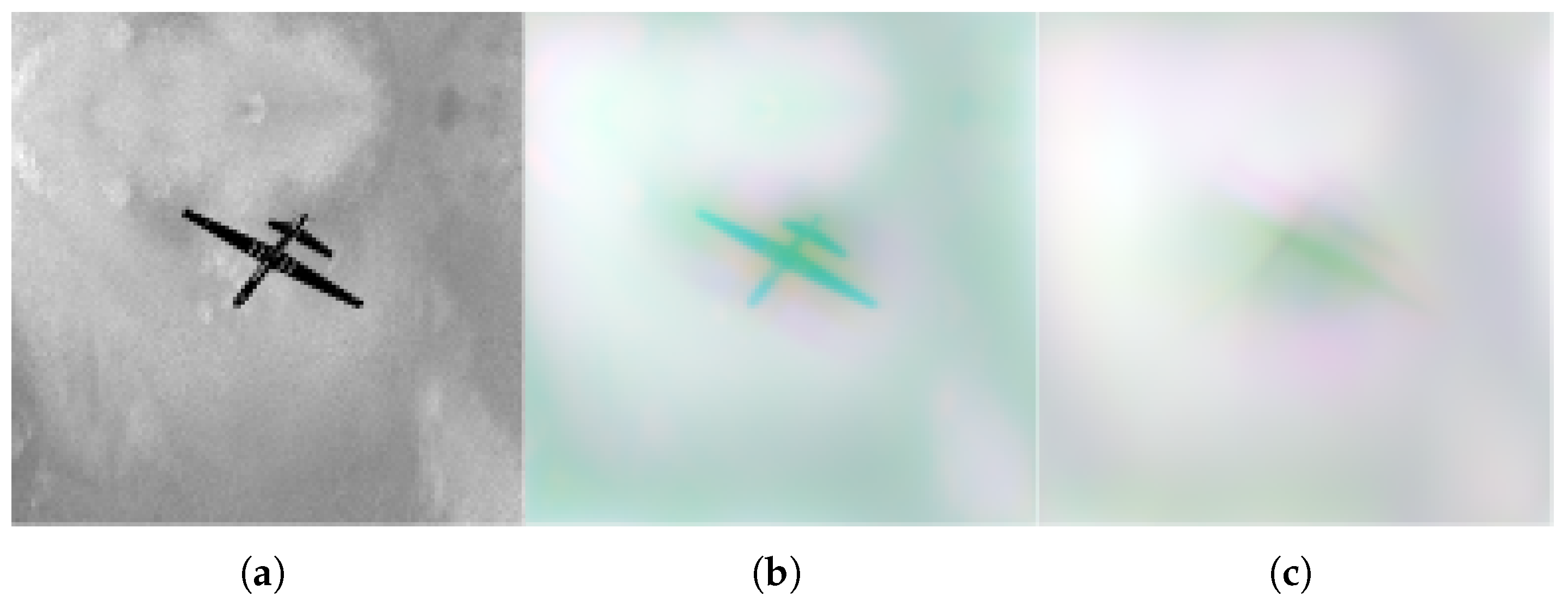
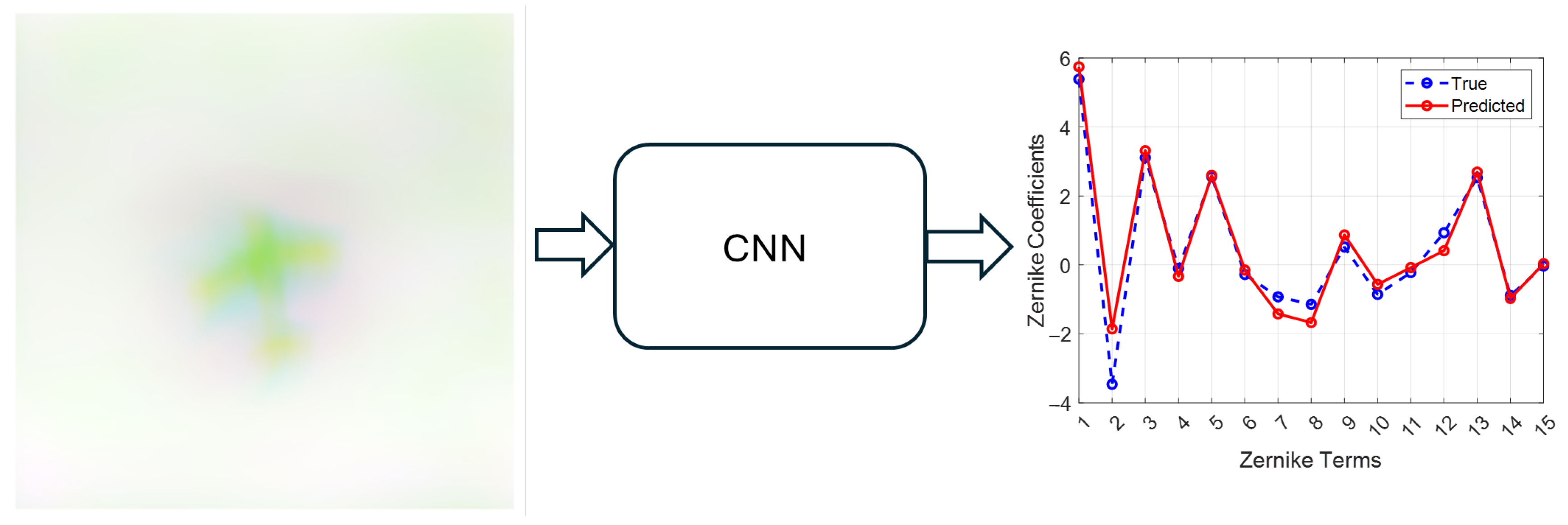
- Image formation and RGB stacking. Each PSF was convolved with the clean image to produce aberrated versions corresponding to different defocus states. These three images were stacked into the RGB channels, providing the network with multi-plane information that improves prediction accuracy compared to single-plane inputs. Each supervised training sample therefore consists of the RGB stack of defocused images together with the 15 Zernike coefficients .
3. Wavefront Sensing from Object Scene
3.1. Comparison with Independent Models and Generalization to Unseen Turbulence
3.2. Model’s Generalization to Different UAV
3.3. Discussion
4. Conclusions
Author Contributions
Funding
Institutional Review Board Statement
Informed Consent Statement
Data Availability Statement
Conflicts of Interest
Abbreviations
| AO | Adaptive Optics |
| CNNs | Convolutional Neural Networks |
| DL | Deep Learning |
| HEL | High Energy Laser |
| MSE | Mean Squared Error |
| PSF | Point Spread Function |
| RGB | Red, Green, Blue |
| ReLU | Rectified Linear Unit |
| SH | Shack–Hartmann |
| UAV | Unmanned Aerial Vehicle |
| ViT | Vision Transformer |
References
- Babcock, H. The possibility of compensating atmospheric seeing. Publ. Astron. Soc. Pac. 1953, 65, 229–236. [Google Scholar] [CrossRef]
- Holmes, R.B. Adaptive optics for directed energy: Fundamentals and methodology. AIAA J. 2022, 60, 5633–5644. [Google Scholar] [CrossRef]
- Billman, K.W.; Breakwell, J.A.; Holmes, R.B.; Dutta, K.; Granger, Z.A.; Brennan, T.J.; Kelchner, B.L. ABL beam control laboratory demonstrator. In Proceedings of the Airborne Laser Advanced Technology II, Orlando, FL, USA, 5–7 April 1999; SPIE: Philadelphia, PA, USA, 1999; Volume 3706, pp. 172–179. [Google Scholar]
- Liu, Y.T.; Gibson, J.S. Adaptive control in adaptive optics for directed-energy systems. Opt. Eng. 2007, 46, 046601. [Google Scholar] [CrossRef]
- Carbillet, M.; Ferrari, A.; Aime, C.; Campbell, H.; Greenaway, A. Wavefront sensing: From historical roots to the state-of-the-art. Eur. Astron. Soc. Publ. Ser. 2006, 22, 165–185. [Google Scholar]
- Shatokhina, I.; Hutterer, V.; Ramlau, R. Review on methods for wavefront reconstruction from pyramid wavefront sensor data. J. Astron. Telesc. Instrum. Syst. 2020, 6, 010901. [Google Scholar] [CrossRef]
- Charman, W. Wavefront technology: Past, present and future. Contact Lens Anterior Eye 2005, 28, 75–92. [Google Scholar] [CrossRef] [PubMed]
- Guo, H.; Xu, Y.; Li, Q.; Du, S.; He, D.; Wang, Q.; Huang, Y. Improved machine learning approach for wavefront sensing. Sensors 2019, 19, 3533. [Google Scholar] [CrossRef] [PubMed]
- Weinberger, C.; Guzmán, F.; Vera, E. Improved training for the deep learning wavefront sensor. In Proceedings of the Adaptive Optics Systems VII, Virtual, 14–22 December 2020; SPIE: Philadelphia, PA, USA, 2020; Volume 11448, pp. 887–892. [Google Scholar]
- Nishizaki, Y.; Valdivia, M.; Horisaki, R.; Kitaguchi, K.; Saito, M.; Tanida, J.; Vera, E. Deep learning wavefront sensing. Opt. Express 2019, 27, 240–251. [Google Scholar] [CrossRef] [PubMed]
- Wang, Y.; Wen, M.; Ma, H. Improved Phase Diversity Wavefront Sensing with a Deep Learning-Driven Hybrid Optimization Approach. Photonics 2025, 12, 235. [Google Scholar] [CrossRef]
- Paine, S.W.; Fienup, J.R. Machine learning for improved image-based wavefront sensing. Opt. Lett. 2018, 43, 1235–1238. [Google Scholar] [CrossRef] [PubMed]
- Wang, K.; Zhang, M.; Tang, J.; Wang, L.; Hu, L.; Wu, X.; Li, W.; Di, J.; Liu, G.; Zhao, J. Deep learning wavefront sensing and aberration correction in atmospheric turbulence. PhotoniX 2021, 2, 8. [Google Scholar] [CrossRef]
- Xu, Y.; He, D.; Wang, Q.; Guo, H.; Li, Q.; Xie, Z.; Huang, Y. An improved method of measuring wavefront aberration based on image with machine learning in free space optical communication. Sensors 2019, 19, 3665. [Google Scholar] [CrossRef]
- Krishnan, A.P.; Belthangady, C.; Nyby, C.; Lange, M.; Yang, B.; Royer, L.A. Optical aberration correction via phase diversity and deep learning. bioRxiv 2020, 2020-04. [Google Scholar] [CrossRef]
- Xin, Q.; Ju, G.; Zhang, C.; Xu, S. Object-independent image-based wavefront sensing approach using phase diversity images and deep learning. Opt. Express 2019, 27, 26102–26119. [Google Scholar] [CrossRef] [PubMed]
- Zhang, Y.; Cheng, M.; He, Y.; Li, X.; Liu, J.; Wang, Z.; Chen, W.; Xu, T. WFS-SpectFormer: Target-Independent Deep Learning Wavefront Sensing via Frequency and Attention Networks. In Proceedings of the International Conference on Intelligent Computing, Ningbo, China, 26–29 July 2025; Springer: Berlin/Heidelberg, Germany, 2025; pp. 3–12. [Google Scholar]
- de Bruijne, V. Extended Scene Deep Learning Wavefront Sensing for Real Time Image Deconvolution. Master’s Thesis, Delft University of Technology, Delft, The Netherlands, 2021. [Google Scholar]
- Liu, X.; Luo, W.; Hu, P.; Zhang, J.; Zhang, F.; Su, H. Transformer-based wavefront sensing for atmospheric turbulence aberration correction. Appl. Opt. 2025, 64, 2451–2463. [Google Scholar] [CrossRef] [PubMed]
- Kou, H.; Gu, J.; You, J.; Wan, M.; Ye, Z.; Xiang, Z.; Yue, X. Single-Shot Wavefront Sensing in Focal Plane Imaging Using Transformer Networks. Optics 2025, 6, 11. [Google Scholar] [CrossRef]
- Khizhnyak, A.; Markov, V. Beaconless adaptive-optics technique for HEL beam control. In Proceedings of the Atmospheric Propagation XIII, Baltimore, Maryland, 20–21 April 2016; SPIE: Philadelphia, PA, USA, 2016; Volume 9833, pp. 16–27. [Google Scholar]
- DiComo, G.P.; Witt, G.A.; Isaacs, J.J.; Helle, M.H. Beaconless adaptive optics for atmospheric laser propagation with multi-plane convolutional neural network. Opt. Express 2025, 33, 31010–31028. [Google Scholar] [CrossRef] [PubMed]
- He, K.; Zhang, X.; Ren, S.; Sun, J. Deep residual learning for image recognition. In Proceedings of the IEEE Conference on Computer Vision and Pattern Recognition, Las Vegas, NV, USA, 27–30 June 2016; pp. 770–778. [Google Scholar]
- Noll, R.J. Zernike polynomials and atmospheric turbulence. J. Opt. Soc. Am. 1976, 66, 207–211. [Google Scholar] [CrossRef]
- Agrawal, B.N.; Kim, J.J.; Agrawal, S. Optical Beam Control: Imaging Satellites and Laser Systems; John Wiley & Sons: Chichester, UK, 2025. [Google Scholar]
Disclaimer/Publisher’s Note: The statements, opinions and data contained in all publications are solely those of the individual author(s) and contributor(s) and not of MDPI and/or the editor(s). MDPI and/or the editor(s) disclaim responsibility for any injury to people or property resulting from any ideas, methods, instructions or products referred to in the content. |
© 2026 by the authors. Licensee MDPI, Basel, Switzerland. This article is an open access article distributed under the terms and conditions of the Creative Commons Attribution (CC BY) license.
Share and Cite
Herrera, L.; Messina, N.; Agrawal, B.N. Deep Learning Wavefront Sensing from Object Scene for Directed Energy HEL Systems. Sensors 2026, 26, 268. https://doi.org/10.3390/s26010268
Herrera L, Messina N, Agrawal BN. Deep Learning Wavefront Sensing from Object Scene for Directed Energy HEL Systems. Sensors. 2026; 26(1):268. https://doi.org/10.3390/s26010268
Chicago/Turabian StyleHerrera, Leonardo, Nicholas Messina, and Brij N. Agrawal. 2026. "Deep Learning Wavefront Sensing from Object Scene for Directed Energy HEL Systems" Sensors 26, no. 1: 268. https://doi.org/10.3390/s26010268
APA StyleHerrera, L., Messina, N., & Agrawal, B. N. (2026). Deep Learning Wavefront Sensing from Object Scene for Directed Energy HEL Systems. Sensors, 26(1), 268. https://doi.org/10.3390/s26010268

