
Outdoor Walking Classification Based on Inertial Measurement Unit and Foot Pressure Sensor Data
 , ,
, ,  ,
,  and
and 
Abstract
1. Introduction
2. Materials and Methods
2.1. Data Acquisition and Segmentation
2.2. Data Preparation
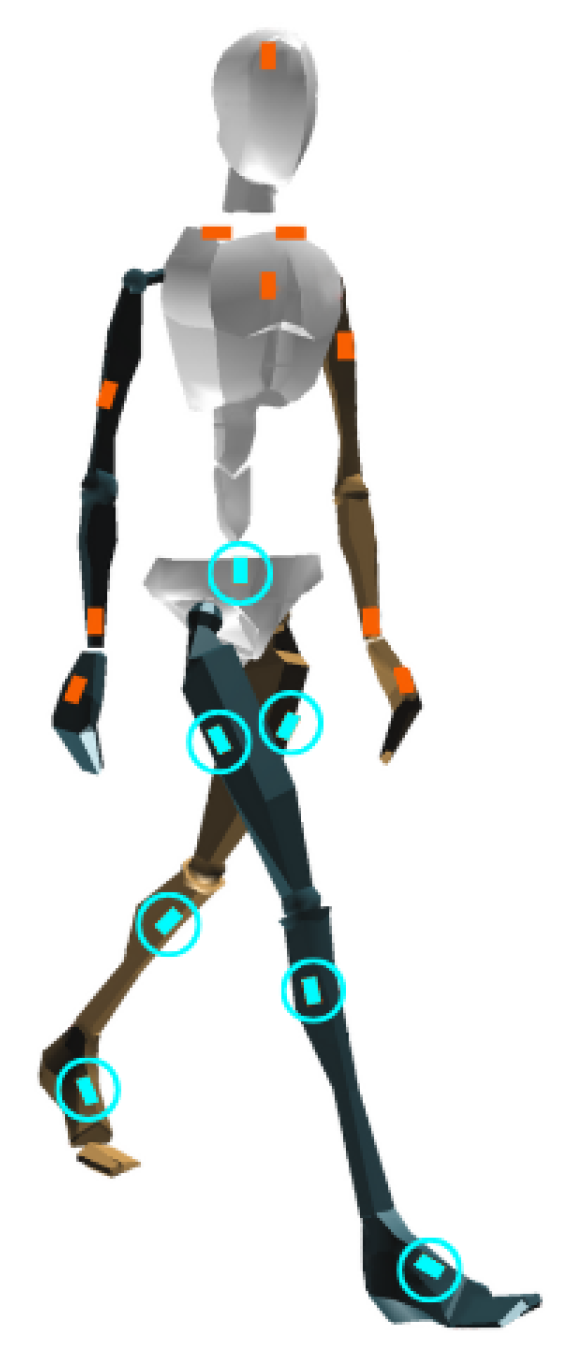
2.2.1. Sensor Configurations
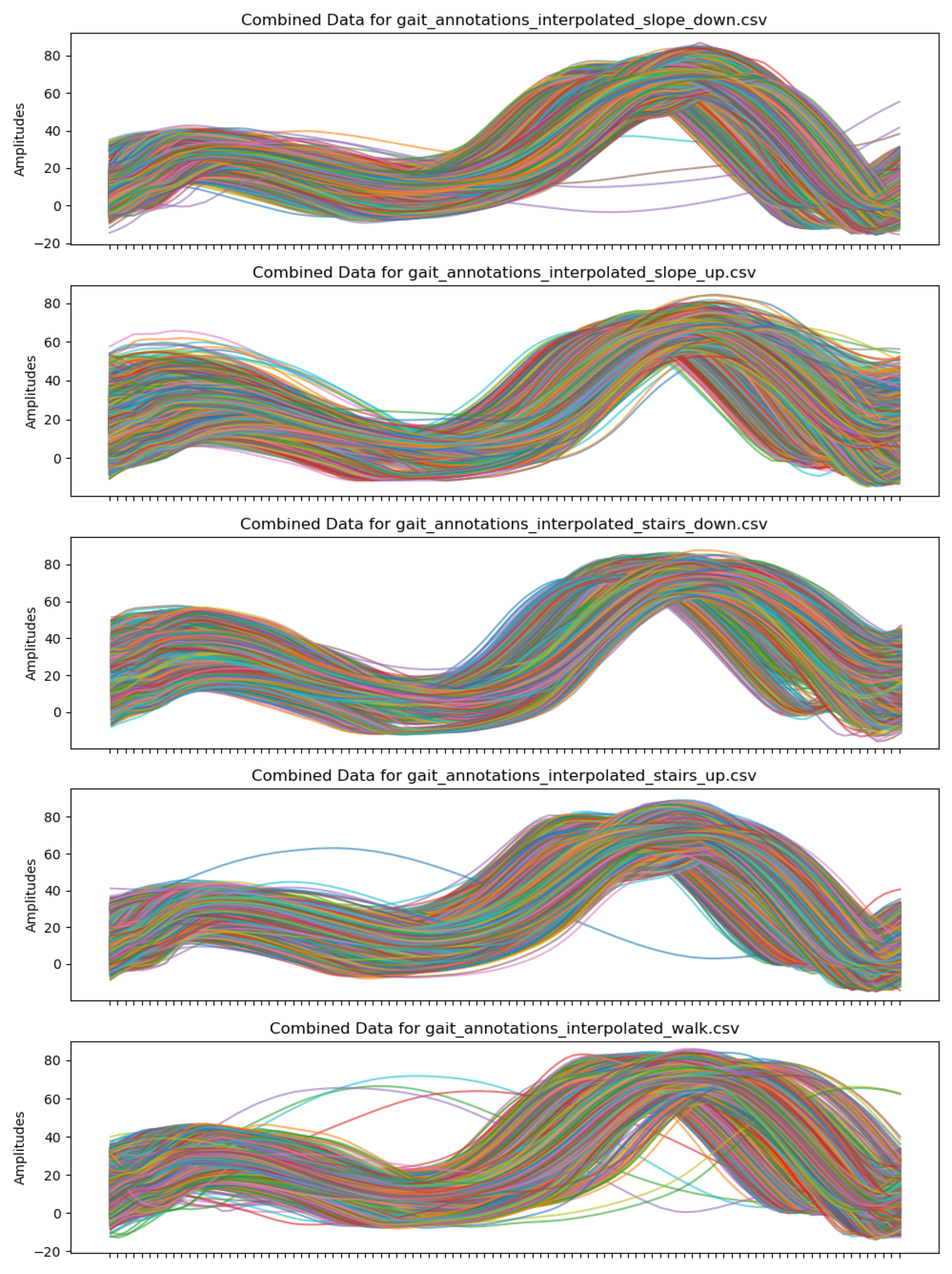
2.2.2. Data Segmentation
2.3. Machine Learning Approach
2.3.1. Feature Engineering and Reduction
2.3.2. Model Training and Evaluation
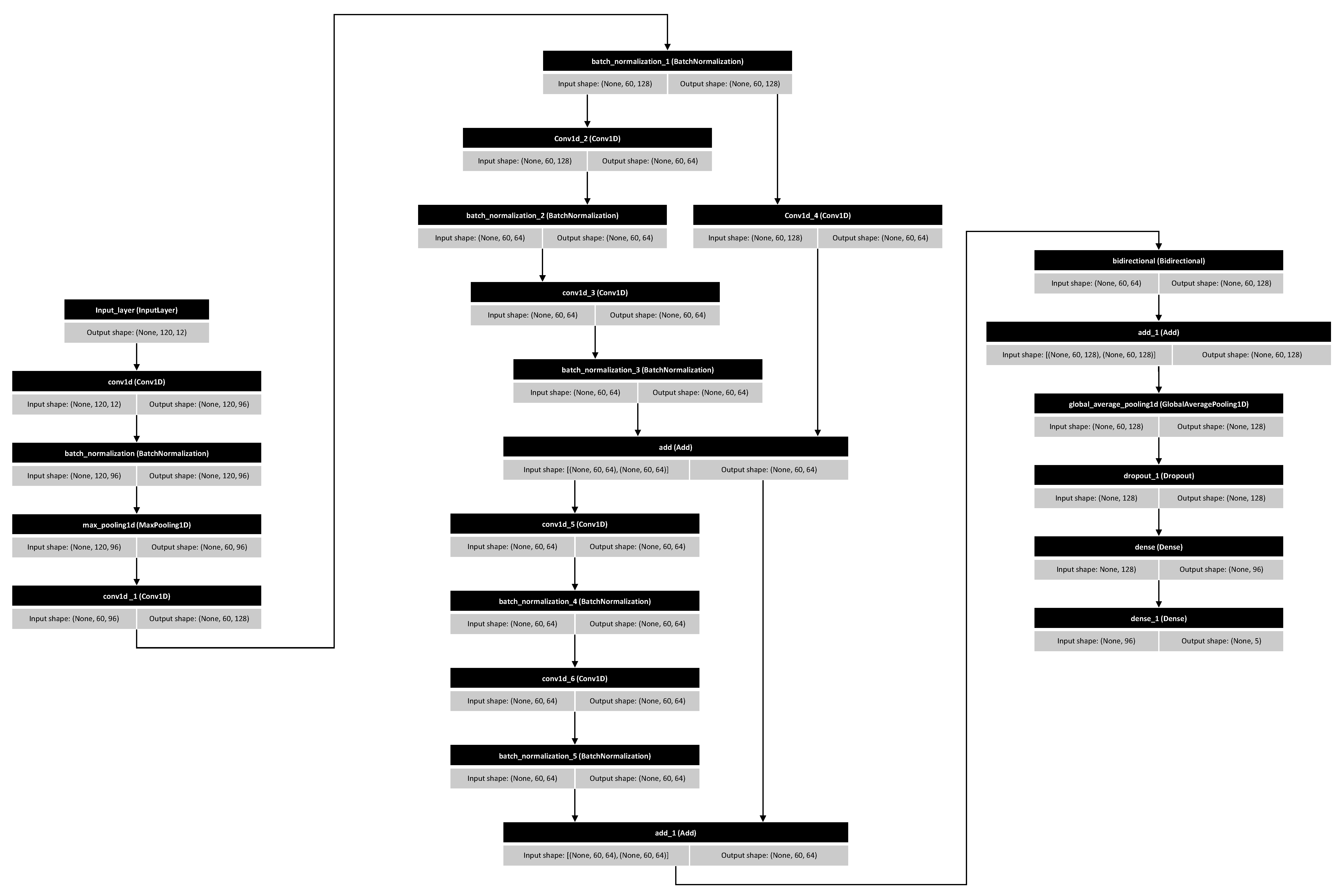
2.4. Deep Learning Approach
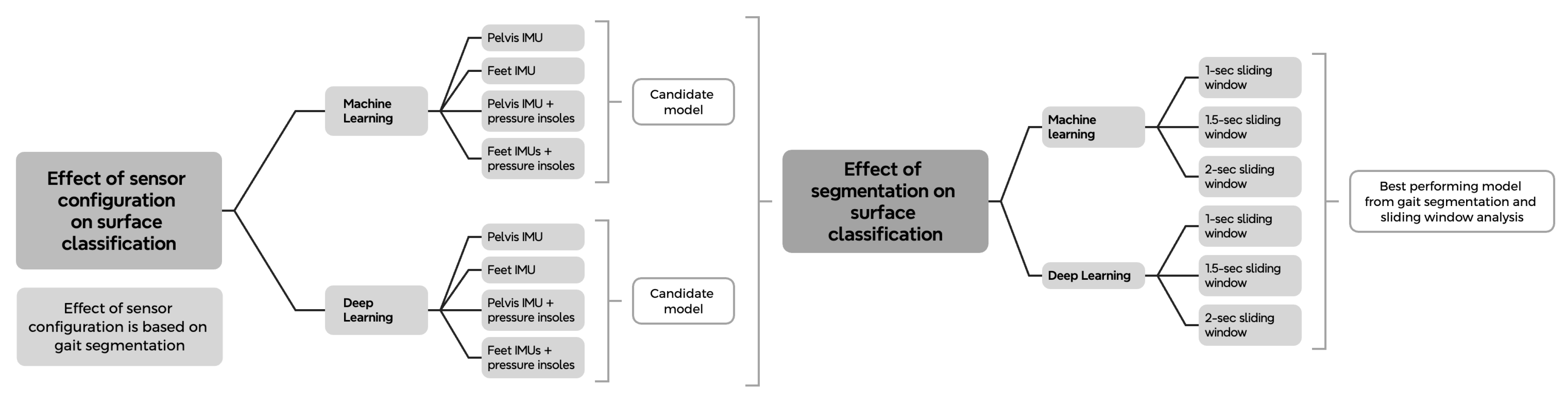
2.5. Model Comparison
3. Results
3.1. Sensor Input
3.2. Segmentation
4. Discussion
4.1. Summary
4.2. Effect of Sensor Input
4.3. Effect of Trial Segmentation Method
4.4. Comparison to Previous Work
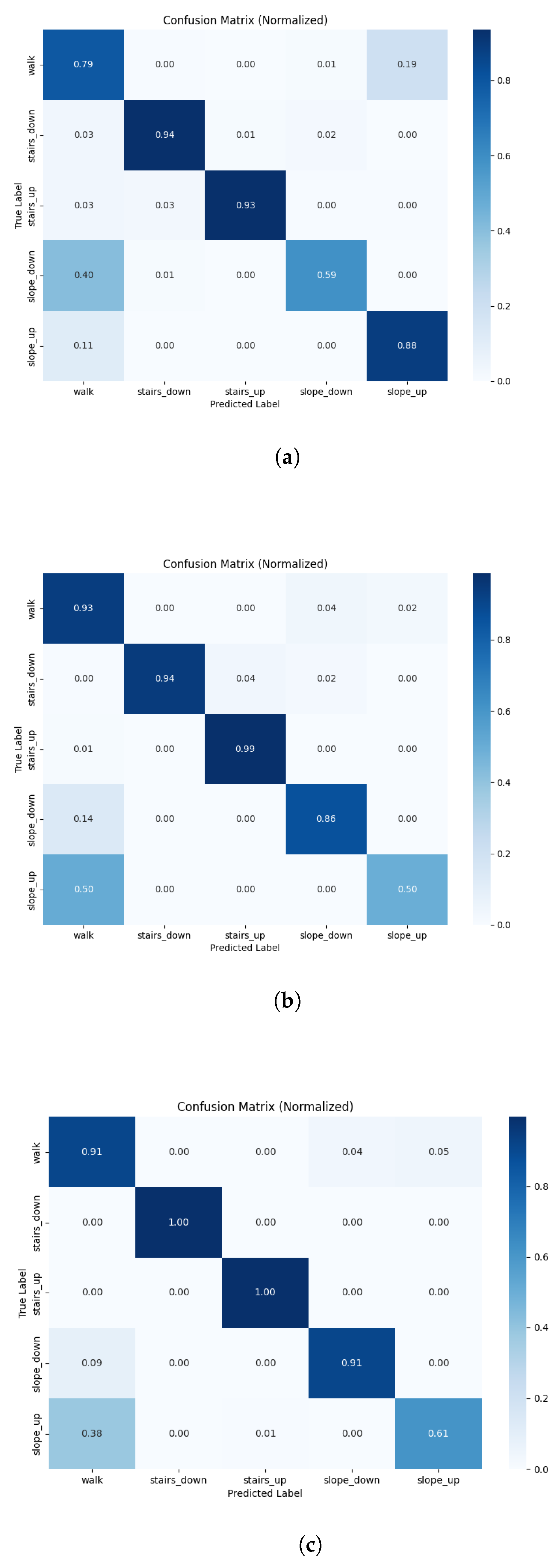
4.5. Surface Specific Performance
4.6. Limitations and Future Work
4.7. Code Availability
Author Contributions
Funding
Institutional Review Board Statement
Informed Consent Statement
Data Availability Statement
Conflicts of Interest
Abbreviations
| IMU | Inertial Measurement Unit |
| ML | Machine Learning |
| DL | Deep Learning |
| CNN | Convolutional Neural Networks |
| ISB | International Society of Biomechanics |
| LSTM | Long Short-Term Memory |
| MHA | Multi-Head Self-Attention |
| TCN | Temporal Convolutional Network |
| TSFRESH | Time Series Feature Extraction based on Scalable Hypothesis Tests |
| TSFuse | Time Series Fusion |
| XGBoost | Extreme Gradient Boosting |
Appendix A

| Paper | Participants | Surfaces (Categorized) | Instrumentation | Model(s) | Evaluation | Metrics | Notes/Setting |
|---|---|---|---|---|---|---|---|
| IMU-only | |||||||
| Shah et al. [10] | Luo dataset: 30 healthy adults (23.5 ± 4.2 y) | urban flat; incline/decline; stairs; natural uneven; banked | IMUs: wrist; L5; anterior thigh (bilateral); anterior shank (bilateral); models per sensor and all sensors | FNN | random and subject-wise | F1: 0.78 (subject-wise; lower limbs/trunk; right shank) 0.97 (random split; lower limbs) | Highly segmented straight-line walking data. |
| Hu et al. [13] | 17 older (71.5 ± 4.2 y) + 18 younger (27.0 ± 4.7 y) | lab brick paths (flat vs. uneven) | IMU at L5–S1 | LSTM | random † | Acc: 0.963 | Data leakage: same-subject data in train/test. |
| Chen et al. [44] | 30 healthy (15 women), 24.0 ± 1.1 y | urban flat; incline/decline; stairs | IMU on exterior left shoe | CNN | random split † | Acc: DL 87.74; custom 84.02 | — |
| Hashmi et al. [47] | 40 (10 female) healthy young (29.2 ± 11.4 y) | urban hard vs. soft (concrete/asphalt/tiles vs. carpet/grass/soil) | Two smartphones: chest and lower back | RF; SVM | k-fold (no subject stratification) † | Acc: 86.8 (lower-back SVM) | Likely leakage (no subject stratification). |
| McGuire et al. [21] | Luo dataset: 30 healthy adults (23.5 ± 4.2 y) | urban flat; natural uneven; incline/decline; banked; stairs | IMUs: trunk; wrist; R/L thigh; R/L shank | Centralized vs. decentralized (federated) ML | random 80/20 † | Acc: 94.252 (SVM centralized); 88.098 (realistic federated) | Highly segmented straight-line walking data; methods uncertain. |
| Ng et al. [22] | 12 healthy (4 females) | irregular vs. regular (grass; obstructions; uneven; debris) | 3D accelerometer at head; lower back; outer shoe | five classifiers | LOSO (best sensor location) ‡ | AUC: 0.80 (right ankle, SVM) | — |
| Chauhan et al. [11] | Luo dataset: 30 healthy adults (23.5 ± 4.2 y) | urban flat; incline/decline; stairs; natural uneven; banked | IMUs: wrist; L5; anterior thigh (bilateral); anterior shank (bilateral); | VM, ANN and LightGBM with salp swarm algorithm | random † | LightGBM ACC: 99.47% | — |
| Kobayashi et al. [42] | 7 participants | asphalt; gravel; lawn; grass; sand; mat (snow mimic) | smartphone (location unspecified) | RF | LOSO/LOSO-session | Acc: 44.9 (subject-CV ‡); 83.5 (session-CV) | — |
| Worsey et al. [14] | 6 healthy (2 female) | athletics track; soft sand; hard sand | ankle-worn inertial sensor | SVM; XGB; LR; RF; MLP-NN | LOSO (athlete-independent) ‡; random 70/30 (athlete-dependent) † | Acc: 0.67 ± 0.17 (best LOSO SVM); 1.0 (athlete-dependent GSVM) | — |
| Bunker et al. [48] | Luo dataset: 30 healthy adults (23.5 ± 4.2 y) | urban flat; natural uneven; incline/decline; banked; stairs | lower back IMU only | FRNN | random split † | Acc: 82 | — |
| Yılịz et al. [12] | Luo dataset: 30 healthy adults (23.5 ± 4.2 y) | shanks only (subset of IMUs) | L/R shank IMUs | CNN | stratified CV (class ratio balanced; not subject) † | F1: 0.962 | Data leakage noted. |
| Sher et al. [49] | 10 healthy participants (29.0 ± 8.7 y) | grass patch, a running track, a pavement, sandy beach, pebble beach, a forest track, a road with a slope (for uphill and downhill walking), a set of stairs (for up and down walking) | 3D accelerometer and 3D gyroscope from smartphone | NB; NN, FNN; J48; JRip; SMO; MLP | LOSO ‡ and subject dependent § | Acc: 92.3 ± 5.3% (personalized); Acc: 31.8 ± 4.0% (generalized) | — |
| Multimodal (EMG/motion capture/insoles) | |||||||
| Camargo et al. [15] | 15 healthy young (21 ± 3.4 y) | lab treadmill; ramps (5.2–18°); stairs (10.1–17.8 cm) | 11 EMG; 3 goniometers; 4 IMU; 32 markers (unilateral) | LDA; NN | subject-dependent § | Acc: 0.981 | Lab setting. |
| Kim et al. [16] | 27 male students (24.5 ± 2.7 y) | urban flat; stairs; incline/decline | EMG of 11 lower-limb muscles | ANN | 80/20 split (no subject-wise mention) † | Acc: 96.3 | Barefoot; laboratory environment. |
| Kyeong et al. [50] | 4 healthy young (24.4 ± 3.0 y) | level; ramp ascent/descent; stair ascent/descent | sEMG (several muscles) | BLDA | leave-one-out per gait section | Acc: 76.7 ± 2.5 | Exoskeleton (lab). |
| Shin et al. [17] | 4 healthy young (29.75 ± 3.96 y) | level; ramp ascent/descent; stair ascent/descent | 4 IMUs (L/R thigh; feet) | GMM | LOOCV (full- and individual-dependent) § | Acc: 99.55 ± 0.5 (individual); 98.75 (full-dependent) | — |
| Seo et al. [18] | 5 healthy (4 females), 37.6 ± 6.5 y | indoor corridor LG; ramps (AR/DR); stairs (AS/DS) | IMUs (shanks, insteps, hypogastric); insoles (GRF); PPG | MLP (feedforward NN) | random split † | Acc: 97.73 | No separation of subjects. |


| Signal and Model Type | Accuracy | F1-Score | Sensitivity | Specificity |
|---|---|---|---|---|
| Original ML | 0.81 (0.05) | 0.82 (0.04) | 0.81 (0.03) | 0.93 (0.02) |
| Perturbed ML | 0.78 (0.05) | 0.78 (0.03) | 0.77 (0.03) | 0.92 (0.02) |
| Original DL | 0.85 (0.04) | 0.82 (0.07) | 0.81 (0.06) | 0.94 (0.01) |
| Perturbed DL | 0.83 (0.03) | 0.82 (0.04) | 0.80 (0.04) | 0.94 (0.01) |
References
- Blair, S.; Lake, M.J.; Ding, R.; Sterzing, T. Magnitude and variability of gait characteristics when walking on an irregular surface at different speeds. Hum. Mov. Sci. 2018, 59, 112–120. [Google Scholar] [CrossRef] [PubMed]
- Allet, L.; Armand, S.; de Bie, R.A.; Pataky, Z.; Aminian, K.; Herrmann, F.R.; de Bruin, E.D. Gait alterations of diabetic patients while walking on different surfaces. Gait Posture 2009, 29, 488–493. [Google Scholar] [CrossRef] [PubMed]
- Ippersiel, P.; Shah, V.; Dixon, P.C. The impact of outdoor walking surfaces on lower-limb coordination and variability during gait in healthy adults. Gait Posture 2022, 91, 7–13. [Google Scholar] [CrossRef] [PubMed]
- Dixon, P.; Schütte, K.; Vanwanseele, B.; Jacobs, J.; Dennerlein, J.; Schiffman, J. Gait adaptations of older adults on an uneven brick surface can be predicted by age-related physiological changes in strength. Gait Posture 2018, 61, 257–262. [Google Scholar] [CrossRef]
- Vieira, M.F.; Rodrigues, F.B.; de Sá E Souza, G.S.; Magnani, R.M.; Lehnen, G.C.; Campos, N.G.; Andrade, A.O. Gait stability, variability and complexity on inclined surfaces. J. Biomech. 2017, 54, 73–79. [Google Scholar] [CrossRef]
- Menz, H.B.; Lord, S.R.; Fitzpatrick, R.C. Acceleration patterns of the head and pelvis when walking on level and irregular surfaces. Gait Posture 2003, 18, 35–46. [Google Scholar] [CrossRef]
- Emmerzaal, J.; Ippersiel, P.; Dixon, P.C. Non-Linear Gait Dynamics Are Affected by Commonly Occurring Outdoor Surfaces and Sex in Healthy Adults. Sensors 2025, 25, 4191. [Google Scholar] [CrossRef]
- Menant, J.C.; Steele, J.R.; Menz, H.B.; Munro, B.J.; Lord, S.R. Effects of walking surfaces and footwear on temporo-spatial gait parameters in young and older people. Gait Posture 2009, 29, 392–397. [Google Scholar] [CrossRef]
- Li, W.J.; Keegan, T.H.M.; Sternfeld, B.; Sidney, S.; Quesenberry, C.P.; Kelsey, J.L. Outdoor falls among middle-aged and older adults: A neglected public health problem. Am. J. Public Health 2006, 96, 1192–1200. [Google Scholar] [CrossRef]
- Shah, V.; Flood, M.; Grimm, B.; Dixon, P. Generalizability of deep learning models for predicting outdoor irregular walking surfaces. J. Biomech. 2022, 139, 111–159. [Google Scholar] [CrossRef]
- Chauhan, P.; Singh, A.K.; Raghuwanshi, N.K. Classifying walking pattern on different surfaces by optimising features extracted through IMU sensor data using SSA optimisation. J. Braz. Soc. Mech. Sci. Eng. 2025, 47, 1–17. [Google Scholar] [CrossRef]
- Yıldız, A. Towards environment-aware fall risk assessment: Classifying walking surface conditions using IMU-based gait data and deep learning. Brain Sci. 2023, 13, 1428. [Google Scholar] [CrossRef] [PubMed]
- Hu, B.; Li, S.; Chen, Y.; Kavi, R.; Coppola, S. Applying deep neural networks and inertial measurement unit in recognizing irregular walking differences in the real world. Appl. Ergon. 2021, 96, 103414. [Google Scholar] [CrossRef] [PubMed]
- Worsey, M.T.; Espinosa, H.G.; Shepherd, J.B.; Thiel, D.V. Automatic classification of running surfaces using an ankle-worn inertial sensor. Sports Eng. 2021, 24, 22. [Google Scholar] [CrossRef]
- Camargo, J.; Flanagan, W.; Csomay-Shanklin, N.; Kanwar, B.; Young, A. A machine learning strategy for locomotion classification and parameter estimation using fusion of wearable sensors. IEEE Trans. Biomed. Eng. 2021, 68, 1569–1578. [Google Scholar] [CrossRef]
- Kim, P.; Lee, J.; Shin, C.S. Classification of walking environments using deep learning approach based on surface EMG sensors only. Sensors 2021, 21, 4204. [Google Scholar] [CrossRef]
- Shin, D.; Lee, S.; Hwang, S. Locomotion mode recognition algorithm based on Gaussian mixture model using IMU sensors. Sensors 2021, 21, 2785. [Google Scholar] [CrossRef]
- Seo, K.J.; Lee, J.; Cho, J.E.; Kim, H.; Kim, J.H. Gait Environment Recognition Using Biomechanical and Physiological Signals with Feed-Forward Neural Network: A Pilot Study. Sensors 2025, 25, 4302. [Google Scholar] [CrossRef]
- Kapoor, S.; Narayanan, A. Leakage and the reproducibility crisis in machine-learning-based science. Patterns 2023, 4, 100804. [Google Scholar]
- Saeb, S.; Lonini, L.; Jayaraman, A.; Mohr, D.; Kording, K. The need to approximate the use-case in clinical machine learning. GigaScience 2017, 6, gix019. [Google Scholar] [CrossRef]
- McQuire, J.; Watson, P.; Wright, N.; Hiden, H.; Catt, M. Uneven and irregular surface condition prediction from human walking data using both centralized and decentralized machine learning approaches. In Proceedings of the 2021 IEEE International Conference on Bioinformatics and Biomedicine (BIBM), Houston, TX, USA, 9–12 December 2021; pp. 1449–1452. [Google Scholar]
- Ng, H.R.; Sossa, I.; Nam, Y.; Youn, J.H. Machine learning approach for automated detection of irregular walking surfaces for walkability assessment with wearable sensor. Sensors 2022, 23, 193. [Google Scholar] [CrossRef]
- Warmerdam, E.; Burger, L.M.; Mergen, D.F.; Orth, M.; Pohlemann, T.; Ganse, B. The walking surface influences vertical ground reaction force and centre of pressure data obtained with pressure-sensing insoles. Front. Digit. Health 2024, 6, 1476335. [Google Scholar] [CrossRef] [PubMed]
- Losing, V.; Hasenjäger, M. A Multi-Modal Gait Database of Natural Everyday-Walk in an Urban Environment. Sci. Data 2022, 9, 473. [Google Scholar] [CrossRef] [PubMed]
- Schepers, M.; Giuberti, M.; Bellusci, G. Xsens MVN: Consistent Tracking of Human Motion Using Inertial Sensing; XSENS TECHNOLOGIES B.V.: Enschede, The Netherlands, 2018. [Google Scholar] [CrossRef]
- IEE Smart Sensing Solutions. Smart Health. 2018. Available online: https://iee-sensing.com/health-tech/ (accessed on 8 April 2025).
- Wu, G.; Siegler, S.; Allard, P.; Kirtley, C.; Leardini, A.; Rosenbaum, D.; Whittle, M.; D D’Lima, D.; Cristofolini, L.; Witte, H.; et al. ISB recommendation on definitions of joint coordinate system of various joints for the reporting of human joint motion—Part I: Ankle, hip, and spine. J. Biomech. 2002, 35, 543–548. [Google Scholar] [CrossRef] [PubMed]
- Leng, Z.; Iyer, A.; Plötz, T. Scaling Human Activity Recognition: A Comparative Evaluation of Synthetic Data Generation and Augmentation Techniques. arXiv 2025, arXiv:2506.07612. [Google Scholar] [CrossRef]
- Banos, O.; Galvez, J.M.; Damas, M.; Pomares, H.; Rojas, I. Window Size Impact in Human Activity Recognition. Sensors 2014, 14, 6474–6499. [Google Scholar] [CrossRef]
- The Pandas Development Team. pandas-dev/pandas: Pandas. 2020. Available online: https://zenodo.org/records/17992932 (accessed on 8 April 2025).
- Harris, C.R.; Millman, K.J.; van der Walt, S.J.; Gommers, R.; Virtanen, P.; Cournapeau, D.; Wieser, E.; Taylor, J.; Berg, S.; Smith, N.J.; et al. Array programming with NumPy. Nature 2020, 585, 357–362. [Google Scholar] [CrossRef]
- Pedregosa, F.; Varoquaux, G.; Gramfort, A.; Michel, V.; Thirion, B.; Grisel, O.; Blondel, M.; Prettenhofer, P.; Weiss, R.; Dubourg, V.; et al. Scikit-learn: Machine Learning in Python. J. Mach. Learn. Res. 2011, 12, 2825–2830. [Google Scholar]
- Christ, M.; Braun, N.; Neuffer, J.; Kempa-Liehr, A.W. Time Series FeatuRe Extraction on basis of Scalable Hypothesis tests (tsfresh—A Python package). Neurocomputing 2018, 307, 72–77. [Google Scholar] [CrossRef]
- Felice, F.; Ley, C.; Bordas, S.P.; Groll, A. Boosting any learning algorithm with Statistically Enhanced Learning. Sci. Rep. 2025, 15, 1605. [Google Scholar] [CrossRef]
- Saeys, Y.; Inza, I.; Larrañaga, P. A review of feature selection techniques in bioinformatics. Bioinformatics 2007, 23, 2507–2517. [Google Scholar] [CrossRef]
- Chen, T.; Guestrin, C. XGBoost: A Scalable Tree Boosting System. In Proceedings of the 22nd ACM SIGKDD International Conference on Knowledge Discovery and Data Mining, New York, NY, USA, 13–17 August 2016; pp. 785–794. [Google Scholar] [CrossRef]
- Burges, E.T.; Oraibi, Z.A.; Wali, A. Gait Recognition Using Hybrid LSTM-CNN Deep Neural Networks. J. Image Graph. 2024, 12, 168–175. [Google Scholar] [CrossRef]
- Urvashi; Kumar, D.; Gupta, T. Fusion of CNN and LSTM Models for Enhanced Gait Swing Phase Identification. In Proceedings of the 2024 Global Conference on Communications and Information Technologies (GCCIT), Bangalore, India, 25–26 October 2024; pp. 1–4. [Google Scholar] [CrossRef]
- Lv, H.; Hao, B. Convolutional neural network and long short-term memory hybrid model-based gait prediction for spacesuit intelligent assistive device in low gravity environment. Acta Astronaut. 2025, 236, 199–212. [Google Scholar] [CrossRef]
- Dumphart, B.; Slijepcevic, D.; Unglaube, F.; Kranzl, A.; Baca, A.; Horsak, B. The effect of inaccurate initial contact events on kinematics in healthy and pathological gait. Gait Posture 2026, 123, 110012. [Google Scholar] [CrossRef] [PubMed]
- Blades, S.; Marriott, H.; Hundza, S.; Honert, E.C.; Stellingwerff, T.; Klimstra, M. Evaluation of Different Pressure-Based Foot Contact Event Detection Algorithms across Different Slopes and Speeds. Sensors 2023, 23, 2736. [Google Scholar] [CrossRef]
- Kobayashi, S.; Katsurada, R.; Hasegawa, T. Estimation of sidewalk surface type with a smartphone. In Proceedings of the 2019 7th International Conference on Information Technology: IoT and Smart City, Shanghai, China, 20–23 December 2019; pp. 497–502. [Google Scholar]
- Luo, Y.; Coppola, S.M.; Dixon, P.C.; Li, S.; Dennerlein, J.T.; Hu, B. A database of human gait performance on irregular and uneven surfaces collected by wearable sensors. Sci. Data 2020, 7, 1–9. [Google Scholar] [CrossRef]
- Chen, W.H.; Lee, Y.S.; Yang, C.J.; Chang, S.Y.; Shih, Y.; Sui, J.D.; Shiang, T.Y. Determining motions with an IMU during level walking and slope and stair walking. J. Sports Sci. 2019, 38, 62–69. [Google Scholar] [CrossRef]
- Mirjalili, S.; Gandomi, A.H.; Mirjalili, S.Z.; Saremi, S.; Faris, H.; Mirjalili, S.M. Salp Swarm Algorithm: A bio-inspired optimizer for engineering design problems. Adv. Eng. Softw. 2017, 114, 163–191. [Google Scholar] [CrossRef]
- De Brabandere, A.; Op De Beéck, T.; Hendrickx, K.; Meert, W.; Davis, J. TSFuse: Automated feature construction for multiple time series data. Mach. Learn. 2024, 113, 5001–5056. [Google Scholar]
- Hashmi, M.Z.U.H.; Riaz, Q.; Hussain, M.; Shahzad, M. What lies beneath one’s feet? terrain classification using inertial data of human walk. Appl. Sci. 2019, 9, 3099. [Google Scholar] [CrossRef]
- Bunker, M.T.; Sher, A.; Akpokodje, V.; Villagra, F.; Parthaláin, N.M.; Akanyeti, O. Towards fuzzy context-aware automatic gait assessments in free-living environments. In UK Workshop on Computational Intelligence; Springer: Cham, Switzerland, 2021; pp. 463–474. [Google Scholar]
- Sher, A.; Bunker, M.T.; Akanyeti, O. Towards personalized environment-aware outdoor gait analysis using a smartphone. Expert Syst. 2023, 40, e13130. [Google Scholar] [CrossRef]
- Kyeong, S.; Shin, W.; Yang, M.; Heo, U.; Feng, J.r.; Kim, J. Recognition of walking environments and gait period by surface electromyography. Front. Inf. Technol. Electron. Eng. 2019, 20, 342–352. [Google Scholar] [CrossRef]


| Model | Sensor Configuration | Accuracy | F1-Score | Sensitivity | Specificity |
|---|---|---|---|---|---|
| ML | IMU lower-limbs | 0.85 (0.05) | 0.87 (0.04) | 0.86 (0.03) | 0.94 (0.01) |
| IMU feet a | 0.70 (0.05) | 0.71 (0.03) | 0.71 (0.04) | 0.89 (0.01) | |
| IMU pelvis a | 0.74 (0.07) | 0.74 (0.05) | 0.75 (0.04) | 0.92 (0.02) | |
| Pressure feet | 0.69 (0.05) | 0.66 (0.03) | 0.65 (0.03) | 0.89 (0.01) | |
| IMU feet + Pressure feet b | 0.81 (0.04) | 0.80 (0.04) | 0.79 (0.04) | 0.93 (0.01) | |
| IMU pelvis + Pressure feet b,c | 0.81 (0.05) | 0.82 (0.04) | 0.81 (0.03) | 0.93 (0.02) | |
| DL | IMU lower-limbs | 0.89 (0.03) | 0.89 (0.04) | 0.87 (0.04) | 0.96 (0.01) |
| IMU feet a | 0.78 (0.05) | 0.80 (0.04) | 0.79 (0.02) | 0.92 (0.01) | |
| IMU pelvis a | 0.81 (0.07) | 0.80 (0.07) | 0.80 (0.06) | 0.93 (0.02) | |
| Pressure Feet | 0.73 (0.05) | 0.66 (0.06) | 0.63 (0.06) | 0.90 (0.02) | |
| IMU feet + Pressure feet | 0.80 (0.07) | 0.80 (0.05) | 0.78 (0.05) | 0.93 (0.02) | |
| IMU pelvis + Pressure feet c | 0.85 (0.04) | 0.82 (0.07) | 0.81 (0.06) | 0.94 (0.01) |
| Model | Window Length | Accuracy | F1-Score | Sensitivity | Specificity |
|---|---|---|---|---|---|
| ML | 1-s | 0.81 (0.04) | 0.79 (0.04) a | 0.78 (0.03) | 0.93 (0.01) |
| 1.5-s | 0.76 (0.07) | 0.76 (0.04) | 0.77 (0.03) | 0.92 (0.02) | |
| 2-s | 0.77 (0.06) | 0.77 (0.04) | 0.77 (0.03) | 0.92 (0.02) | |
| DL | 1-s | 0.83 (0.05) | 0.82 (0.05) | 0.81 (0.04) | 0.94 (0.01) |
| 1.5-s | 0.84 (0.07) | 0.83 (0.08) | 0.83 (0.07) | 0.94 (0.02) | |
| 2-s | 0.84 (0.07) | 0.83 (0.08) | 0.83 (0.06) | 0.94 (0.02) |
Disclaimer/Publisher’s Note: The statements, opinions and data contained in all publications are solely those of the individual author(s) and contributor(s) and not of MDPI and/or the editor(s). MDPI and/or the editor(s) disclaim responsibility for any injury to people or property resulting from any ideas, methods, instructions or products referred to in the content. |
© 2025 by the authors. Licensee MDPI, Basel, Switzerland. This article is an open access article distributed under the terms and conditions of the Creative Commons Attribution (CC BY) license.
Share and Cite
Jlassi, O.; Emmerzaal, J.; Vinco, G.; Garcia, F.; Ley, C.; Grimm, B.; Dixon, P.C. Outdoor Walking Classification Based on Inertial Measurement Unit and Foot Pressure Sensor Data. Sensors 2026, 26, 232. https://doi.org/10.3390/s26010232
Jlassi O, Emmerzaal J, Vinco G, Garcia F, Ley C, Grimm B, Dixon PC. Outdoor Walking Classification Based on Inertial Measurement Unit and Foot Pressure Sensor Data. Sensors. 2026; 26(1):232. https://doi.org/10.3390/s26010232
Chicago/Turabian StyleJlassi, Oussama, Jill Emmerzaal, Gabriella Vinco, Frederic Garcia, Christophe Ley, Bernd Grimm, and Philippe C. Dixon. 2026. "Outdoor Walking Classification Based on Inertial Measurement Unit and Foot Pressure Sensor Data" Sensors 26, no. 1: 232. https://doi.org/10.3390/s26010232
APA StyleJlassi, O., Emmerzaal, J., Vinco, G., Garcia, F., Ley, C., Grimm, B., & Dixon, P. C. (2026). Outdoor Walking Classification Based on Inertial Measurement Unit and Foot Pressure Sensor Data. Sensors, 26(1), 232. https://doi.org/10.3390/s26010232