QL-HIT2F: A Q-Learning-Aided Adaptive Fuzzy Path Planning Algorithm with Enhanced Obstacle Avoidance

Abstract
1. Introduction
2. The Original GA-HIT2F and Its Performance Analysis
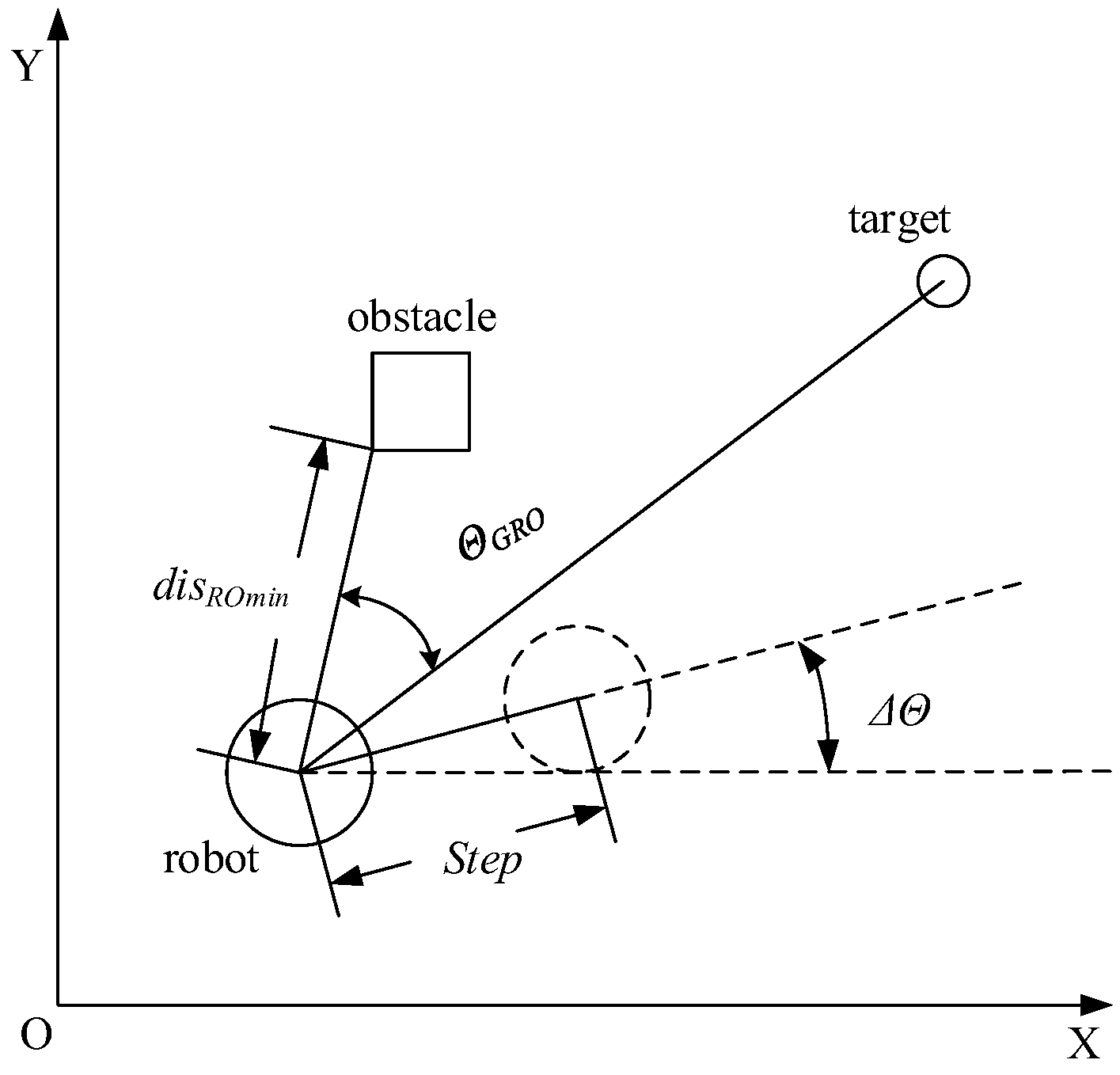
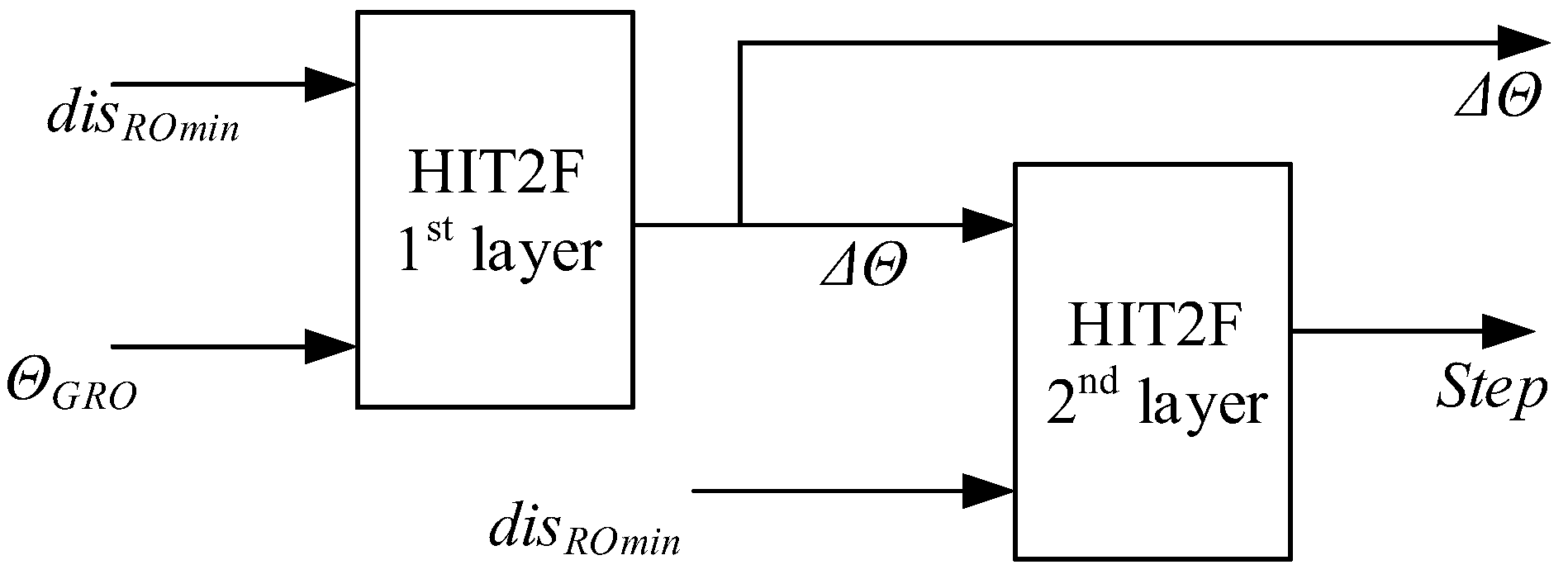
2.1. Basic GA-HIT2F Path Planning Algorithm
| Algorithm 1 The origin GA-HIT2F |
| 1: Input necessary Map and Robot Information 2: ; 3: ; 4: ; 5: 6: ; 7: 8: 9: 10: 11: 12: 13: 14: 15: 16: |
2.2. Principle of Parameter Optimization of the Affiliation Functions in GA-HIT2F
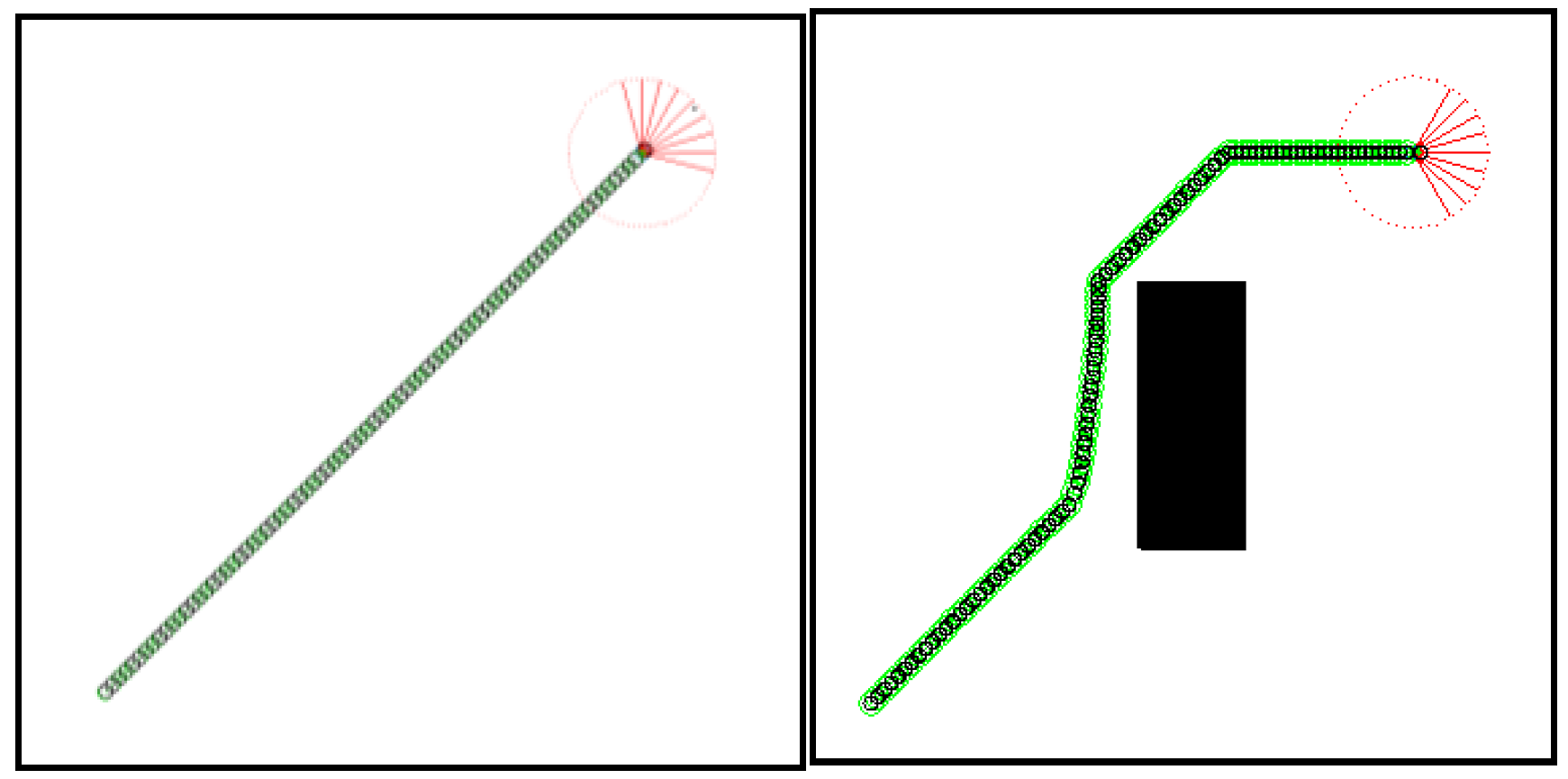
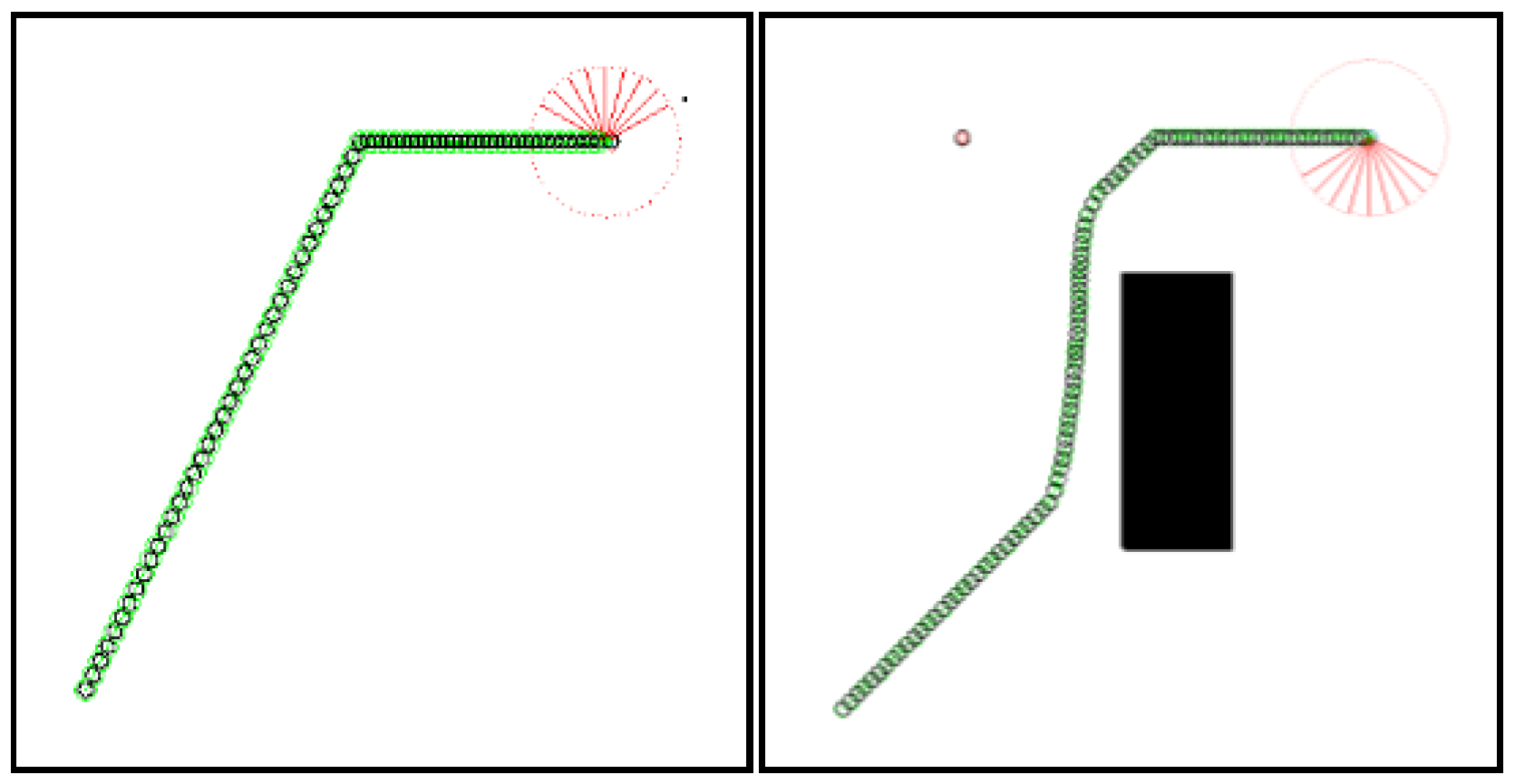
2.3. Parameter Optimization Performance and Its Defect Analysis
2.4. The Necessity of Dynamically Adjusting the Parameters of the Affiliation Function
3. QL-HIT2F Planner Based on Reinforcement Learning and the Concept of Average Obstacle Orientation
3.1. Average Obstacle Orientation
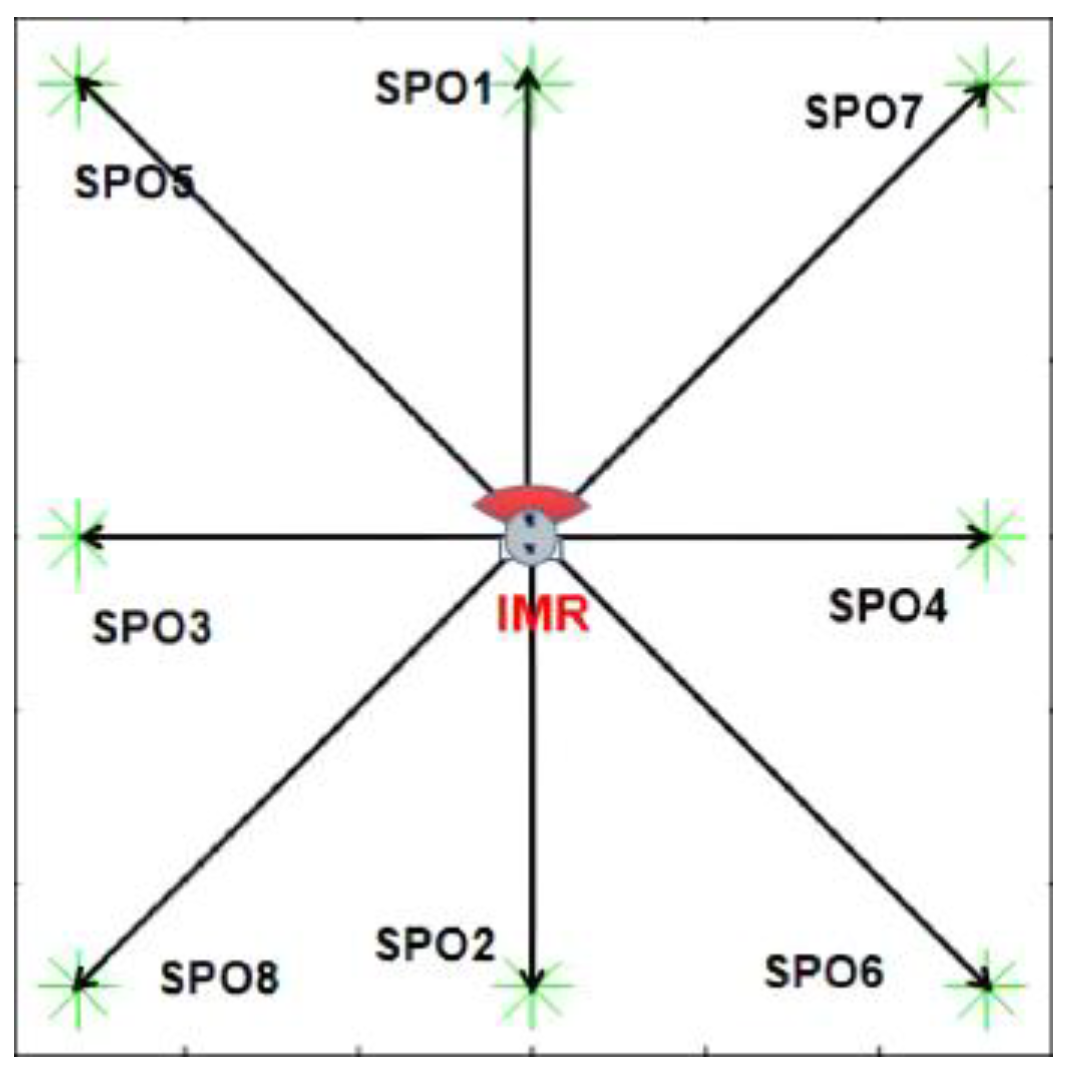
3.2. Dynamic Parameter Configuration of Reinforcement Learning
| Algorithm 2 Standard Q-Learning algorithm |
| 1: 2: for 3: 4: While 5: 6: 7: 8: 9: end while 10: end for |
3.3. Reinforcement Learning State-Space for QL-HIT2F Path Planner
3.4. Reinforcement Learning Action Space for QL-HIT2F Path Planner
3.5. Reinforcement Learning Reward Mechanism and Training Process for QL-HIT2F Path Planner
| Algorithm 3 QL training flow for QL-HIT2F path planner |
| 1: Input necessary Map and Robot preliminary information 2: 3: 4: 5: 6: 7: 8: 9: 10: 11: 12: 13: 14: 15: 16: 17: 18: 19: 20: 21: 22: 23: |
| Algorithm 4 Modified greedy choose action algorithm |
| 1: 2: 3: 4: 5: 6: 7: 8: 9: 10: 11: 12: 13: |
4. QL-HIT2F Path Planning Training and Simulation Test
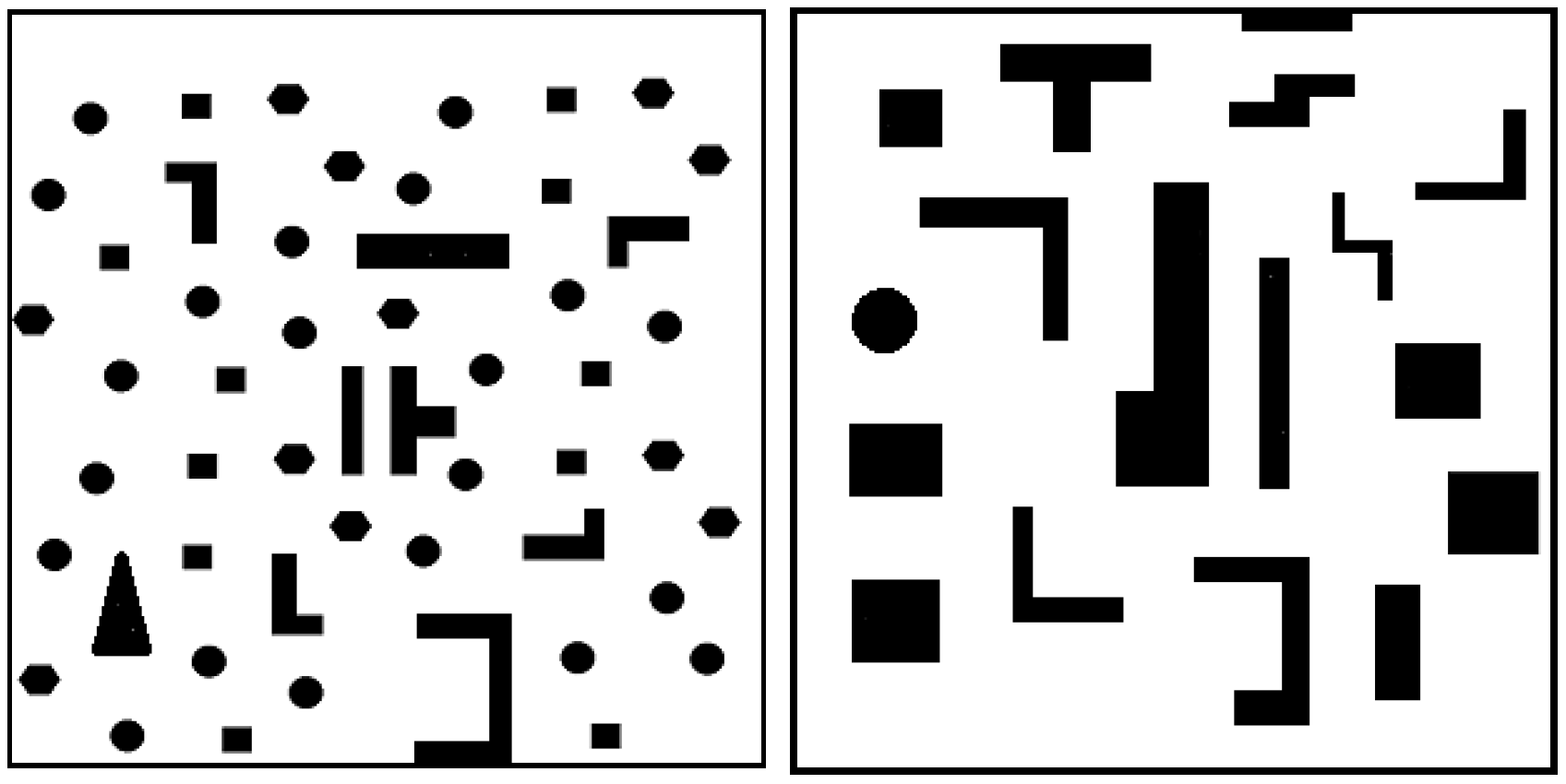
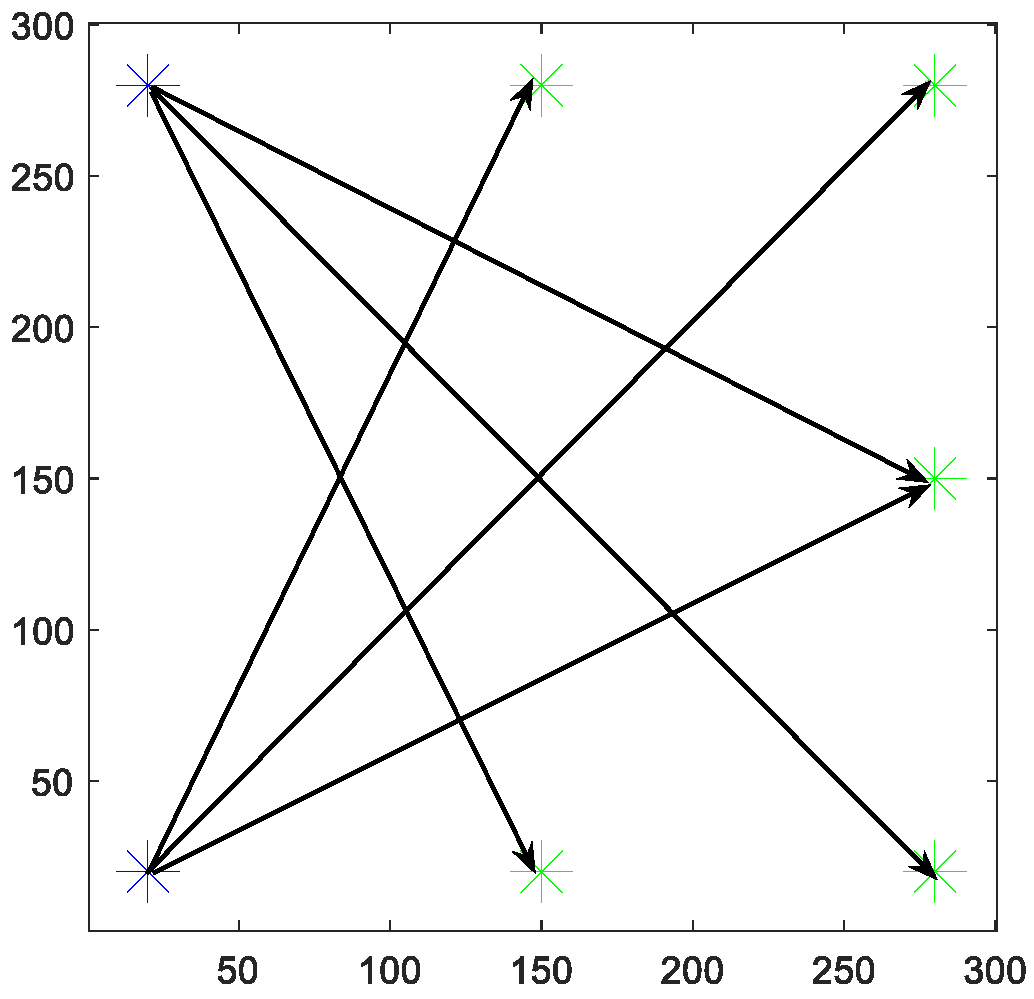
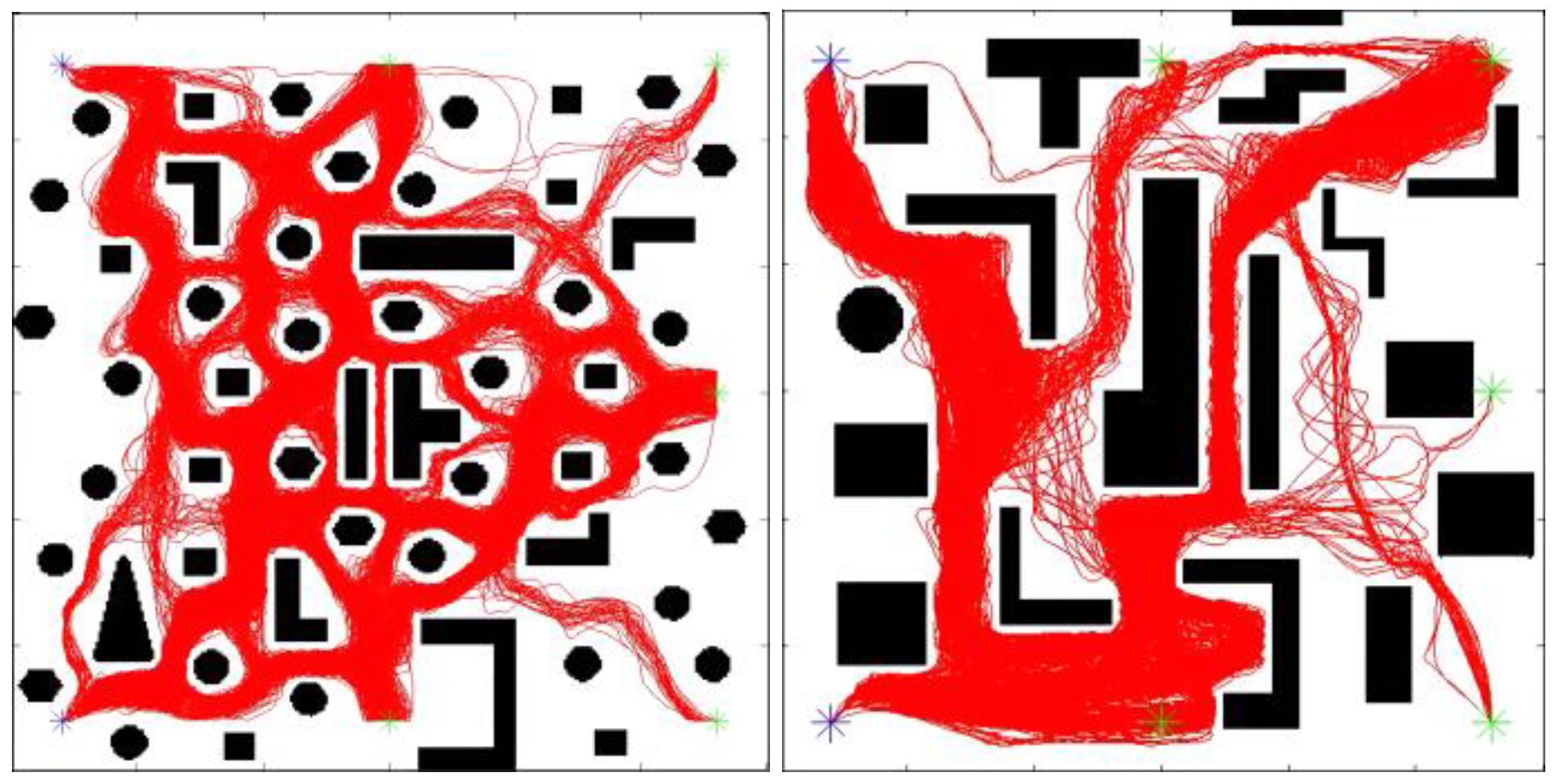
4.1. Path Planning Training of QL-HIT2F for Metamap Scenarios
4.2. QL-HIT2F Algorithm Path Planning Test in Multiple Scenarios
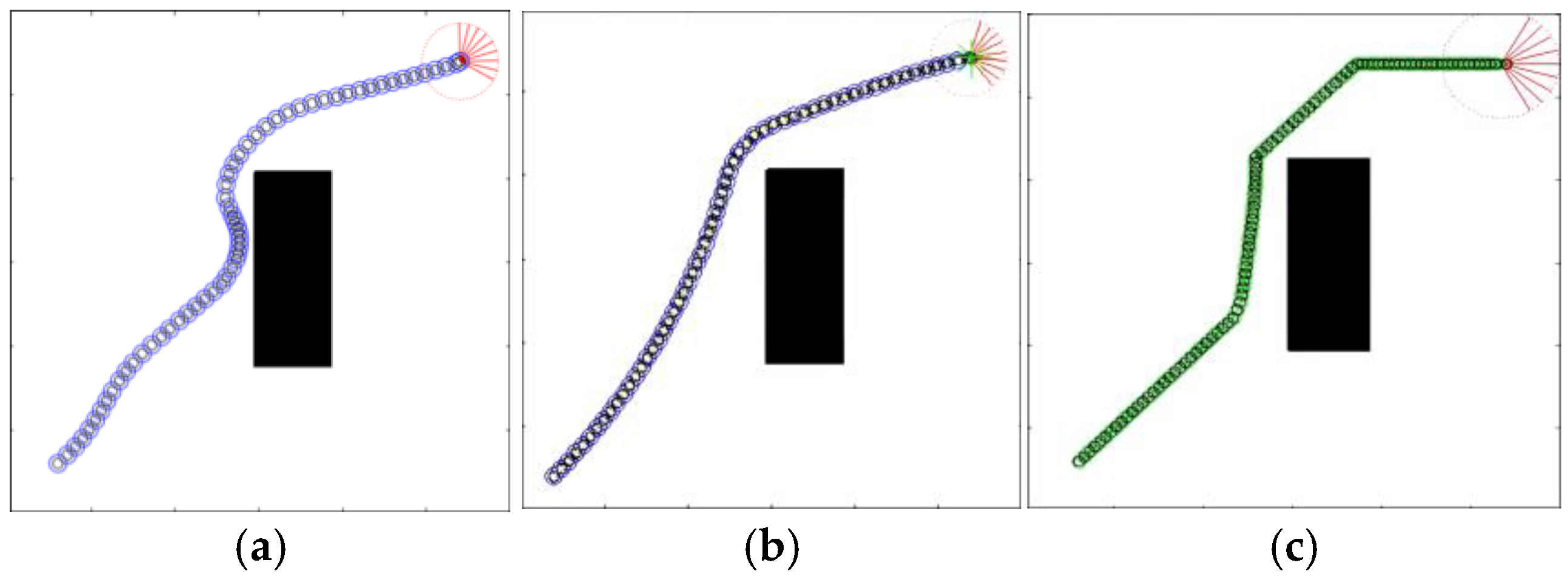
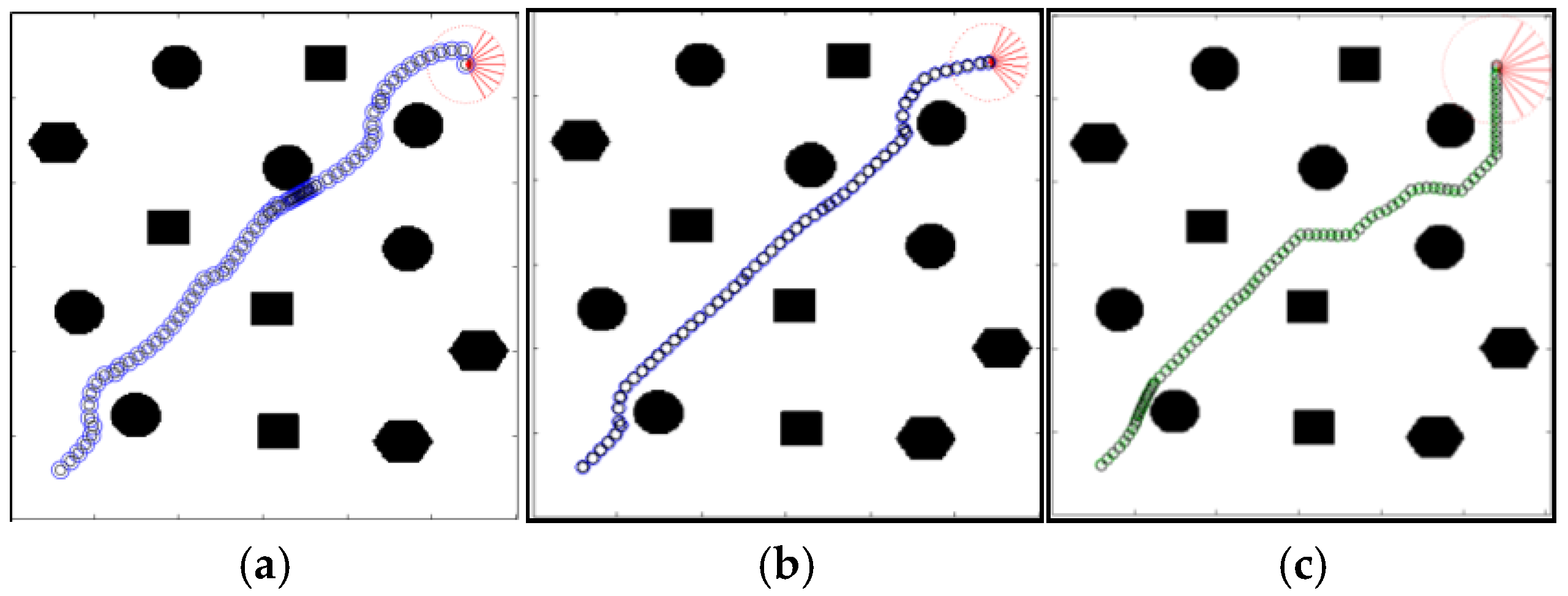
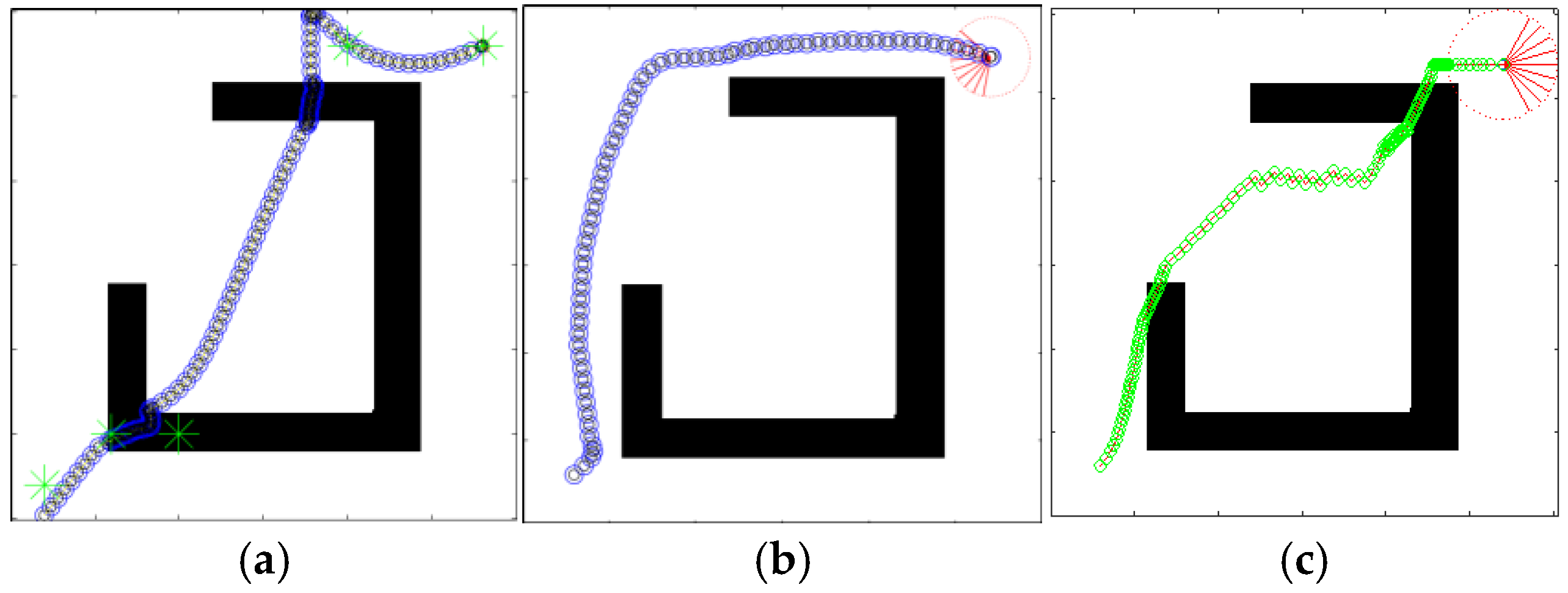
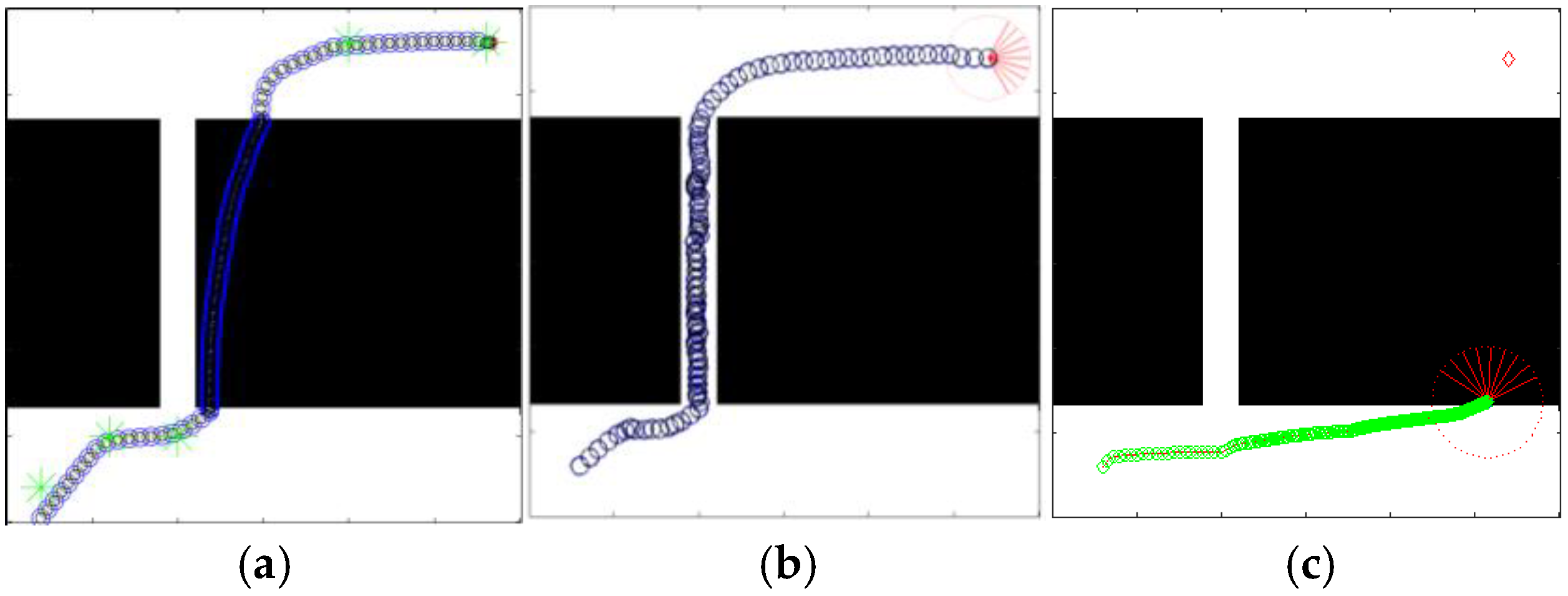
4.3. Path Planning Analysis in General Scenarios
5. Conclusions
Author Contributions
Funding
Institutional Review Board Statement
Informed Consent Statement
Data Availability Statement
Conflicts of Interest
Abbreviations
| GA-HIT2F | Genetic algorithm hierarchical interval type-2 fuzzy |
| QL-HIT2F | Q-Learning-supported adaptive hierarchical interval type-2 fuzzy |
| HIT2F | Hierarchical interval type-2 fuzzy |
References
- Sharma, K.; Doriya, R. Coordination of multi-robot path planning for warehouse application using smart approach for identifying destinations. Intell. Serv. Robot. 2021, 14, 313–325. [Google Scholar] [CrossRef] [Scilit]
- Tang, Y.; Muhammad, A.Z.; Maryam, Y. Path Planning Trends for Autonomous Mobile Robot Navigation: A Review. Sensors 2025, 25, 1206. [Google Scholar] [CrossRef] [Scilit] [PubMed]
- Azpúrua, H.; Rezende, A.; Potje, G.; Júnior, G.P.d.C.; Fernandes, R.; Miranda, V.; Filho, L.W.d.R.; Domingues, J.; Rocha, F.; de Sousa, F.L.M.; et al. Towards Semi-autonomous Robotic Inspection and Mapping in Confined Spaces with the EspeleoRobô. J. Intell. Robot. Syst. 2021, 101, 69. [Google Scholar] [CrossRef] [Scilit]
- Liao, J.; Guo, B.; Zhang, Y.; Miao, X.; Zheng, T. Non-singular optimal terminal sliding mode control for autonomous surface vessels with actuator faults and model uncertainties via adaptive dynamic programming. Ocean Eng. 2026, 343, 123334. [Google Scholar] [CrossRef] [Scilit]
- Vygantas, U.; Michał, N.; Andrius, D.; Česnavičius, R.; Augutis, E.; Martišius, I.; Jurevičius, R.; Eidukynas, D.; Vaitkus, V.; Kačeniauskas, A.; et al. Sensor-Fusion Based Navigation for Autonomous Mobile Robot. Sensors 2025, 25, 1248. [Google Scholar] [CrossRef] [Scilit]
- Krell, E.; King, S.A.; Garcia, R. Autonomous Surface Vehicle energy-efficient and reward-based path planning using Particle Swarm Optimization and Visibility Graphs. Appl. Ocean Res. 2022, 122, 103125. [Google Scholar] [CrossRef] [Scilit]
- Salama, O.A.A.; Eltaib, M.E.H.; Mohamed, H.A.; Salah, O. RCD: Radial Cell Decomposition Algorithm for Mobile Robot Path Planning. IEEE Access 2021, 9, 149982–149992. [Google Scholar] [CrossRef] [Scilit]
- Lin, P.; Yang, J.H.; Quan, Y.S.; Chung, C.C. Potential field-based path planning for emergency collision avoidance with a clothoid curve in waypoint tracking. Asian J. Control. 2022, 24, 1074–1087. [Google Scholar] [CrossRef] [Scilit]
- Tang, G.; Tang, C.; Claramunt, C.; Hu, X.; Zhou, P. Geometric A-Star Algorithm: An Improved A-Star Algorithm for AGV Path Planning in a Port Environment. IEEE Access 2021, 9, 59196–59210. [Google Scholar] [CrossRef] [Scilit]
- Lee, M.-T.; Chuang, M.-L.; Kuo, S.-T.; Chen, Y.-R. UAV Swarm Real-Time Rerouting by Edge Computing D Lite Algorithm. Appl. Sci. 2022, 12, 1056. [Google Scholar] [CrossRef] [Scilit]
- Wang, Z.; Cai, J. Probabilistic roadmap method for path-planning in radioactive environment of nuclear facilities. Prog. Nucl. Energy 2018, 109, 113–120. [Google Scholar] [CrossRef] [Scilit]
- Su, Y.; Xin, J.; Sun, C. Dynamic Path Planning for Mobile Robots Based on Improved RRT* and DWA Algorithms. IEEE Trans. Ind. Electron. 2025, 72, 10595–10604. [Google Scholar] [CrossRef] [Scilit]
- Punriboon, C.; So-In, C.; Aimtongkham, P.; Leelathakul, N. Fuzzy Logic-Based Path Planning for Data Gathering Mobile Sinks in WSNs. IEEE Access 2021, 9, 96002–96020. [Google Scholar] [CrossRef] [Scilit]
- Sahu, S.; Choudhury, B.B. Fuzzy Logic Based Path Planning for Industrial Robot. Int. J. Manuf. Mater. Mech. Eng. 2018, 8, 1–11. [Google Scholar] [CrossRef] [Scilit]
- Samadi, G.M.; Jond, H.B. An intelligent approach for autonomous mobile robots path planning based on adaptive neuro-fuzzy inference system. Ain Shams Eng. J. 2022, 13, 10149. [Google Scholar] [CrossRef] [Scilit]
- Dirik, M.; Castillo, O.; Kocamaz, A.F. Visual-Servoing Based Global Path Planning Using Interval Type-2 Fuzzy Logic Control. Axioms 2019, 8, 58. [Google Scholar] [CrossRef] [Scilit]
- Mirza, N. Robotic Path Planning and Fuzzy Neural Networks. Int. Arab. J. Inf. Technol. 2020, 17, 615–620. [Google Scholar] [CrossRef] [Scilit]
- Mohseni, A.; Duchaine, V.; Wong, T. Experimental study of path planning problem using EMCOA for a holonomic mobile robot. J. Syst. Eng. Electron. 2021, 32, 1450–1462. [Google Scholar] [CrossRef] [Scilit]
- Alomari, A.; Phillips, W.; Aslam, N.; Comeau, F. Dynamic Fuzzy-Logic Based Path Planning for Mobility-Assisted Localization in Wireless Sensor Networks. Sensors 2017, 17, 1904. [Google Scholar] [CrossRef] [Scilit]
- Taheri, E.; Ferdowsi, M.H.; Danesh, M. Fuzzy Greedy RRT Path Planning Algorithm in a Complex Configuration Space. Int. J. Control. Autom. Syst. 2018, 16, 3026–3035. [Google Scholar] [CrossRef] [Scilit]
- Sathiya, V.; Chinnadurai, M.; Ramabalan, S. Mobile robot path planning using fuzzy enhanced improved Multi-Objective particle swarm optimization (FIMOPSO). Expert Syst. Appl. 2022, 198, 116875. [Google Scholar] [CrossRef] [Scilit]
- Zhao, T.; Xiang, Y.; Dian, S.; Guo, R.; Li, S. Hierarchical interval type-2 fuzzy path planning based on genetic optimization. J. Intell. Fuzzy Syst. 2020, 39, 937–948. [Google Scholar] [CrossRef] [Scilit]
- Li, H.; Zhao, T.; Dian, S. Forward search optimization and subgoal-based hybrid path planning to shorten and smooth global path for mobile robots. Knowl.-Based Syst. 2022, 258, 110034. [Google Scholar] [CrossRef] [Scilit]
- Ee, S.L.; Pauline, O.; Cheng, Y.L. A modified Q-learning path planning approach using distortion concept and optimization in dynamic environment for autonomous mobile robot. Comput. Ind. Eng. 2023, 181, 109338. [Google Scholar] [CrossRef] [Scilit]
- Zhao, M.; Lu, H.; Yang, S.; Guo, F. The Experience-Memory Q-Learning Algorithm for Robot Path Planning in Unknown Environment. IEEE Access 2020, 8, 47824–47844. [Google Scholar] [CrossRef] [Scilit]
- Bonny, T.; Kashkash, M. Highly optimized Q-learning-based bees approach for mobile robot path planning in static and dynamic environments. J. Field Robot. 2022, 39, 317–334. [Google Scholar] [CrossRef] [Scilit]
- Xi, M.; Yang, J.; Wen, J.; Liu, H.; Li, Y.; Song, H.H. Comprehensive Ocean Information-Enabled AUV Path Planning via Reinforcement Learning. IEEE Internet Things J. 2022, 9, 17440–17451. [Google Scholar] [CrossRef] [Scilit]
- Lu, C.; Liang, S.; Chao, J.; Jia, Q.; Guo, W. Reinforcement based mobile robot path planning with improved dynamic window approach in unknown environment. Auton. Robot. 2021, 45, 51–76. [Google Scholar]
- Hao, B.; Du, H.; Yan, Z. A path planning approach for unmanned surface vehicles based on dynamic and fast Q-learning. Ocean Eng. 2023, 270, 113632. [Google Scholar] [CrossRef] [Scilit]



| State | Value | Dependence Variable |
|---|---|---|
| 1 | ||
| 2 | ||
| 1 | ||
| 2 | ||
| 3 | ||
| 1 | ||
| 2 | ||
| 3 | ||
| 4 | ||
| 1 | ||
| 2 |
| Variable | Reward Mechanism | Reward Principle |
|---|---|---|
| RW = RW + 5000 | ||
| RW = RW + 10 | ||
| RW = RW − 10 | ||
| RW = RW + 5000 | ||
| RW = RW − 200 | Collision! |
| Start | Target | Initial | |
|---|---|---|---|
| Sub-training1 | |||
| Sub-training2 | |||
| Sub-training3 | |||
| Sub-training4 | |||
| Sub-training5 | |||
| Sub-training6 |
| Algorithm | Map | Cost | maxΔθ | Steps |
|---|---|---|---|---|
| GA-HIT2F | map in Figure 13 | 384.79 | 43.21 | 99 |
| map in Figure 14 | 376.84 | 46.04 | 87 | |
| maps in Figure 15, Figure 16 and Figure 17 | planning failed | |||
| QL-HIT2F (without AOO) | map in Figure 13 | 380.42 | 32.48 | 67 |
| map in Figure 14 | 368.37 | 28.41 | 62 | |
| maps in Figure 15, Figure 16 and Figure 17 | planning failed | |||
| QL-HIT2F (with AOO) | map in Figure 13 | 377.26 | 17.80 | 60 |
| map in Figure 14 | 358.81 | 26.74 | 57 | |
| map in Figure 15 | 305.46 | 36.43 | 47 | |
| map in Figure 16 | 438.01 | 41.42 | 87 | |
| map in Figure 17 | 415.75 | 24.29 | 64 | |
Disclaimer/Publisher’s Note: The statements, opinions and data contained in all publications are solely those of the individual author(s) and contributor(s) and not of MDPI and/or the editor(s). MDPI and/or the editor(s) disclaim responsibility for any injury to people or property resulting from any ideas, methods, instructions or products referred to in the content. |
© 2025 by the authors. Licensee MDPI, Basel, Switzerland. This article is an open access article distributed under the terms and conditions of the Creative Commons Attribution (CC BY) license.
Share and Cite
Zhou, N.; Zhou, F.; Li, C.; Zhong, J. QL-HIT2F: A Q-Learning-Aided Adaptive Fuzzy Path Planning Algorithm with Enhanced Obstacle Avoidance. Sensors 2026, 26, 200. https://doi.org/10.3390/s26010200
Zhou N, Zhou F, Li C, Zhong J. QL-HIT2F: A Q-Learning-Aided Adaptive Fuzzy Path Planning Algorithm with Enhanced Obstacle Avoidance. Sensors. 2026; 26(1):200. https://doi.org/10.3390/s26010200
Chicago/Turabian StyleZhou, Nana, Fengjun Zhou, Changming Li, and Jianning Zhong. 2026. "QL-HIT2F: A Q-Learning-Aided Adaptive Fuzzy Path Planning Algorithm with Enhanced Obstacle Avoidance" Sensors 26, no. 1: 200. https://doi.org/10.3390/s26010200
APA StyleZhou, N., Zhou, F., Li, C., & Zhong, J. (2026). QL-HIT2F: A Q-Learning-Aided Adaptive Fuzzy Path Planning Algorithm with Enhanced Obstacle Avoidance. Sensors, 26(1), 200. https://doi.org/10.3390/s26010200