
An RBFNN-Based Prescribed Performance Controller for Spacecraft Proximity Operations with Collision Avoidance

Abstract
1. Introduction
- Collision avoidance based on prescribed error boundaries: The application of PPC ensures that relative position and attitude errors always remain within user-predefined time-varying boundaries, thus providing intrinsic safety assurance for close-range operations and effectively avoiding collisions with the target [18,22].
- RBF neural network online approximation of system dynamics: Unlike traditional methods that only use RBFNN for disturbance compensation, this paper employs RBFNN to directly identify and fit the complex, uncertain nonlinear dynamic model of the spacecraft online, thereby more effectively addressing significant changes in model parameters and unmodeled dynamics [23,25].
- Strong robustness against model uncertainties and external disturbances: The synergistic effect of the PPC framework and RBFNN dynamic compensation endows the controller with strong robustness against inherent parameter uncertainties in the spacecraft system (such as mass and inertia changes after target capture) and persistent external disturbances in the space environment (such as gravity gradients, solar radiation pressure, etc.) [2,26].
2. Spacecraft Motion Control System and Its Simulator Design
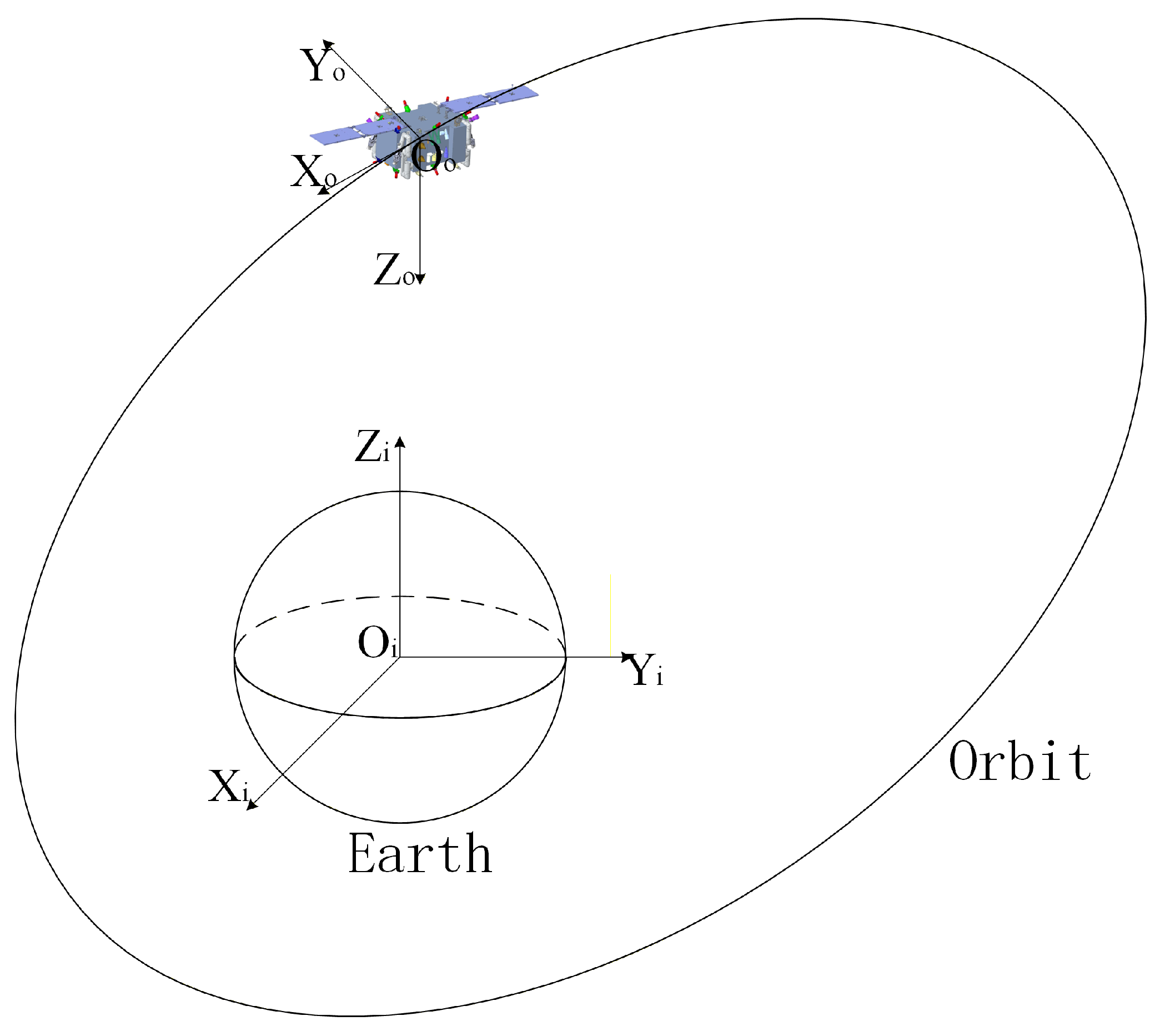
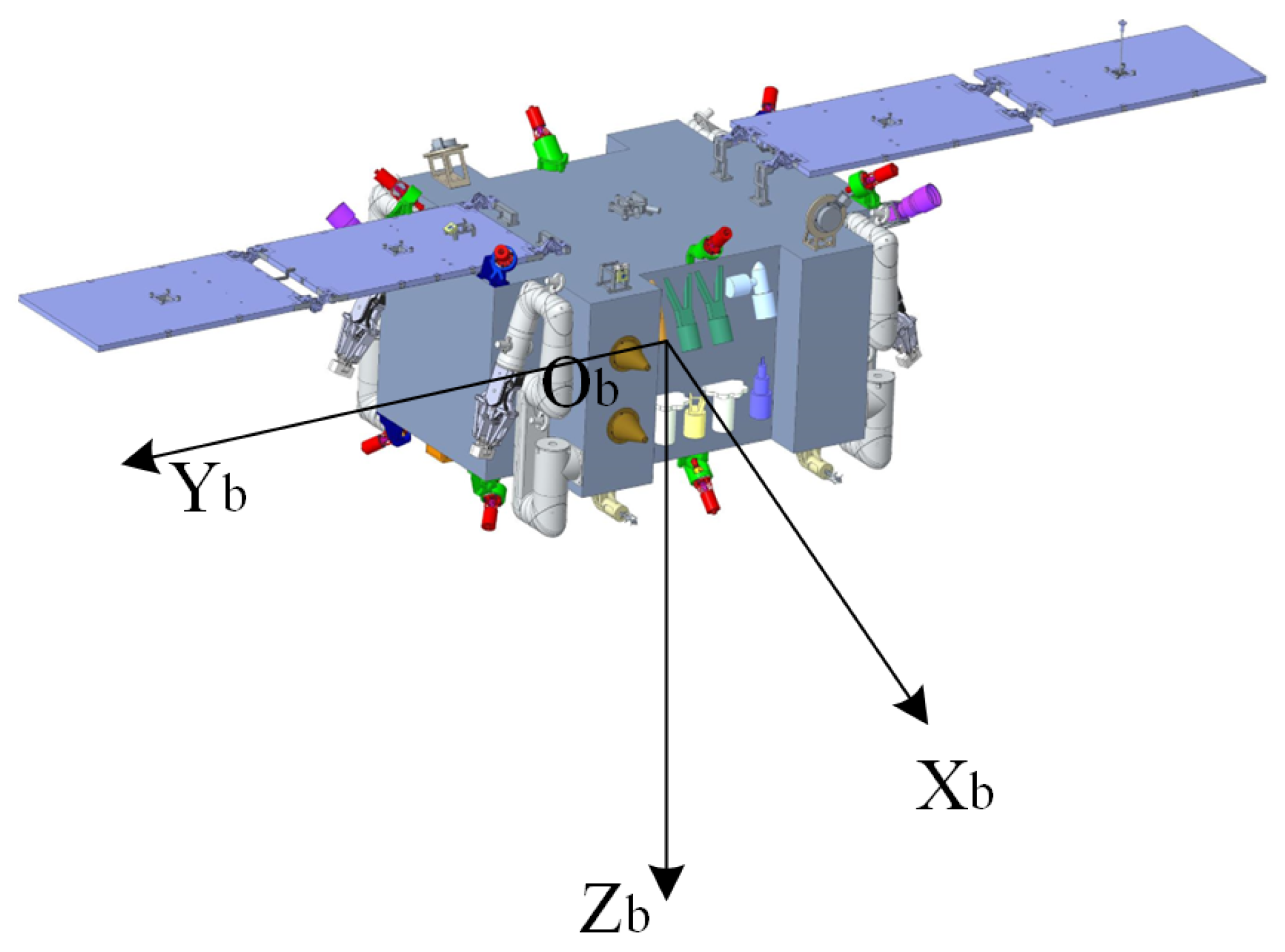
2.1. Definition of Spacecraft Coordinate Systems
- Inertial Coordinate System : is the Geocentric Equatorial Inertial (GEI) coordinate system. Its origin is at the Earth’s center, the axis points towards the vernal equinox in the equatorial plane, the axis is perpendicular to the equatorial plane pointing towards the North Pole along the normal, and the axis is determined by the right-hand rule.
- Orbital Coordinate System : is the center-of-mass orbital coordinate system. Its origin is at the spacecraft’s center of mass, points towards the Earth’s center, the axis is in the orbital plane, perpendicular to the axis, and points in the direction of the spacecraft’s motion. The axis forms a right-handed orthogonal coordinate system with the and axes.
- Body-Fixed Coordinate System : . Its origin is at the spacecraft’s center of mass. The axis points in the forward direction, called the roll axis; the axis is perpendicular to the longitudinal plane of symmetry, called the pitch axis; the axis forms a right-handed orthogonal coordinate system with the other two axes, called the yaw axis. If the spacecraft is not rotating, it coincides with the orbital coordinate system .
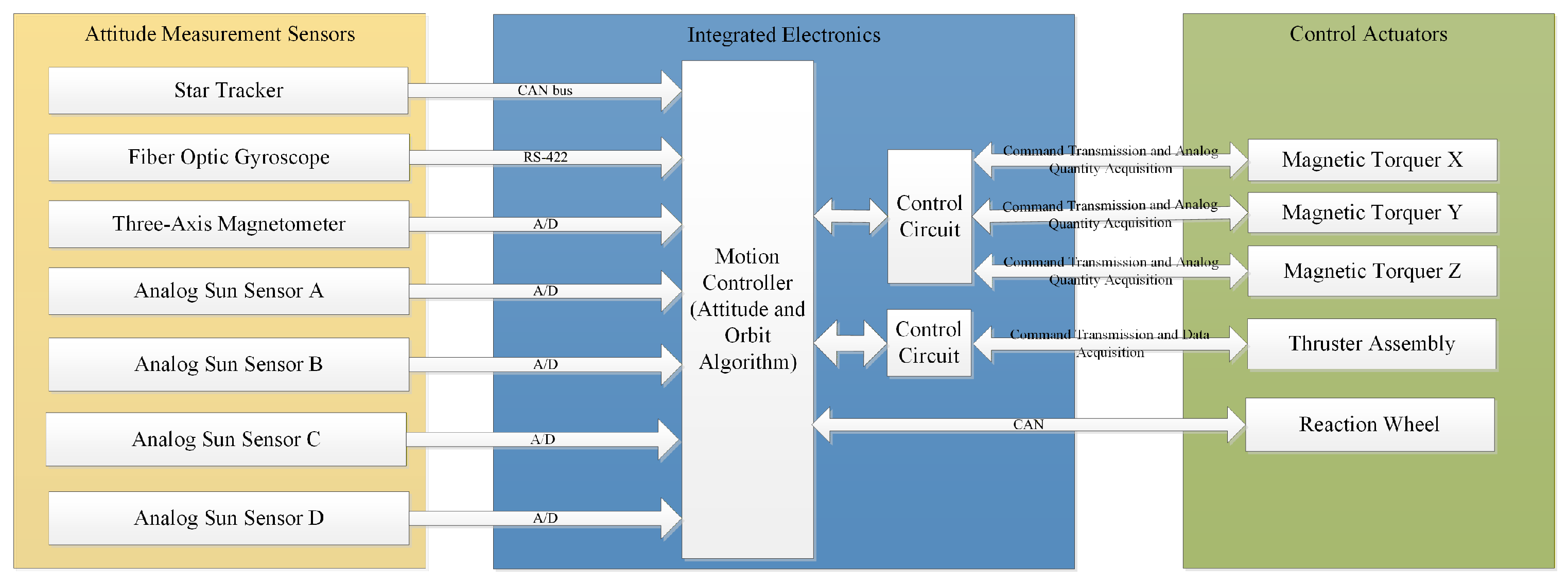
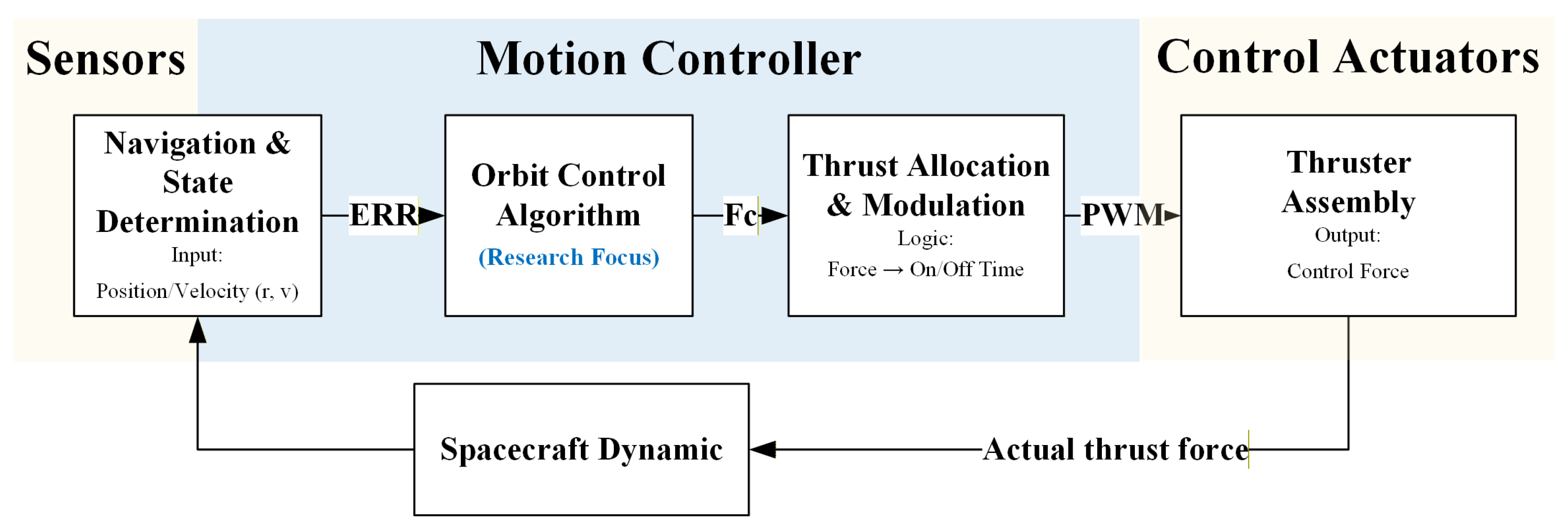
2.2. Spacecraft Motion Control System Design
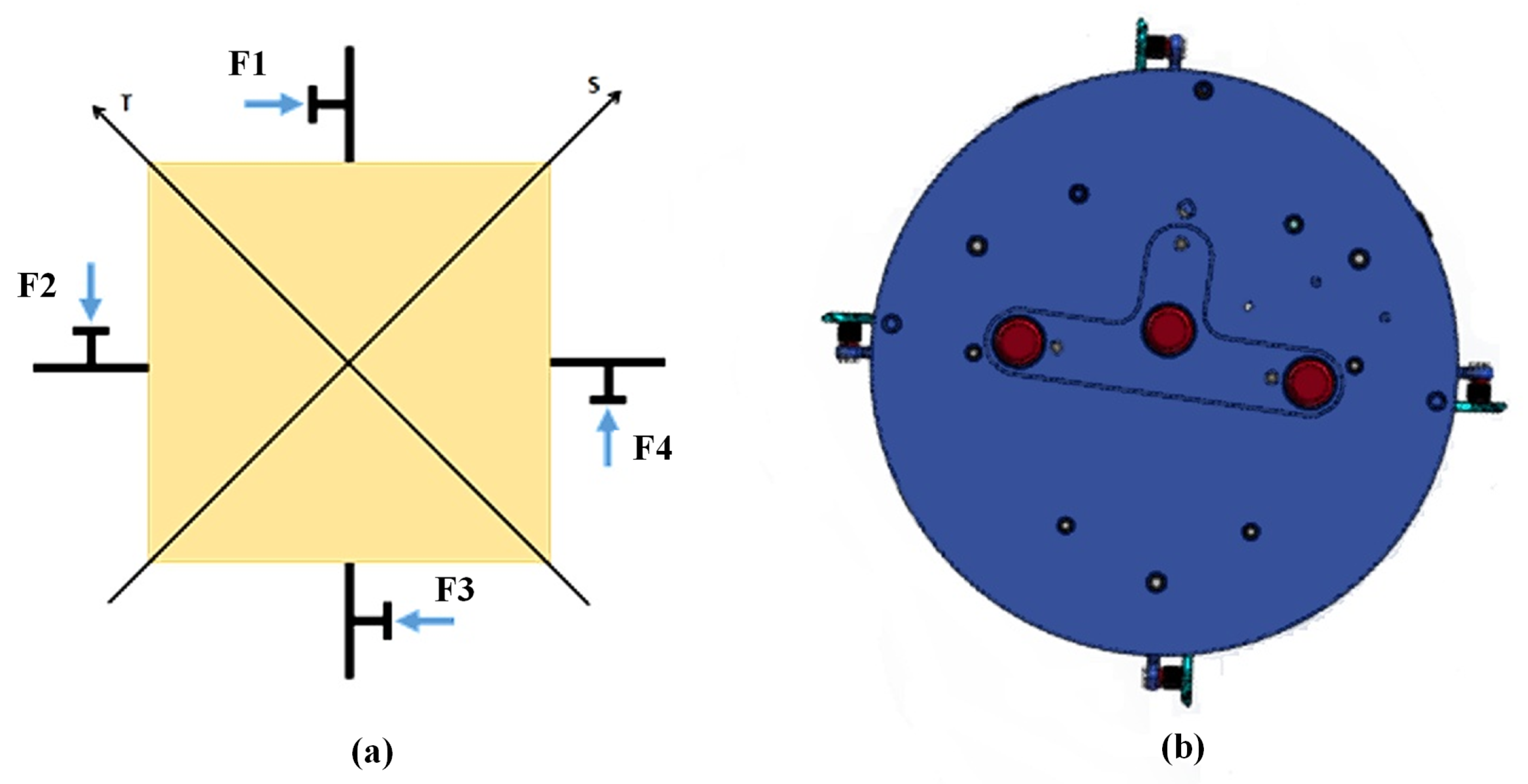
2.3. Ground Simulator Design
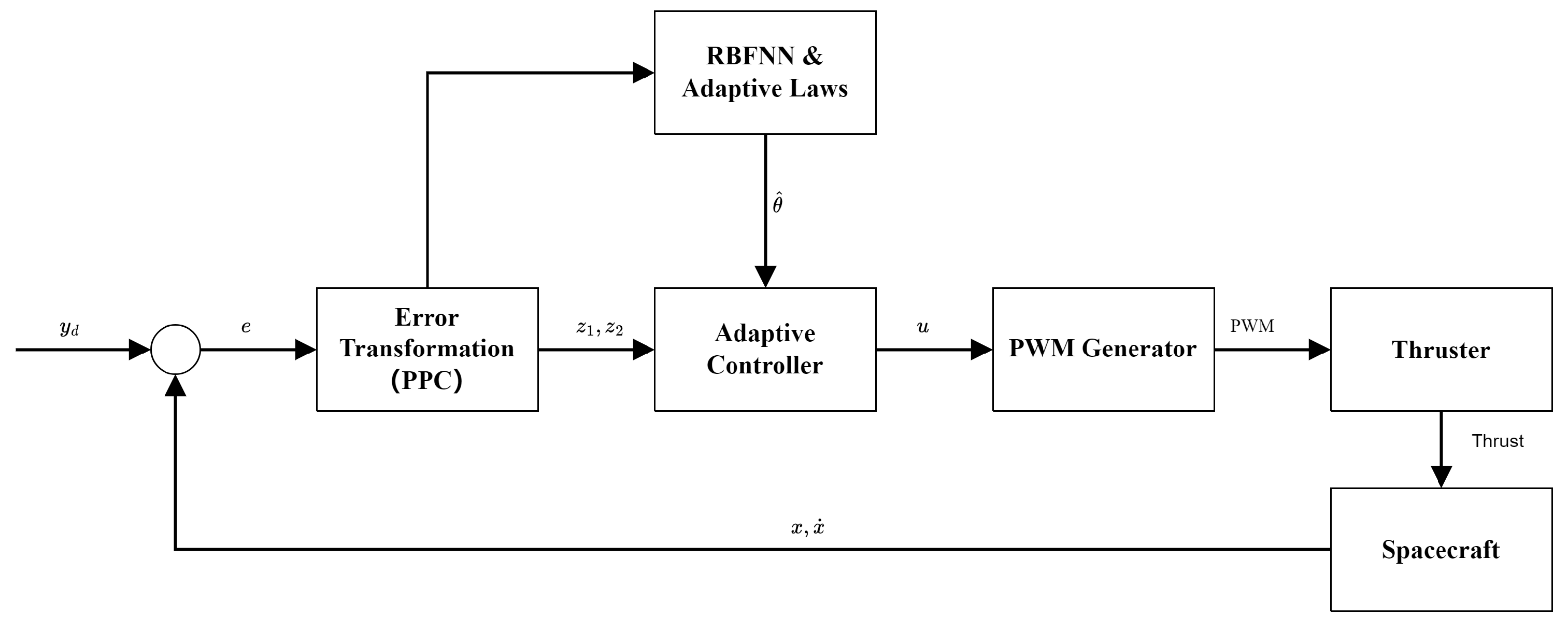
3. Control Algorithm Design
4. Stability Analysis
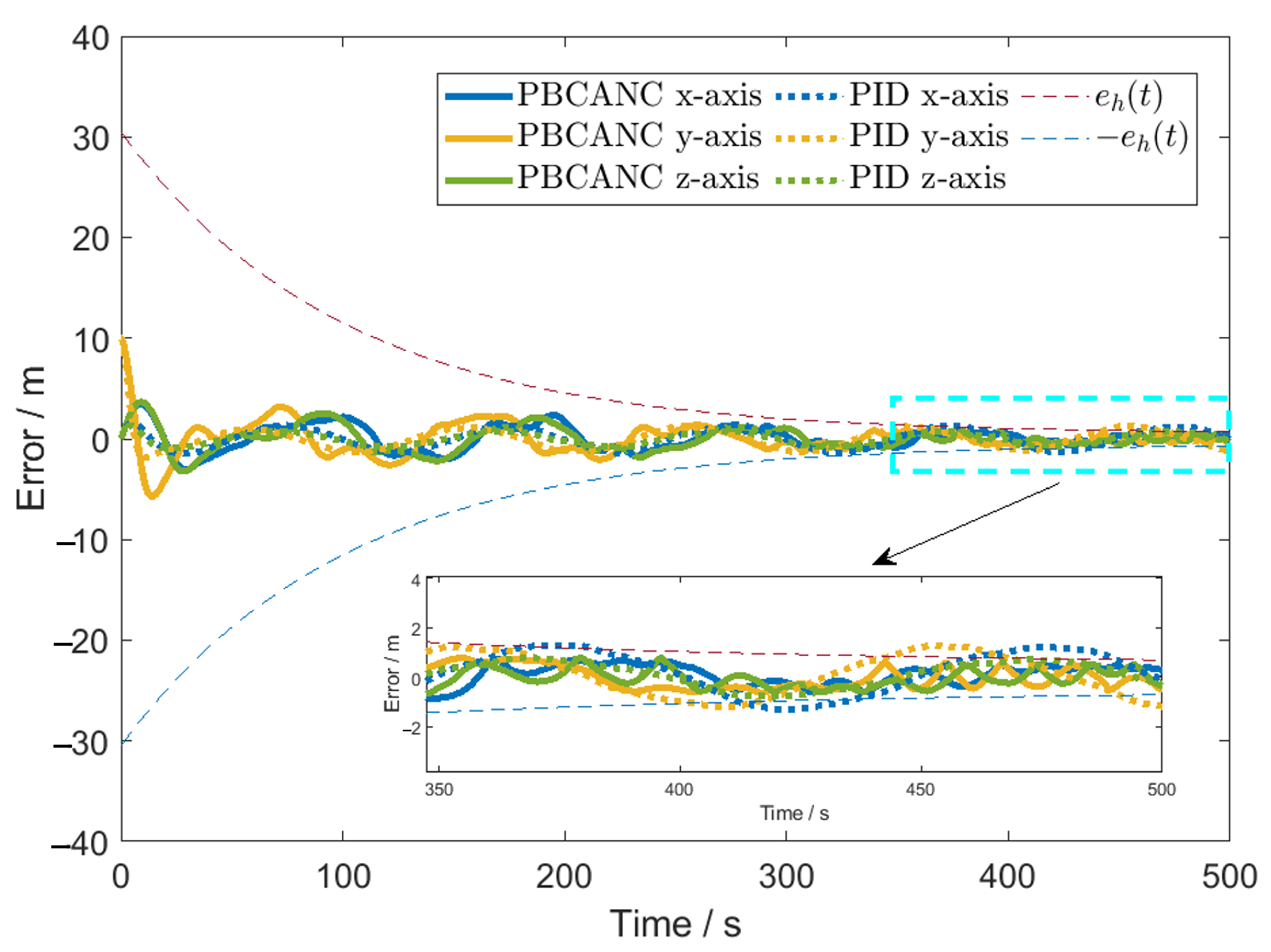
5. Simulation Experiments
6. Ground Simulator Verification
7. Conclusions
Author Contributions
Funding
Data Availability Statement
Conflicts of Interest
References
- Flores-Abad, A.; Ma, O.; Pham, K. A Review of Robotics Technologies for On-Orbit Services. DTIC Doc. ADA576377 2013, 68, 1–26. [Google Scholar]
- Papadopoulos, E.; Aghili, F.; Ma, O.; Lampariello, R. Robotic Manipulation and Capture in Space: A Survey. Front. Robot. AI 2021, 21, 5011. [Google Scholar] [CrossRef] [PubMed]
- Su, Y.; Shen, S. Adaptive predefined-time prescribed performance control for spacecraft systems. Math. Biosci. Eng. 2023, 20, 5921–5948. [Google Scholar] [CrossRef] [PubMed]
- Zhao, J.; Liu, Y.; Pang, B.; Liu, Y.; Yang, Z.; Ding, Z. A predefined-time radial basis function (RBF) neural network tracking control method considering actuator faults for a new type of spraying robot. Mech. Sci. 2025, 16, 51–60. [Google Scholar] [CrossRef]
- Li, S.; Liu, K.; Liu, M.; Cao, X. Neuro-Adaptive Prescribed Performance Control for Spacecraft Rendezvous Based on Fully-Actuated System Approach. IET Control Theory Appl. 2024, 18, 1868–1876. [Google Scholar] [CrossRef]
- Jia, Q.; Shu, R.; Yu, D.; Zhang, C.; Tan, L. Neural Network-based Prescribed Performance Fault-Tolerant Control for Spacecraft Formation Reconfiguration with Collision Avoidance. Res. Sq. 2023. [Google Scholar]
- Alizadeh, M.; Zhu, Z.H. A Comprehensive Survey of Space Robotic Manipulators for On-Orbit Servicing. Front. Robot. AI 2024, 11, 1470950. [Google Scholar] [CrossRef]
- Shi, J.F.; Ulrich, S.; Allen, A. Spacecraft Adaptive Attitude Control with Application to Space Station Free-Flyer Robotic Capture. In Proceedings of the AIAA Guidance, Navigation & Control Conference, Kissimmee, FL, USA, 5–9 January 2015; p. 1708. [Google Scholar]
- Deisenroth, M.P.; Neumann, G.; Peters, J. A Survey on Policy Search for Robotics. Found. Trends® Robot. 2013, 2, 388–403. [Google Scholar]
- Wilde, M.; Clark, C.; Romano, M. Historical survey of kinematic and dynamic spacecraft simulators for laboratory experimentation of on-orbit proximity maneuvers. Prog. Aerosp. Sci. 2019, 110, 100552. [Google Scholar] [CrossRef]
- Fan, S.; Wang, T.; Qin, C.; Qiu, J.; Li, M. Optimized backstepping attitude containment control for multiple spacecrafts. IEEE Trans. Fuzzy Syst. 2024, 32, 5248–5258. [Google Scholar] [CrossRef]
- Zhao, L.; Yu, J.; Shi, P. Command filtered backstepping-based attitude containment control for spacecraft formation. IEEE Trans. Syst. Man Cybern. Syst. 2021, 51, 1278–1287. [Google Scholar] [CrossRef]
- Chen, Z.; Chen, Q.; He, X.; Sun, M. Adaptive backstepping control design for uncertain rigid spacecraft with both input and output constraints. IEEE Access 2018, 6, 60776–60789. [Google Scholar] [CrossRef]
- Xu, D. A collision-avoidance control algorithm for spacecraft proximity operations based on improved artificial potential function. Chin. J. Theor. Appl. Mech. 2020, 52, 1581–1589. [Google Scholar]
- Zappulla, R.; Park, H.; Virgili-Llop, J.; Romano, M. Real-time autonomous spacecraft proximity maneuvers and docking using an adaptive artificial potential field approach. IEEE Trans. Control. Syst. Technol. 2018, 27, 2598–2605. [Google Scholar] [CrossRef]
- Lee, D.; Sanyal, A.K.; Butcher, E.A. Asymptotic tracking control for spacecraft formation flying with decentralized collision avoidance. J. Guid. Control. Dyn. 2015, 38, 587–600. [Google Scholar] [CrossRef]
- Fabris, M.; Cenedese, A.; Hauser, J. Optimal time-invariant formation tracking for a second-order multi-agent system. In Proceedings of the 2019 18th European Control Conference, Naples, Italy, 25–28 June 2019; pp. 1556–1561. [Google Scholar]
- Bechlioulis, C.P.; Rovithakis, G.A. Robust adaptive control of feedback linearizable MIMO nonlinear systems with prescribed performance. IEEE Trans. Autom. Control 2008, 53, 2090–2099. [Google Scholar] [CrossRef]
- Bechlioulis, C.P.; Rovithakis, G.A. Adaptive control with guaranteed transient and steady state tracking error bounds for strict feedback systems. Automatica 2009, 45, 532–538. [Google Scholar] [CrossRef]
- Huang, Y.; Meng, Z.; Dimarogonas, D. Prescribed performance formation control for second-order multi-agent systems with connectivity and collision constraints. Automatica 2024, 160, 111463. [Google Scholar] [CrossRef]
- Shi, Z.; Han, W.; Zhang, C.; Zhang, G. A Modular Prescribed Performance Formation Control Scheme of a High-Order Multi-Agent System with a Finite-Time Extended State Observer. Electronics 2025, 14, 1783. [Google Scholar] [CrossRef]
- Sahoo, S.R.; Subudhi, B.; Behera, L. Adaptive Pose Control for Spacecraft Proximity Operations with Prescribed Performance Under Spatial Motion Constraints. IEEE Trans. Control Syst. Technol. 2020, 29, 1804–1811. [Google Scholar]
- Yu, H.; Xie, T.; Paszczyñski, S.; Wilamowski, B.M. Advantages of Radial Basis Function Networks for Dynamic System Design. IEEE Trans. Ind. Electron. 2011, 58, 5438–5450. [Google Scholar] [CrossRef]
- Broomhead, D.S.; Lowe, D. Radial basis functions, multi-variable functional interpolation and adaptive networks. Complex Syst. 1988, 2, 321–355. [Google Scholar]
- Ma, J.; Zhang, W.; Zhu, H. Adaptive Control for Robotic Manipulators base on RBF Neural Network. TELKOMNIKA 2013, 11, 521–528. [Google Scholar]
- Zhou, N.; Cheng, X.L.; Xia, Y.; Liu, Y.H. Fully Adaptive-Gain-Based Intelligent Failure-Tolerant Control for Spacecraft Attitude Stabilization Under Actuator Saturation. IEEE Trans. Cybern. 2020, 52, 344–356. [Google Scholar] [CrossRef] [PubMed]


Disclaimer/Publisher’s Note: The statements, opinions and data contained in all publications are solely those of the individual author(s) and contributor(s) and not of MDPI and/or the editor(s). MDPI and/or the editor(s) disclaim responsibility for any injury to people or property resulting from any ideas, methods, instructions or products referred to in the content. |
© 2025 by the authors. Licensee MDPI, Basel, Switzerland. This article is an open access article distributed under the terms and conditions of the Creative Commons Attribution (CC BY) license.
Share and Cite
Xie, X.; Chen, W.; Xia, C.; Xing, J.; Chang, L. An RBFNN-Based Prescribed Performance Controller for Spacecraft Proximity Operations with Collision Avoidance. Sensors 2026, 26, 108. https://doi.org/10.3390/s26010108
Xie X, Chen W, Xia C, Xing J, Chang L. An RBFNN-Based Prescribed Performance Controller for Spacecraft Proximity Operations with Collision Avoidance. Sensors. 2026; 26(1):108. https://doi.org/10.3390/s26010108
Chicago/Turabian StyleXie, Xianghua, Weidong Chen, Chengkai Xia, Jiajian Xing, and Liang Chang. 2026. "An RBFNN-Based Prescribed Performance Controller for Spacecraft Proximity Operations with Collision Avoidance" Sensors 26, no. 1: 108. https://doi.org/10.3390/s26010108
APA StyleXie, X., Chen, W., Xia, C., Xing, J., & Chang, L. (2026). An RBFNN-Based Prescribed Performance Controller for Spacecraft Proximity Operations with Collision Avoidance. Sensors, 26(1), 108. https://doi.org/10.3390/s26010108