1. Introduction
Detecting weak target echoes presents significant challenges in both scientific and practical domains, particularly for ultra-long-range surveillance of high-speed maneuvering objects [
1], advanced-material vehicles [
2], and miniaturized unmanned aerial vehicles (UAVs) [
3]. These targets often exhibit markedly reduced radar cross-sections (RCSs), rendering their detection increasingly difficult. Currently, the most widely adopted strategy to improve the detection probability of such low-observable targets involves integration through coherent pulses. However, this method reduces the radar data rate and exhibits sensitivity to target-motion-induced migration across range, Doppler, and beam cells during extended accumulation periods [
4,
5]. Conventional techniques, including linear methods such as the Keystone transform [
6,
7] and Radon–Fourier transform [
8], as well as non-linear approaches like the polynomial-phase transform [
9], seek to mitigate motion-induced distortions by compensating for time-of-arrival variations, Doppler shifts, and higher-order phase terms. However, their effectiveness is often constrained by assumptions regarding target motion, such as constant velocity or acceleration [
10]. Additionally, these algorithms require iterative parameter searches over range, velocity, or acceleration [
11], relying on prior measurements that may lack precision [
12]. These limitations, which restrict the achievable gains from extended accumulation, reduce the robustness of the methods and decrease target detection efficiency.
Transformers offer advantages such as better capability to capture long-range dependencies and global context through their self-attention mechanisms [
13], and improved scalability with larger datasets [
14]. Therefore, Transformer-based radar object detection holds significant promise. Recent architectures such as RadarFormer [
15] and T-RODNet [
16] combine Transformer and CNN modules to achieve target detection. However, these designs have demonstrated almost exclusively on Frequency Modulated Continuous Wave Radar, and comparable approaches for coherent accumulation in pulse-radar systems remain unexplored. Moreover, the CNN-based dimension-mapping required to fuse two elaborate models incurs a substantial computational overhead, and the use of fixed false alarm control during training precludes flexible adjustment of the false alarm level during inference.
Motivated by recent success of Transformers in radar object detection [
15,
16] and time-series forecasting [
17], this paper introduces a hybrid framework designed to address multi-pulse coherent accumulation for pulsed-radar target detection. It integrates a specialized data preprocessing module for complex I/Q sampling, a cross-attention mechanism to extract transmit–receive interaction features from echoes, and a robust training strategy that combines noise injection with early stopping. The main contributions of this paper are as follows:
- (1)
By integrating self-attention and cross-attention mechanisms into the pulsed-radar coherent-accumulation process, the proposed network reduces the required SNR by 14–20 dB compared to optimal coherent energy detection methods under the same false alarm constraints (Pfa = 1 × 10⁻² to 1 × 10⁻⁵) across all Swerling I–IV fluctuation models, relative to optimal coherent energy detection.
- (2)
By significantly reducing the required accumulation pulses, our approach not only enhances detection efficiency but also enables faster and more comprehensive updates of the radar’s coverage, ensuring timely responsiveness in dynamic environments.
- (3)
By leveraging high-dimensional vector embeddings and encoder–decoder network architectures, the RD-Transformer provides an end-to-end solution for radar signal integration and target detection, in which the known transmit waveform is treated as an explicit reference branch that interacts with the received echoes, analogous to a learned matched filter that replaces the fixed filter and covers the entire coherent accumulation process.
The remainder of this paper is organized as follows.
Section 2 reviews conventional radar detection methods and recent deep-learning- and Transformer-based approaches for radar target detection.
Section 3 introduces the signal model and problem formulation for coherent pulse radar.
Section 4 details the proposed RD-Transformer workflow, including sliding-window preprocessing of I/Q echoes, transmit/receive embedding with positional encoding, dual-path encoders, cross-attention-based transmit-receive feature fusion, and the k-sigmoid false alarm control mechanism.
Section 5 presents the data generation strategy, experimental setup, comparative results, ablation studies, and inference-speed evaluation.
Section 6 concludes the paper and discusses future research directions.
3. Signal Model and Problem Formulation
Consider a coherent radar system operating in pulsed mode. Let the complex baseband echo data after analog-to-digital conversion be organized into an
n × m matrix
, where
n denotes the number of range bins (fast-time dimension) and
m represents the number of coherent pulses (slow-time dimension). The matrix structure is expressed as
where
represents the complex-valued echo sample (detailed in Equation (2)) at the
i-th range bin and
j-th pulse, and
denotes the temporal pulse sequence at the
i-th range cell.
For a given range cell, the received echo
can be decomposed into its in-phase (I) and quadrature (Q) components. Each pulse sample
is represented as
where
, and
,
are the in-phase and quadrature components, respectively [
63]. In practice, the received echo comprises two primary components: (i) the reflected signal from targets denoted as
, and (ii) the thermal noise and interference, denoted as
. Thus, (2) can be expanded as
Throughout this work, we adopt the compact notation to emphasize the temporal evolution of echoes within a specific range cell, where m indexes the slow-time (pulse) dimension.
The radar transmits a linear frequency modulation (LFM) chirp signal, which is widely employed in coherent radar systems due to its favorable range resolution and pulse compression properties [
4,
58]. The complex baseband representation of the transmitted LFM signal is given by
where
is the rectangular window function defined as
is the pulse width, represents the chirp rate (frequency modulation rate), denotes the carrier frequency, and t is the fast-time variable.
For a point target with radar cross-section (RCS)
, the received echo in baseband form after dechirping can be expressed as [
4,
58]
where
denotes the slow time (pulse repetition time index),
is the speed of light,
is the radar wavelength, and
represents the instantaneous slant range between the radar and the target at slow time
.
Unlike conventional approaches that model targets with constant velocity [
64,
65,
66], constant acceleration [
59,
67], or jerk motion [
8], this work adopts a generalized polynomial motion model to characterize high-maneuverability targets (HMTs) with arbitrary-order kinematics. The instantaneous range
is modeled as a
z-th order polynomial [
58,
60]:
where
is the initial slant range at
,
z is the maximum motion order, and
are the motion coefficients corresponding to the
i-th order radial motion parameter. Specifically,
represents the radial velocity,
represents half the radial acceleration,
corresponds to one-sixth of the radial jerk, and so forth. This unified representation enables consistent treatment of diverse target dynamics.
The time-varying range
in (7) induces corresponding Doppler and micro-Doppler modulations in the received signal, which serve as discriminative signatures for target detection. Instead of relying on explicit parameter estimation and threshold-based detection—approaches that often suffer from performance degradation in low signal-to-noise ratio (SNR) regimes and complex environments [
4]—we formulate detection as a binary classification problem.
For each range cell, we define the classification task as determining whether a target is present or absent. Let
denote the binary label, where
indicates target presence and
ξ = 0 indicates target absence. The detection problem is then formulated as
where
represents a deep neural network (DNN) with learnable parameters
, and
is the predicted label. The function
F(
·;
) encompasses multiple nonlinear transformations that enable the network to learn hierarchical feature representations directly from the raw range-Doppler data.
4. Method
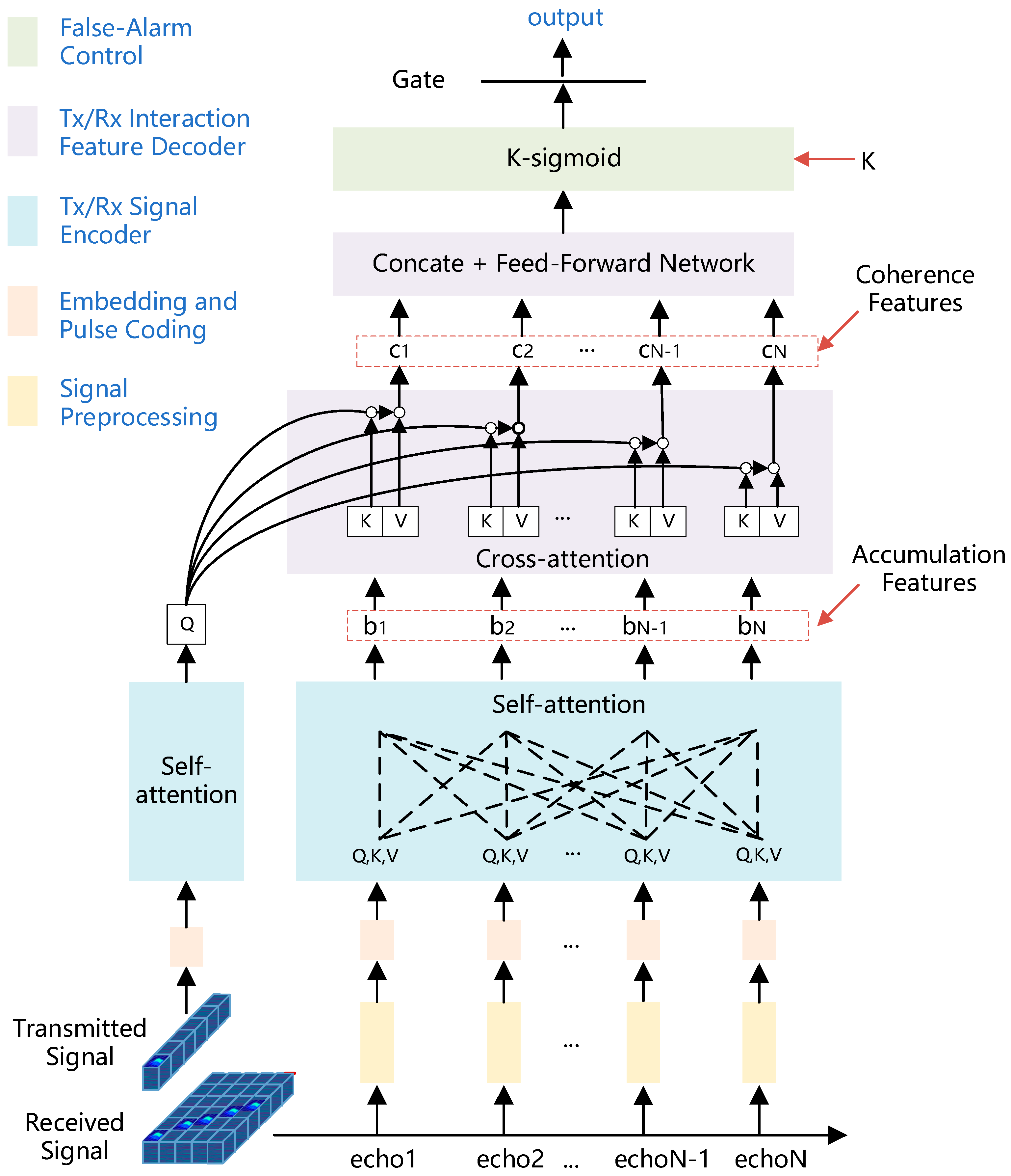
We propose the RD-Transformer, as illustrated in
Figure 1, an end-to-end attention-based architecture that reformulates coherent accumulation as an adaptive feature fusion problem. Unlike conventional FFT-based methods that assume stationary targets, our cross-attention mechanism learns to dynamically weight and align multi-pulse echoes, implicitly compensating for target-induced phase variations across range-Doppler cells. This data-driven approach enables robust detection under motion-induced migration without explicit parameter estimation. First, a data-preprocessing module reduces token count to lower computational load; embedding layers and positional encodings then project transmit and receive pulse sequences into a compact, position-aware feature space. Dual encoders apply self-attention to coherently accumulate receive pulses and to abstract the transmitted signal. A cross-attention decoder fuses these representations, capturing interdependencies between transmit and receive features for multi-pulse coherent accumulation. Finally, a learnable k-sigmoid function—whose steepness is directly controlled by coefficient k—provides tunable false alarm control at inference.
4.1. Radar Signal Preprocessing
For radar echo signals, each sampling moment contains quadrature (Q) and in-phase (I) components, as well as the sampling time (T). A single pulse’s fast-time sampling yields PRI × Fs data points, and N coherent pulses increase the total number of points by N-fold. Directly treating each sampling point as a token for input into a transformer results in prohibitively long sequences, leading to exponential growth in computational and memory demands, thereby limiting the efficiency of model training and inference.
To address this, we propose two preprocessing strategies:
- (1)
Patch-based processing
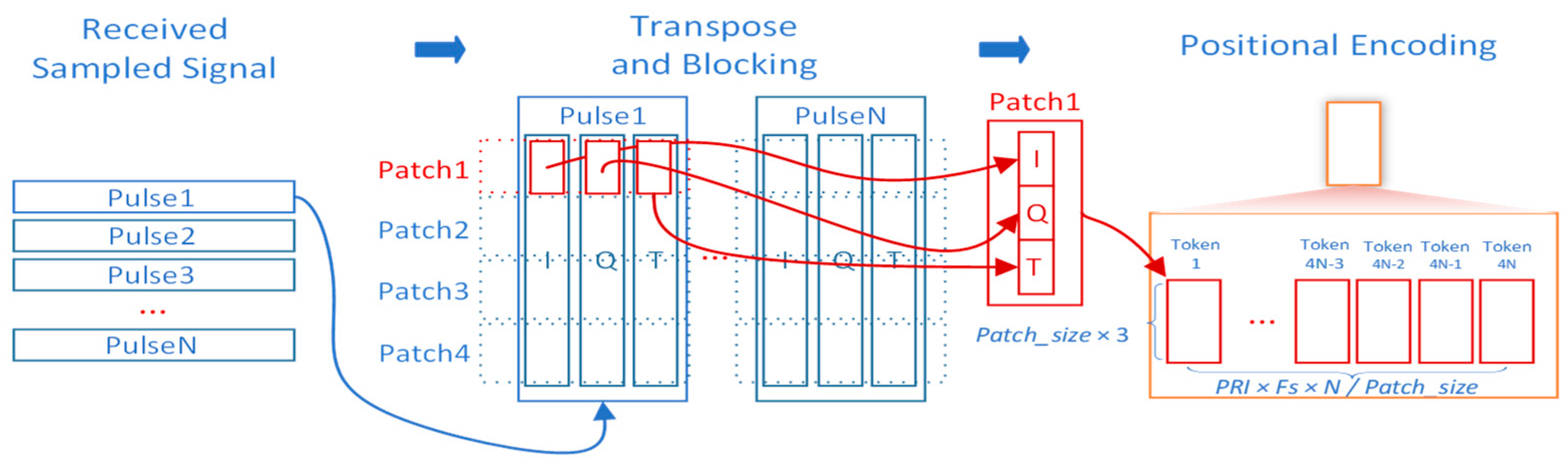
Figure 2 presents the patch-based processing strategy. Fast-time data are divided into patches, and each patch, comprising Patch_size fast-time samples, is reshaped into a Patch_size dimensional vector. Data from an entire coherent processing interval (CPI), spanning fast and slow time dimensions, are processed into patches and fed into the model for target detection. Compared to treating all fast-time samples as tokens, this approach significantly reduces the token count, improving training efficiency. While this method effectively determines target presence within a region, estimating precise target locations requires additional feature flattening and mapping.
From the perspective of coherent integration, each patch is still formed from the full set of coherent pulses within a CPI. The time dimension (i.e., the pulse index) is preserved when constructing the patch sequence, so the phase/time coherence across pulses that is needed for coherent integration is not destroyed by the patching or reshaping operations. In implementation, the long fast-time sampling sequence is first transformed into a higher-dimensional feature representation and then reshaped into multiple patches; the subsequent mappings operate on all patch elements and can implement point-wise accumulation as a special case. As a result, fine-grained phase and timing information remains available for the network to exploit, even for low-RCS or fast-moving targets.
The choice of Patch_size controls the trade-off between token length and feature depth. In our design, Patch_size can in principle vary from 1 (no aggregation along fast time, maximal token length) to the total number of fast-time samples within the CPI (one token per CPI, maximal feature depth). Very small Patch_size values increase the number of tokens and lead to quadratic growth in attention computation and memory consumption, whereas excessively large Patch_size values concentrate too many samples into a single high-dimensional token, which may make optimization difficult and reduce flexibility in modeling local range structure. In practice, Patch_size is chosen to balance detection performance and computational cost under available hardware resources.
- (2)
Sliding-Window processing
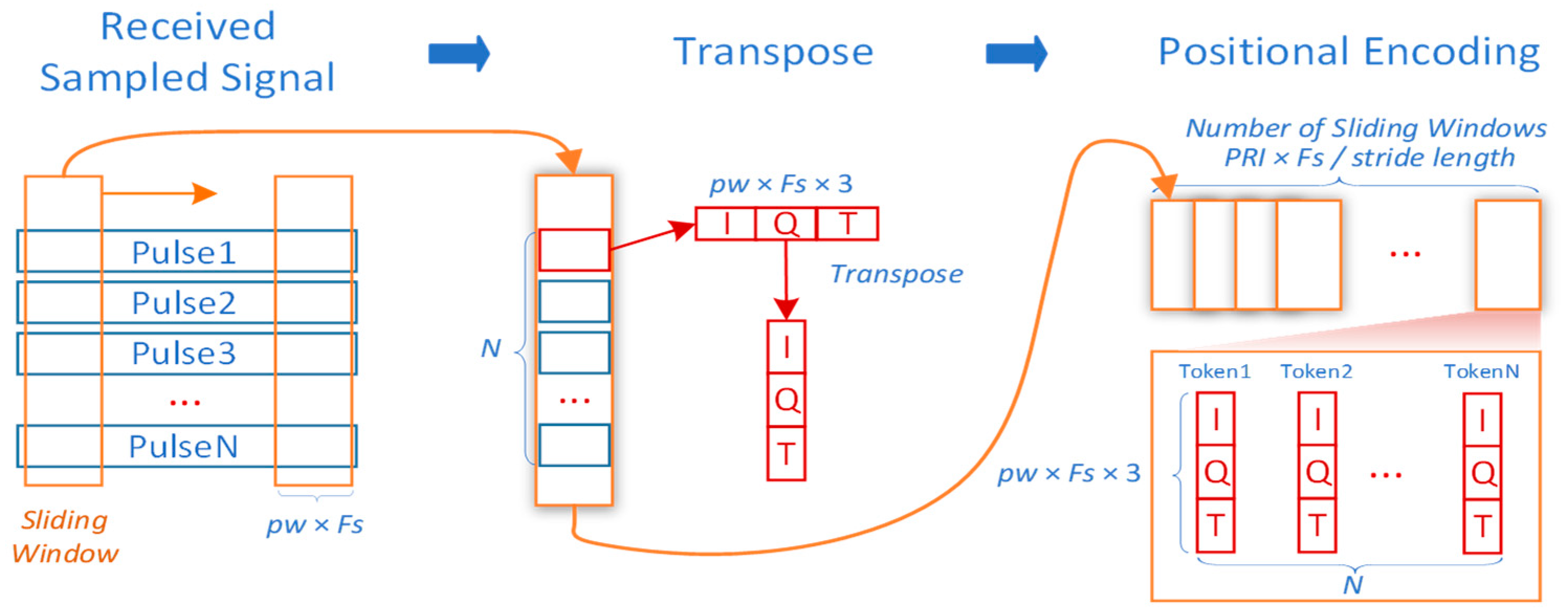
Figure 3 presents the sliding-Window processing strategy. A sliding window of length PW × Fs is applied along the fast-time dimension. For each pulse, fixed-length fast-time data within the window are extracted across all pulses to form a sub-pulse sequence. This sequence retains the original number of pulses but with reduced fast-time samples (PW × Fs). The sampled I/Q components and timestamps are flattened, concatenated, and transformed into d
model dimensional vectors via embedding. N coherent pulses yield N tokens. Here, each token is formed from a three-channel vector [I(t), Q(t), T(t)], where T(t) denotes the fast-time sampling index within the pulse. The inclusion of T(t) provides an explicit intra-pulse temporal coordinate for every sample inside the sliding window, enabling the model to distinguish where a given I/Q sample lies within the pulse duration and to better capture Doppler- and phase-evolution patterns that manifest as structured changes along fast time. When only local windows are observed, this additional temporal cue compensates for the loss of global fast-time context and makes the sliding-window representation sensitive to physically meaningful time-ordering information. The received signals, limited to the pulse duration PW, undergoes the same embedding and is fed into the model for detection. By sliding the window across the fast-time dimension, multiple sub-pulse pairs are generated, and the model performs detection iteratively to provide target presence markers corresponding to range cells. This approach not only reduces the dimensions of inverse-transformed data and token counts but also enables effective target range estimation.
All evaluation results presented in this study are based on the sliding-window preprocessing approach, demonstrating its efficacy for rapid regional target detection and localization.
4.2. Embedding and Pulse Positional Encoding
The raw transmit and receive signals are first mapped into a shared, lower-dimensional feature space via learnable linear projections. Specifically, the transmit embedding is computed as
and the receive embedding as
where
,
denotes batch size,
is the number of coherent pulses, and
,
are trainable parameters. Before forming
and
, all three input channels I, Q, and T within each sliding window are linearly normalized (zero mean and unit variance computed over the training set). This normalization prevents very small-magnitude echoes from being numerically drowned by floating-point precision limits, keeps the activations away from saturated linear regimes, and improves gradient propagation during training. To preserve the intrinsic ordering of the receive pulse sequence, we add sinusoidal positional encodings to
These encodings inject explicit pulse-index information, ensuring that parallel attention operations maintain awareness of the temporal relationships among pulses.
4.3. Encoding of Transmit and Receive Signals
To preserve the distinct characteristics of the transmit and receive signals, we adopt a dual-path transformer encoder, in which the embedded transmit and receive signals are processed by two parallel encoders. Unlike a shared encoder that maps both the noise-free transmit signal and the noisy receive signal through the same transformation, the proposed design enables dedicated representation learning for each signal type. The transmit path performs deep encoding of the ideal reference signal, generating Query (Q), Key (K), and Value (V) representations for subsequent attention-based detection. Meanwhile, the receive path accumulates features across multiple coherent echo pulses using multi-head self-attention, effectively capturing long-range dependencies and inter-pulse correlations. This process yields N aggregated features—where N corresponds to the number of pulses—each incorporating information from the full temporal context. From a radar signal-processing perspective, the Tx encoder plays a role similar to the reference channel in classical matched filtering, while the Rx encoder aggregates noisy echoes over multiple pulses. By feeding both encoded Tx and Rx features into the subsequent cross-attention decoder, the network learns a generalized, data-driven matched filter and coherent integrator that explicitly exploits Tx-Rx coherence instead of relying solely on the received signal. This explicit use of the transmit waveform as a reference preserves the physical interpretability of the detector and enables the model to compensate for motion-induced phase migration across pulses that fixed, Rx-only processing cannot handle effectively.
4.4. Extraction of Transmit–Receive Interaction Features
To capture the deep relationship between the receive and the transmitted signal, we employ a transformer decoder to compute interaction attention in parallel between each received-pulse feature and the transmitted-signal feature, yielding a set of coherence features. These features are then flattened and passed through a fully connected neural network to aggregate the pulse–transmit coherence features into logit, effectively representing the accumulated interaction information across multiple pulses and the transmitted signal. In contrast to conventional detectors that operate only on processed received signals (e.g., after a fixed matched filter and coherent integration), RD-Transformer keeps the transmit waveform in the loop so that the decoder attends directly to a clean Tx reference and implements a learnable Tx-Rx correlation stage that generalizes classical matched filtering to the full coherent accumulation process.
4.5. False Alarm Control Mechanism
To map network logits into detection probabilities and make final binary decisions, we employ a parameterized sigmoid function
where the scalar
(e.g.,
) modulates the sigmoid’s slope: larger values of
yield a steeper transition around zero, enabling finer control over the resulting probability distribution. A detection is declared whenever exceeds an adjustable threshold
:
By jointly tuning and , the system adaptively balances detection probability against false alarm rate under varying signal-to-noise conditions, thus providing robust performance across diverse operating regimes. In practice, we treat the detection gate as a coarse operating-point control and the slope parameter k as a finer shaping parameter for the output probability distribution. Starting from a single trained network, we first sweep on a validation set to satisfy a desired false alarm constraint; when a lower false alarm rate is required, is increased to impose a more stringent decision gate. If approaches the extremes of [0, 1] or the logits become too peaky, is gently reduced to flatten the sigmoid mapping and is increased accordingly, jointly moving the detector toward more conservative decisions. This two-parameter calibration enables us to realize different trade-offs between and with one trained model, instead of retraining separate networks for each operating point.
4.6. Optimization Details
The training process integrates noise injection and early stopping to enhance model performance and robustness. During the initial training phase, substantial noise is introduced to encourage the model to escape local minima, promoting stochasticity and enabling better exploration of the parameter space. As training progresses, the noise level is gradually reduced, allowing the model to stabilize and converge to an optimal solution. This approach improves the model’s ability to explore complex parameter spaces, enhances generalization, and mitigates overfitting risks. Early stopping is implemented with a tolerance of 5 epochs, and the signal-to-noise ratio (SNR) increases by 0.1 dB per step.
The training and validation datasets are generated using either a point target model or an RTX ray-tracing model, with 1 million training samples per SNR scenario and 2000 validation samples. The adamW optimizer is employed with a learning rate of lr = 10−4, a weight decay of 0.01, and a batch size of 512. Binary Cross-Entropy Loss (BCELoss) is used for model evaluation, where the raw logits are directly utilized for loss computation to avoid numerical instability and improve computational efficiency without explicitly applying the Sigmoid function.
Given the weaker performance of accumulated detection under extremely low SNR for non-fluctuating targets, the model is trained exclusively on non-fluctuating target scenarios. More specifically, the RD-Transformer is trained on non-fluctuating point-target echoes with additive white Gaussian receiver noise over a wide SNR range. During evaluation (
Section 5), the trained model is directly applied, without any fine-tuning, to test sets that introduce Swerling I–IV amplitude-fluctuation statistics and a broader range of target kinematics using both Sinc-based and RTX-based echo synthesis. The fact that the detector maintains its SNR advantage across these unseen fluctuation models indicates that the reported gains do not rely on an exactly matched Swerling/noise configuration at training and test time but instead reflect robustness to this family of simulated distribution shifts. The resulting model is generalized across various Swerling cases to ensure robust detection in diverse signal environments.
5. Experiments and Results
We evaluated the performance of the RD-Transformer model in detecting extremely weak targets under noisy backgrounds, utilizing 10-pulse accumulation, and compared it against the state-of-the-art energy accumulation detection methods in radar systems. Experimental results demonstrate that the model consistently achieves target detection while satisfying the required false alarm constraints across all target fluctuation scenarios. Notably, this includes cases where the signal-to-noise ratio (SNR) of the received echoes is significantly lower than the critical SNR required by optimal energy accumulation detection to achieve a specified detection probability. To make the presentation of these results clearer,
Section 5.2 provides qualitative detection examples at representative SNR values,
Section 5.3 reports quantitative detection probability versus SNR curves under different Swerling fluctuation models,
Section 5.4 analyzes false alarm behavior as a function of the detection gate,
Section 5.5 presents ablation experiments isolating the contributions of cross-attention, dual encoders, and sliding-window preprocessing, and
Section 5.6 summarizes the inference latency of small- and large-scale RD-Transformer models.
5.1. Data Preparation Details
The existing number of observed samples is too small compared to the scale of model parameters, making it difficult for the model to converge even with existing real experimental data samples. Therefore, we employ Sinc method data preparation and ray tracing method data preparation to achieve high-confidence generation of target-received echo signals under different scenarios and motion states. The Sinc method has low computational complexity but low fidelity, while the ray tracing method has high computational complexity but high fidelity. Both methods are used simultaneously in this experiment to achieve a balance between computational complexity, sample size, and sample quality.
5.1.1. Parameter Settings
Basic parameters include radar transceiver-related parameters and target motion characteristic parameters. Among them, radar transceiver-related parameters include carrier frequency
Fc = 1 GHz, sampling rate
Fs = 10 MHz, baseband signal bandwidth
B = 1 MHz, pulse width
PW = 10 us, linear frequency modulation signal waveform, transmit-receive antenna gains (
Gtx =
Grx = 35 dB), equivalent noise temperature
T = 293.5 K, load resistance of 50 Ω, noise factor of 3 dB, pulse repetition interval
PRI = 100 μs and coherent accumulation pulse number
N = 10. Target motion characteristic parameters include target position, velocity, acceleration, and jerk, with parameters set within observable distance and velocity ranges, and specific parameter values generated through uniform distribution random sampling during training. The parameters are detailed in
Table 1.
5.1.2. Sinc Method Data Preparation
The received echo signals obtained by radiating with different signals are generally subjected to pulse compression processing to form peaks, followed by subsequent accumulation processing. Therefore, our work refers to the relevant work [
6] based on the point target model, using the Sinc function to achieve rapid generation of echoes in different scenarios. Considering the motion characteristics of the target, the construction method of target echo generation is as follows:
representing the radial motion of the target relative to the reference position, where
is the reference range for Taylor expansion, and
represents the radial displacement function defined in Equation (16). Due to the motion process, the function has high-order derivatives, so the Taylor series expansion around τ = 0 relative to the reference position is
In the current study, reference [
61] and others have shown that using a third-order approximation can effectively reflect the motion characteristics of the target. Based on the third-order derivatives (k = 3), the target’s velocity, acceleration, and jerk are denoted as, respectively:
The fluctuation characteristics of the target RCS were modeled using the Swerling framework. Considering that slow fluctuations exhibit stability within a coherent pulse interval (CPI) but vary across scans (between different CPIs), the detection process focuses on accumulation within a single CPI. Consequently, scenarios involving slow-fluctuation targets (Swerling I and Swerling III) were consolidated for analysis.
5.1.3. RTX Data Preparation
Although the point target model can generate a large number of sample data for training quickly, it cannot accurately model the target echoes in the scene, owing to ignoring factors such as multipath transmission, reflections from different target materials, and complex modulation effects of large targets (individual targets larger than one or multiple resolvable distance units) due to attitude motion, leading to differences between the generated data sample characteristics and actual measured data samples. We refer to the ray tracing method with NVIDIA
® OptiX™ 8.1.0 (NVIDIA Corporation, Santa Clara, CA, USA) for signal-level simulation of radar-received pulses [
68]. In the above method, we no longer equate the received signal to the Sinc function but instead overlay the original transmitted signal x(t) after multi-path radiation attenuation. Each path calculates delay and Doppler according to the radar equation. Delay is obtained by integrating the motion of the target at the radiation-reflection time according to the target’s motion speed; Echo Doppler is calculated by sampling the target’s velocity at the moment of reflection.
5.2. Model Performance Outcomes
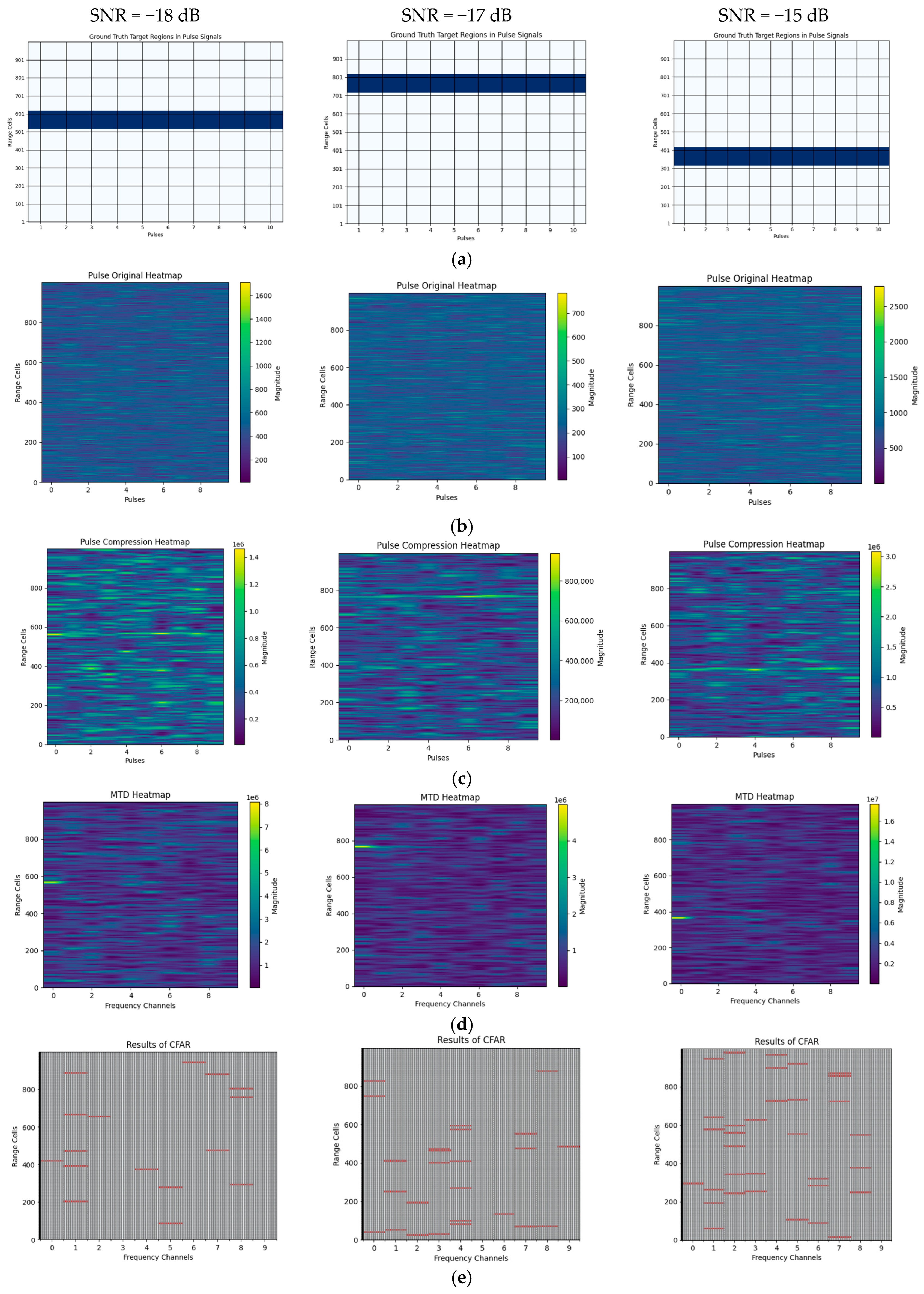
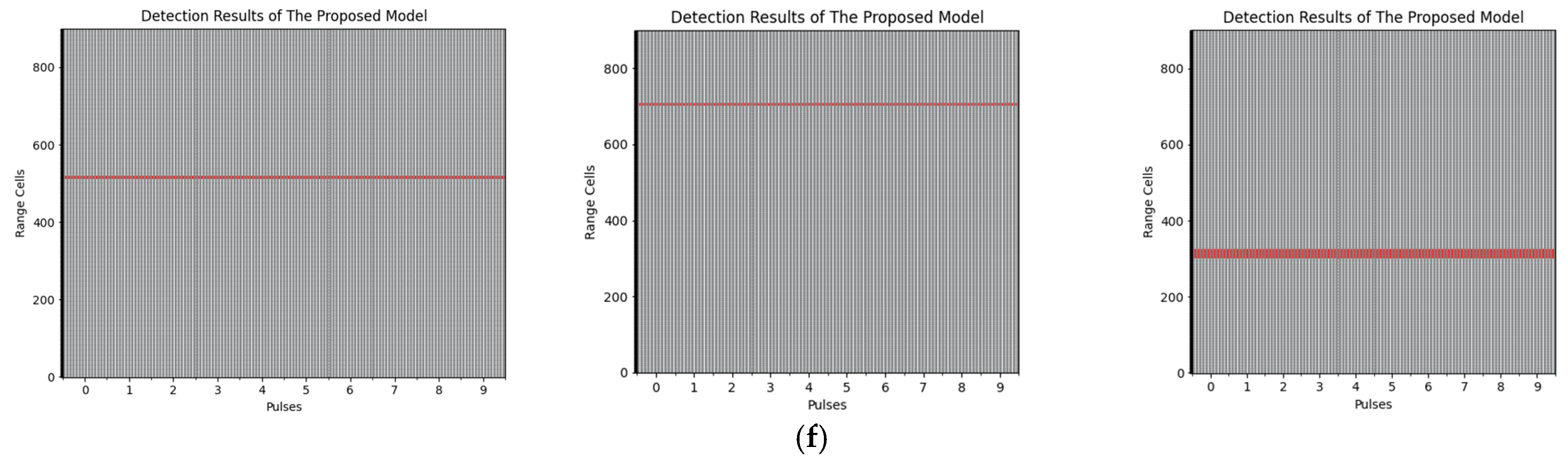
We compare the performance of the proposed model against the optimal radar energy accumulation detection model under identical pulse accumulation conditions, as shown in
Figure 4. For 10-pulse coherent accumulated echo sequences with SNR of −18 dB, −17 dB, and −15 dB, the proposed model successfully detects the target while maintaining control over false alarms. In contrast, conventional radar optimal energy detection methods, such as optimal pulse compression, range-Doppler coherent accumulation, and constant false alarm rate (CFAR) detection, struggle under these conditions. The extremely weak target echo signals result in inconspicuous target features across various conventional transform domains, leading to either excessive false alarms or an inability to detect any targets. In the conventional processing pipeline used for comparison, the complex I/Q echoes within each CPI are first matched-filtered using the known transmit waveform. The resulting outputs are then coherently integrated over N pulses in the range-Doppler domain based on the true PRI. Finally, detection is performed using a cell-averaging CFAR detector.
5.3. Coherent Detection Performance
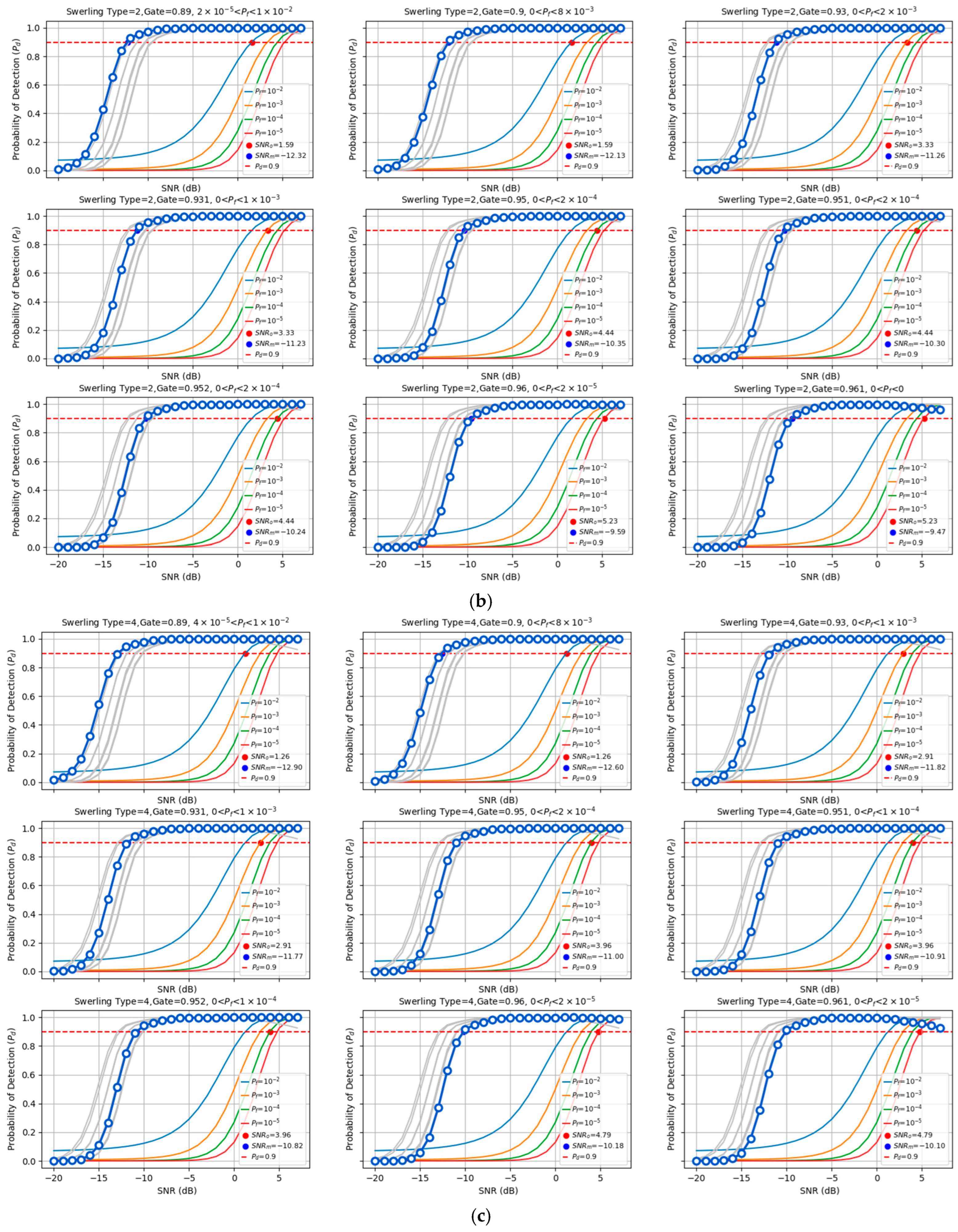
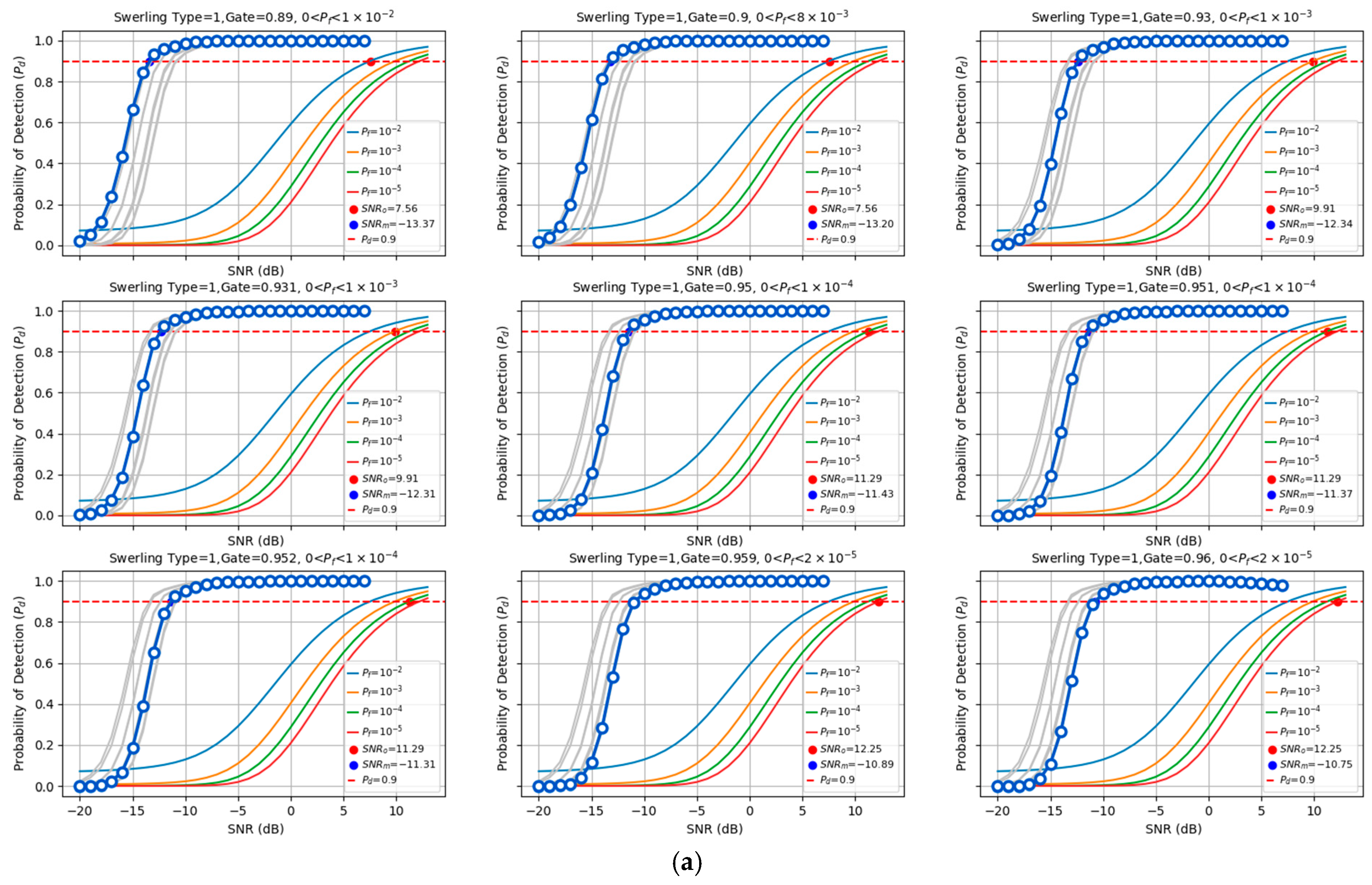
We compared the detection performance of the proposed model against the optimal energy detection method employed in traditional radar systems under different target fluctuation scenarios (Swerling I/II/III/IV). The evaluation examined the effectiveness of low-pulse accumulation (coherent accumulation of 10 pulses), and the detection probabilities were analyzed under various false alarm control levels, as shown in
Figure 5. The proposed method reduces the required SNR to achieve P
d = 90% by 20.76 dB to 23.14 dB compared to the optimal traditional energy accumulation method. For traditional radar, the optimal energy accumulation detection performance is numerically calculated using the incomplete gamma function [
42]. The detection performance of the proposed model was statistically obtained through independent repeated experiments. In the experiments, each SNR point was evaluated with 105 repetitions to ensure statistical reliability.
5.4. False Alarm Rate
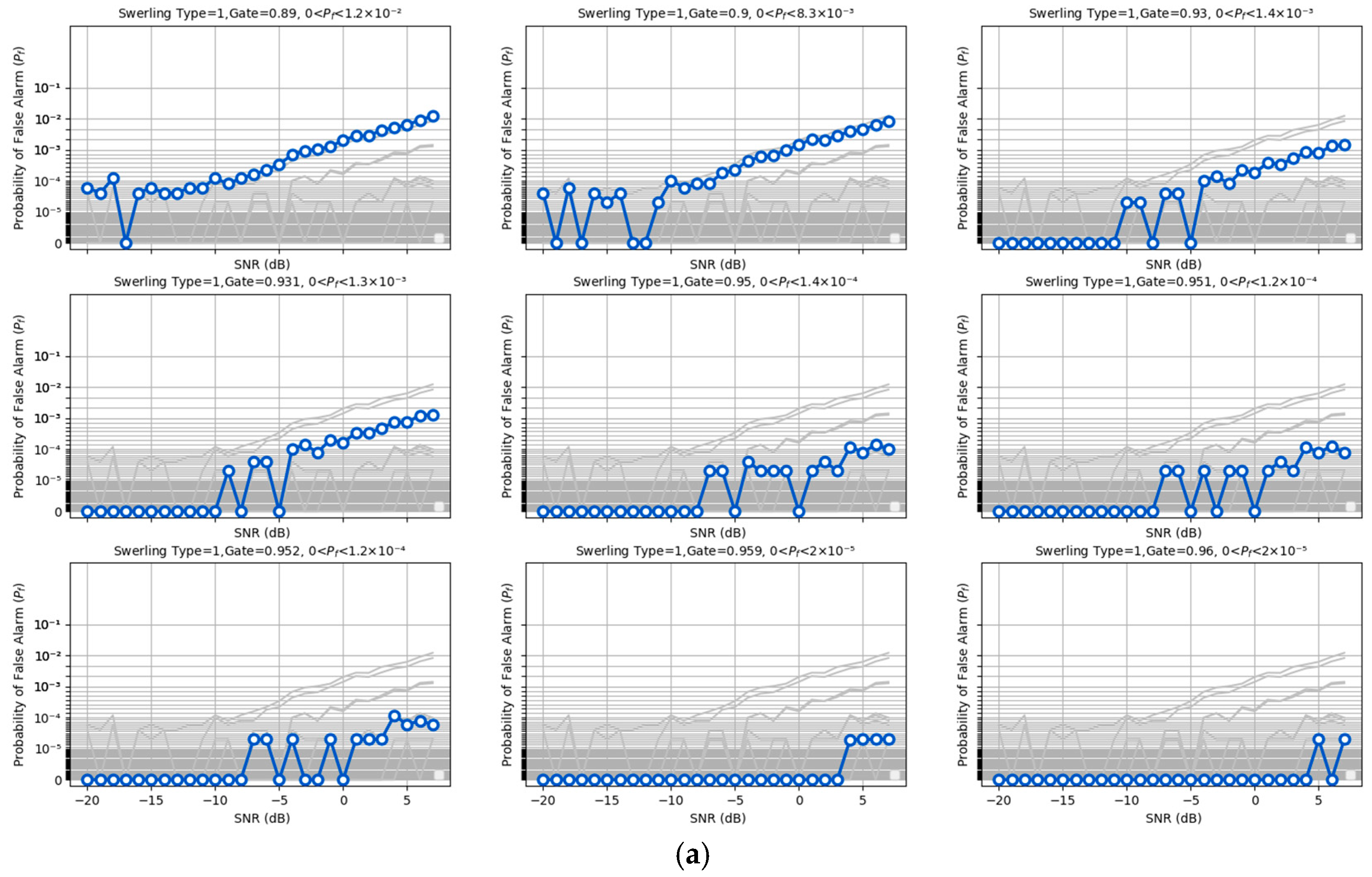
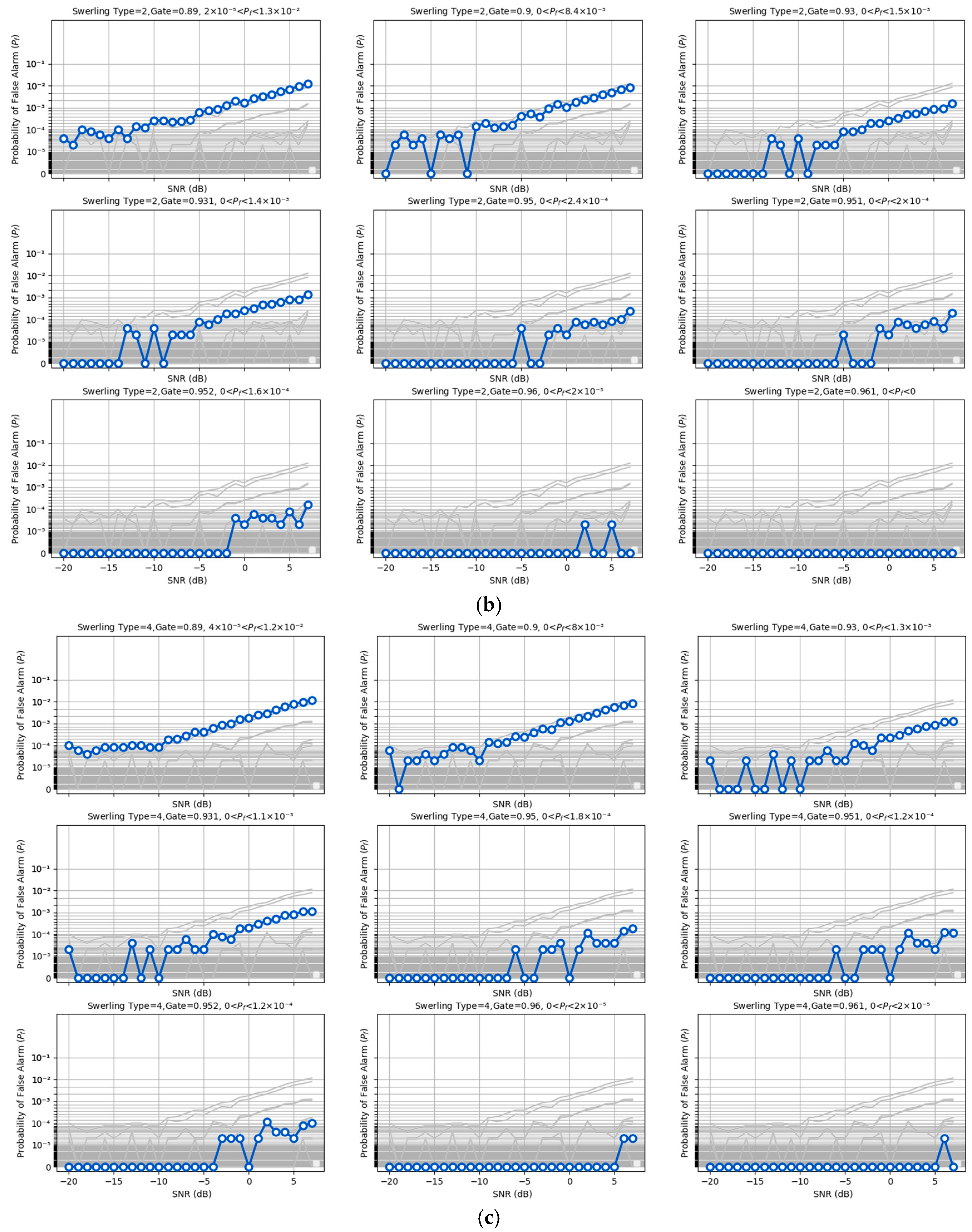
To align with the statistical methodology of energy detection, the proposed model incorporates a mechanism for false alarm control. The model outputs are processed using a tunable sigmoid function and a gating mechanism, enabling flexible adjustments to achieve the desired false alarm performance. Specifically, the sigmoid scaling parameter sigmoid_k is set to 0.1, while the gate threshold is tuned within the range of 0.890 to 0.961. This configuration effectively constrains the model’s false alarm rate between 10
−2 and 10
−5, ensuring comparability with optimal energy detection methods. The model’s False alarm rate exhibits slight variations with changes in the received SNR. These variations were characterized through independent repeated experiments, and the results are presented in
Figure 6 Panels 1–9 (arranged from top left to bottom right) correspond to different False alarm rate levels, panels 1 and 2 represent 10
−2 false alarm level, panels 3 and 4 represent 10
−3 false alarm level, panels 5, 6, and 7 represent 10
−4 false alarm level, and panels 8 and 9 represent 10
−5 false alarm level. It is important to emphasize that, for all comparative experiments in this study, the maximum false alarm rate observed under controlled conditions was used as the baseline for evaluating detection. Notably, across most SNR ranges, the model’s false alarm rate remained below the constant false alarm rate. From this perspective, the proposed model demonstrates superior performance compared to conventional energy detection methods. More specifically, for each pair of sigmoid_k and gate thresholds, the false alarm probability was estimated via large-scale Monte Carlo trials over a wide low-SNR range covering the operating conditions in
Figure 6, and the reported
corresponds to the maximum value observed across all SNR points in this range. Hence, for any SNR within this interval, the actual false alarm probability of the proposed detector does not exceed the
level. We also note that the present study evaluates
under the simulated thermal noise models described in
Section 5.1; in practical deployments with more complex non-Gaussian noise or clutter, the same k-sigmoid gating can be re-calibrated offline using a small amount of site-specific data to restore the desired false alarm level, while a systematic investigation of such scenarios is left for future work.
5.5. Ablation Experiments
To systematically validate the individual contributions of the three key design components in the proposed method—namely, the cross-attention fusion mechanism, the dual-encoder architecture, and the sliding-window preprocessing strategy—this section presents a comprehensive ablation study. All ablation experiments adhere to a unified evaluation protocol to ensure fair comparison. The training hyperparameters, optimizer configuration, and early-stopping criteria remain identical to those employed in the main experiments (
Section 4). Synthetic data generation follows the procedure detailed in
Section 5.1. For each SNR operating point, 1 × 10
6 independent trials are conducted on separate test sets to ensure statistical reliability. The detection performance is evaluated across SNR ∈ [−20, 10] dB with 0.1 dB increments, yielding probability of detection (Pd) versus SNR curves under a fixed false alarm rate P
f = 1 × 10
−4. The primary performance metric is the critical SNR required to achieve P
d = 90%, denoted as SNR
0, which quantifies the detection threshold under operationally relevant conditions.
5.5.1. Ablation 1: Cross-Attention Versus Simple Fusion Strategies
This ablation study investigates whether the cross-attention mechanism provides significant advantages over commonly used simple fusion strategies, thereby validating its role in extracting Tx-Rx mutual information and enhancing detection sensitivity at low SNR. Three fusion strategies are compared under otherwise identical configurations:
- (1.1)
Cross-attention (Proposed): Dual-encoder + Cross-attention decoder + Sliding-window preprocessing.
- (1.2)
Concat + FC (Variant A): The received and transmitted feature sequences are concatenated along the feature dimension, followed by two fully connected (FC) layers for fusion. All other components remain unchanged.
- (1.3)
Dot-product + FC (Variant B): The received and transmitted features undergo channel-wise inner product, followed by FC layers for dimensionality reduction and fusion. All other components remain unchanged.
The results in
Table 2 demonstrate that cross-attention achieves an SNR
0 improvement of 1.10 dB relative to concatenation-based fusion and 1.50 dB relative to dot-product fusion. The superior performance of cross-attention can be attributed to its ability to dynamically align received and transmitted features at each pulse/time position through learned attention weights, thereby selectively enhancing weak-energy channels that are critical for target detection. This adaptive alignment is particularly beneficial in low-SNR regimes. In contrast, simple concatenation or dot-product fusion treats all feature channels uniformly, failing to capture the fine-grained temporal correspondence between transmitted waveforms and received echoes. In accordance with the Monte Carlo evaluation protocol described at the beginning of
Section 5.5, the P
d-SNR curves from which SNR
0 is extracted are obtained from large numbers of independent trials at each SNR operating point.
5.5.2. Ablation 2: Dual-Encoder Versus Shared-Encoder Architecture
This experiment examines whether processing the transmitted (Tx) and received (Rx) pathways with dedicated encoders preserves pathway-specific characteristics and improves cross-pathway mutual information modeling.
Two architectural variants are evaluated:
- (2.1)
Dual-encoder (Proposed): Dual-encoder with independent parameters for Tx and Rx pathways + Cross-attention fusion + Sliding-window preprocessing.
- (2.2)
Shared-encoder (Variant C): A single encoder with shared weights processes both Tx and Rx inputs sequentially. The cross-attention mechanism remains unchanged, operating on the encoded representations, see
Table 3.
The dual-encoder architecture achieves an SNR0 improvement of 0.80 dB compared to the shared-encoder configuration. The advantage of the dual-encoder design stems from its capacity to learn pathway-specific inductive biases: the Tx encoder can specialize in extracting fine-grained features of the transmitted reference signal (e.g., pulse shape, modulation characteristics), while the Rx encoder focuses on capturing received signal characteristics under noise and clutter interference. These specialized representations facilitate more precise alignment during the cross-attention stage, enabling the decoder to better exploit the mutual information between transmitted waveforms and received echoes. In contrast, a shared encoder must learn a generic representation that accommodates both pathways, potentially diluting pathway-specific features critical for weak target detection.
5.5.3. Ablation 3: Sliding-Window Versus Patch-Based Preprocessing
Two preprocessing strategies are compared:
- (3.1)
Sliding-window (Proposed): Sliding-window with parameters specified in
Section 4.1 (window length and stride) + Dual-encoder + Cross-attention.
- (3.2)
Patch-based (Variant D): The fast-time signal stream is partitioned into non-overlapping or minimally overlapping patches. The number of tokens is kept comparable to the baseline to ensure a fair comparison of representational capacity.
The sliding-window approach yields an SNR
0 improvement of approximately 0.70 dB relative to patch-based partitioning. This advantage is particularly pronounced under challenging conditions involving low SNR and limited pulse counts, suggesting that preserving fast-time local continuity plays a critical role in coherent energy integration and temporal consistency modeling for weak targets. Patch-based partitioning, while conceptually simpler and more compatible with image-based processing pipelines, may inadvertently disrupt the temporal correlation structure essential for detecting faint echoes embedded in noise. The boundary discontinuities introduced by non-overlapping patches can fragment coherent signal components across adjacent patches, degrading the model’s ability to aggregate energy across multiple range bins, see
Table 4.
5.5.4. Summary of Ablation Results
The ablation studies collectively validate the design rationale of the proposed method. The cross-attention mechanism contributes the largest performance gain (1.1–1.5 dB), demonstrating its critical role in extracting cross-pathway mutual information. The dual-encoder architecture provides a moderate but meaningful improvement (0.8 dB) by preserving pathway-specific features. The sliding-window preprocessing strategy offers an additional 0.7 dB gain by maintaining temporal continuity. Together, these components form a synergistic system optimized for coherent weak target detection in pulse-Doppler radar systems.
5.6. Inference Speed
To meet real-time processing requirements, the GPU coherent processing time (ProcessTime) for N pulses in a single range unit must be less than
N ×
CPI. Here, ProcessTime denotes the average wall-clock latency from ingesting the complex I/Q samples of one coherent processing interval (CPI) for a single range unit, through sliding-window preprocessing, embedding, dual-encoder and cross-attention inference, k-sigmoid gating, and threshold comparison, to outputting the final binary detection result. In other words, the reported figures correspond to the full online processing chain from I/Q input to detection output, rather than only the bare neural-network forward pass. Inference latency for models of different scales is evaluated, as shown in
Table 5. The small-scale model, tested on a platform equipped with an NVIDIA 3080Ti GPU (NVIDIA Corporation, Santa Clara, CA, USA), achieved a processing time of 4.60 × 10
−5 s. The large-scale model, evaluated on a platform with two NVIDIA Tesla V100 GPUs, achieved a processing time of 1.08 × 10
−4 s. With
N ×
CPI = 1.00 × 10
−3 s in this experiment, both models satisfy the real-time processing requirements. These values correspond to a per-range-cell inference latency of the small-scale model and large-scale model on the tested GPU platforms, only 4.6% and 10.8%, respectively, of the available coherent processing interval in this experiment. Thus, although RD-Transformer requires more floating-point operations than a traditional processing chain, its measured runtime remains well within real-time constraints for the radar parameters considered in this work.
To ensure real-time performance for fast-time detection, the required number of parallel GPUs must exceed ceil (ProcessTime × DisUnit/CPI). However, increasing the number of parallel GPUs does not always lead to better performance due to the overhead introduced by data access between GPUs and memory. Optimal configurations are achieved when ProcessTime × m_DisUnit/CPI approaches but remains below 1, providing a cost-effective balance between processing efficiency and computational resources. In practical deployments, different fast-time range units within a CPI are mutually independent and can be treated as separate samples, which are either batched on a single GPU or assigned to different GPUs without inter-GPU communication. When multiple GPUs are available, distributing disjoint groups of range units across devices avoids splitting a single range unit over several GPUs and thus mitigates performance degradation due to inter-GPU data transfers, leading to near-linear throughput scaling with the number of GPUs in typical deployment scenarios.
6. Conclusions
In this paper, we proposed RD-Transformer, an attention-based framework that achieves significant SNR reduction (14–20 dB) for weak target detection in pulsed radar systems by learning adaptive coherent integration from multi-pulse data. Key contributions include the following: (1) a cross-attention mechanism for transmit-receive feature fusion that implicitly compensates for target motion, (2) dual-encoder architecture preserving pathway-specific characteristics, and (3) a tunable false alarm control mechanism via k-sigmoid gating enables the same trained network to satisfy different Pd–Pf required by radar systems without retraining.
Experimental results demonstrate substantial performance gains over optimal energy detection. However, two main limitations warrant future investigation: (1) all experiments rely on simulated data—validation on real radar measurements is essential to confirm practical effectiveness; (2) computational complexity may limit deployment on resource-constrained platforms. Future work will prioritize real-data validation, model compression (knowledge distillation, pruning), and extension to joint detection and motion parameter estimation tasks.