Application of the E-Nose as a Non-Destructive Technique in the Early Detection of Monilinia laxa on Plum (Prunus domestica L.)
 , ,
, ,  , and
, and
Highlights
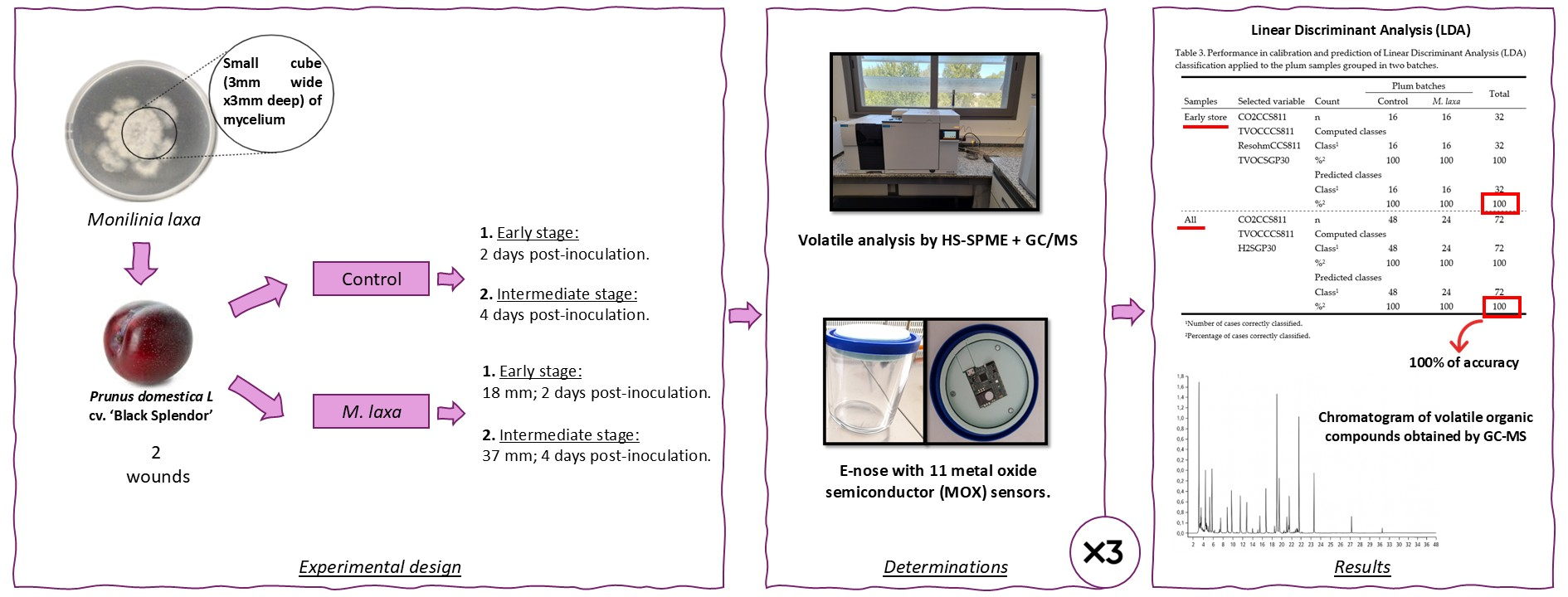
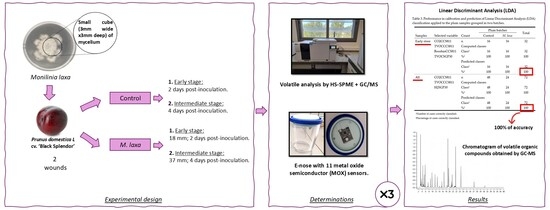
- This study analyses the use of electronic nose (E-nose) technology for the early detection of Monilinia laxa contamination in red-fleshed plums (cv. Black Splendor) during storage.
- The study shows that the LDA (Linear Discriminant Analysis) model based on E-nose data can differentiate between healthy and contaminated fruit with 100% accuracy.
- The E-nose is presented as an effective, non-destructive, real-time tool for improving postharvest quality control in stone fruits.
- It is recommended that the system be validated externally and that advanced machine learning models be applied to expand its use in the agri-food chain.
Abstract
1. Introduction
2. Materials and Methods
2.1. Experimental Design
2.2. Volatile Compound Analysis
2.2.1. Volatile Extraction
2.2.2. Gas Chromatography/Mass Spectrometry (GC/MS) Analysis
2.3. E-Nose Analysis
2.3.1. E-Nose System
2.3.2. Measurement Process and Data Analysis
2.4. Statistical Analysis
3. Results and Discussion
3.1. Volatile Compounds
3.2. Relationship Between VOCs and Signals from E-Nose Sensors
3.3. Determination of Incipient Fungal Decay of Peaches by E-Nose During Postharvest Storage
4. Conclusions
Supplementary Materials
Author Contributions
Funding
Institutional Review Board Statement
Informed Consent Statement
Data Availability Statement
Acknowledgments
Conflicts of Interest
Abbreviations
| GC/MS | Gas Chromatography/Mass Spectrometry |
| LDA | Linear Discriminant Analysis |
| PCA | Principal Component Analysis |
| NIR | Near-Infrared Spectroscopy |
| HSI | Hyperspectral imaging |
| VOCs | Volatile organic compounds |
| PLSR | Partial Least Squares Regression |
| SVM | Support Vector Machines |
| ANN | Artificial Neural Networks |
| MOX | Metal Oxide Sensors |
| E-nose | Electronic nose |
| HCA | Hierarchical Cluster Analysis |
| HS-SPME | Headspace Solid-Phase Microextraction |
References
- Ministerio de Agricultura, Pesca y Alimentación (MAPA). Fruta de Hueso. Campaña 2024. Gobierno de España. 2024. Available online: https://www.mapa.gob.es/es/agricultura/temas/producciones-agricolas/frutas-y-hortalizas/Documentos-fruta-hueso-2024.aspx (accessed on 20 August 2025).
- Larena, I.; Torres, R.; De Cal, A.; Liñán, M.; Melgarejo, P.; Domenichini, P.; Bellini, A.; Mandrin, J.; Lichou, J.; de Eribe, X.O.; et al. Biological control of postharvest brown rot (Monilinia spp.) of peaches by field applications of Epicoccum nigrum. Biol. Control 2005, 32, 305–310. [Google Scholar] [CrossRef]
- Pellegrino, C.; Gullino, M.L.; Garibaldi, A.; Spadaro, D. First report of brown rot of stone fruit caused by Monilinia fructicola in Italy. Plant Dis. 2009, 93, 668. [Google Scholar] [CrossRef]
- Hilber-Bodmer, M.; Bünter, M.; Patocchi, A. First report of brown rot caused by Monilinia fructicola on apricot in a Swiss orchard. Plant Dis. 2010, 94, 643. [Google Scholar] [CrossRef]
- Ondejková, N.; Hudecová, M.; Bacigálová, K. First report on Monilinia fructicola in the Slovak Republic. Plant Prot. Sci. 2010, 46, 181. [Google Scholar] [CrossRef]
- Villarino, M.; Larena, I.; Martínez, F.; Melgarejo, P.; De Cal, A. Analysis of genetic diversity in Monilinia fructicola from the Ebro Valley in Spain using ISSR and RAPD markers. Eur. J. Plant Pathol. 2012, 132, 511–524. [Google Scholar] [CrossRef]
- Vilanova, L.; Valero-Jiménez, C.A.; van Kan, J.A. Deciphering the Monilinia fructicola genome to discover effector genes possibly involved in virulence. Genes 2021, 12, 568. [Google Scholar] [CrossRef] [PubMed]
- Villarino, M.; Egüen, B.; Lamarca, N.; Segarra, J.; Usall, J.; Melgarejo, P.; De Cal, A. Occurrence of Monilinia laxa and M. fructigena after introduction of M. fructicola in peach orchards in Spain. Eur. J. Plant Pathol. 2013, 137, 835–845. [Google Scholar] [CrossRef]
- Rungjindamai, N.; Jeffries, P.; Xu, X.M. Epidemiology and management of brown rot on stone fruit caused by Monilinia laxa. Eur. J. Plant Pathol. 2014, 140, 1–17. [Google Scholar] [CrossRef]
- Rajkumar, P.; Wang, N.; EImasry, G.; Raghavan, G.S.V.; Gariepy, Y. Studies on banana fruit quality and maturity stages using hyperspectral imaging. J. Food Eng. 2012, 108, 194–200. [Google Scholar] [CrossRef]
- Arroyo, P.; Suárez Marcelo, J.I.; Lozano, J.; Herrero Agustín, J.L.; Carmona, P. Nariz electrónica personal para la detección de contaminantes en el aire. In XXXIX Jornadas de Automática; Área de Ingeniería de Sistemas y Automática, Universidad de Extremadura: Badajoz, Spain, 2018; pp. 894–899. [Google Scholar] [CrossRef]
- Shooshtari, M.; Salehi, A. An electronic nose based on carbon nanotube-titanium dioxide hybrid nanostructures for detection and discrimination of volatile organic compounds. Sens. Actuators B Chem. 2022, 357, 131418. [Google Scholar] [CrossRef]
- Wang, M.; Chen, Y. Electronic nose and its application in the food industry: A review. Eur. Food Res. Technol. 2024, 250, 21–67. [Google Scholar] [CrossRef]
- Tyagi, P.; Semwal, R.; Sharma, A.; Tiwary, U.S.; Varadwaj, P. E-nose: A low-cost fruit ripeness monitoring system. J. Agric. Eng. 2023, 54, 31–41. [Google Scholar] [CrossRef]
- Sánchez, R.; Martín-Tornero, E.; Lozano, J.; Boselli, E.; Arroyo, P.; Meléndez, F.; Martín-Vertedor, D. E-Nose discrimination of abnormal fermentations in Spanish-Style Green Olives. Molecules 2021, 26, 5353. [Google Scholar] [CrossRef]
- Chandra, A.; Raj, H.; Ranjan, H.; Kumar, A.; Kumari, P. Isolation, characterization and sporulation of fungi from decaying vegetables and fruits of local vegetable market in hazaribag India. Plant Arch. 2022, 22, 426–430. [Google Scholar] [CrossRef]
- Jia, W.; Liang, G.; Tian, H.; Sun, J.; Wan, C. Electronic nose-based technique for rapid detection and recognition of moldy apples. Sensors 2019, 19, 1526. [Google Scholar] [CrossRef]
- Gu, S.; Wang, Z.; Chen, W.; Wang, J. Early identification of Aspergillus spp. contamination in milled rice by E-nose combined with chemometrics. J. Sci. Food Agric. 2021, 101, 4220–4228. [Google Scholar] [CrossRef] [PubMed]
- Pan, L.; Zhang, W.; Zhu, N.; Mao, S.; Tu, K. Early detection and classification of pathogenic fungal disease in post-harvest strawberry fruit by electronic nose and gas chromatography–mass spectrometry. Food Res. Int. 2014, 62, 162–168. [Google Scholar] [CrossRef]
- Haghbin, N.; Bakhshipour, A.; Mousanejad, S.; Zareiforoush, H. Monitoring Botrytis cinerea infection in kiwifruit using electronic nose and machine learning techniques. Food Bioprocess Tech. 2023, 16, 749–767. [Google Scholar] [CrossRef]
- Amari, A.; El Bari, N.; Bouchikhi, B. Electronic nose for anchovy freshness monitoring based on sensor array and pattern recognition methods: Principal components analysis, linear discriminant analysis and support vector machine. Int. J. Comput. 2014, 6, 61–67. [Google Scholar] [CrossRef]
- Martínez, A.; Hernández, A.; Arroyo, P.; Lozano, J.S.; de Guía Córdoba, M.; Martín, A. E-Nose Detection of Changes in Volatile Profile Associated with Early Decay of ‘Golden Delicious’ Apple by Penicillium expansum. Food Control 2024, 168, 110907. [Google Scholar] [CrossRef]
- Qiu, S.; Wang, J.; Gao, L. Discrimination and characterization of strawberry juice based on electronic nose and tongue: Comparison of different juice processing approaches by lda, plsr, rf, and svm. J. Agric. Food Chem. 2014, 62, 6426–6434. [Google Scholar] [CrossRef] [PubMed]
- Ruiz-Moyano, S.; Martín, A.; Villalobos, M.C.; Calle, A.; Serradilla, M.J.; Córdoba, M.G.; Hernández, A. Yeasts isolated from figs (Ficus carica L.) as biocontrol agents of postharvest fruit diseases. Food Microbiol. 2016, 57, 45–53. [Google Scholar] [CrossRef]
- Lee, S.W.; Kim, B.H.; Seo, Y.H. Olfactory system-inspired electronic nose system using numerous low-cost sensors. PLoS ONE 2023, 18, e0295703. [Google Scholar] [CrossRef]
- Serradilla, M.J.; Martín, A.; Ruiz-Moyano, S.; Hernández, A.; López-Corrales, M.; de Guía Córdoba, M. Physico-chemical and sensorial characterisation of four sweet cherry cultivars grown in Jerte Valley (Spain). Food Chem. 2012, 133, 1551–1559. [Google Scholar] [CrossRef]
- Arroyo, P.; Meléndez, F.; Suárez, J.I.; Herrero, J.L.; Rodríguez, S.; Lozano, J. Electronic nose with digital gas sensors connected via Bluetooth to a smartphone for air quality measurements. Sensors 2020, 20, 786. [Google Scholar] [CrossRef] [PubMed]
- Pino, J.A.; Quijano, C.E. Study of the volatile compounds from plum (Prunus domestica L. cv. Horvin) and estimation of their contribution to the fruit aroma. LWT 2012, 32, 76–83. [Google Scholar] [CrossRef]
- Sun, H.; Lu, X.; Wang, Y.; Li, J.; Liu, S. Study on Evaluation of Fruit Aroma of Plum Variety Resources Based on Headspace Solid-Phase Microextraction Combined with Gas Chromatography–Mass Spectrometry. Foods 2024, 13, 3515. [Google Scholar] [CrossRef]
- Zhang, Q.; Zhu, S.; Lin, X.; Peng, J.; Luo, D.; Wan, X.; Zhang, Y.; Dong, X.; Ma, Y. Analysis of volatile compounds in different varieties of plum fruits based on headspace solid-phase microextraction-gas chromatography-mass spectrometry technique. Horticulturae 2023, 9, 1069. [Google Scholar] [CrossRef]
- Liu, W.; Zhang, Y.; Ma, R.; Yu, M. Comparison of aroma trait of the white-fleshed peach ‘hu jing mi lu’ and the yellow-fleshed peach ‘jin yuan’ based on odor activity value and odor characteristics. Horticulturae 2022, 8, 245. [Google Scholar] [CrossRef]
- Muto, A.; Müller, C.T.; Bruno, L.; McGregor, L.; Ferrante, A.; Chiappetta, A.A.C.; Bitonti, M.B.; Rogers, H.J.; Spa-dafora, N.D. Fruit volatilome profiling through GC× GC-ToF-MS and gene expression analyses reveal differences amongst peach cultivars in their response to cold storage. Sci. Rep. 2020, 10, 18333. [Google Scholar] [CrossRef]
- Wang, Y.; Yang, C.; Li, S.; Yang, L.; Wang, Y.; Zhao, J.; Jiang, Q. Volatile characteristics of 50 peaches and nectarines evaluated by HP–SPME with GC–MS. Food Chem. 2009, 116, 356–364. [Google Scholar] [CrossRef]
- Liu, Q.; Zhao, N.; Zhou, D.; Sun, Y.; Sun, K.; Pan, L.; Tu, K. Discrimination and growth tracking of fungi contamination in peaches using electronic nose. Food Chem. 2018, 262, 226–234. [Google Scholar] [CrossRef]
- López, L.; Echeverria, G.; Usall, J.; Teixidó, N. The detection of fungal diseases in the ‘Golden Smoothee’ apple and ‘Blanquilla’ pear based on the volatile profile. Postharvest Biol. Technol. 2015, 99, 120–130. [Google Scholar] [CrossRef]
- Balsells-Llauradó, M.; Echeverria, G.; Torres, R.; Vall-llaura, N.; Teixidó, N.; Usall, J. Emission of volatile organic compounds during nectarine-Monilinia laxa interaction and its relationship with fruit susceptibility to brown rot. Postharvest Biol. Technol. 2022, 192, 111997. [Google Scholar] [CrossRef]
- Fanesi, B.; D’Ortenzio, A.L.; Kuhalskaya, A.; Nartea, A.; Fiorini, D.; Moumni, M.; Landi, L.; Lucci, P.; Romanazzi, G.; Pacetti, D. Identification of volatile organic compounds as markers to detect Monilinia fructicola infection in fresh peaches. Postharvest Biol. Technol. 2023, 206, 112581. [Google Scholar] [CrossRef]
- Martínez, A.; Hernández, A.; Arroyo, P.; Lozano, J.; Córdoba, M.D.G.; Martín, A. Early Detection of Monilinia laxa in Yellow-Fleshed Peach Using a Non-Destructive E-Nose Approach. Foods 2025, 14, 3155. [Google Scholar] [CrossRef]
- Di Francesco, A.; Di Foggia, M.; Baraldi, E. Aureobasidium pullulans volatile organic compounds as alternative postharvest method to control brown rot of stone fruits. Food Microbiol. 2020, 87, 103395. [Google Scholar] [CrossRef] [PubMed]
- Li, Z.; Suslick, K.S. Portable optoelectronic nose for monitoring meat freshness. ACS Sensors 2016, 1, 1330–1335. [Google Scholar] [CrossRef]
- Wang, Y.; Wang, D.; Lv, Z.; Zeng, Q.; Fu, X.; Chen, Q.; Luo, Z.; Luo, C.; Wang, D.; Zhang, W. Analysis of the volatile profiles of kiwifruits experiencing soft rot using E-nose and HS-SPME/GC–MS. LWT 2023, 173, 114405. [Google Scholar] [CrossRef]
- Huang, G.L.; Liu, T.T.; Mao, X.M.; Quan, X.Y.; Sui, S.Y.; Ma, J.J.; Sun, L.X.; Li, C.H.; Shao, Q.S.; Wang, Y.N. Insights into the volatile flavor and quality profiles of loquat (Eriobotrya japonica Lindl.) during shelf-life via HS-GC-IMS, E-nose, and E-tongue. Food Chem. X 2023, 20, 100886. [Google Scholar] [CrossRef] [PubMed]
- Rezaee, Z.; Mohtasebi, S.S.; Firouz, M.S. An electronic nose system supported by machine learning techniques for rapid detection of Aspergillus flavus in pistachio. J. Food Meas. Charact. 2024, 18, 5757–5765. [Google Scholar] [CrossRef]



| Mean 5 | p Values 7 | ||||||||
|---|---|---|---|---|---|---|---|---|---|
| RT 1 | CD 2 | Volatile Compounds | ID 3 | IK 4 | AAU | % | RSD 6 | Ps | Pi |
| Alcohol | 9695 | 1 | |||||||
| 3.7 | v6 | 3-methylbut-3-en-1-ol | B | 727 | 214 | 0.03 | 87 | +++ | |
| 3.8 | v7 | 2-methylbutan-1-ol | B | 731 | 3535 | 0.49 | 134 | +++ | ++ |
| 4.6 | v8 | 1-pentanol | B | 762 | 458 | 0.06 | 177 | +++ | |
| 8.2 | v14 | 3-hexenol | C | 890 | 579 | 0.08 | 142 | ||
| 8.9 | v17 | 1-hexanol | B | 906 | 4742 | 0.66 | 100 | +++ | |
| 16.1 | v33 | Ethyl-1-hexanol | B | 1033 | 107 | 0.01 | 138 | ||
| 19.4 | v45 | Phenylethyl alcohol | B | 1113 | 59 | 0.01 | 304 | ||
| Ester | 698,007 | 98 | |||||||
| 1.7 | v1 | Methyl acetate | A | 522 | 186 | 0.03 | 168 | + | +++ |
| 2.2 | v2 | Ethyl acetate | A | 616 | 5333 | 0.75 | 60 | ++ | |
| 3.4 | v4 | n-propyl acetate | B | 715 | 215 | 0.03 | 166 | +++ | |
| 3.5 | v5 | Methyl butanoate | B | 719 | 515 | 0.07 | 165 | +++ | |
| 4.9 | v9 | Isobutyl acetate | B | 773 | 519 | 0.07 | 113 | ||
| 5.8 | v11 | Ethyl butanoate | B | 807 | 12,357 | 1.73 | 119 | + | |
| 6.4 | v12 | Butyl acetate | B | 828 | 40,421 | 5.65 | 75 | ++ | ++ |
| 8 | v13 | Ethyl 2-methylbutanoate | B | 883 | 423 | 0.06 | 168 | + | +++ |
| 9.3 | v18 | 3-methylbutyl acetate | B | 913 | 328 | 0.05 | 163 | ||
| 9.4 | v19 | 2-methylbutyl acetate | B | 915 | 51 | 0.01 | 271 | +++ | |
| 10.3 | v20 | Propyl butanoate | B | 929 | 1052 | 0.15 | 77 | ||
| 10.4 | v21 | Ethyl pentanoate | B | 931 | 243 | 0.03 | 156 | ||
| 10.8 | v22 | Butyl propanoate | B | 937 | 12,132 | 1.70 | 58 | −−− | − |
| 11 | v23 | Pentyl acetate | B | 940 | 869 | 0.12 | 118 | +++ | |
| 11.5 | v24 | Methyl hexanoate | B | 948 | 1734 | 0.24 | 136 | ||
| 12.8 | v25 | Butyl 2-methylpropanoate | B | 969 | 870 | 0.12 | 52 | −−− | |
| 12.9 | v26 | 2-methylpropyl butanoate | B | 971 | 3698 | 0.52 | 78 | −−− | |
| 13.6 | v27 | 2-methylbutyl propanoate | B | 982 | 104 | 0.01 | 246 | −−− | |
| 14.8 | v28 | Butyl butanoate | B | 1002 | 126,173 | 17.64 | 76 | +++ | +++ |
| 14.9 | v29 | Ethyl hexanoate | B | 1005 | 143,501 | 20.06 | 92 | −−− | −− |
| 15.2 | v31 | (Z)-3-hexenyl acetate | C | 1012 | 2754 | 0.38 | 120 | ++ | |
| 15.5 | v32 | Hexyl acetate | B | 1019 | 22,226 | 3.11 | 102 | ++ | |
| 16.6 | v34 | Butyl 2-methylbutyrate | B | 1045 | 18,733 | 2.62 | 55 | −−− | |
| 16.8 | v35 | 3-methybutyl butanoate | B | 1050 | 143 | 0.02 | 157 | −−− | |
| 17.1 | v36 | Isobutyl pentanoate | B | 1057 | 4 | 0.00 | 217 | −−− | −−− |
| 17.2 | v37 | 3-methylbutyl isobutyrate | C | 1060 | 851 | 0.12 | 78 | −−− | + |
| 17.3 | v38 | 2-methylbutyl butanoate | B | 1062 | 9329 | 1.30 | 78 | −−− | −−− |
| 17.6 | v39 | 4-pentenyl butanoate | C | 1069 | 206 | 0.03 | 174 | ++ | |
| 18.8 | v40 | Pentyl pentanoate | C | 1097 | 18,381 | 2.57 | 36 | − | −−− |
| 19 | v41 | Ethyl heptanoate | C | 1103 | 160 | 0.02 | 211 | +++ | |
| 19.1 | v42 | 3-methylbut-2-enyl butanoate | C | 1105 | 2679 | 0.37 | 44 | ||
| 19.3 | v44 | Hexyl propanoate | B | 1110 | 1224 | 0.17 | 87 | ||
| 20.5 | v46 | Pentyl 2-methylbutyrate | C | 1141 | 284 | 0.04 | 164 | − | |
| 20.9 | v47 | Hexyl 2-methylpropanoate | C | 1151 | 81 | 0.01 | 259 | ||
| 21 | v48 | Isobutyl hexanoate | C | 1154 | 4838 | 0.68 | 36 | ||
| 21.2 | v49 | 2-methylbutyl pentanoate | C | 1159 | 109 | 0.02 | 196 | ||
| 22.3 | v50 | (E)-3-hexenyl butanoate | C | 1187 | 2464 | 0.34 | 82 | −− | |
| 22.6 | v51 | Butyl hexanoate | C | 1195 | 213,711 | 29.87 | 60 | +++ | |
| 22.7 | v52 | Butyl (Z)-3-hexenoate | C | 1197 | 3600 | 0.50 | 76 | ||
| 24 | v54 | (3Z)-3-Hexenyl 2-methylbutanoate | C | 1330 | 127 | 0.02 | 194 | −−− | |
| 24.1 | v55 | Hexyl 2-methylbutanoate | C | 1335 | 3526 | 0.49 | 54 | −− | |
| 24.6 | v56 | Isopentyl hexanoate | C | 1357 | 294 | 0.04 | 148 | + | |
| 24.7 | v57 | 2-methylbutyl hexanoate | C | 1361 | 10,714 | 1.50 | 61 | −−− | |
| 25 | v58 | 4-pentenyl hexanoate | C | 1374 | 263 | 0.04 | 201 | +++ | |
| 25.9 | v59 | Pentyl hexanoate | C | 1403 | 5114 | 0.71 | 100 | − | |
| 26.2 | v60 | 3-methyl-2-butenylhexanoate | C | 1406 | 566 | 0.08 | 192 | ||
| 29.2 | v62 | Hexyl hexanoate | B | 1438 | 24,900 | 3.48 | 164 | ||
| Aldehyde | 957 | 0.1 | |||||||
| 5.7 | v10 | Hexanal | B | 803 | 98 | 0.01 | 159 | + | |
| 15 | v30 | Octanal | B | 1007 | 206 | 0.03 | 117 | −− | |
| 19.2 | v43 | Nonanal | B | 1108 | 222 | 0.03 | 247 | ||
| 23 | v53 | Decanal | B | 1240 | 430 | 0.06 | 71 | ||
| Hydrocarbons | 1120 | 0.16 | |||||||
| 8.4 | v15 | Ethylbenzene | C | 898 | 130 | 0.02 | 209 | ||
| 8.7 | v16 | p-xylene | 903 | 990 | 0.14 | 147 | −− | −−− | |
| Ketone | 3178 | 0.44 | |||||||
| 3.1 | v3 | 3-pentanone | B | 704 | 3178 | 0.44 | 74 | − | − |
| Carboxilic acid | 2492 | 0.35 | |||||||
| 29 | v61 | (E)-3-octenoic acid | C | 1436 | 2492 | 0.35 | 96 | ||
| MOX 1,2 | ||||||||||||
|---|---|---|---|---|---|---|---|---|---|---|---|---|
| Cluster | VOCs | M_1 | M_2 | M_3 | M_4 | M_5 | M_6 | M_7 | M_8 | M_9 | M_10 | M_11 |
| 1 | Methyl acetate | ++ | −− | −− | ++ | + | −− | −− | ++ | −− | −− | |
| 1 | Ethyl acetate | − | + | |||||||||
| 1 | n-propyl acetate | + | − | + | + | − | + | |||||
| 1 | Methyl butanoate | ++ | −− | −− | ++ | ++ | −− | −− | ++ | −− | −− | |
| 1 | 2-methyl-1-butanol | ++ | −− | −− | ++ | + | − | −− | ++ | − | − | |
| 1 | 1-pentanol | + | −− | −− | ++ | + | −− | −− | ++ | − | − | |
| 1 | Isobutyl acetate | ++ | −− | −− | ++ | ++ | −− | −− | ++ | −− | −− | + |
| 1 | Ethyl butanoate | + | −− | −− | + | − | −− | + | − | − | ||
| 1 | Ethyl 2-methylbutanoate | + | −− | −− | + | − | −− | + | − | − | ||
| 1 | 3-hexenol | + | + | + | −− | ++ | − | − | ++ | |||
| 1 | 1-hexanol | ++ | − | −− | ++ | ++ | −− | −− | ++ | −− | −− | + |
| 1 | 3-methylbutyl acetate | ++ | −− | −− | ++ | + | −− | −− | ++ | −− | −− | |
| 1 | Propyl butanoate | ++ | − | − | + | + | −− | − | ++ | − | − | + |
| 1 | Ethyl pentanoate | −− | − | − | ||||||||
| 1 | Methyl hexanoate | ++ | −− | −− | ++ | ++ | −− | −− | ++ | −− | −− | ++ |
| 1 | Ethyl heptanoate | ++ | −− | −− | ++ | + | −− | −− | ++ | −− | −− | |
| 1 | Phenylethyl alcohol | − | − | |||||||||
| 1 | Butyl (Z)-3-hexenoate | ++ | −− | −− | ++ | ++ | −− | −− | ++ | −− | −− | + |
| 1 | Isopentyl hexanoate | ++ | −− | −− | ++ | + | −− | −− | ++ | − | − | |
| 2 | Hexanal | |||||||||||
| 3 | Butyl propanoate | + | + | + | ||||||||
| 3 | Butyl 2-methylpropanoate | ++ | + | + | ||||||||
| 3 | Octanal | − | − | − | + | − | + | + | − | |||
| 3 | Pentyl pentanoate | + | + | + | − | + | + | |||||
| 3 | 2-methylbutyl hexanoate | + | + | + | + | + | ||||||
| 4 | (Z)-3-hexenyl acetate | + | ||||||||||
| Plum Batches | Total | ||||
|---|---|---|---|---|---|
| Samples | Selected Variable | Count | Control | M. laxa | |
| Early store 4 | CO2CCS811 | n | 16 | 16 | 32 |
| TVOCCCS811 | Computed classes | ||||
| ResohmCCS811 | Class 1 | 16 | 16 | 32 | |
| TVOCSGP30 | % 2 | 100 | 100 | 100 | |
| Predicted classes 3 | |||||
| Class 1 | 16 | 16 | 32 | ||
| % 2 | 100 | 100 | 100 | ||
| All 4 | CO2CCS811 | n | 48 | 24 | 72 |
| TVOCCCS811 | Computed classes | ||||
| H2SGP30 | Class 1 | 48 | 24 | 72 | |
| % 2 | 100 | 100 | 100 | ||
| Predicted classes | |||||
| Class 1 | 48 | 24 | 72 | ||
| % 2 | 100 | 100 | 100 | ||
| Plum Batches | Total | ||||
|---|---|---|---|---|---|
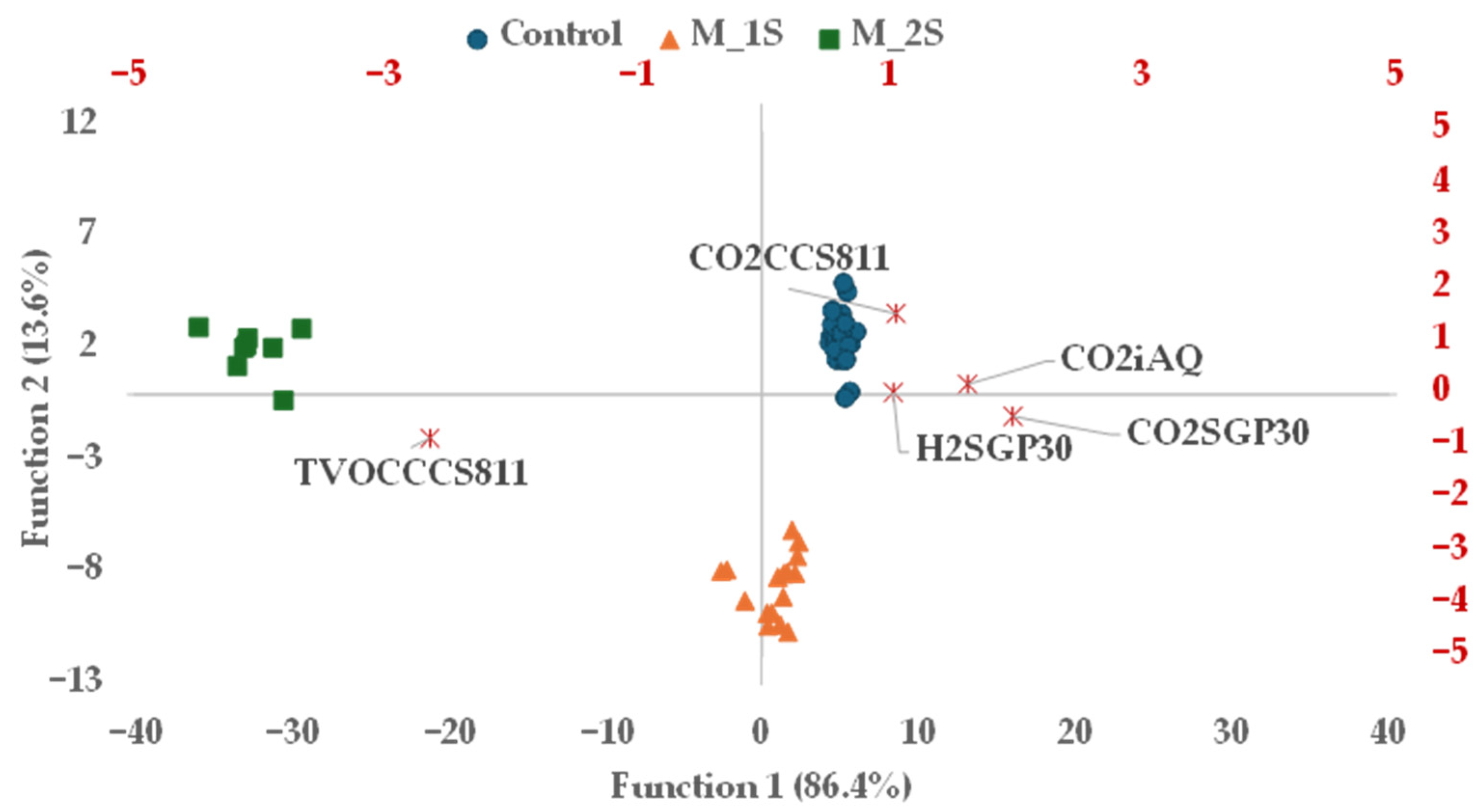
| Selected Variable | Count | Control | M_1S | M_2S | |
| CO2SGP30 | n | 48 | 16 | 8 | 72 |
| CO2CCS811 | Computed classes | ||||
| TVOCCCS811 | Class 1 | 48 | 16 | 8 | 72 |
| CO2iAQ | % 2 | 100 | 100 | 100 | 100 |
| H2SGP30 | Predicted classes 3 | ||||
| Class 1 | 48 | 16 | 8 | 72 | |
| % 2 | 100 | 100 | 100 | 100 | |
Disclaimer/Publisher’s Note: The statements, opinions and data contained in all publications are solely those of the individual author(s) and contributor(s) and not of MDPI and/or the editor(s). MDPI and/or the editor(s) disclaim responsibility for any injury to people or property resulting from any ideas, methods, instructions or products referred to in the content. |
© 2025 by the authors. Licensee MDPI, Basel, Switzerland. This article is an open access article distributed under the terms and conditions of the Creative Commons Attribution (CC BY) license (https://creativecommons.org/licenses/by/4.0/).
Share and Cite
Martínez, A.; Hernández, A.; Arroyo, P.; Lozano, J.S.; Martín, A.; Córdoba, M.d.G. Application of the E-Nose as a Non-Destructive Technique in the Early Detection of Monilinia laxa on Plum (Prunus domestica L.). Sensors 2025, 25, 7576. https://doi.org/10.3390/s25247576
Martínez A, Hernández A, Arroyo P, Lozano JS, Martín A, Córdoba MdG. Application of the E-Nose as a Non-Destructive Technique in the Early Detection of Monilinia laxa on Plum (Prunus domestica L.). Sensors. 2025; 25(24):7576. https://doi.org/10.3390/s25247576
Chicago/Turabian StyleMartínez, Ana, Alejandro Hernández, Patricia Arroyo, Jesús S. Lozano, Alberto Martín, and María de Guía Córdoba. 2025. "Application of the E-Nose as a Non-Destructive Technique in the Early Detection of Monilinia laxa on Plum (Prunus domestica L.)" Sensors 25, no. 24: 7576. https://doi.org/10.3390/s25247576
APA StyleMartínez, A., Hernández, A., Arroyo, P., Lozano, J. S., Martín, A., & Córdoba, M. d. G. (2025). Application of the E-Nose as a Non-Destructive Technique in the Early Detection of Monilinia laxa on Plum (Prunus domestica L.). Sensors, 25(24), 7576. https://doi.org/10.3390/s25247576