Development and Validation of an Openable Spherical Target System for High-Precision Registration and Georeferencing of Terrestrial Laser Scanning Point Clouds



Abstract
1. Introduction
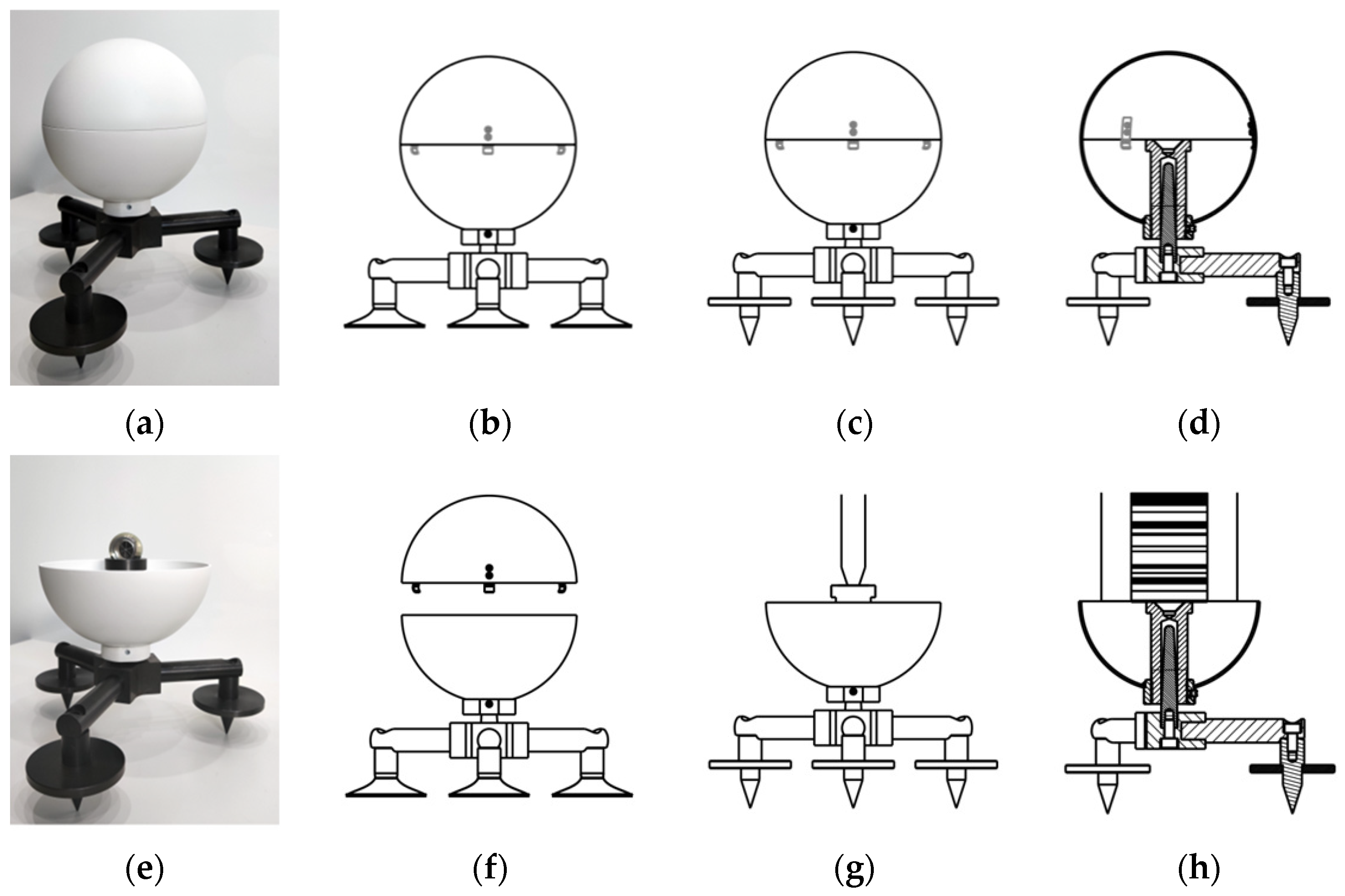
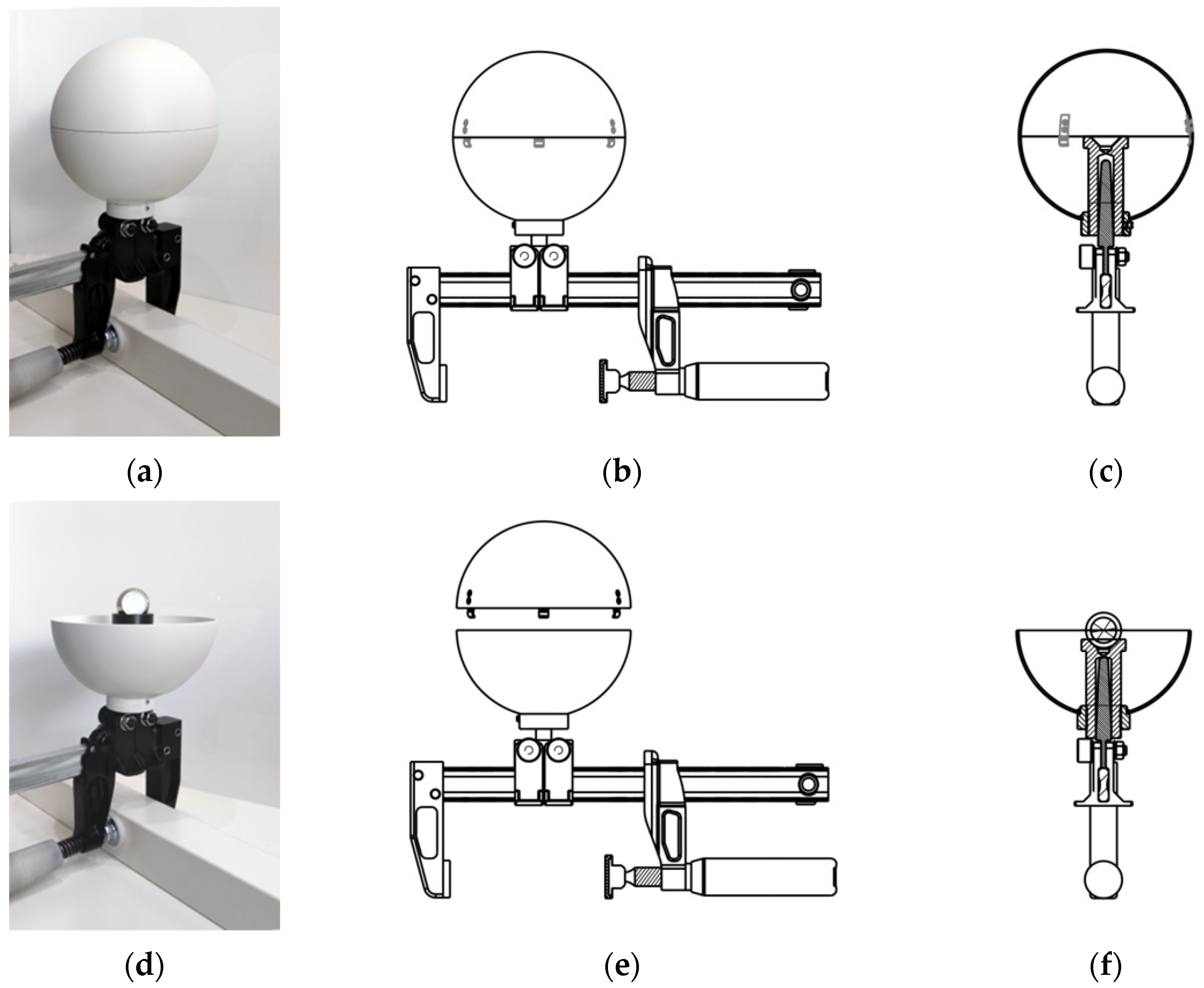
- This article proposes an innovative referencing system to improve the reliability of TLS data registration and georeferencing. The system comprises:
- reference spheres whose centroids can be determined precisely with surveying methods,
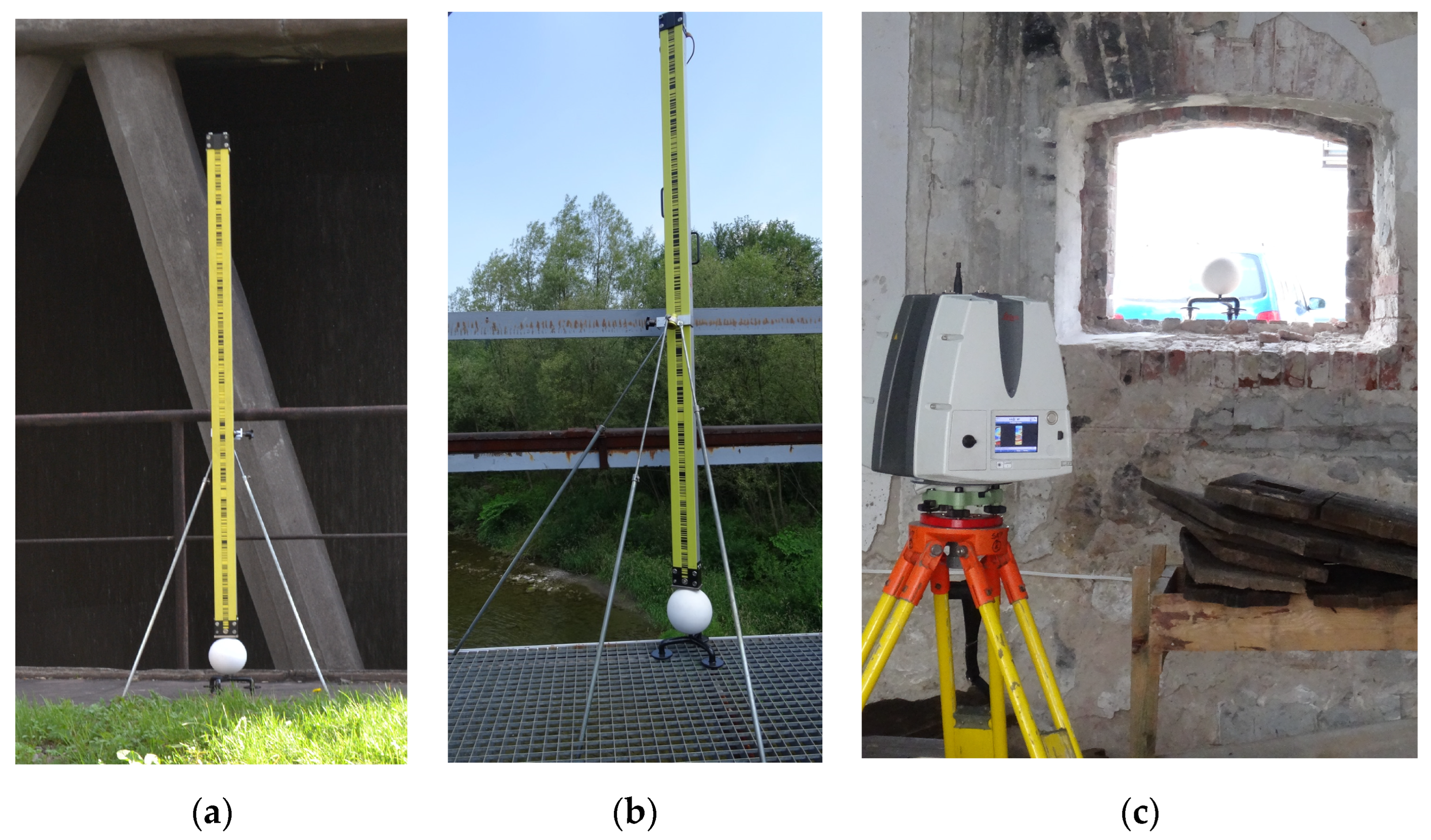
- dedicated adapters for securing the spheres to diverse objects (such as flat surfaces, railings, and balustrades) for the optimal placement of the targets.
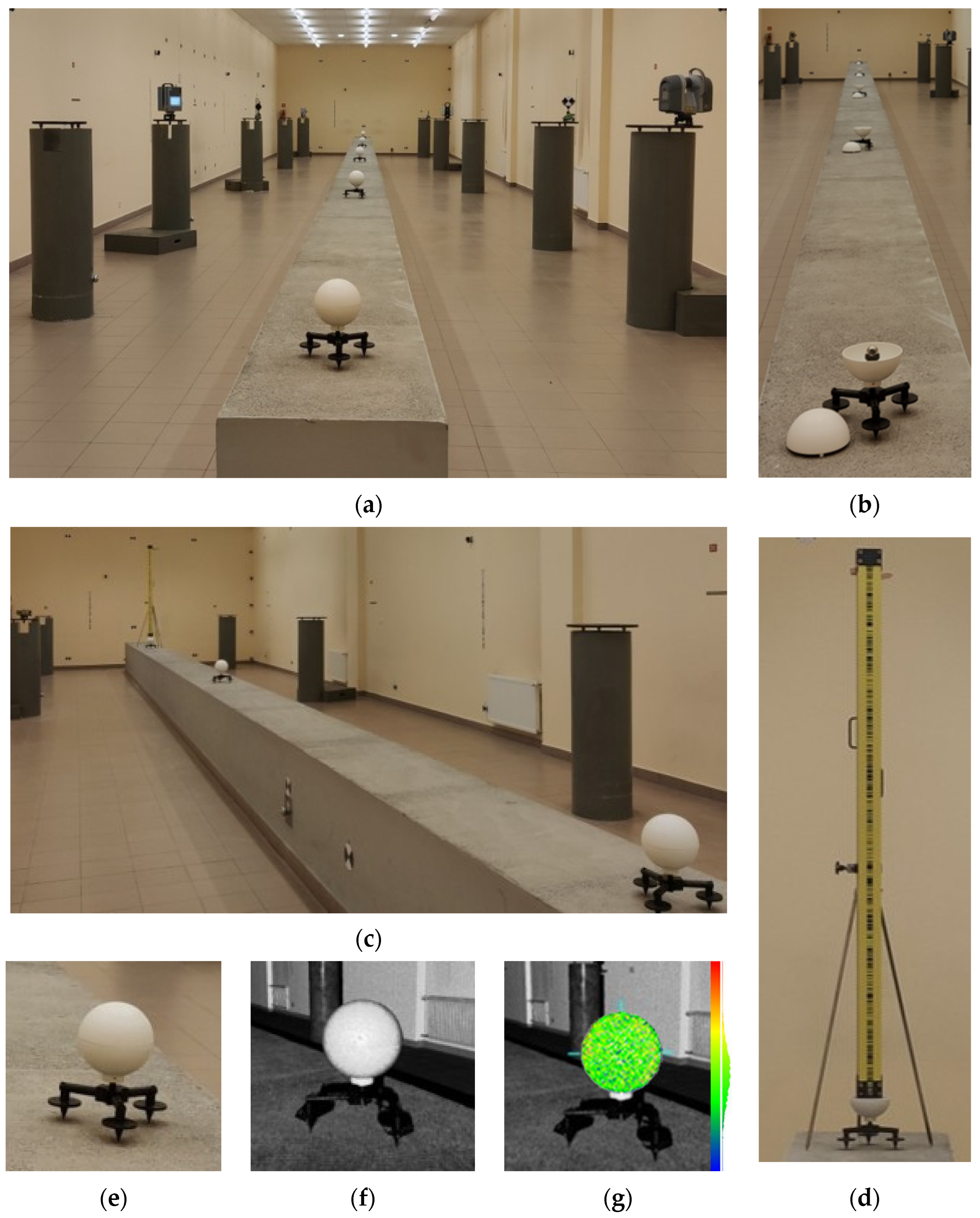
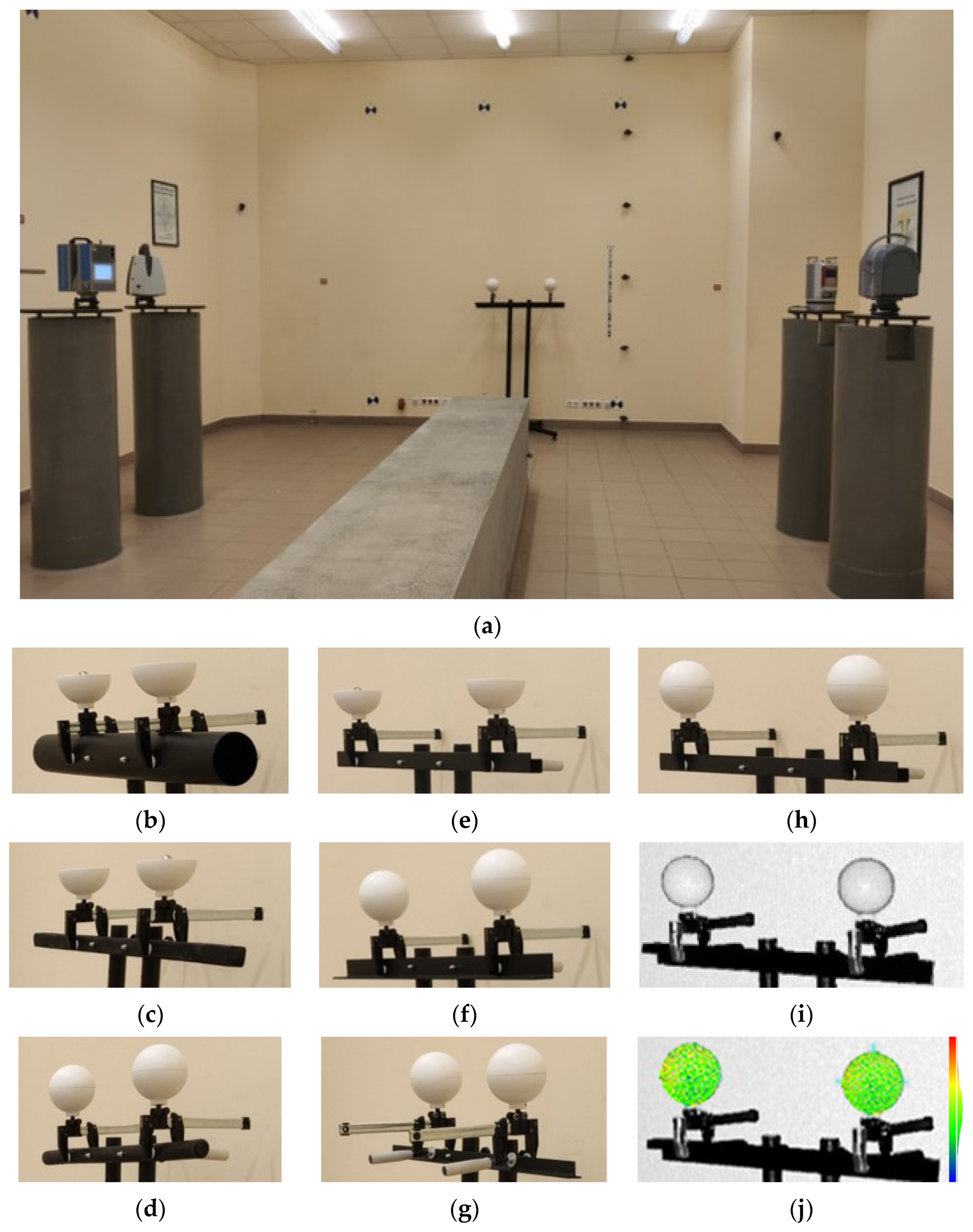
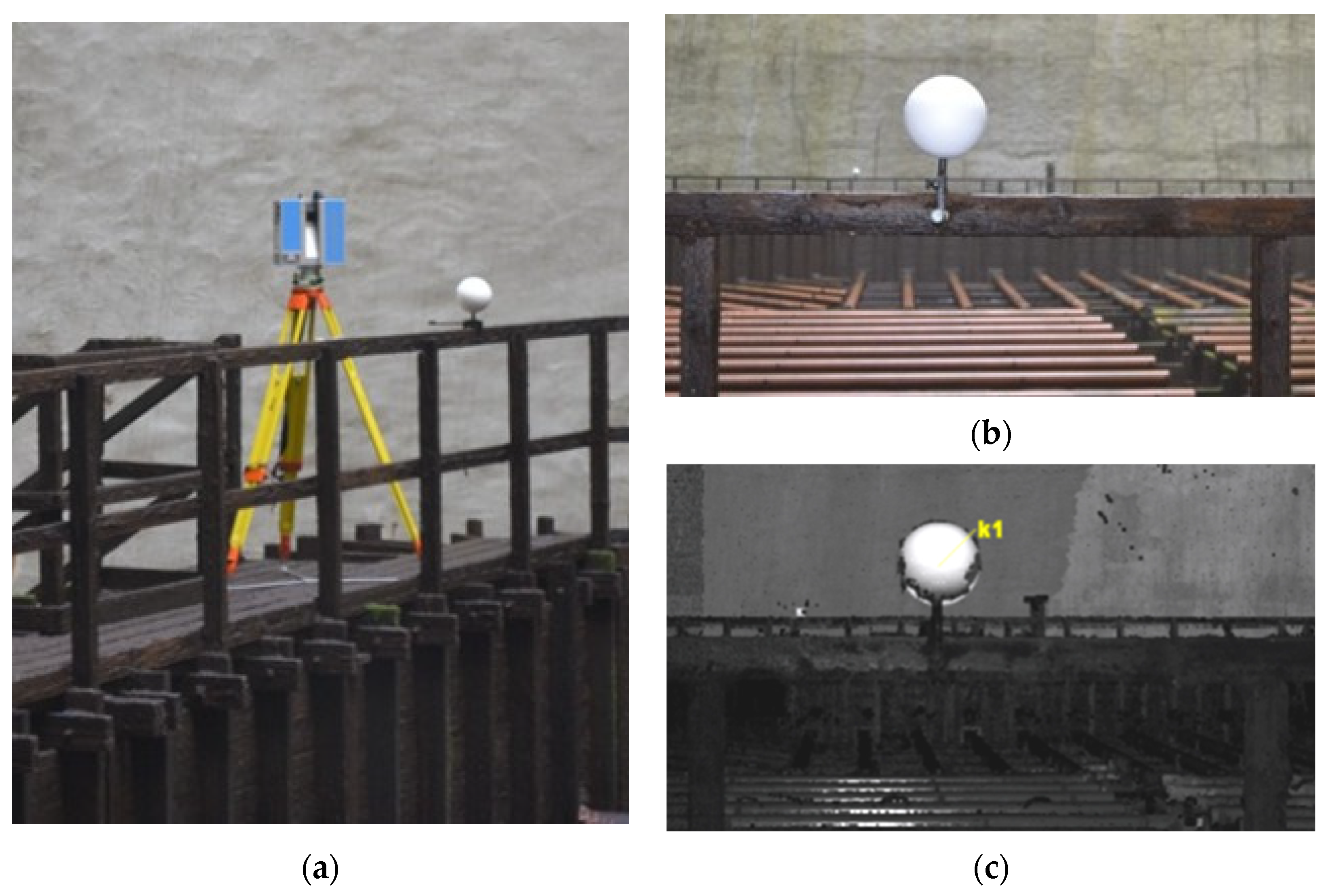
- The system facilitates a precise stitching of point clouds acquired from multiple stations, transformation of TLS data to a common coordinate system, and their integration with data obtained using traditional surveying methods (tacheometry, geodetic levelling, GNSS). The system’s performance was verified under laboratory conditions using four terrestrial laser scanners from leading brands.
2. Materials and Methods
2.1. Novel Openable Spherical Target System
2.2. Validation Procedure
2.2.1. Measurement Equipment
2.2.2. Experimental Measurement Campaign
2.2.3. Data Processing Workflow
3. Results
3.1. Quality of Sphere Fitting and Form Errors
3.2. Sphere Distance Error Analysis
3.3. Registration and Georeferencing Quality
3.4. Stability of Adjustable F-Clamp Adapters
4. Discussion
4.1. Precision, Stability, and Reliability of the Reference System in Laboratory Measurements
4.2. Prototype Evolution Supported by Initial Field Experiments
- Substantial reduction in setup time.Placement of a surveying tripod, levelling, installation of a carrier, and fixing the target take one to five minutes, depending on the tripod and the operator’s experience. It takes only 10–15 s to place a reference sphere on a tripod or F-clamp adapter, meaning a single tie point can be set up 5 to 20 times faster.
- No need to position the targets towards the scanner.Targets typically have to be manually set to face the scanner, which adds 15–20% to the acquisition time for four targets per station, according to our observations and literature data (Becerik-Gerber et al. [41]). The spheres do not need to be rotated or repositioned, which eliminates this stage and the risk of human error.
- Easier transport and logistics.A complete set of ten reference spheres with adapters in transport configurations takes room equivalent to four tripods with carriers and targets. It means a 50% reduction in gear mass and volume, which is highly relevant to multi-station campaigns in hard-to-reach areas.
4.3. Limitations, Environmental Challenges, and Future Research
5. Conclusions
6. Patents
Author Contributions
Funding
Institutional Review Board Statement
Informed Consent Statement
Data Availability Statement
Conflicts of Interest
Abbreviations
| TLS | Terrestrial Laser Scanning |
| TGD | Target Geometric Distribution |
| ToF | Time-of-Flight |
| WFD | Waveform Digitizing |
| FE | Form Error |
| SD | Sphere Distance Error |
| TME | Target Measurement Error |
| TMETLS | TLS Target Measurement Error |
| TMETach | Tacheometric Target Measurement Error |
| TRE | Transformation/Registration Error |
| TRERMS | Root Mean Square of TRE |
| TREMAE | Mean Absolute Error of TRE |
| PTD | Post-Registration Target Difference |
| RMSE | Root Mean Square Error |
| MAE | Mean Absolute Error |
| MaxAE | Maximum Absolute Error |
| ICP | Iterative Closest Point |
References
- Stenz, U.; Hartmann, J.; Paffenholz, J.-A.; Neumann, I. High-Precision 3D Object Capturing with Static and Kinematic Terrestrial Laser Scanning in Industrial Applications—Approaches of Quality Assessment. Remote Sens. 2020, 12, 290. [Google Scholar] [CrossRef]
- Vosselman, G.; Mass, H.G. Airborne and Terrestrial Laser Scanning; Whittles Publishing: Dunbeath, UK, 2010. [Google Scholar]
- Mukupa, W.; Roberts, G.W.; Hancock, C.M.; Al-Manasir, K. A review of the use of terrestrial laser scanning application for change detection and deformation monitoring of structures. Surv. Rev. 2017, 49, 99–116. [Google Scholar] [CrossRef]
- Aryan, A.; Bosché, F.; Tang, P. Planning for Terrestrial Laser Scanning in Construction: A Review. Autom. Constr. 2021, 125, 103551. [Google Scholar] [CrossRef]
- Wu, C.; Yuan, Y.; Tang, Y.; Tian, B. Application of Terrestrial Laser Scanning (TLS) in the Architecture, Engineering and Construction (AEC) Industry. Sensors 2022, 22, 265. [Google Scholar] [CrossRef]
- Truong-Hong, L.; Lindenbergh, R.; Nguyen, T.A. Structural Assessment Using Terrestrial Laser Scanning Point Clouds. Int. J. Build. Pathol. Adapt. 2021, 40, 345–379. [Google Scholar] [CrossRef]
- Teng, J.; Shi, Y.; Wang, H.; Wu, J. Review on the Research and Applications of TLS in Ground Surface and Constructions Deformation Monitoring. Sensors 2022, 22, 9179. [Google Scholar] [CrossRef]
- Shen, N.; Wang, B.; Ma, H.; Zhao, X.; Zhou, Y.; Zhang, Z.; Xu, J. A Review of Terrestrial Laser Scanning (TLS)-Based Technologies for Deformation Monitoring in Engineering. Measurement 2023, 223, 113684. [Google Scholar] [CrossRef]
- Alba, M.; Fregonese, L.; Prandi, F.; Scaioni, M.; Valgoi, P. Structural Monitoring of a Large Dam by Terrestrial Laser Scanning. Int. Arch. Photogramm. Remote Sens. Spat. Inf. Sci. 2006, 36, 1–5. [Google Scholar]
- Gümüş, K.; Erkaya, H.; Soycan, M. Investigation of Repeatability of Digital Surface Model Obtained from Point Cloud in a Concrete Arch Dam for Monitoring of Deformations. Bol. Cienc. Geod. 2013, 19, 268–286. [Google Scholar] [CrossRef]
- Ramos-Alcázar, L.; Marchamalo-Sacristán, M.; Martínez-Marín, R. Estimating and Plotting TLS Midrange Precisions in Field Conditions: Application to Dam Monitoring. Int. J. Civ. Eng. 2017, 15, 299–307. [Google Scholar] [CrossRef]
- Xu, H.; Li, H.; Yang, X.; Qi, S.; Zhou, J. Integration of Terrestrial Laser Scanning and NURBS Modeling for the Deformation Monitoring of an Earth-Rock Dam. Sensors 2019, 19, 22. [Google Scholar] [CrossRef]
- Li, Y.; Liu, P.; Li, H.; Huang, F. A Comparison Method for 3D Laser Point Clouds in Displacement Change Detection for Arch Dams. ISPRS Int. J. Geo-Inf. 2021, 10, 184. [Google Scholar] [CrossRef]
- Van Gosliga, R.; Lindenbergh, R.; Pfeifer, N. Deformation Analysis of a Bored Tunnel by Means of Terrestrial Laser Scanning. Int. Arch. Photogramm. Remote Sens. Spat. Inf. Sci. 2006, 36, 167–172. [Google Scholar]
- Cheng, Y.J.; Qiu, W.; Lei, J. Automatic Extraction of Tunnel Lining Cross-Sections from Terrestrial Laser Scanning Point Clouds. Sensors 2016, 16, 1648. [Google Scholar] [CrossRef] [PubMed]
- Cao, Z.; Chen, D.; Shi, Y.; Zhang, Z.; Jin, F.; Yun, T.; Xu, S.; Kang, Z.; Zhang, L. A Flexible Architecture for Extracting Metro Tunnel Cross Sections from Terrestrial Laser Scanning Point Clouds. Remote Sens. 2019, 11, 297. [Google Scholar] [CrossRef]
- Jiang, Q.; Zhong, S.; Pan, P.Z.; Shi, Y.; Guo, H.; Kou, Y. Observe the Temporal Evolution of Deep Tunnel’s 3D Deformation by 3D Laser Scanning in the Jinchuan No. 2 Mine. Tunn. Undergr. Space Technol. 2020, 97, 103237. [Google Scholar] [CrossRef]
- Zogg, H.M.; Ingensand, H. Terrestrial Laser Scanning for Deformation Monitoring—Load Tests on the Felsenau Viaduct. Int. Arch. Photogramm. Remote Sens. Spat. Inf. Sci. 2008, 37, 555–562. [Google Scholar]
- Lohmus, H.; Ellmann, A.; Mardla, S.; Idnurm, S. Terrestrial Laser Scanning for the Monitoring of Bridge Load Tests—Two Case Studies. Surv. Rev. 2018, 50, 270–284. [Google Scholar] [CrossRef]
- Gawronek, P.; Makuch, M.; Mitka, B.; Gargula, T. Measurements of the Vertical Displacements of a Railway Bridge Using TLS Technology in the Context of the Upgrade of the Polish Railway Transport. Sensors 2019, 19, 4275. [Google Scholar] [CrossRef]
- Gawronek, P.; Makuch, M. TLS Measurement during Static Load Testing of a Railway Bridge. ISPRS Int. J. Geo-Inf. 2019, 8, 44. [Google Scholar] [CrossRef]
- Kermarrec, G.; Kargoll, B.; Alkhatib, H. Deformation Analysis Using B-Spline Surface with Correlated Terrestrial Laser Scanner Observations—A Bridge Under Load. Remote Sens. 2020, 12, 829. [Google Scholar] [CrossRef]
- Tan, D.; Li, W.; Tao, Y.; Ji, B. Bridge Deformation Monitoring Combining 3D Laser Scanning with Multi-Scale Algorithms. Sensors 2025, 25, 3869. [Google Scholar] [CrossRef]
- Schneider, D. Terrestrial Laser Scanning for Area Based Deformation Analysis of Towers and Water Dams. In Proceedings of the 3rd IAG/12th FIG Symposium, Baden, Austria, 22–24 May 2006. [Google Scholar]
- Teza, G.; Pesci, A. Geometric Characterization of a Cylinder-Shaped Structure from Laser Scanner Data: Development of an Analysis Tool and Its Use on a Leaning Bell Tower. J. Cult. Herit. 2013, 14, 411–423. [Google Scholar] [CrossRef]
- Artese, S.; Nico, G. TLS and GB-RAR Measurements of Vibration Frequencies and Oscillation Amplitudes of Tall Structures: An Application to Wind Towers. Appl. Sci. 2020, 10, 2237. [Google Scholar] [CrossRef]
- Głowacki, T. Monitoring the Geometry of Tall Objects in Energy Industry. Energies 2022, 15, 2324. [Google Scholar] [CrossRef]
- Makuch, M.; Gawronek, P.; Mitka, B. Laser Scanner-Based Hyperboloid Cooling Tower Geometry Inspection: Thickness and Deformation Mapping. Sensors 2024, 24, 6045. [Google Scholar] [CrossRef]
- Fan, L.; Smethurst, J.A.; Atkinson, P.M.; Powrie, W. Error in Target-Based Georeferencing and Registration in Terrestrial Laser Scanning. Comput. Geosci. 2015, 83, 54–64. [Google Scholar] [CrossRef]
- Dong, Z.; Liang, F.; Yang, B.; Xu, Y.; Zang, Y.; Li, J.; Wang, Y.; Dai, W.; Fan, H.; Hyyppä, J.; et al. Registration of Large-Scale Terrestrial Laser Scanner Point Clouds: A Review and Benchmark. ISPRS J. Photogramm. Remote Sens. 2020, 163, 327–342. [Google Scholar] [CrossRef]
- Brightman, N.; Fan, L.; Zhao, Y. Point Cloud Registration: A Mini-Review of Current State, Challenging Issues and Future Directions. AIMS Geosci. 2023, 9, 68–85. [Google Scholar] [CrossRef]
- Yang, J.; Li, H.; Jia, Y. Go-ICP: Solving 3D Registration Efficiently and Globally Optimally. In Proceedings of the 2013 IEEE International Conference on Computer Vision, Sydney, NSW, Australia, 1–8 December 2013; pp. 1457–1464. [Google Scholar] [CrossRef]
- Lague, D.; Brodu, N.; Leroux, J. Accurate 3D Comparison of Complex Topography with Terrestrial Laser Scanner: Application to the Rangitikei Canyon (N-Z). ISPRS J. Photogramm. Remote Sens. 2013, 82, 10–26. [Google Scholar] [CrossRef]
- Lindenbergh, R.; Pfeifer, N. A Statistical Deformation Analysis of Two Epochs of Terrestrial Laser Data of a Lock. In Proceedings of the Optical 3D Measurement Techniques VII/2, Vienna, Austria, 3–5 October 2005; pp. 61–70. [Google Scholar]
- Lindenbergh, R. Trends in Detecting Changes from Repeated Laser Scanning Data. In Proceedings of the Joint International Symposia on Deformation Monitoring, Nottingham, UK, 9–10 September 2013. [Google Scholar]
- Diez, Y.; Roure, F.; Lladó, X.; Salvi, J. A Qualitative Review on 3D Coarse Registration Methods. ACM Comput. Surv. 2015, 47, 1–36. [Google Scholar] [CrossRef]
- Cheng, L.; Chen, S.; Liu, X.; Xu, H.; Wu, Y.; Li, M.; Chen, Y. Registration of Laser Scanning Point Clouds: A Review. Sensors 2018, 18, 1641. [Google Scholar] [CrossRef]
- Hana, X.F.; Jin, J.S.; Xie, J.; Wang, M.J.; Jiang, W. A Comprehensive Review of 3D Point Cloud Descriptors. arXiv 2018, arXiv:1802.02297. [Google Scholar] [CrossRef]
- Monji-Azad, S.; Hesser, J.; Löw, N. A Review of Non-Rigid Transformations and Learning-Based 3D Point Cloud Registration Methods. ISPRS J. Photogramm. Remote Sens. 2023, 196, 58–72. [Google Scholar] [CrossRef]
- Yuan, H.; Li, G.; Wang, L.; Li, X. Research on the Improved ICP Algorithm for LiDAR Point Cloud Registration. Sensors 2025, 25, 4748. [Google Scholar] [CrossRef]
- Becerik-Gerber, B.; Farrokh, J.; Geoffrey, K.; Gulben, C. Assessment of Target Types and Layouts in 3D Laser Scanning for Registration Accuracy. Autom. Constr. 2011, 20, 649–658. [Google Scholar] [CrossRef]
- Seo, H. Long-Term Monitoring of Zigzag-Shaped Concrete Panel in Retaining Structure Using Laser Scanning and Analysis of Influencing Factors. Opt. Lasers Eng. 2021, 139, 106498. [Google Scholar] [CrossRef]
- Janßen, J.; Kuhlmann, H.; Holst, C.C. Target-Based Terrestrial Laser Scan Registration Extended by Target Orientation. J. Appl. Geod. 2021, 16, 91–106. [Google Scholar] [CrossRef]
- Yang, R.; Meng, X.; Xiang, Z.; Li, Y.; You, Y.; Zeng, H. Establishment of a New Quantitative Evaluation Model of the Targets’ Geometry Distribution for Terrestrial Laser Scanning. Sensors 2020, 20, 555. [Google Scholar] [CrossRef]
- Uggla, G.; Horemuz, M. Georeferencing Point Clouds—Meeting the Expectations of the User. In Proceedings of the FIG Working Week 2020, Smart Surveyors for Land and Water Management, Amsterdam, The Netherlands, 10–14 May 2020. [Google Scholar]
- Paffenholz, J.A.; Kutterer, H. Direct Georeferencing of Static Terrestrial Laser Scans. In Proceedings of the FIG Working Week, Stockholm, Sweden, 14–19 June 2008. [Google Scholar]
- Reshetyuk, Y. Self-Calibration and Direct Georeferencing in Terrestrial Laser Scanning. Ph.D. Thesis, Royal Institute of Technology (KTH), Stockholm, Sweden, 2009. [Google Scholar]
- Pham, D.T.; Nguyen, A.T.N.; Cao, C.X.; Le, T.D.; Le, C.V.; Ngo, C.S. Resection Method for Direct Georeferencing in Terrestrial Laser Scanner. J. Min. Earth Sci. 2022, 63, 53–64. [Google Scholar] [CrossRef]
- Scaioni, M. On the Estimation of Rigid-Body Transformation for TLS Registration. Int. Arch. Photogramm. Remote Sens. Spat. Inf. Sci. 2012, 39, 601–606. [Google Scholar] [CrossRef]
- Lichti, D.D.; Glennie, C.L.; Jahraus, A.; Hartzell, P. New Approach for Low-Cost TLS Target Measurement. J. Surv. Eng. 2019, 145, 04019008. [Google Scholar] [CrossRef]
- Rabbani, T.; van den Heuvel, F. Automatic Point Cloud Registration Using Constrained Search for Corresponding Objects. In Proceedings of the 7th Conference on Optical 3-D Measurement Techniques, Vienna, Austria, 3–5 October 2005. [Google Scholar]
- Franaszek, M.; Cheok, G.; Witzgall, C. Fast Automatic Registration of Range Images from 3D Imaging Systems Using Sphere Targets. Autom. Constr. 2009, 18, 265–274. [Google Scholar] [CrossRef]
- Singh, S.K.; Banerjee, B.P.; Raval, S. Three-Dimensional Unique-Identifier-Based Automated Georeferencing and Coregistration of Point Clouds in Underground Mines. Remote Sens. 2021, 13, 3145. [Google Scholar] [CrossRef]
- Janßen, J.; Medic, T.; Kuhlmann, H.; Holst, C.C. Decreasing the Uncertainty of the Target Center Estimation at Terrestrial Laser Scanning by Choosing the Best Algorithm and by Improving the Target Design. Remote Sens. 2019, 11, 845. [Google Scholar] [CrossRef]
- Urbančič, T.; Roškar, Ž.; Kosmatin Fras, M.; Grigillo, D. New Target for Accurate Terrestrial Laser Scanning and Unmanned Aerial Vehicle Point Cloud Registration. Sensors 2019, 19, 3179. [Google Scholar] [CrossRef] [PubMed]
- Muralikrishnan, B.; Rachakonda, P.; Lee, V.; Shilling, M.; Sawyer, D.; Cheok, G.; Cournoyer, L. Relative Range Error Evaluation of Terrestrial Laser Scanners Using a Plate, a Sphere, and a Novel Dual-Sphere-Plate Target. Measurement 2017, 111, 60–68. [Google Scholar] [CrossRef]
- Muralikrishnan, B.; Czapla, B.; Lee, V.; Shakarji, C.; Sawyer, D.; Saure, M. Laser Tracker and Terrestrial Laser Scanner Range Error Evaluation by Stitching. Sensors 2024, 24, 2960. [Google Scholar] [CrossRef]
- Alba, M.; Roncoroni, F.; Scaioni, M. Investigations about the Accuracy of Target Measurement for Deformation Monitoring. Int. Arch. Photogramm. Remote Sens. Spat. Inf. Sci. 2008, 37, 1053–1059. [Google Scholar]
- Bornaz, L.; Lingua, A.; Rinaudo, F. Multiple Scan Registration in LiDAR Close-Range Applications. In Proceedings of the ISPRS Workshop WGV/4, Vision Techniques for Digital Architectural and Archaeological Archives, ISPRS Archives, Ancona, Italy, 1–3 July 2003; Volume XXXIV-5/W12. [Google Scholar]
- Yang, R.; Li, J.; Meng, X.; You, Y. A Rigorous Feature Extraction Algorithm for Spherical Target Identification in Terrestrial Laser Scanning. Remote Sens. 2022, 14, 1491. [Google Scholar] [CrossRef]
- Wang, Y.; Shi, H.; Zhang, Y.; Zhang, D. Automatic Registration of Laser Point Cloud Using Precisely Located Sphere Targets. J. Appl. Remote Sens. 2014, 8, 083588. [Google Scholar] [CrossRef]
- Rachakonda, P.; Muralikrishnan, B.; Sawyer, D. Metrological Evaluation of Contrast Target Center Algorithm for Terrestrial Laser Scanners. Measurement 2019, 134, 15–24. [Google Scholar] [CrossRef]
- Muralikrishnan, B.; Lu, X.; Gregg, M.; Shilling, M.; Czapla, B. A Method to Evaluate Orientation-Dependent Errors in the Center of Contrast Targets Used with Terrestrial Laser Scanners. Sensors 2025, 25, 505. [Google Scholar] [CrossRef]
- Gümüş, K.; Gümüş, M.G.; Erkaya, H. A Statistical Evaluation of Registration Methods Used in Terrestrial Laser Scanning in Cultural Heritage Applications. Mediterr. Archaeol. Archaeom. 2017, 17, 53–64. [Google Scholar]
- Wu, Q.; Liu, J.; Gao, C.; Wang, B.; Shen, G.; Li, Z. Improved RANSAC Point Cloud Spherical Target Detection and Parameter Estimation Method Based on Principal Curvature Constraint. Sensors 2022, 22, 5850. [Google Scholar] [CrossRef]
- Shi, Y.; Zhao, G.; Wang, M.; Xu, Y. An Adaptive Grid Search Algorithm for Fitting Spherical Target of Terrestrial LiDAR. Measurement 2022, 198, 111430. [Google Scholar] [CrossRef]
- Wang, Z.; Hu, J.; Shi, Y.; Cai, J.; Pi, L. Target Fitting Method for Spherical Point Clouds Based on Projection Filtering and K-Means Clustered Voxelization. Sensors 2024, 24, 5762. [Google Scholar] [CrossRef] [PubMed]
- Bretagne, E.; Dassonvalle, P.; Caron, G. Spherical Target-Based Calibration of Terrestrial Laser Scanner Intensity: Application to Colour Information Computation. ISPRS J. Photogramm. Remote Sens. 2018, 144, 14–27. [Google Scholar] [CrossRef]
- Guo, M.; Yan, B.; Zhou, T.; Pan, D.; Wang, G.; Bernini, R. Accurate Calibration of a Self-Developed Vehicle-Borne LiDAR Scanning System. J. Sens. 2021, 2021, 8816063. [Google Scholar] [CrossRef]
- Kersten, T.P.; Lindstaedt, M. Geometric Accuracy Investigations of Terrestrial Laser Scanner Systems in the Laboratory and in the Field. Appl. Geomat. 2022, 14, 421–434. [Google Scholar] [CrossRef]
- Fryskowska, A. An Improvement in the Identification of the Centres of Checkerboard Targets in Point Clouds Using Terrestrial Laser Scanning. Sensors 2019, 19, 938. [Google Scholar] [CrossRef] [PubMed]
- Reshetyuk, Y.; Horemuž, M.; Sjöberg, L.E. Determination of the Optimal Diameter for Spherical Targets Used in 3D Laser Scanning. Surv. Rev. 2005, 38, 243–253. [Google Scholar] [CrossRef]
- Zámecníková, M.; Wieser, A.; Woschitz, H.; Ressl, C. Influence of Surface Reflectivity on Reflectorless Electronic Distance Measurement and Terrestrial Laser Scanning. J. Appl. Geod. 2014, 8, 311–326. [Google Scholar] [CrossRef]
- Rachakonda, P.; Muralikrishnan, B.; Cournoyer, L.; Cheok, G.S.; Lee, V.; Shilling, M.; Sawyer, D. Methods and Considerations to Determine Sphere Center from Terrestrial Laser Scanner Point Cloud Data. Meas. Sci. Technol. 2017, 28, 105001. [Google Scholar] [CrossRef]
- Wujanz, D.; Burger, M.; Mettenleiter, M.; Neitzel, F. An Intensity-Based Stochastic Model for Terrestrial Laser Scanners. ISPRS J. Photogramm. Remote Sens. 2017, 125, 146–155. [Google Scholar] [CrossRef]
- Zoller + Fröhlich. Z+F IMAGER® 5010C; Zoller + Fröhlich GmbH: Wangen im Allgäu, Germany, 2015. [Google Scholar]
- RIEGL. RIEGL VZ-400; RIEGL Laser Measurement Systems GmbH: Horn, Austria, 2010. [Google Scholar]
- Leica Geosystems. Leica ScanStation P30/P40: Because Every Detail Matters; Leica Geosystems AG: Heerbrugg, Switzerland, 2016. [Google Scholar]
- Trimble Navigation Limited. Trimble TX8 Laser Scanner; Trimble Inc.: Sunnyvale, CA, USA, 2013. [Google Scholar]
- VDI/VDE. Optical 3-D Measuring Systems—Optical Systems Based on Area Scanning. VDI/VDE Guideline 2634, Part 2; Beuth Verlag: Berlin, Germany, 2012. [Google Scholar]
- Chai, T.; Draxler, R.R. Root Mean Square Error (RMSE) or Mean Absolute Error (MAE)?—Arguments Against Avoiding RMSE in the Literature. Geosci. Model Dev. 2014, 7, 1247–1250. [Google Scholar] [CrossRef]
- Koo, T.K.; Li, M.Y. A Guideline of Selecting and Reporting Intraclass Correlation Coefficients for Reliability Research. J. Chiropr. Med. 2016, 15, 155–163. [Google Scholar] [CrossRef] [PubMed]
- Suchocki, C. Comparison of Time-of-Flight and Phase-Shift TLS Intensity Data for the Diagnostics Measurements of Buildings. Materials 2020, 13, 353. [Google Scholar] [CrossRef]
- Makuch, M. Application of Terrestrial Laser Scanning in the Process of Modernization of Hyperboloid Cooling Towers. Ph.D. Thesis, Faculty of Environmental Engineering and Land Surveying, University of Agriculture in Krakow, 21 March 2018. [Google Scholar]
- Makuch, M.; Gawronek, P. 3D Point Cloud Analysis for Damage Detection on Hyperboloid Cooling Tower Shells. Remote Sens. 2020, 12, 1542. [Google Scholar] [CrossRef]
- Gawronek, P.; Noszczyk, T. Does More Mean Better? Remote-Sensing Data for Monitoring Sustainable Redevelopment of a Historical Granary in Mydlniki, Kraków. Herit. Sci. 2023, 11, 23. [Google Scholar] [CrossRef]
- Wang, C.; He, S.; Fang, X.; Wu, M.; Lam, S.-K.; Tiwari, P. Taylor Series-Inspired Local Structure Fitting Network for Few-Shot Point Cloud Semantic Segmentation. In Proceedings of the AAAI Conference on Artificial Intelligence, Philadelphia, PA, USA, 25 February–4 March 2025; Volume 39, pp. 7527–7535. [Google Scholar] [CrossRef]
- Wang, C.; He, S.; Fang, X.; Han, J.; Liu, Z.; Ning, X.; Li, W.; Tiwari, P. Point Clouds Meets Physics: Dynamic Acoustic Field Fitting Network for Point Cloud Understanding. In Proceedings of the IEEE/CVF Conference on Computer Vision and Pattern Recognition (CVPR) 2025, Nashville, TN, USA, 11–15 June 2025; pp. 22182–22192. [Google Scholar] [CrossRef]
- Wang, W.; Mei, G.; Zhang, J.; Sebe, N.; Lepri, B.; Poiesi, F. Fully-Geometric Cross-Attention for Point Cloud Registration. In Proceedings of the 2025 International Conference on 3D Vision (3DV), Singapore, 25–28 March 2025; pp. 347–356. [Google Scholar] [CrossRef]
- Shou, Y.; Wei, X.; Wang, H.; Zheng, Q.; Li, S.; Xu, Z.; Pan, G.; Cao, Y. Point Cloud Registration Based on Adaptively Fused Multimodal Features. IEEE Robot. Autom. Lett. 2025, 10, 8163–8170. [Google Scholar] [CrossRef]
- Janßen, J.; Kuhlmann, H.; Holst, C.C. Keypoint-Based Registration of TLS Point Clouds Using a Statistical Matching Approach. J. Appl. Geod. 2024, 18, 267–284. [Google Scholar] [CrossRef]
- Makuch, M. Kula Referencyjna do Rejestracji i Georeferencji Danych z Naziemnego Skaningu Laserowego [Reference Sphere for Registration and Georeferencing Terrestrial Laser Scanning Data]. Patent 238935, 18 October 2021. [Google Scholar]



| Specification | Leica ScanStation P40 | Trimble TX8 | Riegl VZ-400 | Z+F Imager 5010C |
|---|---|---|---|---|
| Measurement procedure | ToF with WFD | ToF with Lightning™ | ToF | Phase-based |
| Range [m] | max. 270 | max. 340 | max. 600 | max. 187.3 |
| Scan rate [points/s] | max. 1 million | max. 1 million | max. 122,000 | max. 1.016 million |
| Field of view H/V [°] | 360/270 | 360/317 | 360/100 | 360/320 |
| Measurement accuracy | 1.2 mm + 10 ppm | ±<1 mm, 80 µrad | 3 mm + 10 ppm | 1 mm + 10 ppm |
| Measurement noise | 0.4 mm @ 10 m | ~0.6 mm @ 10 m | 0.4 mm @ 10 m | 0.3–0.5 mm @ 10 m |
| Measurement mode | 0.002/10 m | precision 0.0067/30 m | high speed 0.020/100 m | ultra high 0.0016/10 m |
| Launch year | 2015 | 2016 | 2009 | 2013 |
| Scanner | Fit Quality [mm] | Form Error [mm] | ||||
|---|---|---|---|---|---|---|
| RMSE | MAE | MaxAE | Mean FE | EstdD FE | Range FE | |
| Z+F Imager 5010C | 0.18 | 0.13 | 4 | −0.03 | 0.20 | −0.5–0.5 |
| Riegl VZ-400 | 0.85 | 0.67 | 7 | 0.16 | 0.84 | −1.0–1.0 |
| Leica ScanStation P40 | 0.26 | 0.15 | 5 | 0.06 | 0.29 | −0.5–0.5 |
| Trimble TX8 | 0.36 | 0.28 | 5 | −0.01 | 0.35 | −0.5–0.5 |
| Scanner | SD Error [mm] | TME [mm] | ||||
|---|---|---|---|---|---|---|
| Mean SD | EstdD SD | MAE SD | Range SD | TMETLS | TME | |
| Z+F Imager 5010C | −0.25 | 0.78 | 0.70 | −1.39–1.42 | 0.18 | 0.44 |
| Riegl VZ-400 | 0.17 | 1.63 | 1.42 | −2.66–3.11 | 0.85 | 0.94 |
| Leica ScanStation P40 | −0.20 | 0.84 | 0.66 | −1.82–1.51 | 0.26 | 0.48 |
| Trimble TX8 | 0.01 | 1.06 | 0.89 | −1.98–2.13 | 0.36 | 0.54 |
| Scanner | Registration and Georeferencing Quality [mm] | Cyclone Error [mm] | ||||
|---|---|---|---|---|---|---|
| EstdD PTD | Max. PTD | TRERMS | TREMAE | MAE | RMSE | |
| Z+F Imager 5010C | 0.61 | 1.41 | 1.05 | 0.87 | 1 | 1.02 |
| Riegl VZ-400 | 0.77 | 2.45 | 1.57 | 1.38 | 1 | 1.66 |
| Leica ScanStation P40 | 0.57 | 1.41 | 1.07 | 0.92 | 1 | 1.05 |
| Trimble TX8 | 0.78 | 2.24 | 1.22 | 0.96 | 1 | 1.20 |
| Item | SD Error [mm] | % SD > 4·TME | ICC | |||
|---|---|---|---|---|---|---|
| Mean SD | EstdD SD | MAE SD | Range SD | |||
| Plastic pipe, Ø100 mm | −0.93 | 1.41 | 1.42 | −2.11–1.22 | 0% | 0.90 |
| Steel beam ⫎ | 0.76 | 0.85 | 0.93 | −0.47–1.60 | 0% | 0.95 |
| Steel beam ⧠ | 0.45 | 0.70 | 0.72 | −0.69–0.94 | 0% | 0.96 |
| Steel beam ⎿ | 0.46 | 0.68 | 0.37 | −0.72–1.13 | 0% | 0.96 |
| Wooden beam ⧠ | −0.43 | 0.27 | 0.50 | −1.87–0.14 | 0% | 0.99 |
| Steel beam ⟙ | −0.30 | 0.34 | 0.43 | −0.99–0.37 | 0% | 0.99 |
| Wooden beam ⌾ | 0.18 | 0.28 | 0.29 | −0.29–0.42 | 0% | 0.99 |
Disclaimer/Publisher’s Note: The statements, opinions and data contained in all publications are solely those of the individual author(s) and contributor(s) and not of MDPI and/or the editor(s). MDPI and/or the editor(s) disclaim responsibility for any injury to people or property resulting from any ideas, methods, instructions or products referred to in the content. |
© 2025 by the authors. Licensee MDPI, Basel, Switzerland. This article is an open access article distributed under the terms and conditions of the Creative Commons Attribution (CC BY) license (https://creativecommons.org/licenses/by/4.0/).
Share and Cite
Makuch, M.; Gawronek, P. Development and Validation of an Openable Spherical Target System for High-Precision Registration and Georeferencing of Terrestrial Laser Scanning Point Clouds. Sensors 2025, 25, 7512. https://doi.org/10.3390/s25247512
Makuch M, Gawronek P. Development and Validation of an Openable Spherical Target System for High-Precision Registration and Georeferencing of Terrestrial Laser Scanning Point Clouds. Sensors. 2025; 25(24):7512. https://doi.org/10.3390/s25247512
Chicago/Turabian StyleMakuch, Maria, and Pelagia Gawronek. 2025. "Development and Validation of an Openable Spherical Target System for High-Precision Registration and Georeferencing of Terrestrial Laser Scanning Point Clouds" Sensors 25, no. 24: 7512. https://doi.org/10.3390/s25247512
APA StyleMakuch, M., & Gawronek, P. (2025). Development and Validation of an Openable Spherical Target System for High-Precision Registration and Georeferencing of Terrestrial Laser Scanning Point Clouds. Sensors, 25(24), 7512. https://doi.org/10.3390/s25247512