
A Review of Video-Based Monitoring Systems for Geohazard Early Warning



Abstract
1. Introduction
2. Composition and Technology of Video-Based Monitoring System
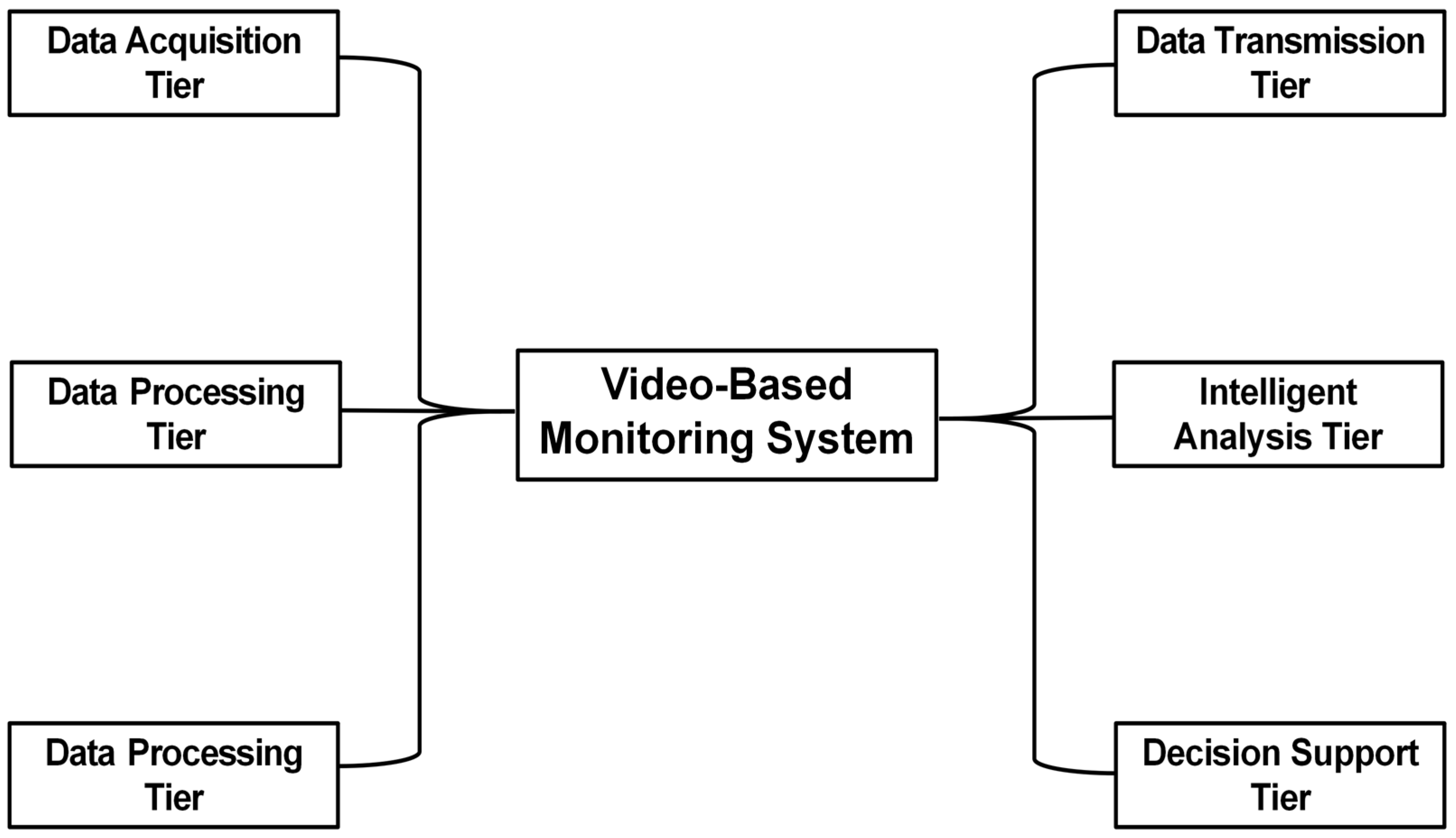
2.1. Composition of Video-Based Monitoring System
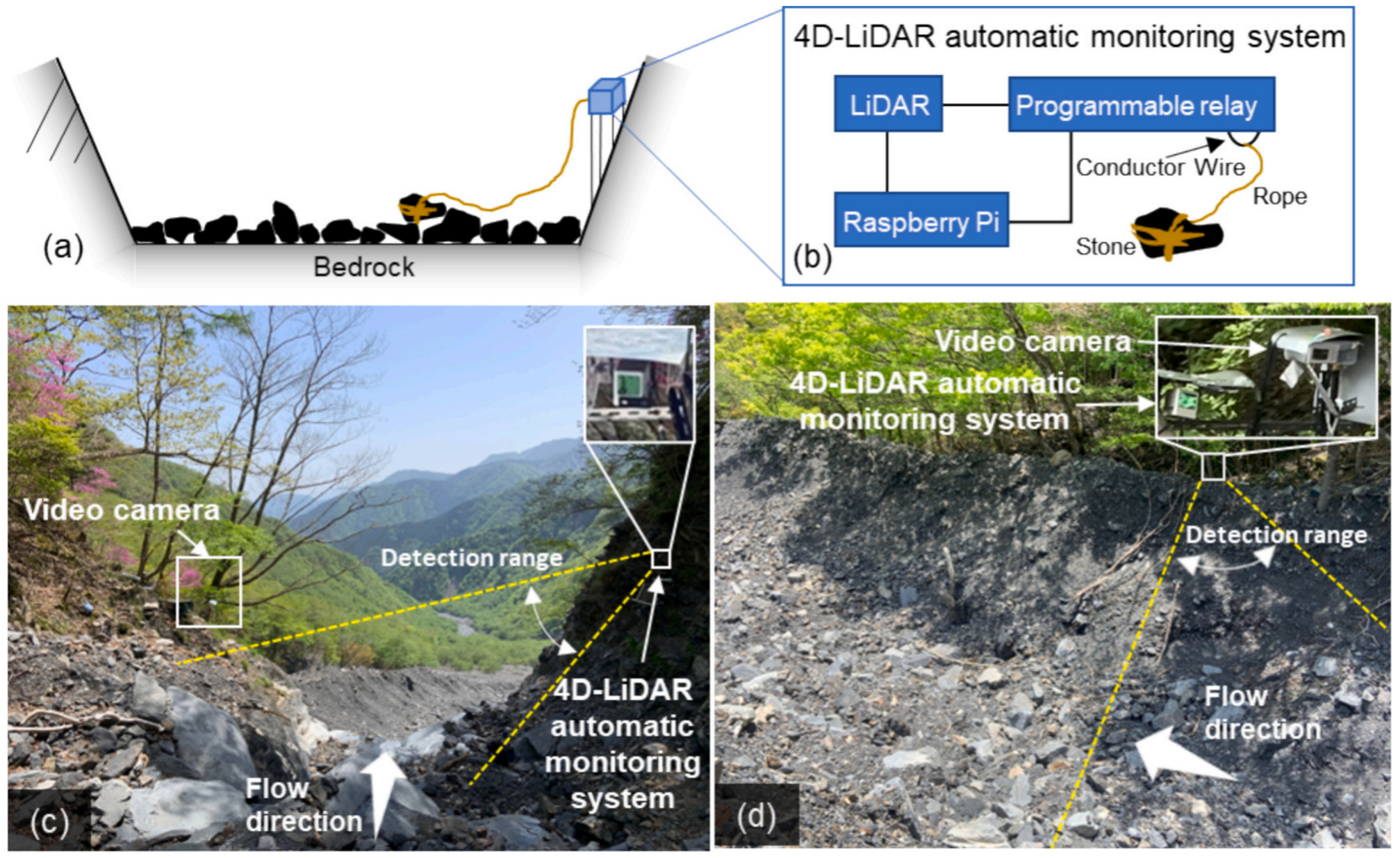
2.2. Video-Based Monitoring Technology
2.2.1. Close-Range Photogrammetry
2.2.2. Real-Time Monitoring
2.2.3. UAV Remote Sensing Monitoring
3. Video Image Processing Techniques
3.1. Machine Learning-Based Video Image Processing Techniques
3.1.1. Convolutional Neural Networks
3.1.2. Other Machine Learning Architectures
3.2. Multi-Source Data-Fused Video Image Processing Techniques
3.2.1. Data-Level Fusion
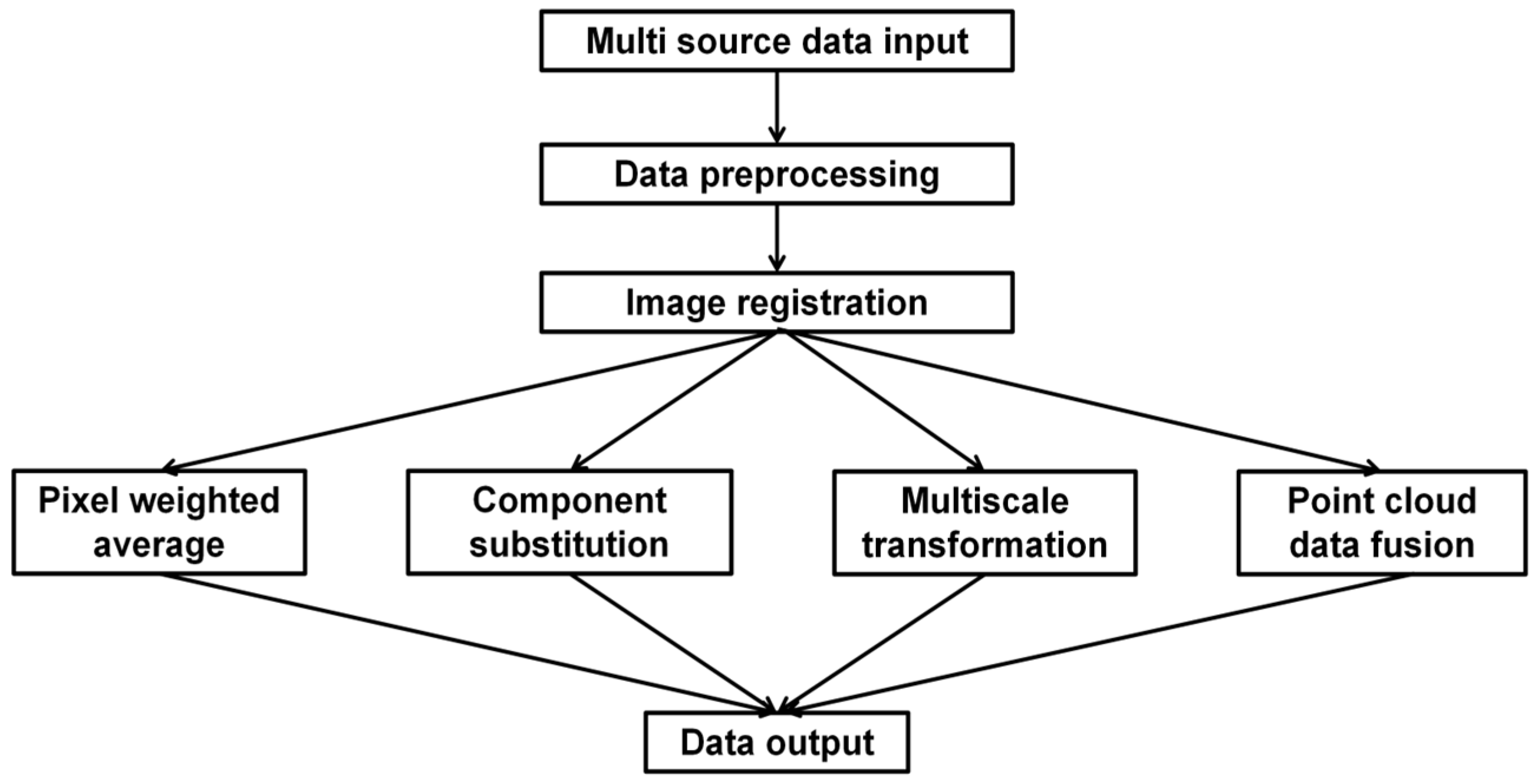
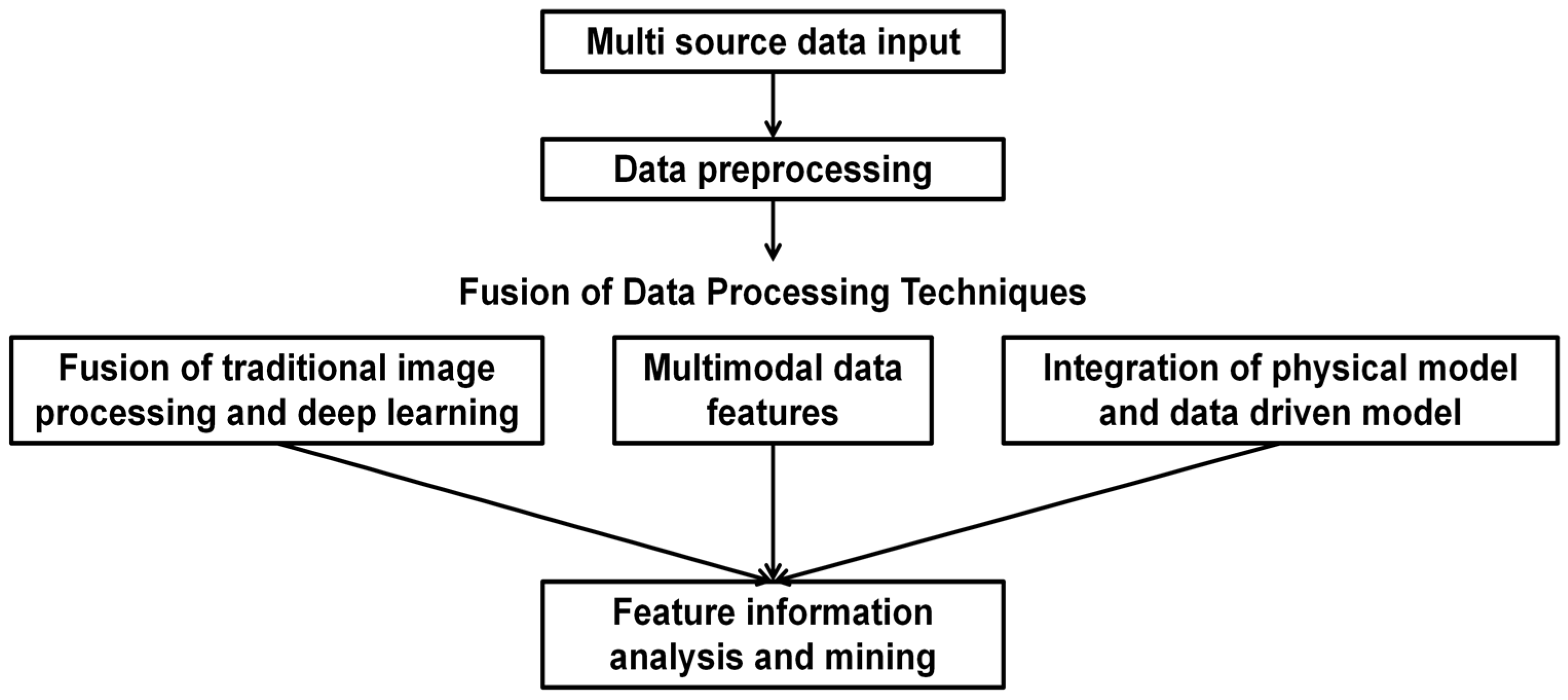
3.2.2. Fusion of Data Processing Techniques
4. Limitations and Future Research Directions
4.1. Limitations of the Video-Based Monitoring System
- Data Storage and Transmission: Video-based monitoring systems generate massive volumes of data, placing significant demands on data transmission [81]. For example, 24-h continuous monitoring of multiple potential landslides in a mountainous area can produce petabyte-scale datasets, potentially causing transmission delays that compromise real-time performance. In addition, the substantial storage requirements lead to high operational costs. To address these challenges, a “cloud–edge–end” collaborative computing framework can be implemented, performing data preprocessing and computational analysis at both the device and monitoring site levels, thereby alleviating transmission bottlenecks and reducing computational load.
- Environmental Adaptability: Geohazard-prone areas are often subject to harsh weather conditions. Heavy rain, dense fog, intense snowfall, and dust storms can obscure camera views, resulting in image blurring, reduced contrast, or complete failure to capture critical details such as landslide cracks or slope deformations [82,83]. Moreover, these hazards frequently occur in complex terrains, including mountainous regions and deep valleys, where line-of-sight obstructions from rocks or cliffs create monitoring blind spots, limiting measurement precision [84,85]. Dense vegetation during summer can further obscure landslide and rockfall masses, preventing optical imagery from capturing deformations in vegetated areas [86,87]. To overcome these limitations and enhance model generalization, multimodal data fusion and cross-modal learning can be employed. Integrating complementary instruments such as infrared thermal imagers and InSAR, combined with deep learning models that correlate visible light, infrared, and radar data, enables cross-modal information enhancement and improves monitoring performance under challenging environmental conditions.
- Monitoring Coverage: The field of view of video-based monitoring systems is typically limited to the immediate vicinity of the surveillance equipment [88,89], and measurement accuracy is affected by target size and camera acquisition angles [90]. Such systems primarily capture surface phenomena and cannot directly detect subsurface variations, including changes in soil or rock porosity and groundwater levels. They are also often insufficient for detecting subtle precursory deformations in the early stages of geohazard development [91]. To address these limitations, a unified data fusion platform can integrate spatiotemporal surface changes from video analysis, large-scale deformation rates from InSAR, and subsurface parameters from sensors, thereby improving overall monitoring accuracy and coverage.
4.2. Prospects of the Video-Based Monitoring System
- All-weather, omnidirectional, high-precision monitoring. Advances in technology will enable video-based monitoring systems to achieve all-weather, omnidirectional observation, allowing clear monitoring of geological hazards even under adverse environmental conditions [92]. Furthermore, these systems will also be capable of detecting minute changes, such as rock fractures and landslide displacements, providing essential data for quantitative assessment of disaster evolution.
- Technological integration and intelligent advancement. The integration of Internet of Things (IoT), 5G mobile communications, big data, and cloud computing will enhance video-based monitoring systems’ support for disaster risk reduction decision-making, improving proactive response capabilities [93]. Simultaneously, continuous advancements in artificial intelligence (AI) and machine learning (ML), including deep learning, computer vision, and big data analytics, will strengthen image recognition, real-time analysis, and scene understanding. This technological evolution is expected to enable more efficient and precise applications in geohazard monitoring [94].
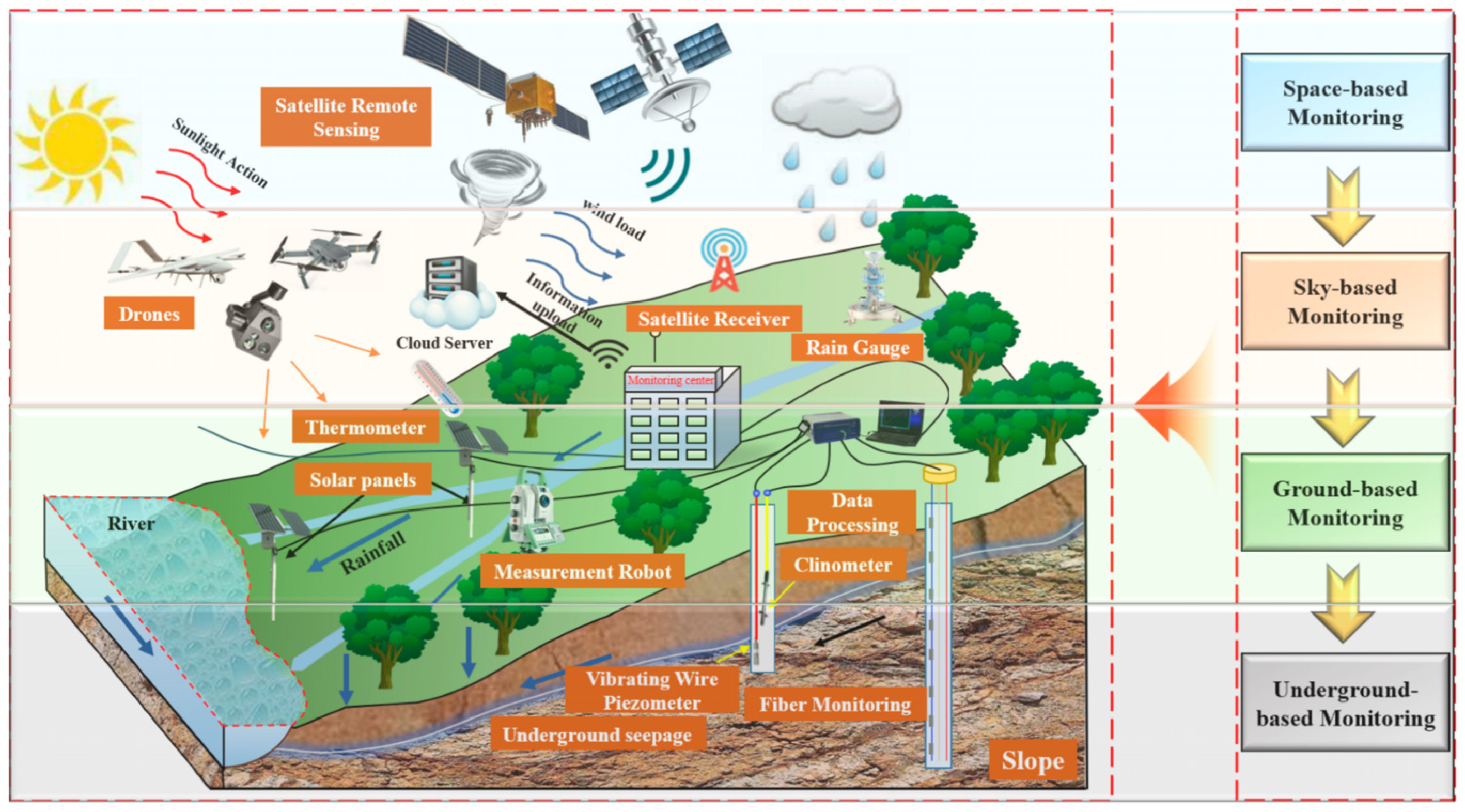
- Space–Air–Ground integrated monitoring. Combining video-based monitoring with satellite remote sensing and sensor networks facilitates the establishment of a Space–Air–Ground integrated early warning system [95,96]. This multi-dimensional, multi-tiered framework provides a more comprehensive and accurate characterization of hazard dynamics, significantly enhancing monitoring and early warning efficiency and precision.
- Multi-source data fusion. Integrating multi-source data addresses the limitations of individual monitoring techniques, enabling comprehensive, multi-level observation of geological hazards [97,98]. By consolidating and analyzing data from various departments and platforms, this approach helps break down information silos and promotes data sharing, improving both the accuracy and timeliness of early warnings [99]. Ongoing technological advances continue to refine multi-source data fusion methodologies, resulting in increasingly efficient real-time monitoring systems.
- Integration with emergency communication technologies. Linking video-based monitoring systems with emergency communication networks allows real-time video transmission from disaster sites. This provides visually intuitive information for command and rescue operations, substantially improving the speed and effectiveness of emergency response.
5. Conclusions
- Video-based monitoring technology employs video acquisition devices to capture images of geohazard sites. Owing to its broad spatial coverage, it can visually document the dynamic processes of hazards such as landslides and debris flows, thereby providing essential information for their early identification.
- Machine learning–based video processing techniques enable the automated analysis of image data, allowing for the identification of critical features such as surface cracks and landslide displacements. These capabilities substantially enhance the efficiency and accuracy of geohazard monitoring.
- By integrating multi-source data and diverse processing techniques, video-based monitoring systems can operate synergistically with instruments such as GNSS receivers and rain gauges. This integration enables cross-validation of observations, thereby substantially enhancing the reliability of early warning outcomes.
Author Contributions
Funding
Institutional Review Board Statement
Informed Consent Statement
Data Availability Statement
Acknowledgments
Conflicts of Interest
References
- Haque, U.; Blum, P.; da Silva, P.F.; Andersen, P.; Pilz, J.; Chalov, S.R.; Malet, J.-P.; Auflič, M.J.; Andres, N.; Poyiadji, E.; et al. Fatal landslides in Europe. Landslides 2016, 13, 1545–1554. [Google Scholar] [CrossRef]
- Gariano, S.L.; Guzzetti, F. Landslides in a changing climate. Earth-Sci. Rev. 2016, 162, 227–252. [Google Scholar] [CrossRef]
- Pei, J. Research on Video Monitoring Technology for Surface Deformation of Landslides. Master’s Thesis, Chinese Academy of Geological Scienses, Beijing, China, 2023. [Google Scholar]
- Liu, F.; Tian, X. Real-Time Monitoring and Early Warning System for Geological Hazards of Coal Mine Goafs in Karst Regions. Plant Maint. Eng. 2024, 140–143. [Google Scholar] [CrossRef]
- Li, N.; Qiu, H.; Zhai, H.; Chen, Y.; Wang, J. Monitoring and Analysis of Slope Geological Hazards Based on UAV Images. Appl. Sci. 2025, 15, 5482. [Google Scholar] [CrossRef]
- Prades-Valls, A.; Corominas, J.; Lantada, N.; Matas, G.; Núñez-Andrés, M.A. Capturing rockfall kinematic and fragmentation parameters using high-speed camera system. Eng. Geol. 2022, 302, 106629. [Google Scholar] [CrossRef]
- Yin, J.; Wang, H.F.; Wang, S.M.; Xu, F. Remote Video Surveillance Applications in Landslide Monitoring. Adv. Mater. Res. 2012, 594–597, 1086–1092. [Google Scholar] [CrossRef]
- Zhu, D.; He, L.; Zhou, W. Application of the Online Monitoring and Early-warning Techniques for Geological Hazards in Hydropower Plants. Hydropower New Energy 2017, 12, 1–5. [Google Scholar] [CrossRef]
- Hürlimann, M.; Coviello, V.; Bel, C.; Guo, X.; Berti, M.; Graf, C.; Hübl, J.; Miyata, S.; Smith, J.B.; Yin, H.-Y. Debris-flow monitoring and warning: Review and examples. Earth-Sci. Rev. 2019, 199, 102981. [Google Scholar] [CrossRef]
- Liao, X.; Sun, C. Application of Machine Vision Technology in Geological Disaster Monitoring and Early Warning. Electron. Technol. Softw. Eng. 2021, 17, 155–156. [Google Scholar] [CrossRef]
- Jafari, N.H.; Li, X.; Chen, Q.; Le, C.-Y.; Betzer, L.P.; Liang, Y. Real-time water level monitoring using live cameras and computer vision techniques. Comput. Geosci. 2021, 147, 104642. [Google Scholar] [CrossRef]
- Li, Y.; Sun, X.; Du, G.; Xu, G. Automated Monitoring of Slopes 4–6 at the Tailings Pond in the Pulang Mining Area, Yunnan Province. Commun. Sci. Technol. Heilongjiang 2024, 47, 10–12+16. [Google Scholar] [CrossRef]
- Que, Y.; Zhang, H.; Chen, T.; Chen, Y.; Zhu, Q. Research on On-line Monitoring of Geological Disaster of High Voltage Transmission Line Tower. J. Beijing Inst. Graph. Commun. 2018, 26, 90–92. [Google Scholar] [CrossRef]
- Tang, X. Application of High-Resolution UAV Remote Sensing Technology to Geological Route Selection for Mountain Highways. Master’s Thesis, Wuhan Institute of Technology, Wuhan, China, 2020. [Google Scholar]
- Ou, S.; Huang, J.; Li, J. Discussion on the Automatic Monitoring of Slope Geological Hazard. J. Huainan Vocat. Tech. Coll. 2015, 15, 10–13. [Google Scholar]
- Meng, Q. The Application of Low Power 3G network Video Surveillance System. Equip. Manuf. Technol. 2017, 11, 71–73. [Google Scholar]
- Zhang, Y.; Ji, B.; Ruan, J. Practice and thinking on intelligent perception mode of natural resources with tower-based monitor equipments. Nat. Resour. Informatiz. 2021, 5, 8–14. [Google Scholar]
- Qiao, S. Design and Implementation of an Intelligent Prevention and Control Information System for Geological Hazards. Consum. Electron. Mag. 2021, 7, 73, 75. [Google Scholar]
- Huo, D.; Zhang, B.; Peng, J.; Zeng, T.; Yang, H.; Hu, C. Review and prospective of landslide deformation monitoring. Geotech. Investig. Surv. 2015, 43, 62–67. [Google Scholar]
- Zhang, J.; Jiang, J.; Zhang, J. Application of digital close-range photogrammetry to the deformation-observing for buildings. J. Henan Polytech. Univ. (Nat. Sci.) 2004, 5, 356–358. [Google Scholar]
- Xu, W.; Li, P.; Sheng, Y.; Hu, Y. Landslide Monitoring Methods: A Review and Perspectives. Anhui Archit. 2020, 27, 92–94+102. [Google Scholar] [CrossRef]
- Wu, Y. Applied Research on Close-Range Photogrammetry for Slope Deformation Monitoring. Master’s Thesis, Kunming University of Science and Technology, Kunming, China, 2017. [Google Scholar]
- Wang, J. Application of Digital Close-Range Photogrammetry to the Deformation-Observing for Reservoir Edge. Geomat. Spat. Inf. Technol. 2012, 35, 9–11. [Google Scholar]
- Qing, Q.; Zhang, Z.; Li, J. Design of a Video Image-Based Early Warning System for Slope Safety. China Plant Eng. 2022, 9, 7–9. [Google Scholar]
- Wang, J.; Zou, J.; Wang, C.; Han, Z.; Li, X.; Chen, M. Monitoring method for borehole images of changes in overlying rock structure during coal mining. Sci. Rep. 2025, 15, 15495. [Google Scholar] [CrossRef] [PubMed]
- Zhang, Y.; Yuan, K.; Bilal, M.; He, J.; Xing, A. Dynamic Characteristics and Risk Assessment of the Yiziyan Rock Topples in Jinsha County, Guizhou, China. Rock Mech. Rock Eng. 2024, 57, 7473–7494. [Google Scholar] [CrossRef]
- Kaneko, T.; Imaizumi, F.; Osada, T.; Yousefi, S.; Takayama, S. Monitoring debris flow dynamics: Insights from 4D-LiDAR observations in Ohya landslide, Central Japan. Geomorphology 2025, 482, 109800. [Google Scholar] [CrossRef]
- Zhao, B.; Gao, L.; Wang, F. Analysis on Group Prevention and Warning System of Landslide Disaster Based on Video Monitoring Data and Artificial Intelligence. Henan Sci. Technol. 2021, 40, 27–29. [Google Scholar]
- Nie, D. Image-Based Displacement Monitoring of Rear Cracks in Landslides. Master’s Thesis, Chengdu University of Technology, Chengdu, China, 2019. [Google Scholar]
- Cheng, G.; Zhang, H.; Wang, Y.; Shi, B.; Zhang, L.; Wu, J.; You, Q.; Li, Y.; Shi, P. Research Trends and ‘Space-Sky-Ground-Underground’ Monitoring Technology Analysis of Landslide Hazard. Water 2024, 16, 2005. [Google Scholar] [CrossRef]
- Zhong, X.; Liang, G. The application of live monitoring system by video network in the prevention and treatment of the geological hazards—One Application Example in DongGuan City. J. Geol. Hazards Environ. Prot. 2007, 1, 96–99. [Google Scholar]
- Huang, X.; Niu, J.; Yang, Z.; Chen, G. Automated remote monitoring system for Lishan landslides in Xi’an City. Chin. J. Geol. Hazard Control 2013, 24, 92–96. [Google Scholar] [CrossRef]
- Zhao, X.; Li, L.; Li, Y.; Liu, T. Application of early warning technology to automatic monitoring of debris-flow-a case study of Wangmo river debris flow in Wangmo county, Guizhou province. J. Eng. Geol. 2014, 22, 443–449. [Google Scholar] [CrossRef]
- Lv, N. Intelligent Monitoring System for Geological Hazards on Expressways: Research and Application. Master’s Thesis, Chang’an University, Xi’an, China, 2019. [Google Scholar]
- Wu, L. Application of Portable UAV Rapid Mapping Technology in Geological Hazard Emergency Response. Sci. Technol. Innov. 2023, 5, 33–36. [Google Scholar]
- Xu, Q.; Guo, C.; Dong, X. Aerial Remote Sensing for Geological Hazards: A Review and Perspectives. Acta Geod. Cartogr. Sin. 2022, 51, 2020–2033. [Google Scholar]
- Han, W.; Ren, Y.; Zhao, S. Primary Usages of UAV Remote Sensing in Geological Disaster Monitoring and Rescuing. Geospat. Inf. 2011, 9, 6–8+163. [Google Scholar]
- Tian, Y. Application of UAV remote sensing technology in geological environmental disaster monitoring. Environ. Dev. 2019, 31, 102+104. [Google Scholar] [CrossRef]
- Zhao, X.; Hu, K.; Lu, X.; Yang, H. Precise detection method for mine geological disasters using low-altitude photogrammetry based on unmanned aerial vehicle. Sci. Surv. Mapp. 2014, 39, 49–52+64. [Google Scholar] [CrossRef]
- Yaqiu, Y.; Cunhao, J.; Jing, L.; Jie, W.; Xing, J.; Hao, W.; Yu, X.; Lushou, Z.; Wu, J.; Weng, C.H. Mining Ground Surface Information Extraction and Topographic Analysis Using UAV Video Data. E3S Web Conf. 2020, 194, 05030. [Google Scholar] [CrossRef]
- Wang, J.; Zhu, S.; Luo, X.; Chen, G.; Xu, Z.; Liu, X.; Li, Y. Refined micro-scale geological disaster susceptibility evaluation based on UAV tilt photography data and weighted certainty factor method in Mountainous Area. Ecotoxicol. Environ. Saf. 2020, 189, 110005. [Google Scholar] [CrossRef]
- Meng, Y.; Yuan, C.; Tian, B.; Wang, B.; Cai, Z.; Zhang, W.; Zhang, X. Slope Surface Displacement Monitoring Trial Using UAV Real-Time Kinematic and Photogrammetric Aerotriangulation. Prog. Geophys. 2022, 37, 2188–2195. [Google Scholar]
- Zhang, C.; Wang, X.; Zhang, E.; Wu, R.; Yu, X.; Luo, W. Technology and Application Research of Unmanned Aerial Vehicle in Landslide Geological Disaster Monitoring. J. Geomat. 2021, 46, 319–321. [Google Scholar] [CrossRef]
- Wang, S.; Tang, C.; He, J.; Zhang, W.; Fang, Q.; Cheng, X. Application of UAVs for Comprehensive Assessment of Geohazards in a High-Intensity Seismic Region. J. Eng. Geol. 2016, 24, 713–719. [Google Scholar] [CrossRef]
- Vivaldi, V.; Bordoni, M.; Mineo, S.; Crozi, M.; Pappalardo, G.; Meisina, C. Airborne combined photogrammetry—Infrared thermography applied to landslide remote monitoring. Landslides 2022, 20, 297–313. [Google Scholar] [CrossRef]
- Huang, H.; Long, J.; Lin, H.; Zhang, L.; Yi, W.; Lei, B. Unmanned aerial vehicle based remote sensing method for monitoring a steep mountainous slope in the Three Gorges Reservoir, China. Earth Sci. Inform. 2017, 10, 287–301. [Google Scholar] [CrossRef]
- Lian, X.; Li, Z.; Yuan, H.; Liu, J.; Zhang, Y.; Liu, X.; Wu, Y. Rapid identification of landslide, collapse and crack based on low-altitude remote sensing image of UAV. J. Mt. Sci. 2020, 17, 2915–2928. [Google Scholar] [CrossRef]
- Ma, J.; Liu, J.; Ming, J.; Sang, X. Geological hazard interpretation and hazard evaluation of open pit mines based on Unmanned Aerial Vehicle images. J. Phys. Conf. Ser. 2021, 2006, 012072. [Google Scholar] [CrossRef]
- Zhang, R.; Wang, Y. Research on Machine Learning with Algorithm and Development. J. Inf. Commun. 2016, 23, 10–18+24. [Google Scholar] [CrossRef]
- Fu, W.; Sun, T.; Liang, J.; Yan, B.; Fan, F. Review of Principle and Application of Deep Learning. Comput. Sci. 2018, 45, 11–15+40. [Google Scholar]
- LeCun, Y.; Bengio, Y.; Hinton, G. Deep learning. Nature 2015, 521, 436–444. [Google Scholar] [CrossRef]
- Zhou, F.; Jin, L.; Dong, J. Review of Convolutional Neural Network. Chin. J. Comput. 2017, 40, 1229–1251. [Google Scholar]
- Nguyen, B.-Q.-V.; Kim, Y.-T.; Song, C.-H. Landslide early warning based on retaining wall damage monitoring by real-time video. KSCE J. Civ. Eng. 2025, 29, 100129. [Google Scholar] [CrossRef]
- Wu, F.; Zhang, J.; Liu, D.; Maier, A.; Christlein, V. Deep learning-based debris flow hazard detection and recognition system: A case study. Sci. Rep. 2025, 15, 6789. [Google Scholar] [CrossRef]
- Pham, M.-V.; Kim, Y.-T. Debris flow detection and velocity estimation using deep convolutional neural network and image processing. Landslides 2022, 19, 2473–2488. [Google Scholar] [CrossRef]
- Patil, M.D.; Ahuja, S.; Michael, M.; Selvan, M.; Mantri, V.; Vyawahare, V.A. Natural disaster detection in social media and satellite imagery. ITM Web Conf. 2022, 44, 03010. [Google Scholar] [CrossRef]
- Li, Q.; Zhao, X.; Bai, X.; Qi, Y. Assumption and Application of AI Technology in Highway Geohazards Monitoring in Beijing. J. Munic. Technol. 2019, 37, 41–43. [Google Scholar]
- He, F.; Liu, H.; Liu, C.; Bao, G. Analysis of radar technology identification model for potential geologic hazard based on convolutional neural network and Harris Hawks optimization algorithm. Soft Comput. 2021, 27, 3493–3507. [Google Scholar] [CrossRef]
- Hu, M.; Liu, D.; Sang, X.; Zhang, S.; Chen, Q. Intelligent Recognition Method for Debris Flow Occurrence Scenarios from Surveillance Video. Comput. Mod. 2024, 3, 41–46. [Google Scholar]
- Wang, H.; Liu, J.; Zeng, S.; Xiao, K.; Yang, D.; Yao, G.; Yang, R. A novel landslide identification method for multi-scale and complex background region based on multi-model fusion: YOLO + U-Net. Landslides 2023, 21, 901–917. [Google Scholar] [CrossRef]
- Zhou, J.; Ju, N.; Zhang, Y.; Tian, H.; He, C. A Study on Video Tracking and Detection of Debris Flows. Adv. Earth Sci. 2025, 40, 388–400. [Google Scholar]
- Li, Y.; Li, J.; Pei, J.; Chen, W.; Luo, G.; Xia, G. Application of non-contact video quantitative measurement method in reservoir bank landslide monitoring. Front. Earth Sci. 2024, 12, 137086. [Google Scholar] [CrossRef]
- Chandra, N.; Vaidya, H.; Chauhan, P.; Shaw, R. YOLOv5 Based on Attention Mechanism for Landslide Information Extraction from Multi-source Remote Sensing Images of Diverse Geological Environments. J. Indian Soc. Remote Sens. 2025, 1–21. [Google Scholar] [CrossRef]
- Zhang, L.; Zheng, X.; Ma, J.; Mo, S.; Peng, F. A Hybrid Deep Learning Model for Detecting and Classifying Debris Flows and Landslides in High-precision Aerial Images. Eng. Lett. 2025, 33, 3335. [Google Scholar]
- Qi, Y.; Wang, Q. Review of multi-source data fusion algorithm. Aerosp. Electron. Warf. 2017, 33, 37–41. [Google Scholar] [CrossRef]
- Deng, Y.; Gao, Q.; Wang, X.; Fan, X. A large-scale rock avalanche-debris flow cascading hazard in the Sedongpu catchment, southeastern Tibetan Plateau. Landslides 2024, 22, 109–120. [Google Scholar] [CrossRef]
- Yang, H.; Huang, G.; Chen, C.; Yang, Y.; Wang, Q.; Dai, X. Method for evaluation of geological strength index of carbonate cliff rocks: Coupled hyperspectral-digital borehole image technique. J. Rock Mech. Geotech. Eng. 2024, 16, 4204–4215. [Google Scholar] [CrossRef]
- Zeng, T.; Yang, W.; Jian, J.; Li, X.; Hu, G.; Hu, B. The Processing Technology on Multi-Sensors RS Image and Methods of Extracting Earthquake Damage Information of Wenchuan Earthquake Hit-area. Areal Res. Dev. 2009, 28, 141–144. [Google Scholar]
- Zhang, Y.; He, J.; Yuan, K.; Xu, X.; Zhou, Y.; Zhang, H.; Xing, A.; Cui, J. Investigation on deformation behavior of unstable rock belt based on multi-source data analysis. Bull. Eng. Geol. Environ. 2024, 84, 5. [Google Scholar] [CrossRef]
- Dai, Z.; Zhang, Y.; Zhang, C.; Fu, X.; Zhang, P.; Ye, R. A photographic method to identify reservoir geohazards induced by rock mass deterioration of hydro-fluctuation belt. Front. Earth Sci. 2024, 12, 1365272. [Google Scholar] [CrossRef]
- Wang, R.; Xiong, S.; Nie, H.; Liang, S.; Qi, Z.; Yang, J.; Yan, B.; Zhao, F.; Fan, J.; Tong, L.; et al. Remote Sensing Technology and its Application in Geological Exploration. Acta Geol. Sin. 2011, 85, 1699–1743. [Google Scholar]
- Zhao, J.; Ke, Z.; Chen, G.; Yuan, L.; Gu, M.; Wang, T. Implementation of the Geological Hazard Monitoring and Early Warning System Based on Multi-source Spatial Data—A Case Study of Deqin County, Yunnan Province. J. Spatio-Temporal Inf. 2017, 24, 35–41. [Google Scholar]
- Xu, Q.; Dong, X.; Li, W. Integrated Space-Air-Ground Early Detection, Monitoring and Warning System for Potential Catastrophic Geohazards. Geomat. Inf. Sci. Wuhan Univ. 2019, 44, 957–966. [Google Scholar] [CrossRef]
- Liu, J.; Ma, J.; Zhang, G.; Wang, H.; Chen, T.; Zhang, Z.; He, X.; Jiang, S.; Li, Y.; Zeng, G. Large deformation mechanisms of the Xiaochatou landslide reactivated by the impoundment of the Wudongde reservoir based on multisource data and the material point method (MPM). Landslides 2025, 22, 4061–4076. [Google Scholar] [CrossRef]
- Shi, L.; Peng, F. A Smart Monitoring System for Highway Slopes Based on Multi-Sensor Data Fusion. China ITS J. 2024, S1, 418–422. [Google Scholar] [CrossRef]
- Deng, F.; Qing, Q.; Hou, K. Design of an Integrated Early Warning System for Geohazards Based on Video Surveillance and Image Analysis. Electron. Technol. Softw. Eng. 2022, 2, 181–184. [Google Scholar] [CrossRef]
- Chang, J.; Yang, C.; Chao, W.; Ku, C.; Huang, M.; Hsieh, T.; Hung, C. Unraveling landslide failure mechanisms with seismic signal analysis for enhanced pre-survey understanding. Nat. Hazards Earth Syst. Sci. 2025, 25, 451–466. [Google Scholar] [CrossRef]
- Navarro, J.; Seidl, T.; Hartlieb, P.; Sanchidrián, J.A.; Segarra, P.; Couceiro, P.; Schimek, P.; Godoy, C. Blastability and Ore Grade Assessment from Drill Monitoring for Open Pit Applications. Rock Mech. Rock Eng. 2021, 54, 3209–3228. [Google Scholar] [CrossRef]
- Wang, X.; Yin, Y.; Zhang, Z.; Wang, L.; Huang, B. Research on the failure mode and kinematics of high-steep rock slides based on video target tracking: A case study of Bijiashan rock fall in Wu Gorge in the Three Gorges Reservoir area, China. Geomorphology 2025, 473, 109638. [Google Scholar] [CrossRef]
- Tang, J.; Tang, J.; Zhong, P.; Li, D.; Liu, F. Study of intelligent monitoring and warning system for reservoir geological disasters and its engineering application. Express Water Resour. Hydropower Inf. 2020, 41, 56–64. [Google Scholar] [CrossRef]
- Xu, L.; Wang, K.; Liu, W. The Future of Safety Monitoring: A Hybrid Sensor System Combining GNSS, Video, and MEMS Accelerometry. Sens. World 2024, 30, 1–6. [Google Scholar] [CrossRef]
- Xu, L.; Cheng, G.; Zhu, H. Research Review of Landslide Monitoring Methods Based on Integration of Space-Air-Ground-Interior. Laser Optoelectron. Prog. 2021, 58, 98–111. [Google Scholar]
- Chen, L. Early Warning Techniques for Debris Flows in the Wenchuan Earthquake Zone: A Case Study from Three Major Areas in Sichuan Province. Master’s Thesis, Chengdu University of Technology, Chengdu, China, 2013. [Google Scholar]
- Xiang, X.; Wang, Y. Application of Close-range Photogrammetry in Slope Deformation Monitoring. Coal Geol. China 2010, 22, 66–69. [Google Scholar]
- Fang, Q.; Shi, Y.; Hou, J.; Meng, L.; Zheng, S.; Cheng, B.; Tang, Q. Research on Designing and Realizing of Early Warning System of Online Monitoring and Emergency Response of Transmission Line in Three Gorges Region. J. China Three Gorges Univ. (Nat. Sci.) 2016, 38, 73–80. [Google Scholar] [CrossRef]
- Yang, Y.; Song, S.; Yue, F.; He, W.; Shao, W.; Zhao, K.; Nie, W. Superpixel-based automatic image recognition for landslide deformation areas. Eng. Geol. 2019, 259, 105166. [Google Scholar] [CrossRef]
- Yu, Y.; Jiang, H. An IoT and Cloud Computing-Based Platform for Automated Landslide Monitoring: Implementation at the Miaolongjing Landslide, China. Huabei Nat. Resour. 2023, 4, 148–151. [Google Scholar]
- Li, Y.; Yang, Y.; Zhao, Z.; Wu, B. GIS-Based Spatial Optimization for Deploying Epidemic Prevention Video Surveillance in the Xishuangbanna Border Area. Remote Sens. Nat. Resour. 2022, 34, 194–202. [Google Scholar]
- Xiao, G.; Deng, X.; Wei, S. A Monitoring Method Based on Quantitative Analysis of Videos and Images. J. Phys. Conf. Ser. 2021, 2026, 012019. [Google Scholar] [CrossRef]
- Wang, J.; Ye, M.; Ma, F.; Li, K.; Ding, K. Design and Implementation of the Rockfall Monitoring and Warning System Based on Video Image Identification. J. Basic Sci. Eng. 2014, 22, 952–963. [Google Scholar]
- Zhao, C.; Zhao, X. Design and Analysis of Video Monitoring System for Transmission Line Tower Foundation Collapse. Telecom Power Technol. 2018, 35, 134–135+137. [Google Scholar] [CrossRef]
- Xie, Y. Development and Implementation of an Intelligent Monitoring Framework for Highway Slopes Based on Multi-Source Data Fusion. Fujian Constr. Sci. Technol. 2025, 4, 85–88. [Google Scholar]
- Huang, J.; Ju, N.; He, C.; Xiao, Y. Establishment of early geohazard warning system using modern information technology. J. Eng. Geol. 2015, 23, 140–147. [Google Scholar] [CrossRef]
- Zhao, Z.; Sun, H.; Zhang, N.; Xing, T.; Cui, G.; Lai, J.; Liu, T.; Bai, Y.; He, H. Application of unmanned aerial vehicle tilt photography technology in geological hazard investigation in China. Nat. Hazards 2024, 120, 11547–11578. [Google Scholar] [CrossRef]
- Cheng, G.; Wang, Z.; Li, G.; Ni, Y.; Xu, L. A Visualized Bibliometric Analysis of Landslide Monitoring Research in China. China Saf. Sci. J. 2022, 32, 172–179. [Google Scholar] [CrossRef]
- He, C. Development and Application of Key Technologies for a Real-Time Landslide Monitoring and Early Warning System. Doctoral Dissertation, Chengdu University of Technology, Chengdu, China, 2020. [Google Scholar]
- Deng, L.; Yuan, H.; Zhang, M.; Chen, J. Advances in Landslide Deformation Monitoring and Early Warning Technologies. J. Tsinghua Univ. (Sci. Technol.) 2023, 63, 849–864. [Google Scholar] [CrossRef]
- Liu, Q.; Zhang, B.; Zhao, B.; Zhong, Y.; Lu, X.-Y.; Zhou, J.-M. Stability of the Hailuogou glacier during the “9.5” Luding Earthquake: A preliminary assessment based on multi-source observations. J. Mt. Sci. 2022, 19, 3037–3050. [Google Scholar] [CrossRef]
- Fan, T.; Wu, Q.; Yu, Y.; Zheng, J.; Zheng, Z.; Guan, G.; Chen, J.; Su, Z. Design and Realization of Nanping Geological Disaster Prevention and Control Command Platform. Geol. Fujian 2022, 41, 76–81. [Google Scholar]



| Methods | Advantages | Limitations |
|---|---|---|
| CNN | Strong feature extraction capability and migration capability | Lack of positioning ability and time series modeling ability |
| TSN | Strong time series modeling ability and suitable for long sequence analysis | Complex calculation and difficult to realize |
| U-net | Pixel level accurate segmentation and boundary alignment | Absence of temporal modeling capacity and high computational demand |
| YOLO | High real-time performance and applicable to global reasoning | Rough positioning accuracy and insensitive to small targets |
Disclaimer/Publisher’s Note: The statements, opinions and data contained in all publications are solely those of the individual author(s) and contributor(s) and not of MDPI and/or the editor(s). MDPI and/or the editor(s) disclaim responsibility for any injury to people or property resulting from any ideas, methods, instructions or products referred to in the content. |
© 2025 by the authors. Licensee MDPI, Basel, Switzerland. This article is an open access article distributed under the terms and conditions of the Creative Commons Attribution (CC BY) license (https://creativecommons.org/licenses/by/4.0/).
Share and Cite
Dong, H.; Sheng, S.; Xu, C. A Review of Video-Based Monitoring Systems for Geohazard Early Warning. Sensors 2025, 25, 7385. https://doi.org/10.3390/s25237385
Dong H, Sheng S, Xu C. A Review of Video-Based Monitoring Systems for Geohazard Early Warning. Sensors. 2025; 25(23):7385. https://doi.org/10.3390/s25237385
Chicago/Turabian StyleDong, Haoran, Shuzhong Sheng, and Chong Xu. 2025. "A Review of Video-Based Monitoring Systems for Geohazard Early Warning" Sensors 25, no. 23: 7385. https://doi.org/10.3390/s25237385
APA StyleDong, H., Sheng, S., & Xu, C. (2025). A Review of Video-Based Monitoring Systems for Geohazard Early Warning. Sensors, 25(23), 7385. https://doi.org/10.3390/s25237385