
You are currently viewing a new version of our website. To view the old version click .
Sensors
  • Article
  • Open Access

26 September 2024

Analysis of Advanced Driver-Assistance Systems for Safe and Comfortable Driving of Motor Vehicles


Faculty of Navigation, Gdynia Maritime University, 81-225 Gdynia, Poland
This article belongs to the Special Issue Advanced Sensing Techniques for Autonomous Vehicles and Advanced Driver Assistance Systems (ADAS): 2nd Edition

Abstract

This paper aims to thoroughly examine and compare advanced driver-assistance systems (ADASs) in the context of their impact on safety and driving comfort. It also sought to determine the level of acceptance and trust drivers have in these systems. The first chapter of this document describes the sensory detectors used in ADASs, including radars, cameras, LiDAR, and ultrasonics. The subsequent chapter presents the most popular driver assistance systems, including adaptive cruise control (ACC), blind spot detection (BSD), lane keeping systems (LDW/LKS), intelligent headlamp control (IHC), and emergency brake assist (EBA). A key element of this work is the evaluation of the effectiveness of these systems in terms of safety and driving comfort, employing a survey conducted among drivers. Data analysis illustrates how these systems are perceived and identified areas requiring improvements. Overall, the paper shows drivers’ positive reception of ADASs, with most respondents confirming that these technologies increase their sense of safety and driving comfort. These systems prove to be particularly helpful in avoiding accidents and hazardous situations. However, there is a need for their further development, especially in terms of increasing their precision, reducing false alarms, and improving the user interface. ADASs significantly contribute to enhancing safety and driving comfort. Yet, they are still in development and require continuous optimization and driver education to fully harness their potential. Technological advancements are expected to make these systems even more effective and user-friendly.

1. Introduction

The number of cars equipped with modern systems that highly support drivers increases yearly. Many science fiction authors wrote about it, and this motif also appeared in films of this genre—about cars moving without a driver. This fanciful vision is now becoming a reality. All this is due to the dynamic development of the automotive industry, particularly ADASs (advanced driver-assistance systems), which turn our cars into vehicles that move without the participation of a driver.
ADAS—a set of advanced driver-assistance systems. No single solution can be called ADAS, and it is more of an idea than a tool. In line with this idea, various sets of driver assistance systems are created, the purpose of which is to support the person driving the vehicle by:
  • increasing driving safety;
  • improvement of driving comfort.
Currently, we have many ADASs, each having different complexity, values, and components [1]. There are really simple ADASs, based solely on the operation of a video recorder (camera), and almost space-like ones, where components of the drive, suspension, and braking systems cooperate with each other, as well as a whole network of complex sensors. Therefore, this paper analyzes in detail and describes only some ADASs [2]—the most important, as well as those that have the greatest impact on improving driver safety [3]. This paper will refer to practical and theoretical aspects because advanced driver-assistance systems are very complex systems, and their intricate design is constantly enriched with innovative solutions. The materials relied primarily on professional literature, scientific publications, articles from industry magazines, and materials publicly available on websites. As part of this paper, a survey was conducted to collect drivers’ opinions on their experiences using these technologies and how they affect driving safety and comfort. The third chapter describes the detailed survey methodology and presents the results and conclusions.
The ADAS will undoubtedly control the future development of the automotive industry. This is indicated, among others, by orders of state and EU administrations. Changes to EU law were proposed by the European Commission and supported by the European Parliament and representatives of Member States, which assume that from 2022, every car of a new model or generation should be equipped with the ADAS. For example, passenger cars will have to be equipped with a speed limit assistant, a lane-keeping system, and a tire pressure measurement system, while trucks and buses will have an advanced emergency braking system. Moreover, starting in 2024, all cars must be equipped with the so-called “black boxes” recording events and trucks—with the new BLIS (blind spot information system), improving cyclists’ safety in the so-called blind spot. Two years later, the requirement to use driver fatigue detection systems will also come into force. At the latest, starting in 2029, the requirement to introduce the DVS (direct visibility standard) in trucks will come into force, which requires the use of cameras or additional mirrors [4]. Although the abovementioned regulations have not yet been officially adopted and are subject to further legislative procedures, we can confidently expect their approval [5].
The standard ADAS, with which modern cars are increasingly equipped at the factory, includes active cruise control, lane keeping assistant, blind spot monitoring system, road sign recognition system, and adaptive headlight system [6]. Increasingly, the set of ADASs also includes a traffic jam assistant or a parking assistance system.

2. Description and Operation of Sensors in Advanced Driver-Assistance Systems
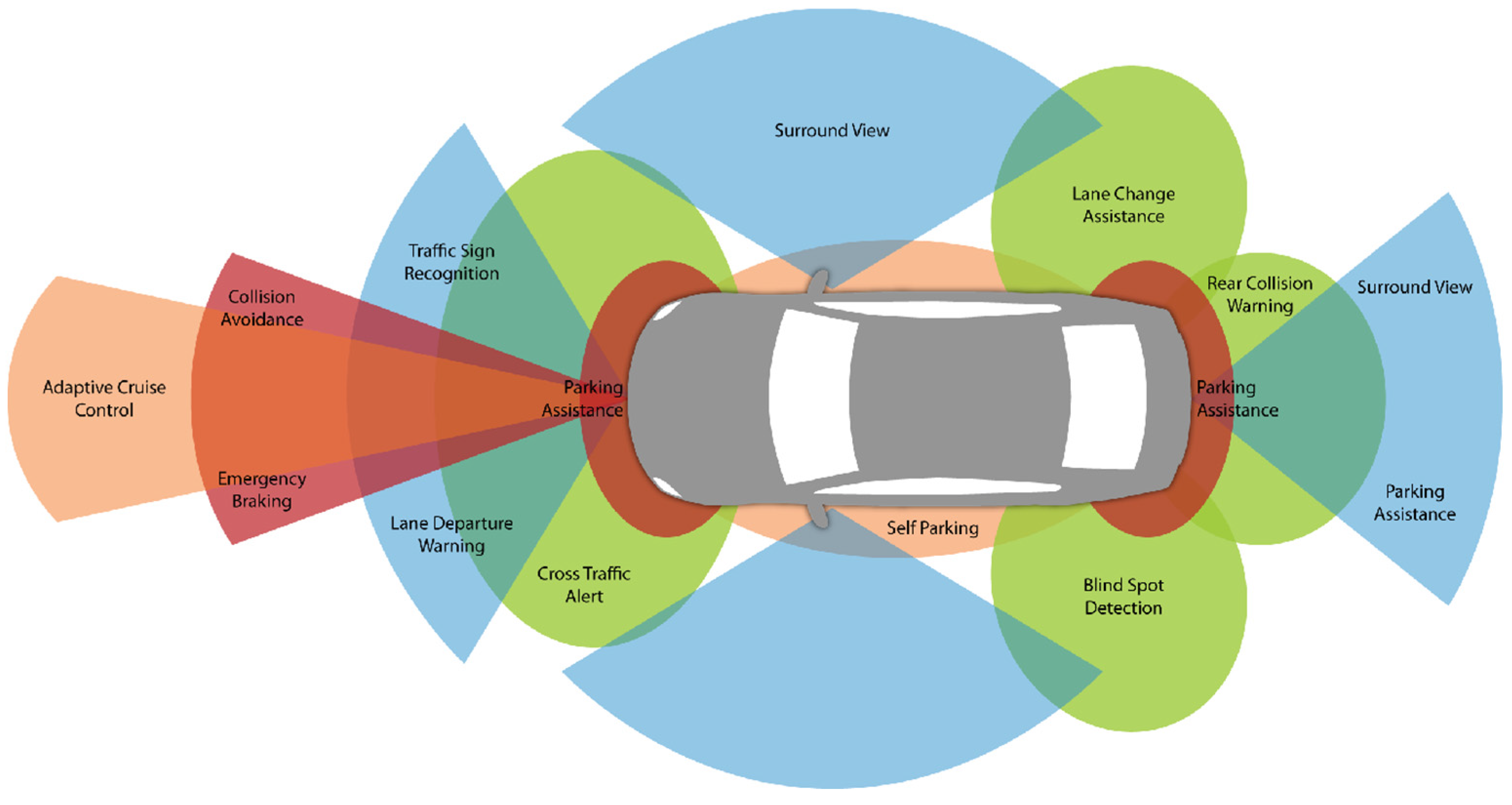
Advanced driver-assistance systems operate primarily by observing the environment in which the car is moving [7]. This requires numerous sensors and cameras. Efficiently functioning sensors improve safety, increase situational awareness, and reduce the risks associated with driving. These systems alert the driver when potential road hazards are detected [8] (see Figure 1).
The data are analyzed and processed by software that uses advanced algorithms to identify potential threats or situations requiring the driver’s attention. Some systems require information from several sensors simultaneously to function properly. Based on these analyses, ADASs can generate warning signals, activate driving assistant or emergency braking, and even take autonomous actions to prevent collisions or minimize the consequences of accidents [9]. The ADAS driver-assistance system package may have different sensor configurations depending on the car’s age, equipment level, selected version, and whether it belongs to a specific segment [10].
Figure 1. Location of ADASs in the vehicle [11].

2.1. Radar Sensors

Radars are very important elements of the ADAS. As the definition suggests, this device works thanks to the ability to receive radio waves. Initially, radars were important primarily in military operations—for detecting planes, ships, and missiles, determining the direction of movement of objects, and assessing distance, size, and measuring speed. Over time, the advantages of these devices have also been noted in more peaceful fields, such as air or surface traffic control, and they are also useful in meteorology (for detecting clouds), geology (for penetrating the ground), glaciology (studying glaciers), geophysics, or astronomy [12]. We cannot forget radars’ importance in road safety in all countries—they are a basic tool for police work, regardless of geographical location [13].
Radar sensors are devices that use electromagnetic waves to detect objects in space. For this purpose, the radar sends a beam of microwave signal, which is then reflected from objects. The echo, or reflected signal, returns to the radar, which is later filtered and processed. Although the operating principle of all radars is based on similar assumptions, the data collected by individual radars differ significantly. Sensors placed in cars can precisely determine the vehicle’s surroundings. Radar reflection analysis provides information about the type of object from which the electromagnetic wave was reflected. The waves are reflected non-uniformly, depending on the material the object is made of, its shape and, above all, its predisposition to reflect electromagnetic waves. Based on a detailed analysis of reflection data, engineers create precise detection algorithms that help determine the type of object, e.g., pedestrians, cyclists, sidewalk curbs, or road signs [14]. This and similar information are collected by the radar in real time and then delivered to subsequent components of the car’s onboard computer. The provided information is then processed and transported to other modules that improve the safety and comfort of car users. Radar sensors are installed in passenger cars near the front license plate. This location of the radar allows for precise observation of the car’s surroundings [15]. To increase the precision of the radar, it is often combined with other sensors, e.g., cameras, which allow for a more accurate analysis of the space in which the car is moving [16].

2.2. A Camera or Set of Cameras

Cameras are usually placed on the windshield. This is the most popular and cheapest solution, on which the simplest ADASs are also based. In more advanced systems, it is only an important element, but not the only one. In more complex ADASs, we deal with many cameras that provide a full 360° overview of the field around the vehicle. Cameras of this type are placed in the front bumper, grill, under the side mirrors, or the trunk lid. The possibility for drivers to purchase and install cameras on their own on the windshield has contributed to the growing popularity of cameras and, consequently, to improved road safety. These devices have very good optical sensors and image processors, which can be used effectively. The cameras can analyze hundreds of details on the route that the driver may miss while driving.
Cameras used in ADASs often operate on the principle of digital image processing, which enables precise data collection and processing. A standard camera system consists of optical components, including a lens that collects light rays and transforms them into an image on a photosensitive matrix. The size of the matrix and the type of sensor used, i.e., CMOS or CCD, are important in converting light into an electrical signal. The information from the matrix is then processed by an electronic system that digitally converts the image and transmits it as data to the ADAS.
Cameras in ADASs play an essential role in improving road safety by offering many functions. The first is the recognition of road signs, including speed limit signs, stop signs, and turn restrictions. The ADAS provides the driver with up-to-date information about road regulations, preventing potential violations. Another function of the cameras is lane monitoring, which allows the driver to be warned of dangers, such as approaching a double solid line. The cameras also detect other vehicles and pedestrians, allowing the system to respond to potential threats, such as activating emergency braking or displaying warnings. The cameras are also useful when parking, providing images of the front and rear of the vehicle on a screen in the cabin. This facilitates precise maneuvering when parking, preventing collisions. Additionally, cameras can monitor driver behavior, detecting fatigue and suggesting the need for a break. The last important function is maintaining the appropriate distance and adaptive cruise control, which uses cameras to control the distance from the vehicle in front and adapt the speed to the traffic on the road. This ensures a smoother and safer ride, especially in difficult traffic conditions.

2.3. LiDAR (Light Detection and Ranging)

It is a combination of a laser and a telescope; the device works on a similar principle to radar but uses a laser light beam instead of radio microwaves [17]. The principle of its operation is based on sending light pulses of a specific wavelength. The light scattered along the way is constantly observed using a telescope and recorded using a detector, photomultiplier, and cameras. Finally, the data go to the computer module, which is analyzed in detail. The principle of operation of LiDAR technology allows for much greater precision compared to radar technologies currently installed in new cars and designed to analyze the vehicle’s surroundings [18]. Currently, two technologies are mainly used. One involves using a short laser pulse—up to 150,000 pulses can be generated per second. If such an impulse hits an object, e.g., another car, it is reflected, and the distance from the object, its position, and ultimately its shape are determined based on the so-called time of flight. The second technology involves emitting light continuously. The phase change between the received and sent pulse is analyzed in this case. Radio waves have much less absorption than light waves when in contact with various objects. Thanks to this, LiDAR technology can obtain a much higher resolution and thus “draw” a much more accurate terrain map with more details [19]. High-class LiDAR sensors can recognize details of a few centimeters at a distance of more than 100 m. LiDAR sensors also have disadvantages, i.e., a very specific range of “visibility” with a given resolution. A single sensor can collect data from the car’s surroundings with an accuracy of a specific distance from the vehicle, e.g., up to 30 m. The second sensor will have “visibility” in the 30–200 m range. In complex systems, one LiDAR module may contain up to several sensors, so that it can exclude the mentioned defect and be able to provide observations of the entire desired space around the car [20].

2.4. Ultrasounds

Ultrasound is sound waves whose frequency is too high for humans to hear. The frequency of 20 kHz is considered to be the upper limit of audible frequencies and the lower limit of ultrasound, although, for many people, this limit is much lower. The conventional upper limit of ultrasound is the frequency of 1 GHz. Ultrasonic sensors in ADASs emit ultrasonic waves, which are then received by the sensor after reflection from an obstacle. By analyzing the return time of these waves, the system can precisely determine the distance to detected objects. Ultrasonic waves with a frequency above 20 kHz allow for accurate measurements at close range, which is crucial for many applications in driver assistance systems [21]. These sensors have a limited measurement range, typically effective from a few centimeters to several meters. This limitation is offset by strategically placing multiple sensors around the vehicle, allowing for more complete coverage of the space around it. In practice, ultrasonic sensors are used in various aspects of driver assistance, including parking assistance systems, detection of obstacles in the blind spot, and assistance in low-speed maneuvers.
Their integration with other sensor systems, such as cameras, radars, or LiDARs, creates more comprehensive and effective ADASs. This synergy of technologies provides a more comprehensive picture of the road situation, which is essential for the precise operation of driver assistance systems. Despite many advantages, ultrasonic sensors also have their limitations. Their effectiveness may be limited in fast and dynamic driving scenarios due to their relatively short operating range. Additionally, different weather conditions, such as rain or snow, can affect the effectiveness of these sensors. Another challenge is acoustic interference in urban environments due to other sound sources. Ultrasonic sensors are an important element of modern ADASs, offering precise information about the vehicle’s surroundings, although external and technological factors may limit their effectiveness. The development of ultrasonic technologies and their integration with other sensor systems will continue to be key to further developing and improving ADASs.

4. Assessment of the Effectiveness of ADASs in the Area of Safety and Driving Comfort in the Opinion of Drivers

In recent years, advanced driver-assistance systems have become an important element of modern vehicles, aiming to increase driving safety and comfort.

4.1. The Role of Driver-Assistance Systems in Improving Road Safety

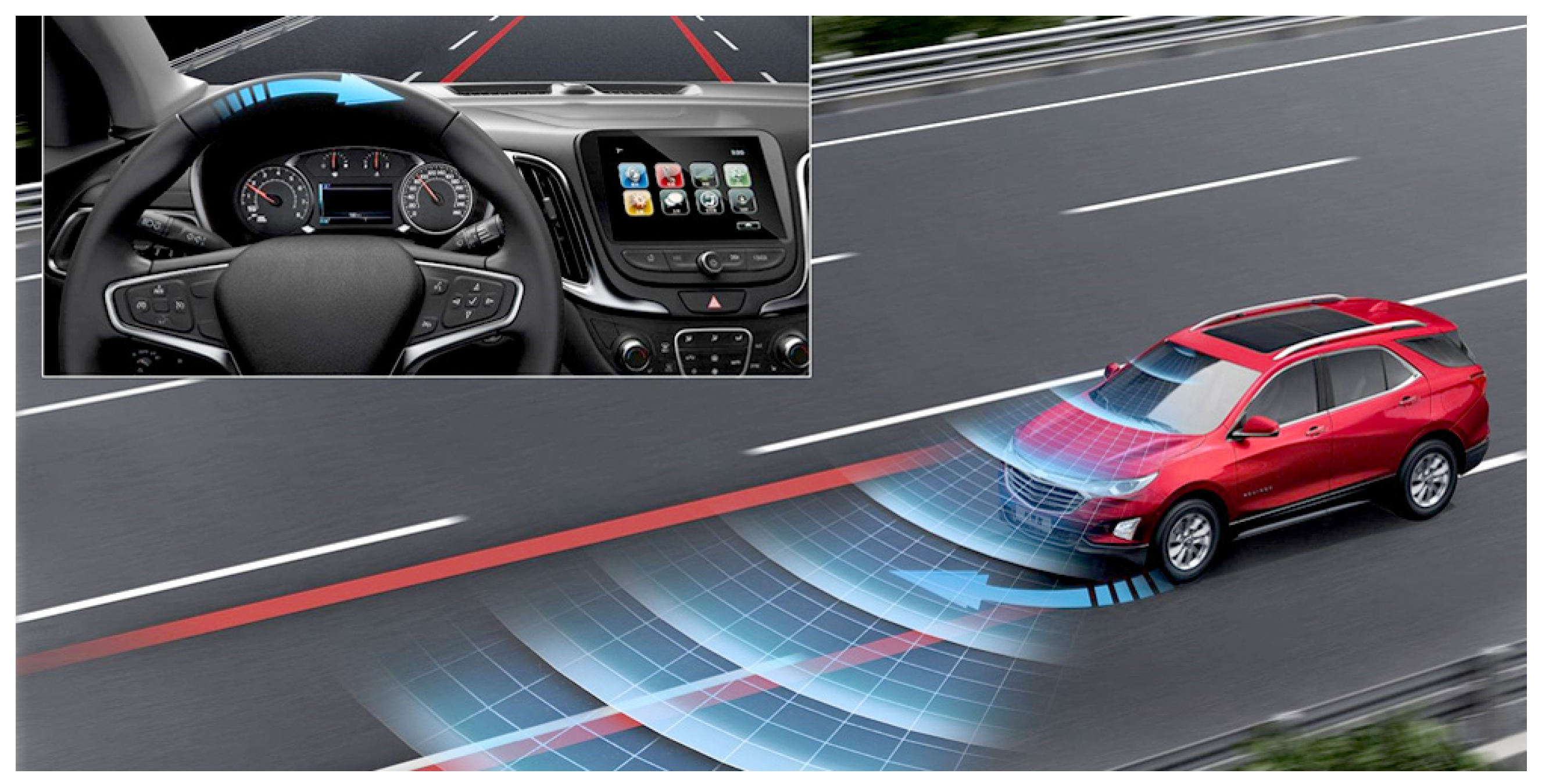
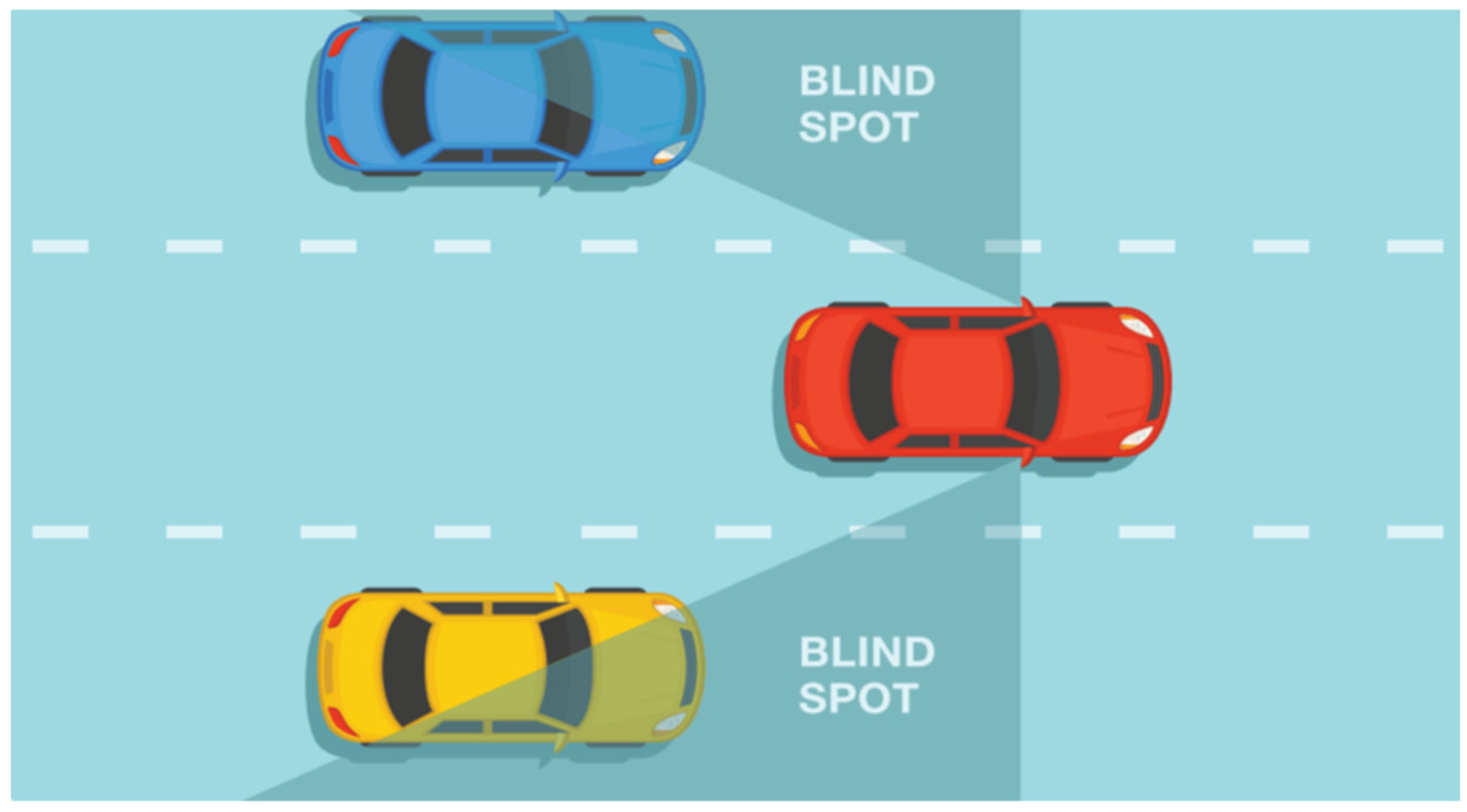
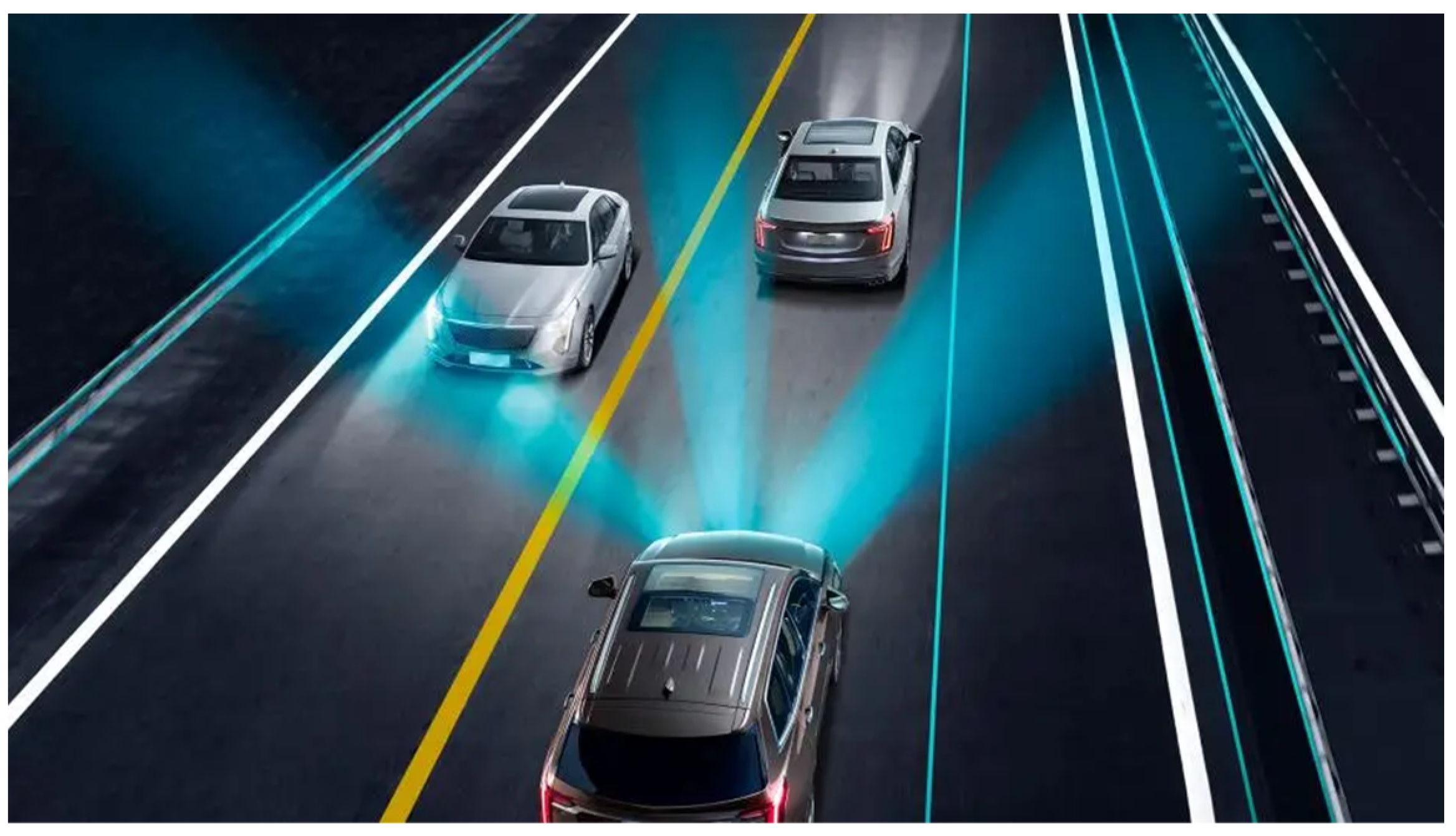
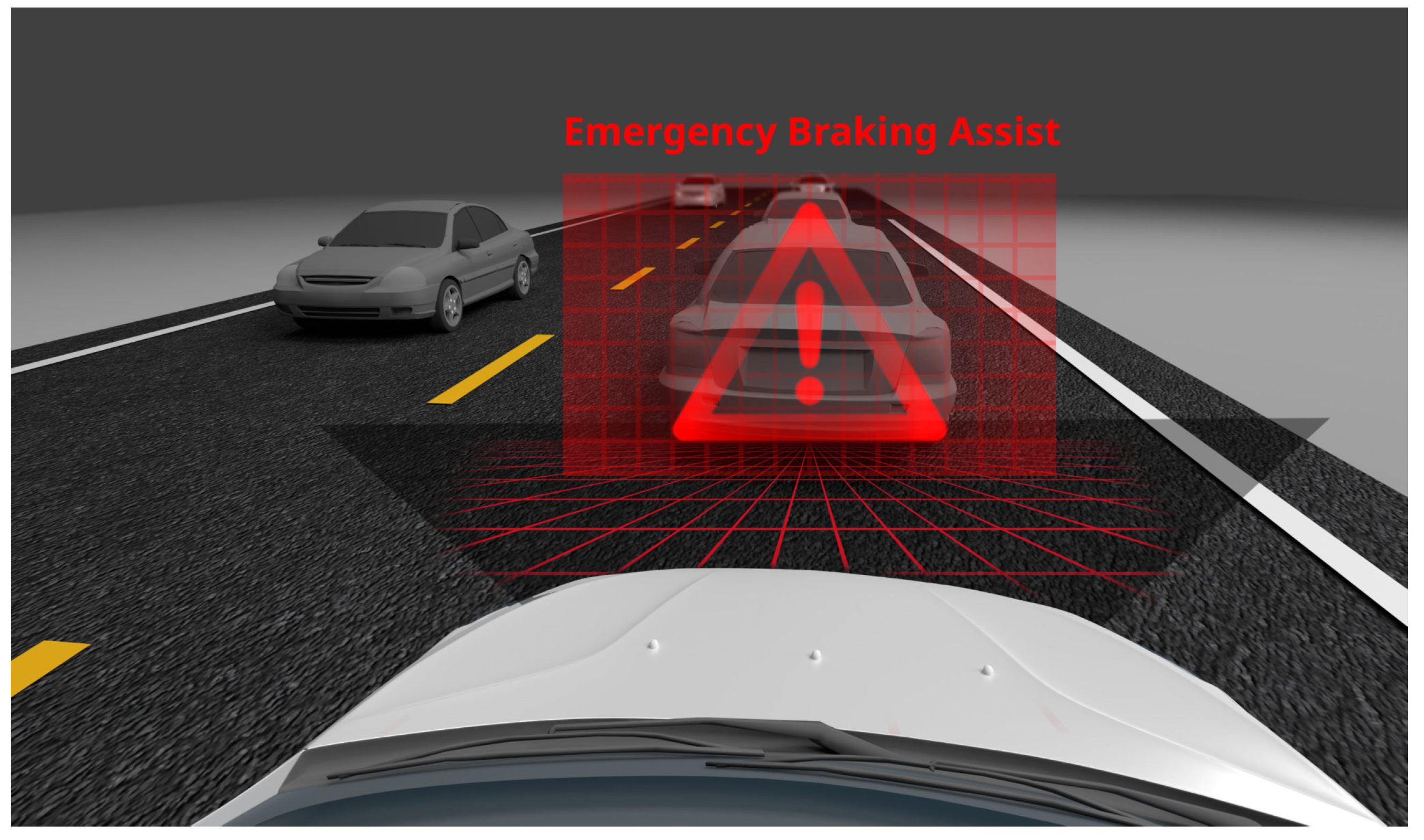
ADASs are breakthrough solutions in the automotive field, opening new perspectives for improving road safety. Although road accidents are not directly related to the safety systems installed in vehicles, these systems can contribute to solving them. These solutions often save lives and contribute to reducing the number of accidents. Despite this, humans remain the main factor influencing road safety and are the key cause of road accidents [34]. In 2022, the number of accidents caused by the driver’s fault is 19,373, which exceeds 90% of all accidents in Poland. The cause of approximately 70% of them is the driver’s inappropriate reaction or lack thereof. ADASs installed in passenger cars make it easier to perform basic activities and contribute to increasing safety. Firstly, these systems provide drivers with valuable information about the surroundings and potential threats, and also intervene automatically in critical situations. An example is ACC cruise control, which automatically adapts the vehicle’s speed to the speed of the vehicle in front, maintaining a safe distance. This is an evolution of the classic cruise control, adapting its functionality to changing road traffic conditions. ACC can significantly reduce the risk of rear collisions by eliminating human errors associated with assessing distance and speed [35]. The blind spot detection (BSD) system informs the driver about vehicles in the blind spot, which is particularly useful when changing lanes. By reducing “invisible” areas, BSD helps reduce the risk of side collisions. Next, the lane keeping system (LDW/LKS) is designed to prevent unintentional departure from the lane. LDW warns the driver when the vehicle unexpectedly starts to cross the lane line, while LKS actively intervenes, correcting the vehicle’s driving path. These systems are particularly useful in preventing accidents caused by driver fatigue or inattention [11]. And the intelligent lamp control system (IHC) adjusts the vehicle’s lights to ambient conditions, improving visibility and safety at night. This system automatically switches between high beam and low beam, ensuring optimal visibility without dazzling other road users. Better night visibility significantly reduces the risk of accidents. Another is the steering assistance system (EBA), which, when a potential collision is detected, initiates automatic braking in order to avoid or mitigate the effects of the collision [36].
Despite its numerous benefits, ADAS also comes with some challenges and limitations. There is a risk of over-reliance on ADASs, which may lead to drivers neglecting their own responsibilities and vigilance. Additionally, these systems may sometimes generate false alarms or may not respond appropriately to all situations, which can create confusion and uncertainty. It is also important to ensure that ADASs operate effectively in a variety of road and weather conditions [37]. Analyzing the presented driver assistance systems, it can be seen that each of them makes a significant contribution to improving road safety. It is worth emphasizing, however, that these systems are only support for the driver and cannot fully replace his attention and skills. It is also important that the development of these technologies goes hand in hand with user education to ensure their conscious and effective use. Further development of these technologies is expected in the future, which may further increase the level of road safety.

4.2. The Impact of Advanced Driver-Assistance Systems in Improving Driving Comfort

Advanced driver-assistance systems significantly contribute to improving driving comfort, offering a wide range of functions that make every day driving more efficient and easier. These systems reduce the physical and mental burden on car users. The introduction of ADAS is a step towards more intuitive and less stressful driving, which makes traveling more pleasant and safe for all road users. By using the latest technological achievements, ADAS minimizes the need for constant driver intervention. For example, ACC cruise control significantly increases driving comfort, especially on long journeys and in congested traffic. Automatic speed adjustment and maintaining a safe distance from the vehicle in front reduces the need for constant driver intervention, minimizing fatigue and stress. Meanwhile, the blind spot detection (BSD) system increases driving comfort by increasing the driver’s confidence during maneuvers such as changing lanes or overtaking. With blind spot warnings, drivers can make maneuvers with greater confidence, reducing the stress associated with the possibility of a collision. Lane keeping systems (LDW/LKS) increase driving comfort by reducing the risk of unintentionally leaving the lane. This provides greater confidence and peace of mind when driving, especially on motorways. The comfort of night driving is influenced by the intelligent lamp control system (IHC), which automatically adjusts the vehicle’s lighting to the surrounding conditions. The system ensures optimal road illumination without the need to manually switch between high beam and low beam, which is particularly comfortable during long night journeys [38].
When considering the impact of the above-mentioned systems on driving comfort, it can be noted that each of them significantly contributes to reducing driver stress and fatigue. These systems, by automating some driving processes and increasing situational awareness, allow for more relaxing and less stressful driving. However, to maximize their potential, it is necessary to provide drivers with education about the functions and limitations of these systems. It is also worth emphasizing that despite the advancement of these systems, they cannot completely replace the vigilance and skills of the driver, who should remain an active participant in road traffic.

4.3. The Impact of ADASs on the Sense of Safety and Driving Comfort—Survey Study

The research hypothesis set before conducting the study was: “The impact of ADAS on the sense of safety and driving comfort demonstrated by users of these systems”. The study was conducted using a paper survey at the turn of May and September 2023. A total of 80 people (40 women and 40 men) participated in the study. Surveys were distributed to drivers of similar age (between 20–30 years old) and with different experience who use vehicles equipped with ADASs. The survey included questions about the frequency of using individual ADAS functions, their perceived impact on driving safety and comfort, as well as experiences and suggestions regarding these systems.
The survey questionnaire included seven questions, both open and closed. It included the following questions:
  • What type of car do you have?
  • What ADAS systems are installed in your car?
  • How often do you use ADAS systems while driving?
  • Do you think ADAS systems increase your sense of safety while driving?
  • Do ADAS systems affect your driving comfort?
  • Do you have any experiences where ADAS systems helped avoid an accident or dangerous situation?
  • Do you have any comments or suggestions for improving ADAS systems?
One of the first questions in the survey was: What type of car do you have? The choices were: sedan, SUV, hatchback, other. Analysis of the answers to this question allowed me to obtain information about drivers’ preferences regarding the choice of car body type and whether they can be related to the use and perception of ADASs. Respondents who own sedans in my survey constitute a significant percentage of vehicles, as much as 40%. Traditionally associated with comfort and elegance, cars are often equipped with advanced technologies, including ADASs. Sedan owners may be particularly interested in the latest ADASs that improve driving comfort and safety, which is consistent with the general character of these vehicles. SUVs accounted for 35%, known for their higher seating position and spacious interior, and are also often equipped with ADASs. Their users may value both safety and comfort, especially in more difficult road conditions. A total of 15% of respondents had a hatchback. Perhaps this is due to the positioning of these cars as more economical and urban. The remaining 10% were station wagons and coupes. Owners of these vehicles may have specific preferences for ADASs, which may be related to the unique features of their cars, such as larger cargo space or sporty character.
The second question was specific and asked if you had the systems (discussed in the second chapter) in your cars. Adaptive cruise control (ACC)—75% of respondents have it. Its high percentage indicates that it is standard equipment in modern vehicles or an option often chosen by drivers. ACC is particularly appreciated for increasing comfort on long journeys and in congested traffic, reducing the need to constantly change speed. Blind spot detection (BSD), which alerts the driver to vehicles in hard-to-see places, is also widely used. Its presence in 60% of vehicles highlights the importance drivers attach to safety when changing lanes. The lane keeping system (LDW/LKS) is present in 43% of vehicles. This proves that drivers are highly aware of the risks associated with inattention and fatigue. Half of the vehicles are equipped with intelligent lighting control systems, which indicates interest in technologies that improve visibility and safety at night. Steering assistance, often in the form of automatic emergency braking, is found in 40% of vehicles. Although it is not as common as other systems, its presence is important for collision prevention. Analysis of the answers to this question shows that these systems are more and more commonly installed in modern vehicles.
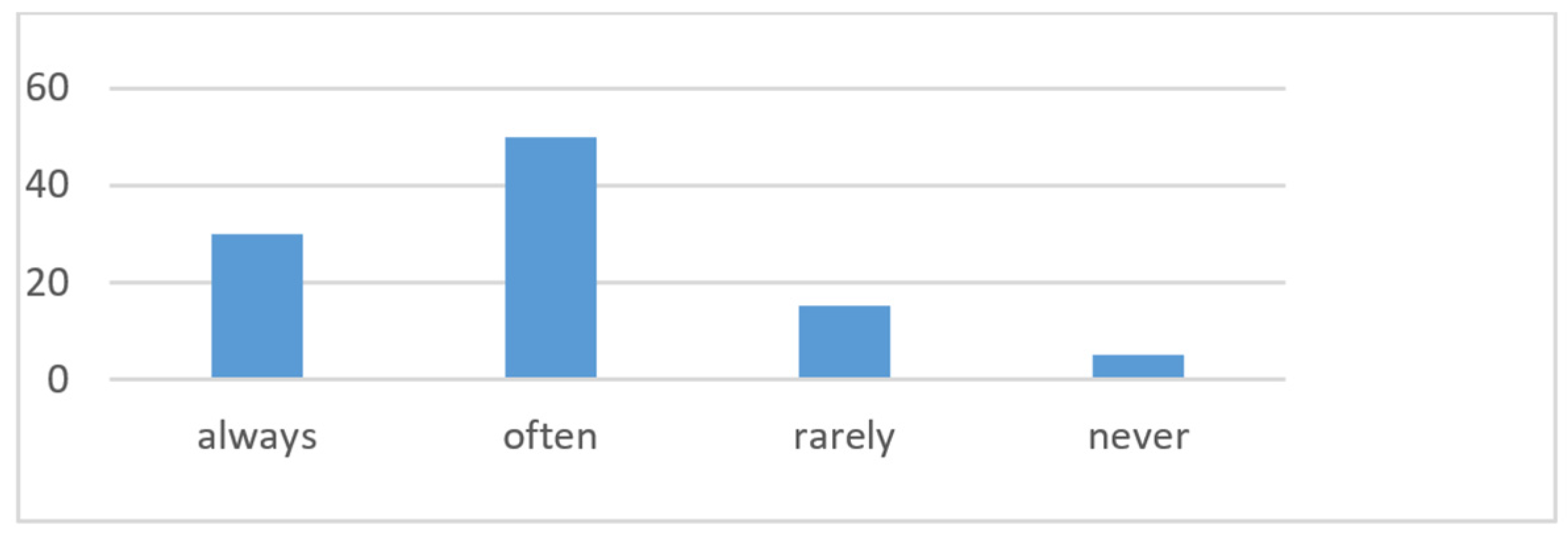
The answers to the third question regarding the frequency of use of ADASs provided information about their acceptance and integration into the everyday driving experience (Figure 7). The “Always” option was selected by 30%—a large group of drivers, which proves a high level of trust and habituation to these technologies. It can be assumed that these users appreciate the benefits of ADAS in terms of safety and comfort. This category may include drivers who often travel long distances or in congested city traffic, where ADASs can significantly contribute to improving the driving experience. Half of the respondents use ADASs “often”, which indicates the widespread acceptance of these technologies. These systems appear to have become an important part of everyday driving for many drivers who are aware of the benefits of ADAS but choose to activate the systems depending on specific road conditions or personal comfort. The “rarely” group of drivers constitutes 15% and may do so for various reasons, such as insufficient awareness of the functions, uncertainty about the effectiveness of the systems, preference for active driving, or specific driving conditions. These users may need additional information or training on the benefits and proper use of ADASs. However, 5% are people resistant to technology and marked “never”. This may be due to a lack of trust in the technology, insufficient knowledge of how it works, or a strong preference for a traditional driving style. The results of the question about the frequency of use of ADASs indicate a generally positive reception of these technologies among drivers. The dominance of the answers “always” and “often” emphasizes that ADASs are considered an important element of support in everyday driving. At the same time, the presence of a group of “rarely” or “never” users highlights the need for further education and improvement of systems to increase their acceptance and effectiveness of use.
Figure 7. How often respondents use ADASs while driving.
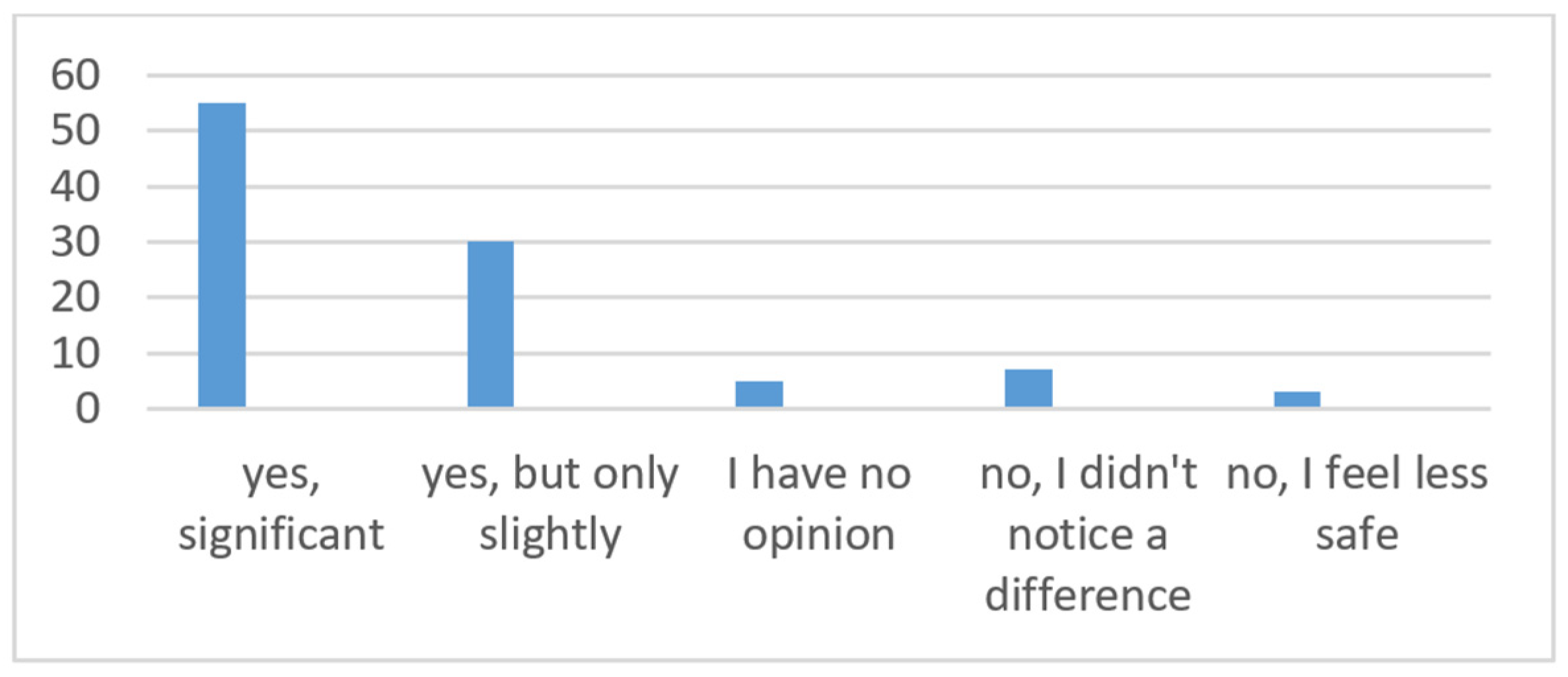
The next question is: Do you think that ADAS systems increase your sense of safety while driving? Answers: Yes, significantly/Yes, but slightly/I have no opinion/No, I don’t notice the difference/No, I feel less safe (Figure 8). Deducing the answer to this question allows you to understand how drivers evaluate these technologies in terms of safety. And “Yes, significantly” was marked by more than half of the respondents, which proves good acceptance and trust in ADASs and the group that believes that these systems significantly contribute to their sense of security. A large number of respondents marked “Yes, but slightly”—30%. These respondents see an improvement in safety thanks to the systems, although they do not consider it significant. This may mean that users are aware of the benefits of ADAS, but their experiences with the systems are not compelling enough to consider the impact to be significant. A total of 5% of respondents are uncertain or have no experience; they cannot determine the impact of ADAS on their sense of security and marked “I have no opinion”. This may be due to lack of experience or sufficient knowledge of these systems. Drivers who choose the answer “No, I don’t notice the difference” are indifferent to technology—7%. They do not notice any difference in the sense of safety when using ADAS. This may suggest that for this group these systems are not effective or understandable enough or that their functionality is not appropriately adapted to their individual needs. A small number of drivers, only 3%, feel less safe with ADASs. This may be related to negative experiences such as false alarms, excessive system intervention, or fear of relying too much on technology. The general analysis of the responses shows that the majority of drivers perceive ADASs as having a positive impact on driving safety, which proves the positive reception of these technologies. At the same time, the presence of a group of users who do not notice the difference or feel less safe highlights the need for further development and optimization of ADASs and user education to maximize benefits and minimize possible negative experiences.
Figure 8. How do respondents feel safe when driving with ADAS systems?
The fifth question on the impact of ADASs on driving comfort reveals the following user observations about these technologies. The answer “Yes, they improve comfort” was indicated by 60% of respondents (Figure 9). Drivers experience increased driving comfort. This may include easier vehicle maneuvering, reduced stress associated with long journeys or congested traffic, and an overall feeling of safety. A high percentage in this category indicates that the systems are perceived as a valuable tool for improving the driving experience. A neutral attitude, i.e., choosing the answer “They have no influence”, was declared by 30% of respondents. This group of drivers does not feel the impact of the systems on driving comfort. This may be due to various factors such as lack of understanding or awareness of ADAS functions, little use of these systems in everyday driving, or personal driving style preferences. These results may suggest the need for greater efforts to educate and promote the benefits of ADASs so that users can fully realize their potential to increase driving comfort. However, a small proportion of respondents believe that driver assistance systems worsen driving comfort. This 10% of negative respondents may be due to various factors, such as false alarms, excessive or inappropriate system intervention, or the feeling that technology is “taking control” from the driver. This result highlights the need to improve systems to make them more intuitive, less invasive, and their operation more understandable and predictable for users. Overall, the responses to the fifth question show that ADASs are perceived by most drivers to improve driving comfort, indicating an overall positive reception of these technologies. However, the presence of a significant number of users who do not perceive an impact on comfort, and a smaller group who believe that these systems impair comfort, highlights the need for continuous development, optimization, and education regarding ADASs. The goal is to maximize benefits for all users and minimize potential negative experiences.
Figure 9. The impact of ADASs on driving comfort according to respondents.
Analysis of the answers to question six regarding direct experiences where ADASs helped avoid an accident or dangerous situation provides information about the practical impact of these technologies on driving safety. Possible answers are yes or no. A large part of respondents, as many as 40%, have positive experiences with the systems and confirm that these systems helped to avoid potential accidents or dangerous situations. This demonstrates the real value of these systems in a practical context, increasing road safety. An increased sense of security can significantly contribute to increasing trust in systems and perceiving them as an essential element of modern vehicles. Users who have experienced direct benefits may be more willing to use these systems and promote their benefits. However, 60% of respondents chose “no” because they had not directly experienced a situation in which the systems would have helped avoid an accident or dangerous situation. This may be due to several reasons, such as limited functionality of the systems in the vehicles, insufficient conditions for activating the systems, or simply the absence of dangerous driving situations. These results highlight the importance of continuous improvement of ADASs and user education to increase their effectiveness and understanding of their capabilities. Ultimately, the goal is clear: to maximize the benefits of ADAS for all road users.
The last survey question concerned comments and suggestions for improving ADASs. It revealed the level of user engagement and satisfaction with these technologies, as well as their willingness to participate in the process of improving them. Possible answers—yes (please describe) or no. The answer “yes” was declared by 35% of respondents, and the most frequently mentioned were: the need for greater precision and reliability of systems, better integration with vehicle functions, and the need for greater personalization and adaptation to the individual preferences of drivers. It revealed specific areas that require improvement, such as increasing the accuracy of the systems, minimizing false alarms, improving the user interface, and better integration with other vehicle systems. The answer “no”, i.e., satisfaction with the systems or no opinion about them, was selected by 65% of drivers. This may suggest general satisfaction with the current state of technology or a lack of sufficient awareness or commitment to make specific proposals for improvement. This result may also indicate that not all users are aware of the potential of ADASs and their limitations, which may result in a lack of specific suggestions for improving them.

4.4. Discussion

The survey results confirmed the hypothesis that ADASs are perceived as a tool that improves driving safety and comfort. However, there is a need to further improve these systems to minimize their imperfections, such as false alarms and excessive intervention. Respondents noted that the development of ADAS technology should also go hand in hand with the continuous expansion and modernization of road infrastructure. Road expansion, better and more legible signs, and well-developed information systems will affect the comfort and speed of travel and significantly improve its safety. It is extremely important that systems and infrastructure are constantly improved. Only a systematic and comprehensive approach to road safety will allow for a continuous reduction in the number of road accidents, which will translate into a decrease in risk for all road users. Coordinated action in this area is crucial to ensuring safe and smooth driving on the roads every year.
It is important to remember that ADAS driver-assistance systems have both a direct and indirect impact on driver health, and this impact can be both positive and negative.
  • Positive impacts on driver health:
    • Reduced stress and fatigue: ADAS automates many tasks, such as keeping the vehicle in lane, adaptive cruise control, or automatic emergency braking, which reduces the cognitive load on the driver and reduces the stress associated with driving, especially on long journeys or in city traffic.
    • Increased safety: ADASs help avoid accidents, which directly translates into a reduced risk of physical injury to the driver and passengers.
    • Support in difficult conditions: Systems such as blind spot detection, forward collision warning, or automatic beam adjustment help the driver respond better to changing road conditions, which can reduce stress and the risk of accidents.
  • Potential negative effects:
    • ADAS dependency: Drivers may become overly reliant on assistance systems, which can lead to reduced driving skills and reduced ability to react quickly in emergency situations when ADASs may not function properly.
    • Increased distraction: Automation of certain tasks can lead to drivers being more distracted, such as using phones or other devices, which can increase the risk of accidents in situations where ADASs are unable to respond appropriately.
    • Risk of inaccurate information: Some ADASs may generate false alarms or incorrect warnings, which can lead to unnecessary stress or, in extreme cases, poor driver decisions.
  • Physical health impacts:
    • Exposure to electromagnetic radiation: ADASs use various technologies such as radars, cameras, and sensors that can emit electromagnetic radiation. The health impacts of long-term exposure are not fully understood, although current levels are considered safe.
    • Posture and ergonomic changes: Reduced engagement in driving can lead to a less active driving posture, which can have long-term impacts on physical health, such as spine problems.
ADASs mainly have a positive impact on driver health by improving safety and reducing stress. However, over-reliance on these systems and potential distraction issues can in some cases lead to negative health effects. It is important that drivers are aware of these systems and use them responsibly.

5. ADASs Systems Failure

Failure of ADASs can occur in various forms and can have various causes, from technical problems to external conditions. Here are some examples of such failures:
  • Automatic Emergency Braking (AEB) Failure. Description: The AEB system may fail to respond to an obstacle on the road, potentially leading to a collision. This could be due to software glitches, sensor malfunctions, or environmental conditions (e.g., fog, heavy rain) that interfere with sensor performance. Example: In 2020, some car models experienced issues with their AEB systems, leading to false alarms or failure to react in real emergency situations.
  • Lane Keeping Assist (LKA) Failure. Description: The lane keeping assist system may stop working or malfunction, causing unintended lane departures. This could happen due to problems with cameras or sensors failing to detect lane markings properly, particularly in the case of poor lighting conditions, dirty sensors, or poorly maintained road markings. Example: Certain vehicles have been reported to have issues where the system fails to recognize lane markings in rain or bright sunlight, causing the system to deactivate unexpectedly.
  • Adaptive Cruise Control (ACC) Failure. Description: Adaptive cruise control might not correctly adjust the vehicle’s speed in response to traffic. For example, the system may fail to detect a vehicle ahead or may not react to sudden speed changes, increasing the risk of a collision. Example: Some vehicles have experienced problems where the ACC does not respond to sudden stops by vehicles ahead, especially at high speeds on highways.
  • Blind Spot Monitoring (BSM) Failure. Description: The Blind Spot Monitoring system may fail to detect vehicles in the driver’s blind spot, potentially leading to dangerous lane changes. This could be caused by sensor malfunctions, electromagnetic interference, or adverse weather conditions that affect radar performance. Example: There have been cases where the Blind Spot Monitoring system failed to detect vehicles next to the driver’s car, leading to risky maneuvers when changing lanes.
  • Traffic Sign Recognition System Failure. Description: The Traffic Sign Recognition system may fail to correctly identify road signs or provide incorrect information. This could result from software errors, camera issues, or poor weather conditions like rain, fog, or low visibility. Example: In some instances, these systems have incorrectly identified speed limit signs, leading to improper speed suggestions for the driver.
  • False Alarms. Description: ADASs may generate false alarms, warning the driver of non-existent hazards. This can lead to unnecessary stress or risky maneuvers. Example: False collision warnings or false detections of vehicles in the blind spot could cause sudden, unwarranted actions like abrupt braking or lane changes.
  • Software Update Issues. Description: ADASs may malfunction due to errors during software updates. An improperly executed update can cause the systems to operate incorrectly or not at all. Example: After a software update, some ADASs in vehicles might malfunction or fail to activate, requiring service intervention.
These examples illustrate that while ADAS technologies are advanced, they are not immune to failures, which in extreme cases could impact driving safety.

6. Comparison of Different ADAS System Architectures

When comparing different architectures with different sensors, the advantages and disadvantages depend on the specific use case, the environment, and the desired outcomes. Let us break down some common architectures and sensors, such as centralized, distributed, and hybrid.
1.
Centralized Architecture
In a centralized architecture, all sensor data are transmitted to a central processing unit for analysis and decision-making. Advantages: Unified data processing: Easier to synchronize and fuse data from multiple sensors; high computational power: The central processing unit can be more powerful, allowing for more complex algorithms; simplified maintenance: Only one core unit needs to be updated or maintained. Disadvantages: Latency issues: High data traffic can lead to communication delays, especially with high-resolution sensors like cameras and LiDAR; single point of failure: If the central processor fails, the entire system can go down; scalability: May not scale efficiently with an increasing number of sensors or sensor types.
2.
Distributed Architecture
In a distributed architecture, sensors have local processing units and only transmit results (or partial data) to a central system. Advantages: Reduced latency: Local processing reduces the need for constant communication with the central unit; scalability: Easier to add more sensors since each sensor handles its own processing; robustness: Failure of one sensor or processing unit does not affect the entire system. Disadvantages: Synchronization challenges: Harder to synchronize data across sensors; increased power consumption: Local processing at each sensor requires more power; Higher cost: each sensor needs to be equipped with local processing capabilities.
3.
Hybrid Architecture
A hybrid architecture combines aspects of centralized and distributed systems, where some sensors have local processing while others rely on the central unit. Advantages: Flexibility: You can choose which sensors need local processing based on the application; optimized performance: Balance between reduced latency and computational power by distributing the workload; fault tolerance: Part of the system can still function if one section fails. Disadvantages: Complexity: More difficult to design and maintain than purely centralized or distributed systems; cost: Can be more expensive to implement, depending on the sensors used.

7. Conclusions

In today’s automotive industry, advanced driver-assistance systems play an underestimated role in improving driving safety and comfort. Equipped with complex sensors such as radars, LiDARs, cameras, and ultrasonic sensors, these systems offer drivers unprecedented support by monitoring the vehicle’s surroundings and responding appropriately to detected threats. From adaptive cruise control (ACC) to blind spot detection (BSD), lane keeping assist (LDW/LKS), intelligent lamp control (IHC), and steering assist (EBA), ADAS is the technological foundation of modern vehicles.
A survey conducted among ADAS users showed acceptance and appreciation of the systems as effective tools that increase travel safety and comfort. Most respondents confirmed to me that these systems significantly improve their sense of safety, reduce stress and fatigue, and increase situational awareness on the road. Some drivers shared their direct experiences where ADAS helped avoid potential accidents or dangerous situations, confirming their usefulness. However, this paper also revealed the need for further development and optimization of ADAS. Drivers indicated the need to increase the precision of systems, reduce false alarms, improve the user interface, and better integrate with other vehicle functions. This indicates that while ADASs are a step in the right direction, their evolution must be a continuous process to meet the growing expectations of users. Additionally, there is a significant need to educate drivers about the operation, benefits, and limitations of ADASs. Correctly understanding and applying these systems is crucial to maximizing their potential. This education should cover not only how ADAS works, but also emphasize drivers’ responsibility for driving, even with advanced assistance systems.
The conclusions of the paper emphasize that the future of ADAS depends on the balance between technological progress, personalization of systems to the individual needs of users, and continuous education. As users increasingly trust and rely on ADASs, manufacturers and designers must strive to continually improve them to ensure maximum effectiveness, reliability and user experience. Further development of ADAS has the potential to further increase the safety and quality of travel, making driving not only safer and more enjoyable for all participants, but also vehicle automation.

Funding

This study was funded by the Gdynia Maritime University, under research project WN/2024/PZ/07.

Institutional Review Board Statement

Not applicable.

Data Availability Statement

Data are contained within the article.

Conflicts of Interest

The author declares no conflicts of interest.

References

  1. Raviteja, S.; Shanmughasundaram, R. Advanced Driver Assitance System (ADAS). In Proceedings of the 2018 Second International Conference on Intelligent Computing and Control Systems (ICICCS), Madurai, India, 14 June 2018; pp. 737–740. [Google Scholar]
  2. Srinivasan, C.; Sridhar, P.; Madhumitha, R.; Sushmitha, R. Advanced Driver Assistance System (ADAS) in Autonomous Vehicles: A Complete Analysis. In Proceedings of the 2023 8th International Conference on Communication and Electronics Systems (ICCES), Coimbatore, India, 1 June 2023; pp. 1501–1505. [Google Scholar]
  3. Sousa, I.S.; Casimiro, A.; Cecílio, J. Artificial Neural Networks for Real-Time Data Quality Assurance. Ada Lett. 2022, 42, 86–89. [Google Scholar] [CrossRef]
  4. Janeba, M.; Bohumel, S.; Hrnčár, J.; Galinski, M.; Kotuliak, I. Small and Affordable Platform for Research and Education in Connected, Cooperative and Automated Mobility. In Proceedings of the 2023 21st International Conference on Emerging eLearning Technologies and Applications (ICETA), Stary Smokovec, Slovakia, 26–27 October 2023; pp. 225–230. [Google Scholar]
  5. Łukasik, Z.; Kuśmińska-Fijałkowska, A.; Olszańska, S. Strategy for the Implementation of Transport Processes toward Improving Services. Zesz. Nauk. Transp./Politech. Śląska 2023, 118, 173–193. [Google Scholar] [CrossRef]
  6. Ding, F.; Zhu, K.; Liu, J.; Peng, C.; Wang, Y.; Lu, J. Adaptive Memory Event Triggered Output Feedback Finite-Time Lane Keeping Control for Autonomous Heavy Truck with Roll Prevention. IEEE Trans. Fuzzy Syst. 2024, 1–14. [Google Scholar] [CrossRef]
  7. Unar, S.; Su, Y.; Liu, P.; Teng, L.; Wang, Y.; Fu, X. An Intelligent System to Sense Textual Cues for Location Assistance in Autonomous Vehicles. Sensors 2023, 23, 4537. [Google Scholar] [CrossRef] [PubMed]
  8. Ding, F.; Han, X.; Jiang, C.; Liu, J.; Peng, C. Fuzzy Dynamic Output Feedback Force Security Control for Hysteretic Leaf Spring Hydro-Suspension With Servo Valve Opening Predictive Management Under Deception Attack. IEEE Trans. Fuzzy Syst. 2022, 30, 3736–3747. [Google Scholar] [CrossRef]
  9. Expósito, I.; Chin, I.; García Sánchez, M.; Cuiñas, I.; Verhaevert, J. Car Bumper Effects in ADAS Sensors at Automotive Radar Frequencies. Sensors 2023, 23, 8113. [Google Scholar] [CrossRef]
  10. Costa, G.; Cecílio, J.; Casimiro, A. Cooperative Autonomous Driving in Simulation. Ada Lett. 2023, 43, 78–82. [Google Scholar] [CrossRef]
  11. Orłowski, Ł.; Wszeborowski, R. Bezpieczeństwo w ruchu drogowym. Syst. Logistyczne Wojsk 2020, 53, 87–102. [Google Scholar] [CrossRef]
  12. Lisaj, A. Model of Radio-Communications Platform Supporting Inland Navigation. TransNav Int. J. Mar. Navig. Saf. Sea Transp. 2024, 18, 383–386. [Google Scholar] [CrossRef]
  13. Alexiev, K.; Slavcheva, N. A Method for Target Localization by Multistatic Radars. In Proceedings of the Modelling and Development of Intelligent Systems, Sibiu, Romania, 28–30 October 2022; Simian, D., Stoica, L.F., Eds.; Springer: Cham, Switzerland, 2023; pp. 89–103. [Google Scholar]
  14. Jarzemski, J.; Szagajew, L. Radar antykolizyjny. Probl. Tech. Uzbroj. 2006, 35, 211–216. [Google Scholar]
  15. Choromański, W.; Grabarek, I.; Kozłowski, M.; Czerepicki, A.; Marczuk, K. Pojazdy Autonomiczne i Systemy Transportu Autonomicznego; Wydawnictwo Naukowe PWN SA: Warszawa, Poland, 2020; ISBN 978-83-01-21154-7. [Google Scholar]
  16. Li, S.; Yan, J.; Chen, H.; Zheng, K. Radar-Camera Fusion Network for Depth Estimation in Structured Driving Scenes. Sensors 2023, 23, 7560. [Google Scholar] [CrossRef] [PubMed]
  17. Haas, L.; Haider, A.; Kastner, L.; Zeh, T.; Poguntke, T.; Kuba, M.; Schardt, M.; Jakobi, M.; Koch, A.W. Velocity Estimation from LiDAR Sensors Motion Distortion Effect. Sensors 2023, 23, 9426. [Google Scholar] [CrossRef] [PubMed]
  18. Podbucki, K. Możliwości i ograniczenia monitorowania otoczenia z wykorzystaniem czujnika LiDAR. Przegląd Elektrotechniczny 2022, 98, 184–187. [Google Scholar] [CrossRef]
  19. Jun, W.; Son, M.; Yoo, J.; Lee, S. Optimal Configuration of Multi-Task Learning for Autonomous Driving. Sensors 2023, 23, 9729. [Google Scholar] [CrossRef] [PubMed]
  20. Nowotyńska, I. Systemy wspomagające bezpieczeństwo w transporcie drogowym. Autobusy Tech. Eksploat. Syst. Transp. 2013, 14, 1303–1310. [Google Scholar]
  21. Ren, J.; Wang, X.; Liu, C.; Sun, H.; Tong, J.; Lin, M.; Li, J.; Liang, L.; Yin, F.; Xie, M.; et al. 3D Ultrasonic Brain Imaging with Deep Learning Based on Fully Convolutional Networks. Sensors 2023, 23, 8341. [Google Scholar] [CrossRef]
  22. Solanke, S. Project 2 Adaptive Cruise Control. Available online: https://skill-lync.com/student-projects/project-2-adaptive-cruise-control-5 (accessed on 20 September 2024).
  23. Koznowski, W.; Łebkowski, A. Control of Electric Drive Tugboat Autonomous Formation. TransNav Int. J. Mar. Navig. Saf. Sea Transp. 2023, 17, 391–396. [Google Scholar] [CrossRef]
  24. Wang, J.; Wang, J.; Zhu, Z.; Qin, J.; Yuan, W.; Zhang, H.; Fan, Y.; Liu, C.; Niu, W.; Li, S. Research on Construction of the Smart Internet of Vehicles. In Proceedings of the 2021 IEEE International Conference on Power, Intelligent Computing and Systems (ICPICS), Shenyang, China, 29 July 2021; pp. 338–341. [Google Scholar]
  25. Xiao-Yun, L.; Hedrick, J.K.; Drew, M. ACC/CACC-Control Design, Stability and Robust Performance. In Proceedings of the 2002 American Control Conference (IEEE Cat. No.CH37301), Anchorage, AK, USA, 8–10 May 2002; Volume 6, pp. 4327–4332. [Google Scholar]
  26. Alexiev, K.; Tkachenko, I.; Ivanushkin, M.; Volgin, S. Telemetry Information Restoring in Satellite Communications. In Proceedings of the 21st International Conference on Computer Systems and Technologies, Ruse, Bulgaria, 21–23 December 2018; Association for Computing Machinery: New York, NY, USA, 2020; pp. 129–134. [Google Scholar] [CrossRef]
  27. Prasanna, K. Blind Spot Detection System Using Deep Learning. Available online: https://devpost.com/software/blind-spot-detection-using-deep-learning (accessed on 20 September 2024).
  28. Bilik, D.; Lehoczký, P.; Kotuliak, I. Simulating Vehicle-to-Vehicle (V2V) Communication in Urban Traffic Scenarios. In Proceedings of the 2023 21st International Conference on Emerging eLearning Technologies and Applications (ICETA), Stary Smokovec, Slovakia, 26–27 October 2023; pp. 56–61. [Google Scholar]
  29. Krzyszkowska, P. Nowoczesne systemy bezpieczeństwa stosowane w pojazdach i ich wpływ na bezpieczeństwo uczestników ruchu drogowego. Bezpieczeństwo Pr. Nauka I Prakt. 2015, 9, 14–17. [Google Scholar] [CrossRef]
  30. Kamiński, T. Pojazdy zautomatyzowane w aspekcie zrównoważonej mobilności miejskiej. Gospod. Mater. I Logistyka 2021, 2021, 13–20. [Google Scholar] [CrossRef]
  31. ICT Group Intelligently Controlling Headlight Beams. Available online: https://www.ict.eu/en/projects/intelligently-controlling-headlight-beams (accessed on 20 September 2024).
  32. Canadian Underwriter The One Technology the Industry Can’t Wait to See Grow. Available online: https://www.canadianunderwriter.ca/insurance/the-one-technology-the-industry-cant-wait-to-see-grow-1004167271/attachment/emergency-braking-assist-eba-sysyem-to-avoid-car-crash-concept-smart-car-technology-3d-rendering-image/ (accessed on 20 September 2024).
  33. Budziszewski, P. Autonomiczny system awaryjnego hamowania–działanie. Bezpieczeństwo Pr. Nauka I Prakt. 2015, 5, 22–24. [Google Scholar] [CrossRef]
  34. Brożyna, E. Czynnik ludzki a bezpieczeństwo w ruchu drogowym. Autobusy Tech. Eksploat. Syst. Transp. 2017, 18, 7–8. [Google Scholar]
  35. Tęczyńska, E.; Dudek, T. Bezpieczeństwo a wykorzystanie inteligentnych systemów wspomagających kierowcę. Autobusy Tech. Eksploat. Syst. Transp. 2017, 18, 12. [Google Scholar]
  36. Gorzelańczyk, P.; Kaczmarek, Ł. Wpływ nowoczesnych systemów informatycznych na eksploatację pojazdów osobowych. Autobusy Tech. Eksploat. Syst. Transp. 2019, 20, 211–215. [Google Scholar] [CrossRef]
  37. Perzyńska, A.; Gliński, H.; Sokalska, A.; Śliwiński, Ł. Nowoczesne systemy bezpieczeństwa w transporcie drogowym. Przedsiębiorczość I Zarządzanie 2019, 20, 19–29. [Google Scholar]
  38. Kłos-Adamkiewicz, Z. Nowoczesne technologie wspomagające bezpieczeństwo w transporcie. Probl. Transp. I Logistyki 2010, 10, 111–124. [Google Scholar]
Disclaimer/Publisher’s Note: The statements, opinions and data contained in all publications are solely those of the individual author(s) and contributor(s) and not of MDPI and/or the editor(s). MDPI and/or the editor(s) disclaim responsibility for any injury to people or property resulting from any ideas, methods, instructions or products referred to in the content.

Article Metrics

Citations

Article Access Statistics

Multiple requests from the same IP address are counted as one view.