You are currently viewing a new version of our website. To view the old version click .
Sensors
  • Article
  • Open Access

6 March 2023

A Study on the Effectiveness of Deep Learning-Based Anomaly Detection Methods for Breast Ultrasonography

,
,
,
,
,
,
,
and
1
National Information Society Agency, Daegu 41068, Republic of Korea
2
School of Computer Science and Engineering, Kyungpook National University, Daegu 41566, Republic of Korea
3
Department of Artificial Intelligence, Kyungpook National University, Daegu 41566, Republic of Korea
4
Department of Radiology, Kyungpook National University Chilgok Hospital, Kyungpook National University, Daegu 41404, Republic of Korea
This article belongs to the Special Issue Image and Video Processing and Recognition Based on Artificial Intelligence-2nd Edition

Abstract

In the medical field, it is delicate to anticipate good performance in using deep learning due to the lack of large-scale training data and class imbalance. In particular, ultrasound, which is a key breast cancer diagnosis method, is delicate to diagnose accurately as the quality and interpretation of images can vary depending on the operator’s experience and proficiency. Therefore, computer-aided diagnosis technology can facilitate diagnosis by visualizing abnormal information such as tumors and masses in ultrasound images. In this study, we implemented deep learning-based anomaly detection methods for breast ultrasound images and validated their effectiveness in detecting abnormal regions. Herein, we specifically compared the sliced-Wasserstein autoencoder with two representative unsupervised learning models autoencoder and variational autoencoder. The anomalous region detection performance is estimated with the normal region labels. Our experimental results showed that the sliced-Wasserstein autoencoder model outperformed the anomaly detection performance of others. However, anomaly detection using the reconstruction-based approach may not be effective because of the occurrence of numerous false-positive values. In the following studies, reducing these false positives becomes an important challenge.

1. Introduction

Recently, deep learning (DL), a branch of machine learning, has attracted considerable attention. This is a technology for hierarchically learning numerous data features through a deep artificial neural network(ANN), extracting from simple features of input data to complex features [1]. In addition, DL performs well in analyzing various data types, such as video, voice, and text. Moreover, it can be applied to various areas, such as image classification, object detection, language translation, sentence classification, voice automatic generation and composition, robotics, medical image analysis, and cybersecurity [2].
In the medical field, various medical imaging techniques, such as magnetic resonance imaging (MRI), X-ray, computed tomography, ultrasound, and endoscopy are used for numerous complicated medical imaging analyses because of their improved diagnosis rates and reduced screening time based on the consistency, scalability, and accuracy of DL. However, it is challenging to apply DL models to numerous medical images using various types of medical equipment without additional information from experts. Consequently, a method for self-learning the inherent features from numerous images without additional expert opinion and maximizing discrimination via a minimal amount of expert judgment has been developed recently [3].
Among the above medical imaging techniques, ultrasound is one of the key diagnostic imaging techniques for the physical examination of various organs, such as abdominal organs, breasts, musculoskeletal systems, heart, and blood vessels [3]. Furthermore, ultrasonic waves can be imaged in real-time and used with existing resources without building a separate environment. However, the quality and interpretation of an image may differ depending on the operator [3,4] and the false-positive rate (FPR), which is the probability of judging a disease-free normal region as an anomaly with a high value [5]. In particular, in breast ultrasonography, it is difficult to detect lesions and accurately diagnose them with a false-negative rate of 50% in dense breasts with a large quantity of mammary tissue and a fairly small quantity of fat [5]. To overcome these limitations, DL technology has been employed to effectively extract biometric information or elaborately visualize anomaly information of organs similar to masses and tumors to aid diagnosis.
Therefore, in this study, DL models were applied to breast ultrasound images to learn the image features. Using anomalous data, the results of applying deep learning-based anomaly detection methods for ultrasound images were verified. Thus, DL-based anomalous region detection technology can automatically detect anomalous regions with tumors or masses in ultrasound images. Moreover, we aim to study the effectiveness of this technology in practical applications, e.g., whether it can be used as a computer-aided diagnostic tool to detect anomalous regions more quickly in ultrasound diagnosis and more accurately by visually presenting the anomalous region to the user than those of the other tools.

3. Materials & Methods

3.1. Materials

In this study, we retrospectively collected 1147 breast ultrasound images comprising 947 normal breast ultrasound images and 200 abnormal ultrasound images from Kyungpook National University Hospital in the Republic of Korea. The images consist of 113 benign tumors and 87 malignant tumors. The size of all data is 224 × 224 × 3 ; 853 normal breast ultrasound data and 94 normal data for model training and verification. Data with anomalous region (region of interest: ROI) label values were used for model evaluation.
The ultrasound images used in the experiment were cut into specific areas. Some normal ultrasound images were used for learning via applying Gaussian filters for noise removal, and gamma correction with 0.5 and 1.5 gamma values, which decide to express the dark areas of ultrasound in more detail. The input data were used by dividing the values of 0–255 pixels into 255 values and converting them into values between 0 and 1.

3.2. Reconstruction-Based Anomaly Detection

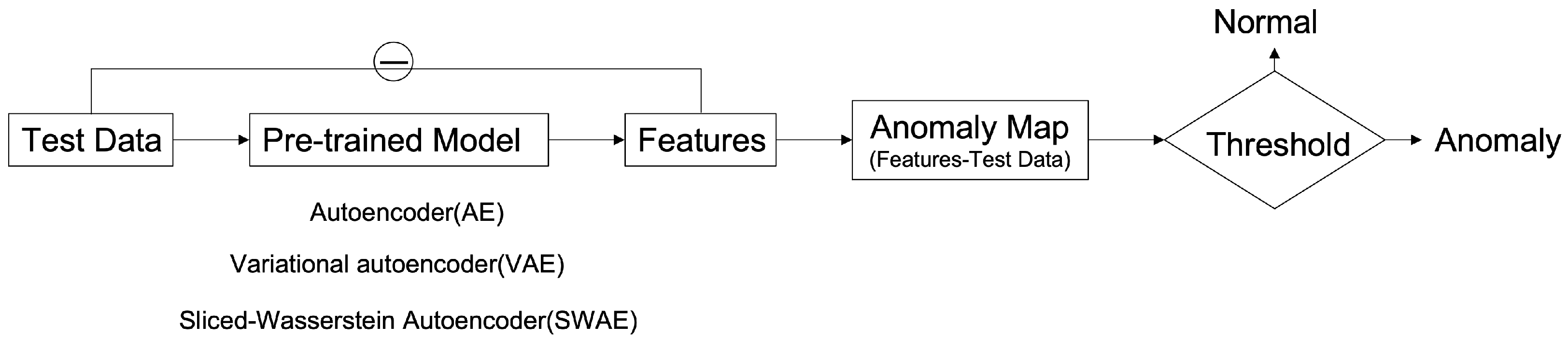
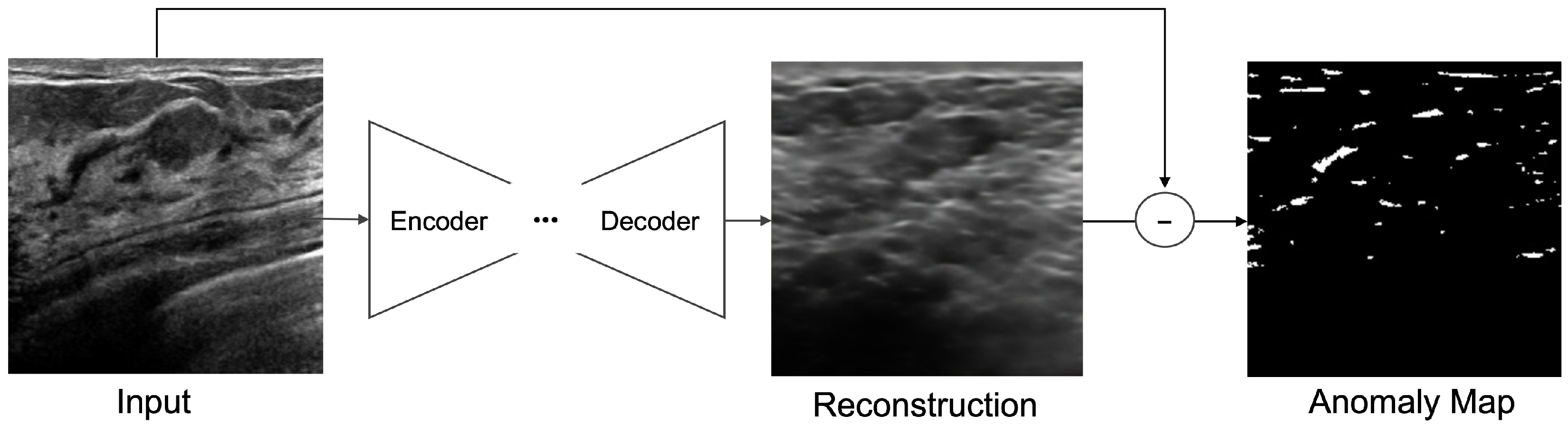
The method of detecting an anomalous region applied in this study is to detect an unrestored region by considering it as abnormal using an error image between an input image and a reconstructed image (Figure 4). The learning process uses a modified SWAE model based on AE, a representative generation model of ANNs, and the conventional AE, which obtains latent features for the summit through input. In the evaluation process, anomalous data are input to the learned model, and an anomalous region is detected through the restored results. The difference between the input image and the restored image is calculated to derive an anomaly map, which is an error image. The anomaly map is binary divided based on a specific threshold to detect the anomalous region. This process was applied to the three models to compare and analyze their detection performances and investigate the factors influencing anomalous region detection in breast ultrasound images.
Figure 4. Deep Learning-based Anomalous Region Detection Process.

3.2.1. Hyperparameter Tuning

In this study, the hyperparameters of the implemented models are as shown in Table 1, Table 2 and Table 3. We tuned the hyperparameters by the grid search method.
Table 1. Hyperparameter setting of the AE model.
Table 2. Hyperparameter setting of the VAE model.
Table 3. Hyperparameter setting of the SWAE model.

3.2.2. Model Architecture of Anomaly Detection Model for Breast Ultrasound

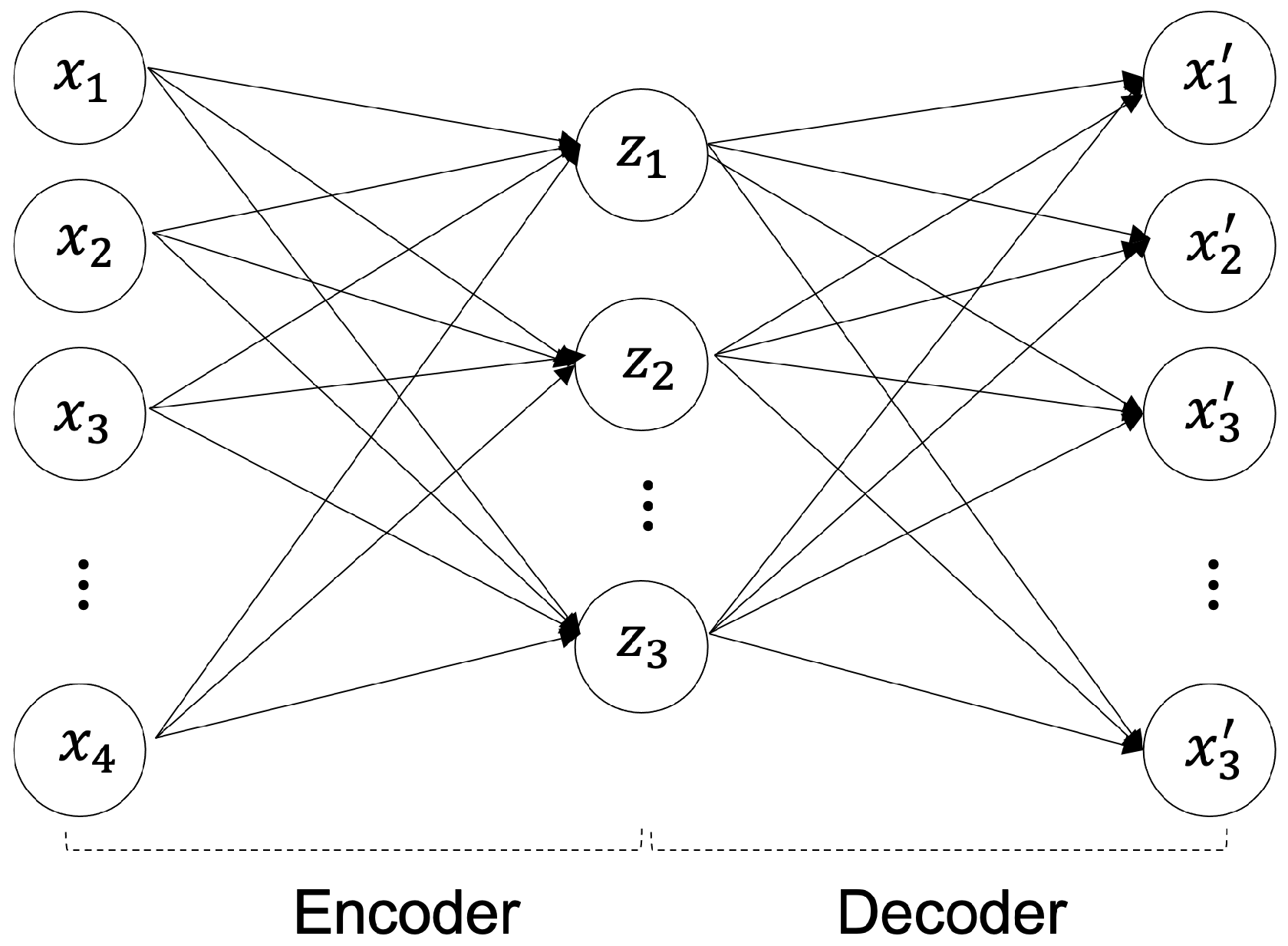
The implemented models comprise encoders and decoders with multiple hidden layers. In the learning process, the encoders map normal ultrasound images into low-dimensional spaces to represent them as key features of the latent space; meanwhile, the decoders update and restore weight to some extent according to input. The process for detecting the anomalous region calculates a pixel unit error over the reconstructed, restored image and the input image (Figure 5). The anomaly map detects an anomalous region by binary division based on a specific threshold. It considers the region abnormal if it is larger than the threshold value and normal otherwise.
Figure 5. Anomaly detection by pixel difference between an original image and reconstructed image on ultrasonography.
Autoencoder (AE) Model
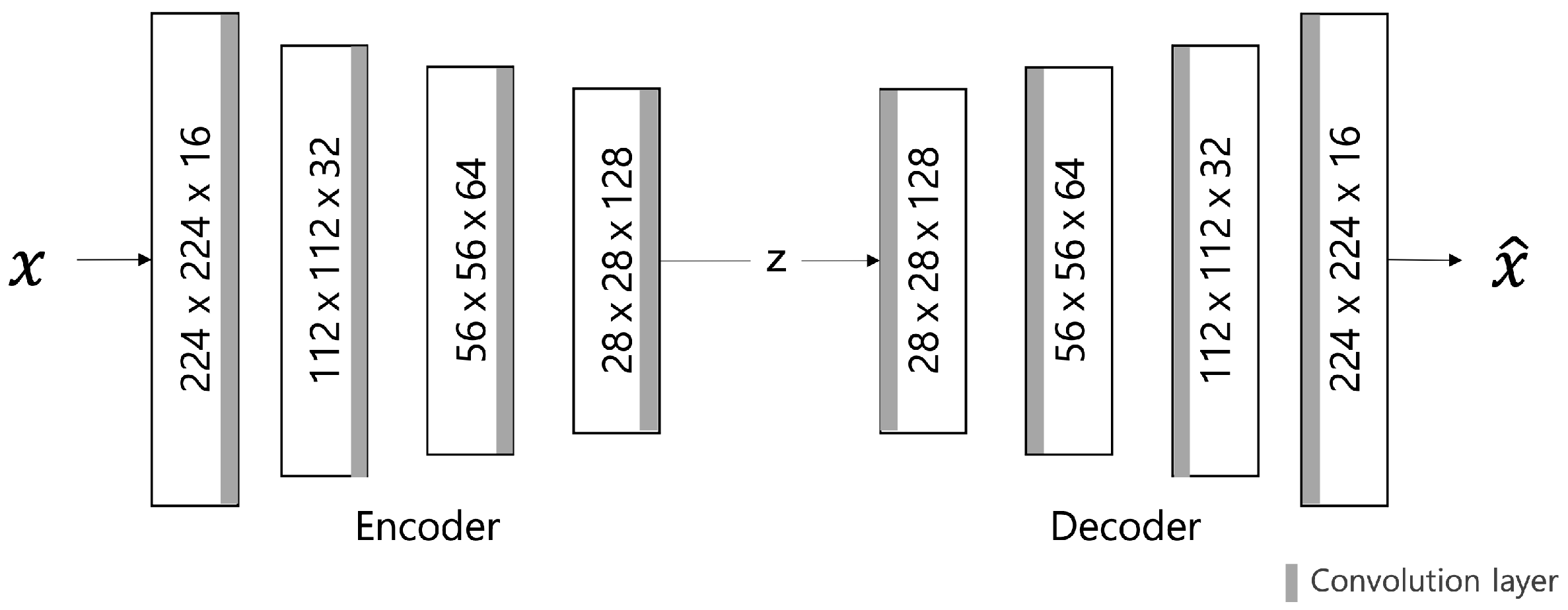
Figure 6 describes the AE model, comprising different filter sizes and convolutional layers that are added to the encoder and decoder to extract features. Therefore, the batch normalization layer is used to normalize the power value. The LeakyRelu activation function is used with a slight slope to convert the calculated input value into the power value. In this model, input data are converted to values between 0 and 1 through normalization, and a sigmoid function is used as the output layer.
Figure 6. AE model architecture.
The loss value L of the AE model is calculated using the L1 distance loss function to indicate the abnormal score by the difference in pixel values. This is calculated as the sum of the absolute values of the difference between the restored image x ^ and the input image x (Equation (15); the smaller the loss value, the better the model performance. The Adam optimizer is used for model optimization. The learning rate is set to the maximum initial value of 0.0002. The cosine annealing method, which can improve accuracy by adjusting the learning rate in a cosine function, is applied.
L ( x , x ^ ) = i = 1 n | x i x i ^ |
Variational Autoencoder (VAE) Model
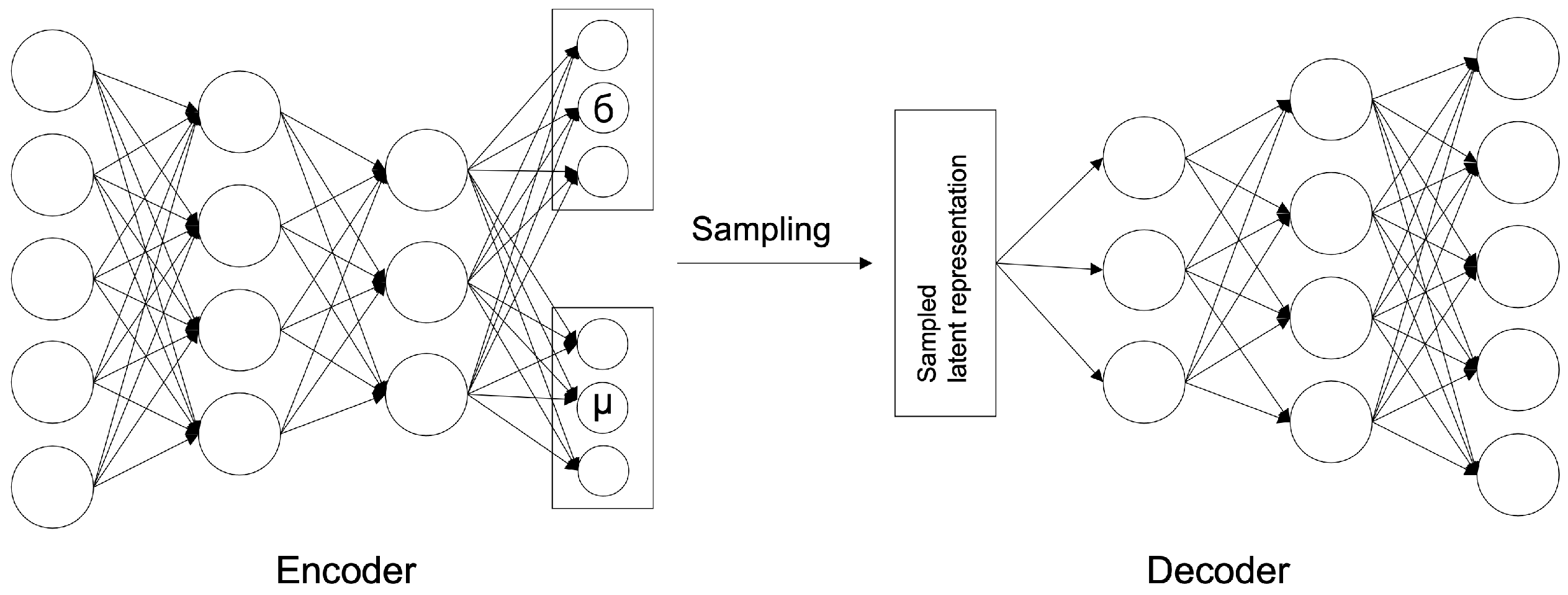
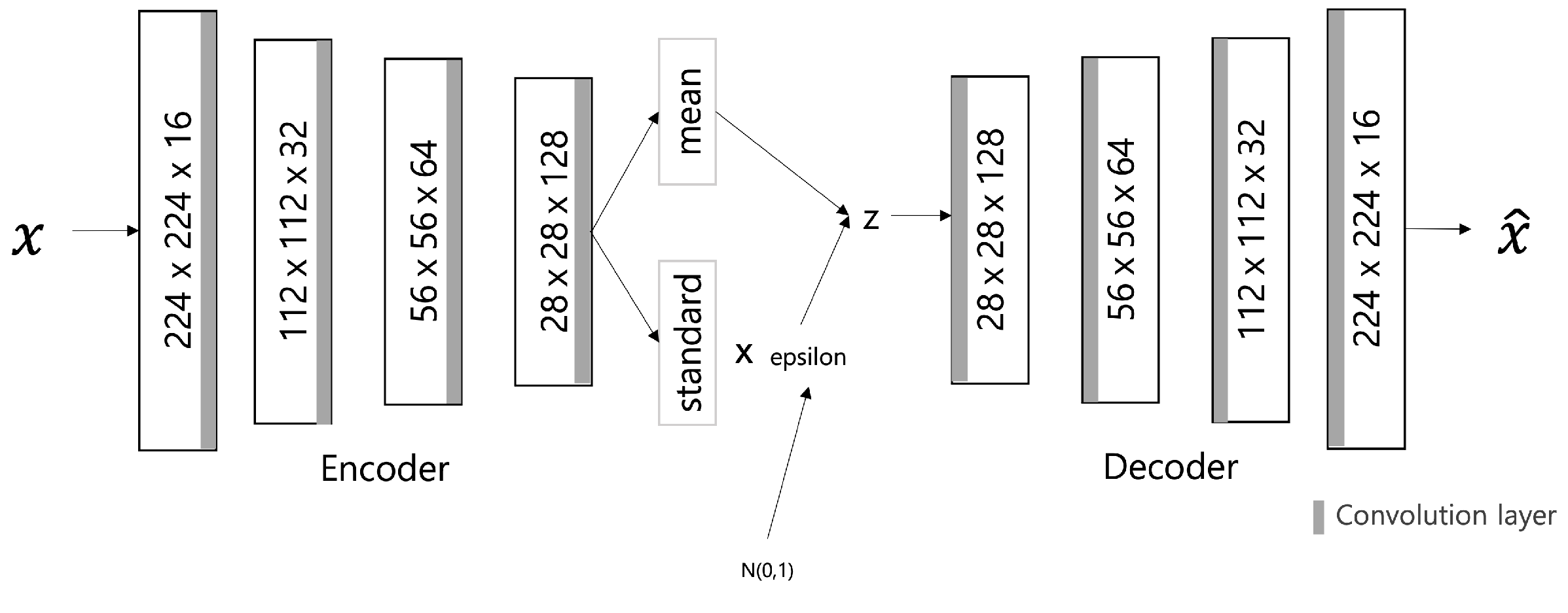
The VAE model comprises an encoder and a decoder similar to the AE model. The only difference is the AE model is used to map Gaussian distribution and noise for normalization to the latent space (Figure 7). It is to generate similar data using the latent variable z by allowing the encoder to return the distribution of the latent space instead of a single point. Changing the parameter can be ideal for the probability distribution. In this case, the distribution returned from the encoder is close enough to the standard normal distribution. In this study, we assumed a Gaussian distribution. Because the immediate differential calculation is impossible in the latent variable sampling stage. Thus, the latent variable is converted into z = μ + ϵ σ ( s a m p l e ϵ N ( 0 , 1 ) ) using the reparameterization trick for optimization to enable backpropagation.
Figure 7. VAE model architecture.
The input data are converted into values between 0 and 1 through normalization, and the output layer of the model uses a sigmoid function. The loss value L for model optimization comprises the sum of reconstruction errors using L1 distances as shown in Equation (16) and the KLD terms for normalization. As in the AE model, the learning rate is set to 0.0002 and adjusted by applying cosine annealing for accurate learning. The parameters are updated using the Adam optimizer for model optimization.
L = R e g u l a r i z a t i o n P a r a m e t e r + R e c o n s t r u c t i o n   E r r o r = D K L ( q ( z | x ) p θ ( z | x ) ) + L ( θ , , x ) = D K L ( N ( μ , ) N ( 0 , 1 ) ) + E q [ log p θ ( x | z ) ] = 1 2 j = 1 J ( 1 + log ( σ j 2 ) μ j 2 + σ j 2 ) + E [ i = 1 D ( x i log y i + ( 1 x i ) log ( 1 y i ) ]
SWAE Model
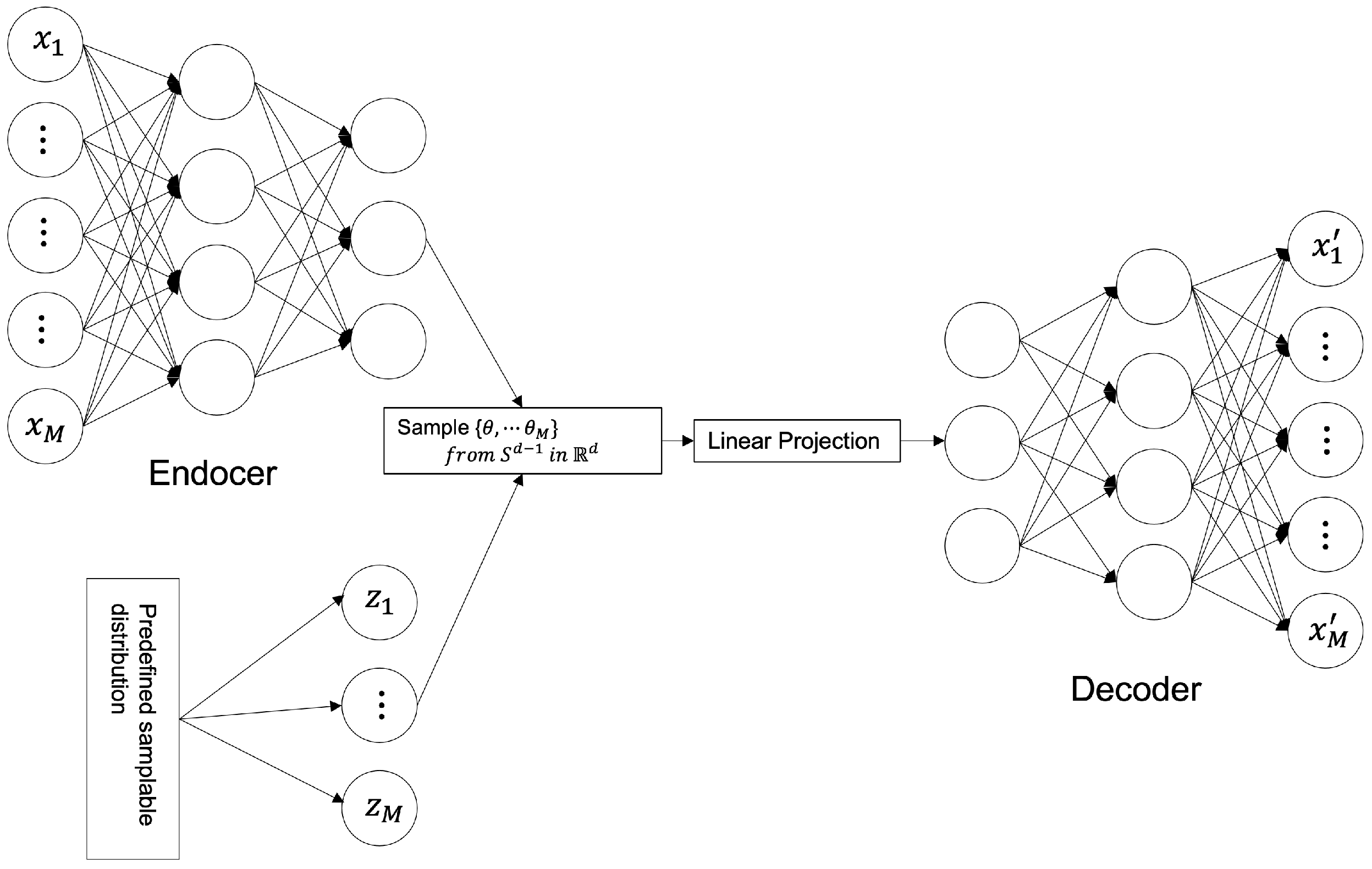
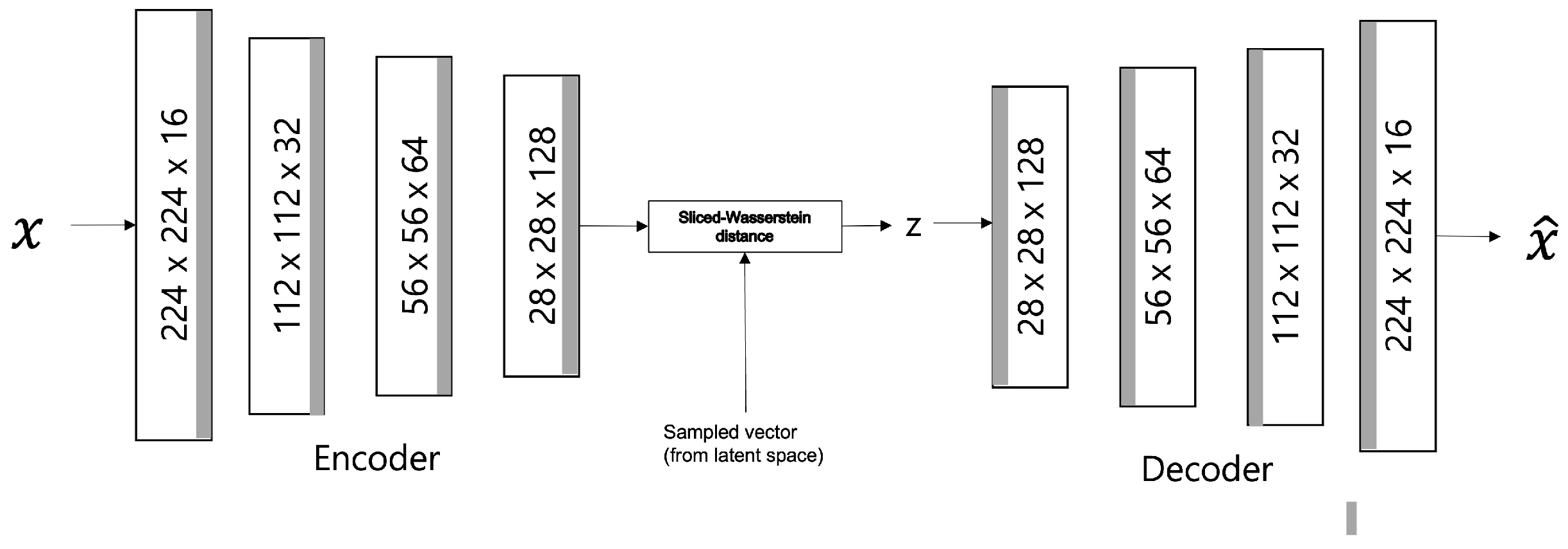
Similar to the VAE model, the SWAE model is a generative model comprising an encoder and a decoder, which allows the latent space to be formed into a sampling probability distribution. However, the only difference is normalizing reconstruction losses using the SWD between the encoded learning sample distribution and the predefined sampling distribution. Figure 8 shows the SWAE architecture.
Figure 8. SWAE model architecture.
Ultrasonography data converted to values between 0 and 1 are used as input, and the configuration and output of each model layer are configured the same as those of the AE and VAE models. The loss value L is calculated as the sum of the reconstruction error and the SWD of the 1D projection for normalization (Equation (17)). The maximum value of the learning rate is set to 0.0002, and cosine annealing is applied and adjusted to increase accuracy.
L = L r e c + S l i c e d W a s s e r s t e i n d i s t a n c e = 1 n i = 1 n ( x x ^ ) 2 + S W ( P x , P x ^ ) = a r g m i n E n c , D e c W ( P x , P x ^ ) + λ S W ( p z , q z )
In the loss function calculation, L r e c evaluates the error between the input and reconstructed images as a pixel-by-pixel MSE, and the SWE is applied by projecting the difference between the encoded data distribution p z and predefined sampling distribution q z in dimensions.
M S E = 1 n i = 1 n ( x i x i ^ ) 2

3.2.3. Validation of Anomaly Detection Method for Breast Ultrasonography

Anomalous data are input to the learned model to detect the anomalous region of an ultrasound image, and the output is a difference image between the restored and input images. The anomalous region is detected by a binary division based on a specific threshold. For performance verification, the ROI label data, extracted from a tumor region of the breast ultrasound image, is used. Indicators such as similarity (Dice), sensitivity (true-positive rate (TPR)), and FPR are calculated using overlapping pixel value information in the anomalous region of the label data and the binary-split image obtained from the models. Further, these indicators are employed to compare and analyze the detection results of each model. In addition, factors influencing the anomalous region detection results in an ultrasound image are identified.
Performance Evaluation of Anomaly Detection
In this study, three models were used to detect anomalous regions using the error value between the input and reconstructed images. This should restore the normal ultrasound image input for learning, and the abnormal ultrasound image input for testing should restore the anomalous region close to normal. The role of restoration is essential for successful anomalous region detection by applying a reconstruction-based approach to ultrasound images. Accordingly, the restoration results for each model for normal and abnormal ultrasound images are compared and analyzed using the root MSE (RMSE) values that minimize the error between the input and reconstructed images (Equation (19)).
R M S E = 1 n i = 1 n ( R e c o n s t r u c t i o n I n p u t ) 2
Restoration performance by RMSE value-based model can be considered as a model with improved learning when learning with normal data, a high RMSE value when evaluated with anomalous data, and failure to restore results and can be attributed to a well-trained model for anomalous region detection.
In addition, three indicators, Dice, TPR, and FPR, belonging to the overlap-based evaluation index group, were used to evaluate anomaly detection performance. Dice is calculated from Equation (20) using true positive (TP), false positive (FP), false negative (FN), and true negative (TN), which are components of the diffusion matrix. It is an indicator that checks the similarity with the correct answer by directly comparing the division results of the two images. TPR is an indicator of sensitivity, and by predicting the actual anomalous region abnormal, the anomalous region detection results can be confirmed. Moreover, FPR is an indicator of the normal region classified above [30]. Performance is measured based on the indicator values for each model derived by inputting anomalous data into the model, which are evaluation data. Indicator values are also compared and analyzed to verify whether the reconstruction-based approach of unsupervised learning is suitable for anomaly detection in ultrasound images.
D i c e = 2 T P 2 T P + F N + F P , T P R = T P T P + F N , F P R = F P F P + T N
Analysis of Factor Influencing Anomalous Region Detection
To measure the anomaly detection performance of the reconstruction-based approach, we analyzed the effects of threshold setting and model-specific latent variables on reconstruction [17] and tumor and mass size of ultrasound images on anomaly detection.
As for the threshold for determining the anomalous region, the difference between the mean values of the individual anomaly maps and the overall anomaly map of the validation data is calculated using 94 normal data points for validation, as shown in Algorithm 1, and the maximum value calculated by applying the Relu function is set as the reference threshold [31]. However, in this study, the Relu function applied to obtain the threshold value treats the negative value of the vector as 0. Hence, the threshold value becomes relatively large, resulting in a region that treats the abnormality as normal. Therefore, by supplementing this, three additional thresholds, 0.1, 0.2, and 0.3, which can more accurately detect anomalous regions in ultrasound images, were applied and compared.
Algorithm 1: Find threshold for anomaly detection
Input: anomaly map of validation dataset
Output: threshold
1:
M a x _ r e l u 0
2:
Calculate an average of anomaly map
3:
for v in validation set do
4:
     r e l u _ t h R e L U ( v average )
5:
    if  M a x _ r e l u < m a x ( r e l u _ t h ) then
6:
         M a x _ r e l u m a x ( r e l u _ t h )
7:
    end if
8:
end for
    return M a x _ r e l u
Other influencing factors include the latent variable dimension of the latent space. The results are analyzed by limiting the structure of latent features through whether the encoder that generates latent variables for each model reduces dimensions. A reconstructed image is derived by varying the latent space dimensions of the three models. Anomalous region detection was performed by setting the latent space to a low dimension. In addition, the encoder and anomalous region detection results were confirmed by setting the latent space to a high dimension. Furthermore, changes in indicators according to the ROI sizes, such as masses and tumors of abnormal images used in the evaluation process, were examined. We also confirmed that ROI affects anomalous region detection.

4. Experimental Results and Analysis

4.1. Experimental Overview and Environment

In our experiment, AE, VAE, and SWAE models were implemented by applying the reconstruction-based approach of unsupervised learning. The detection performance of each model was measured. In addition, the effect of anomaly detection application in ultrasound was confirmed by comparison based on the performance evaluation values for each model.
The experimental environment used is the programming language Python 3.6.9 version, DL framework Pytorch 1.6 version, CUDA 10.0 version for GPU operation, and cuDNN 7.6.5 version library. A model’s learning, evaluation, and outcome analysis are performed in an environment using Intel(R) Core(TM) i7-1065G7 CPU @ 1.30 GHz 1.50 GHz and GeForce GTX Titan Xp 440.100 versions.

4.2. Evaluation of Anomalous Region Detection in Ultrasonography

4.2.1. Reconstruction Performance by Model

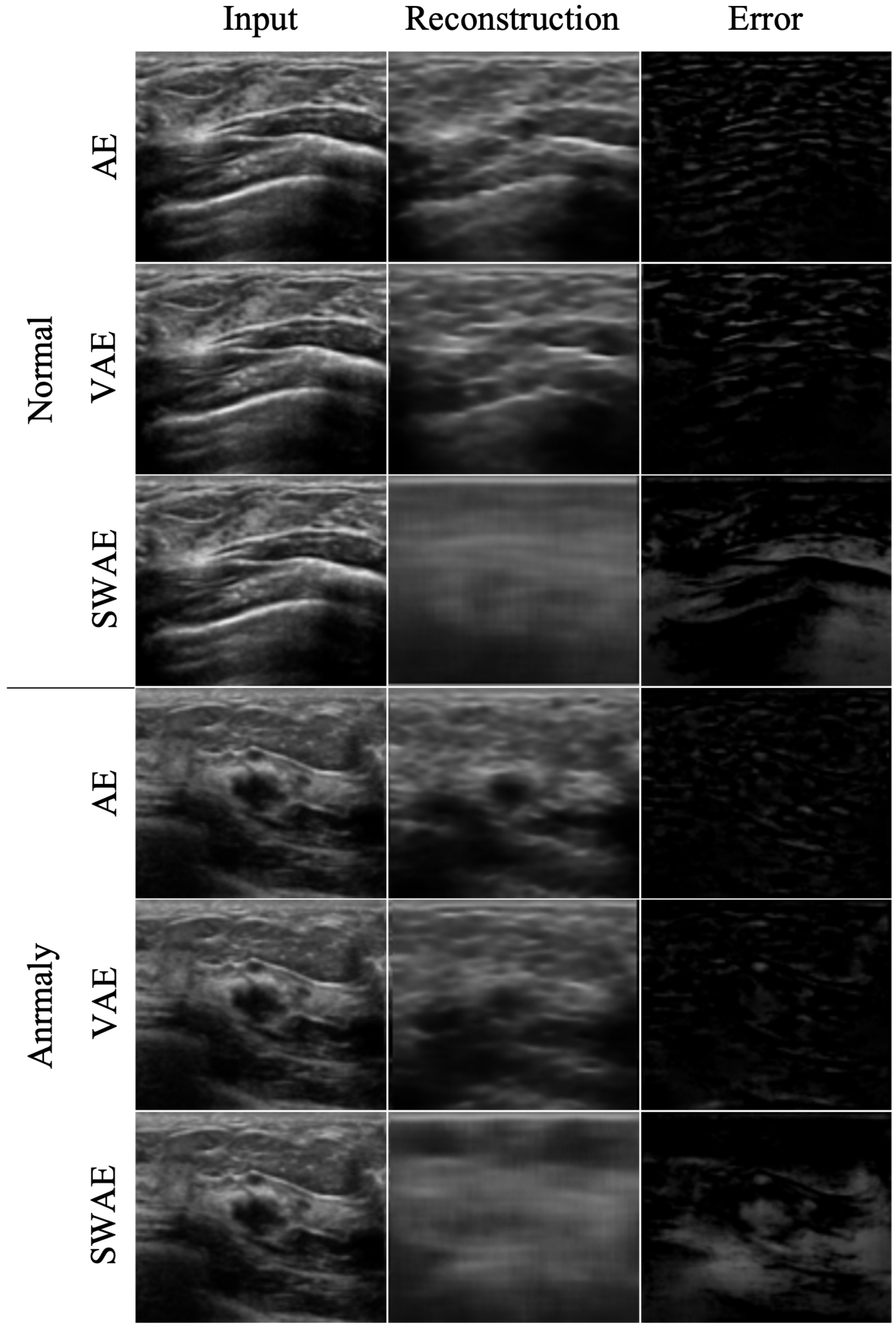
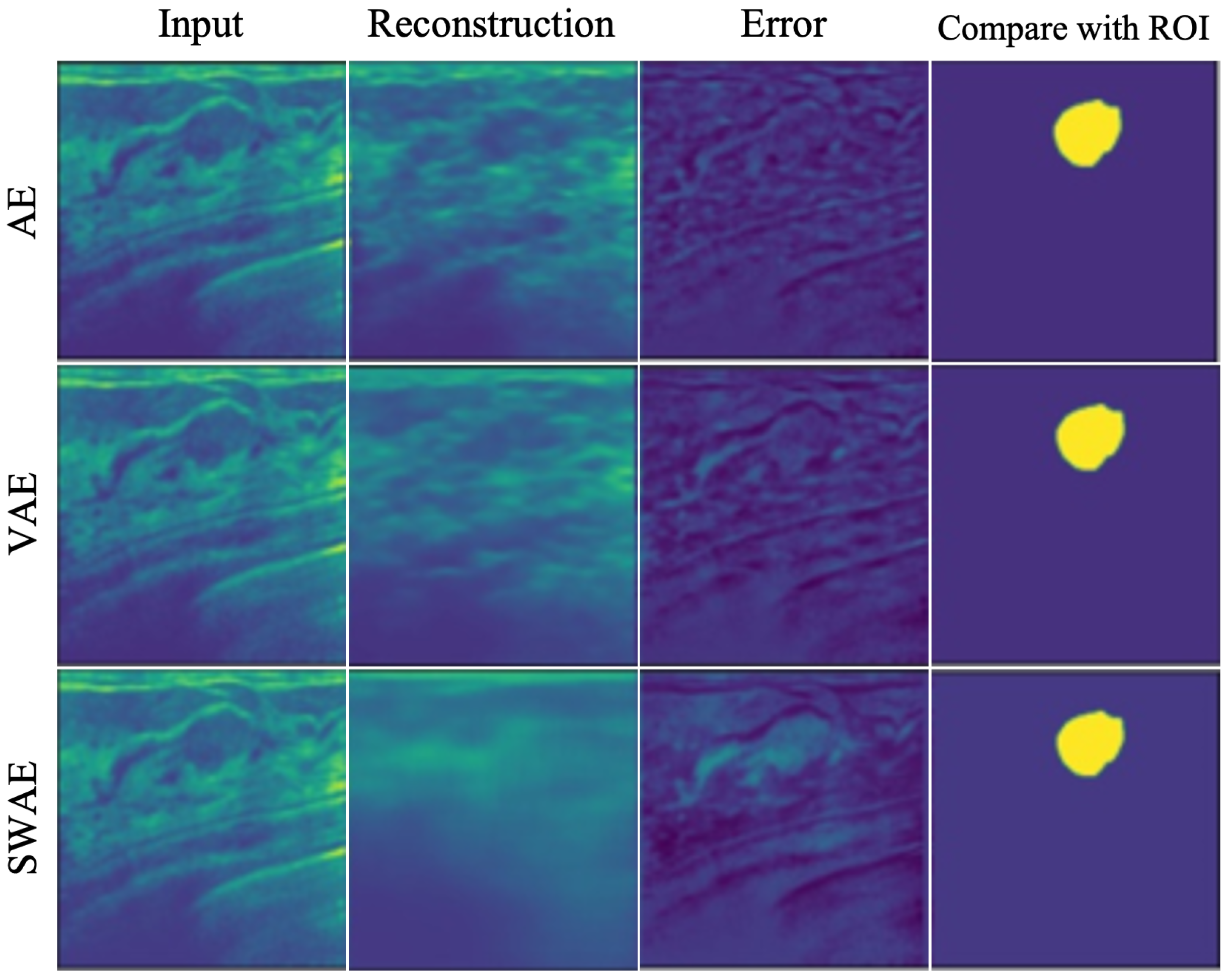
The reconstruction performances of the models are presented in Table 4 by comparing the average RMSE of the verification process using normal ultrasound images and the average RMSE of abnormal ultrasound images. In the image reconstruction process by an AE, the smaller the RMSE value, the better the reconstruction performance. However, in a test process for abnormal ultrasonic images, a larger RMSE value indicates that the input image is not well-reconstructed. This means that the input image contains abnormal features that are difficult to reconstruct by the model. The pixel-wise differences between the input and reconstructed images would be suitable for identifying an anomalous region. In the comparison experiment for the three models, the RMSE value increases in the order of SWAE, VAE, and AE, and the anomalous region detection performance is found to be the best in the SWAE model. Examples of the image reconstruction results for each model are shown in Figure 9 below.
Table 4. Reconstruction performances of models.
Figure 9. Reconstructed images by model.
We confirmed that the AE model with the smallest RMSE value yielded restoration as the input. For the VAE model, although the normalization value was considered in learning, the results were similar to those of the AE model. This shows that it is difficult to find an anomalous region in an error image by restoring the anomalous region similar to the input as a result of the test by inputting an abnormal image. Conversely, the reconstructed images of the SWAE model, which showed the highest RMSE value in the evaluation process, did not restore abnormal features. The anomalous region could be verified in the different maps more accurately.

4.2.2. Anomalous Region Detection

To evaluate the anomaly detection performance of the three models, we used three indicators, Dice, TPR, and FPR, as described in Section N. The results of detecting anomalous regions by the three models based on an arbitrary threshold of 0.2 are shown in Table 5.
Table 5. Indicators of anomalous region detection results of models.
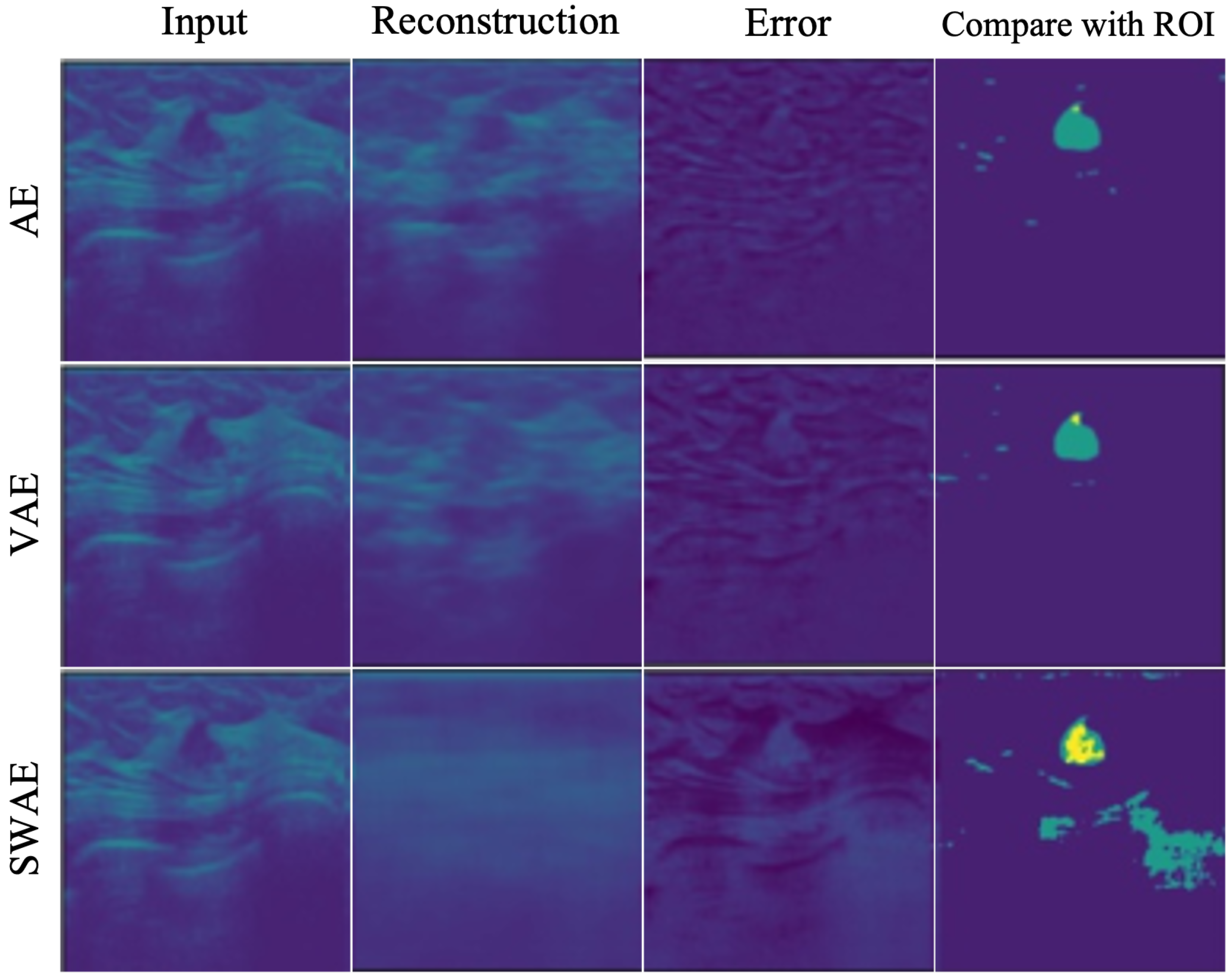
Similarity generally showed low values in the three models. However, they were the lowest in the AE model, and all indicator values showed the highest results in the SWAE model. The SWAE model showed relatively high sensitivity and good performance, but the FPR value was relatively low. Figure 10 shows each model’s anomalous region detection performance.
Figure 10. Reconstructed result images by models.
The AE model, which has the smallest similarity, sensitivity, and performance values, restored an input very similarly. It can be seen that there is almost no region indicating an abnormality in the case of binary division based on a specific threshold of 0.2. The VAE model restored the input image similar to the AE model, and both the error and binary-split images, and the indicator values, showed similar results to the AE model. The SWAE model shows the most significant result in all three indicator values. The anomalous region is most clearly detected and displayed in the error and binary-split images.

4.3. Analysis of Factor Influencing Anomalous Region Detection in Ultrasonography

4.3.1. Threshold

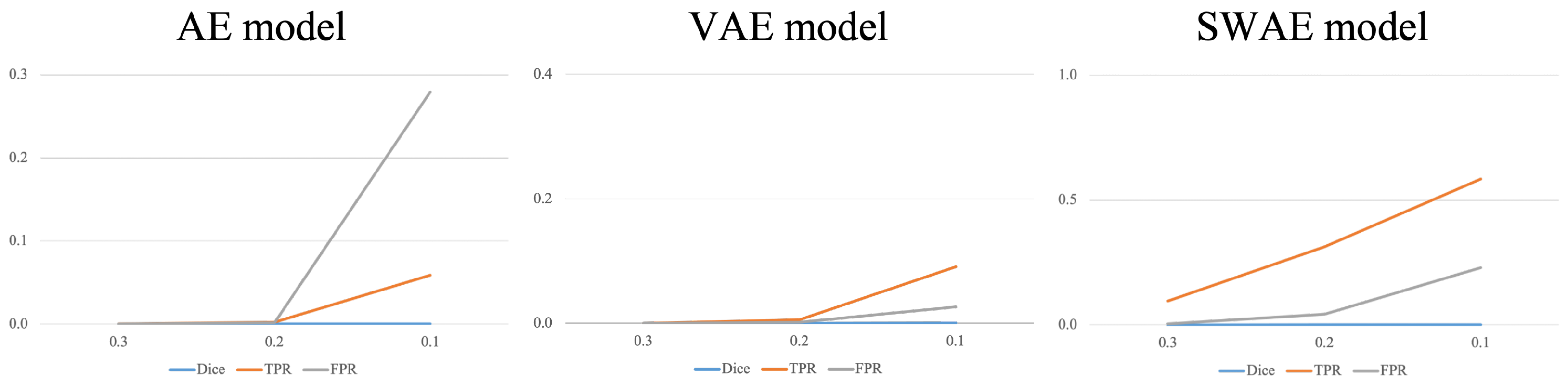
As a result of detecting anomalous regions of the models, the reconstruction-based approach is considerably affected by the threshold value. Figure 11 shows the change in indicators for each arbitrary threshold.
Figure 11. Changes in indicators according to the threshold for each model.
In all three models, the smaller the threshold, the larger the region, which is considered abnormal, indicating an increase in the TPR and FPR values. In the AE model, the FPR value increases significantly more than the TPR value because the FPR value, which considers typical abnormalities as normal, is larger than the TPR value, which considers abnormalities as abnormalities. It is difficult to say that the anomalous region was well-detected. The VAE and SWAE models show that the TPR value increases more than the FPR value as the threshold value decreases. In particular, for the SWAE model, the TPR value increases the most, indicating that the anomalous region was well-detected by considering the actual abnormality as abnormal. As shown in Figure 11, thresholds play an important role in anomalous region detection, thus, we did not use arbitrary thresholds. We applied the method using the validation data mentioned in Algorithm 1 of the Research Methodology to derive thresholds. The derived thresholds are shown in Table 6.
Table 6. Comparison of thresholds by models.
The method applied in Table 6 uses the Relu function. The application method shows a relatively significant threshold value because the negative number is treated as 0 in the vector value of the error image. A significant threshold may occur in a region where the abnormality is treated as normal during the binary division of an error image. Figure 12 demonstrates the anomalous region detection results. Figure 12 shows that most results compared with the ROI are considered normal in the error image, resulting in the anomalous region not occurring and no overlapping area with the ROI occurring, which further indicates that it is difficult to detect the anomalous region.
Figure 12. Anomalous region detection results with respect to threshold with applying Relu function.
When the average value of the verified data error image was used without applying the Relu function to calculate the threshold value for detecting the anomalous region of the breast ultrasonography, a threshold value, somewhat lower than that of applying the Relu function, was derived, indicating relatively good results for anomalous region detection. However, for small thresholds, the FPR value increases as the increase of FPs, indicating the limitation of anomalous detection.

4.3.2. Size of Tumor

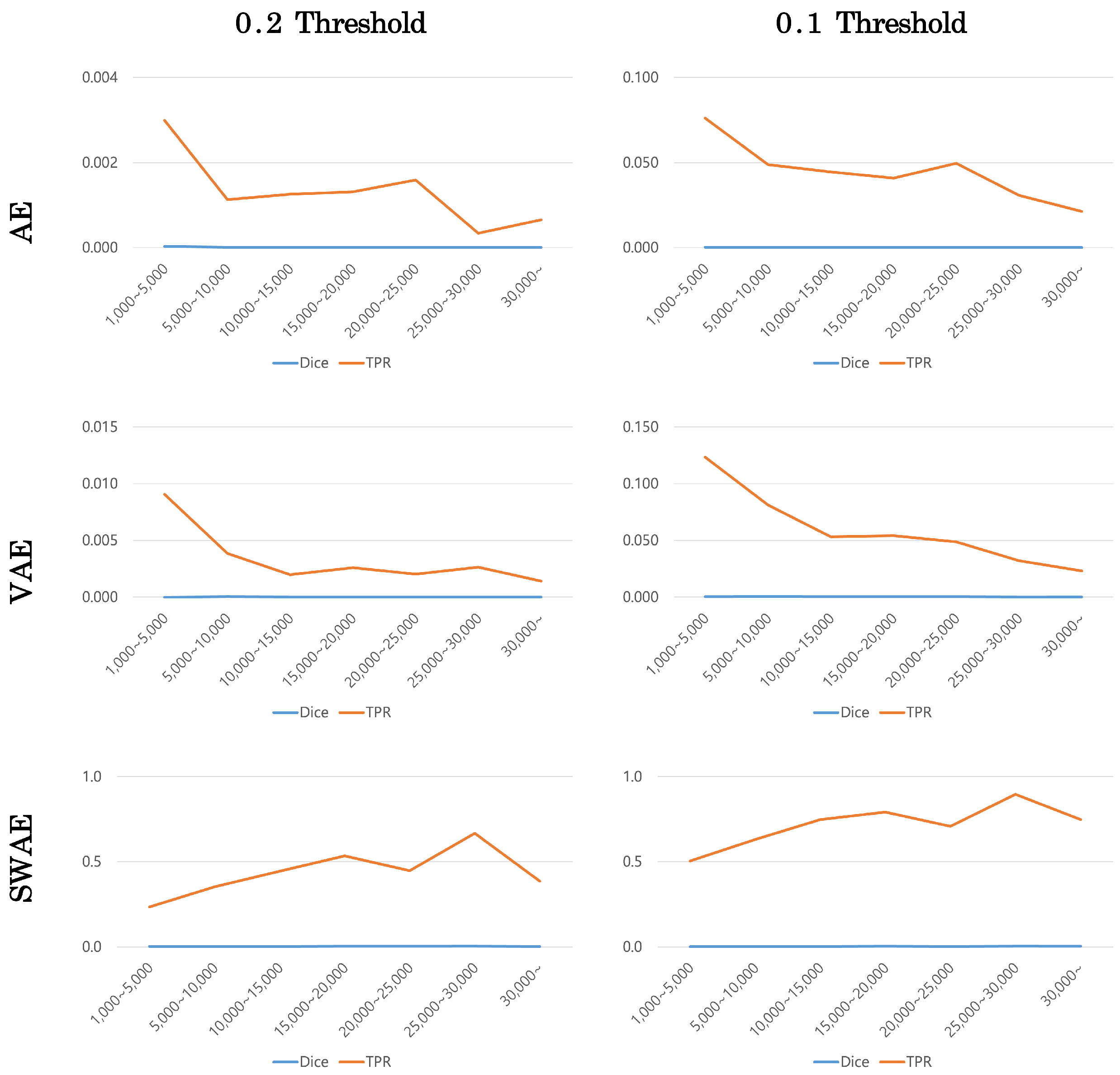
The number of pixels in the ROI image representing the tumor was calculated to confirm the effect of tumor size on anomalous region detection. The tumor size was divided into ranges according to the number of pixels, and the averages of the Dice scores and TPR values in the corresponding range were calculated to compare the performance of each model. Figure 13 shows the change in indicators according to tumor size at a corresponding threshold for each model.
Figure 13. Changes in indicators according to tumor size by model.
Dice scores were small in all models, making it difficult to compare, but TPR values showed similar patterns for each model. The error image is binary divided based on a specific threshold, hence, the TPR value can be calculated somewhat larger at a smaller threshold. However, the TPR value according to tumor size showed a similar pattern depending on the model’s threshold value. In the AE and VAE models, the TPR value decreased as the tumor size increased. Meanwhile, in the SWAE model, the TPR value increased as the tumor size increased to a specific range; in general, the larger the tumor size, the larger the TPR value.

5. Conclusions

In this study, we have used the reconstruction-based approach of unsupervised learning to confirm the effect of using deep learning-based technology to detect anomalies in breast ultrasound images. Three models–AE, VAE, and SWAE–were used to compare the results of anomalous region detection based on calculated specific threshold similarity (Dice), sensitivity (TPR), and FPR indicators. The performance results of restoring ultrasound images were good in the order of AE, VAE, and SWAE; however, abnormal images could not be restored in the anomalous region detection.
In addition, we confirmed that the SWAE model, which represents a more significant TPR value than the FPR value, exhibited relatively good performance in anomalous region detection. Meanwhile, the VAE model, which performed similar learning as the SWAE model by adding normalization values, failed to enforce the distribution of sample data, a characteristic of the model, resulting in similar results to the AE model.
The anomalous region detection technology applied in this study has a threshold-dependent limitation because based on a specific threshold, it determines whether an error image is abnormal by dividing it. This resulted in a higher TPR value with a decreasing threshold value. However, the FPR value that could detect non-tumor regions as tumors also increased and that was not a good result.
Changes in the Dice and TPR indicators according to the tumor size were confirmed to check the effect of tumor size on detecting anomalous regions. Although the indicator values might differ due to the difference in anomalous regions according to the threshold value, similar patterns were observed for each model. In the AE and VAE models, the larger the tumor size, the fewer the detected anomalous regions. This is observed as a result of a restoration similar to the anomalous region, resulting in a smaller region considered abnormal. Furthermore, because the reconstruction in the SWAE model was restored to map the anomalous region to normal, the overall anomalous region was detected. The larger the tumor size, the more overlapping parts occurred, and the higher the TPR value was.
In this study, we detected anomalous regions such as tumors and masses in ultrasound images and checked whether they could be visually presented. The results of anomalous region detection using the SWAE model showed the best performance in ultrasound images among the three AE-based models.
Further research is required to reduce learning through securing various samples, FPR values, and increasing TPR values to detect anomalous regions with improved performance on breast ultrasound images with high variance characteristics. Moreover, because the threshold setting considerably influences the anomalous region detection results, visual presentation of anomalous regions for ultrasound images will be possible if additional methods are applied to determine anomalies without a separate threshold setting.

Author Contributions

Conceptualization, B.E., S.P., C.Y. and J.K.; data curation, B.E., S.P. and J.K.; formal analysis, B.E., S.P. and J.K.; investigation, B.E., S.P. and C.Y.; methodology, B.E. and S.P.; project administration, B.E., S.P. and J.K.; supervision, J.K.; validation, B.E., S.P. and J.K.; visualization, B.E., S.P. and J.K.; writing—original draft, B.E.; writing—review and editing, C.Y., D.K., C.K., J.K. and F.J.; Discussion and Editing, W.H.K. and H.J.K.; And CREDENCE and ICONIC investigators. All authors have read and agreed to the published version of the manuscript.

Funding

This research was supported by Kyungpook National University Research Fund, 2018.

Institutional Review Board Statement

This manuscript contains data from an IRB approved study (Kyungpook National University Chilgok Hospital). The study received ethical approval from the local ethics committee. All data reported here were anonymized and stored in line with data privacy regulations in South Korea.

Data Availability Statement

Not applicable.

Acknowledgments

The authors would like to acknowledge the participants in the study.

Conflicts of Interest

The authors declare no conflict of interest. The funders had no role in the design of the study; in the collection, analyses, or interpretation of data; in the writing of the manuscript; or in the decision to publish the results.

References

  1. Edwards, B.I.; Khougali, N.H.O.; Cheok, A.D. Trends in Computer-Aided Diagnosis Using Deep Learning Techniques: A Review of Recent Studies on Algorithm Development. Preprints 2017, 2017100117. [Google Scholar] [CrossRef]
  2. Alom, M.Z.; Taha, T.M.; Yakopcic, C.; Westberg, S.; Sidike, P.; Nasrin, M.S.; Hasan, M.; Van Essen, B.C.; Awwal, A.A.; Asari, V.K. A state-of-the-art survey on deep learning theory and architectures. Electronics 2019, 8, 292. [Google Scholar] [CrossRef]
  3. Shin, S.J.; Jeong, B.J. Principle and comprehension of ultrasound imaging. J. Korean Orthop. Assoc. 2013, 48, 325–333. [Google Scholar] [CrossRef]
  4. Berg, W.A.; Blume, J.D.; Cormack, J.B.; Mendelson, E.B. Operator dependence of physician-performed whole-breast US: Lesion detection and characterization. Radiology 2006, 241, 355–365. [Google Scholar] [CrossRef] [PubMed]
  5. Boyd, N.F.; Martin, L.J.; Yaffe, M.J.; Minkin, S. Mammographic density and breast cancer risk: Current understanding and future prospects. Breast Cancer Res. 2011, 13, 223. [Google Scholar] [CrossRef] [PubMed]
  6. Chandola, V.; Banerjee, A.; Kumar, V. Anomaly detection: A survey. ACM Comput. Surv. CSUR 2009, 41, 1–58. [Google Scholar] [CrossRef]
  7. Pang, G.; Shen, C.; Cao, L.; Hengel, A.V.D. Deep learning for anomaly detection: A review. ACM Comput. Surv. CSUR 2021, 54, 1–38. [Google Scholar] [CrossRef]
  8. Lee, J.G.; Jun, S.; Cho, Y.W.; Lee, H.; Kim, G.B.; Seo, J.B.; Kim, N. Deep learning in medical imaging: General overview. Korean J. Radiol. 2017, 18, 570–584. [Google Scholar] [CrossRef] [PubMed]
  9. Ruff, L.; Vandermeulen, R.; Goernitz, N.; Deecke, L.; Siddiqui, S.A.; Binder, A.; Müller, E.; Kloft, M. Deep one-class classification. In Proceedings of the International Conference on Machine Learning. PMLR, Stockholm, Sweden, 10–15 July 2018; pp. 4393–4402. [Google Scholar]
  10. Zong, B.; Song, Q.; Min, M.R.; Cheng, W.; Lumezanu, C.; Cho, D.; Chen, H. Deep autoencoding Gaussian mixture model for unsupervised anomaly detection. In Proceedings of the International Conference on Learning Representations, Vancouver, BC, Canada, 30 April–3 May 2018. [Google Scholar]
  11. Chalapathy, R.; Chawla, S. Deep learning for anomaly detection: A survey. arXiv 2019, arXiv:1901.03407. [Google Scholar]
  12. Kingma, D.P.; Welling, M. Auto-encoding variational bayes. arXiv 2013, arXiv:1312.6114. [Google Scholar]
  13. Kolouri, S.; Pope, P.E.; Martin, C.E.; Rohde, G.K. Sliced Wasserstein auto-encoders. In Proceedings of the International Conference on Learning Representations, Vancouver, BC, Canada, 30 April–3 May 2018. [Google Scholar]
  14. Liao, S.; Gao, Y.; Oto, A.; Shen, D. Representation learning: A unified deep learning framework for automatic prostate MR segmentation. In Proceedings of the International Conference on Medical Image Computing and Computer-Assisted Intervention, Nagoya, Japan, 22–26 September 2013; Springer: Berlin/Heidelberg, Germany, 2013; pp. 254–261. [Google Scholar]
  15. Vasilev, A.; Golkov, V.; Meissner, M.; Lipp, I.; Sgarlata, E.; Tomassini, V.; Jones, D.K.; Cremers, D. q-Space novelty detection with variational autoencoders. In Computational Diffusion MRI; Springer: Berlin/Heidelberg, Germany, 2020; pp. 113–124. [Google Scholar]
  16. Chen, X.; Konukoglu, E. Unsupervised detection of lesions in brain MRI using constrained adversarial auto-encoders. arXiv 2018, arXiv:1806.04972. [Google Scholar]
  17. Baur, C.; Wiestler, B.; Albarqouni, S.; Navab, N. Deep autoencoding models for unsupervised anomaly segmentation in brain MR images. In Proceedings of the International MICCAI Brainlesion Workshop, Granada, Spain, 16 September 2018; Springer: Berlin/Heidelberg, Germany, 2018; pp. 161–169. [Google Scholar]
  18. Vu, H.S.; Ueta, D.; Hashimoto, K.; Maeno, K.; Pranata, S.; Shen, S.M. Anomaly detection with adversarial dual autoencoders. arXiv 2019, arXiv:1902.06924. [Google Scholar]
  19. Schlegl, T.; Seeböck, P.; Waldstein, S.M.; Schmidt-Erfurth, U.; Langs, G. Unsupervised anomaly detection with generative adversarial networks to guide marker discovery. In Proceedings of the International Conference on Information Processing in Medical Imaging, Boone, NC, USA, 25–30 June 2017; Springer: Berlin/Heidelberg, Germany, 2017; pp. 146–157. [Google Scholar]
  20. Seeböck, P.; Waldstein, S.M.; Klimscha, S.; Bogunovic, H.; Schlegl, T.; Gerendas, B.S.; Donner, R.; Schmidt-Erfurth, U.; Langs, G. Unsupervised identification of disease marker candidates in retinal OCT imaging data. IEEE Trans. Med Imaging 2018, 38, 1037–1047. [Google Scholar] [CrossRef] [PubMed]
  21. Seeböck, P.; Orlando, J.I.; Schlegl, T.; Waldstein, S.M.; Bogunović, H.; Klimscha, S.; Langs, G.; Schmidt-Erfurth, U. Exploiting epistemic uncertainty of anatomy segmentation for anomaly detection in retinal OCT. IEEE Trans. Med. Imaging 2019, 39, 87–98. [Google Scholar] [CrossRef] [PubMed]
  22. Zhou, K.; Gao, S.; Cheng, J.; Gu, Z.; Fu, H.; Tu, Z.; Yang, J.; Zhao, Y.; Liu, J. Sparse-gan: Sparsity-constrained generative adversarial network for anomaly detection in retinal oct image. In Proceedings of the 2020 IEEE 17th International Symposium on Biomedical Imaging (ISBI), Iowa City, IA, USA, 3–7 April 2020; pp. 1227–1231. [Google Scholar]
  23. Davletshina, D.; Melnychuk, V.; Tran, V.; Singla, H.; Berrendorf, M.; Faerman, E.; Fromm, M.; Schubert, M. Unsupervised anomaly detection for X-ray images. arXiv 2020, arXiv:2001.10883. [Google Scholar]
  24. Tataru, C.; Yi, D.; Shenoyas, A.; Ma, A. Deep Learning for abnormality detection in Chest X-Ray images. In Proceedings of the IEEE Conference on Deep Learning, Cancun, Mexico, 18–21 December 2017. [Google Scholar]
  25. Lu, Y.; Xu, P. Anomaly detection for skin disease images using variational autoencoder. arXiv 2018, arXiv:1807.01349. [Google Scholar]
  26. Burlina, P.; Joshi, N.; Billings, S.; Wang, I.J.; Albayda, J. Unsupervised deep novelty detection: Application to muscle ultrasound and myositis screening. In Proceedings of the 2019 IEEE 16th International Symposium on Biomedical Imaging (ISBI 2019), Venice, Italy, 8–11 April 2019; pp. 1910–1914. [Google Scholar]
  27. Naval Marimont, S.; Tarroni, G. Implicit field learning for unsupervised anomaly detection in medical images. In Proceedings of the International Conference on Medical Image Computing and Computer-Assisted Intervention, Strasbourg, France, 27 September–1 October 2021; Springer: Berlin/Heidelberg, Germany, 2021; pp. 189–198. [Google Scholar]
  28. van Hespen, K.M.; Zwanenburg, J.J.; Dankbaar, J.W.; Geerlings, M.I.; Hendrikse, J.; Kuijf, H.J. An anomaly detection approach to identify chronic brain infarcts on MRI. Sci. Rep. 2021, 11, 7714. [Google Scholar] [CrossRef] [PubMed]
  29. Nakao, T.; Hanaoka, S.; Nomura, Y.; Murata, M.; Takenaga, T.; Miki, S.; Watadani, T.; Yoshikawa, T.; Hayashi, N.; Abe, O. Unsupervised deep anomaly detection in chest radiographs. J. Digit. Imaging 2021, 34, 418–427. [Google Scholar] [CrossRef] [PubMed]
  30. Kim, J.; Kim, J. Review of evaluation metrics for 3D medical image segmentation. J. Korean Soc. Imaging Infor. Med. 2017, 23, 14–20. [Google Scholar]
  31. Jang, J. Deep Learning Algorithms for Visual Inspection. Ph.D. Thesis, Seoul National University Graduate School, Seoul, Republic of Korea, 2020. [Google Scholar]
Disclaimer/Publisher’s Note: The statements, opinions and data contained in all publications are solely those of the individual author(s) and contributor(s) and not of MDPI and/or the editor(s). MDPI and/or the editor(s) disclaim responsibility for any injury to people or property resulting from any ideas, methods, instructions or products referred to in the content.

Article Metrics

Citations

Article Access Statistics

Multiple requests from the same IP address are counted as one view.