
Abstract
Backscatter communication (BC) systems are a promising technology for internet of things (IoT) applications that allow devices to transmit information by modulating ambient radio signals without the need for a dedicated power source. However, the security of BC systems is a critical concern due to the vulnerability of the wireless channel. This paper investigates the impact of side information (SI) on the secrecy performance of BC systems. SI mainly refers to the additional knowledge that is available to the communicating parties beyond transmitted data, which can be used to enhance reliability, efficiency, security, and quality of service in various communication systems. In particular, in this paper, by considering a non-causally known SI at the transmitter, we derive compact analytical expressions of average secrecy capacity (ASC) and secrecy outage probability (SOP) for the proposed system model to analyze how SI affects the secrecy performance of BC systems. Moreover, a Monte Carlo simulation validates the accuracy of our analytical results and reveals that considering such knowledge at the transmitter has constructive effects on the system performance and ensures reliable communication with higher rates than the conventional BC systems without SI, namely, lower SOP and higher ASC are achievable.
1. Introduction
Backscatter communication (BC) is a promising technology that enables devices to transmit information by modulating ambient radio signals, eliminating the need for a dedicated power source. This innovative approach has gained significant attention in internet of things (IoT) applications over recent years due to its low power requirements and potential for widespread deployment [1,2,3,4]. However, the lack of a tractable transmission structure in the BC system makes it susceptible to passive eavesdropping attacks, where an adversary can intercept and decode transmitted information. Moreover, the unlicensed and shared nature of the wireless spectrum in which BC operates raises concerns about interference and unauthorized access. Hence, ensuring the security of the BC system remains a critical challenge that should be considered in future wireless communication technologies such as sixth generation (6G) [5,6,7,8,9].
To address the aforesaid challenges, on the one hand, applying physical layer security (PLS) techniques in BC systems can be helpful [10,11,12,13,14,15,16,17]. The concept of PLS was first proposed by Shannon [18] and then studied by Wyner [19] for a basic wiretap channel exploiting Shannon’s notion of perfect secrecy. Indeed, the PLS aims to exploit the unique characteristics of the wireless channel to provide secure communication. Hence, by leveraging the inherent properties of the channel, such as fading and noise, the PLS can enhance the confidentiality and integrity of the transmitted information in BC systems. On the other hand, considering side information (SI) at the transmitters/receivers may play a vital role in improving the security and reliability of wireless BC systems. Generally speaking, SI mainly refers to additional knowledge available to the communicating parties beyond the transmitted data (e.g., channel state information (CSI), interference sources, noise statistics, prior data transmissions, etc.). The use of SI at the transmitter was first introduced by Shannon [20] for single-user point-to-point (P2P) communication systems, and then studied by Jafar [21] in multi-user communication systems. In this regard, due to the advantages of SI in reducing the destructive effects of interference and guaranteeing reliable communication with higher rates, Mitrpant et al. [22] analyzed the Gaussian wiretap channel with SI. Then, by exploiting dirty paper coding [23], Chen and Vink [24] studied the impact of SI on the Gaussian wiretap channel to find out how much secret information can be reliably and securely sent to the legitimate receiver without leaking information about the secret message to the eavesdropper. They showed that the SI at the transmitter provides a larger secrecy capacity and guarantees a more secure communication.
1.1. Related Works
In recent years, several contributions have been carried out to analyze the performance of secure BC systems [25,26,27,28,29,30,31,32,33,34,35,36,37,38] and to evaluate the impact of SI on various communication systems [39,40,41,42,43,44,45]. Saad et al. [25] studied the PLS performance of a wireless backscatter systems in terms of the secrecy outage probability (SOP). Zhang et al. [26] analyzed the SOP of a multi-tag BC system in the presence of an eavesdropper. Furthermore, Liu et al. [27] enhanced the SOP using an optimal tag selection scheme for a passive BC with multiple tags and one eavesdropper. In [28], Liu et al. proposed a tag selection scheme to enhance the average secrecy capacity (ASC) and SOP of a multi-tag self-powered BC system in the presence of an eavesdropper. By deriving an analytical expression of SOP, Muratkar et al. [29] studied the impact of the eavesdropper’s and reader’s motion on ambient BC systems’ secrecy performance when channel estimation is imperfect. In [30], Zheng et al. proposed an overlay cognitive ambient BC non-orthogonal multiple access (NOMA) system for intelligent transportation systems. They analyzed the secrecy performance of their proposed system model in the presence of an eavesdropping vehicle by deriving the SOP. In addition, Jia et al. [31] studied the secure multi-antenna transmission in an ambient BC-based intelligent transportation system in the presence of a passive eavesdropper with jamming, where a cooperative jammer is placed in the system to deliberately disrupt the eavesdropper without influencing the reader. For analyzing the performance of the proposed scheme, they derived a new closed-form expression of SOP.
Sharma and Kumbhani [32] conducted an in-depth analysis of secrecy performance in automatic toll collection systems employing BC. Their investigation focused on assessing the probability of secrecy compromise, incorporating the principles of PLS. The study placed particular emphasis on the effects of varying distances between the tag, reader, and eavesdropper. In [33], the emphasis shifted towards the evaluation of the secrecy performance in wireless-powered BC systems, particularly within the context of smart sustainable cities. Unique to this work was the consideration of the spatial randomness of network nodes in large-scale wireless-powered BCs. The authors employed a stochastic geometry framework to analyze SOP, accounting for imperfect successive interference cancellation and energy-harvesting constraints. A significant stride in the domain of two-way ambient BC was made by Wang et al. [34]. Their work addressed the challenge of secure communication in two-way ambient BC networks, introducing PLS considerations. The study derived analytical and asymptotic expressions for SOP, showcasing the intricate trade-offs between reliability and security. In the realm of UAV-enabled BC, Ref. [35] brought attention to the issue of information leakage in wireless channels. The authors introduced a multi-user secure BC system with analog beamforming and randomized continuous wave techniques. By exploiting randomized continuous wave techniques for eroding eavesdropping links, the study offered closed-form expressions for the secrecy rate, demonstrating substantial improvements in secrecy performance.
That et al. [36] tackled the secrecy capacity of bi-static BC networks, a critical concern in the adoption of battery-free IoT sensors. This study centered on the presence of a malicious eavesdropper and presented closed-form expressions for ASC. The results were validated through rigorous Monte Carlo simulations. The reliability and security of ambient backscatter NOMA systems under in-phase and quadrature-phase imbalance were the subject of investigation in [37]. The authors derived analytical expressions for SOP, uncovering intriguing insights into the impact of in-phase and quadrature-phase imbalance on system reliability and security trade-offs. In [38], an analysis of PLS was extended to ambient BC systems with source and reader mobility. The study employed SOP as a performance metric, exploring the effects of varying relative speed and the number of tags on the security of the system.
By considering perfect SI, Kim and Skoglund [39] maximized the expected rate over a single-input single-output (SISO) slowly fading Gaussian channel. In contrast, by assuming partial SI, Narula et al. [40] analyzed the expected signal-to-noise ratio (SNR) for a multiple antenna data transmission, where they showed that even a small amount of SI can be quite valuable for the considered system model. In addition, by considering the partial SI at the transmitter to exploit multi-user diversity, the capacity of the multiple-input and multiple-output (MIMO) broadcast channels was derived in [41]. Compact analytical expressions of the coverage region and outage probability for multiple access communications in the presence of non-causally known SI at transmitters were derived in [42,43], respectively. In addition, the impact of SI on emerging RIS-aided multiple access communications in terms of the capacity region and outage probability was investigated in [44]. Furthermore, Ghadi et al. [45] obtained closed-form expressions for the ASC and SOP under correlated Rayleigh fading channels.
While the potential of SI in providing secure and reliable communications for the next generation of wireless networks has been widely acknowledged, the specific challenges and opportunities it presents within the context of BC remain largely untapped. Addressing this research gap is imperative for advancing our understanding of SI’s impact on BC security and for shaping the future of wireless communication systems.
1.2. Motivations and Contributions
To the best of the authors’ knowledge, the performance analysis of secure BC systems in the presence of SI remains an open challenge. Hence, motivated by the potential of SI in providing secure and reliable communications for the next generation of wireless networks and the unique advantages of BC systems, in this paper, we investigate the efficiency of the secrecy performance of wireless BC systems when SI is available at the transmitter.
In particular, the main contributions of this paper can be summarized as follows.
- By considering the non-causally known SI at the transmitter, we first derive the closed-form expressions of marginal distributions of the equivalent SNR at both a legitimate receiver and an eavesdropper under independent Rayleigh fading channels.
- Based on the derived probability density function (PDF) and cumulative distribution function (CDF) of the received SNR at the receiver and eavesdropper, we obtain the analytical expressions of the ASC and SOP to analyze the secrecy performance of the BC systems under the effect of non-causally known SI.
- Finally, we validate our analytical results through a Monte Carlo simulation. Our numerical results validate the analytical expressions and indicate that even considering a small amount of non-causally known SI at the transmitter can significantly enhance the performance of secure BC systems, namely, providing a higher ASC and a lower SOP compared with the blank BC scenarios (i.e., without SI).
1.3. Paper Organization
2. System Model
This section presents the system model, including the channel model and SNR distribution at the legitimate receiver and the eavesdropper by considering the effect of SI.
2.1. Channel Model
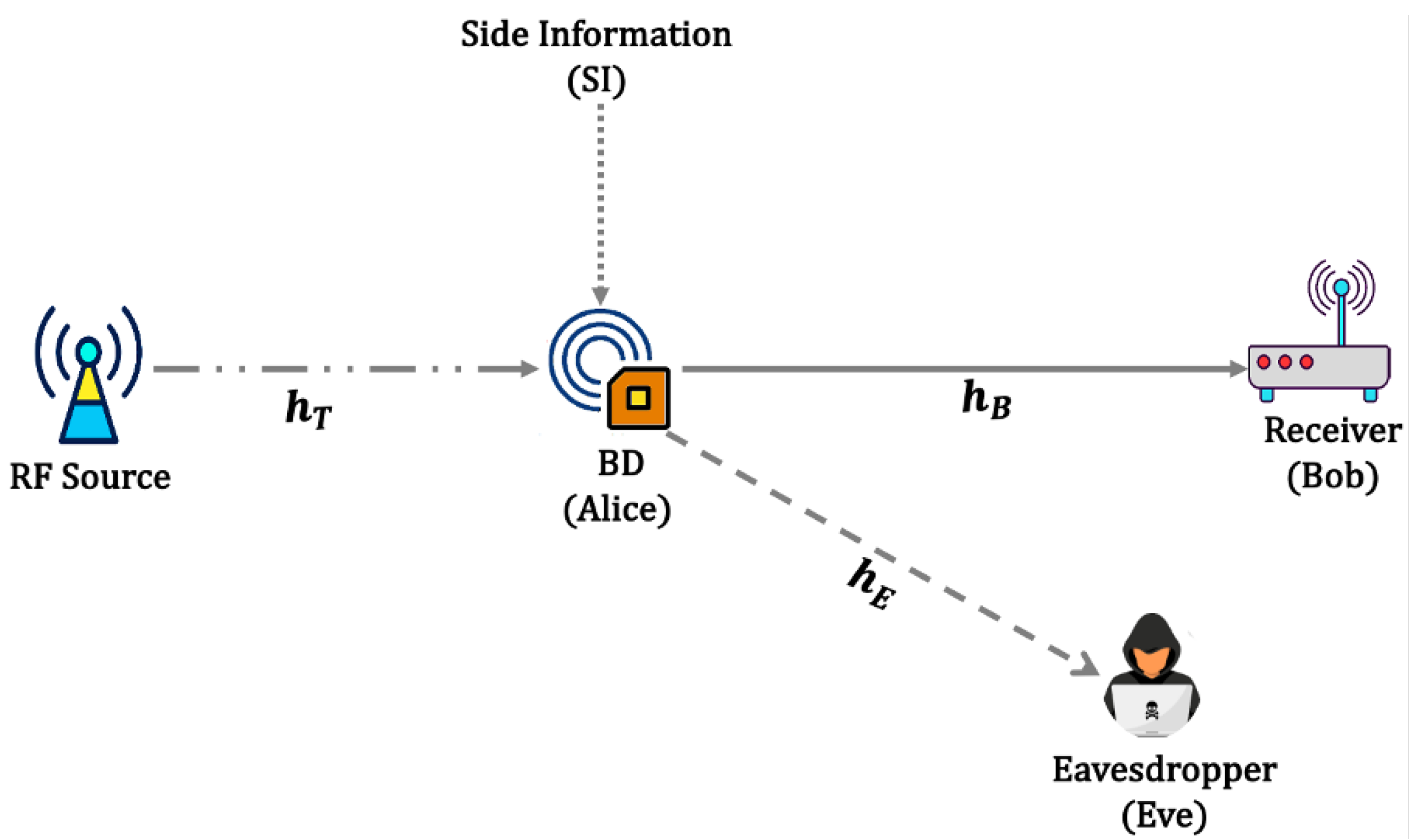
We consider a secure backscatter communication system with non-causally known SI at the legitimate transmitter (Alice), as shown in Figure 1 (It is assumed that the interfering sequence SI at Alice is injected from an external dominant source that exhibits a strong line-of-sight condition with reduced fading fluctuation (Figure 5 in [46]). Hence, we consider this unfaded counterpart approximation for the fading coefficients corresponding to the interfering signals in our analysis [45]). Alice is wirelessly powered up by a remote radio-frequency (RF) source and aims to send a confidential message to a legitimate receiver (Bob) over a wireless fading channel, while an eavesdropper (Eve) attempts to decode the message from its received signal. For simplicity, and without loss of generality, since the RF source is sending an unmodulated carrier, both Bob and Eve can employ cancellation techniques to mitigate the impact of direct link interference from the RF source [47,48,49]. Moreover, we suppose that all nodes are equipped with a single antenna, and thus, the received signal at Bob and Eve can be expressed as
where denotes the fading channel coefficient between the PB and Alice, is the fading channel coefficient between Alice and the node K, s defines the non-causally known SI at Alice with variance Q (i.e., ) which is independently and identically distributed (i.i.d) with probability distribution , and corresponds to i.i.d. additive white Gaussian noise (AWGN) with zero mean and variance at the node K. Furthermore, the instantaneous received signal power at Alice is given by
in which is the transmitted power by the PB, incorporates the gains of the transmit and receive antennas and frequency-dependent propagation losses, is the distance between the PB and Alice, and is the path-loss exponent. Hence, the instantaneous SNR at node K can be defined as
in which is the average SNR.
Figure 1.
Illustration of the secure backscatter communication with SI.
2.2. SNR Distribution
In this paper, we assume that all fading channels follow a Rayleigh distribution, therefore, the channel power gains , for , are the exponential distribution with unit mean (i.e., ). Since the SNR includes the product of two independent exponential random variables, the PDF of can be mathematically determined as
where is the modified Bessel function of the second kind. Then, exploiting the fact that , the PDF of can be given by
By using the definition, , the CDF of the SNR can be derived as
3. Secrecy Performance Analysis
Here, we derive the compact analytical expressions of the ASC and SOP for the proposed system model under Rayleigh fading channels.
3.1. ASC Analysis
In order to analyze the ASC, we first need to define the secrecy capacity for the considered system model. The secrecy capacity for a classic wiretap channel from the information theory viewpoint was derived in [24] and then extended to the wireless channels by considering the propagation environment effects such as fading, shadowing, path-loss, etc. [45]. Hence, the secrecy capacity for the block fading wiretap channel with non-causally known SI at the transmitter is given by (Theorem 2 in [45])
where . blueBesides, Corollaries 1 and 2 are defined in [45].
Theorem 1.
The ASC for the concerned backscatter communications with non-causally known SI at the transmitter is given by
where
and
in which , , and .
Proof.
By re-expressing the logarithm function in terms of the Meijer’s G-function, inserting the PDF of from (7), and using the integral format provided in [50], Equation (2.24.4.3), can be derived as follows:
In order to prove the derived analytical expression for under the SI effect we start with the ASC formula [45].
In order to solve , we first use the Meijer’s G-function shape of the logarithm and MacDonald’s functions (see (24) and (25)) and the variable change.
Then, we have as
By using the the Meijer’s G-function definition, we have (26) as
where and are special contours and can be obtained as
According to the definition of the bivariate Fox’s H-function ([51], Equations (2.56)–(2.60)), we can write (29) as (14), so the proof is completed for .
In order to compute , we first use the Taylor distribution of the logarithm and binomial functions and also re-express the MacDonald’s functions in terms of the Meijer’s G-function. Therefore, we can rewrite (22) as
where . By using the ([50], Equation (2.24.3.1)), we can obtain as
Now, by inserting (31) into (30), we will have as (12) and the proof is completed. We can also take a similar step for completing the proof for obtaining as (13). As a result, the proof will be completed for .
□
3.2. SOP Analysis
The SOP is defined as the probability that the random secrecy capacity is less than a target secrecy rate , i.e.,
Theorem 2.
The SOP for the considered backscatter communications with non-causally known SI at the transmitter is given by
where
and
Proof.
By substituting into (32), can be derived as
in which by inserting into (8), the proof is completed.
Similarly, by inserting into the SOP definition and considering the marginal distributions, we have
where , , and . Now, by re-expressing the Bessel functions in terms of the Meijer’s G-function we have
Now, by inserting (45) into (44) and changing and , we have as
where . According to the definition of the bivariate Fox’s H-function ([51], Equations (2.56)–(2.60)), we can write (46) as (35), so the proof is completed for .
□
4. Numerical Results
In this section, we evaluate the accuracy of our analytical results with Monte Carlo simulations in the presence/absence of non-causally known SI at the transmitter. To this end, we set dBm, dBm, dBm, m, dBm, bits, .
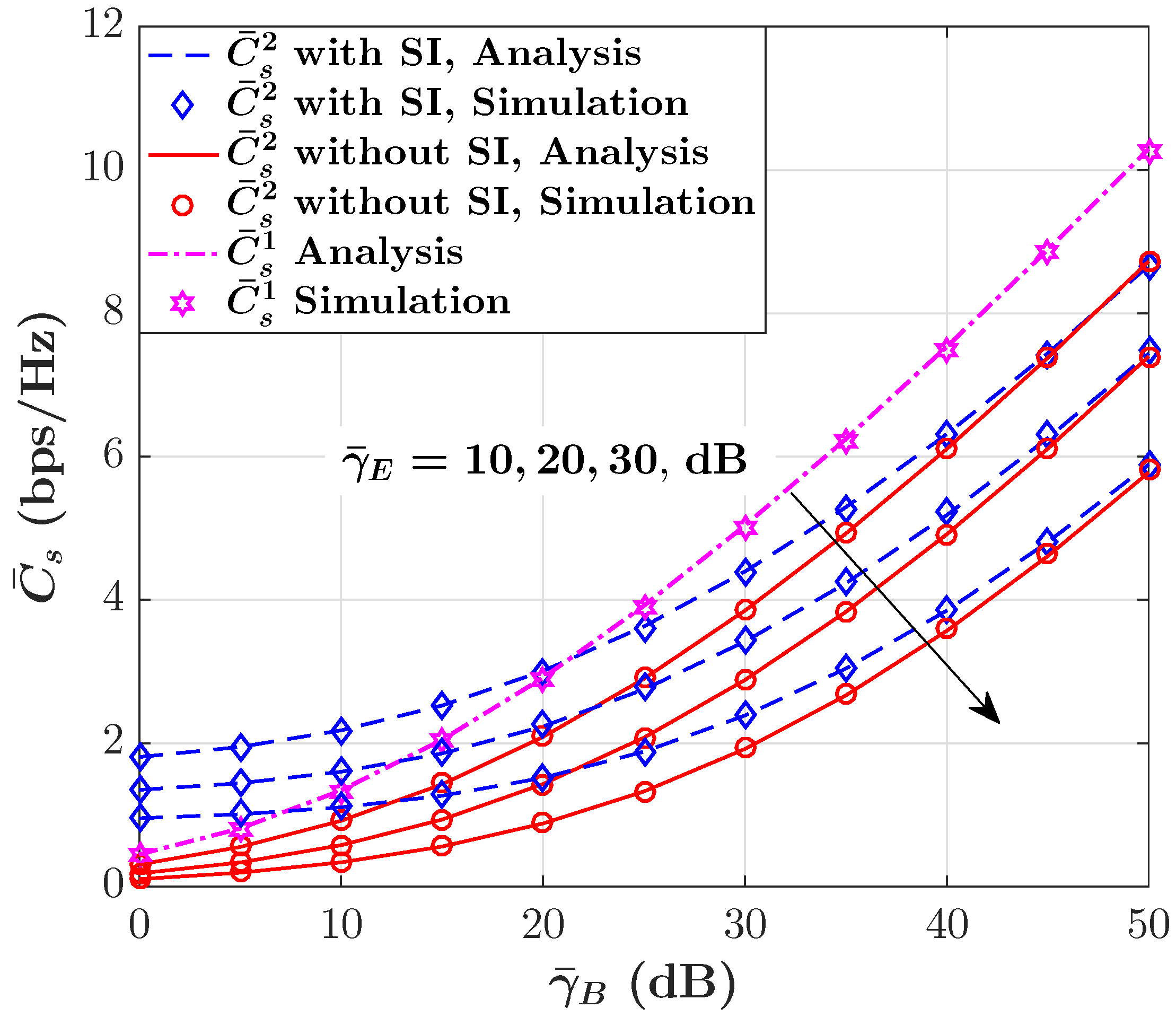
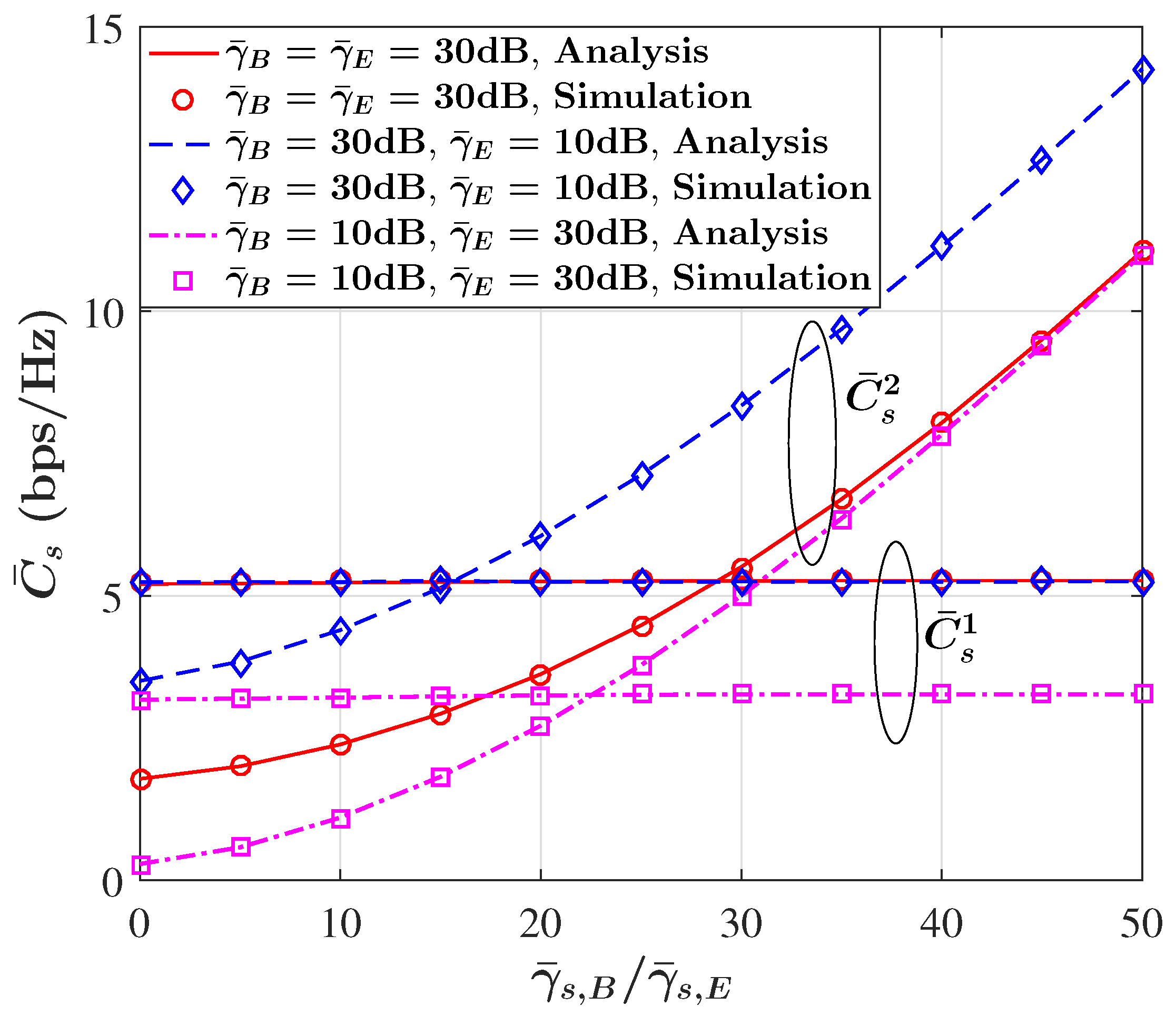
Figure 2 shows the behavior of the ASC in terms of for given values of when the non-causally known SI is available at Alice. As anticipated, it becomes evident that as grows, the ASC also increases. This phenomenon can be attributed to the improvement in the primary communication link (from Alice to Bob) conditions. In simpler terms, as the average SNR at Bob improves, the ability to transmit secure information between Alice and Bob becomes more effective, resulting in an increase in the ASC. It can be also observed that the presence of SI has a constructive impact on the ASC performance. In other words, when SI is available, the ASC is significantly higher compared to scenarios where SI does not exist. This implies that SI plays a vital role in enhancing the ASC, making the communication link more secure and capable of transmitting information more effectively. These observations are in alignment with the findings of [24,45], where it was shown that the non-causally known SI at the transmitter can help to achieve a larger secrecy capacity and achieve a larger rate equivocation region. Additionally, it is worth noting that the positive influence of SI on the ASC gradually diminishes as increases. In simpler terms, when the primary link’s signal quality from Alice to Bob is already quite strong (high ), the additional benefit provided by SI becomes less significant. This suggests that while SI remains beneficial in lower SNR scenarios, its impact becomes less pronounced as the communication conditions improve. However, it is seen that the SI does not affect the ASC performance if Corollary 1 in [45] is considered since is independent of SI and only depends on (see (9)). In order to gain more insights into the impact of SI on the ASC performance, Figure 3 indicates the efficiency of the ASC versus the SI ratio for three different scenarios , , and . It is obvious that in all three scenarios, is fixed as the SI ratio changes and only depends on . In contrast, it can be seen that monotonically increases as the SI ratio grows for all scenarios. It is worth noting that even under the scenario that the eavesdropper link (Alice-to-eavesdropper) is better than the main link (i.e., ), the ASC is still achievable, though with lower values.
Figure 2.
ASC versus for selected values of in presence/absence of SI.
Figure 3.
ASC versus SI ratio for three different scenarios , , and .
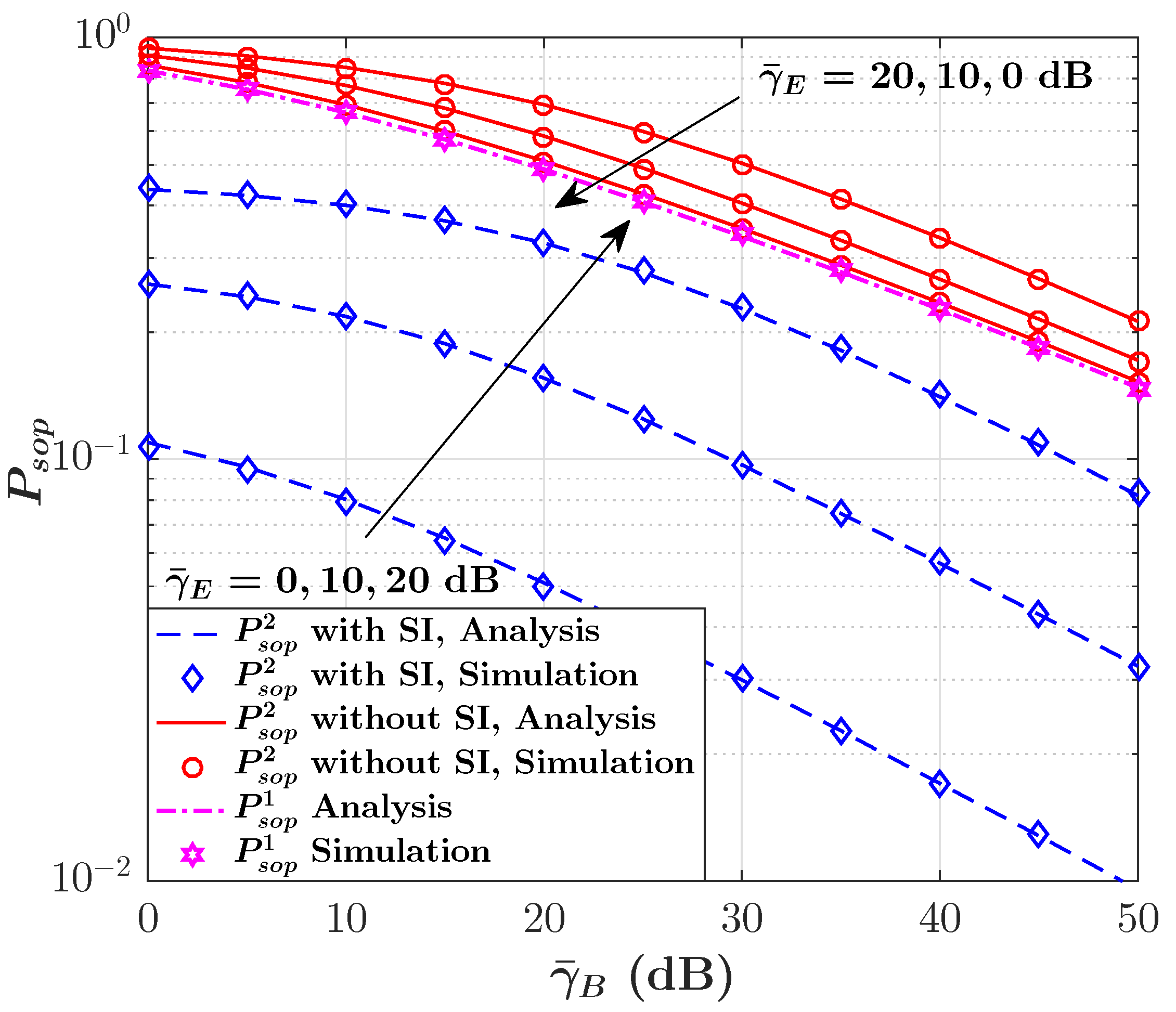
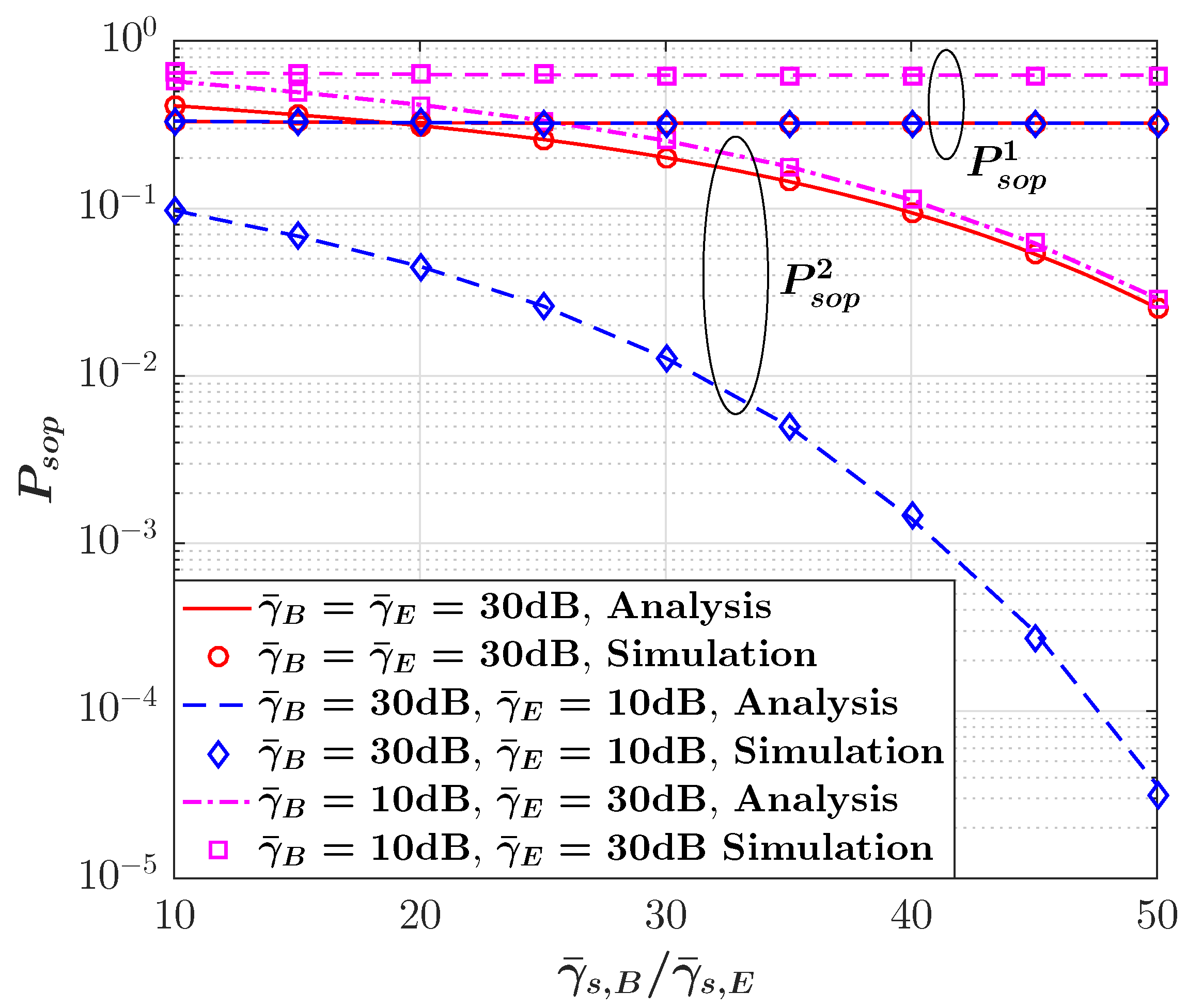
The impact of SI on the SOP performance in terms of for selected values of is illustrated in Figure 4. Due to the definition of the secrecy capacity from (9), we can see that the SOP is constant as grows under Col. 1 provided in [45]; however, it is observed that the SI can significantly improve the SOP performance if Col. 2 in [45] is considered as it can reduce the likelihood of communication failures in the presence of eavesdroppers. To further evaluate the impact of SI on the SOP performance, Figure 5 demonstrates the SOP behavior versus the SI ratio for three different scenarios. For all three scenarios, it can be observed that the SOP decreases as the SI ratio increases. We can also see that when the main link is better than the eavesdropper link (i.e., ), the lowest SOP is achievable compared with two other cases. Hence, we can see that considering the non-causally known SI at the transmitter in the secure backscatter communication system can remarkably enhance the SOP performance.
Figure 4.
SOP versus for selected values of in presence/absence of SI.
Figure 5.
SOP versus SI ratio for three different scenarios , , and .
5. Conclusions
In this study, we have explored the impact of side information on the secrecy performance of backscatter communication systems, assuming Rayleigh fading distributions for all channel conditions. Specifically, our investigation focused on scenarios where non-causally known side information is available at the transmitter. We conducted a comprehensive analysis of the system’s secrecy performance, providing concise analytical expressions for both ASC and SOP. Our analytical findings, coupled with simulation results, have consistently demonstrated the tangible benefits of incorporating SI in securing backscatter communication systems. This inclusion of SI has proven to be highly advantageous, resulting in a significant enhancement in the system’s secrecy performance, as quantified by improvements in both ASC and SOP. To put it succinctly, our results underscore the constructive influence of non-causally known SI in enhancing the security of backscatter communication systems, particularly in scenarios characterized by strong interference. This positive effect becomes particularly pronounced when contrasted with the scenario of an interference-free, clean backscatter communication system.
Author Contributions
Conceptualization, M.K., F.R.G., R.J. and Z.Y.; methodology, M.K. and F.R.G.; formal analysis, M.K. and F.R.G.; investigation, M.K. and F.R.G.; simulation, M.K. and F.R.G.; writing—original draft preparation, M.K. and F.R.G.; writing—review and editing, R.J. and Z.Y.; supervision, R.J. and Z.Y.; project administration, R.J. and Z.Y.; funding acquisition, R.J. and Z.Y. All authors have read and agreed to the published version of the manuscript.
Funding
This research was funded by the Academy of Finland under grants 345072 and 350464.
Institutional Review Board Statement
Not applicable.
Informed Consent Statement
Not applicable.
Data Availability Statement
Not applicable.
Conflicts of Interest
The authors declare no conflict of interest.
Abbreviations
The following abbreviations are used in this manuscript:
| BC | Backscatter communication |
| IoT | Internet of things |
| SI | Side information |
| ASC | Average secrecy capacity |
| SOP | Secrecy outage probability |
| 6G | Sixth generation |
| PLS | Physical layer security |
| P2P | Point-to-point |
| CSI | Channel state information |
| SISO | Single-input single-output |
| MIMO | Multiple-input multiple-output |
| SNR | Signal-to-noise ratio |
| RF | Radio-frequency |
References
- Wu, W.; Wang, X.; Hawbani, A.; Yuan, L.; Gong, W. Survey on ambient backscatter communications: Principles, systems, applications, and challenges. Comput. Netw. 2022, 216, 109235. [Google Scholar] [CrossRef]
- Jameel, F.; Duan, R.; Chang, Z.; Liljemark, A.; Ristaniemi, T.; Jantti, R. Applications of backscatter communications for healthcare networks. IEEE Netw. 2019, 33, 50–57. [Google Scholar] [CrossRef]
- Xu, C.; Yang, L.; Zhang, P. Practical backscatter communication systems for battery-free Internet of Things: A tutorial and survey of recent research. IEEE Signal Process. Mag. 2018, 35, 16–27. [Google Scholar] [CrossRef]
- Yang, L.; Li, X.; Sun, M.; Sun, C. Hybrid policy-based reinforcement learning of adaptive energy management for the Energy transmission-constrained island group. IEEE Trans. Ind. Inform. 2023, 19, 10751–10762. [Google Scholar] [CrossRef]
- Duan, R.; Wang, X.; Yigitler, H.; Sheikh, M.U.; Jantti, R.; Han, Z. Ambient backscatter communications for future ultra-low-power machine type communications: Challenges, solutions, opportunities, and future research trends. IEEE Commun. Mag. 2020, 58, 42–47. [Google Scholar] [CrossRef]
- Wang, P.; Yan, Z.; Zeng, K. Bcauth: Physical layer enhanced authentication and attack tracing for backscatter communications. IEEE Trans. Inf. Forensics Secur. 2022, 17, 2818–2834. [Google Scholar] [CrossRef]
- Ghadi, F.R.; Martin-Vega, F.J.; Martínez, F.J.L. Capacity of backscatter communication under arbitrary fading dependence. IEEE Trans. Veh. Technol. 2022, 71, 5593–5598. [Google Scholar] [CrossRef]
- Cao, K.; Weng, J.; Li, K. Reliability-Driven End–End–Edge Collaboration for Energy Minimization in Large-Scale Cyber-Physical Systems. IEEE Trans. Reliab. 2023. early access. [Google Scholar] [CrossRef]
- Wang, P.; Wang, N.; Dabaghchian, M.; Zeng, K.; Yan, Z. Optimal Resource Allocation for Secure Multi-User Wireless Powered Backscatter Communication with Artificial Noise. In Proceedings of the IEEE INFOCOM 2019, Paris, France, 29 April–2 May 2019. [Google Scholar]
- Li, X.; Zheng, Y.; Khan, W.U.; Zeng, M.; Li, D.; Ragesh, G.K.; Li, L. Physical layer security of cognitive ambient backscatter communications for green Internet-of-Things. IEEE Trans. Green Commun. Netw. 2021, 5, 1066–1076. [Google Scholar] [CrossRef]
- Li, M.; Yang, X.; Khan, F.; Jan, M.A.; Chen, W.; Han, Z. Improving physical layer security in vehicles and pedestrians networks with ambient backscatter communication. IEEE Trans. Intell. Transp. Syst. 2022, 23, 9380–9390. [Google Scholar] [CrossRef]
- Tang, Z.; Hou, T.; Liu, Y.; Zhang, J.; Zhong, C. A novel design of RIS for enhancing the physical layer security for RIS-aided NOMA networks. IEEE Wirel. Commun. Lett. 2021, 10, 2398–2401. [Google Scholar] [CrossRef]
- Zhu, F.; Yao, M. Improving physical-layer security for CRNs using SINR-based cooperative beamforming. IEEE Trans. Veh. Technol. 2015, 65, 1835–1841. [Google Scholar] [CrossRef]
- Yang, Y.S.; Yan, Z.; Zeng, K.; Wang, P.; Li, J.J. Physical Layer Authentication in Backscatter Communication: A Review. IEEE Wirel. Commun. Mag. 2022, 17, 2818–2834. [Google Scholar]
- Wang, P.; Yan, Z.; Wang, N.; Zeng, K. Optimal Resource Allocation for Secure Multi-device Wirelessly Powered Backscatter Communications with Artificial Noise. IEEE Trans. Wirel. Commun. 2022, 21, 7794–7809. [Google Scholar] [CrossRef]
- Yang, Y.S.; Kaveh, M.; Li, J.J.; Zhang, Y.F.; Yan, Z.; Zeng, K. BatAu: A Batch Authentication Scheme for Backscatter Devices in a Smart Home Network. In Proceedings of the IEEE 2023 IEEE International Conference on Communications (ICC), Rome, Italy, 28 May–1 June 2023. [Google Scholar]
- Wang, P.; Jiao, L.; Zeng, K.; Yan, Z. Physical Layer Key Generation between Backscatter Devices over Ambient RF Signals. In Proceedings of the IEEE INFOCOM 2021, Virtual Conference, 10–13 May 2021. [Google Scholar]
- Shannon, C.E. Communication theory of secrecy systems. Bell Labs Tech. J. 1949, 28, 656–715. [Google Scholar] [CrossRef]
- Wyner, A.D. The wire-tap channel. Bell Syst. Tech. J. 1975, 54, 1355–1387. [Google Scholar] [CrossRef]
- Shannon, C.E. Channels with side information at the transmitter. IBM J. Res. Dev. 1958, 2, 289–293. [Google Scholar] [CrossRef]
- Jafar, S. Capacity with causal and noncausal side information: A unified view. IEEE Trans. Inf. Theory 2006, 52, 5468–5474. [Google Scholar] [CrossRef]
- Mitrpant, C.; Vinck, A.J.H.; Luo, Y. An achievable region for the Gaussian wiretap channel with side information. IEEE Trans. Inf. Theory 2006, 52, 2181–2190. [Google Scholar] [CrossRef]
- Costa, M. Writing on dirty paper (corresp.). IEEE Trans. Inf. Theory 1983, 29, 439–441. [Google Scholar] [CrossRef]
- Chen, Y.; Vinck, A.H. Wiretap channel with side information. IEEE Trans. Inf. Theory 2008, 54, 395–402. [Google Scholar] [CrossRef]
- Saad, W.; Zhou, X.; Han, Z.; Poor, H.V. On the physical layer security of backscatter wireless systems. IEEE Trans. Wirel. Commun. 2014, 13, 3442–3451. [Google Scholar] [CrossRef]
- Zhang, Y.; Gao, F.; Fan, L.; Lei, X.; Karagiannidis, G.K. Secure communications for multi-tag backscatter systems. IEEE Wirel. Commun. Lett. 2019, 8, 1146–1149. [Google Scholar] [CrossRef]
- Liu, Y.; Ye, Y.; Hu, R.Q. Secrecy outage probability in backscatter communication systems with tag selection. IEEE Wirel. Commun. Lett. 2021, 10, 2190–2194. [Google Scholar] [CrossRef]
- Liu, Z.; Ye, Y.; Chu, X.; Sun, H. Secrecy performance of backscatter communications with multiple self-powered tags. IEEE Commun. Lett. 2022, 26, 2875–2879. [Google Scholar] [CrossRef]
- Muratkar, T.S.; Bhurane, A.; Sharma, P.K.; Kothari, A. Physical layer security analysis in ambient backscatter communication with node mobility and imperfect channel estimation. IEEE Commun. Lett. 2021, 26, 27–30. [Google Scholar] [CrossRef]
- Zheng, Y.; Li, X.; Zhang, H.; Alshehri, M.D.; Dang, S.; Huang, G.; Zhang, C. Overlay cognitive ABCom-NOMA-based ITS: An in-depth secrecy analysis. IEEE Trans. Intell. Transp. Syst. 2022, 24, 2217–2228. [Google Scholar] [CrossRef]
- Jia, S.; Wang, R.; Xu, Y.; Lou, Y.; Zhang, D.; Sato, T. Secrecy Analysis of ABCom-Based Intelligent Transportation Systems With Jamming. IEEE Trans. Intell. Transp. Syst. 2023. early access. [Google Scholar] [CrossRef]
- Sharma, H.K.; Kumbhani, B. Ergodic secrecy capacity of backscatter communication based automatic toll collection systems. Sādhanā 2023, 48, 83. [Google Scholar] [CrossRef]
- Zan, J.; Shi, L.; Lu, G.; Ye, Y. Wireless-powered backscatter communications for smart sustainable cities: A secrecy analysis. Sustain. Energy Technol. Assess. 2023, 56, 103036. [Google Scholar] [CrossRef]
- Wang, H.; Jiang, J.; Huang, G.; Wang, W.; Deng, D.; Elhalawany, B.M.; Li, X. Physical layer security of two-way ambient backscatter communication systems. Wirel. Commun. Mob. Comput. 2022, 2022, 5445676. [Google Scholar] [CrossRef]
- Bai, L.; Chen, Q.; Bai, T.; Wang, J. UAV-enabled secure multiuser backscatter communications with planar array. IEEE J. Sel. Areas Commun. 2022, 40, 2946–2961. [Google Scholar] [CrossRef]
- That, P.T.; Ha, D.H.; Nguyen, H.N. Secrecy capacity analysis of bi-static backscatter communication systems. Bull. Electr. Eng. Inform. 2022, 11, 3353–3360. [Google Scholar] [CrossRef]
- Li, X.; Zhao, M.; Liu, Y.; Li, L.; Ding, Z.; Nallanathan, A. Secrecy analysis of ambient backscatter NOMA systems under I/Q imbalance. IEEE Trans. Veh. Technol. 2020, 69, 12286–12290. [Google Scholar] [CrossRef]
- Gorbade, S.; Shrivastava, R.; Bhurane, A. Physical Layer Security Analysis in Ambient Backscatter Communication With Source and Reader Mobility. In Proceedings of the 2022 1st International Conference on the Paradigm Shifts in Communication, Embedded Systems, Machine Learning and Signal Processing (PCEMS), Nagpur, India, 6–7 May 2022; pp. 57–61. [Google Scholar]
- Kim, T.T.; Skoglund, M. On the expected rate of slowly fading channels with quantized side information. IEEE Trans. Commun. 2007, 55, 820–829. [Google Scholar] [CrossRef]
- Narula, A.; Lopez, M.J.; Trott, M.D.; Wornell, G.W. Efficient use of side information in multiple-antenna data transmission over fading channels. IEEE J. Sel. Areas Commun. 1998, 16, 1423–1436. [Google Scholar] [CrossRef]
- Sharif, M.; Hassibi, B. On the capacity of MIMO broadcast channels with partial side information. IEEE Trans. Inf. Theory 2005, 51, 506–522. [Google Scholar] [CrossRef]
- Ghadi, F.R.; Hodtani, G.A.; López-Martínez, F.J. The role of correlation in the doubly dirty fading MAC with side information at the transmitters. IEEE Wirel. Commun. Lett. 2021, 10, 2070–2074. [Google Scholar] [CrossRef]
- Ghadi, F.R.; Zhu, W.P. Performance Analysis Over Correlated/Independent Fisher-Snedecor F Fading Multiple Access Channels. IEEE Trans. Veh. Technol. 2022, 71, 7561–7571. [Google Scholar] [CrossRef]
- Ghadi, F.R.; López-Martínez, F.J. RIS-Aided Communications over Dirty MAC: Capacity Region and Outage Probability. IEEE Commun. Lett. 2023, 27, 2009–2013. [Google Scholar] [CrossRef]
- Ghadi, F.R.; López-Martínez, F.J.; Zhu, W.P.; Gorce, J.M. The impact of side information on physical layer security under correlated fading channels. IEEE Trans. Inf. Forensics Secur. 2022, 17, 3626–3636. [Google Scholar] [CrossRef]
- Walid, S.; Bennis, M.; Chen, M. A vision of 6G wireless systems: Applications, trends, technologies, and open research problems. IEEE Netw. 2019, 34, 134–142. [Google Scholar]
- Biswas, R.; Sheikh, M.U.; Yiğitler, H.; Lempiäinen, J.; Jäntti, R. Direct path interference suppression requirements for bistatic backscatter communication system. In Proceedings of the IEEE 93rd Vehicular Technology Conference, Helsinki, Finland, 25–28 April 2022; pp. 1–5. [Google Scholar]
- Zhang, M.; Zhao, J.; Chen, S.; Gong, W. Reliable backscatter with commodity BLE. In Proceedings of the IEEE Conference on Computer Communications (INFOCOM), Toronto, ON, Canada, 6–9 July 2022; pp. 1291–1299. [Google Scholar]
- Liao, J.; Wang, X.; Ruttik, K.; Jäntti, R.; Phan-Huy, D.T. In-band Ambient FSK Backscatter Communications Leveraging LTE Cell-Specific Reference Signals. IEEE J. Radio Freq. Identif. 2023, 7, 267–277. [Google Scholar] [CrossRef]
- Prudnikov, A.P. Integrals and Series: More Special Functions; CRC Press: Boca Raton, FL, USA, 1986; Volume 3. [Google Scholar]
- Mathai, A.M.; Saxena, R.K.; Haubold, H.J. The H-Function: Theory and Applications; Springer Science and Business Media: Berlin/Heidelberg, Germany, 2009. [Google Scholar]
Disclaimer/Publisher’s Note: The statements, opinions and data contained in all publications are solely those of the individual author(s) and contributor(s) and not of MDPI and/or the editor(s). MDPI and/or the editor(s) disclaim responsibility for any injury to people or property resulting from any ideas, methods, instructions or products referred to in the content. |
© 2023 by the authors. Licensee MDPI, Basel, Switzerland. This article is an open access article distributed under the terms and conditions of the Creative Commons Attribution (CC BY) license (https://creativecommons.org/licenses/by/4.0/).