

Distributed Compressive Sensing for Wireless Signal Transmission in Structural Health Monitoring: An Adaptive Hierarchical Bayesian Model-Based Approach

Abstract
1. Introduction
- (1)
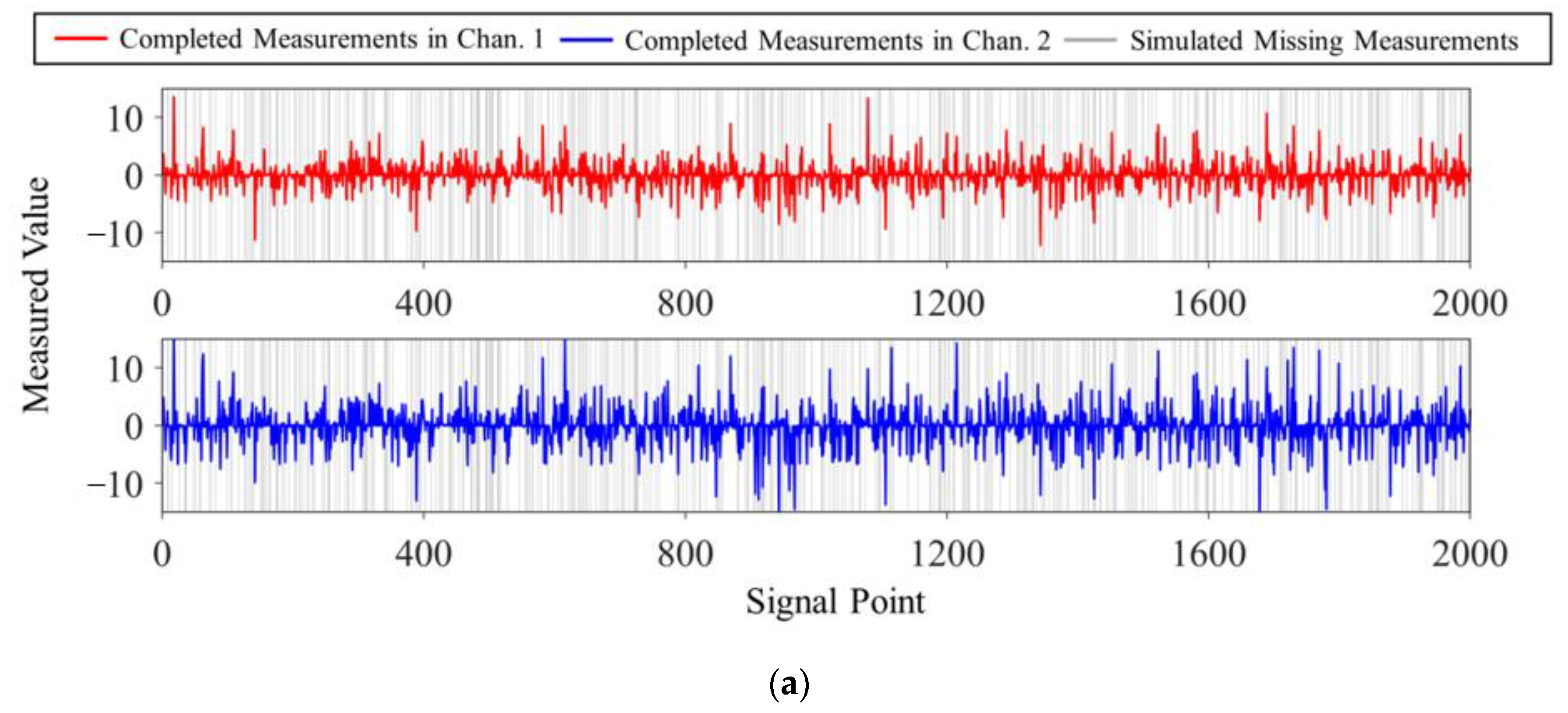
- A comprehensive DCS framework for wireless signal transmission is constructed, incorporating the process of data compression and transmission loss together. Unlike the basic DCS formulation, the proposed framework starts from practical necessity, which can not only activate the connection among the channels but also provide flexibility and independence to single-channel transmission. Specifically, the scheme enables a joint reconstruction of MMV with the same or even different compression and loss rates by using a unique sensing matrix for each channel.
- (2)
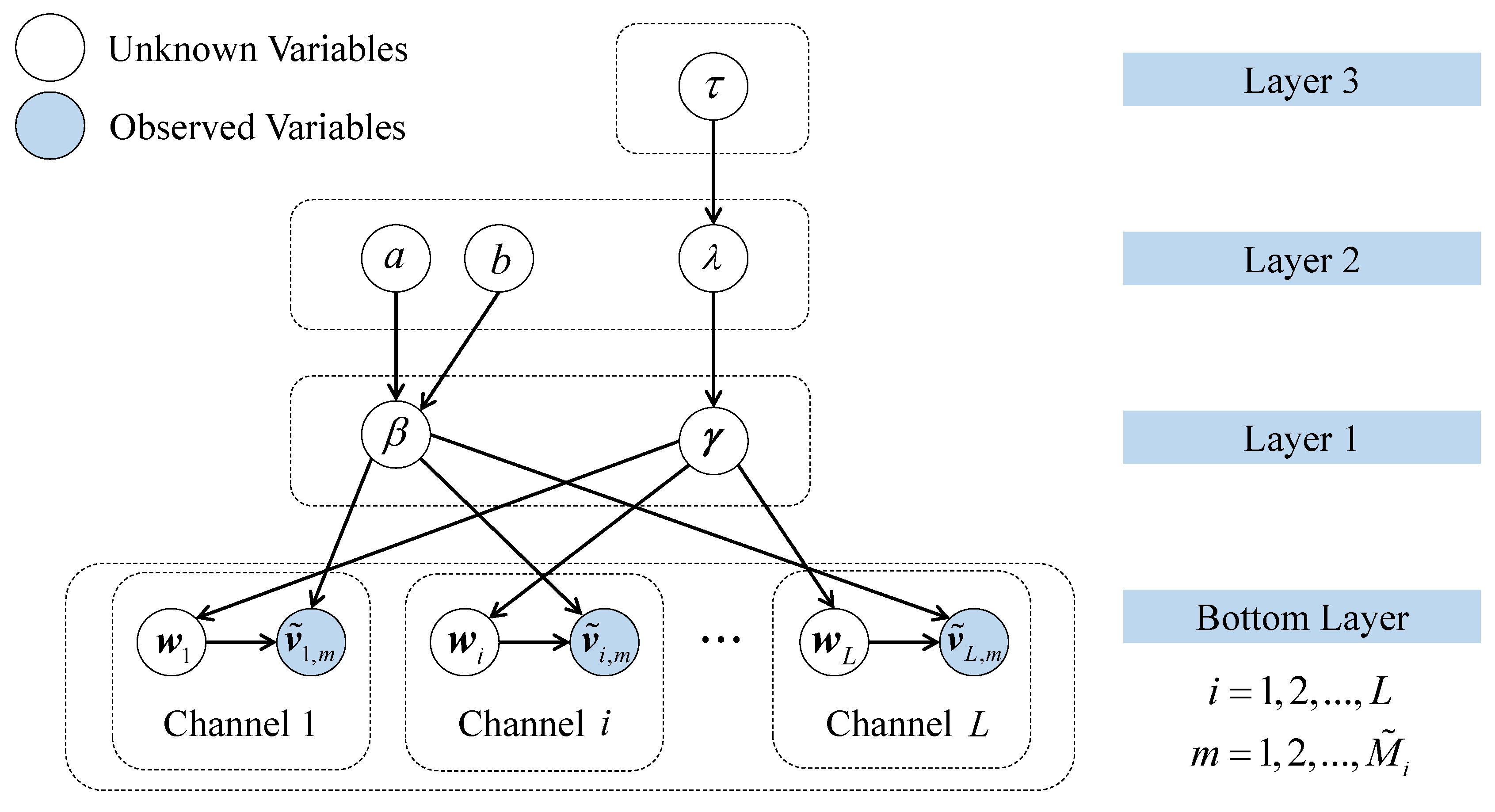
- Considering that common priors in the Bayesian framework can be set flexibly to facilitate multi-task information sharing, a hierarchical Bayesian model is applied for multi-channel signal reconstruction. To strengthen the sparsity constraint on SHM signals, Laplace priors are imposed on sparse vectors. In addition, an efficient iterative algorithm based on a modified sparse regression model, called Fast DCS-Laplace, is employed to improve the computation efficiency in the face of large-scale problems.
- (3)
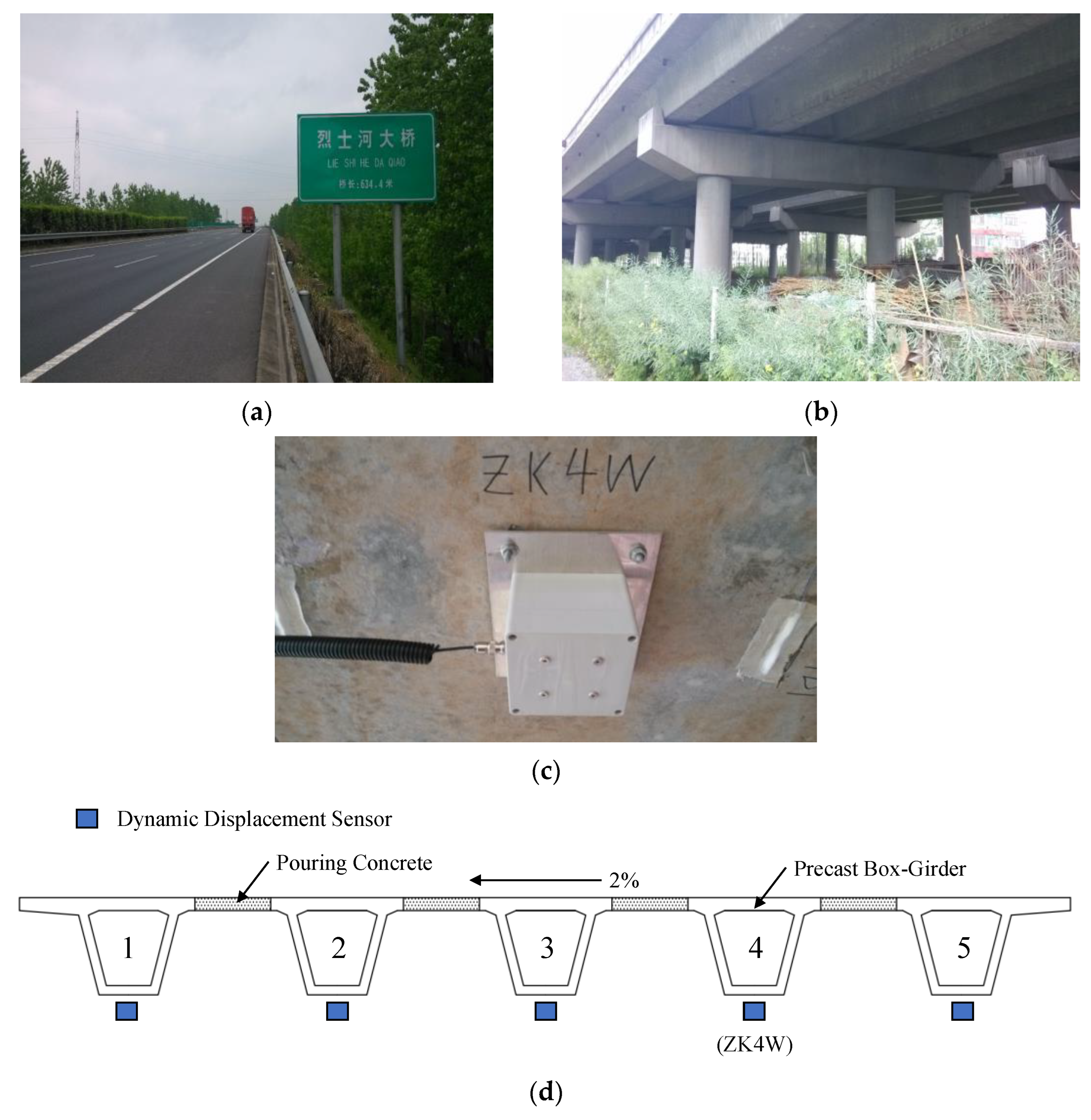
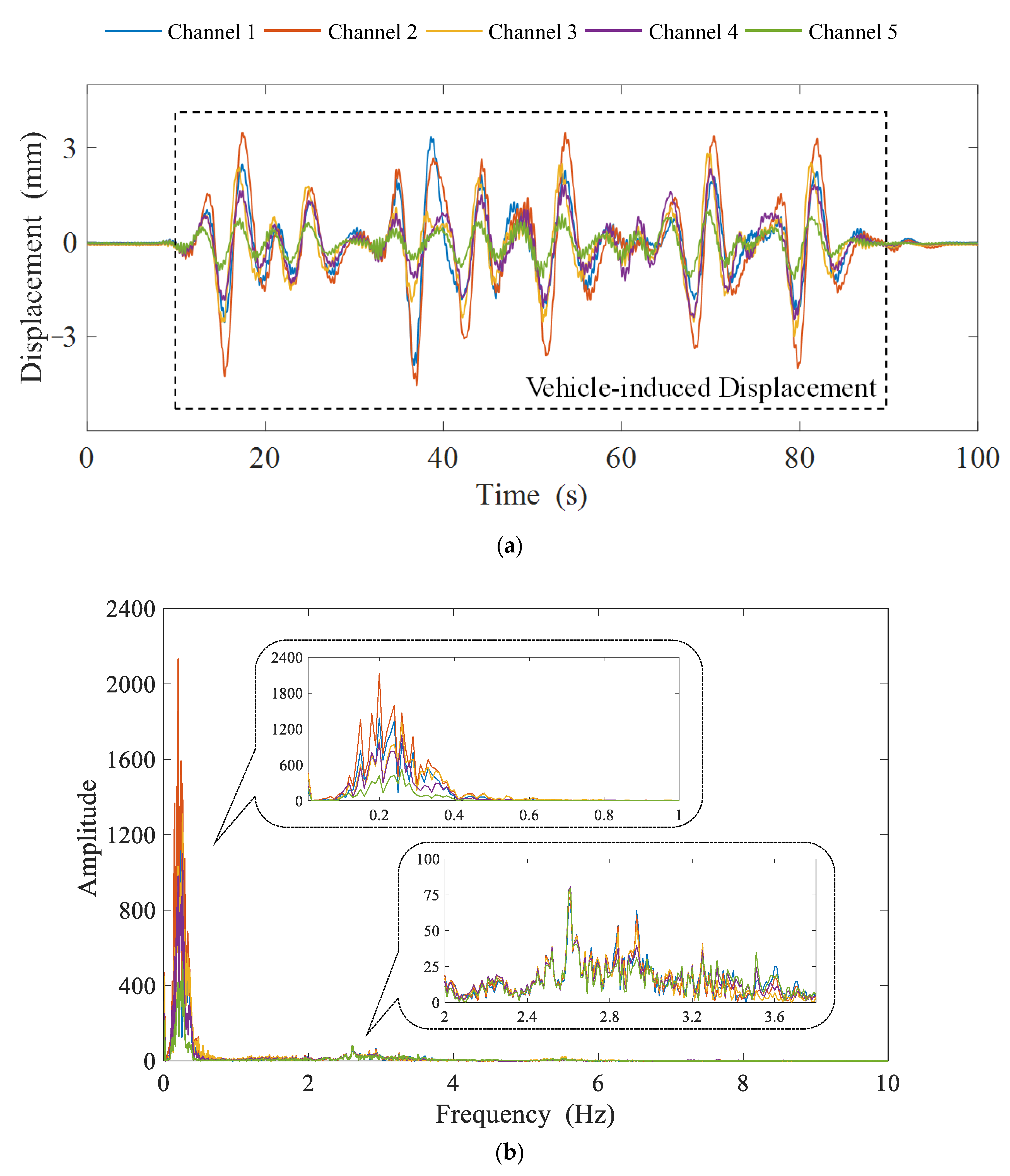
- Vibration signals collected in real-life SHM systems with spatial or temporal correlations are used to simulate the whole process of wireless transmission and test the algorithm’s performance. In addition, a comparison with the DCS-SOMP algorithm that has recently been applied in SHM is carried out under the proposed DCS framework to prove the superiority of Fast DCS-Laplace.
2. Methodology
2.1. General CS-DCS Framework
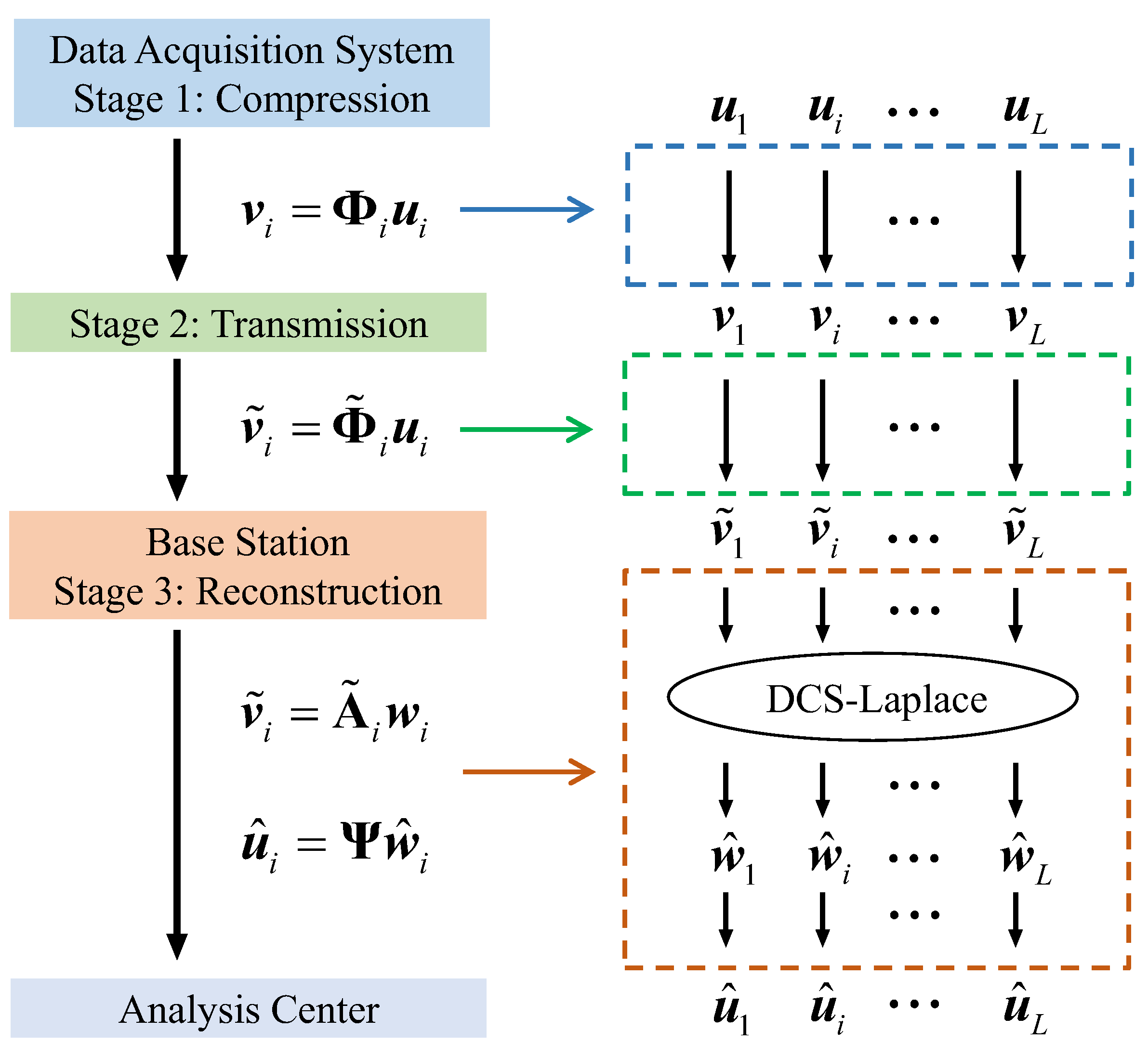
2.2. DCS Framework in SHM Wireless Transmission
2.2.1. Stage 1: Data Compression
2.2.2. Stage 2: Data Loss in Transmission
2.2.3. Stage 3: Data Reconstruction
2.3. DCS-Laplace for Multi-Channel Signal Recovery
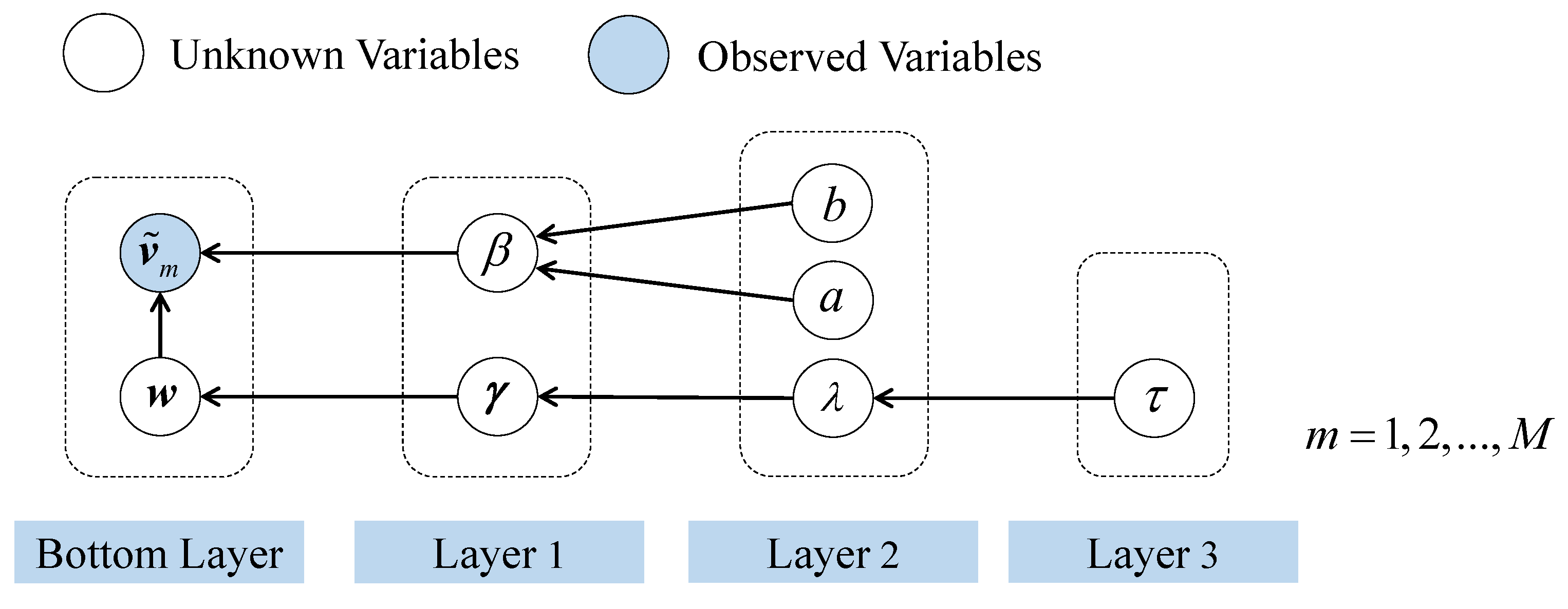
2.3.1. Hierarchical Bayesian Modelling Using Laplace Priors
2.3.2. DCS-Laplace with Parameter Estimation
2.3.3. An Efficient DCS-Laplace Algorithm with Modified Bayesian Model
3. Results
3.1. Case 1: Lieshihe Highway Bridge
3.1.1. Projection Matrix Setting and Data Loss Pattern
3.1.2. Adaptive DCS-Laplace with Different Parameter Settings
- Algorithm 1-1 (Alg. 1-1): automatically estimated using Equation (26)
- Algorithm 1-2 (Alg. 1-2): (MT-BCS)Algorithm 1-3 (Alg. 1-3):
- Algorithm 1-4 (Alg. 1-4):
- Algorithm 1-5 (Alg. 1-5):
3.1.3. Performance Comparison of CS and DCS Methods
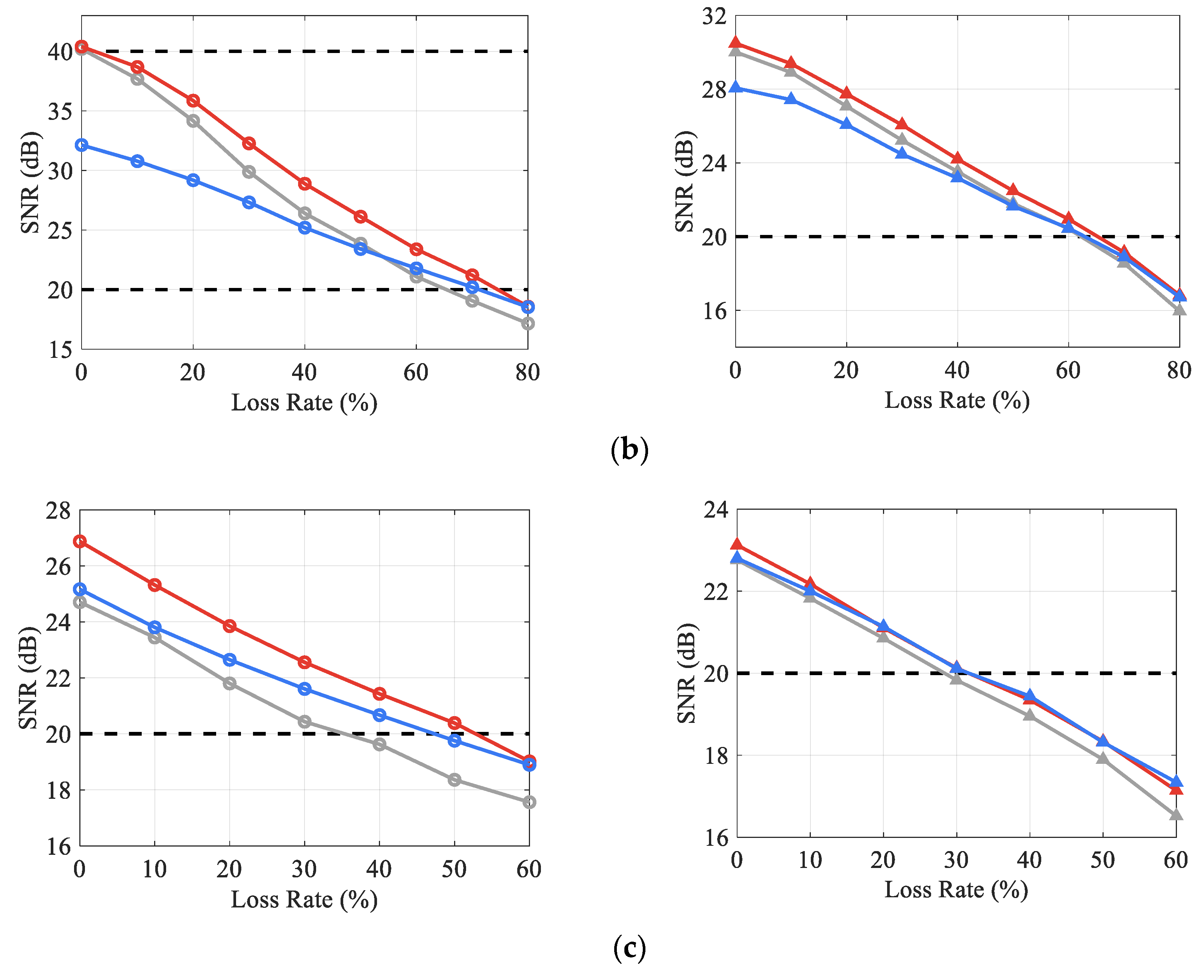
- Algorithm 2-1 (Alg. 2-1): DCS-Laplace with automatically estimated
- Algorithm 2-2 (Alg. 2-2): DCS-Laplace with
- Algorithm 2-3 (Alg. 2-3): DCS-SOMP
- Algorithm 2-4 (Alg. 2-4): CS-Laplace with automatically estimated
- Algorithm 2-5 (Alg. 2-5): CS-Laplace with
- Algorithm 2-6 (Alg. 2-6): CS-OMP
3.1.4. DCS Reconstruction in Non-Uniform Transmission Scenarios
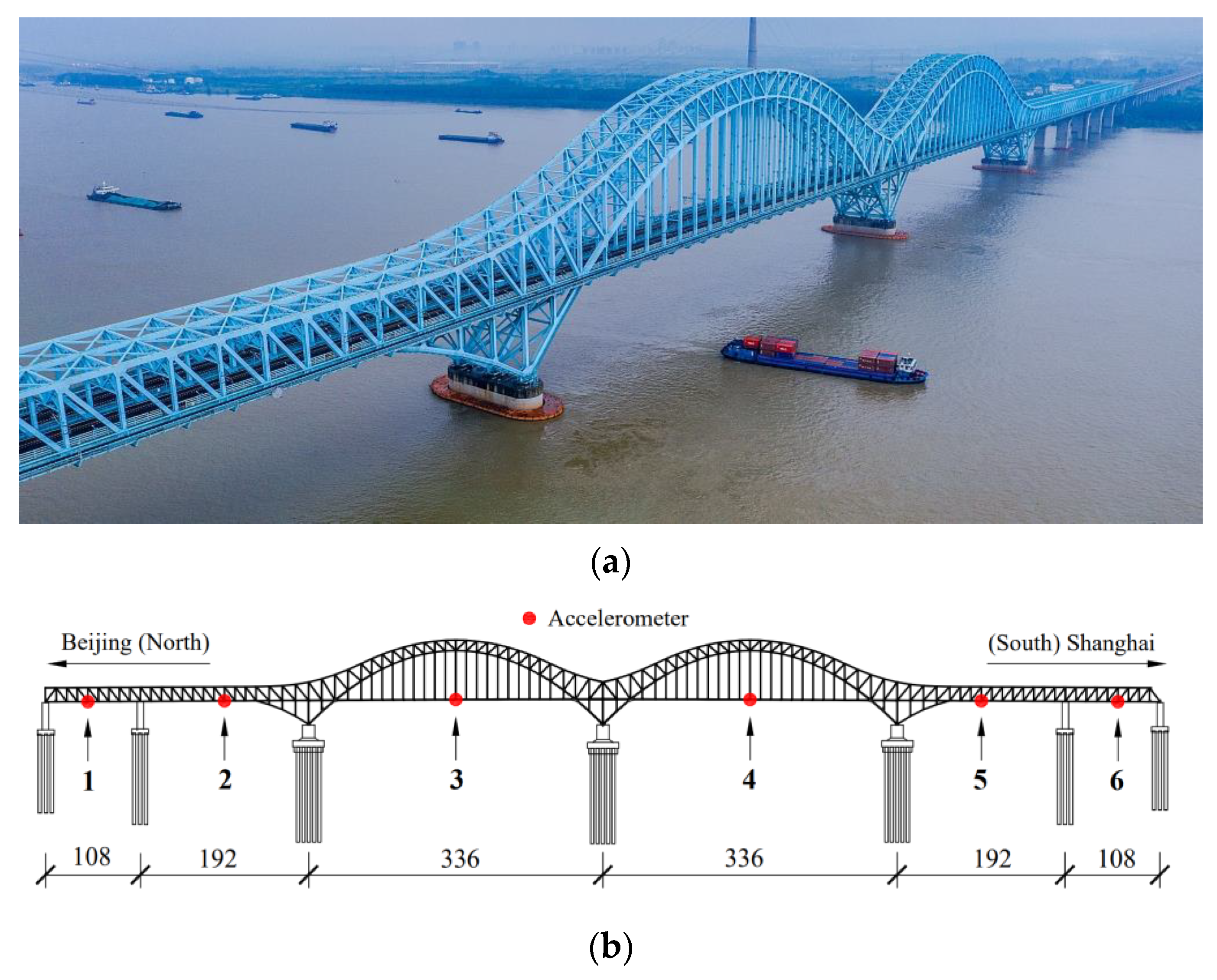
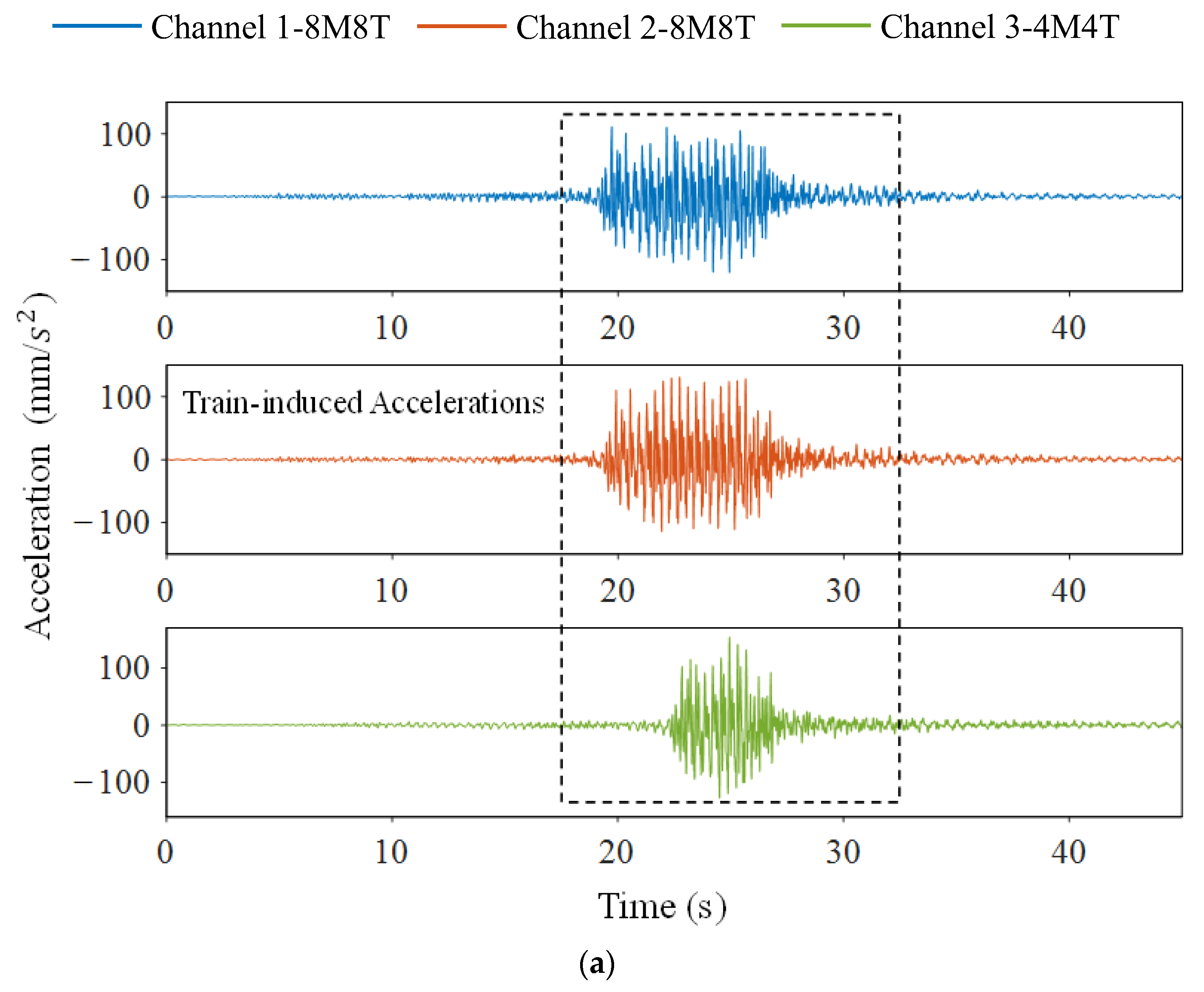
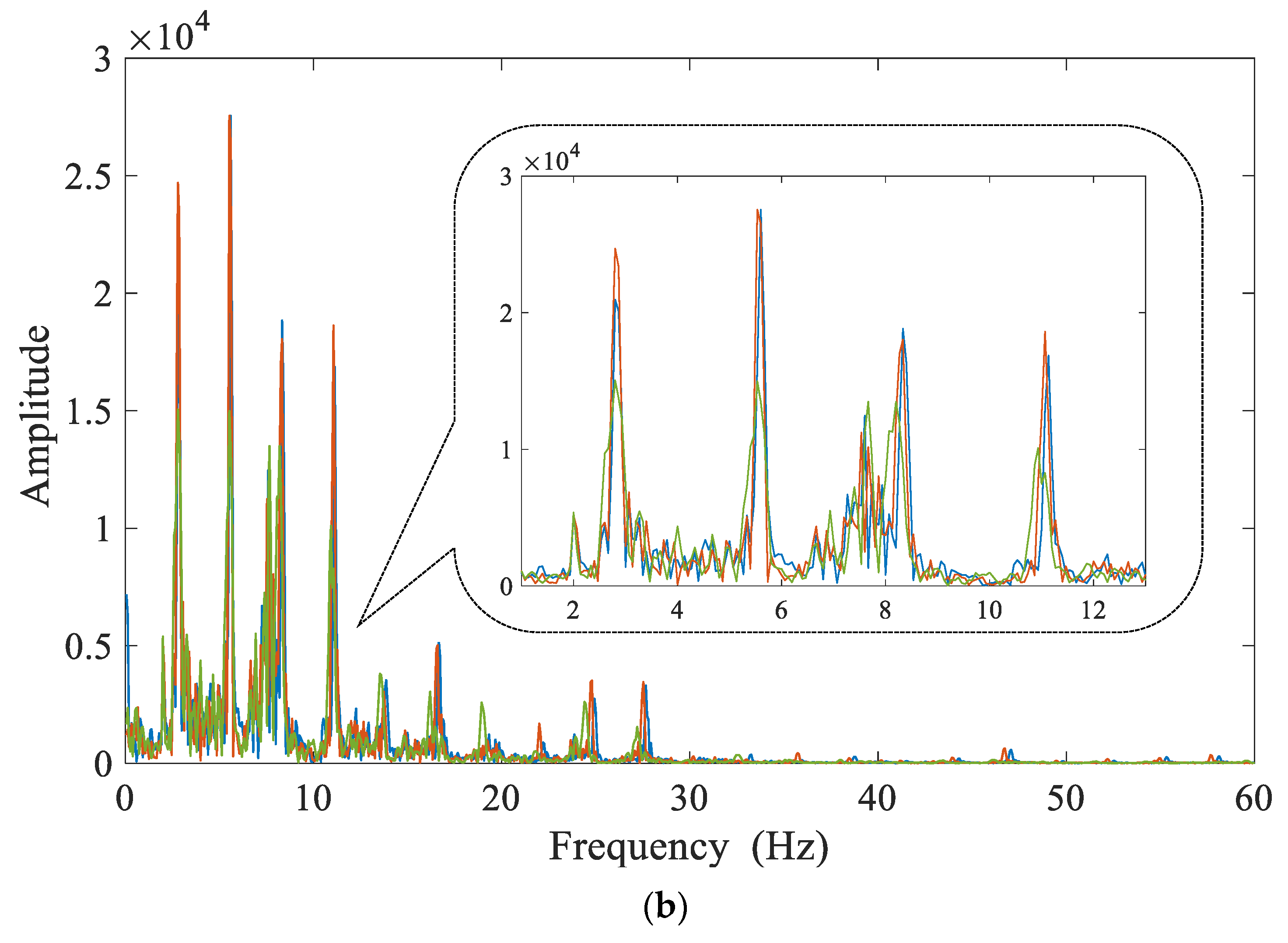
3.2. Case 2: Dashengguan High-Speed Railway Bridge
3.2.1. Adaptive DCS-Laplace with Different Parameter Settings
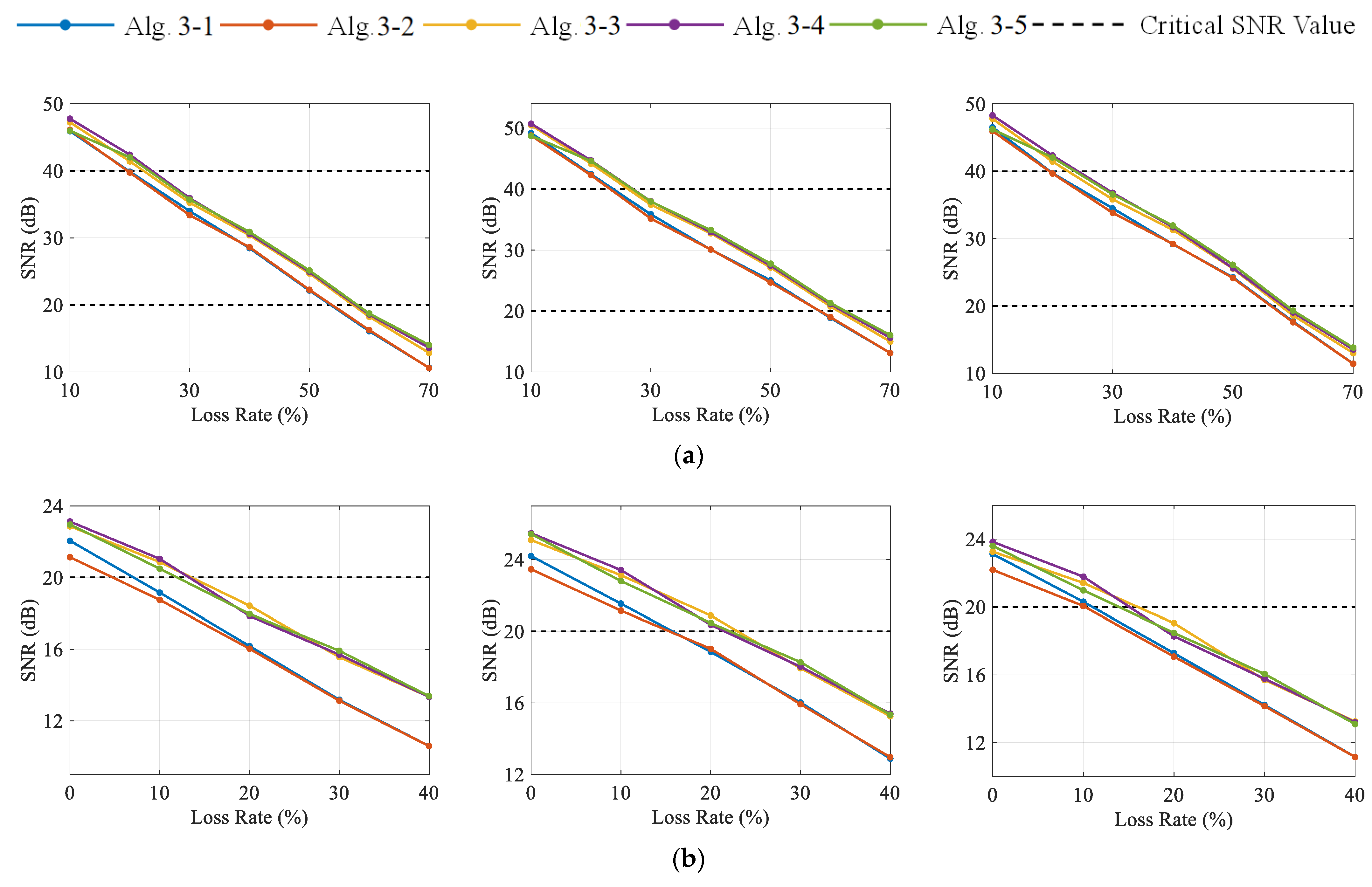
- Algorithm 3-1 (Alg. 3-1): automatically estimated using (26)
- Algorithm 3-2 (Alg. 3-2): (MT-BSC)
- Algorithm 3-3 (Alg. 3-3):
- Algorithm 3-4 (Alg. 3-4):
- Algorithm 3-5 (Alg. 3-5):
3.2.2. Performance Comparison of CS and DCS Methods
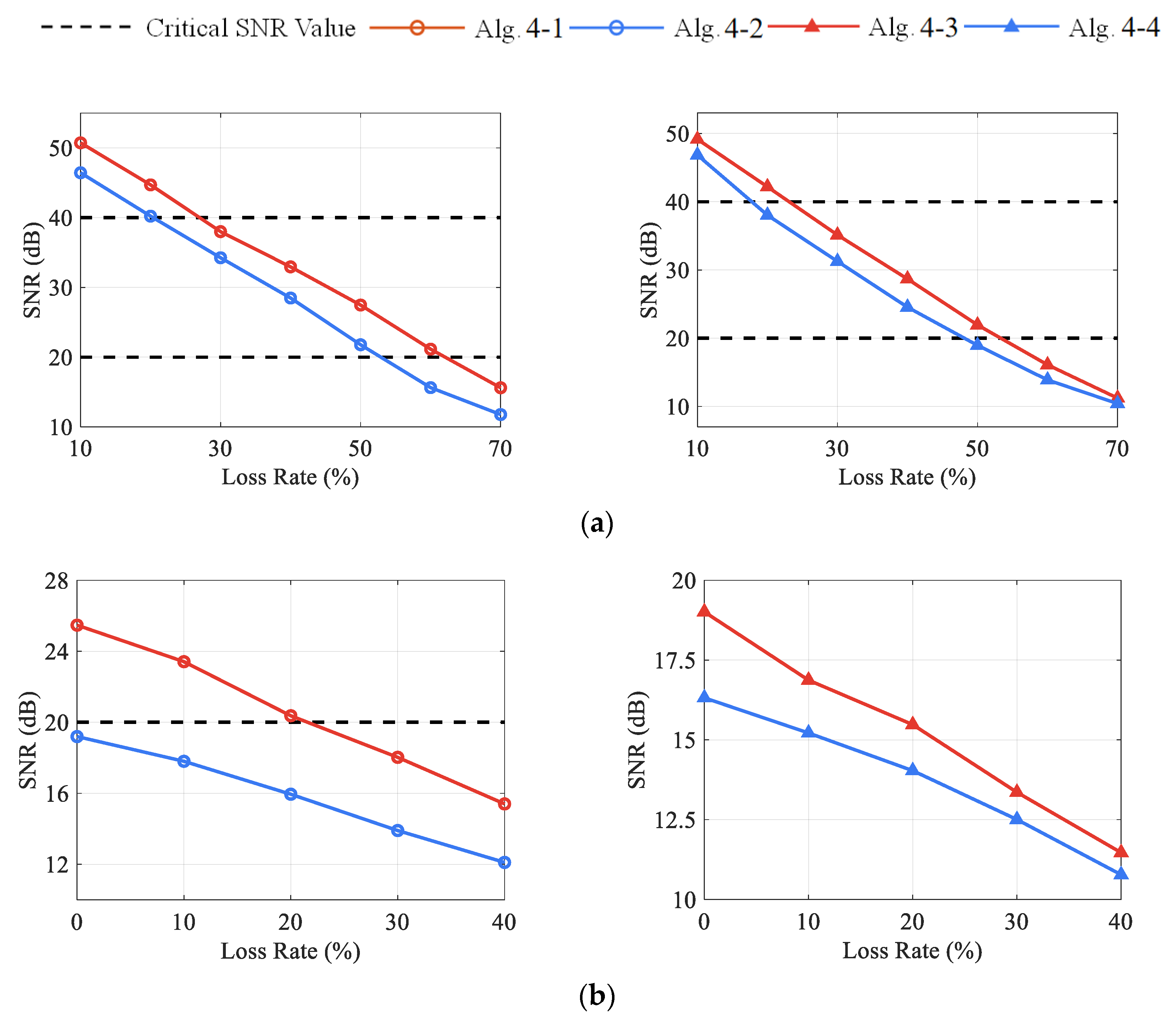
- Algorithm 4-1 (Alg. 4-1): DCS-Laplace with
- Algorithm 4-2 (Alg. 4-2): DCS-SOMP
- Algorithm 4-3 (Alg. 4-3): CS-Laplace with
- Algorithm 4-4 (Alg. 4-4): CS-OMP
4. Conclusions
- Facing multi-channel signals with similar sparse patterns, the DCS method can achieve joint recovery by exploiting the inter-correlation among channels, thus effectively improving the reconstruction performance. Even with a small number of channels (Case 2), DCS can still significantly improve the reconstruction quality and enhance the robustness of data compression and transmission loss compared with the single-channel CS approach. In addition, the proposed DCS framework also provides great flexibility and independence for single channels by using a unique sensing matrix in each task. The compression strategies of each channel can be adjusted according to its own characteristics to reach a compromise among the transmission energy consumption, the tolerance of data loss, and reconstruction accuracy, which is of high practical value in wireless signal transmission.
- DCS-Laplace is an adaptive algorithm that can actively adapt to different types of vibration signals by adjusting the constraints on sparsity to ensure the best reconstruction performance. In general, compared with the RMV-based hierarchical Bayesian model, imposing Laplace priors can achieve a higher reconstruction accuracy; the Fast DCS-Laplace algorithm can maintain a high operational efficiency in the face of large-scale vibration signals; the Laplace method has advantages over the OMP method in terms of reconstruction performance (especially for the reconstruction accuracy of moderately distorted signals) and applicability, which is a better choice in practical applications.
Author Contributions
Funding
Institutional Review Board Statement
Informed Consent Statement
Data Availability Statement
Conflicts of Interest
References
- Sun, L.; Shang, Z.; Xia, Y.; Bhowmick, S.; Nagarajaiah, S. Review of Bridge Structural Health Monitoring Aided by Big Data and Artificial Intelligence: From Condition Assessment to Damage Detection. J. Struct. Eng. 2020, 146, 04020073. [Google Scholar] [CrossRef] [Scilit]
- Sony, S.; Laventure, S.; Sadhu, A. A literature review of next-generation smart sensing technology in structural health monitoring. Struct. Control Health Monit. 2019, 26, e2321. [Google Scholar] [CrossRef] [Scilit]
- Abdulkarem, M.; Samsudin, K.; Rokhani, F.Z.; Rasid, M.F.A. Wireless sensor network for structural health monitoring: A contemporary review of technologies, challenges, and future direction. Struct. Health Monit. 2020, 19, 693–735. [Google Scholar] [CrossRef] [Scilit]
- Lu, N.; Liu, J.; Wang, H.; Yuan, H.; Luo, Y. Stochastic Propagation of Fatigue Cracks in Welded Joints of Steel Bridge Decks under Simulated Traffic Loading. Sensors 2023, 23, 5067. [Google Scholar] [CrossRef] [Scilit]
- Lu, N.; Wang, H.; Wang, K.; Liu, Y. Maximum Probabilistic and Dynamic Traffic Load Effects on Short-to-Medium Span Bridges. Comput. Model. Eng. Sci. 2021, 127, 345–360. [Google Scholar] [CrossRef] [Scilit]
- Aygün, B.; Cagri Gungor, V. Wireless sensor networks for structure health monitoring: Recent advances and future research directions. Sens. Rev. 2011, 31, 261–276. [Google Scholar] [CrossRef] [Scilit]
- Sabato, A.; Niezrecki, C.; Fortino, G. Wireless MEMS-Based Accelerometer Sensor Boards for Structural Vibration Monitoring: A Review. IEEE Sens. J. 2017, 17, 226–235. [Google Scholar] [CrossRef] [Scilit]
- Noel, A.B.; Abdaoui, A.; Elfouly, T.; Ahmed, M.H.; Badawy, A.; Shehata, M.S. Structural Health Monitoring Using Wireless Sensor Networks: A Comprehensive Survey. IEEE Commun. Surv. Tutor. 2017, 19, 1403–1423. [Google Scholar] [CrossRef] [Scilit]
- Bao, Y.; Li, H.; Sun, X.; Yu, Y.; Ou, J. Compressive sampling–based data loss recovery for wireless sensor networks used in civil structural health monitoring. Struct. Health Monit. 2013, 12, 78–95. [Google Scholar] [CrossRef] [Scilit]
- Bao, Y.; Yu, Y.; Li, H.; Mao, X.; Jiao, W.; Zou, Z.; Ou, J. Compressive sensing-based lost data recovery of fast-moving wireless sensing for structural health monitoring. Struct. Control Health Monit. 2015, 22, 433–448. [Google Scholar] [CrossRef] [Scilit]
- Zou, Z.; Bao, Y.; Li, H.; Spencer, B.F.; Ou, J. Embedding Compressive Sensing-Based Data Loss Recovery Algorithm into Wireless Smart Sensors for Structural Health Monitoring. IEEE Sens. J. 2015, 15, 797–808. [Google Scholar]
- Jayawardhana, M.; Zhu, X.; Liyanapathirana, R.; Gunawardana, U. Compressive sensing for efficient health monitoring and effective damage detection of structures. Mech. Syst. Signal Process. 2017, 84, 414–430. [Google Scholar] [CrossRef] [Scilit]
- Lynch, J.P.; Sundararajan, A.; Law, K.H.; Kiremidjian, A.S.; Carryer, E. Power-Efficient Data Management for a Wireless Structural Monitoring System. In Proceedings of the 4th International Workshop on Structural Health Monitoring, Stanford, CA, USA, 15–17 September 2003. [Google Scholar]
- Zhang, Y.; Li, J. Wavelet-Based Vibration Sensor Data Compression Technique for Civil Infrastructure Condition Monitoring. J. Comput. Civ. Eng. 2006, 20, 390–399. [Google Scholar] [CrossRef] [Scilit]
- Xu, N.; Rangwala, S.; Chintalapudi, K.K.; Ganesan, D.; Broad, A.; Govindan, R.; Estrin, D. A wireless sensor network for structural monitoring. In Proceedings of the 2nd International Conference on Embedded Networked Sensor Systems—SenSys’04, Baltimore, MD, USA, 3–5 November 2004; ACM Press: New York, NY, USA, 2004. [Google Scholar] [CrossRef] [Scilit]
- Wan, C.-Y.; Campbell, A.T.; Krishnamurthy, L. Pump-slowly, fetch-quickly (PSFQ): A reliable transport protocol for sensor networks. IEEE J. Sel. Areas Commun. 2005, 23, 862–872. [Google Scholar] [CrossRef] [Scilit]
- De, S.; Qiao, C.; Wu, H. Meshed multipath routing with selective forwarding: An efficient strategy in wireless sensor networks. Comput. Netw. 2003, 43, 481–497. [Google Scholar] [CrossRef] [Scilit]
- Wang, Y.; Lynch, J.P.; Law, K.H. A wireless structural health monitoring system with multithreaded sensing devices: Design and validation. Struct. Infrastruct. Eng. 2007, 3, 103–120. [Google Scholar] [CrossRef] [Scilit]
- Nagayama, T.; Spencer, B.F. Structural Health Monitoring Using Smart Sensors; Newmark Structural Engineering Laboratory, University of Illinois at Urbana-Champaign: Urbana, IL, USA, 2007; Available online: http://hdl.handle.net/2142/3521 (accessed on 1 November 2007).
- Donoho, D.L. Compressed sensing. IEEE Trans. Inf. Theory 2006, 52, 1289–1306. [Google Scholar] [CrossRef] [Scilit]
- Candes, E.J.; Wakin, M.B. An Introduction to Compressive Sampling. IEEE Signal Process. Mag. 2008, 25, 21–30. [Google Scholar] [CrossRef] [Scilit]
- Bao, Y.; Beck, J.L.; Li, H. Compressive sampling for accelerometer signals in structural health monitoring. Struct. Health Monit. 2011, 10, 235–246. [Google Scholar]
- O’Connor, S.M.; Lynch, J.P.; Gilbert, A.C. Compressed sensing embedded in an operational wireless sensor network to achieve energy efficiency in long-term monitoring applications. Smart Mater. Struct. 2014, 23, 085014. [Google Scholar] [CrossRef] [Scilit]
- Klis, R.; Chatzi, E.N. Vibration monitoring via spectro-temporal compressive sensing for wireless sensor networks. Struct. Infrastruct. Eng. 2017, 13, 195–209. [Google Scholar] [CrossRef] [Scilit]
- Wan, H.-P.; Dong, G.-S.; Luo, Y. Compressive sensing of wind speed data of large-scale spatial structures with dedicated dictionary using time-shift strategy. Mech. Syst. Signal Process. 2021, 157, 107685. [Google Scholar] [CrossRef] [Scilit]
- Li, H.; Ai, D.; Zhu, H.; Luo, H. Compressed sensing–based electromechanical admittance data loss recovery for concrete structural health monitoring. Struct. Health Monit. 2021, 20, 1247–1273. [Google Scholar] [CrossRef] [Scilit]
- Huang, Y.; Beck, J.L.; Wu, S.; Li, H. Robust Bayesian Compressive Sensing for Signals in Structural Health Monitoring. Comput.-Aided Civ. Infrastruct. Eng. 2014, 29, 160–179. [Google Scholar] [CrossRef] [Scilit]
- Huang, Y.; Beck, J.L.; Wu, S.; Li, H. Bayesian compressive sensing for approximately sparse signals and application to structural health monitoring signals for data loss recovery. Probabilistic Eng. Mech. 2016, 46, 62–79. [Google Scholar] [CrossRef] [Scilit]
- Chen, S.; Ni, Y.; Zhou, L. A deep learning framework for adaptive compressive sensing of high-speed train vibration responses. Struct. Control Health Monit. 2022, 29, e2979. [Google Scholar] [CrossRef] [Scilit]
- Zhang, Z.; Luo, Y. Restoring method for missing data of spatial structural stress monitoring based on correlation. Mech. Syst. Signal Process. 2017, 91, 266–277. [Google Scholar] [CrossRef] [Scilit]
- Chen, Z.; Bao, Y.; Li, H.; Spencer, B.F. A novel distribution regression approach for data loss compensation in structural health monitoring. Struct. Health Monit. 2018, 17, 1473–1490. [Google Scholar] [CrossRef] [Scilit]
- Chen, Z.; Bao, Y.; Li, H.; Spencer, B.F. LQD-RKHS-based distribution-to-distribution regression methodology for restoring the probability distributions of missing SHM data. Mech. Syst. Signal Process. 2019, 121, 655–674. [Google Scholar] [CrossRef] [Scilit]
- Chen, Z.; Bao, Y.; Tang, Z.; Chen, J.; Li, H. Clarifying and quantifying the geometric correlation for probability distributions of inter-sensor monitoring data: A functional data analytic methodology. Mech. Syst. Signal Process. 2020, 138, 106540. [Google Scholar] [CrossRef] [Scilit]
- Chen, Z.; Lei, X.; Bao, Y.; Deng, F.; Zhang, Y.; Li, H. Uncertainty quantification for the distribution-to-warping function regression method used in distribution reconstruction of missing structural health monitoring data. Struct. Health Monit. 2021, 20, 3436–3452. [Google Scholar] [CrossRef] [Scilit]
- Zhang, Y.-M.; Wang, H.; Bai, Y.; Mao, J.-X.; Xu, Y.-C. Bayesian dynamic regression for reconstructing missing data in structural health monitoring. Struct. Health Monit. 2022, 21, 2097–2115. [Google Scholar] [CrossRef] [Scilit]
- Baron, D.; Duarte, M.F.; Wakin, M.B.; Sarvotham, S.; Baraniuk, R.G. Distributed Compressive Sensing. arXiv 2009, arXiv:0901.3403. [Google Scholar]
- Cotter, S.; Rao, B.; Engan, K.; Kreutz-Delgado, K. Sparse solutions to linear inverse problems with multiple measurement vectors. IEEE Trans. Signal Process. 2005, 53, 2477–2488. [Google Scholar] [CrossRef] [Scilit]
- Duarte, M.F.; Sarvotham, S.; Baron, D.; Wakin, M.; Duarte, M.F.; Baraniuk, R.G. Distributed Compressed Sensing of Jointly Sparse Signals. In Proceedings of the Conference Record of the Thirty-Ninth Asilomar Conference on Signals, Systems and Computers, Pacific Grove, CA, USA, 30 October–2 November 2005; pp. 1537–1541. [Google Scholar]
- Palangi, H.; Ward, R.; Deng, L. Distributed Compressive Sensing: A Deep Learning Approach. IEEE Trans. Signal Process. 2016, 64, 4504–4518. [Google Scholar] [CrossRef] [Scilit]
- Tropp, J.A.; Gilbert, A.C.; Strauss, M.J. Algorithms for simultaneous sparse approximation. Part I: Greedy pursuit. Signal Process. 2006, 86, 572–588. [Google Scholar] [CrossRef] [Scilit]
- Wipf, D.; Nagarajan, S. Iterative Reweighted ℓ1 and ℓ2 Methods for Finding Sparse Solutions. IEEE J. Sel. Top. Signal Process. 2010, 4, 317–329. [Google Scholar] [CrossRef] [Scilit]
- Ji, S.; Dunson, D.; Carin, L. Multitask Compressive Sensing. IEEE Trans. Signal Process. 2009, 57, 92–106. [Google Scholar] [CrossRef] [Scilit]
- Wipf, D.P.; Rao, B.D. An Empirical Bayesian Strategy for Solving the Simultaneous Sparse Approximation Problem. IEEE Trans. Signal Process. 2007, 55, 3704–3716. [Google Scholar] [CrossRef] [Scilit]
- Zhang, Z.; Rao, B.D. Sparse Signal Recovery With Temporally Correlated Source Vectors Using Sparse Bayesian Learning. IEEE J. Sel. Top. Signal Process. 2011, 5, 912–926. [Google Scholar] [CrossRef] [Scilit]
- Wang, Y.-G.; Yang, L.; Tang, L.; Liu, Z.; Jiang, W.L. Enhanced multi-task compressive sensing using Laplace priors and MDL-based task classification. EURASIP J. Adv. Signal Process. 2013, 2013, 160. [Google Scholar] [CrossRef] [Scilit]
- Bao, Y.; Shi, Z.; Wang, X.; Li, H. Compressive sensing of wireless sensors based on group sparse optimization for structural health monitoring. Struct. Health Monit. 2018, 17, 823–836. [Google Scholar] [CrossRef] [Scilit]
- Tang, Z.; Bao, Y.; Li, H. Group sparsity-aware convolutional neural network for continuous missing data recovery of structural health monitoring. Struct. Health Monit. 2021, 20, 1738–1759. [Google Scholar] [CrossRef] [Scilit]
- Huang, Y.; Shao, C.; Wu, S.; Li, H. Diagnosis and accuracy enhancement of compressive-sensing signal reconstruction in structural health monitoring using multi-task sparse Bayesian learning. Smart Mater. Struct. 2019, 28, 035001. [Google Scholar] [CrossRef] [Scilit]
- Huang, Y.; Beck, J.L.; Li, H. Multitask Sparse Bayesian Learning with Applications in Structural Health Monitoring. Comput.-Aided Civ. Infrastruct. Eng. 2019, 34, 732–754. [Google Scholar] [CrossRef] [Scilit]
- Wan, H.-P.; Ni, Y.-Q. Bayesian multi-task learning methodology for reconstruction of structural health monitoring data. Struct. Health Monit. 2019, 18, 1282–1309. [Google Scholar] [CrossRef] [Scilit]
- Amini, F.; Hedayati, Y.; Zanddizari, H. Exploiting the inter-correlation of structural vibration signals for data loss recovery: A distributed compressive sensing based approach. Mech. Syst. Signal Process. 2021, 152, 107473. [Google Scholar] [CrossRef] [Scilit]
- Wan, H.-P.; Dong, G.-S.; Luo, Y.; Ni, Y.-Q. An improved complex multi-task Bayesian compressive sensing approach for compression and reconstruction of SHM data. Mech. Syst. Signal Process. 2022, 167, 108531. [Google Scholar] [CrossRef] [Scilit]
- Candès, E.J.; Eldar, Y.C.; Needell, D.; Randall, P. Compressed sensing with coherent and redundant dictionaries. Appl. Comput. Harmon. Anal. 2011, 31, 59–73. [Google Scholar] [CrossRef] [Scilit]
- Tropp, J.A.; Laska, J.N.; Duarte, M.F.; Romberg, J.K.; Baraniuk, R.G. Beyond Nyquist: Efficient Sampling of Sparse Bandlimited Signals. IEEE Trans. Inf. Theory 2010, 56, 520–544. [Google Scholar] [CrossRef] [Scilit]
- Almasri, N.; Sadhu, A.; Ray Chaudhuri, S. Toward Compressed Sensing of Structural Monitoring Data Using Discrete Cosine Transform. J. Comput. Civ. Eng. 2020, 34, 04019041. [Google Scholar] [CrossRef] [Scilit]
- Candes, E.J.; Romberg, J.; Tao, T. Robust uncertainty principles: Exact signal reconstruction from highly incomplete frequency information. IEEE Trans. Inf. Theory 2006, 52, 489–509. [Google Scholar] [CrossRef] [Scilit]
- Ji, S.; Xue, Y.; Carin, L. Bayesian Compressive Sensing. IEEE Trans. Signal Process. 2008, 56, 2346–2356. [Google Scholar] [CrossRef] [Scilit]
- Babacan, S.D.; Molina, R.; Katsaggelos, A.K. Bayesian Compressive Sensing Using Laplace Priors. IEEE Trans. IMAGE Process. 2010, 19, 53–63. [Google Scholar] [CrossRef] [Scilit] [PubMed]
- Tipping, M.E. Sparse Bayesian Learning and the Relevance Vector Machine. J. Mach. Learn. Res. 2001, 1, 211–244. [Google Scholar]
- Seeger, M.W.; Nickisch, H. Compressed sensing and Bayesian experimental design. In Proceedings of the 25th International Conference on Machine Learning—ICML’08, Helsinki, Finland, 5–9 July 2008; ACM Press: New York, NY, USA, 2008; pp. 912–919. [Google Scholar]
- Tibshirani, R. Regression Shrinkage and Selection via the Lasso. J. R. Stat. Soc. Ser. B Methodol. 1996, 58, 267–288. [Google Scholar] [CrossRef] [Scilit]
- Figueiredo, M.A.T. Adaptive Sparseness Using Jeffreys Prior. In Proceedings of the 14th International Conference on Neural Information Processing Systems: Natural and Synthetic, Cambridge, MA, USA, 3–8 December 2001. [Google Scholar]
- Tipping, M.E.; Faul, A.C. Fast Marginal Likelihood Maximisation for Sparse Bayesian Models. In Proceedings of the Ninth International Workshop on Artificial Intelligence and Statistics, Key West, FL, USA, 3–6 January 2003. [Google Scholar]
- Ju, S.-H.; Lin, H.-T.; Huang, J.-Y. Dominant frequencies of train-induced vibrations. J. Sound Vib. 2009, 319, 247–259. [Google Scholar] [CrossRef] [Scilit]

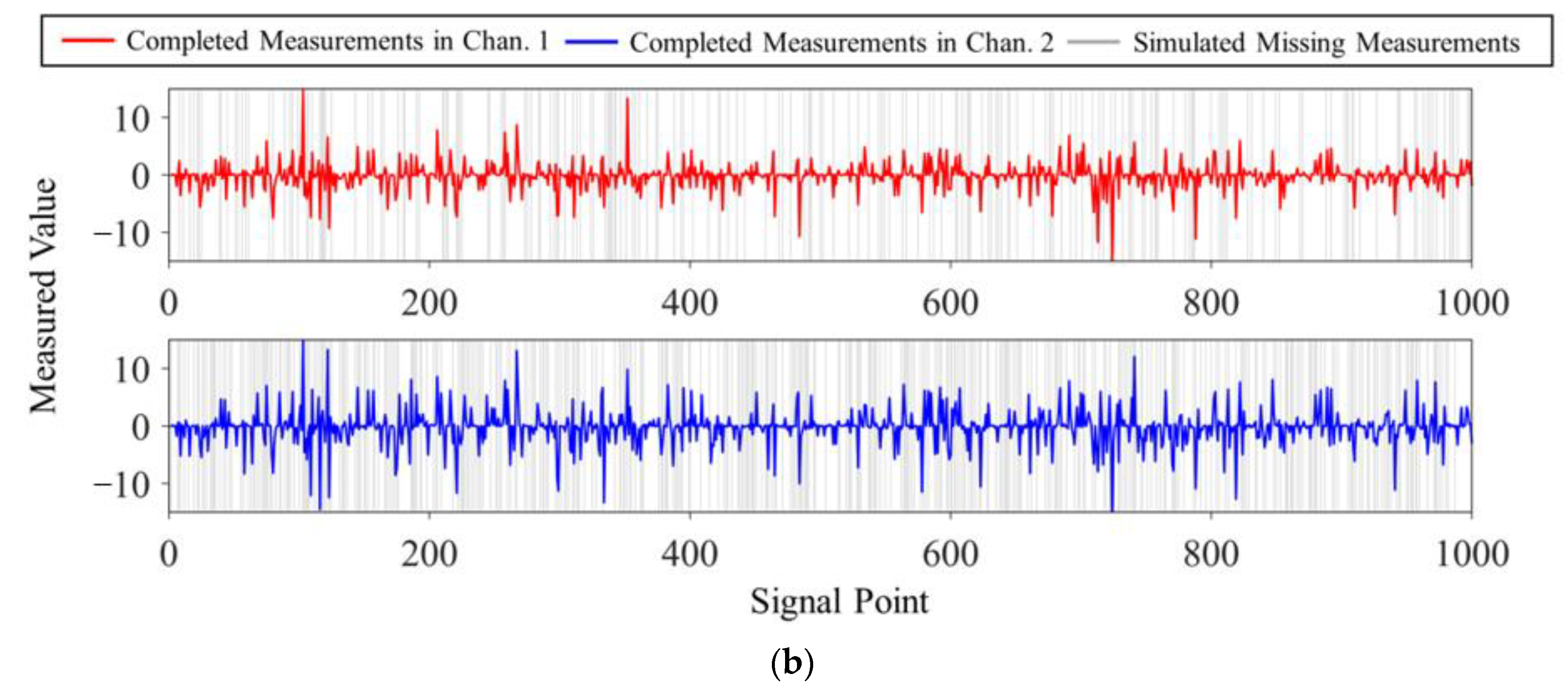
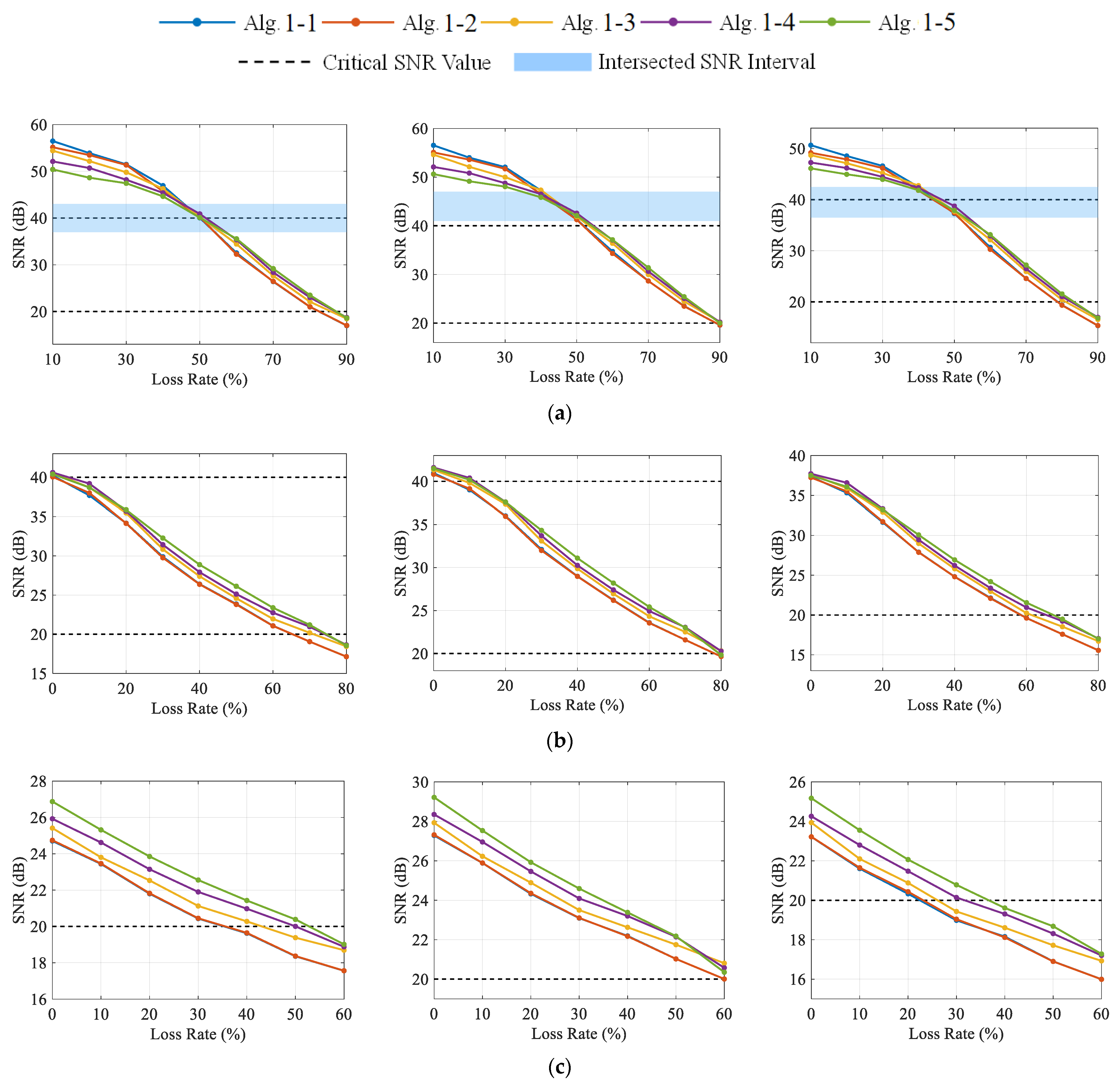
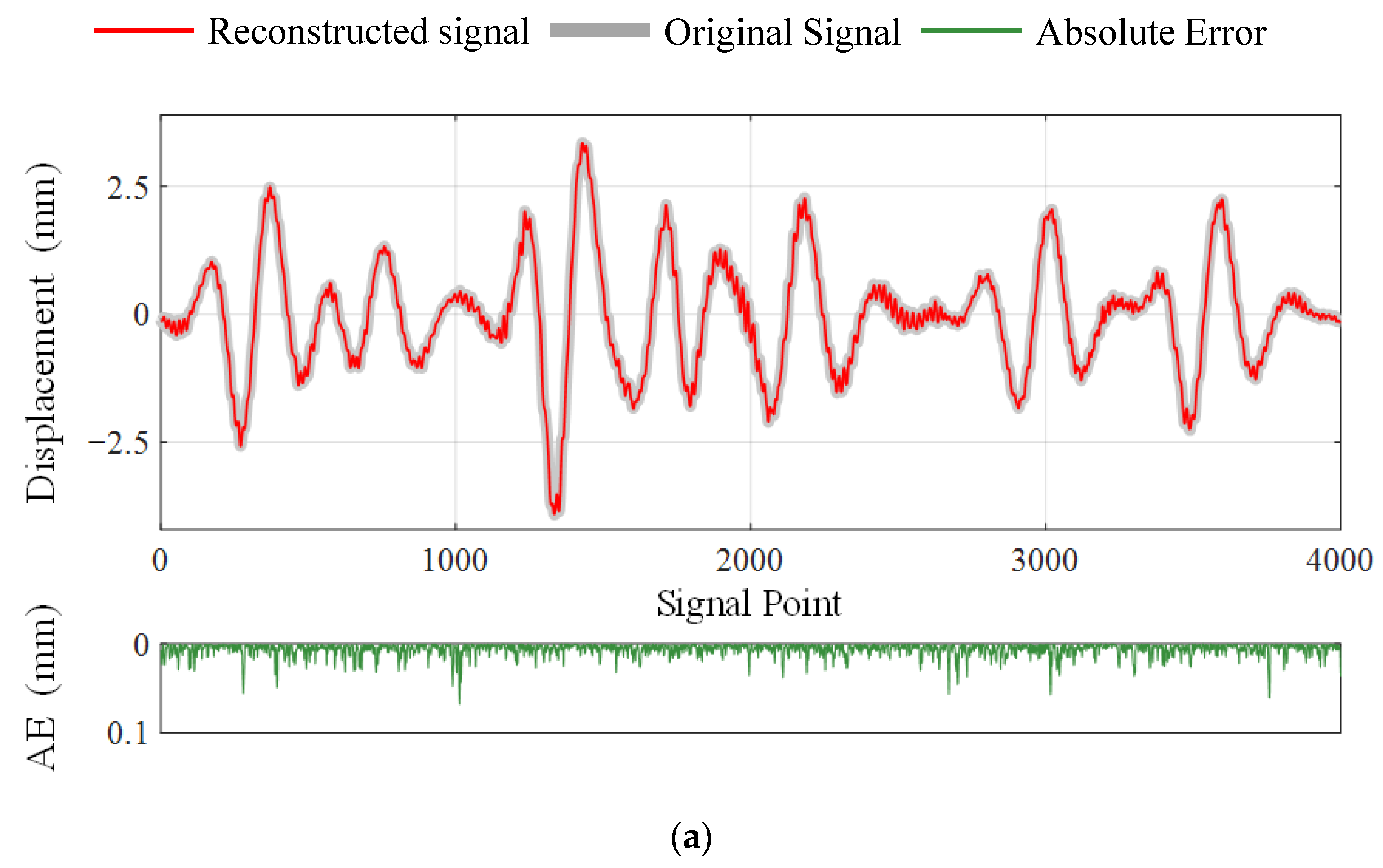

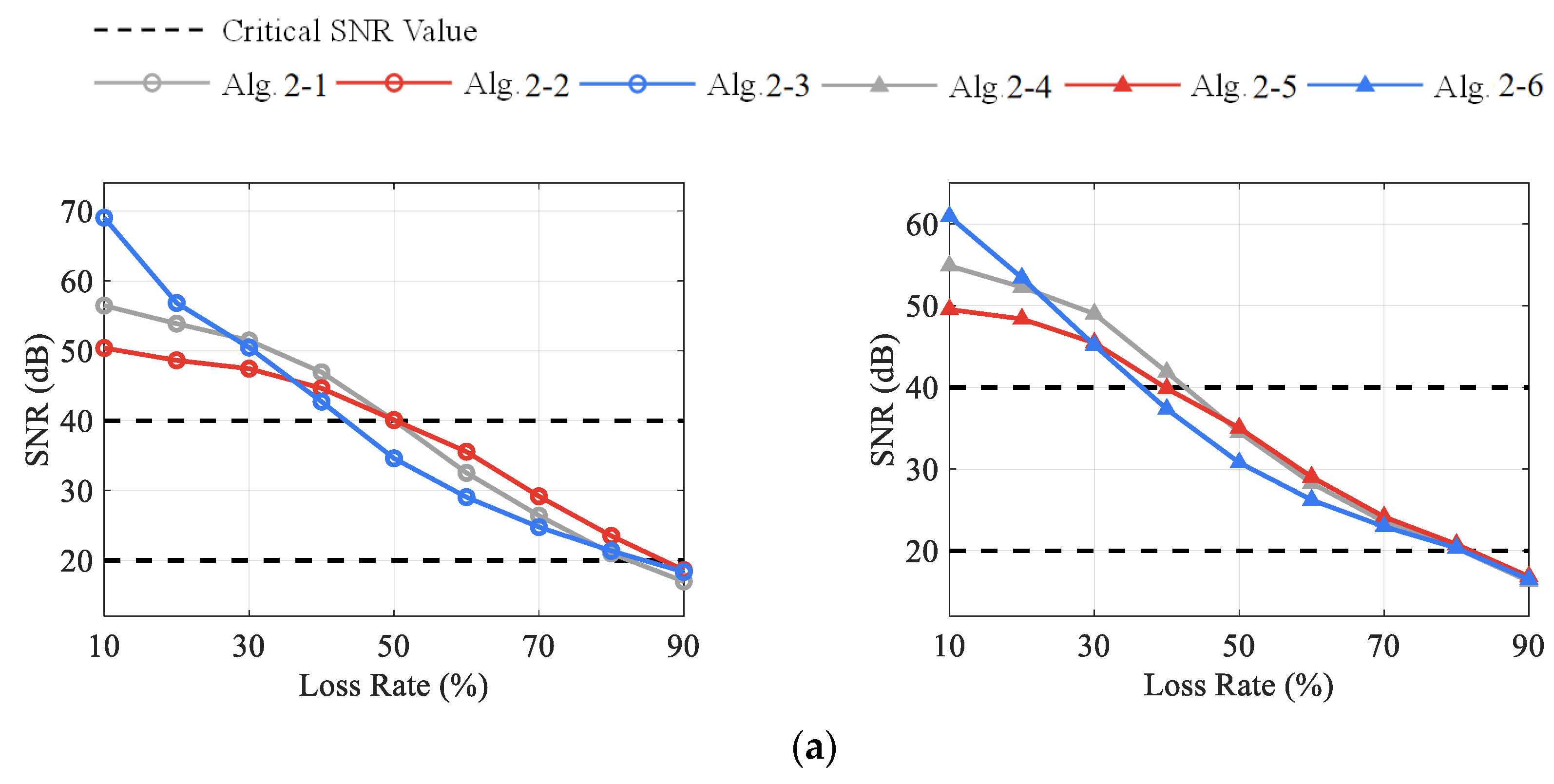


| Chan. 1 | Chan. 2 | Chan. 3 | Chan. 4 | Chan. 5 | |
|---|---|---|---|---|---|
| Chan. 1 | 1 | 0.9859 | 0.9374 | 0.9251 | 0.9039 |
| Chan. 2 | 1 | 0.9555 | 0.9493 | 0.9214 | |
| Chan. 3 | 1 | 0.9685 | 0.9522 | ||
| Chan. 4 | 1 | 0.9838 | |||
| Chan. 5 | 1 |
| Alg 1-1 | Alg 1-2 | Alg 1-3 | Alg 1-4 | Alg 1-5 | |
|---|---|---|---|---|---|
| 126.9731 s | 125.2586 s | 114.4848 s | 93.5504 s | 83.0950 s | |
| 54.0480 s | 54.5392 s | 49.5011 s | 44.6238 s | 48.6521 s | |
| 10.1138 s | 10.2370 s | 11.8390 s | 16.6280 s | 22.2154 s |
| L = 1 | L = 2 | L = 3 | L = 4 | L = 5 | |
|---|---|---|---|---|---|
| Alg. 2-1 | 18.0238 s | 39.5313 s | 59.8162 s | 81.0295 s | 99.3569 s |
| Alg. 2-2 | 11.6737 s | 26.6665 s | 37.9230 s | 60.1796 s | 68.2221 s |
| Alg. 2-3 | 21.3301 s | 46.6377 s | 68.5796 s | 91.5953 s | 114.0725 s |
| L = 1 | L = 2 | L = 3 | L = 4 | L = 5 | |
|---|---|---|---|---|---|
| Alg. 2-1 | 1441 | 1436 | 1497 | 1513 | 1482 |
| Alg. 2-2 | 1073 | 1134 | 1126 | 1216 | 1172 |
| Alg. 2-3 | 910 | 910 | 910 | 910 | 910 |
| Scenario 1 | Scenario 2 | Scenario 3 | Scenario 4 | Scenario 5 | Scenario 6 | Scenario 7 | ||||||||
|---|---|---|---|---|---|---|---|---|---|---|---|---|---|---|
| CR | LR | CR | LR | CR | LR | CR | LR | CR | LR | CR | LR | CR | LR | |
| Chan. 1 | 2 | 10 | 2 | 10 | 2 | 10 | 2 | 10 | 2 | 50 | 4 | 10 | 4 | 10 |
| Chan. 2 | 2 | 30 | 2 | 30 | 2 | 30 | 2 | 30 | 2 | 30 | 2 | 30 | 2 | 30 |
| Chan. 3 | 2 | 50 | 2 | 10 | 1 | 50 | 1 | 50 | 2 | 50 | 2 | 50 | 2 | 50 |
| Chan. 4 | 2 | 0 | 2 | 0 | 2 | 0 | 2 | 0 | 2 | 0 | 2 | 0 | 4 | 0 |
| Chan. 5 | 2 | 20 | 2 | 20 | 2 | 20 | 1 | 20 | 2 | 20 | 2 | 20 | 2 | 20 |
| Scenario 1 | SNR (dB) | |||||
|---|---|---|---|---|---|---|
| Chan. 1 | Chan. 2 | Chan. 3 | Chan. 4 | Chan. 5 | ||
| DCS-Laplace (automatically estimated ) | 1 | 36.6662 | 34.0724 | 26.4272 | 32.6855 | 26.3189 |
| 2 | 37.6487 | 35.4543 | 35.1345 | 33.2156 | 26.8240 | |
| 3 | 38.5772 | 35.1956 | 36.6870 | 34.1764 | 27.5615 | |
| 4 | 40.5286 | 34.6369 | 37.6548 | 35.5751 | 42.6754 | |
| 5 | 28.2025 | 32.7598 | 26.3141 | 31.3953 | 24.4993 | |
| 6 | 28.0049 | 32.6742 | 26.1043 | 31.0674 | 24.2534 | |
| 7 | 28.2131 | 31.9908 | 26.0608 | 27.0719 | 23.1887 | |
| DCS-Laplace () | 1 | 37.5008 | 36.3378 | 27.9808 | 33.6630 | 28.1540 |
| 2 | 38.2697 | 37.1796 | 35.8453 | 34.0343 | 28.7652 | |
| 3 | 39.0819 | 37.6513 | 38.0546 | 35.0832 | 29.7045 | |
| 4 | 40.7152 | 37.9528 | 39.5789 | 36.1490 | 40.0842 | |
| 5 | 29.9361 | 35.1431 | 27.6651 | 32.5002 | 26.7678 | |
| 6 | 29.5179 | 34.7118 | 27.5555 | 32.3976 | 26.3908 | |
| 7 | 29.3773 | 34.0283 | 27.1823 | 28.1313 | 25.0307 | |
| DCS-SOMP | 1 | 30.3471 | 31.1345 | 23.7890 | 28.1335 | 22.0260 |
| 2 | 30.7220 | 31.3312 | 29.2418 | 28.5245 | 22.0624 | |
| 3 | 31.8760 | 32.0159 | 32.4429 | 30.0957 | 22.7680 | |
| 4 | 32.7611 | 31.9126 | 33.9947 | 32.3952 | 41.9091 | |
| 5 | 25.9234 | 30.4896 | 23.7146 | 27.6011 | 21.5107 | |
| 6 | 25.8473 | 30.5776 | 23.7111 | 27.6932 | 21.4629 | |
| 7 | 25.8201 | 30.2585 | 23.7947 | 25.1174 | 20.6950 | |
| Chan. 1 | Chan. 2 | Chan. 3 | |
|---|---|---|---|
| Chan. 1 | 1 | 0.8790 | 0.7710 |
| Chan. 2 | 1 | 0.8247 | |
| Chan. 3 | 1 |
| Alg. 3-1 | Alg. 3-2 | Alg. 3-3 | Alg. 3-4 | Alg. 3-5 | |
|---|---|---|---|---|---|
| 306.0228 s | 293.1825 s | 284.9227 s | 249.9455 s | 188.6743 s | |
| 102.7295 s | 100.3038 s | 133.1828 s | 129.5480 s | 114.7767 s | |
| 49.4826 s | 47.9823 s | 111.7089 s | 135.2697 s | 124.3077 s |
| Alg. 4-1 | Alg. 4-2 | Alg. 4-3 | |
|---|---|---|---|
| Alg. 1. | 41.1258 s | 107.1045 s | 176.9771 s |
| Alg. 2. | 44.1580 s | 88.0031 s | 133.1687 s |
| L = 1 | L = 2 | L = 3 | |
|---|---|---|---|
| Alg. 1. | 41.1258 s | 107.1045 s | 176.9771 s |
| Alg. 2. | 44.1580 s | 88.0031 s | 133.1687 s |
| Scenario 1 | Scenario 2 | Scenario 3 | Scenario 4 | |||||
|---|---|---|---|---|---|---|---|---|
| CR | LR | CR | LR | CR | LR | CR | LR | |
| Chan. 1 | 1 | 10 | 1 | 10 | 1 | 50 | 2 | 10 |
| Chan. 2 | 1 | 30 | 1 | 30 | 1 | 30 | 1 | 30 |
| Chan. 3 | 1 | 50 | 1 | 10 | 1 | 50 | 1 | 50 |
| Algorithm | Scenario | SNR (dB) | ||
|---|---|---|---|---|
| Chan. 1 | Chan. 2 | Chan. 3 | ||
| DCS-Laplace () | 1 | 47.3511 | 38.7360 | 26.1259 |
| 2 | 47.2862 | 39.2743 | 47.3993 | |
| 3 | 25.1775 | 37.1179 | 25.9793 | |
| 4 | 21.4098 | 36.0167 | 24.6136 | |
| DCS-SOMP | 1 | 43.4824 | 34.4658 | 20.2063 |
| 2 | 43.6761 | 34.9629 | 43.7085 | |
| 3 | 19.1648 | 31.5436 | 20.0736 | |
| 4 | 16.5773 | 30.7059 | 19.3118 | |
Disclaimer/Publisher’s Note: The statements, opinions and data contained in all publications are solely those of the individual author(s) and contributor(s) and not of MDPI and/or the editor(s). MDPI and/or the editor(s) disclaim responsibility for any injury to people or property resulting from any ideas, methods, instructions or products referred to in the content. |
© 2023 by the authors. Licensee MDPI, Basel, Switzerland. This article is an open access article distributed under the terms and conditions of the Creative Commons Attribution (CC BY) license (https://creativecommons.org/licenses/by/4.0/).
Share and Cite
Wang, Z.; Sun, S.; Li, Y.; Yue, Z.; Ding, Y. Distributed Compressive Sensing for Wireless Signal Transmission in Structural Health Monitoring: An Adaptive Hierarchical Bayesian Model-Based Approach. Sensors 2023, 23, 5661. https://doi.org/10.3390/s23125661
Wang Z, Sun S, Li Y, Yue Z, Ding Y. Distributed Compressive Sensing for Wireless Signal Transmission in Structural Health Monitoring: An Adaptive Hierarchical Bayesian Model-Based Approach. Sensors. 2023; 23(12):5661. https://doi.org/10.3390/s23125661
Chicago/Turabian StyleWang, Zhiwen, Shouwang Sun, Yiwei Li, Zixiang Yue, and Youliang Ding. 2023. "Distributed Compressive Sensing for Wireless Signal Transmission in Structural Health Monitoring: An Adaptive Hierarchical Bayesian Model-Based Approach" Sensors 23, no. 12: 5661. https://doi.org/10.3390/s23125661
APA StyleWang, Z., Sun, S., Li, Y., Yue, Z., & Ding, Y. (2023). Distributed Compressive Sensing for Wireless Signal Transmission in Structural Health Monitoring: An Adaptive Hierarchical Bayesian Model-Based Approach. Sensors, 23(12), 5661. https://doi.org/10.3390/s23125661