You are currently viewing a new version of our website. To view the old version click .
Sensors
  • Article
  • Open Access

16 December 2022

Fast Image Encryption Algorithm for Logistics-Sine-Cosine Mapping

,
,
and
School of Computer Science, Yangtze University, Jingzhou 434023, China
*
Author to whom correspondence should be addressed.
This article belongs to the Section Sensing and Imaging

Abstract

Because images are vulnerable to external attacks in the process of network transmission and traditional image encryption algorithms have limitations such as long encryption time, insufficient entropy or poor diffusion of cipher image information when encrypting color images, a fast image encryption algorithm based on logistics-sine-cosine mapping is proposed. The algorithm first generates five sets of encrypted sequences from the logistics-sine-cosine mapping, then uses the order of the encryption sequence to scramble the image pixels and designs a new pixel diffusion network to further improve the key sensitivity and plain-image sensitivity of the encryption algorithm. Finally, in a series of security analysis experiments, the experimental image Lena was tested 100 times, and the average encryption time was 0.479 s. The average value of the information entropy, pixel change rate and uniform average change intensity of the cipher image reached 7.9994, 99.62% and 33.48%, respectively. The experimental results show that the fast image encryption algorithm based on logistics-sine-cosine mapping takes less time to encrypt, and the cipher image has good information entropy and diffusivity. It is a safe and effective fast image encryption algorithm.
1. Introduction

Traditional image encryption, such as IDEA, AES, DES and 3-DES [1], is mainly aimed at data stream encryption, which is not only inefficient and computationally expensive, but these limitations become more and more obvious when encrypting color images. Existing image encryption is roughly divided into spatial domain-based pixel scrambling, chaotic system-based, transformation-domain-based, secret segmentation and secret sharing, neural network and cellular automata-based image encryption.
An image encryption algorithm based on spatial-domain pixel scrambling refers to the use of a specific algorithm to change the position of 3-channel pixels in an image without changing the RGB value of the pixel. As a result, such algorithms are generally less secure, but also relatively low in computational complexity.
An image encryption method based on chaos [2,3,4,5,6] uses the self-similarity of chaos to generate a random sequence as a factor sequence of encryption. The key space is large, the encryption speed is fast, but its limitations are also obvious: there is a trivial key. At present, only high-dimensional chaos or super chaos sacrifice speed can break this limitation.
The image encryption algorithm based on the transformation domain transforms the image from the airspace domain to the frequency domain encryption and then transforms it into the airspace, but because of the limitation of computer accuracy, part of the data accuracy will be lost during the encryption process, which is lossy encryption.
Based on secret segmentation and secret sharing image encryption, the image is encrypted into m cipher images and a threshold k (m ≥ k) is set; only by obtaining n (n ≥ k) different cipher images can the plain image be restored, and its advantage is that even if part of the data is lost, the plain image can still be restored, but the data redundancy is relatively large.
Image encryption based on neural networks and cellular automata has a large key space and good noise resistance because of the nonlinear or self-organizing nature of the encryption system. In addition, there are image encryption algorithms based on DNA [7,8,9,10,11], RNA [12,13,14,15,16], image selectivity [17], optical encryption system [18,19,20,21,22] and random grid [23,24,25,26,27] visualization.

Motivations and Contributions

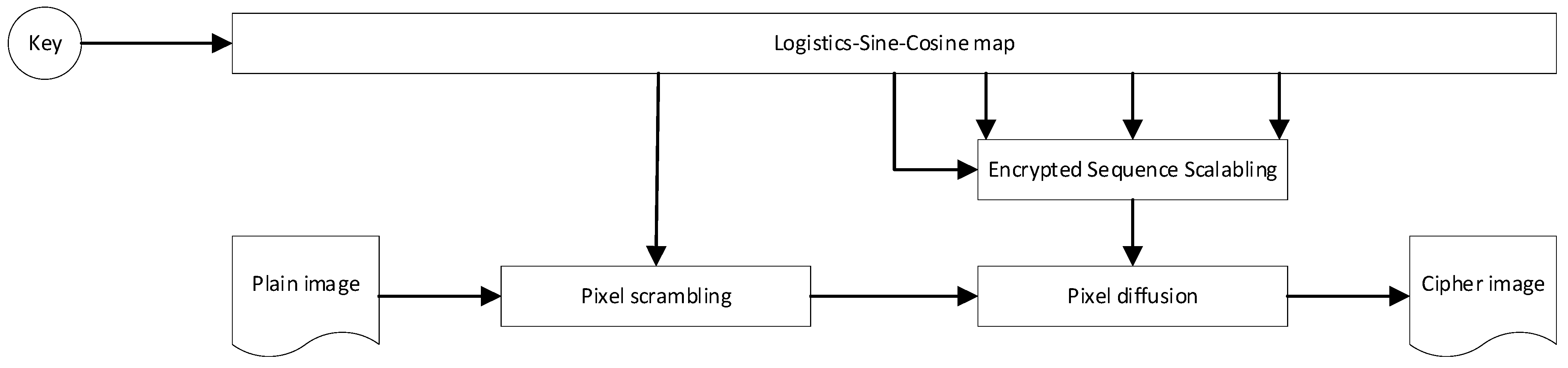
Because images are vulnerable to external attacks in the process of network transmission and traditional image encryption algorithms have limitations such as long encryption time, insufficient entropy or poor diffusion of cipher image information when encrypting color images, a fast image encryption algorithm based on logistics-sine-cosine mapping is proposed that generates encryption sequences with high efficiency based on logistics-sine-cosine mapping and designs an efficient pixel scrambling method and three-round pixel diffusion based on the encryption sequence, which has high encryption efficiency, sufficient information entropy and good diffusion of cipher images.

3. Methods

3.1. Logistics-Sine-Cosine Mapping

The logistics-sine-cosine mapping [31] is a map composed of two seed maps of logistics and sine maps cascading with cosine maps:
x i + 1 = cos ( π ( 4 r x i ( 1 x i ) + r sin ( π x i ) 0.5 ) )
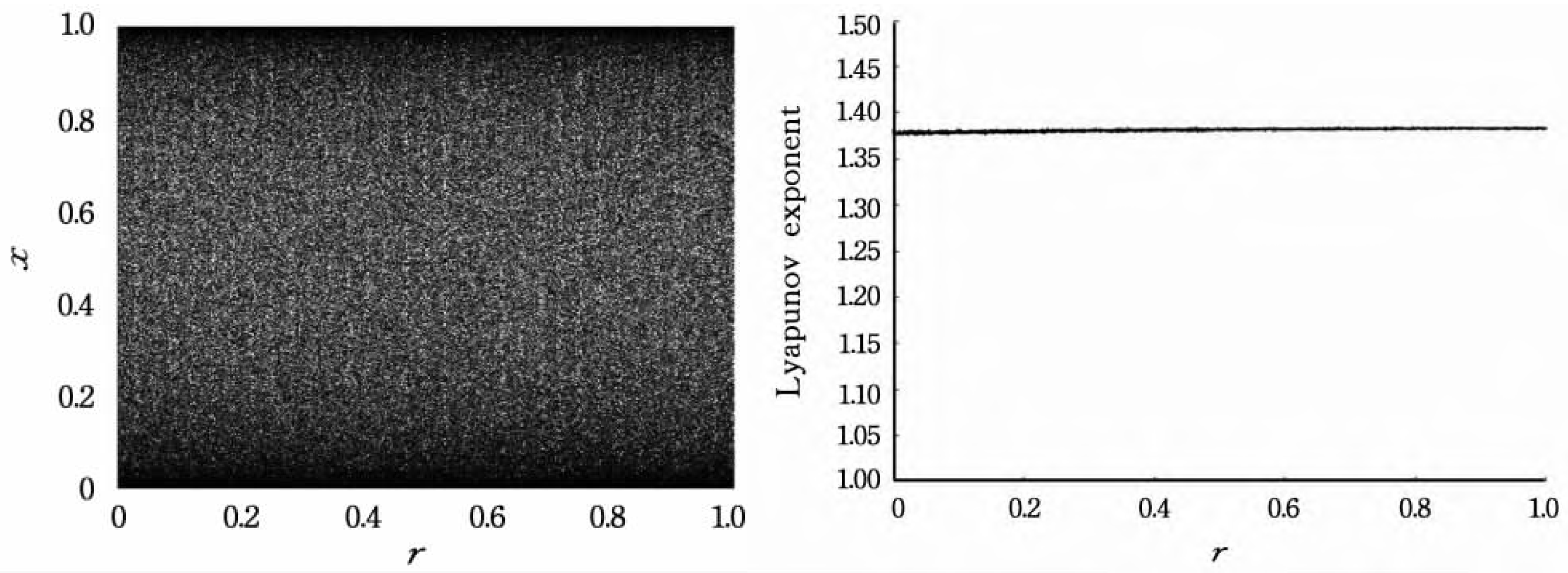
The mapped bifurcation plot, the Lyapunov index, is shown in Figure 3.
Figure 3. Bifurcation graph and Lyapunov exponent of logistics-sine-cosine mapping.
As long as r∈[0, 1], x∈(0, 1), the map can exhibit complex and random behavior.

3.2. Fast Image Encryption Algorithm for Logistics-Sine-Cosine Mapping

3.2.1. Key Distribution and Cryptographic Algorithm Structure

Considering the accuracy of computer calculations, the key is a 320-bit binary number generated by a random binary number generator, consisting of 32-bit binary numbers x 0 , x 1 , x 2 , x 3 , x 4 and r 0 , r 1 , r 2 , r 3 , r 4 , where x is the initial value and r is the control parameter.
The initial value x and the control parameter r are converted from Equation (2) to floating-point numbers:
{ r f l o a t = i = 1 32 r b i n 2 i x f l o a t = i = 1 32 x b i n 2 i
F ( ω , φ , c , p r i m a r y i ) = p r i m a r y i sin ( ω p r i m a r y i + φ ) + c
p r i m a r y i = p r i m a r y 0 + i s t e p
Bring each set of x, r into the logistics-sine-cosine map separately to generate a set of chaotic sequences ω, φ, c, p r i m a r 0 , step of length 5. Then bring each set of ω, φ, c, p r i m a r 0 , step into the third and fourth iterations to generate an encryption sequence with length H × W × 3; finally, five sets of encryption sequences, S 0 , S 1 , S 2 , S 3 and S 4 , are obtained.

3.2.2. Pixel Scrambling

Assuming that the plain image P is a color image of H × W, the five sets of encryption sequences with length H × W × 3 generated by the key are S 0 , S 1 , S 2 , S 3 and S 4 . The rules for scrambling are as follows:
Assuming that the positive sequence corresponding to the encryption sequence S 0 is S s o r t e d (sorted from smallest to largest), there must be S s o r t e d X s c r a m b l e S 0 , where X s c r a m b l e is the scramble operation.
Here is how to scramble an image:
Step 1: use sequence X s c r a m b l e to store the position information of the elements in the positive sequence S s o r t e d in the S 0 of the encrypted sequence; for example, the Ath element B in the positive sequence S s o r t e d is the Cth element in the encryption sequence S 0 ; then the value of the Ath element of sequence X s c r a m b l e is C.
Step 2: transform the image P into a sequence S P with a one-dimensional length H × W × 3, so that S P = ( S P + S 0 ) m o d 256 to get a new S P ; use sequence X s c r a m b l e to scramble the sequence S P ; for example, the Dth element value in the sequence S P is E and the Dth element value in sequence X s c r a m b l e is F; then the Fth element value in the scrambled sequence S S P is E ( S S P is the sequence after scrambling).
For the sake of description, see the following example:
Assuming that the image P is a color image of 2 × 2, the generated encryption sequence S 0 = (2.1, 2.8, 2.6, 2.7, 1.3, 1.6, 0.55, 0.53, 0.74, 1.8, 1.2, 2.5); then the corresponding positive sequence S s o r t e d = (0.53, 0.55, 0.74, 1.2, 1.3, 1.6, 1.8, 2.1, 2.5, 2.6, 3.7, 2.8); it is easy to conclude that the position of the 0th element in S s o r t e d in the S 0 is 7th (counting from 0); then the value of the 0th element of sequence X s c r a m b l e is 7 and so on to get the complete sequence X s c r a m b l e = (7, 6, 8, 10, 4, 5, 9, 0, 11, 2, 3, 1). The image P is transformed into a sequence S P with a one-dimensional length of 2 × 2 × 3, so that S P = ( S P + S 0 ) m o d 256 to get a new S P , and then sequence X s c r a m b l e is used to scramble the sequence S P ; for example, the value of the 0th element in the sequence S P is 111, and the value of the 0th element in the sequence X s c r a m b l e is 7, and then the value of the 7th element in the scrambled sequence S S P is 111. Figure 4 shows a schematic diagram of the position change before and after the P-pixel of the image is scrambled.
Figure 4. Schematic diagram of pixel position before and after scrambling.
When decrypting, perform the reverse operation of pixel scrambling:
Step 1 uses sequence X s o r t to store the position information of the element in the S 0 of the encryption sequence in the positive sequence S s o r t e d ; for example, the Cth element B in the encryption sequence S 0 is the Ath element in the positive sequence S s o r t e d , and then the value of the Cth element of the sequence X s o r t is A.
Step 2: suppose the image after encryption scrambling is P s . The P s is reduced to a one-dimensional sequence S S P of length H × W × 3, and the sequence S S P is restored by using sequence X s o r t ; for example, the Fth element value in the sequence S S P is E, and the Fth element value in sequence X s o r t is D, and then the Dth element value in the restored sequence S P is E. Finally, let S P = ( S P S 0 ) m o d 256 to restore the pixel scrambling.

3.2.3. Pixel Diffusion

Suppose that the image P S before diffusion is an H × W color image after scrambling; first, convert the image P S into a one-dimensional sequence S S P of length H × W × 3, and then use the S 1 to scramble the S 2 , S 3 and S 4 . The scrambling rules are the same as the pixel scrambling rules to obtain a new S 2 , S 3 and S 4 sequence.
For ease of description, here the functions F(L, n) and G(M, n) are set, and F(L, n) represents shifting L left by n units; where L is a sequence, n is an integer, and when n is negative, L is shifted right by -n units. For example, L = (0,1,2,3,4,5,6,7,8,9), n = 3 and then F(L, n) = (3,4,5,6,7,8,9,0,1,2) for the function G(M, n); assuming that the binary number corresponding to M is M b , then G(M, n) means that the n bits of the M b low (right) are shifted out, and the other numbers are shifted n bits to the right, and the decimal number corresponding to the zero is filled in the n empty bits of the high (left); for example, G(5, 1) = 2.
When X is the main diffusion sequence, S 2 is the round of the encryption sequence; when Y is the main diffusion sequence, S 3 is the round of the encryption sequence, and when Z is the main diffusion sequence, S 4 is the round of the encryption sequence. Given the space, only X is given here as the diffusion rule for the principal diffusion vector:
Step 1 divides the sequence S S P into three groups of X, Y and Z so that N = H × W, X = S S P [0:N], Y = S S P [N:2 × N], Z = S S P [2 × N:3 × N] and round = log 2 N + 1 ; divide the encryption sequence S 2 into three groups of sequences, K x , K y and K z ; let K x = S 2 [0:N], K y = S 2 [N:2 × N] and K z = S 2 [2 × N:3 × N].
Step 2: set X as the main diffusion sequence, and the other two as the secondary diffusion sequence; that is, V p is X, V s p 1 is Y and V s p 2 is Z, and the diffusion steps are as follows:
V S P 1 = mod ( V S P 1 + V P + K V P , 256 ) V P = mod ( V P + V S P 1 + K V S P 1 , 256 ) V S P 2 = mod ( V S P 2 + V S P 1 + K V S P 1 , 256 ) V S P 2 = mod ( V S P 2 + V P + K V P , 256 ) V P = mod ( V P + V S P 2 + K V S P 2 , 256 ) V S P 1 = mod ( V S P 1 + V S P 2 + K V S P 2 , 256 ) L ast = 0 , n = 1 V P = F ( V P , L a s t ) N e w = G ( N , n ) V P = F ( V P , N e w ) n = n + 1 L a s t = N e w V S P 1 = mod ( V S P 1 + V P + K V P , 256 ) V P = mod ( V P + V S P 1 + K V S P 1 , 256 ) V S P 2 = mod ( V S P 2 + V S P 1 + K V S P 1 , 256 ) V S P 2 = mod ( V S P 2 + V P + K V P , 256 ) V P = mod ( V P + V S P 2 + K V S P 2 , 256 ) V S P 1 = mod ( V S P 1 + V S P 2 + K V S P 2 , 256 )
Repeat Lines 8 through 18 of the above equation until n > round, and finally splice and recombine the three groups of sequences of X, Y and Z into sequences S D P , which can complete a diffusion.
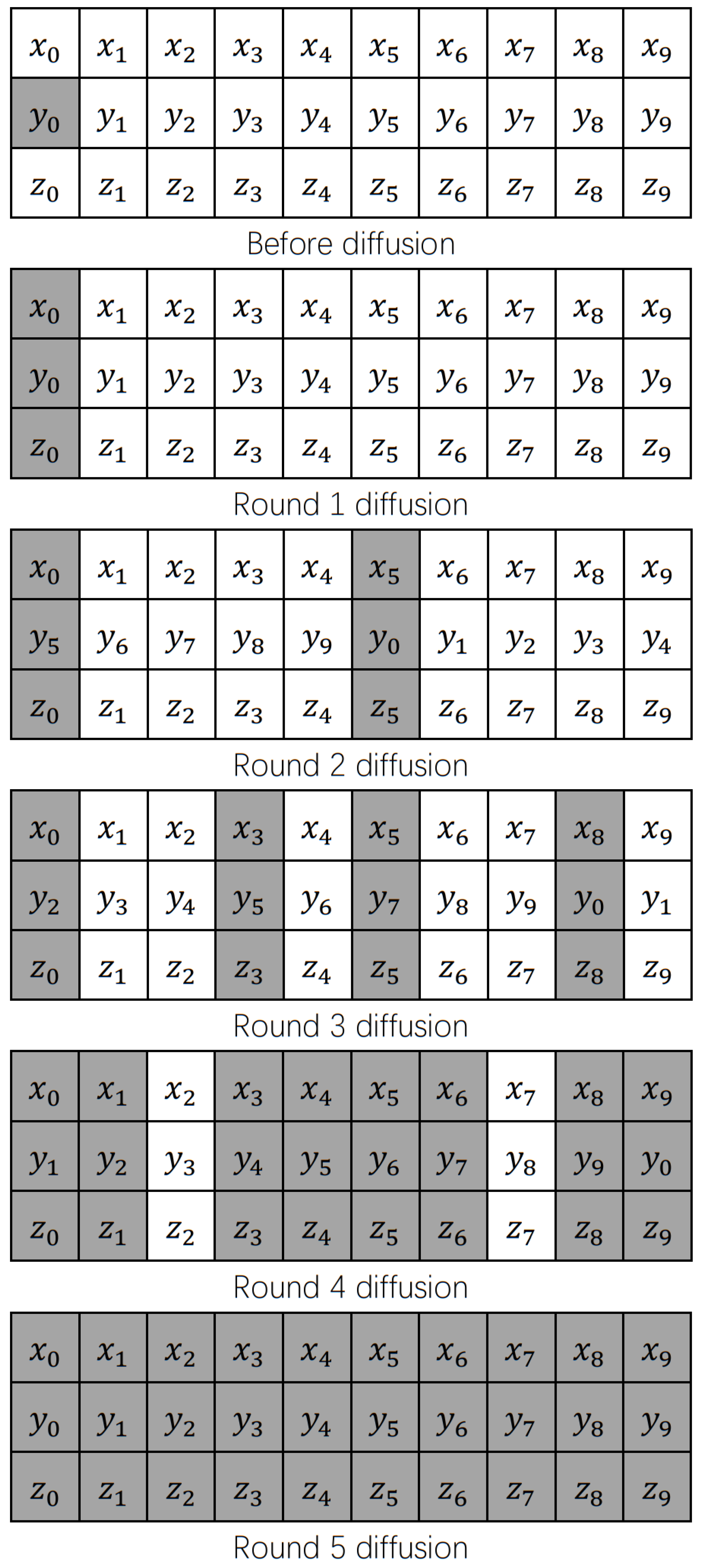
To illustrate the above steps more vividly, assuming that N = 10, round = log 2 N + 1 = 4, the change element is y 0 and Figure 5 is a diffusion diagram of the Y main diffusion sequence, it can be seen that when the y 0 changes, after round + 1 small diffusion, it will lead to the change of all elements.
Figure 5. Diffusion Schematic.
In general, the diffusion process is that the image data is divided into three groups, three rounds of diffusion; each round of diffusion selects one of X, Y or Z as the main diffusion sequence and the other two as the secondary diffusion sequence. The main diffusion vector diffuses at the same time to carry out round cycle shift, and finally realizes that the change of any element will cause all the output elements to change, which further improves the key sensitivity and plain sensitivity of the encryption algorithm in this paper.
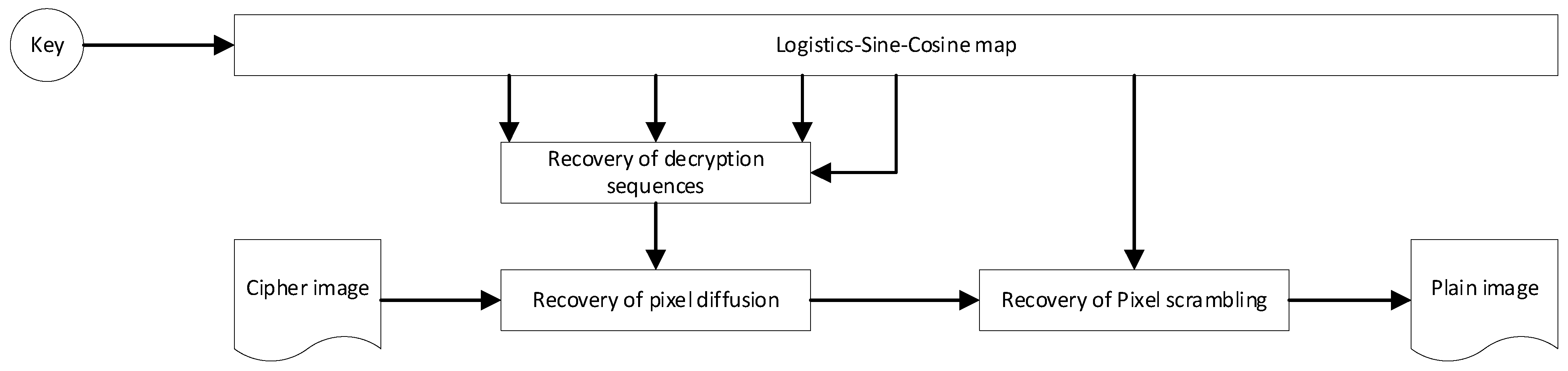
When decrypting, the reverse operation of the encryption operation on the cipher image can be performed, limited by space, and only X is given as the corresponding decryption step when the main diffusion sequence:
n = r o u n d N e w = G ( N , n ) X = F ( X , N e w ) Y = mod ( Y Z K Z , 256 ) X = mod ( X Z K Z , 256 ) Z = mod ( Z X K X , 256 ) Z = mod ( Z Y K Y , 256 ) X = mod ( X Y K Y , 256 ) Y = mod ( Y X K X , 256 ) X = F ( X , - N e w ) n = n 1 Repeat l i n e s   2 - 11   until   n > r o u n d Y = mod ( Y Z K Z , 256 ) X = mod ( X Z K Z , 256 ) Z = mod ( Z X K X , 256 ) Z = mod ( Z Y K Y , 256 ) X = mod ( X Y K Y , 256 ) Y = mod ( Y X K X , 256 )

4. Experimental and Safety Analysis

The experimental environment in this article is as follows: the hardware environment is Intel(R) Core(TM) i5-7200U CPU @ 2.50 GHz, 8.00 GB RAM. The software environment is Windows 10, Python 3.8.8.
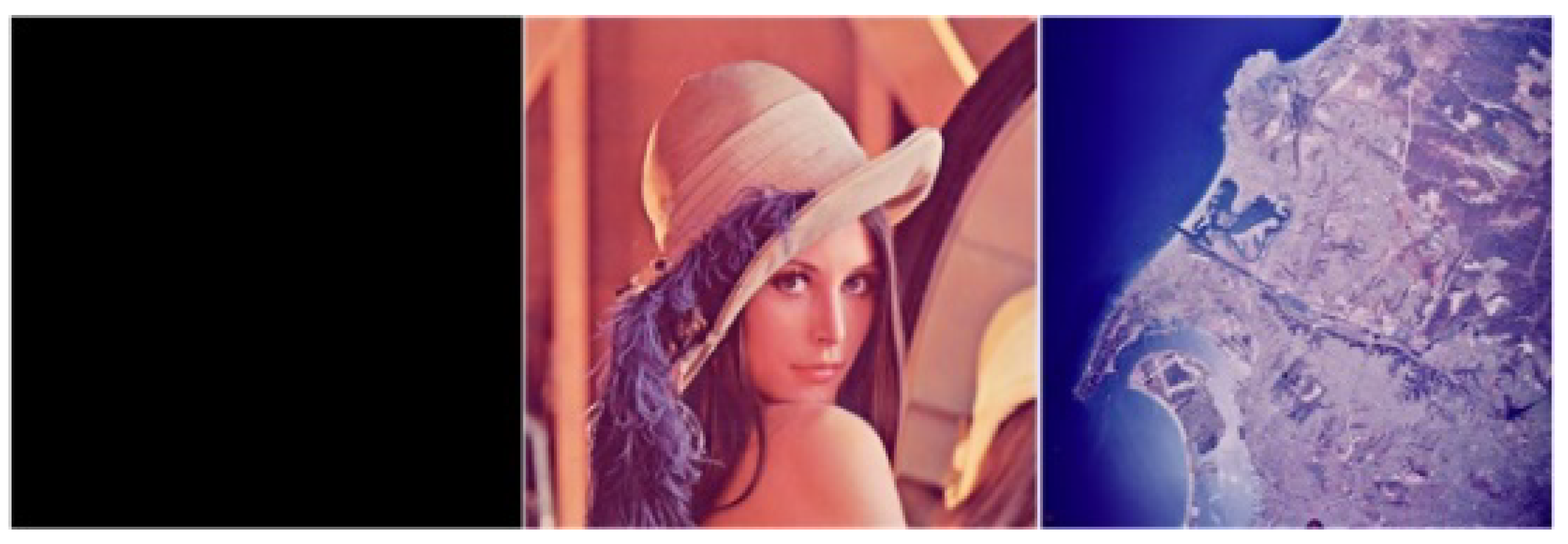
Experimental data (Figure 6): to facilitate the comparison of experimental results, color images 1024 × 1024 2.2.01, 512 × 512 Lena and special images (256 × 256 pure black images) in the public image dataset USC-SIPI “Aerials” were selected for related safety-test experiments.
Figure 6. Experimental image.

4.1. Key Randomness Analysis

The key for the encryption algorithm in this article is a 320-bit binary number generated by the random binary number generator. Therefore, 1000 keys are generated by random binary number generator, and the NIST statistical test suite is used to test the randomness of the generated keys, and the results are averaged to evaluate the randomness of the encryption algorithm keys in this paper. The test results are shown in Table 1, and in the 15 tests of the NIST statistical test, the randomly generated binary numbers all passed the test, indicating that the 320-bit binary numbers generated by the random binary number generator in this paper are of good randomness and can be used for image encryption.
Table 1. NIST statistical test results.

4.2. Key Security Analysis

The key space of the encryption algorithm in this article is 2320 > 2100, which can theoretically resist any form of brute force attack [46], and the following is further proof of the actual size of the key space.
In this paper, the number of bit change rate (NBCR) [47] is used to evaluate the key sensitivity of the algorithm.
N B C R   ( P 1 , P 2 ) = H a m   ( P 1 , P 2 ) 3 H W 8
That is the ratio of the total Hamming distance to the total number of bits.
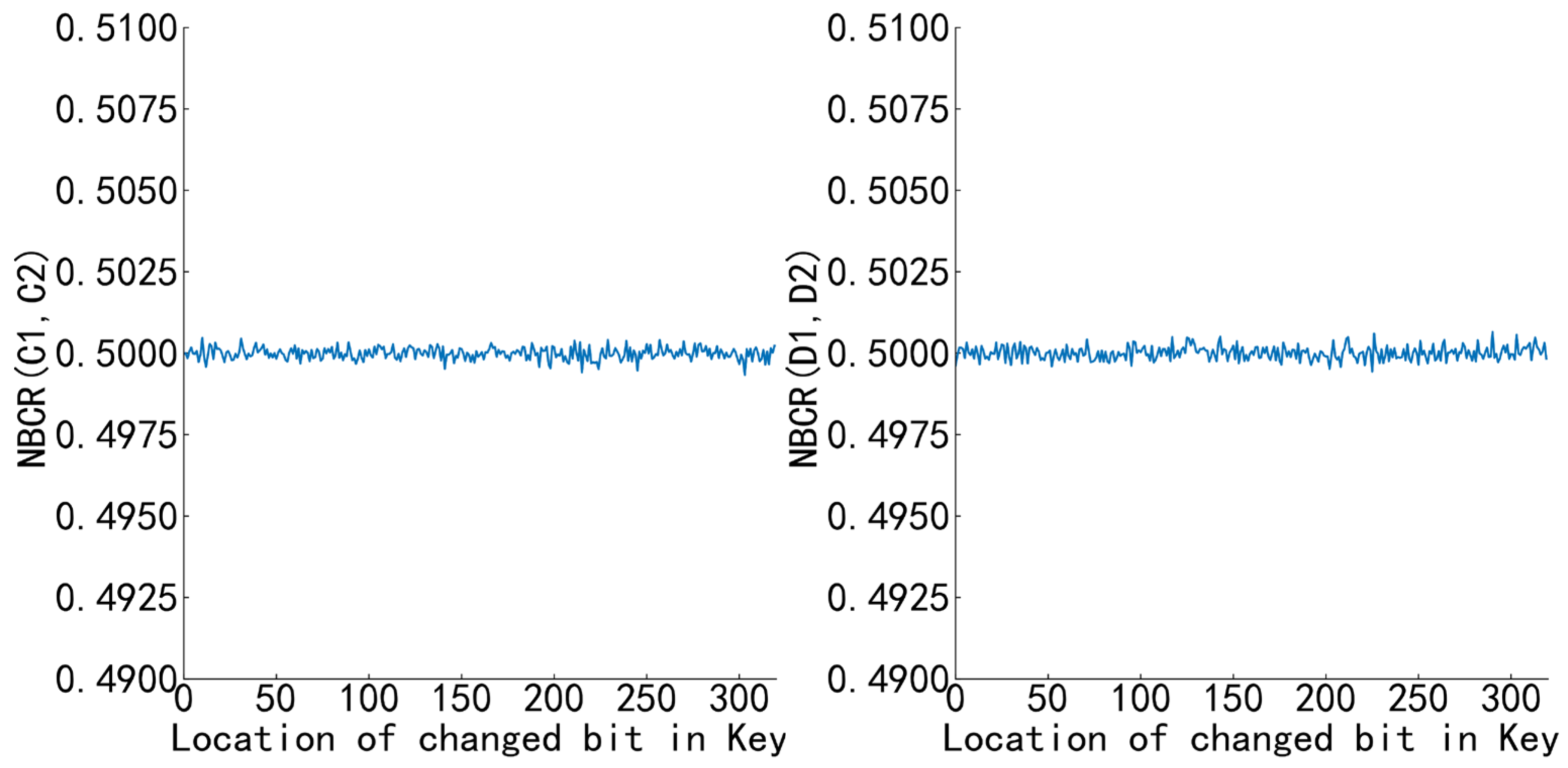
Randomly generate a 320-bit binary number key, change one bit on the basis of the original key from high bit to low bit, encrypt the plain image P with the key before and after the change, obtain two cipher images of C 1 and C 2 , and calculate the NBCR ( C 1 , C 2 ) of the two images of C 1 and C 2 , and then decrypt the cipher image with the key before and after the change C 1 to obtain the images D 1 and D 2 , and calculate the NBCR ( D 1 , D 2 ). The results are shown in Figure 7. NBCR ( C 1 , C 2 ) and NBCR ( D 1 , D 2 ) are both around 0.5 and the oscillation amplitude is extremely small, indicating that the key sensitivity of the algorithm in this paper is good, and changing any bit in the key will lead to a completely different cipher image and decryption image.
Figure 7. NBCR ( C 1 , C 2 ), NBCR ( D 1 ,   D 2 ).

4.3. Image Encryption/Decryption Experiments

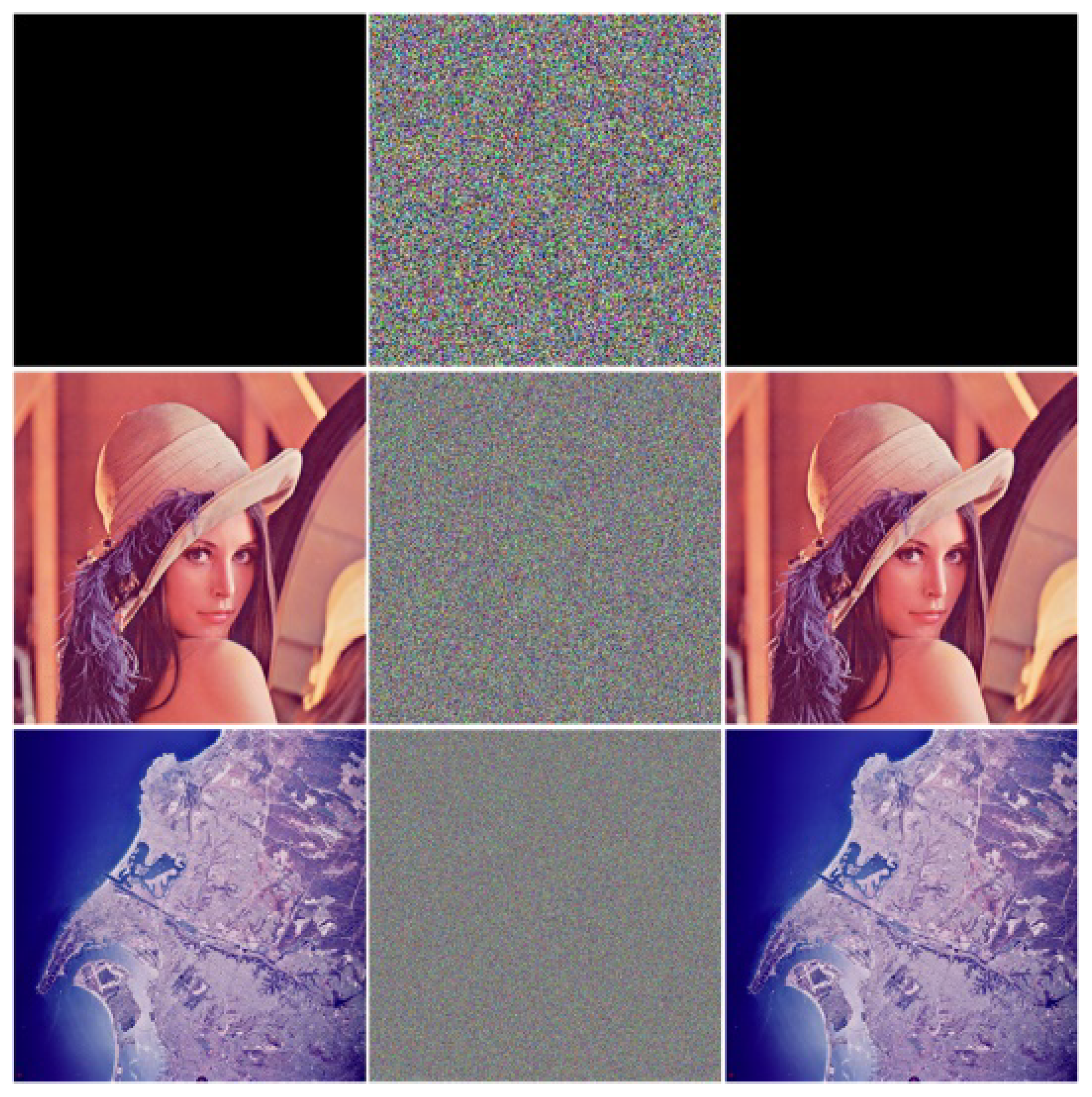
The experimental images shown in Figure 6 were encrypted 100 times, and the key was randomly generated each time, as shown in Figure 8. The results of a randomly selected experiment, algorithm time complexity and the average running time are shown in Table 2 (W and H represent the width and height of the encrypted image, respectively). It can be seen that the encryption algorithm in this paper is lossless, and the encryption time is shorter than that of the literature [42,43,44,45]. Although the proposed encryption algorithm is slightly better than the literature [42,43,44,45] in the time comparison experiment of encrypting Lena images, it can be seen that the encryption time of the proposed algorithm increases with the size of the encrypted image, and the encryption efficiency of the proposed algorithm will gradually decrease as the image size increases, and further improvement is needed.
Figure 8. Encrypt and decode.
Table 2. Time of encrypting/decrypting.

4.4. Statistical Analysis

4.4.1. Histogram Analysis

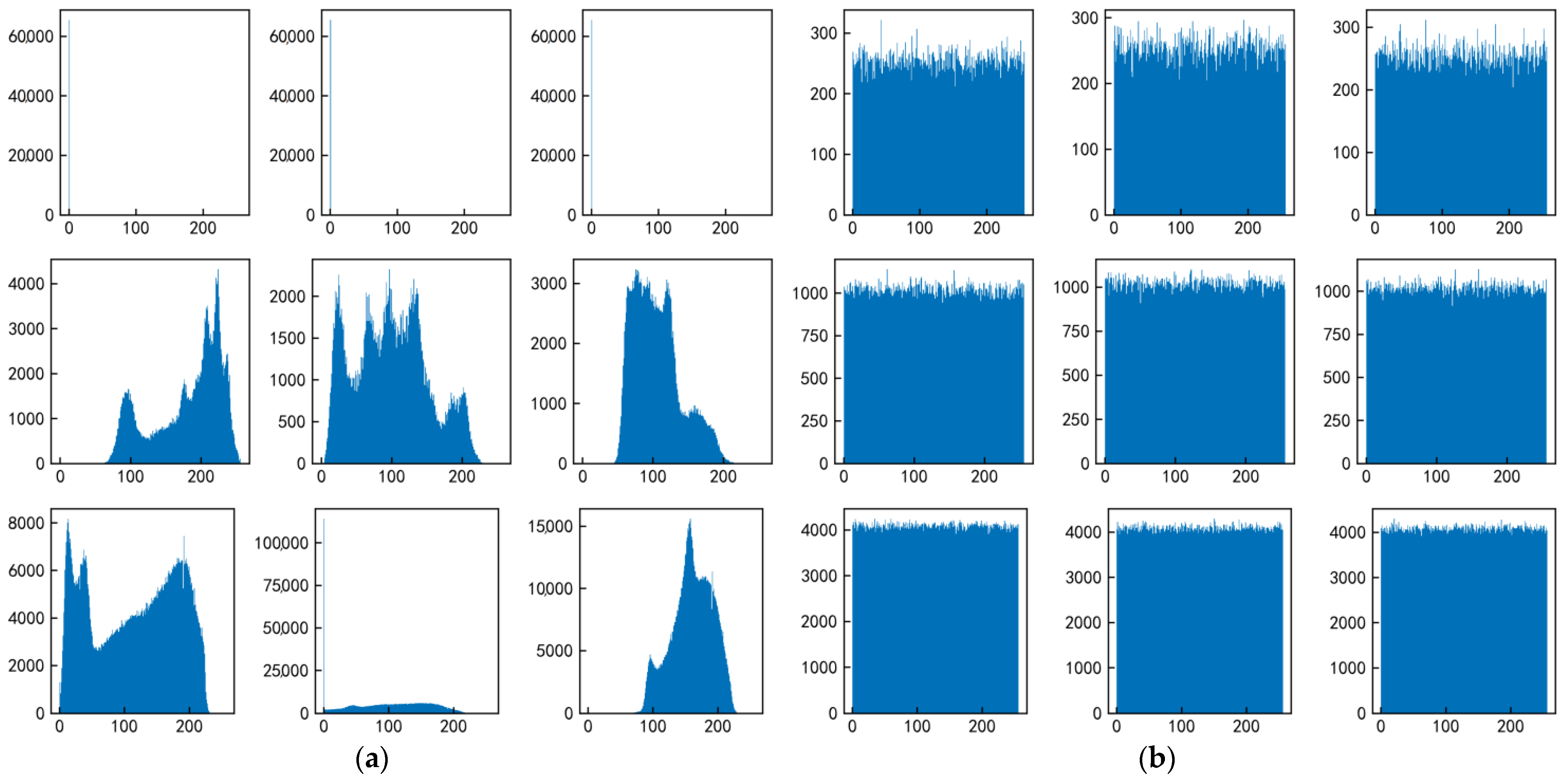
The image histogram visually reflects the distribution of gray values of the image, and an attacker can use this feature to analyze the statistical law between plain and cipher images to potentially decipher the key. For this to happen, the histogram of the cipher image must be evenly distributed and completely different from the histogram of the plain image, and the more evenly distributed, the less statistics an attacker will be able to obtain. The pixel histogram of the cipher image based on the encryption scheme in this paper is shown in Figure 9, and the pixel histogram of the cipher image is completely different from the original image and evenly distributed.
Figure 9. Pixel histogram of the encrypted image based on the encryption algorithm and key of the experimental image. (a) Histogram of plain image. (b) Histogram of cipher image.

4.4.2. Correlation Analysis

In an image, neighboring pixels are often highly correlated, and if this high correlation is not eliminated, an attacker can use this feature to predict its surrounding pixels from one pixel and eventually restore the entire plain image, so it is necessary to completely avoid statistical analysis attacks, eliminating these strong correlations. The correlation coefficient for each upward direction is calculated as follows (horizontal, vertical and diagonal):
R x y = cov ( x , y ) D ( x ) D ( y )
E ( x ) = 1 N i = 1 N x i
D ( x ) = 1 N i = 1 N ( x i E ( x ) ) 2
cov ( x , y ) = 1 N i = 1 N ( x i E ( x ) ) ( y i E ( y ) )
where x and y are two adjacent pixels, N is the total number of pixels in the image, R x y is the correlation coefficient of x, y, cov(x,y) is the covariance of x and y, D ( x ) is the standard deviation, D(x) is the variance and E(x) is the mean.
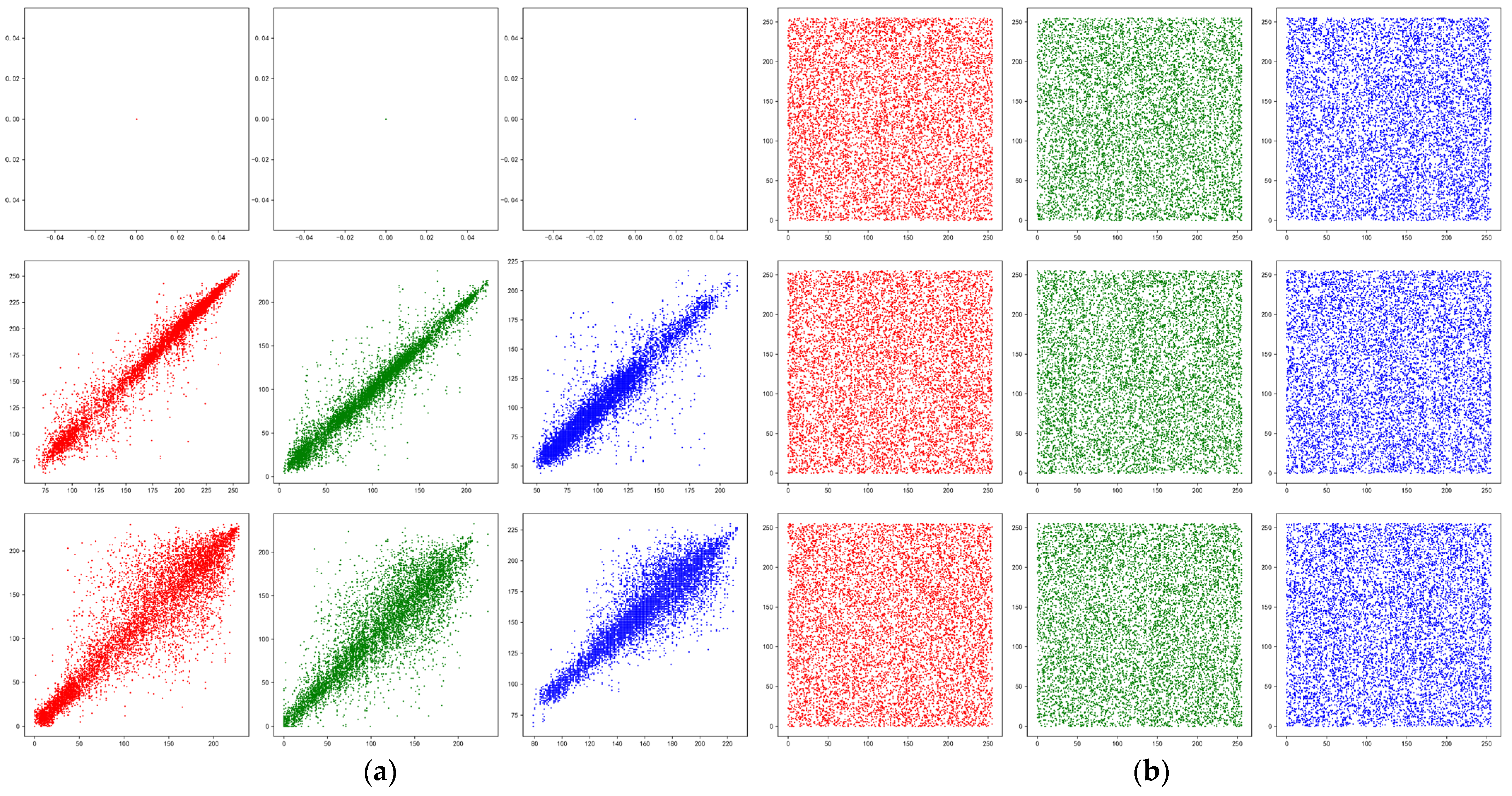
The experimental images were encrypted 100 times; each time the key was randomly generated and 3000 pairs of neighboring pixels were randomly selected. The correlations before and after encryption are shown in Figure 10, and the correlation coefficients are shown in Table 3. Most of the correlation coefficients after encryption are close to 0, indicating that the confusion and diffusion of the encryption scheme in this paper are good, which further reduces the occurrence of statistical analysis attacks, but some correlation coefficients are large, and further work is needed to optimize them.
Figure 10. Image correlation before and after encryption. (a) Plain image correlation. (b) Cipher image correlation.
Table 3. Three-channel correlation comparison between experimental image and cipher image.

4.4.3. Information Entropy Analysis

Information entropy is a quantitative measure of how random a signal source is. That is, information entropy can be used to measure the randomness of an image, which calculates the spread of pixels at each gray level for each color channel. If the uniform distribution is better, then it will be more resistant to statistical attacks. For the R, G and B channels with color image intensity between 0–255, the ideal entropy value of encrypted messages is 8; the higher the value, the more uniform the distribution. The information entropy calculation formula is as follows:
H ( x ) = i = 1 L P ( x i ) log 2 P ( x i )
where x i is the grayscale value and P( x i ) is the probability of the grayscale x i . As shown in Table 4, the three-channel information entropy of the Lena ciphertext image is slightly better than the literature [42,43,44,45], indicating that the randomness of the ciphertext image based on the encryption scheme in this paper is good.
Table 4. Comparison of information entropy of three channels before and after encryption.

4.4.4. Anti-Differential Attack Analysis

The ability to resist differential attacks is an important indicator for evaluating cryptographic algorithms. Attackers usually make minor adjustments to the plain image and then compare the differences between the cipher image produced before and after the adjustment to carry out the attack. To examine the effect of single-pixel change on the cipher image in the original image, the color map in the public image dataset USC-SIPI “Misc” was selected for the anti-differential attack analysis of the encryption scheme in this paper, and the color images of 256 × 256 and 512 × 512 correspond to the ideal pixel change rate (NPCR), and the unified average changing intensity (ACI) values are shown in Table 5 [31].
Table 5. Ideal values of NPCR and UACI for color images of different.
Keeping the key unchanged, randomly test each image 100 times, randomly select the value of any channel of one pixel each time and add 1, change the NPCR and UACI values of the cipher image before and after, as shown in Table 6, and average the results. In Table 6, all the pictures have passed the test, indicating that the proposed algorithm has good resistance to differential attacks and can effectively resist known plain-image attacks and selective plain-image attacks.
Table 6. NPCR and UACI test results.
Keeping the key unchanged, randomly test the experimental image Lena 100 times, randomly select the value of any channel of one pixel each time and add 1, change the NPCR and UACI values of the cipher image before and after, as shown in Table 7, and average the results. Compared with the literature [42,43,44,45], the NPCR and UACI of the encryption scheme in this paper are slightly higher overall. This proves that the encryption scheme in this paper has good ability to resist differential attacks.
Table 7. Comparison of NPCR and UACI for the Lena by different encryption algorithms.

4.5. Damage Resistance Analysis

4.5.1. Analysis of Noise Immunity Performance

Image noise refers to unwanted or unwanted interference information that exists in image data. In the process of image acquisition and transmission, because of the influence of image sensor material, working environment, transmission channel [48], etc., the image may be contaminated by a variety of noise, which will have a certain impact on the decryption of the terminal picture. Therefore, the ability to resist a certain intensity of salt-and-pepper-noise attacks is an indicator of the performance of image encryption algorithms. In this paper, the noise pollution in the transmission of pepper–salt noise is simulated, and different intensities of pepper–salt noise are added to the cipher image to test the noise resistance ability of the proposed algorithm.
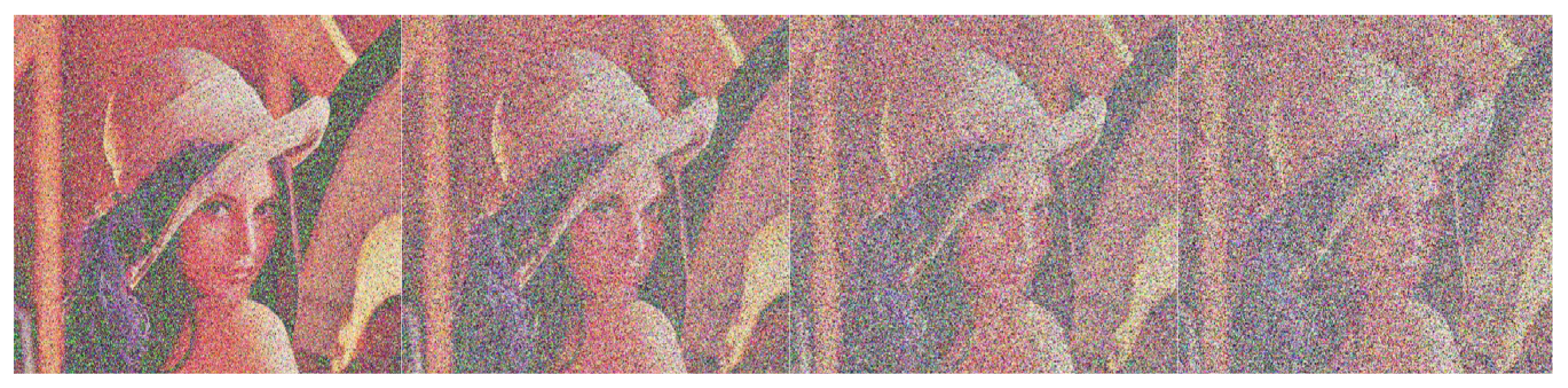
The cipher image of the test image Lena shown in Figure 8 was decrypted by adding salt-and-pepper noise with noise densities of 0.05, 0.1, 0.15 and 0.2, respectively, and the decrypted image is shown in Figure 11. It can be seen from Figure 11 that when the salt and pepper densities are 0.05 and 0.1, respectively, the decryption algorithm in this paper can basically restore the original image. When the salt density is 0.15, the restored image is blurry, but the original image can still be recognized; when the salt density is 0.2, the restored image can still recover the general outline. The experimental results show that the greater the intensity of the noise, the deeper the impact on the image, and the worse the quality of the decrypted image, but the algorithm in this paper can still distinguish the main information of the original image from the overall visual effect, indicating that the algorithm can tolerate a certain degree of noise and have strong anti-interference ability.
Figure 11. Decrypt images after different salt-and-pepper noise was added to cipher images.

4.5.2. Analysis of Shear Resistance

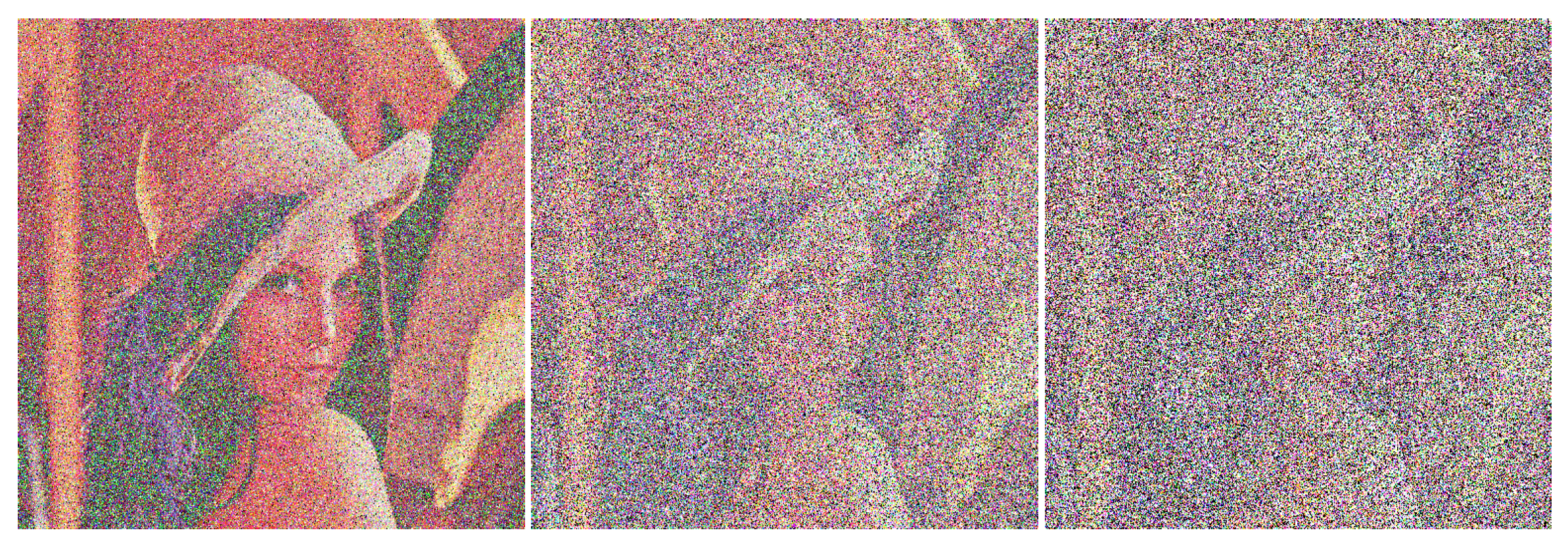
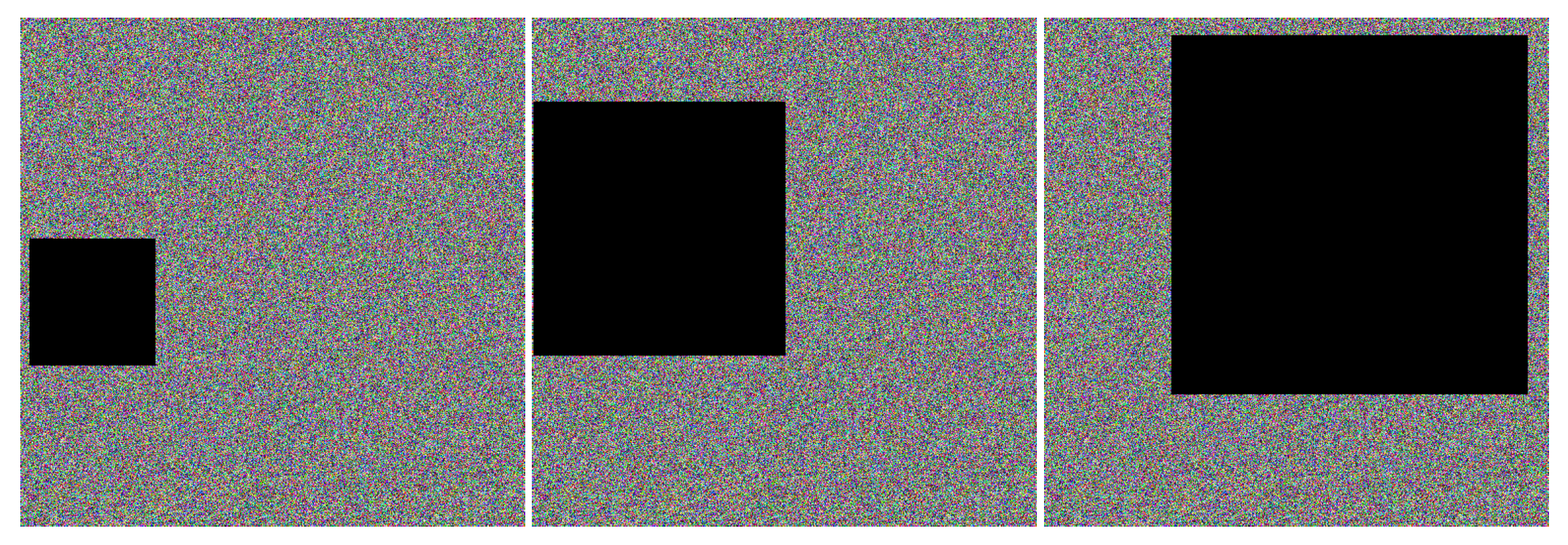
A clipping attack is an attack method that intercepts a ciphertext image during transmission and destroys or deletes part of the data [49]. The part that is usually clipped is an area in the image that has a strong correlation between pixels, and the lost information is difficult to recover. Therefore, breaking the correlation between pixels is an indicator to measure the anti-clipping performance of image encryption algorithms. If the correlation between image pixels is strong, the cipher image after the loss of information cannot provide enough valid information, and the decryption may fail. The cipher image of the test image Lena shown in Figure 8 is cut 1/16, 1/4 and 1/2 (the pixels at the clipping position are all 0, and the clipping sample is shown in Figure 12), and the decryption of the cut cipher image is obtained as shown in Figure 13. It can be seen from Figure 13 that when the cipher image is cut by 1/16, the image can basically be decrypted and restored to the original image; when cutting 1/4, the approximate image information can still be recovered after decryption; when cutting 1/2, the restored image information can see the general outline. Experimental results show that the proposed algorithm has a certain recovery ability when subjected to shear attacks, and the proposed encryption algorithm can resist shear attacks to a certain extent.
Figure 12. Sample encryption of secret image.
Figure 13. Decrypted images of cipher images cut in varying degrees.
Through a series of security experiments such as key randomness analysis, key security analysis, statistical analysis, anti-differential attack analysis and damage resistance analysis, it is proved that the encryption scheme proposed in this paper has a large key space and is a lossless color image encryption algorithm. By comparing the literature [42,43,44,45], it shows that the encryption scheme in this paper has good encryption efficiency, image information entropy, robustness and resistance to differential attacks.

5. Conclusions

Because images are vulnerable to external attacks in the process of network transmission and traditional image encryption algorithms have limitations such as long encryption time, insufficient entropy or poor diffusion of cipher image information when encrypting color images, this paper proposes a fast image encryption algorithm for logistics-sine-cosine mapping. A random binary number generator is used to generate 320-bit binary numbers as keys, and five sets of encrypted sequences are generated based on logistics-sine-cosine. Five sets of encryption sequences are used to scramble and spread the image pixels, and the color image is encrypted with small computing resources and high efficiency. A large number of color images of different resolutions and sizes were selected from the gallery and a series of security analysis experiments. Experimental results show that the encryption algorithm in this paper has a short encryption time, robustness and resistance to differential attacks, and is a safe and effective color image encryption algorithm, but it has certain limitations in correlation and needs to be further optimized. At the same time, although the proposed encryption algorithm is slightly better than the literature [42,43,44,45] in the time comparison experiment of encrypting Lena images, it can be seen that the encryption time of the proposed algorithm increases with the size of the encrypted image, and as the image size increases, the encryption efficiency of the proposed algorithm will gradually decrease, and further improvement is needed.

Author Contributions

Methodology, P.W.; Formal analysis, J.X.; Investigation, Y.W.; Writing—original draft, X.X. All authors have read and agreed to the published version of the manuscript.

Funding

This research was funded by National Natural Science Foundation of China: 61771354.

Institutional Review Board Statement

Not applicable.

Data Availability Statement

Not applicable.

Conflicts of Interest

The authors declare no conflict of interest.

References

  1. Zhang, Q.; Ding, Q. Digital image encryption based on advanced encryption standard (AES). In Proceedings of the 2015 Fifth International Conference on Instrumentation and Measurement, Computer, Communication and Control (IMCCC), Qinhuangdao, China, 18–20 September 2015; pp. 1218–1221. [Google Scholar]
  2. Murillo-Escobar, M.; Cruz-Hernández, C.; Abundiz-Pérez, F.; López-Gutiérrez, R.; Del Campo, O.A. A RGB image encryption algorithm based on total plain image characteristics and chaos. Signal Process. 2015, 109, 119–131. [Google Scholar] [CrossRef]
  3. Parvaz, R.; Zarebnia, M. A combination chaotic system and application in color image encryption. Opt. Laser Technol. 2018, 101, 30–41. [Google Scholar] [CrossRef]
  4. Liu, X.; Tong, X.; Wang, Z.; Zhang, M. A new n-dimensional conservative chaos based on Generalized Hamiltonian System and its’ applications in image encryption. Chaos Solitons Fractals 2022, 154, 111693. [Google Scholar] [CrossRef]
  5. Yang, S.; Tong, X.; Wang, Z.; Zhang, M. Efficient color image encryption algorithm based on 2D coupled chaos and multi-objective optimized S-box. Phys. Scr. 2022, 97, 045204. [Google Scholar] [CrossRef]
  6. Elkamchouchi, H.; Anton, R.; Abouelseoud, Y. New Encryption Algorithm for Secure Image Transmission Through Open Network. Wirel. Pers. Commun. 2022, 125, 45–62. [Google Scholar] [CrossRef]
  7. Liu, X.; Tong, X.; Wang, Z.; Zhang, M. A novel hyperchaotic encryption algorithm for color image utilizing DNA dynamic encoding and self-adapting permutation. Multimed. Tools Appl. 2022, 81, 21779–21810. [Google Scholar] [CrossRef]
  8. Zou, C.; Wang, X.; Zhou, C.; Xu, S.; Huang, C. A novel image encryption algorithm based on DNA strand exchange and diffusion. Appl. Math. Comput. 2022, 430, 127291. [Google Scholar] [CrossRef]
  9. Samiullah, M.; Aslam, W.; Sadiq, S.; Mehmood, A.; Choi, G.S. Hyperchaos and MD5 Based Efficient Color Image Cipher. CMC-Comput. Mater. Contin. 2022, 72, 1645–1670. [Google Scholar] [CrossRef]
  10. Yu, J.; Xie, W.; Zhong, Z.; Wang, H. Image encryption algorithm based on hyperchaotic system and a new DNA sequence operation. Chaos Solitons Fractals 2022, 162, 112456. [Google Scholar] [CrossRef]
  11. Liang, Z.; Qin, Q.; Zhou, C.; Xu, S. Color Image Encryption Algorithm Based on Four-Dimensional Multi-stable Hyper Chaotic System and DNA Strand Displacement. J. Electr. Eng. Technol. 2022, 1–21. [Google Scholar] [CrossRef]
  12. Chu, R.; Zhang, S.; Gao, X. A Novel 3D Image Encryption Based on the Chaotic System and RNA Crossover and Mutation. Front. Phys. 2022, 10, 57. [Google Scholar] [CrossRef]
  13. Lu, Y.; Gong, M.; Huang, Z.; Zhang, J.; Chai, X.; Zhou, C. Exploiting compressed sensing (CS) and RNA operations for effective content-adaptive image compression and encryption. Optik 2022, 263, 169357. [Google Scholar] [CrossRef]
  14. Ghorbani, A.; Saberikamarposhti, M.; Yadollahi, M. Using Ribonucleic acid (RNA) and Hénon map in new image encryption scheme. Optik 2022, 259, 168961. [Google Scholar] [CrossRef]
  15. Sha, Y.; Bo, S.; Yang, C.; Mou, J.; Jahanshahi, H. A Chaotic Image Encryption Scheme Based on Genetic Central Dogma and KMP Method. Int. J. Bifurc. Chaos 2022, 32, 2250186. [Google Scholar] [CrossRef]
  16. Zhang, X.; Tian, J. Multiple-image encryption algorithm based on genetic central dogma. Phys. Scr. 2022, 97, 055213. [Google Scholar] [CrossRef]
  17. Hasimoto-Beltran, R.; Calderon-Calderon, M.D.; Olavarría-Jaramillo, V.H. Secure Real-Time Chaotic Partial Encryption of Entropy-Coded Multimedia Information for Mobile Devices: Smartphones. IEEE Access 2022, 10, 15876–15890. [Google Scholar] [CrossRef]
  18. Li, X.; Mou, J.; Cao, Y.; Banerjee, S. An optical image encryption algorithm based on a fractional-order laser hyperchaotic system. Int. J. Bifurc. Chaos 2022, 32, 2250035. [Google Scholar] [CrossRef]
  19. Kumar, P.; Nishchal, N.K.; AlFalou, A. Controllable Optical Vortex Array for Image Encoding. IEEE Photonics Technol. Lett. 2022, 34, 521–524. [Google Scholar] [CrossRef]
  20. Chen, W. Spatial nonlinear optics for securing information. Light Sci. Appl. 2022, 11, 11. [Google Scholar] [CrossRef]
  21. Cheremkhin, P.; Evtikhiev, N.; Krasnov, V.; Ryabcev, I.; Shifrina, A.; Starikov, R. Lensless Optical Encryption of Multilevel Digital Data Containers Using Spatially Incoherent Illumination. Appl. Sci. 2021, 12, 406. [Google Scholar] [CrossRef]
  22. Kumar, P.; Nishchal, N.K.; Omatsu, T.; Rao, A.S. Optical vortex array for two-dimensional exclusive-OR operation. Appl. Phys. B 2022, 128, 98. [Google Scholar] [CrossRef]
  23. Chen, T.H.; Li, K.C. Multi-image encryption by circular random grids. Inf. Sci. 2012, 189, 255–265. [Google Scholar] [CrossRef]
  24. Chen, T.H.; Tsao, K.H.; Lee, Y.S. Yet another multiple-image encryption by rotating random grids. Signal Process. 2012, 92, 2229–2237. [Google Scholar] [CrossRef]
  25. De Prisco, R.; De Santis, A. On the relation of random grid and deterministic visual cryptography. IEEE Trans. Inf. Secur. 2014, 9, 653–665. [Google Scholar] [CrossRef]
  26. Lin, C.H.; Chen, T.H.; Wu, C.S. A batch image encryption scheme based on chaining random grids. Sci. Iran. 2013, 20, 670–681. [Google Scholar]
  27. Shyu, S.J.; Chen, K. Visual multiple-secret sharing by circle random grids. SIAM J. Imaging Sci. 2010, 3, 926–953. [Google Scholar] [CrossRef]
  28. Cheng, G.; Wang, C.; Chen, H. A novel color image encryption algorithm based on hyperchaotic system and permutation-diffusion architecture. Int. J. Bifurc. Chaos 2019, 29, 1950115. [Google Scholar] [CrossRef]
  29. Xiong, Z.; Wu, Y.; Ye, C.; Zhang, X.; Xu, F. Color image chaos encryption algorithm combining CRC and nine palace map. Multimed. Tools Appl. 2019, 78, 31035–31055. [Google Scholar] [CrossRef]
  30. Chai, X.; Fu, X.; Gan, Z.; Lu, Y.; Chen, Y. A color image cryptosystem based on dynamic DNA encryption and chaos. Signal Process. 2018, 155, 44–62. [Google Scholar] [CrossRef]
  31. Fei, X.; Zhang, J.; Qin, W. Design a new image encryption algorithm based on a 2D-ASCC map. Phys. Scr. 2022, 97, 125206. [Google Scholar] [CrossRef]
  32. Hoang, T.M. A novel design of multiple image encryption using perturbed chaotic map. Multimed. Tools Appl. 2022, 81, 26535–26589. [Google Scholar] [CrossRef]
  33. Sridevi, A.; Sivaraman, R.; Balasubramaniam, V.; Sreenithi; Siva, J.; Thanikaiselvan, V.; Rengarajan, A. On Chaos based duo confusion duo diffusion for colour images. Multimed. Tools Appl. 2022, 81, 16987–17014. [Google Scholar] [CrossRef]
  34. Pour, N.R.; Yaghoobi, M. A new method in encryption of gray scale images using chaos game representation. Multimed. Tools Appl. 2022, 81, 29653–29672. [Google Scholar] [CrossRef]
  35. Zhang, Z.; Tang, J.; Zhang, F.; Ni, H.; Chen, J.; Huang, Z. Color image encryption using 2d sine-cosine coupling map. IEEE Access 2022, 10, 67669–67685. [Google Scholar] [CrossRef]
  36. Su, Y.; Wang, X.; Lin, S. An image encryption algorithm based on spatiotemporal chaos and middle order traversal of a binary tree. Chin. Phys. B 2022, 31, 110503. [Google Scholar] [CrossRef]
  37. Zhang, Y.; He, Y.; Liu, X. Multiple Digital Image Encryption Algorithm Based on Chaos Algorithm. Mob. Netw. Appl. 2022, 27, 1349–1358. [Google Scholar] [CrossRef]
  38. Li, X.; Yu, C.; Guo, J. Multi-Image Encryption Method via Computational Integral Imaging Algorithm. Entropy 2022, 24, 996. [Google Scholar] [CrossRef]
  39. Song, W.; Fu, C.; Zheng, Y.; Cao, L.; Tie, M.; Sham, C.-W. Protection of image ROI using chaos-based encryption and DCNN-based object detection. Neural Comput. Appl. 2022, 34, 5743–5756. [Google Scholar] [CrossRef]
  40. Yu, X.L.; Ma, M.M.; Xiao, J.J.; Sun, Y.Q.; Li, X.F.; Jiang, P.; Wang, K.W. Scattering-medium-based optical image encryption by chaos and digital optical phase conjugation. J. Mod. Opt. 2022, 69, 1006–1015. [Google Scholar] [CrossRef]
  41. Tsafack, N.; Sankar, S.; Abd-El-Atty, B.; Kengne, J.; Jithin, K.C.; Belazi, A.; Mehmood, I.; Bashir, A.K.; Song, O.-Y.; El-Latif, A.A.A. A new chaotic map with dynamic analysis and encryption application in internet of health things. IEEE Access 2020, 8, 137731–137744. [Google Scholar] [CrossRef]
  42. Hosny, K.M.; Kamal, S.T.; Darwish, M.M. A novel color image encryption based on fractional shifted Gegenbauer moments and 2D logistic-sine map. Vis. Comput. 2022, 1–18. [Google Scholar] [CrossRef]
  43. Wang, X.; Su, Y.; Liu, L.; Zhang, H.; Di, S. Color image encryption algorithm based on Fisher-Yates scrambling and DNA subsequence operation. Vis. Comput. 2021, 1–16. [Google Scholar] [CrossRef]
  44. Dou, Y.; Liu, X.; Fan, H.; Li, M. Cryptanalysis of a DNA and chaos based image encryption algorithm. Optik 2017, 145, 456–464. [Google Scholar] [CrossRef]
  45. Hu, T.; Liu, Y.; Gong, L.-H.; Ouyang, C.-J. An image encryption scheme combining chaos with cycle operation for DNA sequences. Nonlinear Dyn. 2017, 87, 51–66. [Google Scholar] [CrossRef]
  46. Alvarez, G.; Li, S. Some basic cryptographic requirements for chaos-based cryptosystems. Int. J. Bifurc. Chaos 2006, 16, 2129–2151. [Google Scholar] [CrossRef]
  47. Castro, J.C.H.; Sierra, J.M.; Seznec, A.; Izquierdo, A.; Ribagorda, A. The strict avalanche criterion randomness test. Math. Comput. Simul. 2005, 68, 1–7. [Google Scholar] [CrossRef]
  48. Adeel, M.; Song, Y. Secure Encryption of Color Images with Chaotic Systems and Particle Swarm Optimization. Iran. J. Sci. Technol. Trans. Electr. Eng. 2022, 46, 847–872. [Google Scholar] [CrossRef]
  49. Basha, S.M.; Mathivanan, P.; Ganesh, A.B. Bit level color image encryption using Logistic-Sine-Tent-Chebyshev (LSTC) map. Optik 2022, 259, 168956. [Google Scholar] [CrossRef]
Publisher’s Note: MDPI stays neutral with regard to jurisdictional claims in published maps and institutional affiliations.

Article Metrics

Citations

Article Access Statistics

Multiple requests from the same IP address are counted as one view.