You are currently viewing a new version of our website. To view the old version click .
Sensors
  • Article
  • Open Access

13 October 2022

Comparison of Representative Microservices Technologies in Terms of Performance for Use for Projects Based on Sensor Networks


,
,
,
and
1
Department of Microelectronic and Computer Science, Lodz University of Technology, ul. Wólczańska 221, 90–924 Łódź, Poland
2
Department of Semiconductor and Optoelectronic Devices, Lodz University of Technology, ul. Wólczańska 211/215, 90-924 Łódź, Poland
3
Department of Computer Aided Design Systems, Lviv Polytechnic National University, Mytropolyta Andreya St., 79013 Lviv, Ukraine
*
Author to whom correspondence should be addressed.
This article belongs to the Special Issue Wireless Communication Systems: Prospects and Challenges

Abstract

Reading and analyzing data from sensors are crucial in many areas of life. IoT concepts and related issues are becoming more and more popular, but before we can process data and draw conclusions, we need to think about how to design an application. The most popular solutions today are microservices and monolithic architecture. In addition to this choice, there is also the question of the technology in which you will work. There are more and more of them on the market and in each of them it is practically possible to achieve similar results, but the difference lies in how quickly it will be possible and whether the approach invented will turn out to be the most optimal. Making the right decisions at the beginning of application development can determine its path to success or failure. The main goal of this article was to compare technologies used in applications based on microservice architecture. The preparation of a book lending system, whose server part was implemented in three different versions, each using a different type of technology, helped to achieve this goal. The compared solutions were: Spring Boot, Micronaut and Quarkus. The reason for this research was to investigate projects using sensor networks, ranging from telemedicine applications to extensive sensor networks collecting scientific data, or working in an environment with limited resources, e.g., with BLE or WIFI transmitters, where it is critical to supply energy to these transmitters. Therefore, the issue of efficiency and hence energy savings may be a key issue depending on the selected programming technology.

1. Introduction

One of the most important tasks before starting work on a project is to create an appropriate application architecture. The discussed issue has an impact on the functioning of the enterprise, the pace of changes, and security, among others. The consequences of this choice can be felt in everyday work, and changing the approach would involve long and costly changes that would cause a lot of problems and would slow down the development of applications from a business point of view.
In our department, we run many projects based on sensors or sensor networks. These include sensor network projects collecting data from complex high energy physics projects and large rotor machine endurance testing projects. Research related to smart clothing and telemedicine is also carried out. So far, in many situations, applications created by our teams have been executed in various programming technologies. Sometimes it was due to the technology being imposed by the project partner and sometimes simply because the language was better known or preferred in a given team. In addition to the general knowledge and experience of our programmers, which generally gave the knowledge of the best choice of programming technology, we found that this was a further field for optimization. This was especially so, since in some projects the processing time and communication speed could and did have a critical importance. For example, if data collected from sensors placed on the patient’s body sent data to a device and the device had to make a decision based on this analysis, time was of the essence. The delay in this case could mean the patient’s fall. In another project, the data collected using information from BLE beacons and WiFi transmitters, apart from the fact that they should be processed relatively quickly, additionally, due to the difficulties with powering sensors and beacons, it was crucial to minimize energy consumption, so it was necessary to reduce the transmission time. Yet in another project, due to problems with power supply in the form of a battery, it was necessary to reduce energy consumption in general, so it was necessary to optimize resource consumption, processing times, etc. so that the control process itself consumed as little of such valuable energy as possible. Therefore, although the problem of performance is known among other studies and other teams, the research they conducted did not prove useful to us. The tests that were planned and carried out by us have been tailored to our needs, including, among others, database operations. In the following, we refer to the state of art, pointing to possible gaps in the research conducted for our needs, without in any way detracting from the achievements of other scientists. We just needed something else.

3. Architecture

Many well-known companies have moved from monolithic architecture to microservices. One of the more famous examples is Netflix. The streaming service is connected to thousands of microservices and data store instances on AWS (Amazon Web Services) to serve millions of users around the world. The system is under heavy load due to tens of millions of real-time mutations, replicated globally, per second [49] and it still appears to be reliable.

3.1. Monolith

The term monolith refers to systems that are designed as single deployment units. Most often they have only one database, which is shared by all services. In theory, the biggest advantages of such architecture include its simplicity and accessibility. This approach does not require thinking about the division of services and functionalities, because everything takes place within one application. Unfortunately, in the case of an error occurring when even one service is called, the whole application usually stops working and finding the cause itself is often problematic. In such a central system, one technology is used and for some functionalities it is simply not advisable and in another one the given demand could be executed much faster and more efficiently. It is this lack of flexible approach to change and low scalability that are among the biggest arguments against this solution. The monolith is difficult to scale due to irregular consumption of different services deployed on a single application. When there is demand for highly consumed services, additional infrastructure is needed for the entire application, regardless of the increase in consumption of services. For this reason, sometimes server resources are wasted on unused services [50].

3.2. Microservices

The term microservices describes an approach to software development that decomposes business domain models into smaller and consistent services. An application consists of multiple modules and each module is responsible for a single functionality. Microservices are separate and fully autonomous components that communicate with each other to form a coherent whole. Usually, a separate team is responsible for the implementation of one such service. Such an approach enables independence in system development and does not impose the technology when implementing a given service [49].
Advantages:
  • Scalability;
  • Freedom of technology choice;
  • Code quality;
  • Stability;
  • Shortening the production cycle.
Disadvantages:
  • No transactivity;
  • Challenging design of architecture;
  • Unprofitable in small projects.

3.2.1. Compared Technologies

In our study, we took the most popular, in our opinion, microservice technologies. We briefly outline them in the following sections.

3.2.2. Spring Boot

When discussing the first technology, Spring Boot, it is important to mention Spring itself. It is a popular, open-source, JVM-based framework for creating standalone, production-grade applications [51]. Its creators tried to solve the problems appearing in Java Enterprise Edition (JEE). The initial versions were clumsy and the application development itself was not an easy or pleasant task. The solutions used in JEE were complex and not easy to configure. The goal of the developers was to create an accessible product for everyone and that is why they decided to provide default configurations at the start, which made the work much easier. One of the most important advantages of Spring is their own IoC container, which is responsible for creating, managing and configuring bean objects. It manages the entire life cycle from the new operator to the finalize method. The IoC abbreviation refers to the Inversion of Control pattern, which in practice means the transfer of responsibility for object creation to the Spring container. Referring to the topic, Spring Boot is a tool that makes developing web application and microservices with the Spring Framework faster and easier [52].

3.2.3. Micronaut

It is a JVM-based technology that was created in 2018 and its creators are the people responsible for creating Grails. Micronaut is a modern framework for building modular and easily testable microservice applications. The supported programming languages are Java, Kotlin and Groovy [53].
The biggest differences between the Spring Boot and Micronaut include the method of bean creation. In Spring, during startup, classes with appropriate annotations are scanned, from which beans are then created. The described process is not the fastest one, because it is based on reflection. In Micronaut, a different approach was chosen. An annotation processor was used, which takes care of these issues at the compilation level. The consequence of such action is a shorter application startup time.
Micronaut was designed in such a way that it harmonizes with cloud solutions. It has built-in integration components for GCP (Google Cloud Platform) and AWS as well as for Kubernetes. Thanks to fast startup time and dependency injection during compilation, Micronaut is very well suited for serverless environments. Spring Boot suffers a bit more in this area because it uses more memory and takes more time than Micronaut, and the application customization itself is more difficult and requires more attention.

3.2.4. Quarkus

RedHat is responsible for creating this technology and its first version was released in 2018. Quarkus was developed to work with the GraalVM universal virtual machine, but it is also possible to work with the JVM. The supported programming languages are Java and Kotlin. Quarkus does not use reflection, but injects dependencies at compile time. Thanks to that, the application starts up comparably as fast as Micronaut, and on native images startup times drop to the millisecond level. The presented technology was based on the Container First concept. It was created to have the best possible results in such categories as: memory consumption, runtime and docker image size. Such features have allowed it to become an effective platform for serverless, cloud and Kubernetes environments [54].

3.3. Popularity

The popularity of a given technology is worth noting, because when choosing technological solutions, the support of the community and the developers’ plans for the future should also be taken into account. The greater the popularity, the greater the chance that the authors of the project will develop it further. Another noteworthy factor is the fact that in case of encountering problems while programming, it is much easier to find help on the internet for technologies with a large number of supporters.

Github

When comparing the popularity of the analyzed technologies, it is worth looking at their code repositories on Github. The service provides the possibility to mark a given repository with a star, which means that a given user considers it noteworthy and is satisfied with the content provided.
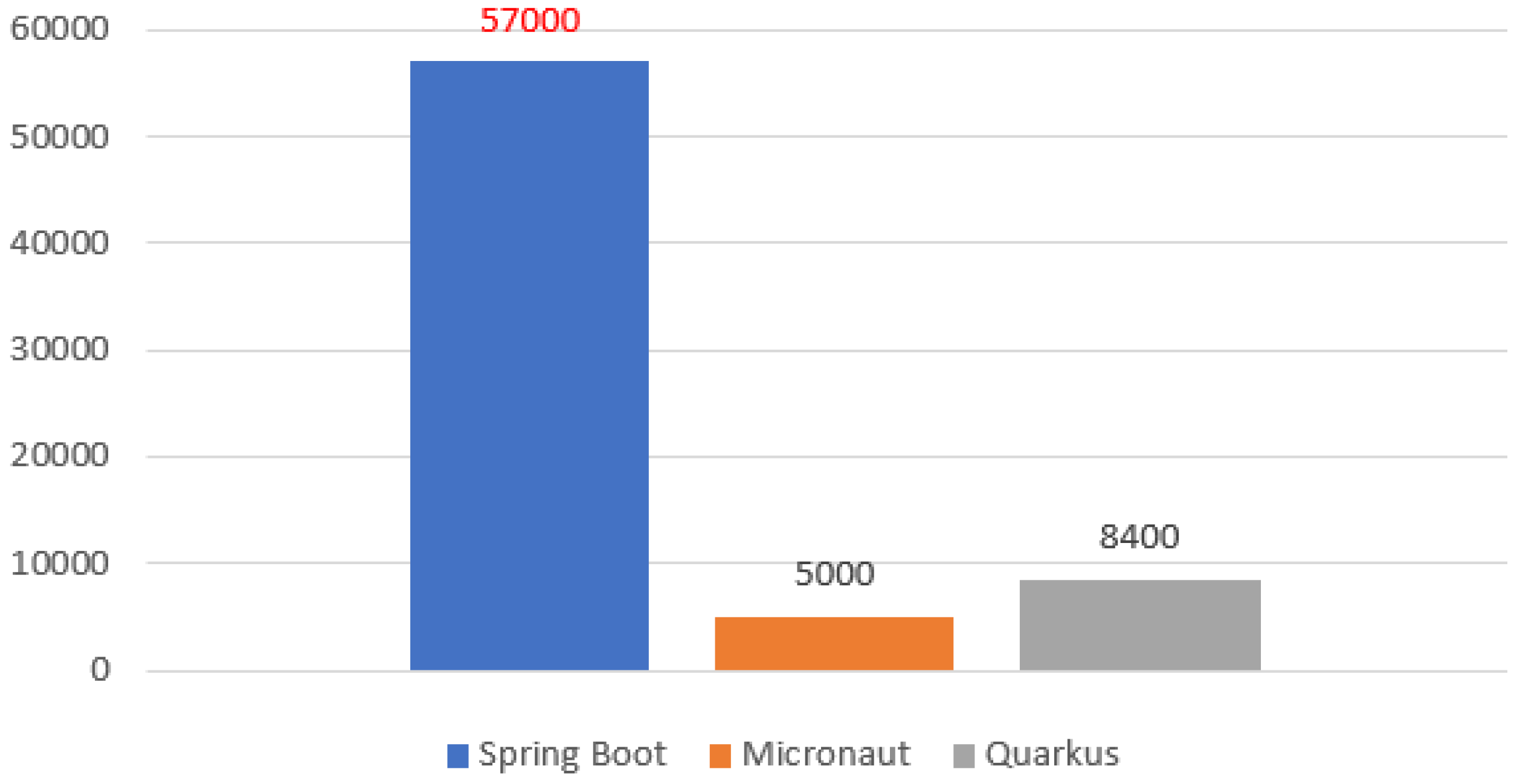
Spring Boot has about 57,000 such ratings, Micronaut 5000, and Quarkus 8400 (Figure 1). These results confirm that the product from Spring is the most popular, which cannot be a surprise since it has definitely been on the market longer. As for Micronaut and Quarkus, they are newer offerings; Quarkus came a little later, and you can see that it is already more popular than Micronaut by more than 50%.
Figure 1. Popularity on Github.
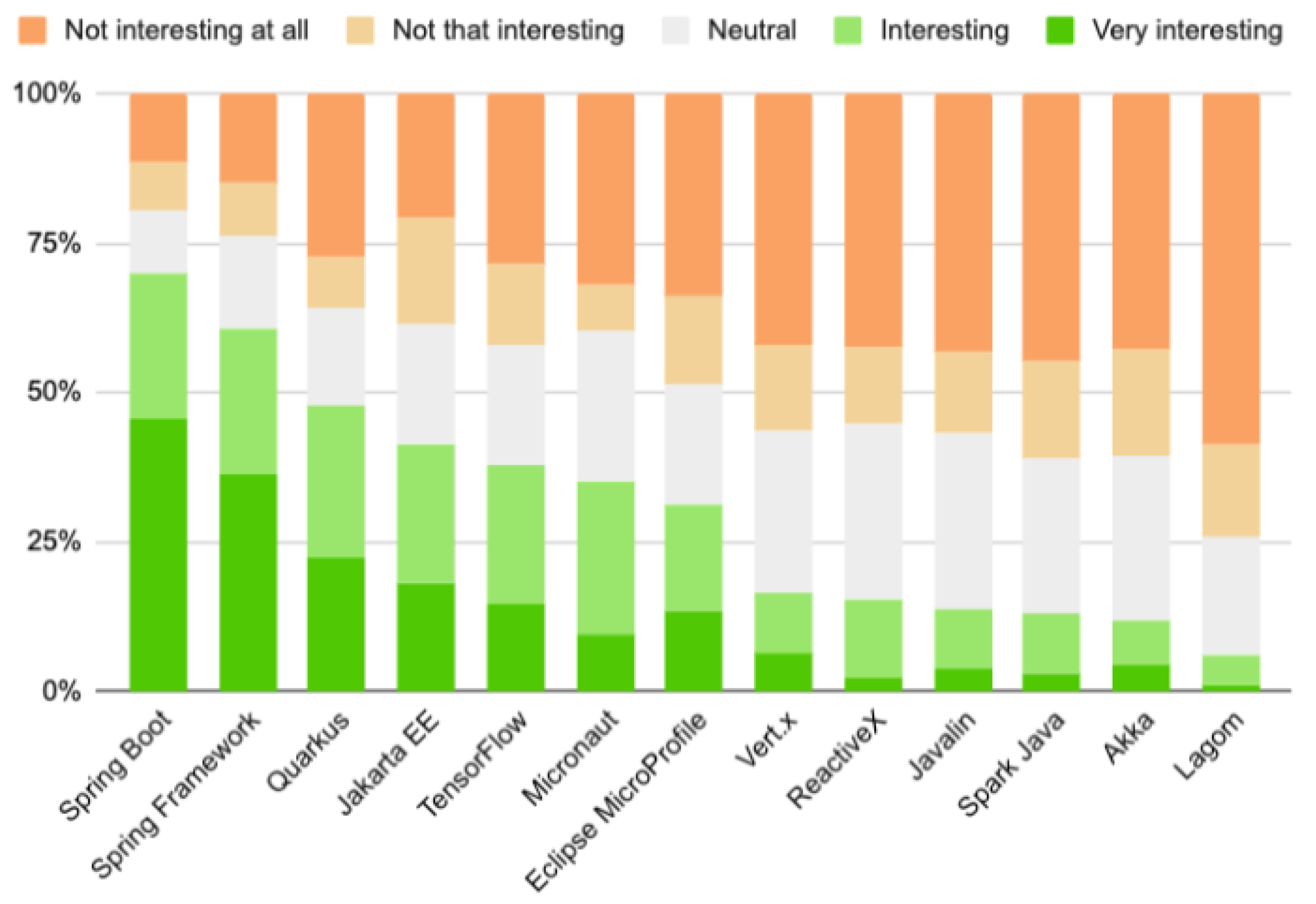
An interesting comparison was presented by the JAXenter portal [55], which in 2020 conducted a survey on popular technologies used for application development. Participants could indicate their attitude towards each of them on a scale from not interesting at all through to neutral and to very interesting.
Also in this comparison Spring Boot definitely wins, but again the result of Quarkus is worth noting. Despite the fact that it was created only in 2018, it already managed to take the third place. For 22% of respondents, it was very interesting, and for 25%, it was at least interesting. Micronaut, on the other hand, ranked in the middle (Figure 2).
Figure 2. Results of a survey conducted by JAXenter [55].

4. Materials and Methods

Spring Boot (v. 2.3.10), Micronaut (v. 2.1.1) and Quarkus (v. 1.13.4) were tested for performance, stability and resource requirements. To test performance, three applications were developed that were as similar as possible. The projects were generated from the developers’ websites with only those dependencies that were necessary. The application itself was very simple. It consisted of a controller, a service and a class-containing bean configuration. The prepared service tests were written using RestAssuredMvc library, which allowed us to test API calls. This application will be called “First type app” in this article. One of the most important aspects of running the application in production is its stability, and to establish this stability, the three applications were implemented as a book rental service, which were based on a microservices architecture. That will be the “Second type app”.
The comparison was made under repeatable and identical conditions. In order to ensure real results, the tests were repeated serially, and the number of series was selected based on experience. So, for some tests, 5 was enough, and for others, as much as 1000 units. To increase the readability of the experiment, we first presented which tests were taken into account, and only later the results themselves, summarized in the form of graphs and with appropriate comments.
In our research work, equipment with the given specification was used. The presented tests took place on a laptop Lenovo Legion 5 15ARH05, whose parameters are as follows:
  • CPU: AMD Ryzen™ 5 4600H 3.0–4.0 GHz;
  • RAM: 16 GB;
  • GPU: NVIDIA® GeForce GTX™ 1650 + AMD Radeon™ Graphics;
  • Drive: 512 GB SSD;
  • OS: Windows 10 Home Edition.
Due to the prior analysis of the performance needs of our projects, only some aspects affecting performance were tested. These are the aspects that constitute a bottleneck or a potential field for optimization of the final application.
Due to the convenience and speed of development and deployment, we also took the compilation time into account.
The results obtained were the arithmetic average of five attempts for “First type app” The mvn clean compile command was used to compile.
Due to the specificity of the results, also for the remaining tests, we did not subject the obtained results to a special statistical evaluation, but only used the arithmetic mean. In our opinion, this is completely sufficient to obtain knowledge about the goal set at the beginning of the research. Entering complex and elaborate statistics would be an artificial activity.
Testing plays a very important role in our projects. In many situations, we cannot afford to run tests after the final application has been deployed.
Therefore, an important aspect that we took into account due to frequent changes in the application environment was the testing time.
The tests were written using RestAssuredMvc and checked the returned value, which was a simple String test. The presented result is the average of five trials for the “First type app”.
Due to possible restarts of the implemented system, sometimes the time of starting the application is of key importance. The result of the test is an average time needed to start the “First type app”, based on five attempts.
In all or almost all our projects, the applications work with the database. The time, efficiency of basic database operations is of great importance for the overall data processing and obtaining the appropriate system decisions. The result of the test is an average time needed to start the “First type app”, based on five attempts.
Therefore, the performance of save and read operations from the database was analyzed. Due to the high speed of the read operation, it was necessary to increase the number of cycles in order to obtain measurable results that could be compared.
For the “Save” operation, the result is the average of three attempts to add 1000 identical records to the database, and empty the BOOKS table.
On the other hand for the “Read” operation, the result of the test is an average time needed to read 10,000 identical records from the BOOKS table, based on three attempts.
Application stability is a very important aspect. Therefore, it is important to choose the technology with the greatest certainty of stability. For the same reason, C++ based systems do not fly into space.
Stability tests were conducted for the “Second type app”, using the popular tool Gatling. It allowed us to introduce an actor model oriented towards sending requests instead of creating threads and thus generating more workloads. One of its biggest advantages is the ability to create or record test scenarios. The test scenario used to check the application overload was recorded while using the developed library and included routine user actions, such as displaying data from the database.
Each technology was tested under identical initial conditions, where the number of actors was 50 and the database had, respectively, 500 users, 1000 reservations and 2000 books.
For each application, tests were performed to find the threshold of first errors.
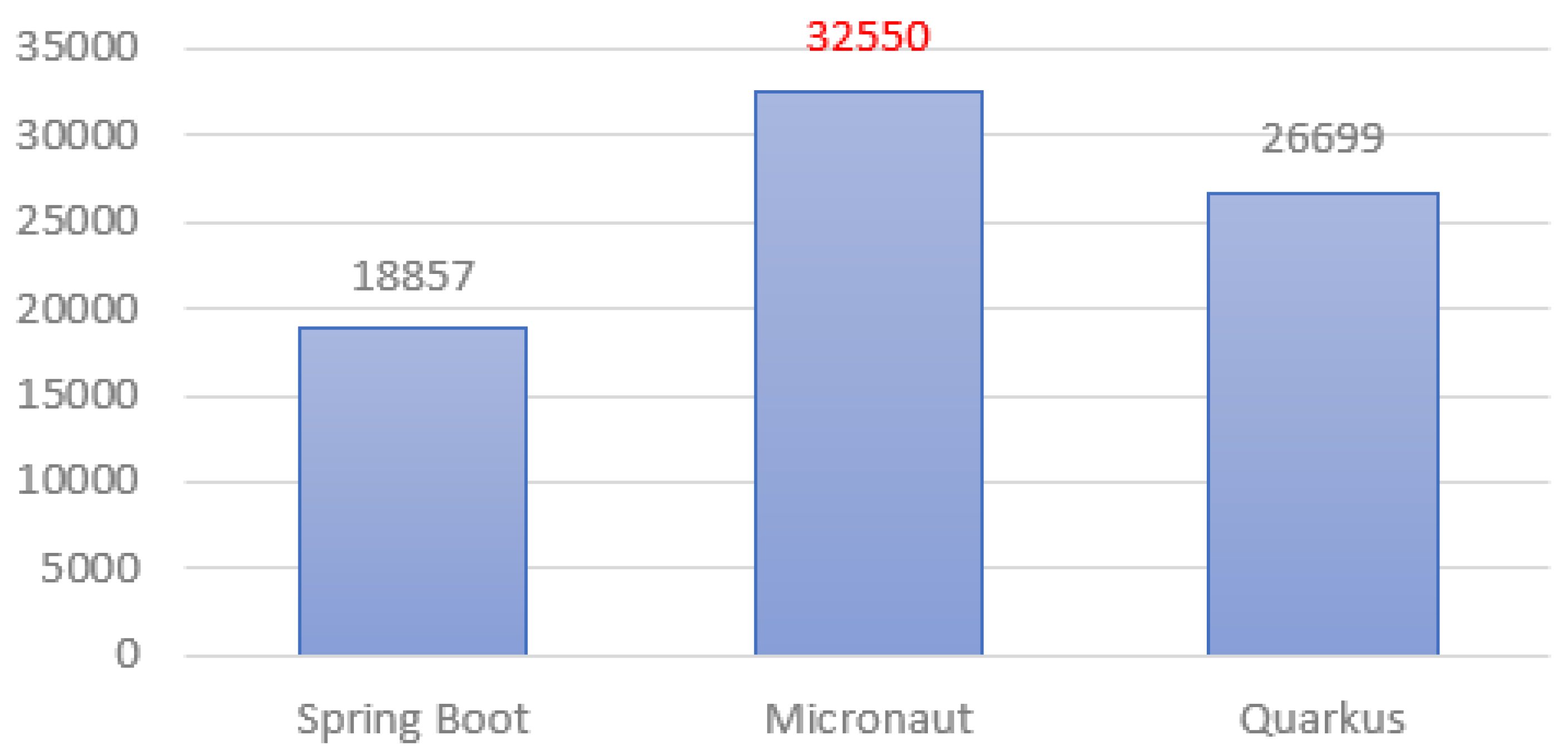
A very important factor in our projects is the high volume of received data. Therefore, in the study, we took into account requests per second. For this kind of testing Apache Benchmark was used, which tested the exposed API with huge amounts of requests. The console command ab -k -c 20 -n 10000 http://localhost:8081/test was sufficient to run the test. The parameter n specifies the total number of http requests that were made. The c parameter specifies the number of clients that were created to send requests in parallel. http://localhost:8081/test is the address that was tested with parameters c = 20 and n = 10,000 respectively. The results obtained are shown in the graph below and are the average result from five attempts for the “Second type app”.
Of course, all the previously mentioned problems, whether related to energy management or response time, are influenced by the use of memory and processor—key resources. The Apache Benchmark tool presented in Section 4 was also useful for checking resource requirements. For each technology 20 such commands ab -k -c 20 -n 10000 http://localhost:8081/test were executed for each technology, and at this point the CPU and memory consumption was observed. VisualVM provides a way to see what is happening with applications running in a Java virtual machine. The initial results were not taken into account because the first queries are more for warming up the application.

5. Results

5.1. Compile Time

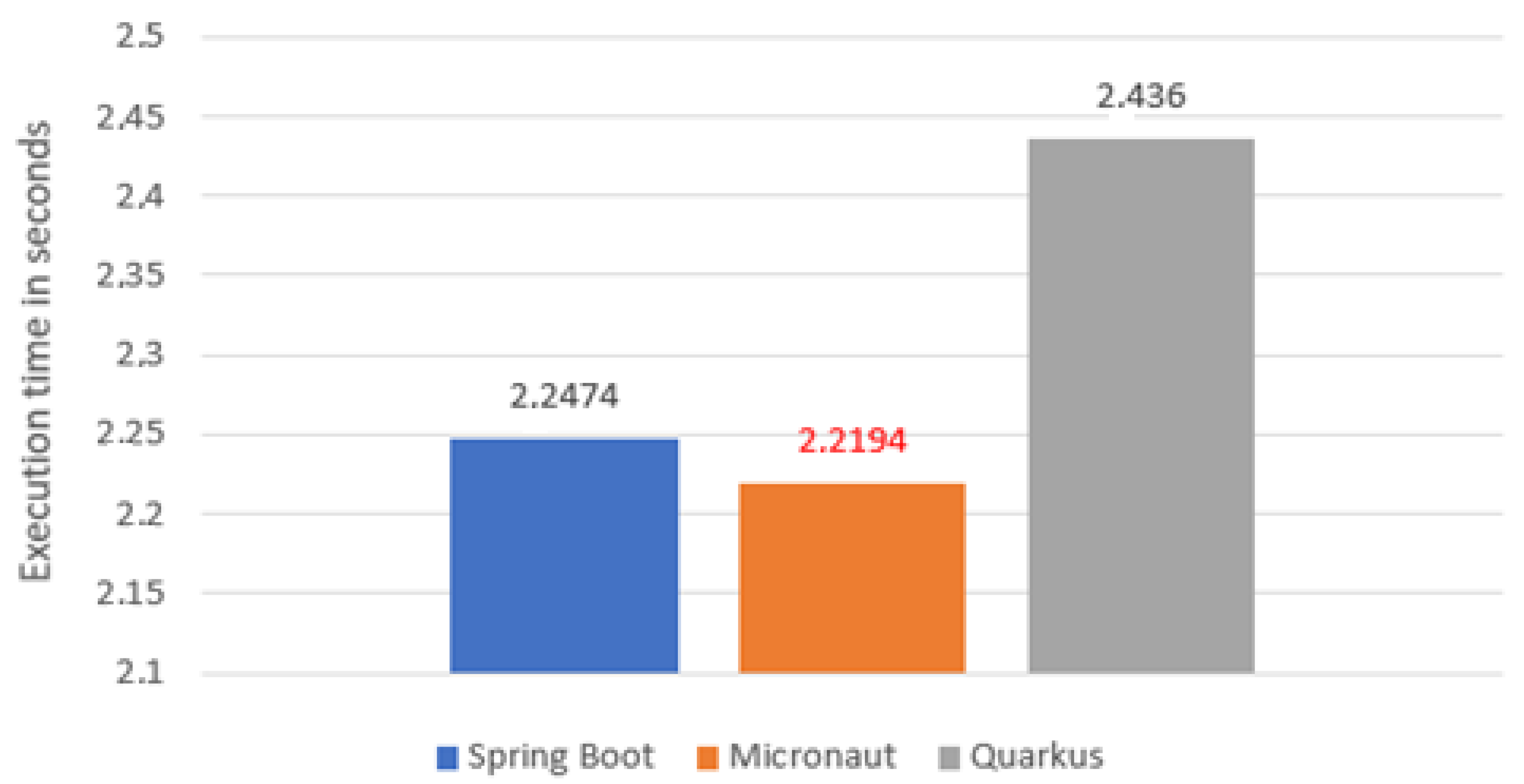
The first test focused on compile time (Figure 3). It was performed using mvn clean compile command. As you can see, the best time was achieved by Micronaut (2.2194 s), but its advantage over Spring Boot was minimal. Quarkus was slower than them by about 0.2 s.
Figure 3. Average application compile time.
The results of this test are not surprising, as one would have expected Spring Boot to be no worse than its competitors in this category. This is due to the fact that both Micronaut and Quarkus deal with bean issues at the compilation level, while Spring Boot only deals with them at runtime.

5.2. Test Time

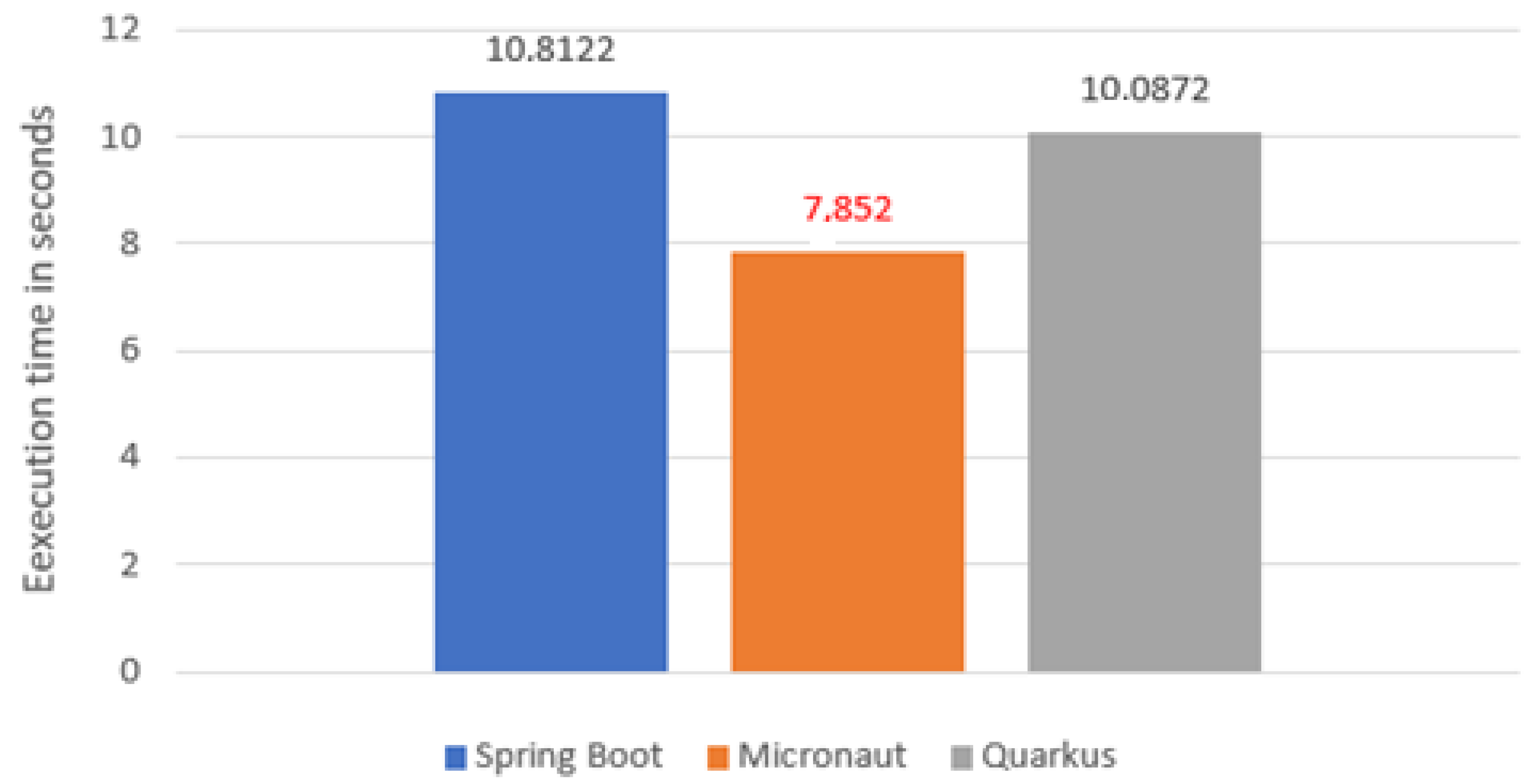
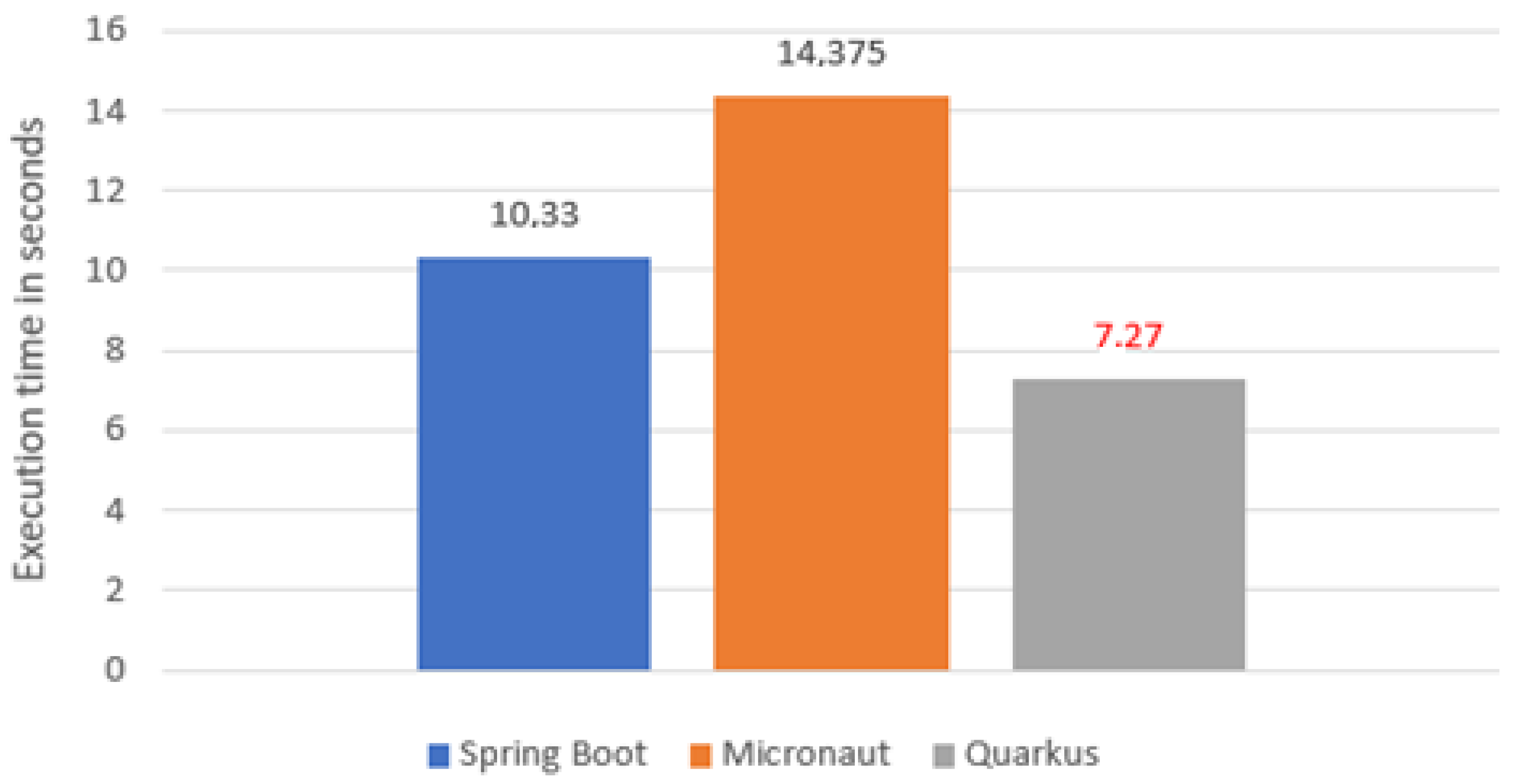
The second aspect compared was test execution time (Figure 4). In this case, the Micronaut proved to be by far the fastest (7.852 s). Its result was by more than 2 s better than Quarkus, which was slightly ahead of Spring Boot. This may be due to the less complicated configuration of the class loader.
Figure 4. Average application test time.

5.3. Startup of the Application

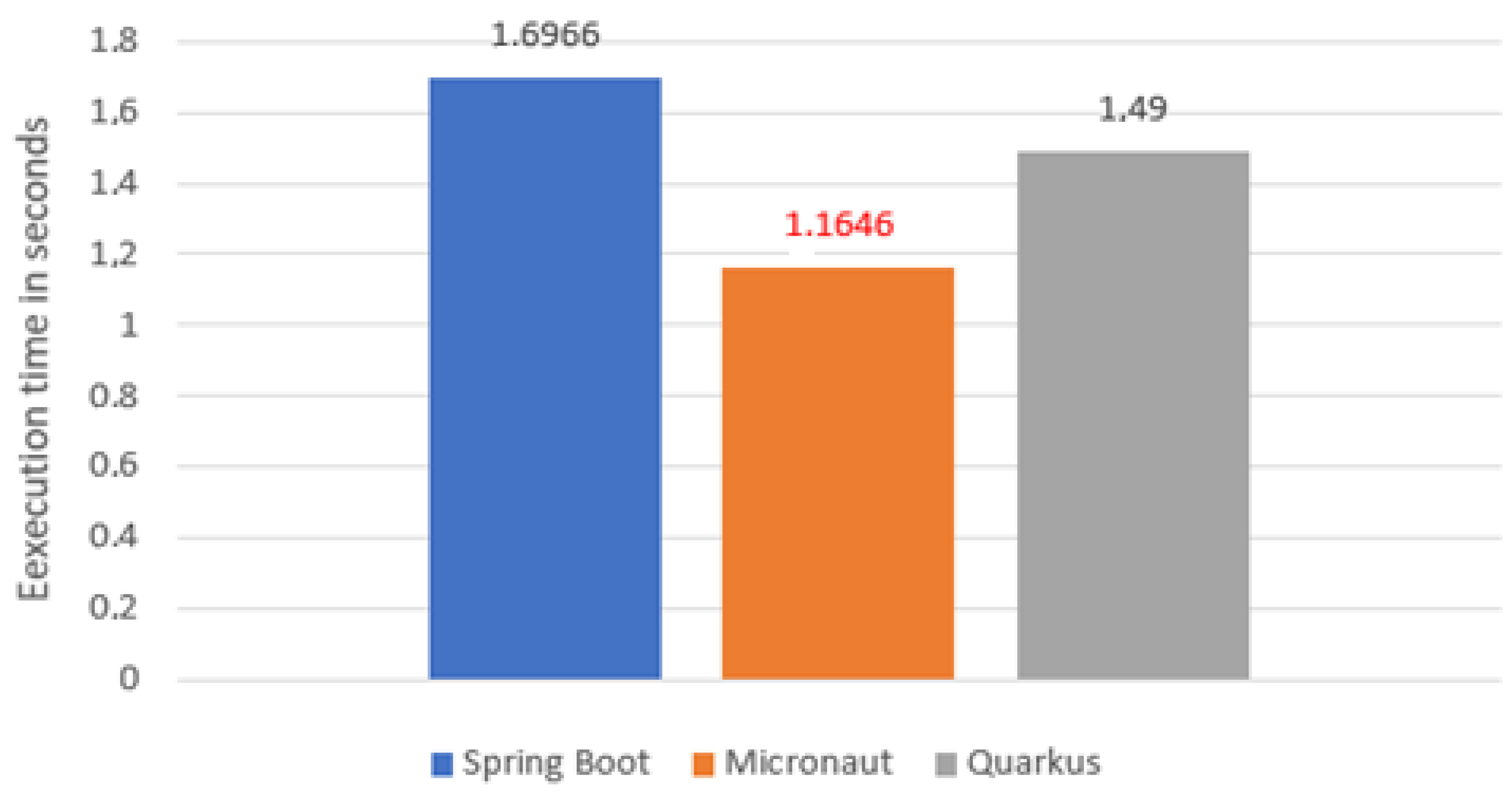
Next, the timing of one of the most important actions for a developer, which is launching the application, was examined (Figure 5).
Figure 5. Average startup of the application time.
As mentioned earlier, Spring Boot scans annotated classes at startup from which it later creates beans, while the other technologies tested inject dependencies at compile time. So one would have guessed that in this comparison Spring Boot would turn out to be the slowest and that is exactly what happened, with Micronaut again being the fastest. This test would probably end up with a different result if the applications were run on native images, where Quarkus could present its full potential. According to some sources, its results then drop to the millisecond level.

5.4. Database Operations

5.4.1. Save

Considering process of saving 1000 books (Figure 6), Quarkus proved to be the most efficient, with saving 50% better than Spring Boot and about twice as fast as Micronaut.
Figure 6. Average time of saving data to database.

5.4.2. Read

In the case of reading data, Quarkus was also the fastest, but in this case it had a decisive advantage over Spring Boot and was much slower than Micronaut (Table 1). When analyzing the results, it is worth noting that Quarkus uses PanacheRepository to manage data on the database, which is their own overlay on Hibernate. The developers’ goal was to create the simplest possible mechanism for communicating with the database. The results show that one of the biggest advantages of Quarkus is its speed, which makes it seem like an ideal candidate for native solutions.
Table 1. Average time of reading and writing data to/from database.

5.5. Stability

5.5.1. Tests for Identical Data

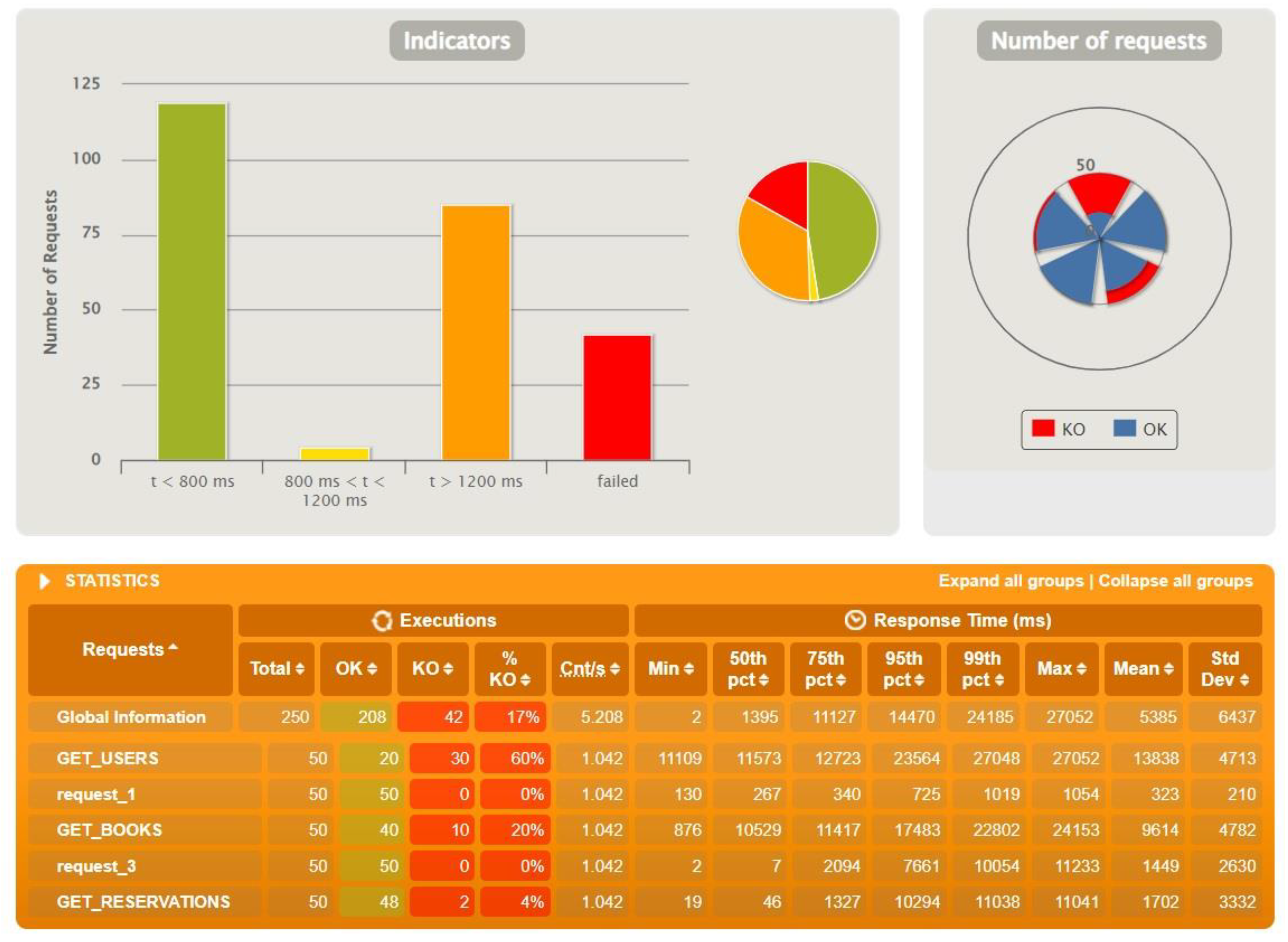
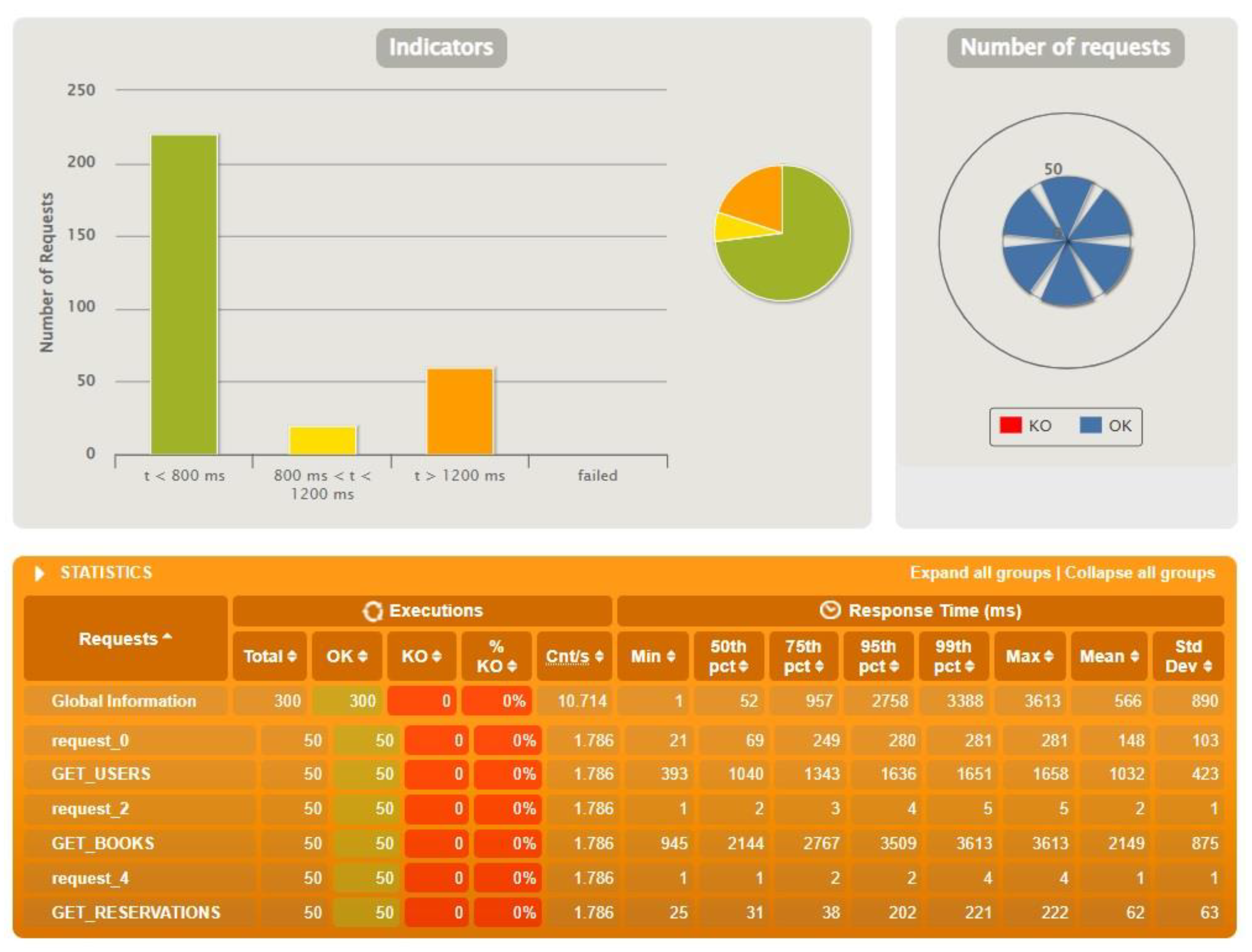
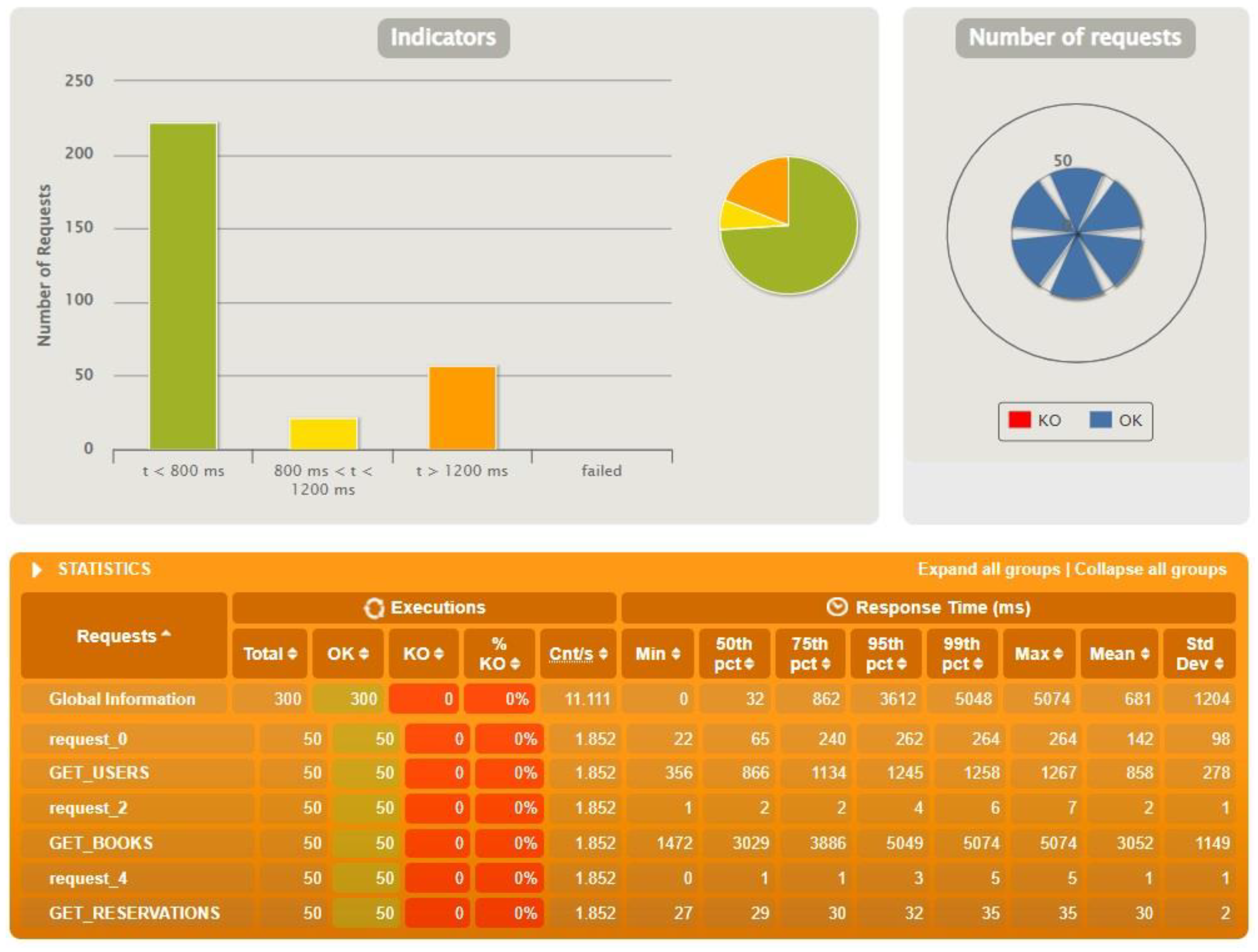
The following figure presents the results from the test run for Spring Boot (Figure 7). The presentation itself is detailed and easy to read for the user. As you can see, Spring Boot handled this test without any major problems. Analyzing the figure, you can see the division into three parts. In the upper left corner, there is a bar chart that represents how many queries were executed in under 800 ms, how many in the 800–1200 ms range, and how many in over 1200 ms. The fourth bar reports errors, but none appeared here. In the upper right corner is a slightly modified pie chart where you can see how many queries of a given type were correct. In the case of Spring Boot, they all executed and there were no KOs. Below the graphs are more detailed statistics, visualized by the previously mentioned charts. Below are also the results for Micronaut (Figure 8) and Quarkus (Figure 9).
Figure 7. Results for test data: 500 users, 1000 reservations, 2000 books, 50 actors—Spring Boot.
Figure 8. Results for test data: 500 users, 1000 reservations, 2000 books, 50 actors—Micronaut.
Figure 9. Results for test data: 500 users, 1000 reservations, 2000 books, 50 actors—Quarkus.
The figures above (Figure 7, Figure 8 and Figure 9) show the results of tests conducted using Gatling for the three technologies for an identical test scenario. The database had 500 users, 1000 reservations and 2000 books. The number of actors in the script was set to 50. The interesting requests sent from the application were those related to users, reservations and books. The abbreviations were taken from the view representing the data by Gatling. As can be seen, Spring Boot and Quarkus handled this task with 100% efficiency. Micronaut’s results, on the other hand, are already much worse in comparison. In this case, 42 queries failed. Analyzing the logs received in the Gateway microservice console, we were able to determine that the errors were caused by exceeding the default time limit.

5.5.2. Achieved Limits

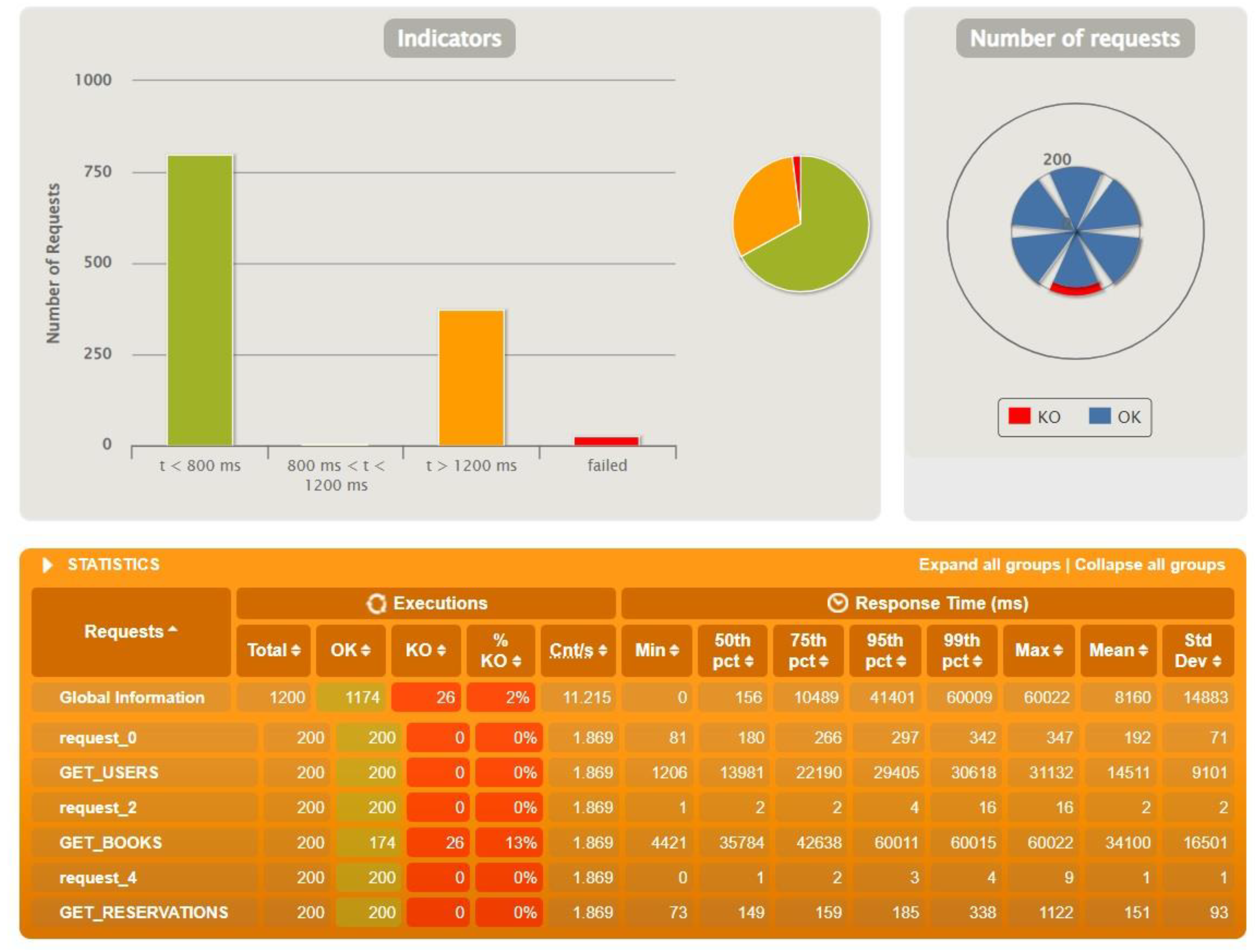
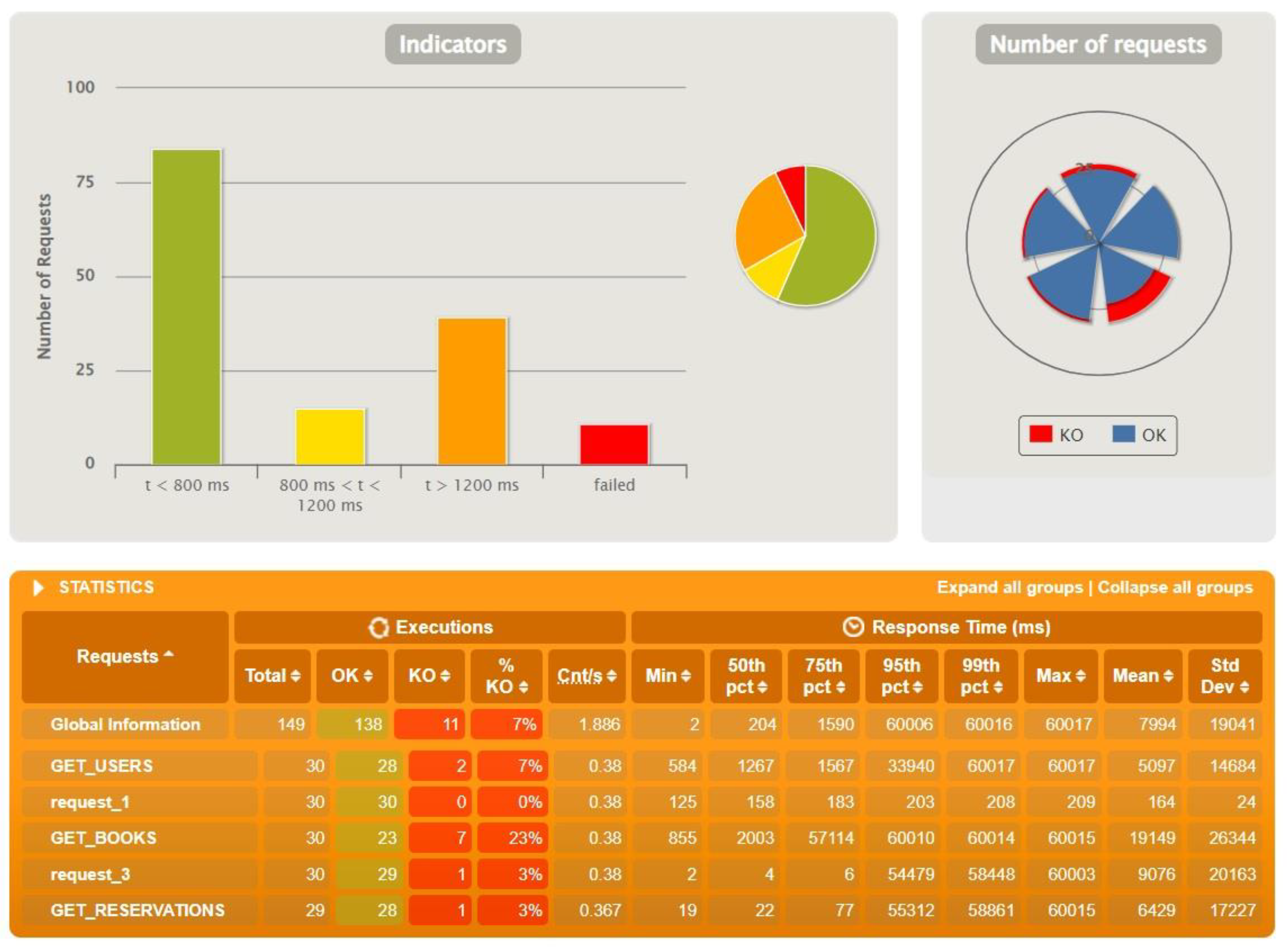
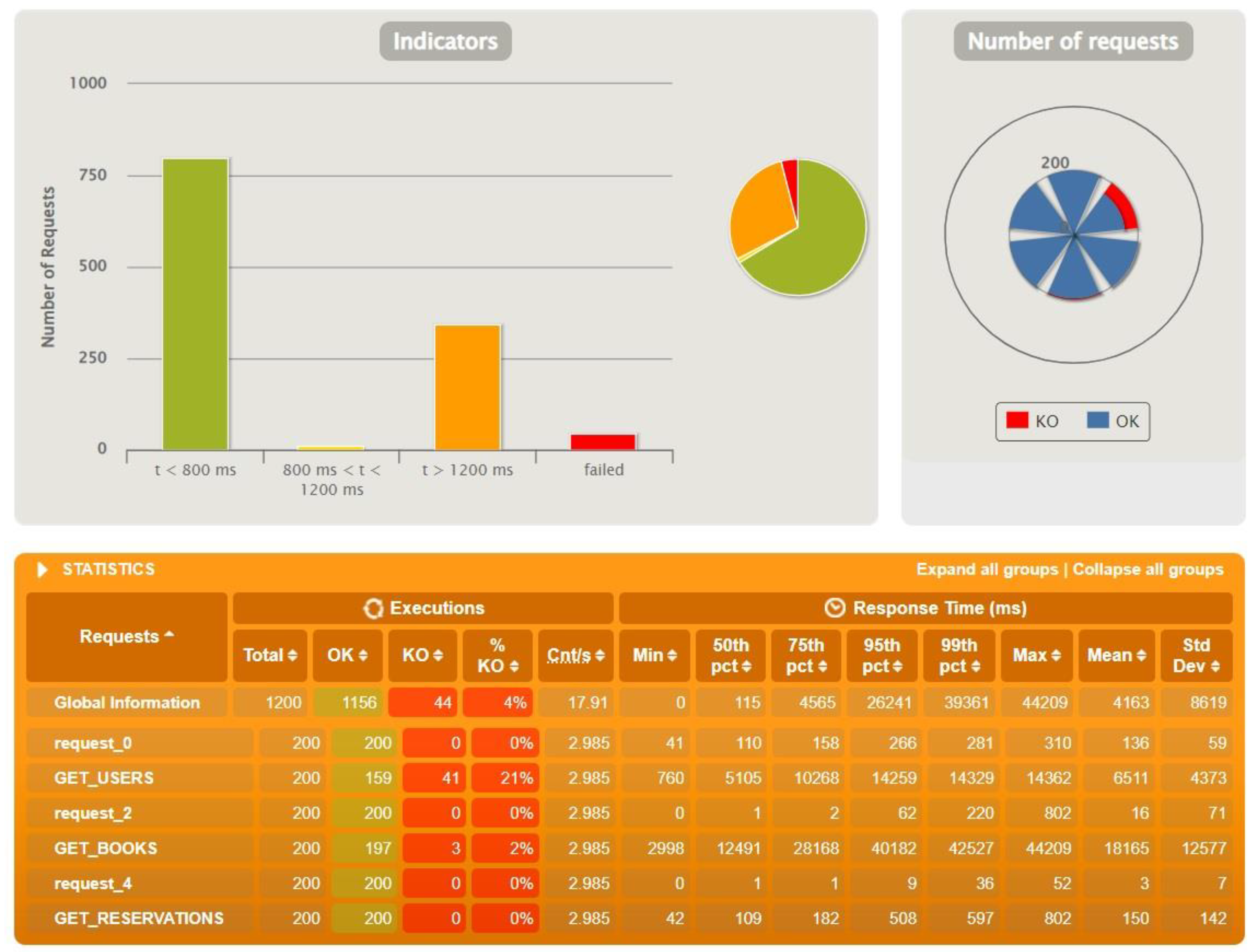
After the first tests with identical test data, further tests were performed to find the threshold of occurrence of the first errors. During the tests the resources stored on the database and the number of actors were increased accordingly. The achieved limits are presented in the following graphs—Figure 10 for Sping Boot, Figure 11 for Micronaut and Figure 12 for Quarkus.
Figure 10. Results for test data: 2000 users, 4000 reservations, 8000 books, 200 actors—Spring Boot.
Figure 11. Results for test data: 500 users, 1000 reservations, 2000 books, 30 actors—Micronaut.
Figure 12. Results for test data: 1000 users, 2000 reservations, 4000 books, 200 actors—Quarkus.
In the load test (Table 2), the clear winner was Spring Boot. The first problems started to appear when the number of actors was equal to 200 and the number of records stored on the database was as follows: 2000 users, 4000 reservations and 8000 books. The cause of the errors was the default timeout set to 60,000 ms.
Table 2. Load limits for tested technologies.
With Quarkus, the first failed queries appeared with 200 active actors and twice as little data stored in the database as with Spring. Application logs allowed us to discover the cause of the problems and it was a broken connection to the database.
Micronaut at the initial test already noted problems with exceeding the time threshold on the gateway, so here we had to look for limits by reducing the parameters. For the initial data stored on the base and with 50 actors, significant problems were noted, but when reducing the latter value to 30, the situation improved significantly, and it can be considered that the maximum values for Micronaut oscillate within these limits.
To sum up, Gatling turned out to be a great and simple tool for application overload testing. Created test scenarios allowed us to mimic real user traffic as it occurs in systems already running on the client’s production environment. The winner of the test was Spring Boot. It maintained stability and responded to queries for the longest time, and the problems encountered were caused by the timeout set at 60,000 ms. It was followed by Quarkus, which also started to report the first irregularities while handling 200 actors, but twice as little data. The most surprising results concern Micronaut, because it achieved much worse results than the rest. The reasons for such results can be found in the default configuration of each technology. The main reason for the errors was exceeding the time limit or breaking the connection with the database. Potentially after adjusting the configuration to the application architecture, the results could look different.

5.6. Request per Second

In this test (Figure 13), Micronaut proved to be the best, achieving a result about 20% better than Quarkus and almost twice as good as Spring Boot.
Figure 13. Average amount of requests per second.

5.7. CPU and Memory Usage

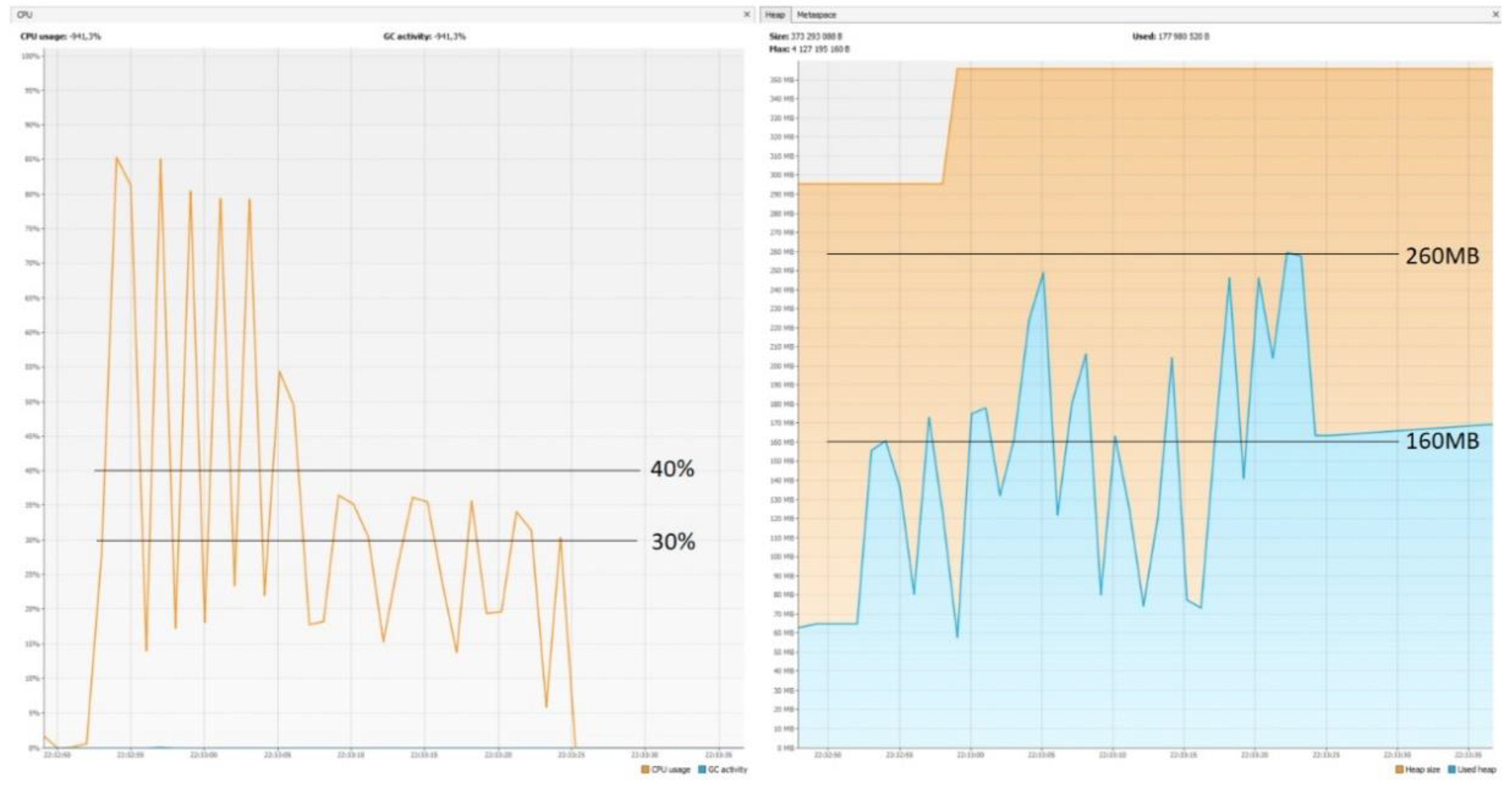
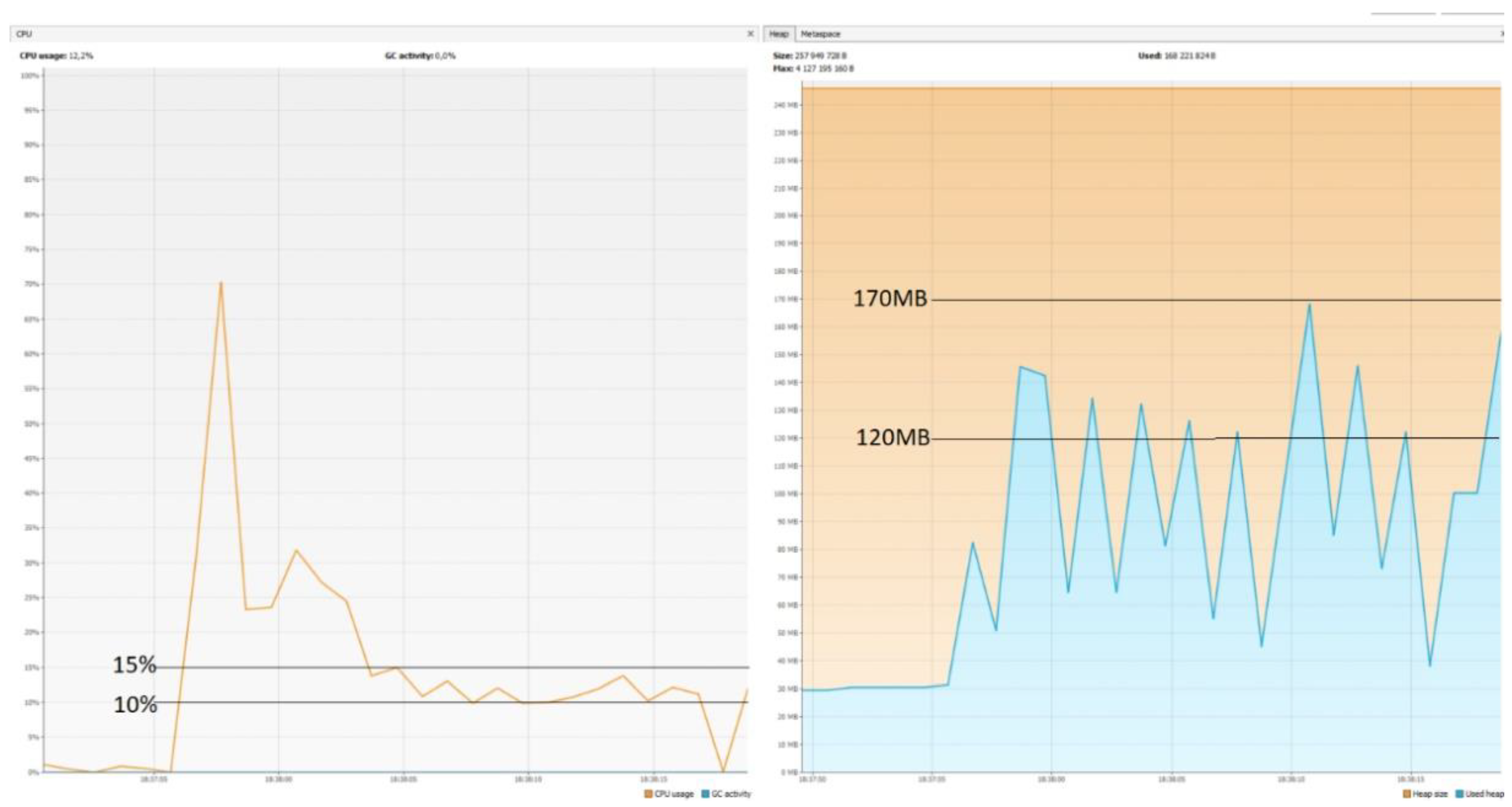
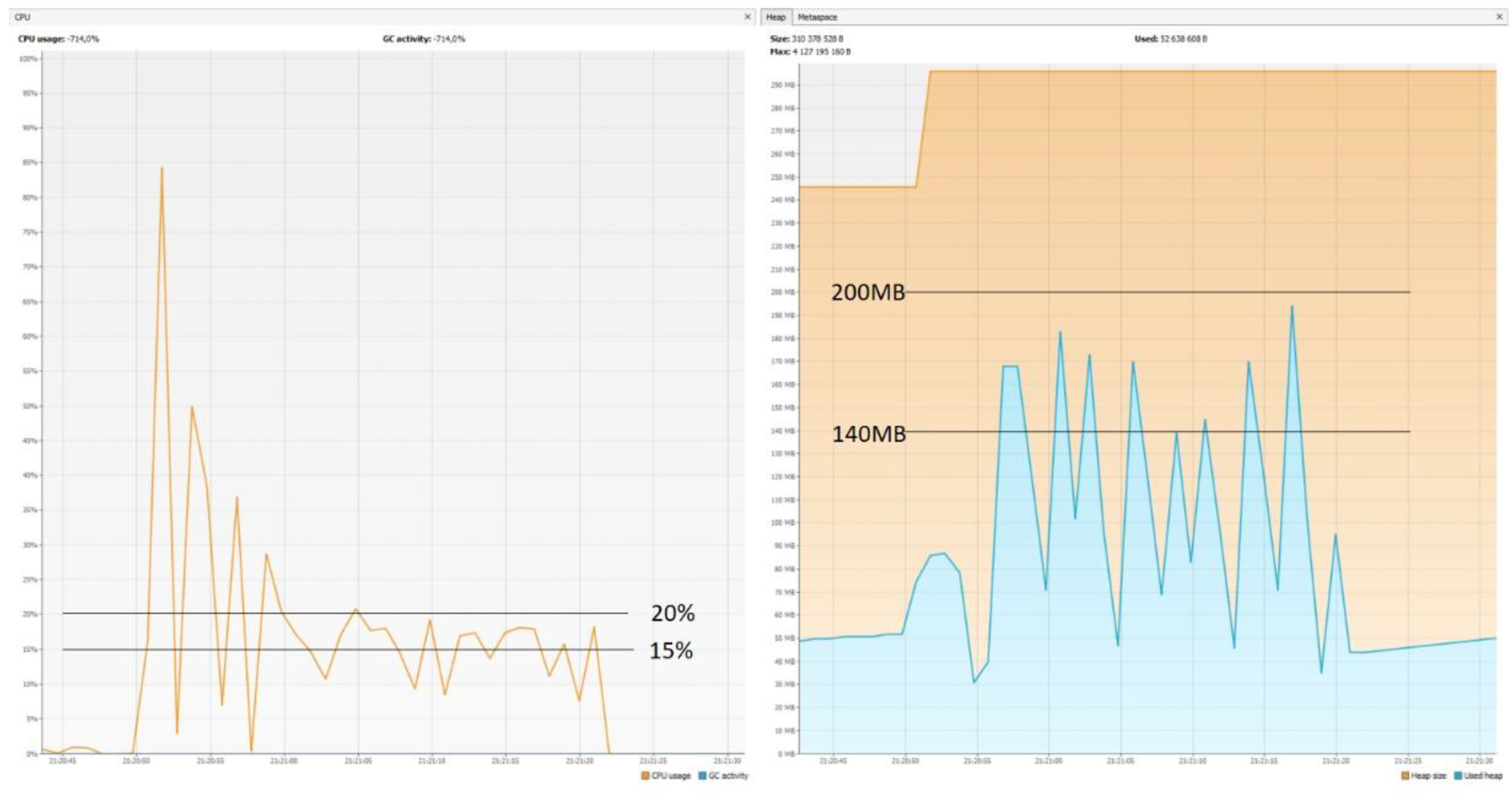
The graphs (Figure 14, Figure 15 and Figure 16) show that Micronaut consumed the least resources. Quarkus was slightly worse, but its results in comparison with those achieved by Spring Boot were still much better. These results confirm the trend that newer technologies are geared towards running in serverless environments. They are designed to keep startup time as short as possible and memory consumption as low as possible, since charges are incurred for the direct execution time of given functions. One of the reasons Spring consumes so much memory is the already mentioned reflection mechanism, which is not ideal when it comes to optimization.
Figure 14. CPU usage: 30–40%; memory usage: 160–260 MB—Spring Boot.
Figure 15. CPU usage: 10–15%; memory usage: 120–170 MB—Micronaut.
Figure 16. CPU usage: 15–20%; memory usage: 140–200 MB—Quarkus.

6. Discussion

At the beginning it is worth noting that in each of these technologies it was possible to implement the assumed functionalities in the test application and the way of implementation looked similar everywhere. The biggest differences could be seen in the used annotations and in the configuration issues. From the perspective of the authors, who had the most experience with Spring Boot, getting started with the other technologies was not too difficult because the developers provide project generators and support the developer with rich documentation.
What turned out to be problematic was finding solutions when errors occurred in the application. Spring Boot is a few years older than the other two items, and because of that it was much easier to find help on the Internet. It is more popular and has decidedly more community support at this point, but in a few years, this should change in favor of Micronaut and Quarkus, as they have a lot to offer.
The tests conducted have shown that Spring Boot’s younger rivals perform better in several key elements, such as application startup time and resource consumption. This is due to the fact that dependencies are injected at the compilation level, which helps to speed up the process. However, when tested for application robustness to overloads, Spring Boot proved to be the more stable solution.
From the analysis of all these results, a very important point emerges. It is true that some results could be expected, but it is one thing to suppose and another to prove, and this is the role of the research process. Most of the results, however, were not at all obvious and both our own tests and the tools used have shown the real features of each technology.

7. Conclusions

When choosing the right technology for a project with microservices and lots of sensor data, you need to consider what it will entail. If you intend to run in the cloud, it is better to use Micronaut or Quarkus, as they are designed to run in the cloud, where costs are incurred based on time of use and resources consumed. For server-side solutions, the proven Spring Boot may be a more efficient choice.
Our research showed very important information related to the performance of each of the tested technologies, when used precisely for applications related to sensor networks. Of course, the conclusions drawn from the research are applicable to each application written in the technologies mentioned, but most importantly, the specificity of tests selected in terms of the challenges of our projects has proved that the choice of technology is not arbitrary. When developing applications on the edge of performance or with limited resources, the conclusions of our research can and are crucial.
Our work allowed for better selection of technologies in terms of various requirements in our projects. Each project has different requirements, ranging from efficiency, speed and energy consumption. The presented study enables such a selection of technologies to optimize certain aspects of our projects based on microservices. These are projects ranging from small networks based on sensors used in telemedicine to large networks of sensors used in industry. The authors plan further research in this area in order to check other microservice platforms and their suitability for our research. The conducted research is in line with the research carried out by our team to research the efficiency of various pro-programming technologies and programming languages and to use them to optimize the systems we design. The results of these studies will certainly be useful and are now useful for other teams, for which the authors already had information.
The results of our research are applicable in our work on the projects mentioned in the introduction to this article, and also for future implementations. We believe that the results and conclusions obtained as a result of this study will be useful also for others, due to the universality of this comparison, which certainly fills a certain gap in information on this type of problem.

Author Contributions

Conceptualization, W.Z.; Data curation, P.P. and M.M.; Formal analysis, T.K.; Funding acquisition, W.Z.; Investigation, P.P.; Methodology, N.B. and W.Z.; Project administration, W.Z.; Software, P.P.; Supervision, W.Z.; Validation, W.Z.; Writing—original draft, W.Z.; Writing—review & editing, N.B., T.K., M.M. and W.Z. All authors have read and agreed to the published version of the manuscript.

Funding

This research received no external funding.

Institutional Review Board Statement

Not applicable.

Data Availability Statement

Not applicable.

Conflicts of Interest

The authors declare no conflict of interest.

References

  1. Which Java Microservice Framework Should You Choose in 2020? Exploring Micronaut and Quarkus vs. Spring Boot—How Good Are They? Available online: https://betterprogramming.pub/which-java-microservice-framework-should-you-choose-in-2020-4e306a478e58 (accessed on 3 September 2021).
  2. Review of Microservices Frameworks: A Look at Spring Boot Alternatives. Available online: https://dzone.com/articles/not-only-spring-boot-a-review-of-alternatives (accessed on 3 September 2021).
  3. Błaszczyk, M.; Pucek, M.; Kopniak, P. Comparison of lightweight frameworks for Java by analyzing proprietary web applications. J. Comput. Sci. Inst. 2021, 19, 159–164. [Google Scholar] [CrossRef]
  4. Dhalla, H.K. A Performance Comparison of RESTful Applications Implemented in Spring Boot Java and MS.NET Core. J. Phys. Conf. Ser. 2021, 1933, 2–7. [Google Scholar] [CrossRef]
  5. Massaga, A.; Kouamou, G.E. Towards a Framework for Evaluating Technologies for Implementing Microservices Architectures. J. Softw. Eng. Appl. 2021, 14, 442–453. [Google Scholar] [CrossRef]
  6. Al-Debagy, O.; Martinek, P. A Comparative Review of Microservices and Monolithic Architectures. In Proceedings of the 18th IEEE International Symposium on Computational Intelligence and Informatics, CINTI 2018, Budapest, Hungary, 21–22 November 2018. [Google Scholar]
  7. Grambow, M.; Wittern, E. Benchmarking the Performance of Microservice Applications. ACM SIGAPP Appl. Comput. Rev. 2020, 20, 20–34. [Google Scholar] [CrossRef]
  8. Kubiak, D.; Zabierowski, W. A Comparative Analysis of the Performance of Implementing a Java Application Based on the Microservices Architecture, for Various AWS EC2 Instances. In Proceedings of the 2021 IEEE XVIIth International Conference on the Perspective Technologies and Methods in MEMS Design (MEMSTECH), Polyana, Ukraine, 12 May 2021. [Google Scholar]
  9. Calderón-Gómez, H.; Mendoza-Pittí, L.; Vargas-Lombardo, M.; Gómez-Pulido, J.M.; Sención, D.R.G.; Polo-Luque, M. Evaluating Service-Oriented and Microservice Architecture Patterns to Deploy eHealth Applications in Cloud Computing Environment. Appl. Sci. 2021, 11, 4350. [Google Scholar] [CrossRef]
  10. Pratama, Y.P.; Basuki, D.K.; Sukaridhoto, S.; Yusuf, A.A.; Yulianus, H.; Faruq, F.; Putra, F.B. Designing of a Smart Collar for Dairy Cow Behavior Monitoring with Application Monitoring in Microservices and Internet of Things-Based Systems 2019 International Electronics Symposium (IES). In Proceedings of the 2019 International Electronics Symposium (IES), Surabaya, Indonesia, 27–28 September 2019. [Google Scholar]
  11. Li, P.; Jiang, P.; Liu, J. Mini-MES: A Microservices-Based Apps System for Data Interconnecting and Production Controlling in Decentralized Manufacturing. Appl. Sci. 2019, 9, 3675. [Google Scholar] [CrossRef]
  12. Tapia, F.; Mora, M.Á.; Fuertes, W.; Aules, H.; Flores, E.; Toulkeridis, T. From Monolithic Systems to Microservices: A Comparative Study of Performance. Appl. Sci. 2020, 10, 5797. [Google Scholar] [CrossRef]
  13. Herrera-Quintero, L.F.; Vega-Alfonso, J.C.; Banse, K.B.A.; Zambrano, E.C. Smart ITS Sensor for the Transport ation Planning Based on IoT Approaches Using Serverless and Microservices Architecture. IEEE Intell. Transp. Syst. Mag. 2018, 10, 17–27. [Google Scholar] [CrossRef]
  14. Khazaei, H.; Barna, C.; Beigi-Mohammadi, N.; Litoiu, M. Efficiency Analysis of Provisioning Microservices. In Proceedings of the 2016 IEEE 8th International Conference on Cloud Computing Technology and Science, Luxembourg, 12–15 December 2016. [Google Scholar]
  15. Mostof, V.M.; Krishnamurthy, D.; Arlitt, M. Fast and Efficient Performance Tuning of Microservices. In Proceedings of the 2021 IEEE 14th International Conference on Cloud Computing (CLOUD), Chicago, IL, USA, 5–10 September 2021. [Google Scholar]
  16. Panduman, Y.Y.F.; Albaab, M.R.U.; Besari, A.R.A.; Sukaridhoto, h.S.; Tjahjono, A. Implementation of Microservice Architectures on SEMAR Extension For Air Quality Monitoring. In Proceedings of the 2018 International Electronics Symposium on Knowledge Creation and Intelligent Computing (IES-KCIC), Bali, Indonesia, 29–30 October 2018. [Google Scholar]
  17. Samardzic, M.; Sajina, R.; Tankovic, N. Microservice Performance Degradation Correlation. In Proceedings of the MIPRO 2020, Opatija, Croatia, 28 September–2 October 2020. [Google Scholar]
  18. Kumar, P.K.; Agarwal, R.; Shivaprasad, R.; Sitaram, D.; Kalambur, S. Performance Characterization of Communication Protocols in Microservice Applications. In Proceedings of the 2021 International Conference on Smart Applications, Communications and Networking (SmartNets), Glasgow, UK, 22–24 September 2021; IEEE: Glasgow, UK, 2021. [Google Scholar]
  19. Khazaei, H.; Mahmoudi, N.; Barna, C.; Litoiu, M. Performance Modeling of Microservice Platforms. IEEE Trans. Cloud Comput. 2020, 1. [Google Scholar] [CrossRef]
  20. Miyagoshi, K.; Teranishi, Y.; Kawakami, T.; Yoshihisa, T.; Shimojo, S. Proposal of a Logical Sensor Architecture using WoT-based Edge Microservices. In Proceedings of the 2020 IEEE 44th Annual Computers, Software, and Applications Conference (COMPSAC), Madrid, Spain, 13–17 July 2020. [Google Scholar]
  21. Yilmaz, R.; Buzluca, F. A Fuzzy Quality Model to Measure the Maintainability of Microservice Architectures. In Proceedings of the 2021 2nd International Informatics and Software Engineering Conference (IISEC), Ankara, Turkey, 16–17 December 2021. [Google Scholar]
  22. Liu, X.; Jiang, S.; Zhao, X.; Jin, Y. A Shortest-Response-Time Assured Microservices Selection Framework. In Proceedings of the 2017 IEEE International Symposium on Parallel and Distributed Processing with Applications and 2017 IEEE International Conference on Ubiquitous Computing and Communications (ISPA/IUCC), Guangzhou, China, 12–15 December 2017. [Google Scholar]
  23. Haselbock, S.; Weinreich, R.; Buchgeher, G. An Expert Interview Study on Areas of Microservice Design. In Proceedings of the 2018 IEEE 11th International Conference on Service-Oriented Computing and Applications, Paris, France, 20–22 November 2018. [Google Scholar]
  24. Bilgin, B.; Ünlü, H.; Demirörs, O. Analysis and Design of Microservices: Results from Turkey. In Proceedings of the 2020 Turkish National Software Engineering Symposium (UYMS), Istanbul, Turkey, 9 November 2020. [Google Scholar]
  25. Munaf, R.M.; Ahmed, J.; Khakwani, F.; Rana, T. Microservices Architecture: Challenges and Proposed Conceptual Design. In Proceedings of the 2019 International Conference on Communication Technologies (ComTech 2019), Rawalpindi, Pakistan, 20–21 March 2019. [Google Scholar]
  26. Sill, A. The Design and Architecture of Microservices. IEEE Cloud Comput. 2016, 3, 76–80. [Google Scholar] [CrossRef]
  27. Al-Doghman, F.; Moustafa, N.; Khalil, I.; Tari, Z.; Zomay, A.Y. AI-enabled Secure Microservices in Edge Computing: Opportunities and Challenges. IEEE Trans. Serv. Comput. 2022. [Google Scholar] [CrossRef]
  28. Kazlauskas, M.; Navakauskas, D. Case Study of a Multisensor Patient Network and Microservices Managed by Fog Computing. In Proceedings of the 2021 IEEE 9th Workshop on Advances in Information, Electronic and Electrical Engineering (AIEEE), Riga, Latvi, 14 January 2022. [Google Scholar]
  29. Bolesta, I.; Kushnir, O.; Bavdys, M.; Khvyshchun, I.; Demchuk, A. Computational-Measurement System “Nanoplasmonics”. Part 2: Structure of Microservices. In Proceedings of the 2019 XIth International Scientific and Practical Conference on Electronics and Information Technologies (ELIT), Lviv, Ukraine, 16–18 September 2019. [Google Scholar]
  30. Chen, C.; Cai, J.; Ren, N.; Cheng, X. Design and Implementation of Multi-tenant Vehicle Monitoring Architecture Based on Microservices and Spark Streaming. In Proceedings of the 2020 International Conference on Communications, Information System and Computer Engineering (CISCE), Kuala Lumpur, Malaysia, 3–5 July 2020. [Google Scholar]
  31. Al-Debagy, O.; Martinek, P. Extracting Microservices’ Candidates from Monolithic Applications: Interface Analysis and Evaluation Metrics Approach. In Proceedings of the IEEE 15th International Conference of System of Systems Engineering, SoSE 2020, Budapest, Hungary, 2–4 June 2020. [Google Scholar]
  32. Mazlami, G.; Cito, J.; Leitner, P. Extraction of Microservices from Monolithic Software Architectures. In Proceedings of the 2017 IEEE 24th International Conference on Web Services, Honolulu, HI, USA, 25–30 June 2017. [Google Scholar]
  33. Kyryk, M.; Tymchenko, O.; Pleskanka, N.; Pleskanka, M. Methods and process of service migration from monolithic architecture to microservices. In Proceedings of the 2022 IEEE 16th International Conference on Advanced Trends in Radioelectronics, Telecommunications and Computer Engineering (TCSET), Lviv-Slavske, Ukraine, 22–26 February 2022. [Google Scholar]
  34. De Lauretis, L. From Monolithic Architecture to Microservices Architecture. In Proceedings of the 2019 IEEE International Symposium on Software Reliability Engineering Workshops (ISSREW), Berlin, Germany, 27–30 October 2019. [Google Scholar]
  35. Chen, R.; Li, S.; Li, Z. From Monolith to Microservices: A Dataflow-Driven Approach. In Proceedings of the 2017 24th Asia-Pacific Software Engineering Conference, Nanjing, China, 4–8 December 2017. [Google Scholar]
  36. Ponce, F.; Márquez, G.; Astudillo, H. Migrating from monolithic architecture to microservices: A Rapid Review. In Proceedings of the 2019 38th International Conference of the Chilean Computer Science Society (SCCC), Concepcion, Chile, 4–9 November 2019. [Google Scholar]
  37. Filippone, G.; Autili, M.; Rossi, F.; Tivoli, M. Migration of Monoliths through the Synthesis of Microservices using Combinatorial Optimization. In Proceedings of the 2021 IEEE International Symposium on Software Reliability Engineering Workshops (ISSREW), Wuhan, China, 25–28 October 2021. [Google Scholar]
  38. Wan, F.; Wu, X.; Zhang, Q. Chain-Oriented Load Balancing in Microservice System. In Proceedings of the 2020 World Conference on Computing and Communication Technologies, Warsaw, Poland, 13–15 May 2020. [Google Scholar]
  39. Nisansala, S.; Chandrasiri, G.L.; Prasadika, S.; Jayasinghe, U. Microservice Based Edge Computing Architecture for Internet of Things. In Proceedings of the 2022 2nd International Conference on Advanced Research in Computing (ICARC), Belihuloya, Sri Lanka, 23–24 February 2022. [Google Scholar]
  40. Cabrera, E.; Cardenas, P.; Cedillo, P.; Pesantez-Cabrera, P. Towards a Methodology for creating Internet of Things (IoT) Application based on Microservices. In Proceedings of the 2020 IEEE International Conference on Services Computing (SCC), Beijing, China, 7–11 November 2020. [Google Scholar]
  41. Blinowski, G.; Ojdowska, A.; Przybyłek, A. Monolithic vs. Microservice Architecture: A Performance and Scalability Evaluation. IEEE Access 2022, 10, 20357–20374. [Google Scholar] [CrossRef]
  42. Dinh-Tuan, H.; Katsarou, K.; Herbke, P. Optimizing microservices with hyperparameter optimization. In Proceedings of the 2021 17th International Conference on Mobility, Sensing and Networking (MSN), Exeter, UK, 13–15 December 2021. [Google Scholar]
  43. Li, S. Understanding Quality Attributes in Microservice Architecture. In Proceedings of the 2017 24th Asia-Pacific Software Engineering Conference Workshops, Nanjing, China, 4–8 December 2017. [Google Scholar]
  44. Gos, K.; Zabierowski, W. The Comparison of Microservice and Monolithic Architecture. In Proceedings of the 2020 IEEE XVIth International Conference on the Perspective Technologies and Methods in MEMS Design (MEMSTECH), Lviv, Ukraine, 22–26 April 2020. [Google Scholar]
  45. Liu, C.-C.; Huang, C.-T.; Tseng, C.-W.; Yang, Y.-T.; Chou, L.-D. Service Resource Management in Edge Computing Based on Microservices. In Proceedings of the 2019 IEEE International Conference on Smart Internet of Things (SmartIoT), Tianjin, China, 9–11 August 2019. [Google Scholar]
  46. Zhou, X.; Peng, X.; Xie, T.; Sun, J.; Xu, C.; Ji, C.; Zhao, W. Benchmarking Microservice Systems for Software Engineering Research. In Proceedings of the 2018 ACM/IEEE 40th International Conference on Software Engineering: Companion Proceedings, Gothenburg, Sweden, 30 August 2018. [Google Scholar]
  47. Akbulut, A.; Perros, H.G. Performance Analysis of Microservice Design Patterns. IEEE Internet Comput. 2019, 23, 19–27. [Google Scholar] [CrossRef]
  48. Ueda, T.; Nakaike, T.; Ohara, M. Workload Characterization for Microservices. In Proceedings of the 2016 IEEE International Symposium on Workload Characterization (IISWC), Providence, RI, USA, 25–27 September 2016. [Google Scholar]
  49. Papapanagiotou, I.; Chella, V. NDBench: Benchmarking Microservices at Scale. ResearchGate 2018, 1. [Google Scholar]
  50. Villamizar, M.; Garcés, O.; Ochoa, L.; Castro, H.; Salamanca, L.; Verano, M.; Casallas, R.; Gil, S.; Valencia, C.; Zambrano, A.; et al. Cost comparison of running web applications in the cloud using monolithic, microservice, and AWS Lambda architectures. ResearchGate 2017, 11, 233–247. [Google Scholar] [CrossRef]
  51. Posta, C. Microservices for Java Developers. In Microservices for Java Developers; O’Reilly Media, Inc.: Sebastopol, CA, USA, 2016; pp. 6–7. [Google Scholar]
  52. What is Java Spring Boot? Available online: https://www.ibm.com/cloud/learn/java-spring-boot (accessed on 3 September 2021).
  53. Micronaut Tutorial: How to Build Microservices with This JVM-Based Framework. Available online: https://www.infoq.com/articles/micronaut-tutorial-microservices-jvm (accessed on 3 September 2021).
  54. Implementing Microservicilities with Quarkus and MicroProfile. Available online: https://www.infoq.com/articles/microservicilities-quarkus (accessed on 3 September 2021).
  55. Available online: https://jaxenter.com/java-trends-top-10-frameworks-2020-168867.html (accessed on 3 September 2021).
Publisher’s Note: MDPI stays neutral with regard to jurisdictional claims in published maps and institutional affiliations.

Article Metrics

Citations

Article Access Statistics

Multiple requests from the same IP address are counted as one view.